Oslo sits at the head of a fjord, and for most of the last twenty years the city has been turning itself round to face the water. The old docks and rail yards of Bjørvika have become the Fjord City: the marble roof of the Opera House rising out of the harbour since 2008, the striped glass of Deichman library since 2020, the leaning tower of the Munch Museum since 2021, and the row of narrow high-rises called Barcode behind them. These twenty frames, taken over four years from midwinter to high summer, keep returning to that waterfront, mostly after dark, when the buildings light up and double themselves in the still water. They also go into the older centre, to the twin brick towers of City Hall, the Storting and the Freia sign over Egertorget, and finally up to the hills above the city for the view back over the whole lit bowl of the capital and its harbour.

The Roof That Walks into the Sea
Snøhetta’s marble slope at sunset and after dark, and the oak wave wall glowing through the glass.
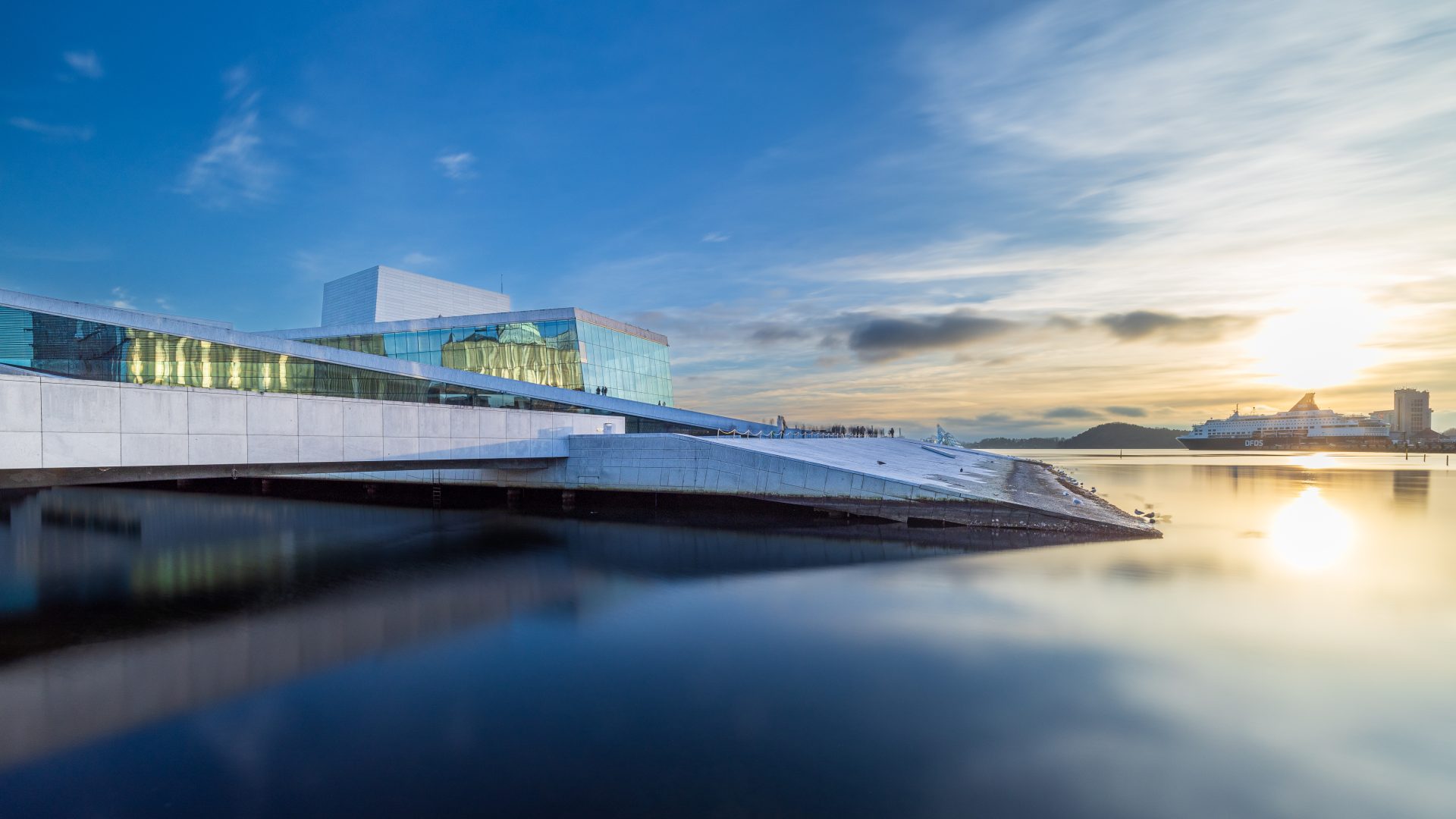
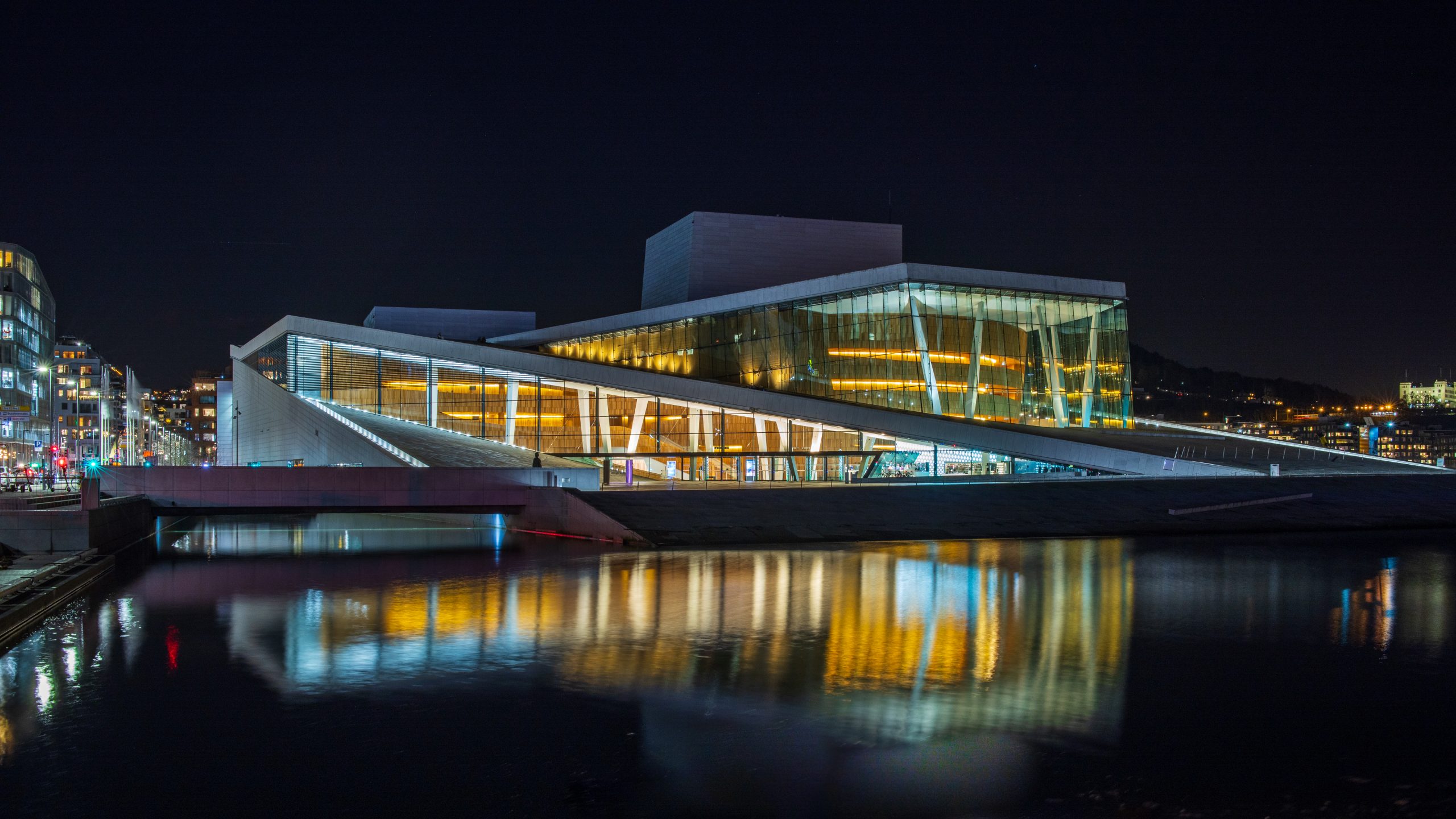
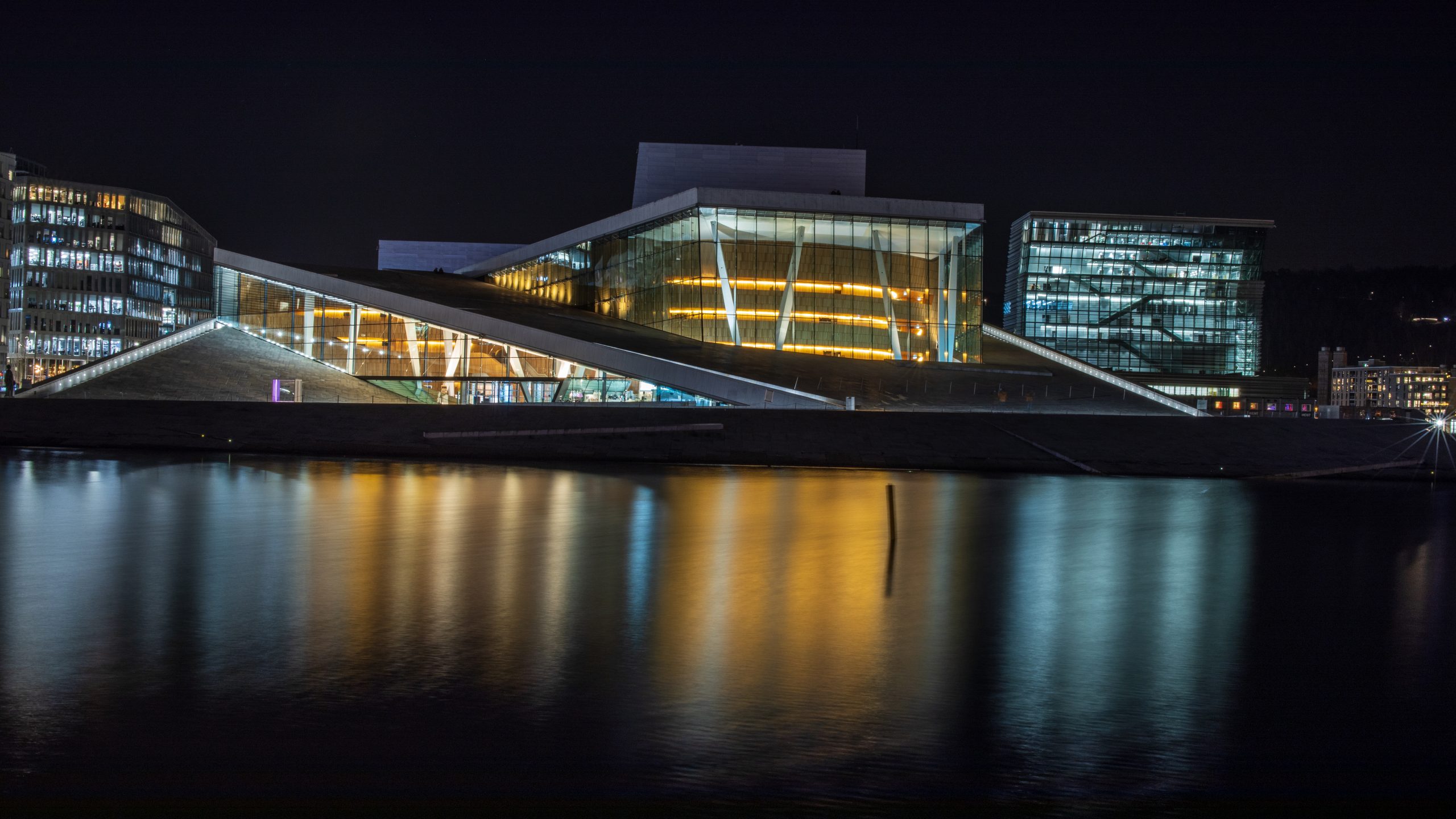
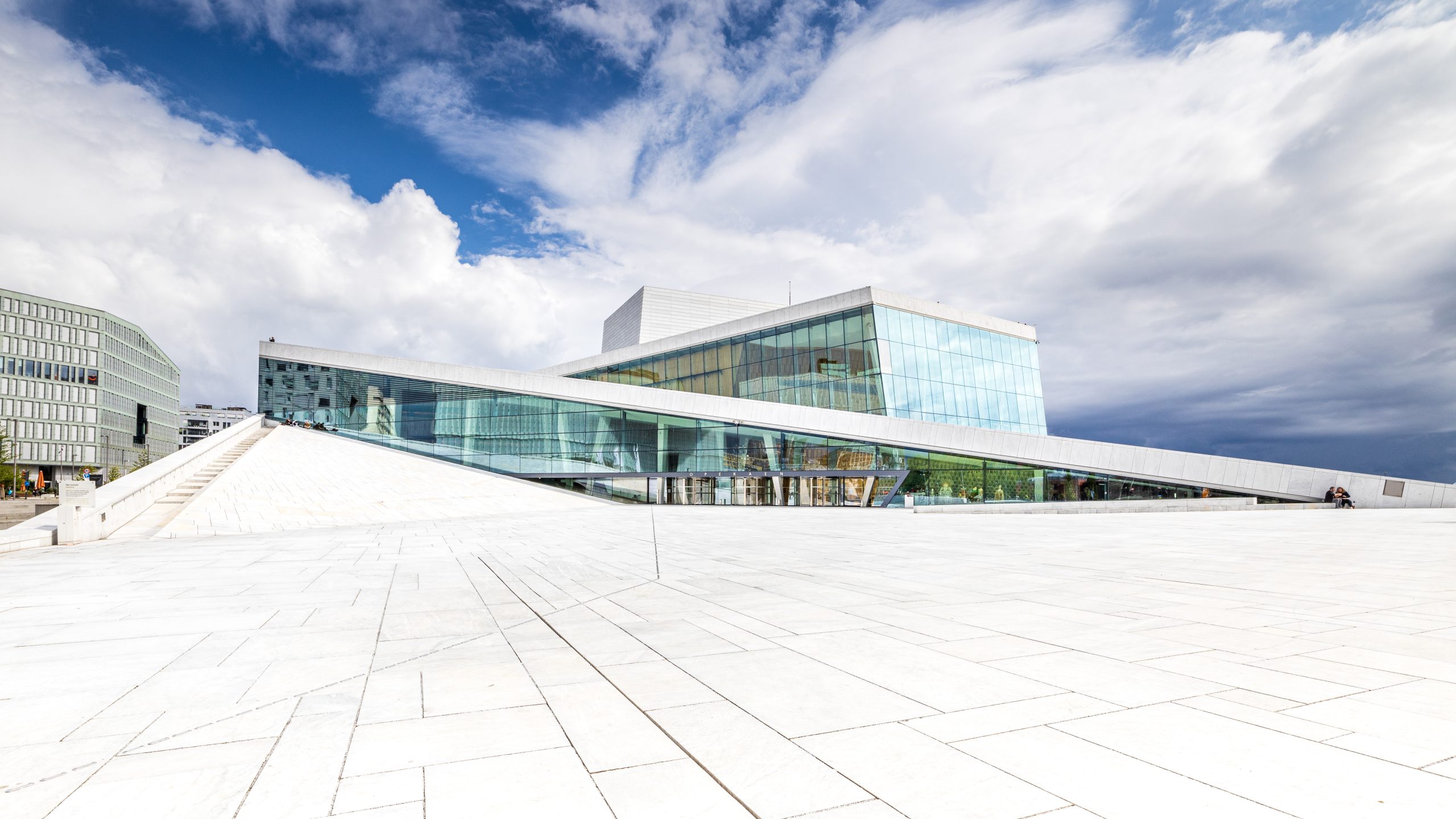
The Opera House was the first of the Fjord City buildings and is still the one that defines Bjørvika. Snøhetta won the competition with a building whose roof is a public space: a slope of white Carrara marble and granite that rises from the water to the top of the fly tower, so that people walk over the opera rather than past it. It opened on 12 April 2008 and holds 1,100 rooms over 49,000 m², the three stages buried beneath the walkable surface.
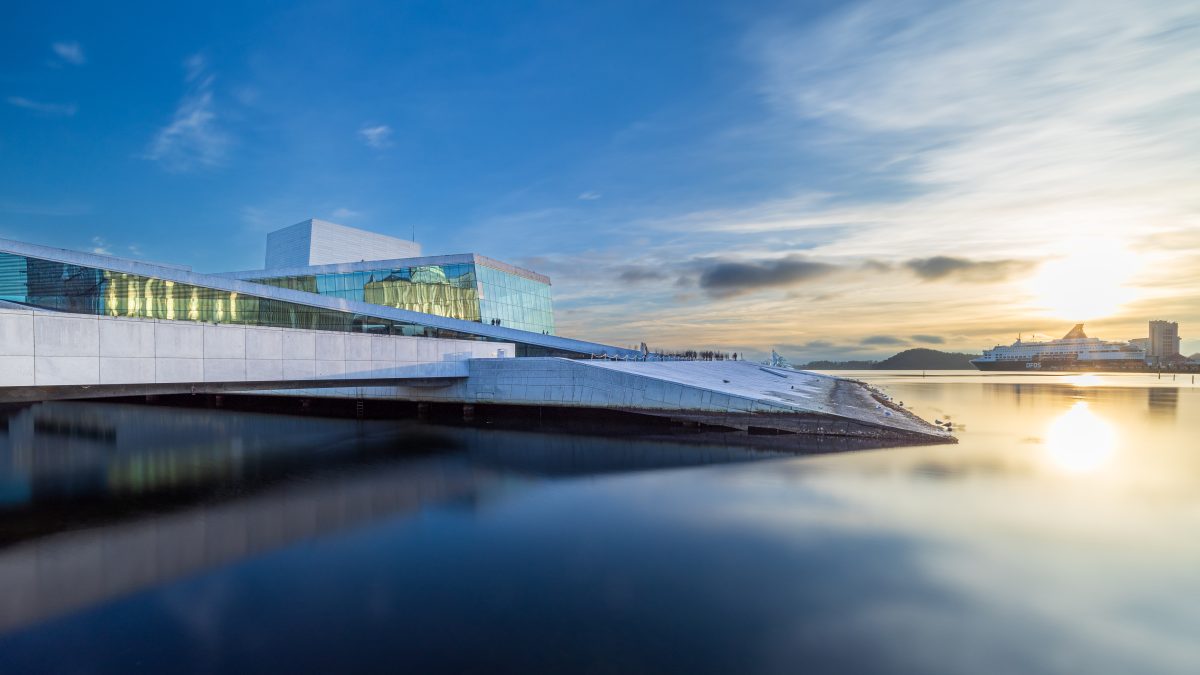
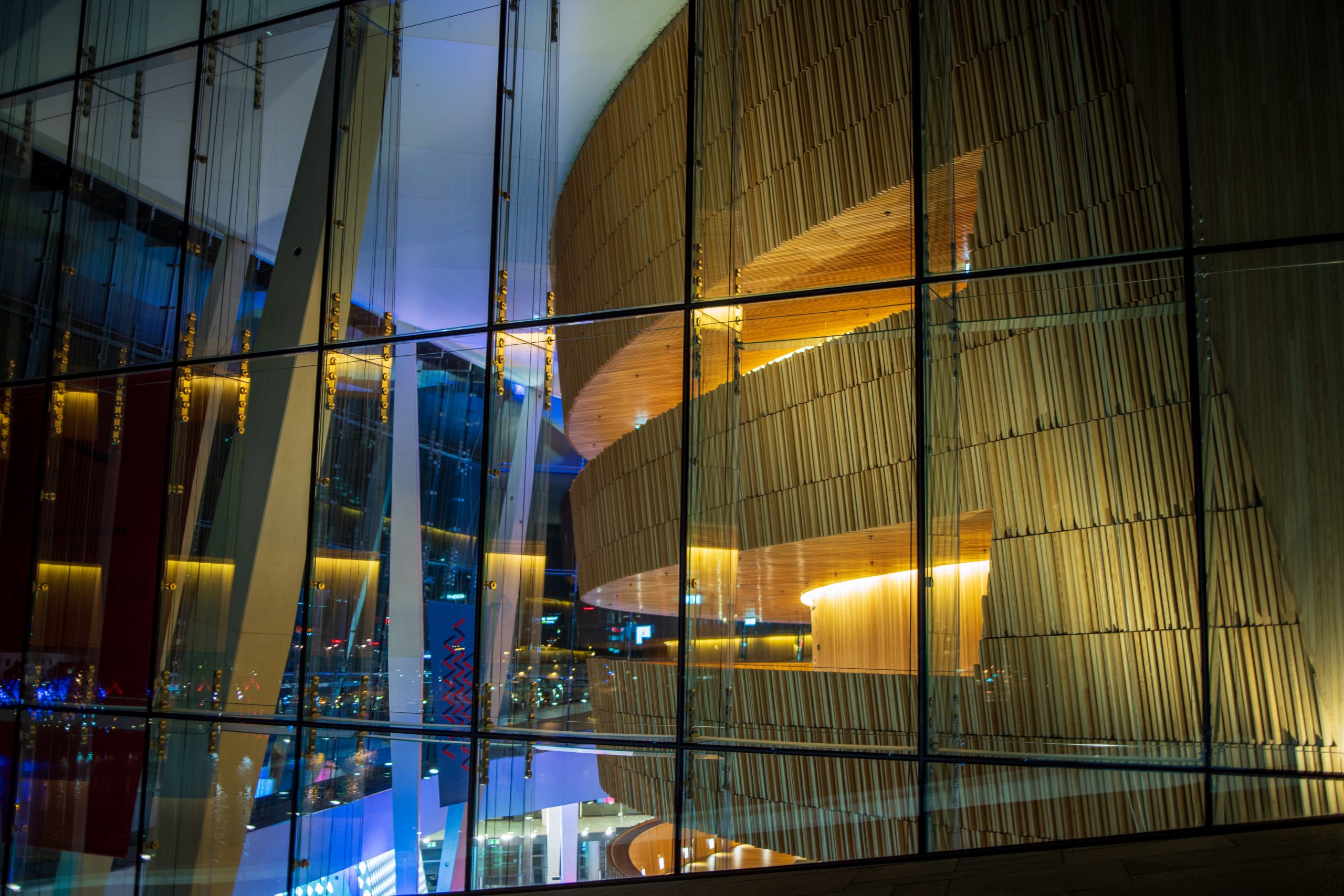
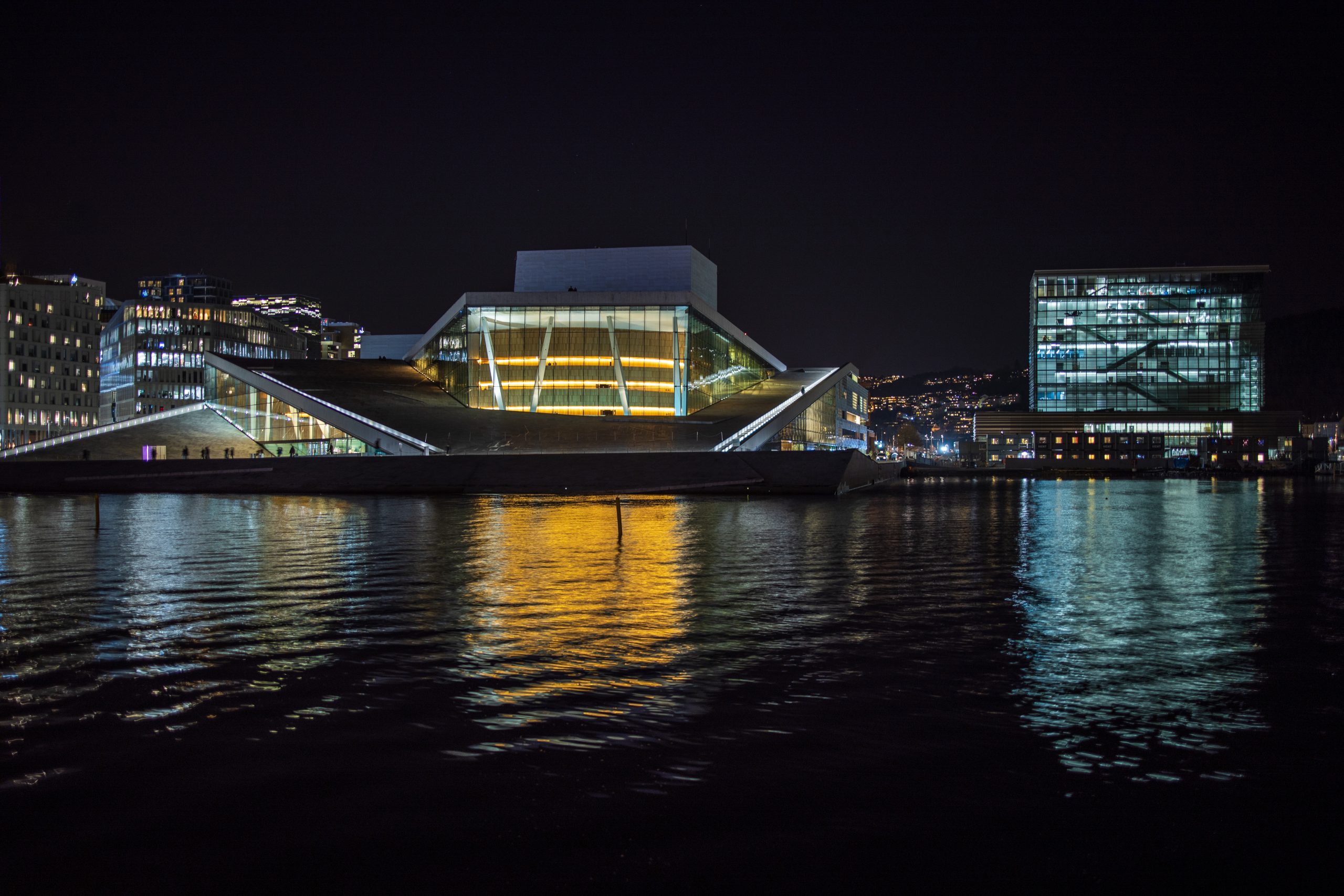
Three of the four frames are taken at night from across the harbour basin, when the glass walls of the foyer glow amber and the whole angular building lies reflected in the black water, its sloping roof a pale wedge against the dark. One frame closes in on the glass itself: behind it stands the wave wall, a curved screen of oak strips that wraps the main auditorium and is lit from within so that the timber reads as a golden curtain through the façade. The fourth frame, the opening one, is the same roof in November sunlight, with the sun low over the fjord and the harbour as still as a mirror.
Two Towers of Glass
The leaning museum and the striped library that completed the waterfront in 2020 and 2021.
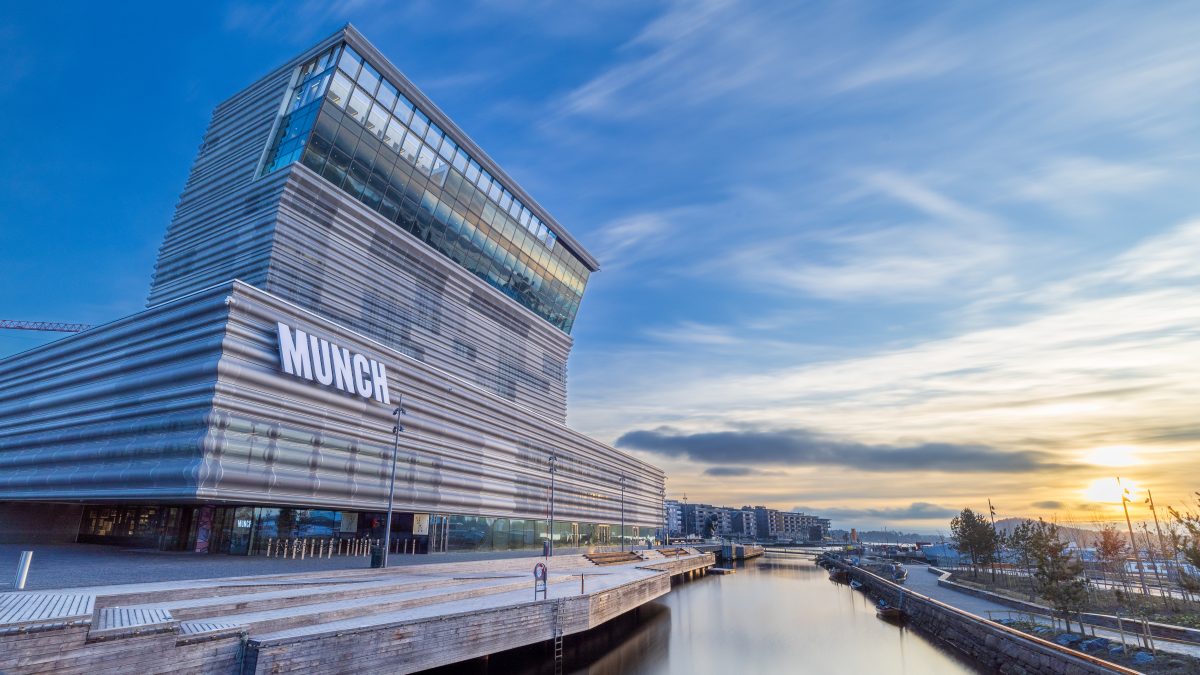
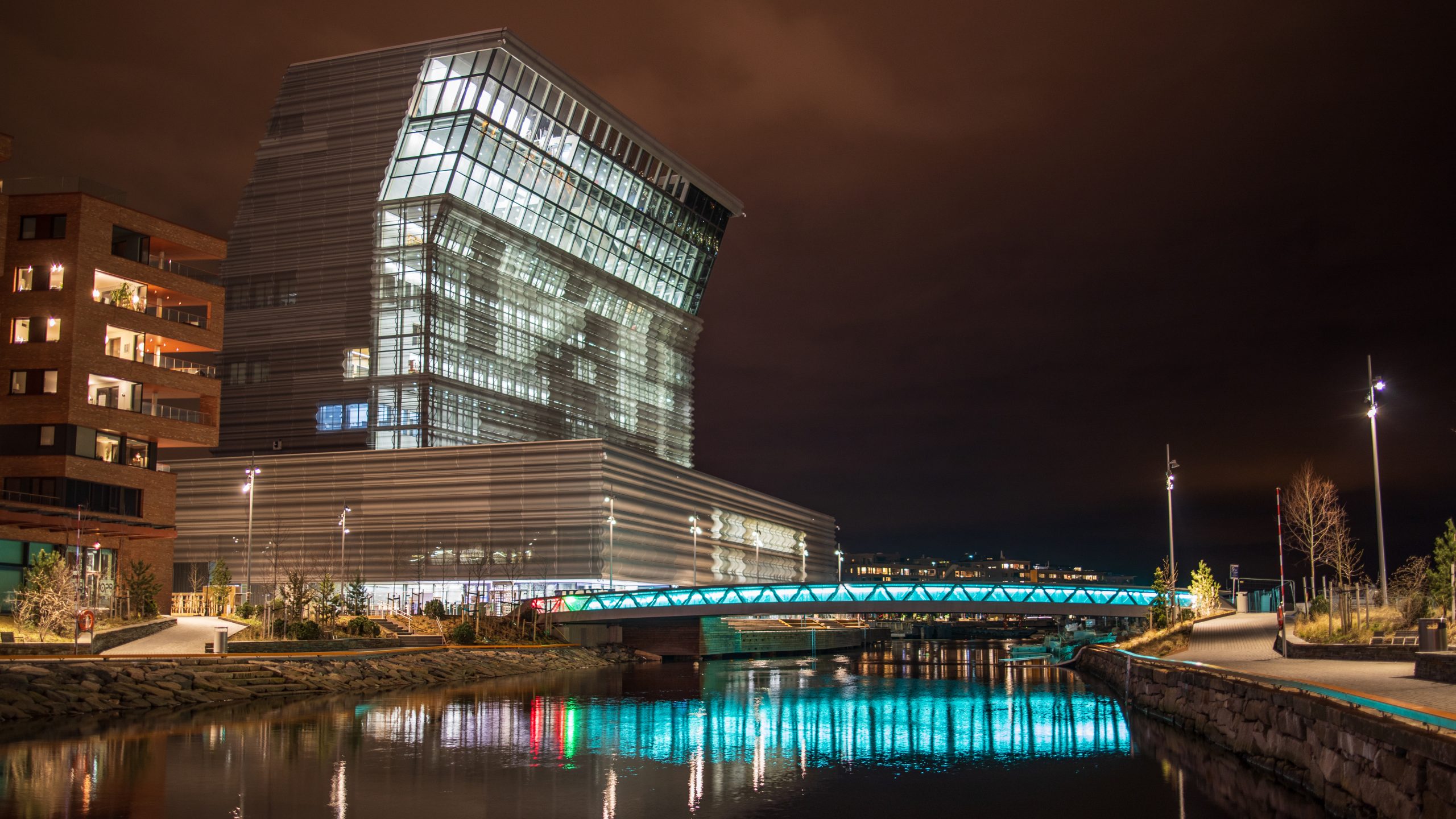
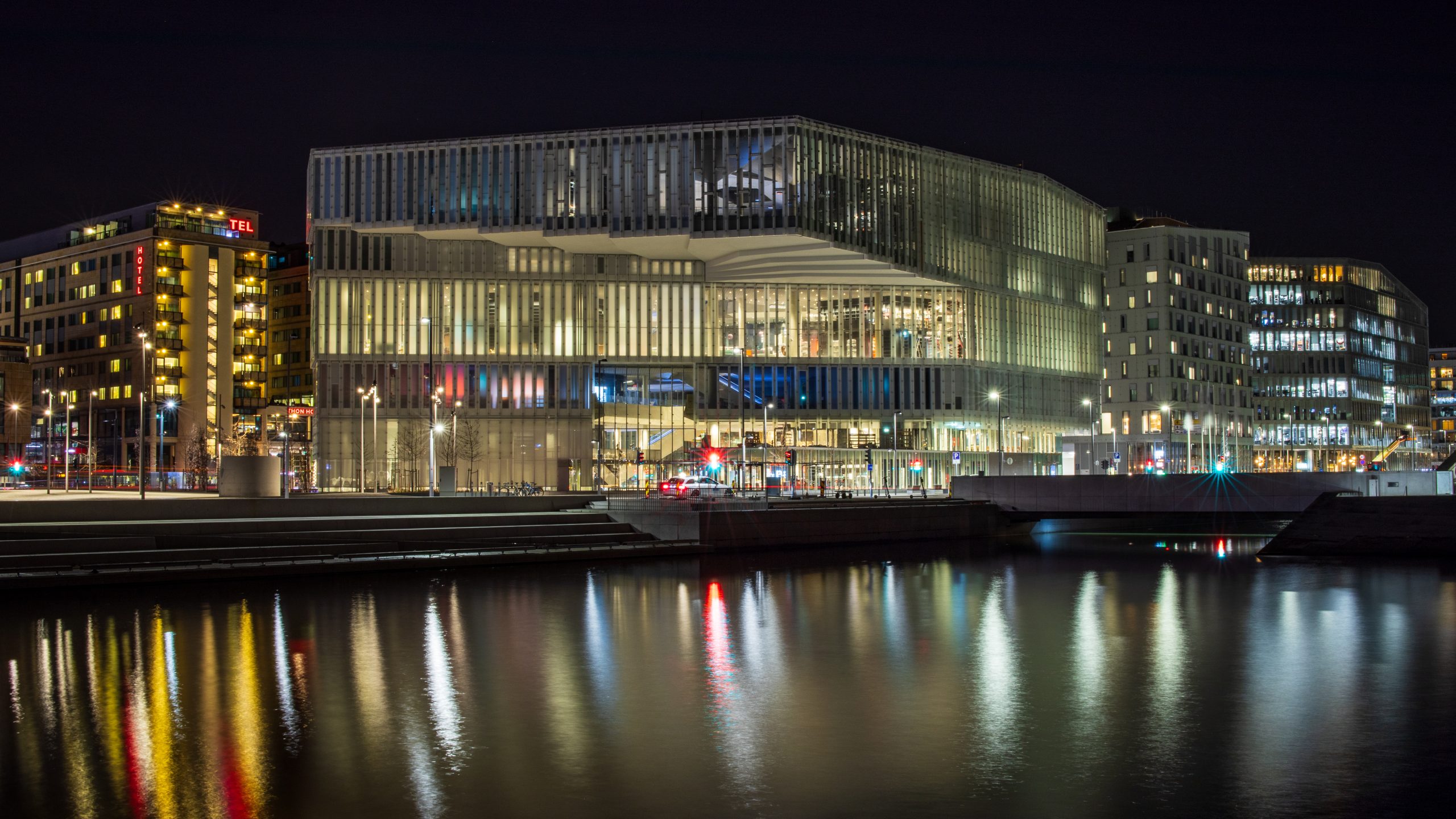
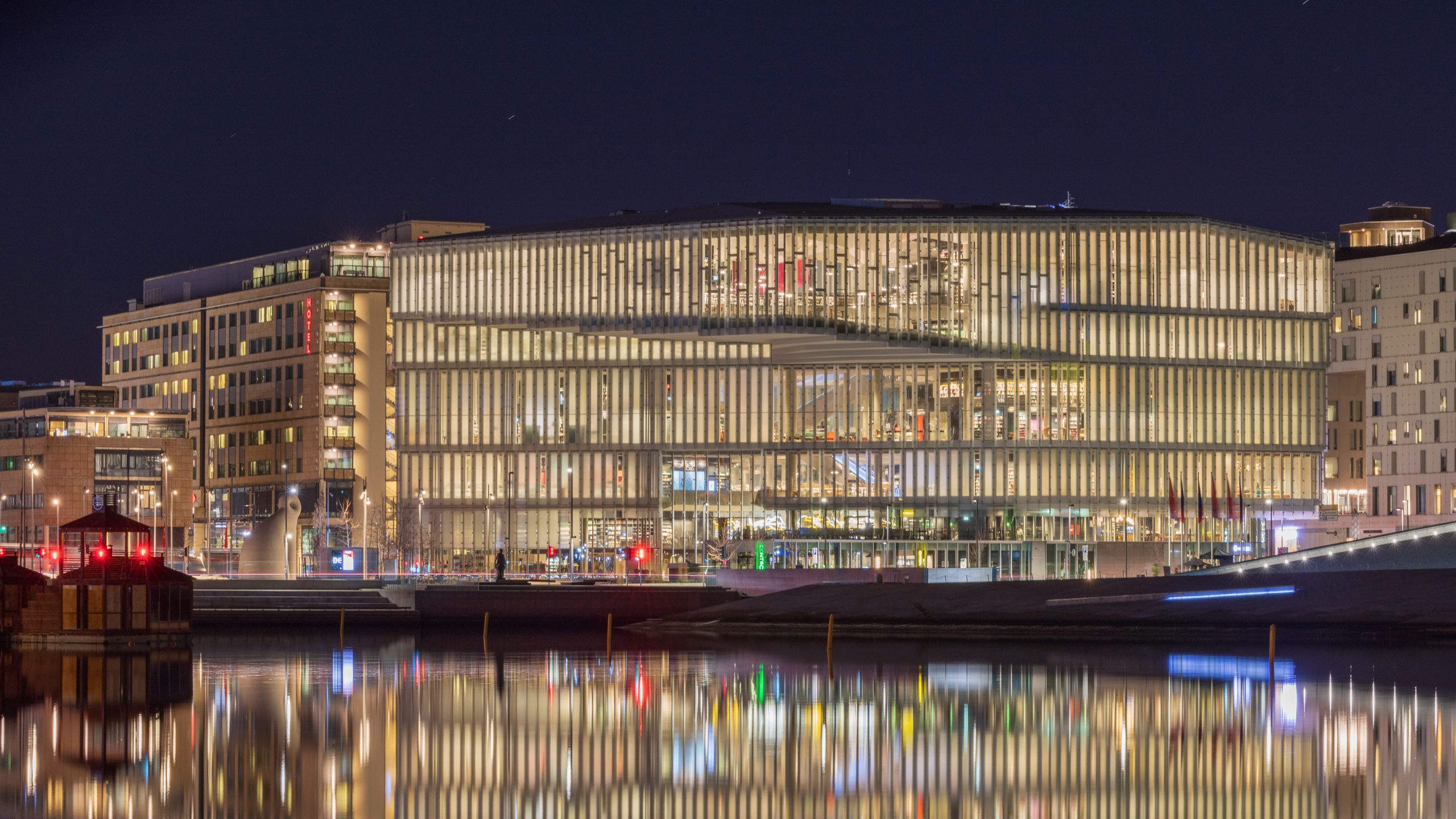
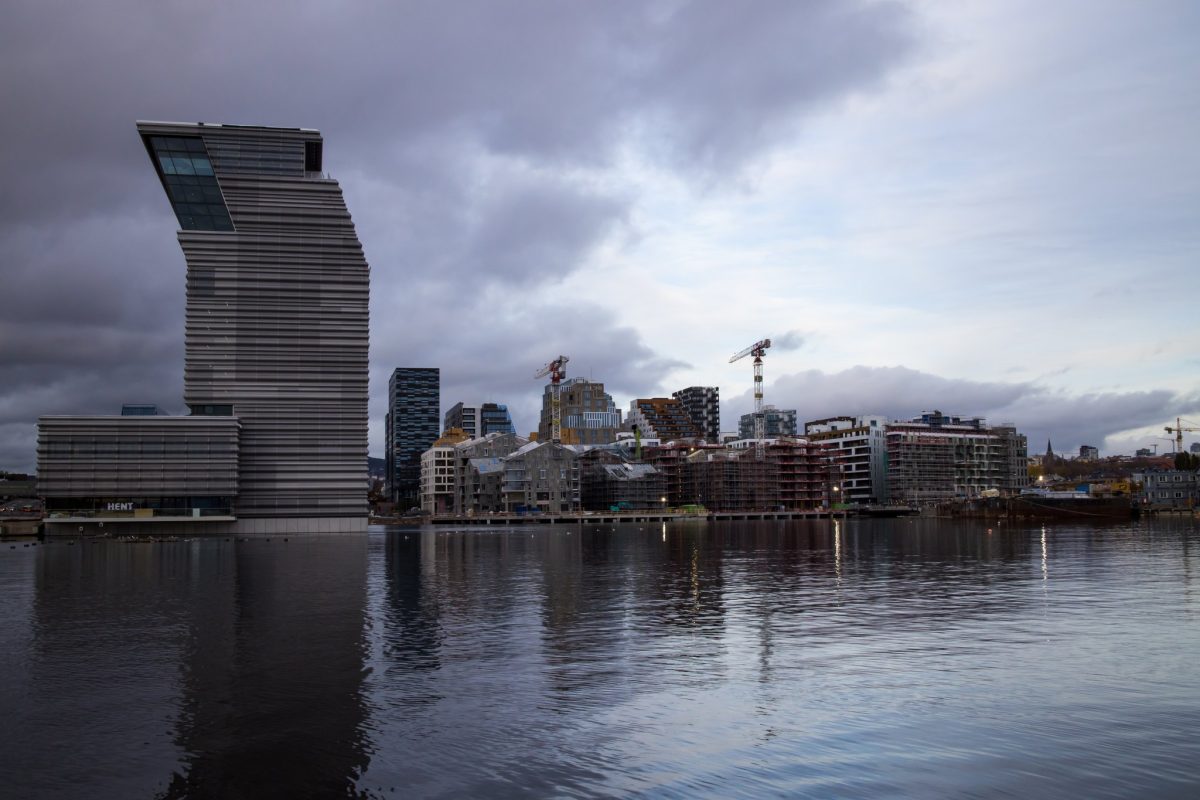
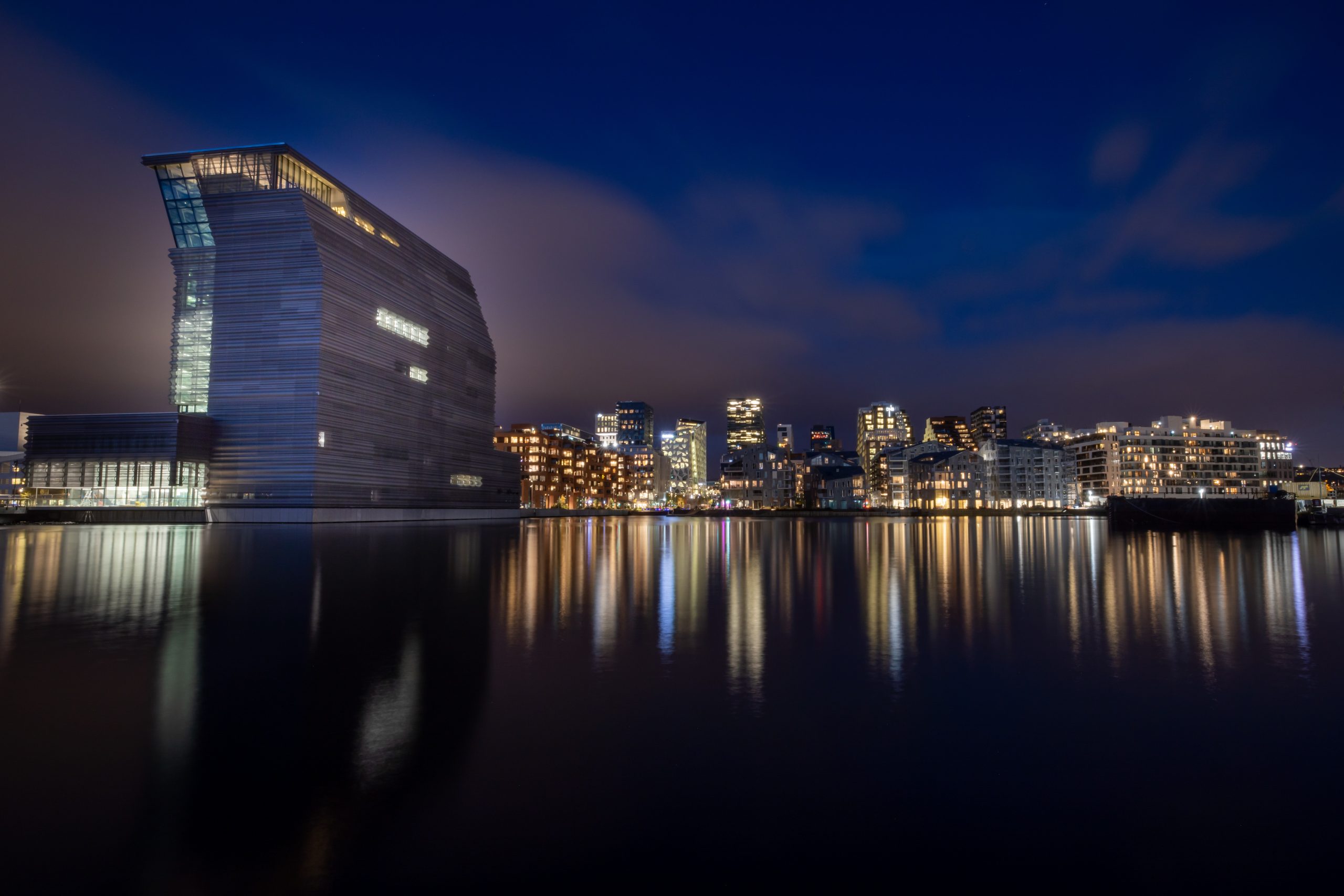
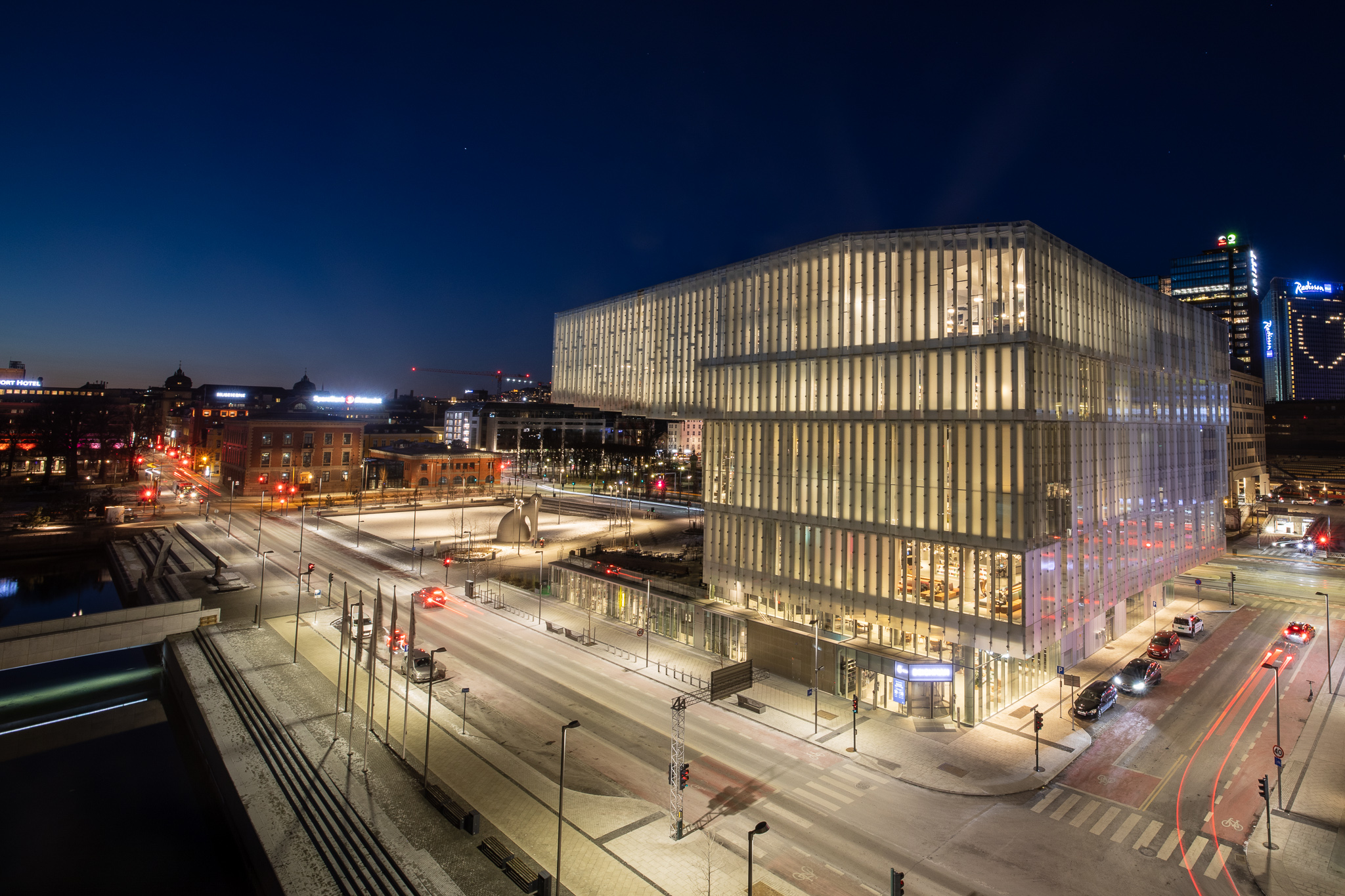
On either side of the Opera House stand the two buildings that finished the Bjørvika waterfront. Deichman Bjørvika, the city’s main public library, opened in June 2020 in a five-storey block of layered, translucent glass by Lund Hagem and Atelier Oslo, its top floor cantilevered out towards the fjord and the Opera; it has space for 450,000 books and is as much a public living room as a library. The Munch Museum followed on 22 October 2021 across the water, a thirteen-storey tower by estudio Herreros wrapped in perforated aluminium, with its upper floors tilted towards the harbour in a lean that has divided the city ever since. Its collection, almost 28,000 works, is the largest body of Edvard Munch’s art anywhere.
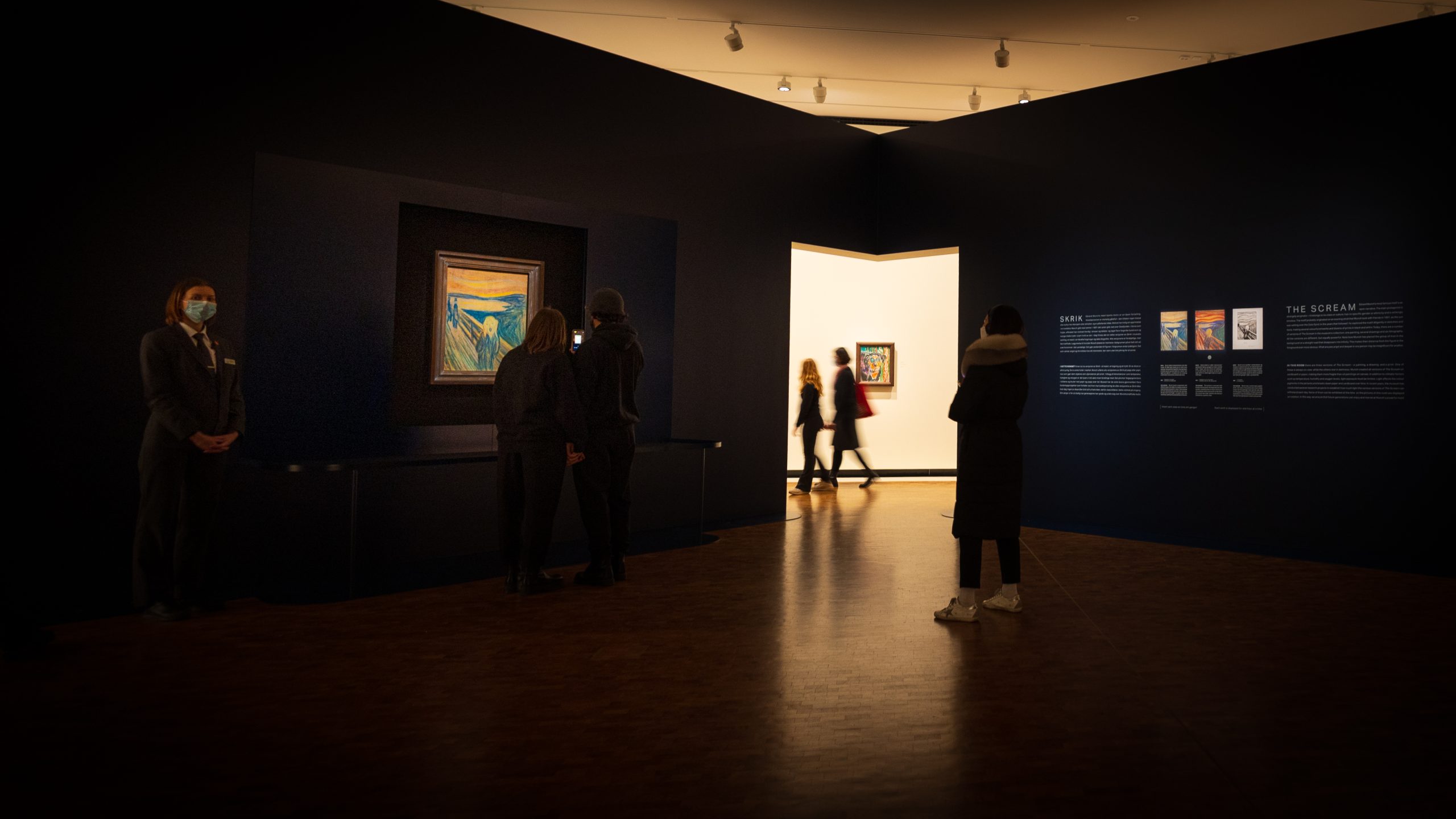
At night both buildings turn into lanterns. The frames show Deichman lit from within, its horizontal bands of glass mirrored in the still water, and the Munch Museum glowing above the canal with the blue-lit pedestrian bridge beside it. A daytime frame catches the museum against a winter sunset over the fjord, and one more goes inside, to a darkened gallery where visitors stand before a single lit painting.
The Barcode and the New Shore
A row of slim towers behind the station, a steel footbridge over the tracks, and apartments with a harbour bath.
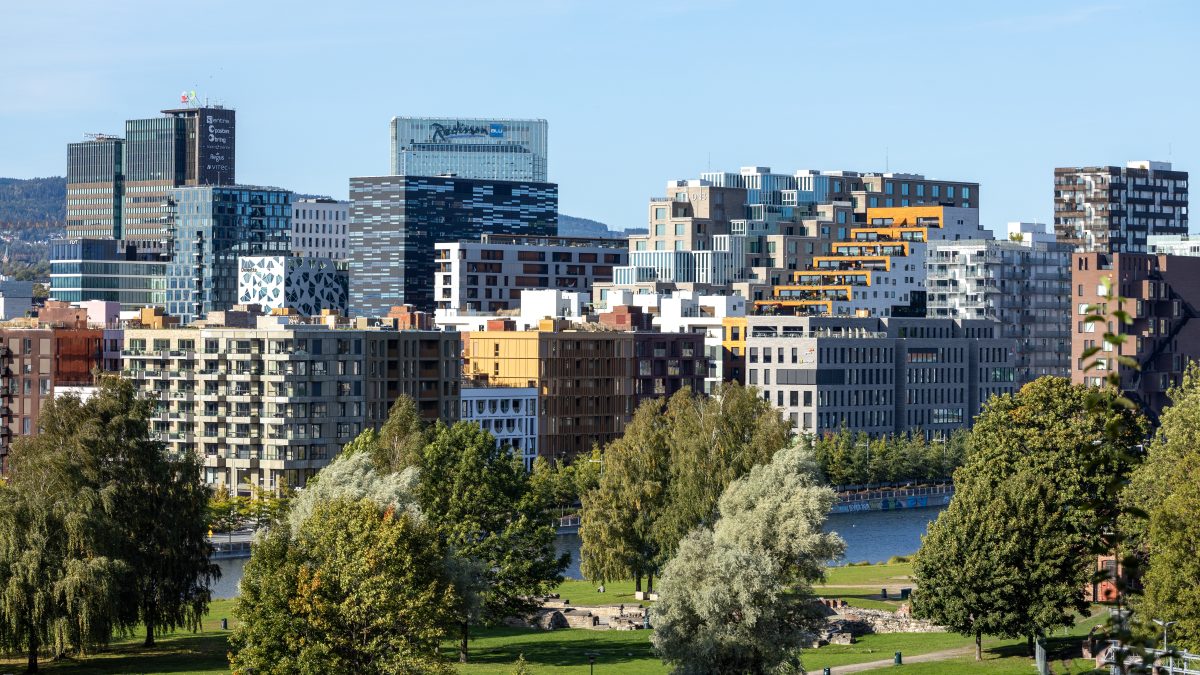
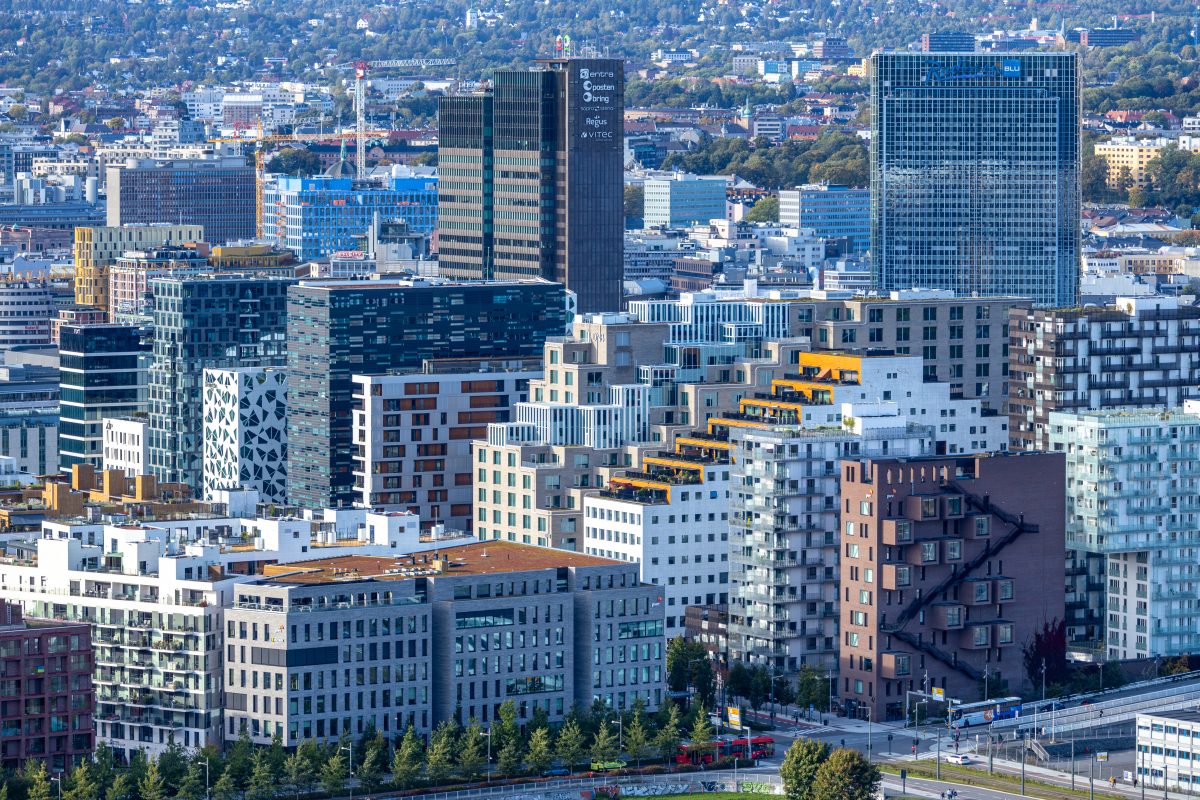
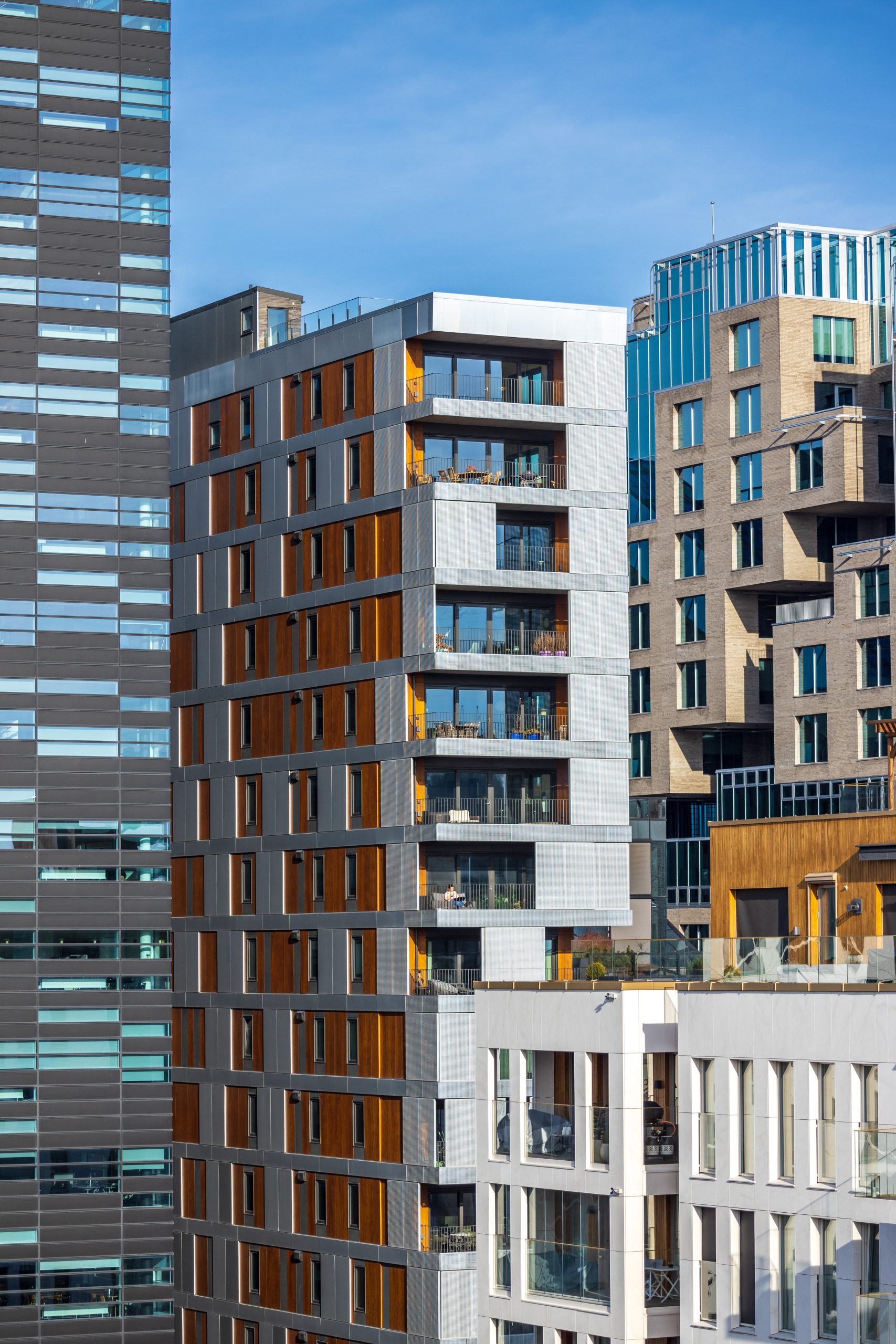
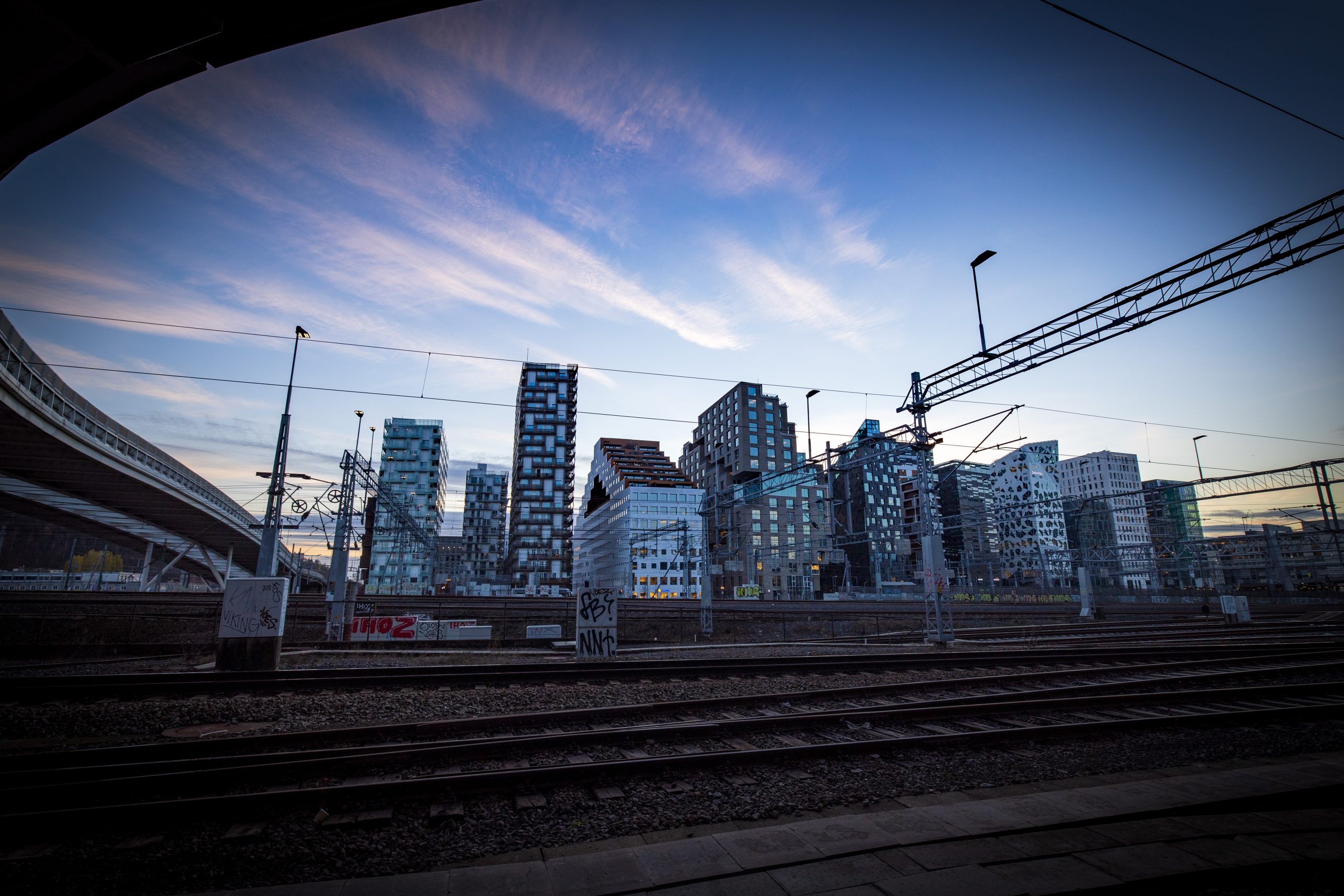
Barcode is the name the city gave to the row of narrow high-rises built between the railway and the fjord from 2007 to 2016, and it stuck. The plan allotted each slice a different architect, among them Snøhetta, MVRDV, a-lab and Dark, and required gaps between the buildings so that light and views could pass through to the water; the result reads from a distance like the stripes of a barcode. Two frames look at it from across the Middelalderparken in autumn sun, the towers stepping up in white, black and bronze above the trees, and one closes in on a single façade with its grid of timber-lined balconies.
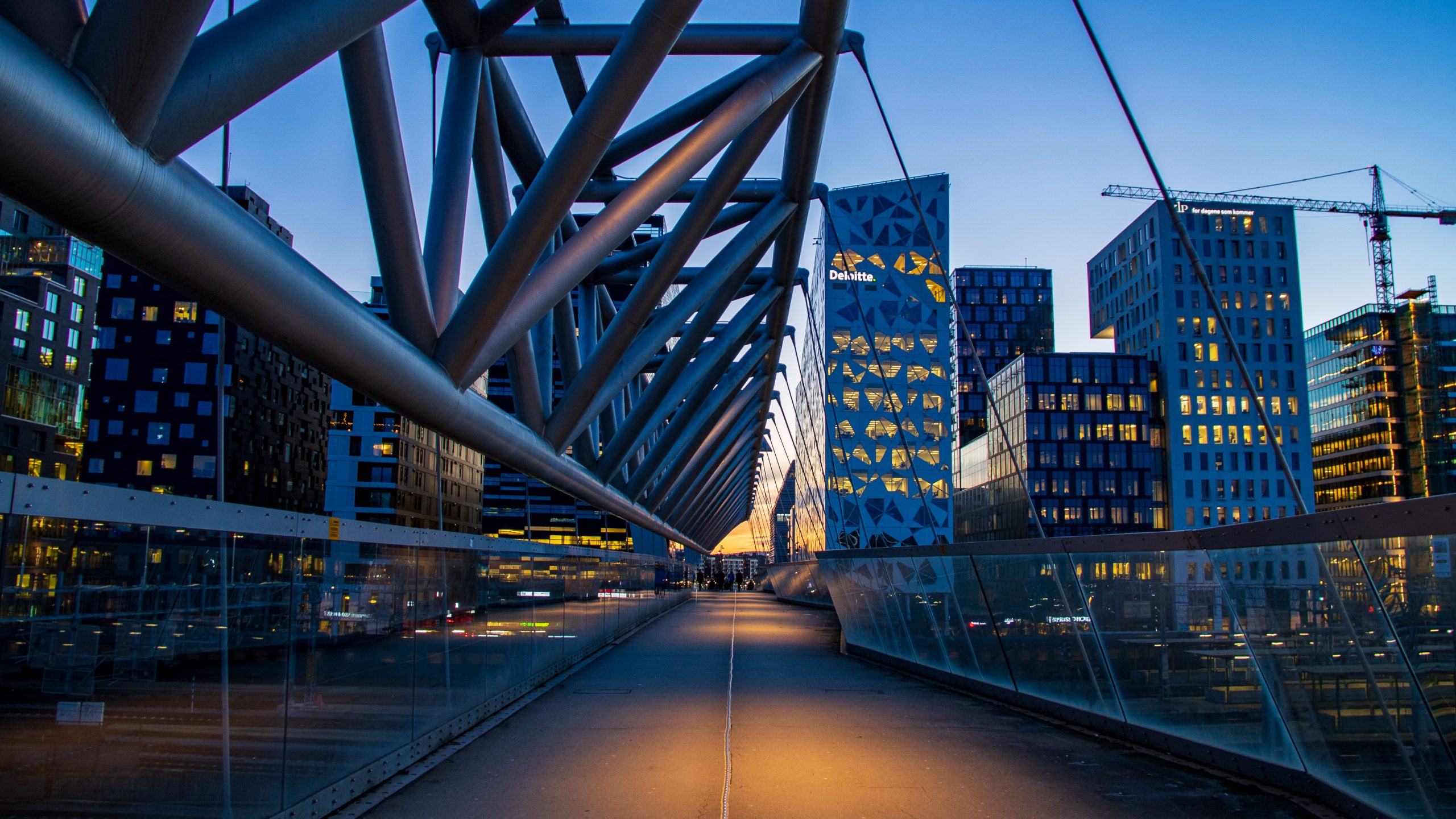
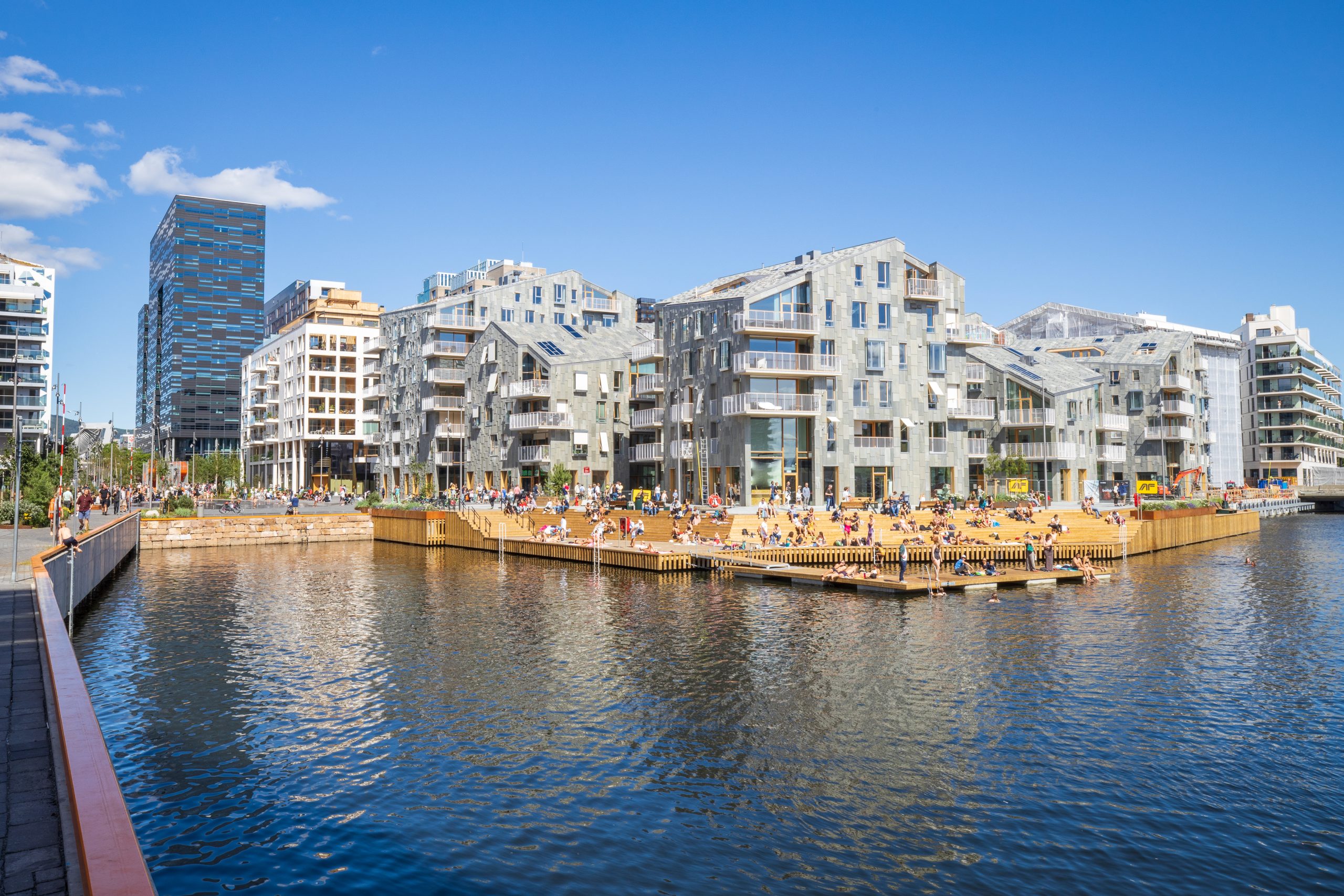
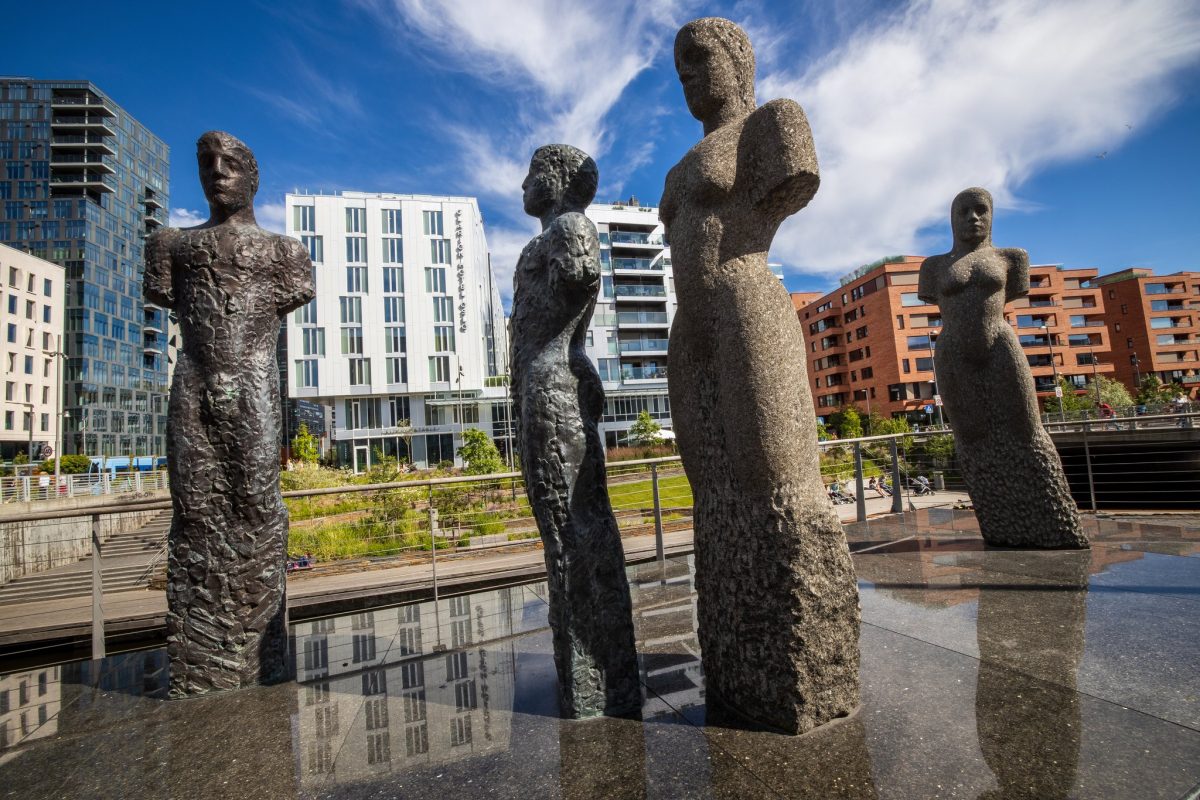
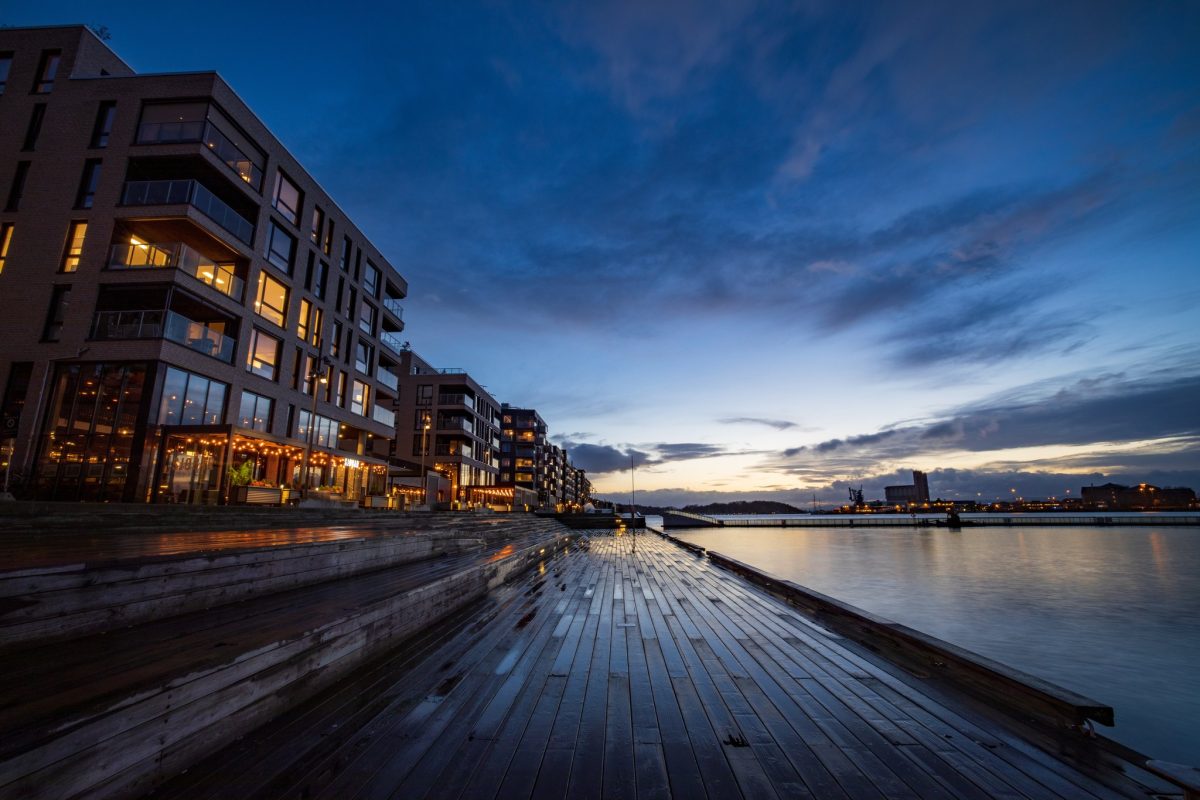
The Akrobaten footbridge carries pedestrians over the tracks of the central station into Bjørvika through a lattice of steel; here it is seen at dusk with the lit towers rising at its far end. South of Barcode lies Sørenga, a former container pier turned into blocks of waterfront apartments around a public harbour bath, pictured on a bright July day with the promenade full of people and the fjord water inside the baths.
The Older Capital
The twin brick towers over the harbour, the parliament on its lawn and the Freia sign above the square.
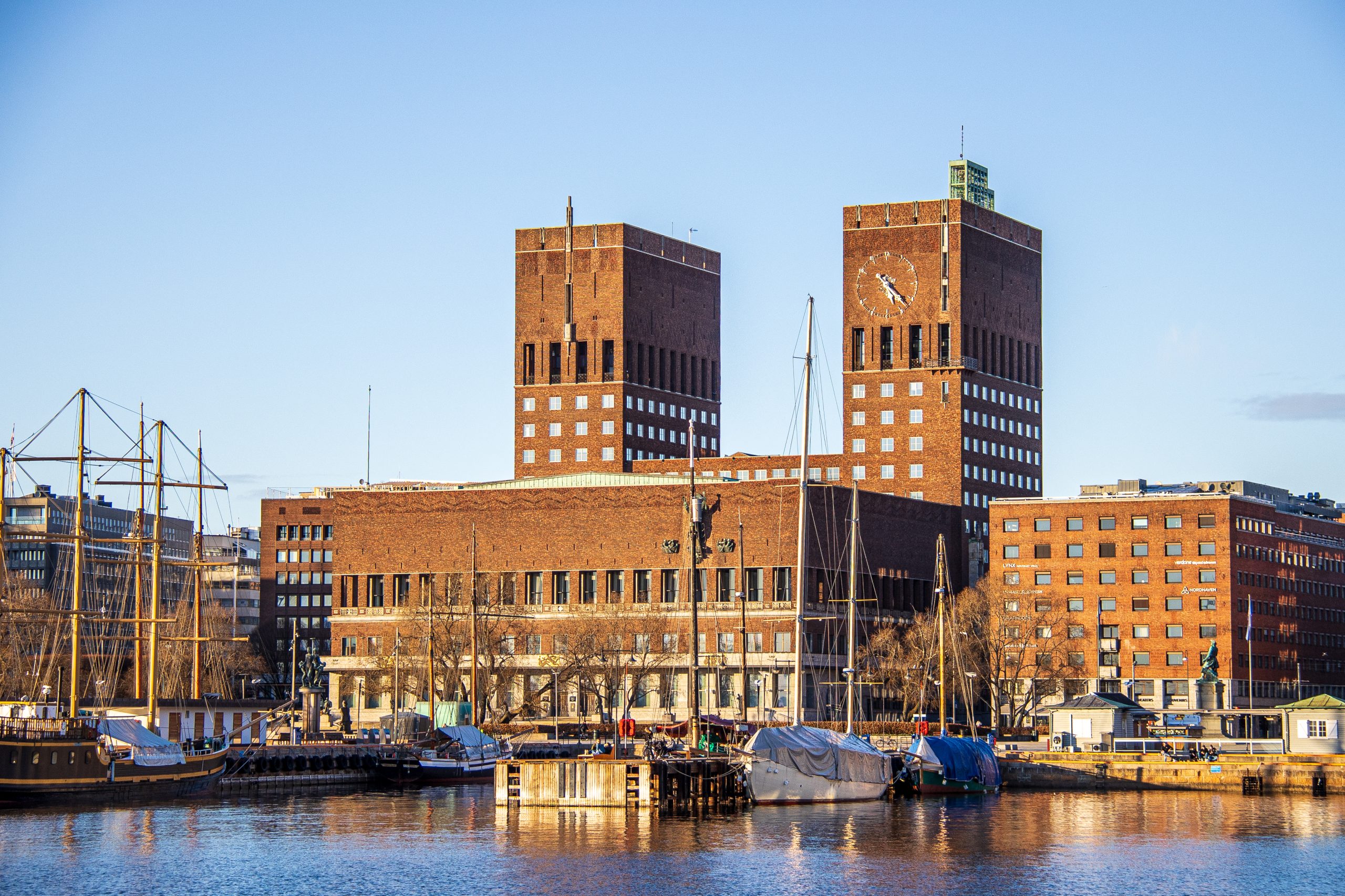
West of Bjørvika the city turns older and more formal. Oslo City Hall stands on the harbour at Pipervika, a mass of dark red brick with two towers of 63 and 66 m, begun in 1931 and inaugurated in 1950; it is where the Nobel Peace Prize is handed over every December. The frame here is taken from the water on a March evening, with the masts of the boats in the harbour in front and the last light on the brick.
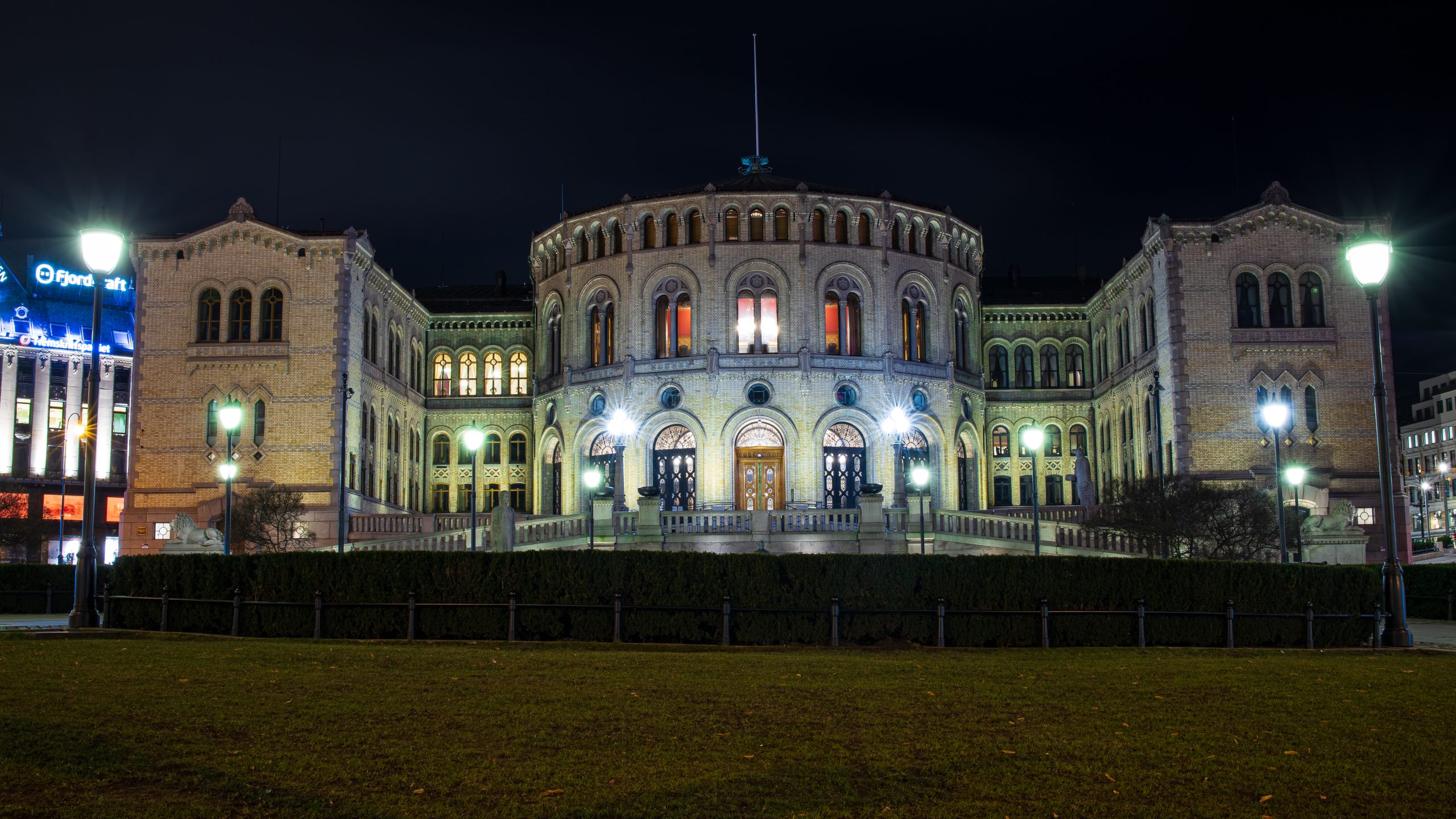
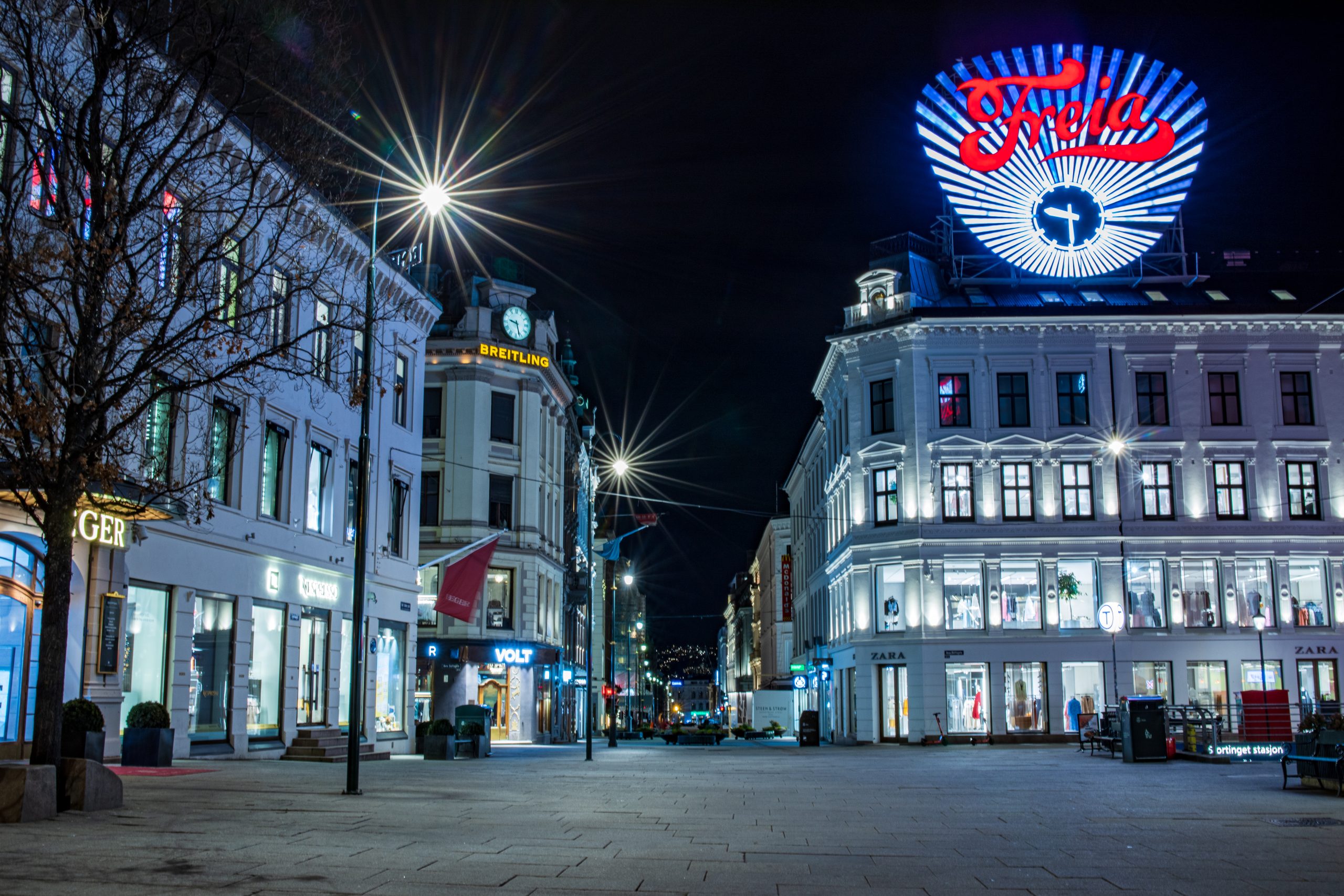
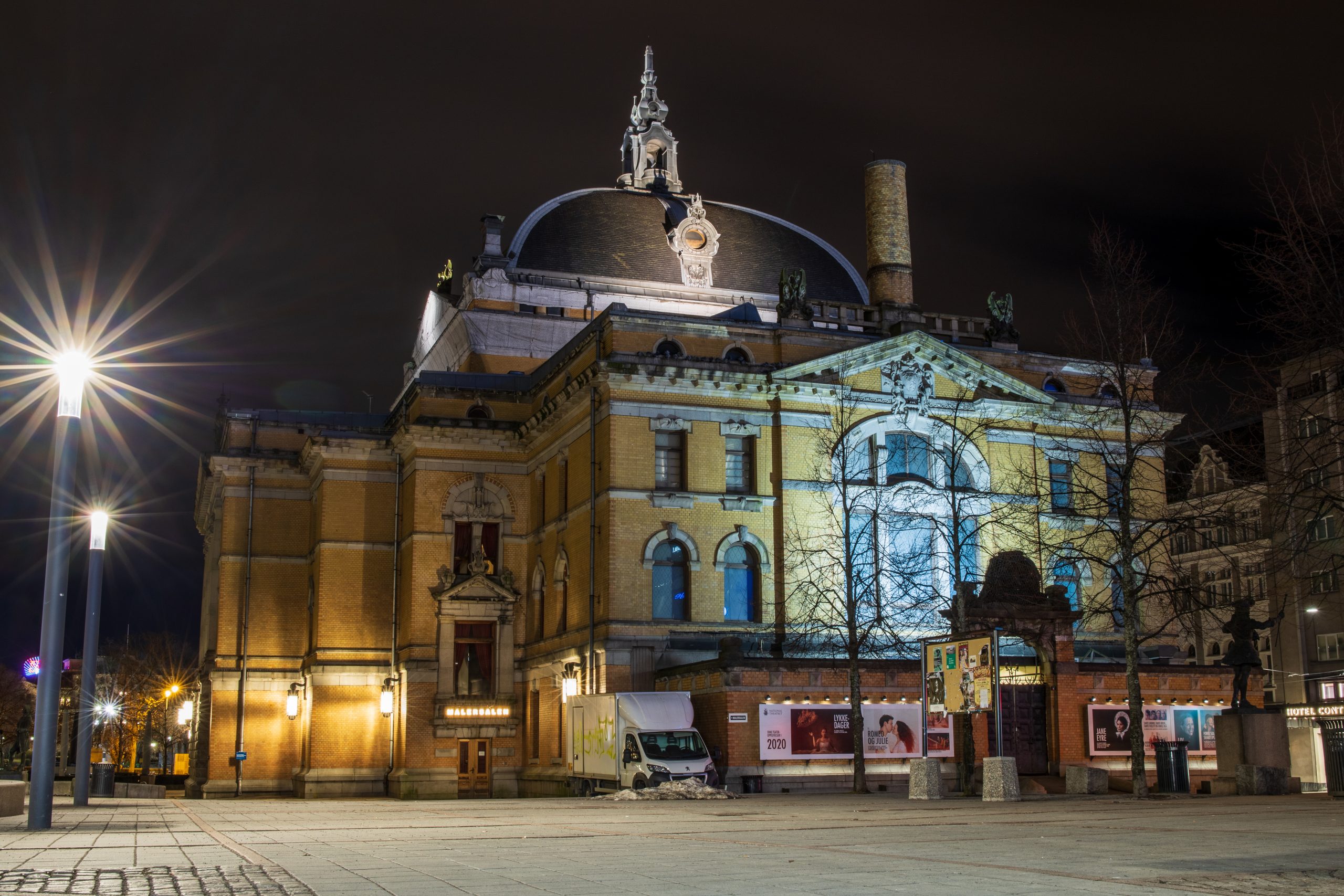
Three night frames follow Karl Johans gate, the main street running from the central station to the Royal Palace. The Storting, Norway’s parliament since 1866, sits behind its lawn with its curved yellow-brick front lit and the Norwegian flag above the door. At Egertorget, where the street crosses Øvre Slottsgate, the illuminated Freia chocolate sign with its clock and globe hangs above the rooftops as it has for generations, one of the best-known pieces of advertising in the country. A few blocks on, the ornate domed front of the National Theatre of 1899 stands lit on its square, with projections playing across the stone.
The Lit Bowl
From the hillside above the harbour, the whole centre lies spread out in lights on a December night.
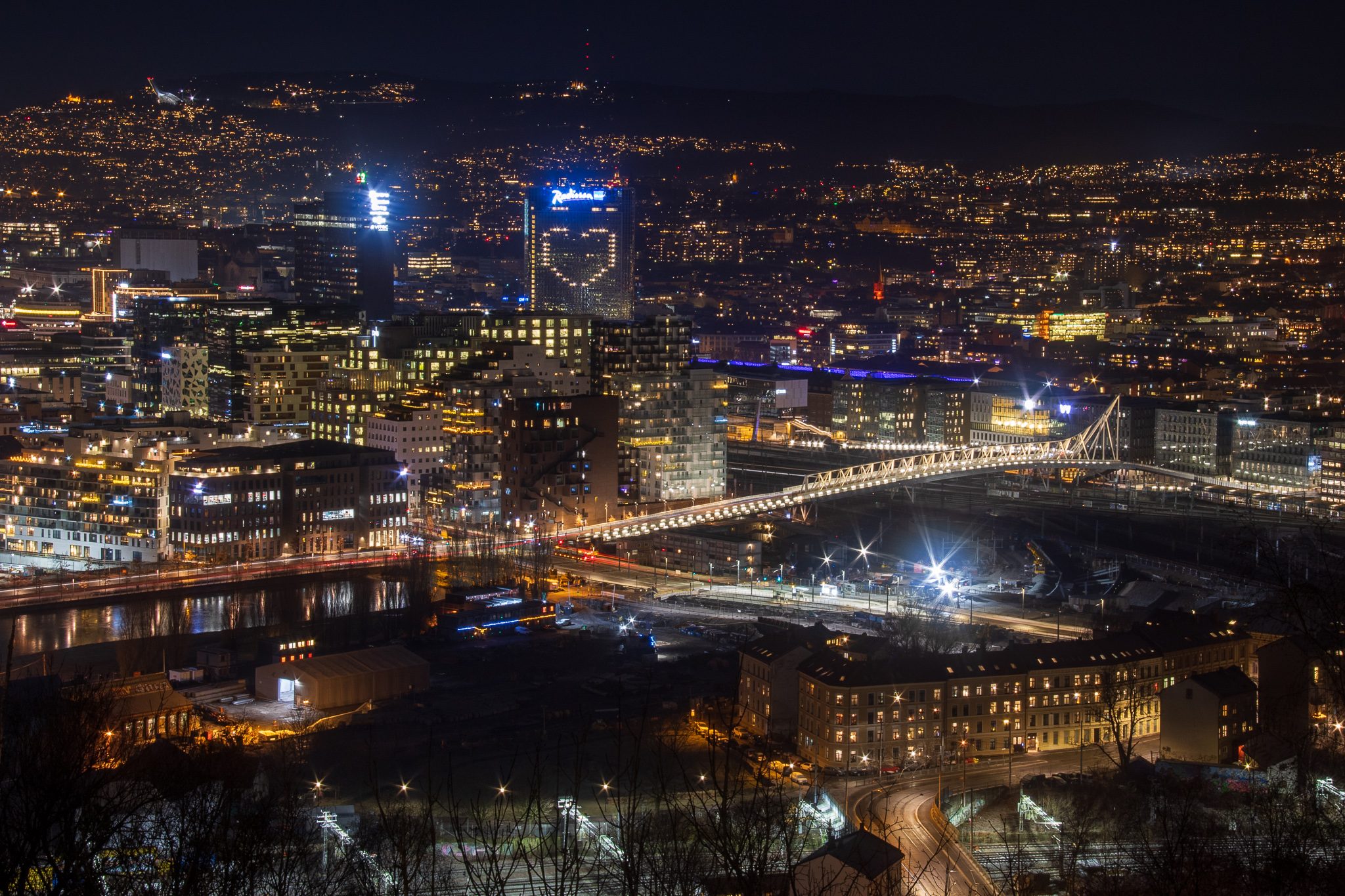
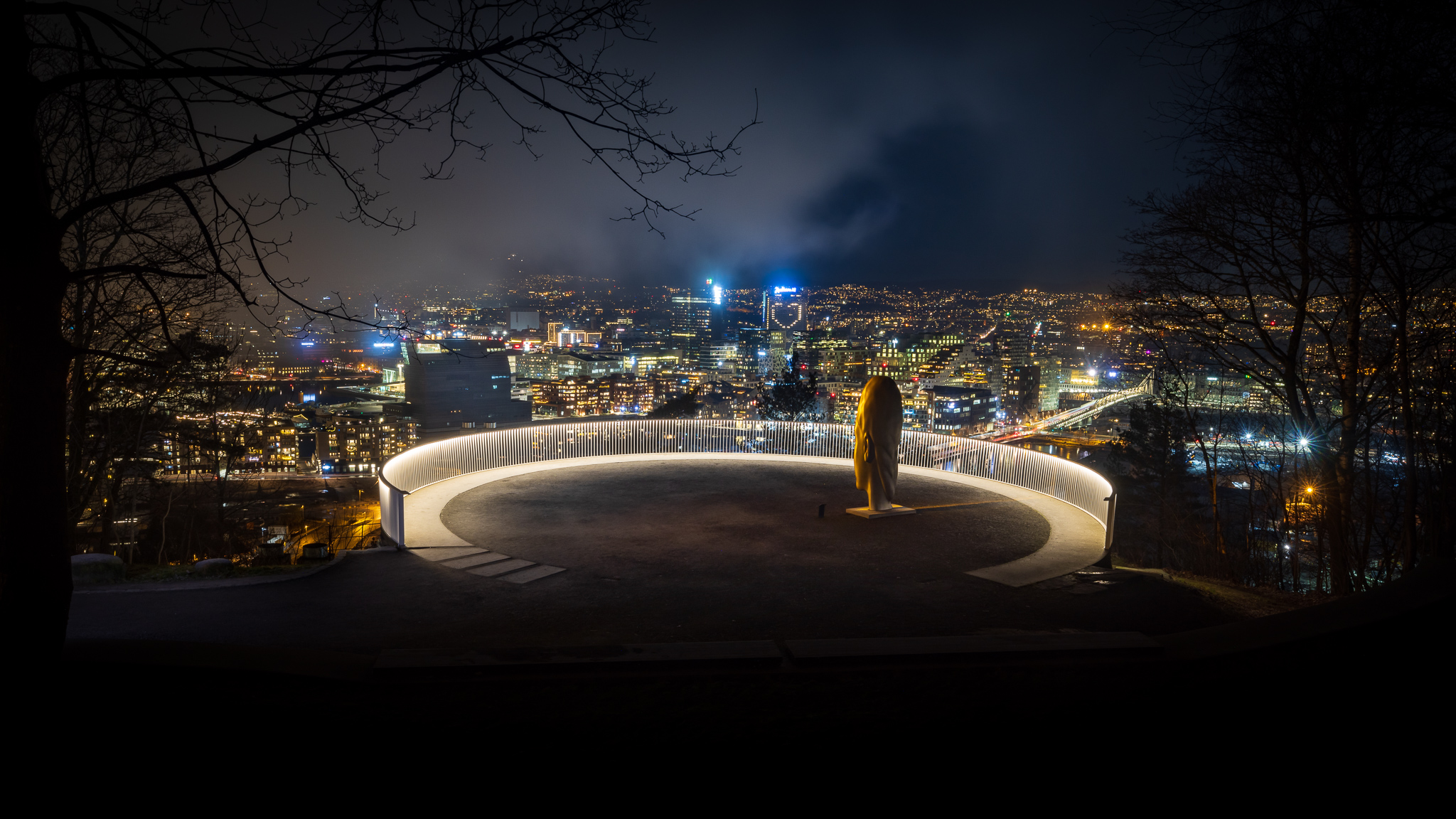
Oslo is built in a bowl, with forested hills on three sides and the fjord on the fourth, and from the slopes east of the harbour the whole centre can be taken in at once. The first frame, from a December night, looks down across the dark water of the harbour to the lit buildings of Bjørvika and the city centre beyond, the Barcode towers and the Radisson sign picked out against the hillside behind, and the bridge lights of the inner harbour strung across the foreground. The second frame, taken twenty minutes earlier a little higher up, is of the viewpoint itself: a circular platform with a lit rail, a single figure standing at its edge, and the glow of the city filling the valley below.
Both frames date from the first days of December, when Oslo has barely seven hours of daylight and the lights come on in mid-afternoon. It is the season in which the city is seen more often lit than not, and the season in which most of the frames in this set were taken.
«Oslo is a small capital that photographs best in the dark. For most of the winter the lights are on by three in the afternoon, and the new buildings along the fjord were made for it: glass, marble and aluminium that glow from inside and lie doubled in the harbour. Twenty frames over four years, from the Opera roof at sunset to the whole city seen from the hill, with the water in almost every one.»
More in the same area
 ArchitectureBarcode and Bjørvika: Oslo’s New Waterfront Skyline
 CitiesThe Vibrant Heart of Norway, Oslo
 CitiesBjørvika, Oslo: From Container Port to Cultural Waterfront
 ArchitectureMunch Museum in Oslo: A Modern Icon of Art and Architecture
 ArchitectureDeichman Bjørvika: Oslo’s Main Library on the Fjord
 ArchitectureOslo Opera House