In 1997, Frank Gehry completed a building on the banks of the Nervión River in a post-industrial Basque city that most of Europe had never thought much about. Within a year, Bilbao had become a global destination. The Guggenheim Museum Bilbao did not just house contemporary art — it demonstrated, with unambiguous clarity, that a single building could reshape a city’s economy, identity, and future. Architect Philip Johnson called it “the greatest building of our time.” Nearly three decades later, over 25 million visitors have come to see it. The building is still the main event — and it still earns the superlatives.

Bilbao in the late 1980s was a city in serious trouble. The shipyards that had built its prosperity were closing, unemployment was rising, and the post-industrial riverfront was derelict. The Basque government decided to bet on culture. In 1991 they approached the Solomon R. Guggenheim Foundation with a straightforward proposition: we will fund a Guggenheim museum in full if you bring your name and collection here. The deal was struck, an invited competition held, and Frank Gehry — then known primarily for expressive work in California — was chosen over Arata Isozaki and Coop Himmelb(l)au. He was given a site on the river and a mandate: not a competent museum, but a landmark. The building he completed cost $89 million and opened on 18 October 1997 to an audience that exceeded all projections. The 400,000 visitors expected in the first year became 1.3 million. The concept of the “Bilbao effect” — architecture as urban regeneration strategy — entered the vocabulary of city planners worldwide.
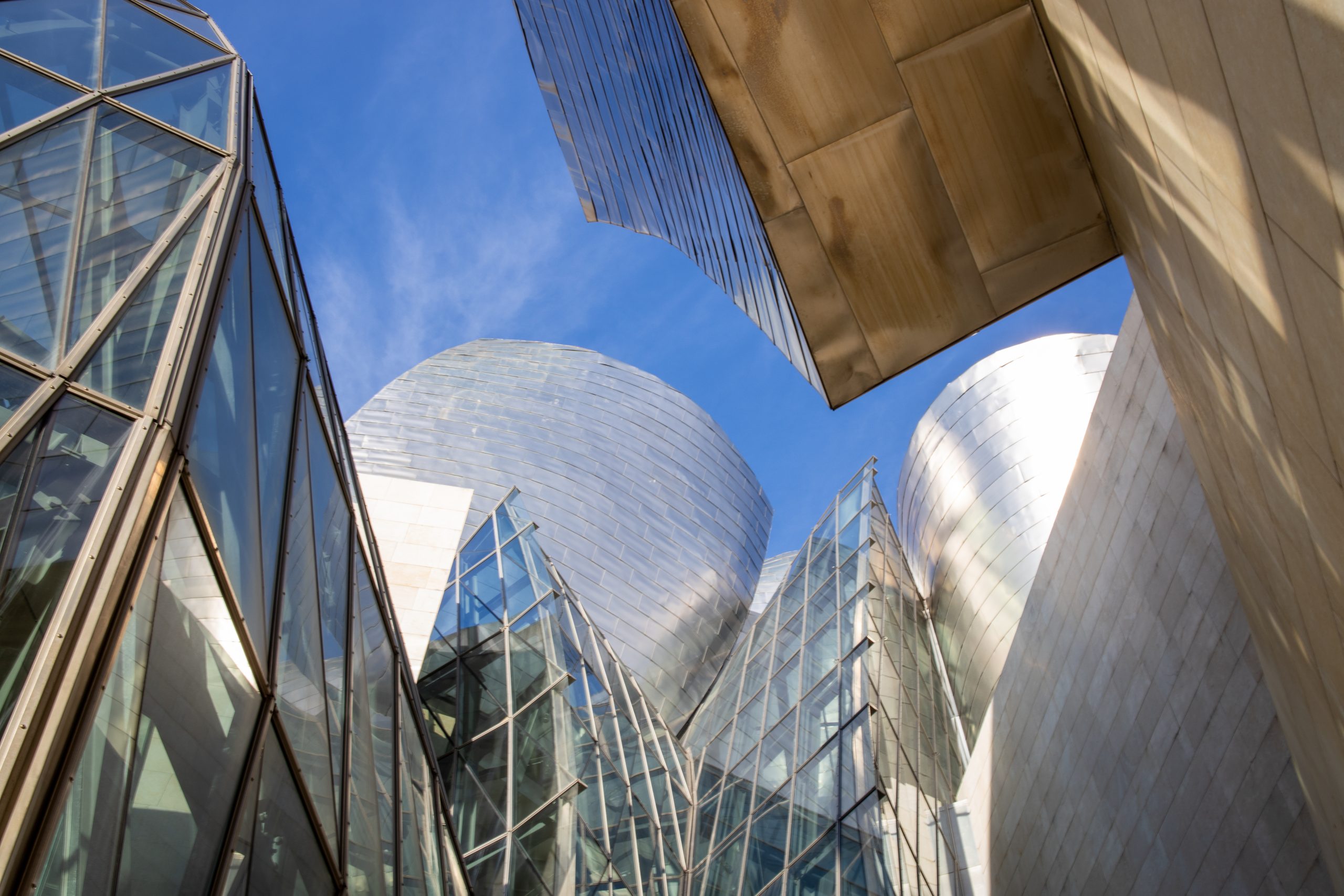
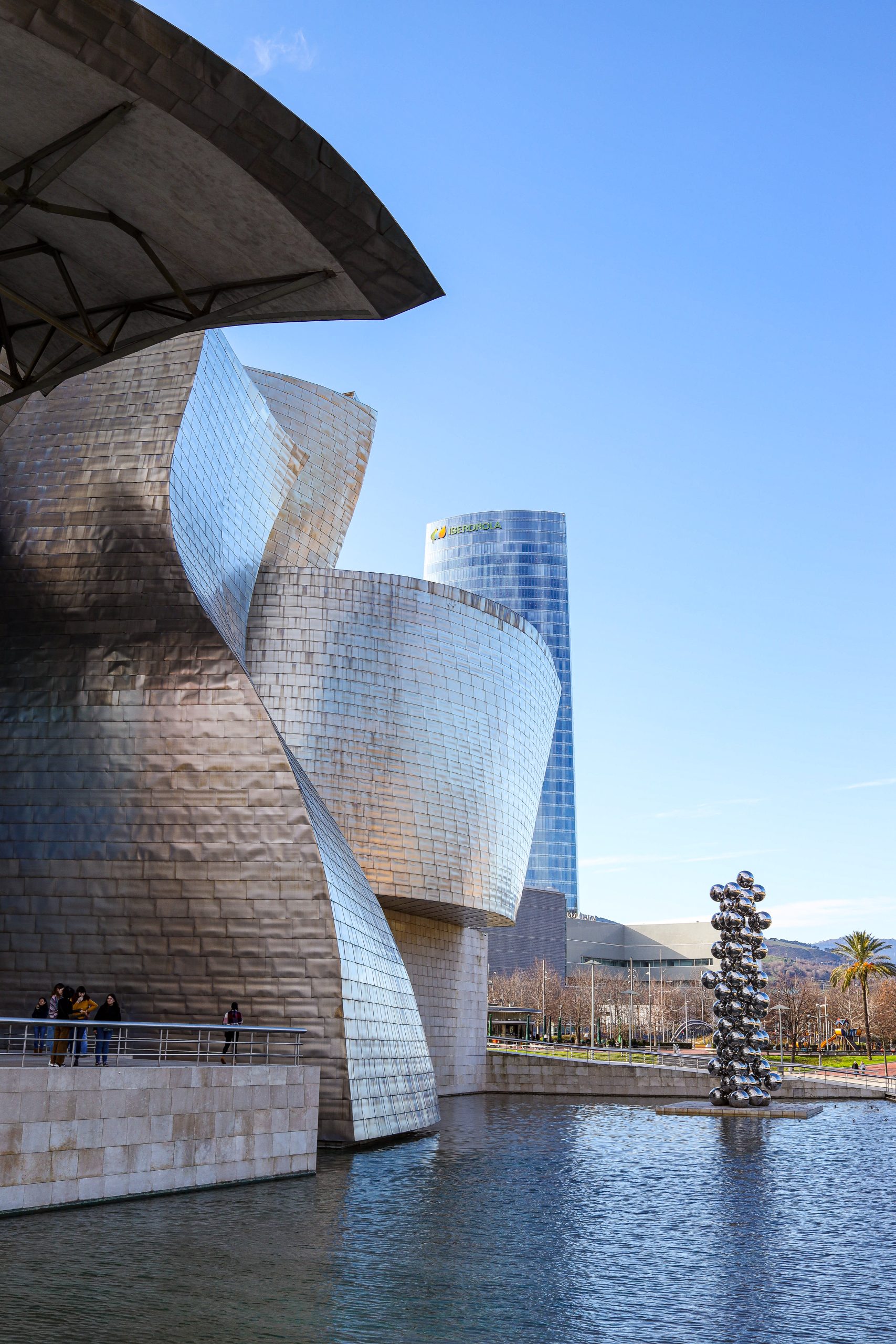
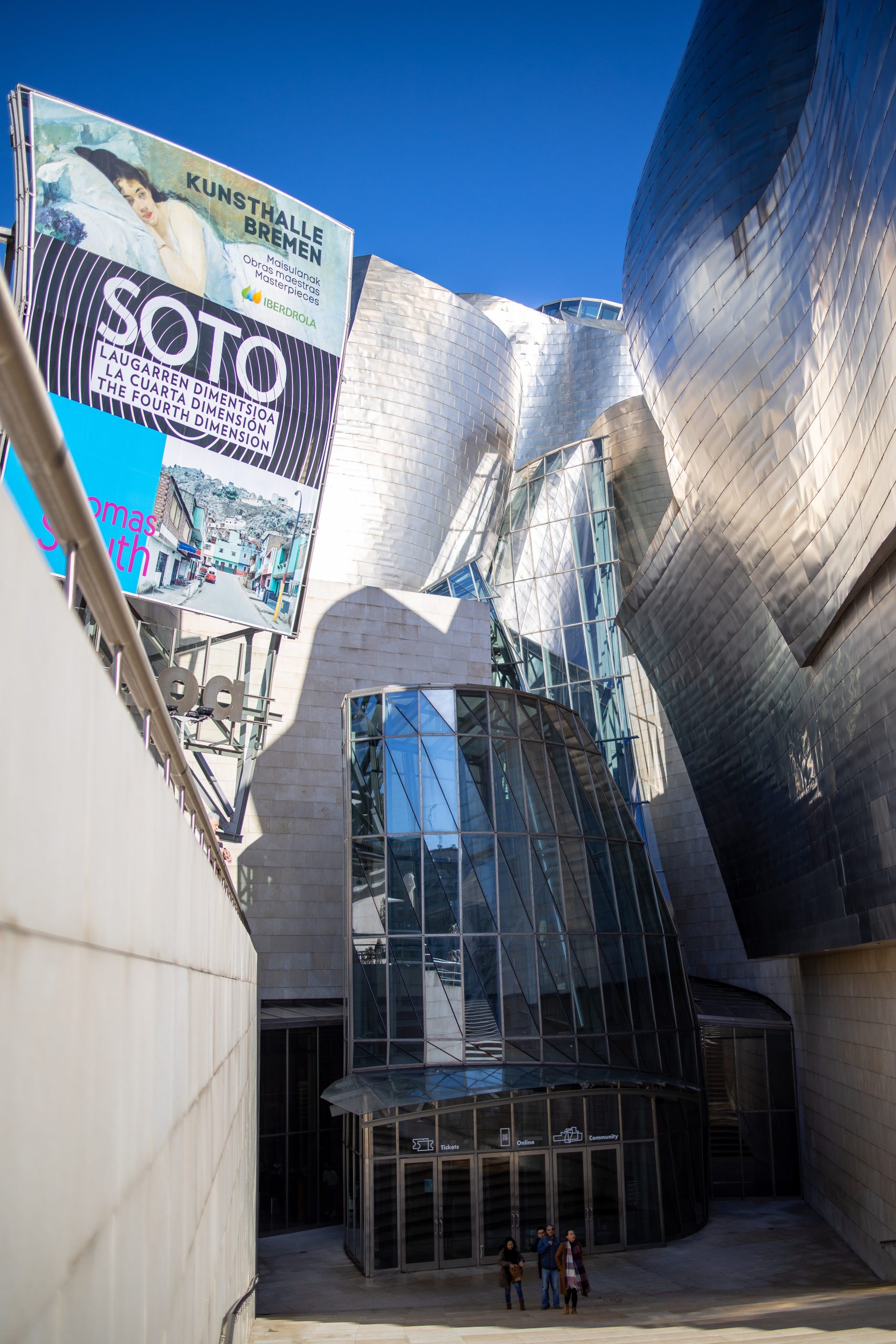
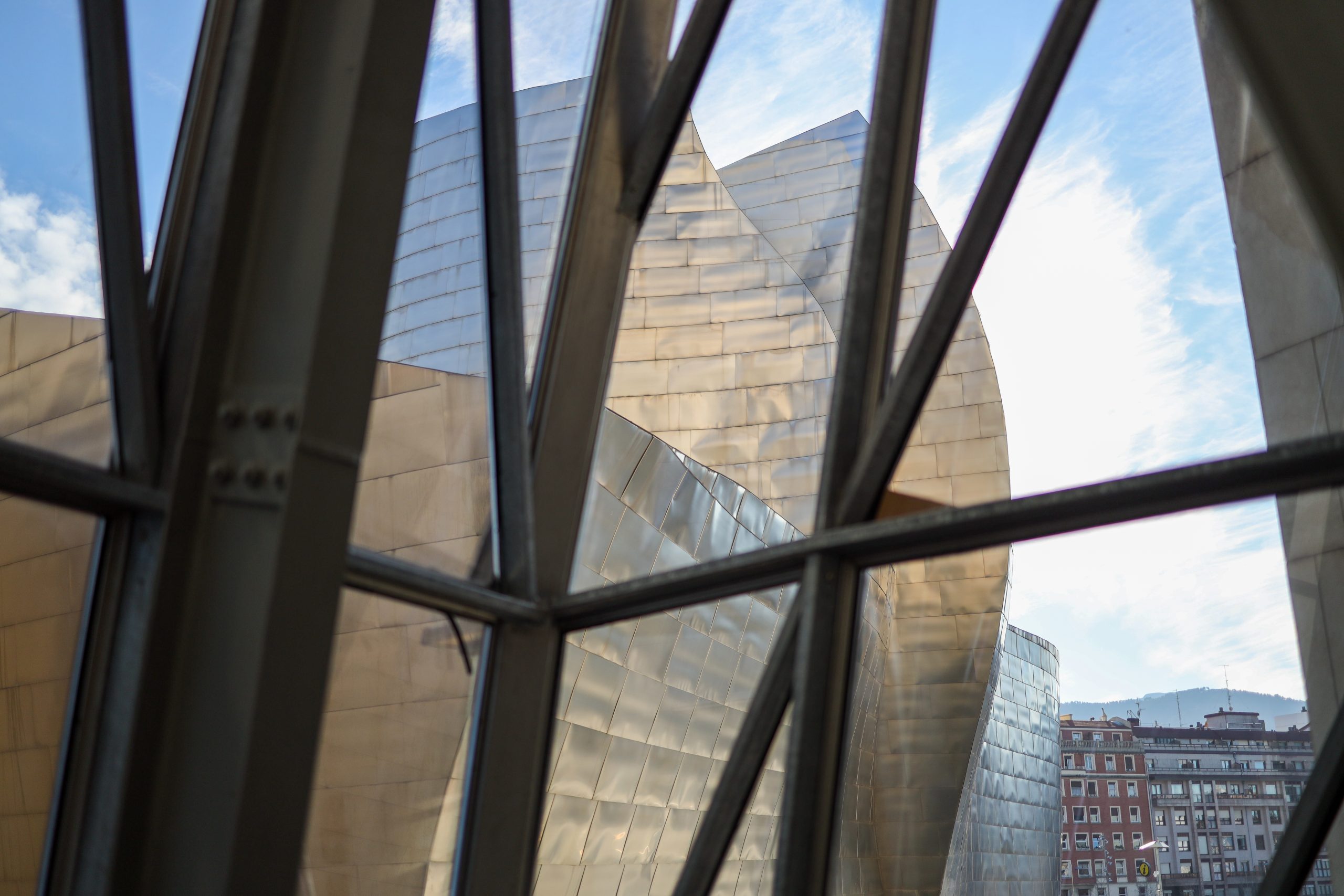
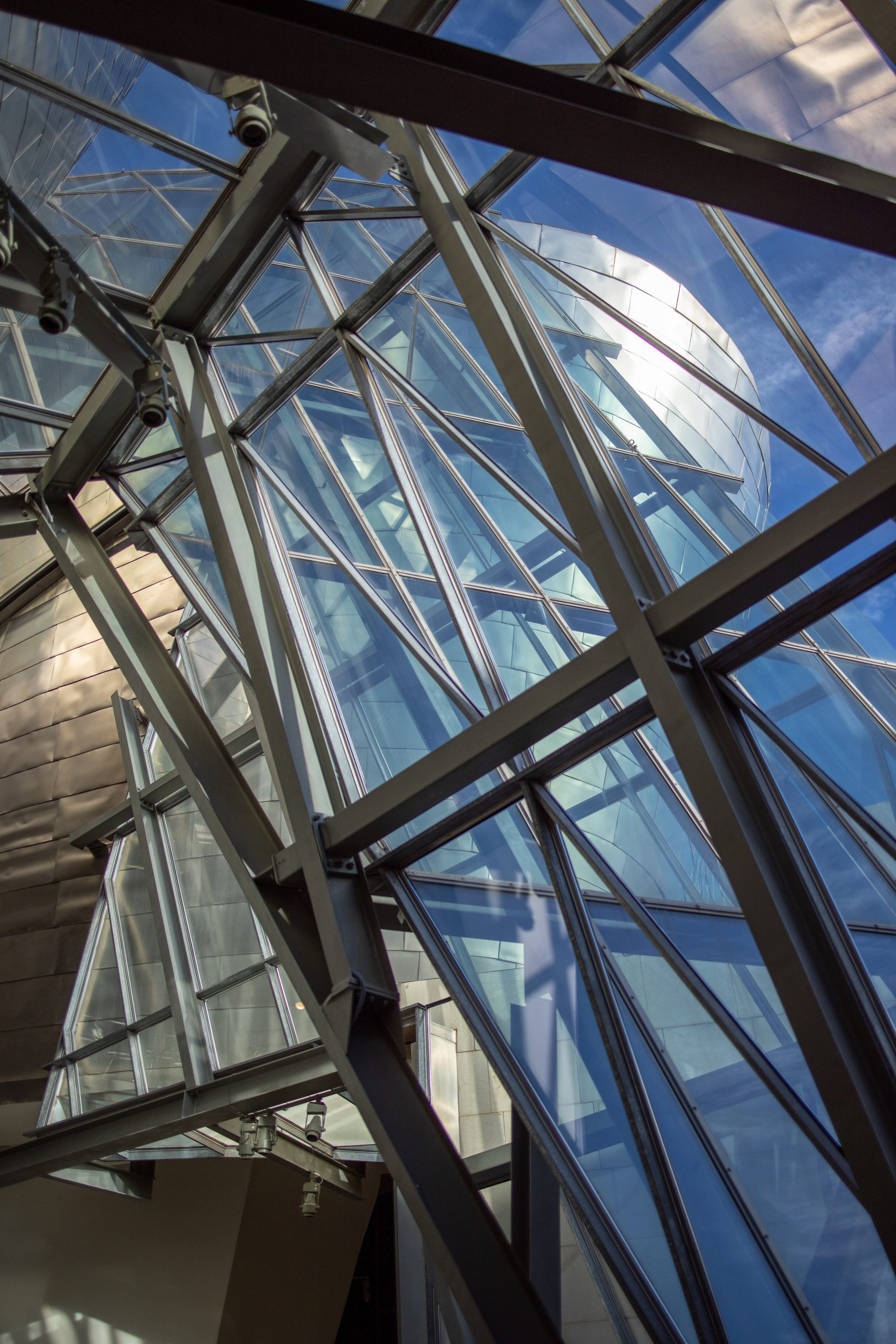
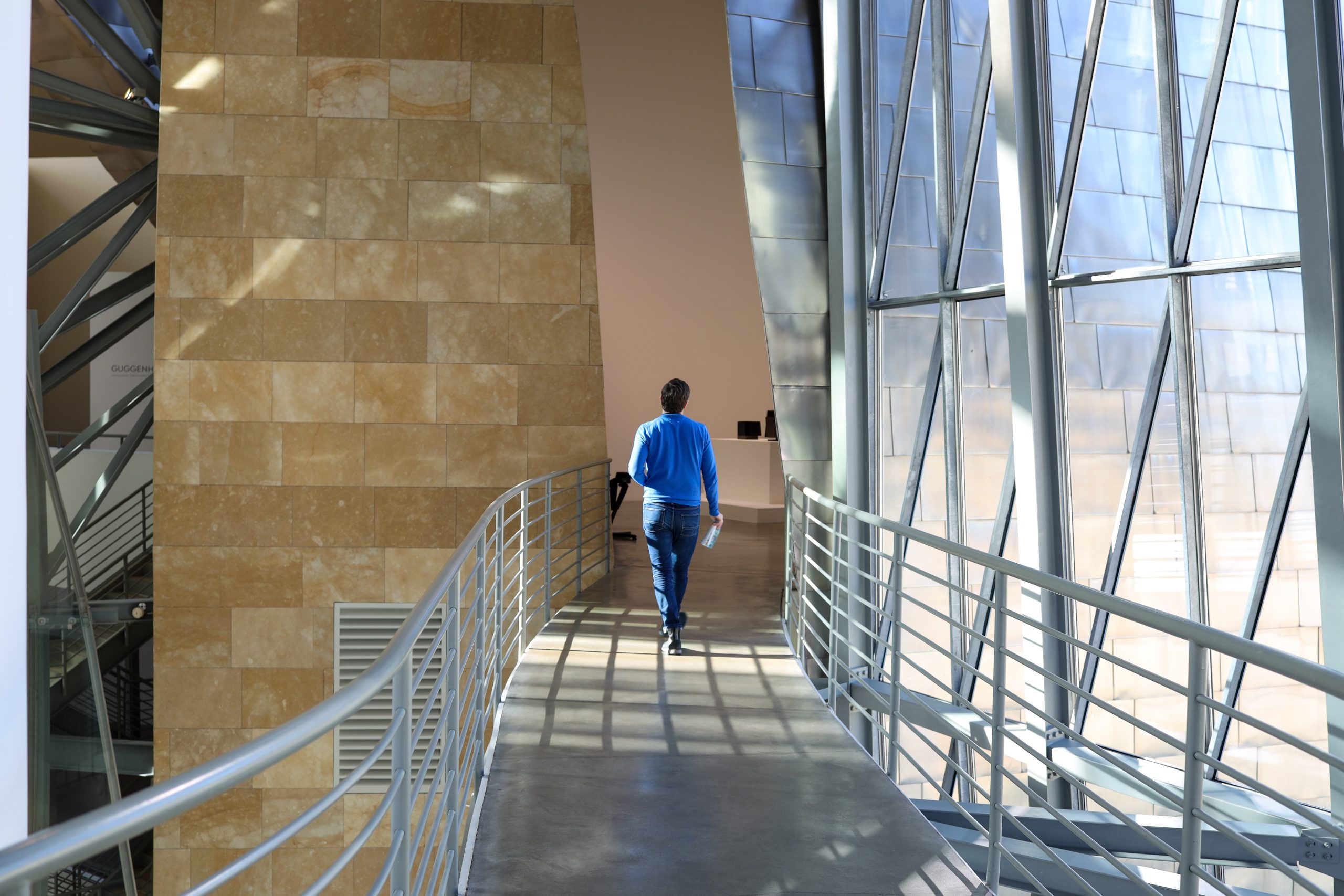
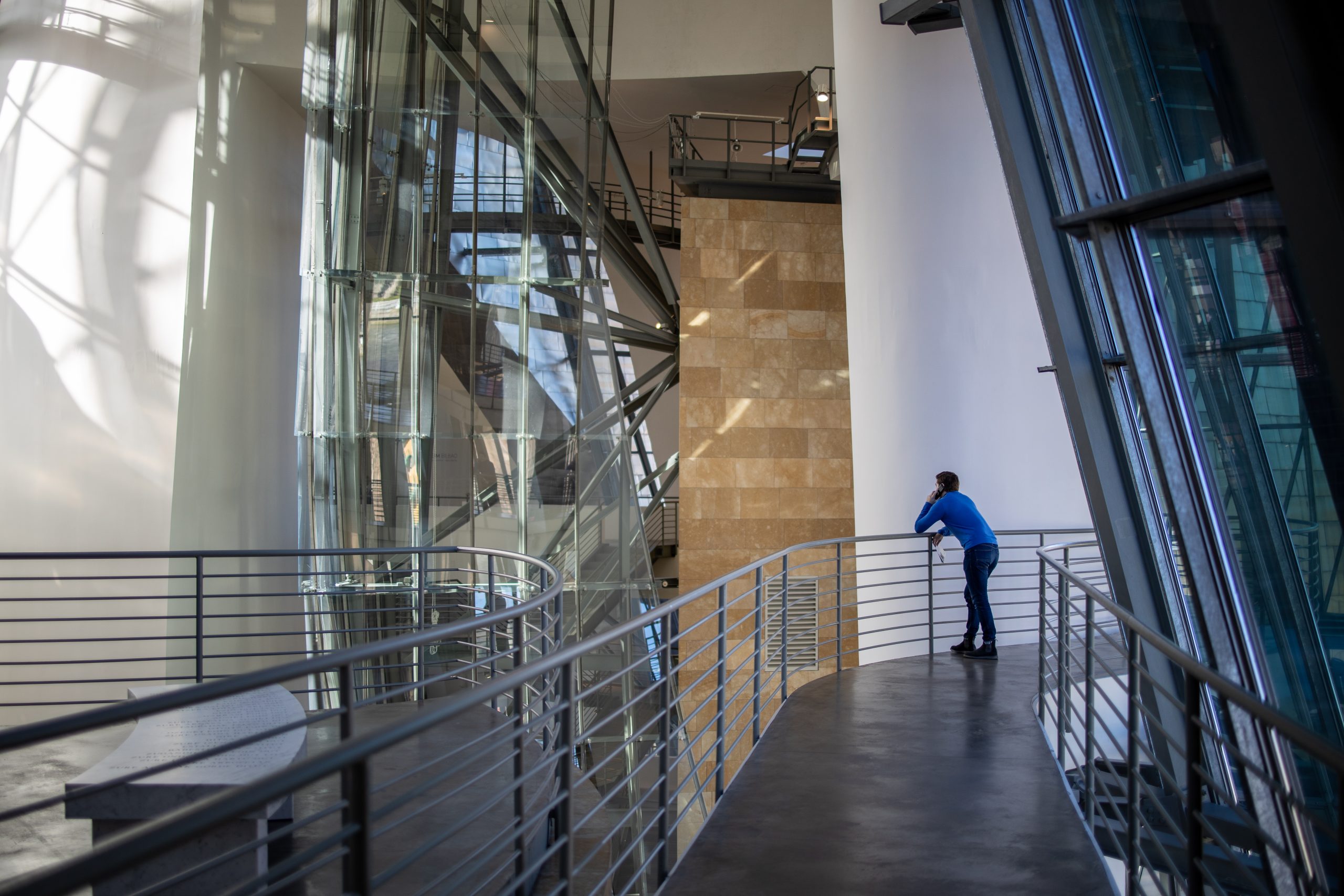
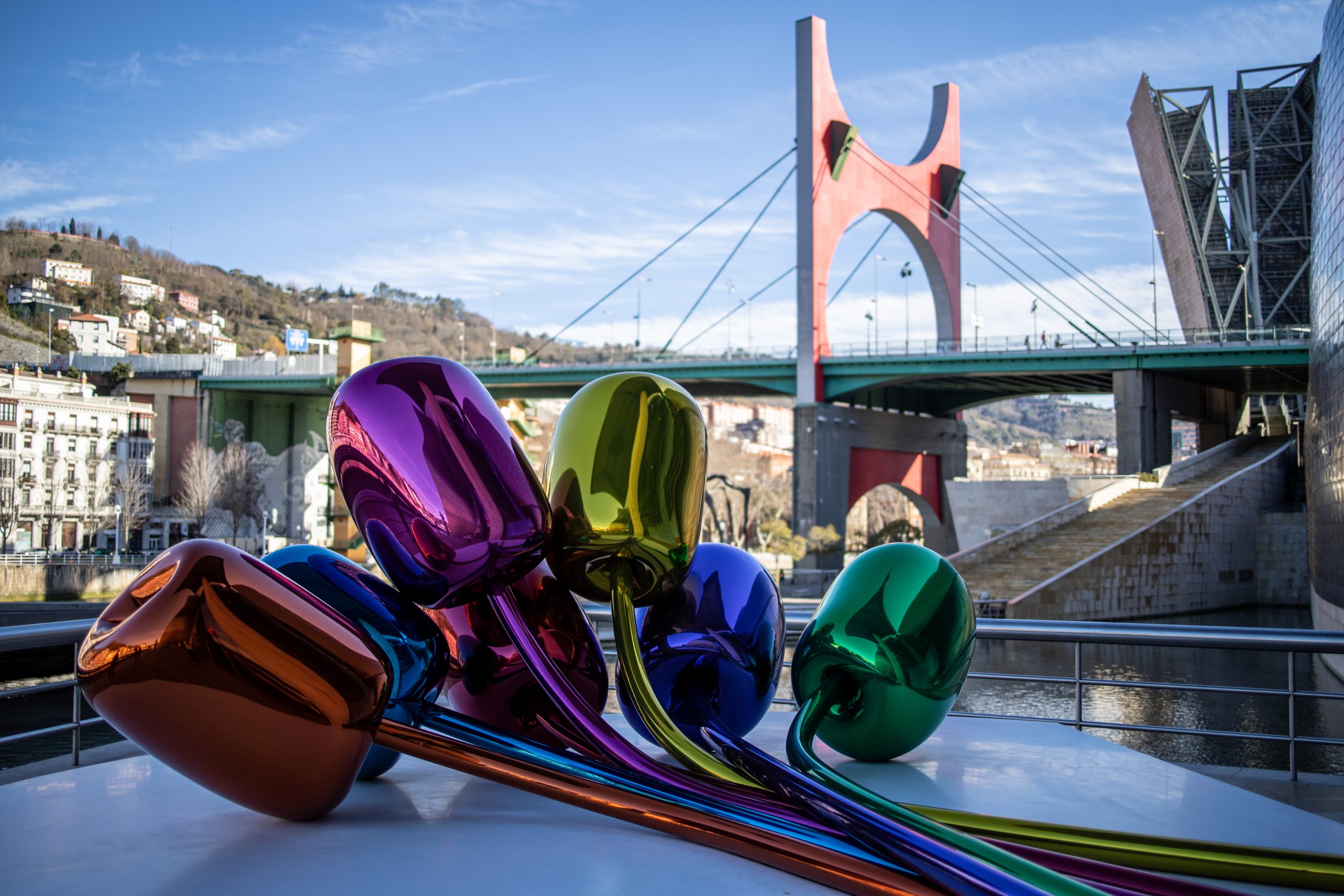
The museum sits in the Abandoibarra district on the south bank of the Nervión, connected to the city by the La Salve Bridge, which Gehry wrapped into the composition so that the museum passes beneath it. The red arch over the bridge is a later addition: Daniel Buren’s Red Arches, installed in 2007 for the museum’s tenth anniversary. The building is clad in approximately 33,000 titanium panels, each 0.38 millimetres thin, shaped and installed individually so that the surface shimmers and shifts colour as daylight changes and cloud passes. The form is deliberately uncategorisable: Gehry has resisted the “deconstructivist” label, and the building does resist labels. It reads differently from every angle — from the river as a ship; from the La Salve Bridge as a flower; from below as something between a rock formation and an organism. Inside, the 50-metre Atrium connects three floors of galleries through ramps, lifts, and walkways, some of them glazed, some curving out over the river.
How to approach the Guggenheim Bilbao
This guide covers the museum in four sections. We begin outside — the building’s exterior, the approach from the river, and the outdoor sculptures including Jeff Koons’ Puppy and Louise Bourgeois’ Maman, which together constitute one of the best outdoor sculpture environments in Europe. We then go inside, with particular focus on the one room that everyone agrees on: Gallery 104, where Richard Serra’s The Matter of Time permanently occupies 130 metres of the museum’s largest hall. The third section covers the permanent collection highlights and the Atrium. The fourth section is practical: tickets, timing, the free Tuesday window, and what to combine with a Bilbao visit.

The building that changed a city
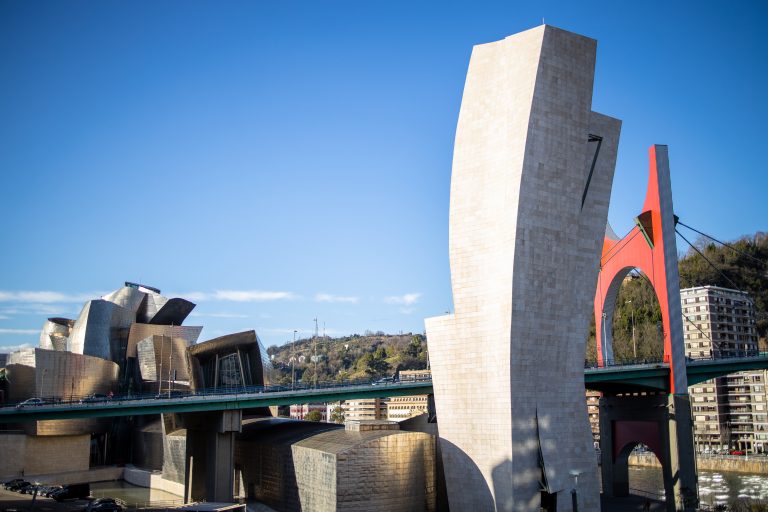
Frank Gehry's Guggenheim opened on 18 October 1997 on the south bank of the Nervión. The 400,000 visitors expected in the first year became 1.3 million, and the "Bilbao effect" entered the vocabulary of city planners.
The Guggenheim Museum Bilbao beside the Nervión, with the red arch of the La Salve Bridge and a limestone tower
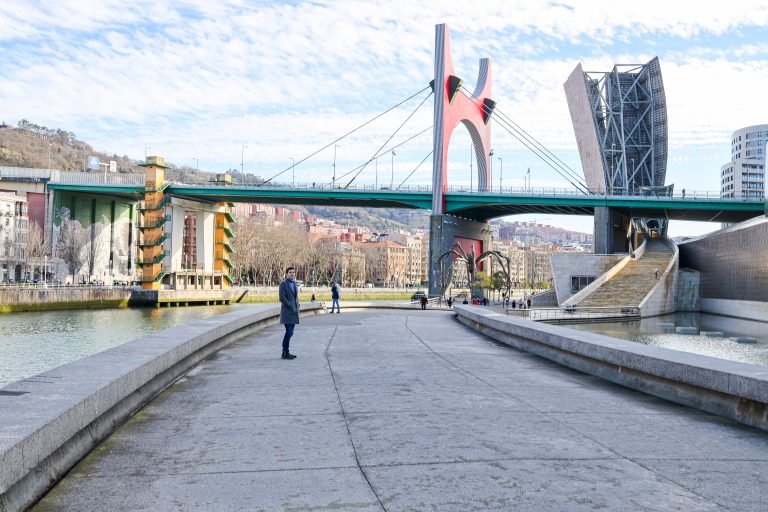
Arrive from the east
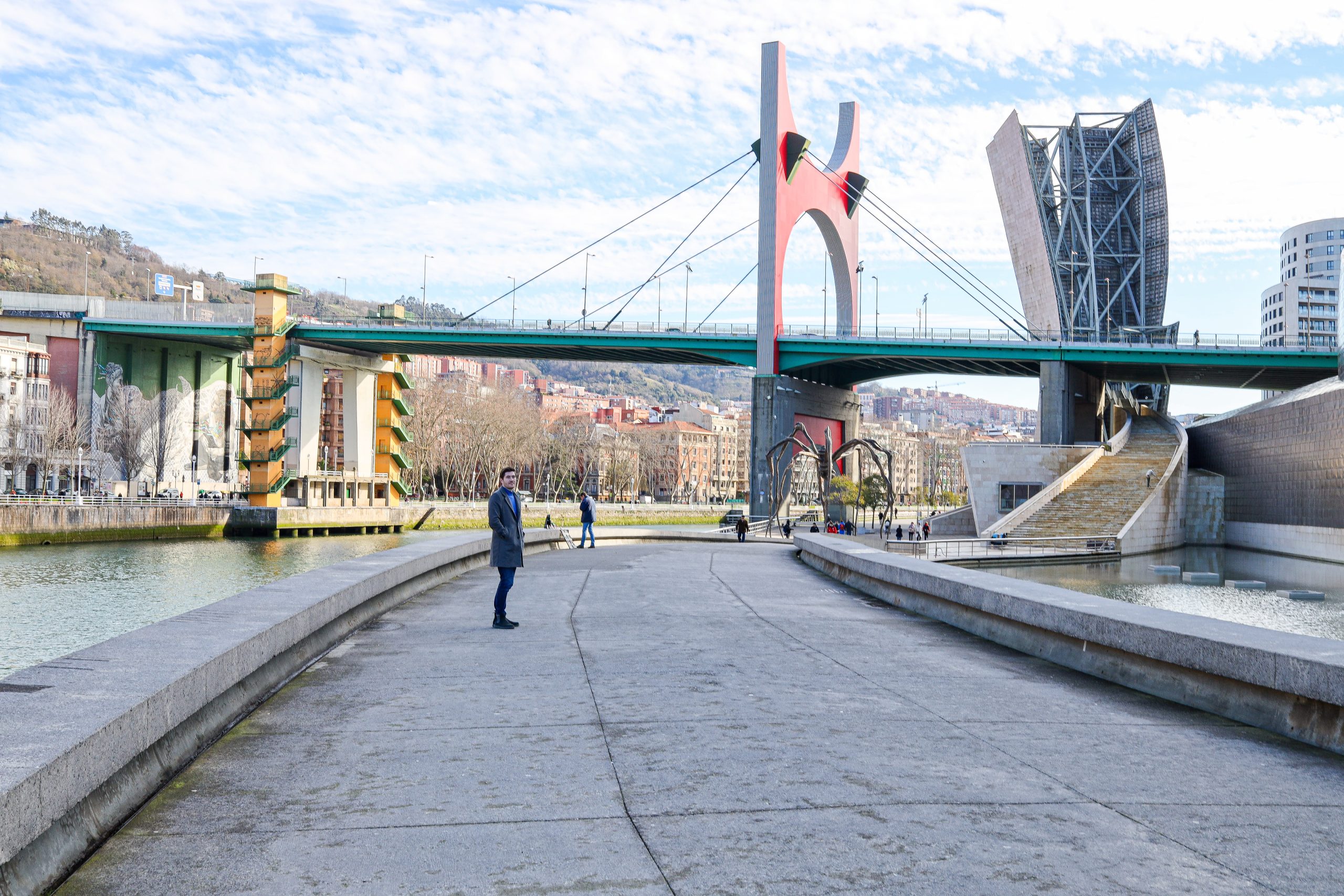
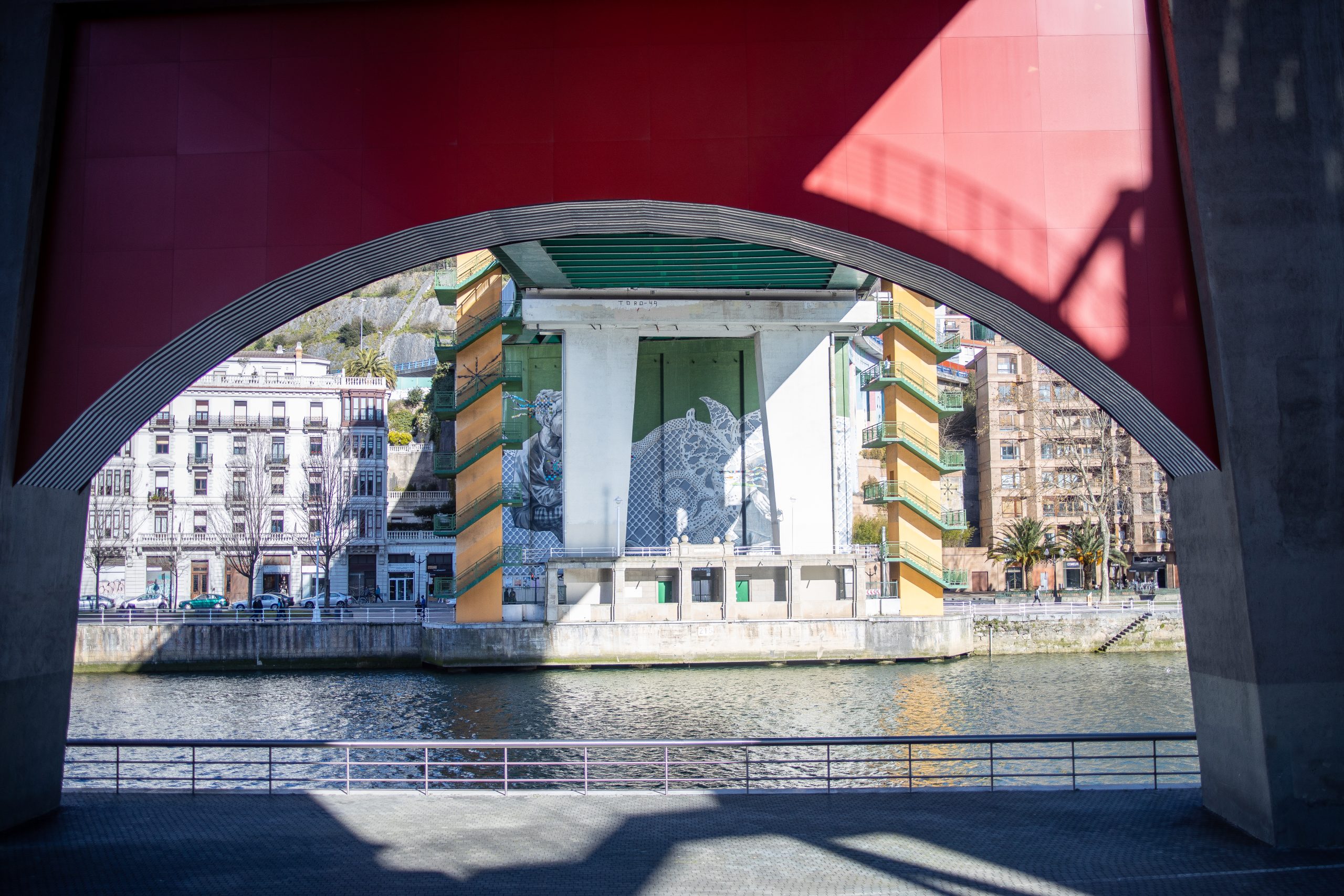
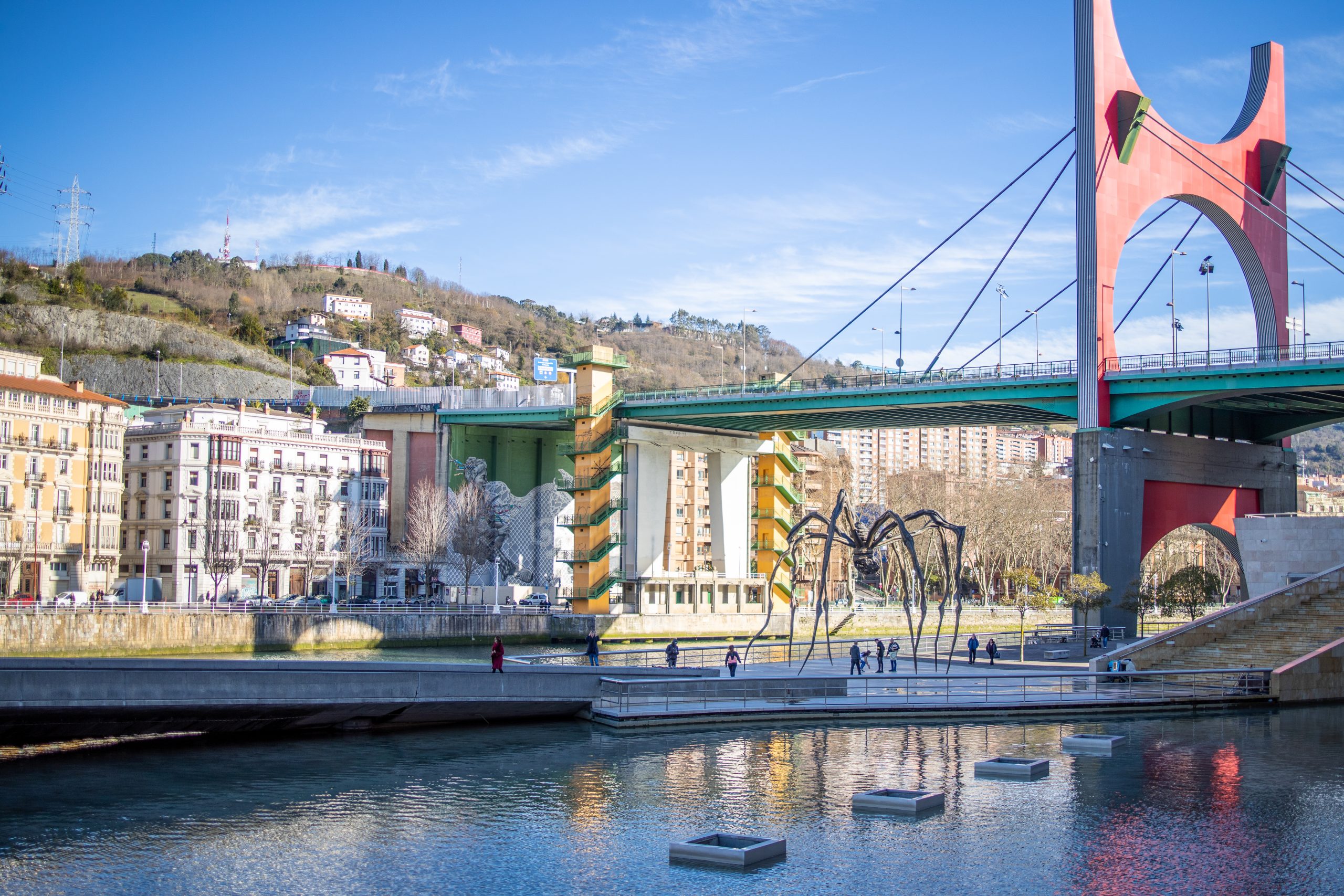
Walk along the Nervión from the old town and approach under the La Salve Bridge, which Gehry wrapped into the composition so that the museum passes beneath it. Daniel Buren's red arches on the bridge were added in 2007.
The riverside promenade below La Salve Bridge, the eastern approach to the Guggenheim Museum along the Nervión
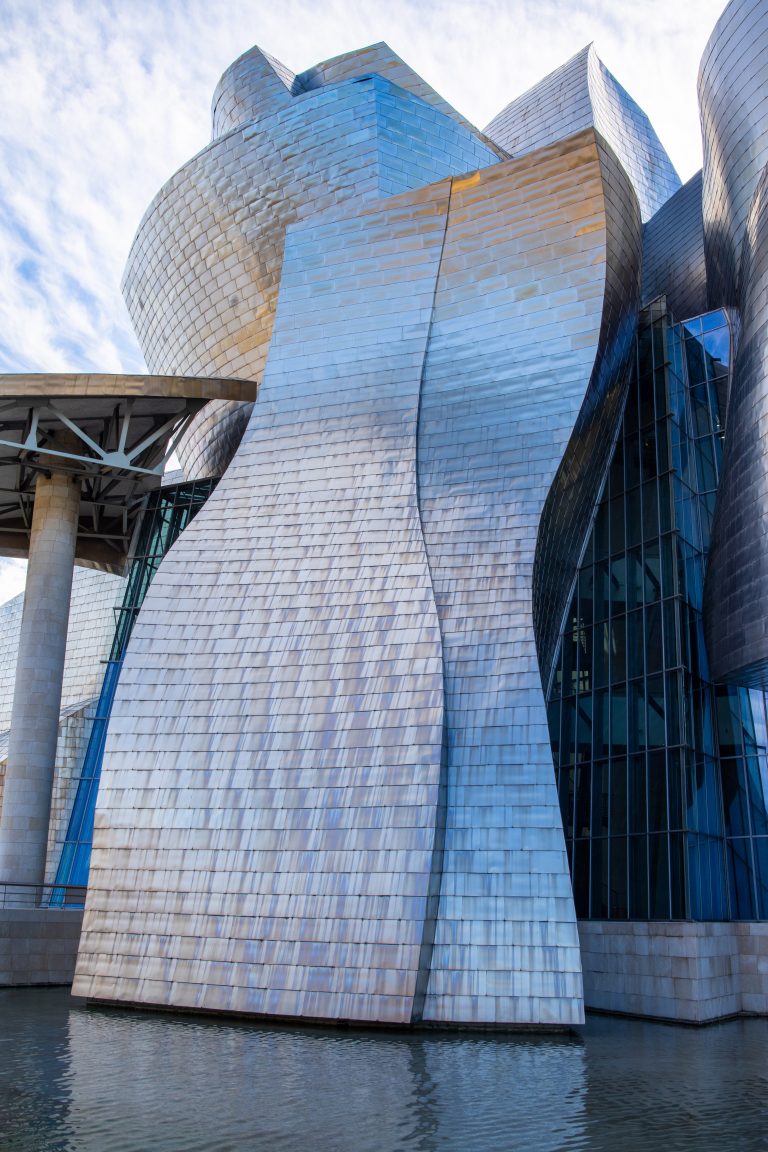
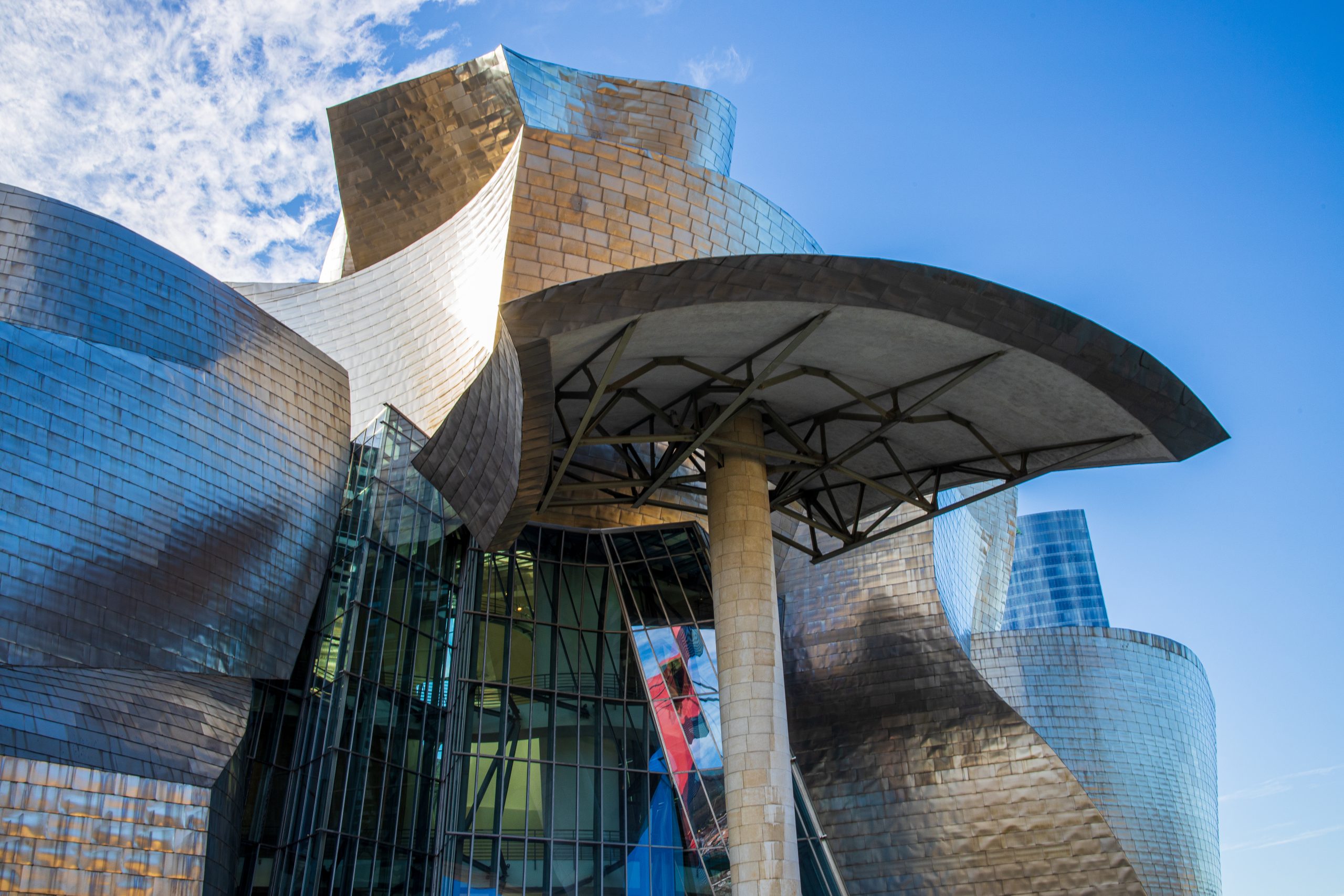
A skin 0.38 millimetres thin
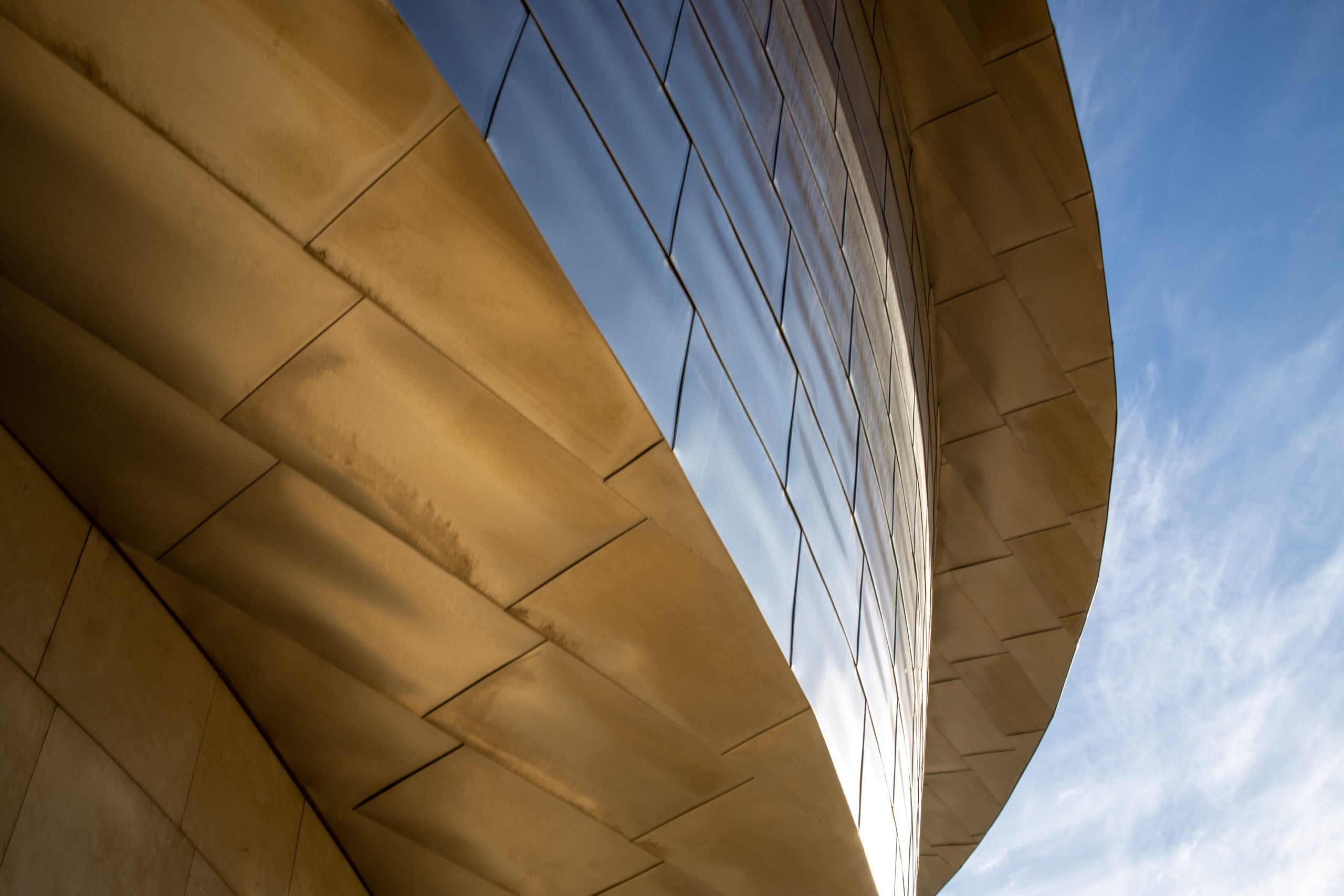
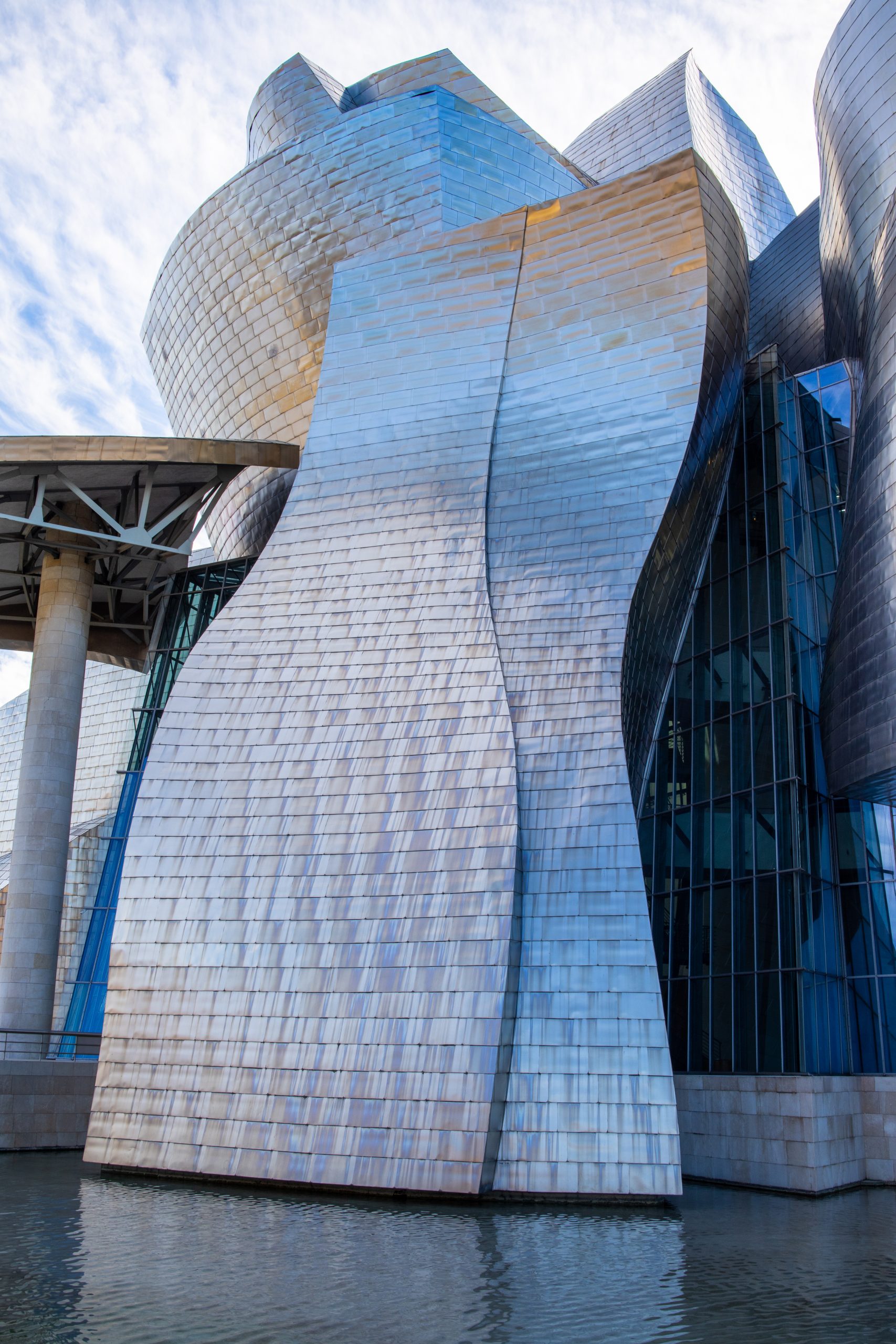
The building is clad in about 33,000 titanium panels, each 0.38 millimetres thin, shaped with aerospace software. The surface shifts from silver to gold to near-white as cloud and sun pass.
The rippling titanium skin of the Guggenheim Museum Bilbao rising straight from the water
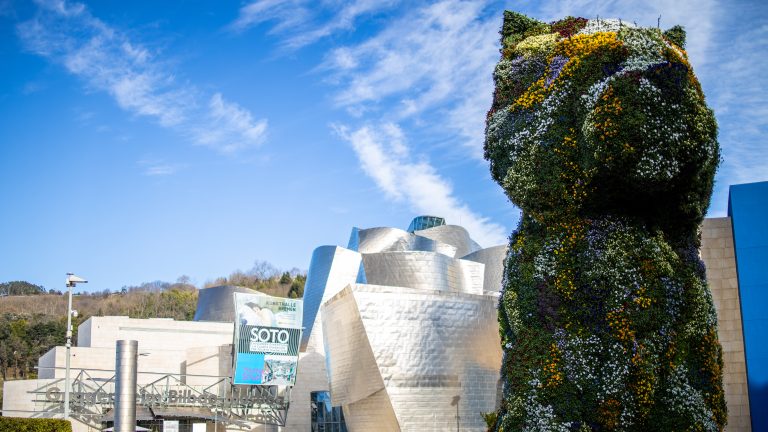
Puppy
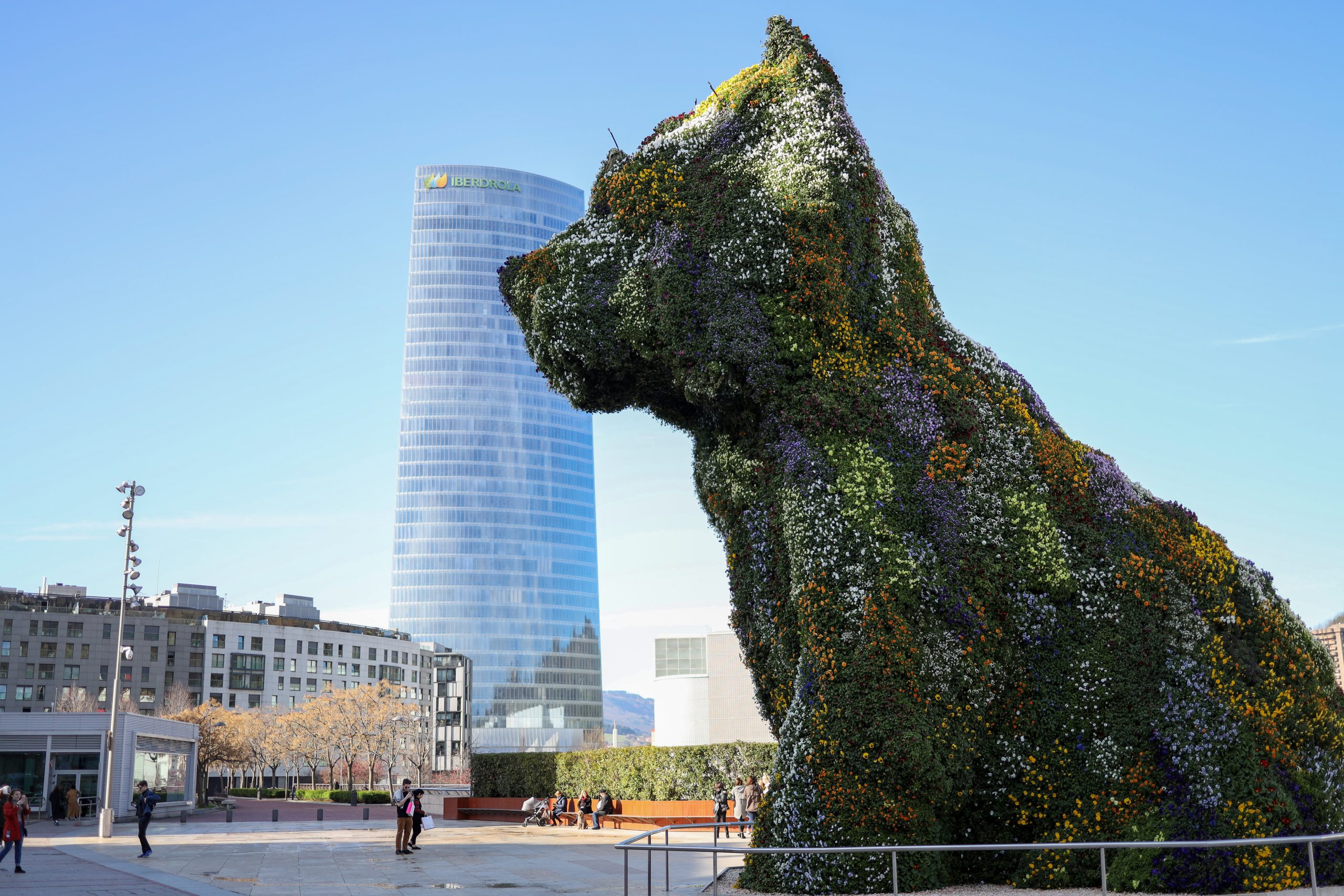
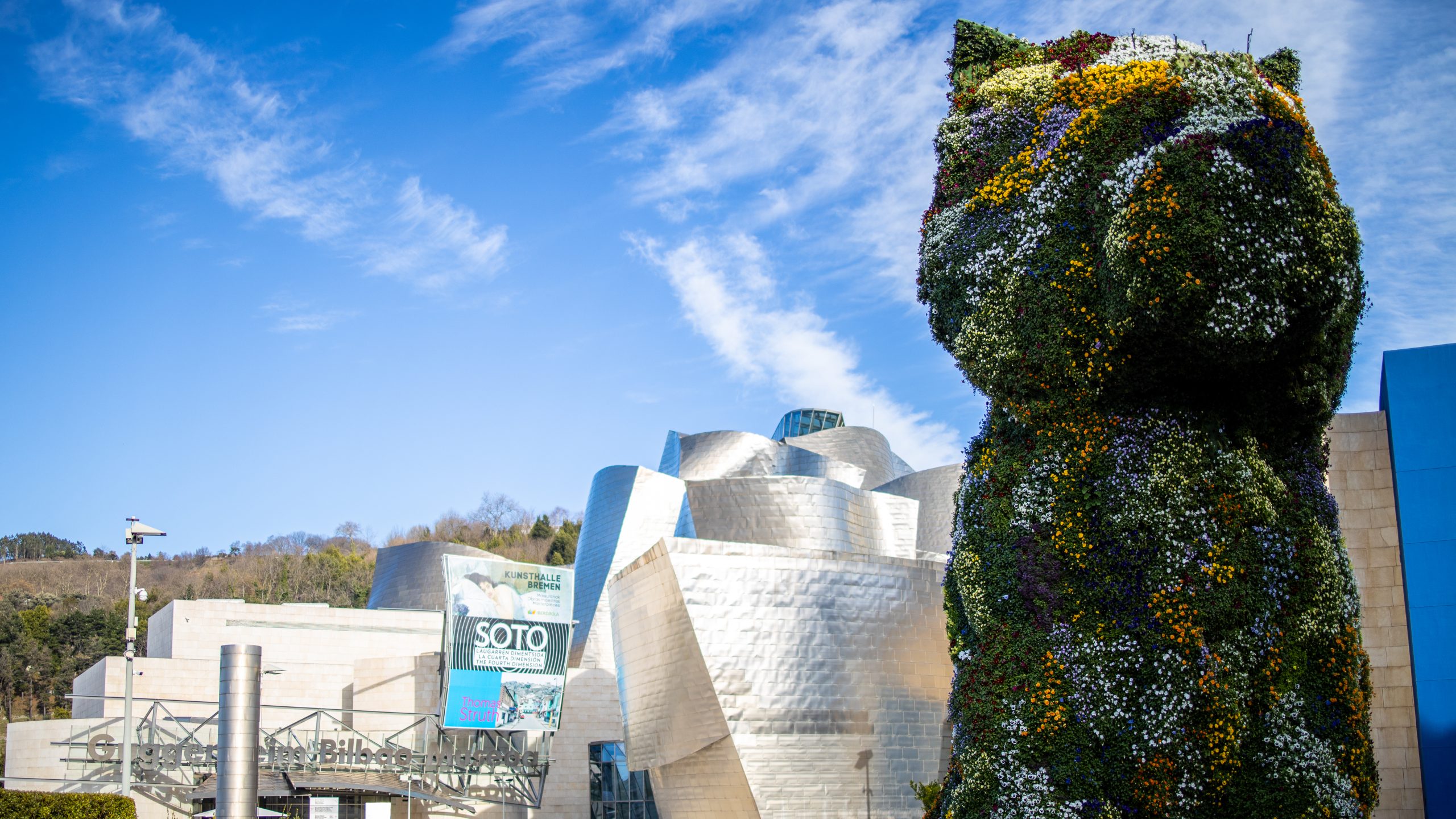
Jeff Koons' Puppy, a 12-metre West Highland terrier covered in about 60,000 living flowers, stands at the main entrance and changes with the seasons.
Jeff Koons’ flower-covered Puppy standing guard in front of the titanium facade of the Guggenheim Museum Bilbao
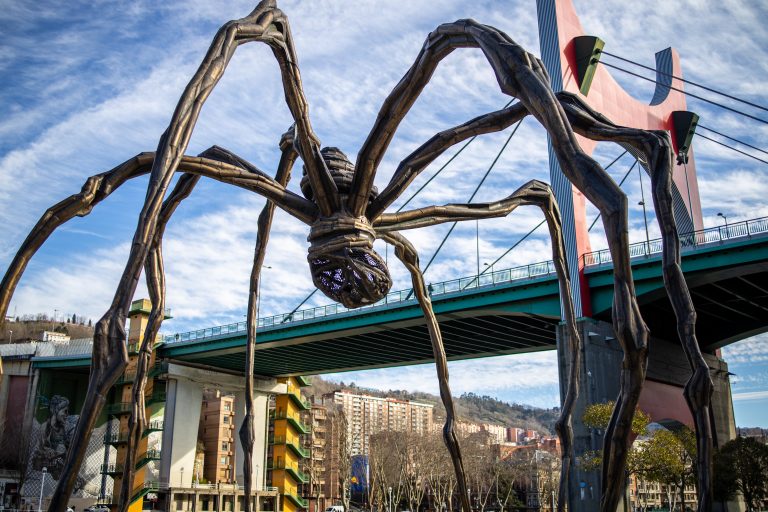
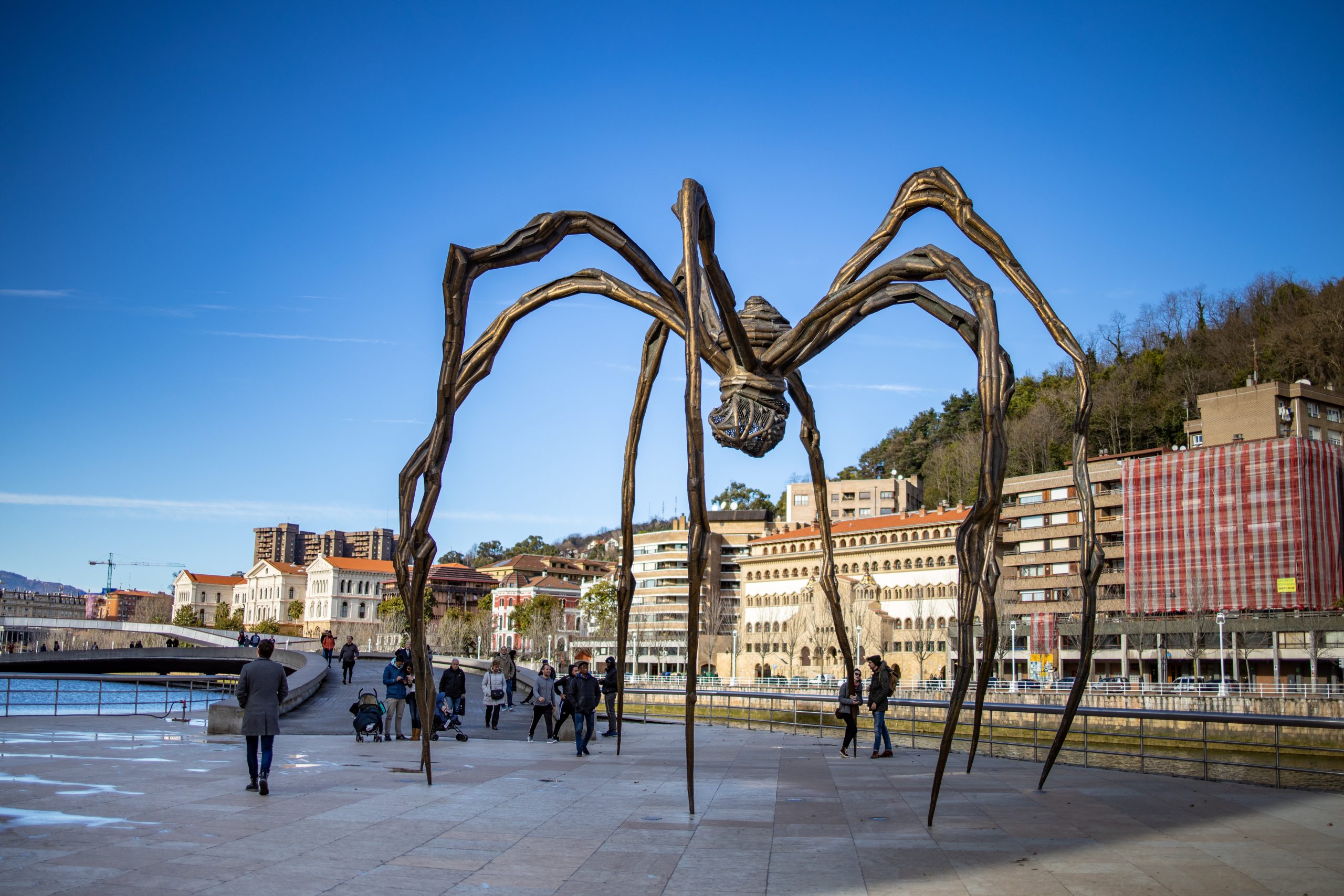
Maman and the water garden
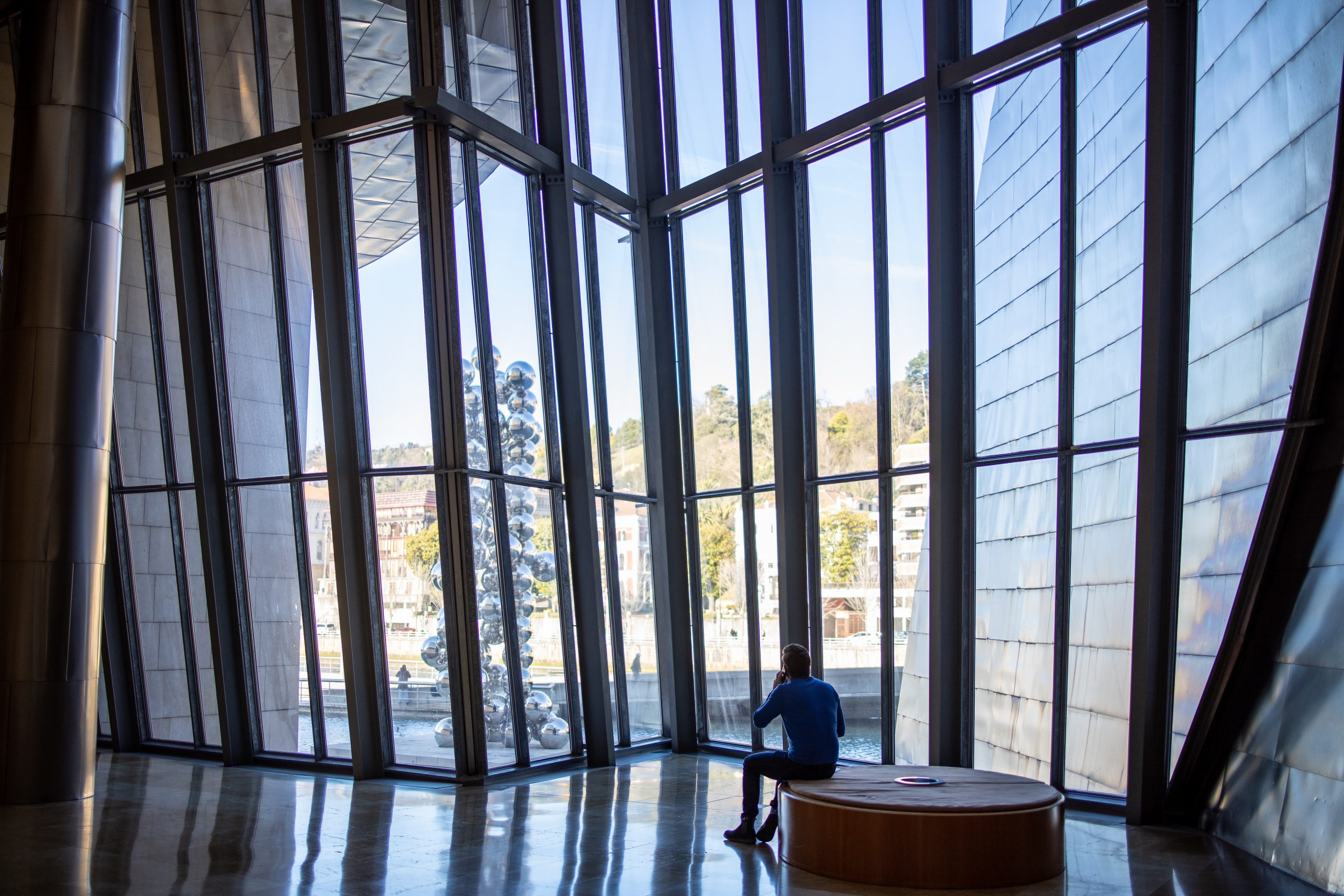
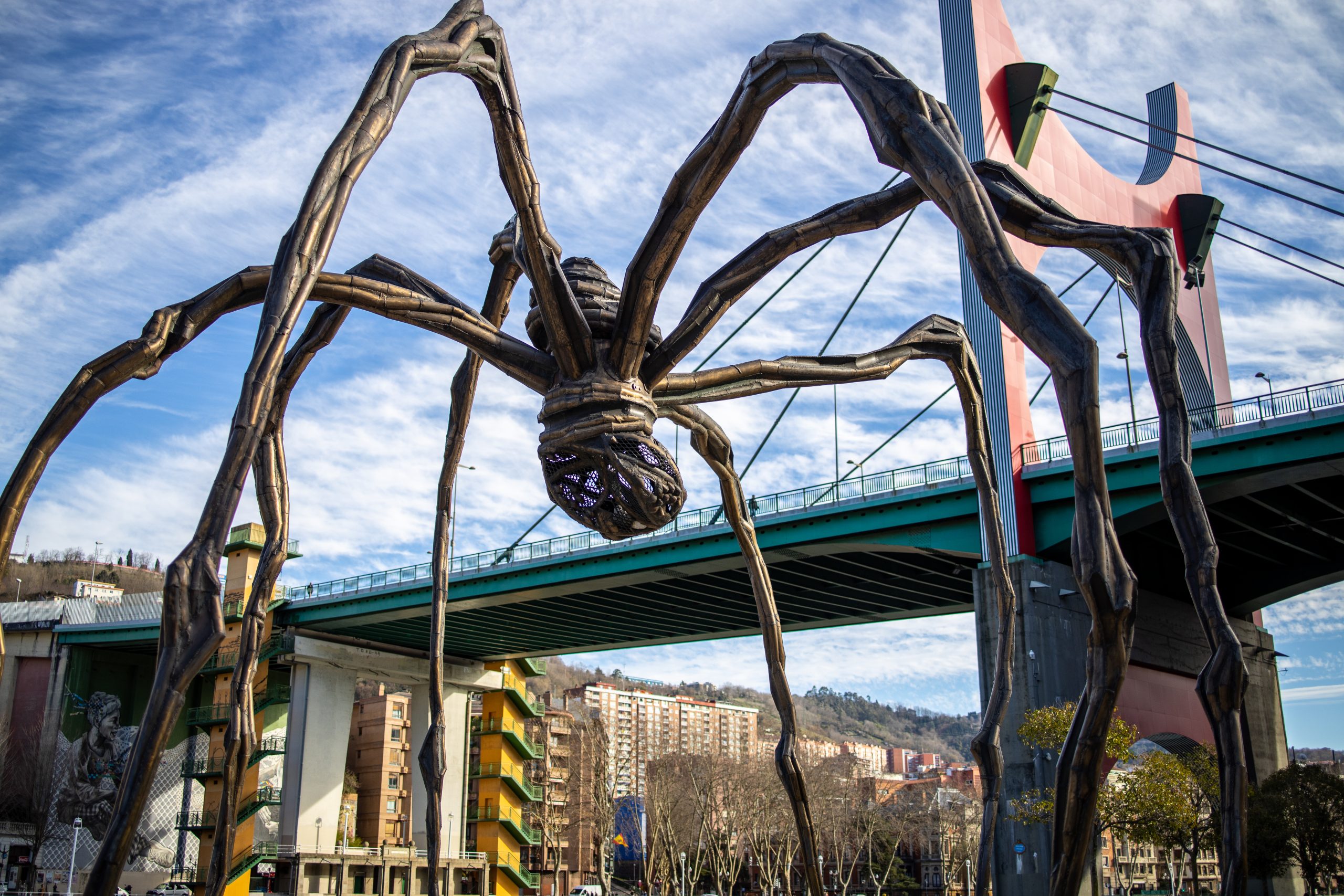
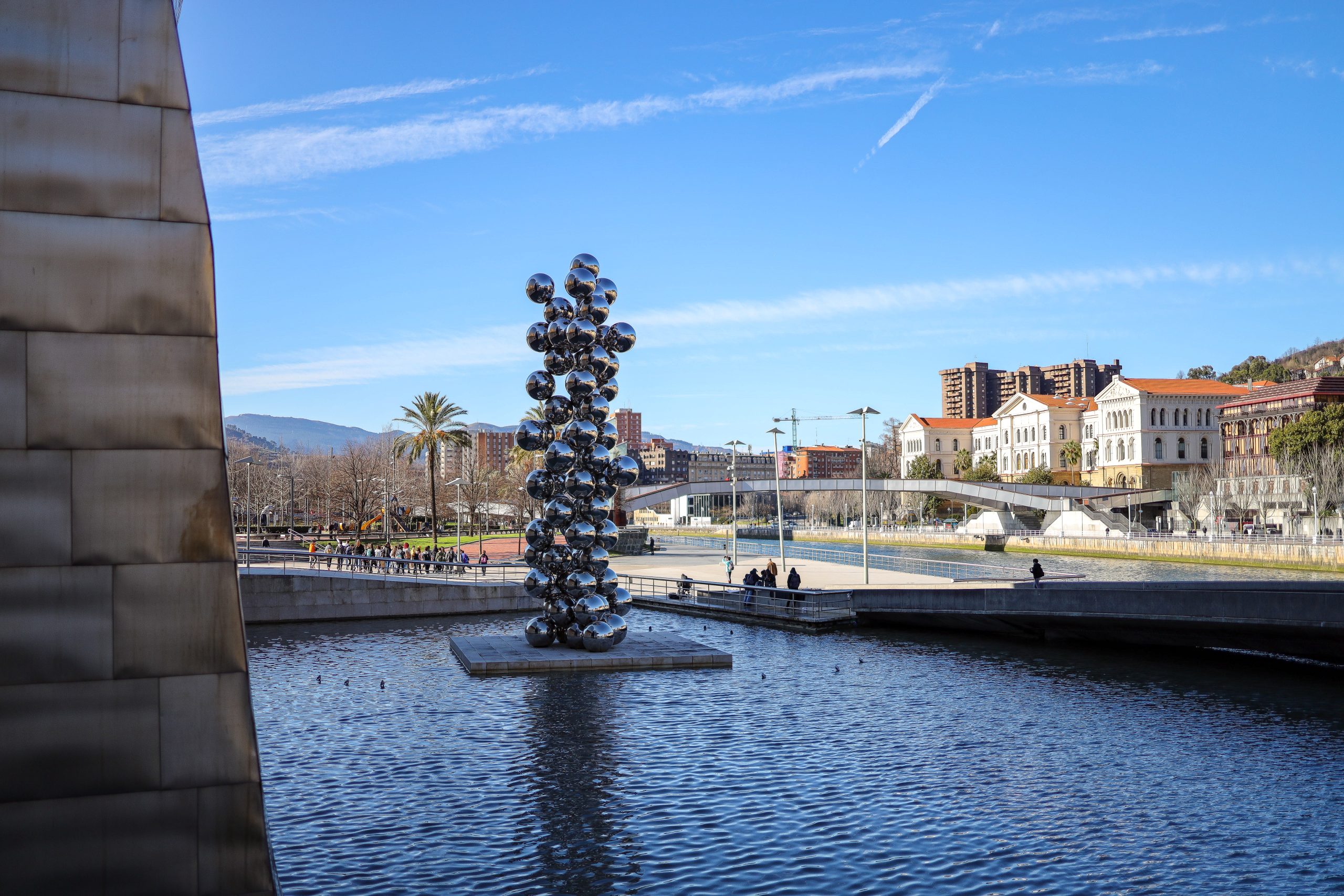
Louise Bourgeois' Maman, a 9-metre bronze and steel spider, stands between the building and the river. Anish Kapoor's Tall Tree and the Eye rises from the pool nearby.
Louise Bourgeois’ giant spider Maman on the Nervión riverfront, with the red arch of La Salve Bridge behind
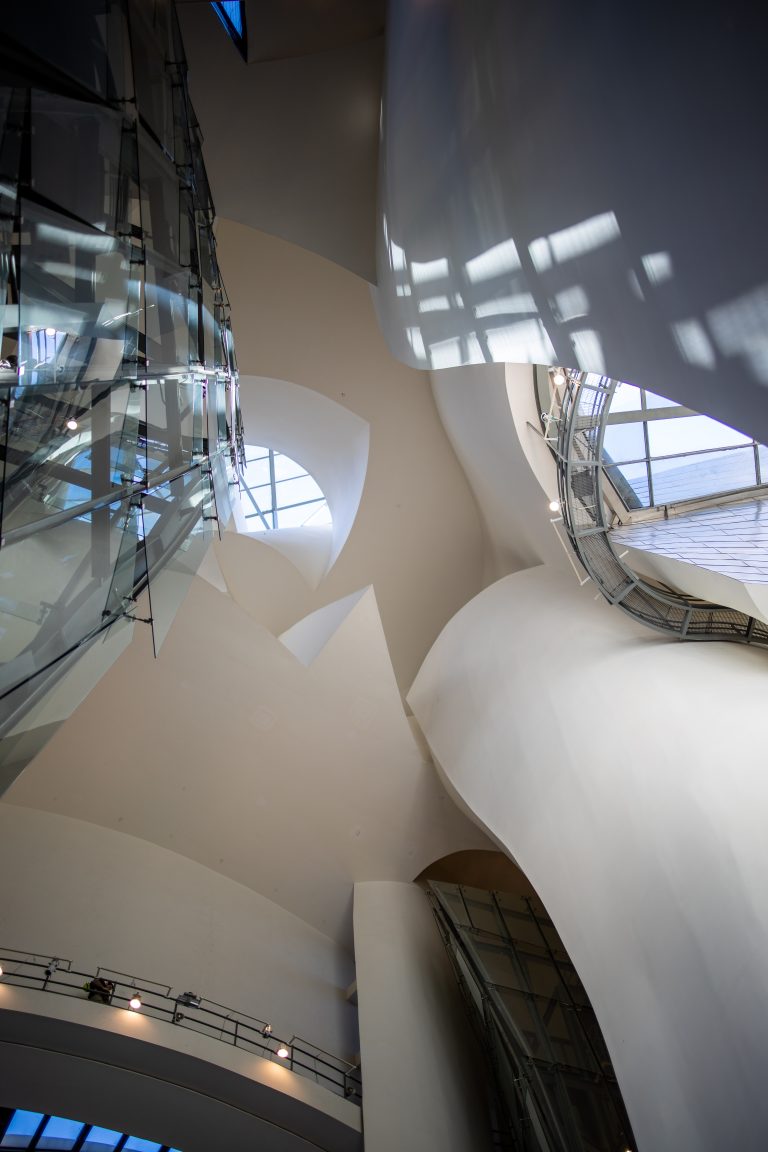
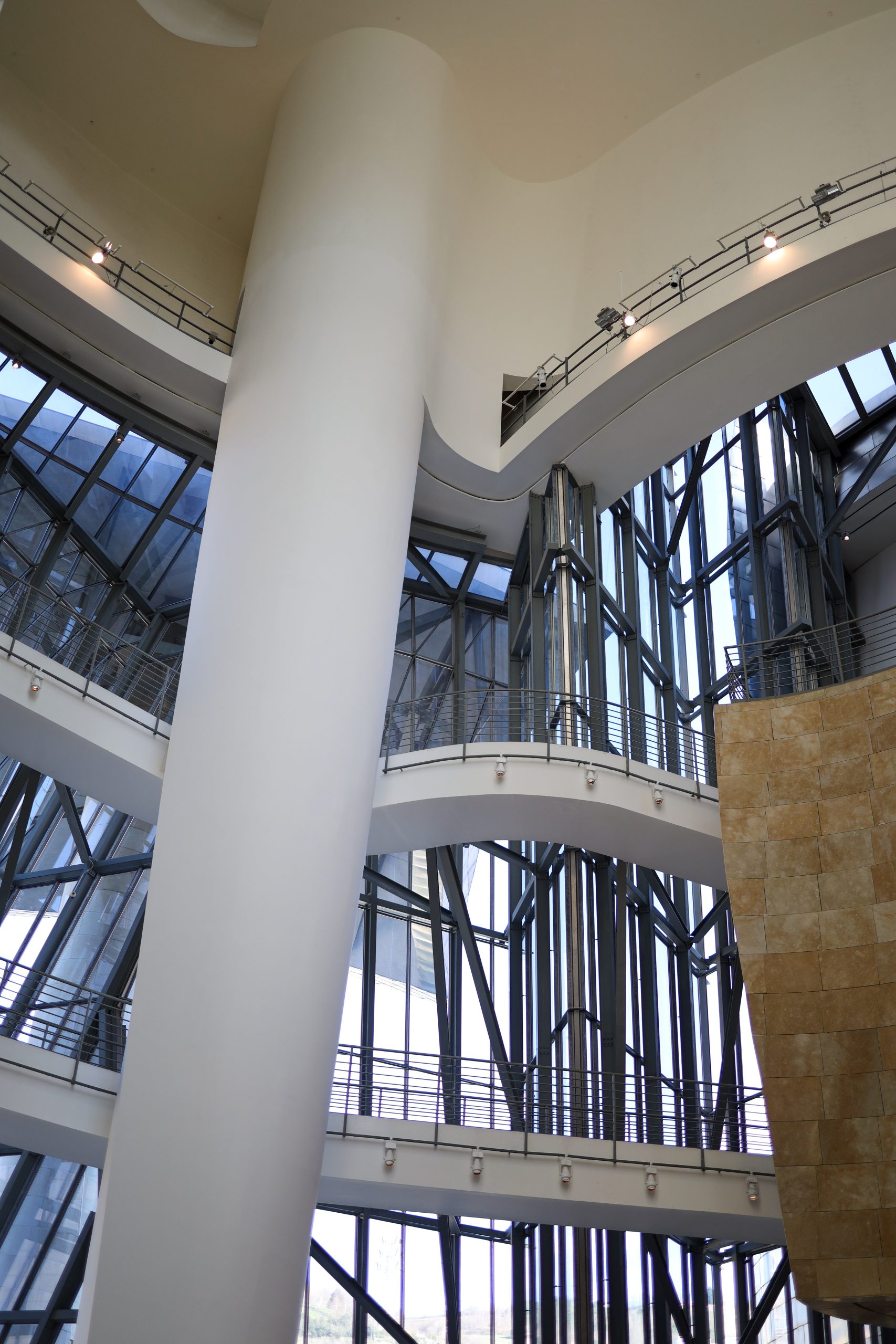
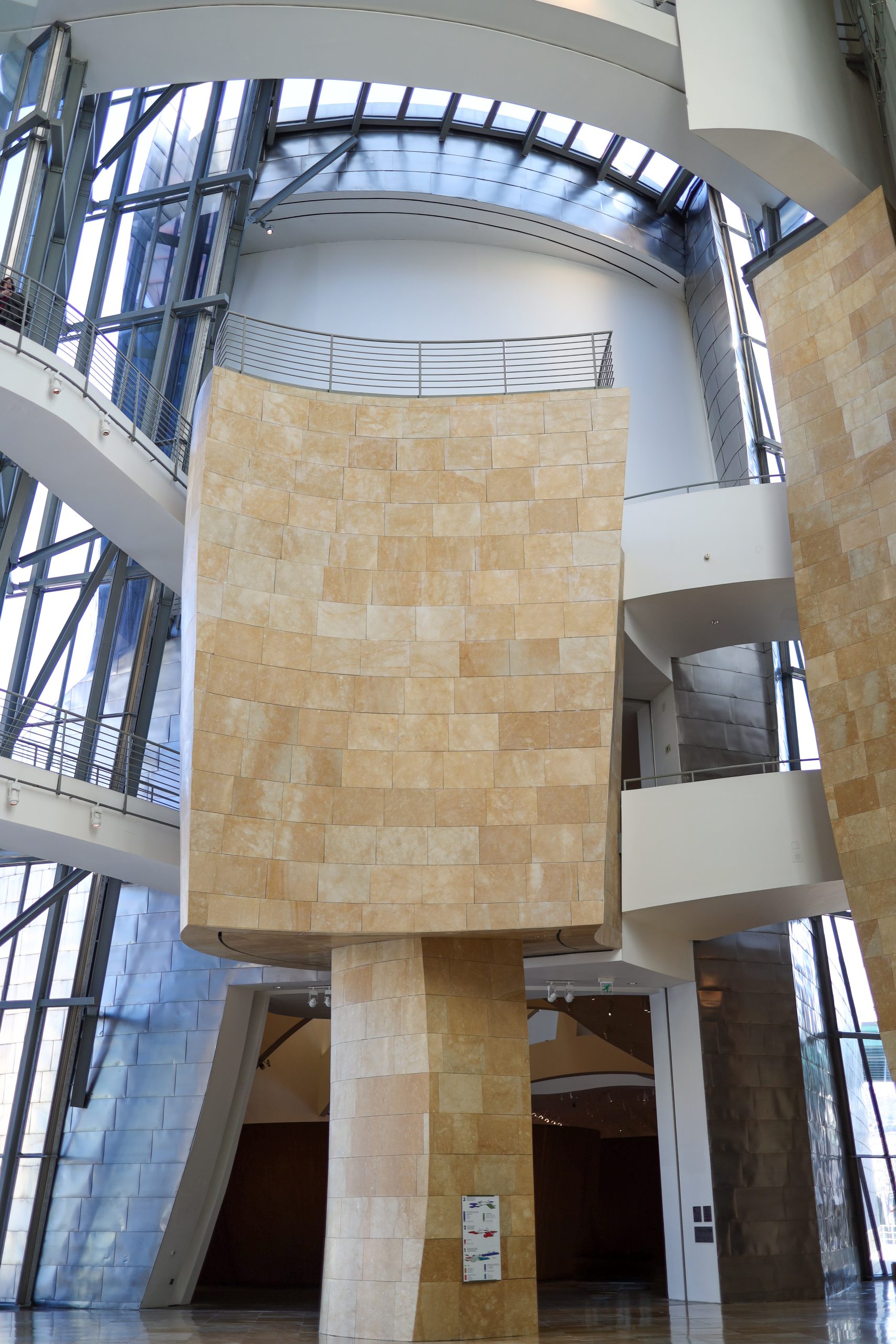
Three floors around a 50-metre Atrium
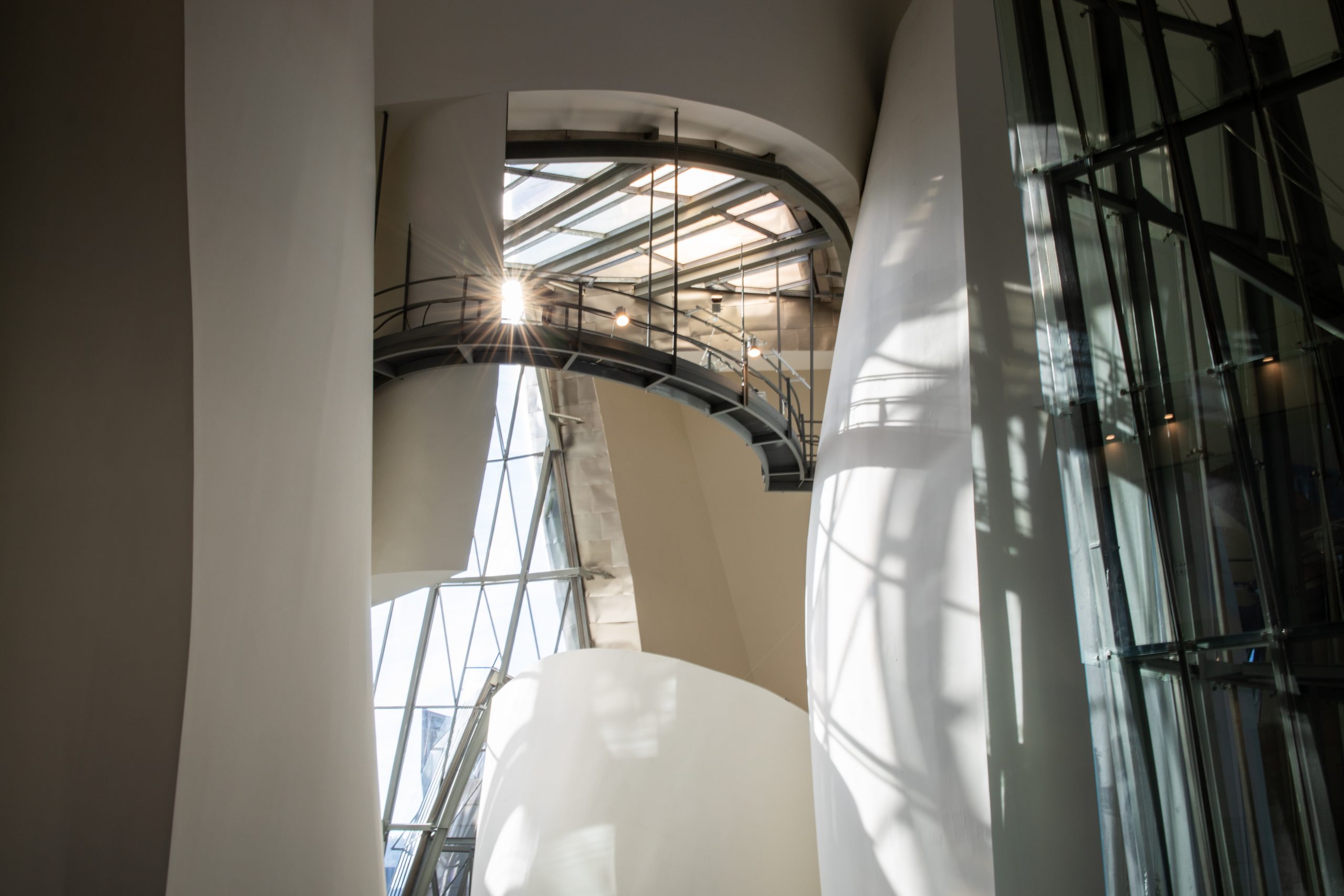
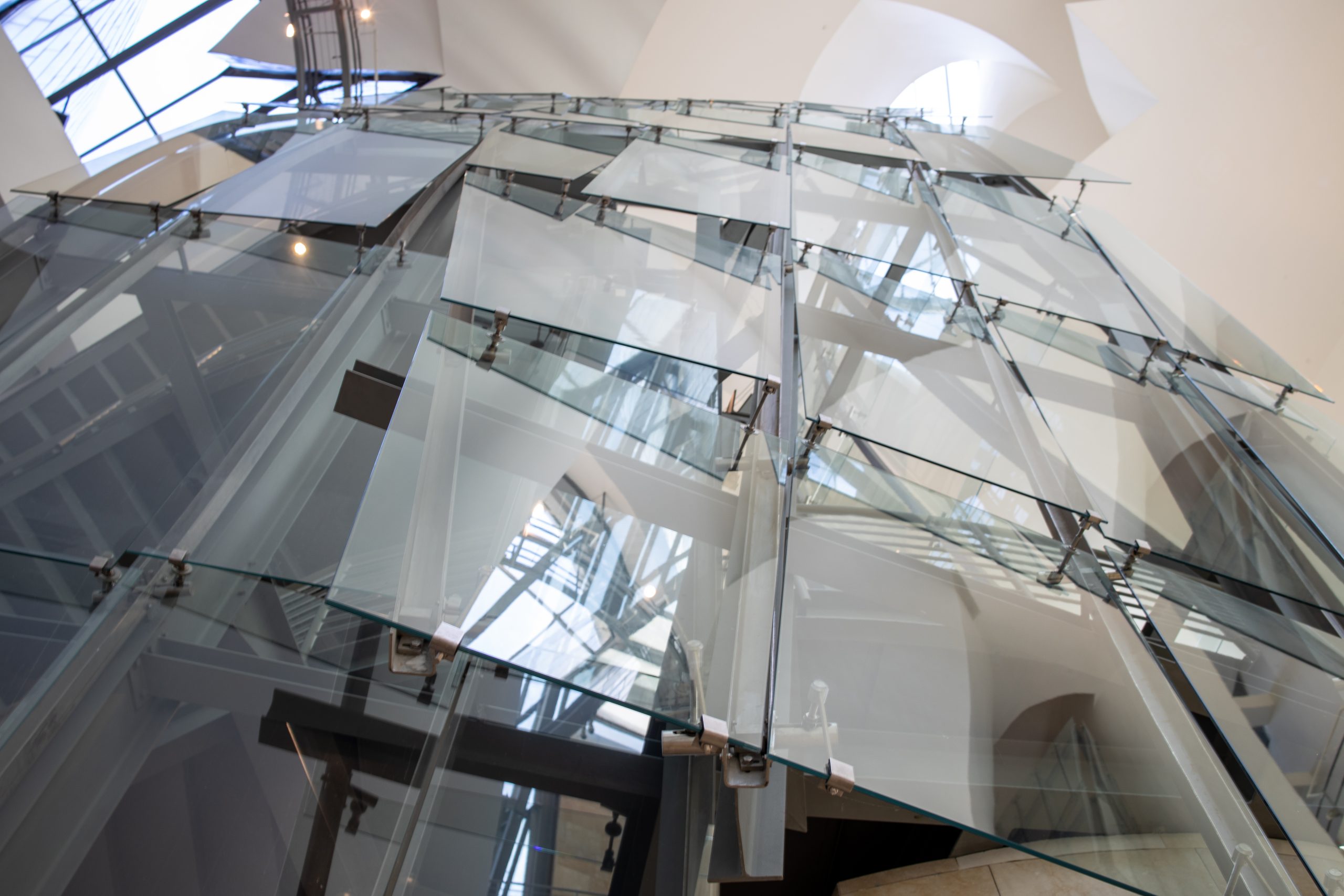
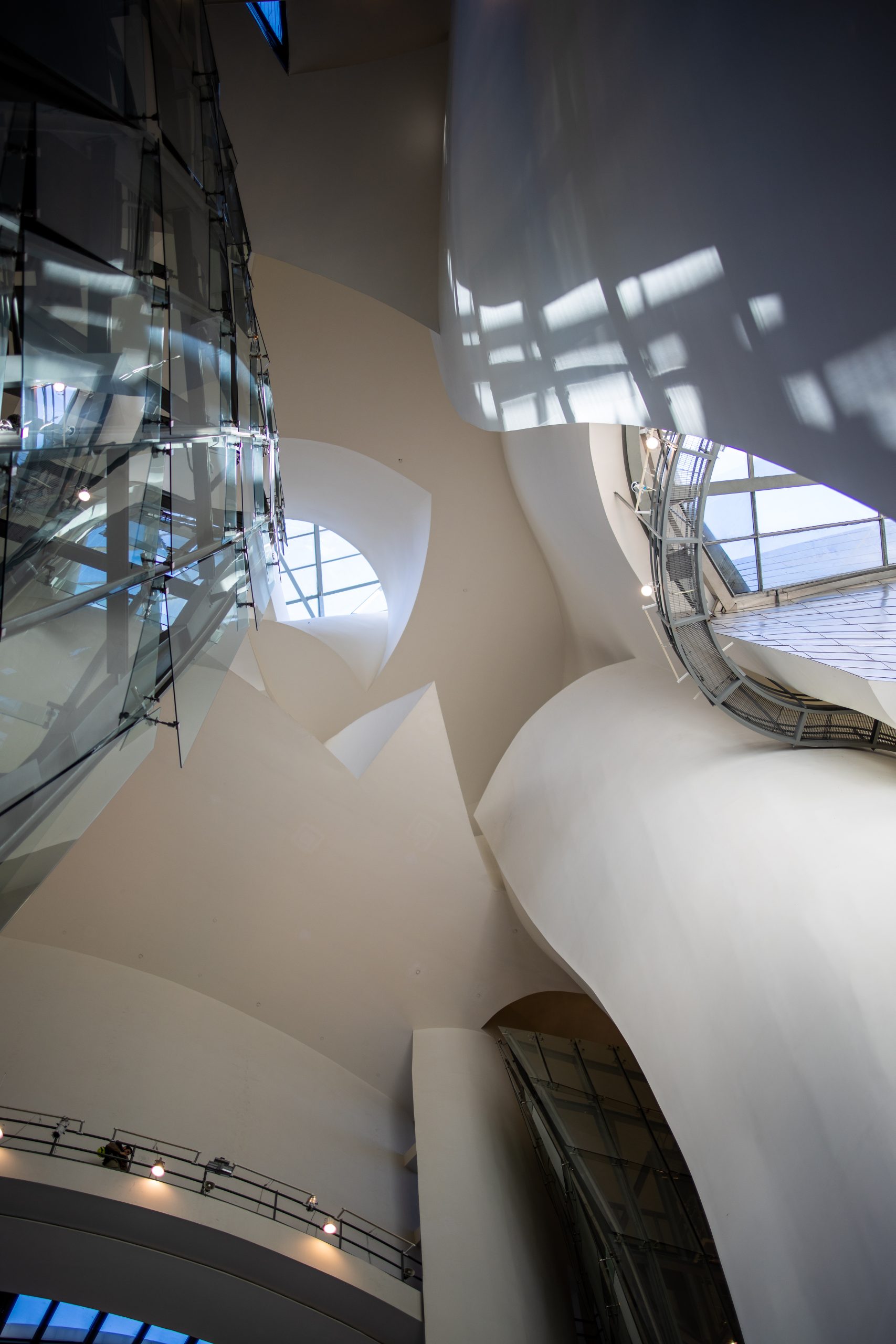
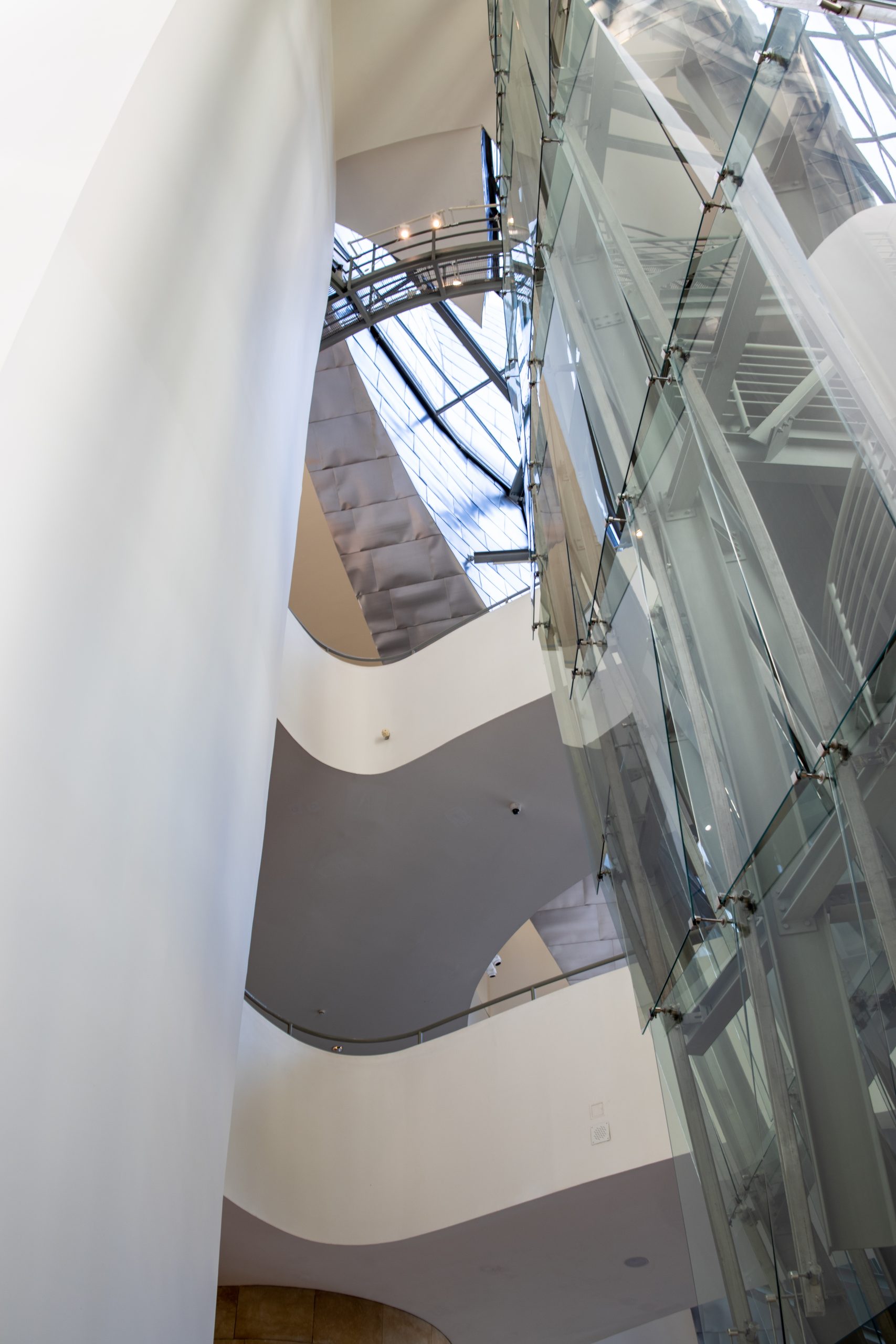
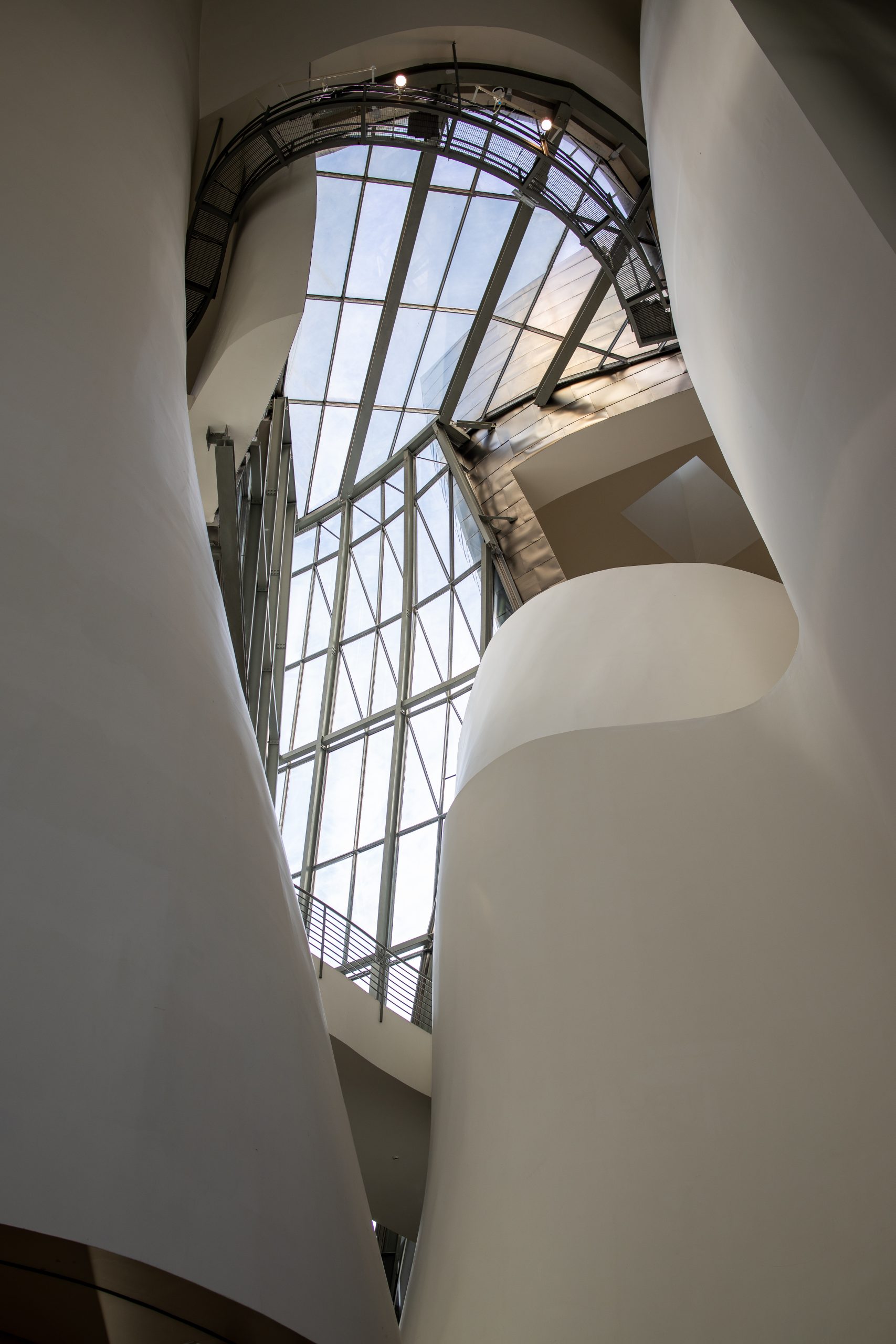
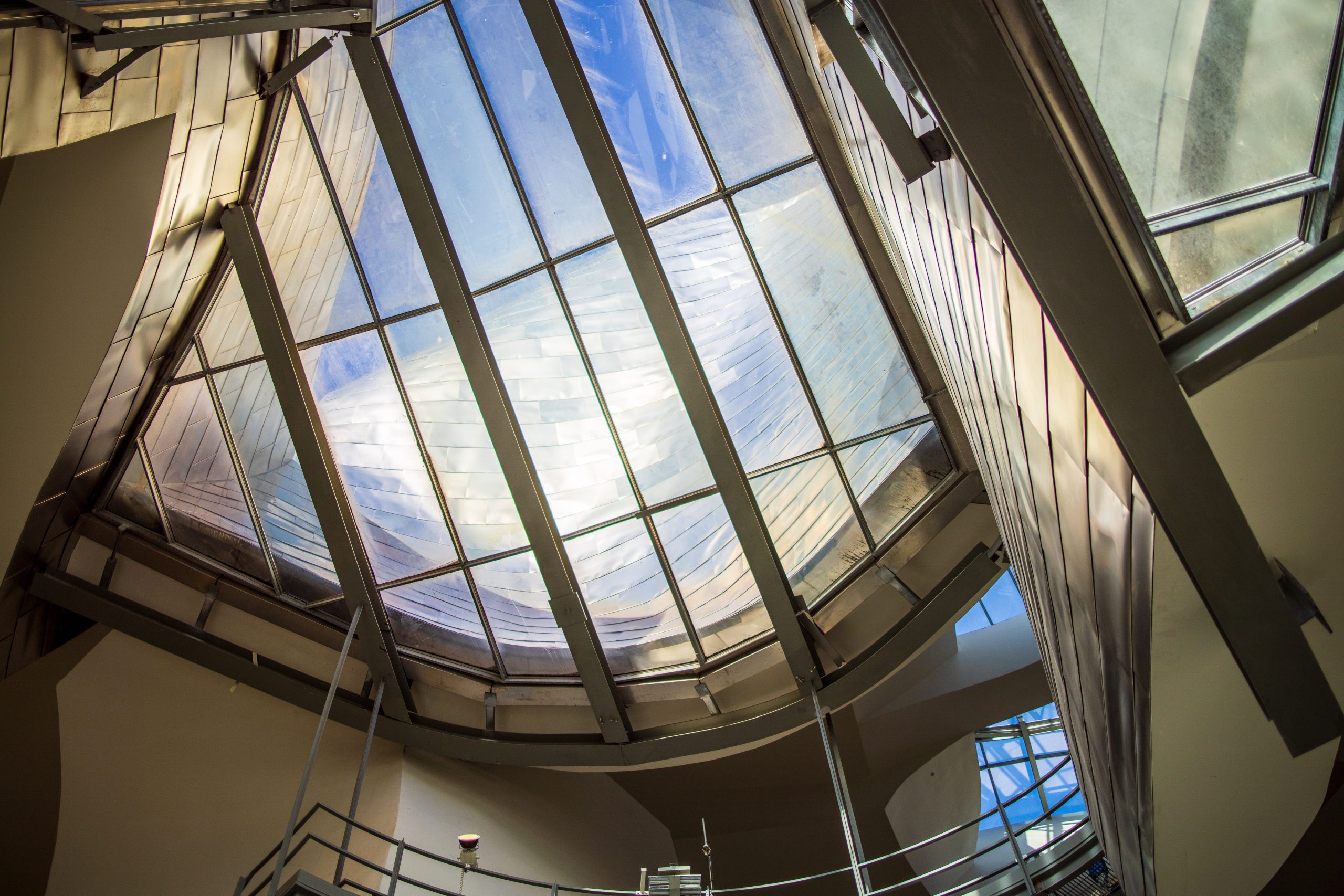
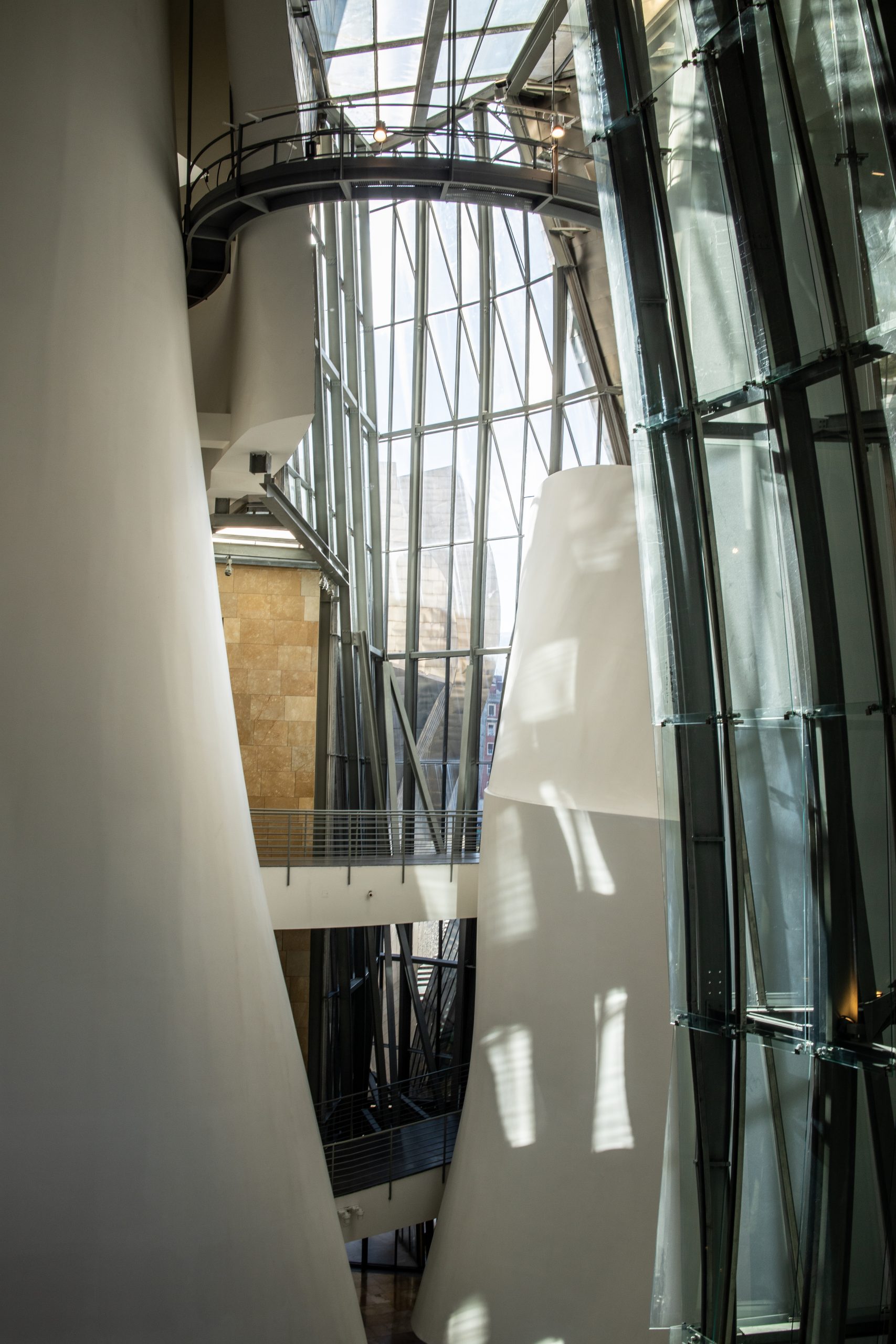
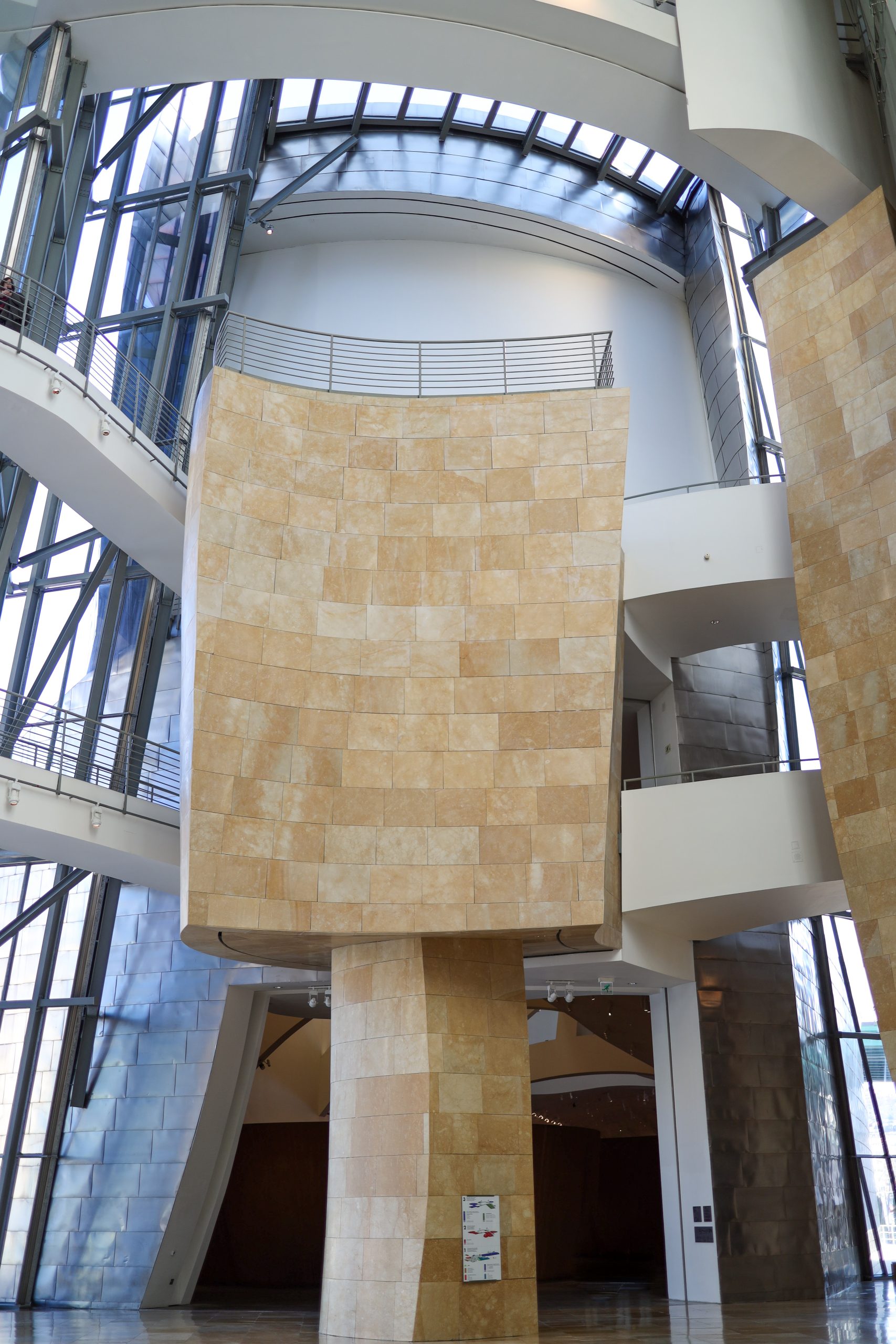
Inside, the 50-metre Atrium connects three floors of galleries through ramps, lifts and walkways, some glazed, some curving out over the river.
Soft white curves and sunlit glass meet high in the Atrium of the Guggenheim Museum Bilbao
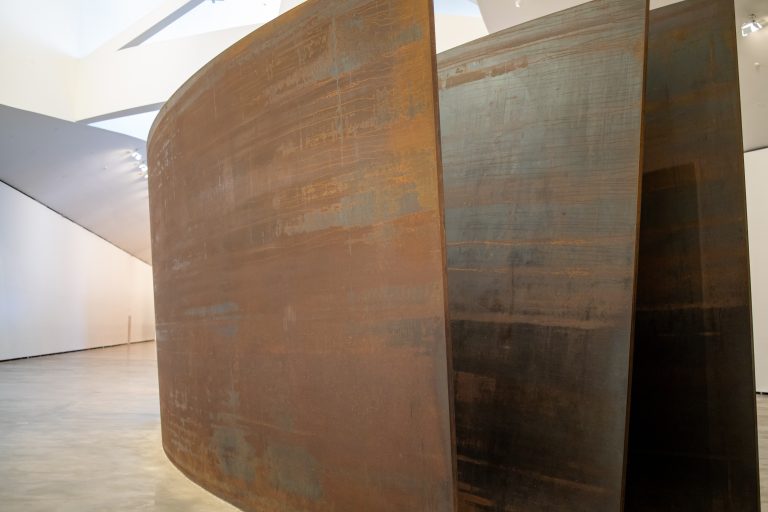
The Matter of Time
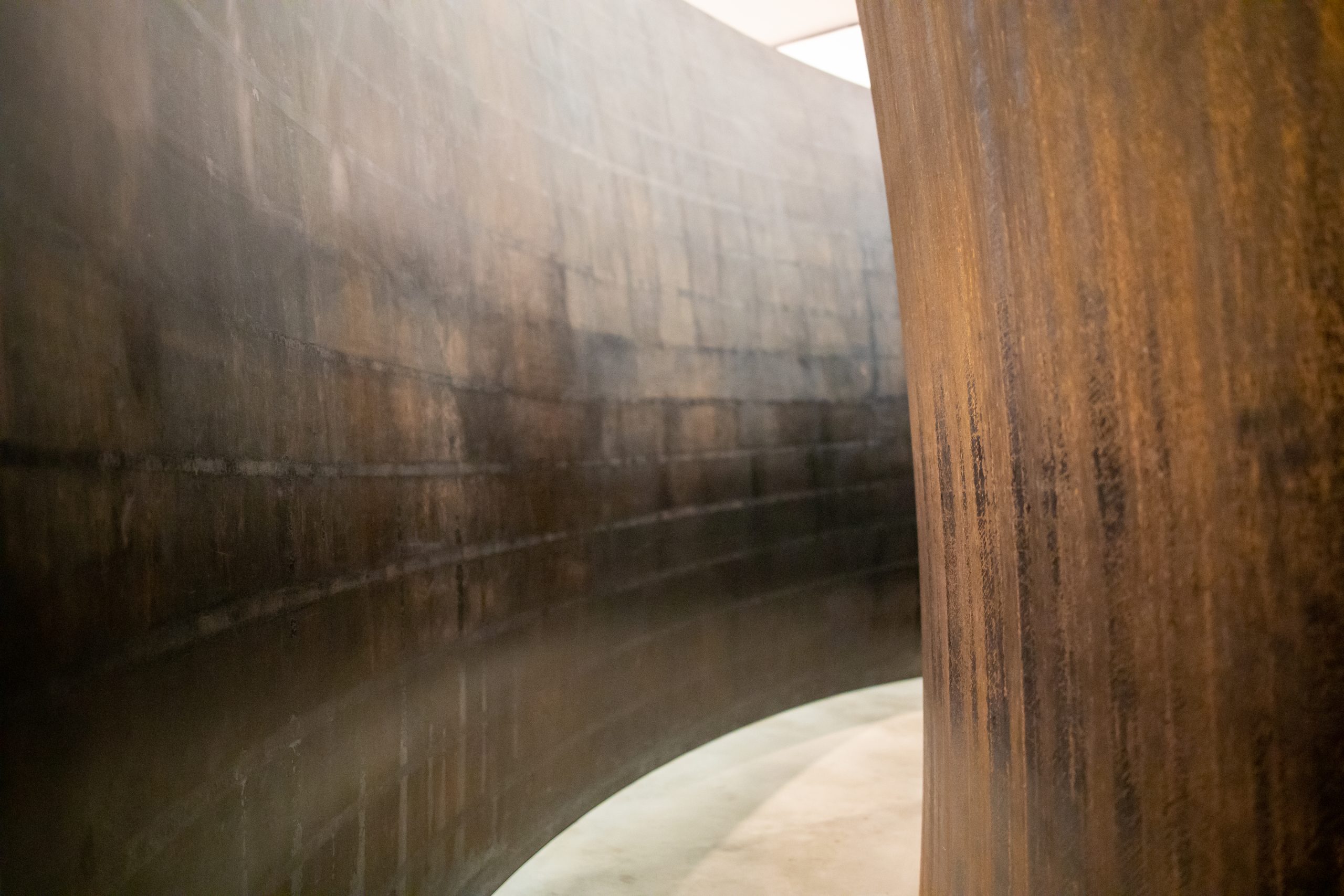
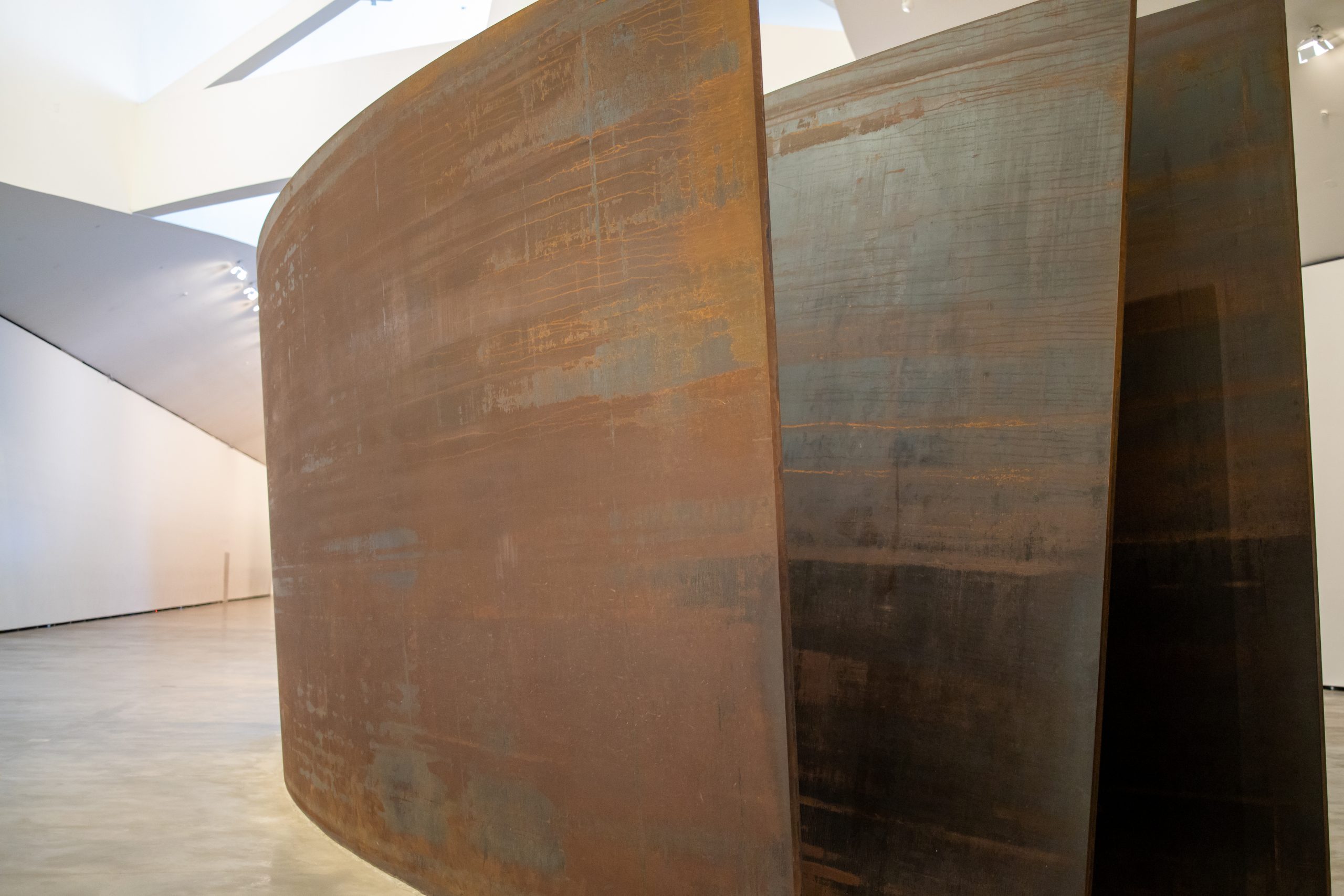
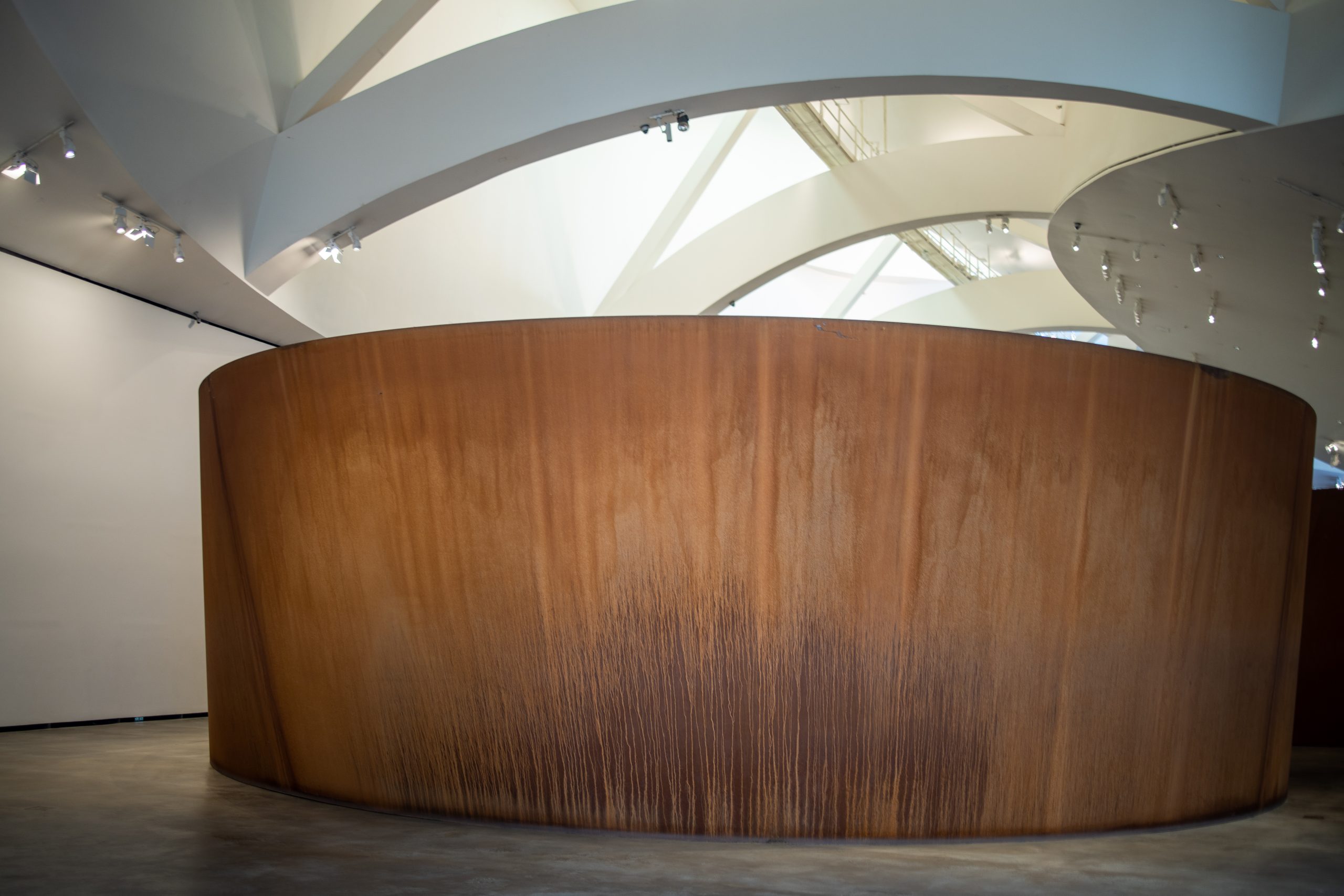
Gallery 104, the largest hall, is 130 metres long and 30 metres wide. Since 2005 it has permanently held Richard Serra's The Matter of Time, a sequence of monumental steel spirals and ellipses.
The leaning steel walls of Richard Serra’s The Matter of Time in Gallery 104 at the Guggenheim Museum Bilbao
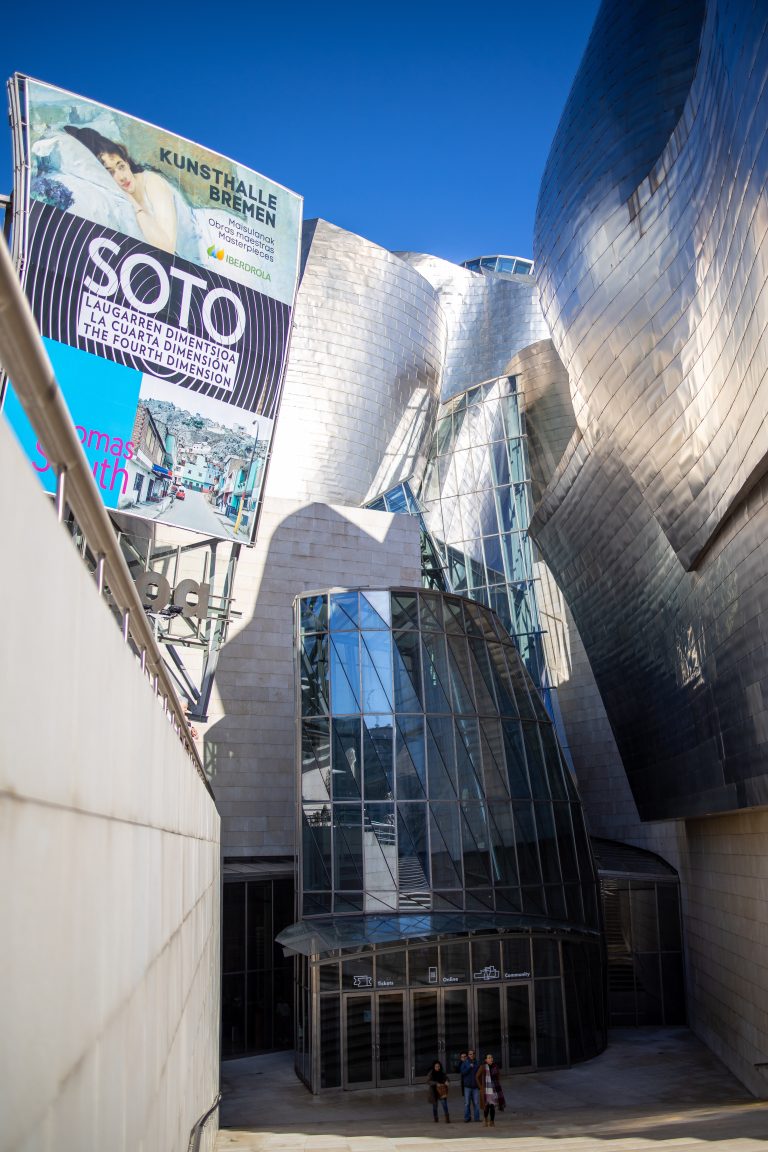
Free on Tuesday evenings
Adult admission is €15, and under-18s are always free. Every Tuesday from 18:00 to 20:00 entry is free for all. Walk the full perimeter before going inside.
The main entrance of the Guggenheim Museum Bilbao, set below street level between stone and titanium
3D model © 2026 madseriksson.no · Photographs © madseriksson.no. Building parts and surroundings: © OpenStreetMap contributors (ODbL). The curved titanium forms are simplified to their mapped parts and heights from floor counts; the cut-away floors are approximate.
The Building — Start Outside and Take Your Time
Spend forty minutes walking the exterior before you buy a ticket. The building is the main event.
The standard advice from almost everyone who knows the Guggenheim Bilbao well is the same: arrive from the river. Walk along the Nervión from the old town, approach the museum from the east under the La Salve Bridge, and let the building reveal itself gradually rather than arriving directly at the main entrance on the Abandoibarra side. From the riverbank, the titanium cladding catches the northern Spanish light differently than any other surface — shifting from silver to gold to near-white depending on cloud and sun, the curved forms reading as something between a ship’s hull and a geological formation. Gehry himself described the building as attempting to evoke the feeling of a fish, and the river approach makes that sensibility tangible.
Walk the full perimeter before going inside. Puppy, Jeff Koons’ twelve-metre West Highland terrier covered in approximately 60,000 living flowers, stands at the main entrance on the eastern plaza and changes appearance with the seasons as the flowers are replanted. It is cheerful and absurd and completely disarming, which is precisely the point — Koons designed it to lower the threshold for visitors intimidated by contemporary art. Around the back, between the building and the river, Louise Bourgeois’ Maman stands nine metres tall in bronze and steel, a spider carrying an egg sac of marble eggs. It is one of the most formally powerful outdoor sculptures anywhere in Europe, and it is almost always quieter here than at the main entrance — worth taking time with. Fujiko Nakaya’s fog sculpture in the pool near the riverfront façade activates on the hour, filling the space with dense white mist for eight minutes; if you time your circuit, wait for it.
Walk the perimeter. Approach from the river. Let the building change as you move around it. The architecture does something different from every angle — it is not a static object but a kinetic one.
The 33,000 titanium panels were shaped using CATIA, aerospace software developed by Dassault Systèmes, adapted by Gehry’s office in a process that had no precedent in construction at the time. Each panel is unique. The software allowed Gehry to design curves that would have been impossible to specify or build using conventional architectural drawing, and its adoption for this project influenced the entire subsequent development of parametric design in architecture. Whether or not you care about that history, the building is evidence of it: there is nothing else that looks like this, and there is a reason for that.
The Matter of Time — The One Room Everyone Agrees On
Eight weathering steel sculptures in a 130-metre gallery. Walk through them, not around them.
Gallery 104 is 130 metres long and 30 metres wide, built specifically for monumental contemporary works. Since 2005 it has housed Richard Serra’s The Matter of Time permanently — eight weathering steel sculptures that together weigh over a thousand tonnes and constitute what many critics consider the most significant site-specific installation in any museum in the world. The steel is Cor-Ten, the same alloy used in outdoor bridges and industrial structures; it rusts on its outer surface to form a self-protecting patina of deep orange-brown while remaining structurally stable within. Up close, the surfaces carry the marks of their fabrication: roller lines, weld patterns, the particular texture of hot-rolled steel cooled in air.
The installation includes Snake, three enormous serpentine ribbons of steel made for the museum’s inauguration in 1997, and seven subsequent works added between 2004 and 2005. Each sculpture is a curved corridor or enclosure of steel — some elliptical, some spiralling, some with walls that lean inward as they rise. The instruction for experiencing them is simple and almost universally ignored on first arrival: walk through them, not around them. The corridors between the steel walls narrow and widen, compress and expand. The sound of the space changes as the geometry changes. The light falls differently depending on how far into a curve you have walked. Serra has described the work as being about the relationship between sculpture, space, and time in the most literal sense — you can only experience its full meaning by moving through it.
The Matter of Time is not a sculpture to look at. It is a space to inhabit. Walk through every corridor, not once but twice — the experience in each direction is entirely different.
Art critic Robert Hughes described the installation as “courageous and sublime.” The hyperbole is, in this case, earned. Visitors who arrive at the museum without knowing what to expect often report that Gallery 104 is the most physically affecting art experience they have encountered — not because of its scale, though the scale is extreme, but because of what happens to spatial perception inside the corridors. The steel walls lean. The floor is flat, but the lean of the walls creates the sensation of tilt. This is not illusion; it is the precise management of the relationship between the human body and steel plate, achieved by a sculptor who has spent fifty years thinking about almost nothing else.
The Atrium & Collection — Light, Text & Post-War Abstraction
A 50-metre skylit void, nine LED columns scrolling in three languages, and works by Rothko, Kiefer, and Basquiat.
The Atrium is the spatial heart of the museum — a 50-metre-high void flooded with natural light from a skylight above, connecting the three gallery floors through ramps, panoramic lifts, and glass-enclosed walkways that cantilever out over the space. It functions as the building’s circulation hub, and Gehry designed it so that you can always orient yourself relative to the centre: wherever you are in the building, the Atrium is a reference point. Jenny Holzer’s Installation for Bilbao (1997/2017) runs nine LED columns from floor to ceiling through this space, each more than twelve metres tall, scrolling fragments of text in Basque, Spanish, and English — lines about intimacy, loss, power, and mortality drawn from Holzer’s Truisms and other series. Most visitors glance at the columns and move on. They are worth stopping for. The text is the work, not the LED technology, and the multilingual presentation in the Basque Country is a considered political act.
The museum’s permanent collection occupies parts of all three floors and focuses primarily on post-war European and American abstraction alongside large-scale contemporary installations. Floor 3 houses the museum’s own holdings: works by Anselm Kiefer, Jean-Michel Basquiat, Anish Kapoor, Mark Rothko, and Basque sculptors Eduardo Chillida and Jorge Oteiza, whose presence in the collection reflects the institution’s commitment to its local cultural context. Yayoi Kusama’s I’m Here, But Nothing (2000, acquired 2020) fills a domestic room with polka-dot furniture and UV-lit fluorescent dots that accumulate on every surface — one of her most quietly unsettling room-scale works, and frequently the piece visitors spend the most time with after Serra.
Jenny Holzer’s nine LED columns in the Atrium scroll text about loss and power in Basque, Spanish, and English. Most visitors mistake them for decoration. Stop. Read. The text is the work.
Floor 2 hosts the major temporary exhibitions, which rotate several times a year. The programme has historically been ambitious — major retrospectives, international loans, and site-specific commissions — and 2025 delivered one of the museum’s strongest years, with Tarsila do Amaral, Helen Frankenthaler, Barbara Kruger, and a Refik Anadol digital installation that became the most visited exhibition in the museum’s history. Check the current programme on the official website before visiting, as the temporary floor varies significantly in appeal depending on what is showing. The permanent Serra installation and the building itself, however, remain constant.
«The Guggenheim Bilbao is one of the few buildings in the world where the architecture makes you feel something before you have read a single label or entered a single gallery. Standing at the waterline on the eastern approach, watching the titanium catch a break of Atlantic light, you understand why Philip Johnson called it the greatest building of his time — not because of any architectural argument, but because the building simply does what very few buildings ever manage: it changes the quality of your attention. Once inside, Richard Serra’s steel corridors in Gallery 104 do something similar, and more disorienting: they alter your perception of space itself. The Guggenheim Bilbao is proof that architecture and art, at their most ambitious, are not things you consume passively. They require you to bring your full physical presence, to move, to listen to what changes as you move. Plan to spend longer than you think you need, arrive from the river, and walk through the Serra installation twice.»
More in the same area
ArchitectureTen Buildings That Changed Their Cities — Modern Architecture Ranked on Impact, Not Image
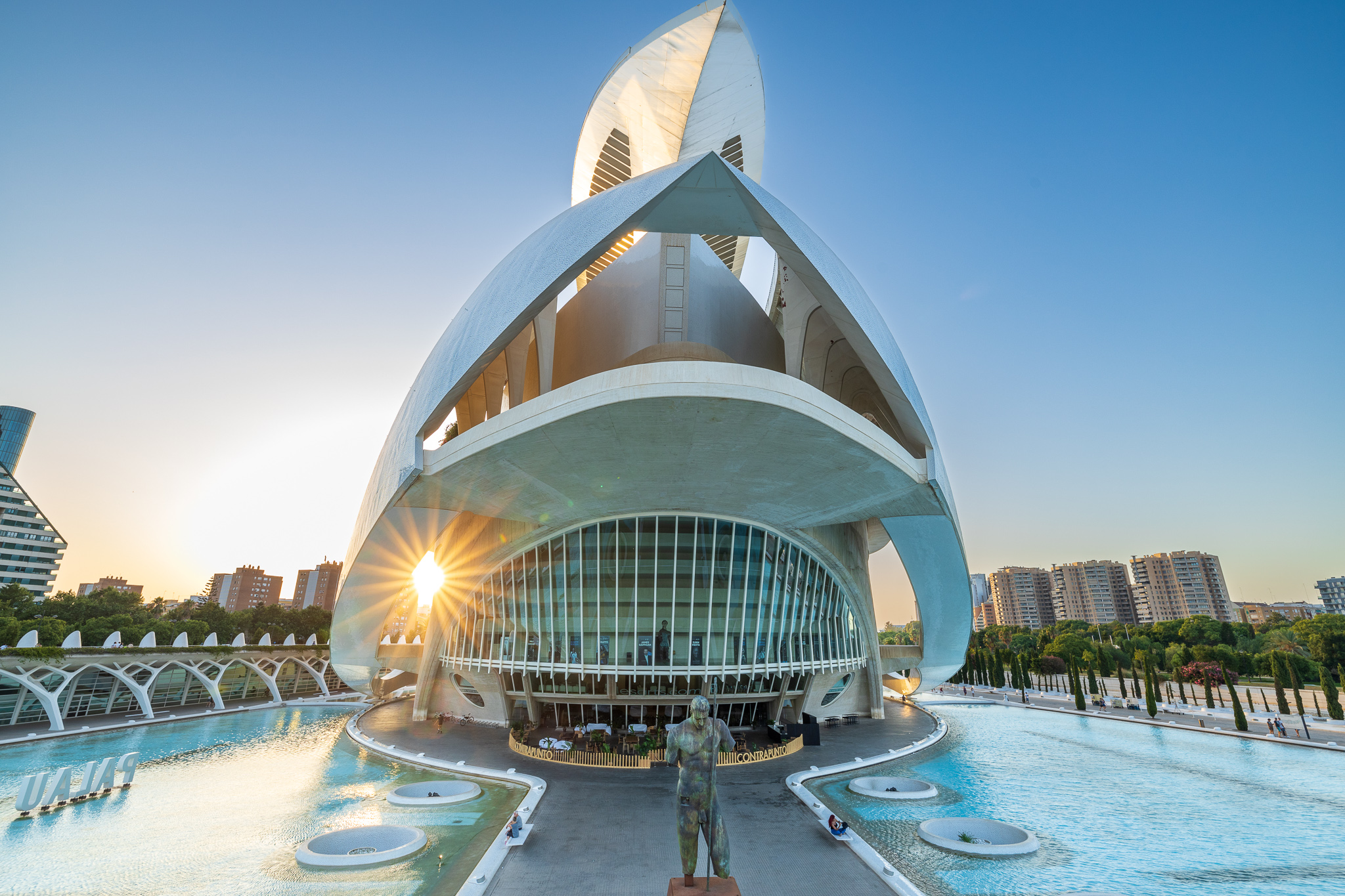 ArchitectureValencia’s City of Arts and Sciences — The Eye, the Skeleton and the €400 Million Opera House
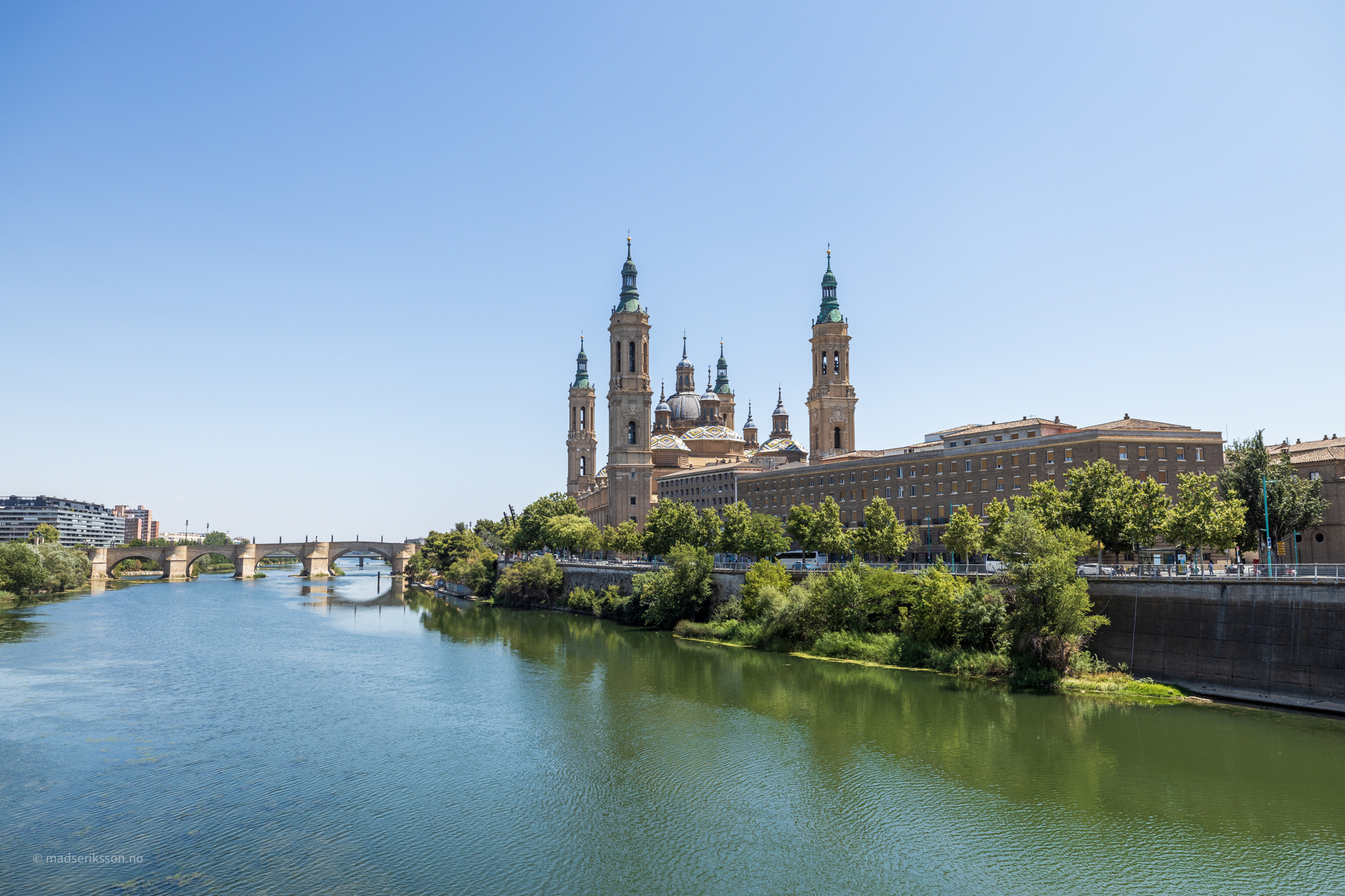 CitiesZaragoza: Roman Colony, Islamic Palace and the Basilica of the Pillar
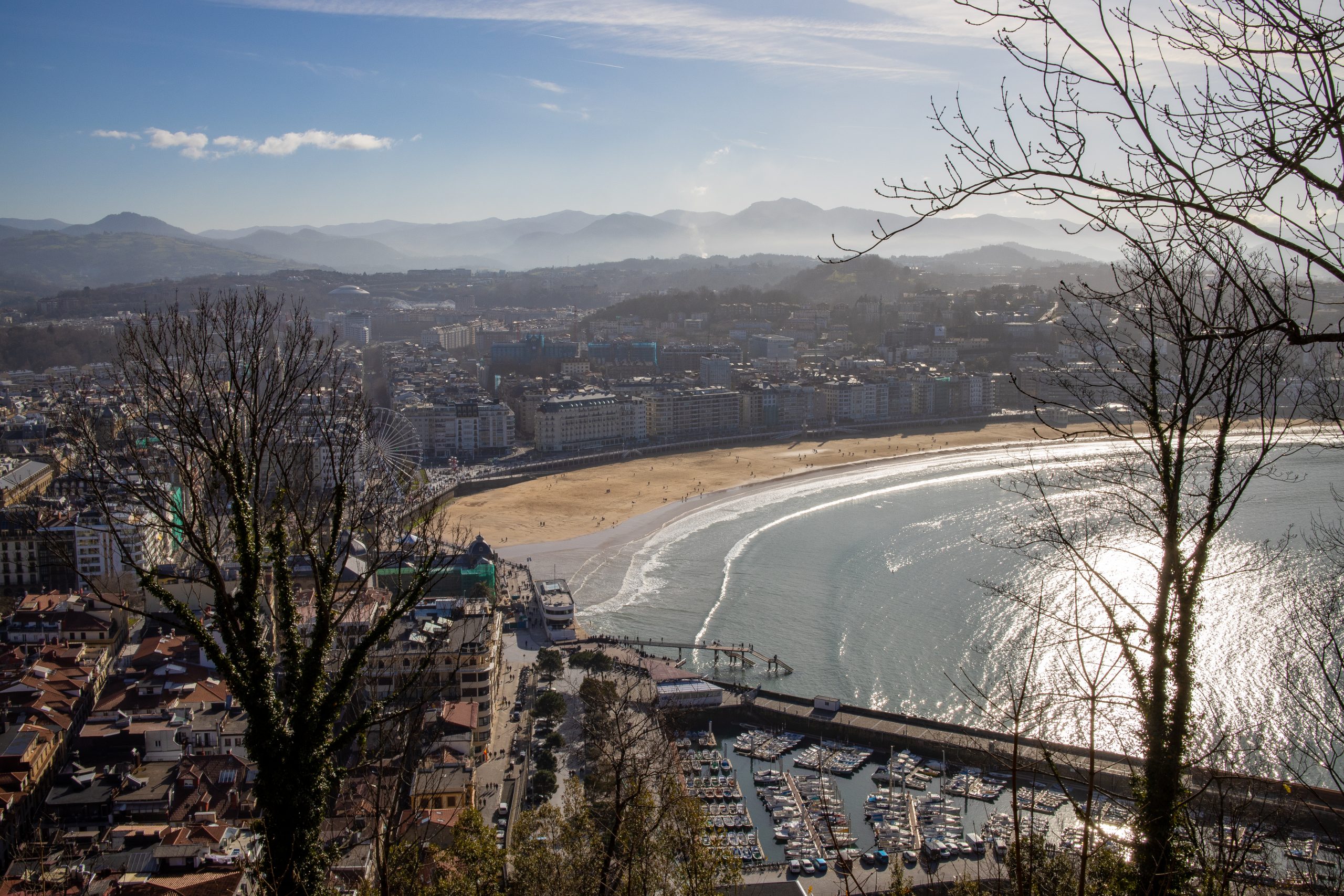 CitiesSan Sebastián — More Michelin Stars Per Person Than Anywhere on Earth
 CitiesAlicante — Castillo, Explanada and the Festival That Burns at Midnight
 CitiesMadrid — The Capital That Was Chosen by Calculation and Became Something Else