Most museums are boxes that hold art. The Solomon R. Guggenheim Museum on Fifth Avenue is a single continuous ramp that winds upwards for 432 metres around an open rotunda, under a glass oculus nearly thirty metres above the floor. Frank Lloyd Wright was commissioned to design it in 1943 and spent sixteen years fighting clients, critics and the New York building code to get it built. He died in April 1959, six months before it opened. Today the white spiral facing Central Park is a UNESCO World Heritage Site and one of the most recognisable buildings in Manhattan — and still one of the most argued-about places in the world to look at a painting.

The museum grew out of one man’s conversion to abstract art. Solomon R. Guggenheim, heir to a mining fortune, had spent decades collecting Old Masters when the German-born artist Hilla Rebay persuaded him in the late 1920s to buy the work of the European avant-garde. In 1929 the two visited Wassily Kandinsky in his studio in Dessau, and Guggenheim bought Composition 8 — the first of more than 150 works by Kandinsky to enter the collection. The Solomon R. Guggenheim Foundation was set up in 1937, and in 1939 it opened the Museum of Non-Objective Painting in rented premises at 24 East 54th Street, with Rebay as director. The collection needed a permanent home, and Rebay had a clear idea of who should design it.
What Wright delivered was a building that is as much the reason to visit as anything hanging in it. Around 861,000 people came in 2023, and many of them spend as long looking up into the rotunda as at the art. The museum is compact compared with the Metropolitan Museum of Art a few blocks south: a visit takes two to three hours rather than a whole day, and the way the building works — a single path, one direction, the whole exhibition visible across the void — makes it unlike any other gallery in the city.
How to approach the Guggenheim
This guide covers the museum in three parts: how a collection of abstract painting led to one of the longest and most contentious commissions of Wright’s career; the building itself — the spiral ramp, the rotunda, the oculus and the tower added in 1992; and the collection and the practical side of a visit, including how to use the ramp, when to come, and the other museums along Fifth Avenue’s Museum Mile.
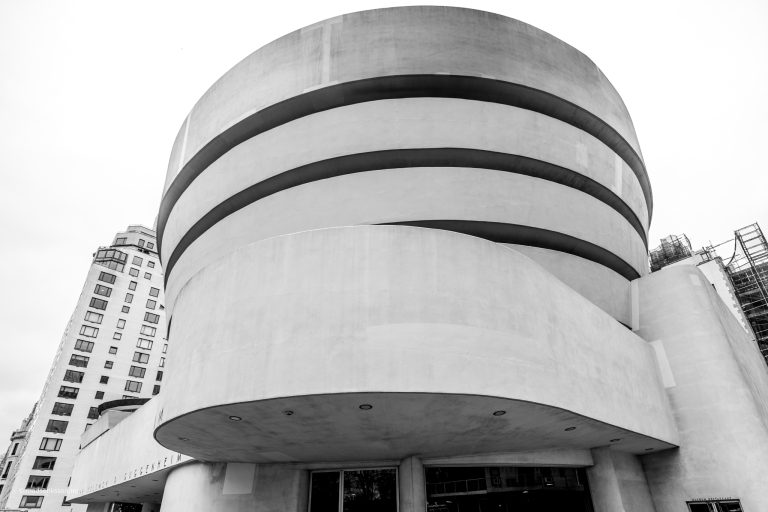
A spiral facing Central Park
Frank Lloyd Wright was commissioned in 1943 and spent sixteen years on the Guggenheim. He died in April 1959, six months before it opened on Fifth Avenue between 88th and 89th Streets, facing Central Park.
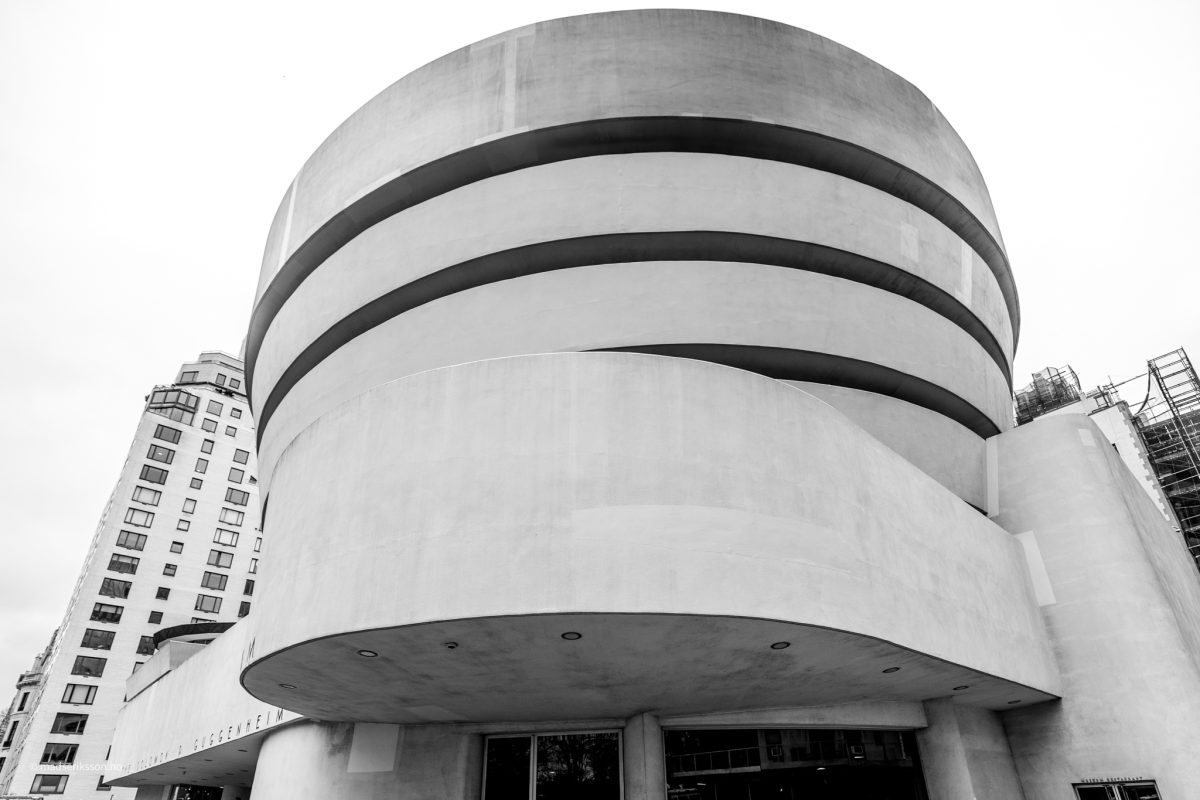
The widening rings of the Guggenheim Museum rotunda rising above Fifth Avenue, New York
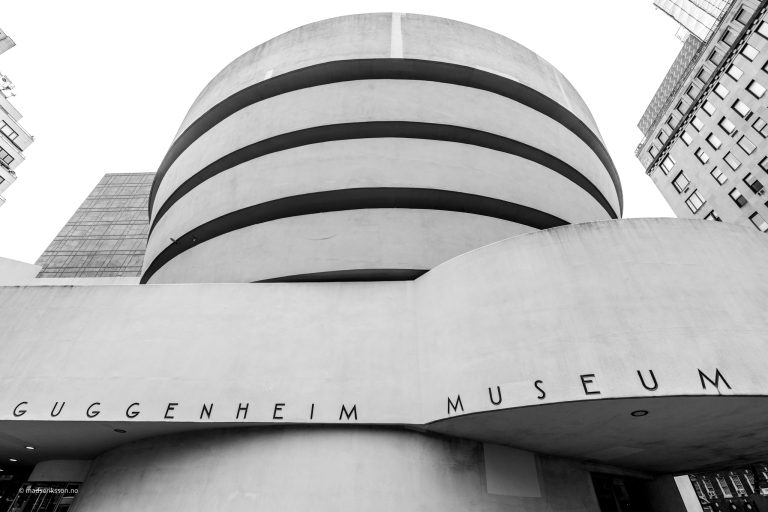
One ramp around an open void
The main gallery is a single ramp about 432 metres long, coiling upwards around a rotunda open from floor to roof at a gradient of around five per cent. It widens as it rises, from about 7.6 metres at the bottom to nearly ten at the top: an inverted ziggurat.
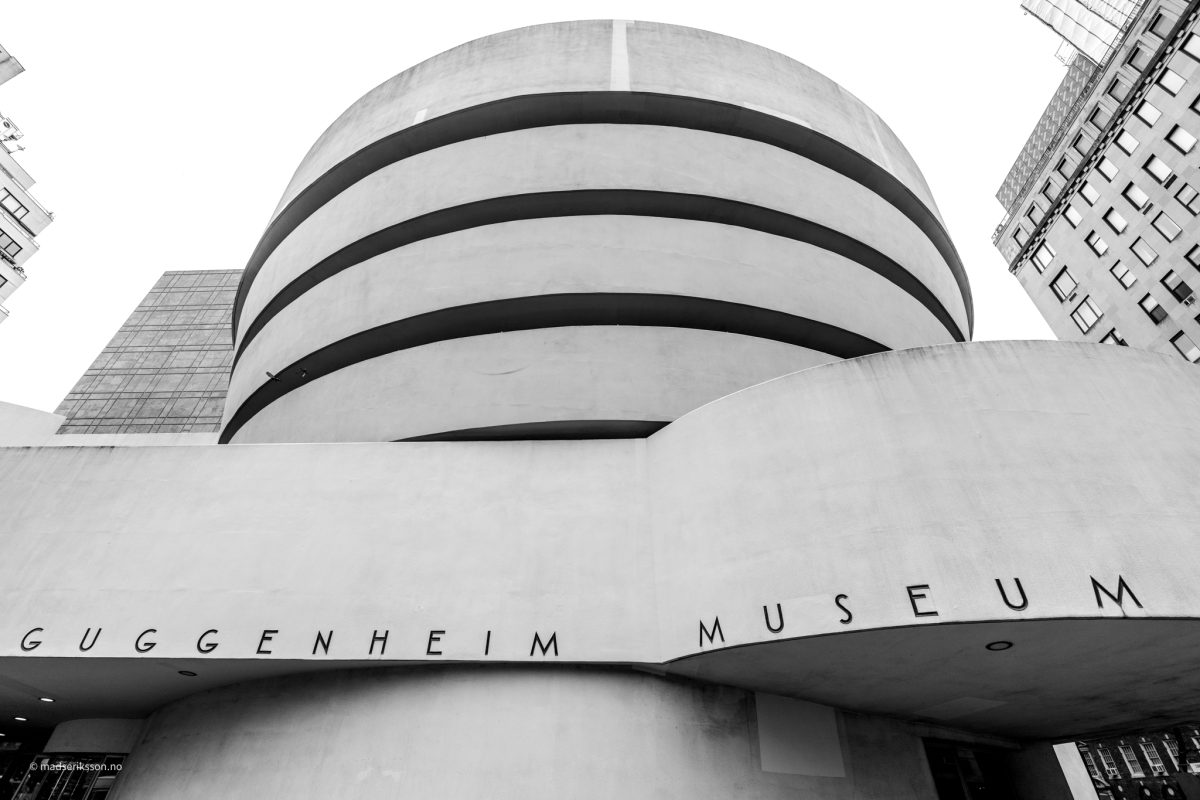
The spiral bands of Frank Lloyd Wright’s Guggenheim Museum on Fifth Avenue, New York
Twelve panes of glass
The rotunda is capped by an oculus about 29 metres above the floor, divided into twelve sections of glass. The view straight up from the floor, the white bands tightening towards the glass, is the image most visitors leave with.
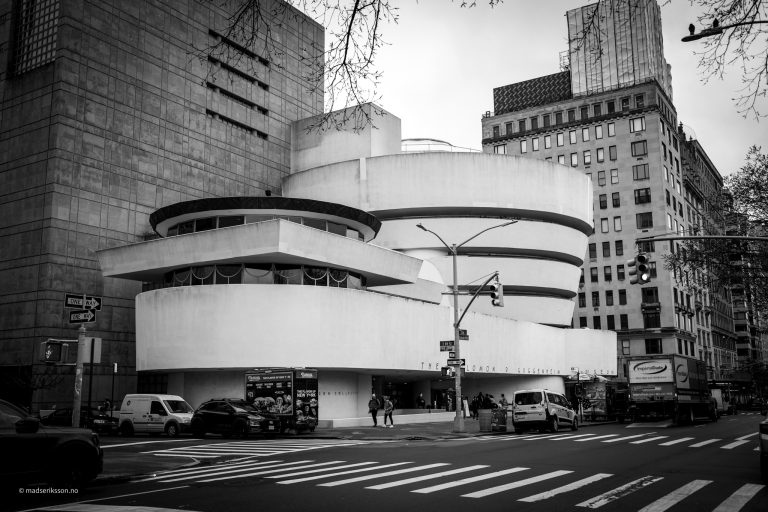
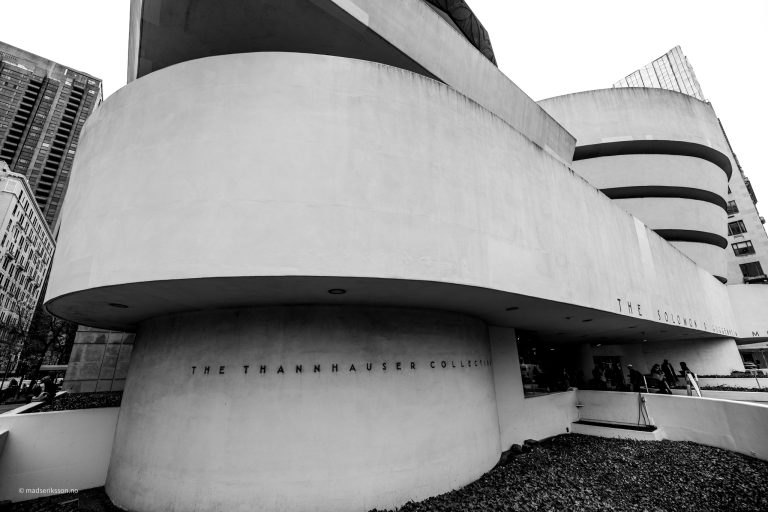
The Guggenheim Museum on Fifth Avenue, in black and white.
Sprayed concrete, not marble
Wright wanted marble. To save money the curved facade was built of gunite, sprayed concrete, without expansion joints, and it cracked. A $29 million restoration from 2005 to 2008 repaired it.
The Guggenheim Museum’s spiral on Fifth Avenue in New York.
Flat walls for large works
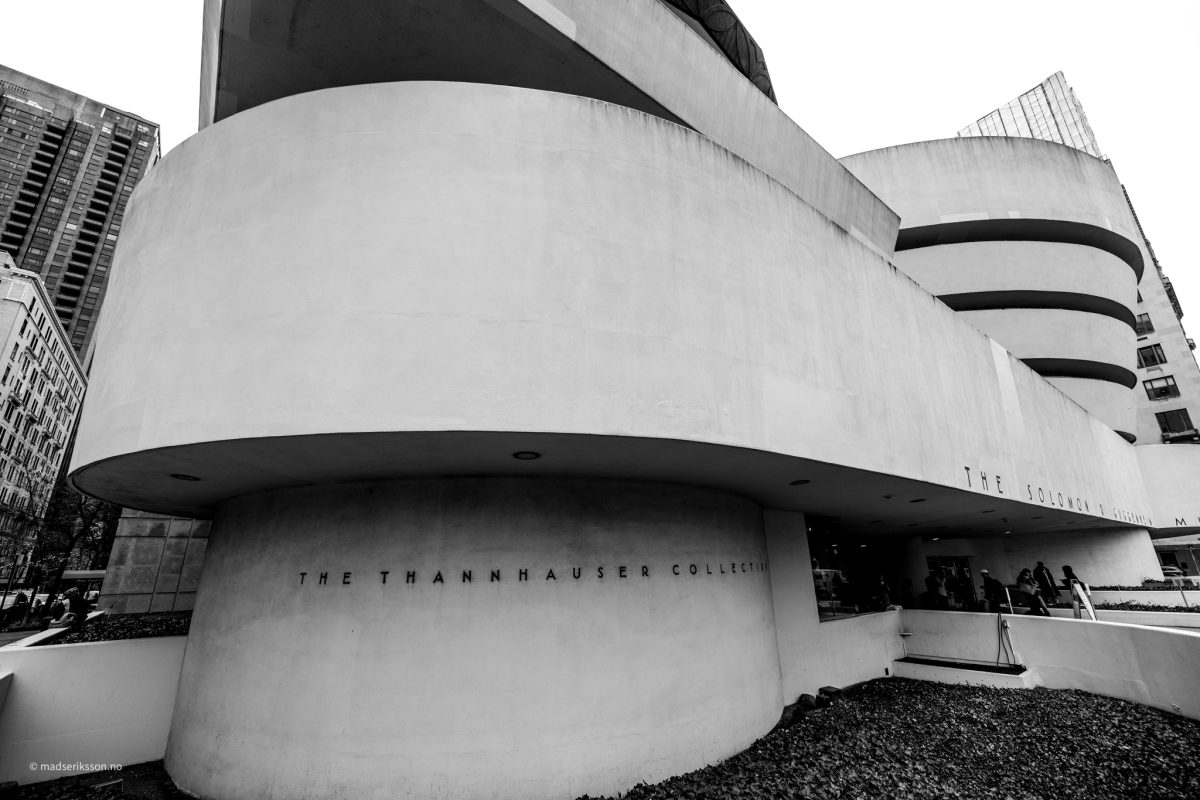
A renovation completed in 1992 added a ten-storey tower behind the spiral, designed by Gwathmey Siegel, with four double-height galleries with flat walls. The smaller rotunda beside the spiral has held the Thannhauser galleries since 1965.
The curved entrance canopy and Thannhauser Collection lettering at the Guggenheim Museum, New York
Ride up, walk down
The collection holds around 8,000 works, more than 150 of them by Kandinsky. The rotunda usually holds one large exhibition running the full height of the ramp. Take the lift to the top and walk down, as Wright intended.
Museum Mile
The museum is at 1071 Fifth Avenue, open daily 10:30–17:30 in 2026. Adult tickets cost $30, and pay-what-you-wish tickets are released on Tuesdays and Sundays from 16:00. The Met is a few minutes south on Fifth Avenue.
The widening rings of the Guggenheim Museum rotunda rising above Fifth Avenue, New York
3D model © 2026 madseriksson.no · Photographs © madseriksson.no. Surroundings: © OpenStreetMap contributors (ODbL). The spiral is modelled from the ramp widths and oculus height given in the article and the mapped outline, as stacked bands rather than a continuous ramp; the tower behind it is simplified.
“A Temple of Spirit” — Sixteen Years From Letter to Opening Day
How a request for a monument to abstract art turned into the longest, most fraught commission of Wright’s career, and why he never saw it open
On 1 June 1943 Hilla Rebay wrote to Frank Lloyd Wright asking him to design a permanent home for the Guggenheim collection. “I want a temple of spirit, a monument!” she wrote — a building fit for paintings that, in her view, were not pictures of things but spiritual objects in their own right. Wright, then in his mid-seventies, accepted that month. The commission suited him: he had little patience for the boxy, rectilinear city that New York had become, and a museum for “non-objective” art gave him licence to build something equally unconventional. Within a year he had worked through four different designs, settling on the idea of a spiral — at first an “inverted ziggurat”, wider at the top than at the bottom.
The building then took thirteen more years to start. A site on Fifth Avenue facing Central Park was assembled piece by piece; wartime shortages and rising costs pushed the budget up; and in 1949 Solomon Guggenheim died, leaving the project without its patron. His nephew Harry Guggenheim took over the foundation, Rebay was forced out as director in 1951, and her successor James Johnson Sweeney, appointed in 1952, had very different ideas about how art should be shown. In 1953 the city’s Department of Buildings rejected the permit application because the design did not meet the building code, and revised drawings had to be prepared to bring it into line. Wright produced more than 700 sketches and six sets of working drawings before demolition of the old buildings on the site began in May 1956 and construction started that August.
Before the museum opened, a group of prominent artists — among them Willem de Kooning, Franz Kline, Robert Motherwell, Adolph Gottlieb and Philip Guston — wrote to protest that Wright’s curved, sloping walls were not suitable for a sympathetic display of painting and sculpture.
The argument between architect and museum was never fully settled. Wright believed the building and the art should form a single experience; Sweeney and many artists believed a museum should be a neutral backdrop. By early 1958 the two men were no longer speaking, and Harry Guggenheim was relaying messages between them. Wright died in April 1959, at the age of 91, before the work was complete. The museum was shown to the press on 20 October 1959 and formally opened the following day. Critics were divided; the public, as with many controversial buildings, made up its own mind faster than the critics did.
The Building — A Single Ramp Around an Open Void
Why Wright wanted visitors to ride to the top and walk down, how the facade was built, and what the 1992 tower added
The idea is simple to describe and still startling to stand inside. The main gallery is one ramp, about 432 metres long, coiling upwards around a central rotunda that is open from floor to roof. It climbs at an even gradient of around five per cent and grows wider as it rises, from about 7.6 metres at the bottom to nearly ten at the top, so that the building swells outwards towards the sky — the reverse of a conventional tower. Wright’s intention was that visitors would take the lift to the top and drift downwards, looking at the art on the outer wall and across the void at the rest of the exhibition, until they arrived back where they started. There are no rooms, no corridors and no decisions about which way to go.
Light was part of the design from the start. The rotunda is capped by an oculus about 29 metres above the floor, divided into twelve sections of glass, and a band of lay-lights originally let daylight in along the top of each turn of the ramp; today these use artificial light so that curators can control ultraviolet exposure. The walls slope gently outwards and the ceilings in the bays are low, which is exactly what the artists of the 1950s objected to: large canvases have to be hung slightly tilted, and the floor is never quite level. Next to the main spiral sits a smaller rotunda, about 15 metres across, which Wright called the monitor building. It held administrative offices until 1988 and now contains galleries, including the rooms for the Thannhauser Collection.
Wright wanted the exterior faced in marble. To save money it was built of gunite — sprayed concrete — without expansion joints. The New York winters did the rest, and by the early 2000s the smooth white shell was covered in cracks.
The building has been altered twice in a significant way. Between 1990 and 1992 a renovation costing $24 million added a ten-storey tower behind the spiral, designed by Gwathmey Siegel & Associates, with four double-height galleries with flat walls — space for large works that the ramp cannot hold. Wright had himself sketched a tower on the site in 1951, though his was meant for studios and apartments. Then, from September 2005 to September 2008, a $29 million restoration repaired the cracked facade and modernised the building’s systems and exterior details. The building was designated a New York City landmark in 1990 and a National Historic Landmark in 2008, and in 2019 UNESCO inscribed it on the World Heritage List as one of eight buildings representing the 20th-century architecture of Frank Lloyd Wright.
The Collection and the Visit — From Kandinsky to the Ramp Shows
What is in the permanent collection, how the rotunda exhibitions work, and how to fit the museum into a day on Museum Mile
The collection, around 8,000 works today, still reflects its origins. Its core is the early abstract painting that Rebay and Solomon Guggenheim bought between the wars, with Kandinsky at the centre: more than 150 of his works, spanning most of his career. Around them sit works by Paul Klee, Robert Delaunay, Fernand Léger, Piet Mondrian and László Moholy-Nagy. Later gifts broadened the range. In 1963 the art dealer Justin Thannhauser decided to leave the essential works of his private collection to the museum — Impressionist, Post-Impressionist and early modern paintings, including Picasso’s Woman Ironing of 1904 — and the Thannhauser galleries have occupied the smaller rotunda since 1965. The foundation later acquired Minimalist and Conceptual art from the collection of Giuseppe Panza and, in 1992, some 200 photographs by Robert Mapplethorpe.
What a visitor actually sees depends on the exhibition calendar. The rotunda is usually given over to one large temporary exhibition that runs the full height of the ramp, often a retrospective of a single artist; past rotunda shows have ranged from Kandinsky to Hilma af Klint. Works from the permanent collection rotate through the tower and Thannhauser galleries rather than hanging permanently, so a particular painting may not be on view — worth checking before a visit made for a specific work. The best way to see the building remains Wright’s: take the lift to the top of the ramp and walk down, stopping on the way to look across the rotunda and up into the oculus.
The view straight up from the floor of the rotunda, with the white bands of the ramp tightening towards the glass, is one of the great interior views in New York. It costs nothing more than the ticket and takes thirty seconds — and it is still the image most visitors leave with.
The museum stands at 1071 Fifth Avenue, between 88th and 89th Streets, on the stretch known as Museum Mile. It pairs naturally with its neighbours. The Metropolitan Museum of Art is a few minutes’ walk south on Fifth Avenue; the Neue Galerie, a small museum of early 20th-century German and Austrian art, is at 86th Street; and the Cooper Hewitt design museum and the Jewish Museum are a few blocks north. Directly across Fifth Avenue is Central Park, with the running track around the Jacqueline Kennedy Onassis Reservoir just inside the wall — a good place to step back and see the spiral against the line of apartment buildings that Wright so deliberately set it apart from. Morning, shortly after opening, is the quietest time to see the rotunda before the ramp fills.
«The Guggenheim was built against the wishes of half the people involved in it, and it still provokes the argument it started: is a museum a neutral box for art, or a work of art in its own right? Wright had no doubt about the answer, and the building has outlived most of its critics. It is not the largest museum on Fifth Avenue, nor the one with the most famous paintings. But no other building in New York makes looking at art feel quite so much like a single continuous movement. Ride to the top, walk slowly down, and stop now and then to look up.»

More in the same area
 ArchitectureThe United Nations in New York: A Hub for Global Diplomacy
 ArchitectureBrooklyn Bridge: Roebling’s Steel-Wire Span and the Walk Across the East River
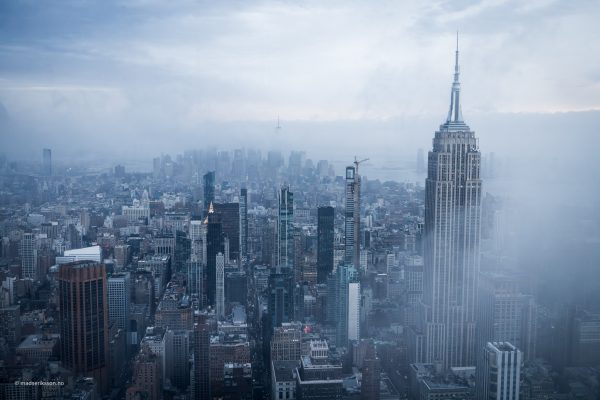
 ArchitectureEmpire State Building: The 410-Day Skyscraper and Its Observation Decks
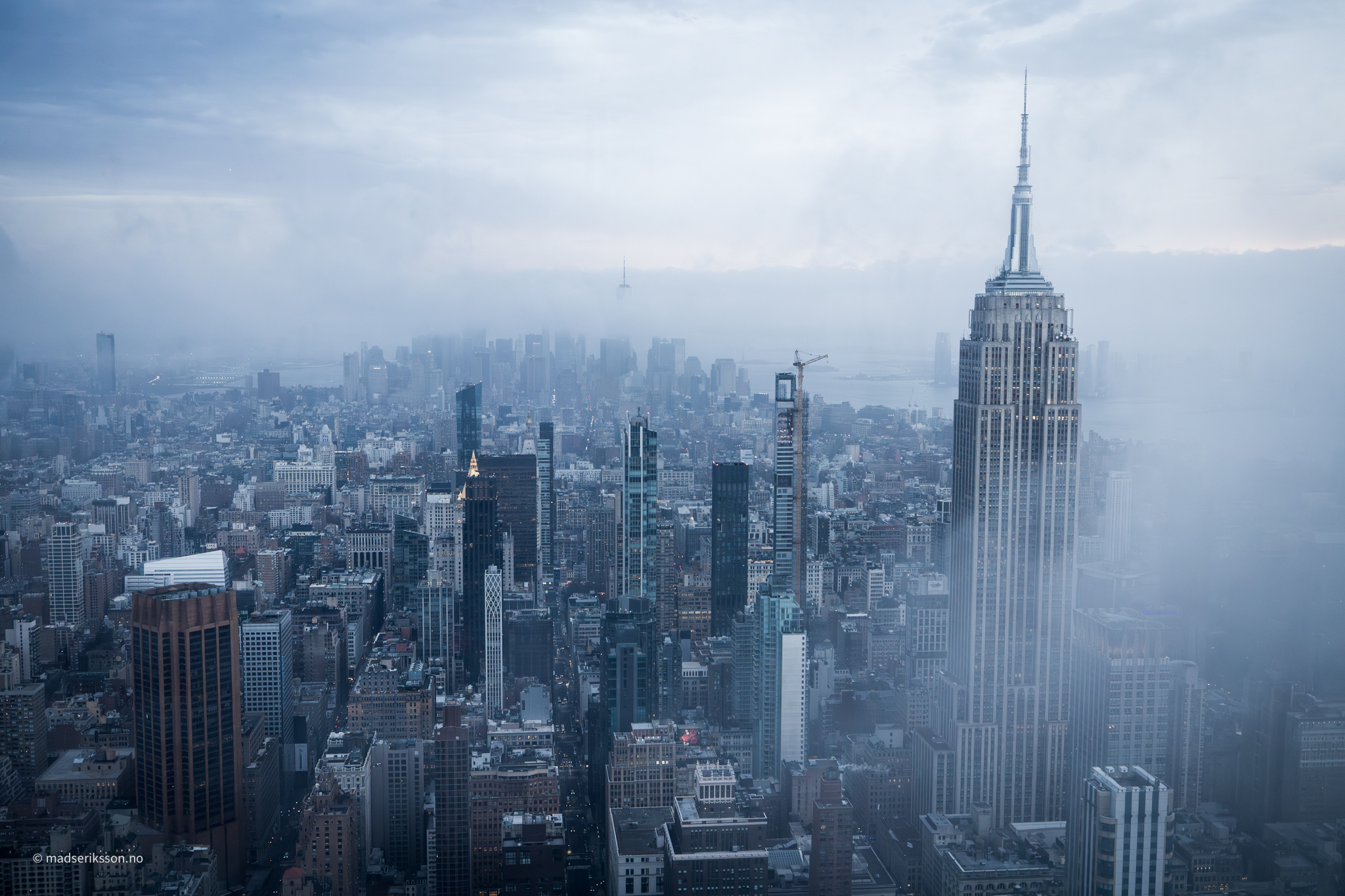 CitiesDiscovering New York: The City That Never Sleeps
 ArchitectureTen Buildings That Changed Their Cities — Modern Architecture Ranked on Impact, Not Image
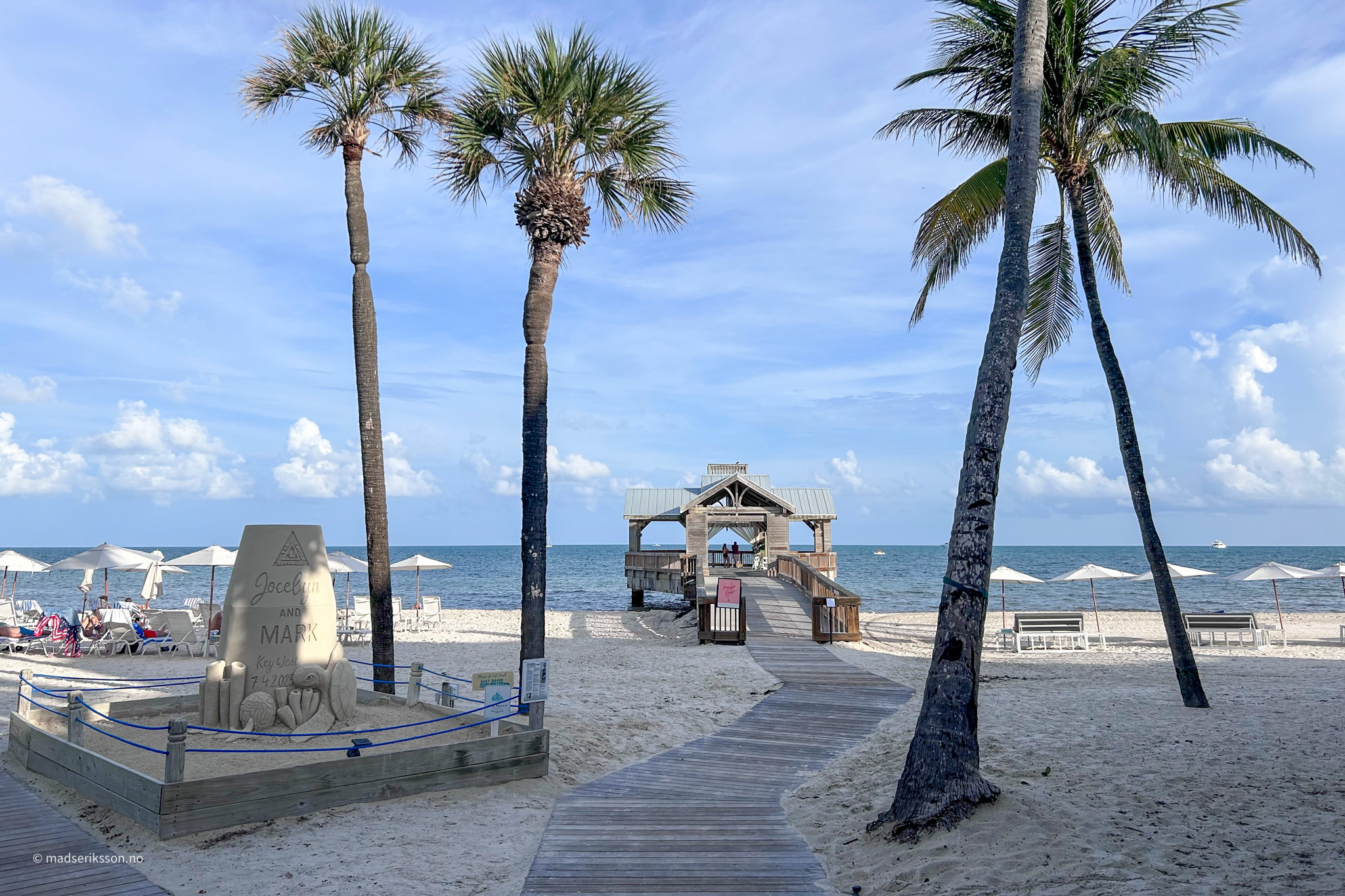 TravelFlorida Keys and Key West: The Overseas Highway, the Reef and the End of the Road