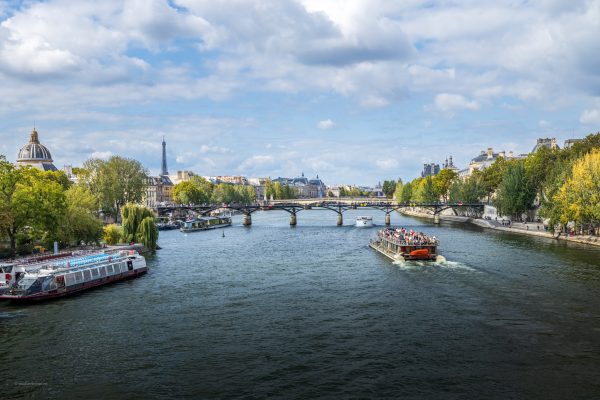
On the left bank of the Seine, opposite the tip of the Île Saint-Louis, stands a building whose south wall behaves like a camera. Its glass façade is fitted with 240 metal panels, each filled with light-sensitive apertures designed to open and close with the sun — a high-tech reinterpretation of the carved wooden screens of traditional Arab houses. This is the Institut du Monde Arabe, founded in 1980 by France and eighteen Arab states, opened by François Mitterrand in November 1987 and designed by a young Jean Nouvel with Architecture-Studio. It is a museum, a library, a concert and lecture venue and one of the finest free viewpoints in Paris, all under one roof.

The institute was born of politics as much as culture. In the 1970s France was redefining its relations with the Arab world after the oil crisis, and the idea took shape of a single institution in Paris that would make the culture, history and languages of the Arab countries better known in France and in Europe. It was established in 1980 as a joint venture between the French state and eighteen Arab countries, with funding from both sides, and given a site on the edge of the Jussieu university campus, beside the Seine. Its museum opened in 1982, and the building that made it famous followed five years later.
More than a million people a year pass through its doors, many of them never visiting the museum at all: they come for the temporary exhibitions, for the library, for concerts, films and debates, or simply to ride the glass lifts to the ninth-floor terrace and look across the river at Notre-Dame. The institute has been led by former ministers and diplomats, and in 2026 the diplomat Anne-Claire Legendre became its first woman president. It remains a place where French and Arab cultural life meet on equal terms — which was the point from the start.
How to approach the Institut du Monde Arabe
This guide covers the institute in three parts: how it came to be founded and what it does; the building by Jean Nouvel and Architecture-Studio, with its famous light-sensitive façade and spiralling tower of books; and the visit itself — the museum on four floors, the library, the rooftop terrace and how to fit them into an afternoon on the left bank.
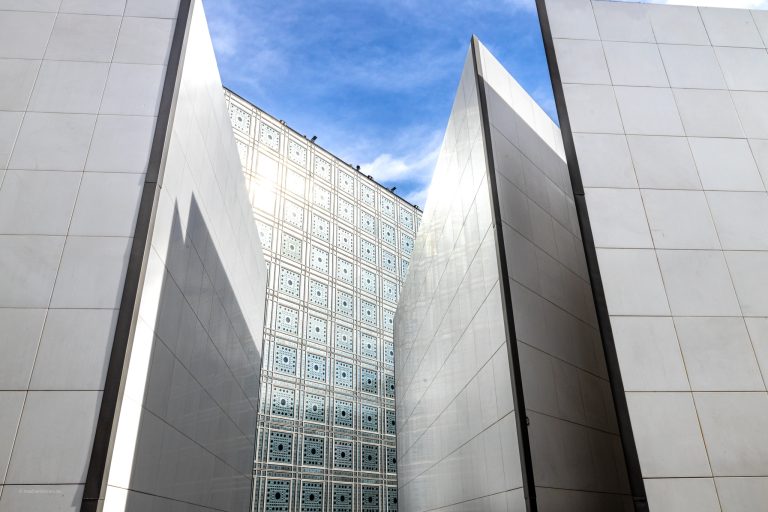
A bridge between France and the Arab world
The institute was founded in 1980 by France and eighteen Arab countries on a strip of the Quai Saint-Bernard, opposite the Île Saint-Louis. A team including the young Jean Nouvel won the 1981 competition with Architecture-Studio, and Mitterrand inaugurated the building in 1987.
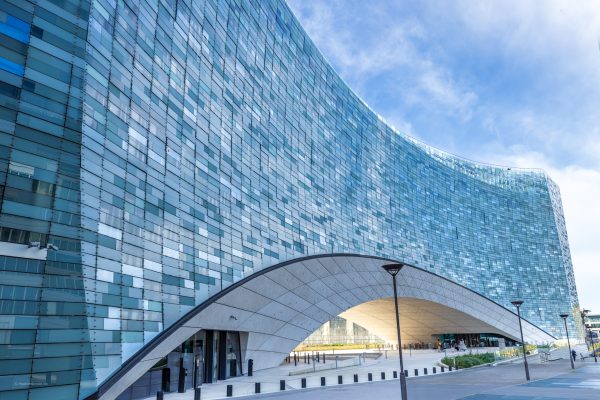
The angular façade of the Institut du Monde Arabe in Paris.
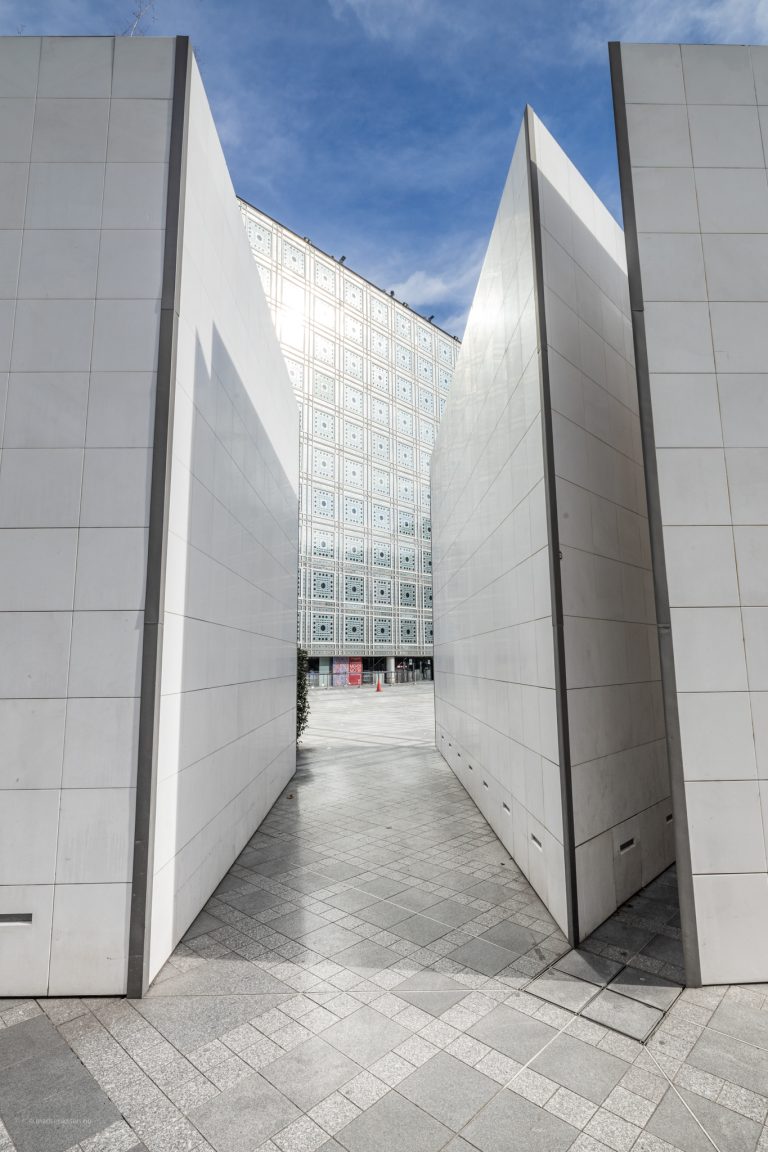
A cleft aimed at Notre-Dame
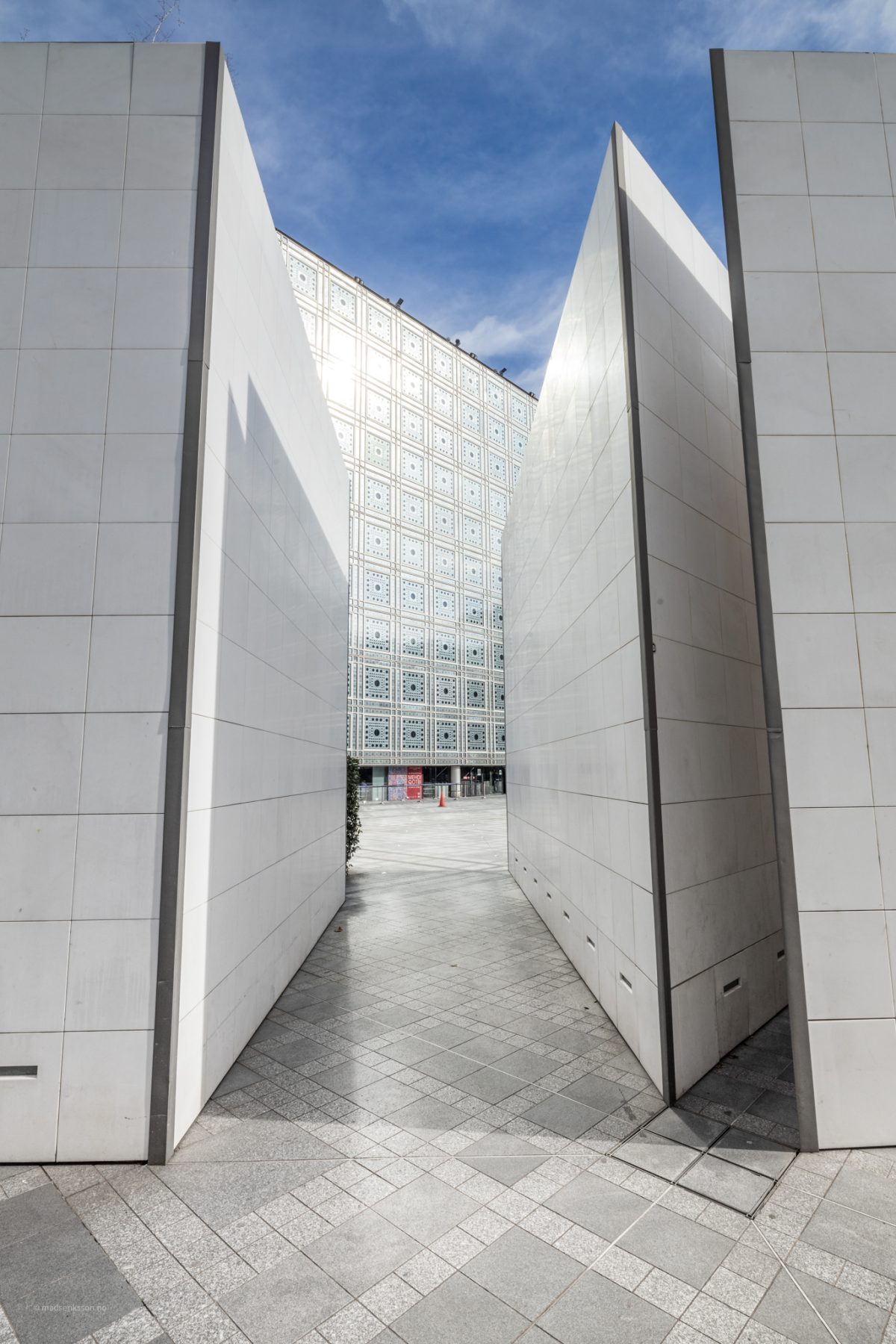
The building is really two, split by a narrow courtyard: a long, low seven-storey wing following the curve of the river, and a taller eleven-storey rectangle facing a square on the university side. The cleft between them frames a view towards Notre-Dame.
A narrow passage between white stone walls leading to Jean Nouvel’s Institut du Monde Arabe on the Seine
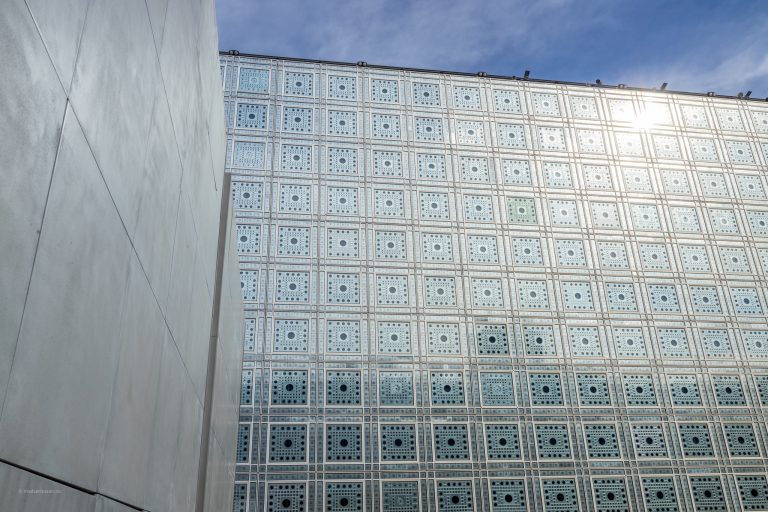
A wall that behaves like a camera
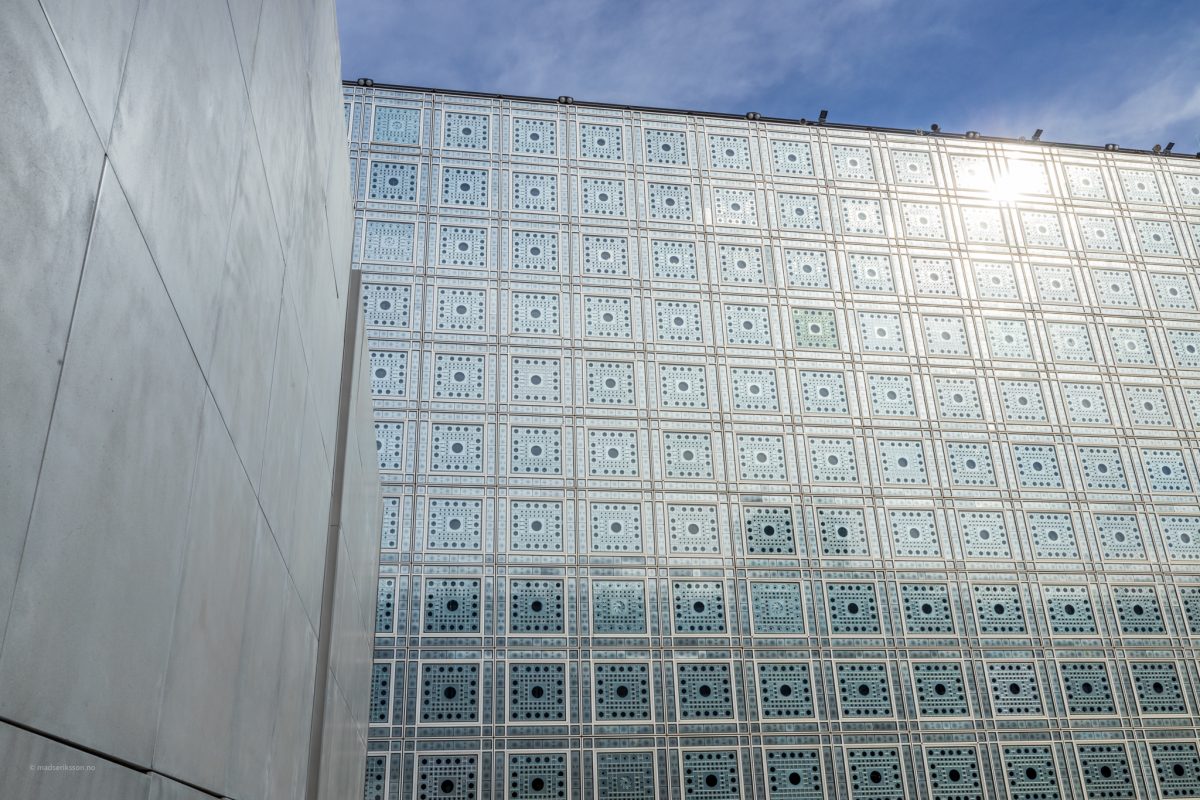
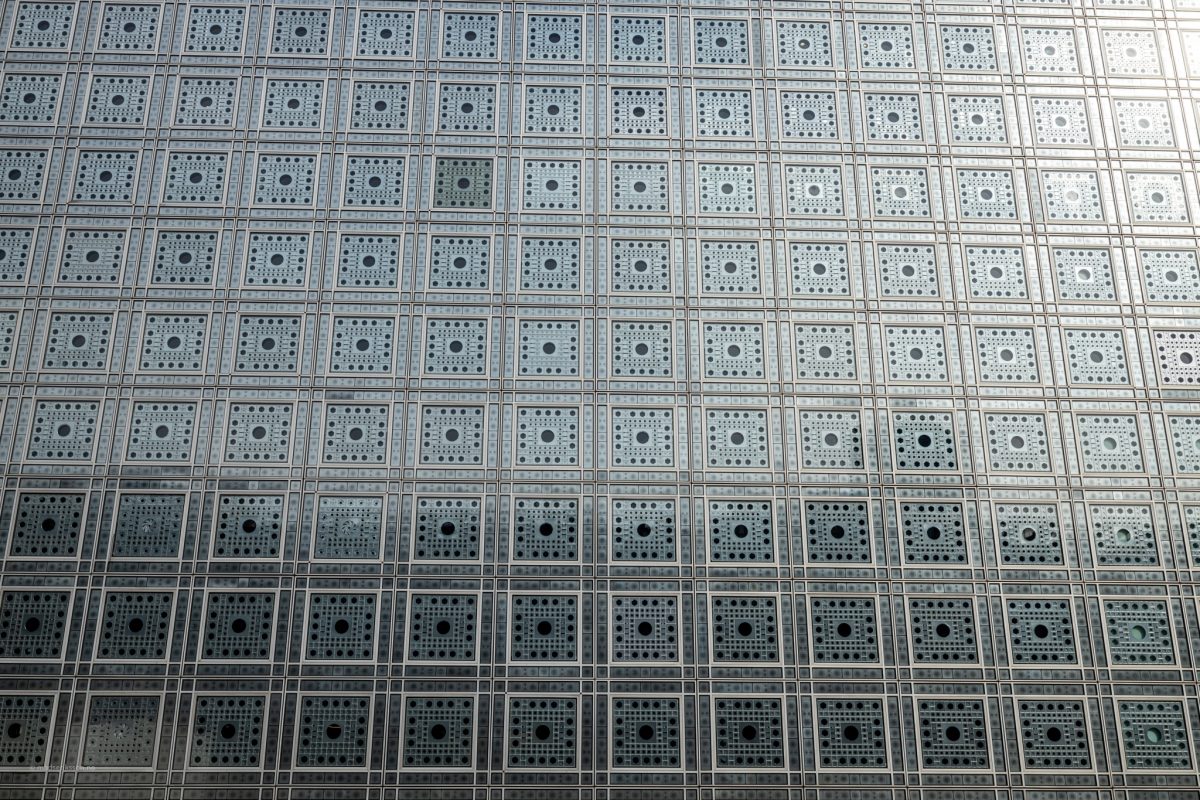
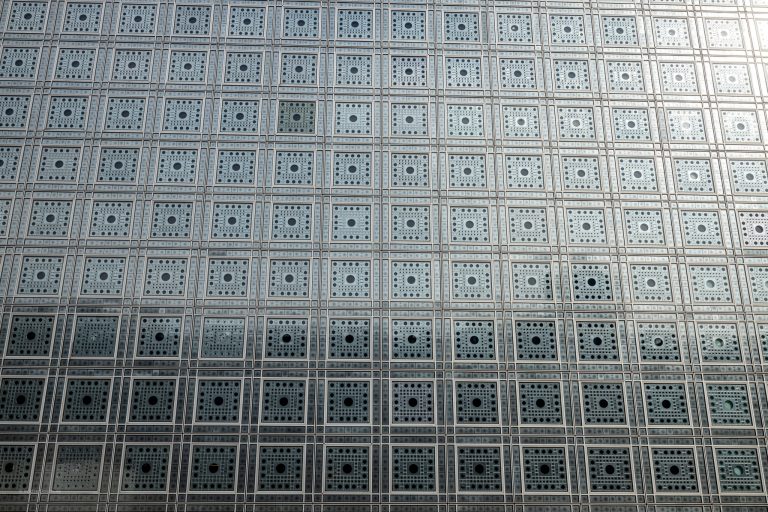
The south wall rebuilds the mashrabiya in steel and glass: 240 square metal panels, each filled with photosensitive apertures in Islamic geometric patterns, designed to close as the sunlight grows stronger and open as it fades. It won an Aga Khan Award in the 1987–1989 cycle.
The south façade of the Institut du Monde Arabe in Paris, its metal light-sensitive apertures catching the sun
Along the curve of the Seine
The northern wing follows the Quai Saint-Bernard with a façade of screen-printed glass. It is best seen from the Pont de Sully and the tip of the Île Saint-Louis; the library's reading rooms look out through it over the river.
The angular façade of the Institut du Monde Arabe in Paris.
A museum from the top down
Glass lifts carry visitors to the seventh floor, and the museum's route descends floor by floor through around 3,500 works. Behind the river wall, the Tour des livres, a spiral of books inspired by the minaret of Samarra, rises from the first floor to the seventh.
Rows of mechanical diaphragms in the south wall of the Institut du Monde Arabe, Jean Nouvel’s Paris landmark
A free view of Notre-Dame
The ninth-floor terrace is free and open to anyone who walks in, reached by the same glass lifts. It looks north and west over the Seine, the Île Saint-Louis and the Île de la Cité to Notre-Dame, and may close in bad weather.
The south façade of the Institut du Monde Arabe in Paris, its metal light-sensitive apertures catching the sun
3D model © 2026 madseriksson.no · Photographs © madseriksson.no. Surroundings: © OpenStreetMap contributors (ODbL). The two wings are cut from the mapped outline at heights estimated from their storey counts; the model is simplified.
The Institute — A Joint Venture Between France and the Arab World
Why a museum, library and cultural centre for the Arab world was founded in Paris, and how it has worked for more than four decades
The Institut du Monde Arabe is an unusual institution: neither a French state museum nor an embassy, but a joint undertaking between France and the Arab countries. It was set up in 1980 by France and eighteen Arab countries, and the League helped to fund its headquarters. Its brief was broad from the outset — to study and make known the culture and civilisation of the Arab world, to encourage cultural exchange and cooperation between France and Arab countries, and to give Arab art, literature, music and science a permanent home in the French capital.
The site chosen was a strip of land on the Quai Saint-Bernard, between the Seine and the modernist university buildings of Jussieu, at the point where the left bank faces the Île Saint-Louis. A competition for the building was held in 1981, and it was won by a team that included Jean Nouvel, then in his thirties and not yet the international figure he would become. The building was inaugurated by President François Mitterrand on 30 November 1987, one of the first of the Grands Projets that changed the face of Paris in the 1980s and 1990s — alongside the Louvre pyramid, the Opéra Bastille and, later, the new national library a little further upstream.
The institute was conceived as a bridge rather than a showcase: a place where Arab culture would be presented not as something exotic and distant, but as part of a long shared history with France and with Europe.
In practice the institute works on several fronts at once. Its large temporary exhibitions range from archaeology and Islamic art to contemporary photography, fashion and music; in autumn 2026 the programme includes an exhibition on wedding traditions in Algeria, Morocco and Tunisia and another on the Alhambra in Granada. There are concerts and films in the auditorium, Arabic language courses, debates and book prizes.
The Building — A Façade That Opens and Closes With the Light
How Jean Nouvel turned the latticed window screen of Arab architecture into a wall of steel camera lenses, and set it beside a curving wall of glass
The building is really two buildings, split by a narrow courtyard. The northern wing follows the curve of the Quai Saint-Bernard and the river, a long, low, seven-storey block with a façade of screen-printed glass. The southern wing is a taller, eleven-storey rectangle facing a square on the side of the university. Between them, the cleft of the courtyard is aligned so that it frames a view towards Notre-Dame — a deliberate gesture that ties the institute to the historic heart of the city across the water.
It is the south façade that made the building famous. Jean Nouvel and his partners took the mashrabiya — the carved wooden lattice used in houses across the Arab world to filter sunlight and give privacy — and rebuilt it in steel, glass and electronics. The wall is made up of 240 square metal panels, each containing a set of photosensitive apertures of different sizes, arranged in geometric patterns that echo Islamic ornament. Like the diaphragm of a camera, the apertures were designed to close as the sunlight grew stronger and open as it faded, so that the light inside would always be filtered and patterned. Whether the apertures are moving or still, the façade is one of the most striking walls in modern architecture.
Inside the river wing, behind a glass wall, a spiral ramp of books rises from the first floor to the seventh. The Tour des livres, as it is called, was inspired by the spiral minaret of the Great Mosque of Samarra in Iraq.
The building was honoured with an Aga Khan Award for Architecture in the 1987–1989 cycle, the prize for architecture that engages with Muslim societies and traditions. The jury did not hide its reservations — it found the building at times overly complex to use with ease and comfort — but concluded that it was a successful bridge between French and Arab cultures. Outside, the institute is best seen from two directions: from the Pont de Sully and the tip of the Île Saint-Louis, for the curving river façade, and from the square on the south side, where the full grid of metal lenses can be seen at close range. On a sunny day, the patterns cast through the façade on the floors inside are reason enough to go in.
Inside — A Museum From the Top Down and a Terrace Above Notre-Dame
Four floors of art from the Arab world, the largest open-access library on the subject in France, and a free view across the Seine
The museum is visited from the top down. Glass lifts carry visitors to the seventh floor, where the route begins with the ancient origins of the Arab world, the origins of writing and calligraphy, and descends floor by floor. The historical galleries cover faith and religion, science and the transmission of knowledge — astrolabes, instruments and manuscripts from the centuries when Arabic was the language of learning across the Mediterranean — daily life, textiles, ornament and landscape. The lower level is given over to modern and contemporary art, from the cultural revival of the 19th century to artists working today. The collection now counts around 3,500 works, greatly enlarged by the donation of Claude and France Lemand, which by 2024 amounted to nearly 1,900 works by 148 modern and contemporary artists.
The library, named after the Palestinian diplomat Leïla Shahid, reopened in 2017 after three years of renovation. It is the largest open-access library in France devoted to the Arab world: three reading rooms on three levels with 150 seats, around 70,000 books, a thousand periodicals and more than 6,000 older documents, in Arabic, French and other languages. Anyone may use it without a reader’s card, and its reading rooms look out through the glass river façade over the Seine. Behind the same wall, the Tour des livres winds upwards through the floors — seen best from inside the library itself.
The rooftop terrace on the ninth floor is free and open to anyone who walks in. From it, the Seine curves around the Île Saint-Louis, and the towers and spire of Notre-Dame stand up just across the water.
The terrace is the institute’s best-kept open secret. It is reached by the same glass lifts, past the panoramic restaurant on the top floor, and looks north and west over the river, the Île Saint-Louis, the Île de la Cité and Notre-Dame. It may close in bad weather. A visit that combines the façade, the terrace and an hour in the museum fits easily into an afternoon, and the institute sits on a pleasant walk along the left bank: the Jardin des Plantes lies a few minutes upstream, the riverside sculpture garden of the Jardin Tino Rossi lines the quay below, and the Latin Quarter is just behind. The new Bibliothèque nationale de France stands further upstream on the same bank.
«The Institut du Monde Arabe is easy to walk past on the way to Notre-Dame, and worth stopping for. It is one of the buildings that made modern Paris, and one of the few that tried to borrow from another architectural tradition rather than simply sit beside the old city. Stand in front of the south façade and look at the steel lenses; go inside on a sunny day and see the patterns they throw across the floor; walk the museum from the seventh floor down through four floors of Arab art and science. Then take the lift to the ninth floor, step onto the terrace, and look across the Seine at Notre-Dame — for free.»

More in the same area
 ArchitectureThe Eiffel Tower: Built for a Fair, Saved by the Radio
 LibrariesBibliothèque nationale de France: Six Centuries of Books, Two Sites in Paris
 ArchitectureLe Monde Headquarters, Paris: Snøhetta’s Glass Bridge Over the Austerlitz Tracks
 ArchitectureArc de Triomphe: Napoleon’s Arch, the Unknown Soldier and the View Down Twelve Avenues
 ArchitectureLouvre Museum, Paris: From Medieval Fortress to the World’s Most Visited Museum
 CitiesParis: The City of Lights