Florence is the city where the Renaissance happened — not as a metaphor but as a specific series of events in a specific sequence of streets and buildings. Brunelleschi solved the problem of the dome in 1436. Ghiberti spent 27 years on the bronze doors of the Baptistery. Botticelli painted the Birth of Venus for a Medici villa. Michelangelo carved the David from a block of marble that two other sculptors had already abandoned. What resulted from all of this — in a city of 370,000 people on the Arno River — is the most concentrated accumulation of the greatest art in the Western tradition that any single city contains.

Florence was founded by Julius Caesar around 59 BCE as a Roman colony on the Arno River, on the site of an earlier Etruscan settlement. It grew steadily through the medieval period, becoming one of the most prosperous cities in Europe on the strength of the wool trade and, crucially, banking. The Florentine florin, minted from 1252, became the reference currency for European commerce for two centuries. The Medici family — Cosimo de’ Medici (1389–1464) and his descendants, particularly Lorenzo the Magnificent (1449–1492) — deployed the wealth generated by the Medici Bank to become the most significant patrons of art and learning in 15th-century Europe. They commissioned Brunelleschi, Ghiberti, Donatello and Botticelli. They funded the Platonic Academy where scholars translated Greek manuscripts. They collected ancient sculpture and created the conditions in which the Renaissance — the rebirth of classical learning and a new approach to art, architecture and humanism — could happen. Florence did not invent the Renaissance single-handedly, but it was the place where its defining works were made.
The city that resulted from this history is extraordinary and, in peak season, extraordinarily crowded. Florence receives around 13 million tourists a year in a city of 370,000 people, and the most famous attractions — the Uffizi, the Accademia, the Duomo — require booking months in advance and are visited under conditions that bear no resemblance to the contemplation the art deserves. The solution is not to skip them but to plan: to book early, to arrive at opening, and to supplement them with the less-visited but equally significant churches, museums and neighbourhoods where the art is as fine and the crowds are not. Florence also has a food culture of considerable seriousness — the bistecca alla Fiorentina, the ribollita, the lampredotto sandwich — and the wines of the surrounding Chianti Classico zone are among the finest produced in Italy.
How to approach Florence
This guide covers four aspects of Florence: the Duomo, Baptistery and the Piazza della Signoria at its political heart; the Uffizi and the David at the Accademia, and the art-historical context that makes them comprehensible; the Medici city — the Santa Croce basilica, the Ponte Vecchio, the Oltrarno and the Palazzo Pitti; and the Tuscan food and wine culture that frames all of it. Florence is compact, almost entirely walkable, and best approached with a modest but firm plan: the art is inexhaustible and the time is always short.
Florence in 3D
Florence was founded as a Roman colony on the Arno around 59 BCE and grew rich in the Middle Ages on wool and banking; its gold florin, first minted in 1252, became a reference currency across Europe. This frame covers the historic centre, a UNESCO World Heritage Site since 1982, from Santa Maria Novella to Santa Croce and across the river to the Oltrarno and the Boboli Gardens.
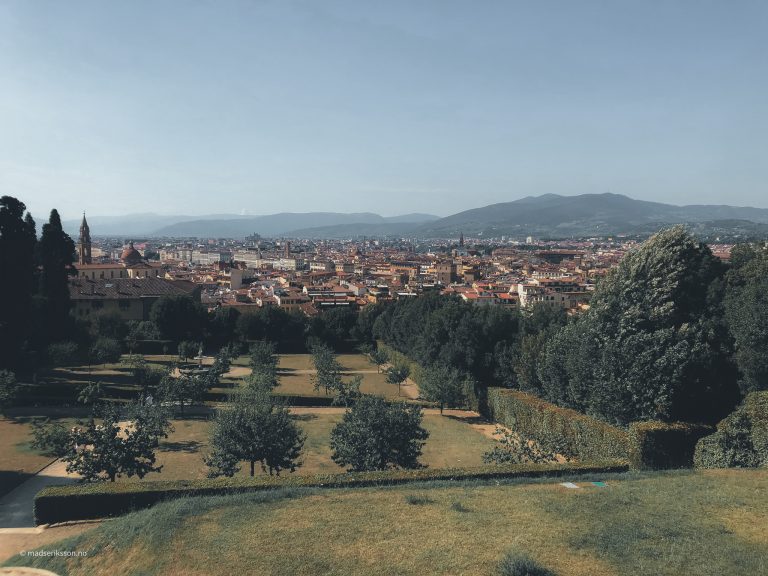
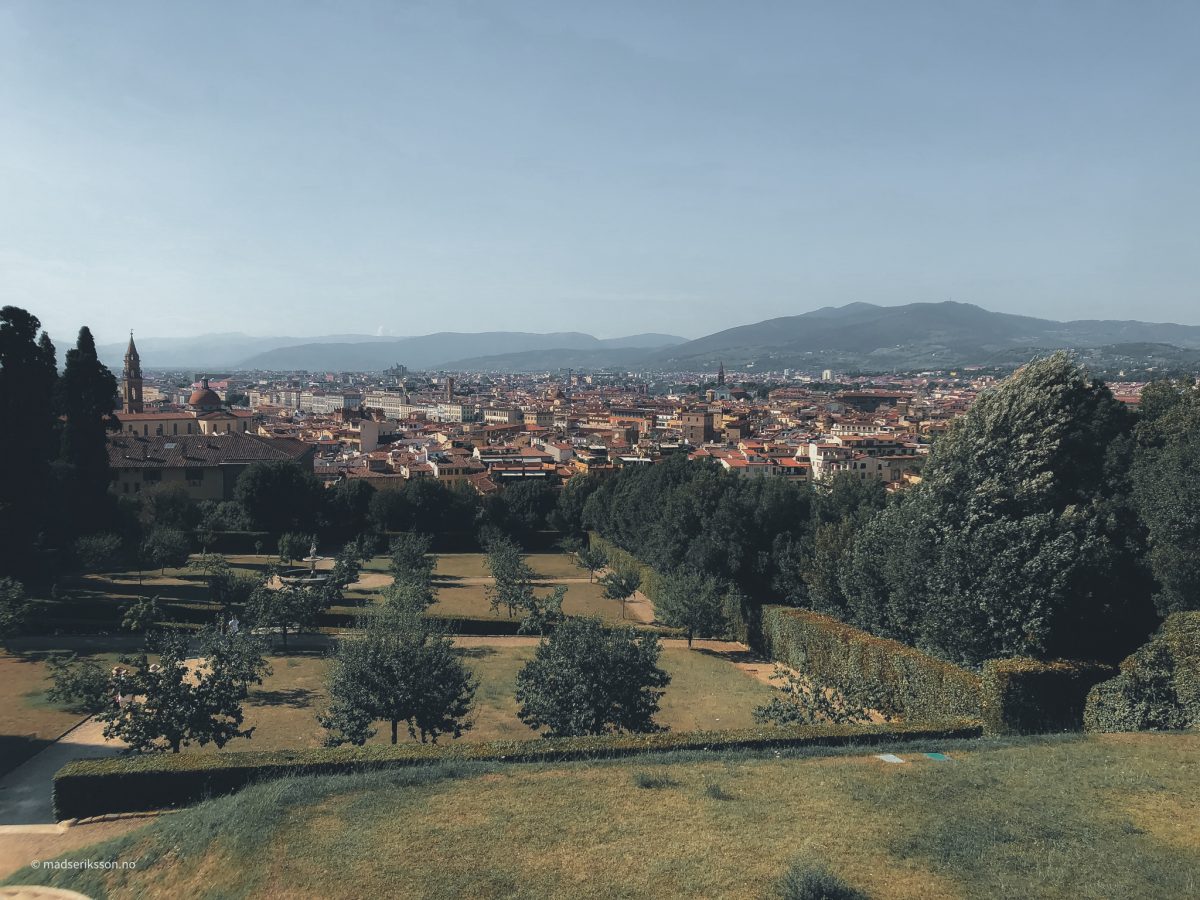
Looking out from the Boboli Gardens over the Oltrarno and the city towards the hills north of Florence
Santa Maria del Fiore
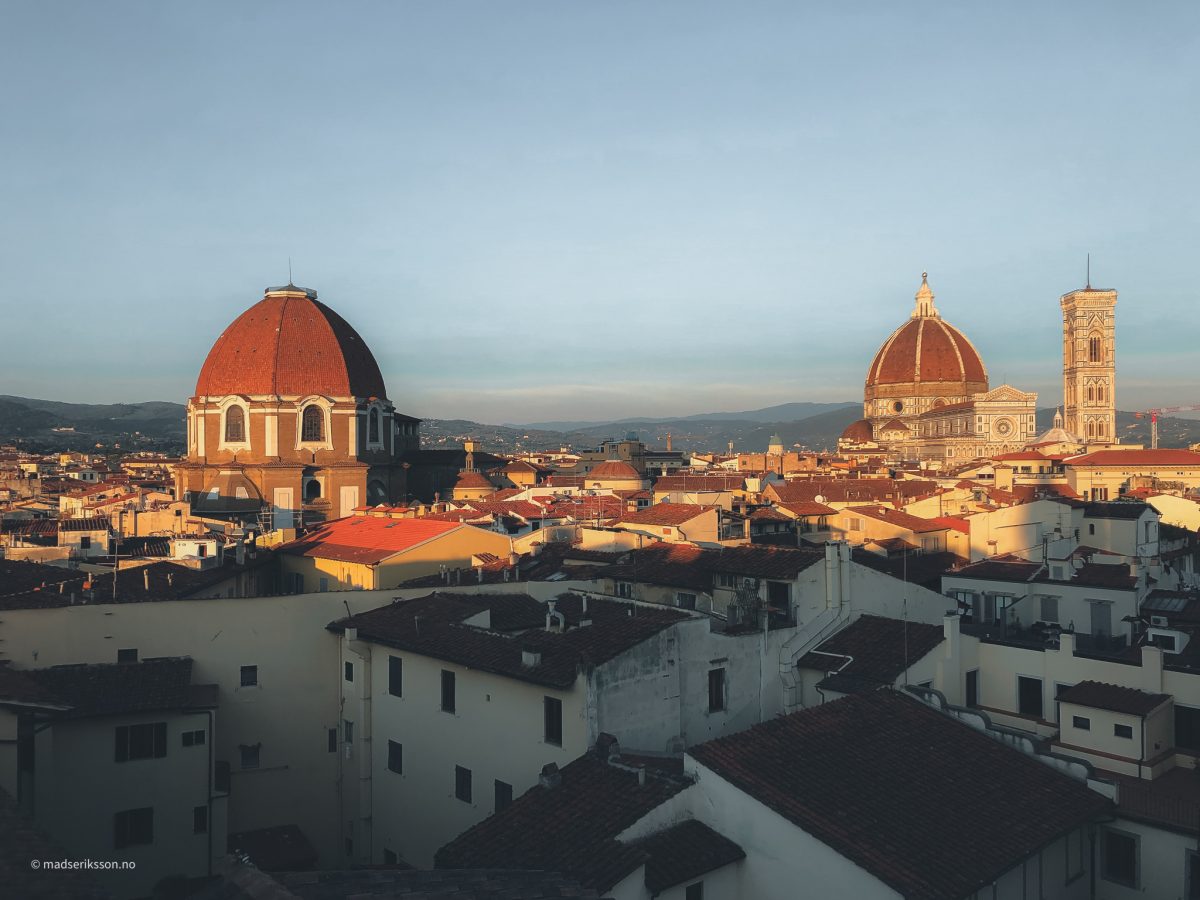
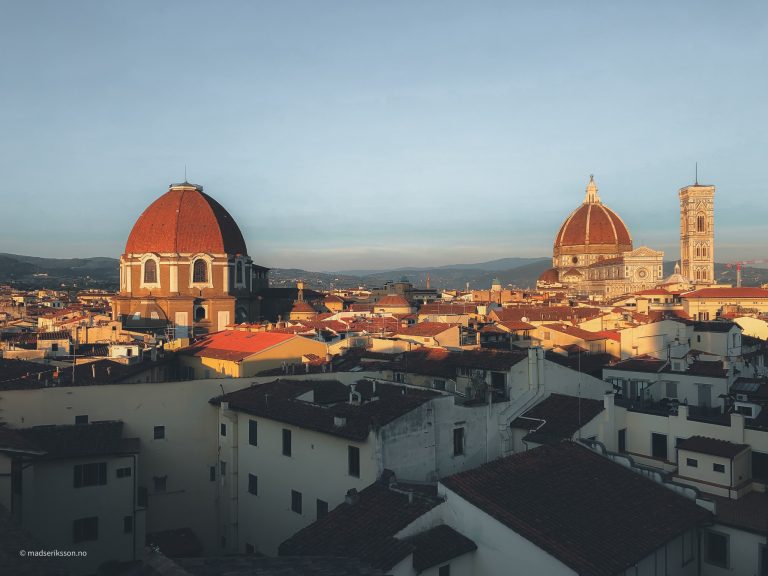
The first stone of the cathedral was laid on 9 September 1296, and Filippo Brunelleschi built its dome between 1420 and 1436 over the 43 m octagonal crossing without wooden centring. With its lantern, the dome reaches 114.5 m. Giotto's Campanile, begun in 1334, stands beside the facade, and the octagonal Baptistery of San Giovanni faces it across the square.
Evening light on the dome of the Medici Chapels at San Lorenzo (left) and Brunelleschi’s cathedral dome with Giotto’s bell tower (right)
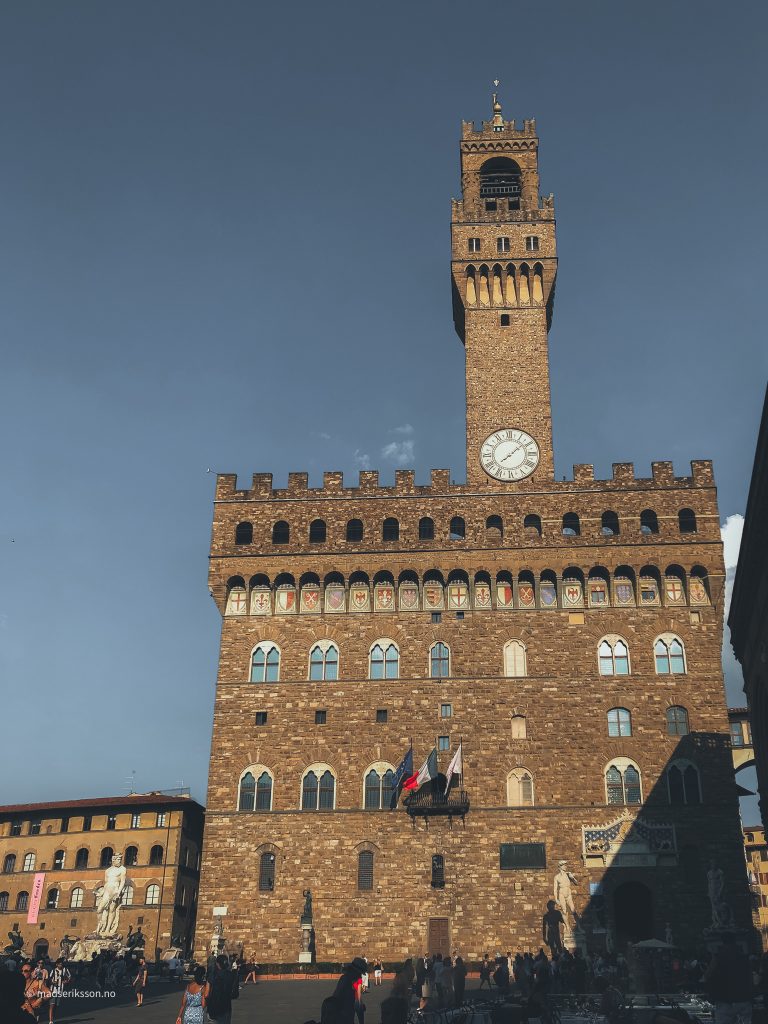
Palazzo Vecchio and the Uffizi
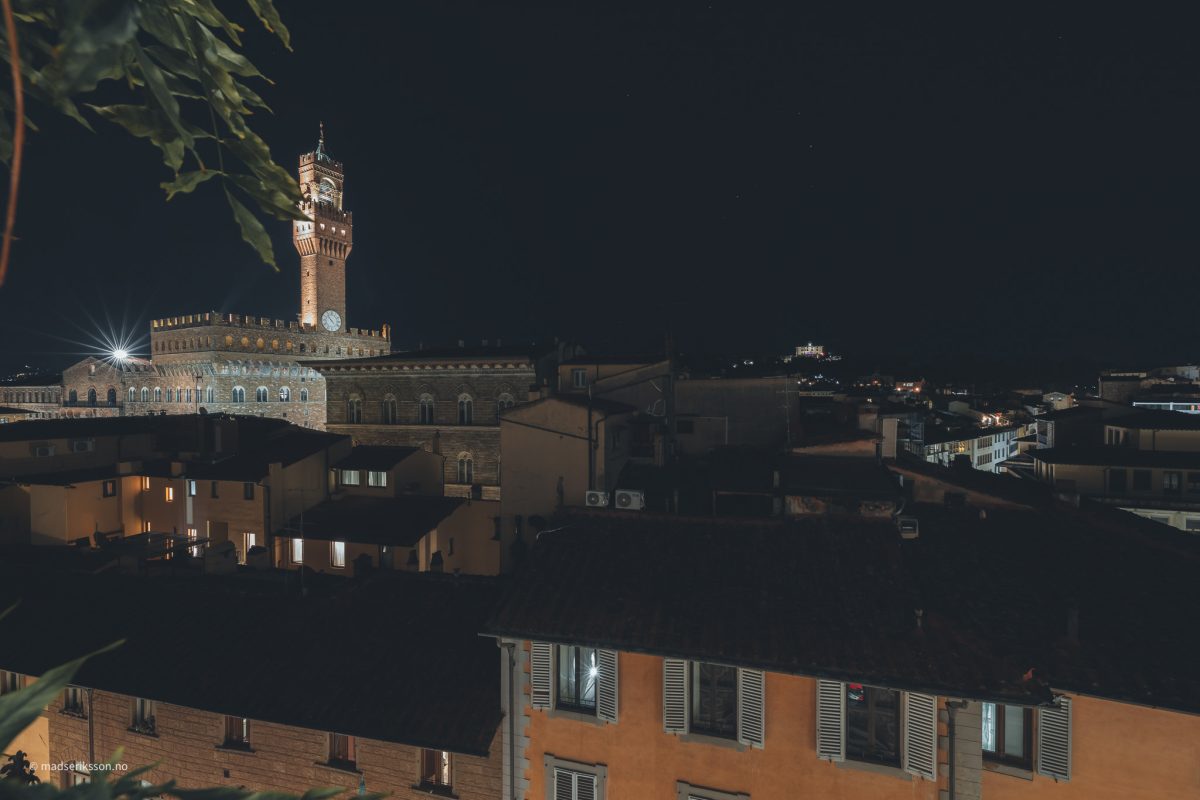
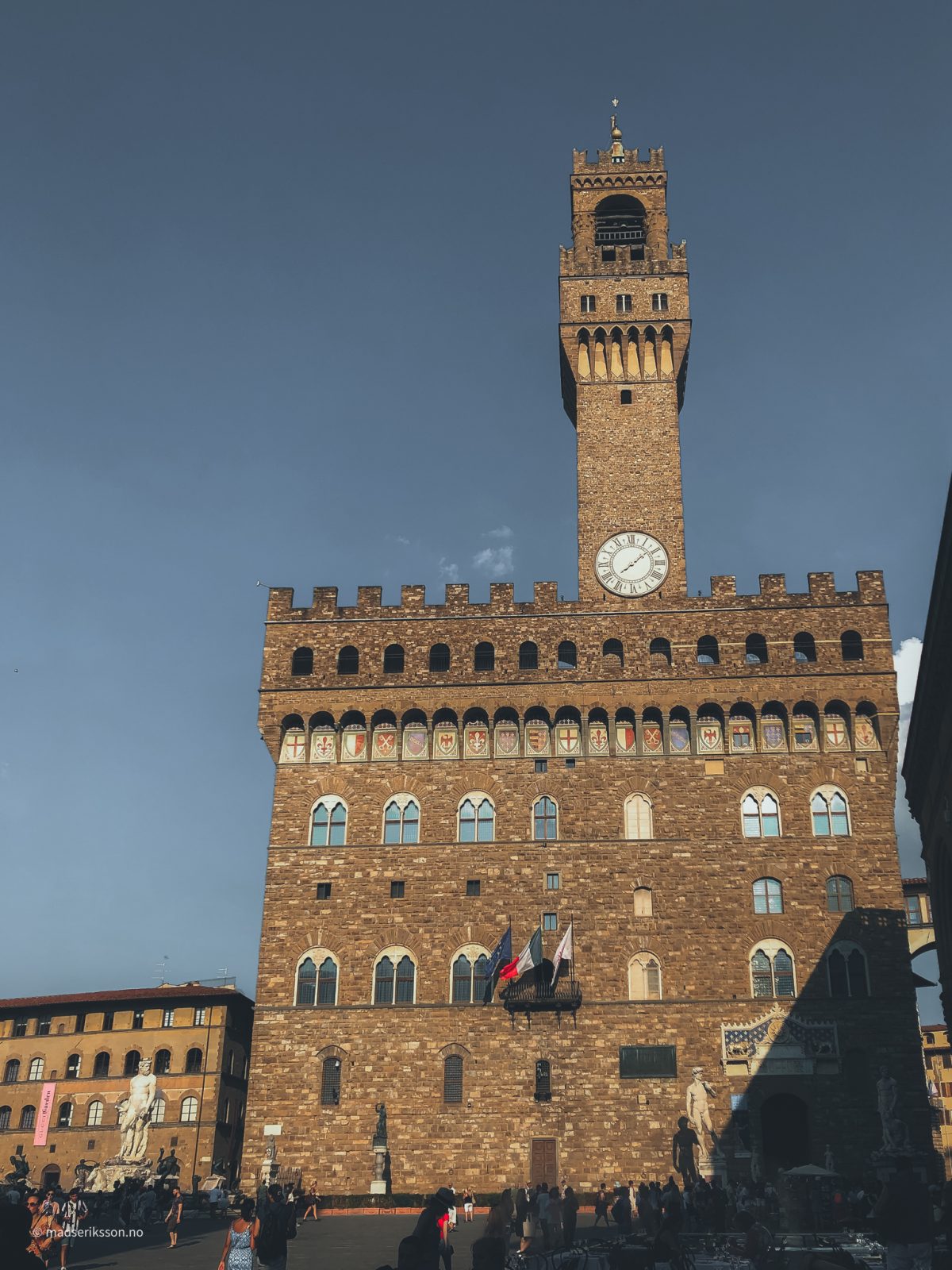
Palazzo Vecchio, begun in 1299 to designs attributed to Arnolfo di Cambio, is still Florence's town hall, and its Torre d'Arnolfo rises 94 m above Piazza della Signoria. The Uffizi, begun by Giorgio Vasari in 1560 as offices for Cosimo I de' Medici and completed in 1581, runs from the square down to the river and now holds one of the world's best-known collections of Renaissance painting.
Palazzo Vecchio on Piazza della Signoria, with the Fountain of Neptune and the copy of Michelangelo’s David at its foot
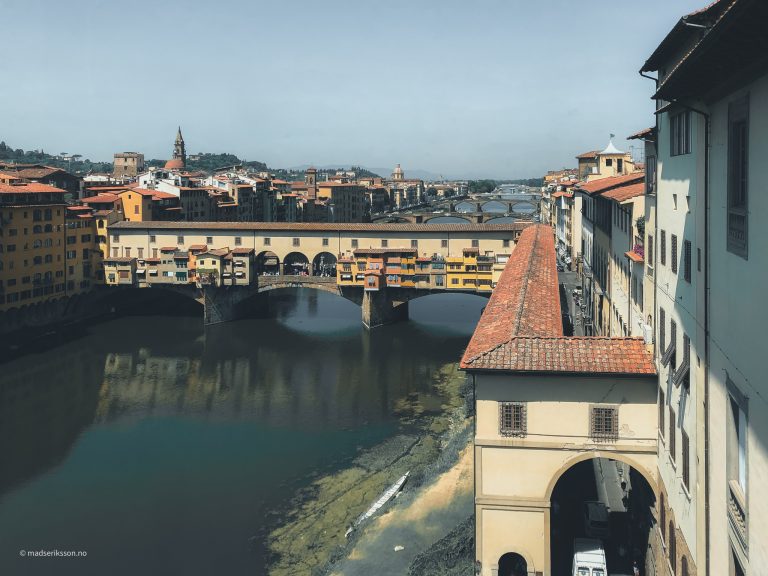
The Ponte Vecchio
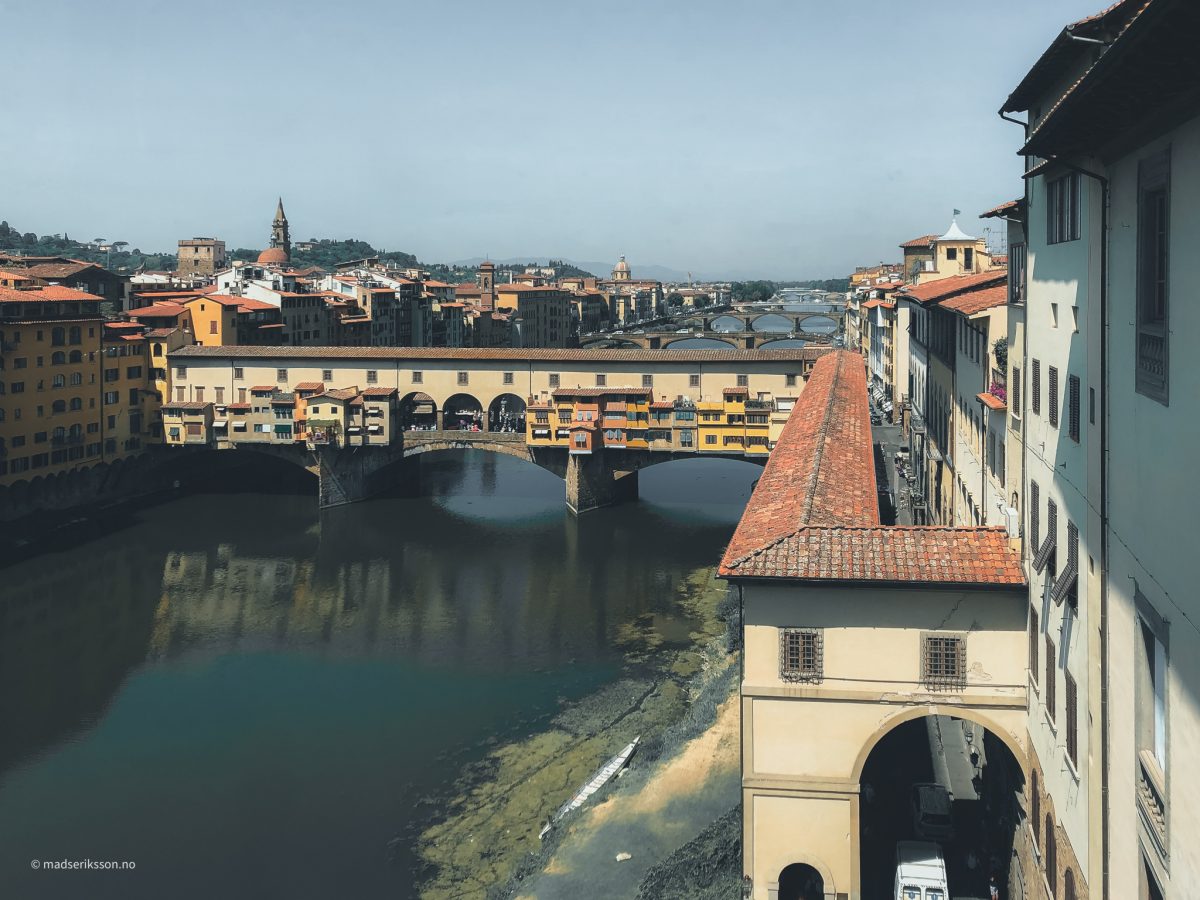
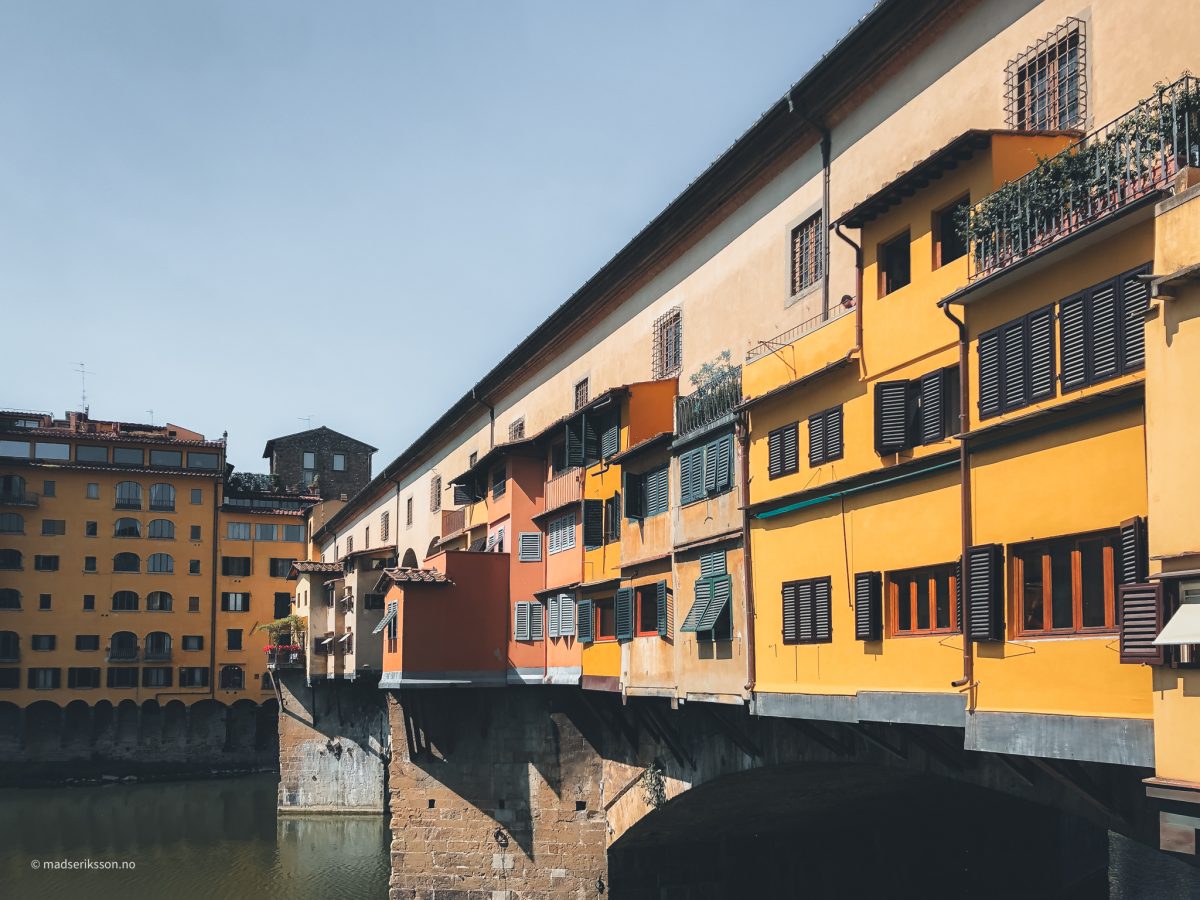
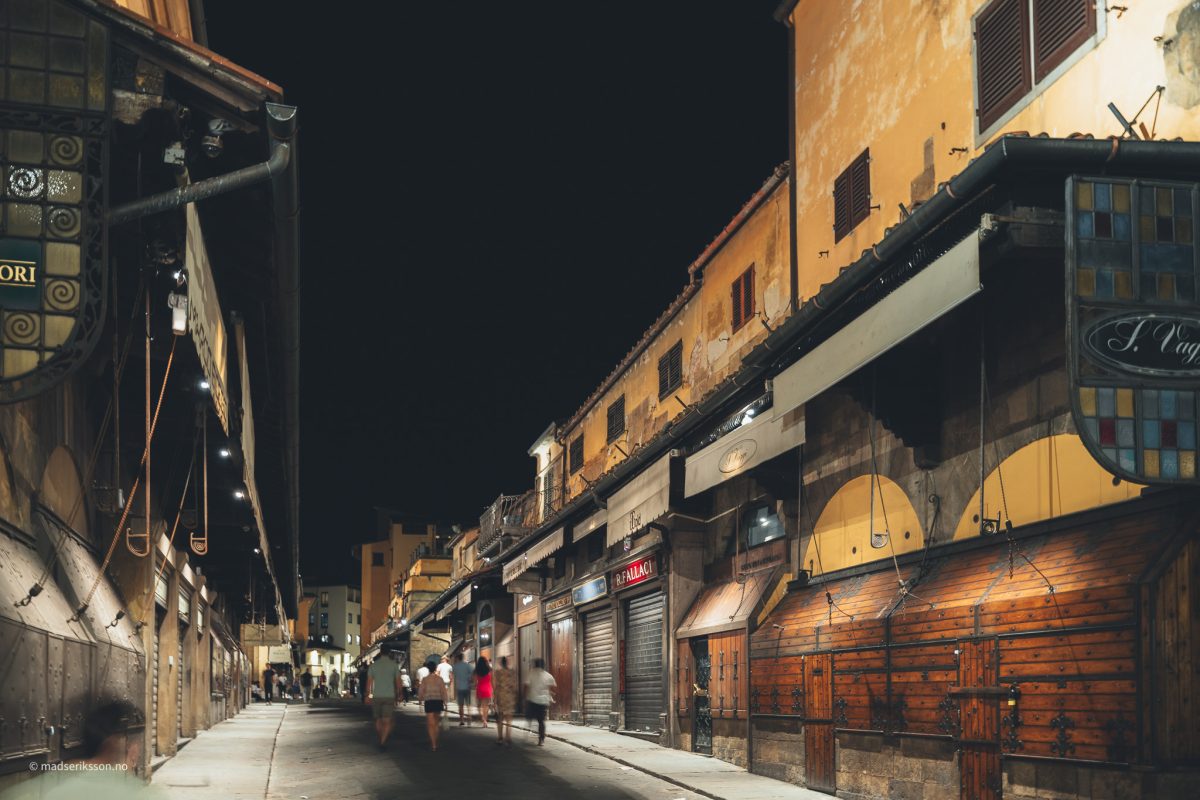
The Ponte Vecchio was rebuilt in 1345 after the flood of 1333, on a main span of 30 m and two side spans of 27 m. Its shops have belonged to goldsmiths and jewellers since 1593, when Grand Duke Ferdinando I expelled the butchers. Above them runs the Vasari Corridor, built in 1565 to link Palazzo Vecchio with Palazzo Pitti on the far bank.
The Ponte Vecchio from the Uffizi, with the Vasari Corridor running along the river towards the bridge
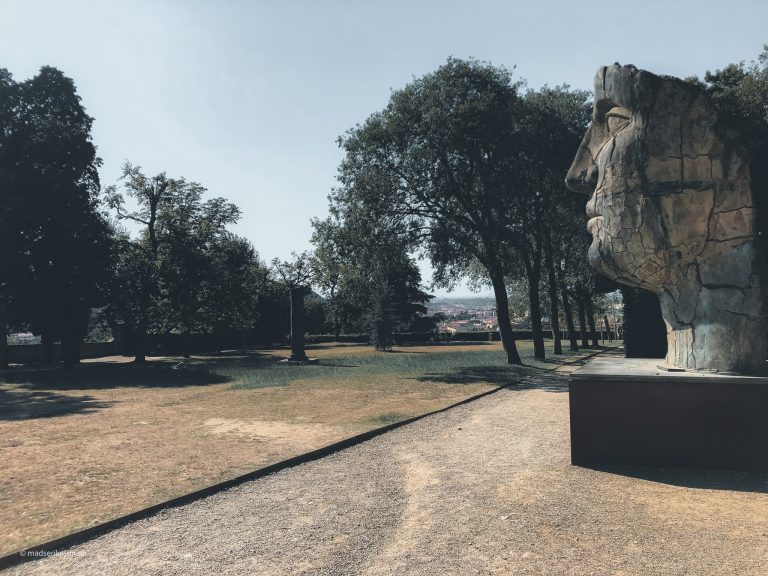
Palazzo Pitti and the Boboli Gardens
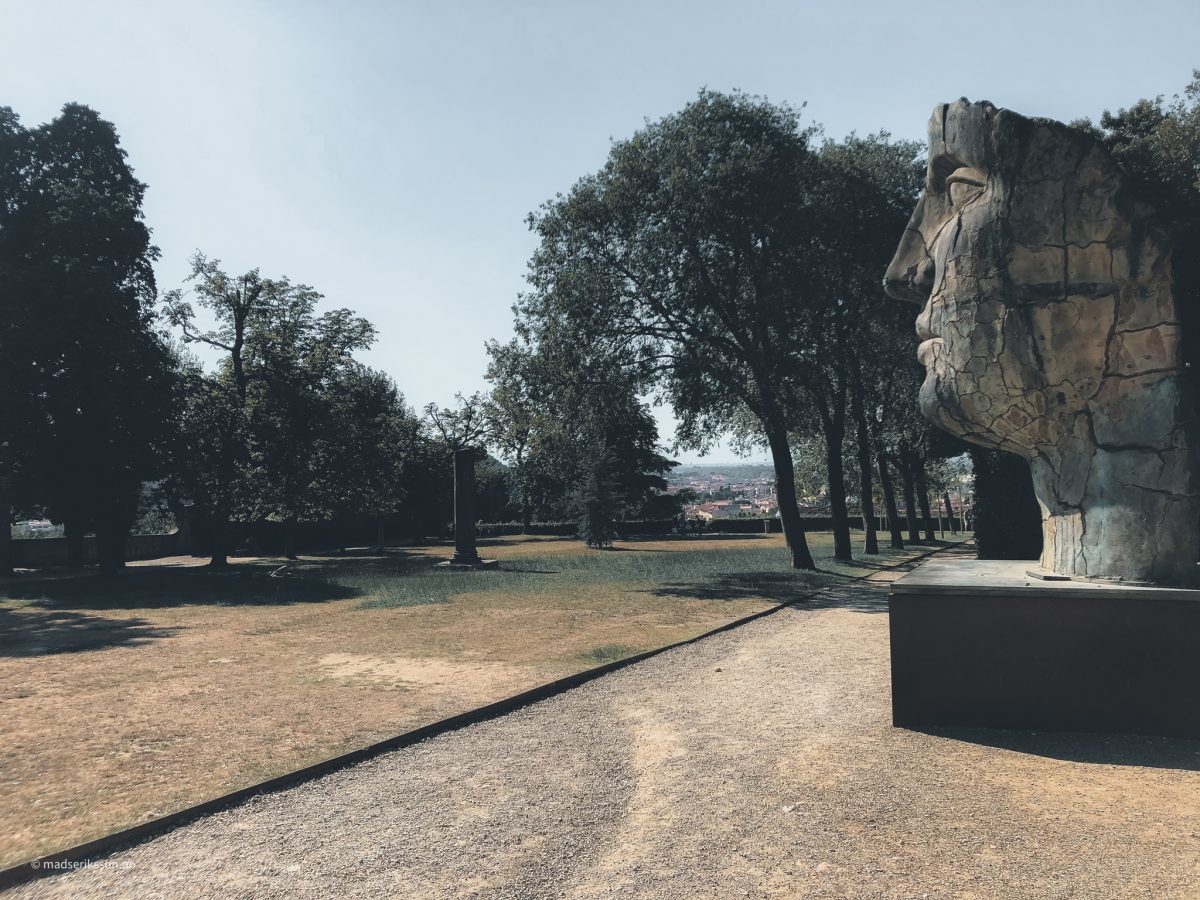
Palazzo Pitti was begun in the 15th century for the banker Luca Pitti and bought by the Medici in 1549, after which it became the main residence of the grand dukes of Tuscany. The Boboli Gardens climb the hill behind it, laid out from the mid-16th century with terraces, fountains, grottoes and sculpture, and their upper terraces look out across the city to the hills of Fiesole.
A colossal cracked bronze head lying on a gravel lawn in the Boboli Gardens, with the hills beyond
Piazzale Michelangelo and Santa Croce
Piazzale Michelangelo was laid out by Giuseppe Poggi in 1869, while Florence was capital of Italy, as a terrace on the hills south of the Arno with a bronze copy of Michelangelo's David. From there the view runs across the river to Santa Croce, the Franciscan basilica begun in 1294, where Michelangelo, Galileo and Machiavelli are buried.
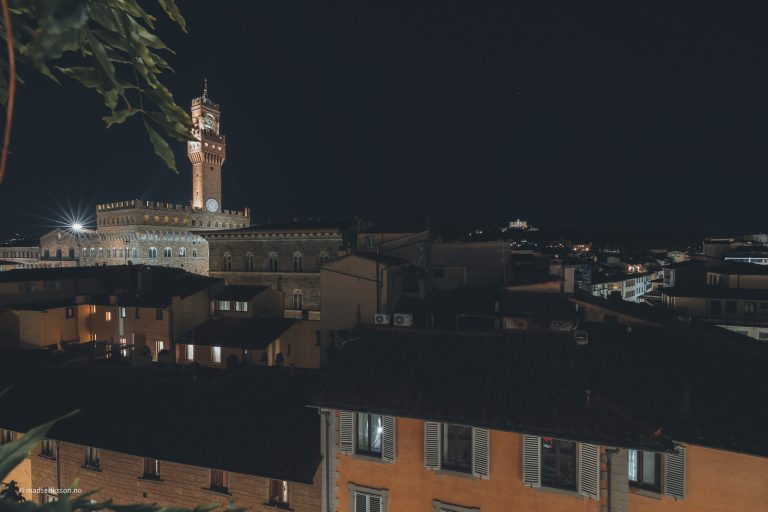
The river at dusk
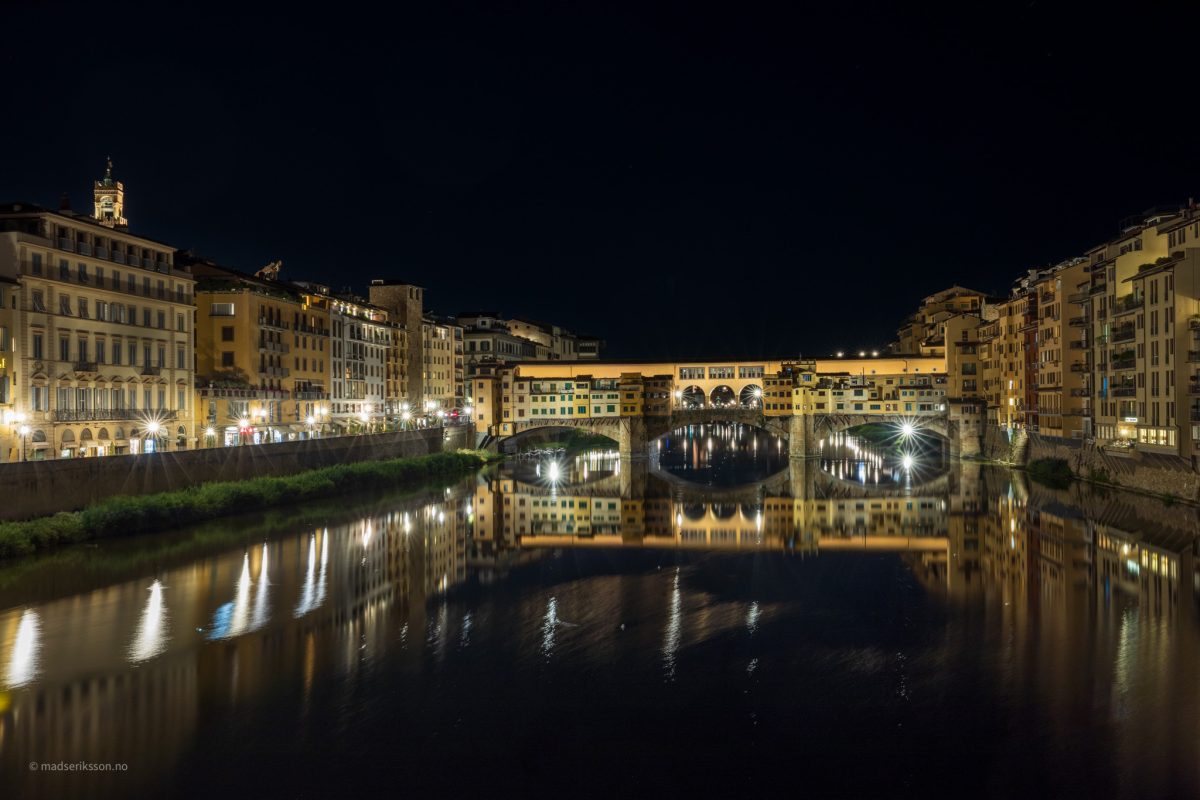
At dusk the floodlit tower of Palazzo Vecchio stands above the rooftops and the Arno reflects the lights along the Lungarno. The Ponte Vecchio was the only bridge in Florence spared by the retreating German army in August 1944; the buildings at each end of it were blown up instead to block the crossing.
Palazzo Vecchio and its Arnolfo tower lit up at night above the rooftops of central Florence
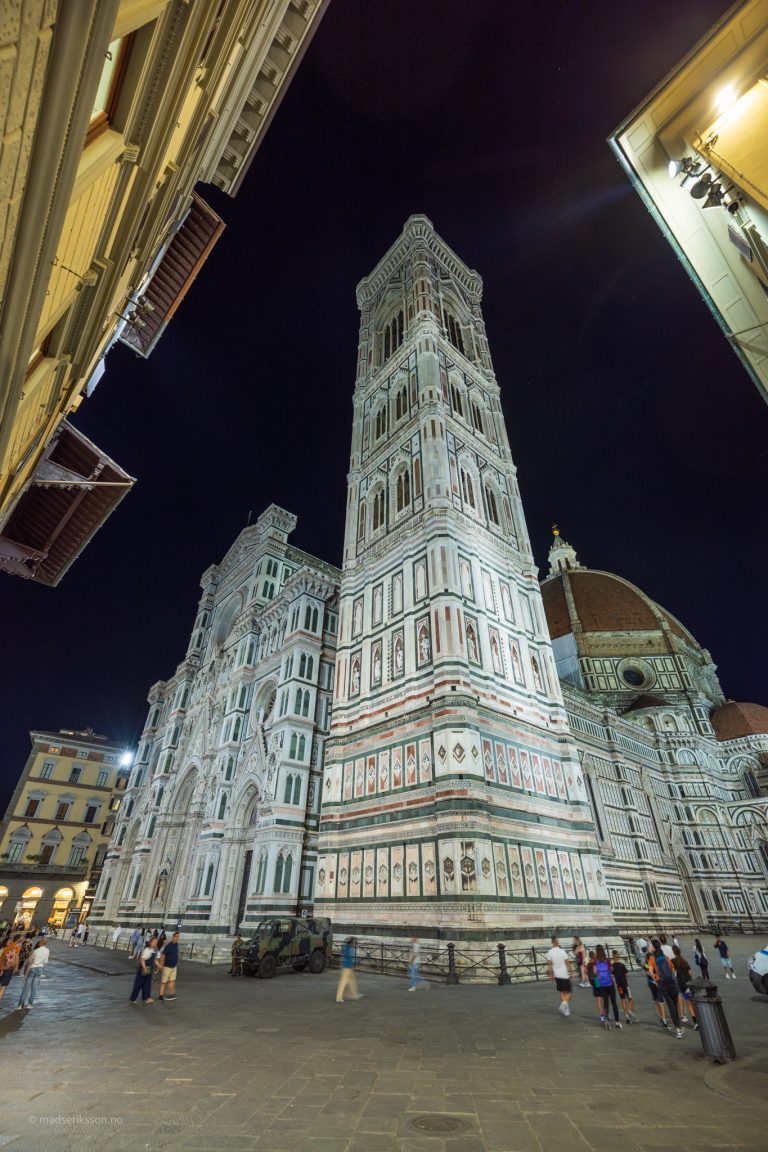
Giotto's Campanile at night
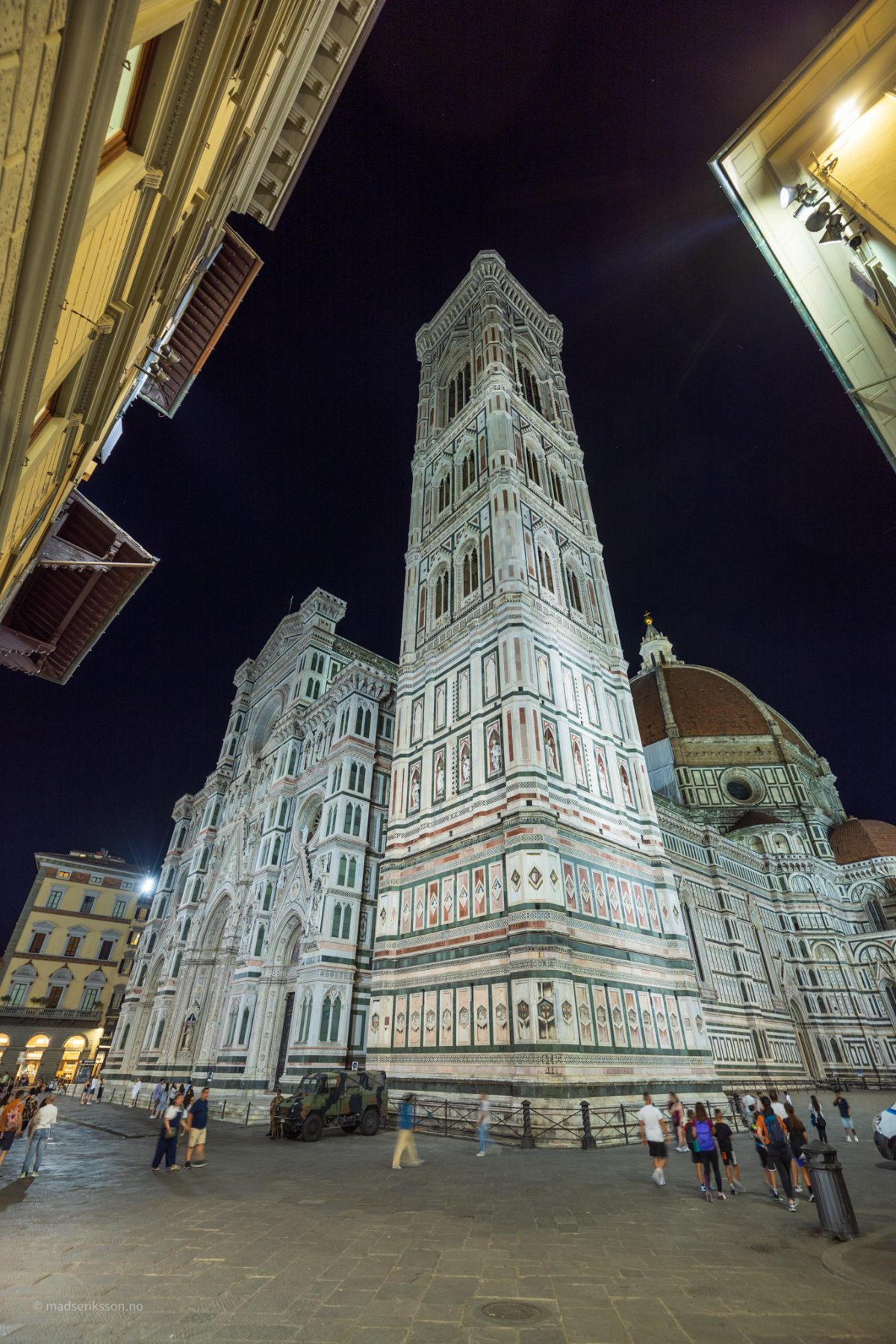
Giotto's Campanile, begun under Giotto in 1334 and completed by Francesco Talenti, is about 85 m high and clad in white, green and red marble, the same palette as the cathedral. The cathedral's neo-Gothic facade is far younger than the building behind it: it was only added between 1876 and 1887, to designs by Emilio De Fabris.
Giotto’s Campanile and the marble facade of Santa Maria del Fiore at night, with the cathedral dome behind
3D model © 2026 madseriksson.no · Photographs © madseriksson.no. Buildings and heights: © OpenStreetMap contributors (ODbL), via OpenMapTiles. Ground imagery: Sentinel-2 cloudless 2023 by EOX IT Services GmbH (contains modified Copernicus Sentinel data 2023; CC BY 4.0). Heights are approximate where OpenStreetMap has no measured value; sun positions are approximate.
The Duomo and the Piazza — Florence’s Religious and Political Heart
The dome Brunelleschi built without scaffolding, the bronze doors Michelangelo called the Gates of Paradise, and the square where Florentines decided the fate of the city for five centuries
The Cathedral of Santa Maria del Fiore — the Duomo — was begun in 1296 and its nave and walls were complete by the early 15th century, when a technical problem remained that no one had been able to solve: how to build a dome over the 43-metre octagonal crossing without the wooden centring (scaffolding) that conventional construction required, since no trees large enough to span the space existed in Tuscany. Filippo Brunelleschi solved the problem by inventing a self-supporting double-shell construction with interlocking herringbone brickwork that transferred the load horizontally rather than downward, eliminating the need for centring entirely. He also invented new hoisting machines to lift the materials, since the existing equipment could not handle the height. The dome was completed in 1436 and remains the largest masonry dome ever constructed. Climbing to the summit via the 463 steps between the inner and outer shells — which gives a close-up view of the fresco of the Last Judgement on the interior surface — is physically demanding and worth every step. The exterior view of the dome from the surrounding hills, particularly from the Piazzale Michelangelo at sunset, is the defining image of Florence.
The Baptistery of San Giovanni, immediately west of the Duomo and older than the cathedral by several centuries, is most celebrated for its three sets of bronze doors. The south doors (Andrea Pisano, 1336) and the north doors (Ghiberti, 1403–1424) are significant; the east doors — the Gates of Paradise — are transcendent. Ghiberti spent 27 years on them, from 1425 to 1452, creating ten gilded bronze panels depicting Old Testament scenes with a mastery of linear perspective, atmospheric depth and narrative compression that represents one of the highest points of Renaissance sculpture. Michelangelo, who saw them later in the century, called them worthy to be the gates of heaven — giving them the name they have kept ever since. The originals are in the Museo dell’Opera del Duomo; the doors on the Baptistery are high-quality reproductions.
Brunelleschi won the commission for the dome in 1418 by demonstrating that he could make an egg stand upright on a flat marble surface — by cracking the bottom. The other architects protested that they could have done the same. Brunelleschi said: so too could you have built my dome, if I had shown you how.
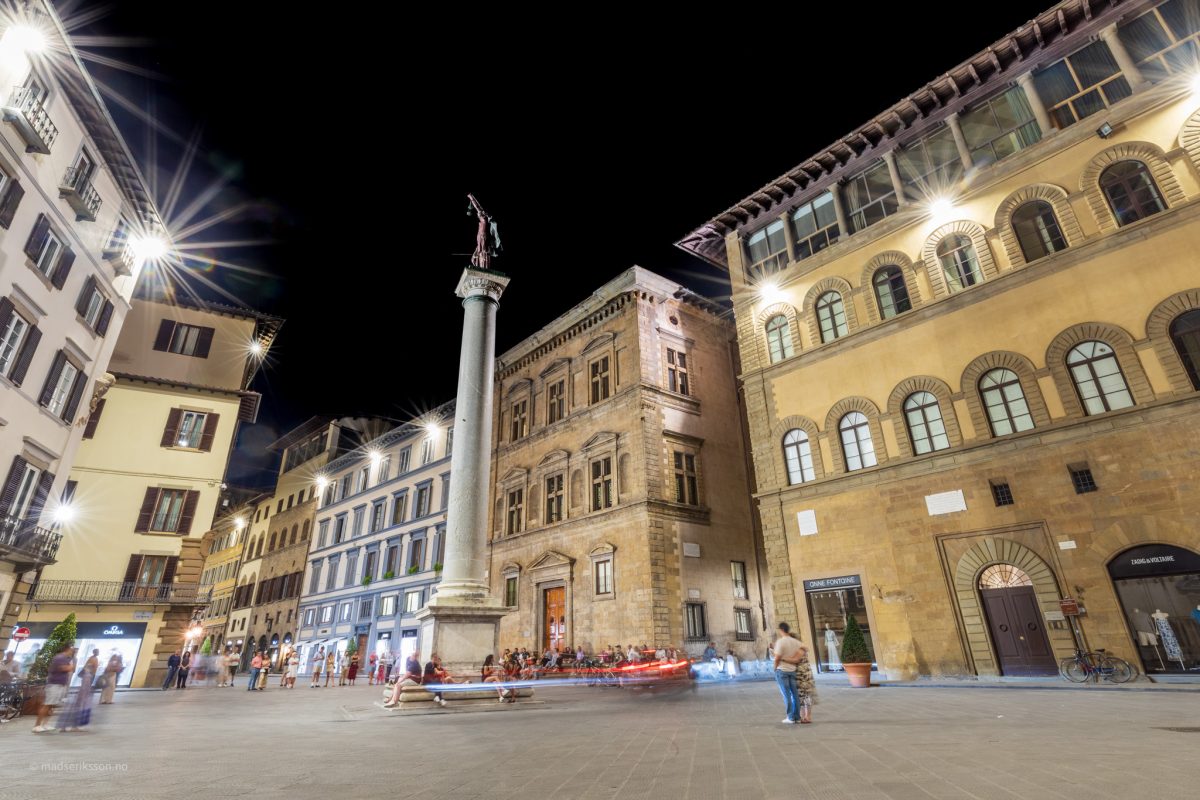
Piazza della Signoria — the political centre of the Florentine Republic — is dominated by the crenellated Palazzo Vecchio (begun 1299), whose 94-metre tower defined the Florence skyline before the dome arrived. The Loggia dei Lanzi, the open-air sculpture gallery on the southern side of the square, contains Perseus with the Head of Medusa by Benvenuto Cellini (1554), the Rape of the Sabine Women by Giambologna (1583) and other major works available to any passerby at any hour. A copy of Michelangelo’s David stands where the original stood until 1873 (the original replaced a Donatello Judith that had stood there since 1495). The square is also where, in 1498, the Dominican friar Girolamo Savonarola — who had briefly governed Florence with a theocratic severity that included the Bonfire of the Vanities (burning books, mirrors, cosmetics and artworks) — was himself burned at the stake. A small bronze disc in the paving marks the spot.
The Uffizi and the David — The Greatest Concentration of Renaissance Art in the World
The Birth of Venus in one museum. The David in another. Both require advance booking, patience and a clear head. Both are worth everything they require.
The Uffizi Gallery was built by Cosimo I de’ Medici from 1560 as the administrative offices (uffizi) of the Florentine government, and the upper floor was opened as a gallery to display the Medici art collection in 1581. It is now one of the most important art museums in the world: the collection includes Botticelli’s Birth of Venus (c. 1484–1486) and Primavera (c. 1477–1482), Leonardo’s Annunciation (c. 1472) and his unfinished Adoration of the Magi, Michelangelo’s Doni Tondo, Raphael’s Madonna of the Goldfinch, Titian’s Venus of Urbino, and significant works by Caravaggio, Dürer, Rembrandt, Rubens, Giotto and Cimabue. The sequence of rooms traces the full development of Italian painting from the Byzantine to the Baroque, and is inexhaustible in the depth of what it contains. The Birth of Venus and the Primavera in Room 10–14 are the rooms most visitors come to see; they are also the rooms most likely to be so crowded that adequate contemplation is impossible without arriving at opening (9am) or near closing (generally 19:00 in summer).
Michelangelo’s David, in the Galleria dell’Accademia on Via Ricasoli, is the most visited sculpture in the world and one of the most significant objects of the Western Renaissance. Carved from a single block of Carrara marble between 1501 and 1504, when Michelangelo was 26–29 years old, it depicts the biblical David at the moment before his confrontation with Goliath — the sling over his left shoulder, the right hand holding the stone, the body in a classical contrapposto stance but the face turned to the right in alert concentration rather than the heroic calm of classical sculpture. The scale is overwhelming in person: 5.17 metres, designed to be placed high on the exterior of the Duomo and therefore disproportionately enlarged in the head and hands to compensate for the viewing angle from below. When it was placed instead in the Piazza della Signoria at ground level, the distortion became a deliberate formal power. It has been in the climate-controlled Tribune of the Accademia since 1873.
The marble block Michelangelo used for the David had been quarried in 1464, worked and abandoned by Agostino di Duccio, left to rot in the Opera del Duomo yard for 35 years, and offered to Leonardo da Vinci, who declined it. Michelangelo started on it in 1501. He was 26.
The Bargello Museum, in the medieval civic building southeast of the Piazza della Signoria, holds the finest collection of Italian Renaissance sculpture outside the Accademia: Donatello’s bronze David (c. 1440–1460 — the first free-standing male nude since antiquity), his polychrome wood Mary Magdalene, and the St. George (c. 1417) that established the vocabulary of Renaissance heroic sculpture before Michelangelo was born; Michelangelo’s early Bacchus and Tondo Pitti; Cellini’s preparatory model for the Perseus; and the two competing panel reliefs that Brunelleschi and Ghiberti submitted for the 1401 competition to design the Baptistery doors — the competition that effectively launched the Florentine Renaissance. The Bargello is less visited than the Uffizi or Accademia and does not require advance booking on most days; it is one of the best-kept secrets in Florence.
The Medici City — The Bridge, the Basilica and the Other Side of the Arno
The medieval bridge the German army spared, the basilica where Florence buried its greatest, and the Oltrarno neighbourhood where the Medici lived and artisans still work
The Ponte Vecchio is the only bridge in Florence that survived the German military retreat of August 1944, when all the other Arno crossings were blown up on direct military orders. According to one account, Adolf Hitler personally countermanded the orders to destroy the Vecchio — having admired it on a visit to Florence in 1938 — and the German commander found an alternative by demolishing the medieval buildings on both approaches instead, which blocked access without destroying the bridge itself. The bridge has had shops on it since at least the 13th century; they were jewellers, fishmongers and butchers until 1593, when Ferdinando I — irritated by the smells reaching the Vasari Corridor that passes above the bridge — expelled all food traders and replaced them with goldsmiths and jewellers. The same trade occupies the same spaces today. The Corridor itself, built by Vasari in 1565 to allow the Medici to travel between the Palazzo Vecchio and the Palazzo Pitti without descending to street level, runs along the top of the bridge’s eastern row of shops and is visible from below as the continuous row of small windows above the jewellery display.
Santa Croce — the great Franciscan basilica at the eastern end of the historic centre, begun in 1294 — is the burial place of the most significant individuals in Florentine and Italian cultural history. Michelangelo’s tomb, designed by Vasari, is on the right nave; across from it, the monument to Dante Alighieri (whose body is in Ravenna; he was exiled from Florence and never returned) was placed as a cenotaph in 1829. Galileo Galilei, rehabilitated by the Church long after his death and moved here in 1737; Niccolò Machiavelli; and the composer Gioachino Rossini are also interred here. Donatello’s gilded bronze relief of the Annunciation and, in the Sacristy, his painted wooden Crucifix (described by Brunelleschi as “a peasant on a cross”) are among the significant works in the church; the Peruzzi and Bardi chapels frescoed by Giotto in the 1320s represent some of the earliest examples of the proto-Renaissance naturalism that would develop into the full movement a century later.
The German commander in Florence in 1944 was reportedly told not to destroy the Ponte Vecchio by direct order from Hitler, who had admired it on his 1938 visit to the city. Every other bridge over the Arno was blown up. The Vecchio’s approaches were demolished instead.
The Oltrarno — literally “beyond the Arno” — is the district on the south bank of the river that has remained the artisan and working quarter of Florence while the north bank became increasingly tourist-dominated. The Palazzo Pitti, the vast Mannerist palace that the Medici purchased in 1549 and gradually expanded to dwarf its neighbours, now houses multiple museums including the Palatine Gallery (with major works by Raphael, Titian and Rubens in their original palace settings), the Royal Apartments, and the Museum of the History of Fashion. Behind it, the Boboli Gardens — laid out from 1549 as the Medici’s private garden and now a public park — rise up the hillside in a series of terraces, grottos, fountains and long cypress avenues. The streets of San Nicolò and Santo Spirito in the Oltrarno retain workshops making shoes, picture frames, furniture and leatherwork in the craft traditions that have occupied these streets for centuries, and the neighbourhood’s restaurants and wine bars are generally better and less expensive than their equivalents north of the river.
Tuscan Food — The Steak, the Soup and the Street Offal
Florentine cooking is austere, seasonal and ingredient-driven — built on the best olive oil in Italy, the finest beef, the bread with no salt, and the wine of the surrounding hills
Florentine cooking is defined by an austere commitment to quality ingredients and a corresponding suspicion of elaboration. The cuisine does not build sauces or construct complexity; it presents the best possible version of a small number of things. The most famous of these things is the bistecca alla Fiorentina: a T-bone steak from the Chianina breed of cattle — an ancient white Tuscan breed whose meat is leaner, more flavourful and more expensive than commodity beef — cut at a minimum of 5 centimetres, grilled on oak wood embers at high heat to achieve a charred exterior and an interior that remains deep red. The correct internal temperature is around 50°C. It is seasoned only with salt and Tuscan olive oil, and it is served on a board, bone up, without sauce. Asking for it anything other than rare (al sangue) is possible but widely regarded as a categorical misunderstanding of the dish. It is ordered by weight — typically 600 grams to 1.5 kilograms — and is not a dish for small appetites or small budgets.
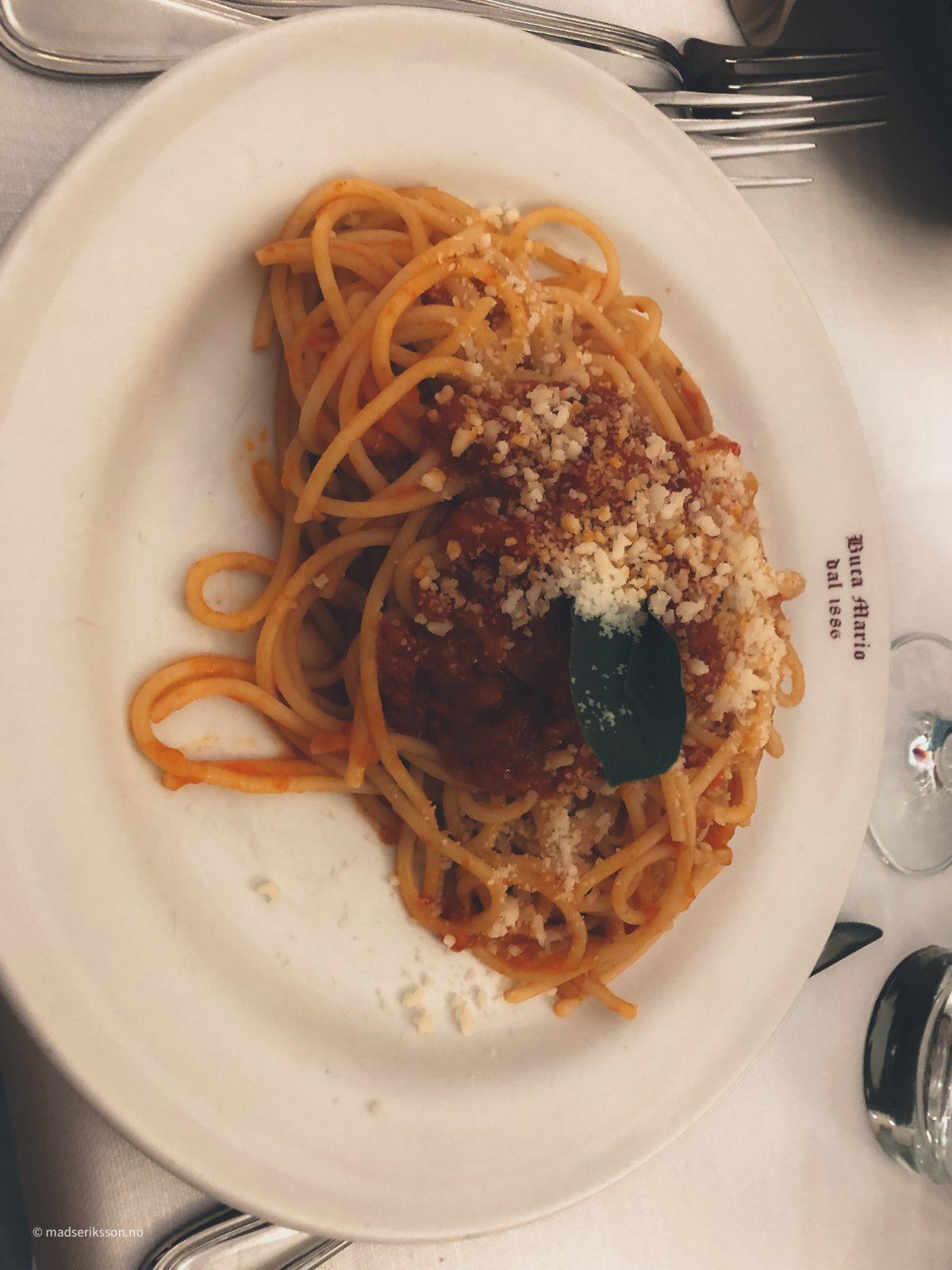
Tuscan bread — pane sciocco — is made without salt, a tradition dating from the 12th century when Florence imposed a salt tax that Tuscan bakers refused to pay. The resulting bread is bland by itself but essential for Florentine cooking: for ribollita (the twice-cooked bean and vegetable soup thickened with stale bread that is the defining dish of Florentine cucina povera), for pappa al pomodoro (bread and tomato soup), for panzanella (bread salad with tomatoes, basil and onion in summer), and for crostini di fegato (toasted bread topped with chicken liver pâté spiced with capers and anchovies — Florence’s universal antipasto). Pappardelle al cinghiale — wide flat pasta with wild boar ragù — is the standard first course in Florentine restaurants from September through March, when the boar are hunted in the Tuscan forests. Ribollita is better the day after it is made; the name means “re-boiled” and the best versions are dense enough to be cut with a knife.
Lampredotto — the fourth stomach of the cow, slow-boiled in broth with tomatoes and herbs, sliced and served in an unsalted roll that is dipped in the cooking broth — has been the street food of Florence’s workers since the medieval period. It is eaten standing at a cart, with salsa verde.
Lampredotto — the reticulum or fourth stomach of the cow, a street food specific to Florence — is the city’s most confrontational culinary tradition and its most authentic: slow-boiled in a herb and tomato broth for hours, sliced and served in a soft bread roll (the top half dipped in the cooking broth), with a choice of green sauce or red sauce or both. The lampredottaio (the lampredotto vendor) operates from a cart or kiosk, generally in the traditional market areas, and the food is eaten standing. It is either exactly what you want or completely out of the question, and there is very little middle ground. Chianti Classico — the wine produced in the hills between Florence and Siena, identified by the black rooster label of the Chianti Classico Consortium — is the natural accompaniment to almost everything in the Florentine kitchen: a Sangiovese-based red of depth and structure, produced in both the regular Classico and the more complex Gran Selezione categories. Vin Santo — the sweet amber dessert wine made from dried Trebbiano grapes — is served with cantucci (hard almond biscuits for dipping) and is the appropriate end to any serious Florentine meal.
«Florence is the city where a banker’s family decided to fund artists, and the artists turned out to be Brunelleschi, Donatello, Botticelli and Michelangelo. The consequence is a city where the greatest works of the Western tradition are in the buildings they were made for, or a short walk from them, in a city that is neither too large to navigate nor too small to exhaust. The crowds are real and the heat is real and the need to book everything months ahead is real. None of it changes what is here. The dome seen from the Piazzale Michelangelo at sunset, the Birth of Venus seen before the tour groups arrive, the David seen without a queue — each of these is an experience that belongs to a category that the word “art” only partially describes. Florence is worth whatever it costs to see it properly.»
More in the same area
 ArchitecturePisa — The Leaning Tower, the Square of Miracles and the City on the Arno
 CitiesRome: A Timeless Journey Through History and Culture
 CitiesExploring the Enchanting City of Venice
 CitiesMilan: A Fashionable and Cultural Hub in Italy
 ArchitectureSt Peter’s Basilica: Michelangelo’s Dome and 120 Years of Building
 CitiesSan Marino — The Republic on the Rock, Its Towers and Its Captains Regent
City Frames · scroll-driven 3D
More cities in three dimensions
54 city guides open with a model built from open map data. Scroll, and the camera moves from landmark to landmark.
Departures · City Frames
Where to next?
| Time | Destination | Country | Status |
|---|
Live · position of the sun
Golden hour, right now
The low, warm light just after sunrise and just before sunset. These are the cities on the site where it is happening at this moment.