Basel is a city built around a bend in the Rhine, at the point where Switzerland, France and Germany meet. The river divides it into two halves — the old merchant city of Grossbasel on the high left bank, crowned by the red sandstone Minster, and the flatter Kleinbasel on the right — and in summer the people of both halves float down it to work. It is a city of around 178,000 people with about forty museums, Switzerland’s oldest university, the oldest public art collection in the world, and a carnival that starts at four in the morning with every street light in the old town switched off. It is also one of the easiest cities in Europe to explore: compact, walkable, and free to get around for anyone staying the night.

Basel’s position on the Rhine made it rich long before it was Swiss. A bishop’s city in the Middle Ages, it was largely destroyed by an earthquake in 1356 and rebuilt; between 1431 and 1449 it hosted the Council of Basel, which made it for a time a focal point of western Christendom, and in 1460 it founded the first university in what is now Switzerland. On 9 June 1501 it joined the Swiss Confederation as the eleventh canton. In the decades that followed, Basel’s printers made it one of the great publishing centres of Europe, and the humanist Erasmus of Rotterdam worked here with the printer Johann Froben, died here in 1536 and is buried in the Minster.
Modern Basel lives from chemistry, pharmaceuticals and trade, and spends a remarkable share of its wealth on culture. The art museum’s collection began in 1661, when the city and the university bought a private cabinet of paintings and made it public; the world’s leading art fair began here in 1970. Yet for all its museums, the city’s character is best felt outdoors — on the terrace behind the Minster, on the little ferries that cross the Rhine without an engine, and on the river itself on a hot afternoon.
How to approach Basel
This guide covers Basel in four parts: the old town of Grossbasel, from the red Town Hall on the Marktplatz to the Minster on its hill; the Rhine, with its bridges, current-driven ferries and summer swimming; the museums, from the Kunstmuseum to the Fondation Beyeler in Riehen and the Museum Tinguely; and Fasnacht, the three-day carnival that is the city’s great annual event.
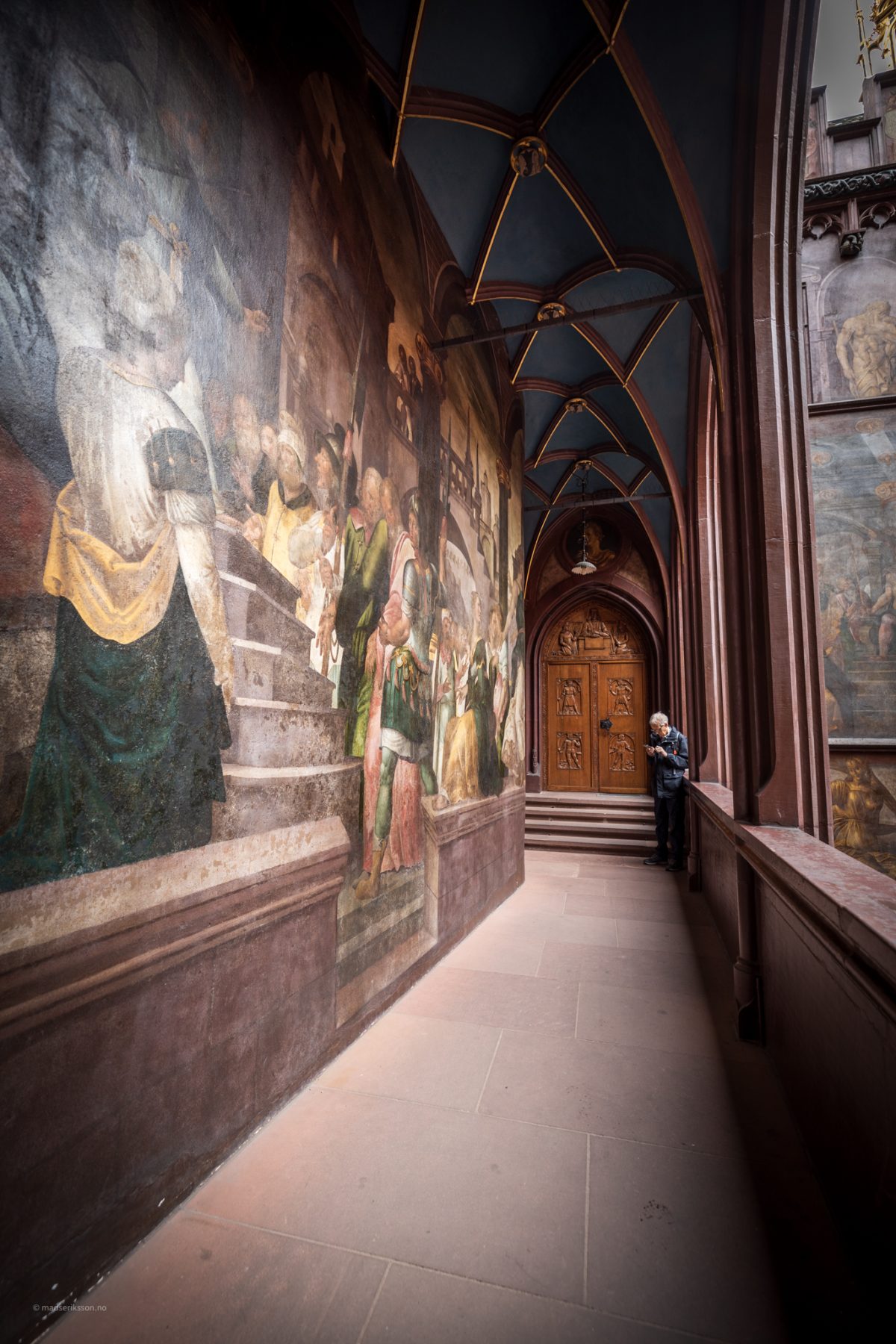
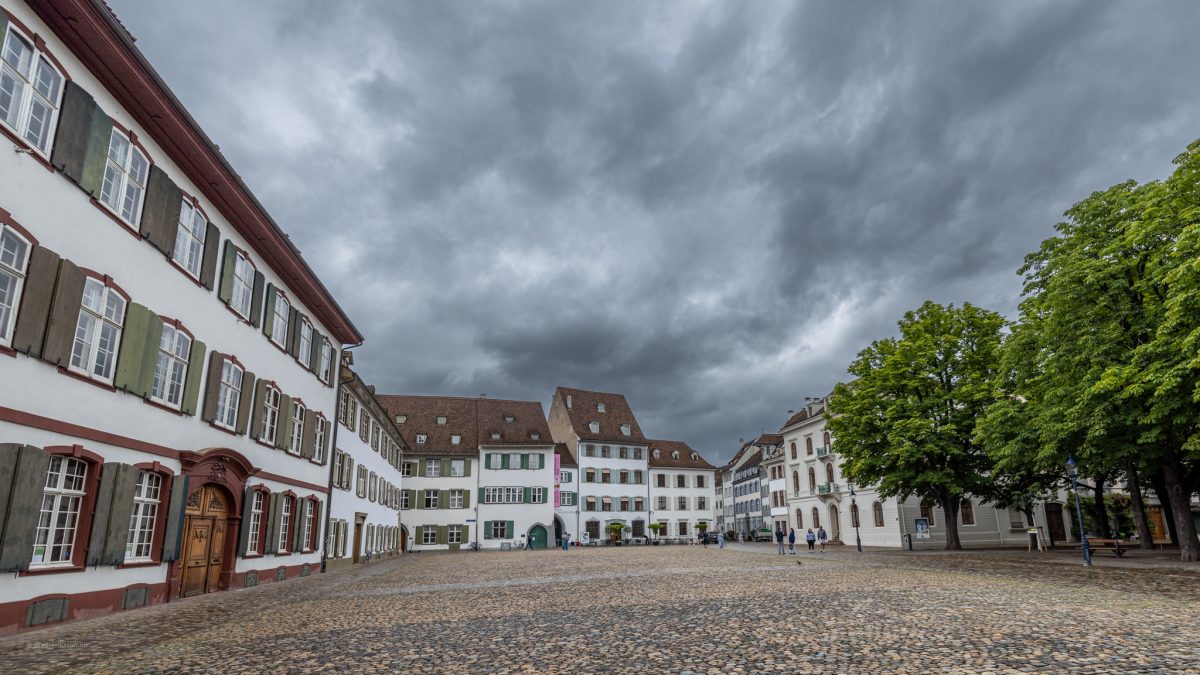
Basel in 3D
Basel lies on a bend of the Rhine where Switzerland, France and Germany meet. The river divides the old merchant city of Grossbasel on the high left bank from the flatter Kleinbasel on the right. Largely destroyed by an earthquake in 1356 and rebuilt, the city joined the Swiss Confederation as the eleventh canton on 9 June 1501.
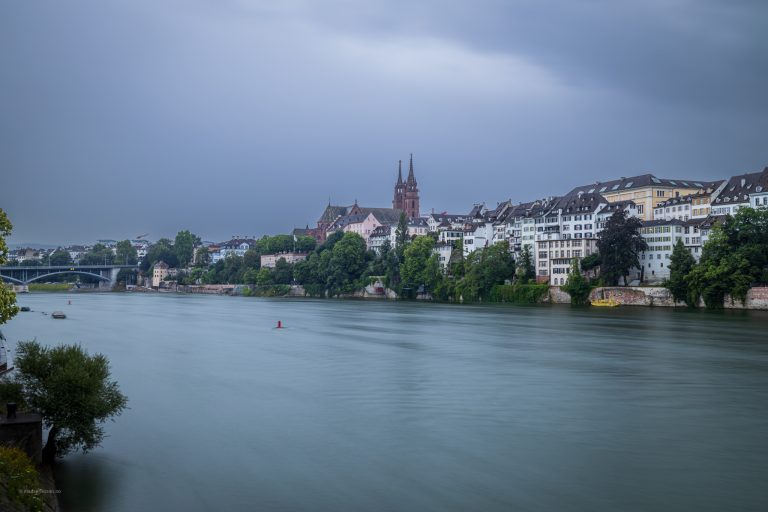
Basel Minster and the Pfalz
Basel Minster is built of red sandstone and roofed with coloured glazed tiles; its history runs from a crypt consecrated in 1019 to the completion of the south tower in 1500. The taller of its two towers, the Georgsturm, is 64.2 m, and Erasmus of Rotterdam, who died in Basel in 1536, is buried inside. Behind the choir, the Pfalz terrace stands about 20 m above the Rhine.
The Rhine, Basel
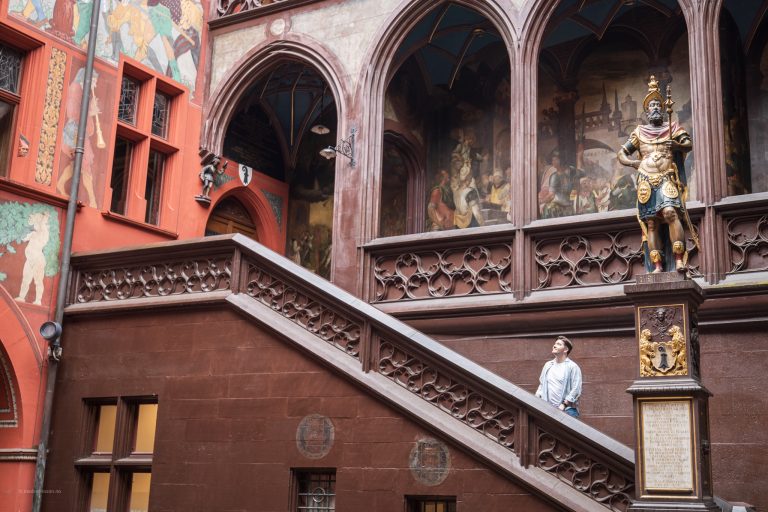
The Rathaus and the Mittlere Brücke
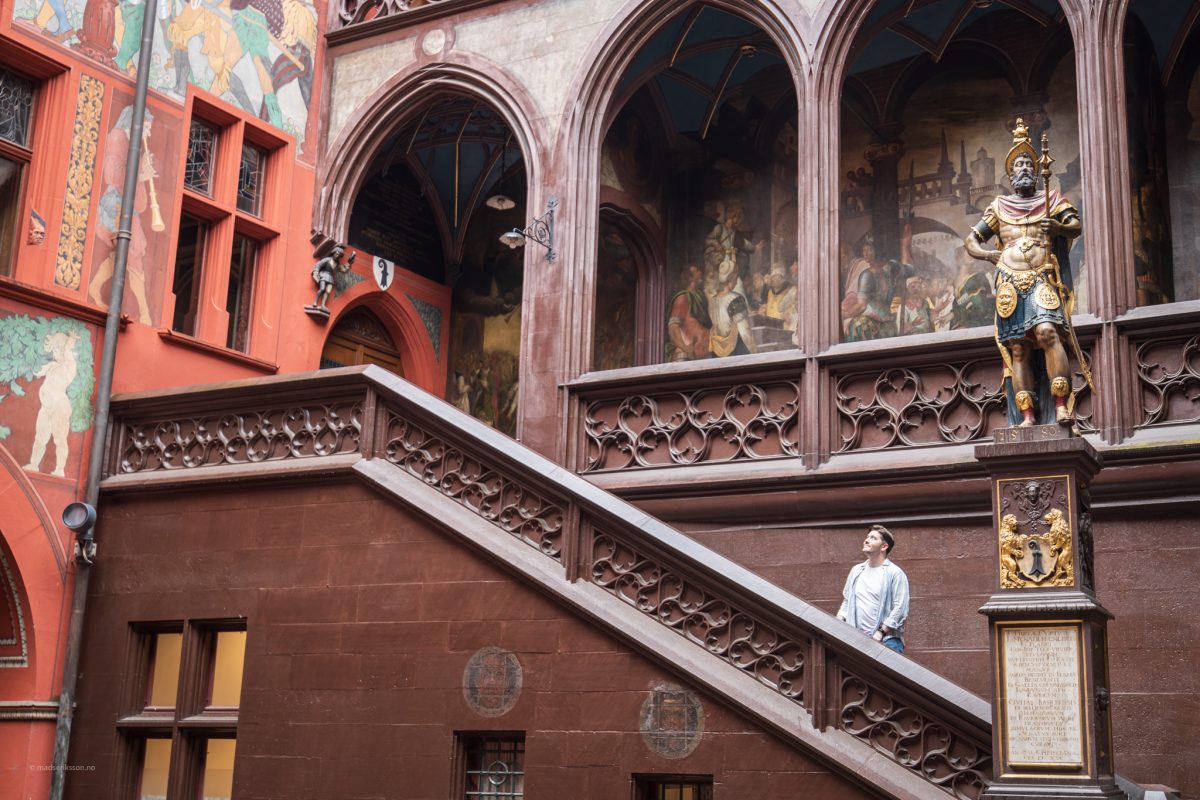
The red Rathaus on the Marktplatz was built in 1504–1514 to mark Basel's entry into the Confederation, and it is still the seat of the cantonal parliament and government; its tower was added in 1898–1904. A few minutes north, the Mittlere Brücke has crossed the Rhine since at least 1225, though the present stone bridge dates from 1903–05.
Rathaus, the Town Hall in Basel.
The Spalentor
The Spalentor, completed around 1400, is the grandest of the three gates that survive from Basel's medieval outer wall; the others are the St. Johanns-Tor and the St. Alban-Tor. Between it and the river lies the steep old town of Grossbasel, near the University of Basel, founded in 1460 as the first university in what is now Switzerland.
The Kunstmuseum and the Tinguely Fountain
In 1661 the city and university bought the Amerbach Cabinet and opened it to the public, the origin of the Kunstmuseum Basel and the oldest public art collection in the world. Its main building opened in 1936 and a new building across the street in 2016. On Theaterplatz nearby, Jean Tinguely's fountain of 1975–77 sets ten mechanical sculptures splashing on the site of the old theatre stage.
The Rhine ferries
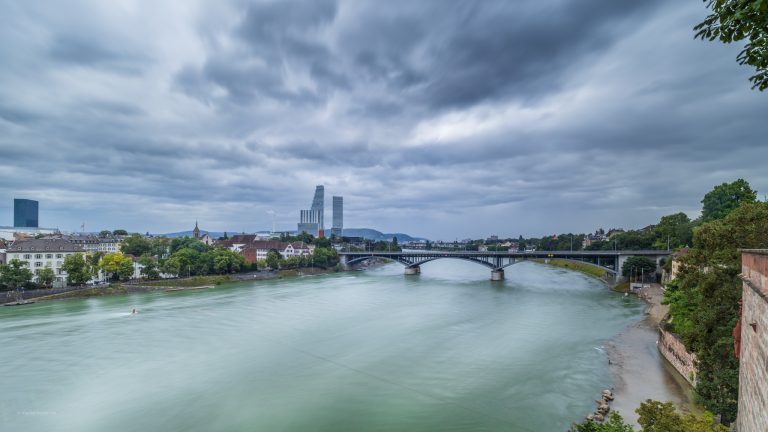
Four ferries cross the Rhine between Grossbasel and Kleinbasel with no engine: each hangs from a cable and is pushed across by the current. The first began service in 1854. In summer, swimmers drift down the stretch between the Wettsteinbrücke and the Johanniterbrücke with their clothes sealed in a fish-shaped Wickelfisch bag.
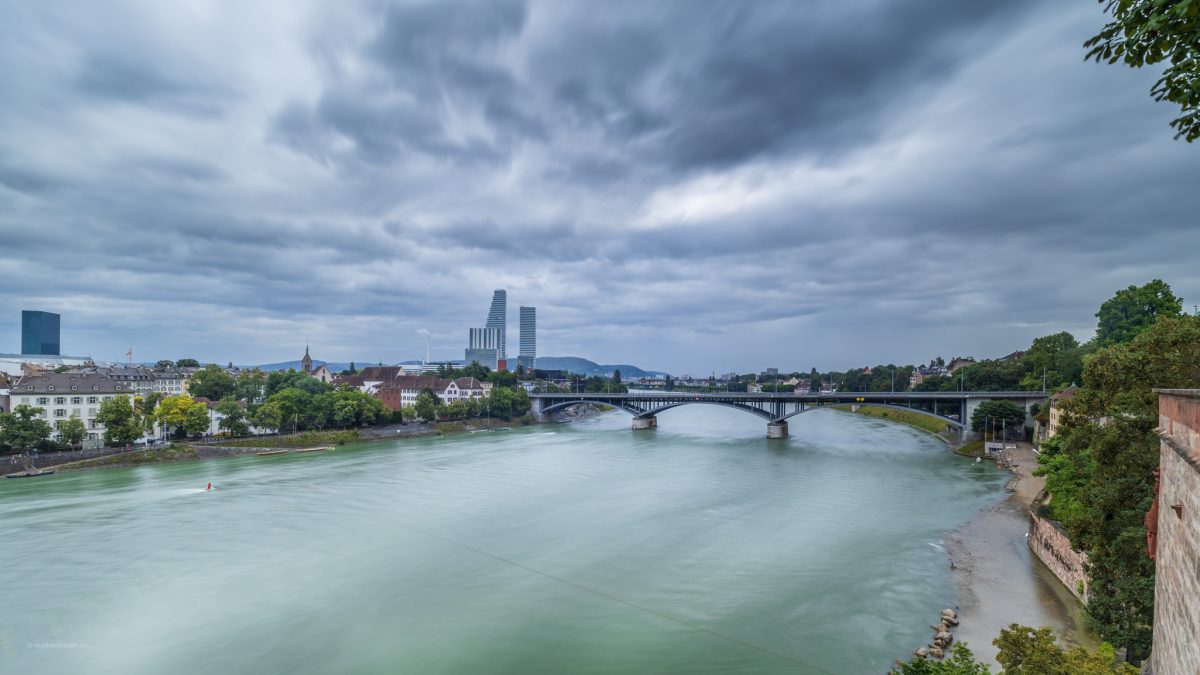
The Rhine and Basel, Switzerland.
The Roche towers
Upstream on the Kleinbasel bank, the pharmaceutical company Roche has built two stepped towers by Herzog & de Meuron: Roche Tower 1, 178 m, opened in 2015, and Roche Tower 2, 205 m, opened in 2022 as the tallest building in Switzerland. The Museum Tinguely, designed by Mario Botta and opened in 1996, stands beside the river just to the east.
Basel by night
Basel's carnival, the Fasnacht, begins at 4 a.m. on the Monday after Ash Wednesday, when the street lights of the old town are switched off and the cliques march out with lit lanterns, piccolos and drums. It lasts exactly 72 hours, involves around 18,000 participants and has been on UNESCO's intangible heritage list since 2017. Across the river, the 105 m Messeturm of 2005 marks the exhibition centre that hosts Art Basel every June.
3D model © 2026 madseriksson.no · Photographs © madseriksson.no. Buildings and heights: © OpenStreetMap contributors (ODbL), via OpenMapTiles. Ground imagery: Sentinel-2 cloudless 2023 by EOX IT Services GmbH (contains modified Copernicus Sentinel data 2023; CC BY 4.0). Heights are approximate where OpenStreetMap has no measured value; sun positions are approximate.
Grossbasel — A Red Town Hall, a Red Minster and a Terrace Over the Rhine
The old merchant city on the left bank, rebuilt after the earthquake of 1356, with its painted town hall, its twin-towered cathedral and its surviving medieval gates
The heart of Grossbasel is the Marktplatz, and the building that dominates it is the Rathaus. The town council decided to build it in 1503 to mark Basel’s entry into the Confederation, and it was completed in 1514: a facade of red sandstone, painted with figures and coats of arms, with the arms of the Swiss cantons along the battlements. The tower on the right and much of the painting are later — the tower was added in 1898–1904, and its mural dates from 1901 — but the effect is of one exuberant whole. The inner courtyard has painted arcades and a painted staircase wall by Hans Bock the Elder. The building is still in daily use as the seat of the cantonal parliament and government of Basel-Stadt.
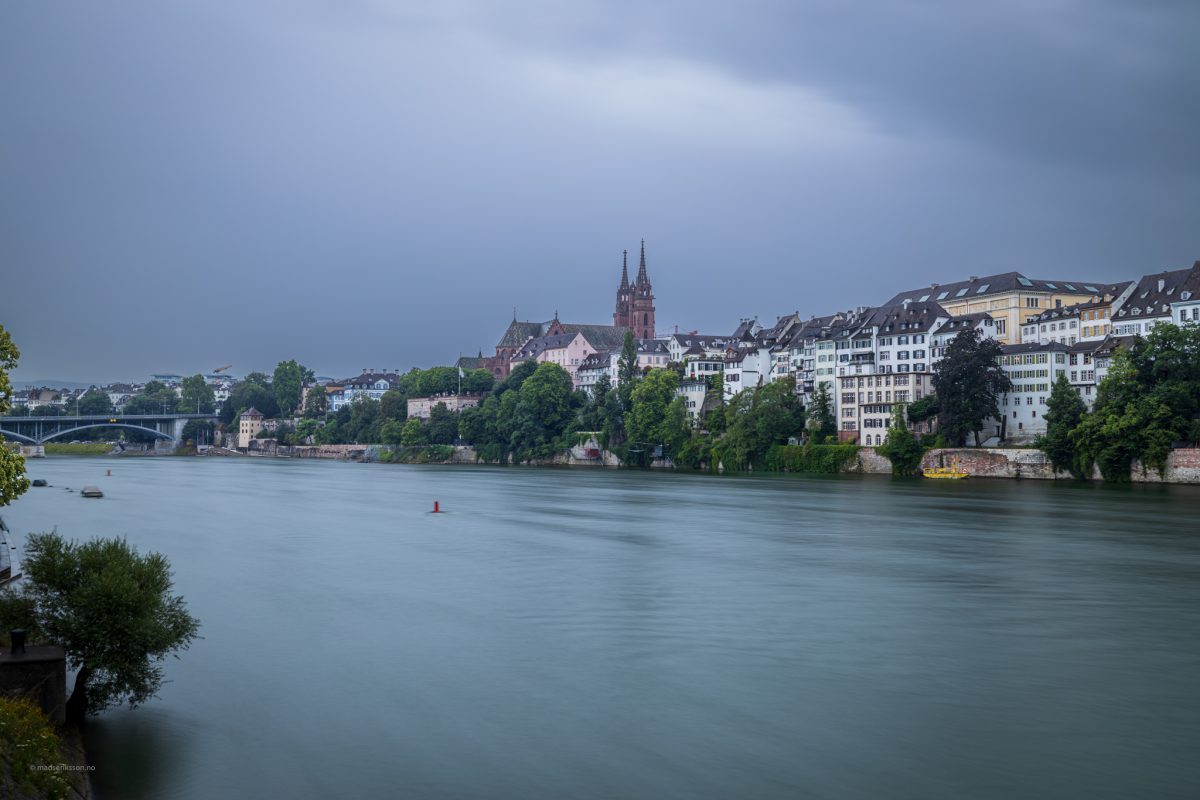
From the Marktplatz, lanes climb to the Münsterplatz and the Minster, Basel’s cathedral, built of the same red sandstone and roofed with coloured glazed tiles. Its history runs from a crypt consecrated in 1019 to the completion of the south tower in 1500; the earthquake of 1356 brought down five towers and much of the vaulting, and the church was rebuilt. On the north transept, the Galluspforte of around 1150–70 is the most important Romanesque sculpture in Switzerland. Inside, the red marble epitaph of Erasmus, made in 1538, marks the humanist’s burial, and to the south lie the double cloisters of the 15th century, lined with tombstones. Both towers can be climbed — 242 steps to a view over the city, the Black Forest and the Jura.
Behind the Minster’s choir, the Pfalz terrace stands some 20 metres above the Rhine. It is the best balcony in Basel: the river sweeping round its bend below, Kleinbasel opposite, and on clear days the Vosges on the horizon.
The old town extends well beyond the cathedral hill. Down at the river, the Mittlere Brücke has crossed the Rhine since at least 1225 — the first bridge in Basel — though the present stone bridge dates from 1903–05; a copy of the little chapel that stood on one of its piers since 1392 still marks the midpoint. On the far side of Grossbasel, the Spalentor, completed around 1400, is the grandest of the three gates that survive from the medieval outer wall; the others are the St. Johanns-Tor and the St. Alban-Tor. Between the gates and the river, the lanes of Grossbasel climb and fall steeply, and the whole of the old town is easily covered on foot.
The Rhine — Ferries Without Engines and a River to Swim Home In
How Basel lives on its river: four current-driven ferries, a summer habit of floating downstream with a fish-shaped bag, and the point where three countries meet
The Rhine at Basel is wide, fast and green, and it is part of daily life in a way few big rivers in Europe are. The best way onto it is one of the four ferries that cross between Grossbasel and Kleinbasel, each roughly midway between two bridges. They have no engine. Each small boat hangs from a pulley on a cable stretched high across the river; the ferryman angles the hull into the current, and the force of the water pushes it sideways to the other bank. The first ferry began running in 1854, and the four now in service each have a name: the Wild Maa at St. Alban, the Leu below the Minster, the Vogel Gryff at Klingental and the Ueli at St. Johann. In 2026 a crossing costs CHF 2 for adults, paid on board.
In summer the river becomes a swimming pool. On warm afternoons swimmers walk upstream, wade in and let the current carry them down past the old town, with their clothes and phones sealed in a Wickelfisch — a waterproof, fish-shaped swim bag that has become a Basel emblem. The usual stretch runs between the Wettsteinbrücke and the Johanniterbrücke, with outdoor bars on the Kleinbasel bank to relax in afterwards. It is a swim for strong swimmers only: the current is strong, and the bag is a dry-bag, not a buoyancy aid, and should never be tied to the body.
On a hot summer day the Rhine at Basel is one of the great urban sights of Europe: the Minster on its hill, the bridges, the ferries swinging across on their cables, and swimmers with bright swim bags drifting past beneath them.
Kleinbasel, on the right bank, is the flatter, less formal half of the city, and its riverside promenade is the place to watch the river and the old town opposite, best in the evening light. Downstream, past the harbour, the borders of three countries meet in the middle of the river. A tall pylon at the Rhine port marks the Dreiländereck, the tripoint of Switzerland, France and Germany, and the spot is within easy reach of the city centre. Upstream of the old town, the Museum Tinguely stands beside the river.
The Museums — From Holbein to Beyeler, and a Fountain That Never Stops Moving
The world’s oldest public art collection, a collector’s museum in a park by Renzo Piano, and a museum of machines by the Rhine
The Kunstmuseum Basel is the city’s great museum and one of the most important in Europe. It traces its origin to 1661, when the city and university bought the Amerbach Cabinet, a private collection that included works by Hans Holbein the Younger, and made it public. That makes it the oldest public art collection in the world, and it still holds the largest collection of works by the Holbein family anywhere. Its main building, opened in 1936, shows art from the 15th century to around 1950; a new building across the street, opened in 2016, holds the later collection and major exhibitions. In 2026 admission to the collection and exhibitions costs CHF 25 for adults, and the collection is free in the last hour on several weekday afternoons and on the first Sunday of the month. The museum is closed on Mondays. Its third site, for contemporary art by the Rhine, is closed until late November 2026.
In Riehen, on the north-eastern edge of the city, the Fondation Beyeler shows the collection of the dealers Ernst and Hildy Beyeler — classic modern art — in a long, low building by Renzo Piano that opened in 1997, set in a park. In 2016 it was the most visited art museum in Switzerland, and it is known for its temporary exhibitions; in autumn 2026 these include a major show of the sculptor Ruth Asawa. The museum is open daily, with late opening on Wednesdays. Ernst Beyeler was also one of the gallerists who founded Art Basel in 1970, the fair that takes over the Messe Basel exhibition centre for about a week every June.
Jean Tinguely’s fountain on Theaterplatz stands where the stage of the old city theatre used to be, and some of its ten clanking, spraying machines were built from pieces of the old stage equipment.
The Museum Tinguely, designed by Mario Botta and opened in 1996, is devoted to the same Swiss artist’s kinetic sculptures — moving machines, alongside works by his partner Niki de Saint Phalle in the park outside. Beyond these three, Basel has around forty museums in all, many of them within walking distance of each other. Visitors staying overnight in the city receive the BaselCard, which gives 25 per cent off admission at many of them.
Fasnacht — Three Days That Begin in the Dark at Four in the Morning
A carnival held after everyone else’s has finished, which begins with the street lights of the old town switched off
Basel’s carnival, the Fasnacht, takes place when the rest of the carnival world has already stopped. It begins on the Monday after Ash Wednesday — at the earliest on 9 February and at the latest on 15 March — and lasts exactly 72 hours, from 4 a.m. on Monday to 4 a.m. on Thursday. In 2017 it was added to UNESCO’s list of the intangible cultural heritage of humanity. Around 18,000 people take part, most of them organised into cliques, groups that march through the old town in costume and masks playing the piccolo and the Basel drum, each clique carrying its own painted lantern.
The opening, the Morgestraich, is the most extraordinary moment of the year in Basel. Shortly before four in the morning the street lights in the old town are switched off. On the stroke of four the command is given, and the cliques set off through the dark streets with only the light of their lanterns — huge painted lanterns up to four metres high carried on poles, and small lanterns worn on the head — to the sound of hundreds of piccolos and drums. The only light in the old town comes from the lanterns of the cliques.
From Monday evening until Wednesday morning around 200 of the great lanterns are displayed on the Münsterplatz in front of the Minster — a free open-air exhibition of painted satire, lit up after dark.
On Monday and Wednesday afternoons the great parades, the Cortège, wind through the centre. Before the carnival itself, the Drummeli — a huge concert of drums and piccolos — is held at the Musical Theater Basel. For visitors the main practical point is accommodation: book well ahead, and plan to be in the old town before four on Monday morning.
«Basel rarely makes lists of Europe’s most beautiful cities, and it does not seem to mind. It is a working city that happens to have the oldest public art collection in the world, a cathedral of red sandstone above a bend in the Rhine, and a river clean and warm enough to swim through the centre. Spend a morning in the Kunstmuseum, an afternoon at the Beyeler, and an evening on the Kleinbasel bank. If it is summer, walk upstream with a swim bag and float back past the Minster. If it is the Monday after Ash Wednesday, set an alarm for half past three.»

More in the same area
 Train travelThe World’s 10 Great Railway Journeys
 TravelCrossing the Great St. Bernard Pass
 MountaineeringBreithorn and Pollux: Two 4,000-Metre Peaks on Skis from Cervinia
 CitiesThe World’s 10 Great Food Markets
 ArchitectureTen Buildings That Changed Their Cities — Modern Architecture Ranked on Impact, Not Image
 CitiesHiroshima and Miyajima: A preserved ruin and a shrine on the tideline
City Frames · scroll-driven 3D
More cities in three dimensions
54 city guides open with a model built from open map data. Scroll, and the camera moves from landmark to landmark.
Departures · City Frames
Where to next?
| Time | Destination | Country | Status |
|---|
Live · position of the sun
Golden hour, right now
The low, warm light just after sunrise and just before sunset. These are the cities on the site where it is happening at this moment.