London began as a Roman bridge over the Thames and grew, over two thousand years, into one of the great world cities: rebuilt by Christopher Wren after the Great Fire of 1666, the largest city on earth for much of the 19th century, and today a place where more than 300 languages are spoken. It is a city of layers — Roman wall beneath the banks of the City, medieval Tower beside glass towers, royal parks between neighbourhoods that each feel like a town of their own — and of an extraordinary public generosity, with many of the world’s finest museums free to enter. Its scale is real, but its centre is walkable, and the best of it lies along the river.

The Romans founded Londinium around 43 CE, building a bridge over the Thames and a trading settlement on the north bank that grew into the administrative capital of their British province. The city they built was walled, gridded and prosperous; the Roman walls are still visible in places beneath the modern City of London. After the Romans departed in the 5th century the city declined and was gradually resettled, becoming the capital of an Anglo-Saxon kingdom, then of a Norman one following the conquest of 1066, and accumulating through the medieval period the institutions — Parliament, the common law, the trading guilds — that would eventually shape the modern world. The Great Fire of 1666, which burned for four days and destroyed 373 acres of the medieval city, gave Christopher Wren the commission to rebuild 51 churches, including St Paul’s Cathedral — a commission he executed over the following 35 years.
The city that followed the fire was larger, more regularised and more ambitious than what it replaced. By the early 19th century London had overtaken Beijing and Constantinople to become the largest city in the world, a position it held until New York surpassed it in the early 20th century. The British Empire, at its peak covering roughly a quarter of the world’s land surface, made London a global capital in the most literal sense — the point through which trade, governance and culture for an extraordinary range of territories was coordinated. That empire is gone, but its legacy is visible in the city’s demographics, its museums and its food, and in the remarkable fact that over 300 languages are spoken in London today.
How to approach London
This guide covers four aspects of London: the historic city from the Tower to Westminster; the museum culture, which is among the richest in the world and largely free; the parks, neighbourhoods and markets that make London more liveable than its scale suggests; and the food culture, which has been transformed in the last 30 years from a standing joke into one of the most interesting in Europe. London is best navigated by Tube and on foot. It is very large but very walkable in its centre, and the walk from Westminster to Tate Modern via the South Bank is one of the great urban walks in the world.
London in 3D
London grew from Londinium, a Roman bridgehead founded on the north bank of the Thames around 43 CE. This frame follows the river from Westminster in the west to the Tower and Tower Bridge in the east, with the City of London on the north bank and Southwark opposite. After the Great Fire of 1666 destroyed about 373 acres of the medieval city, Christopher Wren rebuilt St Paul's Cathedral and 51 churches.
Westminster
The Palace of Westminster was rebuilt to designs by Charles Barry and Augustus Pugin after the fire of 16 October 1834, and its clock tower, the 96 m Elizabeth Tower, was completed in 1859. Big Ben is the 13.5-tonne bell inside it. Westminster Abbey across the road has hosted every coronation since William the Conqueror's on Christmas Day 1066, and palace and abbey were inscribed together as a World Heritage Site in 1987.
Buckingham Palace and Trafalgar Square
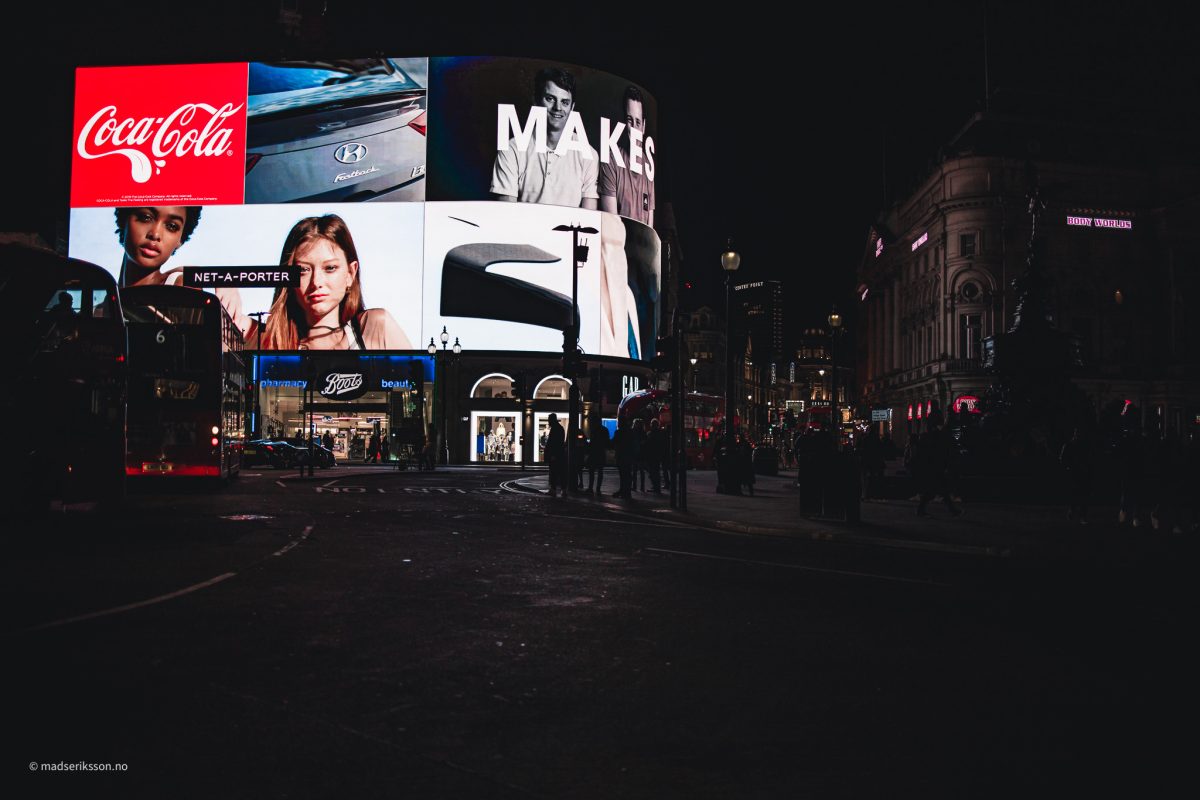
Buckingham Palace has been the monarch's London residence since Queen Victoria moved in in 1837. From its gates The Mall runs north-east through Admiralty Arch to Trafalgar Square, where the National Gallery holds about 2,300 paintings from the 13th to the early 20th century, free to enter. Piccadilly Circus, laid out by John Nash in 1819, lies a few hundred metres to the west.
St Paul's and Tate Modern
St Paul's Cathedral was built between 1675 and 1710 to Christopher Wren's design, and its dome rises 111 m to the top of the cross. The Millennium Bridge crosses the Thames from below the cathedral to Tate Modern, opened in May 2000 in the former Bankside Power Station. Its Turbine Hall is 35 m high and 155 m long.
The City towers
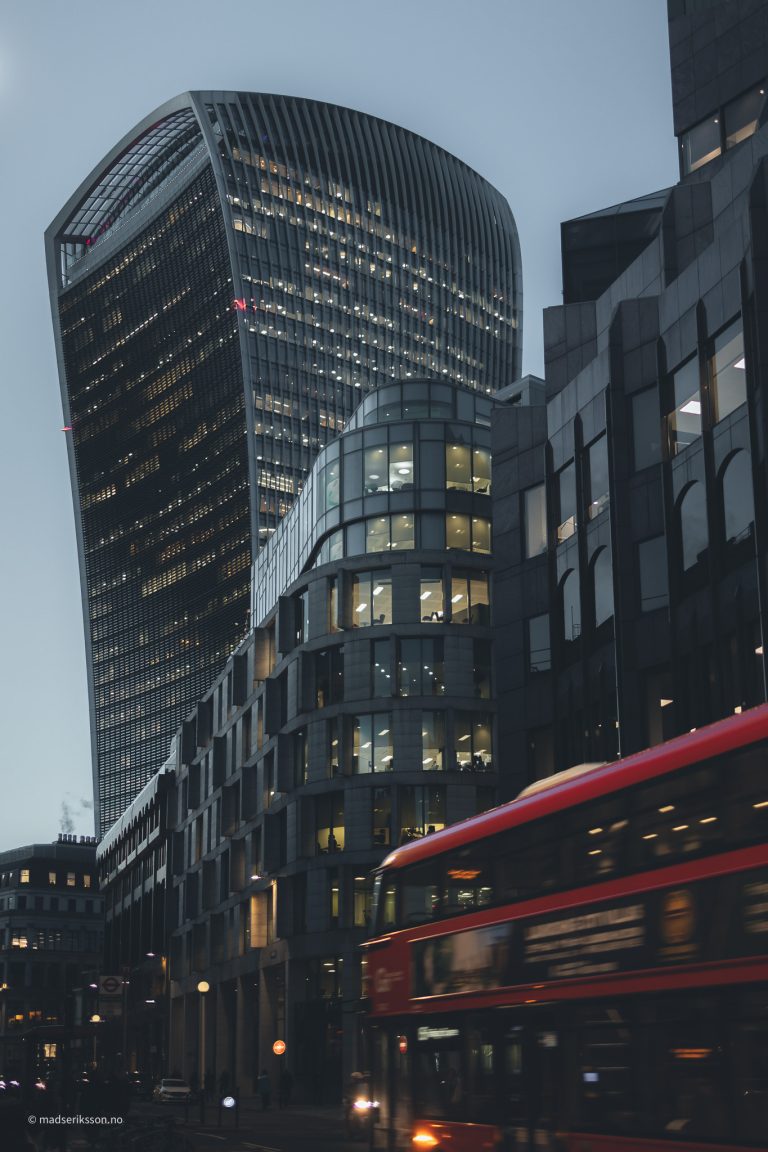
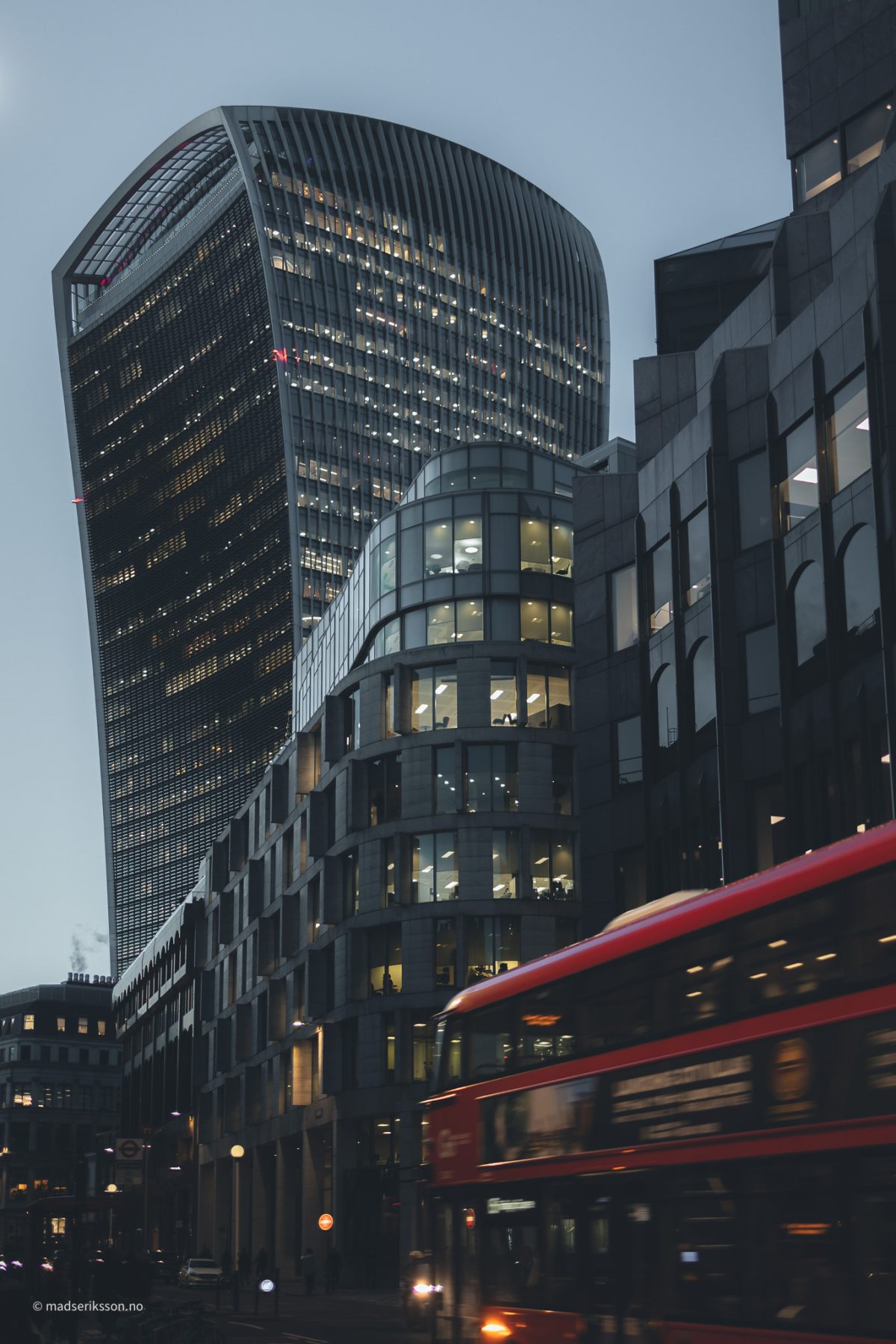
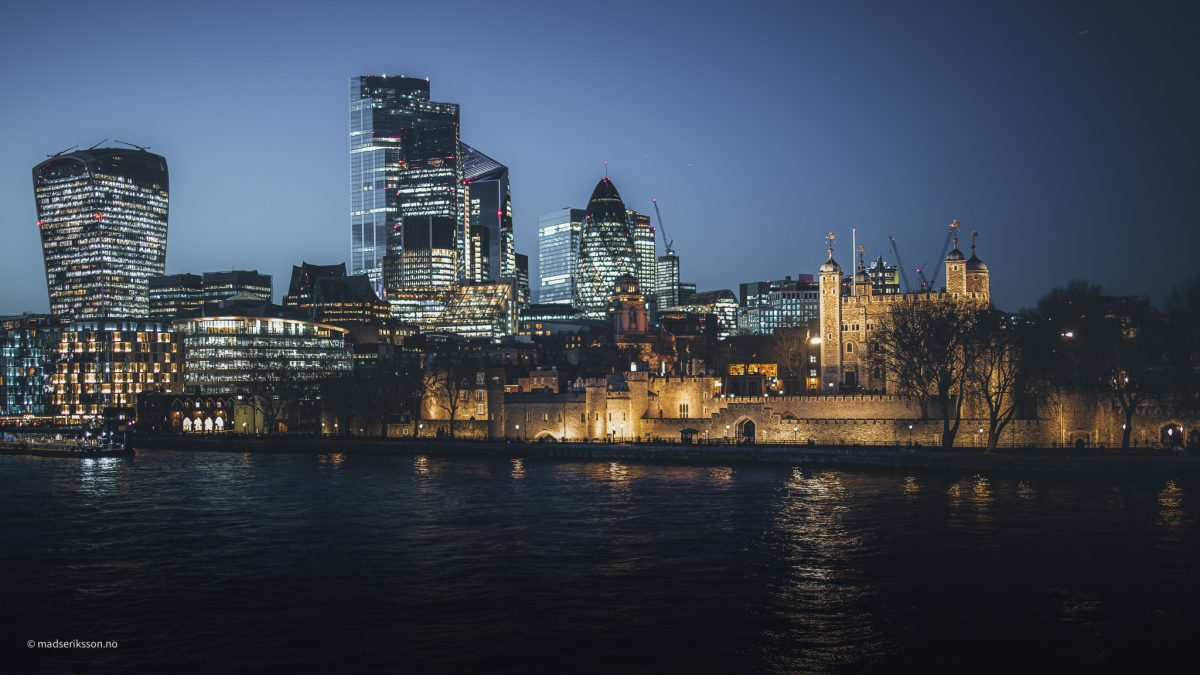
The Square Mile, the historic City of London, is now the main high-rise cluster of central London. 22 Bishopsgate, completed in 2020, rises 278 m; around it stand the 180 m 30 St Mary Axe, the 'Gherkin' of 2003, the 225 m Leadenhall Building and the 160 m 20 Fenchurch Street, the 'Walkie-Talkie' of 2013. Sections of the Roman wall built around 200 CE still survive at the edge of the district.
The Walkie-Talkie tower at 20 Fenchurch Street rising above a red double-decker bus in the City of London
The Tower of London and Tower Bridge
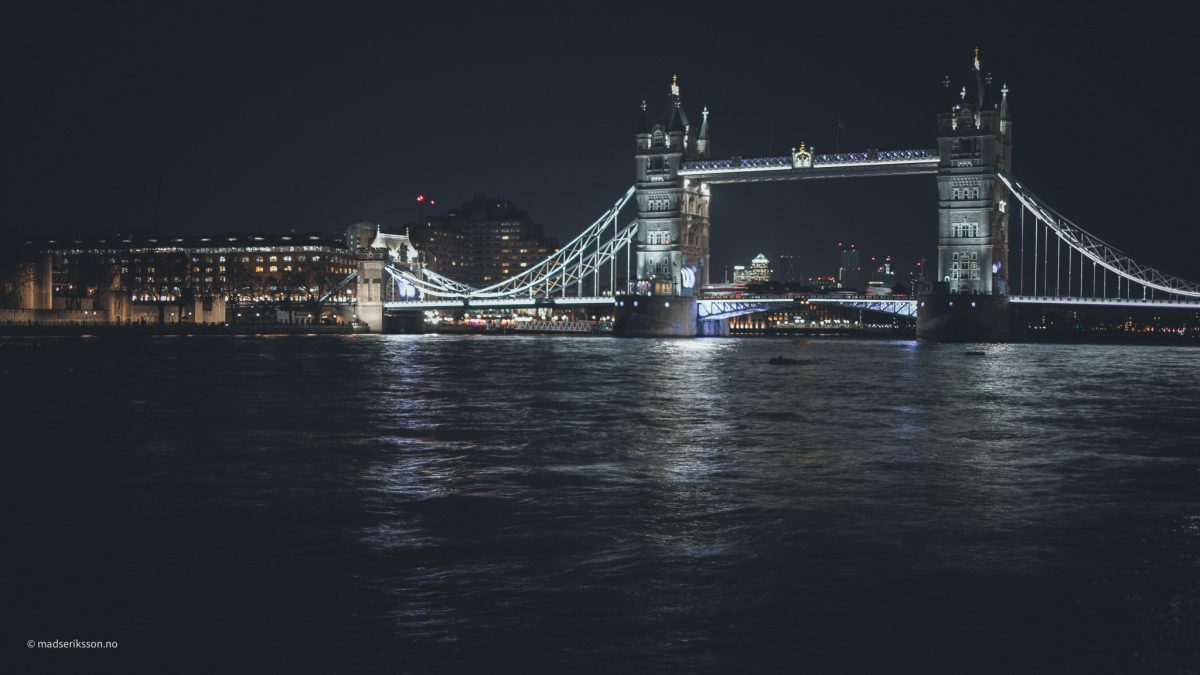
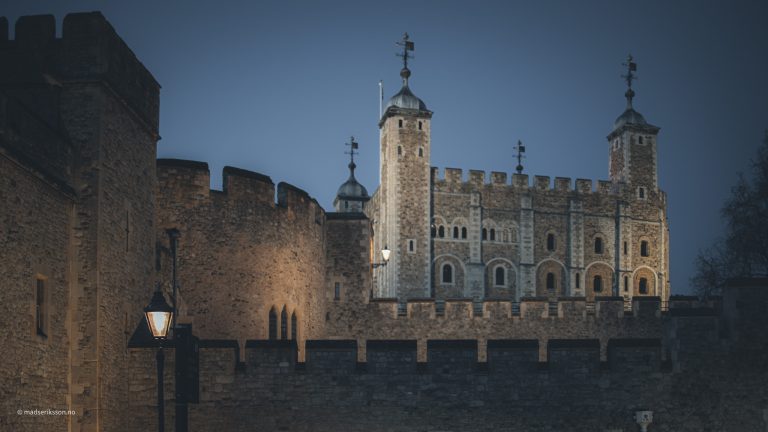
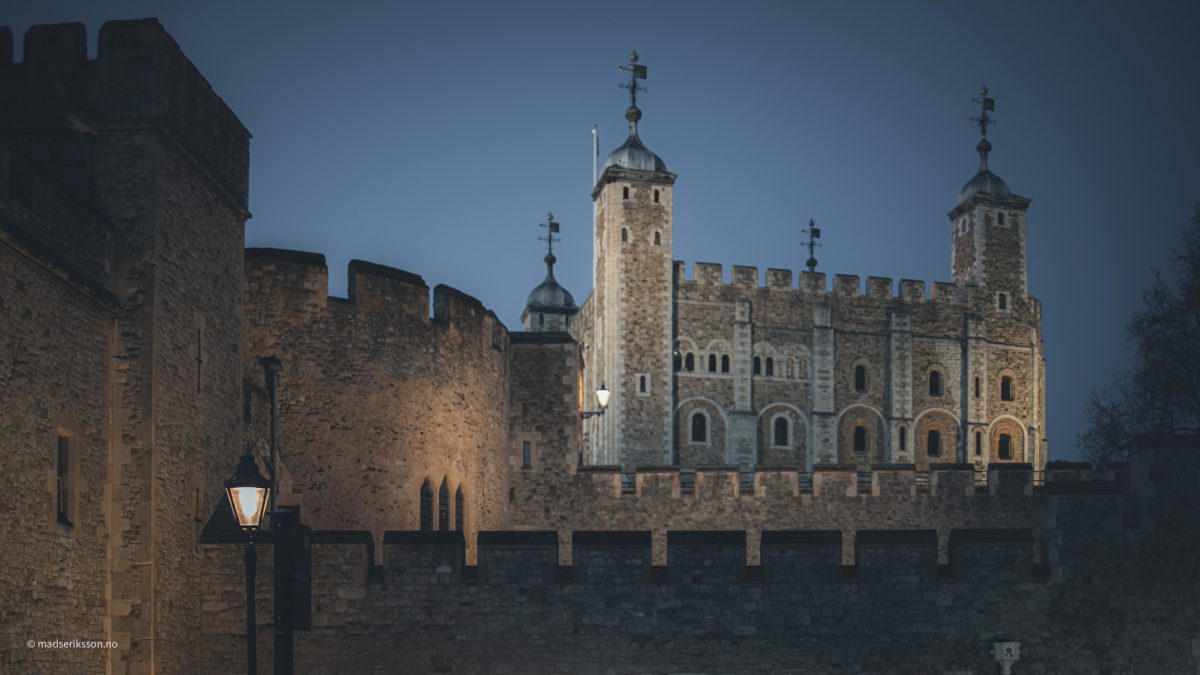
William the Conqueror began the Tower of London in 1066, and its central keep, the White Tower, was completed around 1100. It has served as a royal palace, prison, armoury and mint, holds the Crown Jewels and has been a World Heritage Site since 1988. Tower Bridge, built between 1886 and 1894 just downstream, still raises its bascules for river traffic.
The White Tower rising above the floodlit curtain walls of the Tower of London at dusk
The Shard
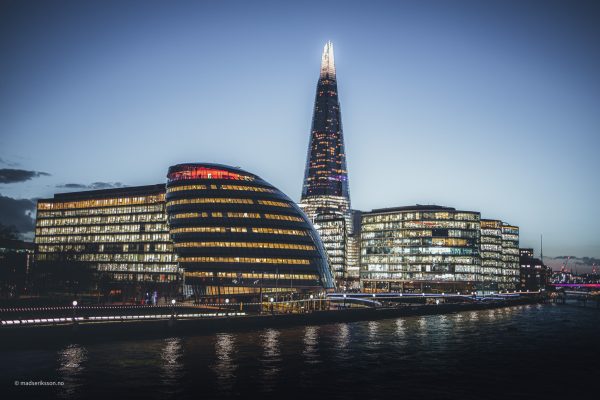
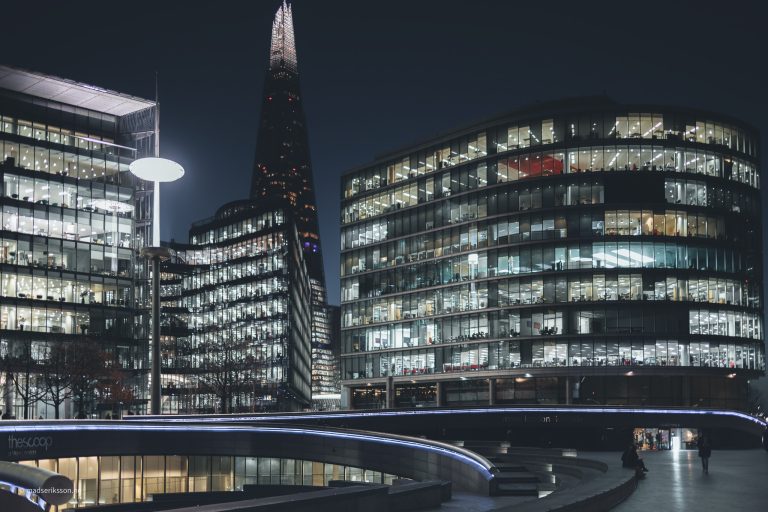
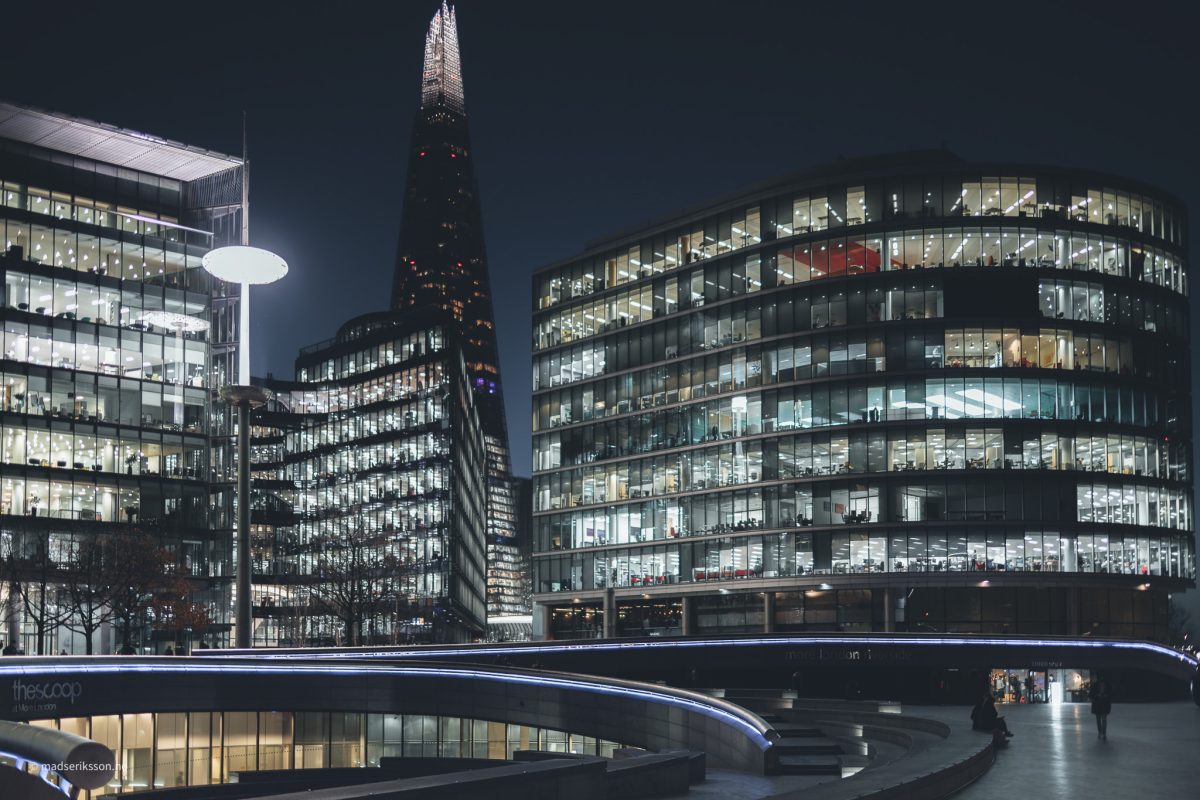
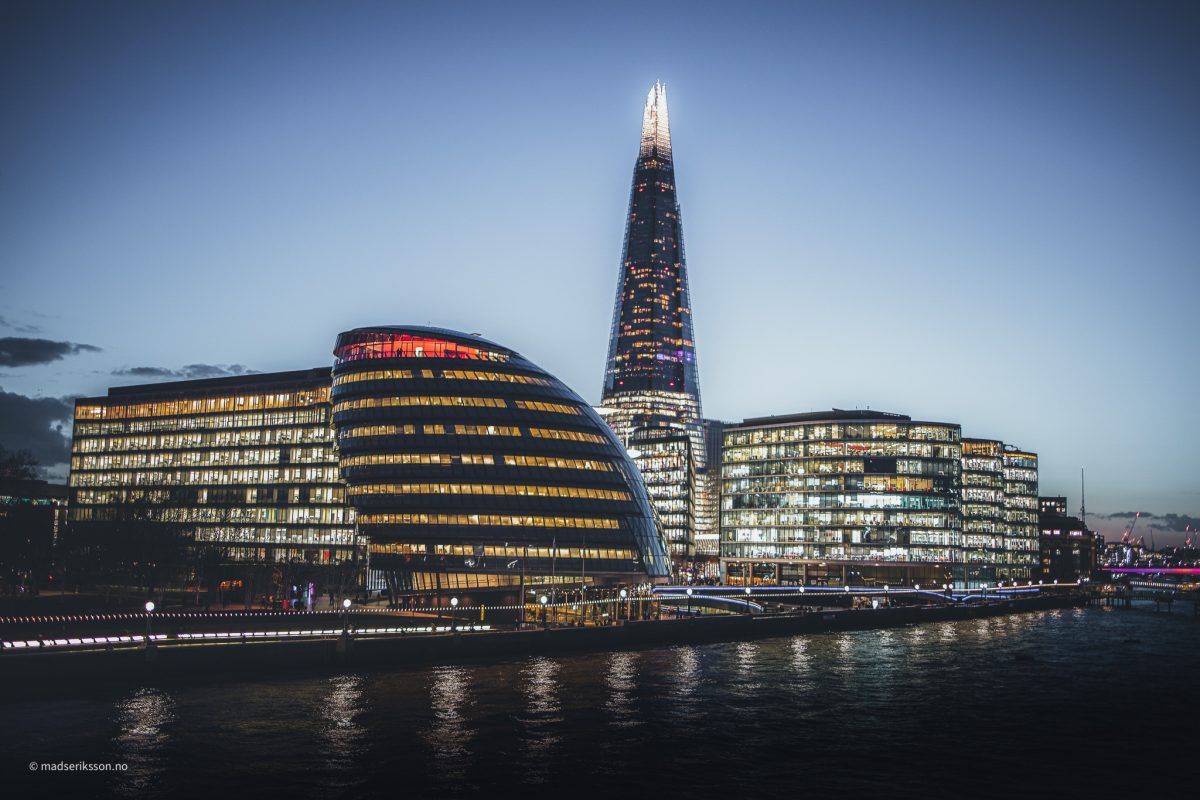
The Shard, designed by Renzo Piano and inaugurated in July 2012, is 309.6 m tall and the tallest building in the United Kingdom, with its public viewing gallery at about 244 m. At its foot, the More London offices line the river around the rounded former City Hall, completed in 2002, and Borough Market, recorded as a food market since around 1014, lies a few hundred metres inland.
The Shard towering over the lit offices of More London beside The Scoop on the South Bank
The London Eye and Piccadilly Circus
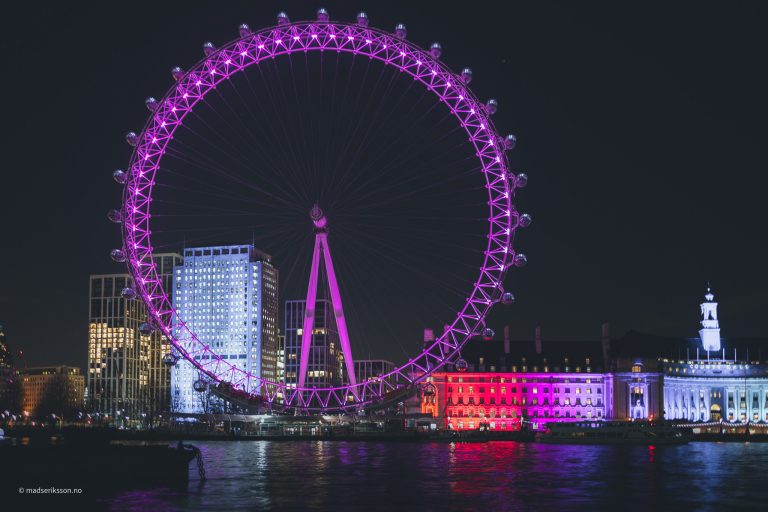
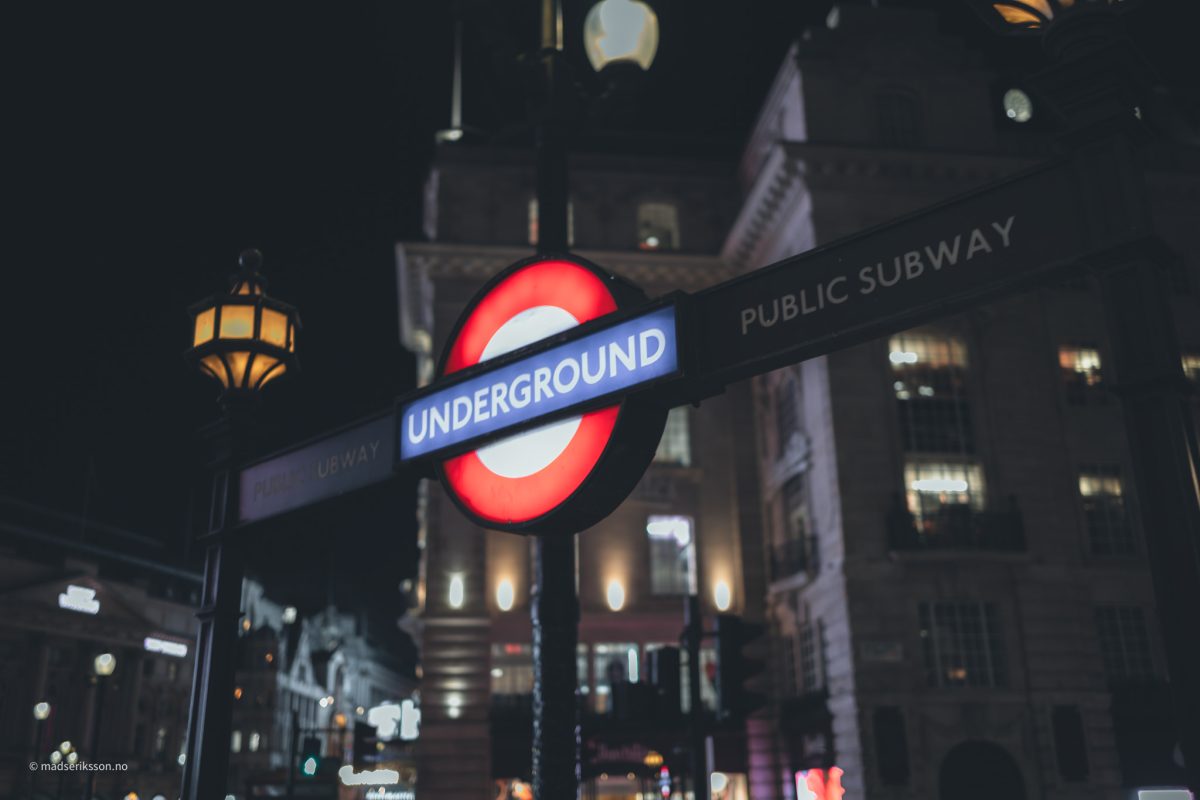
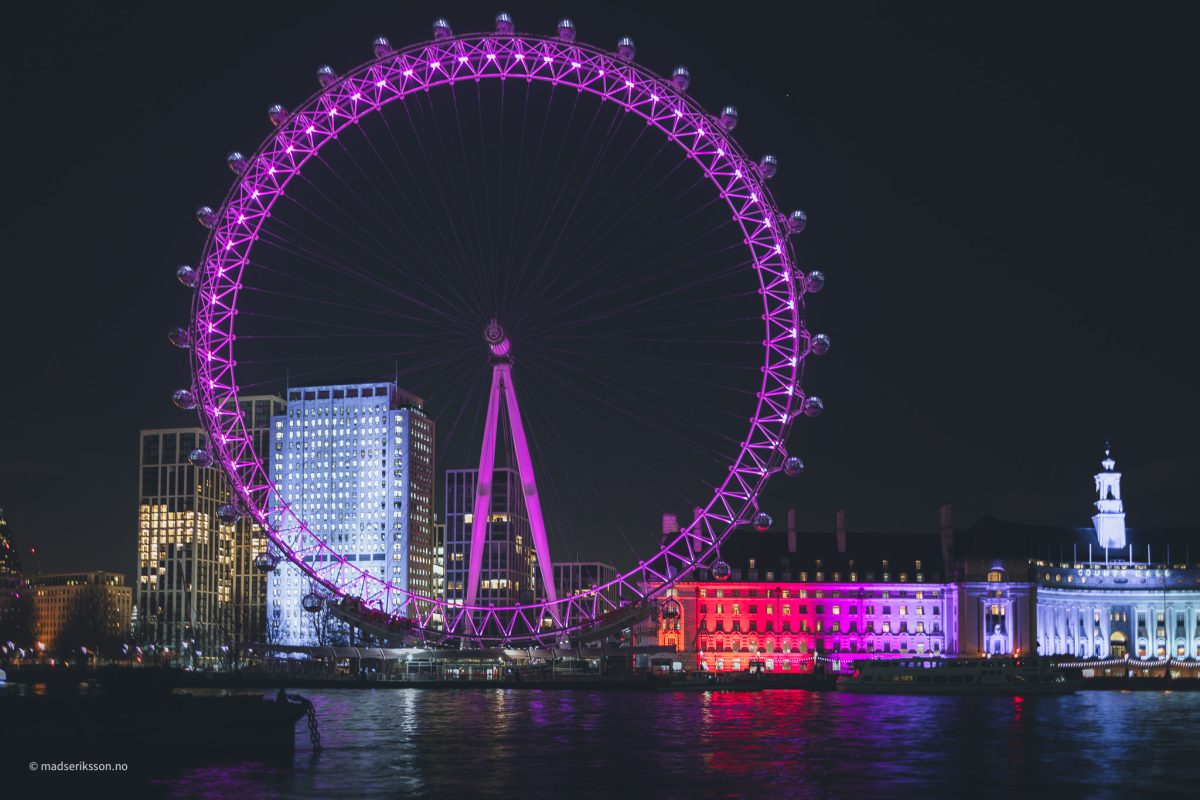
The London Eye, a 135 m observation wheel, opened in 2000 on the South Bank, where a riverside walk of about 3 km runs from Westminster Bridge to Tower Bridge. Across the river, illuminated advertising has lit Piccadilly Circus since 1908. Beneath it runs the London Underground, which opened in 1863 as the world's first metro system.
The London Eye lit in pink and purple at night above the Thames, beside County Hall
3D model © 2026 madseriksson.no · Photographs © madseriksson.no. Buildings and heights: © OpenStreetMap contributors (ODbL), via OpenMapTiles. Ground imagery: Sentinel-2 cloudless 2023 by EOX IT Services GmbH (contains modified Copernicus Sentinel data 2023; CC BY 4.0). Heights are approximate where OpenStreetMap has no measured value; sun positions are approximate.
Historic London — From the Norman Tower to Wren’s Cathedral
Almost two thousand years of continuous settlement, compressed into a few square miles between the Tower and Westminster
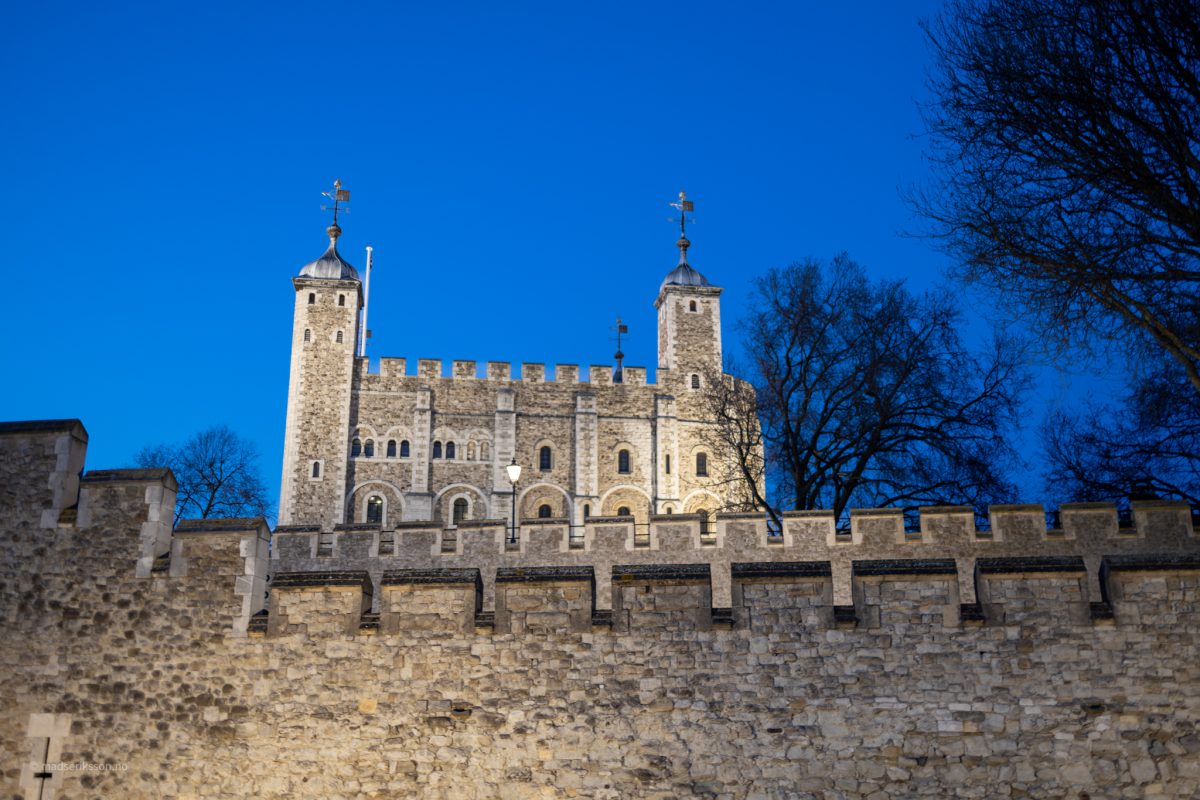
The Tower of London, begun by William the Conqueror in 1066 on the north bank of the Thames just east of the old Roman city wall, is the best-preserved medieval fortress in Britain and one of the most historically significant buildings in the world. In its long history it has served as a royal palace, a prison (where Anne Boleyn, Lady Jane Grey and Thomas More were held and executed), a treasury, an armoury, a royal mint and a menagerie. Today it houses the Crown Jewels — the collection of crowns, sceptres, orbs and regalia used in coronations and state ceremonies — in a vault that is both a museum exhibit and a functioning state treasury. The Yeoman Warders (Beefeaters) who guard and guide the Tower have been in residence since 1485. The six ravens kept in the Tower are there in accordance with a legend that the kingdom will fall if they ever leave: they are currently maintained by the Ravenmaster, a specific role within the Yeoman Warder establishment.
Westminster Abbey, at the opposite end of the historic city, has been the site of every English and British coronation since William the Conqueror was crowned there on Christmas Day 1066. The current Gothic building dates largely from the 13th and 14th centuries, with Henry VII’s chapel added in the early 16th. The Abbey is the burial place of monarchs, statesmen, scientists and poets: Geoffrey Chaucer, Isaac Newton, Charles Darwin, Stephen Hawking, Charles Dickens and Laurence Olivier are among those interred or commemorated in Poets’ Corner and the nave. It remains an active church and the setting for major state occasions; entrance fees apply to the historic areas.
The six ravens at the Tower of London are maintained in accordance with a 17th-century legend that the kingdom will fall if they ever leave. Their wings are clipped as insurance. The current Ravenmaster is a salaried position within the Yeoman Warder establishment.
St Paul’s Cathedral, designed by Christopher Wren and built between 1675 and 1710 to replace the medieval cathedral destroyed in the Great Fire of 1666, is one of the finest domed buildings in the world. The dome — 111 metres to the top of the cross — dominated the London skyline for nearly three centuries and remains one of its defining landmarks. The Whispering Gallery inside the dome, 30 metres above the cathedral floor, transmits whispered sounds across the full diameter of the space. During the Blitz of 1940–1941, the cathedral survived the bombing of the surrounding city almost intact; photographs of the dome rising through smoke became iconic images of British wartime resilience. Tower Bridge, immediately east of the Tower, was built between 1886 and 1894 and remains the most recognisable bridge in London — its two Victorian Gothic towers and its ability to open for river traffic making it simultaneously a working piece of infrastructure and the city’s most-photographed landmark.
The Museums — Eight Million Objects and a Turbine Hall
London’s national museums are among the richest in the world — and most of them are free
The British Museum, in Bloomsbury, was founded in 1753 as the world’s first public national museum and remains the most comprehensive collection of human civilisation ever assembled: 8 million objects spanning every culture and every period of human history. The Rosetta Stone, the Elgin Marbles, the Lewis Chessmen, the Sutton Hoo helmet, Egyptian mummies, the Portland Vase — the concentration of irreplaceable objects in a single building, open to anyone who enters, is one of the most remarkable facts about London. The Great Court at its centre, redesigned by Norman Foster with a glass-and-steel roof over the circular Reading Room in 2000, is one of the finest public spaces in the city. The museum receives around 6 million visitors a year; the permanent collection is free to enter.
The National Gallery, overlooking Trafalgar Square, holds approximately 2,300 paintings covering Western European art from the 13th to the early 20th century — including Van Eyck’s Arnolfini Portrait (1434), Velázquez’s Rokeby Venus, Rembrandt’s self-portraits, Vermeer’s Woman Standing at a Virginal, Turner’s The Fighting Temeraire and Seurat’s Bathers at Asnières. Like the British Museum, it is free. The smaller National Portrait Gallery, recently reopened after renovation, holds the world’s largest collection of portraits and is similarly free. These two institutions side by side, and the walk between them across Trafalgar Square, constitute one of the most accessible concentrations of great art in the world.
The British Museum has 8 million objects, spanning every human culture from every continent and every period of recorded history. It is free to enter. On a busy summer Saturday, it receives around 25,000 visitors.
Tate Modern, opened in May 2000 in the converted Bankside Power Station on the South Bank of the Thames, is the world’s most visited modern art museum. Its permanent collection of international modern and contemporary art is free; ticketed exhibitions are typically the most ambitious in London’s contemporary art calendar. The Turbine Hall — the vast central space of the former power station, 35 metres high and 155 metres long — is the site of annual commissioned installations that have included Olafur Eliasson’s giant artificial sun, Doris Salcedo’s crack in the concrete floor, and Carsten Höller’s slides. The Victoria and Albert Museum (V&A) in South Kensington, founded in 1852, holds the world’s largest collection of decorative arts and design: 2.27 million objects including furniture, ceramics, fashion, jewellery, textiles, photography and architecture. It is also free.
Parks, the South Bank and the Neighbourhoods
London’s Royal Parks, the riverside walk from Westminster to Tower Bridge, and the neighbourhoods that reveal the city at street level
The South Bank walk — along the Thames from Westminster Bridge to Tower Bridge, approximately three kilometres on the south bank of the river — is one of the great urban walks in the world. The route passes the London Eye (the 135-metre observation wheel, opened in 2000), the Southbank Centre (the Hayward Gallery, the Royal Festival Hall), the BFI Film Institute, the National Theatre, the Tate Modern and Shakespeare’s Globe Theatre, all within a continuous pedestrian riverside promenade with the north bank of the Thames and the London skyline opposite. The walk can be done in under an hour or extended into a full day by entering the institutions along it. Borough Market, a few hundred metres inland from the riverbank between London Bridge and Southwark Cathedral, is one of London’s oldest and finest food markets: over 100 traders selling produce, artisan food, cheese, charcuterie, wine and prepared dishes, open Thursday to Saturday.
Hyde Park, 142 hectares of open grassland, lake and woodland in the centre of the city, is the largest of London’s eight Royal Parks. The Serpentine lake at its centre has a swimming area (the Lido) that has been in use since 1930. Speakers’ Corner at the northeast edge of the park has been a site of public oratory and debate since the 18th century; by convention, anyone may speak on any subject without interference from the authorities. The park merges with Kensington Gardens to the west, which contains the Albert Memorial, the Serpentine Gallery and Kensington Palace. Together they form a continuous green space of 265 hectares extending from Hyde Park Corner to the western suburbs.
Speakers’ Corner in Hyde Park has been a site of free public speech since the 18th century. By convention, anyone may speak on any subject. Karl Marx, George Orwell and Vladimir Lenin all spoke here. The tradition continues every Sunday.
Shoreditch and the surrounding East End have been the creative and countercultural heart of London for decades, and despite significant gentrification retain a concentration of galleries, independent restaurants, music venues and street art — including Brick Lane, where the former Bangladeshi immigrant community established a curry restaurant culture that has been a London institution since the 1970s. Notting Hill, in the west, contains the Portobello Road Market (one of the world’s largest antique markets, at its most complete on Saturday mornings) and is the site of the Notting Hill Carnival every August Bank Holiday weekend — the largest street festival in Europe, with approximately two million attendees and a history rooted in Caribbean immigrant culture since the 1960s. Covent Garden, between the West End theatres and the Strand, occupies the former fruit and vegetable market that occupied the site from the 17th century until 1974 and now houses independent restaurants, street performers and the London Transport Museum.
London Food — The Transformation of British Cooking
London food was once a standing joke. It is now one of the most interesting eating cities in Europe — and fish and chips remains entirely defensible
The transformation of London’s food culture over the past 30 years is one of the more significant shifts in European gastronomy. In the 1980s, the city was genuinely difficult to eat well in; by the 2000s it had become one of the most interesting restaurant cities in the world. The explanation is immigration — successive waves from South Asia, the Caribbean, China, the Middle East, West Africa, Eastern Europe and elsewhere have deposited food traditions of remarkable depth and authenticity across the city. Brick Lane’s Bangladeshi restaurants, Golders Green’s Israeli and Jewish delis, Brixton Market’s Caribbean food, Peckham’s West African restaurants, and the Chinese communities of Soho and Chinatown represent just the most legible layers of a city that now has serious cooking from practically every culinary tradition in the world, at every price level.
The Sunday roast — a joint of beef, lamb, pork or chicken, roasted and served with potatoes (roasted in the meat’s fat), vegetables, Yorkshire pudding (a baked batter risen in the oven) and gravy — is Britain’s most enduring meal institution, served in pubs and households across the country every Sunday and, in London, increasingly available on Saturday as well. The quality ranges from the institutional to the genuinely excellent; a good pub Sunday roast is one of the most satisfying meals available in London, and the appropriate drink is a pint of bitter, stout or pale ale. Afternoon tea — small sandwiches, scones with clotted cream and jam, and cakes, served with a pot of tea in a hotel or tearoom — is a Victorian invention (attributed to Anna, Duchess of Bedford, around 1840) that has become one of London’s most consistent tourist experiences; Claridge’s, The Ritz and Fortnum & Mason’s Diamond Jubilee Tea Salon are the most celebrated venues.
The Sunday roast is served at the same time every week across the country, with variations on the same ingredients that have been debated for generations. The argument over Yorkshire pudding — whether it belongs with any roast or only with beef — is one of the more durable controversies in British domestic life.
Fish and chips — battered and deep-fried fish (traditionally cod or haddock) with thick-cut fried potatoes, served in paper with salt and vinegar — emerged in the 19th century as working-class street food and remains one of the most deeply embedded British foods, despite the decline of the traditional chippie. A good fish and chip shop (they still exist, and their quality is immediately discernible by the smell and the queue) produces fish of a quality that bears no resemblance to its airport-lounge reputation. The British pub — the public house, a social institution with roots going back to the Roman roadside tavern — is the most important non-domestic social space in British life. The best London pubs have good cask ales from British breweries, a reasonable food menu and a physical character accumulated over decades or centuries; they are worth seeking out over the generic bar alternatives that have proliferated in tourist areas.
«London does not resolve itself into a single character. It is too large, too diverse and too continuously in motion for that. What it offers instead is depth — in every direction you look there is more of it: more history under the pavement, more food from more parts of the world, more free museums with more extraordinary things in them, more parks, more pubs, more unexpected things around corners. The city that burned down in 1666 and was rebuilt. That was bombed in 1940 and kept going. That absorbed the world and was changed by it. London’s greatest quality is its capacity to continue — to keep adding to itself without losing what it already was.»
More in the same area
 ArchitectureTen Buildings That Changed Their Cities — Modern Architecture Ranked on Impact, Not Image
 CitiesThe World’s 10 Great Food Markets
 CitiesHiroshima and Miyajima: A preserved ruin and a shrine on the tideline
 CitiesThe World’s 10 Most Beautiful City Parks
 CitiesBangkok — the World’s most visited City
 CitiesLuang Prabang — The Most Complete Traditional City in Southeast Asia
City Frames · scroll-driven 3D
More cities in three dimensions
54 city guides open with a model built from open map data. Scroll, and the camera moves from landmark to landmark.
Departures · City Frames
Where to next?
| Time | Destination | Country | Status |
|---|
Live · position of the sun
Golden hour, right now
The low, warm light just after sunrise and just before sunset. These are the cities on the site where it is happening at this moment.