Luang Prabang is the city that time passed over gently. It sits on a narrow peninsula at the confluence of the Mekong and Nam Khan rivers, surrounded by forested mountains, its streets lined with over thirty Buddhist temples and the pale-yellow villas of the French protectorate. At dawn, hundreds of monks in saffron robes move in procession through the streets collecting alms, as they have every morning for centuries. The last king abdicated in 1975 and was taken to a reeducation camp where he died. The city that bore his kingdom’s name was inscribed as a UNESCO World Heritage Site in 1995. Tourists now outnumber residents on the main street in high season. None of this has yet destroyed what the city is, though the question of how long that will remain true is one that everyone who loves Luang Prabang thinks about.

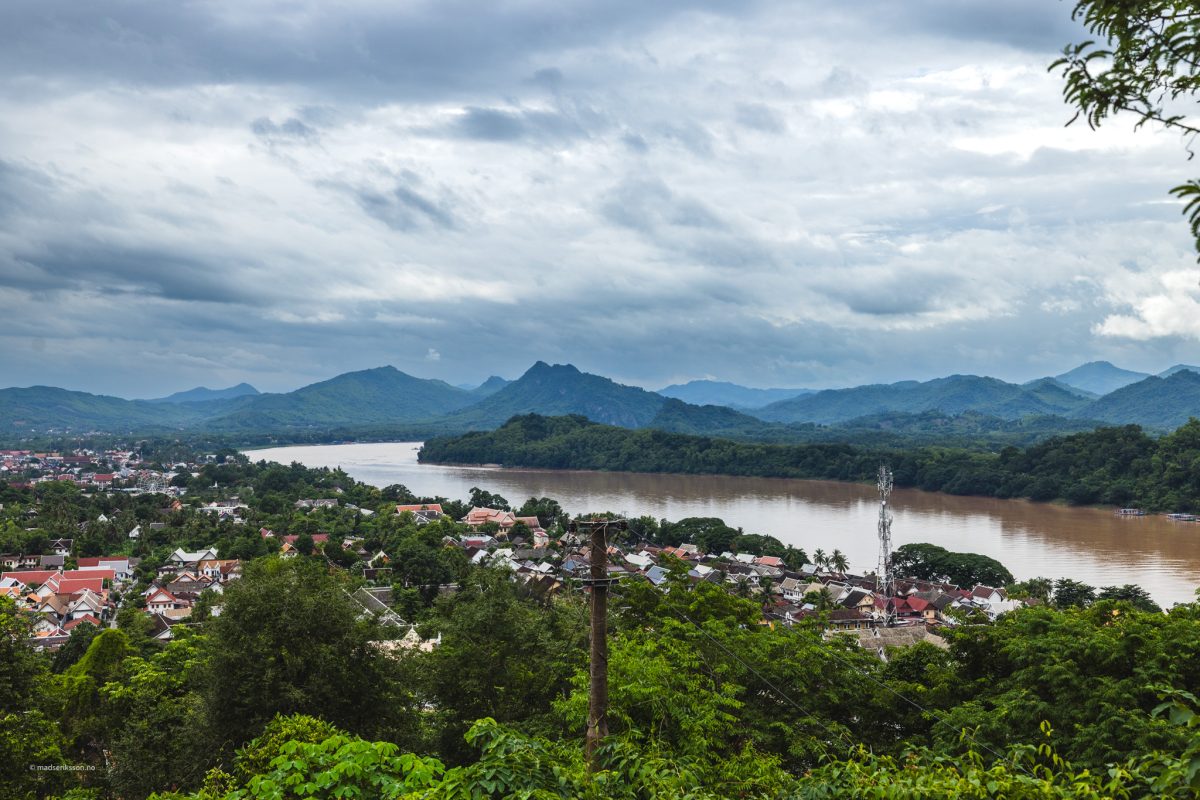
Luang Prabang takes its name from the most sacred object in Laos: the Pha Bang, an 83-centimetre solid gold Buddha image presented to the Lao king Fa Ngum in 1359 by his father-in-law the Khmer king of Angkor, said to have originated in Sri Lanka. The city was renamed in the Pha Bang’s honour — Luang Prabang means “Royal Pha Bang” — after the statue arrived, and it has been the spiritual centre of Lao Buddhism ever since. The city stands on a peninsula formed by the Mekong River and its tributary the Nam Khan, in a mountain valley in northern Laos, at approximately 300 metres above sea level. The surrounding landscape is dramatic: forested limestone mountains rise on all sides, the rivers run wide and brown after rain, and the peninsula itself is narrow enough that you can stand on the Mekong bank and throw a stone into the Nam Khan.
The UNESCO World Heritage designation of 1995 — describing the town as “an outstanding example of the fusion of traditional Lao urban architecture and Lao traditional wooden structures with French colonial buildings” — recognised what visitors had been quietly discovering for decades: that Luang Prabang is one of the most complete and best-preserved traditional Southeast Asian cities in existence, and that its specific character derives from the improbable combination of Theravada Buddhist temple culture and French colonial administrative architecture that history deposited on this peninsula and that no subsequent conflict or development has yet destroyed. The designation has also contributed to the tension that now defines the city’s present: between the authenticity that made it worth protecting and the tourism that protection attracted.
How to approach Luang Prabang
This guide covers four aspects of Luang Prabang: the Buddhist city — its temples, its monks and the Pha Bang Buddha that gives the city its name; the royal history and its abrupt end in 1975; the rivers, mountains and natural landscape that frame the city; and the food, the French colonial legacy and the morning alms ceremony that is simultaneously the city’s most visited and most fraught daily event.
Luang Prabang in 3D
Luang Prabang stands on a narrow peninsula where the Nam Khan joins the Mekong, about 300 m above sea level among the forested mountains of northern Laos. It became the capital of the kingdom of Lan Xang in 1353 and remained the royal seat until 1975, and its temples, wooden houses and French colonial buildings were inscribed as a World Heritage Site in 1995. More than 30 Buddhist temples stand on and around the peninsula.
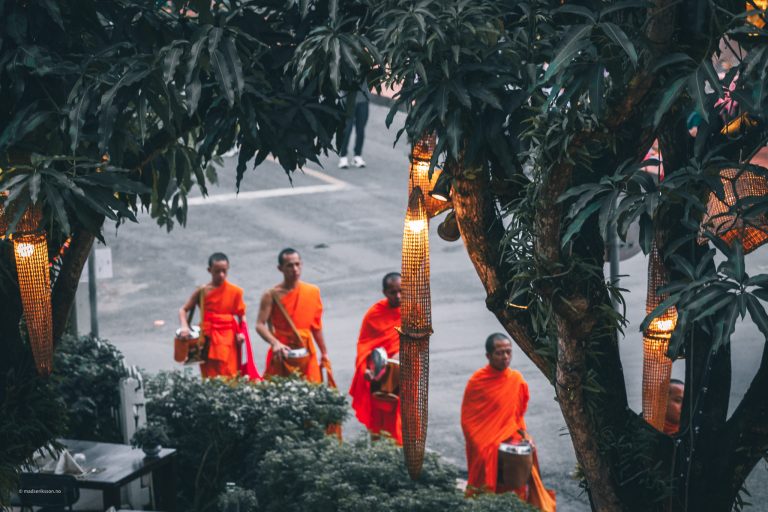
Tak Bat, the morning alms round
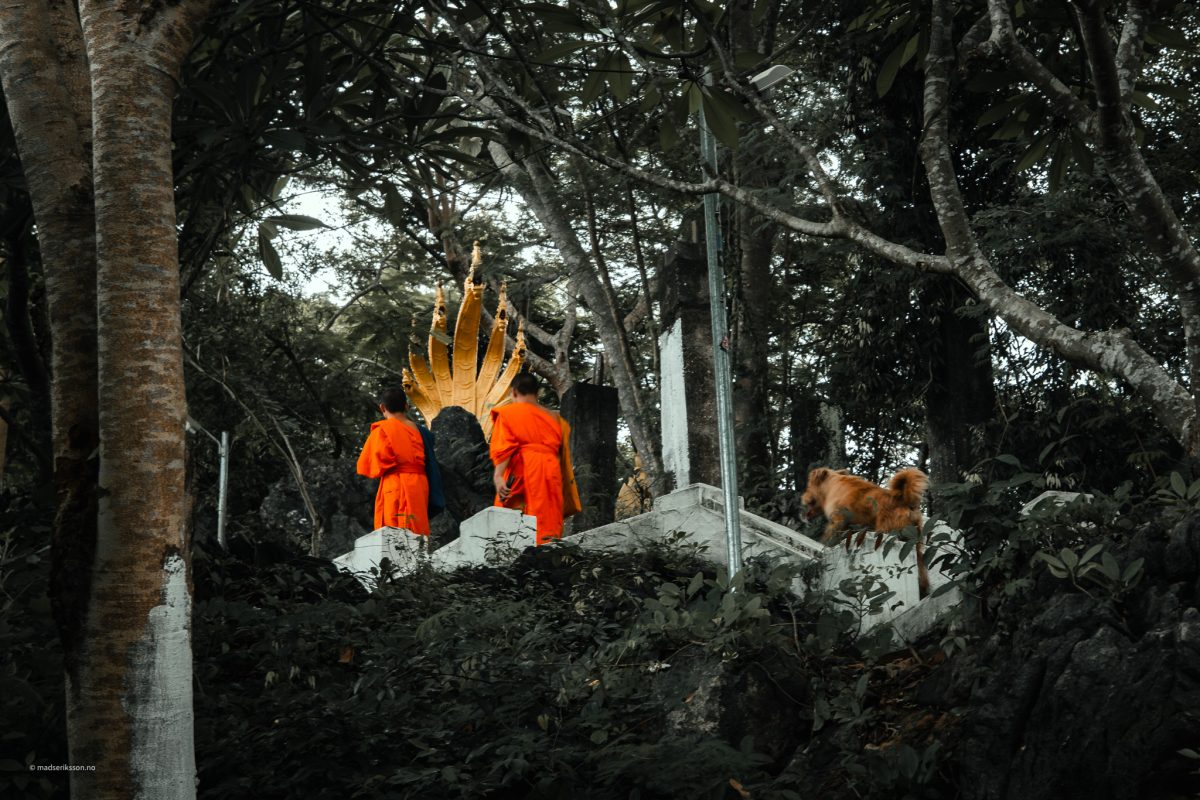
Every morning at first light, hundreds of monks and novices in saffron robes walk in silent single file through the streets of the peninsula. Residents kneel by the roadside and place sticky rice and food in their bowls, a ceremony known as Tak Bat. Along Sakkaline Road the procession passes temple gates and the colonial villas of the old town.
Monks in saffron robes walking to the dawn alms round, Tak Bat, in the streets of Luang Prabang, Laos
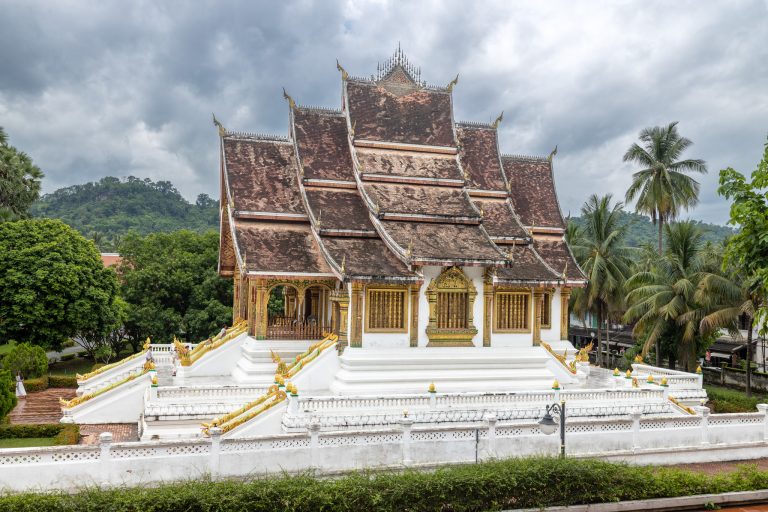
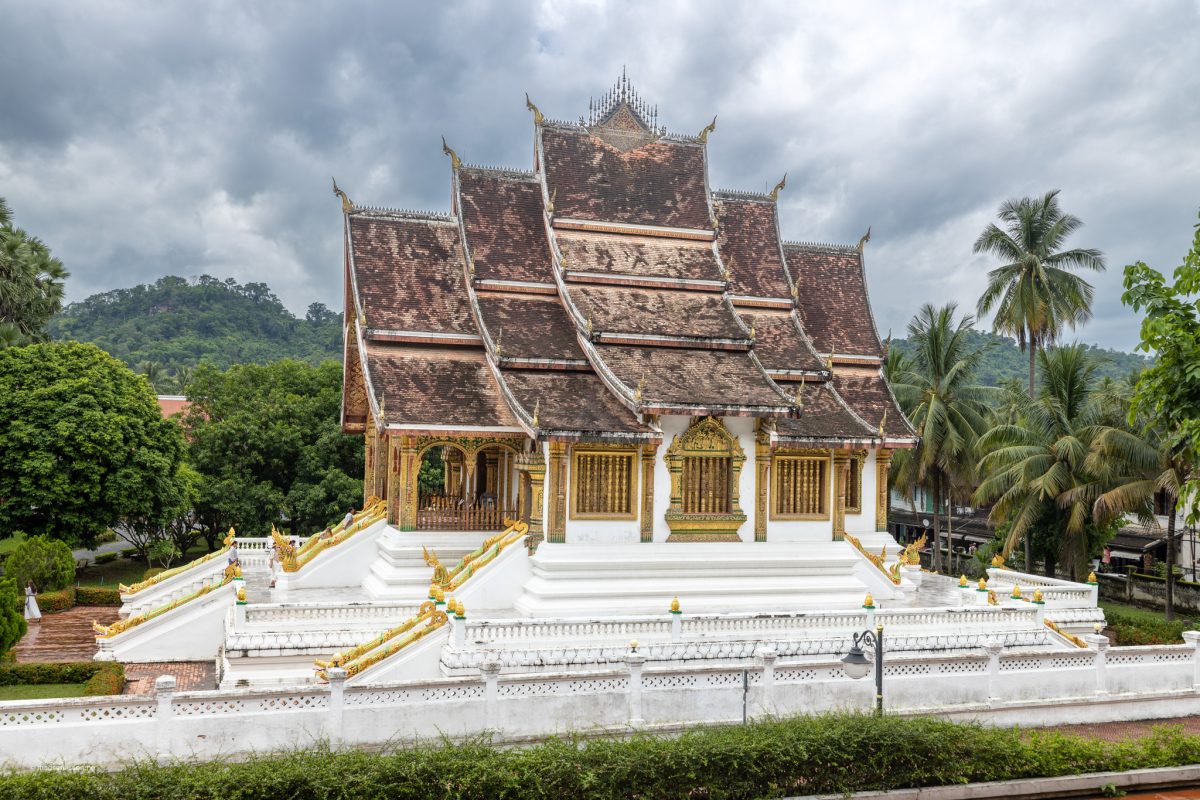
The Royal Palace and Haw Pha Bang
The Royal Palace, Haw Kham, was built between 1904 and 1909 for King Sisavang Vong in a blend of Lao and French Beaux-Arts styles, and became a national museum after the monarchy was abolished in 1975. The gilded Haw Pha Bang in its grounds was built for the Phra Bang, an 83 cm Buddha of gold, silver and bronze that gave the city its name.
A gilded temple with tiered roofs in the grounds of the former Royal Palace in Luang Prabang
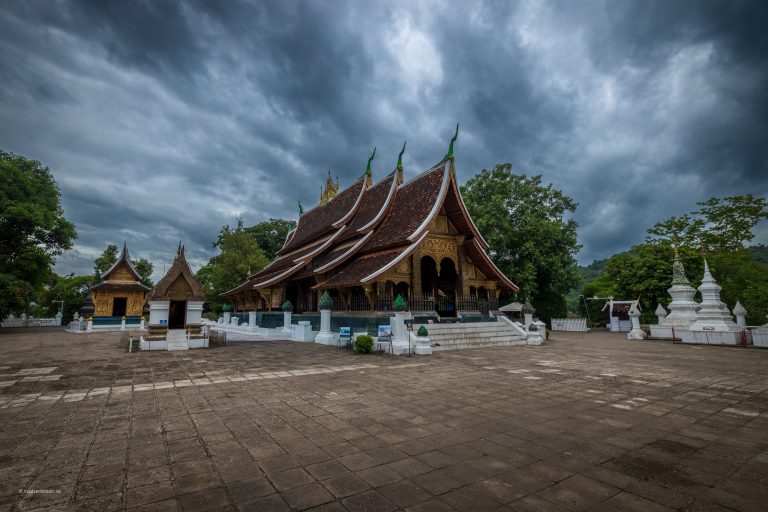
Wat Xieng Thong
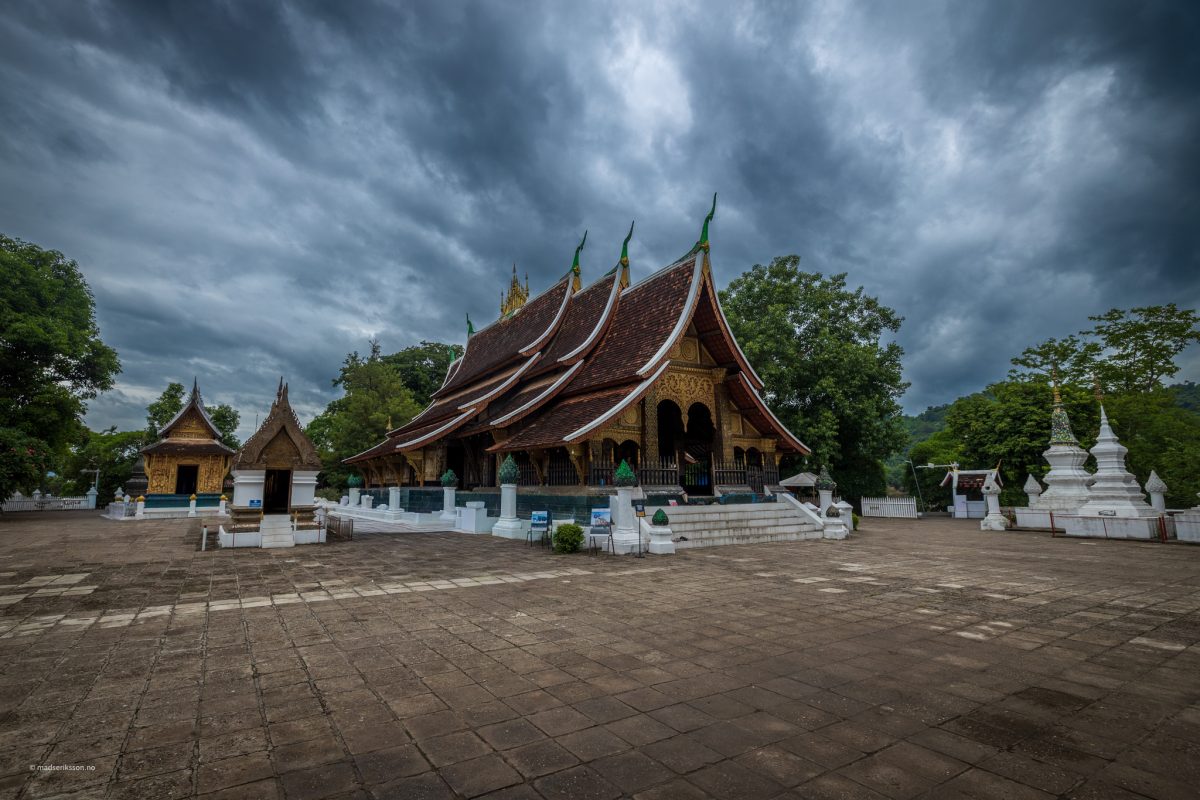
King Setthathirath built Wat Xieng Thong in 1559–1560 at the northern tip of the peninsula, close to where the Nam Khan meets the Mekong. Its ordination hall has sweeping, multi-tiered roofs that come down almost to the ground, and a glass mosaic of the tree of life covers its rear gable. A hall by the eastern gate holds the royal funeral carriage, about 12 m high.
The sweeping, layered roofs of Wat Xieng Thong beneath a dark monsoon sky in Luang Prabang
The colonial streets
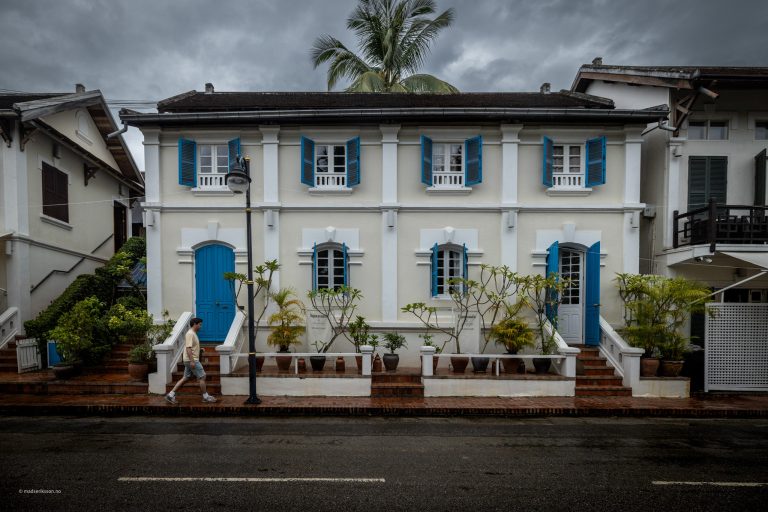
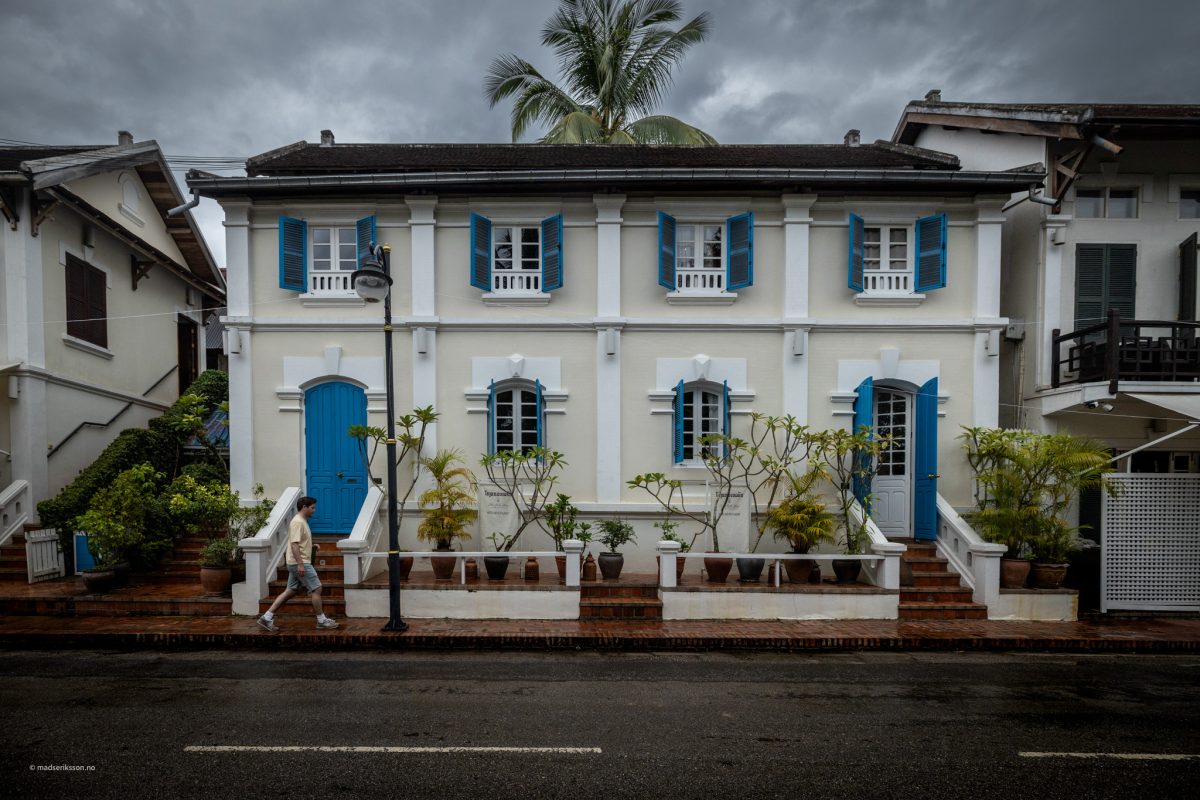
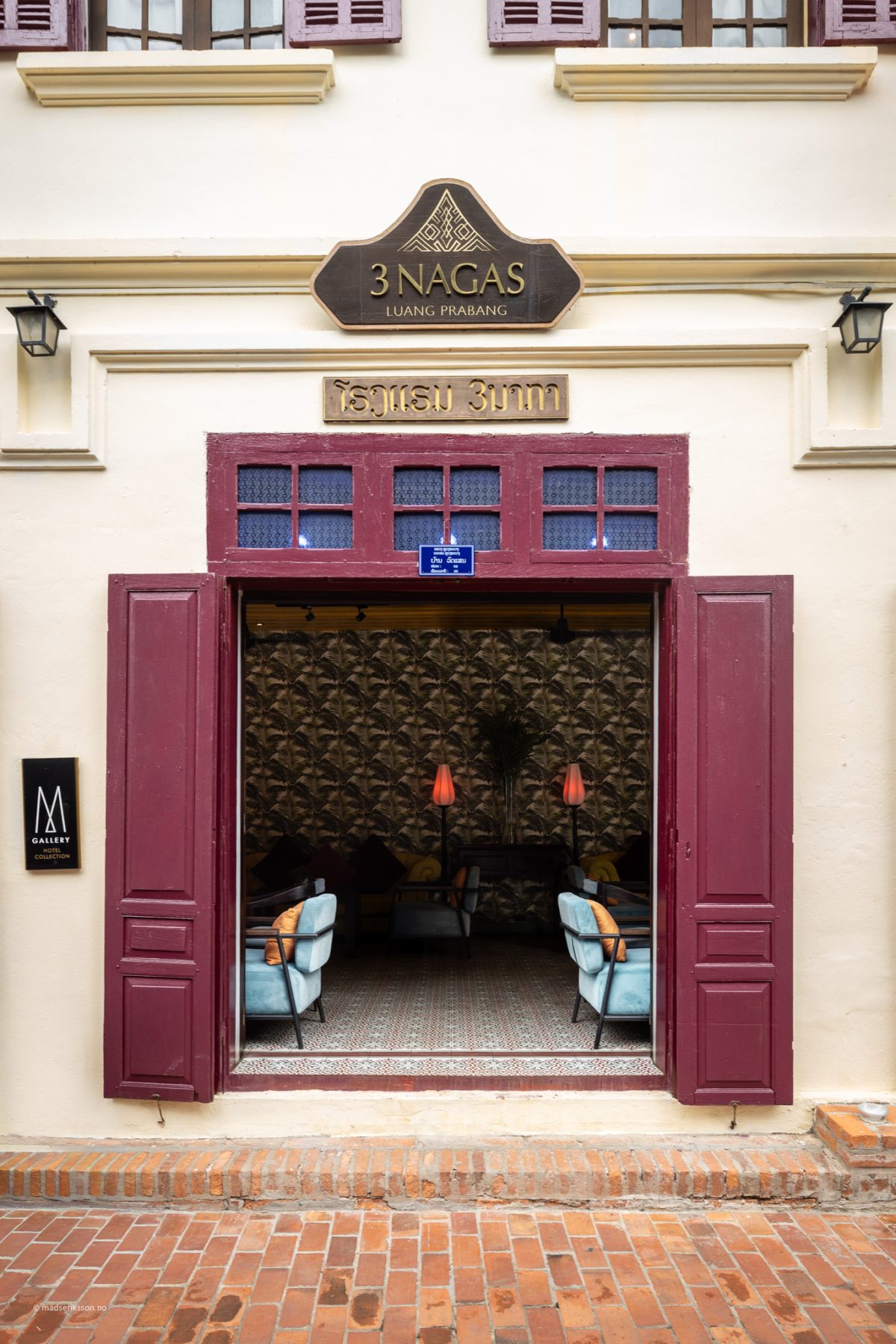
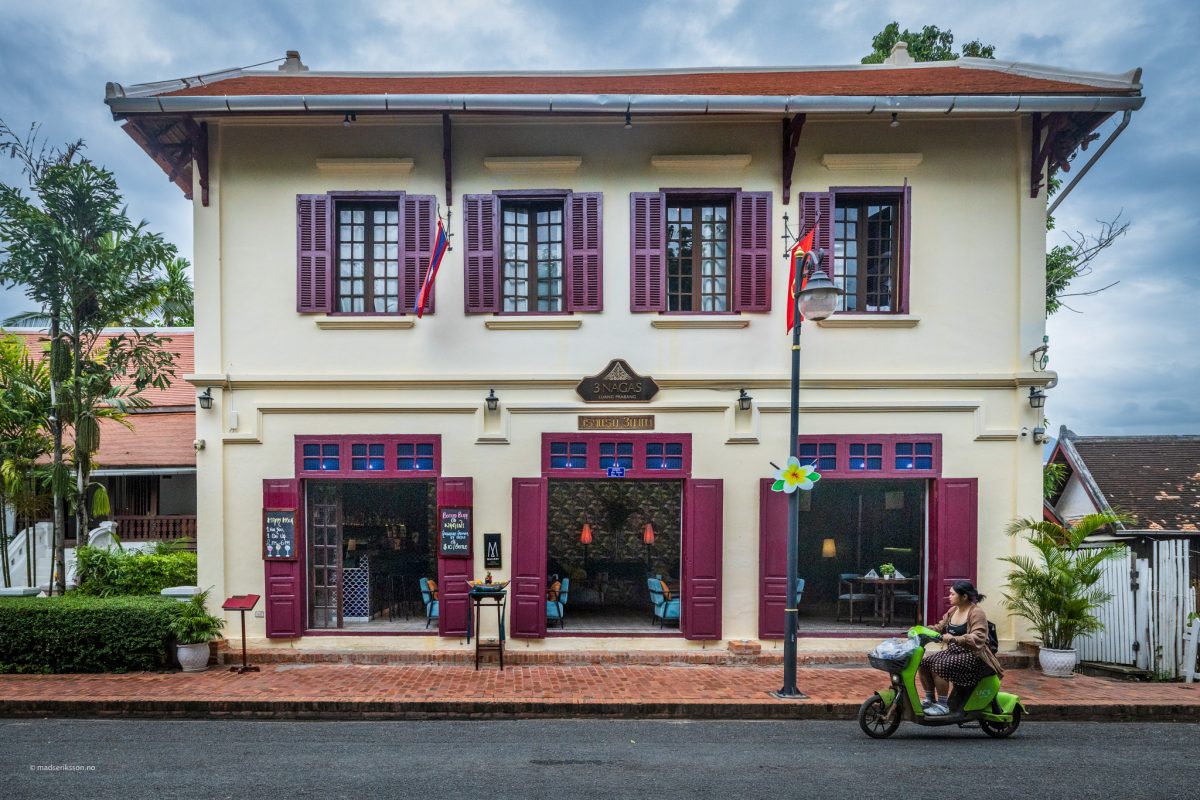
Laos became a French protectorate in 1893, and the colonial administration built two-storey villas and shophouses with shutters and tiled roofs between the temples. The World Heritage listing protects these buildings together with the traditional Lao wooden houses, and many now serve as guesthouses, cafés and small hotels.
A whitewashed colonial villa with blue shutters on a street in Luang Prabang
Where the Nam Khan meets the Mekong
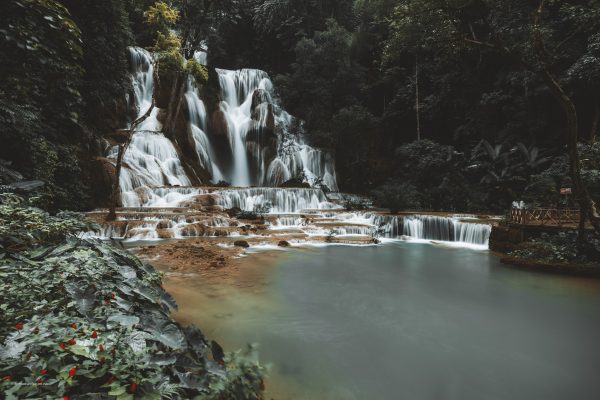
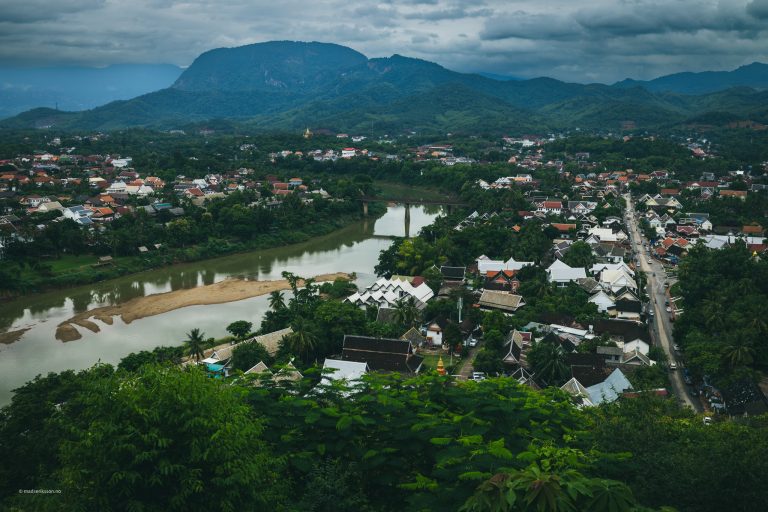
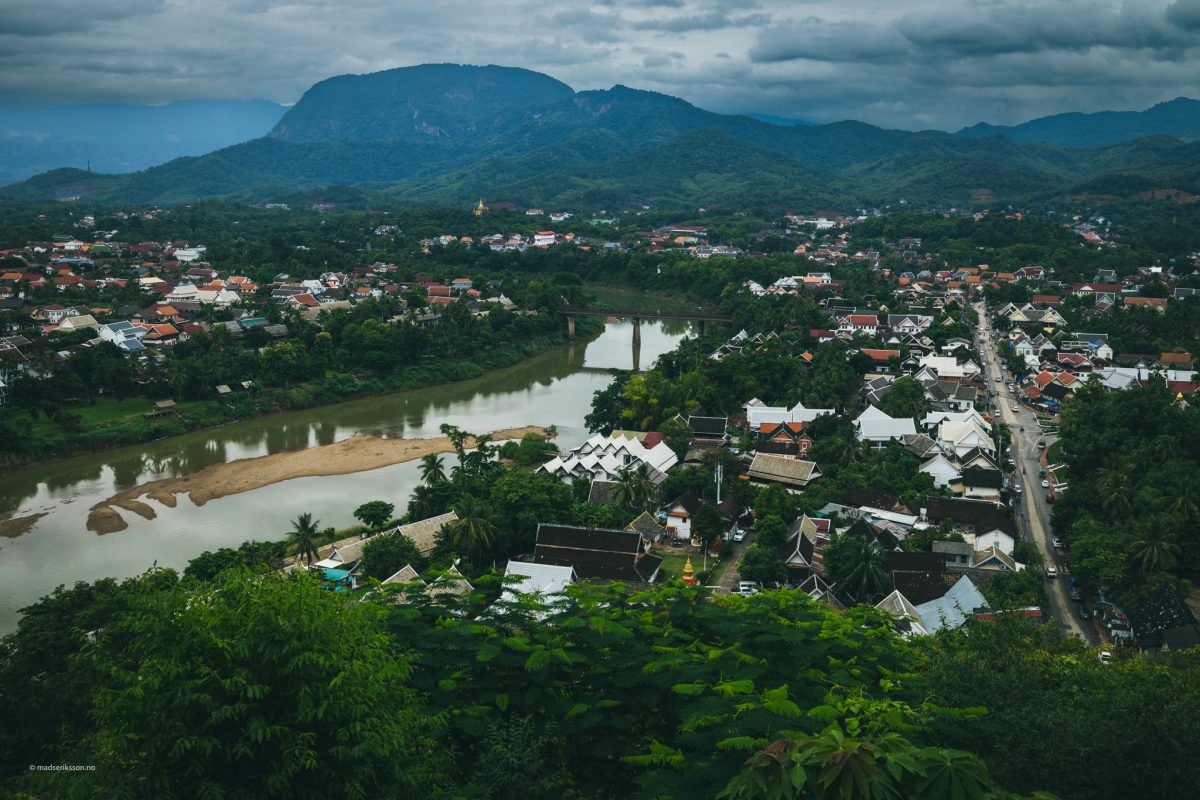
The Nam Khan curves around the eastern side of the peninsula and joins the Mekong just beyond Wat Xieng Thong; in the dry season, bamboo footbridges are rebuilt across it each year. Across the Mekong, Wat Chom Phet stands on the hillside of the west bank. The terraced turquoise pools of Tat Kuang Si lie 29 km south of the town.
A river winding past sandbanks and the green suburbs of Luang Prabang, with a long mountain ridge behind
Phou Si at sunset
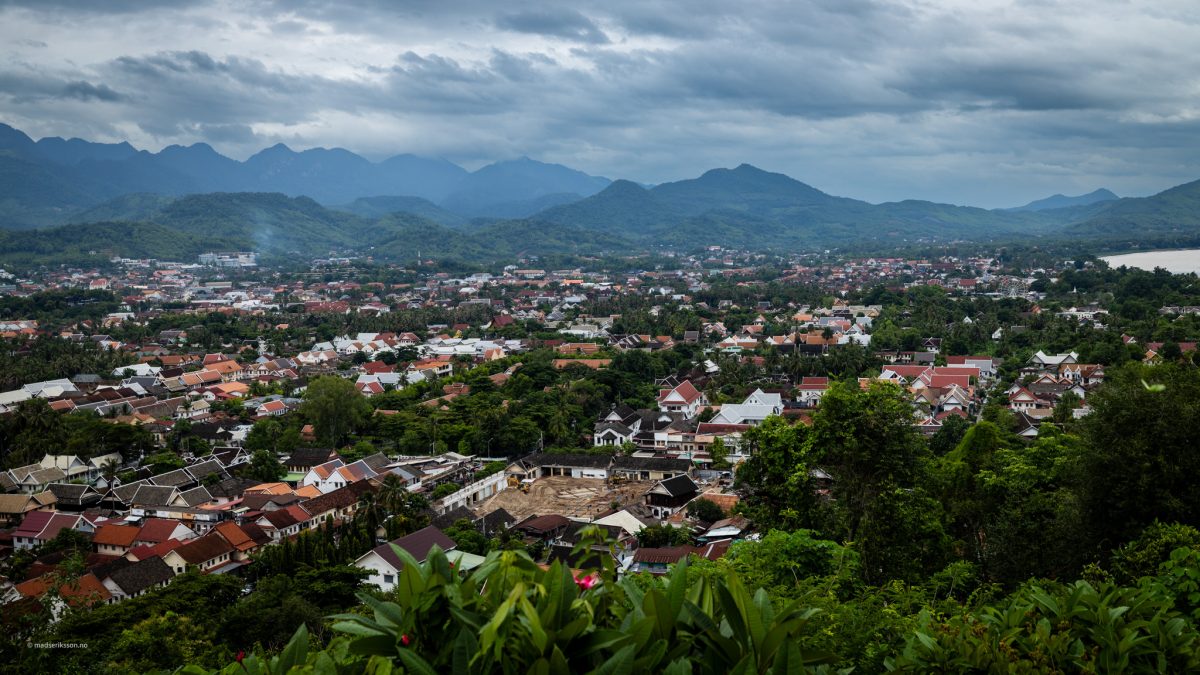
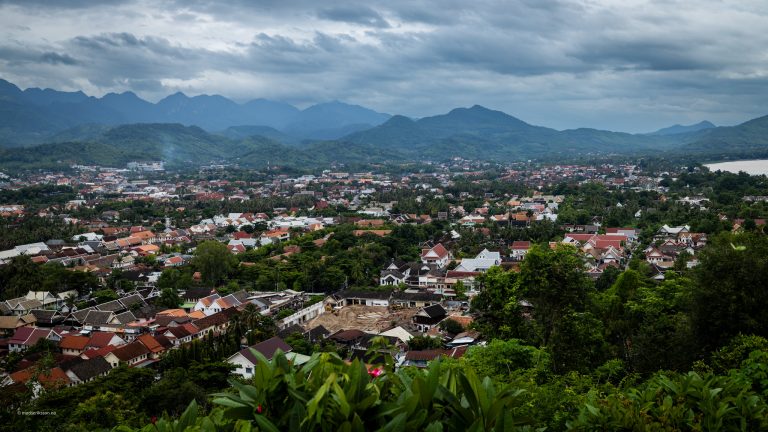
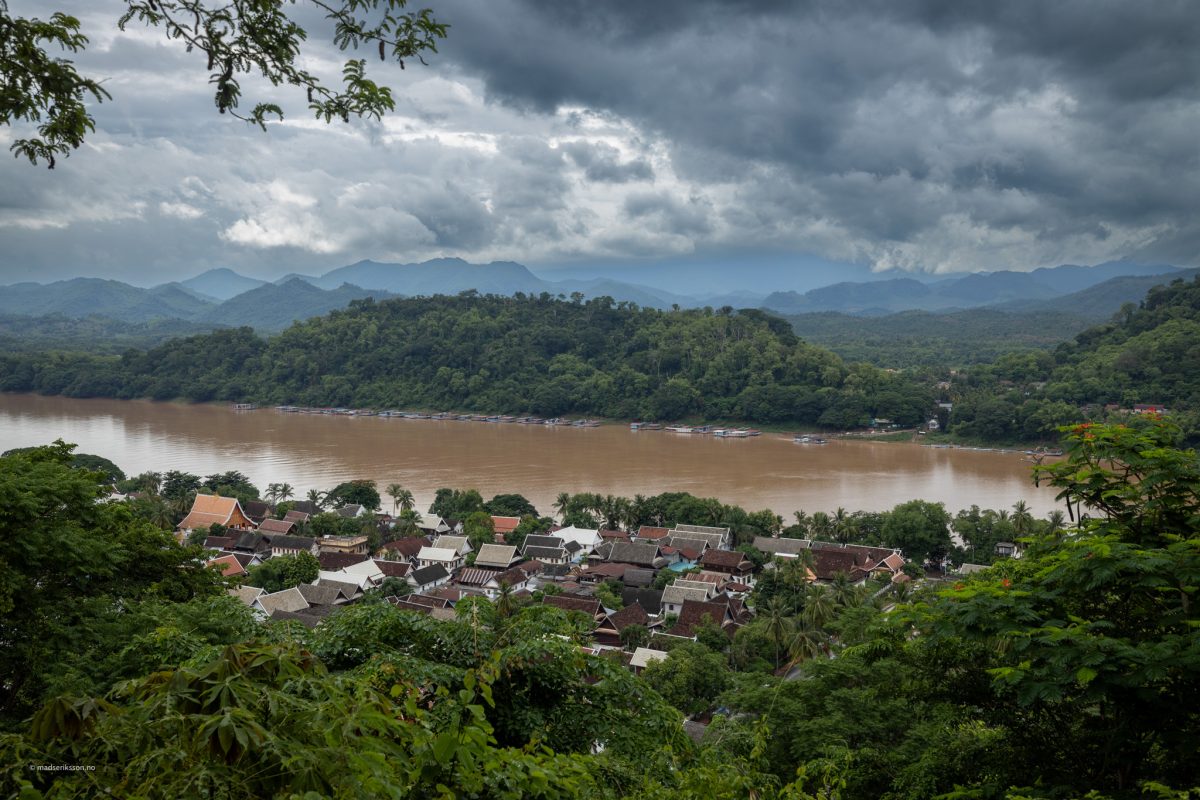
Phou Si rises about 100 m above the centre of the peninsula, opposite the Royal Palace, with the gilded stupa of That Chomsi on its summit. Steps climb past small shrines and a reclining Buddha, and at sunset the top looks out over the temple roofs to the Mekong and the forested mountains beyond.
Luang Prabang spread out below forested mountains, seen from high above the town under heavy cloud
The night market
Each evening the main street, Sisavangvong Road, closes to traffic below the Royal Palace and fills with stalls of textiles, paper lanterns and handicrafts. Food stalls in the narrow lanes nearby serve grilled river fish, sausages and khao jii, the Lao baguette sandwich inherited from the French period.
3D model © 2026 madseriksson.no · Photographs © madseriksson.no. Buildings and heights: © OpenStreetMap contributors (ODbL), via OpenMapTiles. Ground imagery: Sentinel-2 cloudless 2023 by EOX IT Services GmbH (contains modified Copernicus Sentinel data 2023; CC BY 4.0). Heights are approximate where OpenStreetMap has no measured value; sun positions are approximate.
The Buddhist City — Thirty Temples on a Peninsula Where the Rivers Meet
More than thirty Buddhist temples within a few walkable kilometres, the most sacred Buddha image in Laos, and approximately a thousand monks whose daily lives give the city its specific character at every hour of the day
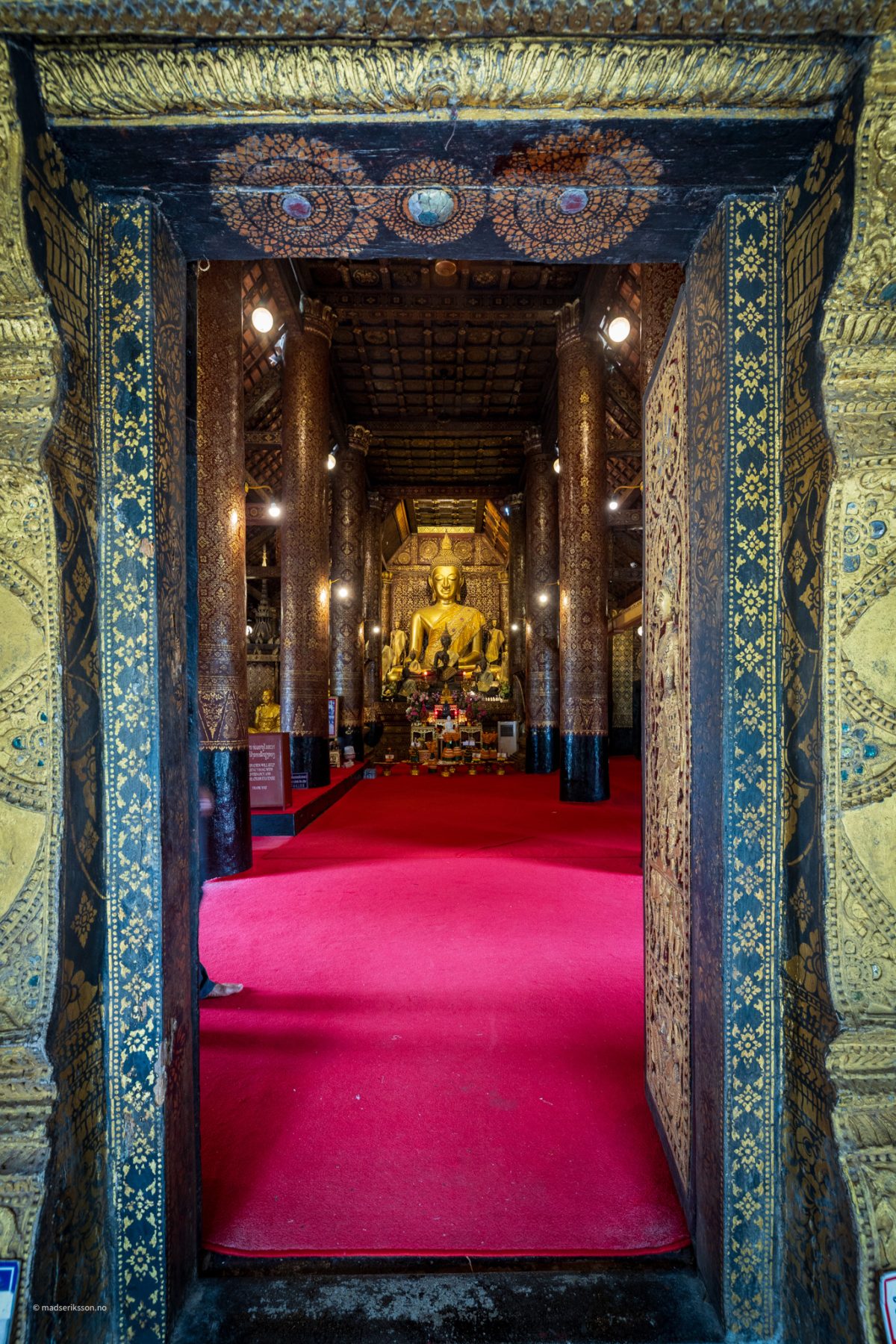
The peninsula of Luang Prabang contains more than thirty Buddhist temples within a walkable area, a concentration that reflects the city’s role as the spiritual capital of the Lao kingdom for six centuries. The most significant of them is Wat Xieng Thong — “Temple of the Golden City” — built in 1560 by King Setthathirath at the northern tip of the peninsula, where the Nam Khan meets the Mekong. It is considered the finest surviving example of Luang Prabang temple architecture: the sim (ordination hall) has a sweeping multi-tiered roof with eaves that descend almost to the ground, decorated on its interior with gold stencil patterns on black lacquer and lit at night to extraordinary effect. The rear exterior wall carries a large mosaic of the Tree of Life in coloured glass — red, gold and green fragments depicting a tree with animals and birds in its branches, specific to this temple and executed with a delicacy of design that rewards close attention. Adjacent to the sim, a small chapel contains a rare reclining Buddha, and the royal funeral carriage house holds an enormous 12-metre gilded vessel used for royal cremations. The temple was never attacked or looted; it exists today in essentially the condition in which it was built.
Wat Mai — “New Temple,” though it dates from the 18th century — is the residence of the supreme patriarch of Lao Buddhism and the current home of the Pha Bang, the golden Buddha image that gives Luang Prabang its name and that is the most sacred object in the country. The Pha Bang is displayed publicly only during Pi Mai, the Lao New Year (usually mid-April), when it is carried in procession and ritually bathed; at other times it is kept in the temple treasury, though a replica can be seen in the Royal Palace Museum. The temple’s gilded facade, decorated with scenes from the Ramayana, is among the most elaborate in the city. The approximately 1,000 monks resident in Luang Prabang at any given time — many of them novices from rural villages, sent to the city’s monasteries for their education — give the streets a specific character: the saffron and orange of their robes moving through the early morning light, the sound of chanting from the wats at dawn and dusk, the presence of young monks learning English from willing tourists in the evenings at the temple steps.
Wat Xieng Thong was built in 1560 and has never been attacked, looted or significantly altered. It contains the royal funeral carriage, the Tree of Life mosaic and a reclining Buddha visible through a small door at the back of a locked chapel. The key is held by a monk who will unlock it if you ask politely. Few visitors ask.
The UNESCO World Heritage designation covers the entire old town peninsula and requires new buildings to conform to traditional materials and height limits. The designation has preserved the physical fabric of the city more successfully than similar protections in other Southeast Asian cities: the wooden shophouses, colonial villas and temple grounds coexist on the peninsula in a spatial density that makes Luang Prabang uniquely walkable, and uniquely legible as a historical document. The tension between this preservation and the tourist economy that protection attracted — the hostels and tour operators now occupying the protected colonial buildings, the night market running through the historic centre — is the central unresolved question of Luang Prabang’s present.
The Kingdom and Its End — From a Million Elephants to a Reeducation Camp
Six centuries of Lao royal history, a French protectorate that preserved the monarchy as a decorative institution, and the abrupt ending of 2 December 1975 when the last king abdicated and was taken to the mountains where he died
The Kingdom of Lan Xang — “the Kingdom of a Million Elephants” — was founded in 1353 CE by Fa Ngum, a Lao prince who had been raised at the Khmer court of Angkor and returned with a Khmer princess and the Pha Bang Buddha to unify the fragmented Lao principalities into a single state. At its peak in the 16th and 17th centuries, Lan Xang was one of the largest kingdoms in Southeast Asia, controlling territory from the Yunnan border in the north to the edge of the Mekong delta in the south. Luang Prabang was its capital from 1353 until 1563, when King Setthathirath — who also built Wat Xieng Thong — moved the capital south to Vientiane for strategic reasons. The kingdom fragmented in the early 18th century under Siamese and Vietnamese pressure, and was absorbed into the French colonial system in 1893 as a protectorate: France administered Laos as part of French Indochina while preserving the Lao monarchy as a symbolic institution, much as the British preserved the Malay sultans.
The Royal Palace — Haw Kham — was built in 1904 for King Sisavang Vong by French colonial architects as a fusion of Lao and French Beaux-Arts styles: a pale-yellow neoclassical building with Lao decorative elements, set in gardens on the Mekong bank at the centre of the peninsula. It now operates as the National Museum and contains the throne room, the reception rooms with their Lao lacquerwork and French furnishings, and the Pha Bang chapel where the replica of the sacred image is displayed. The museum is modest in scale but specific in what it reveals about the intersection of traditional Lao court culture with French colonial administration: the rooms feel not fully French and not fully Lao, which is precisely what they were. Photographs are not permitted inside.
King Sisavang Vatthana abdicated on 2 December 1975 and offered himself “in the service of the revolution.” He was sent to a seminar camp in Hua Phan Province with his wife and crown prince. The government said nothing about their fate for fourteen years. In 1989 it acknowledged he had died. It did not say when, or where, or how.
On 2 December 1975, the Pathet Lao — the communist movement that had been fighting a parallel war to the Vietnamese communists since the 1950s, backed by North Vietnam and sustained by the massive political disruption of the US Secret War bombing campaign — proclaimed the Lao People’s Democratic Republic. King Sisavang Vatthana abdicated. He, his wife Queen Khamphoui and Crown Prince Vong Savang were subsequently sent to a “seminar camp” in the remote mountains of Hua Phan Province. The government made no announcement about their condition or whereabouts for fourteen years. In 1989, a Lao official told an interviewer that the king had died — probably of malnutrition or illness in captivity, sometime around 1978 or 1979. The exact date, cause and circumstances of his death have never been officially confirmed. He is the only reigning Southeast Asian monarch to have died in communist captivity following a revolution, and his fate remains, in Laos, a subject that is not publicly discussed.
The Rivers and the Mountains — The Natural Frame That Makes the City
The Mekong and Nam Khan rivers, Phu Si Hill at sunset, a cave filled with thousands of Buddha images where the Mekong meets the Nam Ou, and the turquoise waterfalls 29 kilometres south that are the most beautiful natural site in Laos
Luang Prabang sits on a narrow peninsula where the Nam Khan River joins the Mekong from the east, with forested limestone mountains rising on all sides and the Mekong running wide and brown to the west and north. The physical geography of the city is inseparable from its character: the rivers define the boundaries of the peninsula, limit its growth, and provide the horizon views and river life — the long-tail boats, the fishing nets, the sand beaches that appear in the dry season — that give the city its specific atmosphere. Phu Si Hill, rising 150 metres above the centre of the peninsula with the gilded stupa of That Chomsi on its summit, is the geographic and spiritual heart of the city: the view from the top at sunset, over the red rooftops of the temples, the rivers curving away in both directions and the mountains receding in mist, is one of the defining images of the Mekong basin. The climb takes twenty minutes on steps that pass multiple small shrines and a reclining Buddha; the descent on the northern side passes a small meditation cave and emerges on the Mekong bank near Wat Xieng Thong.
The Pak Ou Caves — Tham Ting (lower cave) and Tham Phum (upper cave) — are carved into a limestone cliff at the confluence of the Mekong and the Nam Ou River, approximately 25 kilometres north of Luang Prabang by boat. They contain thousands of Buddha images of all sizes and materials, deposited over centuries by Lao Buddhists as offerings: some are gilded bronze of considerable age and quality, others are simple painted wood or plastic. The effect of entering the lower cave — a wide, open cavern facing the river, its walls and shelves and every horizontal surface covered with Buddhas of every size — is of a sacred collection that has accumulated without curation or plan, which gives it a different quality from any museum display. The boat journey from Luang Prabang, through the Mekong canyon with its karst formations and riverside villages, is itself the better part of the experience. Tat Kuang Si, 29 kilometres south by tuk-tuk or motorbike, cascades over three tiers of limestone into turquoise pools coloured by dissolved calcium carbonate. The lower pool is open for swimming; the upper tiers are closed for conservation. A small bear rescue centre at the entrance holds sun bears rescued from the illegal wildlife trade.
The slow boat from the Thai border takes two days. Eighteen hours on the Mekong through the canyon, stopping overnight in Pak Beng. Most people who have done it describe it as one of the best journeys they have ever made. Most people who visit Luang Prabang fly in. The city can be reached; the sense of arrival cannot.
The traditional approach to Luang Prabang from Thailand — the two-day slow boat on the Mekong from Huay Xai, on the Thai-Lao border — has been one of the classic overland journey segments in Southeast Asia for decades, and remains the approach that most completely corresponds to the scale and character of the country being entered. The boat carries approximately 100 passengers on wooden seats, takes 8–10 hours each day, and passes through a landscape of limestone cliffs, forest, river villages and the slow movement of water and light that no road or flight can replicate. The overnight stop in Pak Beng — a single-street town on the Mekong bank, with guesthouses facing the river — is not comfortable. The arrival in Luang Prabang on the evening of the second day, with the golden roofline of Wat Xieng Thong appearing around a bend in the river, is one of the better arrivals available to a traveller in Asia.
The Tak Bat, the Baguette and the Food That Belongs to This Valley
The most photographed dawn ceremony in Southeast Asia and its growing ethical problem; the French colonial gift of the baguette; and a Lao cuisine that is specific, sticky and quietly one of the most distinctive in the region
The Tak Bat — the alms-giving procession in which monks walk the streets at dawn collecting food from residents — is performed every morning in Luang Prabang as it has been for centuries: hundreds of monks in saffron and orange moving in silence through the pale early light, while residents kneel on mats by the roadside and place rice and food in their lacquered bowls. It is a genuinely moving ceremony when observed as it is intended — from a respectful distance, in silence, as witness rather than participant — and it has become, in the main streets of the UNESCO town, something quite different. Tourists line the kerbs with cameras on flash; tour operators sell cheap, industrially-processed sticky rice for tourists to offer (the monks eat what they collect, and this rice causes digestive problems); some visitors step into the procession for photographs. A number of monasteries have moved their Tak Bat to alternative streets away from the tourist areas. UNESCO, the Lao National Tourism Authority and local organisations have repeatedly asked visitors to observe from a distance of at least 10 metres, to wear modest clothing, to turn off camera flash, and not to buy rice from street vendors for offering. If you come to watch, stand back. If you cannot stand back, do not come.
Lao cuisine is built on khao niao — glutinous sticky rice, steamed in a conical bamboo basket and eaten by hand, rolled into small balls and dipped into sauces and accompaniments. It is eaten at every meal; the standard greeting in Lao, kin khao niao læo bò, translates roughly as “have you eaten sticky rice yet?” — an indication of how central the staple is to daily life. Laap, the national dish, is a salad of minced meat (pork, chicken, duck, buffalo or fish) tossed with toasted ground rice, lime juice, fish sauce, shallots and herbs — mint, coriander, culantro, sawtooth coriander — with a sharpness and depth of flavour that rewards attention. Or lam, the distinctive Luang Prabang stew of meat and vegetables with wood ear mushrooms, lemongrass, chilli and the bitter Lao ingredient sakhan (a woody vine with a numbing, pepper-like quality), is specific to this city and not widely found elsewhere. Mok pa — fish steamed in banana leaf with herbs and coconut — is the most delicate preparation in the Lao kitchen. All of it is eaten with sticky rice.
The Lao greeting is not “how are you?” but “have you eaten sticky rice yet?” (Kin khao niao læo bò?). Sticky rice is not a side dish or a preference. It is the centre of the plate, the unit of the meal, the thing eaten at breakfast, lunch and dinner, scooped with the right hand, rolled into balls, used to scoop everything else. The restaurants that give you jasmine rice were opened for tourists.
The French protectorate left two lasting contributions to Luang Prabang’s food culture: the baguette and the café au lait. Khao jii — a baguette sandwich with pâté, mayonnaise, fresh vegetables and chilli — is sold from carts and stalls throughout the city from early morning and represents a genuinely successful fusion: the baguette in Laos is lighter and crispier than its French counterpart, and the fillings are Southeast Asian in flavour. Café au lait, made with strong Lao drip coffee and sweetened condensed milk, is the morning drink. The Sisavangvong Road night market, running the length of the main tourist street, is primarily a textile and craft market rather than a food market; the better food is in the side streets and the morning market (Talat Dala) near the Royal Palace, where local vegetables, herbs, river fish, grilled meats and fresh noodle soups are sold to residents who arrive before the tourist traffic begins.
«Luang Prabang is a city that makes specific demands on the visitor. It asks you to slow down, to be quiet in its temples, to stand back from its ceremonies, to eat what its food actually is rather than what has been adapted for an international palate. In return it offers something that is increasingly rare in Southeast Asian tourism: a city that is still, recognisably, itself — where the monks are monks and not a performance, where the temples are living religious institutions and not museums, where the sticky rice is eaten with the right hand and the laap is as sharp as it should be. That this remains true is partly the consequence of UNESCO’s 1995 designation, partly the consequence of geography (Luang Prabang is in a mountain valley on a narrow peninsula, and its physical form resists the kind of sprawl that has consumed similar cities), and partly the consequence of luck. It may not remain true indefinitely. Come now.»
More in the same area
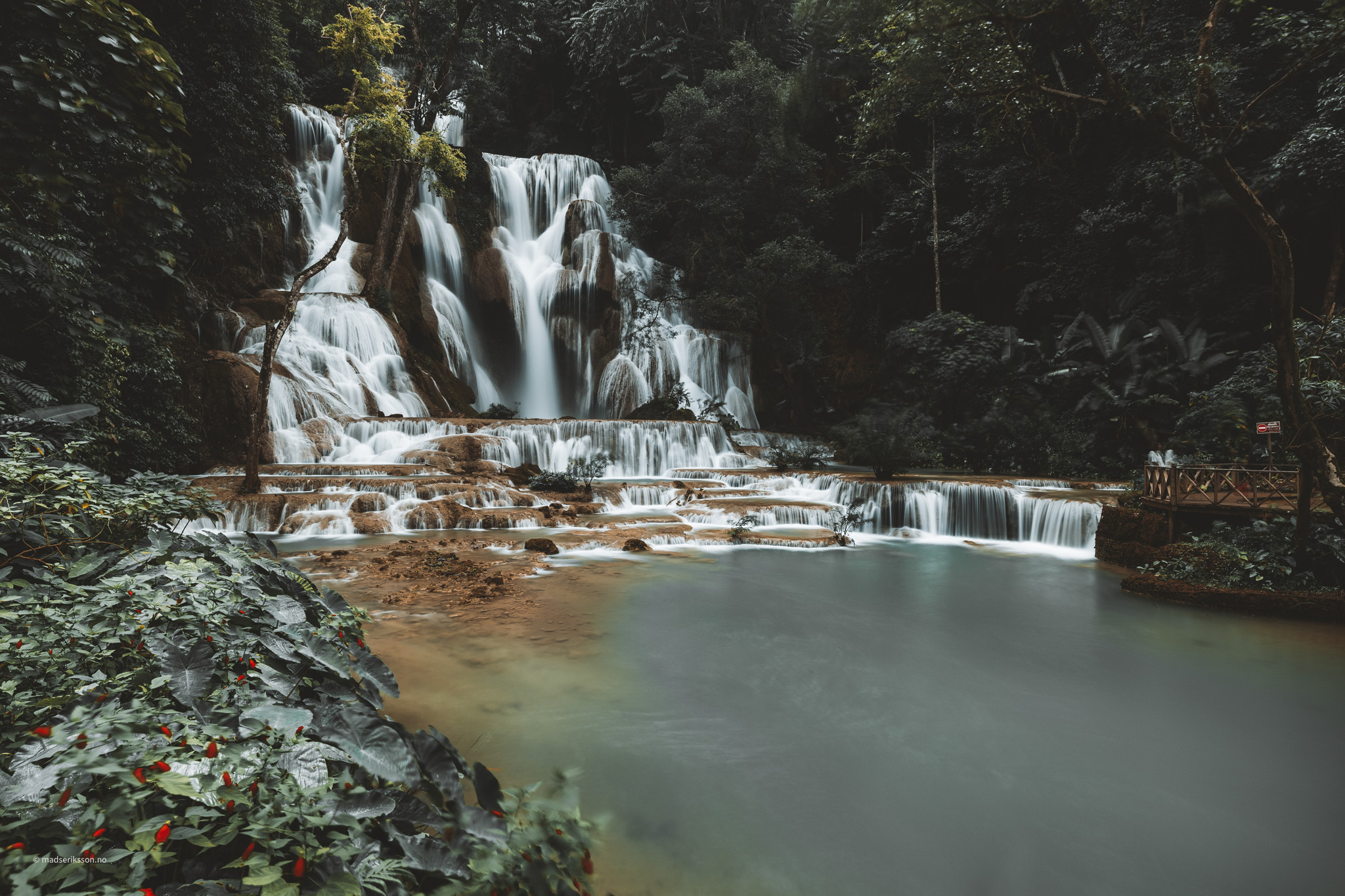 ForrestsTat Kuang Si Falls — The Turquoise Pools of Laos
 NatureThe World’s 15 Most Spectacular Waterfalls
 CitiesThe World’s 10 Great Food Markets
 ArchitectureTen Buildings That Changed Their Cities — Modern Architecture Ranked on Impact, Not Image
 CitiesHiroshima and Miyajima: A preserved ruin and a shrine on the tideline
 CitiesThe World’s 10 Most Beautiful City Parks
City Frames · scroll-driven 3D
More cities in three dimensions
54 city guides open with a model built from open map data. Scroll, and the camera moves from landmark to landmark.
Departures · City Frames
Where to next?
| Time | Destination | Country | Status |
|---|
Live · position of the sun
Golden hour, right now
The low, warm light just after sunrise and just before sunset. These are the cities on the site where it is happening at this moment.