Nishiki Market is 390 metres long and approximately three metres wide — a covered arcade of roughly 130 shops running parallel to Shijō-dōri in central Kyoto, one block north of the main shopping street and invisible from it unless you know where the entrance is. It has been here in some form for over 400 years, and it has been called Kyoto’s Kitchen — Kyō no daidokoro — for most of that time. The nickname is accurate: the market has supplied the professional kitchens, temple cooks and domestic households of Kyoto with the ingredients that Kyoto food specifically requires — the kyo-yasai (traditional heirloom vegetables), the tsukemono (pickles), the yuba (tofu skin), the fu (wheat gluten), the konbu for the light dashi that underlies everything — for four centuries. It is currently, and with increasing speed, becoming a tourist attraction. The question of what remains of the original character, and where precisely to find it, is the most useful question a visitor can ask before entering.

Nishiki Market occupies Nishiki-kōji — a lane in the Nakgyō-ku district of central Kyoto, one block north of Shijō-dōri, running east from Teramachi-dōri to Takakura-dōri. The lane exists because of a cold underground spring: in the early Edo period (17th century), the proximity of this spring to a natural cold zone made the location ideal for preserving fresh fish, and a fish market established itself accordingly. Kyoto’s position as an inland city — far from the sea, in an era before refrigeration and reliable transport — made fresh fish a luxury and preserved fish a necessity, and the Nishiki vendors who supplied both to the imperial court, the temples and the townspeople (chōnin) of Edo-period Kyoto occupied a commercially and culturally significant position. The market was formally organised under the Tokugawa shogunate, received official guild status, and has operated on roughly the same lane ever since, through the Meiji Restoration, the Second World War and the advent of the supermarket.
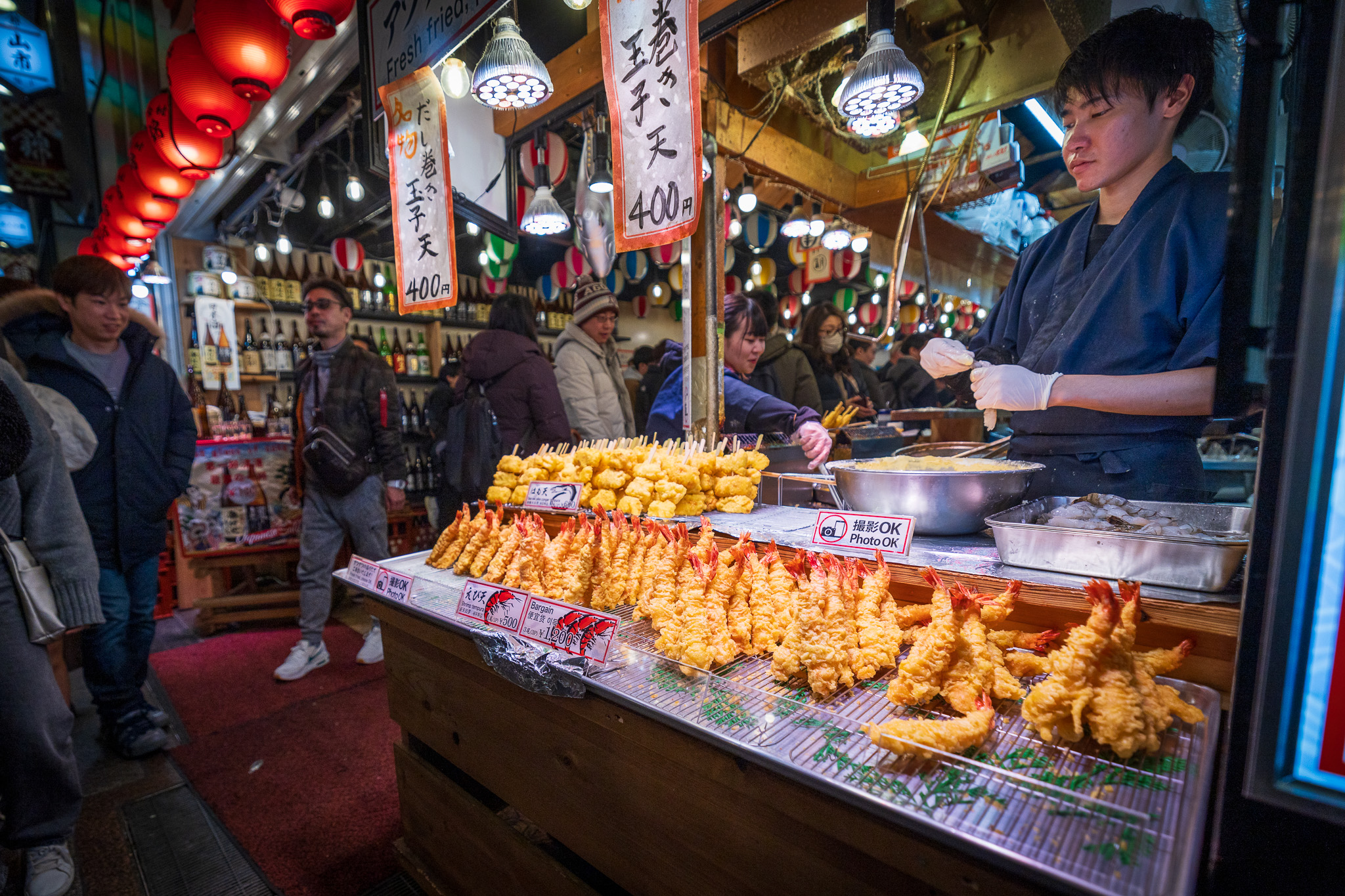
What Nishiki sells today is not quite what it sold in 1615, but the categories remain largely consistent: fresh and pickled vegetables, tofu and tofu products (yuba, tofu skin; various forms of fresh tofu), dried and preserved seafood, konbu and other seaweed for dashi, fu (wheat gluten, a Kyoto staple with no real equivalent elsewhere in Japan), wagashi (traditional Japanese confectionery), Kyoto-style prepared foods, and the pickles — tsukemono — that are the most direct expression of Kyoto’s food culture in a single product. The market also sells, increasingly, skewers of grilled octopus and cheese, matcha soft cream, and various food items on sticks designed for consumption while walking. The two ends of the market have drifted in different directions: the eastern stretch (Teramachi end) trends toward tourist snacks; the western stretch retains more of the traditional provisioning character. This distinction matters and should govern how you walk the market.
How to approach Nishiki Market
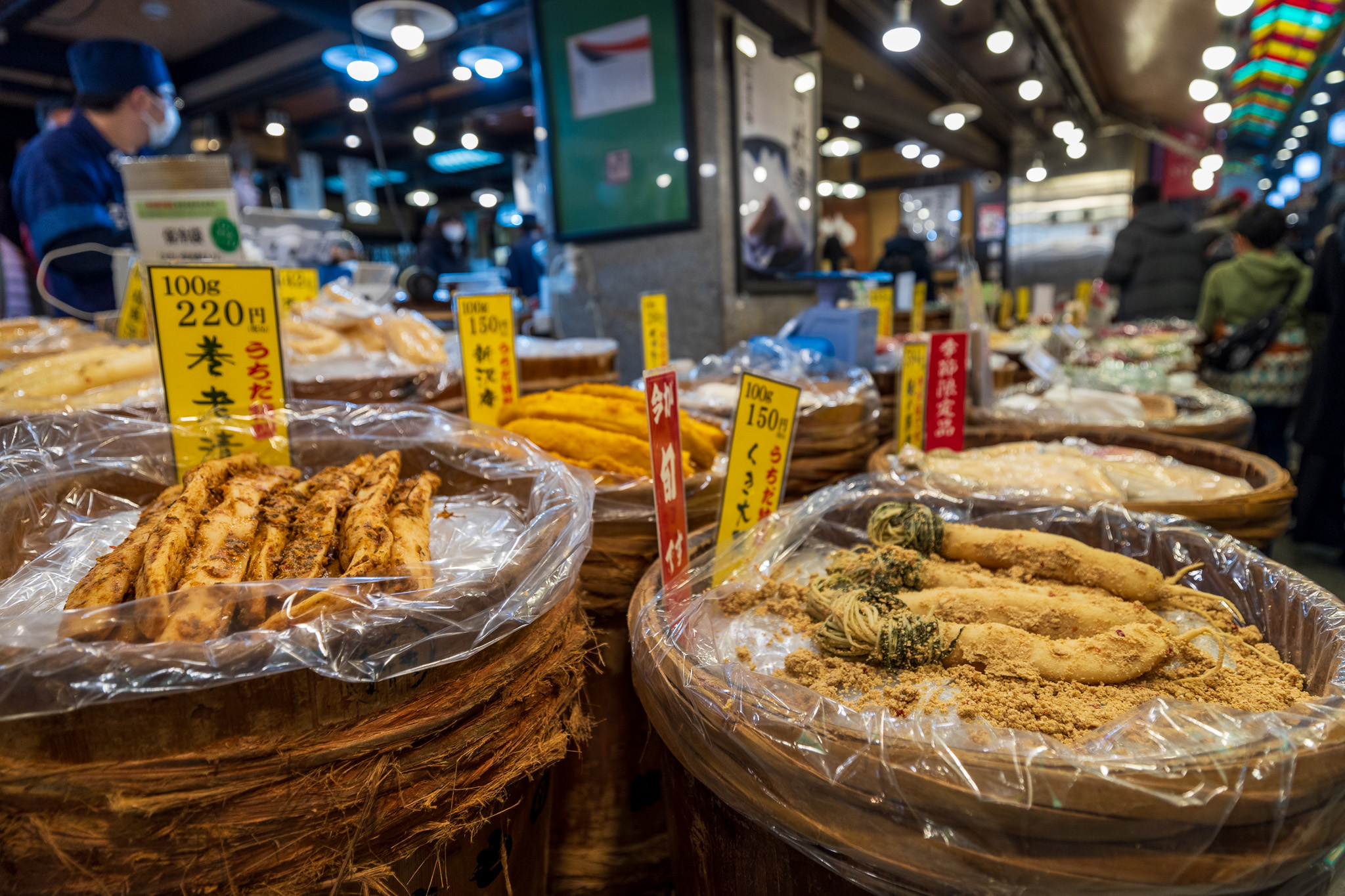
Nishiki Market is best approached as a food culture experience rather than a shopping destination. The most valuable thing to do is to walk the full length slowly, identify the genuinely traditional shops — the tsukemono specialist with barrels of fermenting vegetables visible, the konbu shop with its specific marine smell, the tofu producer with the day’s yuba listed on a handwritten board — and then return to eat and buy with intention. Going early (by 9am) gives access to the market at its most functional, before the tour groups arrive and the lanes become impassable. Going on a Wednesday or Sunday means some shops will be closed; check ahead.
The Market — Four Hundred Years of Kyoto’s Kitchen in a Three-Metre Lane
A covered arcade 390 metres long and three metres wide, operating on the same lane since the early 17th century, originally a fish market built around a cold underground spring, now the most concentrated expression of Kyoto food culture accessible to a visitor in a single walk
The lane that Nishiki Market occupies has been a commercial thoroughfare since at least the Muromachi period (14th–15th century), but the market in its organised form dates to the early Edo period, when a cold underground spring in Nishiki-kōji made it the ideal location for a fresh fish market in the pre-refrigeration era. Fish transported to Kyoto from the Sea of Japan or the Pacific was perishable; the natural cold zone around the spring extended its usable life by critical hours. The fishmongers who established themselves here received guild status from the Tokugawa shogunate, formalising the market’s role as a supplier to the imperial court, the aristocratic households (kuge), the hundreds of Buddhist temples and Shinto shrines, and the prosperous merchant class (chōnin) of Edo-period Kyoto. The market acquired the name Kyō no daidokoro — Kyoto’s Kitchen — to describe its function: not a market where you bought luxury goods, but where you bought the daily ingredients that Kyoto cooking required. The nickname has persisted for 400 years because the function, transformed but not replaced, has also persisted.
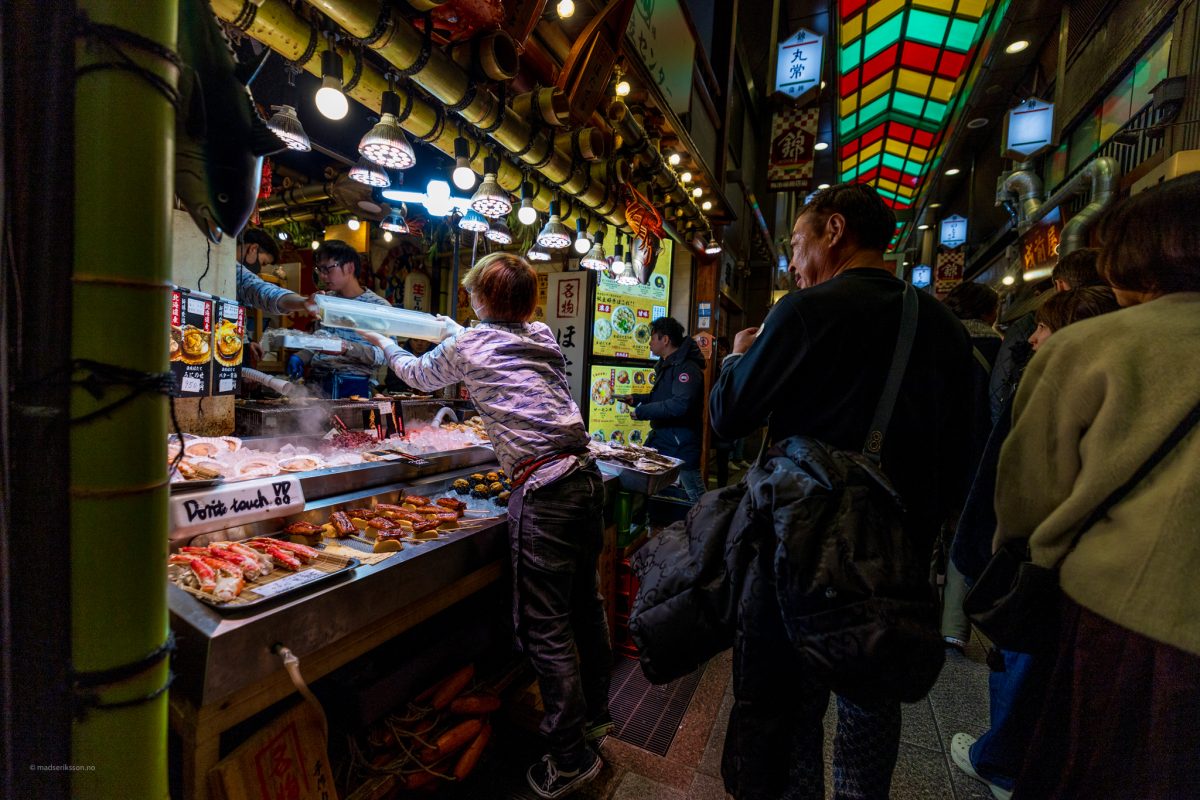
The physical structure of Nishiki today — a roofed arcade of continuous stall fronts along a narrow pedestrian lane, illuminated by the overhead glazing and the spill of each shop’s interior light — is a shotengai: a traditional covered shopping street, a form that was once common across Japan and has declined everywhere as supermarkets and convenience chains have replaced the specialist provisioning shops that gave shotengai their reason to exist. Nishiki has survived partly because of its historical reputation, partly because Kyoto’s food culture has kept specialist provisioning economically viable at a level that no other Japanese city matches, and partly because the tourist economy has provided a supplementary revenue stream — the same revenue stream that is now transforming the market’s character. The balance between these forces is visible in the market’s current state: traditional tsukemono barrels and konbu stacks on one side of the lane, matcha soft cream and takoyaki skewers on the other, with the proportion shifting gradually eastward toward the tourist end. The western third of the market — the stretch between Nishiki Tenmangu shrine and the Takakura intersection — retains the most of the original provisioning character. This is where to spend more time.
The Nishiki Tenmangu shrine at the western end of the market is accessed through a passage between two stalls, three metres from the market noise. It is a small Shinto shrine that has been here since the Heian period, dedicated to Sugawara no Michizane, the deity of learning. Inside: a rope curtain, a stone fox, complete quiet. Most visitors walk past without knowing it exists. This is a pattern that applies to several things in Nishiki.
Kyoto Food Culture — Why an Inland City Developed the Most Refined Cuisine in Japan
Landlocked, imperial and deeply Buddhist, Kyoto developed a food culture defined by what it could not easily get (fresh ocean fish) and what it had in abundance (heirloom vegetables, temple vegetarian traditions, the softest water in Japan and a court culture that demanded refinement in everything)
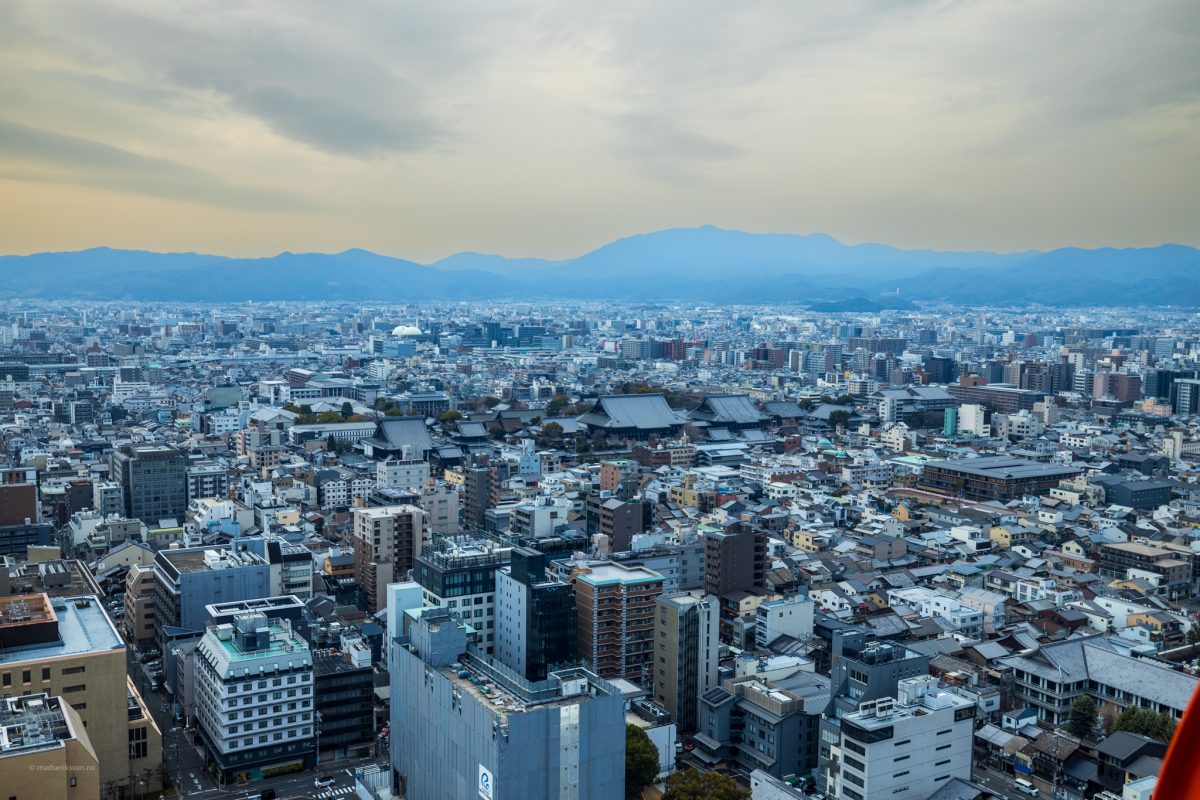
Kyoto’s position as Japan’s imperial capital for over a millennium (794–1868 CE) combined with its geographical situation — an inland basin surrounded by mountains, 75 kilometres from the nearest sea coast — to produce the specific food culture that Nishiki Market expresses. The court demanded refinement; the geography imposed constraint. Fresh ocean fish was expensive and difficult to transport; the Kyoto kitchen developed instead around what was local: the vegetables grown in the Kyoto basin’s particular soil and climate, the tofu made from the soft water of the Kamo and Katsura rivers, the mountain vegetables and fungi from the surrounding hills, and the preserved and fermented foods — tsukemono, dried fish, konbu, miso — that could be held and used over time. The Buddhist temple culture of Kyoto, with its requirement for shojin ryori (Buddhist vegetarian cuisine that avoids meat, fish and the pungent aromatics onion, garlic, leek, chive and spring onion), further developed the techniques and ingredients of Kyoto cooking: yuba, fu, and elaborate preparations of vegetables and tofu that could satisfy the aesthetic and nutritional requirements of a monastic kitchen.
Kyo-yasai — the officially designated traditional vegetable varieties of Kyoto, currently numbering over 40 — are among the most specific expressions of a regional food culture in Japan. They are cultivars that developed in Kyoto’s particular conditions over centuries: the Kamo eggplant, round and dense, with a texture that absorbs miso in ways that no other eggplant variety does; the Kujo negi (a long green onion with a distinctively mild, sweet flavour); the Shishigatani kabocha (a dramatically ridged, cylindrical heirloom pumpkin with a dry, sweet flesh); the Manganji pepper (large, mild, with a softness that disappears when heated). These vegetables are grown in small quantities by specialist farmers, sold at premium prices, and used by Kyoto’s kaiseki restaurants in dishes where their specific character is the point. Finding them at Nishiki — in season, fresh from the farm — is finding an ingredient that is not available anywhere else at any price. The konbu stock that forms the dashi base of Kyoto cooking is lighter and more delicate than the katsuobushi-based dashi of Tokyo; it allows the flavour of these specific vegetables to be present in the broth rather than overwhelmed by a stronger base note. The soft water of the Kamo basin is part of this: it extracts flavour from konbu more gently than hard water, producing a stock that is barely there and completely present at the same time.
Kaiseki — the multi-course formal cuisine of Kyoto, the most technically demanding and expensive food experience in Japan — developed from the small meal served before a tea ceremony. The tea master Sen no Rikyū (1522–1591) established the principle that food served in the tea context should be simple, seasonal and respectful of the ingredient. Kaiseki developed from this principle into something of extraordinary elaboration, which Rikyū would perhaps have found ironic. The ingredients it uses are still largely found in Nishiki.
What to Buy and What to Eat — The Traditional Stalls and the Tourist Traps, Identified
The market contains both the most traditional food products in Kyoto and an increasing density of skewer stalls and soft cream vendors. Here is how to navigate between them, what is worth eating on the spot, what is worth buying to take home, and what to ignore entirely
The most valuable things to buy in Nishiki fall into clear categories. Tsukemono — Kyoto-style pickles, bought from a specialist with open fermentation barrels visible — are the best single purchase the market offers: they are specific to Kyoto, they are available in varieties not found elsewhere, they travel well (vacuum-packed at the shop), and the tasting before buying that every tsukemono vendor offers is itself one of the better free food experiences in the market. Suguki (sour pickled turnip), shibazuke (purple eggplant and cucumber with red shiso) and senmaizuke (thin-sliced turnip with konbu) are the three most specifically Kyoto styles; ask to taste all three before deciding. Konbu — dried kelp, in the thick, mineral-rich varieties specific to the Japanese market — is worth buying if you cook at home; Nishiki’s konbu shops stock qualities and varieties not easily found outside Japan. Wagashi — traditional Japanese confectionery — from the specialist confectionery shops is both a gift and an eating experience; the small, seasonal sweets shaped to suggest the current month’s flower or weather are made to be eaten the day they are purchased, and the ones sold in Nishiki are of a quality consistent with Kyoto’s position as the center of wagashi tradition in Japan.
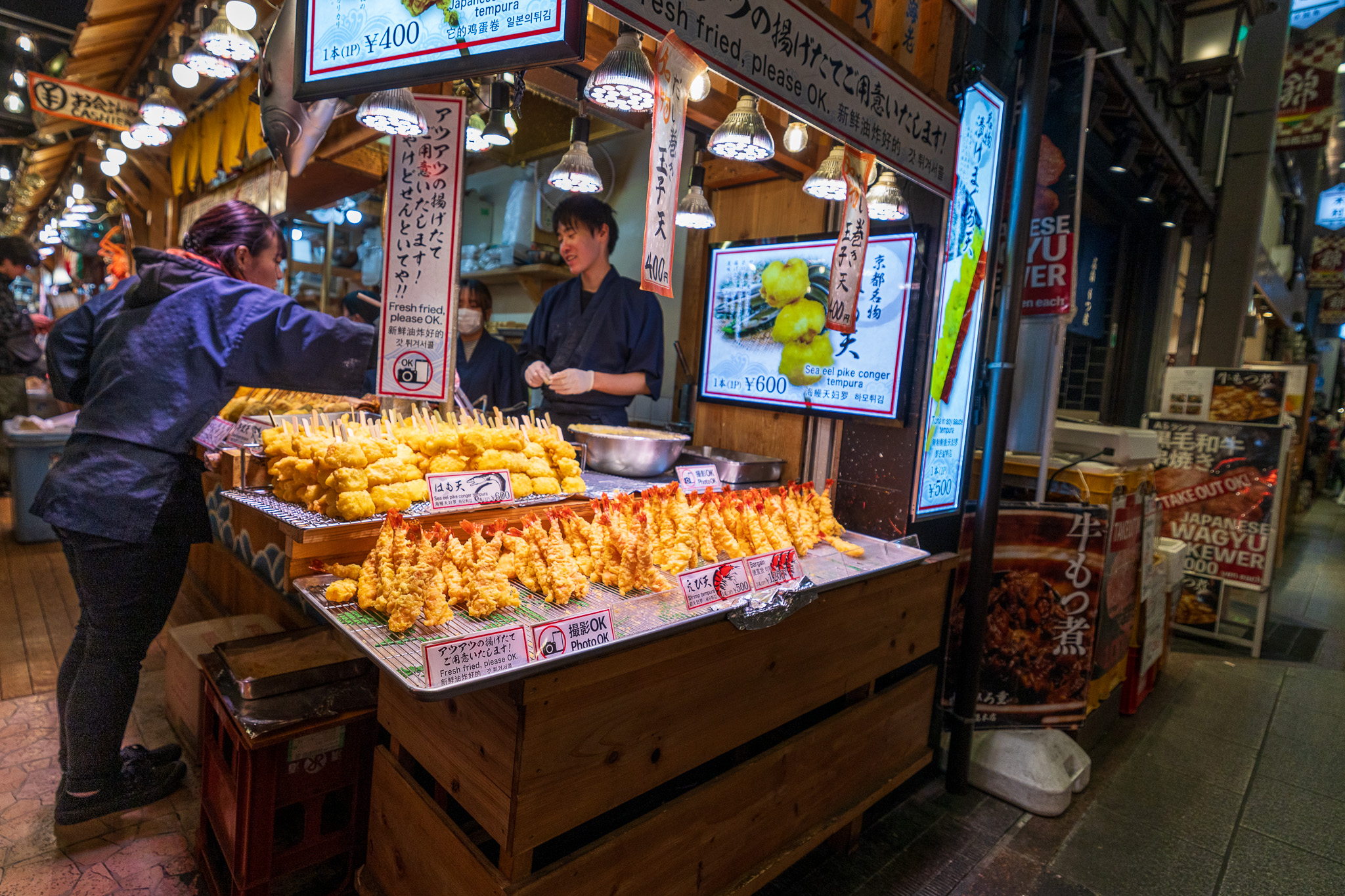
For eating on the spot, the tamagoyaki — sweet rolled omelette, Kyoto style, slightly sweeter and softer than the Tokyo version — sold on small skewers at the specialist egg shops is the most universally recommended market snack, and deservedly so: fresh, hot and specific to the place. Fresh yuba — eaten simply with soy sauce, or in the thin rolls of fresh tofu skin served at yuba specialists — is the best way to understand what yuba is before ordering it in a restaurant. Dashi-maki tamago (a rolled omelette cooked in dashi) from the traditional egg vendors is a more substantial version of the same egg tradition. What to skip is equally clear: the cheese-stuffed skewers, the fried octopus balls (takoyaki, a specialty of Osaka rather than Kyoto), the matcha soft cream (fine, but available everywhere in Kyoto and not specific to Nishiki), and any skewered item that is primarily designed for eating while walking. The “walking food” tendency in Nishiki is partly a product of the tourist economy and partly a practical problem: the lane is narrow enough that stopping to eat blocks the flow entirely. Eating at the stall counter, standing, is the correct format; eating while moving is not.
The tsukemono vendors in Nishiki offer tasting before buying as a matter of course. This is not generosity; it is the traditional way of selling pickles in Japan, where the variation between a well-fermented and a poorly fermented barrel of the same vegetable is large enough to matter commercially. Taste the suguki, the shibazuke and the senmaizuke. Taste them again. Then buy the one that tastes most specifically of itself — most sour, most present, least like anything you have eaten before. That one is the point of being in Nishiki.
When to Go — The Arithmetic of a Three-Metre Lane and Several Thousand Daily Visitors
The difference between Nishiki at 8:30am and Nishiki at 11:30am is the difference between a functional market and a tourist attraction. The market opens early; the tour buses do not. This is the most important practical fact about visiting.
The arithmetic of Nishiki is simple: 390 metres long, three metres wide, up to several thousand visitors per day in peak season. At a certain visitor density the lane ceases to function as a market and becomes a slow-moving crowd, which is a categorically different experience from anything the market was built to provide. The tour groups from Kyoto’s hotels typically arrive at the market between 10am and noon; the lane fills progressively from the eastern (Teramachi) entrance, which is the most accessible from the main tourist hotel district, toward the west. Arriving by 9am — when the most traditional shops are setting out their morning displays, the tsukemono barrels have their freshest stock and the tamagoyaki vendors are frying the day’s first orders — gives access to the market at its most functional and most resembling its historical purpose. By 9:30 the first groups are beginning to arrive. By 11am in peak season the central stretch is difficult to navigate at walking pace. These are not exaggerations.
Nishiki is changing, and the direction of change is worth being honest about. The traditional provisioning shops — the ones serving the professional kitchens of Kyoto’s kaiseki restaurants, the temples, the domestic cooks who have bought their konbu and tsukemono here for generations — are closing at a rate that worries the Kyoto food community. Rents in the market have risen as the tourist economy has increased the commercial value of the lane; the margin available to a konbu specialist selling to local customers cannot compete with the margin available to a matcha ice cream stand selling to 300 tourists a day. Some of the shops that have defined Nishiki’s character for decades no longer exist; others are in the hands of the last generation of a family that has run them for a century without a successor willing to continue. The market that exists in 2025 is still substantially worth visiting — the remaining traditional shops are of high quality, the food culture they represent is still accessible, and the early morning experience is still genuinely that of a working kitchen market. The market that will exist in 2035 may be considerably more tourist-oriented than what is here now. This is a reason to come now rather than later, and to spend money at the traditional shops rather than the skewer stands when you do.
The konbu shop near the western end of the market has been selling dried kelp to the same Kyoto restaurants for three generations. The current owner’s grandfather sourced konbu from the same fishing cooperative in Hokkaido. The shop is three metres wide and smells powerfully of the sea. It is the only place in the market where the smell of the original cold-spring fish market survives in any form. It will not be there indefinitely. This applies to several things in Nishiki.
«Nishiki Market is what a food culture looks like when it has been compressed into 390 metres and forced to coexist with the tourism industry that its own quality attracted. The tsukemono vendors, the konbu shops, the yuba specialists and the tamagoyaki stalls are still here; so are the matcha ice cream stands and the cheese skewers. The two kinds of market exist on the same lane, three metres wide, and the visitor chooses which of them they are in. Go early, walk west, taste the suguki before you buy it, stand at the stall counter to eat your tamagoyaki, and look for the passage between the stalls that leads to the shrine. These are not complicated instructions. They are the difference between experiencing Kyoto’s kitchen and passing through a tourist attraction with good lighting. The difference is considerable.»
More in the same area
TravelTenryū-ji — Arashiyama’s Zen Temple and Japan’s Oldest Surviving Garden
 CitiesHiking Mount Inari — Fushimi Inari’s Full Loop
 CitiesKyoto: A Timeless Journey Through Japan’s Cultural Heart
 ForrestsDiscover the Enchantment of Arashiyama Bamboo Grove
 ArchitectureTokyo Skytree: One tower over thirty-seven million
 CitiesHiroshima and Miyajima: A preserved ruin and a shrine on the tideline