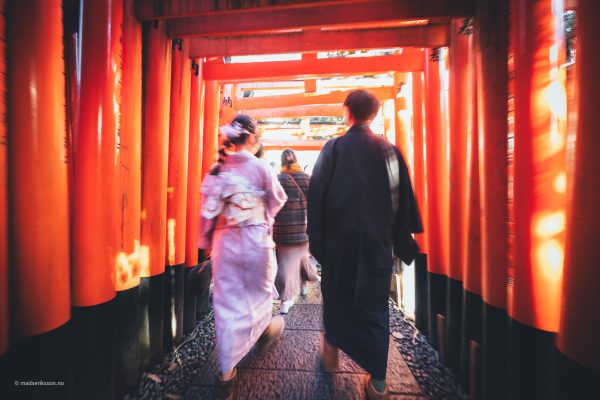
Fushimi Inari Taisha is the most photographed shrine in Japan and one of the least completed hikes. Almost every visitor walks the first ten minutes — the dense double row of vermilion gates called Senbon Torii, the section that appears in every photograph ever taken here — takes the picture, and turns back. Above that point the mountain continues for another two and a half hours: approximately 10,000 torii gates in a continuous tunnel up the forested slope of a 233-metre mountain, past thousands of small private stone altars set among the cedars, past tea houses that have been serving the same route for generations, to a summit shrine where the crowds have thinned to almost nothing and the only sound is the wind in the trees and the occasional bell. The gates are free. The mountain is open 24 hours a day, every day of the year, and lit at night. The most visited shrine in western Japan is also, above the first 400 metres, one of the quietest walks in Kyoto.

Mount Inari (Inariyama) rises 233 metres above the southeastern edge of Kyoto, in the Fushimi ward, approximately 5 kilometres south of the city centre. It is not a difficult mountain by any measure — the full circuit from the main shrine to the summit and back is approximately 4 kilometres with 230 metres of ascent, on stone steps and paved paths throughout, requiring between two and three hours at an unhurried pace — but it is a mountain, and the number of visitors who arrive in sandals expecting a photo opportunity and discover a sustained stair climb in Kyoto’s summer humidity is considerable. The route is a loop: up through the gate tunnels on one side, around the summit ring of shrines, and down the other side, returning to the main shrine at the base. There is no route-finding difficulty; the path is unambiguous and signposted, and the gates themselves function as a continuous handrail of orientation.
The shrine at the base — Fushimi Inari Taisha — was founded in 711 CE and is the head shrine of approximately 30,000 Inari shrines across Japan, making it one of the most institutionally significant Shinto sites in the country. Inari is the kami (deity) of rice, agriculture, sake, prosperity and, by natural extension in a commercial society, business success. This last association explains the gates: the torii on the mountain are donations, given by individuals and companies in gratitude for prosperity received or in hope of prosperity to come. Each gate carries the name of its donor and the date of donation, inscribed on the reverse side of the uprights. Walking up the mountain you see only plain vermilion; walking down you see thousands of names and dates — the accumulated commercial history of Japan, written on the back of a mountain, in black lacquer on red wood.
Practical basics
Fushimi Inari Taisha is free to enter and open 24 hours a day, 365 days a year. There is no ticket office, no closing time and no admission control of any kind. The main paths of the mountain are lit at night. JR Inari station on the Nara Line is directly opposite the shrine entrance (5 minutes from Kyoto Station); Fushimi-Inari station on the Keihan Line is a 5-minute walk away. Bring water — there are vending machines and tea houses on the mountain, but they are spaced out — and wear shoes suitable for two hours of stone steps.
A shrine and a mountain
Mount Inari rises 233 metres above the south-eastern edge of Kyoto, about 5 kilometres south of the city centre. The full circuit from the main shrine to the summit and back is about 4 kilometres with 230 metres of ascent, on stone steps throughout, and takes two to three hours: up through the gate tunnels, around the summit ring of shrines and down the other side.
The shrine at the foot
The shrine was established in 711 CE by the Hata clan and is the head shrine of approximately 30,000 Inari shrines across Japan. The Rōmon gate was donated by Toyotomi Hideyoshi in 1589. JR Inari station on the Nara Line is directly opposite the entrance, and the shrine is free to enter and open 24 hours a day.
The thousand gates
Behind the main shrine the gates stand so close together that they form a continuous tunnel, splitting briefly into two parallel paths before rejoining at the Okusha Hohaisho, where the Omokaru Ishi stands. This is the section in every photograph, about 400 metres long, and it is empty before 07:00 and after 21:00.
Names on the back
Above the Okusha Hohaisho the gates continue up the forested slope, around 10,000 in all. Each is a donation, with the donor’s name and the date inscribed on the reverse, so the inscriptions are hidden on the way up and visible on the way down. Tea houses at the switchbacks sell green tea and inari-zushi.
The view over Kyoto
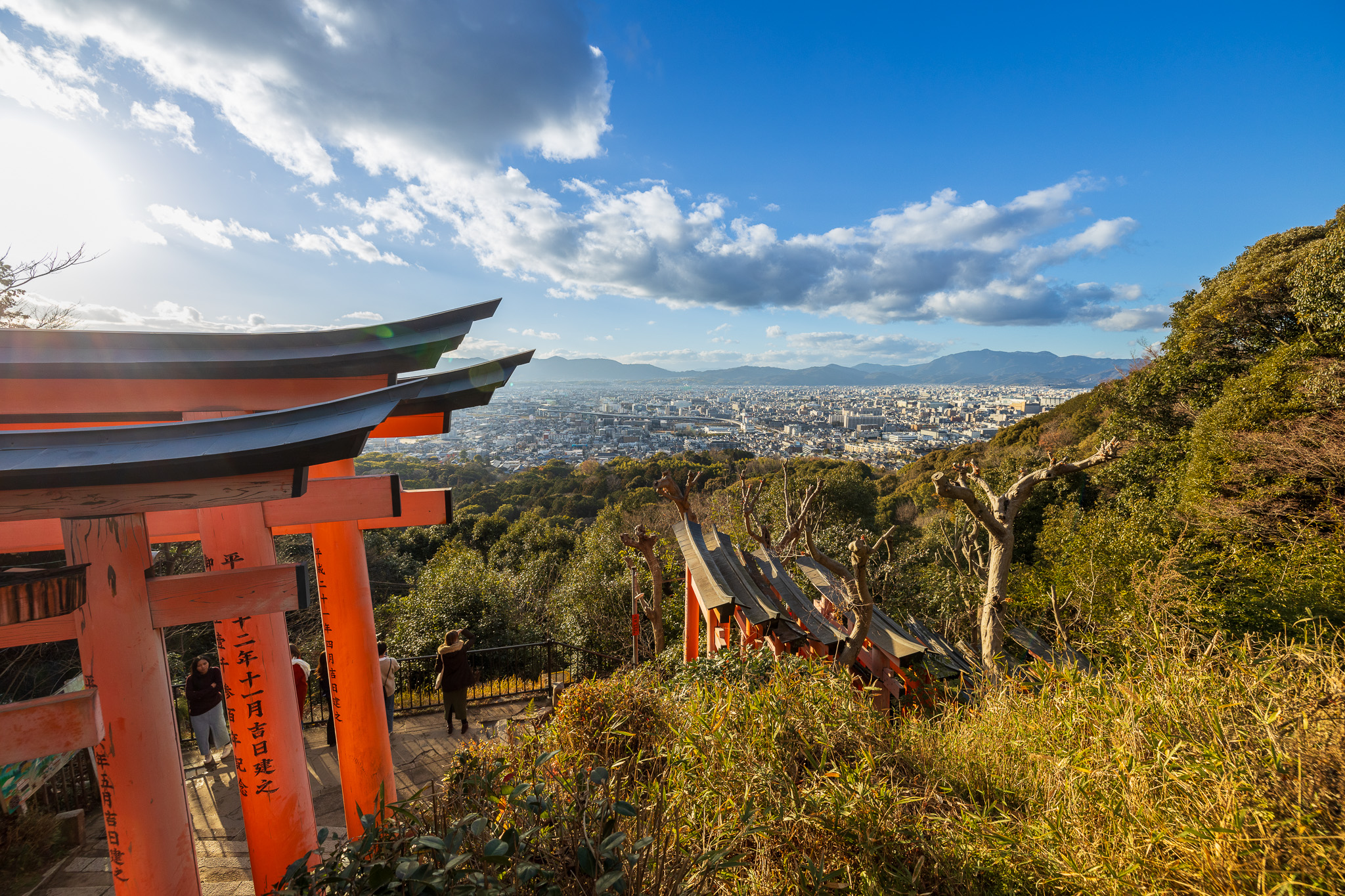
After roughly 45 minutes the path reaches Yotsutsuji, a four-way intersection with a terrace, benches, a tea house and the only substantial view over Kyoto on the route. It is where the summit loop begins, and where most of the visitors who get this far turn around; the summit is another 30 minutes above.
A summit without a view
Above Yotsutsuji the path loops around the summit ridge through the three peak shrines, Sannomine, Ninomine and Ichinomine, the summit at 233 metres. The summit shrine sits in dense forest with no view at all: a small, dim, heavily offered sanctuary where the number of other people drops to single figures.
Down the other side
Descending the far side of the loop, the otsuka are at their densest: approximately 10,000 small private stone altars erected over the past 150 years, moss-covered and tied with white paper streamers, many still tended. This stretch between the summit and the rejoining of the route near Yotsutsuji is the most atmospheric part of the mountain and the least visited.
3D graphic © 2026 madseriksson.no. Terrain: Mapzen/Tilezen terrain tiles (SRTM, EU-DEM and other public elevation data, see tilezen.org). Surface: Sentinel-2 cloudless by EOX IT Services GmbH (contains modified Copernicus Sentinel data, CC BY 4.0). Heights exaggerated 1.5×. Label positions are approximate, and the summit loop is not drawn.
Fushimi Inari Taisha — The Shrine at the Foot of the Mountain
Founded in 711 CE, 83 years before Kyoto existed as a capital, and now the head shrine of approximately 30,000 Inari shrines across Japan — dedicated to the kami of rice, prosperity and commerce, guarded by fox messengers carrying keys to the granary, and the starting point for everything above it
Fushimi Inari Taisha was established in 711 CE by the Hata clan, an immigrant family of Korean origin who had settled the Fushimi area and who dedicated the shrine to Inari, the kami of rice cultivation. The date matters: the shrine predates the founding of Heian-kyō — the imperial capital that became Kyoto — by 83 years. When the emperor moved his court here in 794, the shrine on Mount Inari had already been receiving offerings for nearly a century. Over the following twelve centuries Inari’s domain expanded outward from rice: rice meant food, food meant wealth, wealth meant commerce, and by the Edo period Inari had become the deity most closely associated with business prosperity in Japan. Merchants prayed here. They still do. Approximately a third of all Shinto shrines in the country are dedicated to Inari, and Fushimi Inari Taisha is the head of all of them.
The main shrine buildings at the base — the Rōmon gate donated by Toyotomi Hideyoshi in 1589, the honden (main sanctuary), the outer worship hall — are approached from the JR station directly across the road, and constitute the formal ceremonial heart of the complex. Their vermilion and white architecture, the roof lines, the hanging lanterns and the offering hall are impressive in the way that a major Shinto shrine is impressive, and they are also, for most visitors, a corridor to be passed through on the way to the gates. The fox statues flanking the approaches and the shrine buildings deserve more attention than they generally receive: they are not images of Inari but of Inari’s messengers, and each holds an object in its mouth that identifies its function. A key opens the rice granary. A jewel represents the spirit of the deity. A sheaf of rice is the harvest itself. A scroll contains wisdom. The statues are individually carved, weathered differently, and stand in pairs at every significant threshold on the mountain from the base to the summit — several hundred of them across the full route, in styles that vary by the century in which they were placed.
The fox is not the god. This is the single most commonly misunderstood thing about Fushimi Inari, and correcting it changes what you are looking at: the hundreds of fox statues on the mountain are not objects of worship but attendants, messengers, intermediaries between the visible world and a deity who is not depicted at all. Shinto does not, generally, make images of its kami. What you see everywhere on Mount Inari is the staff. The deity is present and unrepresented, which is the point.
The Gates — Ten Thousand Donations Forming a Tunnel Up a Mountain
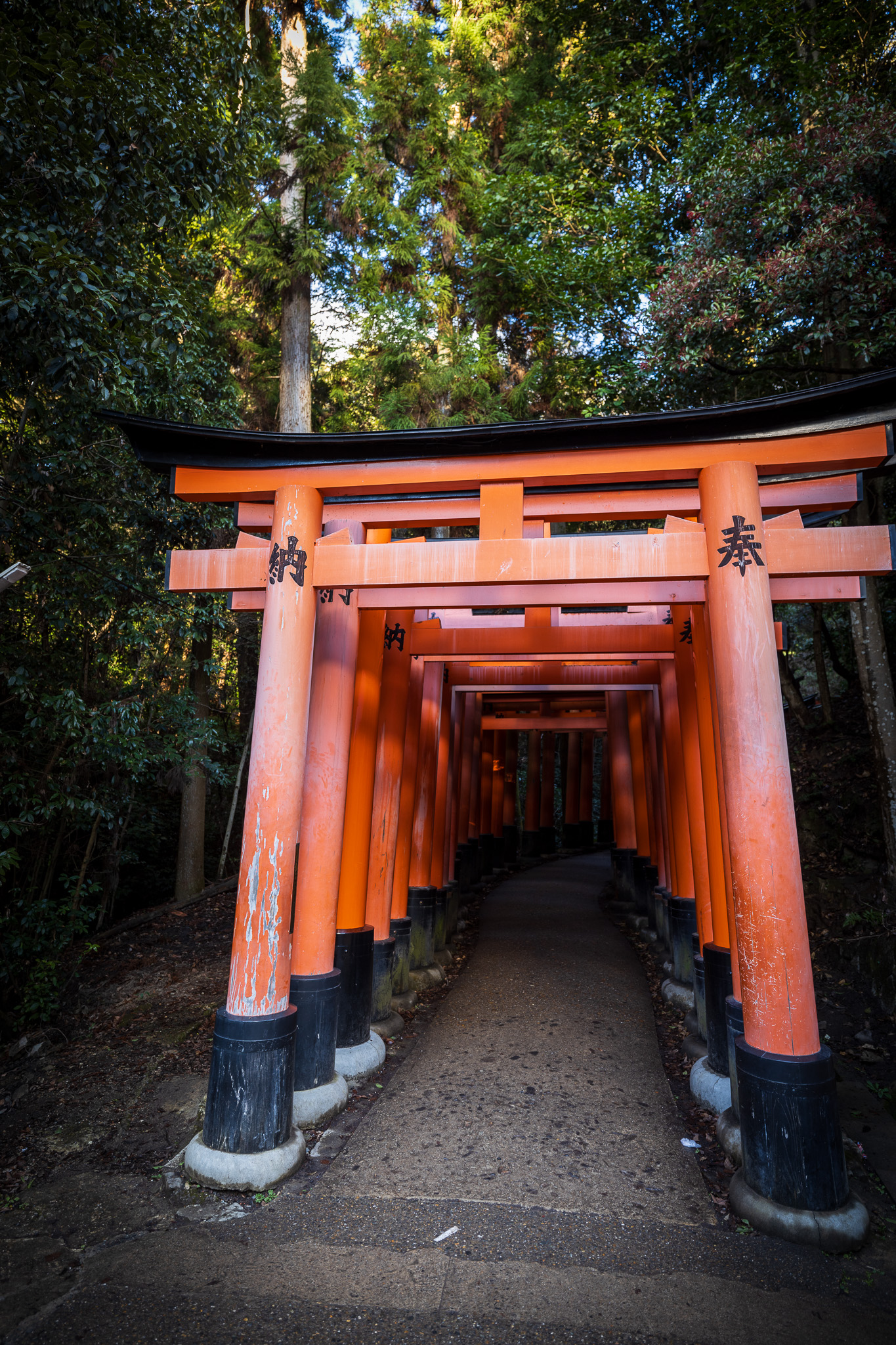
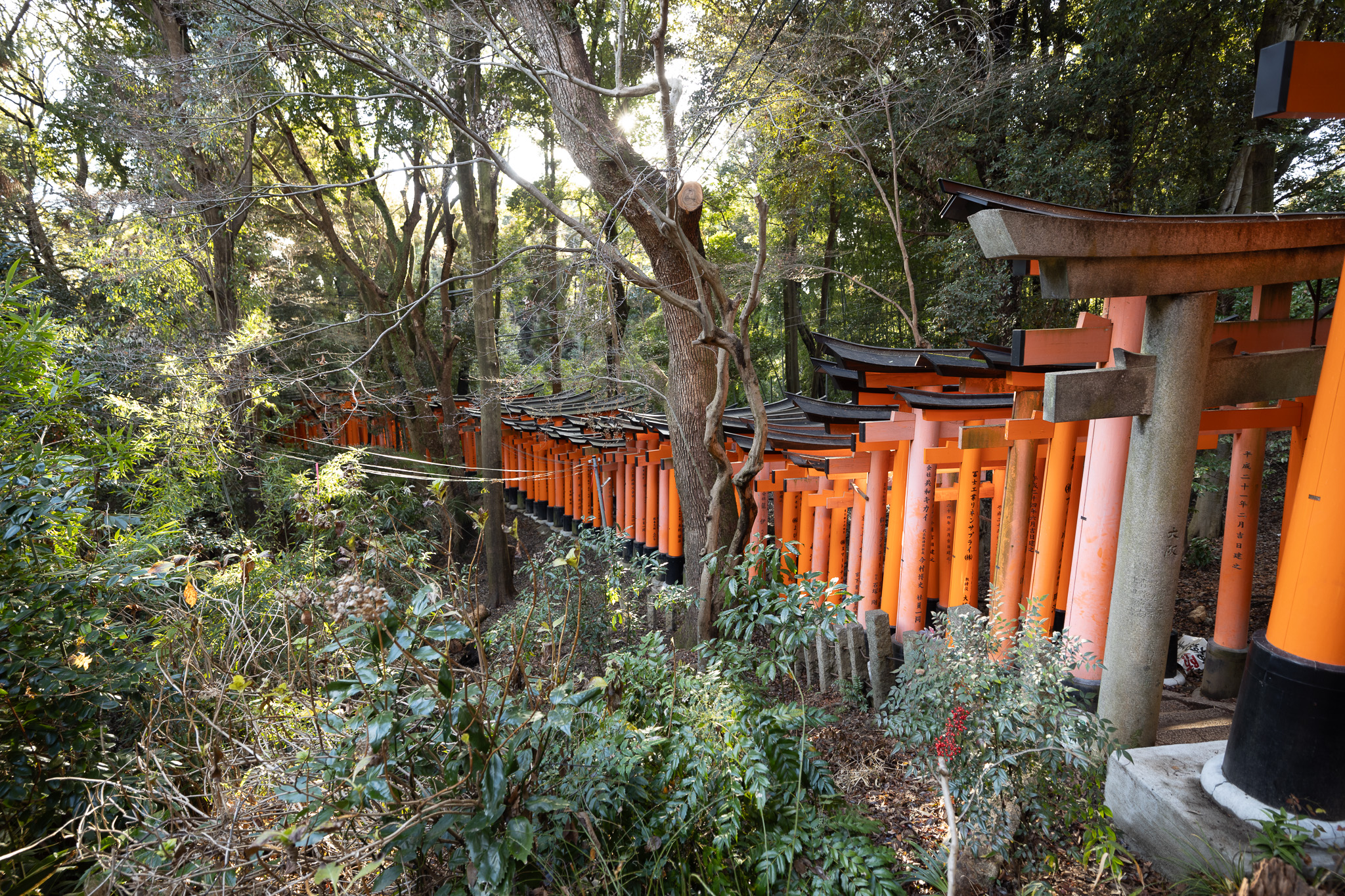
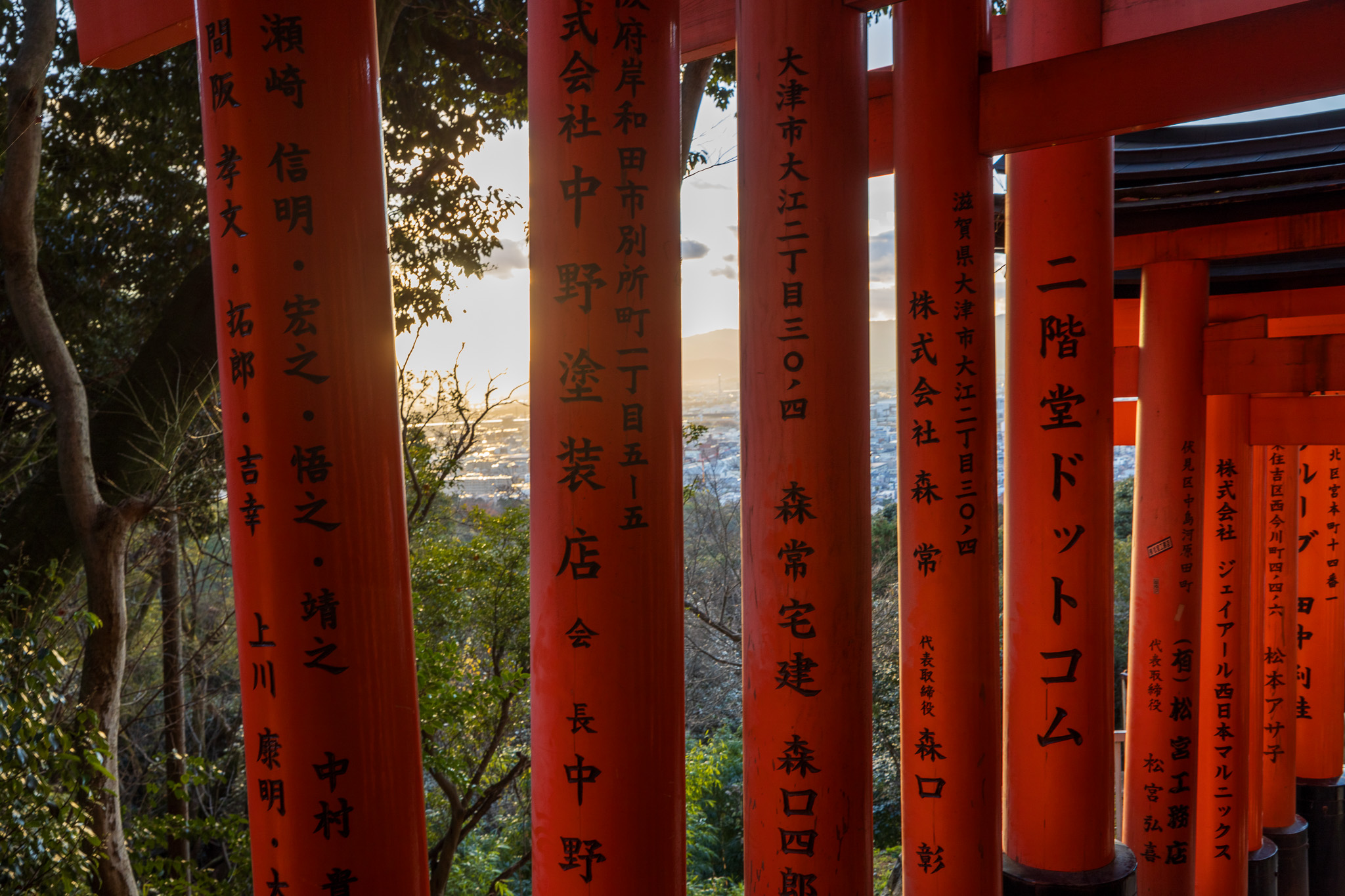
Senbon Torii — the “thousand gates” — is only the beginning: approximately 10,000 vermilion torii line the paths of Mount Inari, each one paid for by a person or a company, each carrying the donor’s name and the date on the reverse. Uphill you see pure colour. Downhill you read a century of Japanese commercial history in black lacquer
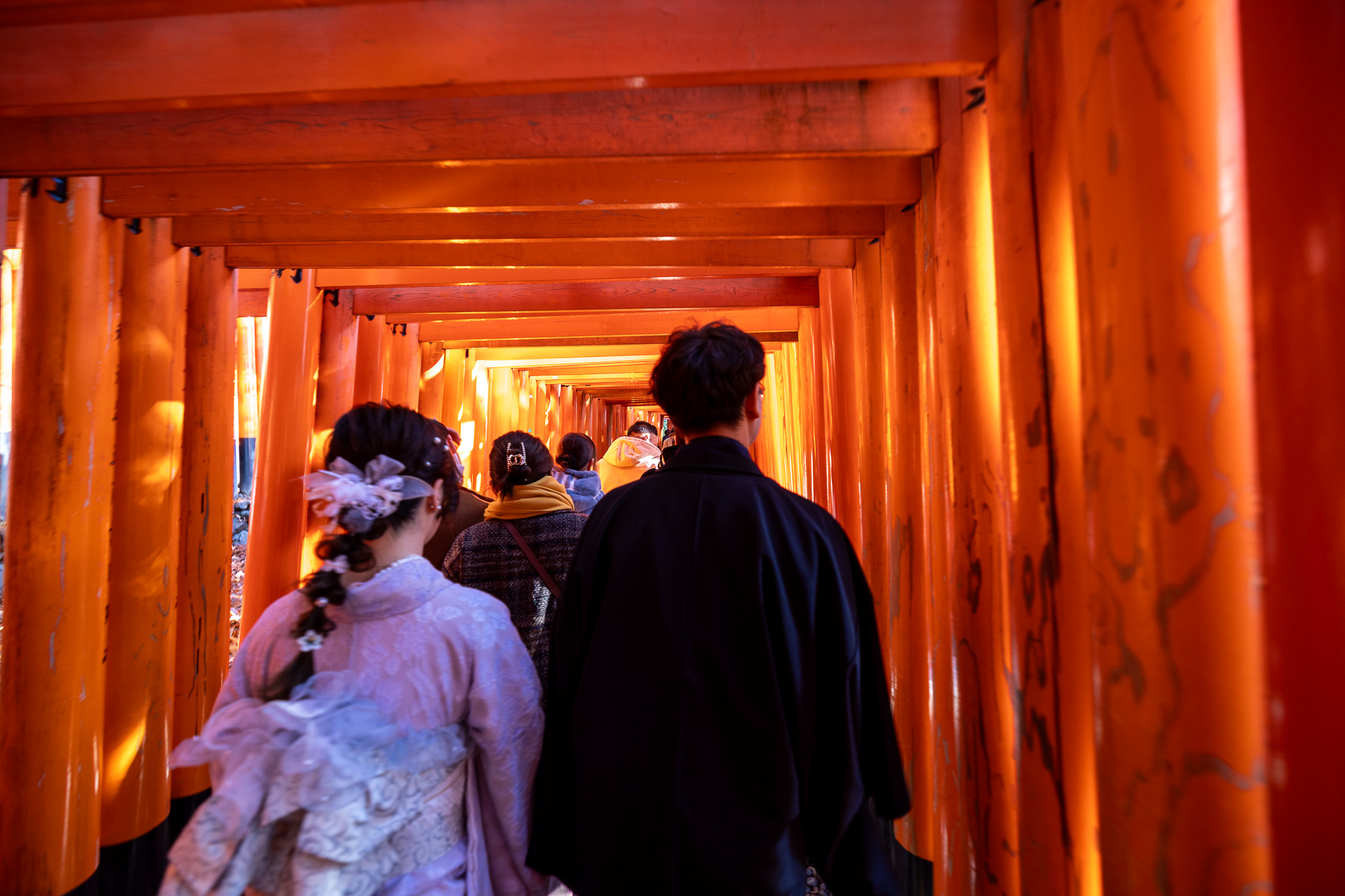
The Senbon Torii — literally “thousand torii” — is the section immediately behind the main shrine where the gates stand so close together that they form a continuous tunnel, splitting briefly into two parallel paths before rejoining at the Okusha Hohaisho. This is the section in every photograph of Fushimi Inari ever taken, and it is approximately 400 metres long. Above it, the gates continue: less densely in places, in long unbroken runs in others, all the way to the summit and around the loop and back down again, totalling somewhere around 10,000 gates on the mountain as a whole. The practice of donating gates began in the Edo period and accelerated through the Meiji era and the 20th century as Japan industrialised and the number of businesses with reason to thank a deity of commercial prosperity multiplied accordingly. A torii is not a cheap offering — the smallest standard sizes begin in the hundreds of thousands of yen and the largest cost well over a million — and the waiting list for placement is long.
The detail that changes the experience of the mountain is directional. Torii are inscribed on the reverse: the donor’s name, usually a company, and the date of the donation, in black characters on the vermilion uprights. Because the gates face down the mountain — toward the shrine, in the direction a deity would travel — the inscriptions are invisible on the ascent and fully visible on the descent. Walking up, you move through pure colour: an unbroken tunnel of vermilion and the green light of the forest filtering through the gaps. Walking down, you read: hundreds of company names, family names, dates from the 1970s and the 1990s and last year, an accumulated record of who in Japan had a good year and chose to say so on the side of a mountain. It is the same path in both directions and two completely different walks, and doing the full loop rather than turning back is the only way to experience both. The gates deteriorate in the humid forest and are replaced continuously; the structure you walk through is not preserved but perpetually renewed, which is itself a very Japanese approach to permanence.
The Senbon Torii section is impassable for photography between roughly 9am and 5pm. There is no trick to this and no clever angle that removes the crowds; there are simply several thousand people in a 400-metre tunnel. The solutions are two: arrive before 7am, or go after 9pm. Both work completely. At 6am the tunnel is empty and the light comes in low and horizontal from the east. At 10pm it is lit, empty, silent and considerably stranger.
The Hike — 233 Metres, Two Hours, and the Point Where Everyone Else Turns Back
A 4-kilometre loop on stone steps from the shrine at the base to the summit shrine of Ichinomine and back down the other side, past the Yotsutsuji viewpoint over Kyoto, past thousands of moss-covered private altars in the cedar forest, past tea houses that have served this route for generations — and above the halfway point, almost entirely alone
The route begins behind the main shrine and climbs continuously. The first section — the Senbon Torii and the Okusha Hohaisho where the Omokaru Ishi stands — takes ten minutes and is where the overwhelming majority of visitors stop. Above it the gates continue and the gradient increases: a sustained staircase through the cedar forest, gates overhead the entire way, with occasional openings where a cluster of otsuka altars sits among the trees or a tea house appears at a switchback selling green tea, inari-zushi (sweet fried tofu pockets of rice — named after the deity, and the correct thing to eat here) and cold drinks. After roughly 45 minutes the path arrives at Yotsutsuji, a four-way intersection with a terrace, benches, a tea house and the only substantial view over Kyoto on the route: the city spread out to the northwest, the western hills beyond it, and at the right hour the whole basin in low sun. Yotsutsuji is where the second wave of visitors turns around, having decided reasonably enough that they have seen the view and the gates and that the mountain has delivered.
Above Yotsutsuji the path becomes a loop around the summit ridge, passing through the three peak shrines — Sannomine (third peak), Ninomine (second peak) and Ichinomine (first peak, the summit at 233 metres) — each with its own cluster of altars, offering boxes, fox statues and candle stands. The summit shrine itself has no view: it sits in dense forest, enclosed, with the gates continuing past it and around. This is not a failure of the mountain but a statement about what the walk is for. The summit is a shrine, not a viewpoint; the reward for the last thirty minutes of climbing is not a panorama but a small, dim, heavily-offered sanctuary in a forest clearing where the number of other people has dropped to single figures and the sound of the city has disappeared entirely. Descending the far side of the loop, the gates carry their inscriptions and the otsuka clusters are at their densest — thousands of small stone altars in the moss under the cedars, tied with white paper, many still tended, stretching off the path into the trees in every direction. This section, between the summit and the rejoining of the route near Yotsutsuji, is the most atmospheric part of the mountain and the least visited.
The otsuka are the reason to do the full loop. Ten thousand small private altars, erected over the past 150 years by families and businesses, each dedicated to an individually named form of Inari, scattered through the forest off the path in clearings and hollows and along side-trails that nobody walks. They are moss-covered, uneven, crowded together, tied with weathered white paper streamers, and many still have fresh offerings on them. Nobody photographs them because they are dark and difficult to shoot and do not look like anything in particular. They are, by a considerable margin, the most remarkable thing on the mountain.
When to Walk It — The Two Hours That Change Everything
The shrine never closes and never charges, which means the single most consequential decision a visitor makes is what time to arrive. Before 7am the gate tunnels are empty and the light is horizontal. After 9pm they are lit, silent and entirely different. Between 10am and 4pm they are a queue
Because Fushimi Inari has no closing time, no gate and no admission fee, the crowd distribution across the day is entirely determined by when tour groups and day visitors choose to arrive — which is, with great consistency, between 10am and 4pm. The consequence is that the same site produces two utterly different experiences depending on a decision made the night before. At 6:30am the Senbon Torii is empty, the low eastern sun comes horizontally through the gaps between the gates, the shrine staff are sweeping the paths and the only other people on the mountain are runners and a handful of photographers. By 10am there are several thousand people in the same tunnel. The mountain above Yotsutsuji thins out at any hour, but the lower sections are transformed entirely by the clock. Night is the other option and is in some ways the more striking one: the main paths are lit, the gates glow from within the tunnel, the forest around them is completely dark, and the mountain is almost deserted. Walking to the summit at 10pm is entirely permitted and requires only a phone torch for the darker sections and a reasonable tolerance for atmosphere.
Seasonally, November is the best month: Kyoto’s autumn colour peaks in the second half of the month, the maples on the lower mountain turn against the vermilion of the gates in a combination that is specific to this site, and the temperature is ideal for a two-hour climb. April brings cherry blossom and the heaviest Kyoto crowds of the year, which affects the lower shrine considerably more than the upper mountain. July and August are difficult: Kyoto’s summer combines temperatures above 33°C with humidity that makes a stair climb genuinely strenuous, and the dawn start becomes less of a preference and more of a requirement. Winter is underrated — cold, clear, very quiet, occasionally snow on the gates, which is one of the finest sights in Kyoto and impossible to plan for. The single date to avoid is New Year: hatsumōde, the first shrine visit of the year, brings several million people to Fushimi Inari over the first three days of January, making it one of the most visited shrines in Japan during that window and effectively impassable.
The mistake is treating Fushimi Inari as a stop rather than a morning. Most itineraries allocate an hour to it, slot it between two other temples, and arrive at eleven. What that produces is a photograph of a crowded tunnel and no sense of the mountain at all. The alternative costs nothing extra: set an alarm, take the first train from Kyoto Station at 05:30, and walk the full loop before breakfast. You will be back in the city by nine with the rest of the day intact, having had the best two hours available in Kyoto to yourself.
«Fushimi Inari is the most photographed place in Japan and one of the least understood. The photograph — the tunnel of vermilion gates, taken in the first 400 metres, usually with the crowd cropped out — is accurate and completely insufficient. What it misses is that the gates go on for another two hours, that each one was paid for by somebody who had a reason to be grateful, that their names are written on the side you only see going down, that ten thousand small stone altars sit in the forest off the path where nobody walks, and that the summit is a dark forest shrine with no view at all. The mountain does not reward the visitor who arrives for the image. It rewards the one who keeps walking after the image has been taken, which takes two hours, costs nothing, and is available at any hour of any day of the year including three in the morning. Very few places of this significance ask so little and offer so much to anyone willing to simply continue upward.»
More in the same area
 CitiesKyoto: A Timeless Journey Through Japan’s Cultural Heart
 TravelTenryū-ji — Arashiyama’s Zen Temple and Japan’s Oldest Surviving Garden
 Food and DrinksNishiki Market — Kyoto’s Kitchen
 ForrestsDiscover the Enchantment of Arashiyama Bamboo Grove
 CitiesHiroshima and Miyajima: A preserved ruin and a shrine on the tideline
 CitiesShibuya Crossing: The Heartbeat of Tokyo