Water that stays above twenty degrees all year, coral gardens fifteen minutes offshore, and almost none of the crowding you would find at an equivalent reef anywhere else in Asia. Okinawa is Japan’s tropical end, six hundred kilometres south of the mainland, and the diving off the Motobu peninsula — Minna Island and Sesoko — is the easiest introduction to it: shallow, bright, forgiving, and considerably better than its modest reputation suggests.

Okinawa is the southern end of Japan — a chain of subtropical islands closer to Taipei than to Tokyo, with coral reefs that have no business belonging to the same country as Hokkaido. The water rarely drops below 20 °C even in February, which makes this one of the few places in the developed world where you can dive comfortably twelve months a year without leaving a temperate country.
This article is centred on the Motobu peninsula in the north-west of the main island, and specifically on Minna Island and Sesoko — because that is where the photographs in it were taken, and because it is the part of Okinawa most visitors overlook in favour of the Blue Cave. Minna is a fifteen-minute ferry from Toguchi Port; Sesoko is joined to the mainland by a bridge. Between them lies a stretch of shallow reef that is, in August, every bit as alive as places with far bigger names.
How this article is arranged
Four sections: the diving around Minna and Sesoko, with the sites worth asking for by name; the rest of Okinawa, meaning the Blue Cave and the Kerama Islands, so you know what you are choosing between; conditions and season, which is the part that decides whether a trip works; and the practical business of operators, certification and not standing on the coral.
The reefs off Motobu
Shallow coral, easy entries and no queue — the part of Okinawa most visitors skip in favour of a cave with a boat jam outside it
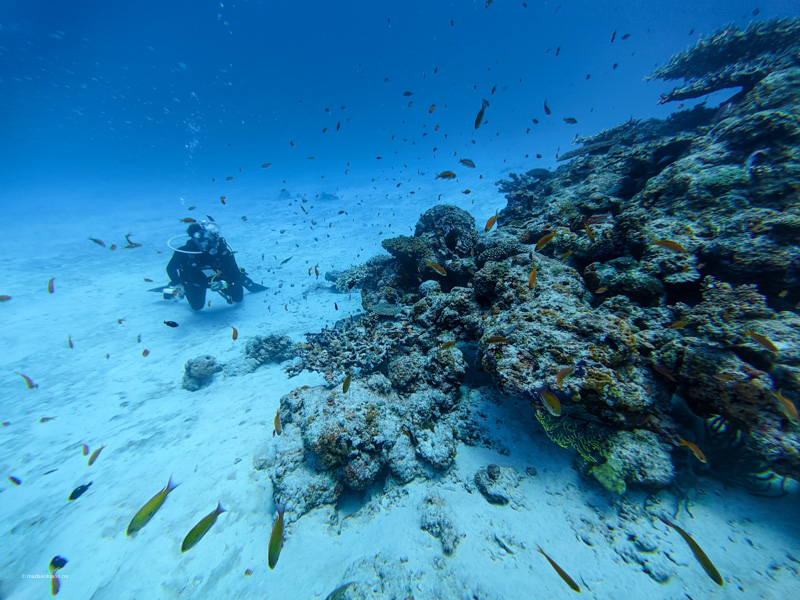
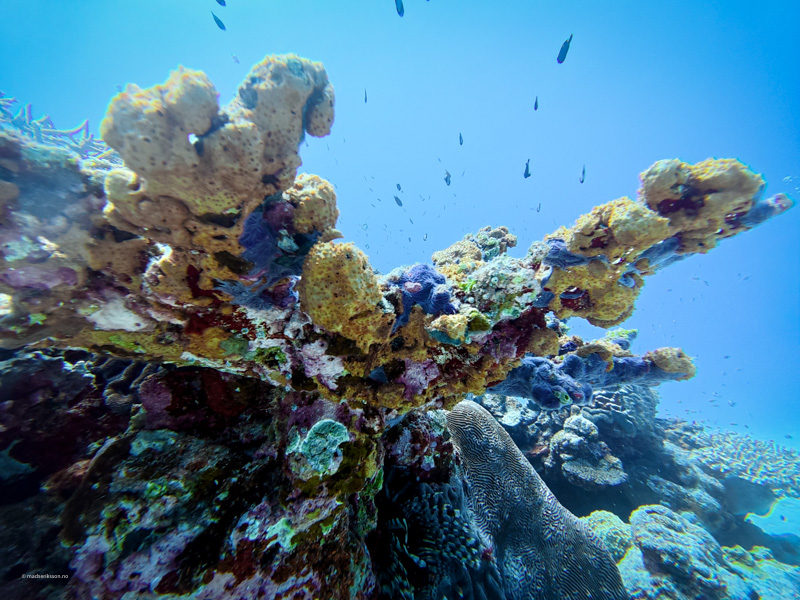
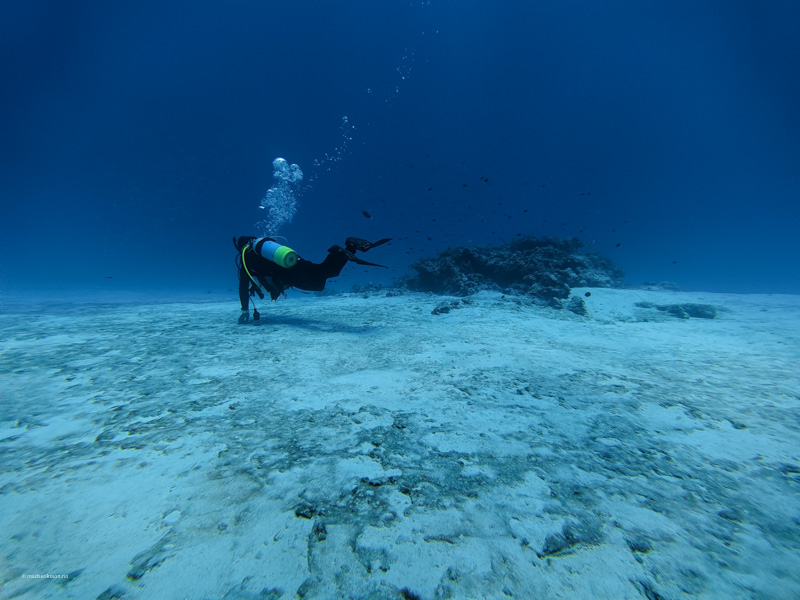
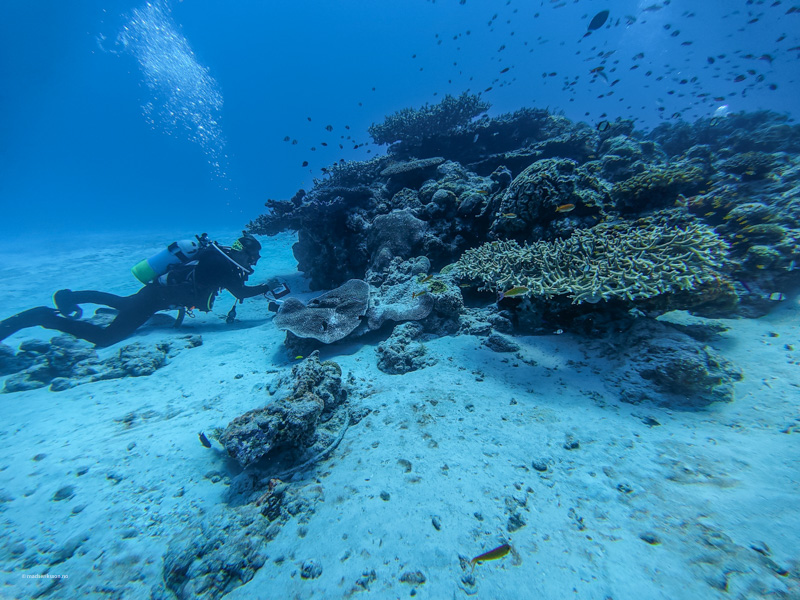
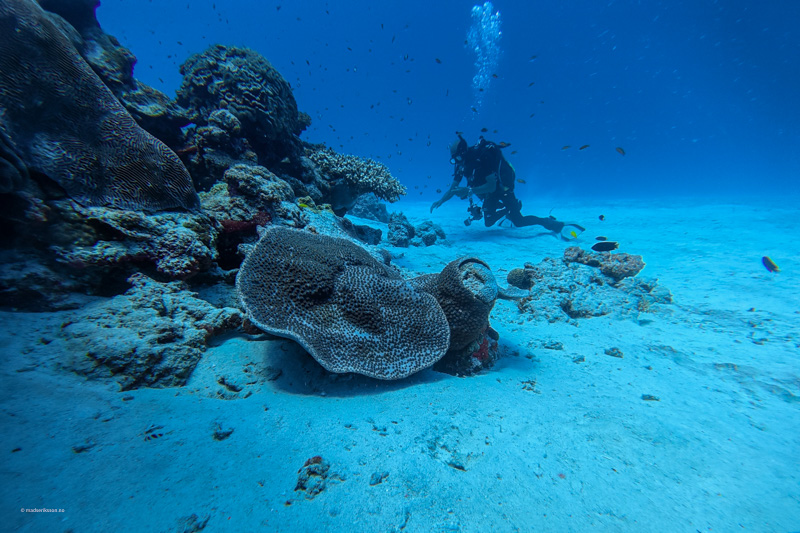
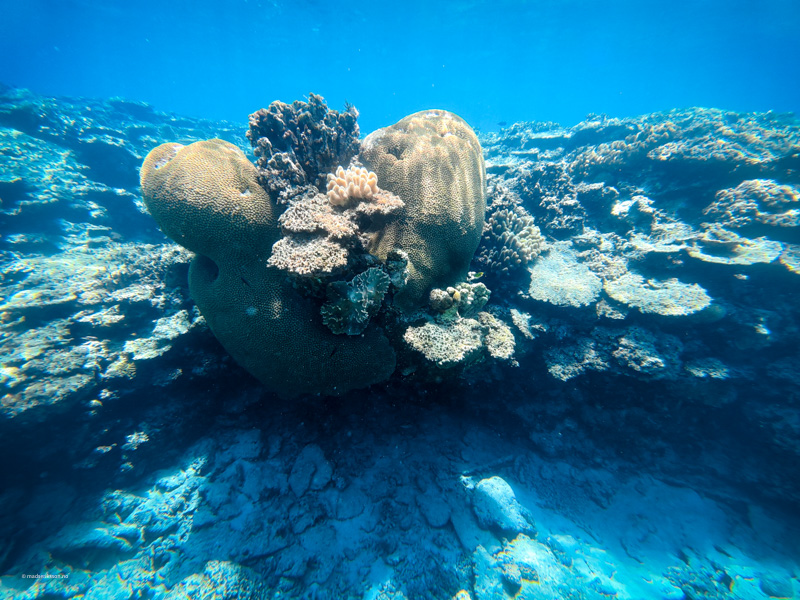
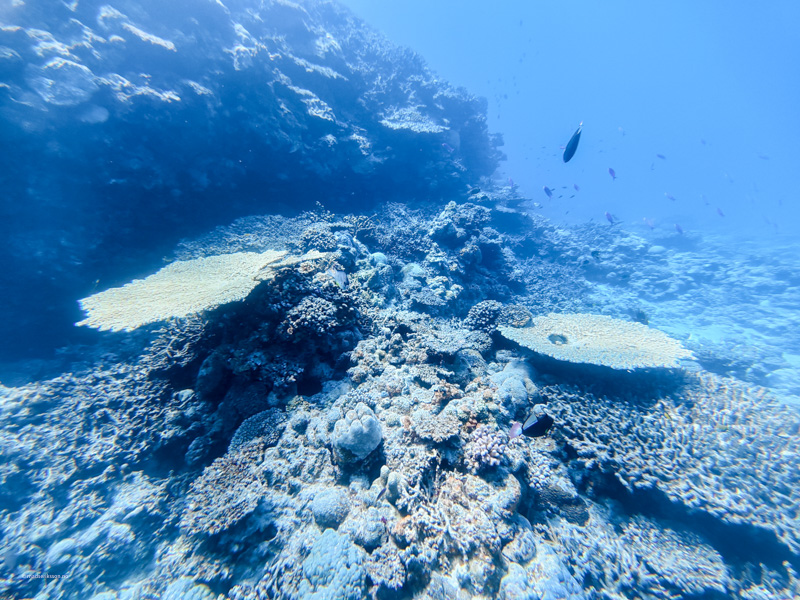
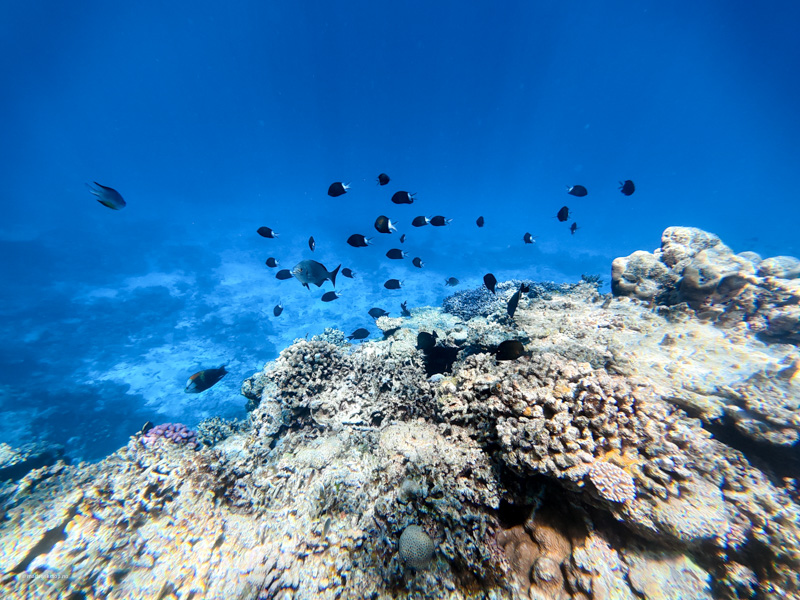
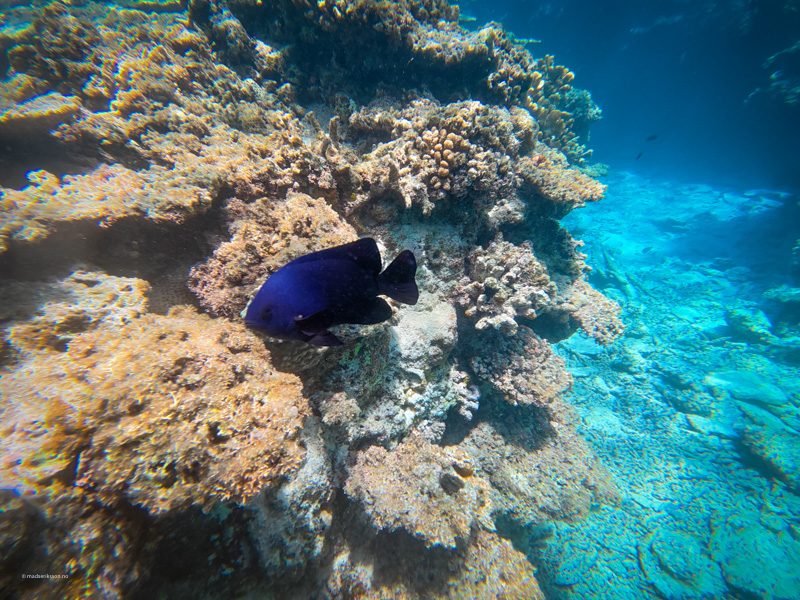
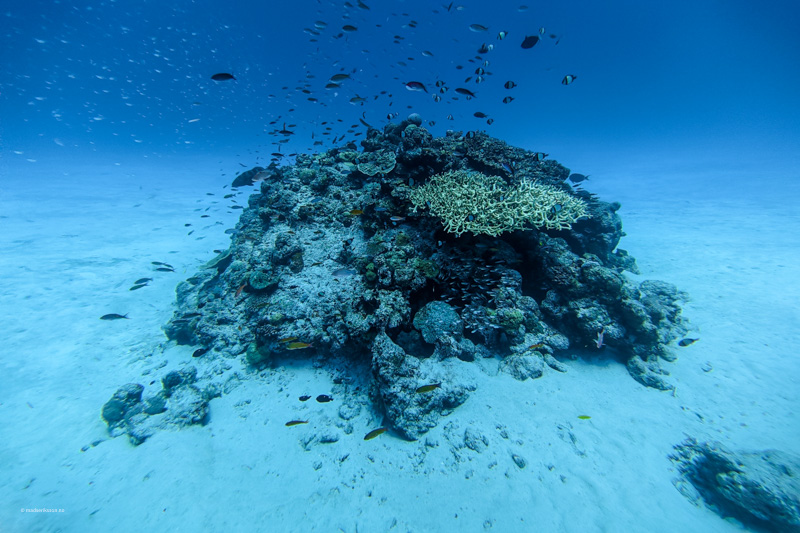
Minnajima — nicknamed Croissant Island for its curved shape — sits a fifteen-minute ferry ride from Toguchi Port in Motobu, and has more or less nothing on it except white sand and shallow reef. That is the appeal. The water around it is bright, warm and shallow enough that light does most of the work for you, and the coral gardens start within swimming distance of the beach. For photography this is the easy end of the difficulty scale: no depth to fight, no filter tricks required, and colour that survives the shot.
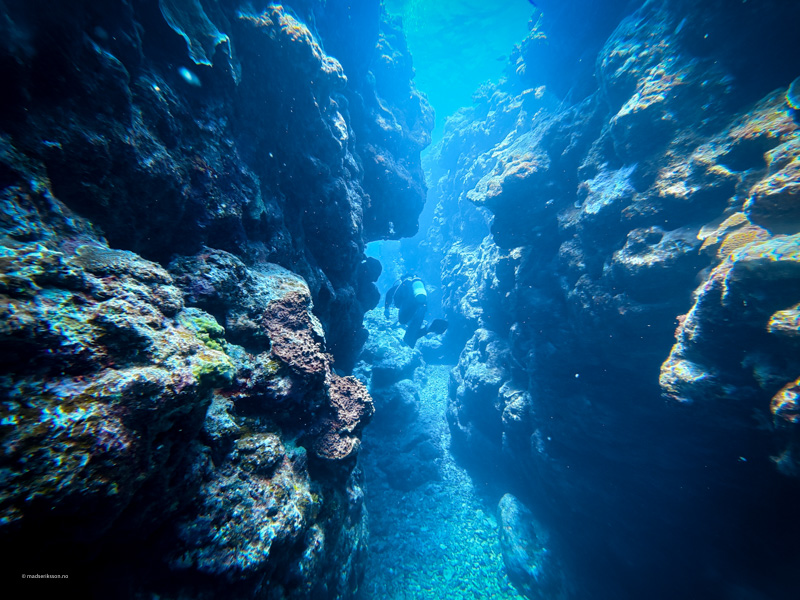
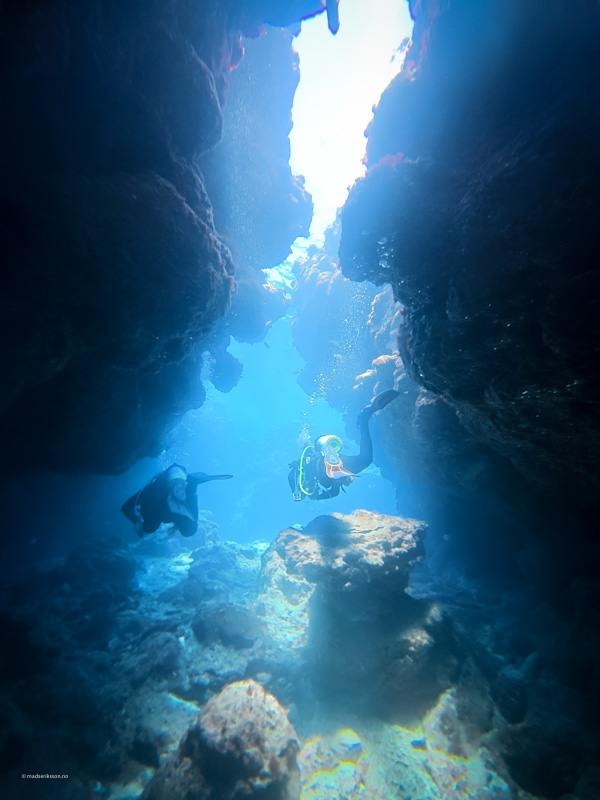
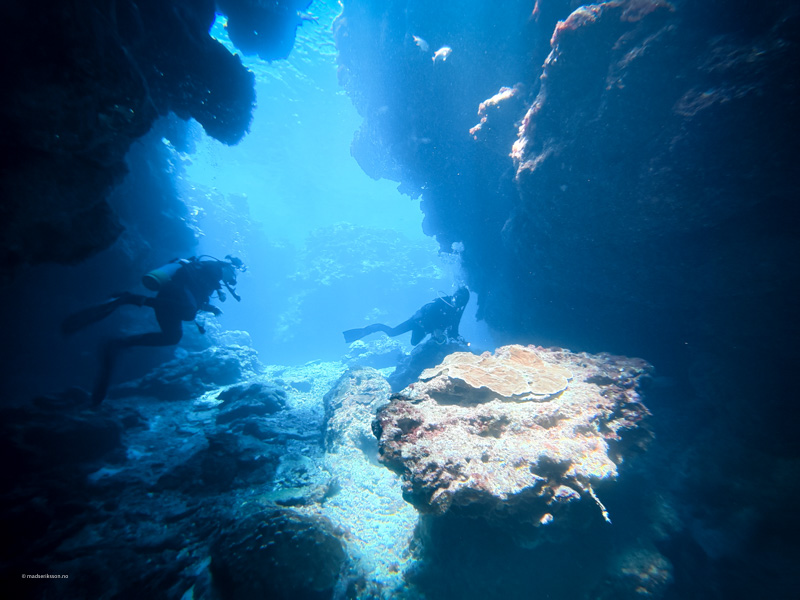
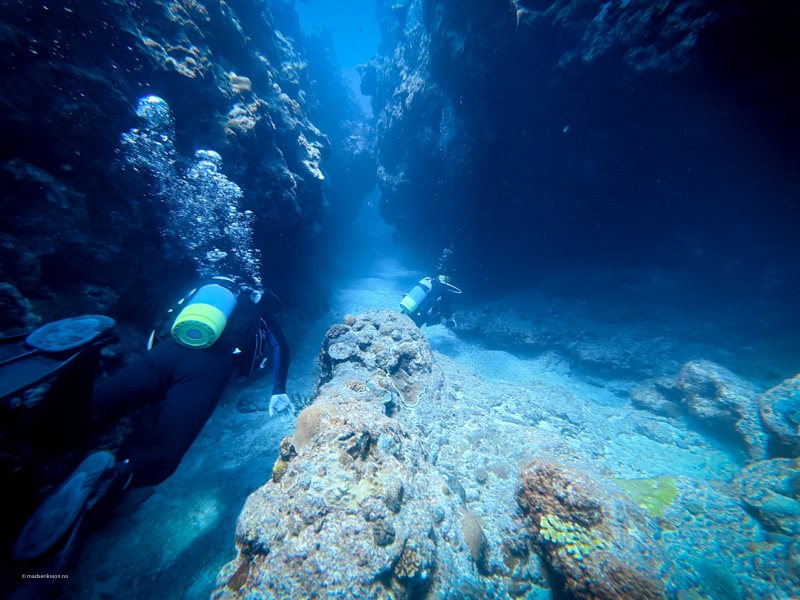
Sesoko is joined to the main island by a bridge, which makes it the practical base — you drive there. The two sites to ask a shop for by name are Clownfish Mountain, a coral bommie with a resident anemone population and the fish that live in them, and Labyrinth, a set of coral channels and swim-throughs at forgiving depth. Both are firmly beginner-friendly, which in Okinawa means genuinely so rather than optimistically so.
“In August the reef between Sesoko and Minna is as alive as places with ten times the reputation — and you will share it with one other boat rather than fifteen.”
If you would rather not get on a boat at all, Gorilla Chop on the Motobu shore is the local shore dive — named for a rock that looks like a gorilla delivering a karate chop, which is not a description anyone improved on. You walk in from the beach into coral, white sand and a great deal of fish. It is where most of the training dives on this coast happen, and it is a completely reasonable place to spend an afternoon on your own with a buddy.
One thing worth saying about expectations. This is not big-animal diving. You are not here for mantas or sharks or walls dropping into blue — you are here for a shallow, intensely colourful, densely populated reef in warm water, twenty minutes from a car park. Judged against that, Motobu is excellent. Judged against Palau, it is not, and nobody should be selling it that way.
The lionfish, at home
The most famous invasive species in the Atlantic is not invasive here — this is where it comes from, and where it behaves itself
Most people meet the lionfish as a villain. It is the best-known marine invasive species in the world — Pterois volitans and its close relative P. miles have spread through the west Atlantic, the Caribbean and the Mediterranean, where they have no predators, breed prodigiously and eat their way through juvenile reef fish. There are culls, derbies and restaurant campaigns dedicated to removing them.
None of that applies here. The lionfish is native to the Indo-Pacific, and the reef off Minna is where it comes from. On these reefs it sits inside a system that has had several million years to work out what to do about it: it has predators, it has competitors, and its numbers are held where they should be. The same animal, the same spines, an entirely different meaning — and it is a useful thing to hold in mind, because “invasive” is a description of a relationship rather than of a species.
“The fish that Florida pays divers to spear is, three metres under a coral head off Minna, simply a fish that lives there.”
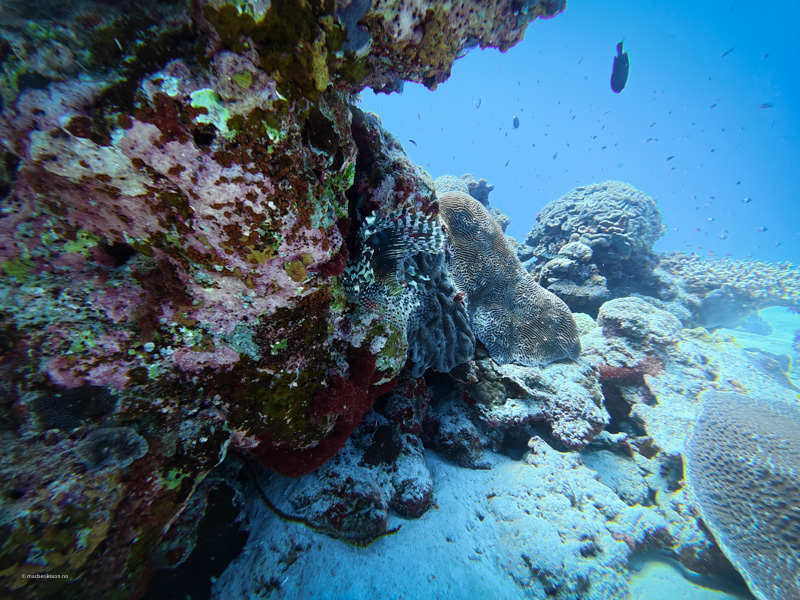
The animal itself is worth looking at properly. Those fanned pectoral fins are for herding — the lionfish drives small prey into a corner and then takes it with a strike fast enough that you will not see it. The defensive equipment is separate: thirteen dorsal spines, three anal and two pelvic, eighteen in all, each with venom glands along a groove. The tail fin is harmless. The banding is warning colouration, and it works — which is precisely why the fish does not bother to flee.
That last point is what makes it such a gift underwater. Most reef fish give you one distracted second at an awkward angle. A lionfish will hover, hold position, and let you compose — you can work the light, change your angle, and shoot the fins against a dark overhang the way you actually intended. It is the easiest difficult subject on the reef, and it is why almost every diver comes back from Okinawa with at least one good frame of one.
Which is also where the discipline comes in. A lionfish that does not flee is a lionfish that you can push too far without noticing. Keep a full arm’s length, do not corner it against the reef, and be aware of where your hands, knees and fin tips are — nearly all stings happen to people who were paying attention to a camera rather than to their own limbs. If you are stung, the treatment is well established: immerse the wound in hot water, no hotter than 45 °C, for thirty to ninety minutes, which breaks down the venom and does more for the pain than anything else available. Then get medical attention. It is rarely dangerous and it is reportedly among the more memorable pains available on a reef holiday.
Beyond Motobu
A cave everyone goes to and an island group nobody regrets — the two other things Okinawa diving means, and how they compare
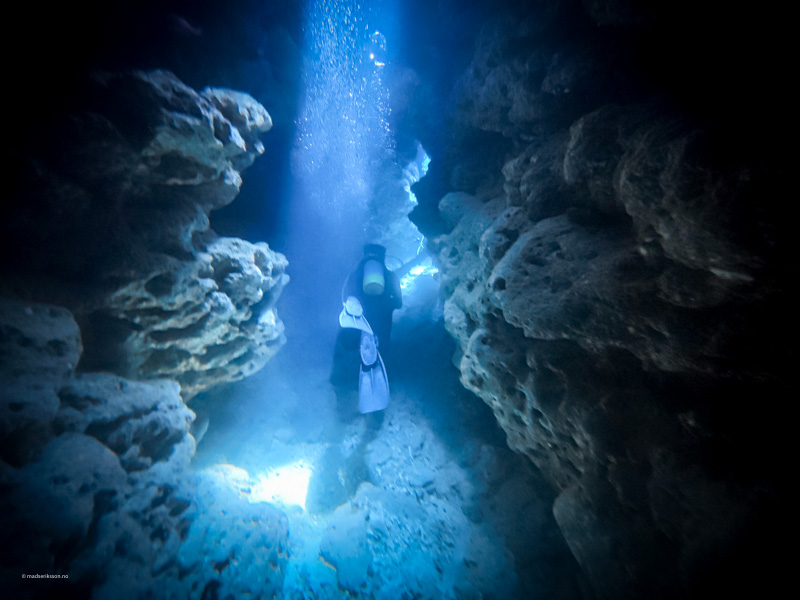
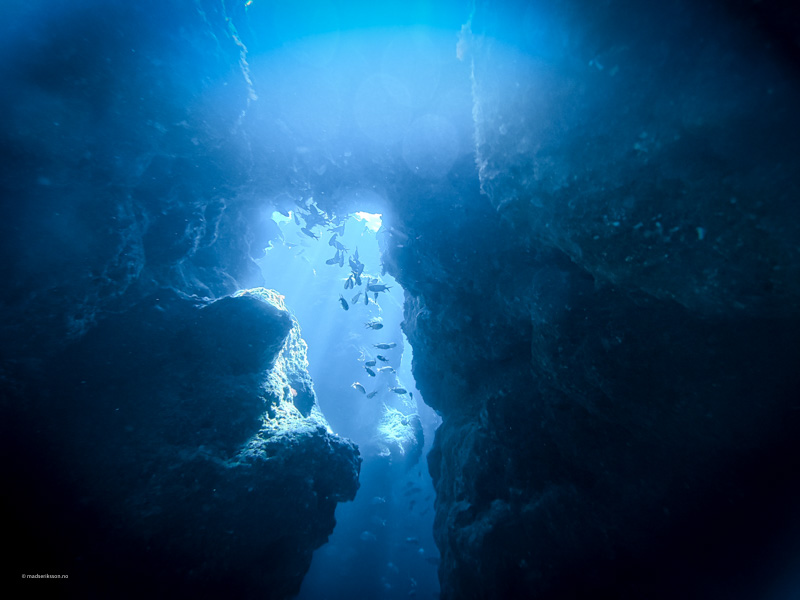
The site most people book before they know anything else about Okinawa is the Blue Cave at Cape Maeda, on the west coast about halfway up the island. It is a sea cave where the light entering underwater turns the interior an intense blue, and the effect is genuinely striking — at its best when the sun is at its highest, which is the single most useful thing to know before booking a time slot.
It is also, by a distance, the busiest place to get in the water on Okinawa. On a summer weekend the surface above the cave is a raft of snorkellers and boats. Whether that ruins it depends on temperament. My honest advice: go if you have the day spare, book the earliest slot available, and do not build the trip around it.
“The Blue Cave is what Okinawa sells. The Keramas are what Okinawa is.”
The Kerama Islands, about 40 kilometres west of Naha, are the other story entirely. They were designated Japan’s 31st national park on 5 March 2014 — a date picked because in Japanese the numbers 3 and 5 can be read as sango, coral — and the park protects 3,520 hectares of land and 90,475 hectares of sea. The ratio tells you what it exists for.
The water there has its own name, Kerama Blue, and the reason is that visibility frequently exceeds fifty metres. There are more than 250 species of fish, healthy hard coral, and turtles that are close to guaranteed. Ferries run from Naha to Zamami and Tokashiki, and day trips are possible, though staying a night or two on one of the islands is a better use of the crossing.
And there is a winter argument for the Keramas that has nothing to do with reefs: humpback whales come to these waters to breed from roughly December to April. The same islands that are a diving destination in August are a whale-watching one in February. If you are looking at a trip outside the obvious season, that is the reason to take it.
Picking the month
Warm water all year, a rainy June, a typhoon season that runs into autumn — and one month that quietly beats the rest
The headline number is the one that makes Okinawa unusual: the sea rarely drops below 20 °C at any point in the year. In practice that means roughly 23–24 °C from January to May, up to about 28 °C through the summer, and around 26 °C into the autumn. Around the Keramas the coldest weeks, January to March, sit closer to 22 °C.
That translates directly into exposure protection. In August you can dive without a wetsuit at all if you would rather; through the winter you want 3–5 mm, and local divers in the coldest weeks add an inner layer under a thicker suit. Do not pack by latitude — Okinawa reads as tropical on a map and is genuinely cool in February.
“Ask ten dive shops which month is best and you will get the same answer from most of them: October. Warm water, settling seas, and the typhoons mostly finished.”
The weather pattern matters more than the temperature. June is the wettest month of the year, and the typhoon season runs broadly from July into October, with the peak risk through late summer. A typhoon does not merely cancel a day’s diving; it can shut boat operations for the better part of a week and stir the water up for days afterwards. If you are travelling in that window, book a longer trip than the diving requires and treat two or three lost days as the base case rather than bad luck.
Which is why October is the consistent recommendation: the sea is still warm, the storm risk is dropping away, and visibility improves as the water calms after the summer. April and May are the other quiet, underrated window — cooler, drier than June, and with almost nobody about.
Booking it, and not breaking it
Certified or not, shore or boat — and the short list of things that decide whether the reef is still there in twenty years
Everything starts at Naha, which has the airport and the ferry terminals. From there the Motobu peninsula is roughly two hours north by car on the expressway and coast road, and a car is effectively essential — the dive shops, the harbours and the shore entries are spread along a coastline that public transport serves badly. If you are combining diving with the rest of northern Okinawa, the Churaumi Aquarium is in Motobu too, and is one of the largest in the world.
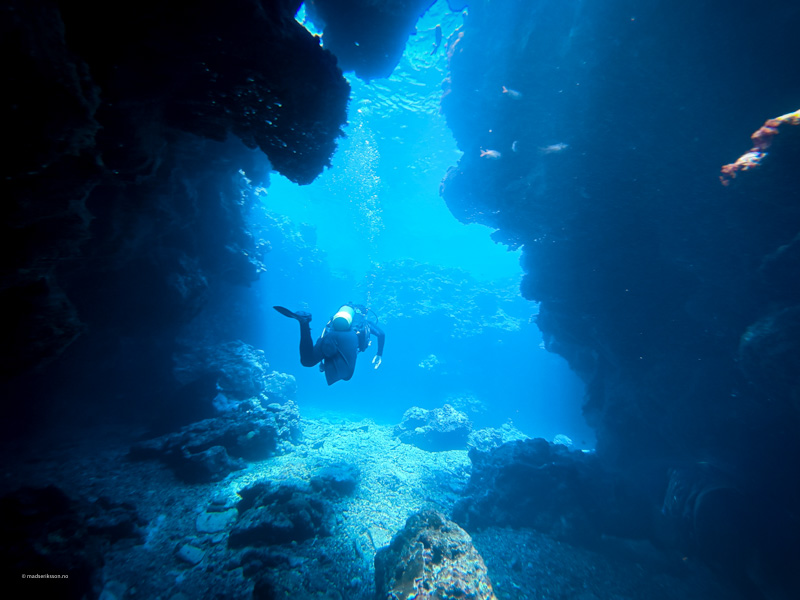
On qualifications: Okinawa is unusually accommodating. Certified divers can book boat trips out to Minna and Sesoko with any of the shops in Motobu, usually as a two-dive morning. Uncertified visitors can do guided try dives — Japanese operators run these extensively and competently — and the shallow, calm sites off Sesoko are close to ideal for it. Snorkelling at Minna needs nothing at all beyond a mask and the ferry ticket.
“Book the boat before you fly. Okinawan dive shops are small operations, the good ones fill up, and August is not the month to be walking in hopefully.”
A few practical points that repeat across every trip report. Book ahead, particularly for summer and for weekends — these are small businesses with a handful of boat places each. Bring your certification card and logbook; Japanese operators do check. Ask about the day’s site before you commit, because conditions move the plan around constantly at this end of the year. And if you are photographing, say so when booking — some shops will pace the dive differently for a camera.
Then the part that matters more than any of it. Okinawan coral is under real pressure from warming water, and the difference between a reef that survives and one that does not is partly made up of small individual decisions. Do not touch or stand on coral — not on a dive, not while snorkelling at Minna, not to steady yourself for a photograph. Sort your buoyancy out before you go near a bommie. Keep fins clear of anything living; a fin stroke breaks branching coral that took years to grow. Take nothing off the reef, put nothing on it, and use a reef-safe sunscreen or a rash vest instead.
None of that is unique to Okinawa, and all of it is worth repeating here because these are shallow, accessible reefs with a lot of beginners on them. That accessibility is exactly what makes Minna and Sesoko such a good place to learn — and exactly why the damage, when it happens, happens in five metres of water rather than thirty.
“Okinawa does not do drama underwater. There is no wall dropping into the blue, no cleaning station with a queue of mantas, nothing that will make a dive log sound impressive at a dinner party. What it does is warm, bright, shallow reef, fifteen minutes from a harbour, in a country where nothing else looks remotely like this. Come in October, take the ferry to Minna, and spend a morning at eight metres watching the light move across the coral. That is the whole offer, and it is a very good one.”
More in the same area
 ArchitectureTokyo Skytree: One tower over thirty-seven million
 CitiesHiroshima and Miyajima: A preserved ruin and a shrine on the tideline
 CitiesJapan’s Kitchen, Osaka
 CitiesKyoto: A Timeless Journey Through Japan’s Cultural Heart
 ForrestsDiscover the Enchantment of Arashiyama Bamboo Grove
 Train travelTwelve seconds: sixty years of the Shinkansen