Six hundred and thirty-four metres, and not one of them accidental — the number is a pun. Tokyo Skytree is the tallest tower on earth, built on a floodplain in one of the most seismically active cities in the world, using a damping principle borrowed from wooden pagodas that have stood through a thousand years of earthquakes. It is also the tallest thing this blog has written about, which seemed like a good moment to line the others up beside it.

Tokyo Skytree stands in Sumida, about seven kilometres north-east of Tokyo Station, on the flat old-town side of the river. It is a broadcasting tower first and a visitor attraction second: the older Tokyo Tower had been swallowed by high-rises and could no longer give clean digital coverage across the Kantō region, so the broadcasters needed height. Skytree reached its full 634 metres on 18 March 2011, was completed on leap day 2012, and opened to the public on 22 May 2012.
One correction, because a great many guides still get it wrong. Skytree is the tallest tower in the world — that part is right, and Guinness certified it as the tallest free-standing tower in November 2011. But it is no longer the second-tallest structure. It now sits third, behind the Burj Khalifa at 829.8 m and Merdeka 118 in Kuala Lumpur at 678.9 m. Tower and structure are different categories, and the figure moved.
What this article covers
Four sections. The tower itself and the reasoning behind its height. The two observation decks and how to visit them without wasting money. The engineering, which is the genuinely interesting part — a central concrete shaft that deliberately moves out of step with the structure around it, borrowed from pagoda carpentry. And finally, since the collection on this site is starting to add up, a section putting Skytree next to the other towers and viewpoints covered on this site.
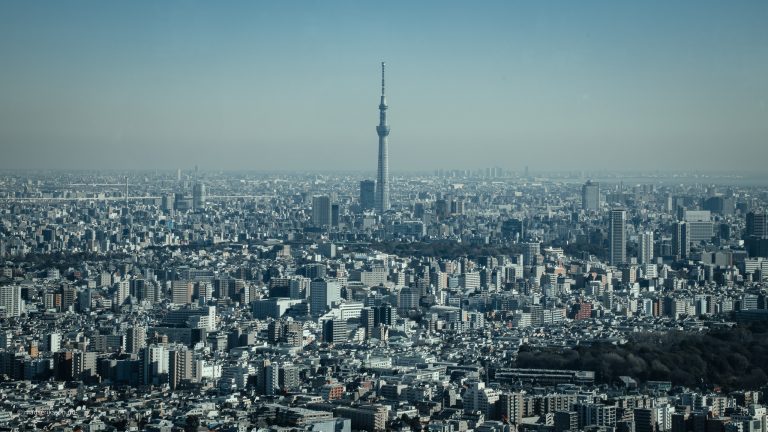
At the foot of 634 metres
Tokyo Skytree stands in Sumida, about seven kilometres north-east of Tokyo Station, on the flat old-town side of the river. From the pavement in Oshiage the base is a triangle that turns into a circle as it rises, and the top is lost against the sky. Scroll to ride up.
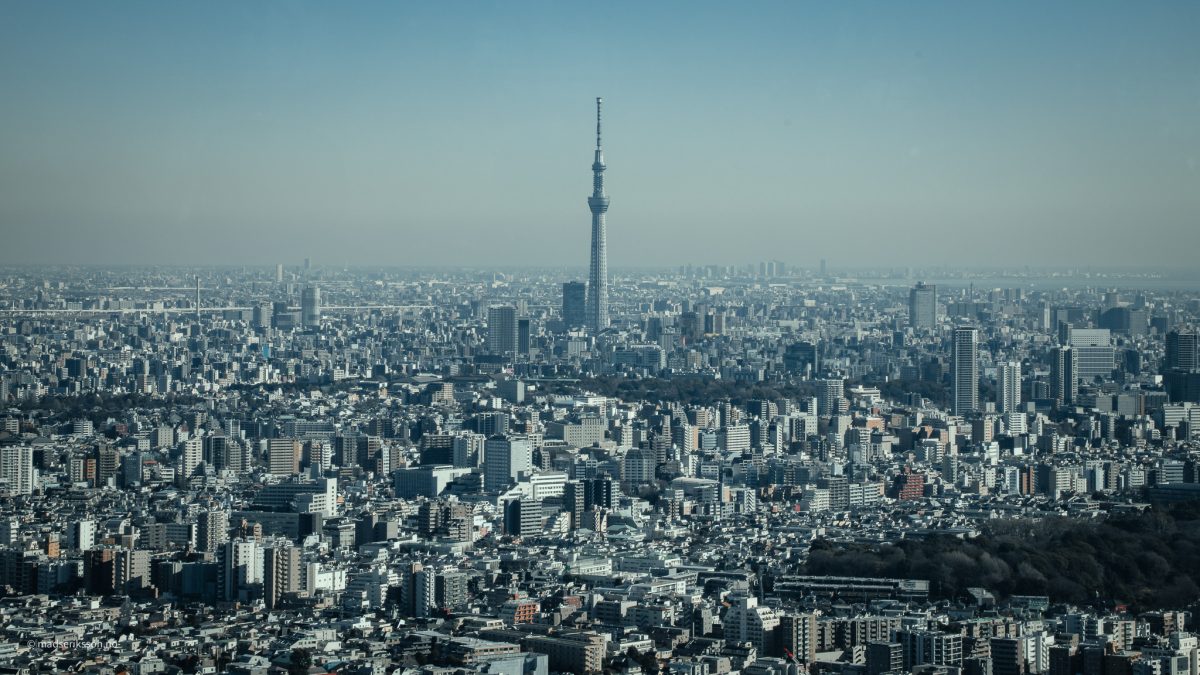
The Tokyo Skytree rising above the endless low-rise sprawl of Tokyo on a hazy day
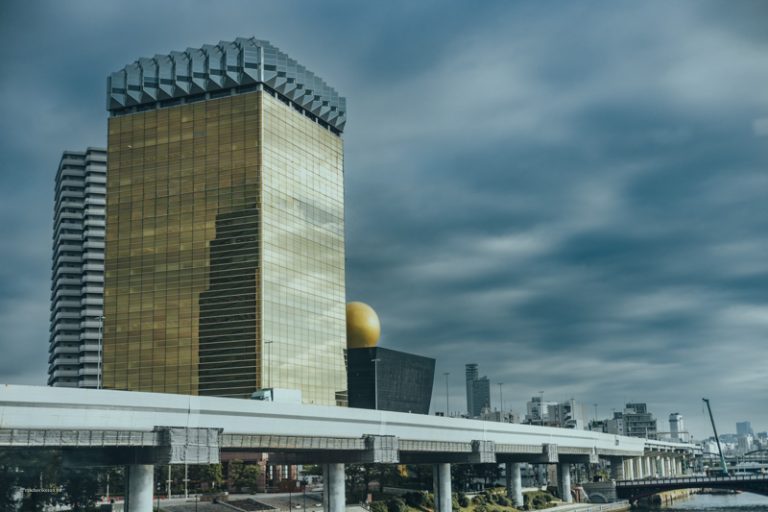
Through the roofs of Sumida
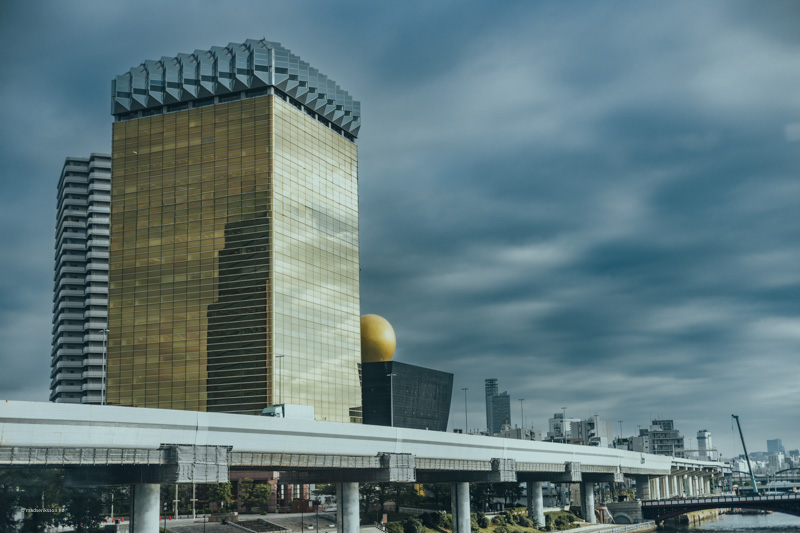
At 150 metres the camera is already well above everything around it. The low-rise grid of eastern Tokyo runs out in every direction, the Sumida River bends past Asakusa, and the golden flame of the Asahi Beer Hall marks the far bank.
The golden Asahi Beer Tower and its flame-topped hall beside the Sumida River, across from Asakusa
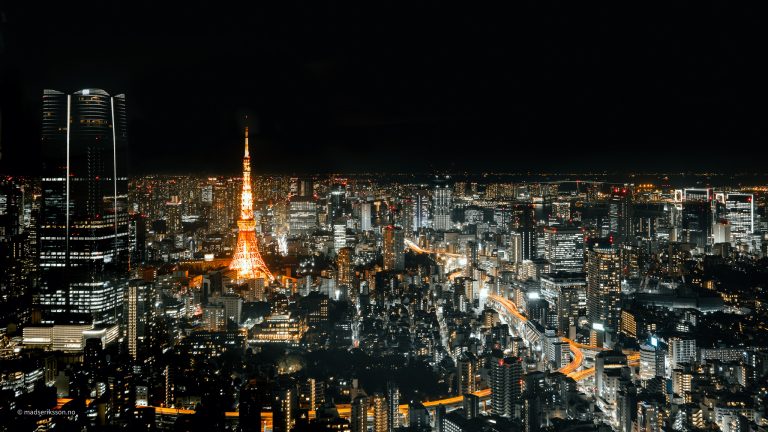
Tembo Deck: the city to the south-west
The Tembo Deck at 350 metres holds up to 2,000 people across three floors, with floor-to-ceiling glass and a glass floor panel. Looking south-west the view crosses the whole of central Tokyo: Tokyo Station, the Imperial Palace gardens, Tokyo Tower and the new Azabudai Hills. On a clear winter afternoon Mount Fuji appears beyond them.
Tokyo Tower among the lights of central Tokyo, the heart of the world’s largest metropolitan area
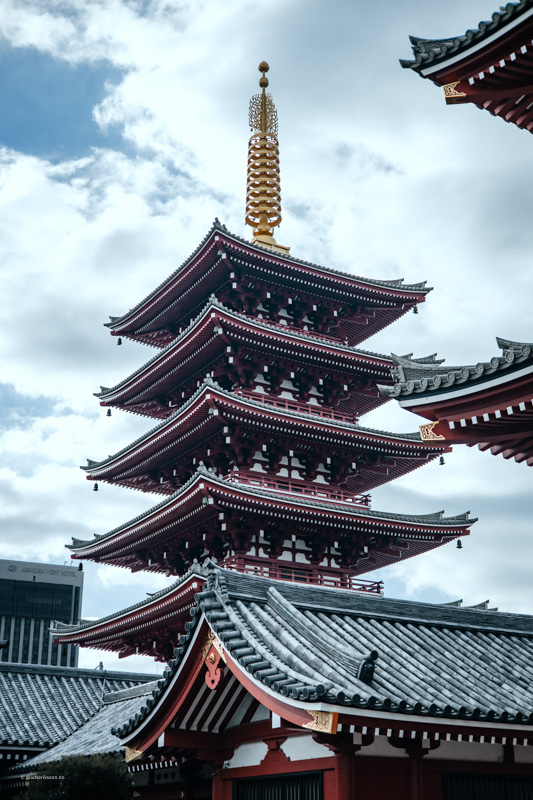
Asakusa straight below
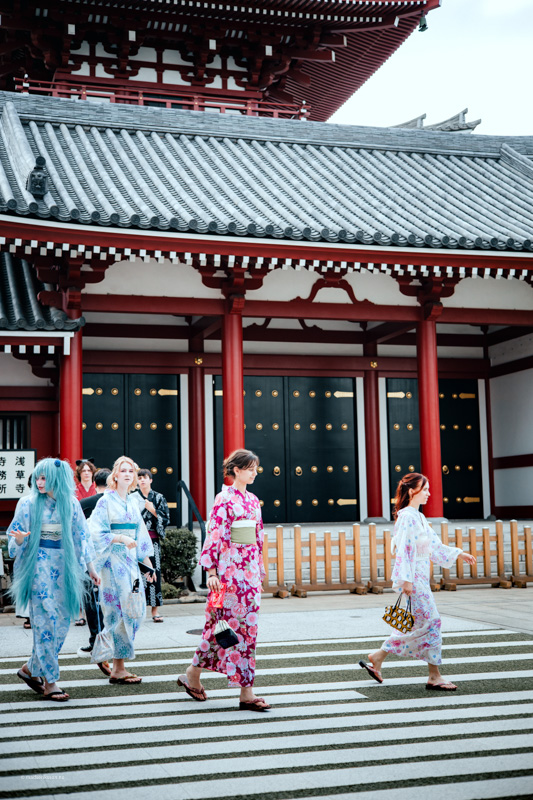
The same deck, turned west. Senso-ji, Tokyo’s oldest temple, sits in the middle of Asakusa little more than a kilometre away, with the Kaminarimon gate and the Nakamise shopping street running up to it. From here the temple district reads as one small block in an enormous city.
The five-storey pagoda of Senso-ji in Asakusa, rising above the temple roofs against a cloudy sky
Tembo Galleria: the glass spiral
A second lift continues to the Tembo Galleria at 450 metres, a spiral glass-covered skywalk that takes up to 900 people and climbs the final five metres to the highest point visitors can reach. To the south the city runs out towards the waterfront and Tokyo Bay.
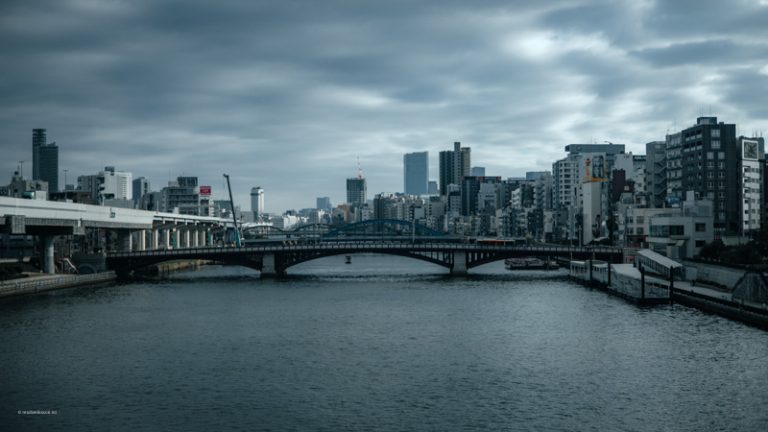
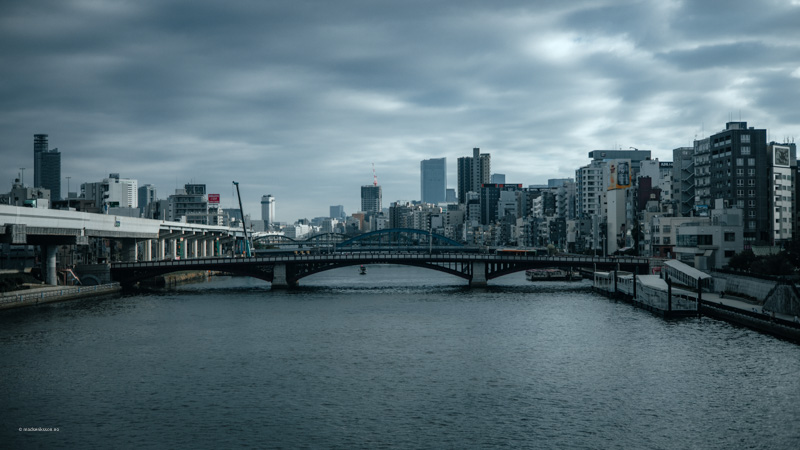
The Sumida River under grey skies, with its bridges and the apartment blocks of eastern Tokyo
The city after dark
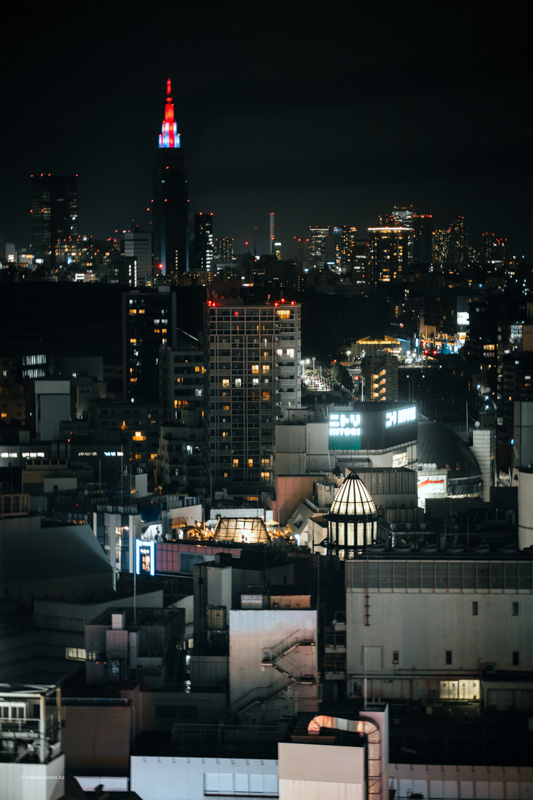
Last entry is late in the evening, so arriving about an hour before sunset gives daylight, dusk and the lit city on one ticket. At night the towers of Minato and the red lattice of Tokyo Tower stand out from the glow of the grid.
Tokyo Tower among the lights of central Tokyo, the heart of the world’s largest metropolitan area
Six hundred and thirty-four metres
The height is a pun: in Japanese wordplay 6-3-4 reads mu-sa-shi, Musashi, the old name of the province Tokyo stands in. The design was raised from 610 metres in 2009 to land on it. A central column modelled on the shinbashira of a wooden pagoda runs up the middle, joined to the outer frame by oil dampers so that the two move independently in an earthquake.
The Tokyo Skytree rising above the endless low-rise sprawl of Tokyo on a hazy day
3D model © 2026 madseriksson.no · Photographs © madseriksson.no. Buildings and heights: © OpenStreetMap contributors (ODbL), via OpenMapTiles. Ground imagery: Sentinel-2 cloudless 2023 by EOX IT Services GmbH (contains modified Copernicus Sentinel data 2023; CC BY 4.0). Heights are approximate where OpenStreetMap has no measured value; sun positions are approximate.
Two decks, one decision
Whether the upper level is worth the second ticket — and the answer is not the one the pricing implies
The tower gives you a choice and prices it in a way that pushes you upward. Tembo Deck at 350 metres is the main observatory: three floors, a café, glass from floor to ceiling, and a panel of glass floor for the obligatory look straight down. It holds up to 2,000 people, and below this level the tower is still a tripod — from 350 m up it becomes a cylinder, which is precisely why the deck sits where it does.
Tembo Galleria at 450 metres is a different thing altogether: a spiral, glass-covered skywalk that climbs gently around the shaft, gaining height as you walk it, and finishing at the highest point any visitor reaches. Capacity is 900, and the narrowness is the point — you are walking up a ramp inside a glass tube with Tokyo below you on both sides.
“A hundred extra metres does not buy you a better view of Tokyo. What it buys is the walk itself, which is the part worth paying for.”
So, is the upper deck worth the second ticket? Honestly: the view is not meaningfully better at 450 metres than at 350. Tokyo is flat and enormous, and past a certain height it simply becomes more of the same. What the Galleria gives you is the experience of the ramp — the sensation of ascending inside the structure with nothing solid at eye level. If you like buildings, pay the extra. If you came for the view of the city, save the money and spend longer on the lower deck.
Two practical points that matter more than the choice of deck. Book online. Buying at the fourth-floor counter on the day adds ¥500 per ticket, and the queue is the worst part of the visit. And go for the transition: opening hours run 10:00 to 22:00 on weekdays and from 09:00 at weekends, with last entry at 21:00, so arriving about an hour before sunset gives you daylight, dusk and the city lit from one ticket. On a clear winter afternoon Mount Fuji is visible to the south-west, which is the single best reason to come in January rather than August.
How you build 634 metres on a fault line
A concrete core that deliberately moves out of step with the tower around it — an idea taken from wooden pagodas that have outlasted every earthquake thrown at them
The engineering question at Skytree is not how to make something tall. It is how to make something tall in Tokyo — on soft ground, in a city that expects a major earthquake, with a broadcasting function that has to keep working afterwards. The answer borrows from a building type that has already solved the problem: the five-storey wooden pagoda, which in Japan has an extraordinary record of surviving quakes that flattened everything around it.
A pagoda has a shinbashira — a central pillar running up the middle, not rigidly tied to the floors around it. When the ground moves, the pillar and the structure swing out of phase, and the two damp each other. Skytree does the same thing at industrial scale: a reinforced-concrete central shaft is bonded to the outer steel frame for the first 125 metres, and from there up to 375 metres it is connected only through oil dampers. Core and frame move independently, and each fights the other’s motion.
“The central shaft is not there to hold the tower up. It is there to disagree with it.”
On top of that sits a tuned mass damper — an added mass that shifts counter to the building’s sway to keep the centre of gravity over the base. The designers put the combined effect at absorbing roughly half the energy of an earthquake. The system got an unplanned test before it was even finished: the tower stood at 625 metres when the Tōhoku earthquake struck on 11 March 2011, was fully inspected the following day, and reached its final height six days later.
The shape follows the same logic. The base is a tripod — three legs on a wide footprint, which is what you want for stability on this ground — and the section above about 350 metres is cylindrical, which is what you want for a 360-degree observatory and for shedding wind. The transition between the two happens gradually, and it is the reason the tower reads as curved from a distance and angular from underneath. The lattice is painted Skytree White, a bespoke colour derived from aijiro, a pale bluish-white from the traditional Japanese palette.
And then the height itself, which is the least engineering-driven number in the whole project. The design originally specified 610 metres. In October 2009 it was raised to 634 — not for structural or broadcast reasons, but because in Japanese numeric wordplay 6-3-4 reads mu-sa-shi, and Musashi is the old provincial name for the land Tokyo is built on. A twenty-four-metre increase, on the tallest tower in the world, for a pun. It is difficult to think of a more Japanese decision.
Putting the numbers side by side
Eight viewpoints from these pages, ranked by height — and the consistent finding that height predicts almost nothing about whether the view is any good
Six of those eight are places these pages have written up properly, and lining them up produces a conclusion I did not expect when the first one was written: height is almost useless as a predictor of whether a viewpoint is worth the ticket. The correlation runs the other way as often as not.
Consider the cases. Shibuya Sky at 229 metres is the smallest paid deck on the list and arguably the best, because it is open to the air — no glass between you and the city — and everything above it is enclosed. Lotte Center Hanoi at 272 metres beats a taller tower a few kilometres away in the same city, purely because it stands between the lake, the river and the old quarter rather than in a district of newer high-rises. And the Mole Antonelliana, the shortest thing here, gives you the Alps behind Turin from 85 metres up a brick dome — which is a better composition than most of the four-hundred-metre decks manage.
“The best view on this list is 229 metres up and open to the weather. The highest place on it is a stone building from 1560 that you walk to.”
What actually decides it, on the evidence of these six, is three things. Position — whether the interesting things are close enough to read, which is why Hanoi works and why Keangnam does not. Whether there is glass in the way — the open roof at Shibuya and the terrace at Seoul are what people remember, not the panoramic windows below them. And the air, which decides more visits than anything else: a clear day at 229 metres beats a hazy one at 634, and both Seoul and Hanoi are frequently hazy.
Then there is the entry at the top of the table, which is there partly as a joke and partly not. The highest place written about on this site is 2,469 metres, and it is not a tower at all — it is the Great St Bernard hospice, a stone building begun in 1560 on a pass between Switzerland and Italy, which you reach by driving or walking rather than by lift, and which charges nothing to stand outside. Four times the height of Skytree, four hundred and fifty years older, and no ticket. Worth remembering the next time a lift costs three thousand yen.
Getting there and getting it right
Two stations at the foot of it, a mall underneath, and one weather condition that decides whether you should go at all
Skytree sits about seven kilometres north-east of Tokyo Station, in Sumida, and has two stations at its foot: Tokyo Skytree Station on the Tobu line, which puts you at the base, and Oshiage on the Metro Hanzōmon and other lines, about ten minutes’ walk. Either works; Oshiage connects better to the rest of the network.
Underneath the tower is Tokyo Solamachi, a large mall that also contains the Sumida Aquarium, and the ticket desk for the observatories is on the fourth floor. Opening hours run 10:00 to 22:00 on weekdays and from 09:00 at weekends and public holidays, with last entry at 21:00.
“Book online, arrive an hour before sunset, and check the visibility first. In that order.”
Three things decide whether the visit is any good. Book online — the same-day counter adds ¥500 per ticket and a queue. Arrive about an hour before sunset, which gives you the city in daylight, the light going, and Tokyo lit, all on one ticket. And check the air: Tokyo is often hazy, and 634 metres is unforgiving about it. On a clear winter afternoon you get Mount Fuji to the south-west; on a humid summer one you get a grey wall at fifteen kilometres.
If the forecast is poor, the good news is that Skytree works from outside too. The tower is visible across much of eastern Tokyo, and the classic photograph is not from it but of it — from the Sumida river below, or from the streets of Asakusa on the far bank, with the tower rising behind the old town. It is lit every evening in one of two alternating schemes: Iki, sky blue, and Miyabi, purple. Working out which one is on is a small and satisfying way to spend a walk along the river.
“Six hundred and thirty-four metres, twenty-four of them added for a pun, held steady by an idea taken from carpenters who were solving the same problem a thousand years ago. That is a better reason to come than the view — and the view is very good. But having now stood on six of these things across four countries, I would say this: go up the tall one once, and then go and find the small one with the open roof. That is where the city actually is.”
More in the same area
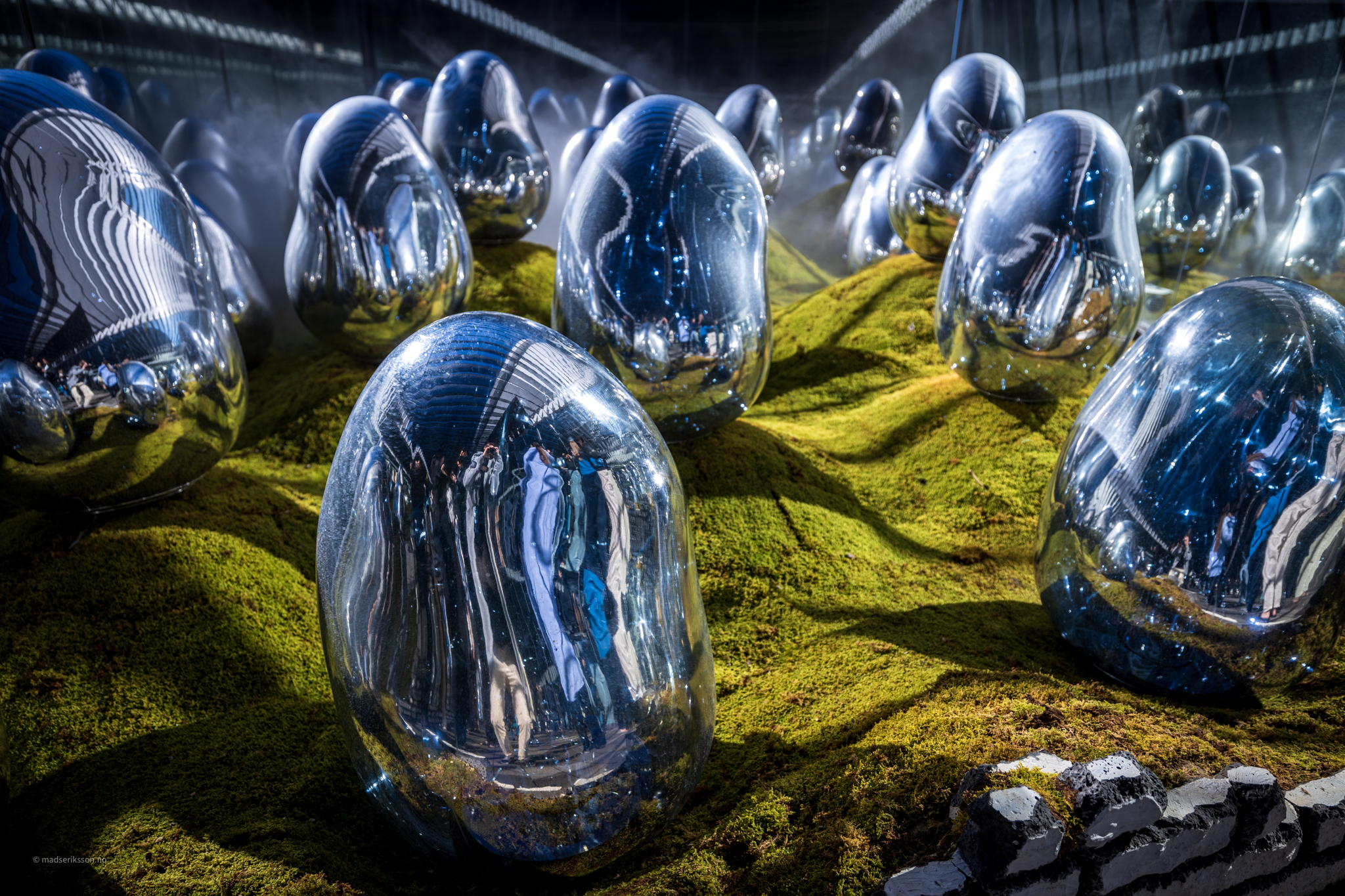 MuseumsteamLab in Tokyo: Planets in Toyosu and Borderless in Azabudai Hills
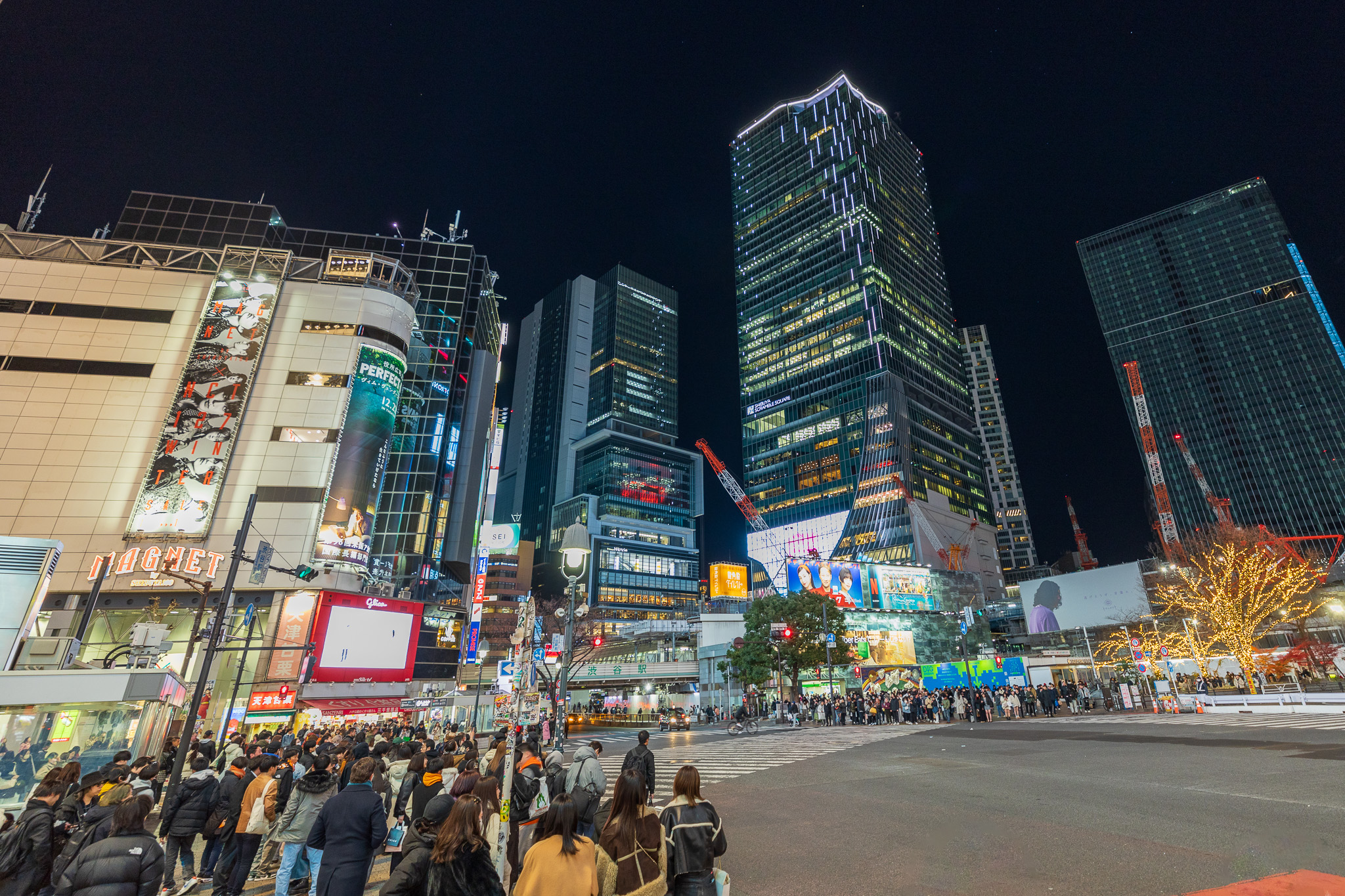 CitiesShibuya Crossing: The Heartbeat of Tokyo
 CitiesTokyo — Enormous, Efficient, Beautiful and Entirely Unlike Anywhere Else
 CitiesHiroshima and Miyajima: A preserved ruin and a shrine on the tideline
 Train travelTwelve seconds: sixty years of the Shinkansen
 TravelTenryū-ji — Arashiyama’s Zen Temple and Japan’s Oldest Surviving Garden