Tenryū-ji was built in 1339 by a man attempting to placate a ghost. Ashikaga Takauji had overthrown Emperor Go-Daigo and driven him into exile, where he died — and when plague and misfortune followed, Takauji was advised that the emperor’s spirit required appeasement. The temple he founded to accomplish this is now the head temple of the Tenryū-ji branch of Rinzai Zen, ranked first among the Five Great Zen Temples of Kyoto, and a UNESCO World Heritage Site. Its buildings have burned to the ground eight times in seven centuries and been rebuilt each time. The garden has not. The Sōgenchi pond garden, laid out by the founding abbot Musō Soseki in the 1340s, survives essentially as he designed it — the oldest garden of its kind in Japan, and the first site in the country ever designated a Special Place of Scenic Beauty. It is composed around mountains that stand outside the temple walls and do not belong to it: Arashiyama and Kameyama, borrowed into the picture as though they were part of the arrangement. Which, in every way that matters to the garden, they are.

Tenryū-ji stands in Arashiyama, the district at the western edge of Kyoto where the Ōi River comes out of the mountains and the city stops. It is not, strictly, outside Kyoto — it is within the city boundary, twenty minutes by train from the centre — but the distinction matters less than the effect: Arashiyama is where the flat urban grid of Kyoto runs into forested hills, and the temple sits precisely on that line, with the city behind it and the mountains in front. This position is not incidental. It is the reason the garden works.
The temple was founded in 1339 by Ashikaga Takauji, the first shōgun of the Ashikaga shogunate, on the site of a former imperial villa. The stated purpose was the pacification of the spirit of Emperor Go-Daigo, whom Takauji had deposed and who had died in exile that year — a project of considerable political usefulness as well as spiritual precaution, since a temple honouring the deposed emperor also demonstrated the new shogunate’s piety and legitimacy. The funding came from an unusual source: Takauji authorised a trade mission to Ming China specifically to raise money for construction, and the ships that sailed became known as the Tenryūji-bune — the Tenryū-ji ships. A Zen temple in Kyoto was financed by a state-sponsored commercial voyage to the Asian mainland, which tells you something accurate about how 14th-century Japanese Buddhism actually operated. The founding abbot was Musō Soseki, the most influential Zen master and garden designer of his era, who laid out the Sōgenchi garden as part of the original construction.
What survives and what does not
The temple buildings have been destroyed by fire eight times since 1339 — by accident, by war, and repeatedly during the Onin War and the upheavals of the 19th century. What stands today dates mostly from the Meiji period (1868–1912), which means that visitors expecting 14th-century architecture will not find it. The garden is the exception and the reason to come: the Sōgenchi pond and its rock arrangements are substantially as Musō Soseki designed them nearly 700 years ago, making this one of the very few Japanese gardens whose original composition can be viewed essentially intact.
A temple built to placate a ghost
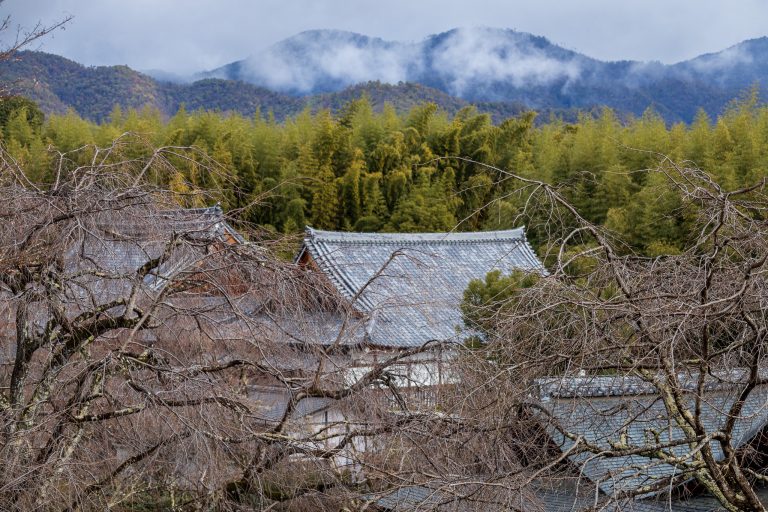
Ashikaga Takauji, the first Ashikaga shōgun, founded Tenryū-ji in 1339 on the site of a former imperial villa, to pacify the spirit of Emperor Go-Daigo, whom he had deposed and who had died in exile that year. It stands where the flat grid of Kyoto runs into the forested hills of Arashiyama, ranks first among the Five Great Zen Temples of Kyoto and is a UNESCO World Heritage Site.
The temple roofs of Tenryū-ji in Arashiyama, with bamboo and misty hills behind.
Eight fires, one white gable
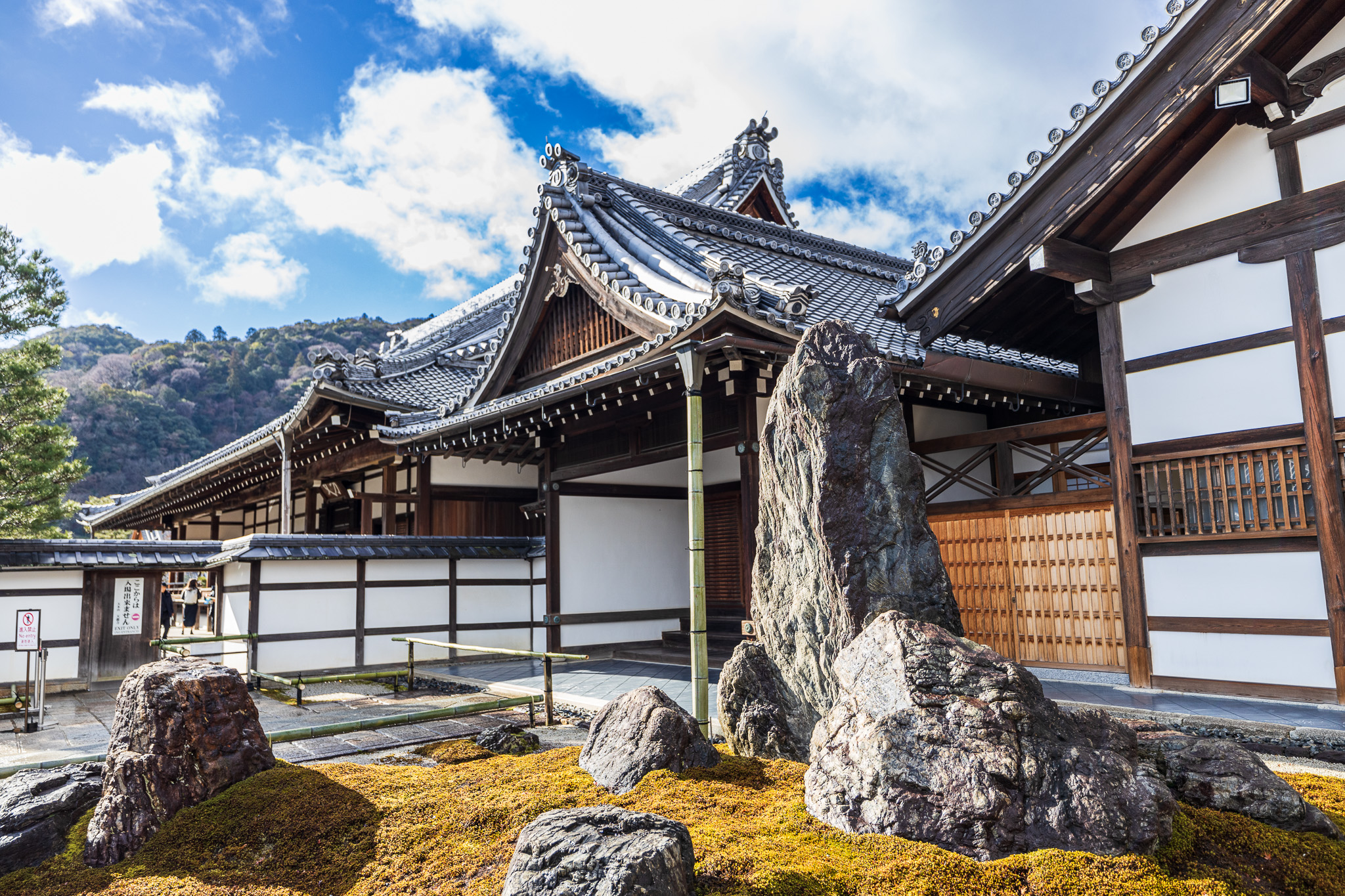
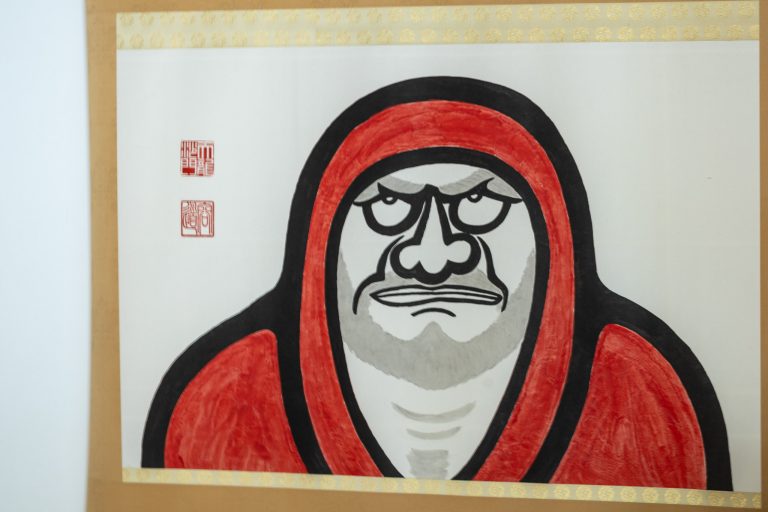
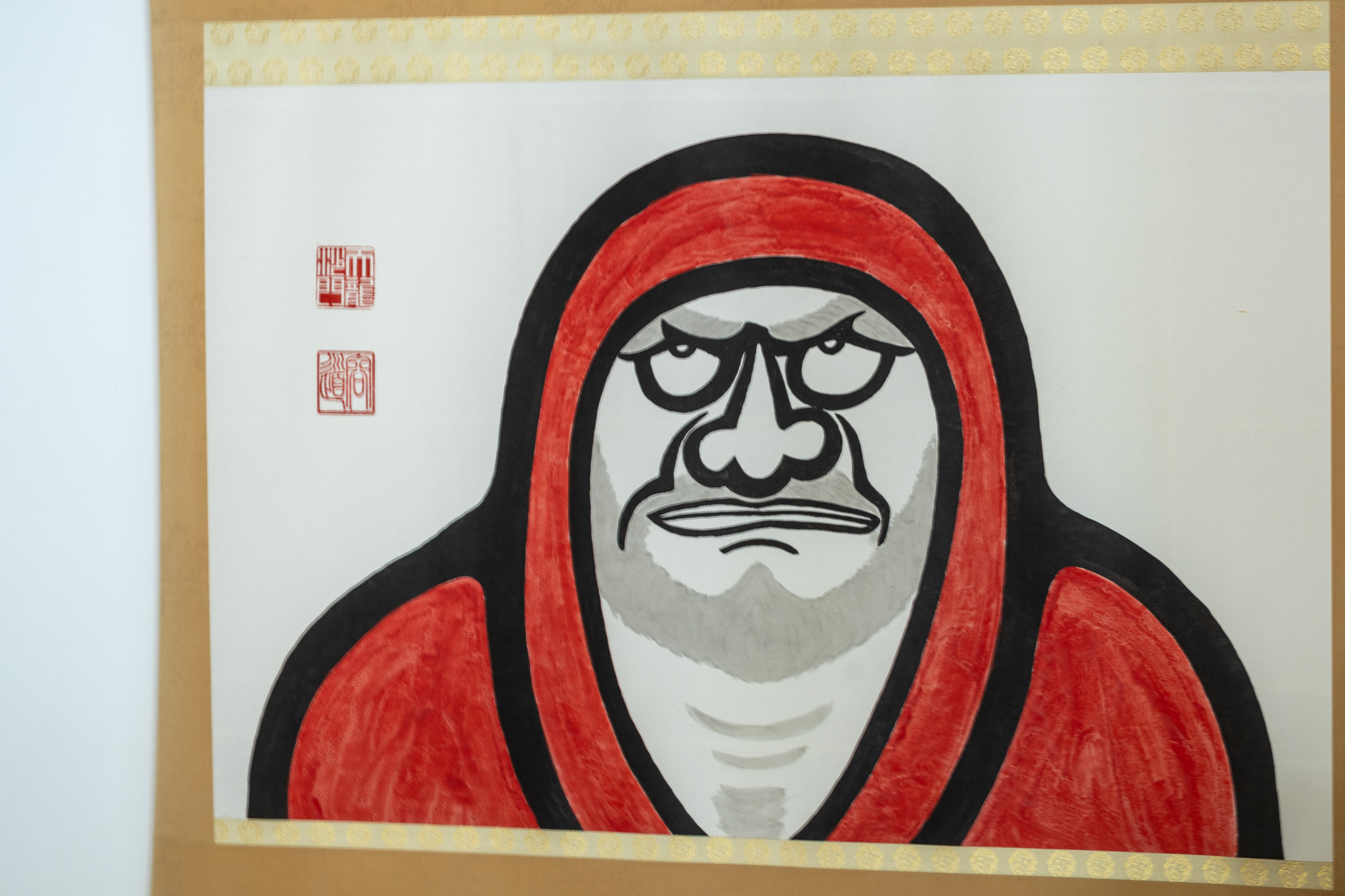
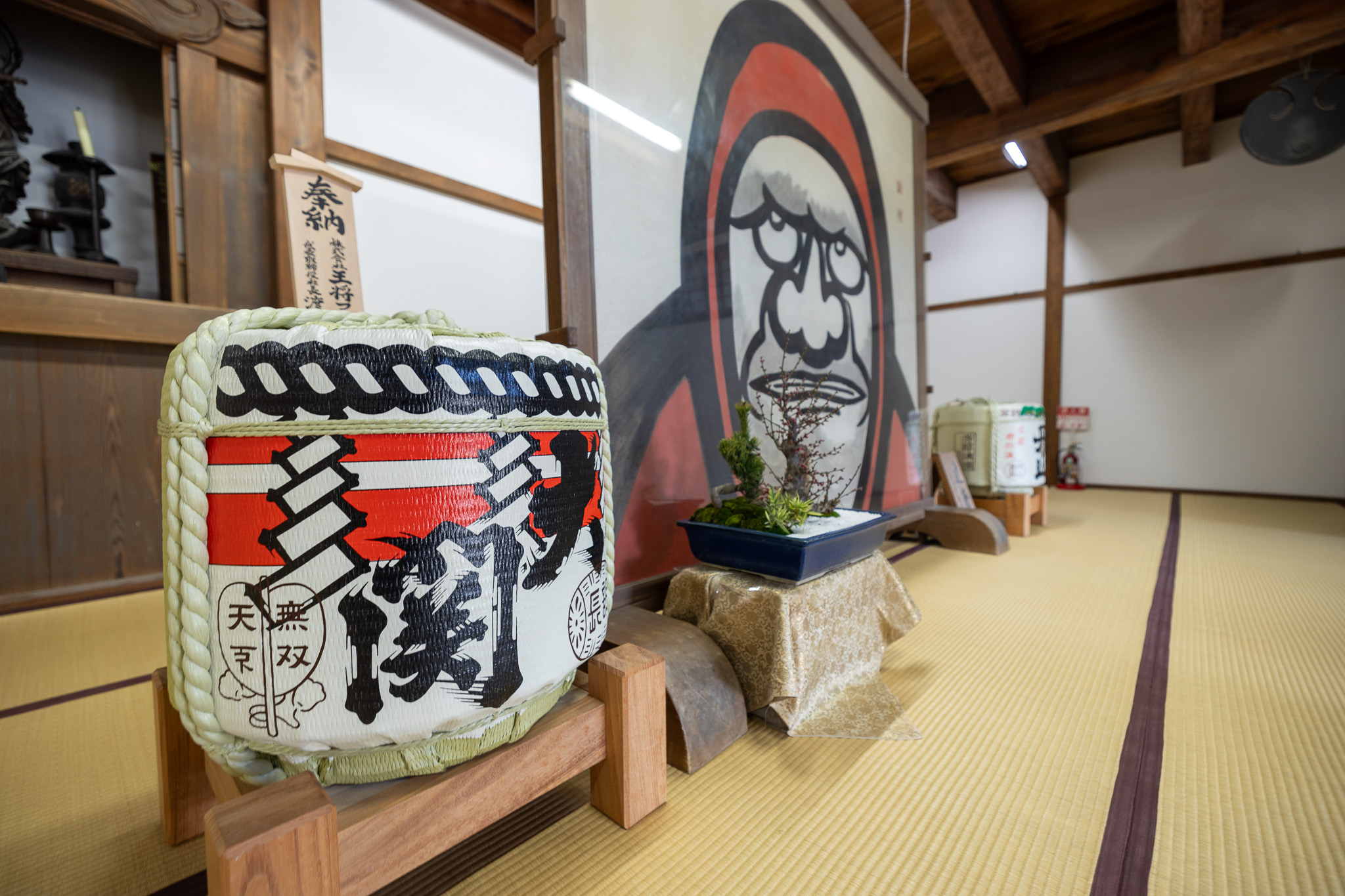
The temple buildings have burned to the ground eight times since 1339, and what stands today dates mostly from the Meiji period. The first building seen on entering is the Kuri, the kitchen and administrative building, with its steep white gable; inside its entrance hangs a large painting of Daruma, the founder of Zen.
The painting of Daruma, the founder of Zen, at the entrance of Tenryū-ji.
Sit rather than walk
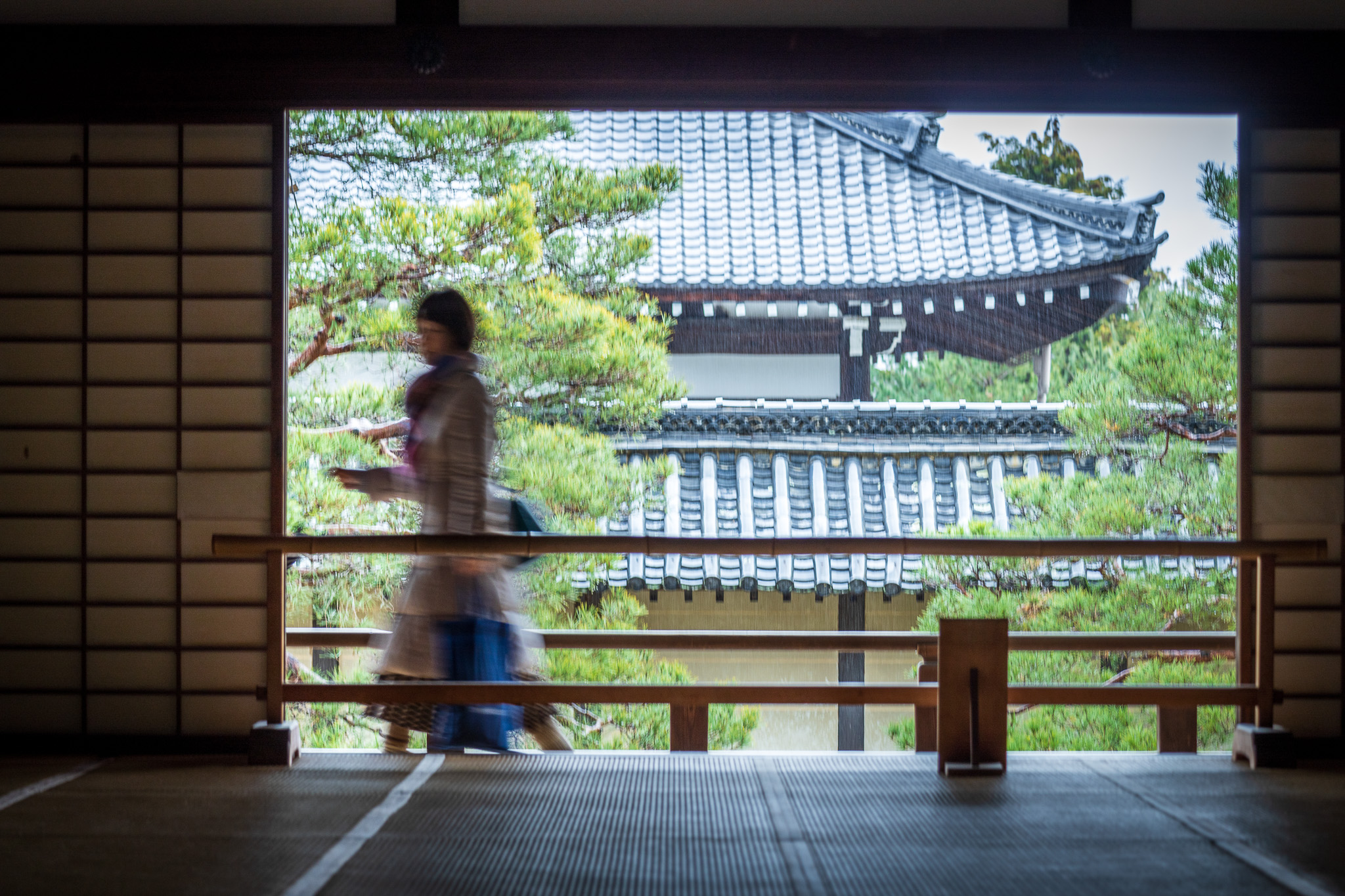
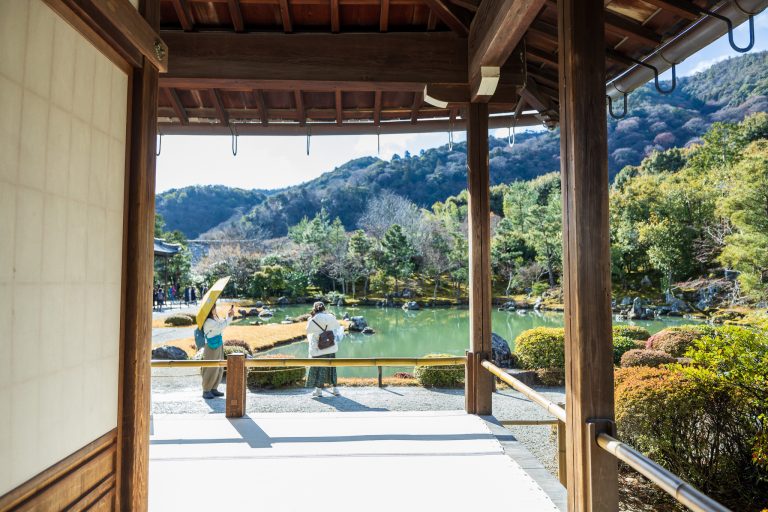
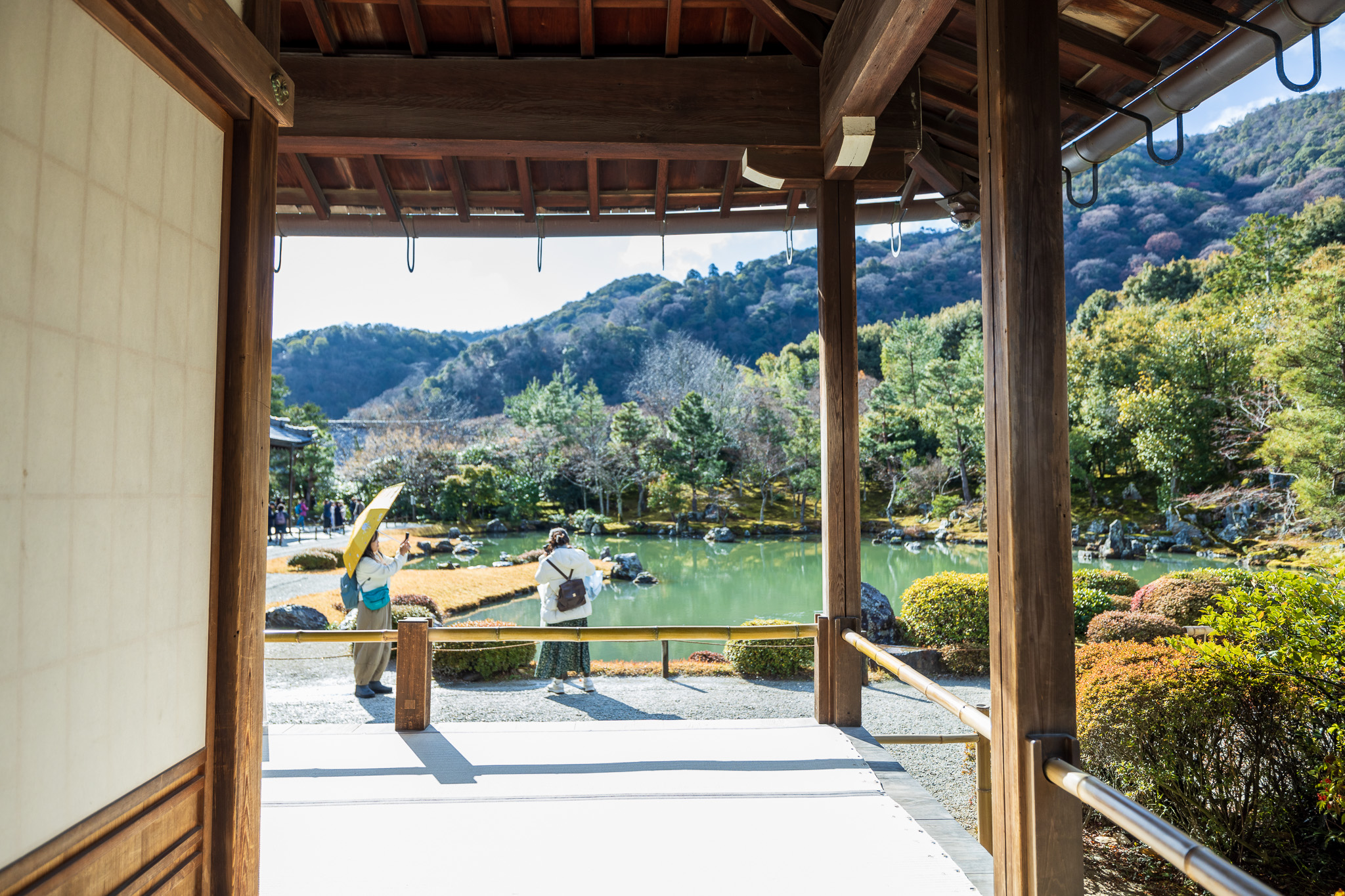
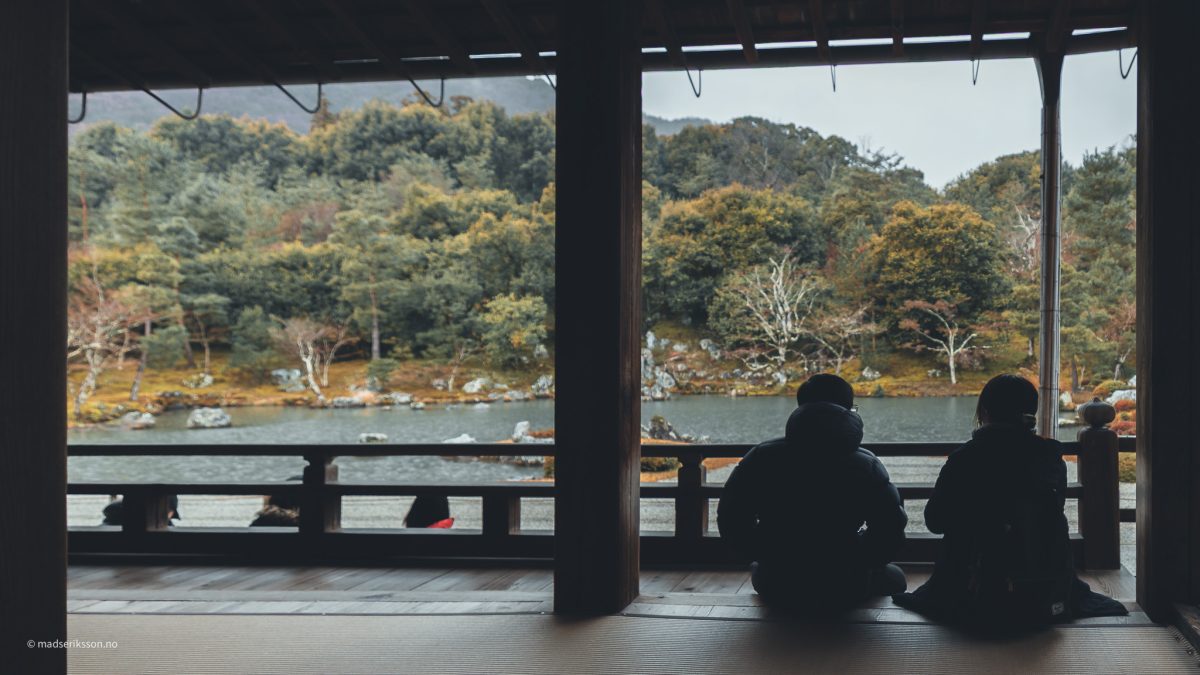
The Sōgenchi garden lies immediately behind the Ōhōjo, the abbot’s main hall, and was designed to be seen seated from its wooden veranda: the pond in the foreground, the planted slope rising behind it and the mountains beyond. Every sightline was calibrated for that viewpoint. The circuit path round the pond shows the stones from other angles, but that is not what the composition is for.
Visitors on the veranda looking out over the Sōgenchi pond garden.
A garden composed around borrowed mountains
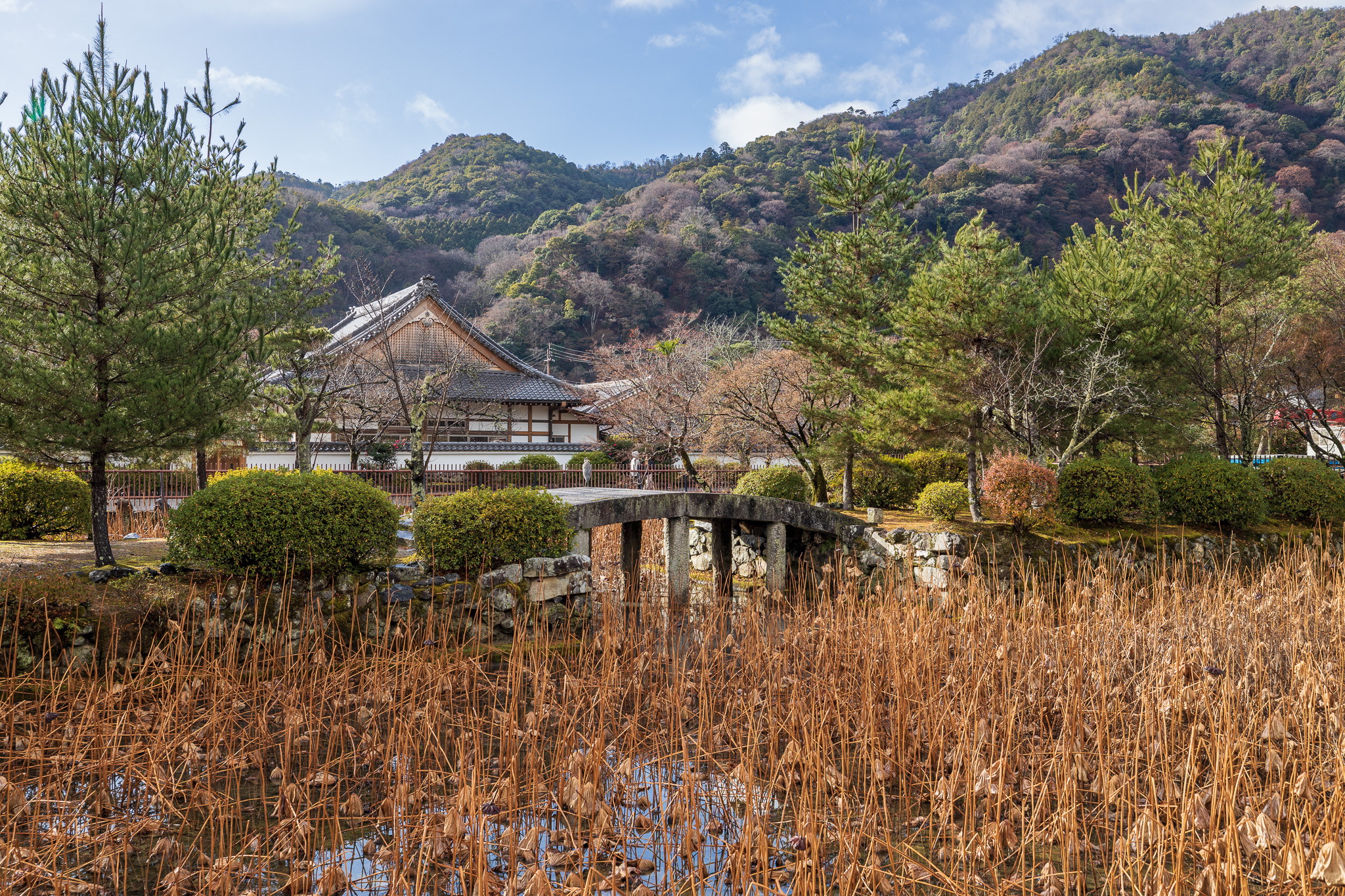
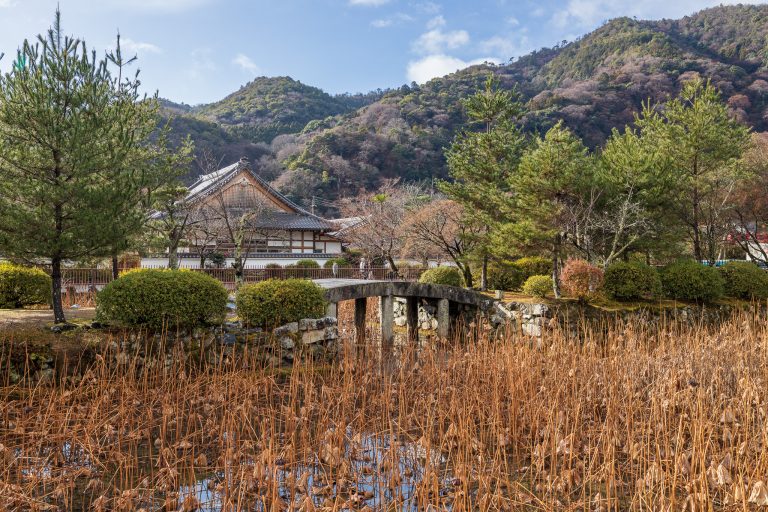
Laid out by the founding abbot Musō Soseki in the 1340s, Sōgenchi survives essentially as he designed it, the oldest garden of its kind in Japan and the first Special Place of Scenic Beauty, designated in 1923. It borrows Mount Arashiyama and Mount Kameyama into the picture. On the far side of the pond a dry waterfall of upright stones, with carp stones below it, recalls the legend of the Dragon Gate.
Gardens and temple buildings of Tenryū-ji below the hills of Arashiyama.
The dragon that watches
The ceiling of the Dharma Hall carries a Cloud Dragon painted in ink in 1997 by Kayama Matazō for the temple’s 650th anniversary. It is a happōnirami dragon, composed so that its eyes seem to follow the viewer from any point in the hall. The Hattō is generally open only at weekends, on public holidays and in special periods, for a separate fee.
A working Zen monastery
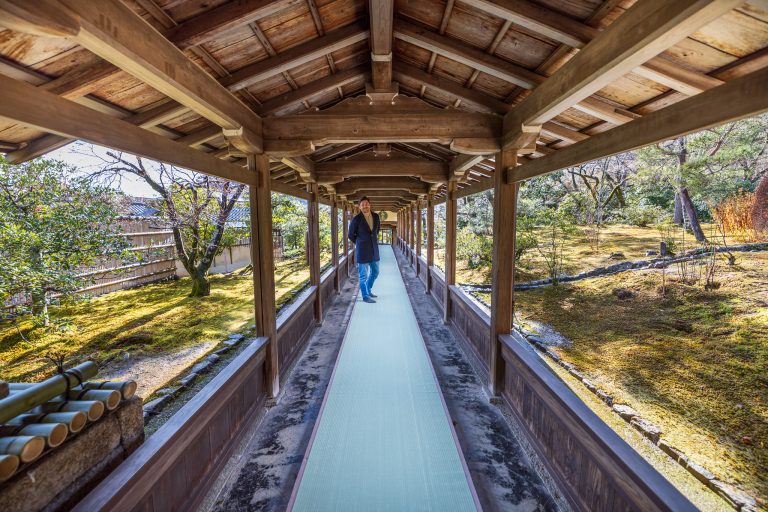
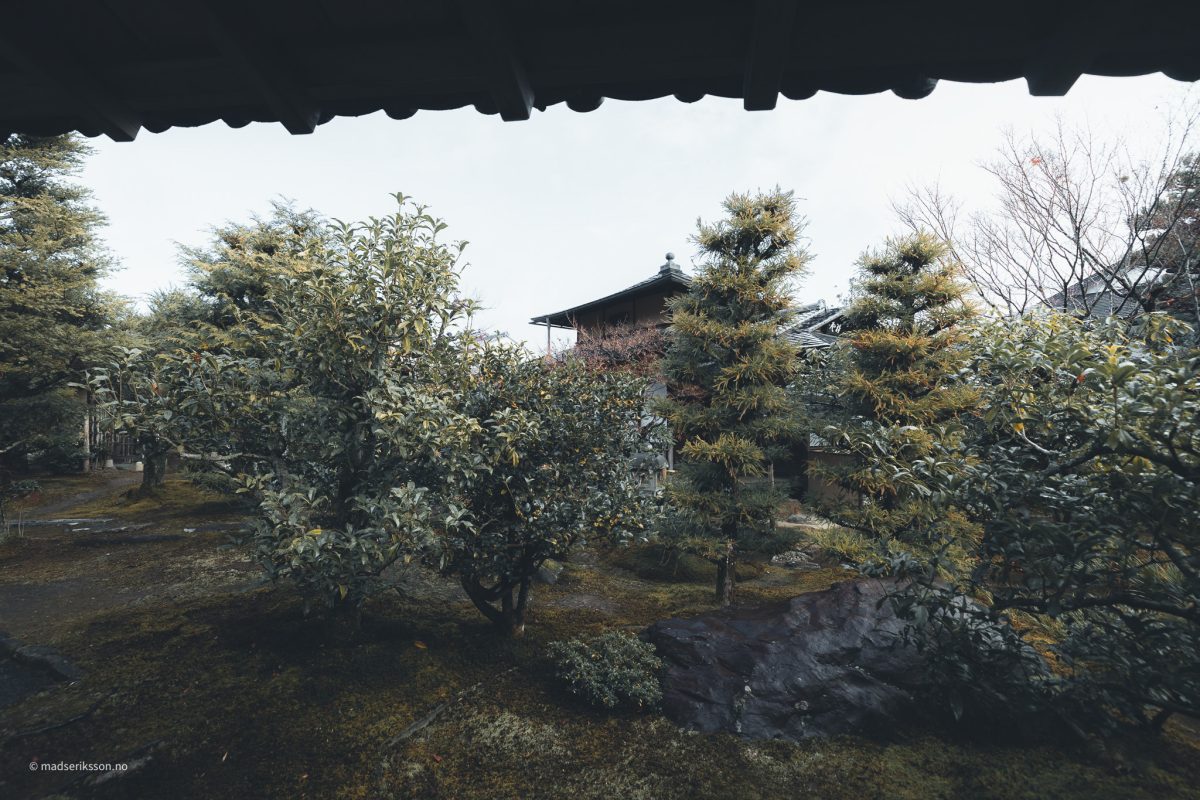
The Ōhōjo and Kohōjo, the greater and lesser abbot’s halls, the Kuri, the Tahoden and the Shoin are Meiji-period reconstructions, open on the garden-and-buildings ticket. Handsome and restrained, they frame a 14th-century garden, and the whole complex still functions as a Zen monastery. Shigetsu, inside the grounds, serves shōjin ryōri overlooking the garden by reservation.
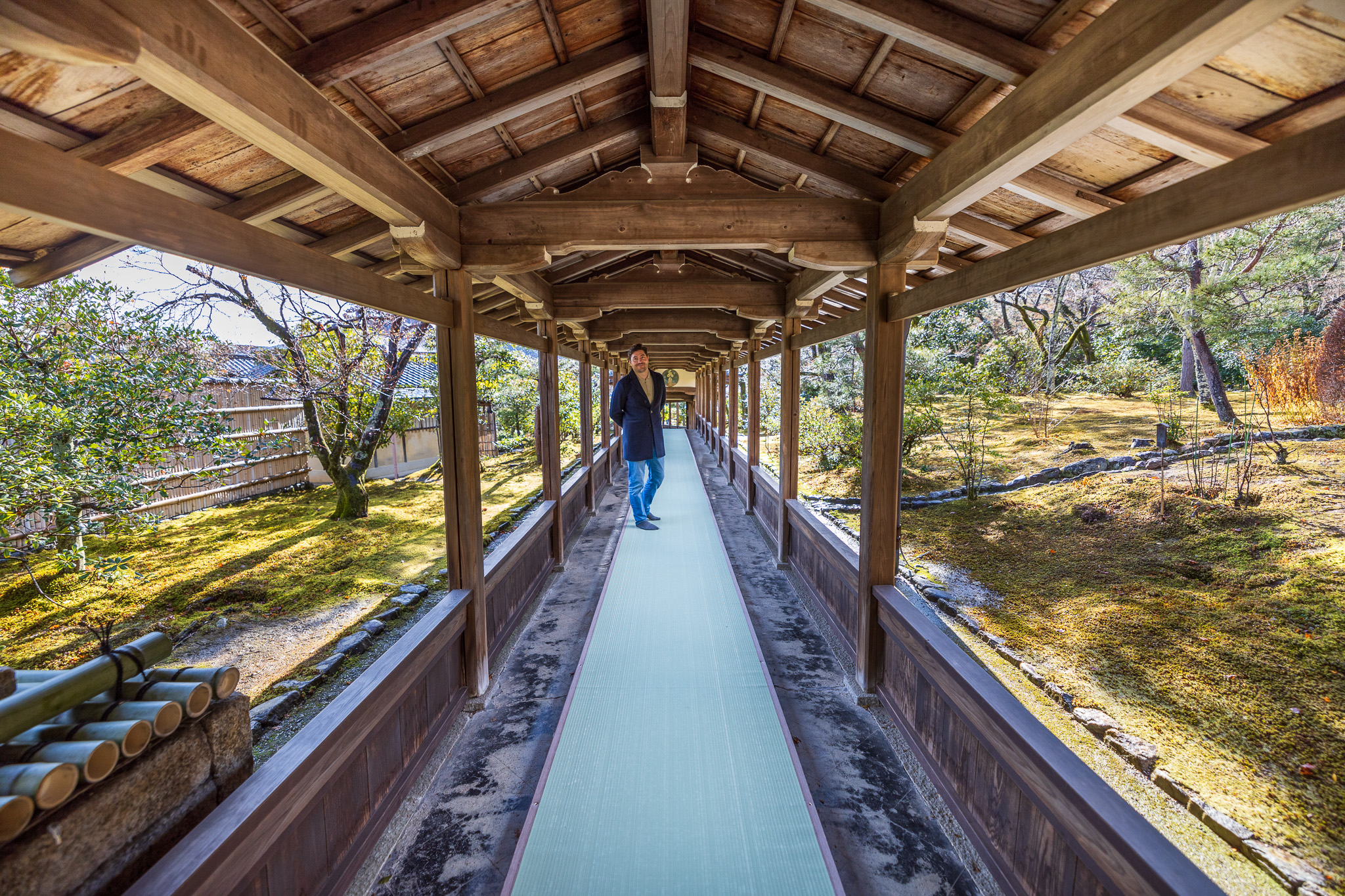
A long covered wooden corridor linking the halls of Tenryū-ji, with the temple garden on either side
Out through the back gate
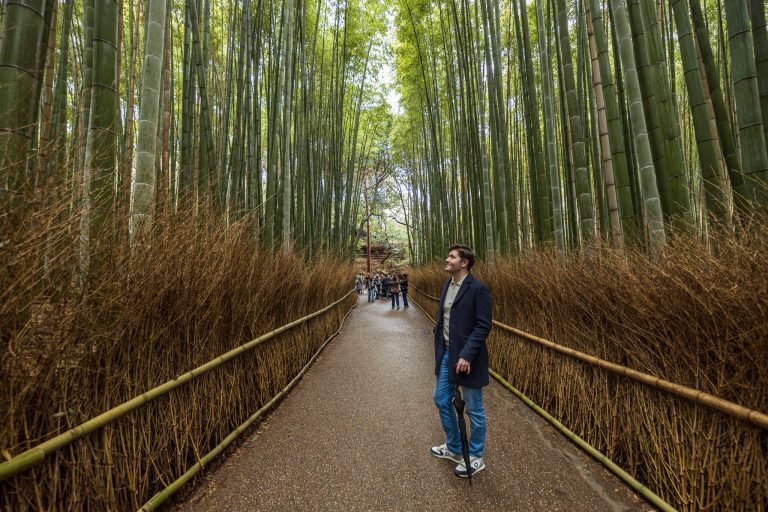
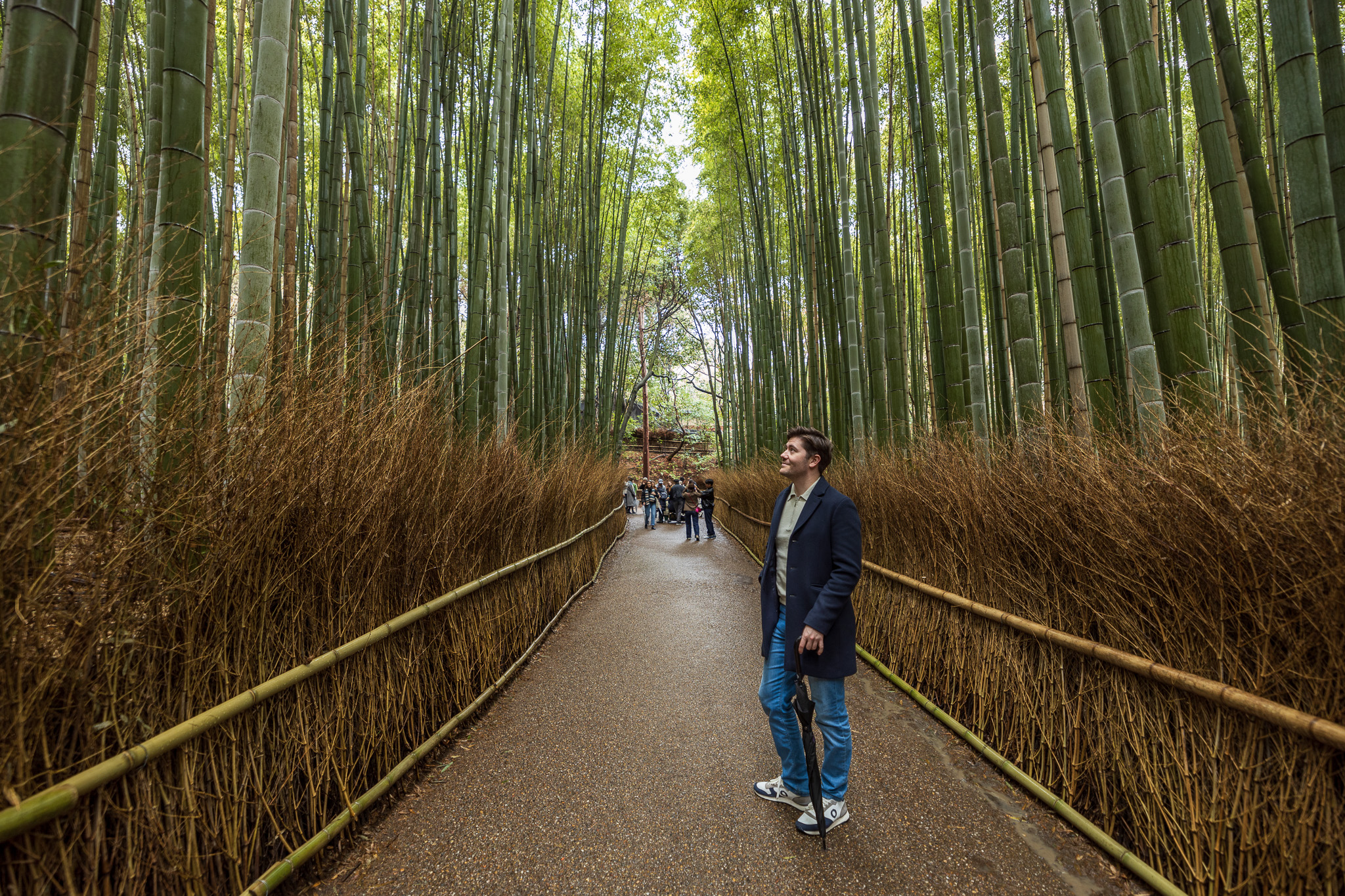
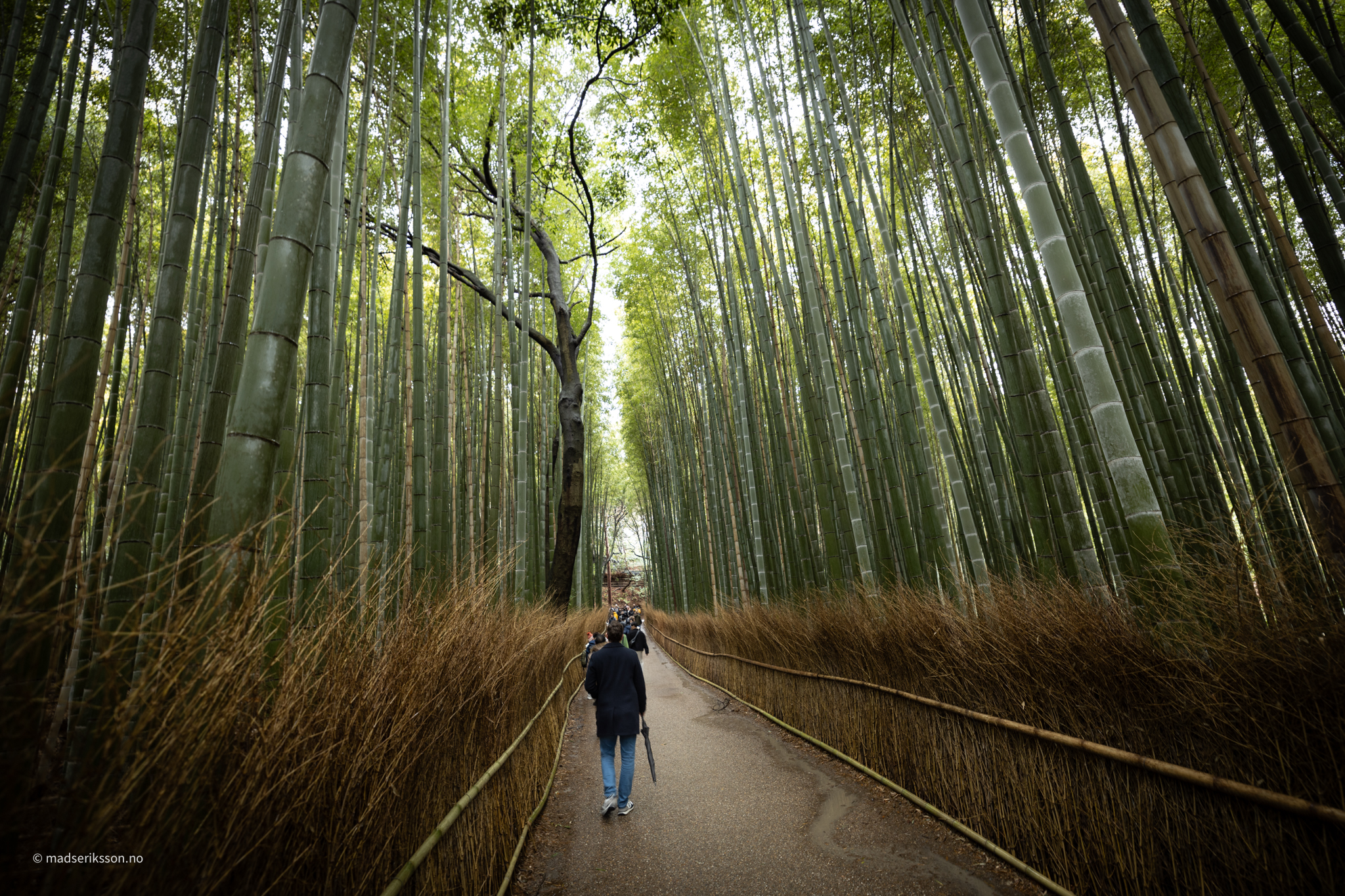
The temple’s north gate opens directly onto the Arashiyama Bamboo Grove partway along its length, bypassing the crowded southern entrance. Beyond the grove lies the villa garden of Ōkōchi Sansō; south of the temple the Ōi River runs under the Togetsukyō bridge. Arriving when the temple opens at 08:30 leaves the veranda nearly empty before the district fills from mid-morning.
A visitor pausing on the path through the Arashiyama Bamboo Grove in western Kyoto
3D model © 2026 madseriksson.no · Photographs © madseriksson.no. Buildings, ponds, river and paths: © OpenStreetMap contributors (ODbL). Tree cover from Sentinel-2 cloudless imagery (EOX, CC BY 4.0). Heights of the halls and gates are simplified and approximate, and the Arashiyama hills are shown flat. Sun positions are approximate.
The Founding — A Temple Built to Placate the Ghost of a Deposed Emperor
Ashikaga Takauji overthrew Emperor Go-Daigo, drove him into exile, and when the emperor died there in 1339 amid plague and political disaster, built him a temple. It was funded by a trade voyage to Ming China, laid out by the greatest Zen garden designer of the age, and ranked first among the Five Great Zen Temples of Kyoto
The political background to Tenryū-ji is worth understanding because it explains why the temple exists at all. Emperor Go-Daigo attempted, in the 1330s, to restore direct imperial rule to Japan after more than a century of government by military shogunates. The attempt — the Kenmu Restoration — succeeded briefly and then collapsed, largely because Ashikaga Takauji, the general whose support had made it possible, turned against the emperor and installed a rival claimant to the throne. Go-Daigo fled south to Yoshino and established a rival court there, dying in exile in 1339. Takauji, now shōgun, was left with a dead emperor whose claim had never been formally resolved and whose spirit, in the understanding of the period, had every reason to be dangerous. Vengeful spirits of the wrongfully treated great — onryō — were held responsible for epidemics, fires, droughts and political catastrophe, and the standard remedy was formal religious commemoration on a scale proportionate to the grievance. Takauji, advised by the Zen master Musō Soseki, founded Tenryū-ji on the site of a former imperial villa in Arashiyama and dedicated it to Go-Daigo’s memory.
The financing was as pragmatic as the motive. Rather than raise the money by taxation or donation, Takauji authorised an official trade mission to Ming China, with the profits designated for the temple’s construction. The vessels became known as the Tenryūji-bune — the Tenryū-ji ships — and the venture was successful enough to fund a temple complex of considerable scale. Musō Soseki became the founding abbot. He was, by any measure, the most consequential religious figure of his generation in Japan: adviser to emperors and shōguns, a leading Rinzai master, and the designer of several of the most significant gardens in Japanese history including Saihō-ji (the moss temple) and this one. Under him Tenryū-ji was placed at the head of the Kyoto Gozan, the five-temple hierarchy through which the Ashikaga shogunate organised and controlled Rinzai Zen, giving it a rank it has held ever since. The temple that a shōgun built out of fear of a ghost became the administrative centre of a branch of Zen Buddhism that today oversees roughly 3,000 temples.
The founding logic of Tenryū-ji is not devotional and not, in any straightforward sense, sincere. Takauji built it because a dead emperor he had destroyed was believed capable of destroying him in return. That the result is one of the most serenely beautiful places in Japan — a garden of such refinement that it became the first landscape the modern Japanese state ever placed under its highest protection — is an outcome that has nothing to do with the intention behind it. Buildings outlive their motives. This one has outlived its motive by seven centuries.
Sōgenchi — The Oldest Garden of Its Kind in Japan, Composed Around Mountains It Does Not Own
A pond garden laid out in the 1340s by Musō Soseki and surviving essentially unchanged: a dry waterfall of upright stones with carp climbing toward the Dragon Gate, a pond shaped to hold reflections, and behind it all Arashiyama and Kameyama — mountains outside the temple walls, borrowed into the composition so precisely that they read as its back wall
The Sōgenchi garden is arranged around a pond immediately behind the Ōhōjo (the abbot’s main hall), and the intended way to see it is from the wooden veranda of that hall: seated, looking out, with the pond in the foreground, the planted slope rising behind it and the mountains beyond that. What makes the composition remarkable is shakkei — borrowed scenery — the technique of incorporating distant landscape features that lie outside the garden’s boundary into its visual design. Mount Arashiyama and Mount Kameyama do not belong to the temple. They cannot be pruned, altered or maintained. What Musō Soseki controlled instead was everything in front of them: the height of the planting on the far bank, the position of the trees that frame the view, the shape of the pond, the level of the veranda. Manage all of that precisely enough and the mountain two kilometres away stops reading as background and starts reading as the garden’s furthest element — part of the arrangement, borrowed without being owned. Sōgenchi is the most celebrated surviving example of the technique in Japan, and standing on the veranda it is immediately obvious why: there is no visual seam. The garden simply continues into the hills.
Within the composition, the central symbolic feature is the karetaki — a dry waterfall arrangement of upright stones on the far side of the pond, with a group of flat stones set below it representing carp struggling up the falls. The reference is to the Chinese legend of the Dragon Gate: a carp that succeeds in ascending the waterfall is transformed into a dragon. In a Zen context the meaning is direct — the practitioner striving toward awakening — and the arrangement is one of the earliest surviving examples of this motif in Japanese garden design. These stones have been in these positions since the 14th century. The eight fires that destroyed the temple buildings did not move them. Successive abbots did not redesign them. The pond has been dredged and the planting has been replaced many times over, but the underlying structure — the placement of the stones, the shape of the water, the sightlines to the mountains — is the arrangement of a man who died in 1351. There are very few gardens anywhere in the world where this is true, and none in Japan of this age and quality.
Sit on the Ōhōjo veranda rather than walking the garden path. The garden was designed to be looked at from a seated position on that specific wooden platform, and every sightline in it was calibrated for that viewpoint. Walking the circuit path around the pond is pleasant and shows you the stones from other angles, but it is not what the composition is for. The veranda is free of charge with the garden ticket, has space to sit, and delivers in ten seated minutes what an hour of walking will not.
The Cloud Dragon — A Ceiling That Watches You From Every Position in the Room
The Dharma Hall ceiling carries a dragon painted in 1997 by Kayama Matazō for the temple’s 650th anniversary — a happōnirami composition with an “eight-directional glare” designed so the eyes follow the viewer from anywhere in the hall. It is open to visitors only on weekends and during special periods, and it is the reason to check the calendar before you go
Dragons on the ceilings of Zen dharma halls are a convention rather than a decoration. The dragon is a guardian of the Buddhist teaching and a bringer of rain — and rain, in a complex of wooden buildings that had burned down eight times, is not a trivial association. Most major Rinzai temples in Kyoto have one. Tenryū-ji’s is unusually recent: the previous ceiling dragon was moved to another hall, and in 1997, for the temple’s 650th anniversary, the Nihonga painter Kayama Matazō produced a new Unryū-zu — Cloud Dragon — on a circular field directly above the centre of the Hattō. It is painted in ink on a plaster ground, executed in a monochrome that keeps it firmly within the classical tradition despite its date, and it is a happōnirami dragon: composed so that the eyes appear to be looking directly at the viewer from any point in the hall, in all eight directions. The effect is achieved through the geometry of the eyes and the foreshortening of the head, and it is startlingly effective. Standing beneath it and walking a slow circle — which is exactly what visitors do, and what the composition invites — the gaze tracks you the entire way round.
The Hattō is not always open. Access to the Dharma Hall is generally limited to weekends and public holidays plus designated special-opening periods (typically the spring and autumn seasons), carries a separate small admission fee from the garden ticket, and is closed at other times. This is the single most common disappointment among visitors who arrive at Tenryū-ji on a Tuesday expecting to see the dragon, and it is easily avoided by checking the temple’s opening schedule before setting the date. The other principal buildings — the Ōhōjo and Kohōjo (the greater and lesser abbot’s halls), the Kuri (the kitchen and administrative building, whose steep white gable is the first thing visitors see on entering), the Tahoden and the Shoin — are Meiji-period reconstructions and open on the standard garden-and-buildings tickets. They are handsome, restrained and worth walking through, particularly the Ōhōjo with its tatami rooms opening onto the garden veranda. But they are not old, and pretending otherwise misrepresents what Tenryū-ji is: a 14th-century garden surrounded by 19th-century architecture and a 20th-century dragon, all of it operating as a functioning Zen monastery.
The Cloud Dragon was painted in 1997 by a man born in 1927, in a tradition established a thousand years earlier, for a temple founded in 1339, on a ceiling that had burned eight times. Nothing about this is a contradiction in Japanese religious architecture. The building is the temporary container; the institution is the continuity. When it burns, you rebuild it, and when you rebuild it you commission the best painter of the current generation to put a new dragon on the ceiling. The dragon is 28 years old. It belongs there completely.
Arashiyama — The Back Gate Into the Bamboo, and the Rest of the Day
Tenryū-ji’s north gate opens directly into the Arashiyama Bamboo Grove, bypassing its crowded southern entrance entirely — the single most useful logistical fact in western Kyoto. Beyond it: the Togetsukyō bridge over the Ōi river, the Ōkōchi Sansō villa gardens, and shōjin ryōri served inside the temple grounds overlooking the garden that just took an hour of your attention
The Arashiyama Bamboo Grove is among the most photographed places in Japan and, at midday, one of the most crowded: a narrow path between towering stands of moso bamboo, entered from the south by a large majority of the several thousand people who walk it daily. Tenryū-ji’s north gate opens directly onto the grove path partway along its length. Buying a garden ticket, walking the Sōgenchi circuit and exiting north deposits you in the middle of the bamboo without ever queueing at the main entrance — a route that costs nothing extra and removes the worst part of the Arashiyama experience. Beyond the grove’s northern end lies Ōkōchi Sansō, the hillside villa and gardens built by the film actor Ōkōchi Denjirō over three decades from the 1930s, which charges a comparatively high admission that includes tea and a sweet, and which is consistently among the least crowded and most rewarding gardens in the district. To the south of the temple, the Ōi River runs under the Togetsukyō — the Moon Crossing Bridge, named by a 13th-century emperor who watched the moon appear to move across it — with the wooded slopes of Arashiyama rising directly behind. The bridge, the river and the mountain constitute the standard image of Arashiyama and are at their best in the last hour of daylight.
On timing: Tenryū-ji opens at 08:30, and arriving at opening is the difference between having the Ōhōjo veranda largely to yourself and sharing it with a coach party. Arashiyama as a district fills steadily from mid-morning and is genuinely congested from around 11:00 to 16:00, particularly in the autumn colour season and during cherry blossom. Late November is the peak of the maple season here and the finest time to see the garden — the borrowed mountains turn as well, which means the shakkei composition changes colour in its entirety — but it is also when Arashiyama receives its heaviest visitor numbers of the year. The resolution is the same as everywhere else in Kyoto: come at opening. Inside the grounds, Shigetsu serves shōjin ryōri — the monastic vegetarian cuisine, no meat, fish, onion or garlic, built on tofu, seasonal vegetables, pickles and clear broth — in set courses in a room overlooking the garden. It is not inexpensive, requires a reservation, and is one of the few opportunities in Kyoto to eat food that belongs to precisely the same tradition as the building you are sitting in.
Most visitors do Arashiyama in the wrong order: bamboo grove first, at eleven, with everybody else, then the temple as an afterthought. Reversed, it works: at the temple gate for 08:30, an hour on the Ōhōjo veranda with the garden nearly empty, out through the north gate into the bamboo before the grove has filled, up to Ōkōchi Sansō for tea, and down to the Togetsukyō by lunchtime as the crowds arrive from the opposite direction. Same district, same sites, entirely different day.
More in the same area
 Food and DrinksNishiki Market — Kyoto’s Kitchen
 CitiesHiking Mount Inari — Fushimi Inari’s Full Loop
 CitiesKyoto: A Timeless Journey Through Japan’s Cultural Heart
 ForrestsDiscover the Enchantment of Arashiyama Bamboo Grove
 Train travelThe World’s 10 Great Railway Journeys
 NatureThe World’s 15 Most Spectacular Waterfalls