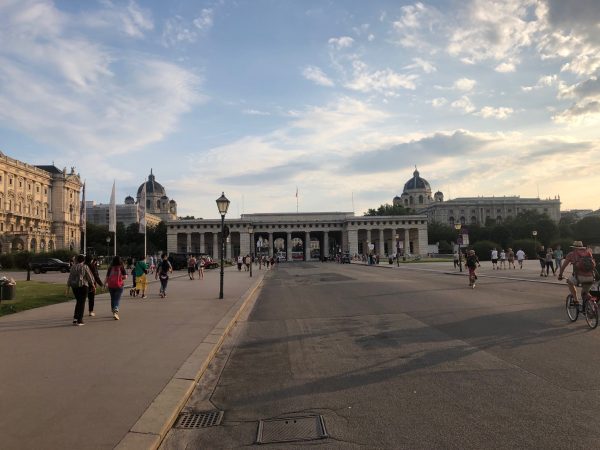
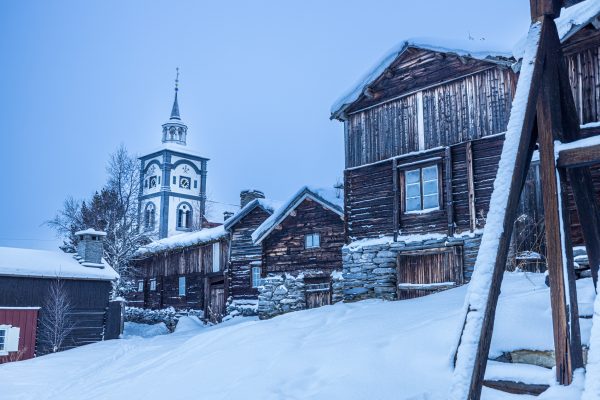
Strasbourg has changed nationality five times since 1681. French under Louis XIV, German after the Franco-Prussian War of 1871, French again in 1918, German again in 1940, French again in 1945 — and each transfer left buildings, street names, institutions and a population that learned to be careful about which language it spoke and to whom. The result is a city that is not French with German influences or German with French influences but something that exists only here: a cathedral in pink Vosges sandstone that was the tallest building in the world for 227 years, a quarter of half-timbered tanners’ houses on the water, an entire German imperial district built between 1871 and 1918 that is now a UNESCO site in France, and a cuisine that puts sauerkraut and Riesling on the same plate without anyone finding it remarkable. It is also, since 1949, the seat of the Council of Europe and the European Parliament — a decision that was not about logistics. The most contested city on the Franco-German border was made the meeting place of a reconciled Europe on purpose.

Strasbourg sits on the Ill River a few kilometres west of the Rhine, which here forms the border with Germany — the German town of Kehl is a twenty-minute tram ride from the centre of Strasbourg, and the tram crosses the Rhine into another country as a matter of ordinary daily commuting. The city’s historic core, the Grande Île, is an island formed where the Ill divides and rejoins: a compact oval of medieval and early modern streets containing the cathedral, the Palais Rohan, the covered bridges and the tanners’ quarter of La Petite France, inscribed in its entirety as a UNESCO World Heritage Site in 1988. In 2017 the inscription was extended across the water to include the Neustadt — the “new town” built by the German Empire between 1871 and 1918 as the showpiece capital of the annexed province of Alsace-Lorraine. It is one of the few places where UNESCO protects, in the same city, the medieval French heritage and the imperial German architecture built expressly to replace it.
The name is Germanic — Strateburgum, the fortress on the road — and the local language, Alsatian, is a High German dialect that was the everyday speech of the region into the twentieth century and is still heard among older residents. This linguistic fact is the key to understanding the city’s history: Alsace was culturally and linguistically Germanic for most of its existence and politically French for most of the modern period, which made it the obvious prize in every Franco-German confrontation and the obvious symbol once those confrontations ended. Strasbourg is where the European Parliament sits, and where Robert Schuman — a Frenchman born in Luxembourg who was conscripted into the German army in the First World War — helped construct the institutions that made another war between these countries structurally implausible. The city’s history is not a background detail to a pleasant weekend break. It is the reason the weekend break is possible.
How to approach Strasbourg
The Grande Île is entirely walkable and largely pedestrianised; nothing on it is more than twenty minutes on foot from anything else. Two days covers the island and the Neustadt comfortably; three allows a day on the Alsace wine route in the villages to the south. Strasbourg is 1h50 from Paris by TGV and has an excellent tram network. The Christmas market season, from late November to Christmas Eve, transforms the city completely and requires booking accommodation months in advance.
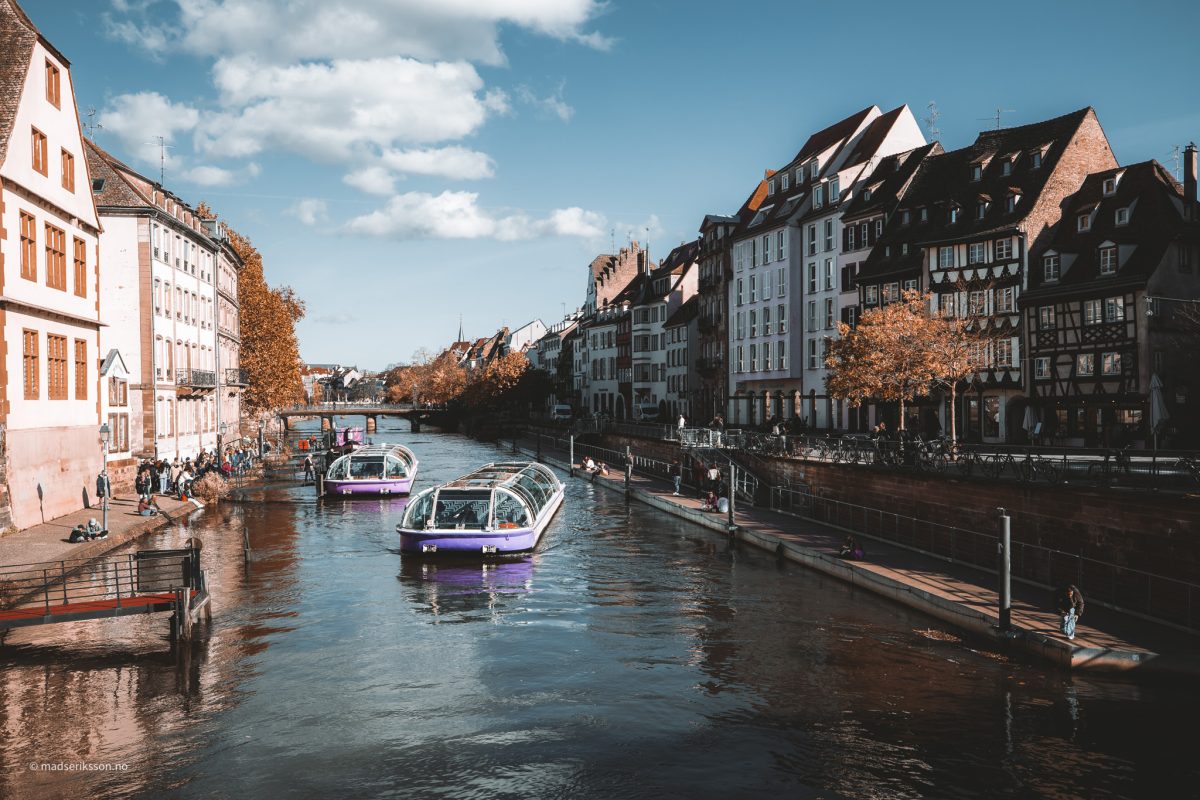
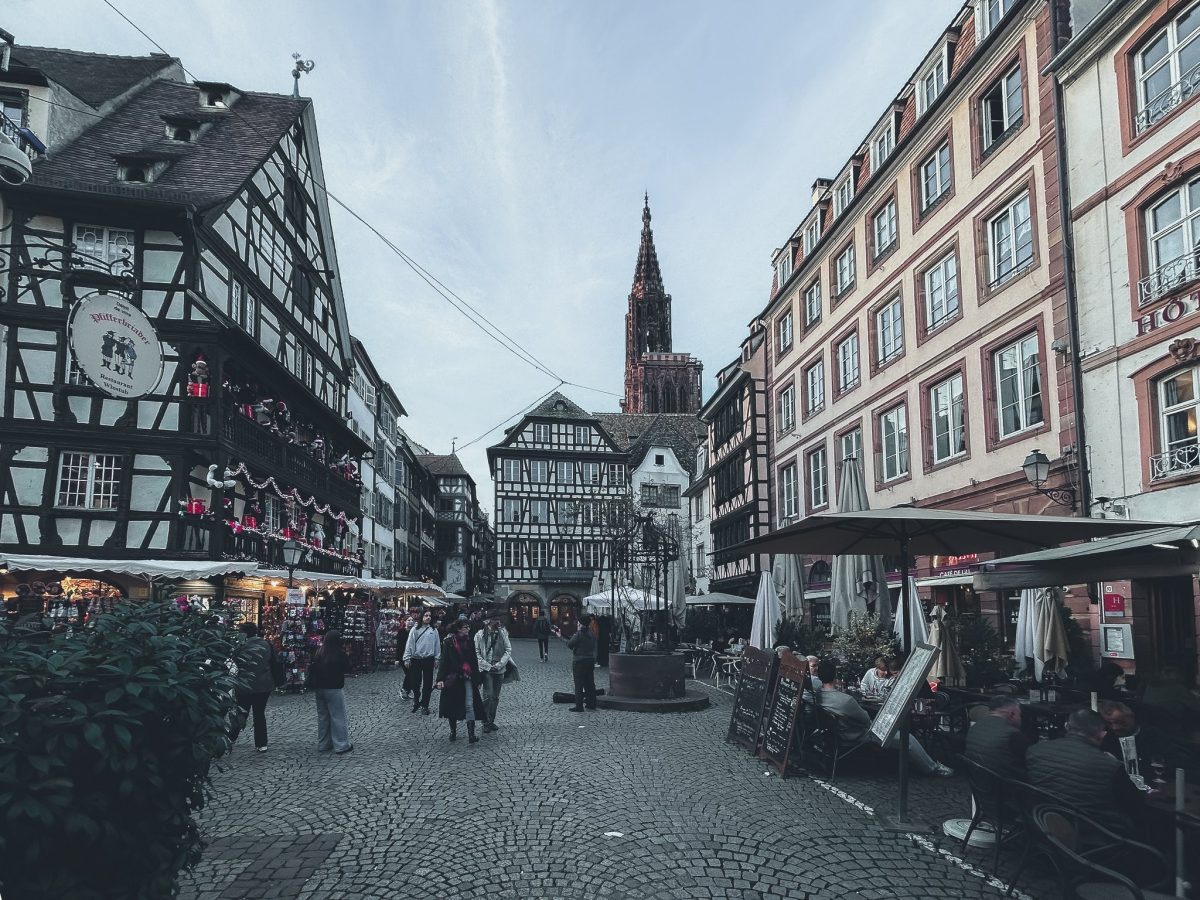
Strasbourg in 3D
Strasbourg lies on the Ill a few kilometres west of the Rhine, which here forms the border with Germany. The city changed country five times between 1681 and 1945. Its historic core, the Grande Île, became a World Heritage Site in 1988, and in 2017 the listing was extended to the Neustadt built by the German Empire between 1871 and 1918.
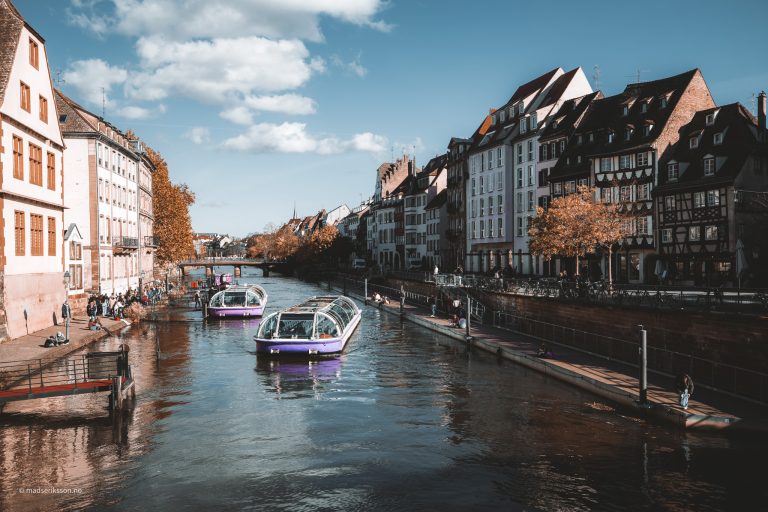
La Petite France and the Ponts Couverts
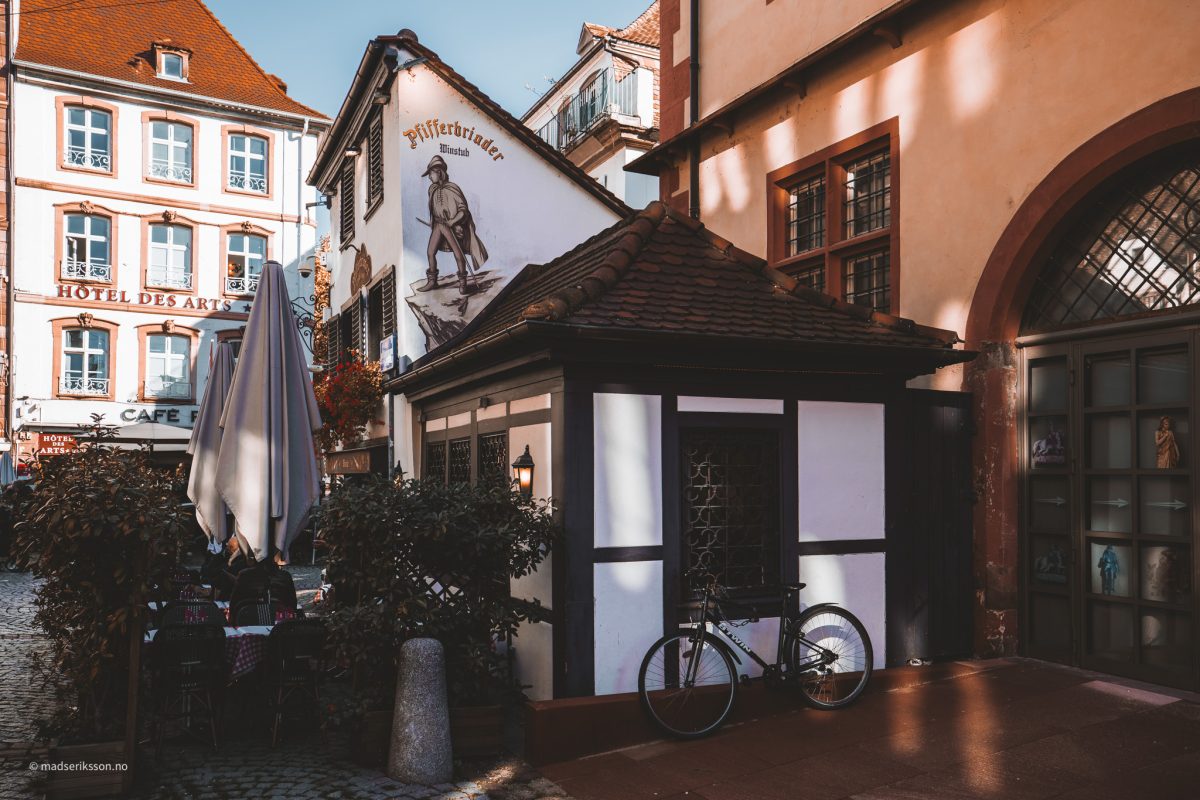
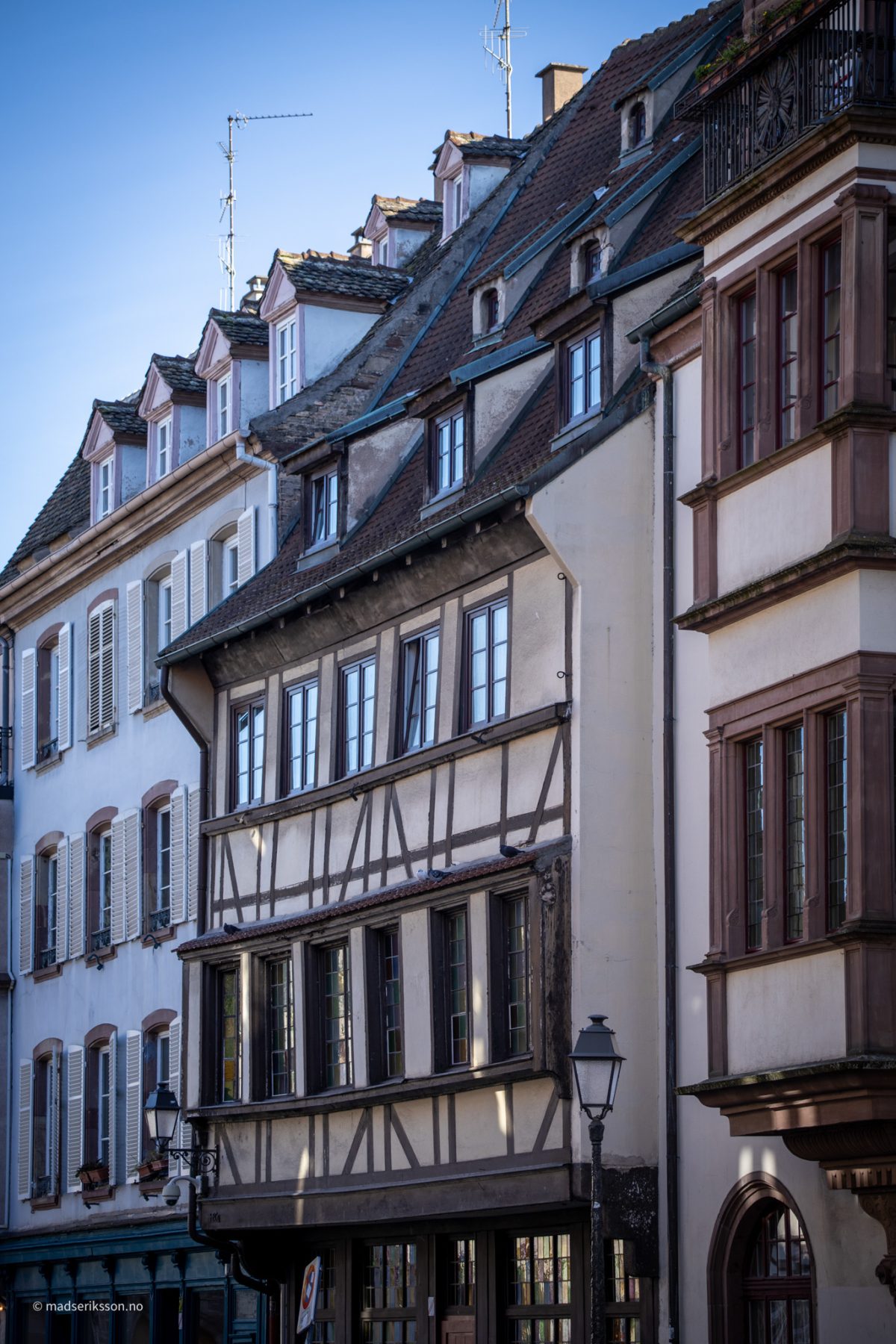
La Petite France, at the western end of the Grande Île, was the quarter of tanners, millers and fishermen; the steep, open attic storeys of its half-timbered houses were lofts for drying hides. At the western tip stand the Ponts Couverts, three 13th-century bridges with four square towers, and behind them the Barrage Vauban of 1690, built so the southern approach to the city could be flooded.
Glass-roofed tour boats on the Ill, lined by tall half-timbered houses in Strasbourg
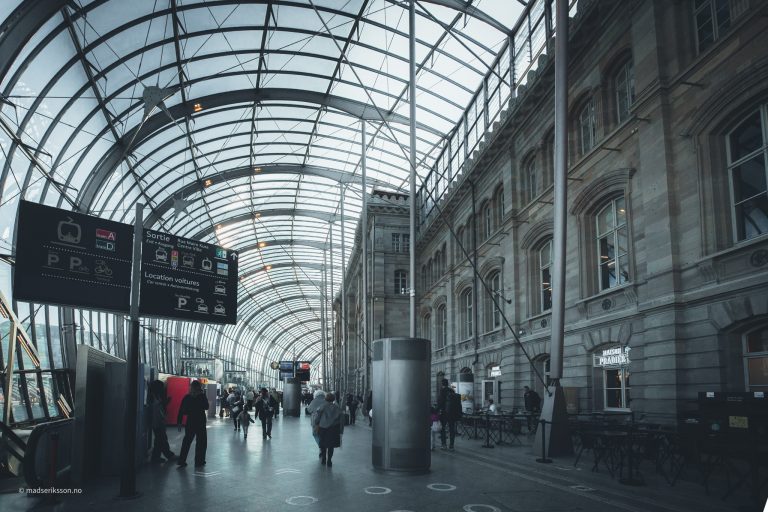
Strasbourg station
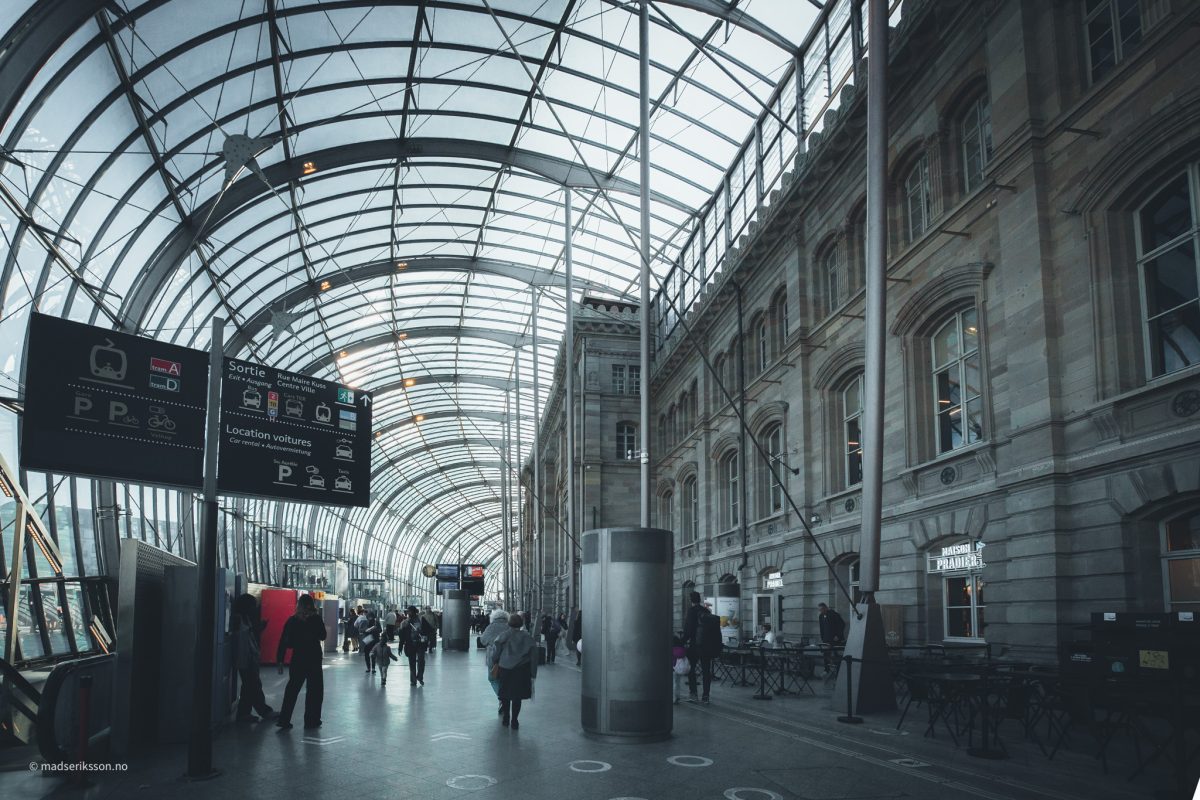
The main station was built between 1878 and 1883, during the German period. In 2006–2007, before the LGV Est high-speed line opened, its historic facade was wrapped in a large glass canopy. The TGV reaches Paris in about 1 hour 50 minutes.
The glass canopy wrapped around the historic facade of Strasbourg’s main railway station
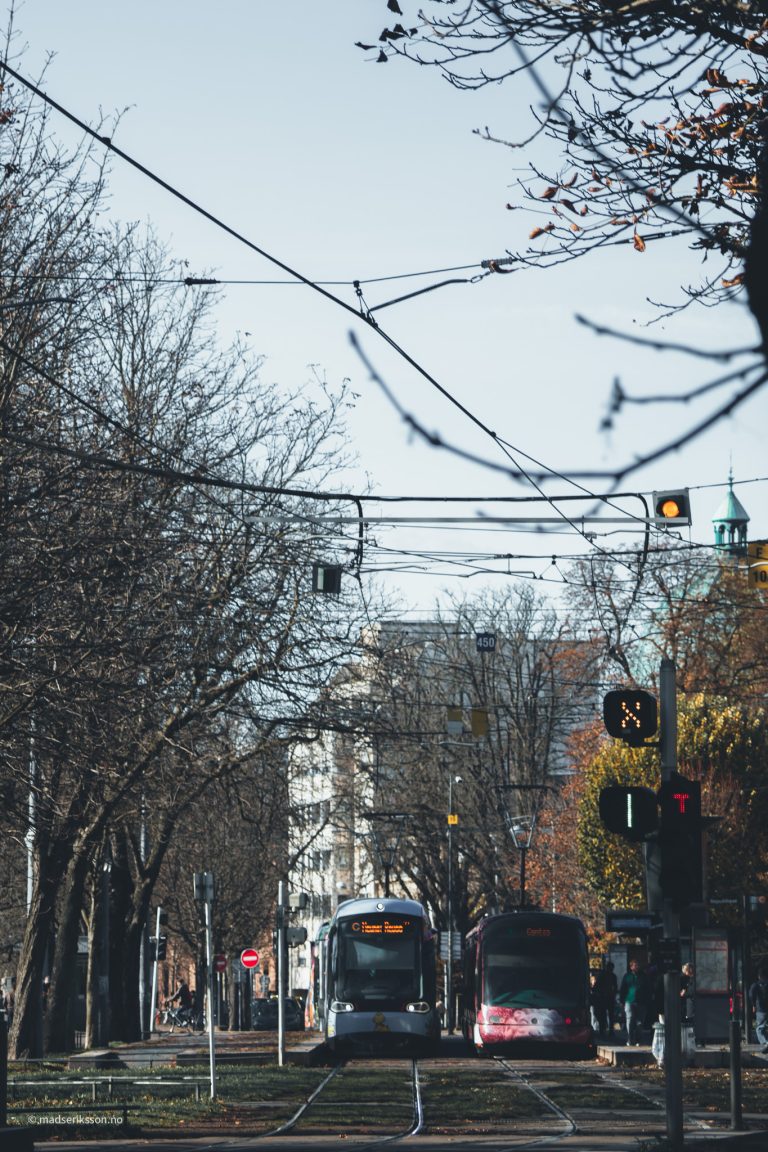
The Neustadt and Place de la République
After annexing Alsace-Lorraine in 1871, the German Empire built the Neustadt north and east of the old island as the capital of the new province, with broad boulevards, a university and imperial administrative palaces. The Palais du Rhin, built as the Kaiser's residence, faces Place de la République, whose war memorial shows a mother holding two dying sons, one who fought for France and one for Germany.
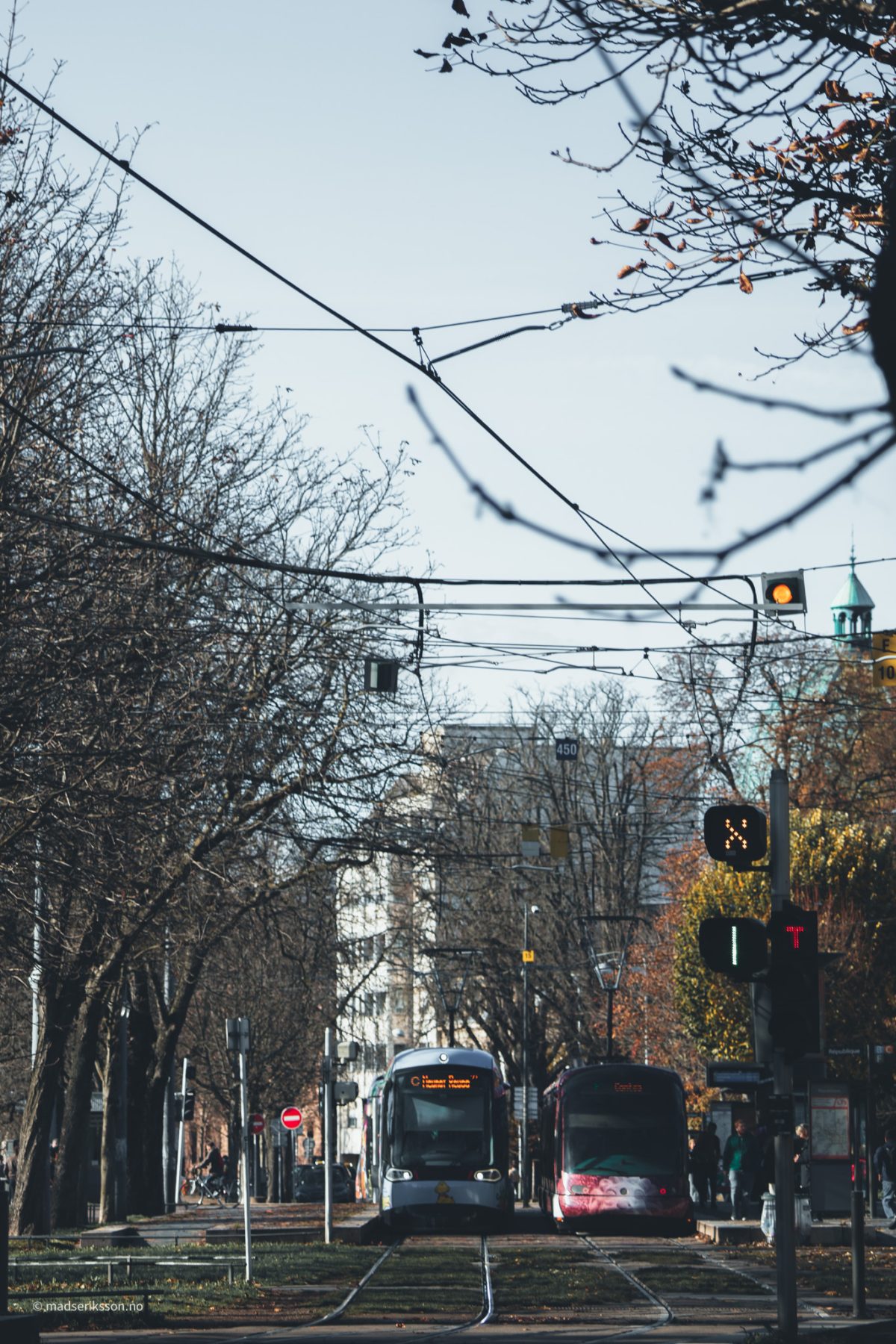
Trams waiting beneath bare autumn trees on a tree-lined avenue in Strasbourg
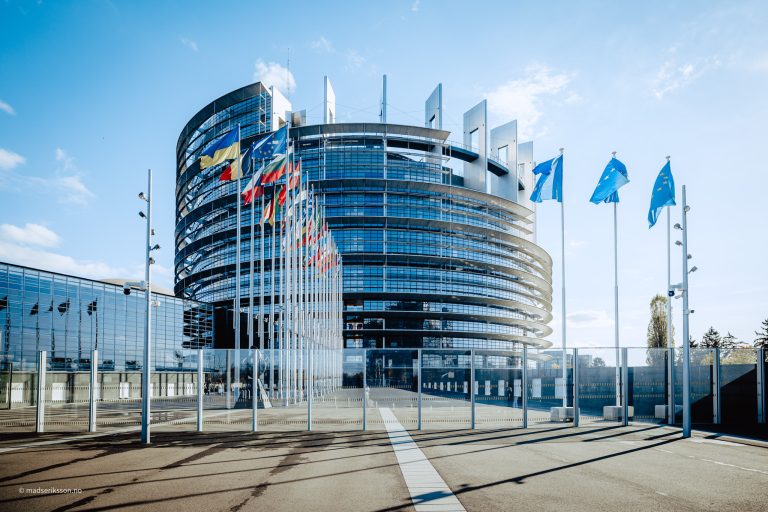
The European Parliament
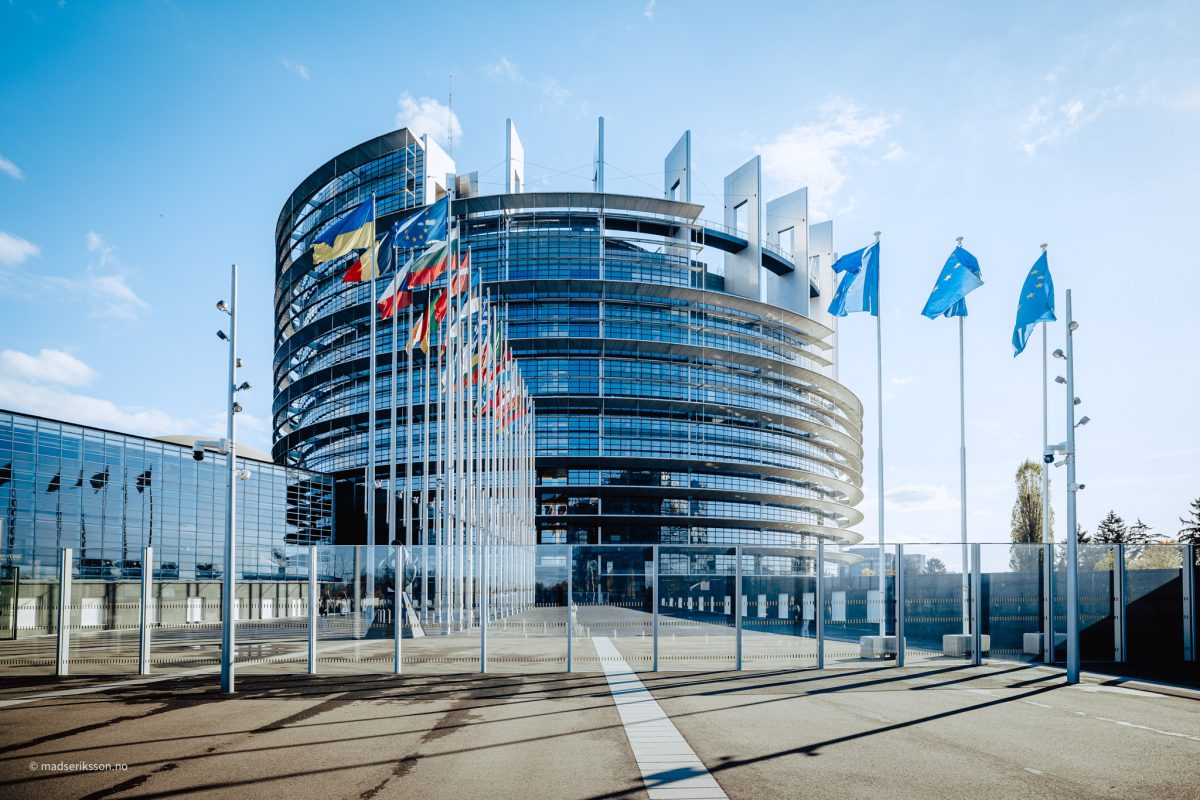
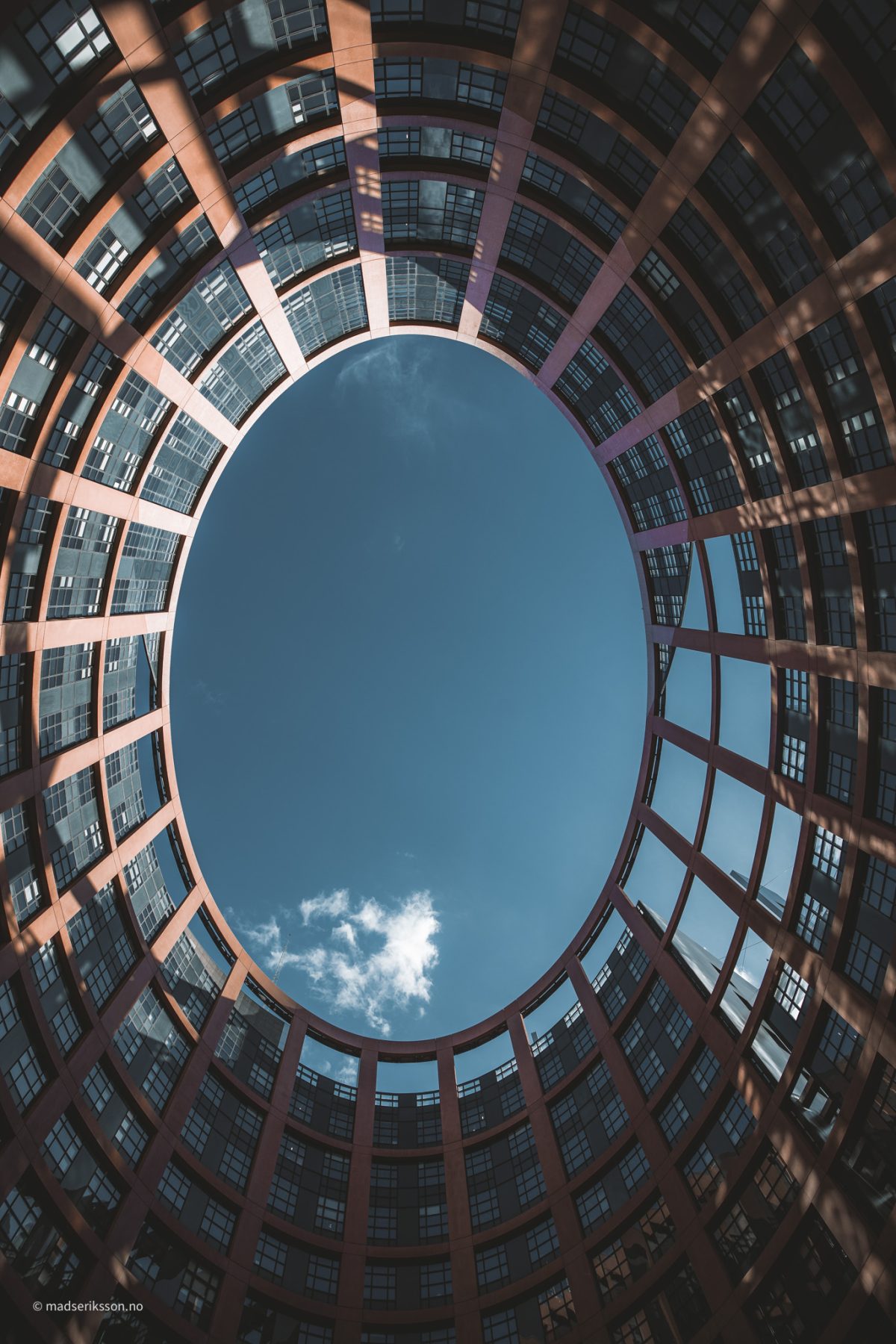
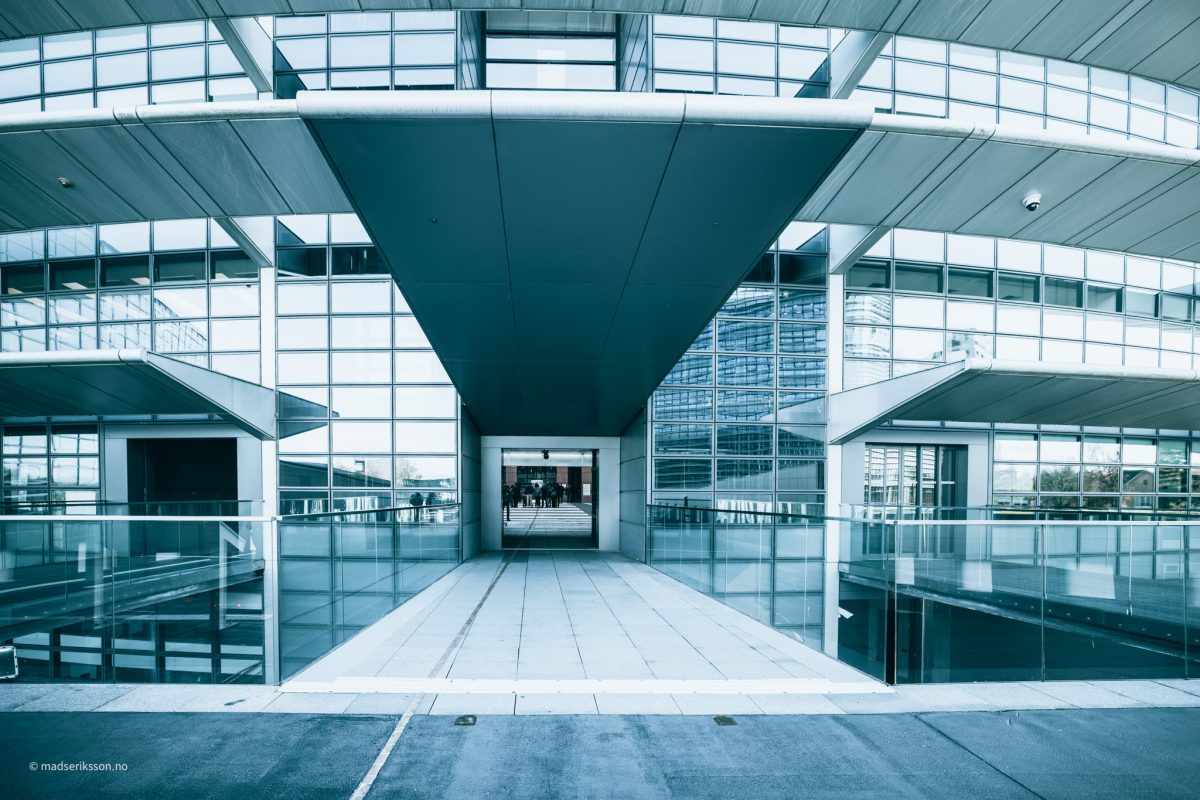
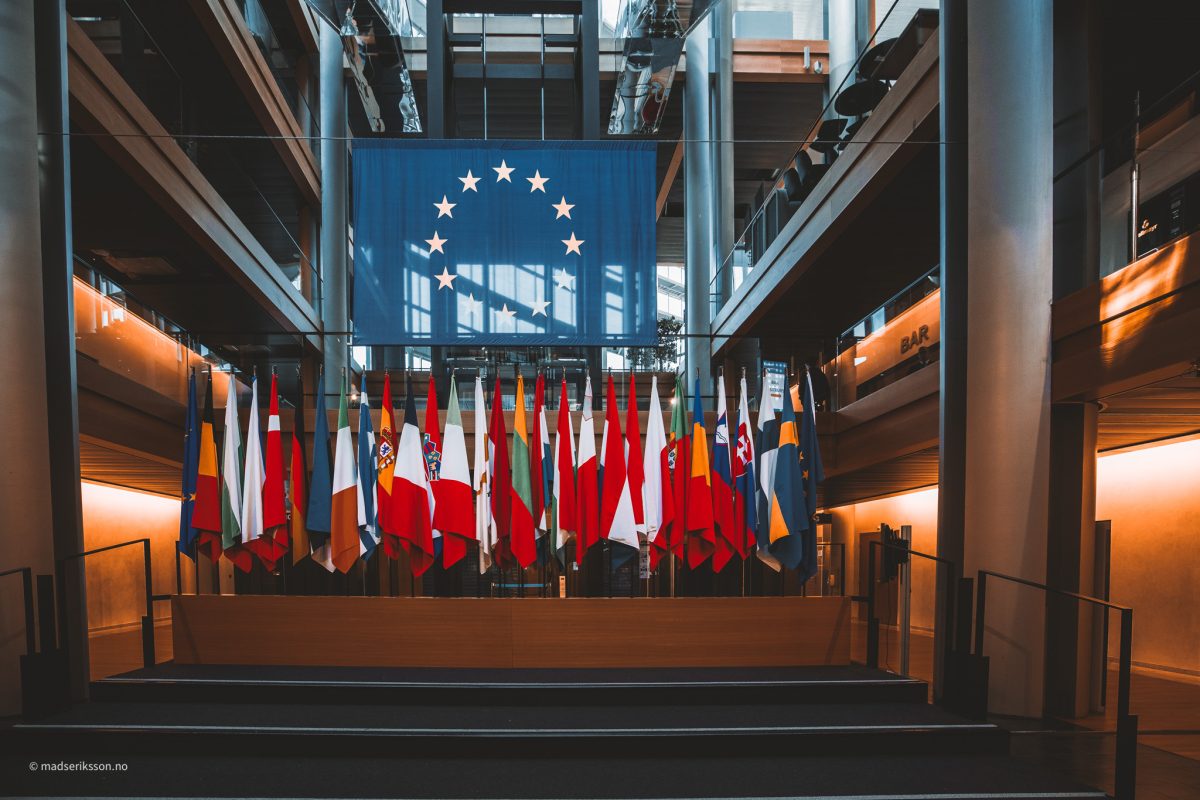
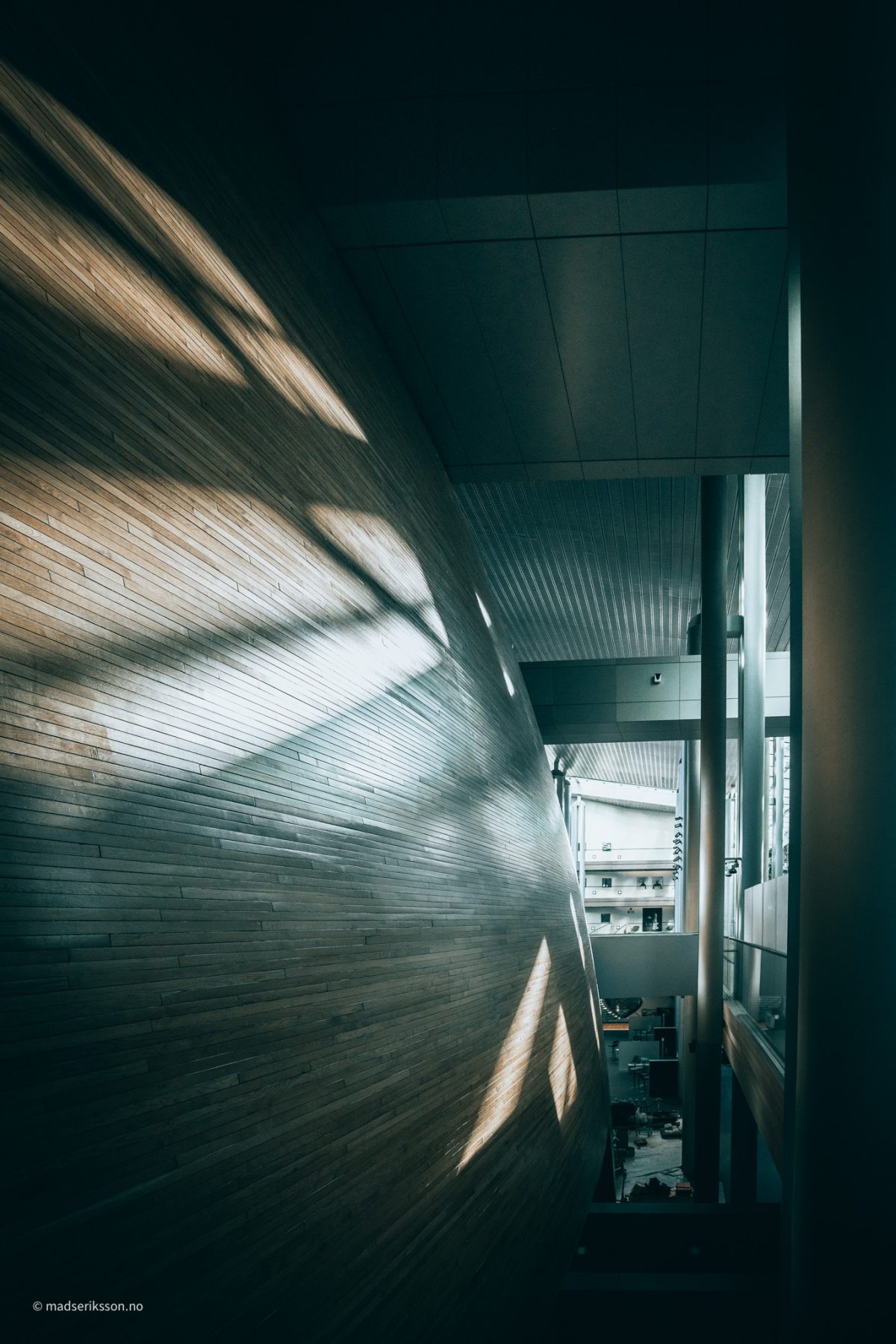
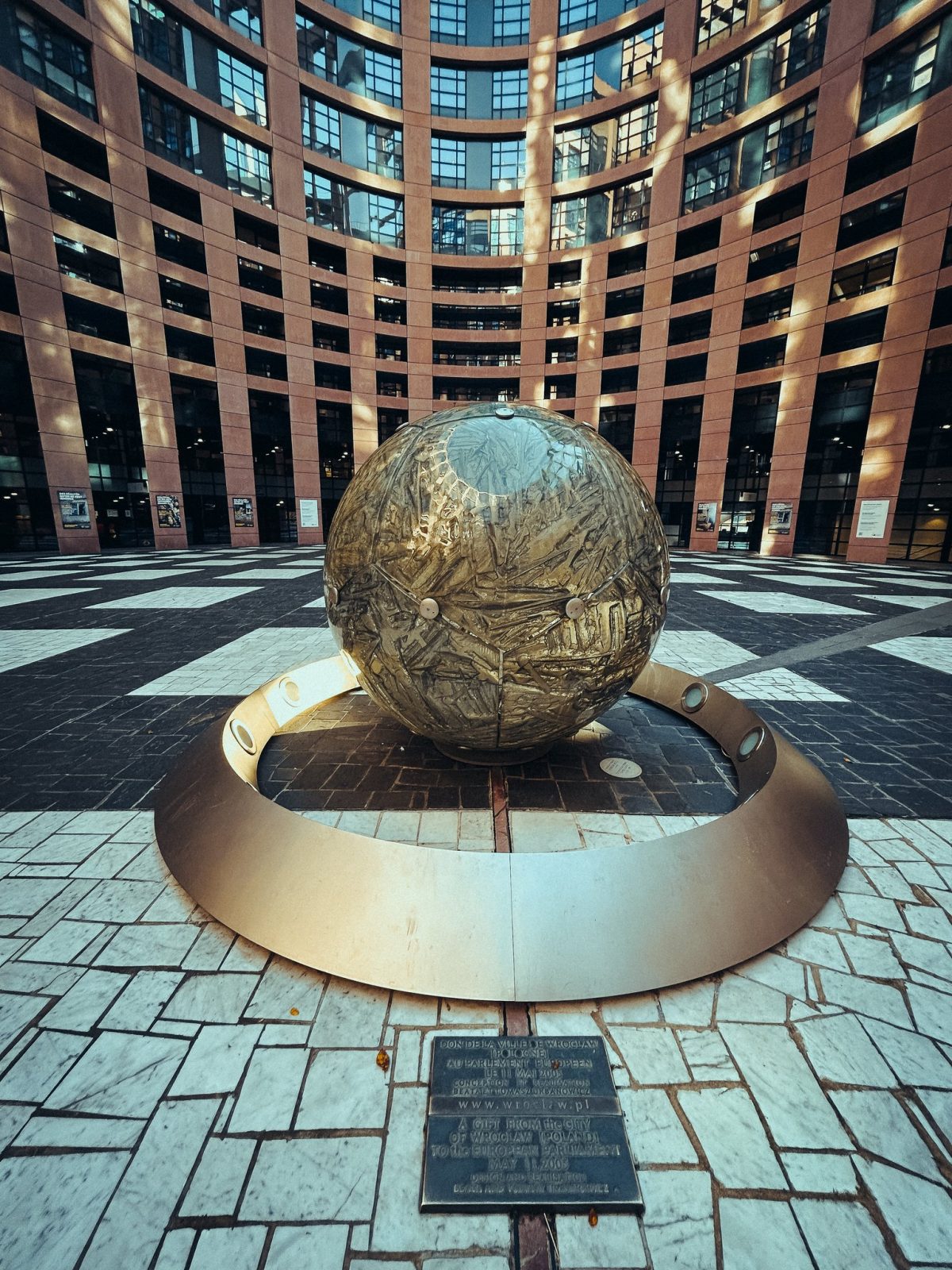
The Council of Europe chose Strasbourg as its seat in 1949, and the European Court of Human Rights and the European Parliament followed. The Parliament's Louise Weiss building by Architecture-Studio was inaugurated in December 1999 beside the Ill, with a 60 m tower and a hemicycle originally built for 750 members.
The European Parliament building in Strasbourg, flags lined up in front of its glass tower
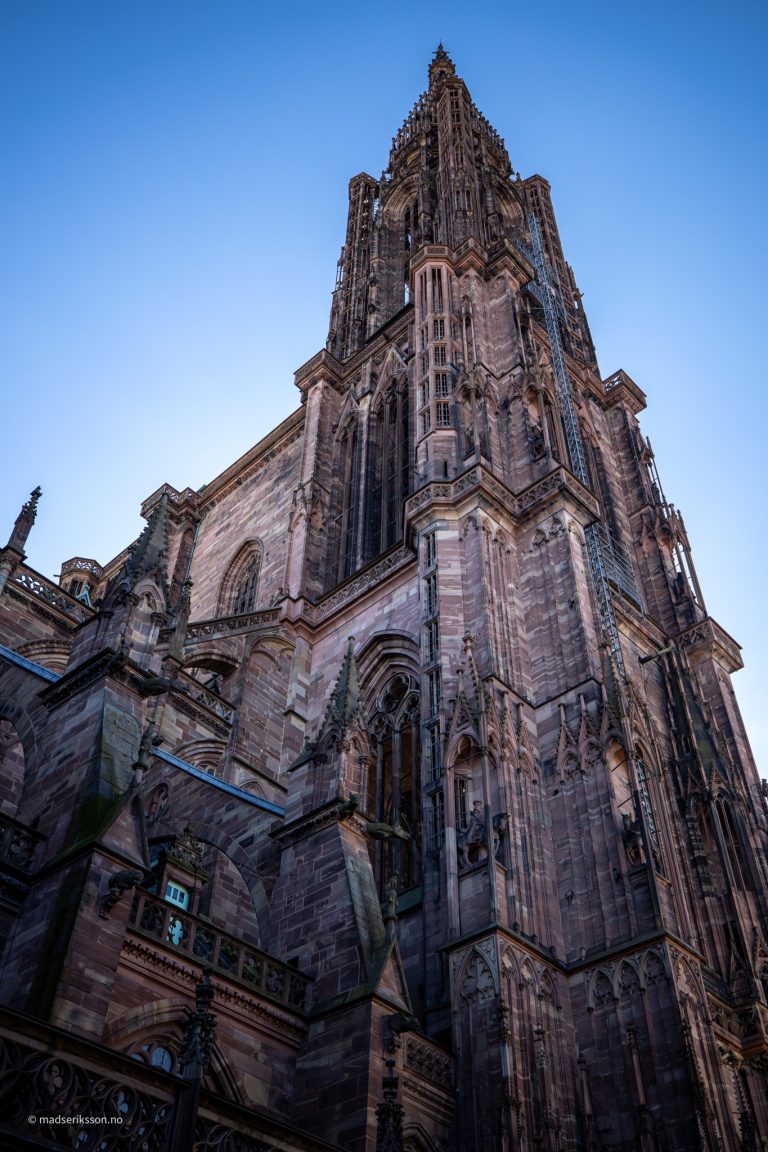
Strasbourg Cathedral
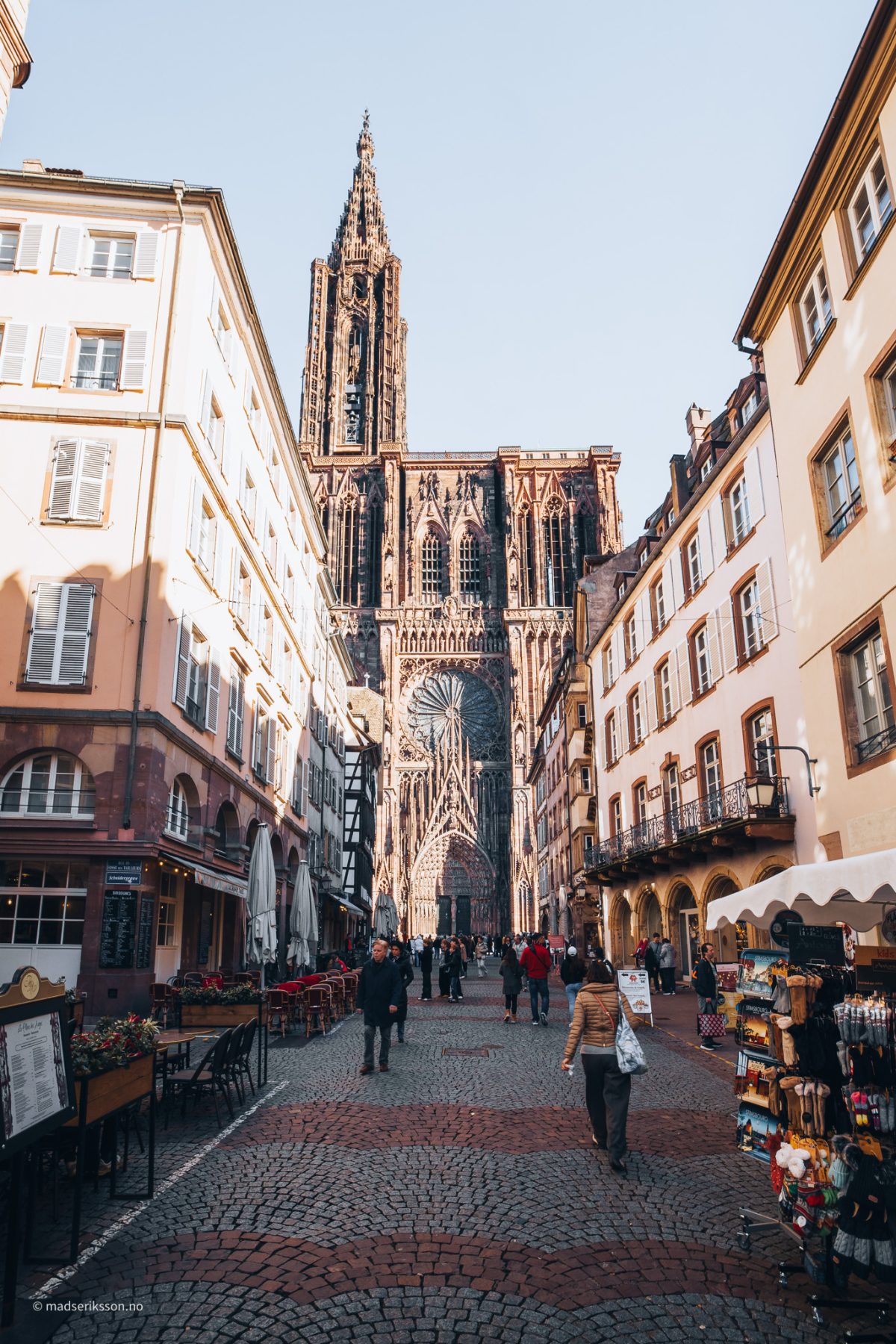
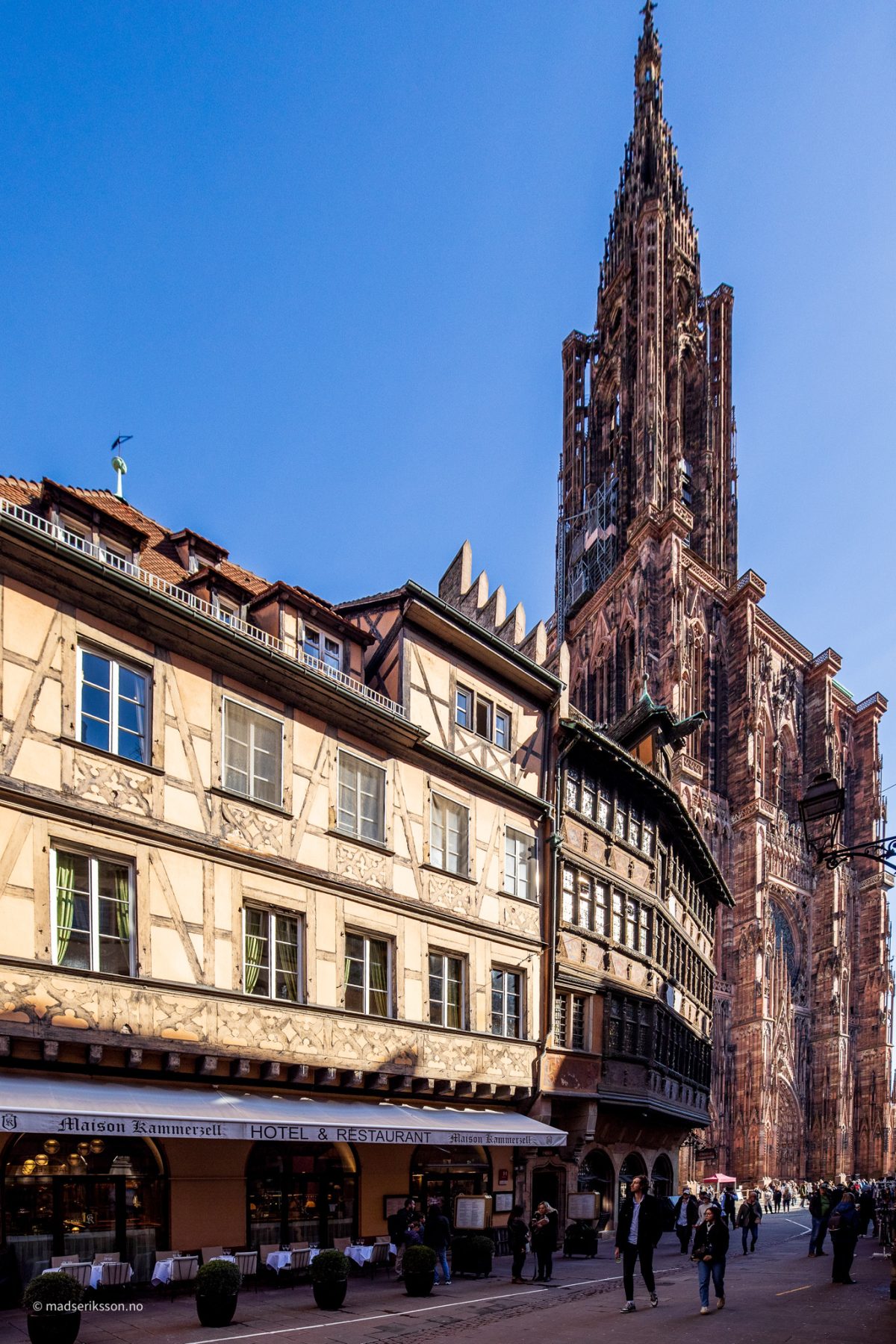
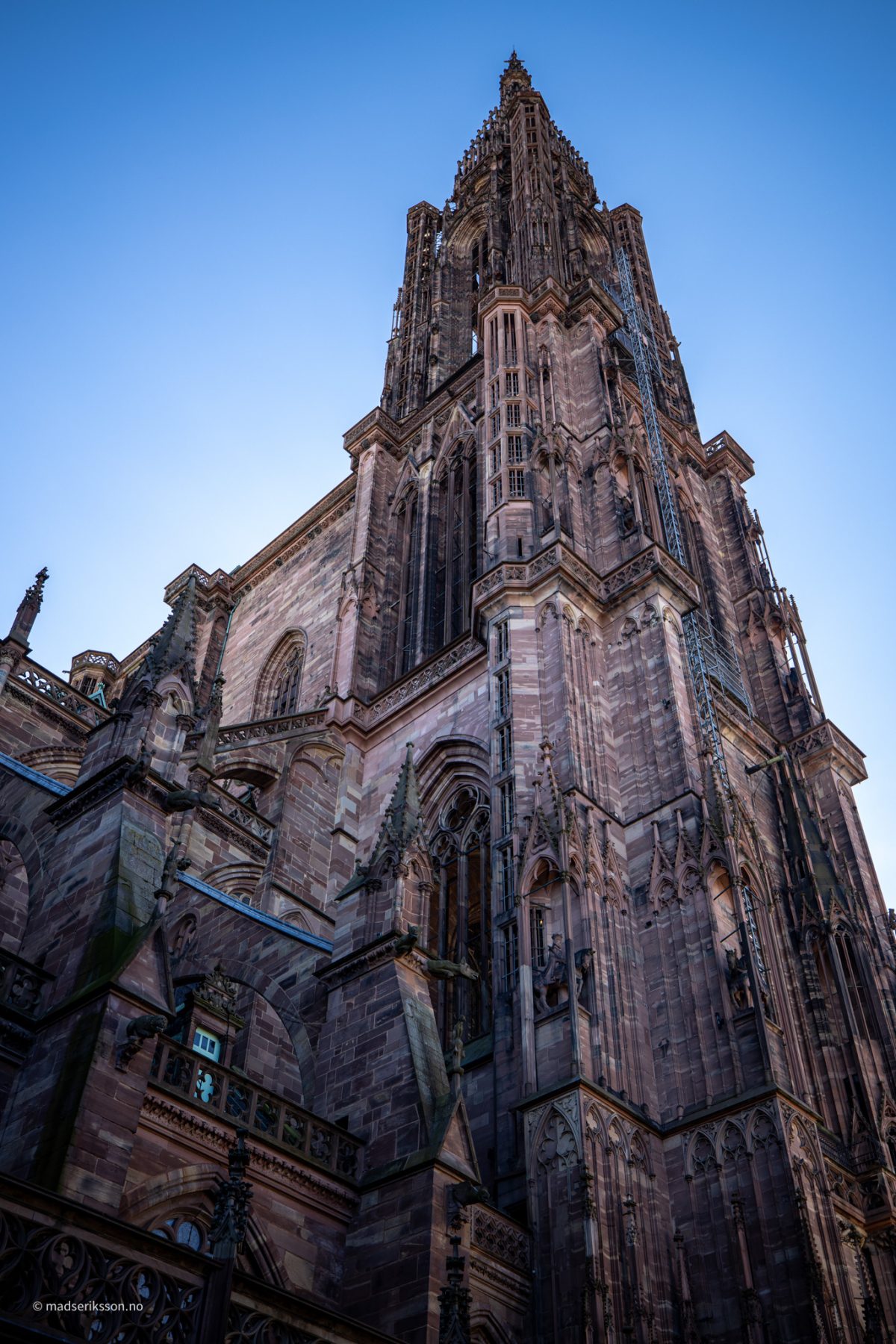
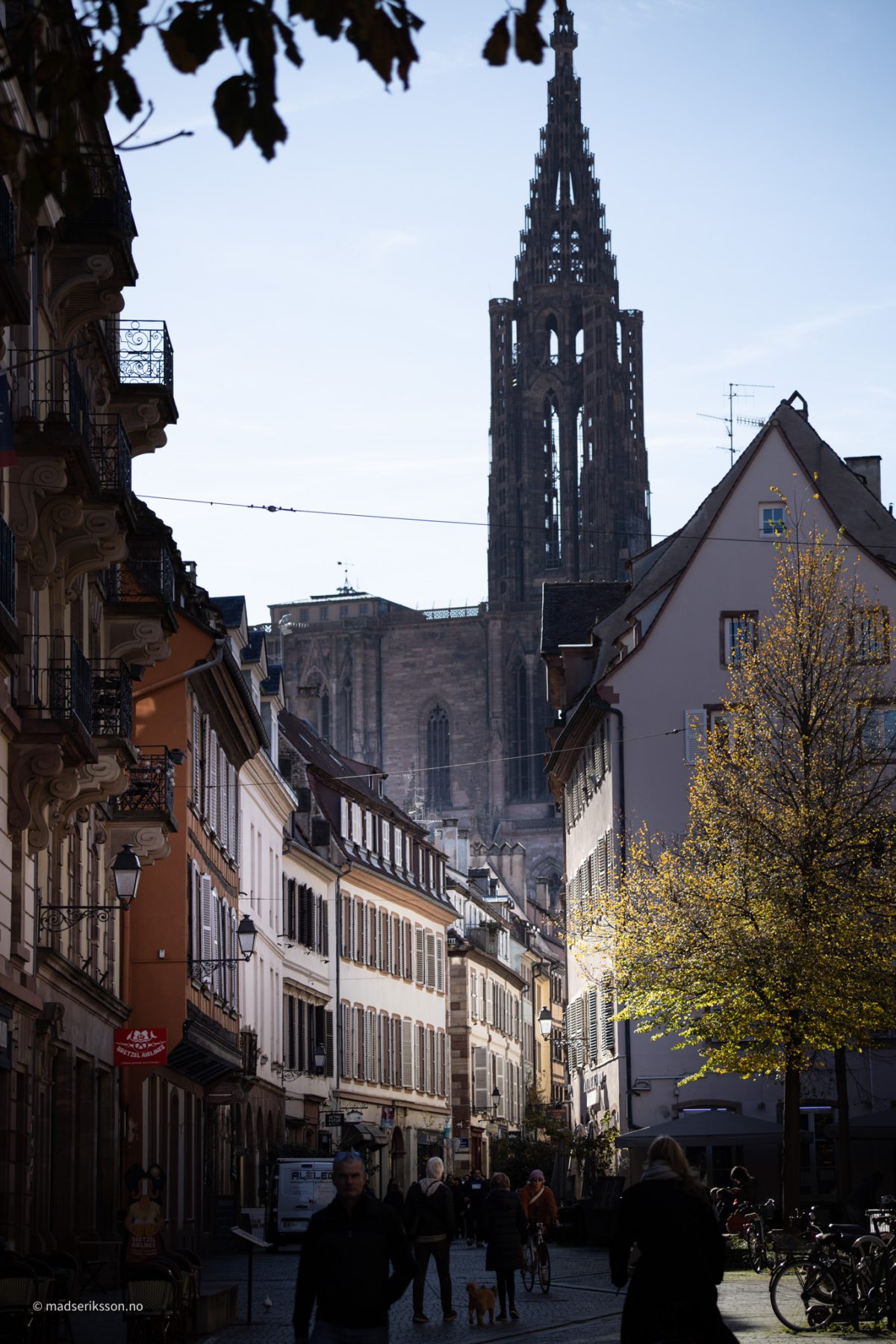
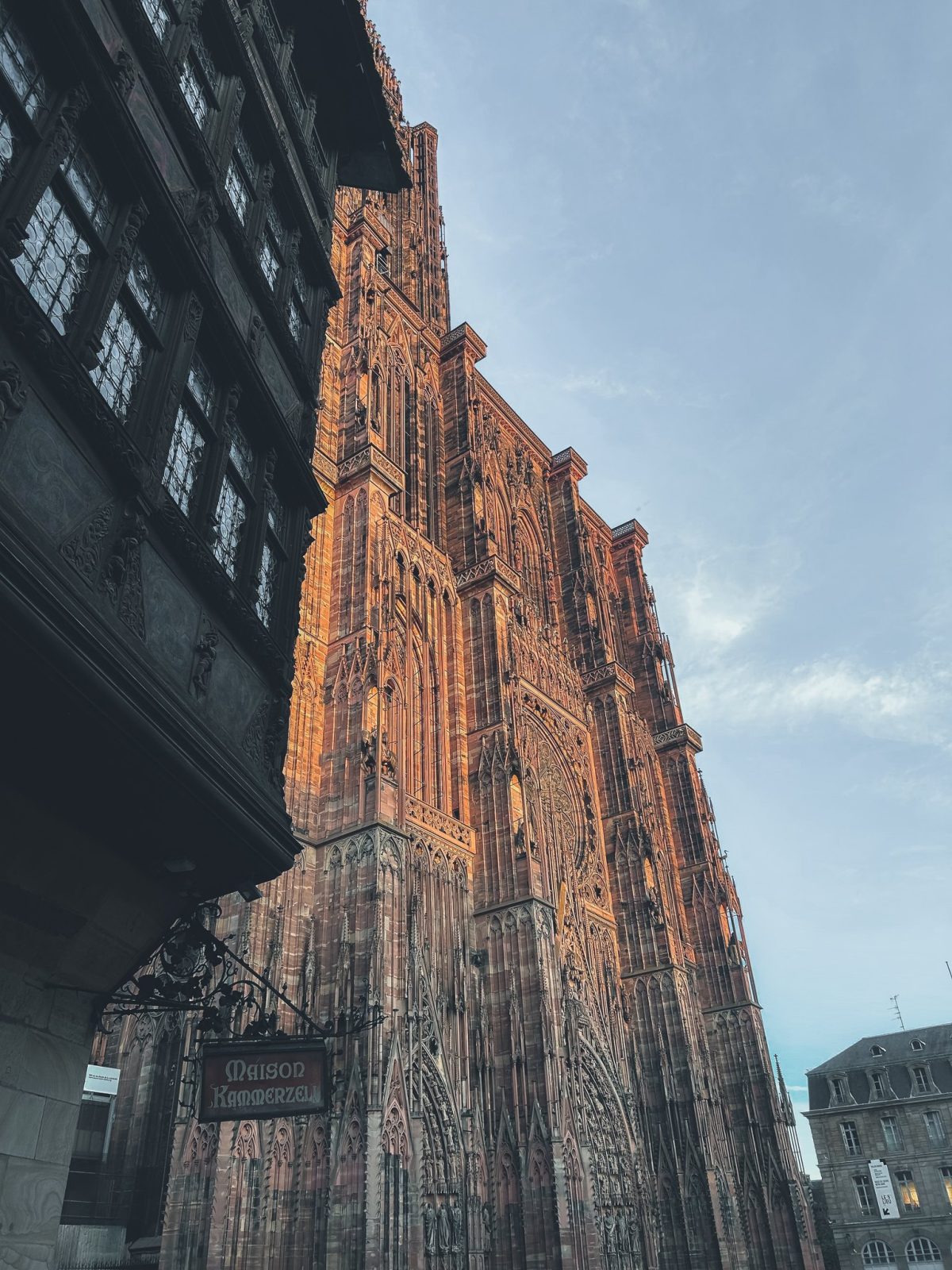
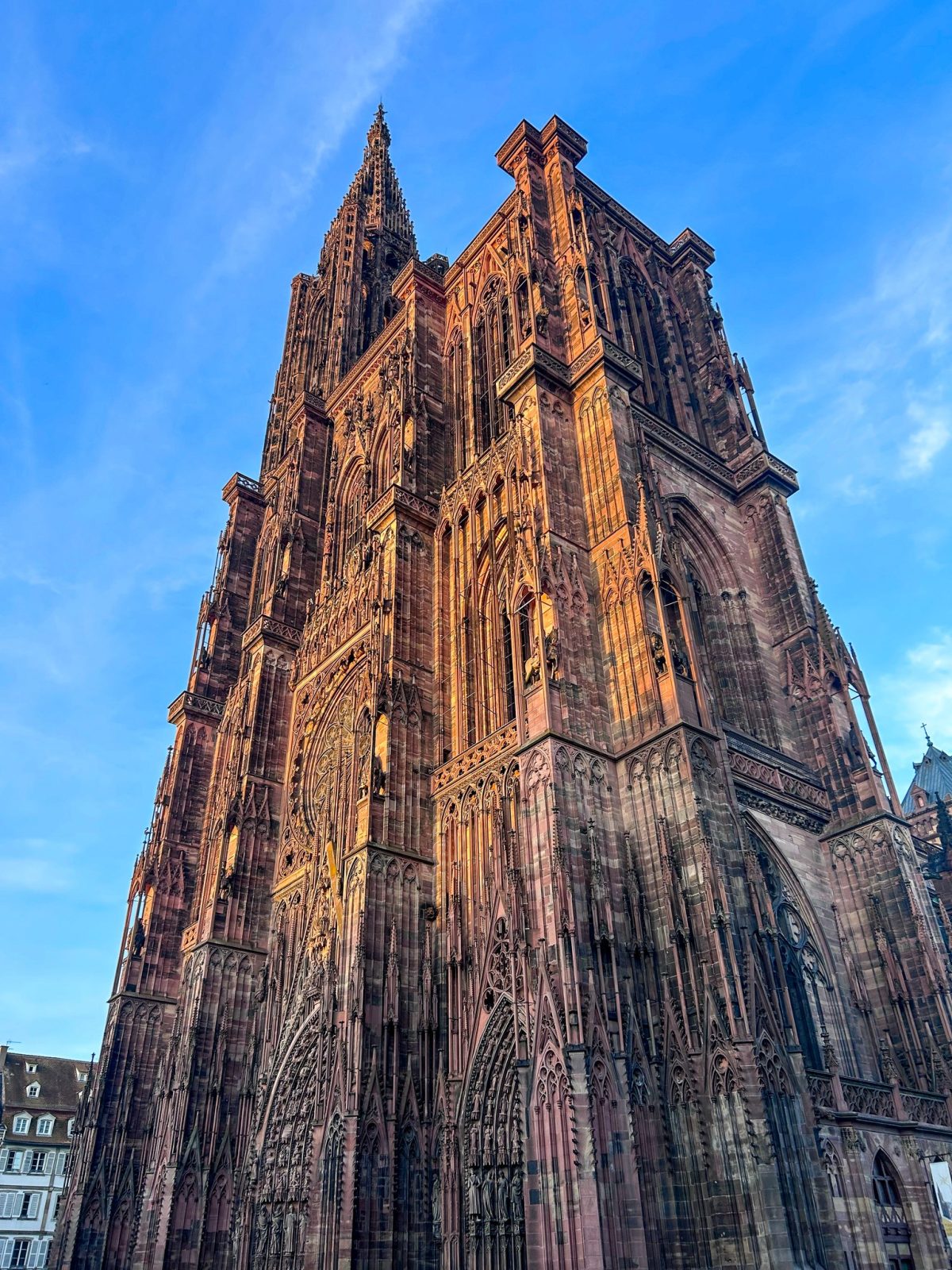
The cathedral was built of pink Vosges sandstone between 1176 and 1439, and when its north spire was finished it reached 142 m, the tallest building in the world from 1647 to 1874. The south tower was never built. Beside it stand the carved timber house Maison Kammerzell and the Palais Rohan, the bishops' palace of 1732–1742, now home to three museums.
Looking up the pink sandstone west front and spire of Strasbourg Cathedral against a blue sky
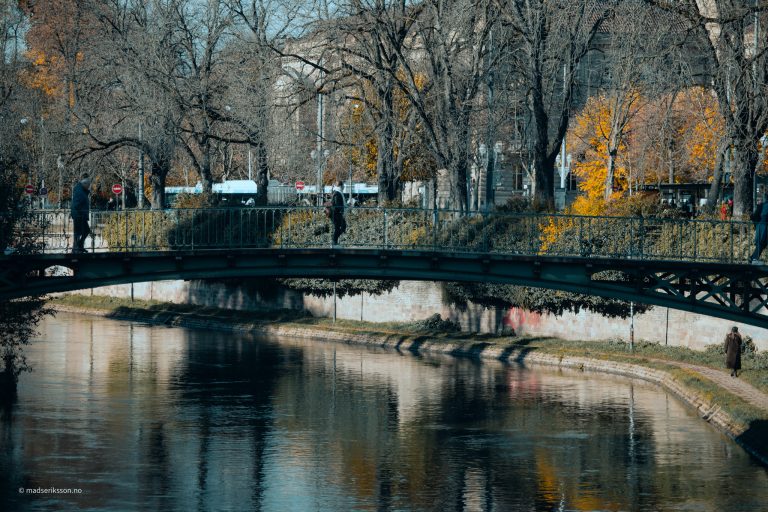
The view from the Barrage Vauban
The free roof terrace of the Barrage Vauban looks back across the Ill to the towers of the Ponts Couverts, the half-timbered houses of La Petite France and the cathedral spire above them. Boat tours from the quay by the Palais Rohan circle the Grande Île and continue through a lock to the European institutions.
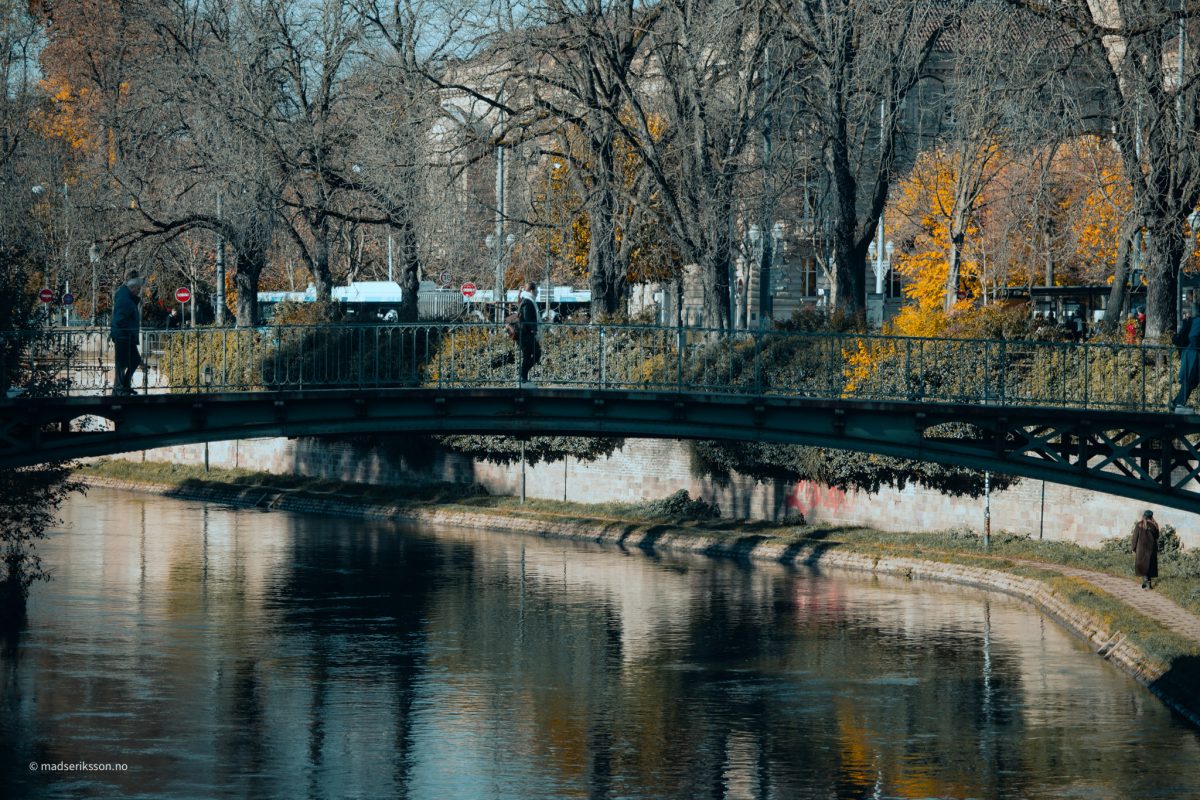
An iron footbridge over the Ill in Strasbourg, with autumn trees reflected in the still water
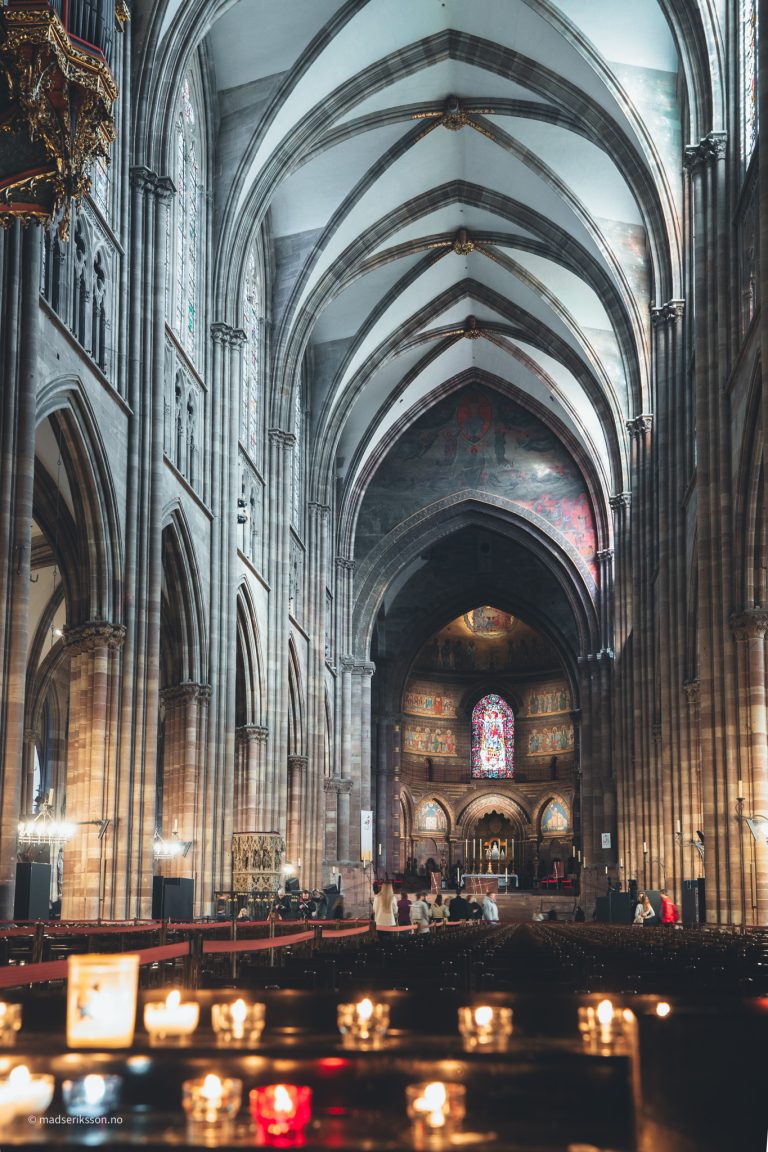
The cathedral by night
Strasbourg's Christmas market, the Christkindelsmärik, has been held since 1570 and is the oldest in France, spreading across a dozen squares from Place Broglie to Place Kléber. Inside the cathedral, the astronomical clock in the south transept, rebuilt in 1842 by Jean-Baptiste Schwilgué, performs its procession of apostles every day at 12:30.
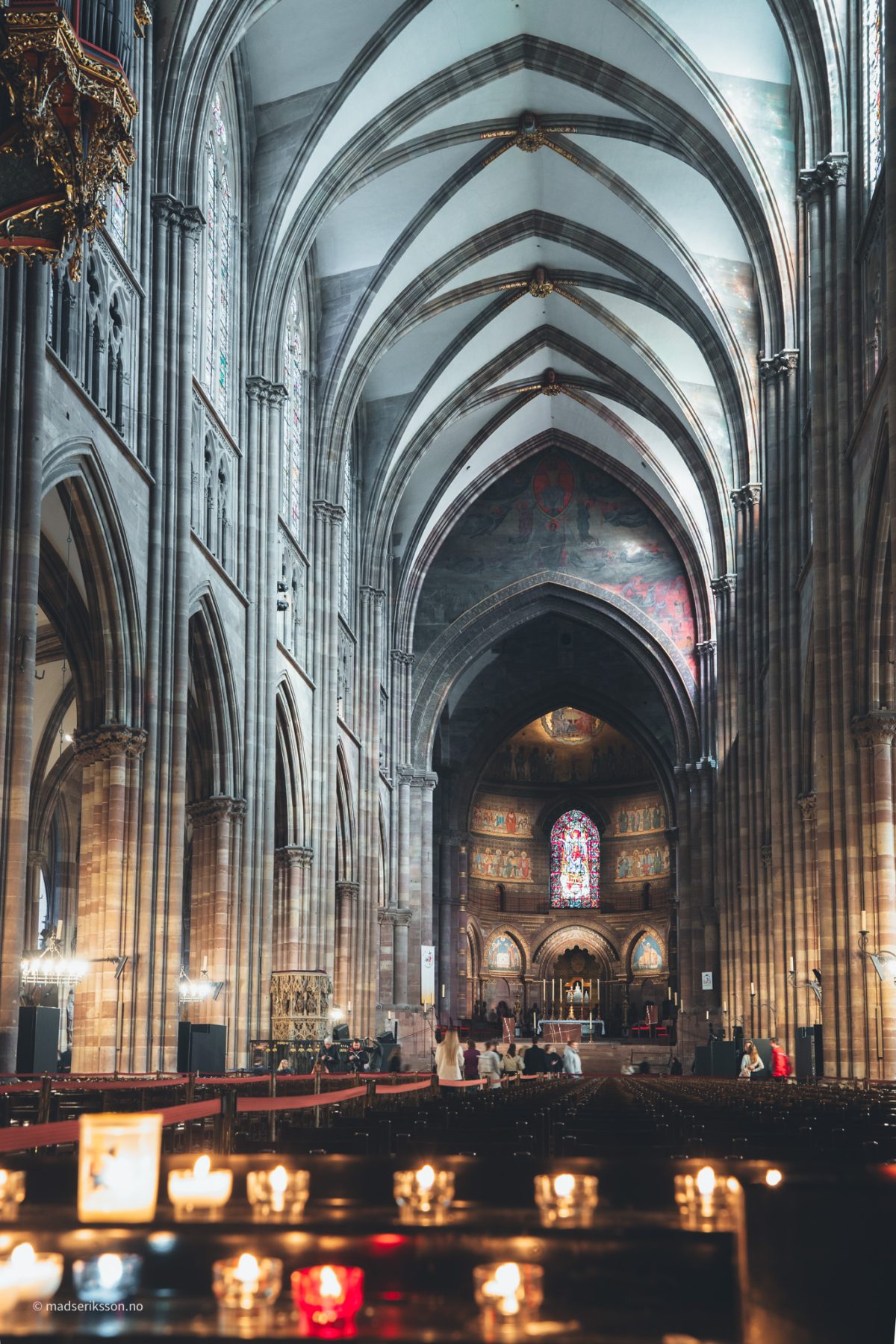
The Gothic nave of Strasbourg Cathedral, looking east towards the painted apse
3D model © 2026 madseriksson.no · Photographs © madseriksson.no. Buildings and heights: © OpenStreetMap contributors (ODbL), via OpenMapTiles. Ground imagery: Sentinel-2 cloudless 2023 by EOX IT Services GmbH (contains modified Copernicus Sentinel data 2023; CC BY 4.0). Heights are approximate where OpenStreetMap has no measured value; sun positions are approximate.
The Cathedral — Tallest Building on Earth for 227 Years, and Still Missing a Tower
142 metres of pink Vosges sandstone, the world’s tallest building from 1647 to 1874, with one spire where the design called for two, an astronomical clock whose apostles process at half past twelve every day, and a viewing platform that Goethe climbed over and over in 1770 to force himself out of his fear of heights
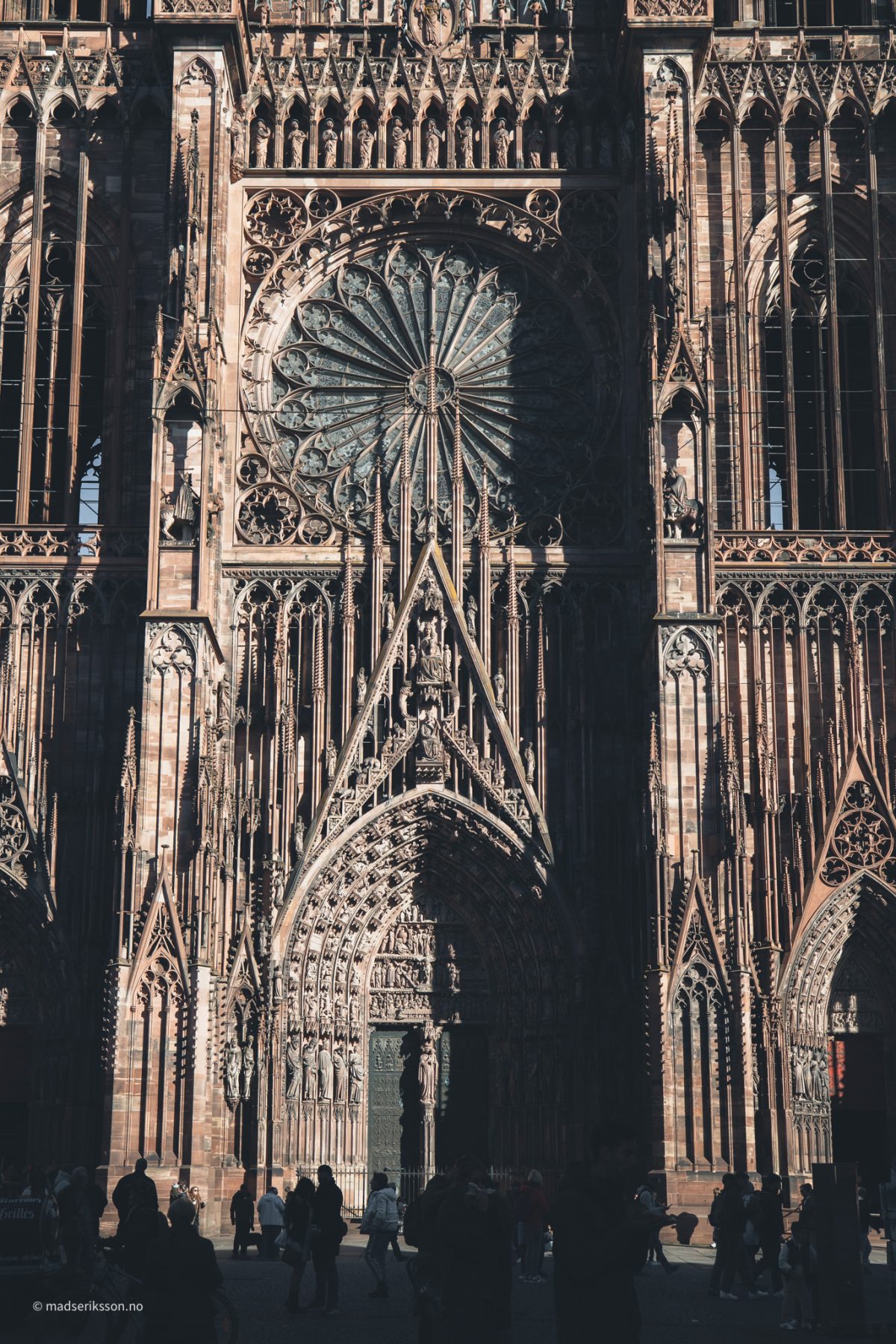
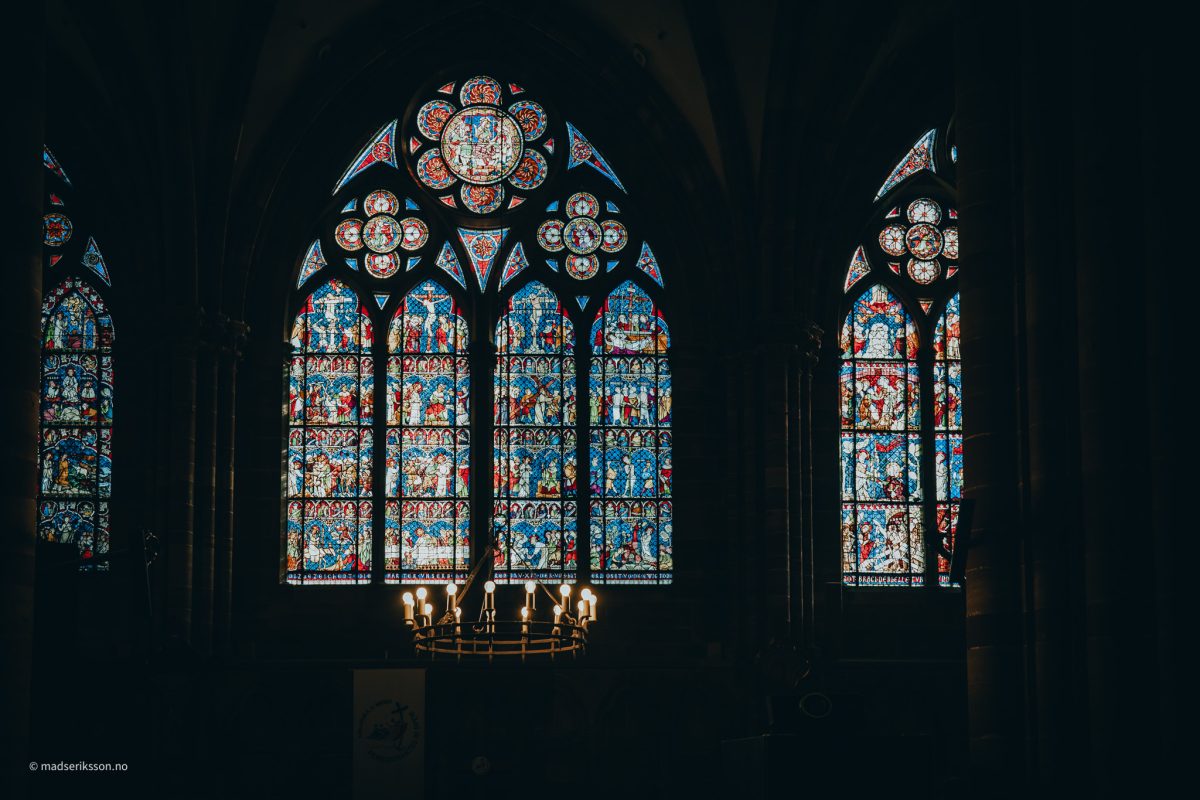
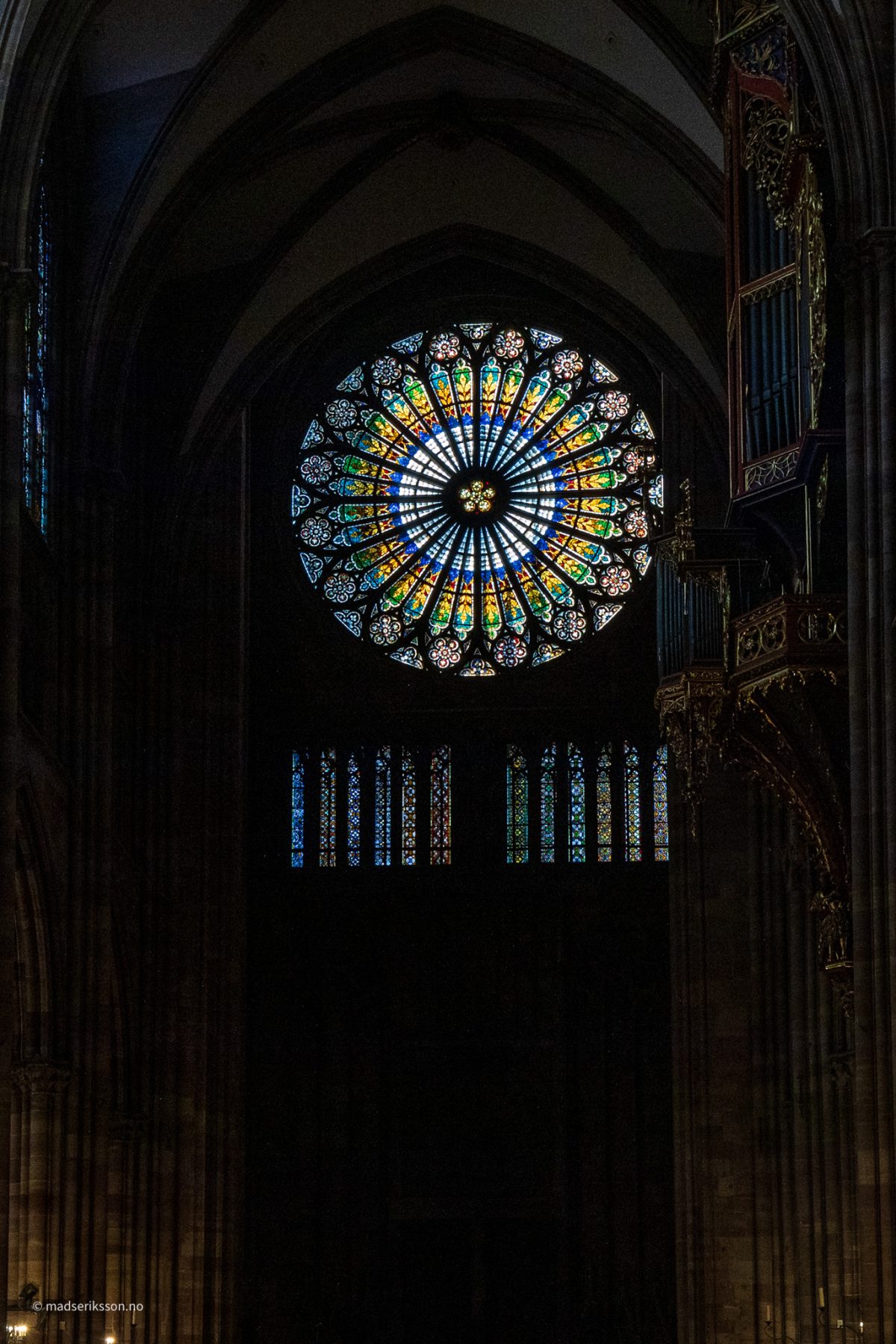
The cathedral is built from the pink sandstone of the Vosges mountains to the west, which gives it a colour unlike any other major Gothic building in Europe: rose-grey in flat light, deep salmon at sunset, almost violet in rain. Construction ran from 1176 to 1439 across the transition from Romanesque to high Gothic, and the west facade — begun under Erwin von Steinbach in 1277 — is among the most densely worked in Europe, its entire surface covered in a lattice of stone tracery so fine that from a distance it reads as texture rather than structure. The north tower and its spire were finished in 1439 at 142 metres, making the cathedral the tallest building in the world; it held that title for 227 years until 1874. The south tower was never built. Money ran out, priorities shifted, and by the time either might have been resolved the taste for completing medieval cathedrals had passed. The asymmetry that resulted is now inseparable from the building’s identity: a single vast spire rising off-centre above a facade that was designed to be balanced, visible across the flat Alsace plain from thirty kilometres away.
Inside, the principal attraction besides the building itself is the astronomical clock in the south transept — a Renaissance case housing a mechanism rebuilt in 1842 by Jean-Baptiste Schwilgué after its predecessors stopped. It tracks solar and lunar time, the positions of the visible planets, leap years, and the computation of the date of Easter, and at 12:30 each day it performs: the figures of the twelve apostles process in front of a figure of Christ while a mechanical cockerel raises its head and crows three times, in reference to Peter’s denial. Admission is ticketed separately and the transept fills well before the hour. The tower platform, reached by 332 steps, sits at 66 metres on the base of the north tower and gives a view over the Grande Île, the Neustadt, the Rhine plain and, in clear weather, the Black Forest in Germany and the Vosges in France simultaneously — the entire contested geography of Alsace visible from one place. This is the platform Goethe climbed, repeatedly and deliberately, as a twenty-year-old law student determined to overcome his vertigo. He described the process, and the building, in an essay that helped rehabilitate Gothic architecture for a European intellectual culture that had spent two centuries dismissing it as barbarous.
Goethe’s essay on Strasbourg cathedral, written in 1772, is the moment German Romanticism decides that the Gothic is not primitive but sublime — that a building can be irregular, unfinished, overwhelming and great precisely because of those things rather than despite them. He was writing about a cathedral with one tower missing. It is difficult to imagine him making the same argument about a symmetrical building.
La Petite France — The Prettiest Quarter in Alsace Was Built for Curing Hides
The whole historic island became a UNESCO World Heritage Site in 1988 — and its most photographed corner, the half-timbered tanners’ quarter on the canals, owes its steep open attic storeys not to decoration but to the need to dry animal skins, in a district that was for centuries the most malodorous in the city
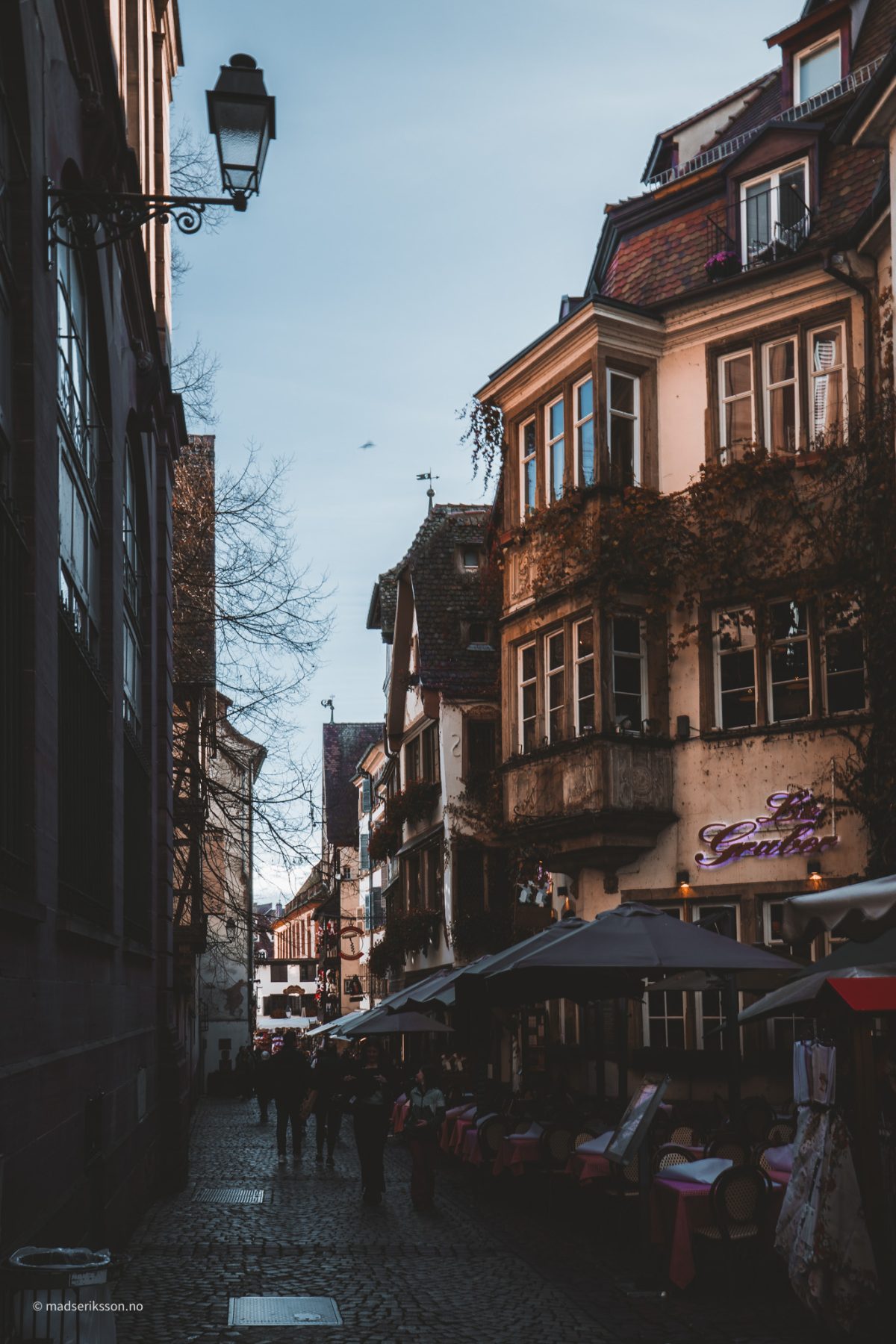
The Grande Île — the Large Island — is the historic core of Strasbourg, enclosed where the Ill river splits and rejoins, and it was inscribed in its entirety as a UNESCO World Heritage Site in 1988: the first time the organisation had listed an entire city centre in France rather than individual monuments. Within it, at the western end where the river divides into channels, lies La Petite France, the quarter of the tanners, millers and fishermen. The half-timbered houses along the Rue du Bain-aux-Plantes are the image of Alsace that appears on every promotional photograph of the region: dark timber frames on white plaster, flowers at every window, canals below, the whole thing reflected in still water. What the photographs do not explain is the architecture’s function. The upper storeys of these houses are unusually steep and open-sided because they were drying lofts: tanners hung hides in them to cure in circulating air, which is why the roofs are pitched the way they are and why the attic levels have that distinctive slatted openness. The canals supplied the water the tanneries consumed and carried away what they produced. For several centuries this was the quarter of the city that people avoided when the wind was wrong.
At the western tip of the island stand the Ponts Couverts — the Covered Bridges — a defensive complex of three bridges and four square towers built in the thirteenth century as the city’s river fortification. The wooden roofs that gave them their name were removed in the eighteenth century; the name survived the roofs. Immediately behind them is the Barrage Vauban, a dam and defensive barrage built in 1690 to the design of Louis XIV’s military engineer Sébastien Le Prestre de Vauban, whose function was to allow the entire southern approach to the city to be deliberately flooded in the event of attack by raising the level of the Ill. It is now open to the public, and its roof terrace — free of charge — gives the classic view back across the water to the Ponts Couverts, the towers, the half-timbered quarter behind them and the cathedral spire rising above the whole arrangement. It is the single best free viewpoint in Strasbourg and, at sunset, the reason to structure a day so as to be there at the right hour.
Boat tours run continuously from the quay near the Palais Rohan and are, unusually for a tourist boat trip, genuinely worth it here: the Grande Île is an island, the canals were the reason the city functioned, and seeing the tanners’ houses from the water level they were built to exploit explains the architecture more efficiently than walking past them at street height. The route also passes through a lock and out to the European institutions, which stitches the medieval city and the modern one into a single seventy-minute narrative.
The Border City — Five Nationalities in 250 Years, and Then the Parliament of a Reconciled Europe
French in 1681, German in 1871, French in 1918, German in 1940, French in 1945 — and in 1949 the seat of the Council of Europe, followed by the European Parliament and the European Court of Human Rights. The most fought-over city on the Franco-German border was chosen as the meeting place of a Europe that had decided to stop fighting, and the choice was entirely deliberate
When the newly unified German Empire annexed Alsace-Lorraine in 1871, it set about making Strasbourg the visible capital of the acquisition. North and east of the medieval island, on land cleared of its old fortifications, Berlin built the Neustadt: a monumental quarter of broad boulevards, imperial administrative palaces, a university, a vast Protestant church and apartment blocks of Wilhelmine grandeur, all laid out on a scale and in a style that no French provincial city of the period would have produced. The Palais du Rhin — built as the Kaiser’s residence — anchors the Place de la République, a circle of imperial institutions surrounding a war memorial that, characteristically for this city, shows a mother holding two dying sons: one who fought for France and one who fought for Germany. The Neustadt is architecturally German, was built to make a political point, and became a UNESCO World Heritage Site in 2017 as part of Strasbourg’s extended listing. A French city protects and celebrates, under international designation, the imperial architecture of a foreign power that annexed it. Very few cities anywhere have arrived at that position, and none as calmly.
The alternations continued: Alsace returned to France in 1918 under the Treaty of Versailles, was annexed by Nazi Germany in 1940 with the local population subject to forced Germanisation and conscription into the Wehrmacht — the malgré-nous, “against our will”, a wound in Alsatian memory that remained politically sensitive for decades — and was restored to France in 1945. Four years later, in 1949, the newly founded Council of Europe chose Strasbourg as its seat. The European Court of Human Rights followed, and eventually the European Parliament, which holds its plenary sessions here in the Louise Weiss building beside the Ill. The logic was not administrative convenience: Brussels was closer to everything. The logic was symbolic and explicit. The institutions built to make another European war impossible were placed in the city that the last three wars had been fought over. Today a tram runs from the centre of Strasbourg across the Rhine to Kehl in Germany, and nobody checks anything.
The war memorial at Place de la République shows a mother holding two dying sons. One fought in the French army, one in the German. It carries no inscription naming an enemy. In a country where war memorials are usually unambiguous about who was on which side, this one refuses the question entirely, because in Strasbourg the question has no answer that would be true for everyone standing in front of it.
Winstubs and the Christmas Market — Sauerkraut, Riesling and the Oldest Advent Market in France
Alsatian food is what happens when French technique meets German ingredients and neither side concedes: choucroute garnie, tarte flambée on wafer-thin dough, baeckeoffe stewed for hours in a sealed clay pot — eaten in wood-panelled winstubs and washed down with dry Riesling. And every December, a Christmas market that has been running since 1570
The winstub — literally “wine room” in Alsatian — is the region’s characteristic eating house: wood-panelled, low-ceilinged, hung with pewter and checked curtains, serving regional cooking and local wine in a register that is neither French bistro nor German gasthaus but recognisably its own thing. The core dishes are worth knowing in advance. Choucroute garnie is sauerkraut slowly braised in Riesling and served under an assembly of pork cuts and sausages; it is substantial to a degree that visitors consistently underestimate. Tarte flambée (Flammekueche in Alsatian) is a paper-thin dough base baked very fast at very high heat with crème fraîche, onions and lardons — ordered by the board and eaten with the hands, traditionally as a way of testing the bread oven’s temperature before the loaves went in. Baeckeoffe is a layered stew of three meats, potatoes and onions marinated in white wine and sealed into a clay pot with a strip of dough, historically left at the baker’s oven on wash day and collected at midday. The wines are almost entirely white and almost entirely dry: Riesling of a mineral sharpness quite unlike the German sweet styles, aromatic Gewürztraminer, Pinot Gris, Sylvaner, and Crémant d’Alsace, which is the most consistently underpriced sparkling wine in France.
The Christkindelsmärik has been held in Strasbourg since 1570, which makes it the oldest Christmas market in France and among the oldest anywhere. It began as a Protestant substitute: after the Reformation the city replaced the traditional Catholic St. Nicholas fair with a market centred on the Christ child, and the name stuck. From late November until Christmas Eve the market spreads across a dozen squares in the city centre — Place Broglie, Place de la Cathédrale, Place Kléber with its enormous illuminated tree, Place Gutenberg and others — with several hundred chalets selling mulled wine, bredele (the small spiced Alsatian Christmas biscuits, baked in dozens of varieties), pain d’épices, decorations and crafts. The city calls itself the Capitale de Noël and receives roughly two million visitors across the season. It is genuinely spectacular and genuinely crowded; the sensible approach is to visit on a weekday, in the evening when the illuminations are on, and to accept that a weekend in mid-December in central Strasbourg means moving slowly through dense crowds in the cold, which for some people is the entire appeal and for others is a reason to come in October instead.
Order the tarte flambée first, not as a main course. In a proper winstub they arrive on wooden boards within minutes of ordering, are eaten with the fingers, and cost very little; the convention is to keep ordering them while deciding what else to have. Trying to eat one as a whole meal, in the manner of a pizza, misreads the dish. It is a bar snack that happens to come out of a wood oven.
«Strasbourg is the most instructive city in Western Europe about what borders actually do to a place. Five changes of nationality in 250 years produced a city where the cathedral is French Gothic in German sandstone, the grandest quarter was built by an occupying empire and is now protected by UNESCO, the local language is a German dialect spoken by French citizens, the food puts sauerkraut on a plate with a French wine list, and the war memorial refuses to say who the enemy was because half the families in the city sent sons to both armies. And then, in 1949, the countries that had spent three wars fighting over this ground put the institutions of their reconciliation here — not in a neutral capital, not somewhere convenient, but in the exact place that had cost the most. Today a municipal tram crosses the Rhine into Germany every eight minutes and nobody looks up. That is the whole argument, delivered as a timetable.»
More in the same area
 CitiesLyon: Two Rivers, Two Hills and Two Thousand Years of History
 CitiesDijon: The Dukes’ Capital, Its Owl and Its Mustard
 ArchitectureEurope’s 10 Greatest Cathedrals and Churches
 CitiesSiem Reap — The City at the Gate of the Largest Temple on Earth
 CitiesBordeaux: The Port of the Moon and the Capital of Wine
 CitiesParis: The City of Lights
City Frames · scroll-driven 3D
More cities in three dimensions
54 city guides open with a model built from open map data. Scroll, and the camera moves from landmark to landmark.
Departures · City Frames
Where to next?
| Time | Destination | Country | Status |
|---|
Live · position of the sun
Golden hour, right now
The low, warm light just after sunrise and just before sunset. These are the cities on the site where it is happening at this moment.