For a little over a century Dijon was the capital of one of the richest states in Europe. The four Valois dukes of Burgundy ruled from here between 1363 and 1477, and they left the city a palace with a 46-metre tower, a museum built around their tombs, and a habit of commissioning the best artists money could buy. What came afterwards is just as visible: a royal square laid out by the architect of Versailles, streets of stone townhouses under roofs of glazed, patterned tiles, an iron market hall, and a name that has become a word on supermarket shelves around the world. Dijon is the gateway to the Burgundy vineyards, and since 2015 its historic centre has been part of a UNESCO World Heritage Site.

Dijon began as Divio, a small Roman settlement on the road between the Mediterranean and the Rhine, and grew into the seat of the dukes of Burgundy from the early 11th century. Its golden age came under the Valois dukes — Philip the Bold, John the Fearless, Philip the Good and Charles the Bold — whose territories, through Philip the Bold’s marriage to the heiress of Flanders, eventually stretched from Burgundy to the North Sea. When Charles the Bold was killed at the Battle of Nancy in 1477, the French crown took the duchy, and Dijon became a provincial capital: the seat of the States of Burgundy and of a powerful parliament whose lawyers and magistrates built the townhouses that still line the old streets.
Today Dijon is a city of around 160,000 people, the capital of the Bourgogne-Franche-Comté region and a stop on the TGV line from Paris, about an hour and a half away. It is compact enough to cross on foot in twenty minutes, and much of what makes it worth visiting costs nothing: the city’s museums are free for their permanent collections, the old centre is largely pedestrian, and the owl that brings luck to anyone who touches it is carved into the side of a church on a public street. The vineyards of the Côte de Nuits begin a few kilometres south of the city limits.
How to approach Dijon
This guide covers Dijon in four parts: the dukes of Burgundy and the palace they left behind, now the town hall and the Musée des Beaux-Arts; the medieval and Renaissance streets of the old centre, from Notre-Dame and its owl to the cathedral crypt; the food the city is known for — mustard, the market hall and the Cité de la Gastronomie; and the wine country that begins at the edge of town along the Route des Grands Crus.
Dijon in 3D
Dijon was the capital of the Valois dukes of Burgundy from 1363 to 1477, when Philip the Bold, John the Fearless, Philip the Good and Charles the Bold ruled territories stretching to the North Sea. This frame covers the compact old centre, from the ducal palace and Notre-Dame to the cathedral, the station and the Cité de la Gastronomie. Since 2015 the historic centre has been part of the UNESCO listing for the Climats of Burgundy, whose vineyards begin a few kilometres south.
The Palace of the Dukes
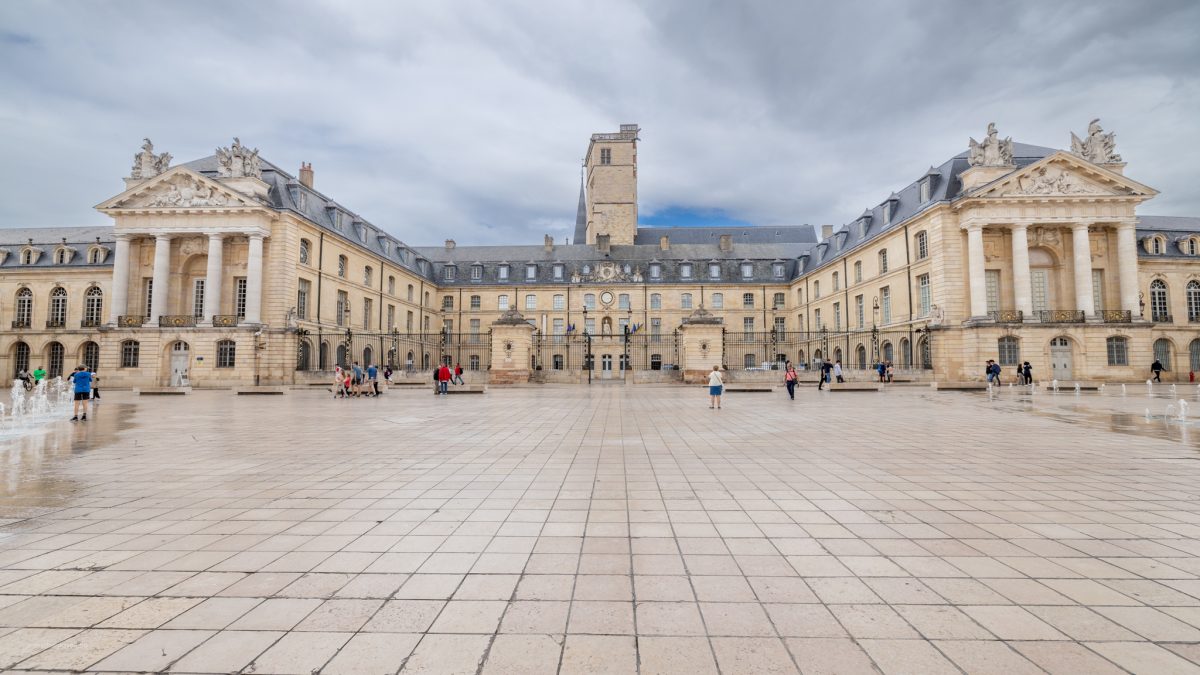
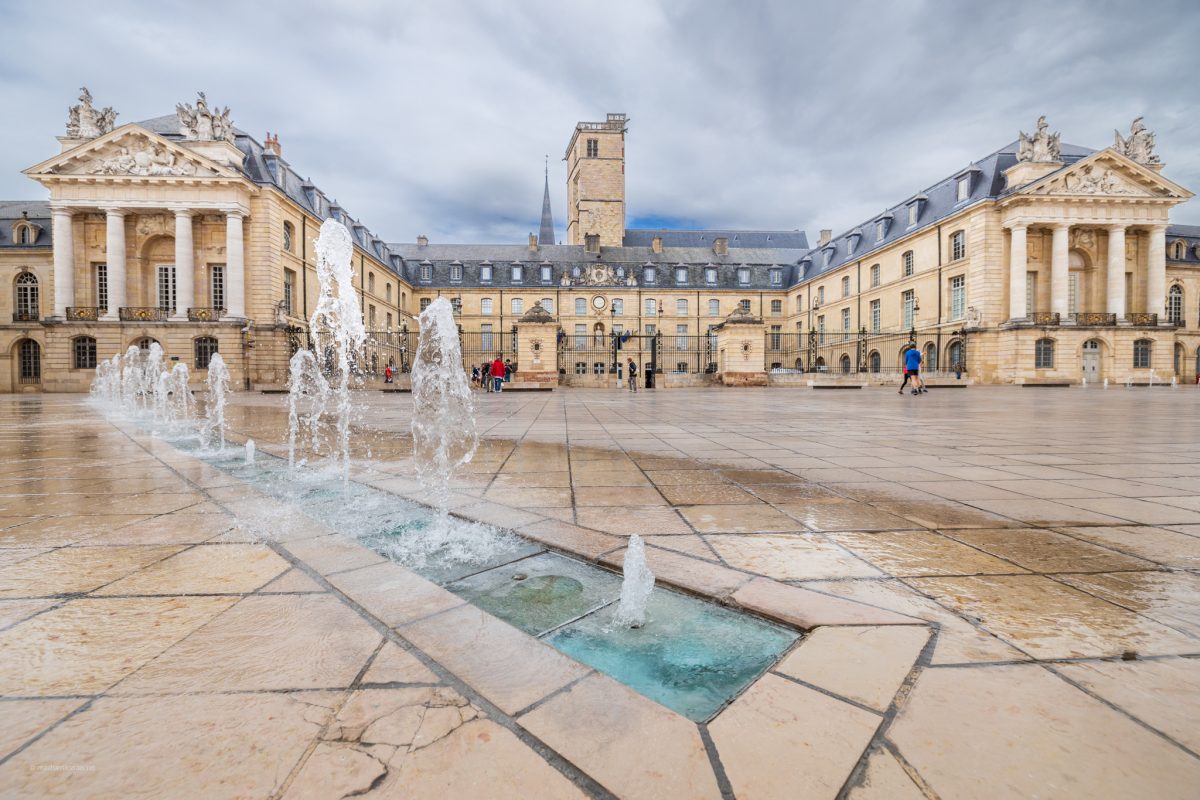
The ducal palace was rebuilt by the Valois dukes, and Philip the Good's tower, completed in the 1450s, still rises 46 m over the old town; its 316 steps can only be climbed on a guided visit. In front of it, Jules Hardouin-Mansart, the architect of Versailles, laid out the semicircular Place Royale from 1686, renamed Place de la Libération in 1944. The palace now holds the town hall and the Musée des Beaux-Arts, founded in 1787.
Palais des ducs et des États de Bourgogne.
Les Halles and Place François Rude
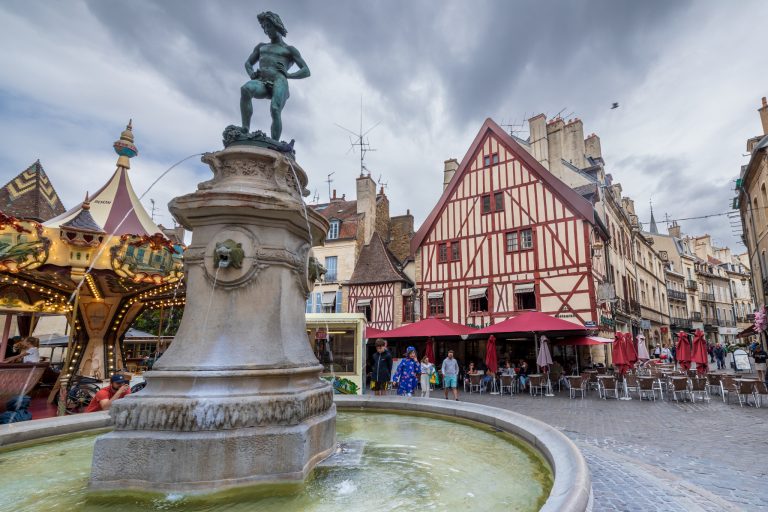
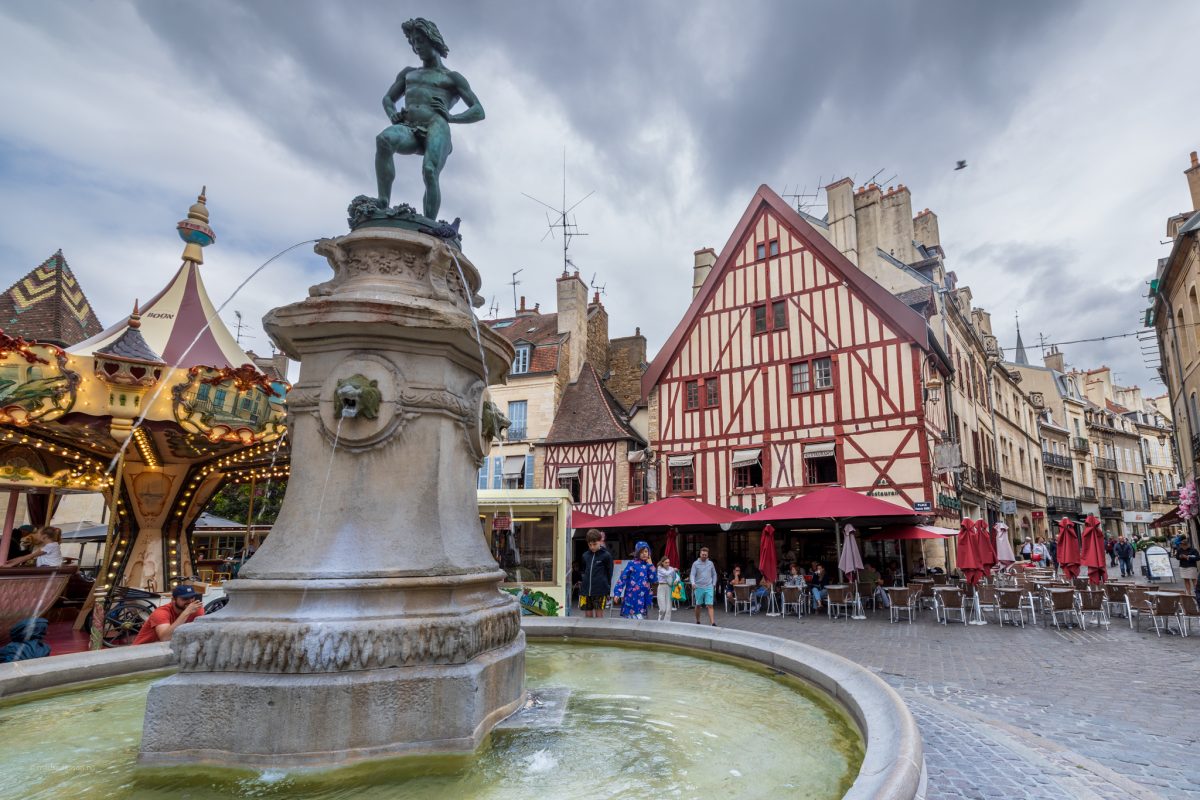
The iron-and-glass market hall was built in 1873–1875 to plans by the city engineer Louis-Clément Weinberger, although it is often credited to Gustave Eiffel, who was born in Dijon. On Tuesday, Thursday, Friday and Saturday mornings its four pavilions fill with butchers, cheesemongers and growers. Place François Rude, a few streets south, is ringed by half-timbered houses around its fountain.
The Place François Rude, Dijon
Notre-Dame and the owl
Notre-Dame, begun around 1230, has a flat west front lined with 51 gargoyles that carry no water, and on its corner tower the figure of Jacquemart has struck the hours since 1383, on a clock taken from Kortrijk in Flanders. In Rue de la Chouette, a small owl carved into a buttress has been worn almost smooth by hands touching it for luck. Brass owl markers lead from here along a 22-stop trail through the old town.
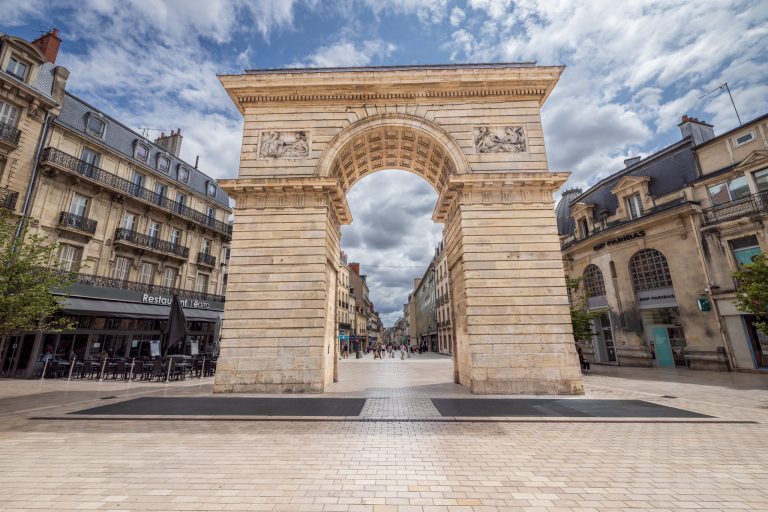
Cathédrale Saint-Bénigne and Porte Guillaume
The Gothic cathedral of Saint-Bénigne was begun in 1281, and its spire, rebuilt in 1896, rises 93 m as the tallest structure in Dijon. Beneath it lies the crypt of a Romanesque rotunda begun in 1001, which reopened to visitors in July 2024. To the north, the 18th-century triumphal arch of the Porte Guillaume marks Place Darcy and the start of Rue de la Liberté.
The triumphal arch of the William Gate, Dijon.
Cité de la Gastronomie and the Well of Moses
The Cité internationale de la gastronomie et du vin opened in May 2022 on the 6.5-hectare site of the former general hospital. Further west, in the grounds of a hospital on the site of the Chartreuse de Champmol, founded by Philip the Bold in 1383, stands the Well of Moses: six life-size prophets carved by Claus Sluter between 1395 and 1403.
The dukes' town at night
After dark the Tour Philippe le Bon and the curved arcades of Place de la Libération are lit above the patterned roofs of glazed tiles. The fountains of the square, set straight into the paving when it was pedestrianised in 2005–06, rise between the palace and the restaurant terraces.
3D model © 2026 madseriksson.no · Photographs © madseriksson.no. Buildings and heights: © OpenStreetMap contributors (ODbL), via OpenMapTiles. Ground imagery: Sentinel-2 cloudless 2023 by EOX IT Services GmbH (contains modified Copernicus Sentinel data 2023; CC BY 4.0). Heights are approximate where OpenStreetMap has no measured value; sun positions are approximate.
The Palace of the Dukes — Four Dukes, One Tower and a Free Museum
How the residence of the most lavish court in 15th-century Europe became a town hall, a royal square and one of France’s oldest art museums
In 1363 King John II of France gave the duchy of Burgundy to his youngest son, Philip the Bold. Philip married the heiress of Flanders, and within two generations the dukes ruled a patchwork of territories that made them richer than most kings. Their home in Dijon was rebuilt to match. Philip began with the Tour de Bar, completed in 1365; his grandson Philip the Good added the great vaulted kitchens, finished in 1431, and the tall tower that now bears his name, completed in the 1450s. At 46 metres it still dominates the skyline of the old town. The climb to the top — 316 steps — is only possible on a guided visit of about 45 minutes, in groups of no more than 18, booked through the tourist office, and the reward is a view over the patterned roofs of the old town.
After 1477 the palace became the residence of the king’s governor and the meeting place of the States of Burgundy, and in the late 17th century it was given a new classical face. Jules Hardouin-Mansart, first architect to Louis XIV, designed the semicircular Place Royale in front of it from 1686 as a setting for a bronze equestrian statue of the king. The statue took decades to arrive and was melted down during the Revolution, but the square survives as Place de la Libération, pedestrianised in 2005–06 and fitted with fountains that rise straight out of the paving. Behind the curved arcades, the palace now houses the town hall, the city archives, the tourist office and the Musée des Beaux-Arts.
The heart of the museum is the Salle des Gardes, the dukes’ great hall, where the tombs of Philip the Bold and of John the Fearless and Margaret of Bavaria lie beneath their painted effigies, surrounded by small carved mourners in hooded robes.
The tombs were made for the Chartreuse de Champmol, the Carthusian monastery Philip the Bold founded just outside Dijon in 1383 as a burial place for his dynasty, and they were moved to the palace after the Revolution. The monastery itself is gone, but on its site, in the grounds of a hospital, the base of the Well of Moses by the Netherlandish sculptor Claus Sluter still stands: six life-size prophets carved between 1395 and 1403, among the most powerful sculpture of the Middle Ages. The Musée des Beaux-Arts, founded in 1787, reopened in 2019 after a renovation of more than a decade and now shows around 1,500 works in 50 rooms, from Egyptian antiquities and Burgundian altarpieces to 20th-century painting. The permanent collections are free to enter; the museum is closed on Tuesdays.
The Old Town — Gargoyles, a Lucky Owl and a Crypt Under the Cathedral
A 13th-century church with a clock stolen from Flanders, a stone owl worn smooth by passing hands, and a Romanesque rotunda that survived its own demolition
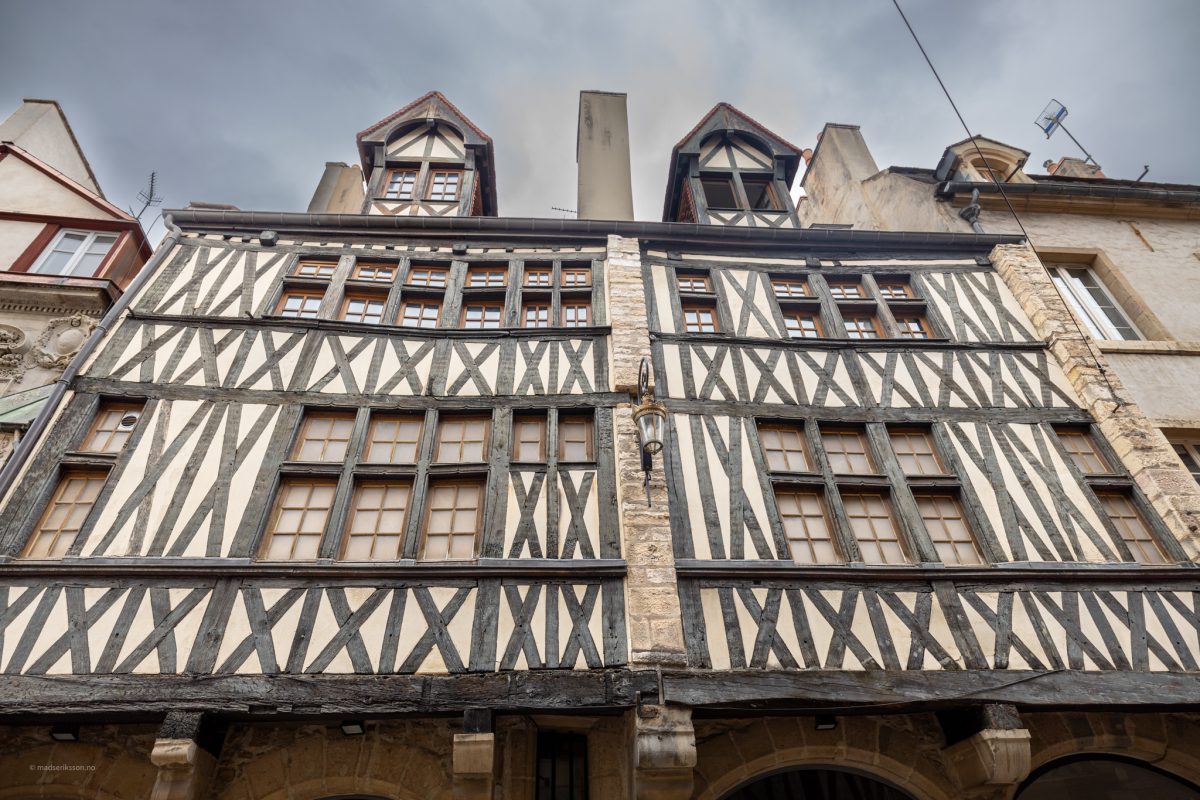
The old centre of Dijon lies within a short walk of the ducal palace, and its streets are a catalogue of what wealth built here between the 13th and the 18th centuries. The lanes around Notre-Dame are lined with old houses and stone hôtels particuliers, many of them built in the 18th century for the lawyers and magistrates of the Burgundian parliament after the dukes had gone. Look up and the city’s signature appears: roofs of glazed terracotta tiles in green, yellow, red and black, laid in diamonds and chevrons. They are a Burgundian tradition and one of the most recognisable sights of the city.
The church of Notre-Dame, begun around 1230, is the finest Gothic building in the city and one of the most unusual in France. Its west front is a flat screen of two open arcades lined with 51 carved gargoyles that carry no water — the originals were taken down in the Middle Ages, it is said after a falling stone figure killed a moneylender, and the present figures date from 1880–82. On the corner tower stands the clock of Jacquemart, an iron figure who has struck the hours since 1383. Philip the Bold carried the clock and its bell off from Kortrijk after his army sacked the Flemish town in 1382; Dijon later gave Jacquemart a wife, Jacqueline, in 1651, and two children to strike the quarters. Inside, the wooden statue of Notre-Dame de Bon-Espoir, dating from the 11th or 12th century, may be among the oldest Marian figures in France.
On the north side of Notre-Dame, in Rue de la Chouette, a small owl is carved into a buttress. Touch it with the left hand, the side of the heart, and make a wish — centuries of hands have worn it almost featureless.
The owl was damaged by a vandal in 2001 and restored from a mould taken years earlier, and it has become the emblem of the city. The Owl’s Trail, or Parcours de la Chouette, uses it as a guide: brass triangles stamped with an owl are set into the pavement and lead past 22 numbered stops through the old town in about an hour, with a booklet available from the tourist office. The trail ends near the Cathédrale Saint-Bénigne, whose Gothic church was begun in 1281 on the site of an abbey founded in 871. Beneath it lies the most remarkable survival in Dijon: the crypt of a three-storey Romanesque rotunda begun in 1001 by the abbot Guillaume de Volpiano and consecrated in 1018, modelled on the Pantheon in Rome. The upper levels were pulled down in 1792; the lower one was rediscovered in the 19th century and, after four years of restoration costing 7.9 million euros, reopened to visitors in July 2024.
At the Table — Mustard, an Iron Market Hall and a City of Gastronomy
Why Dijon mustard is a recipe rather than a place, why the market hall is not quite by Eiffel, and what a canon of the Church has to do with an aperitif
Mustard has a long history in Dijon, but the version the world knows dates from 1856, when Jean Naigeon replaced the vinegar in the recipe with verjuice, the sharp juice of unripe grapes. The result was smoother and hotter, and Dijon mustard became famous enough that a decree of 1937 turned the name into a description of a method rather than a place of origin. “Dijon mustard” can be made anywhere, and most of the seed used in France comes from Canada. The exception is moutarde de Bourgogne, which carries a protected geographical indication and must be made with seed grown in Burgundy. Mustard shops in the old centre sell both, and the city remains a good place to taste the difference.
The covered market, Les Halles, stands a few streets north of Notre-Dame. It was built between 1873 and 1875 to plans by the city engineer Louis-Clément Weinberger, with ironwork from the foundries of Fourchambault, and is often attributed to Gustave Eiffel, who was born in Dijon. His company had proposed plans for a market in 1868 which influenced the design, but the building is not his. Its four glass-and-iron pavilions are decorated with cast-iron animal heads, fruit, fish and vine leaves, and on Tuesday, Thursday, Friday and Saturday mornings they fill with butchers, cheesemongers and growers from the surrounding countryside, while stalls spread into the streets outside. Around the market, the cafés and bistros serve the Burgundian classics — œufs en meurette poached in red wine, jambon persillé, beef bourguignon and coq au vin.
The aperitif that bears the name of Dijon’s post-war mayor began life as blanc-cassis: white aligoté wine with a measure of local blackcurrant liqueur. Canon Félix Kir, a priest and Resistance figure, served it at receptions for visiting delegations, and the drink took his name.
The newest addition to the city’s food culture is the Cité internationale de la gastronomie et du vin, which opened in May 2022 on the 6.5-hectare site of the former general hospital. It follows UNESCO’s listing of the gastronomic meal of the French as intangible heritage in 2010, and combines restored hospital buildings and chapels with new ones: exhibition spaces on French food and wine, training courses, a wine cellar, restaurants and food shops. It makes a useful counterpart to the market — the one about how French food is eaten, the other about where it comes from. In autumn the city’s International and Gastronomic Fair takes over the exhibition centre; in 2026 it runs from 31 October to 11 November.
Into the Vineyards — The Climats of Burgundy Begin at the City Limits
How a strip of hillside south of Dijon came to be divided into more than a thousand named plots, and why the city’s historic centre shares their World Heritage listing
South of Dijon, a long, narrow escarpment runs towards Beaune and beyond: the Côte d’Or, divided into the Côte de Nuits in the north and the Côte de Beaune in the south. Over centuries its slopes have been parcelled into precisely bounded vineyard plots called climats, each with its own name and its own wine, determined by soil, slope and exposure. Around 1,250 of them were inscribed together as a UNESCO World Heritage Site in 2015, as a unique example of how a landscape and a wine culture shaped each other. The listing includes not only the vineyards but also the historic centres of Dijon and Beaune, the two towns from which the climats were defined, regulated and traded since the Middle Ages.
The Route des Grands Crus is the road that ties them together. It runs for about 60 kilometres from Dijon to Santenay through 33 villages, and the names along it read like a wine list: Marsannay, Fixin, Gevrey-Chambertin, Morey-Saint-Denis, Chambolle-Musigny, Vougeot, Vosne-Romanée and Nuits-Saint-Georges on the Côte de Nuits, then Aloxe-Corton, Beaune, Pommard, Volnay, Meursault and Puligny-Montrachet to the south. The road keeps to the foot of the slope, with the vines climbing on one side and the flat Saône plain on the other, and the villages are small enough that it is easy to stop, walk among the vineyards and taste in a cellar door.
At Vougeot, the Cistercian monks of Cîteaux assembled a vineyard from the early 12th century and had enclosed it with a stone wall by 1336; a château was built inside the wall in 1551. The Clos de Vougeot shows what a climat is: a named plot whose boundaries have not moved for centuries.
The northern end of the route, the Côte de Nuits, is close enough to Dijon to explore as a half-day trip, by car, by bicycle or on one of the many small-group tours that leave from the city. Gevrey-Chambertin is about 15 kilometres south of the city, and Beaune, the wine town of the Côte de Beaune, is also reachable by regional train. Many domaines receive visitors by appointment rather than as walk-ins, so it is worth arranging tastings in advance. For those without a car, the simplest approach is to base the trip in Dijon and take a guided vineyard tour for the day.
«Dijon is easy to underestimate: smaller than Lyon, quieter than Paris, known abroad for a condiment. But for a century it was the capital of a court that set the taste of Europe, and the city still carries that inheritance lightly — in the mourners around the ducal tombs, in the patterned roofs over the old streets, in a stone owl worn smooth by passing hands. Spend a morning in the market, an afternoon in the palace and the museum, and a day in the vineyards to the south. Then touch the owl with the left hand, and plan to come back.»

More in the same area
 CitiesLyon: Two Rivers, Two Hills and Two Thousand Years of History
 ArchitectureEurope’s 10 Greatest Cathedrals and Churches
 CitiesStrasbourg — The City That Changed Country Five Times and Ended Up Hosting Europe
 CitiesBordeaux: The Port of the Moon and the Capital of Wine
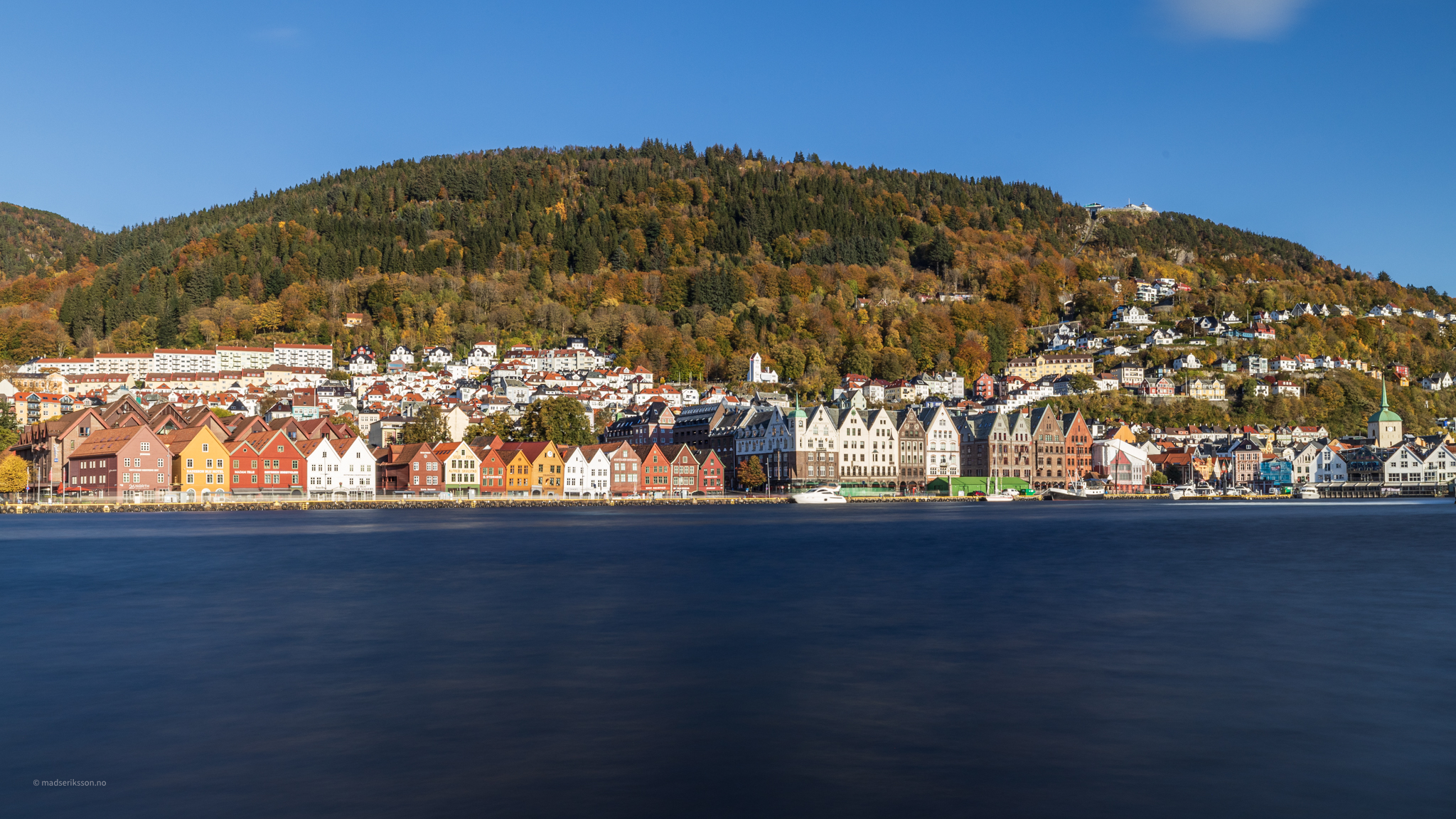 CitiesBergen: The Gateway to the Fjords
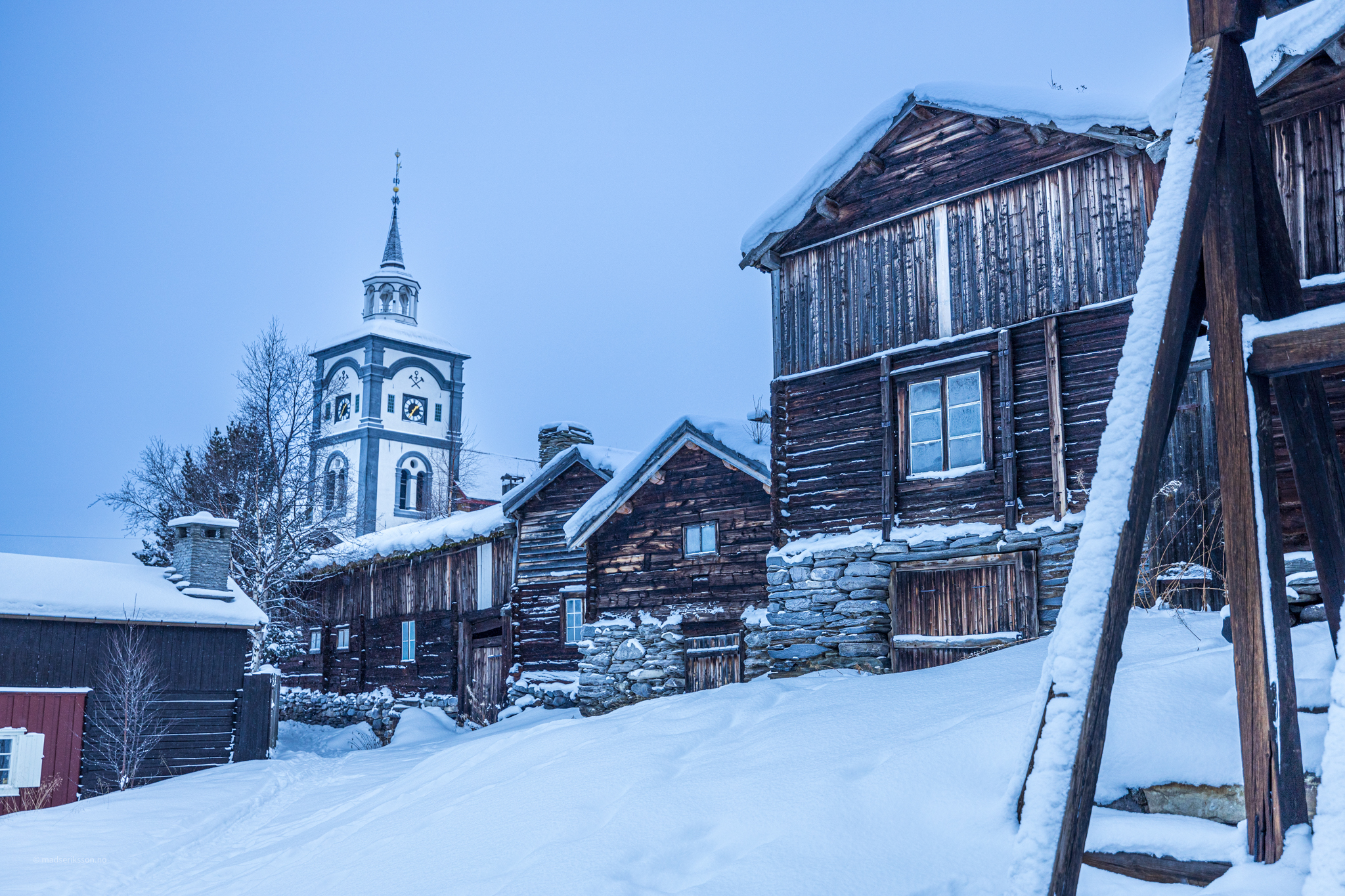 CitiesRøros: Norway’s Copper Town and World Heritage Site
City Frames · scroll-driven 3D
More cities in three dimensions
54 city guides open with a model built from open map data. Scroll, and the camera moves from landmark to landmark.
Departures · City Frames
Where to next?
| Time | Destination | Country | Status |
|---|
Live · position of the sun
Golden hour, right now
The low, warm light just after sunrise and just before sunset. These are the cities on the site where it is happening at this moment.