A food market is the most honest institution a city has. Its museums are curated, its restaurants are designed, its monuments are restored for the photograph, but the market is where a city shows what it actually eats, what it grows and catches within reach, what it has learned to preserve, and how it behaves when it is hungry at seven in the morning. The ten markets in this guide were chosen because each of them still does that work. In Tokyo, the alleys around the old fish market still sell the knives, the dried bonito and the rolled omelette that the city’s sushi counters depend on, six years after the wholesale trade moved across the bay. In Valencia, the rice for the paella is sold by variety under a Modernista dome topped by a weathervane parrot. In Seoul, women who have worked the same griddle for decades fry mung-bean pancakes for office workers in a market founded in 1905. In Istanbul, a covered bazaar built to pay for a mosque is still selling sumac and red pepper by the kilo three and a half centuries later. These are not food halls. They are the kitchens of their cities, and the ranking that follows is an argument about which of them do that job best.

Every great food market sits on a tension it cannot fully resolve. The qualities that make a market worth crossing the world for — the specificity of what it sells, the depth of its history, the noise and smell and competence of people doing a job they have done for generations — are exactly the qualities that draw the crowds who, in sufficient numbers, make the job impossible. A fishmonger cannot serve a restaurant buyer through a wall of phones. A pickle merchant cannot survive on visitors who taste and do not buy. Several of the markets on this list are actively fighting that problem: Barcelona has capped the share of prepared food that La Boqueria’s stalls may sell, Kyoto’s Nishiki asks visitors not to eat while walking, and Tokyo’s Tsukiji outer market has the same rule. A ranking of the world’s great food markets that ignored this tension would be a ranking of the world’s most photographed ones. This one does not ignore it.
The ranking is built on four criteria, weighted roughly equally. The first is the quality and specificity of the food: whether the market sells things that cannot easily be found elsewhere, and whether what it sells is good. The second is history: how long the market has existed, how continuously, and how much of its city’s past it carries. The third is local use against tourist use — whether residents and professional cooks still shop there, or whether the market has become a backdrop. The fourth is atmosphere: the physical and social experience of being in the place, from the architecture overhead to the people behind the counters. A market that scores at the top on one criterion and poorly on another can still rank highly; a market that scores well on all four ranks higher. Nine of the ten markets are covered on madseriksson.no, four of them in articles of their own — Gwangjang in Seoul, Nishiki in Kyoto, the Spice Bazaar in Istanbul and Dongmun in Jeju — and the others in the city guides linked in their sections.
How to read this ranking
Size and fame were deliberately not criteria. Bangkok’s Chatuchak, with its roughly 15,000 stalls, is one of the largest markets on earth, but most of what it sells is not food, and it is open only at weekends; it is covered in the Bangkok guide rather than here. Osaka’s Kuromon, which the Osaka article calls the city’s kitchen, was a close call; it lost its place to Jeju’s Dongmun because Dongmun is still, unambiguously, the market where its island buys fish and fruit, while Kuromon has tilted further toward visitors eating on the spot. Munich’s Viktualienmarkt, Budapest’s Great Market Hall, Bordeaux’s Marché des Capucins, Dijon’s iron Les Halles, Paris’s Marché des Enfants Rouges (noted in the Paris guide as the oldest covered market in the city), Florence’s Mercato Centrale, Vienna’s Naschmarkt and Bangkok’s Or Tor Kor are all excellent markets that would hold a place in a top twenty-five. What the ten below have in common is that each of them is, in its own way, irreplaceable: remove it, and its city would eat differently.
#1 Tsukiji Outer Market — The Fish Market That Lost Its Fish Market and Kept Its Kitchen
Around 460 shops in the narrow streets beside the site of what was once the largest fish market in the world: knife-makers, dried-bonito merchants, kelp dealers, omelette shops and breakfast sushi counters that grew up to serve Tokyo’s professional kitchens, and still do, years after the auctions moved across the bay
Tokyo’s fish market is older than Tokyo. When Tokugawa Ieyasu made the small castle town of Edo his base in 1590, he brought fishermen from Tsukuda and Osaka to supply the castle, and the catch they did not need was sold on the riverbank beside the Nihonbashi bridge. That market, the uogashi, fed one of the largest cities of the pre-industrial world for more than three centuries, and its culture of speed, freshness and obsessive grading of fish is the culture that produced Edo-style sushi. The Great Kantō earthquake of 1923 destroyed it. The city used the catastrophe to build something modern on reclaimed land at Tsukiji, by the mouth of the Sumida, and the new market opened in February 1935. For the next eight decades Tsukiji was the largest wholesale fish market on earth: on a typical day, around 1,600 tonnes of seafood of more than 480 kinds passed through it, and its pre-dawn tuna auctions became one of the most famous spectacles in Japan. In October 2018, after a two-year delay, the wholesale trade moved to a new market at Toyosu, two kilometres away across the water. The inner market, the jōnai shijō where the auctions had taken place, closed for good.
What remained was the part that had always mattered most to anyone who cooks. Around the walls of the wholesale market, a dense grid of streets had grown up over the decades: the outer market, or jōgai shijō, where the restaurant buyers who had just bid on tuna went to buy everything else. It never needed the auctions to survive, because its customers were never only the fishmongers. Today the outer market counts around 460 shops in a few blocks. Some still sell fish — the ward built a two-storey hall, Tsukiji Uogashi, in 2018 so that the fish trade would not leave entirely, and its first floor is reserved for professional buyers before nine in the morning — but most of them sell the infrastructure of Japanese cooking. There are knife shops whose blades are sharpened for sushi chefs and sold to home cooks in the same tone of voice; merchants of katsuobushi, the smoked, dried and fermented bonito that is shaved into dashi; kombu dealers with kelp graded by origin and age; makers of tamagoyaki, the sweet rolled omelette that a sushi chef’s apprentice may spend years learning, sold here hot, by the slice, from shops that have made nothing else for generations; tea merchants, pickle shops, tableware suppliers and the small counters that serve sushi and rice bowls for breakfast. The Tokyo guide describes a sushi breakfast here, starting around seven, as one of the city’s great rituals. That is not tourist hyperbole; it is how the market’s own workers have eaten for ninety years.
Tsukiji ranks first because it combines the four criteria at a level no other market quite reaches. The food is the most refined on this list, and the most specific: this is where the ingredients of the world’s most exacting cuisine are bought by the people who cook it. The history runs from Ieyasu’s fishermen to the present without a real break. Local and professional use is still high in the early hours, before the visitors arrive. The atmosphere is not grand — low buildings, tangled awnings, wet pavements, delivery bikes — but it is the atmosphere of a working kitchen at full speed. The pressure is real: by late morning the main streets are crowded, the market asks visitors not to eat while walking, most shops are cash only, and the narrow alleys are not built for large groups. The practical rules are simple. Come early, ideally before nine, and leave by early afternoon, when most shops close. Check the market calendar before going: the outer market follows the rhythm of the wholesale trade, and it is closed on Sundays and national holidays and on many Wednesdays. For the auctions, go to Toyosu, where the tuna can be watched from a gallery and where a food and hot-spring complex in Edo style, Senkyaku Banrai, opened beside the market in 2024. But for the market itself, the place where Tokyo still buys what it cooks, go to Tsukiji.
The tuna left in 2018. The omelette stayed. In the streets around the empty site of the world’s greatest fish market, the shop that has sold tamagoyaki for generations still opens before dawn, the knife merchant still sharpens for the sushi counters of Ginza, and the katsuobushi seller still shaves bonito to order. What Tsukiji proves is that a great market is not its biggest transaction. It is everything that grows up around it.
#2 Mercat Central — The Modernista Cathedral Where Valencia Still Buys Its Rice
More than 8,000 square metres of iron, glass and glazed tile opposite the Gothic silk exchange, a central dome around 30 metres high crowned by a weathervane parrot, and more than 250 stalls selling the produce of the huerta, the rice of the Albufera and the salted fish of the coast to a city that still does its shopping here
Valencia held an architectural competition for a new central market in 1910, and the winners were two young Catalans, Alexandre Soler i March and Francesc Guàrdia i Vial, who had worked with Lluís Domènech i Montaner, the architect of the Palau de la Música Catalana in Barcelona. Construction began in 1914, stalled through years of shortages, and was finished in 1928 under the Valencian architect Enrique Viedma; King Alfonso XIII inaugurated it. The building that resulted is one of the masterpieces of Valencian Modernisme, and one of the very few places where that style was given a job as large as feeding a city. It covers more than 8,000 square metres on an irregular plot in the old town, and instead of fighting the shape of the plot it folds itself around it: two great naves under sloping iron-and-glass roofs, a central dome that rises to around 30 metres, and walls of brick, stone and ceramic tile in the greens, blues and oranges of the Valencian orchards. Oranges, in fact, are everywhere in the decoration. The market stands across the square from the Llotja de la Seda, the fifteenth-century silk exchange that is a UNESCO World Heritage Site, and beside the Baroque church of Sant Joan del Mercat. Few squares in Europe hold the history of a city’s trade so completely: Gothic merchants on one side, Modernista grocers on the other, and the same commerce in food and goods running between them.
The real argument for the Mercat Central is what happens under the dome. The stalls, more than 250 of them, are organised in long aisles by trade, and their stock is the larder of the huerta, the irrigated plain of market gardens that surrounds the city and has fed it since the Islamic period. Here are the ingredients of paella in their proper form: rice sold by variety, the short, absorbent grains from the paddies of the Albufera lagoon south of the city; the broad white garrofó beans and flat green beans without which a Valencian will not recognise the dish as paella at all; snails, rabbit and chicken, sold by butchers who know exactly what the customer is making. The fish section, beneath a second weathervane in the shape of a swordfish, sells the catch of the Gulf of Valencia, and a cluster of stalls specialises in salazones, the salted and air-dried tuna loin, roe and fish of the Mediterranean coast. There are counters of tigernuts from Alboraya, the raw material of horchata; there are dried peppers, pickled olives, cured meats and the local cheeses; and there is, increasingly, a small number of places to eat. The most celebrated is the Central Bar, a counter run by the chef Ricard Camarena, whose restaurant holds two Michelin stars; it does not take reservations, and its customers stand among the shoppers.
Valencia’s market ranks second, ahead of Barcelona’s more famous Boqueria, because it has managed the balance that the Boqueria lost. The site’s own article on the City of Arts and Sciences calls it one of the finest food markets in Spain and, by most accounts, more genuinely a daily market for the city’s residents than its rival in Barcelona; that judgement is widely shared. The aisles are busy with tourists in the middle of the morning, but the stallholders sell by the kilo, not by the cone, and the people with trolleys are buying dinner. The building is a protected monument, and the market keeps its old working hours: it opens early, from Monday to Saturday, and closes around the middle of the afternoon, with no trading on Sundays or public holidays. The parrot on the dome, the Cotorra del Mercat, perched on a crown and turning with the wind, is said to stand for the gossip of the market, and across the square the bird on the church tower is said to answer it. It is a nice legend and a fair summary: the Mercat Central is a place where a city talks to itself, about food, every morning.
A paella is an argument about ingredients, and Valencia settles the argument here. The rice is sold by the name of its variety, the garrofó by the kilo, the rabbit cut to order by a butcher who will ask what it is for. Under a dome of glass and tile, the city buys the dish it gave the world, in the form it insists the world has got wrong.
#3 La Boqueria — Eight Centuries on the Rambla, and a Fight to Stay a Market
The most famous food market in Europe, recorded since 1217, rebuilt on the ruins of a burned convent from 1840 and roofed in iron in 1914 — and now, with more than 23 million visits a year, in the middle of a deliberate effort to win back the residents who made it great in the first place
The Boqueria began as a few tables outside a city gate. The earliest document that mentions it, from 1217, records a royal representative granting one man the right to a table for cutting meat on the open ground beside the gate of the medieval walls, where the Rambla — then a seasonal riverbed — ran along the outside of the city. By 1470 a pig market was held there in December, and over the following centuries the open-air market spread along the Rambla until, in the early nineteenth century, it had some 200 stalls for meat, fish and produce. In July 1835, in the anticlerical riots that swept Barcelona, the convent of the Discalced Carmelites of Sant Josep, which stood just off the Rambla, was burned. The city cleared the site and gave it to the market, and on St Joseph’s Day, 19 March 1840, the first stone of a new market was laid to plans by the architect Josep Mas i Vila. That is why the Boqueria’s official name is still the Mercat de Sant Josep. The first hall was a neoclassical square of arcades; the iron roof that now defines it was added in 1914, the year after the Modernista entrance arch with its stained-glass crest went up on the Rambla, and the market has grown in stages since, most recently in 2015.
For most of the twentieth century the Boqueria was simply the best market in Barcelona, and one of the best in Europe: the place where the city’s chefs bought their fish at dawn, where the Catalan larder — wild mushrooms in autumn, calçots in winter, the first artichokes in spring, the cured hams and sausages of the interior — was laid out in its full range, and where the tiny bars wedged between the stalls cooked whatever the market had that morning for the people who worked there. Some of those bars are still there, and still very good: a seat at a counter, a plate of razor clams or chickpeas with blood sausage, a glass of cava at eleven in the morning, is one of the great Barcelona experiences. The problem is everything around them. The Boqueria received more than 23 million visits in 2023, more than any other municipal market in the city, and by most estimates around nine in ten of its visitors come from abroad. Over the past two decades, stall after stall switched from selling produce by weight to selling fruit cups, juices and paper cones of ham to people who will not cook, and in some aisles it became hard to buy dinner at all. The city began restricting organised groups of fifteen or more on Fridays and Saturdays in the high season as early as 2017.
What is happening now is the most serious attempt yet by a major city to turn a famous market back into a working one. In September 2025 the Boqueria’s traders voted by more than 90 per cent for new rules that cap prepared food at no more than half of what the market sells, with the rest reserved for fresh, traditional produce. A reform of around €12 million follows, with first works from the autumn of 2026 and a main phase between 2027 and 2029 that will replace the old roof, restore the iron structure and rework the square behind the market; the fish island at the centre is to be transformed in the first phase. The Boqueria ranks third rather than first because the balance between residents and visitors — one of the four criteria — is, for now, the worst on this list, and the plan to fix it is not yet finished. It ranks this high because nothing else in Europe matches its combination of eight centuries of history, a location at the heart of a great city and, at its best counters, produce of the very highest quality. The practical advice is the advice of Barcelona’s own cooks: go early in the morning, on a weekday; walk past the juice stands at the front toward the fish and the butchers at the back; sit down at a counter bar; and remember that the market, like its city, closes on Sundays.
La Boqueria has been a market for eight hundred years and a tourist attraction for perhaps thirty. The city has now decided that the first of these facts matters more than the second, and its traders have agreed. Whether a market can be returned to its residents once the world has discovered it is one of the most interesting questions in European urbanism. The answer will be written on the Rambla.
#4 Gwangjang Market — Mung-Bean Pancakes, Makgeolli and the Market That Never Closed
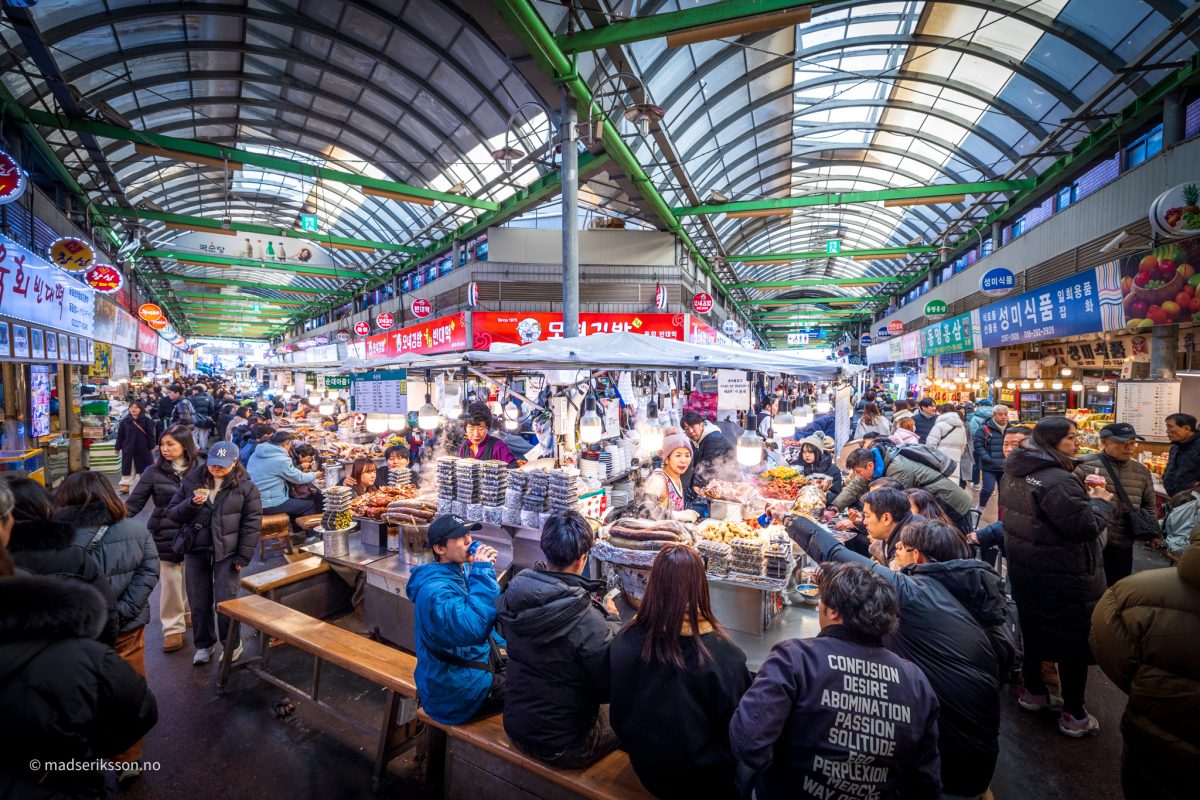
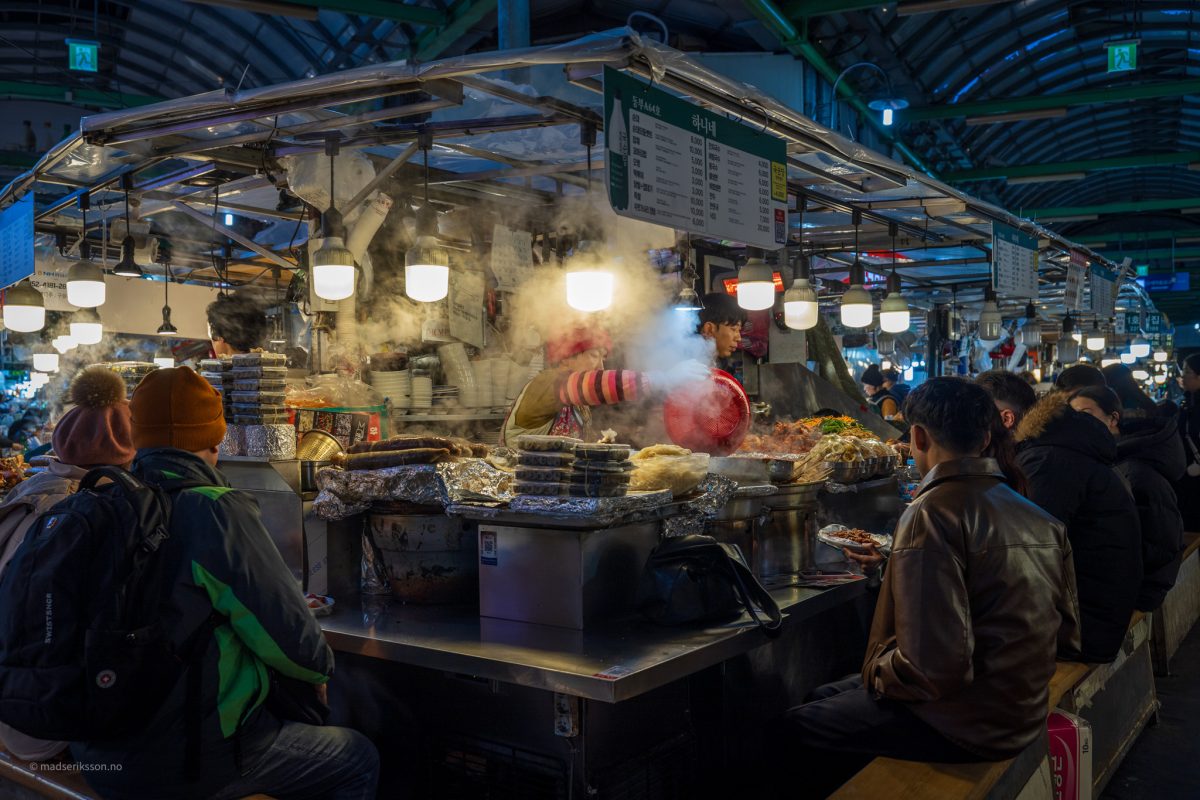
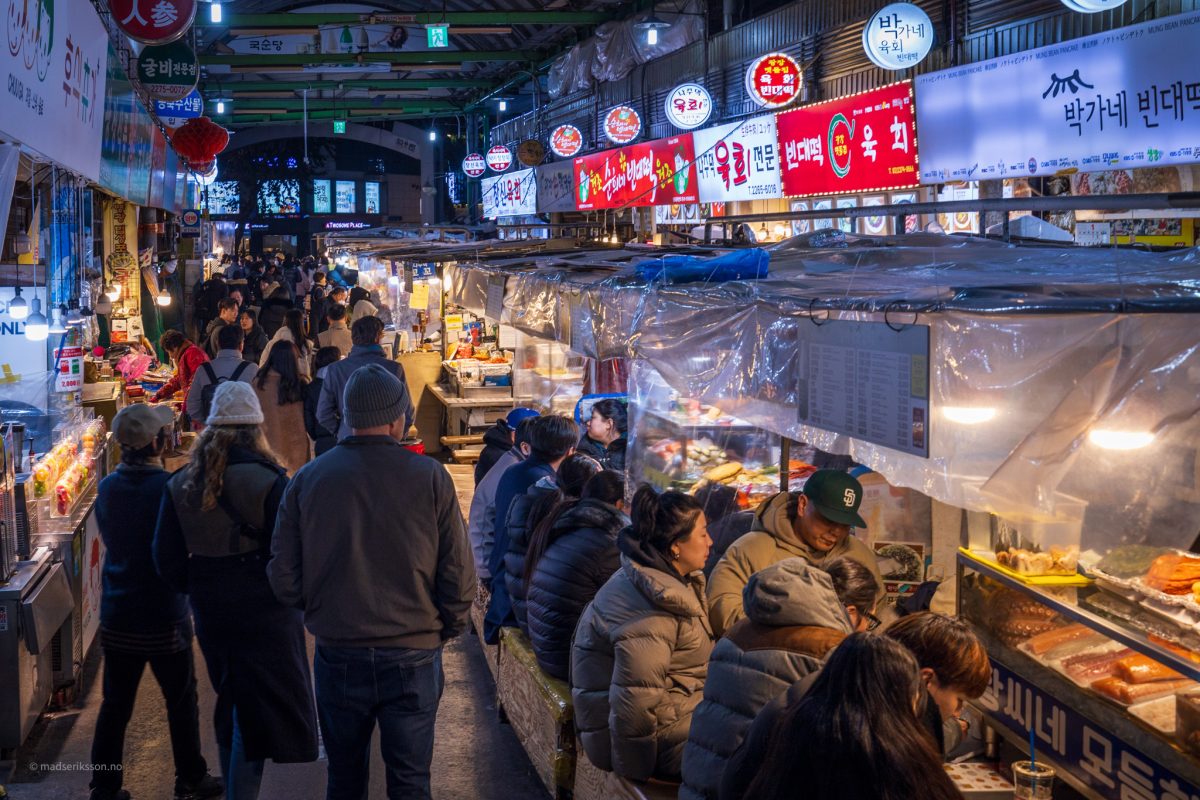
Seoul’s first permanent daily market, founded in 1905 between two old bridges over the Cheonggyecheon, with more than 5,000 shops of silk, hanbok and vintage clothing around a covered food alley where cooks fry bindaetteok on cast iron for office workers and visitors at the same long tables
In the summer of 1905, the year Korea became a Japanese protectorate, a group of Korean merchants formed a company to build a market in the eastern part of Seoul, near the Dongdaemun gate. Its name was simply Dongdaemun Market, and its innovation was a quiet revolution in Korean commerce: it was open every day. Until then, markets in Korea were periodic gatherings that set up for a few days and moved on, on a rhythm set by the agricultural calendar; a market that stayed in one place and traded through the week was something new, and it was also, at a time when Japanese capital was taking over the city’s trade, a statement of Korean commercial independence. The market stood between two bridges over the Cheonggyecheon stream, the Gwanggyo and the Janggyo, and in 1960 it took a name made from the two of them: Gwangjang. It survived the colonial period, the Korean War and the industrialisation of Seoul, and it grew into one of the largest traditional markets in the country, with more than 5,000 shops spread over some 42,000 square metres. As the madseriksson.no guide to Gwangjang notes, the market built its reputation on fabric, and much of it still runs on it: wholesale silk, linen, bedding and upholstery, hanbok tailors who make traditional dress to measure, and an upstairs arcade of vintage clothing that draws young Seoulites hunting old denim.
The food alley is what has made Gwangjang famous abroad, and it deserves the fame. Under a vaulted roof at the centre of the market, rows of stalls face long shared benches, and each stall cooks one or two things it has cooked for decades. The signature is bindaetteok: ground mung beans mixed with pork, kimchi and bean sprouts and fried on wide cast-iron griddles until the edges are crisp, the smell of which reaches the street before the visitor reaches the entrance. It is eaten with soy and onion, and with makgeolli, the milky, lightly sparkling rice wine poured from a kettle. Around it are mayak gimbap, tiny rolls of rice and vegetables slicked with sesame oil and served with mustard, whose name translates loosely as narcotic gimbap; sundae, here a glutinous-rice sausage; knife-cut noodles in broth; and yukhoe, raw hanwoo beef cut by hand and dressed with sesame oil, Asian pear and egg yolk, served by a restaurant that has been in the same family since 1965 and has been recognised by the Michelin guide. The food is cheap, fast and very good, and it is still cooked overwhelmingly by women who learned the trade from the women who held the stall before them. In 2019 the market was featured in the Netflix series Street Food, and the queues at the most famous stalls have been long ever since.
Gwangjang ranks fourth because it scores highly on all four criteria and has absorbed its fame without losing its function. The food is specific to Seoul and of real quality; the history, at a little over 120 years, is short by European standards but central to the story of modern Korea; and the market is still full of local people — office workers from the Jongno district at lunch, families buying fabric, tailors at work — at the same benches as the visitors. The atmosphere, under the steam and the yellow light of the food alley, is among the most intense on this list. The practical points are covered in the site’s own guide: the market opens daily from the morning into the late evening, but the food stalls only get going around late morning, many close on one day a week, most are cash only, and the hours between eleven and two are the most crowded. For the wider city around it, the Seoul guide places the market in context, a short walk from the restored Cheonggyecheon stream that once ran beneath its two bridges.
The man at the next bench is eating bindaetteok on his lunch break, as he does every week. The woman at the griddle learned the batter from her mother. The visitors with cameras are welcome and fed at the same speed. Gwangjang has been open every day since 1905, and the point of a market that is always open is that it belongs to everyone who turns up. It still does.
#5 Borough Market — A Thousand Years at the Foot of London Bridge
A market that claims to have traded since 1014, was abolished by Parliament for blocking the traffic, was re-founded by its own parishioners in 1756, became a wholesale hub under the railway viaducts and then, at the end of the twentieth century, reinvented itself as the place where Britain relearned how to eat
Borough Market is where it is because of London Bridge. For most of London’s history the bridge was the only crossing of the Thames, and everything that came into the City from the south — from Kent, Sussex and the Channel ports — passed through Southwark at its southern end. Traders gathered there for the same reason that traders gather at every bottleneck. The market itself claims a history going back to 1014, and probably earlier; a market at the bridge foot is first recorded in 1276, when the City of London was already trying to stop its citizens buying food outside its jurisdiction. In 1550 the City took control of Southwark’s markets by royal charter and extended trading to four days a week. By the mid-eighteenth century the stalls on Borough High Street had become such an obstacle to the traffic heading for the bridge that Parliament abolished the market altogether. The local parishioners responded by raising money and setting it up again in 1756 on a yard just off the street, on the site where it still stands, under a trust run for the benefit of the community. That arrangement has survived for more than 260 years: Borough Market is still a registered charity, governed by volunteer trustees who must live in the area.
The physical market is a product of the Victorian age and the railway. The main market buildings were designed by Henry Rose in 1851, and from 1862 a railway viaduct was driven straight through the site, so that trains to and from London Bridge station still rumble overhead on iron bridges above the stalls. The railways made Borough one of London’s great wholesale fruit and vegetable markets, and it remained one into the second half of the twentieth century, until the rise of supermarkets and their own supply chains left it half empty. Its revival began in 1998 with a food fair that brought small producers into the old wholesale halls, and the result was a new kind of market: a retail market for high-quality, often artisan British and European food, at a time when that idea was still novel in Britain. Farmhouse cheeses, rare-breed meat, game in season, bread, fish, oysters, fruit and vegetables from small growers, and an ever-growing ring of hot-food stalls fill the halls, beneath the Victorian ironwork and a classical portico rescued from Covent Garden’s Floral Hall and re-erected here in 2004. The London guide places the market a few hundred metres inland from the river, at the end of the South Bank walk, with more than a hundred traders.
Borough ranks fifth for its history, which is the longest on this list, for the quality of its produce, and for what it did for British food culture at a moment when that culture needed it. It ranks below Gwangjang because its balance between local use and tourism has tilted: the hot-food stalls and the lunchtime crowds now dominate much of the market, and on a Saturday it can be hard to move. The market itself is aware of this and has broadened its hours to give its regulars more room; it began opening on Sundays in 2021, and it is closed on Mondays for most of the year. It has also had to absorb real damage: the Thameslink railway works of the 2010s cost the area several historic buildings, and in June 2017 the market was at the centre of the London Bridge terror attack, in which eight people were killed; it closed for eleven days and then reopened. The best time to come is early on a weekday, when the shoppers with bags outnumber the people with lunch, and the cheese and meat counters can be approached at leisure.
Parliament abolished Borough Market in the 1750s because it was in the way. The people of Southwark refused to accept the decision, bought a yard behind the high street and opened it again. The market they founded is still run on their terms, by trustees who live within its parish. Few institutions in London have argued their case so successfully for so long.
#6 Nishiki Market — Kyoto’s Kitchen in a Lane Three Metres Wide
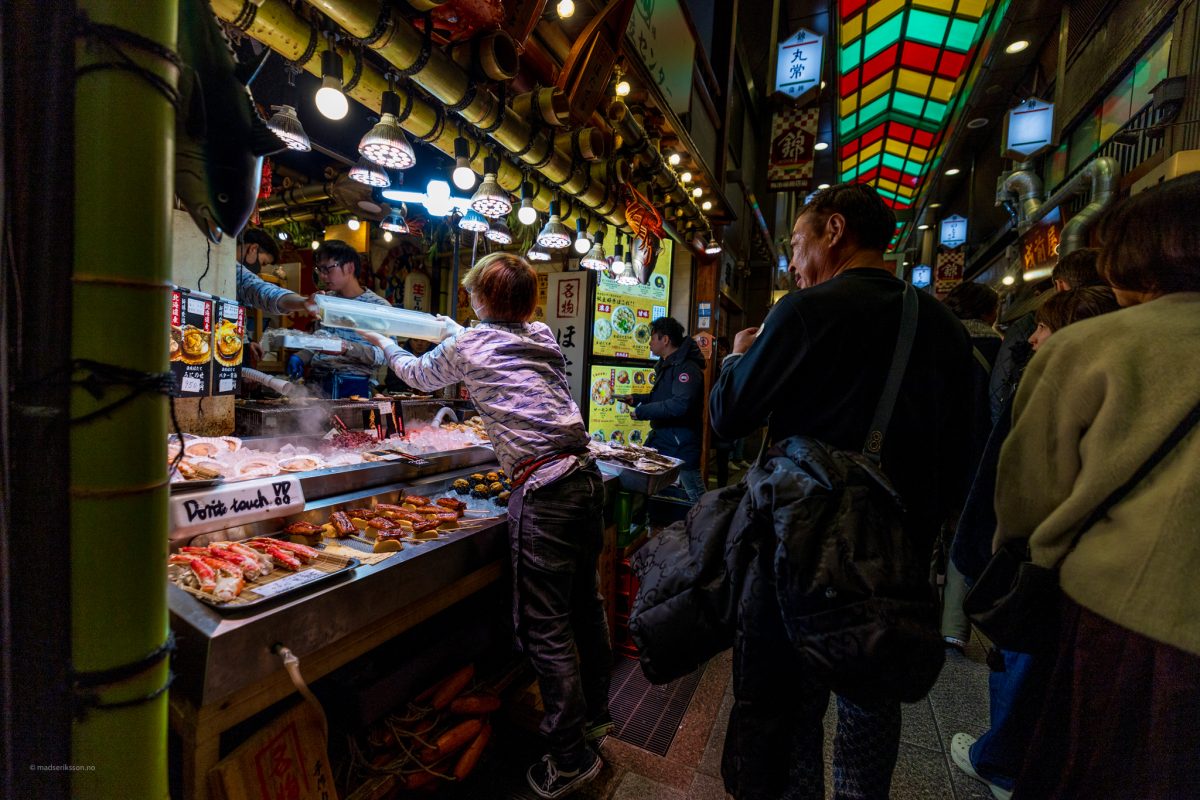
A covered lane 390 metres long, born around a cold spring that kept fish fresh in an inland capital, where pickle-makers, kelp merchants, tofu-skin specialists and confectioners have supplied the temples, the court and the kitchens of Kyoto for more than four centuries
Kyoto was Japan’s capital for more than a thousand years, and for all that time it had a problem: it is an inland city, in a basin ringed by mountains, a long way from the sea. Fresh fish was expensive and perishable, and what the city’s court, temples and merchants ate was shaped by what could be grown nearby, preserved, dried or fermented. Nishiki-kōji, a lane one block north of Shijō-dōri, had a natural advantage: a cold spring under the ground, which made it possible to keep fish fresh for longer than anywhere else in the city. In the early Edo period fishmongers settled there, and under the Tokugawa shogunate their trade received official recognition. Over four centuries the lane became the place where Kyoto bought everything its cooking required, and acquired the name it still carries: Kyō no daidokoro, Kyoto’s Kitchen. Today it is a roofed arcade of around 130 shops, 390 metres long and in places barely three metres wide, running from Teramachi-dōri in the east to Takakura-dōri in the west, with a small Shinto shrine, Nishiki Tenmangū, tucked behind the stalls at its eastern end.
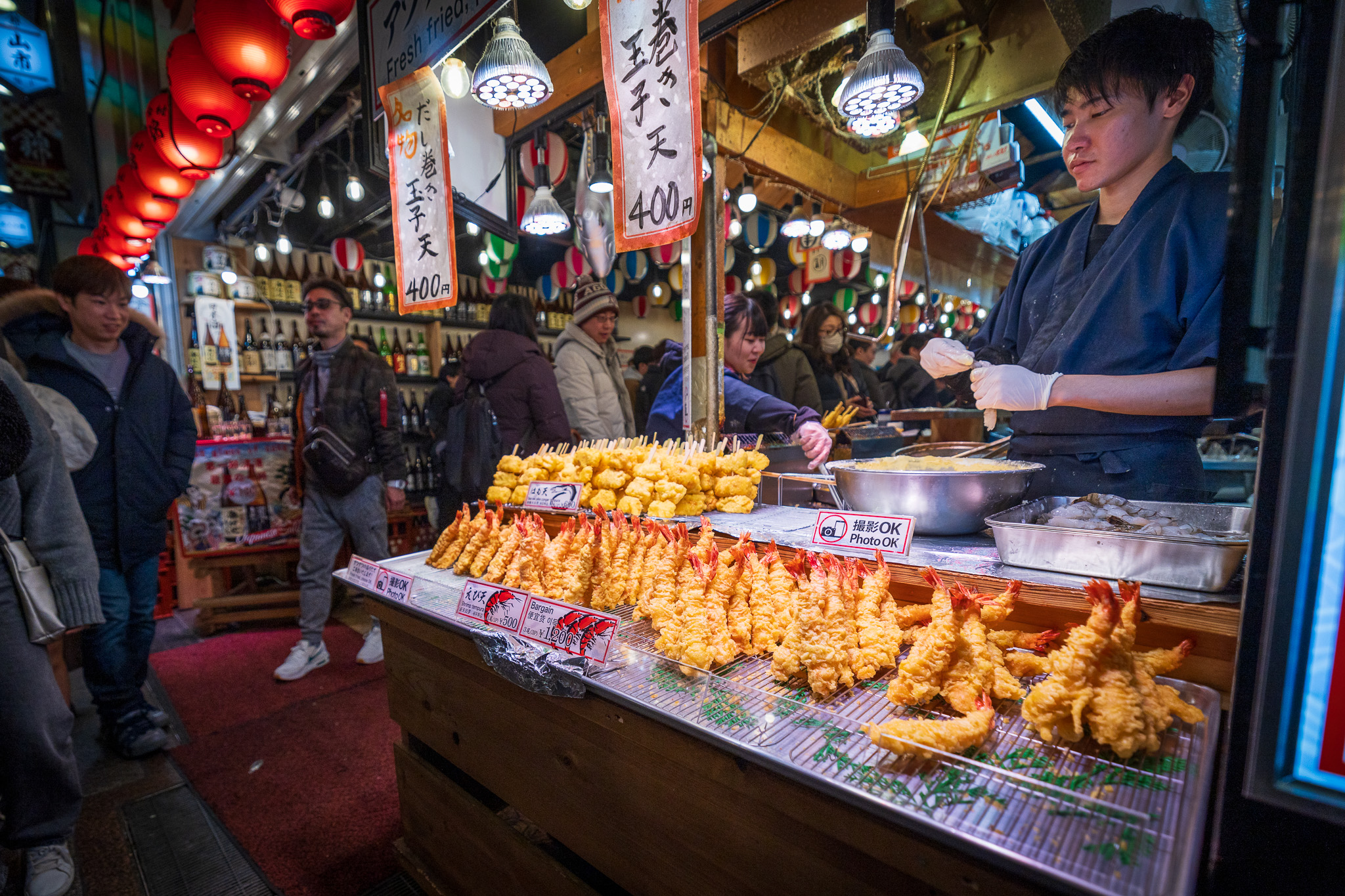
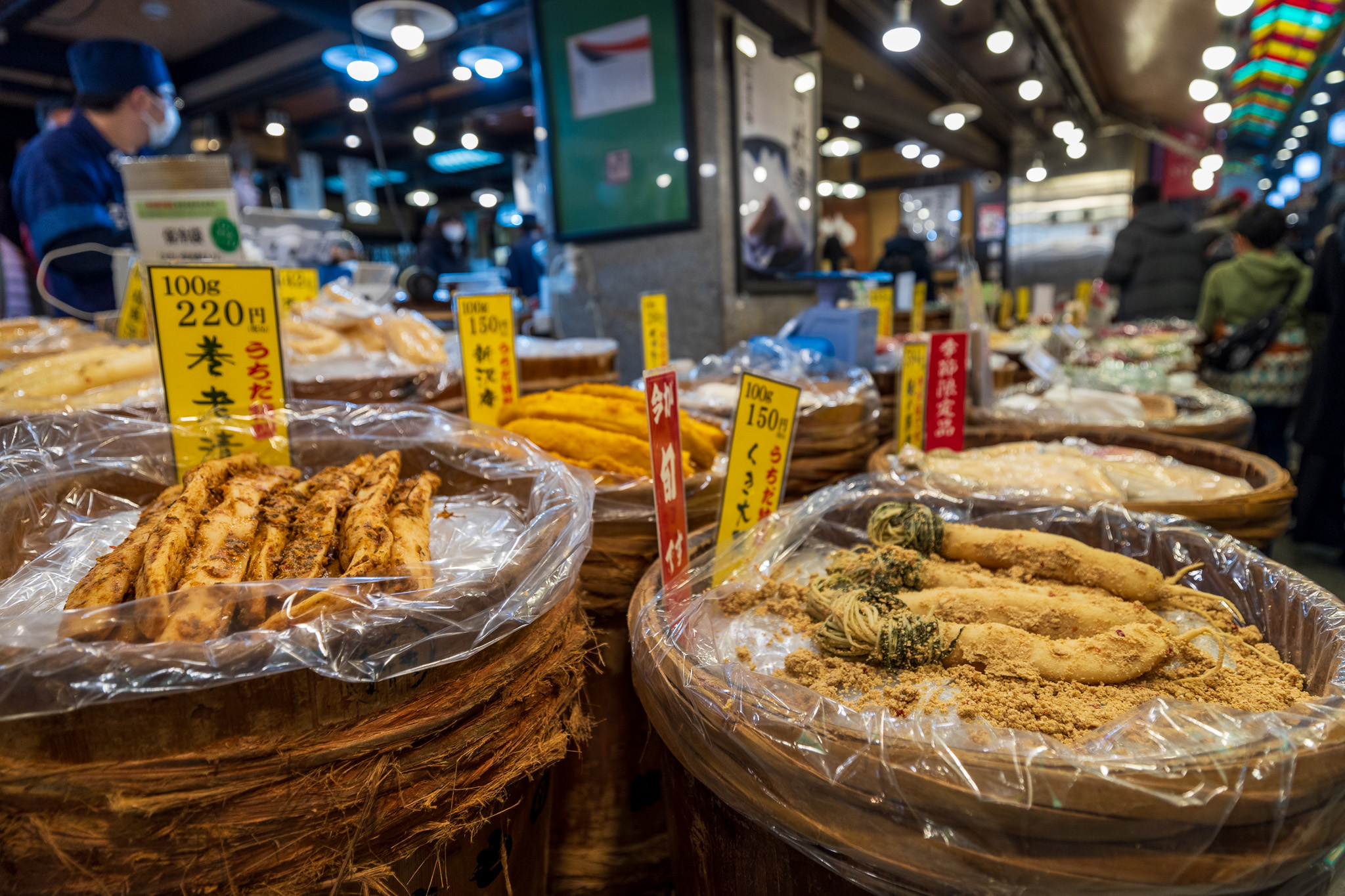
What Nishiki sells is the most specific food culture on this list. As the madseriksson.no guide to Nishiki describes in detail, the market is the place to find the ingredients that make Kyoto cooking distinct from Japanese cooking anywhere else. There are the tsukemono, Kyoto’s pickles — sour suguki turnip, purple shibazuke of aubergine and red shiso, wafer-thin senmaizuke — sold from barrels by merchants who expect to be asked for a taste. There is yuba, the skin lifted from heated soy milk, developed in Buddhist temple kitchens as a protein for monks who ate no meat; there is fu, wheat gluten, shaped and coloured for kaiseki; there is kombu for the light kelp dashi that underlies Kyoto cooking; there are the kyō-yasai, the city’s heirloom vegetables, from the round Kamo aubergine to the long Kujō leek; there are dried fish and wagashi, the seasonal sweets of the tea ceremony. And there is tamagoyaki, the rolled omelette, sold hot from shops that make it in front of the customer, which may be the single best thing to eat in the market. Behind all of it is the soft water of the Kyoto basin, which is why the tofu tastes as it does, and the court and temple culture that demanded refinement in everything.
Nishiki ranks sixth, not higher, for a reason the site’s own guide states plainly: the market is changing, and not in the direction of its history. A lane three metres wide cannot absorb thousands of visitors a day, and in peak seasons — cherry blossom in April, autumn colour in November — the central stretch becomes a slow-moving crowd. Rents have risen, and some of the traditional provisioning shops have given way to stalls selling matcha soft-serve and skewers designed to be eaten on the move. The market’s own association asks visitors not to walk while eating, but to eat in front of the shop where the food was bought. The western end, toward Takakura, keeps more of the old character than the eastern end by Teramachi, and the difference between the market at nine in the morning and at noon is the difference between a working kitchen and a queue. Shops open from around nine and close in the early evening, and each closes on its own day of the week, Wednesday and Sunday being common. Go early, walk west, taste the pickles before buying, and the market is still what its name says it is. The wider city is covered in the Kyoto guide.
Kyoto is a city that turned its distance from the sea into a cuisine. Without fresh fish, it learned to pickle, dry, ferment and coax flavour out of kelp, soy and its own vegetables. Nishiki is where that history is still for sale, barrel by barrel, in a lane so narrow that two shoppers must turn sideways to pass. It is a market built on a cold spring, and on four hundred years of making do with elegance.
#7 La Merced — The Heir of Tlatelolco and the Larder of a Megacity
The largest traditional market in a city of more than twenty million, descended from the canoe markets of the Aztec capital, housed since the late 1950s in Enrique del Moral’s great concrete halls with a metro station opening into them, and rebuilt in stages after a fire on Christmas Eve 2019
When Hernán Cortés reached Tenochtitlan in 1519, the market that astonished the Spanish was at Tlatelolco, the twin city to the north, where tens of thousands of people traded every day in goods that came in by canoe across the lake. The lake was drained over the following centuries, and the city’s market life moved toward the canals that still reached its eastern edge. The district that grew up there took its name from the monastery of Nuestra Señora de la Merced, founded by the Mercedarian order in 1594; only its Plateresque cloister survives. By the end of the eighteenth century, contemporary accounts describe almost the entire neighbourhood as one great market, supplied by boats on the Canal de la Viga. In the 1860s the city decided to put it under a roof, and the first permanent market buildings went up on the monastery grounds. For most of the twentieth century La Merced was the city’s central wholesale market, the point through which most of Mexico City’s food passed, until that role moved in the 1980s to the vast Central de Abasto in the south-east. In the late 1950s the retail market moved into a new complex designed by the architect Enrique del Moral, whose principal hall, the Nave Mayor, is a huge, high-roofed space of concrete vaults; the Merced station of the metro, opened with the first line in 1969, leads straight into it.
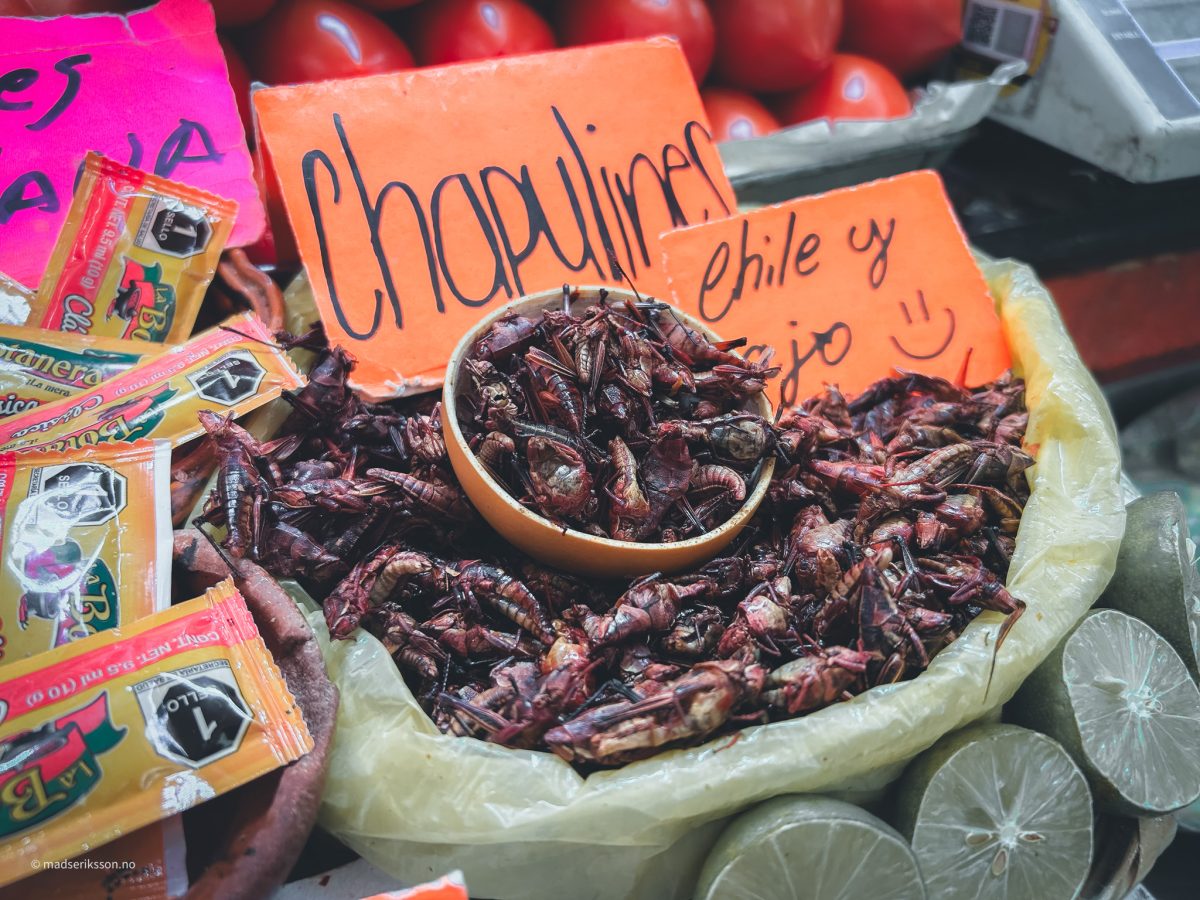
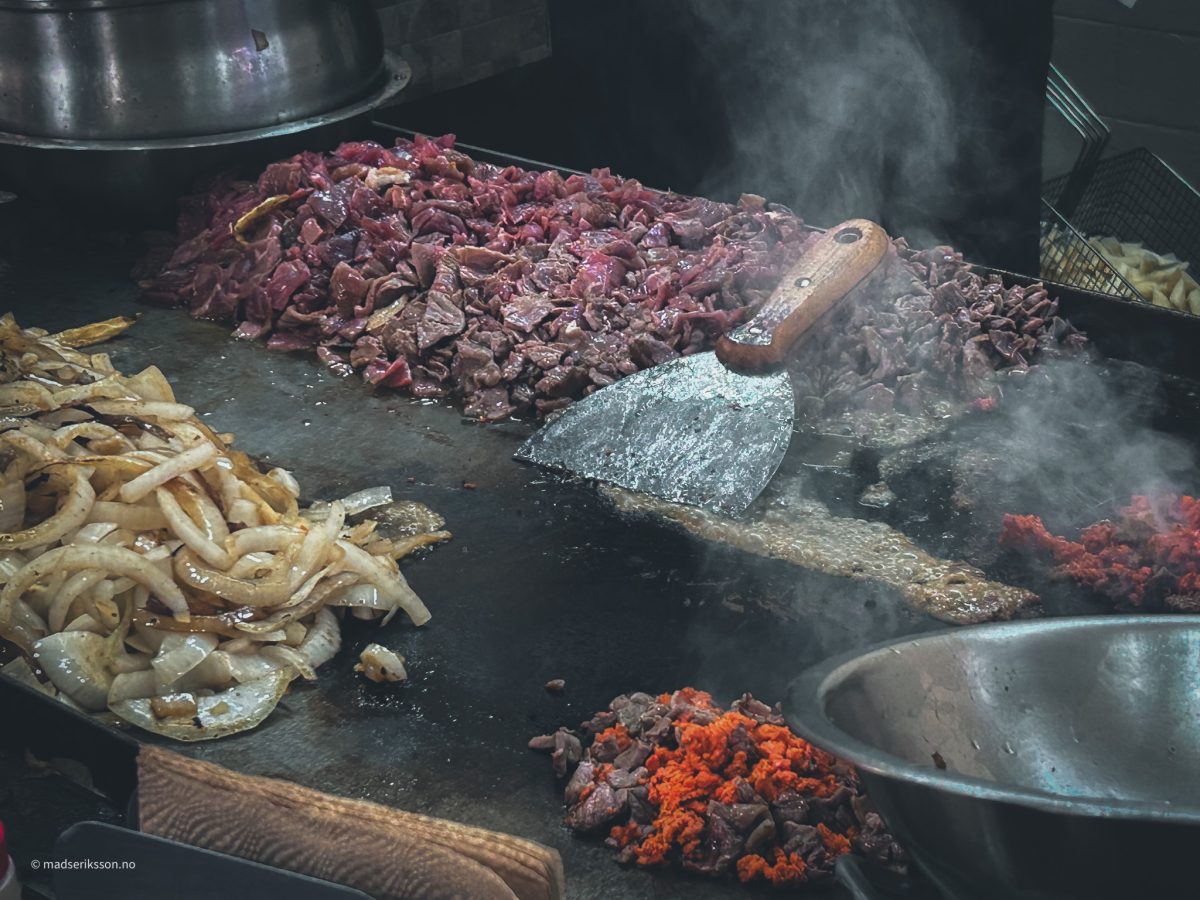
La Merced today is the largest traditional retail market in Mexico City, a cluster of halls and street markets east of the Zócalo that is less a building than a neighbourhood. The madseriksson.no guide to Mexico City describes it, with the flower market of Jamaica, as the older market culture beneath the neighbourhood restaurants — chaotic, vast and indispensable to the daily food supply of the city. What it sells is the raw material of Mexican cooking at its widest. The dried chiles are the market’s most characteristic sight: sacks and towers of ancho, guajillo, pasilla, mulato and chipotle, sold by the variety and the kilo to cooks who know exactly which mole they are making. There are nopales cleaned of their spines at the stall; epazote and other herbs; fresh and dried corn and the masa made from it; Oaxaca cheese wound into balls; sheets of chicharrón; wild mushrooms in the rainy season; tropical fruit from the coasts; and, around and between the stalls, the small kitchens that feed the people who work there — tacos and quesadillas off the griddle, chicken broth, tamales in the morning. Next door, the Mercado de Sonora sells medicinal herbs, ritual goods and live animals, a reminder that the market world of Mexico City has never separated food from everything else.
La Merced ranks seventh because, on two of the four criteria, it is close to unbeatable. Its local use is total: almost everyone here is buying for a kitchen, a restaurant or a stall, and visitors are a small minority. Its history runs, in one form or another, from the Aztec markets to the present. On food quality it is a market of ingredients rather than of finished dishes, and it rewards those who cook more than those who only taste. On atmosphere it is the most overwhelming market on this list, and the least curated. It has also had a hard few years. On Christmas Eve 2019 a fire destroyed much of the Nave Mayor and left more than 700 traders without their stalls; the damaged section was demolished and rebuilt in stages between 2020 and 2022, and work on the rest of the complex was still continuing in 2026, when the electrical system of the smaller hall, the Nave Menor, was replaced. The surrounding streets are crowded and, in places, rough, and the city has made the area a priority for policing. The sensible way to visit is in daylight, with little to carry, ideally with someone who knows the market; it is open every day, and busiest in the morning.
Five centuries ago the Spanish wrote home about the market at Tlatelolco, where a whole lake’s worth of produce arrived by canoe. The lake is gone and the canoes with it, but the trade never left the eastern edge of the city. In the dried-chile aisles of La Merced, sold by the kilo to cooks who know precisely what they need, the oldest market tradition in the Americas is still doing business at full volume.
#8 Ballarò — The Street Market That Still Sounds Like the Medieval City
Palermo’s oldest and largest market, traced to the Arab period of Sicily and named, by tradition, after a Muslim village near Monreale: a run of shouting fish stalls, blood oranges and artichokes through the lanes of the Albergheria, where breakfast is a fried rice ball or a spleen sandwich eaten standing up
Palermo was an Arab city for more than two centuries. The Emirate of Sicily made it one of the largest and richest cities in the Mediterranean, and the Normans who followed kept its administration, its craftsmen and much of its food: citrus, sugar cane, rice, saffron and the taste for sweet-and-sour that still runs through Sicilian cooking all arrived or flourished in this period. Ballarò is the market that carries that inheritance most directly. It is traditionally traced to the Arab period, and its name is usually derived from Balhara, a Muslim village near Monreale whose traders set up their stalls beyond the Kemonia river, on the edge of the old city. It runs today along Via Ballarò and the lanes around it in the Albergheria quarter, between the Norman palace and the central station, from Piazza Casa Professa to Piazza del Carmine. The madseriksson.no guide to Palermo describes the city’s three historic markets — Ballarò, the Vucciria and the Capo — as operating on medieval footprints with medieval noise levels, and Ballarò as the oldest of them.
The noise is the first thing. Ballarò’s traders practise the abbanniata, the sung, shouted cry with which Palermo’s market sellers advertise their goods, and the lanes ring with it from early morning. The produce is Sicilian and seasonal: artichokes, wild fennel, broad beans, blood oranges and lemons in winter, tomatoes, aubergines and peppers in summer, prickly pears in autumn, piles of capers, almonds and pistachios from the interior, and fish laid out on ice at the lower end of the market — swordfish steaks, sardines for pasta con le sarde, octopus boiled and sold hot. Around the stalls, the street food of Palermo is cooked and eaten on the spot: arancine, the fried rice balls filled with ragù or butter and cheese; panelle, chickpea fritters in a soft roll; sfincione, the thick, spongy Palermitan pizza with onion and caciocavallo; and pani ca meusa, veal spleen and lung cooked in lard and served in a sesame bun, the city’s most uncompromising breakfast. In recent decades the market has also become the commercial centre for Palermo’s immigrant communities, and stalls selling West African and South Asian produce now sit beside the Sicilian ones — a modern echo of a market that was multi-ethnic from the start.
Ballarò ranks eighth because it is the most authentic open-air street market in Europe and among the most historic: its local use is high, its food is specific and excellent, its atmosphere is unmatched, and visitors, though numerous, have not changed what it is. It ranks below the covered markets above it because it is less a single institution than a living district, without their concentration of specialists, and because the quarter around it is poor and, in places, run down. Its sister markets show the alternative futures. The Vucciria, once the most famous market in Palermo, has largely become a nightlife district of bars and grills; the Capo, north of the cathedral, is the quietest and most local of the three. Ballarò sits between them, still a morning food market first. It trades from early morning on every day except Sunday afternoon, and it is at its best before midday, when the fish is freshest and the voices are loudest.
The Arabs gave Palermo its oranges, its sugar and its market; the Normans kept all three. A thousand years later, in the lanes behind the Norman palace, a fishmonger is singing the price of swordfish in a dialect full of Arabic words, beside a stall selling cassava from Ghana and another frying chickpea fritters in a roll. Ballarò has never stopped absorbing new arrivals. That is why it has never stopped being Palermo.
#9 Spice Bazaar — The Market Built to Pay for a Mosque
An L-shaped hall of vaulted shops on the Golden Horn, begun after the great fire of 1660 as the commercial wing of the New Mosque and named after the revenues of Ottoman Egypt that funded it, still selling red pepper, sumac, saffron, pistachios and lokum to Istanbul and its visitors in roughly equal measure
The Spice Bazaar was never meant to be a sight. As the madseriksson.no guide to the Spice Bazaar tells the story, it began as a rent roll. In 1597 Safiye Sultan, mother of Mehmed III, ordered a great mosque on the waterfront at Eminönü, but the site was difficult, her influence ended with her son’s death in 1603, and for more than half a century the unfinished walls stood by the harbour. In July 1660 a fire burned for about two days through the old city along the Golden Horn, and in the rebuilding that followed Turhan Hatice Sultan, mother of the young Mehmed IV, took up the abandoned project. The mosque was completed and inaugurated in 1665; beside it, at the same time, the architect Koca Kasım Ağa built a long covered market whose shop rents were assigned to the mosque and its charities — its school, its bath and its hospital. So the trade in pepper and cinnamon paid for prayer and for the poor. The bazaar became known as Mısır Çarşısı, the Egyptian Bazaar, after the revenues of Ottoman Egypt that financed it, and for centuries it was the centre of the city’s spice trade, at the point on the Golden Horn where goods arrived by sea.
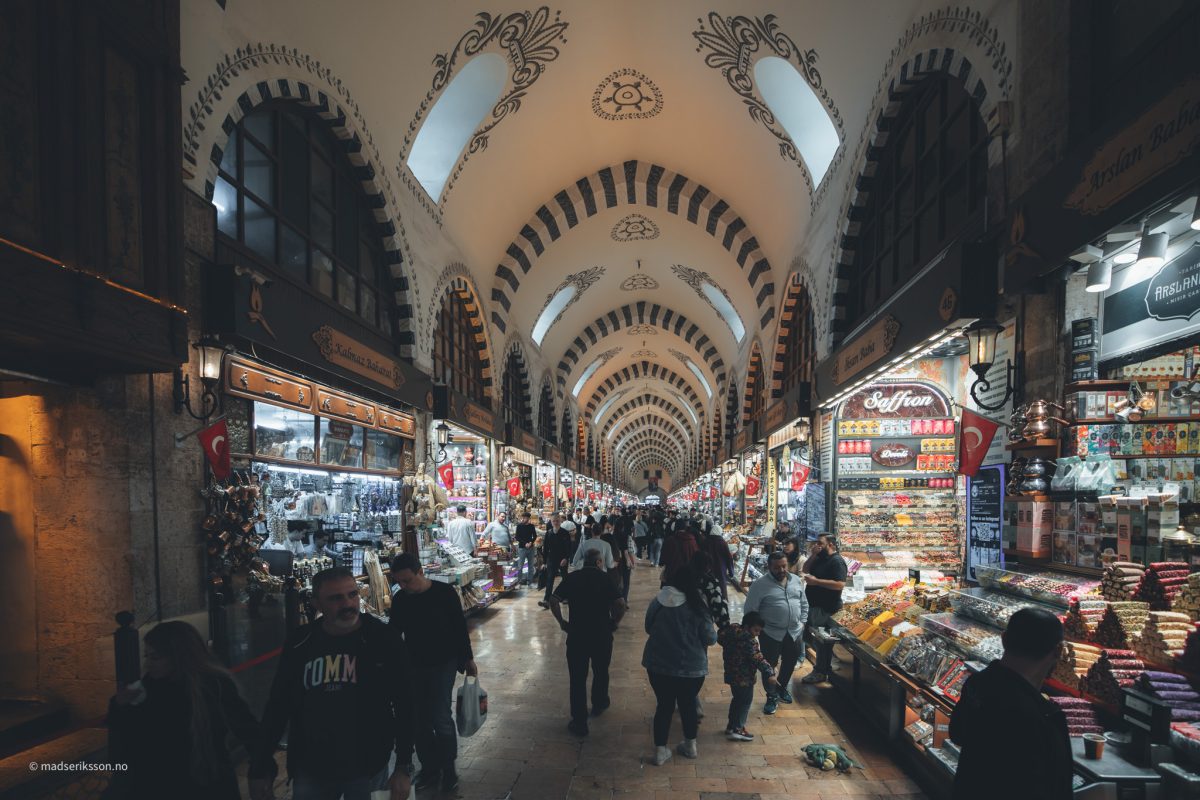
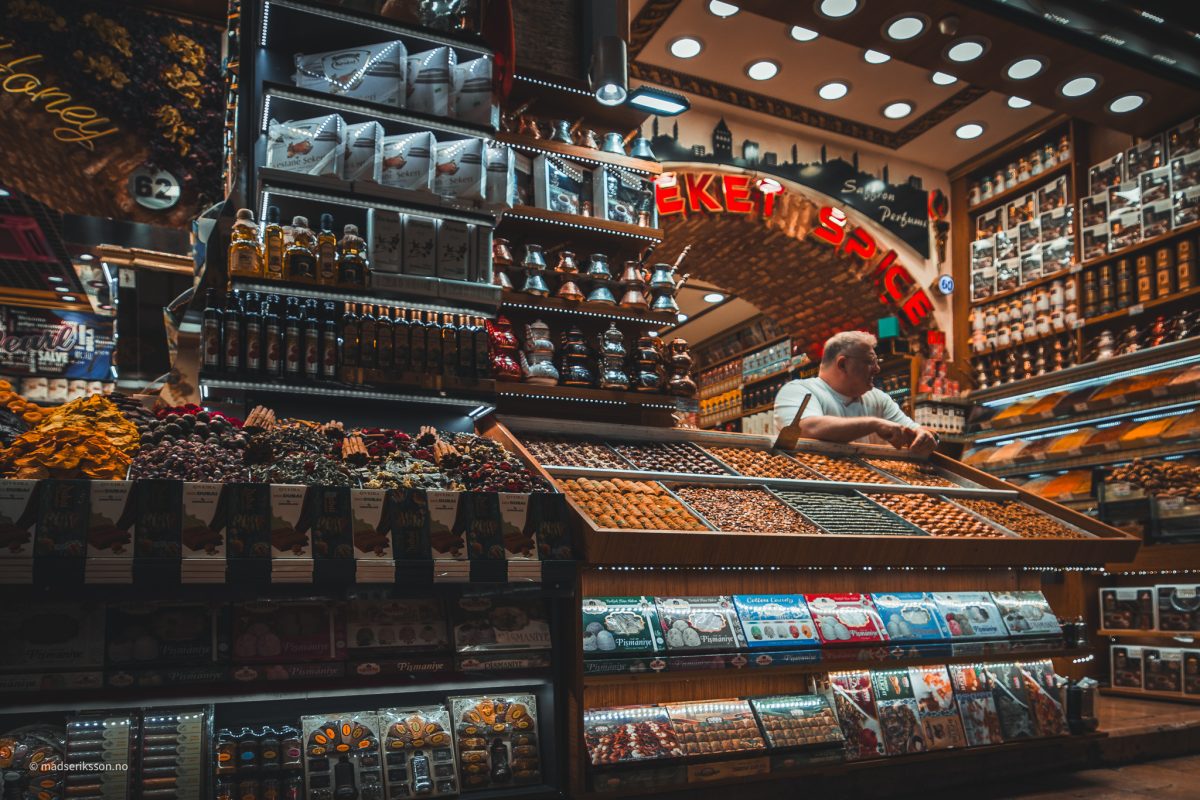
The building is an L of two long vaulted arcades meeting at a right angle, with six gates and around 85 shops inside, more in its outer walls. It has burned more than once; after a fire in 1940 it was restored over three years, the shops were opened up into the back rooms, and each was given a painted symbol — a boat, a pair of scissors, an ostrich egg — so that customers could tell them apart. Under the vaults the shopfronts are walls of colour: deep red pul biber and the smoky, almost black isot pepper of the south-east, purple sumac, cumin, coriander, cinnamon bark, dried mint; saffron in sealed boxes; Turkish delight cut in cubes, flavoured with rose, pomegranate or mastic and packed with pistachios; dried apricots, figs and mulberries; walnuts, hazelnuts and the pistachios of Antep. The best buys, as the site’s guide advises, are the everyday ingredients of Turkish kitchens rather than the gift boxes, and most shops expect to offer a taste. Behind the bazaar, the streets of Tahtakale carry on the trade at wholesale level and local prices — coffee, cheese, olives, cured meats, nuts, kitchenware — and on the corner the coffee roaster Kurukahveci Mehmet Efendi has been grinding Turkish coffee since 1871.
The Spice Bazaar ranks ninth because its history and its setting are as strong as any market on this list, while its local use has thinned. On busy days it receives 50,000 to 60,000 visitors, roughly half from abroad and half from Türkiye, and a growing share of its shops sell to the first group. Its food offering is also narrower than that of the markets above it: this is a market of spices, sweets, nuts and dried goods rather than of fresh produce, fish and meat, which are found in the streets outside. But it remains a working market in the old commercial heart of the city, and its surroundings are extraordinary: the New Mosque it was built to serve, reopened in 2023 after years of conservation; the tile-covered Rüstem Pasha Mosque above a row of shops a few minutes away; the ferries and the Galata Bridge at the door. The bazaar is open every day from early morning to early evening, closes on the first days of the religious holidays, and is calmest soon after opening; by late morning, especially when cruise ships are in port, the arcades are shoulder to shoulder. The Istanbul guide covers the Grand Bazaar up the hill and the rest of the city.
For three and a half centuries the Spice Bazaar has done exactly what it was built to do: sell things, and send the rent to the mosque next door. It is a monument that has never stopped being a shop. Buy a bag of red pepper and a bag of sumac, not a gift box; then walk out of the side gate into Tahtakale, where the coffee roaster has had a queue since 1871.
#10 Dongmun Market — An Island’s Larder, and a Night Market Under the Lights
Jeju’s oldest and largest traditional market, founded in the weeks after Korea’s liberation in 1945, burned and rebuilt in 1954, where the island still buys its silver cutlassfish, tangerines and black pork by day, and where a municipal night market of open grills has drawn crowds to the old town since 2018
Korea was liberated from Japanese rule in August 1945, and two months later, in the east of Jeju City, a permanent market took shape. Its name, Dongmun, means simply East Gate, and for years it was the only permanent market on the island: the place where Jeju’s farmers, fishing families and traders met. In March 1954 a fire destroyed it completely. The traders did not rebuild on the ashes; they moved a short distance into the old heart of the city, and by November of the same year the market had reopened on its present site under the same name. It has grown and been modernised since — the main alleys are now roofed, with numbered gates leading in from the surrounding streets — but its layout of tightly packed stalls still reflects the way it grew, piece by piece. As the madseriksson.no guide to Dongmun describes, it stands a few minutes’ walk from Gwandeokjeong, a pavilion built in 1448 and the oldest building on Jeju, in a compact old downtown that most visitors to the island pass straight through on the way from the airport to the beaches.
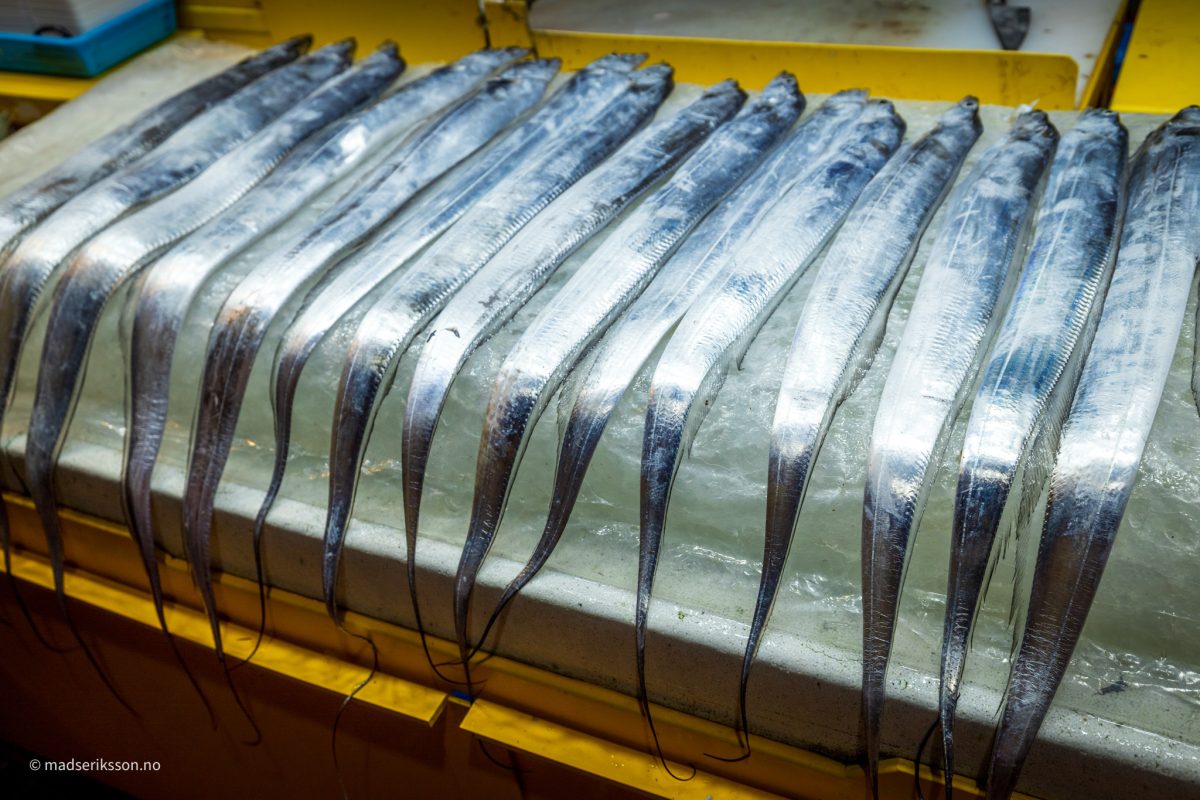
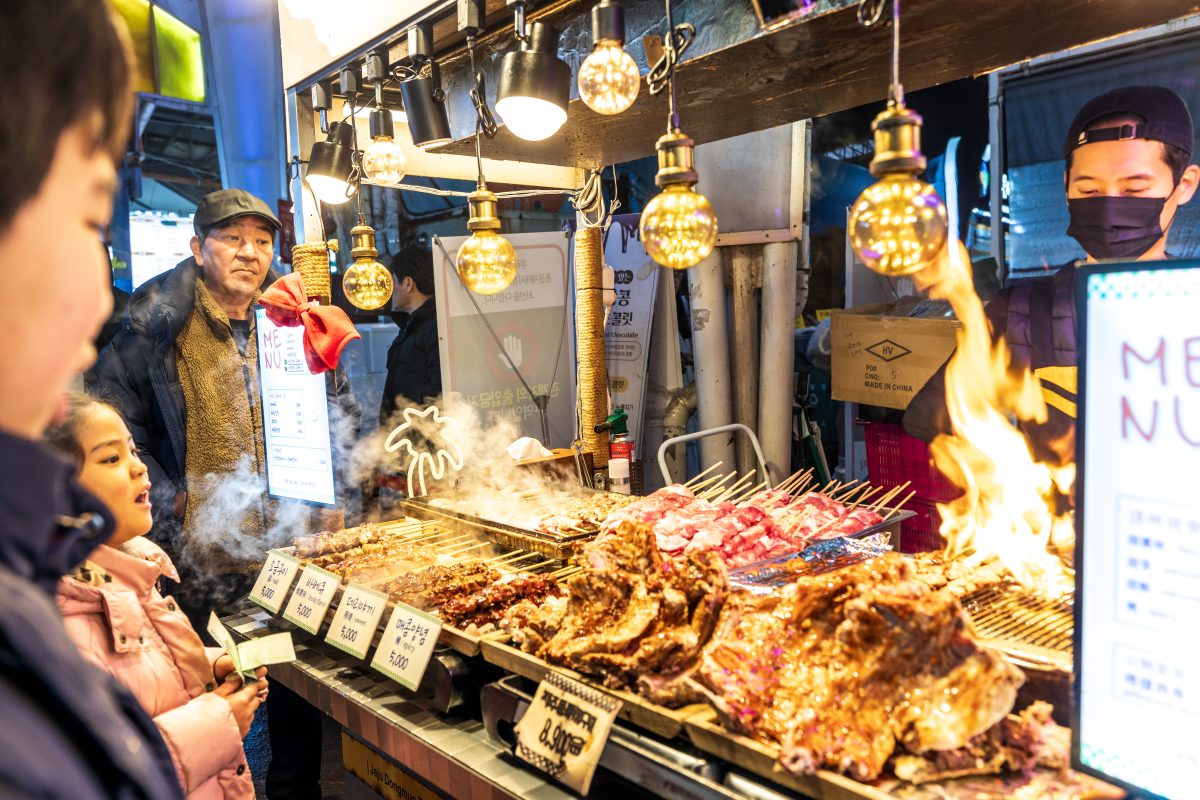
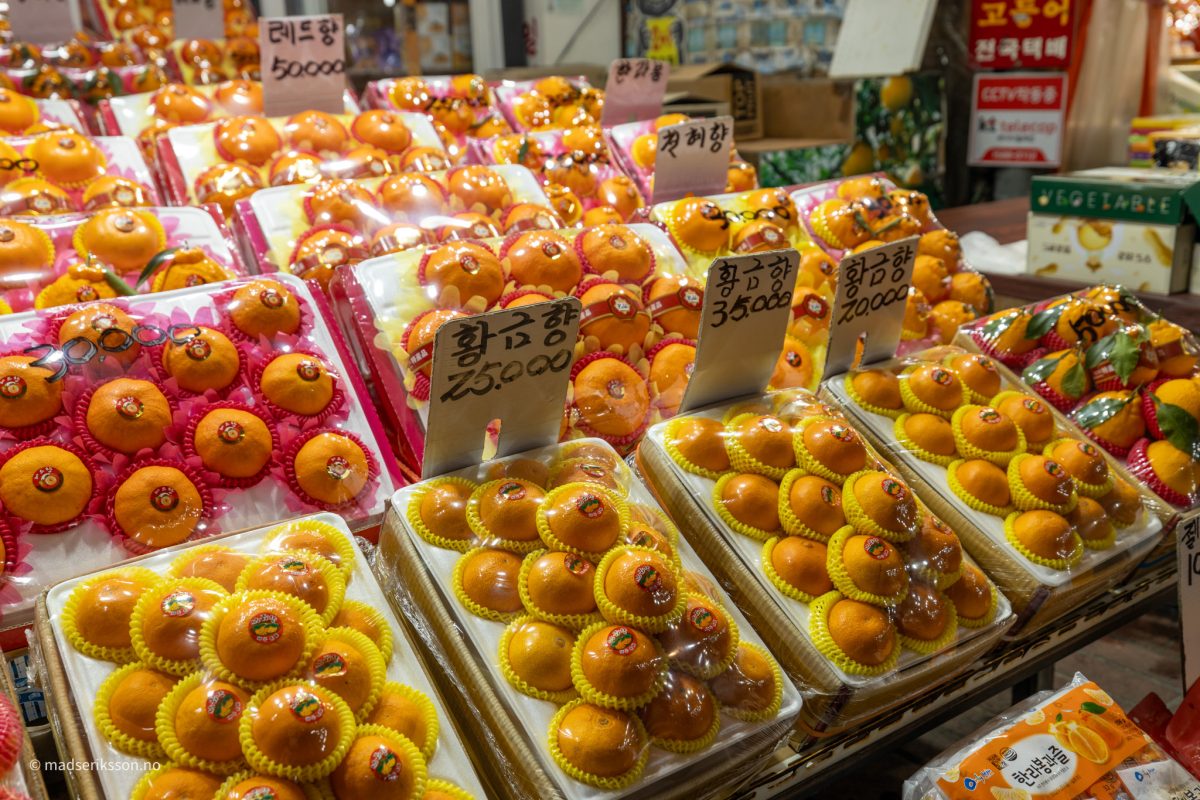
What makes Dongmun worth the detour is that it is the larder of a particular place. Jeju is a volcanic island with its own climate, its own sea and its own food, and the market sells all three. The fish market is its oldest and busiest part: long, silver cutlassfish, galchi, laid out on ice; mackerel, squid, octopus, shellfish and abalone, which also turns up cooked in rice and in braised dishes; and counters that prepare platters of raw fish to order. Further in, the fruit alleys are given over almost entirely to citrus, because Jeju is Korea’s tangerine island: thin-skinned mandarins sold by the box, and hallabong, the large, knobbly fruit named after the island’s volcano, bred in Japan in 1972 and introduced to Korea in 1990, in season from winter into spring. There is Jeju black pork, from a native breed whose purebred herd is protected as a Natural Monument and whose farmed descendants are the island’s most famous dish; there are rice-cake makers selling omegi-tteok, the traditional Jeju rice cake; and there are small counters serving gimbap and tteokbokki to market workers. In 2018 the city added a night market in an alley at the back, reached through Gate 8: a trial of 32 mobile food stalls, built with public money to bring people into the old town after dark. It worked, and its grills, lobster finished with a blowtorch, black-pork rolls and peanut hotteok now draw some of the biggest evening crowds on Jeju.
Including Dongmun at number ten is a deliberate choice, and an arguable one. It has neither the long history of the European markets above it nor the culinary depth of Tsukiji or Nishiki. What it has, more clearly than almost any market on this list, is the fourth criterion: it is still a market for the people who live around it. The site’s own guide puts it plainly — it is not a market built for visitors, which is what makes it worth visiting: the fish is the fish that Jeju eats, and the tangerines are sold by the box to local families. That quality was the reason it took the last place ahead of Osaka’s Kuromon, a more famous market that has moved further toward food for tourists. The daytime market is open every day of the year, with most stalls trading from early morning into the evening; the night market runs from six until midnight, and is most crowded on Friday and Saturday evenings. The best plan is the one the guide recommends: walk the daytime alleys in the late afternoon, before the fish and fruit stalls close, and stay as the lights come up at Gate 8.
Dongmun was founded in the first autumn of Korean freedom, burned within a decade, and was rebuilt within a year. Seven decades later it still does what it was founded to do: sell the island its own fish and fruit. Then, at six in the evening, the grills light up at the back of the market, and a municipal experiment that began with thirty-two stalls turns the old town into the liveliest place on Jeju.
«The ten markets in this ranking are not food halls, and that is the point of them. A food hall is designed to be visited; a market is designed to be used, and the visit is a by-product. Tsukiji grew up to supply the sushi counters of Tokyo, and it still sharpens their knives. Valencia’s Mercat Central was built to feed a city, and the city still comes with its trolleys. Gwangjang was founded to be open every day, and every day its benches fill with office workers. Borough was abolished by Parliament and re-founded by its own parish, and its parish still runs it. La Merced, Ballarò and Dongmun are what their cities eat, sold in the voices of the people who sell it. Nishiki, the Spice Bazaar and La Boqueria carry the heaviest weight of fame, and each of them is, in different ways, trying to remain a market rather than become a picture of one. The test of all ten is the same, and it is easy to apply on the spot: watch who is carrying the shopping. Where the bags are full of things that will be cooked tonight, the market is alive. Where they are not, it is becoming something else. These ten are still alive.»
More in the same area
 ArchitectureEurope’s 10 Greatest Cathedrals and Churches
 GlaciersEurope’s 10 Greatest Glaciers — And How to Experience Them
 ArchitectureTen Buildings That Changed Their Cities — Modern Architecture Ranked on Impact, Not Image
 CitiesThe World’s 10 Most Beautiful City Parks
 CitiesTokyo — Enormous, Efficient, Beautiful and Entirely Unlike Anywhere Else
 Train travelThe World’s 10 Great Railway Journeys