Vienna was built to impress an empire, and the empire left in 1918. What remains is a capital of two million people living inside the stage set of a state that once ruled fifty million: a 5.3-kilometre boulevard of opera house, parliament and museums where the walls used to stand; a palace that grew for six centuries; a Gothic cathedral with a roof like a patterned carpet; and a painting of two lovers wrapped in gold. Yet the Viennese do not live in a museum. They read the newspaper for two hours over one coffee, drink wine grown inside the city limits under a bunch of pine branches, and spend summer evenings by a canal or in front of a cinema screen hung across their neo-Gothic town hall. Few cities wear their grandeur so lightly.

Vienna — Wien in German — grew from a Roman frontier camp on the Danube into the residence of the House of Habsburg. The site of the Hofburg has been a documented seat of government since 1279, and the Emperors of Austria lived there until the monarchy collapsed in November 1918. Two Ottoman sieges, in 1529 and 1683, failed at its walls; the Congress of Vienna redrew the map of Europe here in 1814–15; and in the decades around 1900 the city produced Mahler, Freud, Klimt, Schiele, Otto Wagner and Adolf Loos almost at once. Then the empire was gone, and Vienna became the oversized capital of a small republic.
That mismatch is the key to the city. Vienna has about 2.04 million inhabitants — 2,042,036 on 1 January 2026 — but the buildings of its centre were sized for something bigger. The Historic Centre, 371 hectares of medieval, Baroque and late-nineteenth-century city, has been a UNESCO World Heritage Site since 2001, five years after Schönbrunn. From 2017 it was on the List of World Heritage in Danger because of a planned high-rise at the Heumarkt; the World Heritage Committee took it off that list in Busan in July 2026.
How to approach Vienna
The city is organised in concentric rings, and the sections below follow them: the Ringstraße, the Hofburg and the State Opera; St Stephen’s Cathedral, the Belvedere with its Klimts, and Schönbrunn; the Kunsthistorisches Museum and the MuseumsQuartier; the coffee houses and the Wiener schnitzel; and the summer city of the Danube Canal, the Film Festival on Rathausplatz and the wine taverns of Grinzing, before the practicalities of getting around. Like Prague and Budapest, the other great capitals of the old Habsburg lands, Vienna rewards walking; unlike them, its best moments are often spent sitting still.
Vienna in 3D
Vienna grew from a Roman frontier camp on the Danube into the residence of the House of Habsburg, and today has about 2.04 million inhabitants. Its Historic Centre, 371 hectares of medieval, Baroque and late-nineteenth-century city, has been a UNESCO World Heritage Site since 2001; the World Heritage Committee took it off the List in Danger in July 2026. This frame covers the Innere Stadt inside the Ringstraße, from the City Hall to the Danube Canal and south to the Belvedere.
The Hofburg and Michaelerplatz
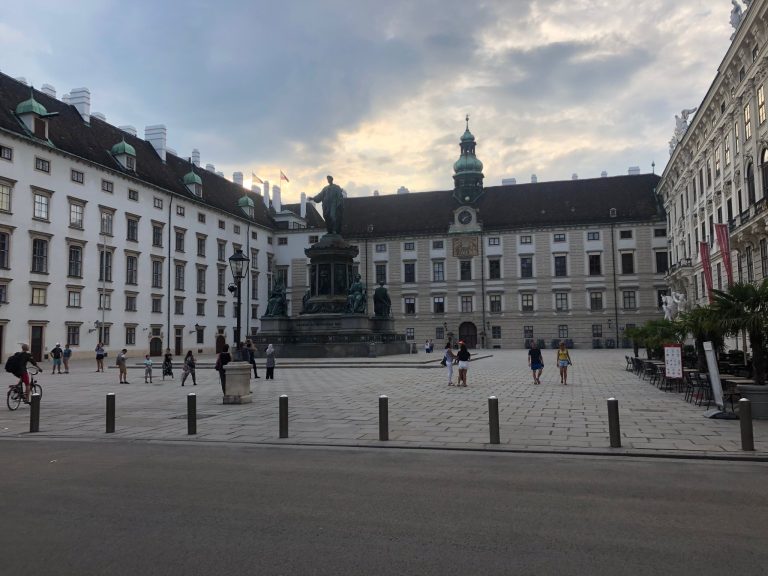
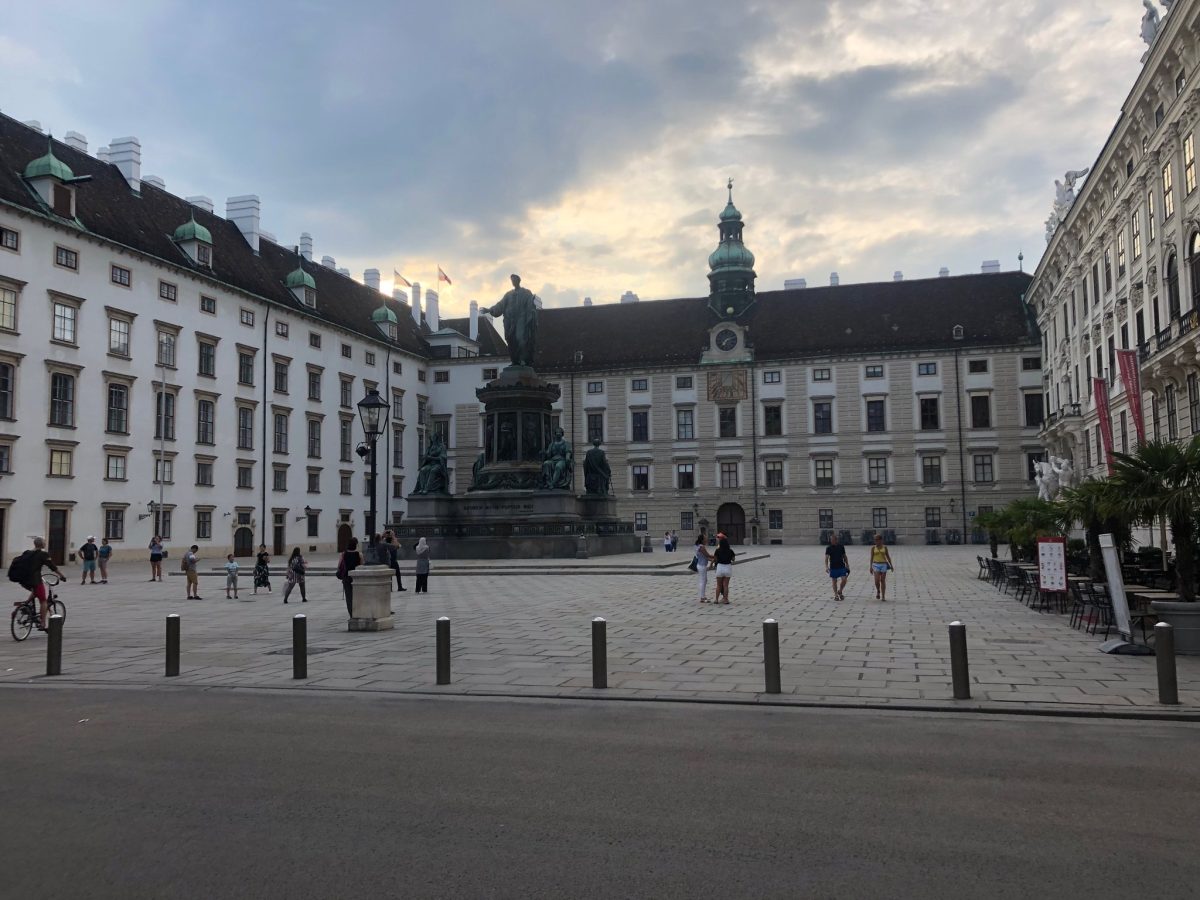
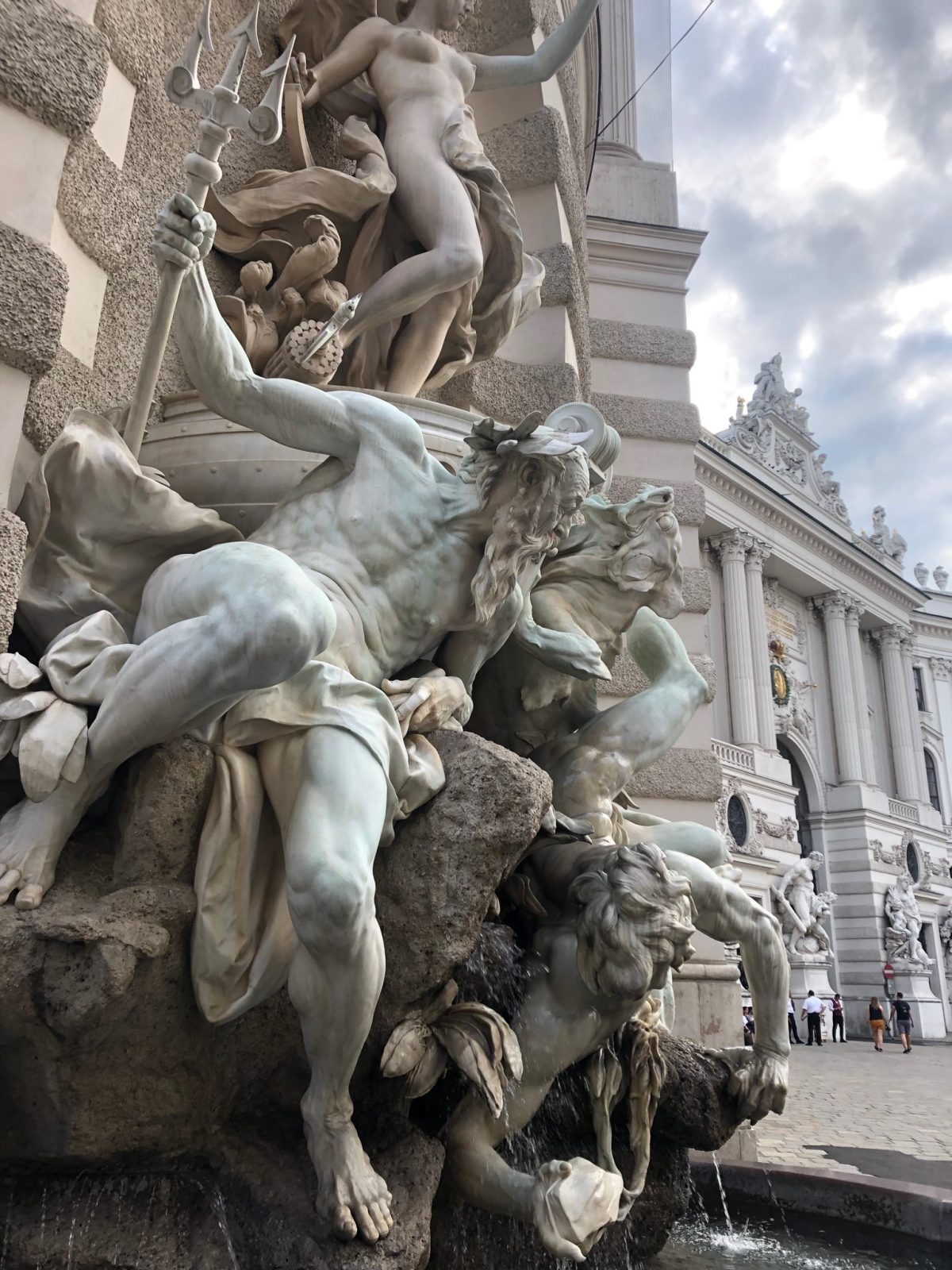
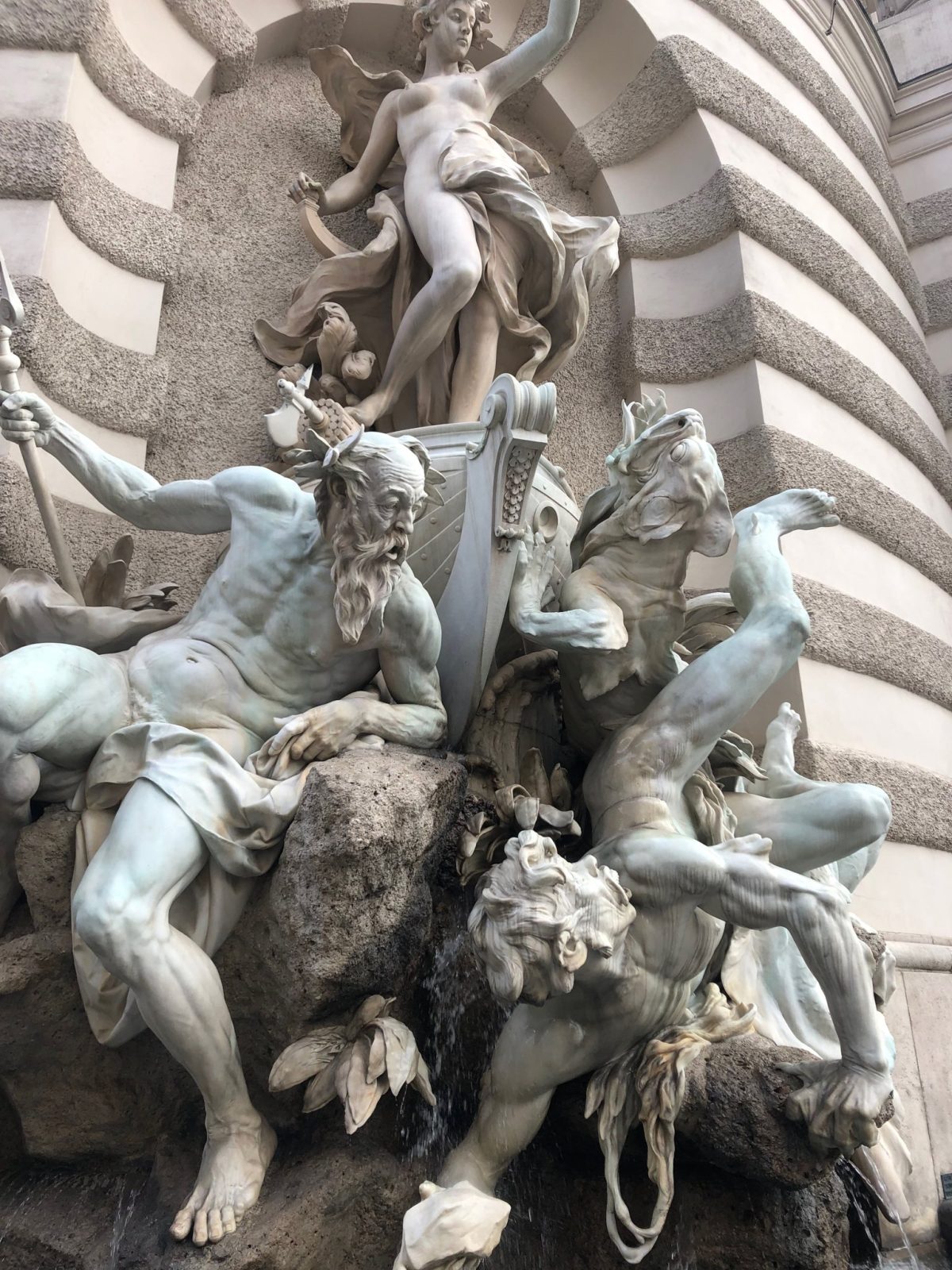
The Hofburg has been a documented seat of government since 1279, less a palace than a district of courtyards and wings built over six centuries. In der Burg, the inner courtyard, has a bronze of Emperor Franz I and the clock tower of the Amalienburg, and the Federal President has had his offices here since 1946. The city face, the Michaelertrakt, was completed in 1888–1893, with the Power at Sea fountain by Rudolf Weyr (1895) beside the domed Michaelertor.
In der Burg, the inner courtyard of the Hofburg in Vienna, with the monument to Emperor Franz I and the clock tower of the Amalienburg
The Ring and the State Opera
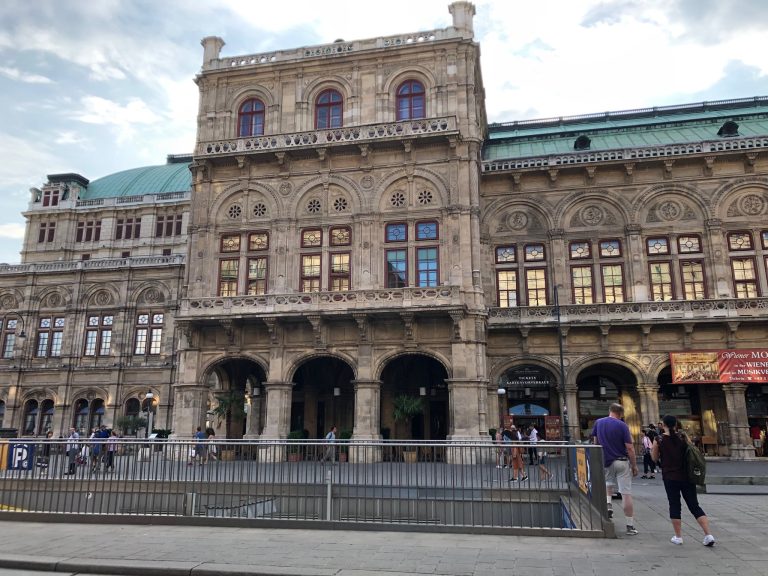
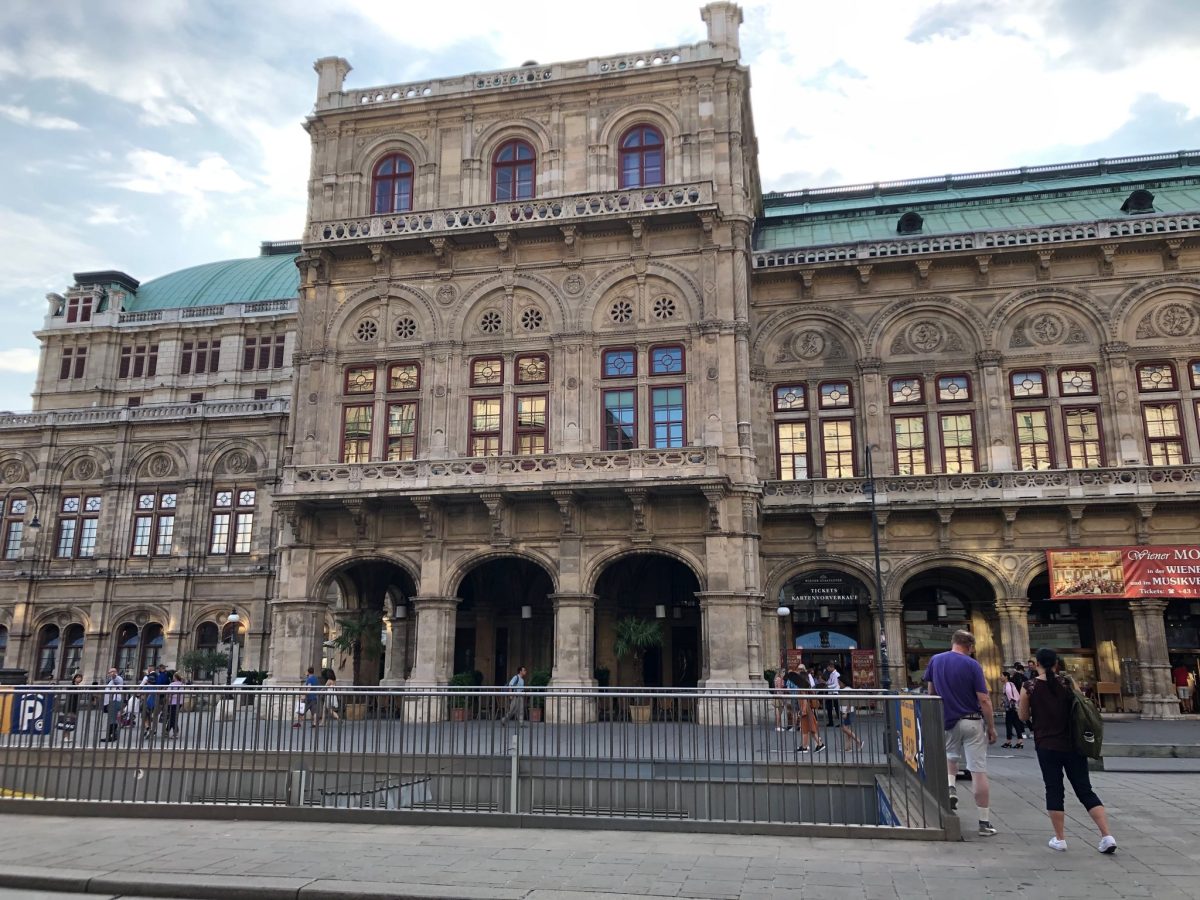
Franz Joseph's decree of December 1857 replaced the walls with a boulevard 57 m wide and 5.3 km long, opened on 1 May 1865 while most of it was still a building site. The State Opera on the Ring opened on 25 May 1869 with Don Giovanni, was gutted in an air raid on 12 March 1945 and reopened on 5 November 1955 with Fidelio.
The Vienna State Opera on the Ringstraße, the Neo-Renaissance opera house that opened in 1869
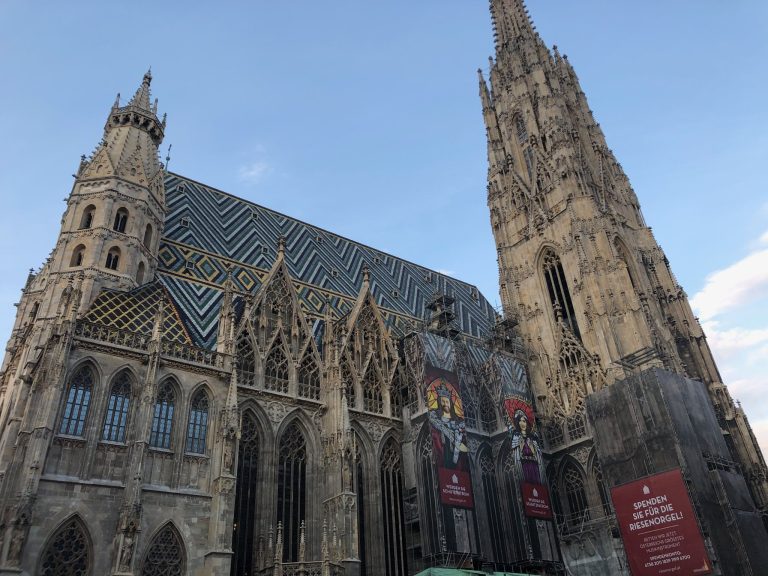
St Stephen's Cathedral
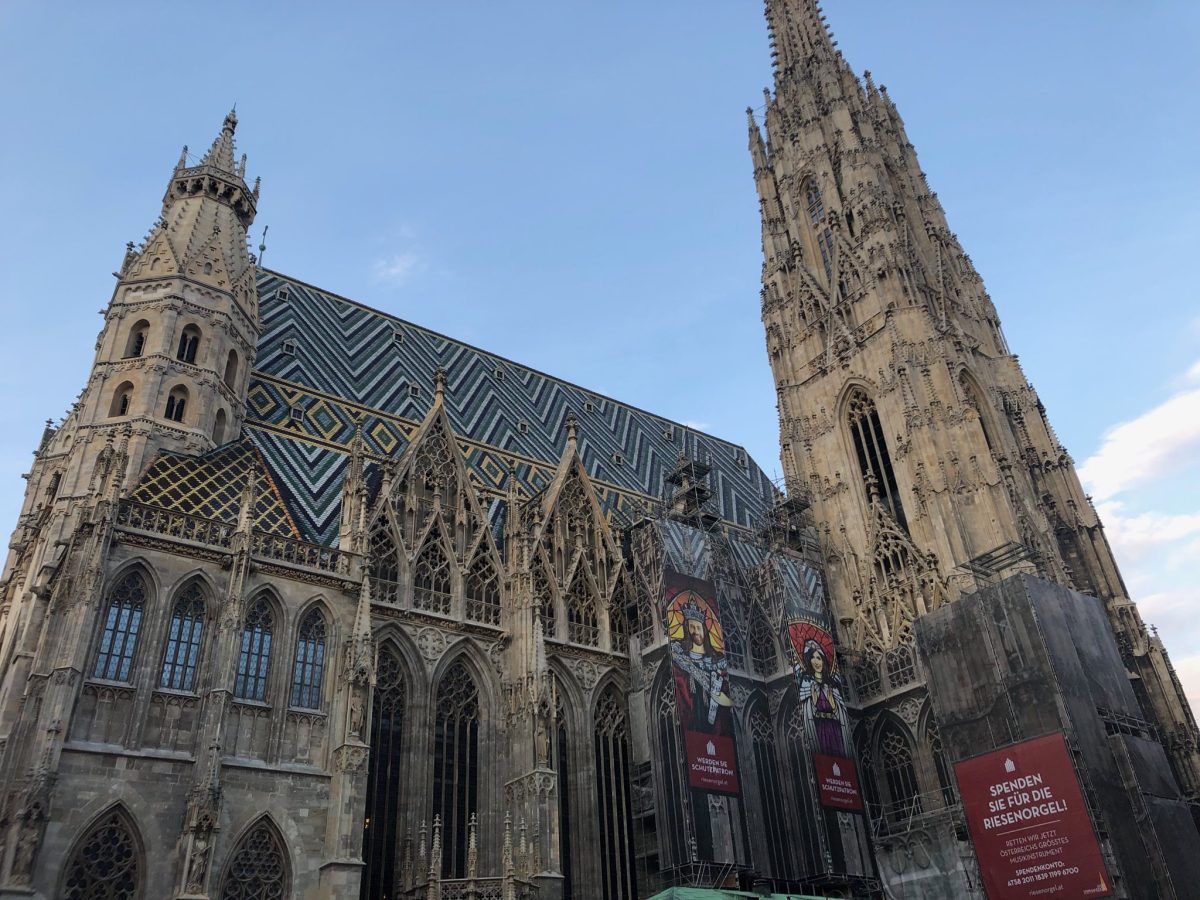
A Romanesque church was consecrated here in 1147; Duke Rudolf IV began the Gothic south tower, the Steffl, in 1359, and at 136.4 m it still defines the skyline. Its steep roof is laid with glazed tiles in zigzags and, on the south side, in the shape of the double-headed eagle; the cathedral burned at the end of the Second World War and was rebuilt by 1952.
St Stephen's Cathedral in Vienna, with its patterned glazed-tile roof and the Gothic south tower
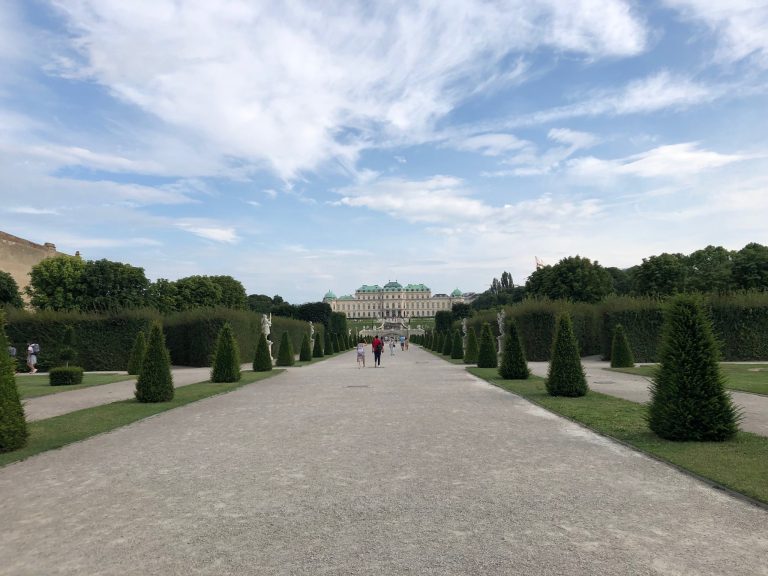
The Belvedere
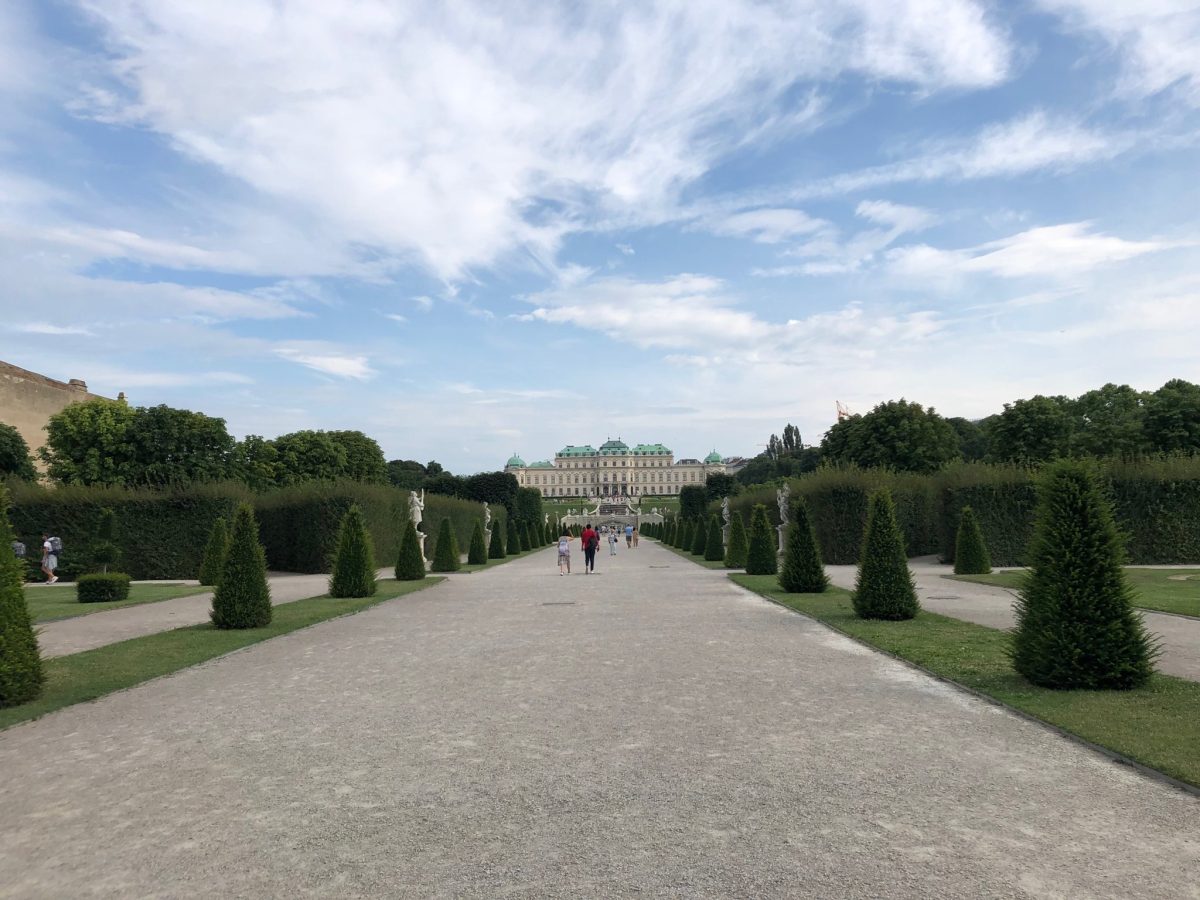
Johann Lukas von Hildebrandt built the Belvedere for Prince Eugene of Savoy: the Lower Belvedere, begun by 1712, and the Upper Belvedere on the hill, completed in 1723, joined by a terraced garden laid out by Dominique Girard. The Austrian State Treaty was signed in the Upper Belvedere on 15 May 1955, and Klimt's The Kiss of 1908–1909 hangs there today.
The formal garden of the Belvedere in Vienna, with clipped conical yews lining the path up to the Upper Belvedere
The Kunsthistorisches Museum and the MuseumsQuartier
Across the Ring from Heldenplatz, the Kunsthistorisches Museum and the Natural History Museum face each other over Maria-Theresien-Platz; the KHM opened in 1891 and owns twelve of the roughly forty-five surviving paintings by Pieter Bruegel the Elder. Behind them, the former imperial stables became the MuseumsQuartier in 2001, with the Leopold Museum and the mumok in its courtyards.
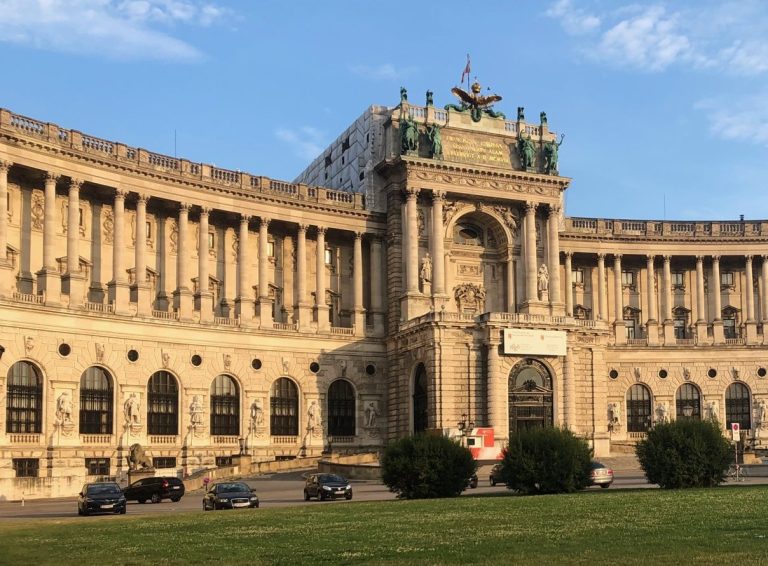
Heldenplatz and the Neue Burg
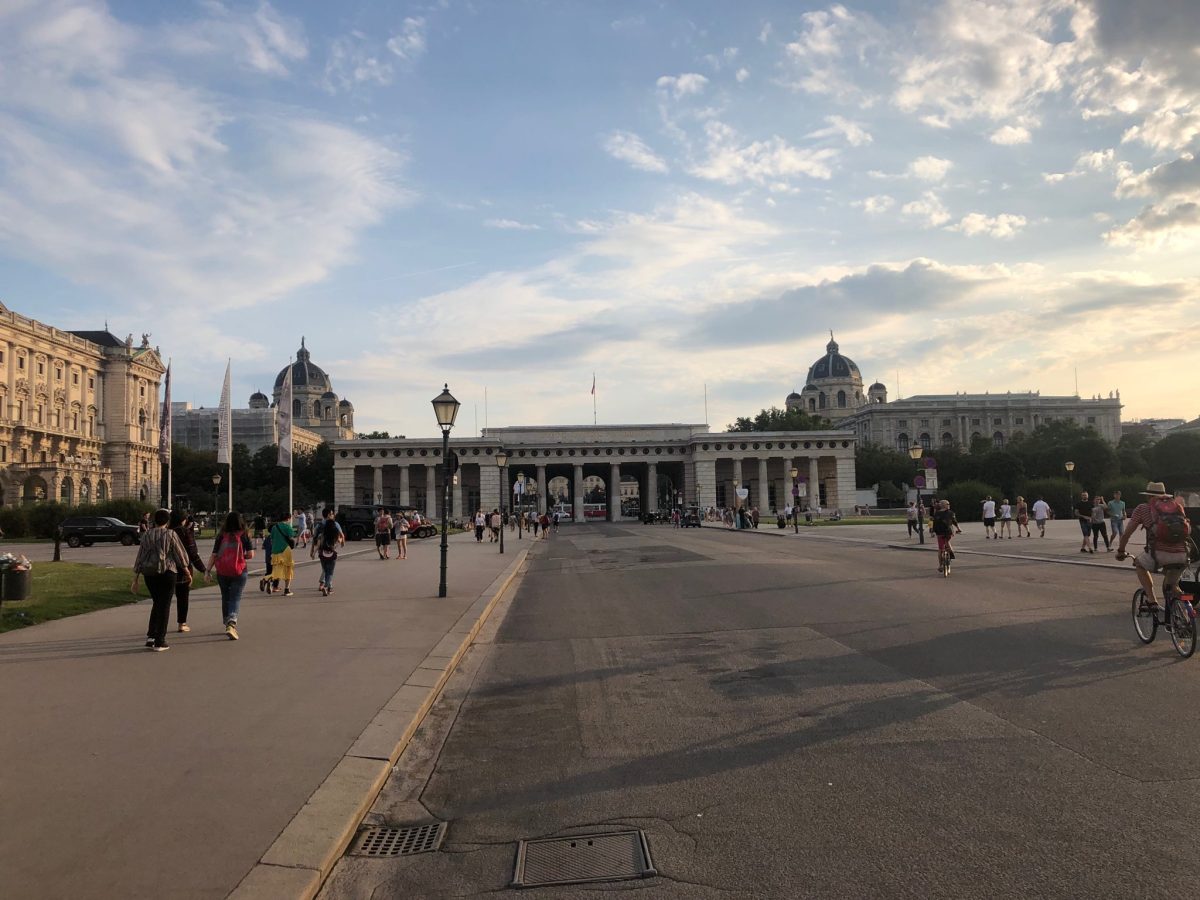
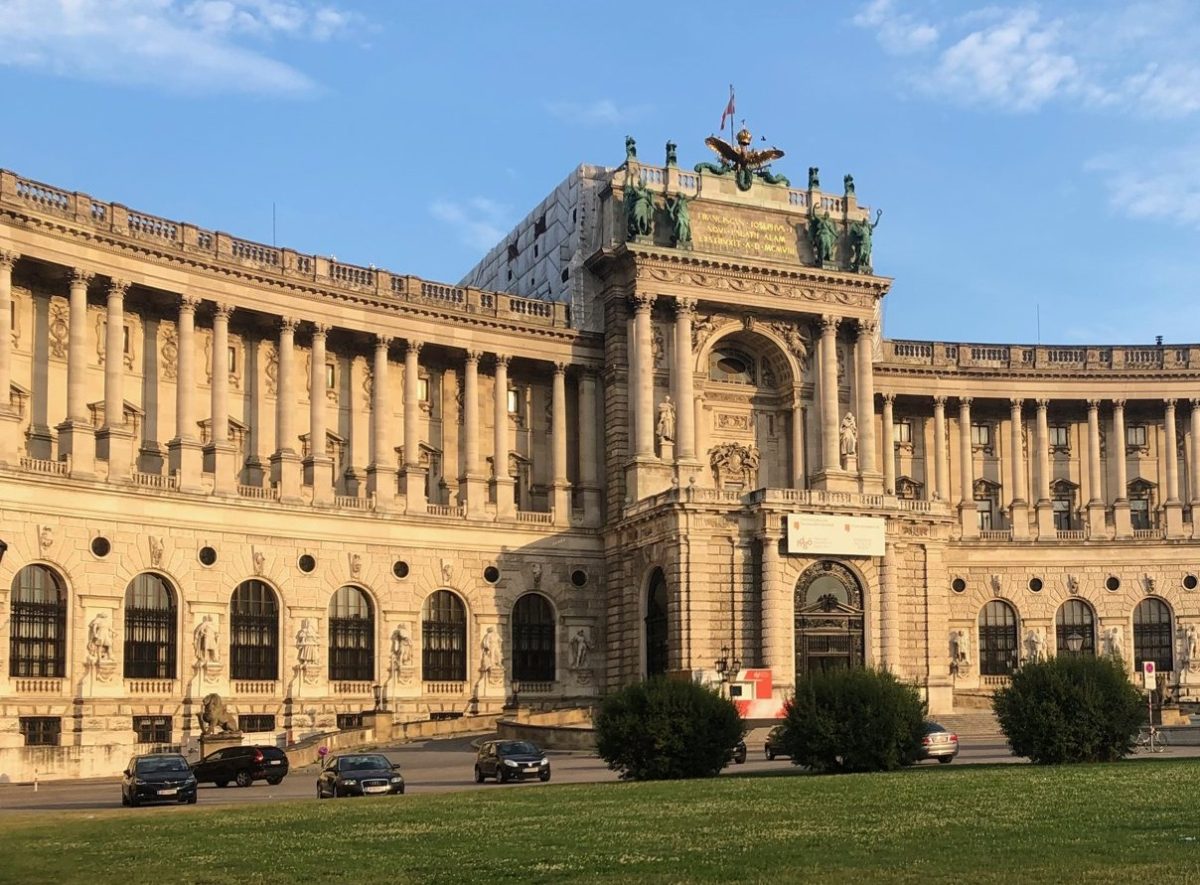
Heldenplatz is framed by equestrian statues of Archduke Charles and Prince Eugene and by the curved Neue Burg, built between 1881 and 1913 as one half of an Imperial Forum that was never completed. In the evening the lawn faces Peter von Nobile's colonnaded Outer Castle Gate on the Ring.
The curving colonnaded facade of the Neue Burg on Heldenplatz, the last wing of the Hofburg in Vienna, in the evening sun
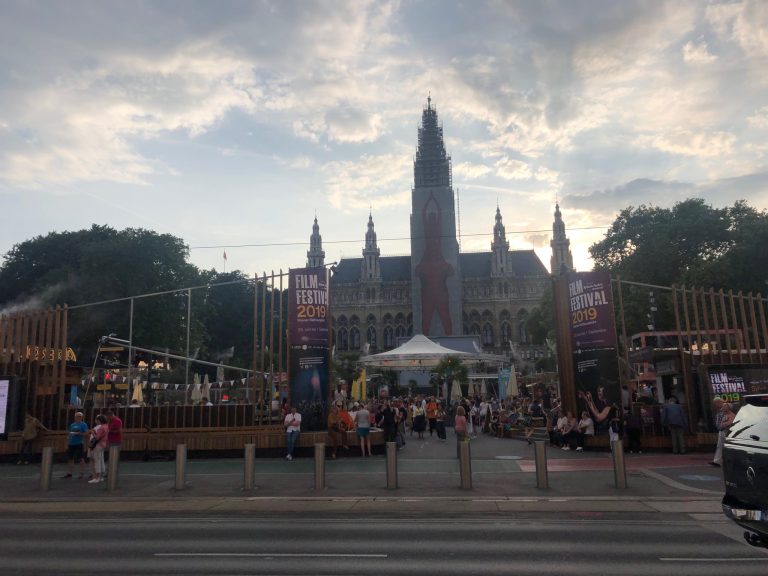
The City Hall and the Film Festival
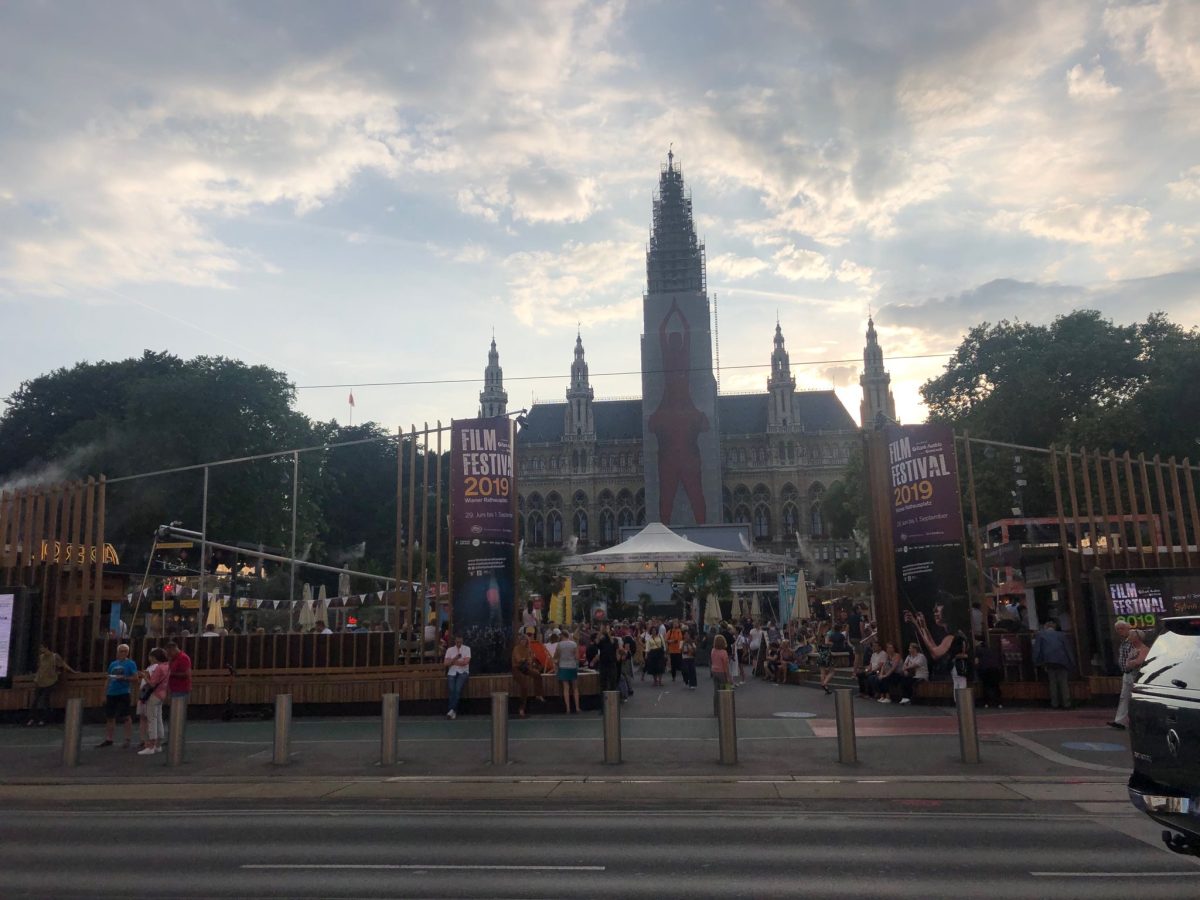
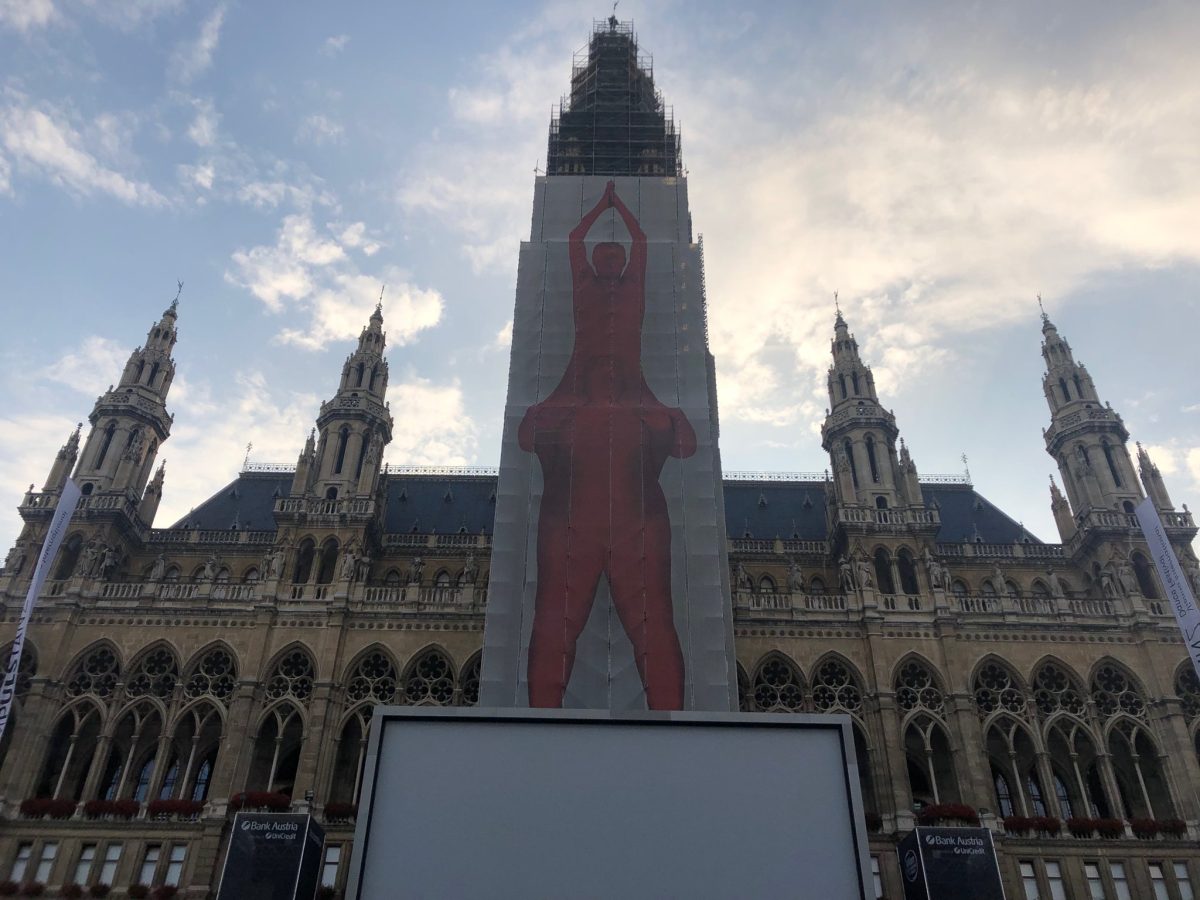
Friedrich von Schmidt built the neo-Gothic City Hall between 1872 and 1883, with a central tower 98 m high. From July to early September a giant screen in front of the facade shows opera, concert and ballet films every evening after sunset, free of charge, for about 900,000 visitors a summer.
The Film Festival on Rathausplatz in Vienna, with festival banners and stands in front of the Gothic Revival City Hall
The Danube Canal at night
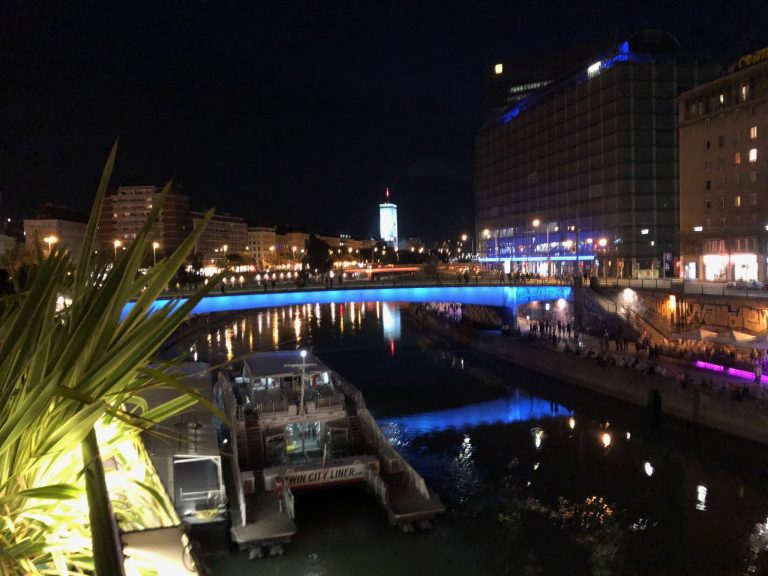
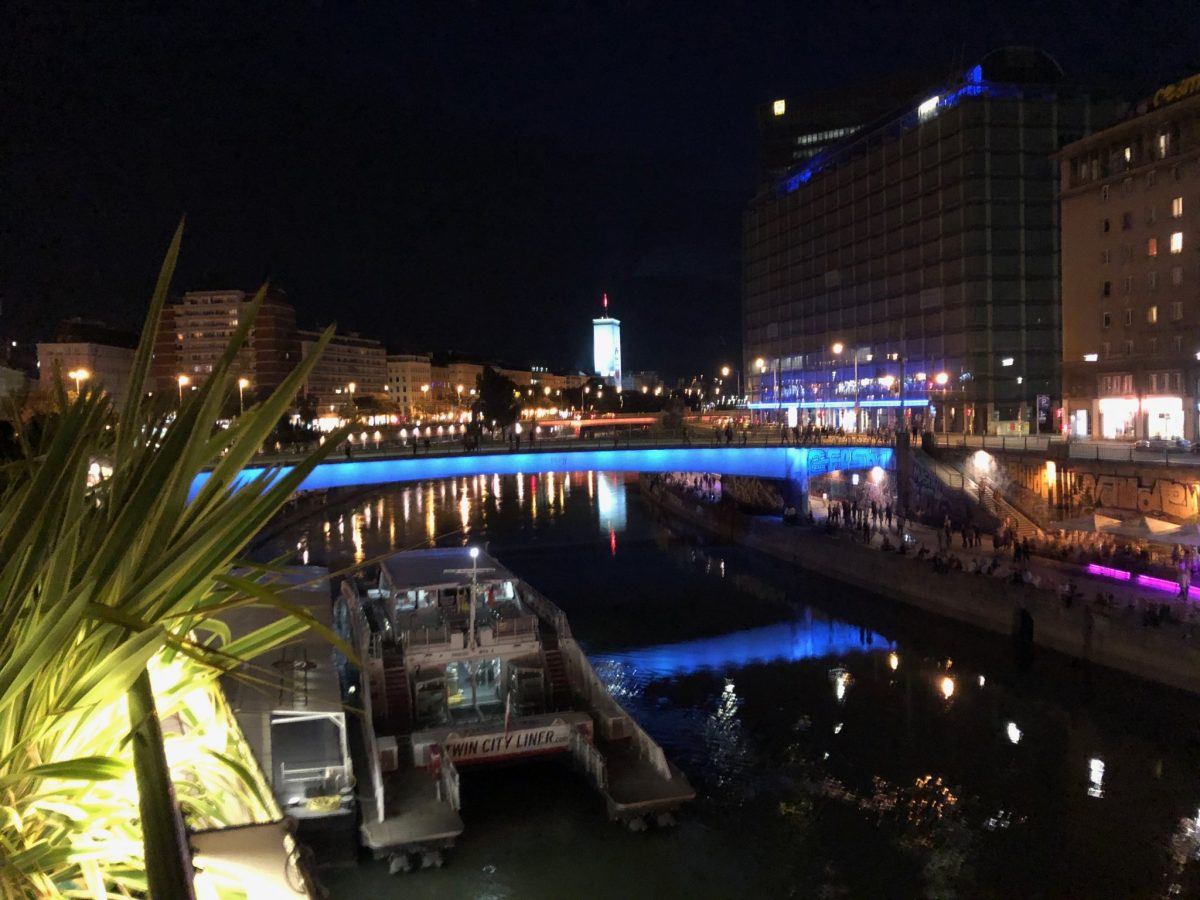
The Danube Canal is the arm of the river closest to the old town, and below Schwedenplatz its embankments fill on summer evenings with pop-up beach bars, deckchairs and long stretches of legal graffiti. The catamarans of the Twin City Liner leave from the canal for Bratislava, about 75 minutes down the Danube.
The Danube Canal in Vienna at night, with a blue-lit bridge, a Twin City Liner boat moored at the quay and the lights of Leopoldstadt
3D model © 2026 madseriksson.no · Photographs © madseriksson.no. Buildings and heights: © OpenStreetMap contributors (ODbL), via OpenMapTiles. Ground imagery: Sentinel-2 cloudless 2023 by EOX IT Services GmbH (contains modified Copernicus Sentinel data 2023; CC BY 4.0). Heights are approximate where OpenStreetMap has no measured value; sun positions are approximate.
The Ringstraße and the Hofburg — A Boulevard Where the Walls Stood, and a Palace That Never Stopped Growing
Nineteenth-century ambition around the old town, an imperial palace six centuries in the making, and the opera house on the Ring
Until the 1850s the inner city of Vienna was still a fortress, ringed by bastions and an empty glacis. In December 1857 Franz Joseph published the decree that ended it — “Es ist mein Wille” — and the walls came down to make room for a boulevard 57 metres wide and 5.3 kilometres long, opened in front of the Burgtor on 1 May 1865 while most of it was still a building site. It filled with historical styles chosen for their meaning: Greek for the Parliament, Flemish Gothic for the City Hall, Renaissance for the University, and private palaces for the bankers who paid for it all. The Ring is best seen from trams 1 and 2, which between them run most of its length.
On its inner side the Ring brushes the Hofburg, less a palace than a district of courtyards, wings and gates built over six centuries. Heldenplatz, the parade ground on its Ring side, is framed by equestrian statues of Archduke Charles and Prince Eugene of Savoy and by the concave sweep of the Neue Burg, built between 1881 and 1913 as one half of an Imperial Forum that was never completed. From its balcony Adolf Hitler proclaimed the Anschluss on 15 March 1938; today it holds reading rooms of the National Library and museum collections, and the square is a lawn where people lie in the evening sun, looking towards Peter von Nobile’s colonnaded Outer Castle Gate.
The Neue Burg was meant to be one half of an Imperial Forum. It was finished in 1913. Five years later there was no emperor left to fill it.
The inner courtyard, In der Burg, has a bronze of Emperor Franz I dressed as a Roman emperor by Pompeo Marchesi and the clock tower of the Amalienburg on its far side; the Federal President has had his offices here since 1946, and the Imperial Apartments and the Sisi Museum open off the same courtyard (€15, or €33 with a guided tour of the apartments; checked November 2026, the museum reopens redesigned on 19 November 2026). The palace’s city face is the Michaelertrakt, completed in 1888–1893 to a Baroque design by Joseph Emanuel Fischer von Erlach that had waited more than 150 years. Colossal statues of Hercules flank the entrances of the domed Michaelertor, and two wall fountains stand at either end: Power at Sea by Rudolf Weyr (1895), a bearded sea god with a trident above a ship’s prow and tritons, and Power on Land by Edmund Hellmer (1897). Across Michaelerplatz, Adolf Loos’s plain-fronted Looshaus of 1911 caused such outrage that work stopped until flower boxes were added, and Roman foundations lie open in the middle of the square.
Ten minutes south along the Ring stands the Vienna State Opera, opened on 25 May 1869 with Mozart’s Don Giovanni. Neither architect lived to see it: Eduard van der Nüll took his own life after the building was mocked, and August Sicard von Sicardsburg died soon afterwards. Gutted in an air raid on 12 March 1945, it reopened on 5 November 1955 with Fidelio. The season runs from September to June, and the house keeps one of Europe’s great democratic traditions: standing places, sold from 10:00 on the day of the performance online and at the box offices, and from a standing-room counter on the Operngasse side that opens 80 minutes before the curtain, for a fraction of the price of a seat. Once a year, in February, the stalls are floored over for the Opera Ball.
St Stephen’s, the Belvedere and Schönbrunn — A Gothic Spire, a Golden Kiss and the Emperor’s Summer House
The cathedral at the centre, the summer palace of the general who turned back the Ottomans, and the 1,441 rooms where Franz Joseph was born and died
St Stephen’s Cathedral stands at the centre of the old town. A Romanesque church was consecrated here in 1147, it was rebuilt in Gothic form from the fourteenth century, and Duke Rudolf IV began the south tower — the “Steffl” — in 1359. At 136.4 metres it still defines the skyline, and 343 steps climb to the old watchroom at 72 metres. The north tower was left unfinished in 1511; a lift now runs up it to the Pummerin, Austria’s largest bell. Most visitors remember the roof, a steep plane of glazed tiles laid in zigzags and, on the south side, in the shape of the double-headed eagle. The cathedral burned at the end of the Second World War and was rebuilt by 1952. The nave is open from 6:00 (Sundays 7:00) to 22:00 and the south tower from 9:00 to 19:00; the catacombs can be seen only on a guided tour.
A twenty-minute walk south-east, the Belvedere was built by Johann Lukas von Hildebrandt for Prince Eugene of Savoy, the general who drove back the Ottomans after 1683: the Lower Belvedere, begun by 1712, and the Upper Belvedere on the hill, completed in 1723, joined by a terraced garden of clipped hedges, cascades and sculptures laid out by Dominique Girard, who had trained at Versailles. The Austrian State Treaty was signed in the Upper Belvedere on 15 May 1955. The palace now holds the national collection of Austrian art, and it is here that Gustav Klimt’s The Kiss, begun in 1908 and finished in 1909, hangs among his gold-period portraits, alongside Schiele and Kokoschka. Admission is €23 for the Upper Belvedere, €20 for the Lower and €32 for both (adult prices checked November 2026); the Upper Belvedere opens daily from 9:00 to 18:00, and the first hour is the only quiet one in front of The Kiss.
Prince Eugene never married. Nearly two centuries after his death, the most famous painting of two people in love found its home in his house.
Schönbrunn, a short ride west on the U4, is the Habsburg summer residence in its final form: designed by Johann Bernhard Fischer von Erlach, rebuilt for Maria Theresa in the 1740s and 1750s by Nicolaus Pacassi, and a World Heritage Site with its gardens since 1996. The palace has 1,441 rooms; Franz Joseph was born in it in 1830 and died in it in November 1916. The State Apartments tour (about 40 minutes, €30) and the Grand Tour of the whole piano nobile (about 75 minutes, €42) both use timed entry, so booking ahead is sensible (checked November 2026). The garden is the real attraction: avenues of clipped trees climb to the Gloriette, the colonnade that has crowned the hill since 1775, with a view over the palace to the whole city. The same park holds the Palm House and the zoo founded in 1752, and from 6 November 2026 to 6 January 2027 a Christmas market fills the forecourt.
The Kunsthistorisches Museum and the MuseumsQuartier — The Emperors’ Pictures and the Imperial Stables
The Habsburg collections in a palace built to hold them, a room of Bruegels, and the imperial stables turned cultural district
Across the Ring from Heldenplatz, two identical domed palaces face each other over Maria-Theresien-Platz: the Natural History Museum and the Kunsthistorisches Museum, designed by Gottfried Semper and Carl von Hasenauer and opened by Franz Joseph in 1891 for the collections the Habsburgs had gathered over four centuries. The building is a work of art in itself, with its domed hall, the marble staircase with Canova’s Theseus and, high above it between the columns, paintings by the young Gustav Klimt. The picture gallery is one of the richest anywhere for Titian and the Venetians, Rubens and Velázquez, and above all for Pieter Bruegel the Elder: the museum owns twelve of the roughly forty-five paintings by him that survive, among them The Tower of Babel, The Hunters in the Snow and The Peasant Wedding.
The museum opens daily from 10:00 to 18:00 and until 21:00 on Thursdays, the best evening to come; the café beneath the cupola is one of the finest rooms in the city for coffee. Tickets cost €22 online and €24 at the desk, under-19s enter free, and since 8 September 2026 entry is by reserved time slot only (checked November 2026).
About forty-five paintings by Pieter Bruegel the Elder survive. Twelve of them are in one room in Vienna.
Behind the museums, the long Baroque front of the early-eighteenth-century imperial stables hides the MuseumsQuartier, opened on 30 June 2001. Two new buildings rise from its courtyards like sculptures. The white limestone cube of the Leopold Museum holds the largest collection of Egon Schiele’s work anywhere, with Klimt, Kokoschka and the Wiener Werkstätte — the best single place to understand Vienna around 1900. Opposite, the dark basalt block of the mumok covers modern and contemporary art, while the Kunsthalle Wien shows changing exhibitions. In summer the courtyards, furnished with large, brightly coloured lounge seats and a few bars, become an open-air living room; Spittelberg’s Biedermeier lanes and the Naschmarkt are a few minutes’ walk away.
Coffee Houses and the Wiener Schnitzel — Where Time Is Part of the Bill
A way of life recognised as heritage, and the breaded cutlet that the law insists must be veal
The Viennese coffee house begins with the siege of 1683: the retreating Ottoman army left sacks of coffee in its camp, and within two years the first coffee houses had opened. Over two centuries the Kaffeehaus became a public drawing room of marble-topped tables, bentwood chairs, newspapers on wooden holders and waiters in black jackets who neither hurry the guest nor are hurried. The coffee arrives on a small silver tray with a glass of water, refilled unasked, and a single Melange buys a table for the morning. When coffee-house culture was recognised as intangible cultural heritage under the UNESCO convention, from 10 November 2011, it was for exactly this social practice: a place “where time and space are consumed, but only the coffee is found on the bill”.
Café Central, opened in 1876 under the vaults of the Palais Ferstel and once frequented by Peter Altenberg and Trotsky, closed for renovation on 16 March 2026 and is due to reopen in the winter of 2026, with a temporary Café Decentral in the Palais Harrach on the Freyung meanwhile. Café Sperl, opened in 1880, has barely changed: billiard tables, long benches and its own Sperl cake. Café Schwarzenberg is the oldest coffee house on the Ring, and Café Hawelka serves warm, jam-filled Buchteln late into the evening. Order a Melange, an Einspänner under whipped cream or a kleiner Brauner, with Apfelstrudel or Sachertorte.
The water is refilled for as long as the guest stays, and nobody brings the bill until it is asked for. That is the whole of the heritage.
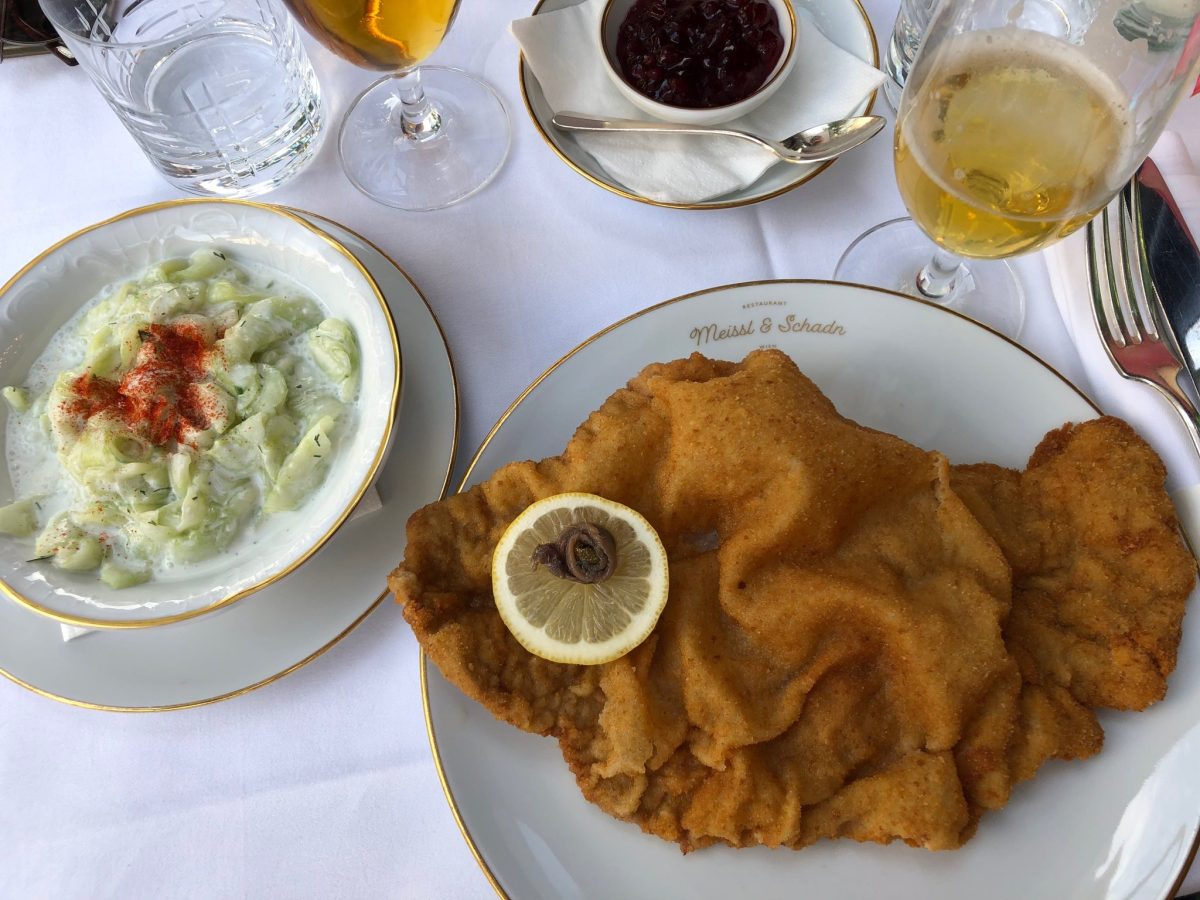
The Wiener Schnitzel is the other half of the city’s table. Under the Austrian Food Code it is veal, beaten thin, dipped in flour, egg and breadcrumbs and fried — traditionally in lard, today often in clarified butter — until the crumb puffs away from the meat in golden waves; pork must be sold as “Schnitzel Wiener Art”. Breaded cutlets appear in Viennese cookbooks from 1798 and the name from 1831; the story that Field Marshal Radetzky brought the recipe from Milan has been traced to an Italian guidebook of 1969. It comes with a wedge of lemon and potato or cucumber salad, or parsley potatoes, and many restaurants add lingonberries.
Summer Vienna — The Canal, the Screen on the Town Hall and the Wine Under the Pine Branch
Deckchairs along the Danube Canal, free opera on Rathausplatz, and new wine at the end of the tram line
The Danube Canal, the arm of the river closest to the old town, is where Vienna goes on summer evenings. Below Schwedenplatz the embankments fill with pop-up beach bars, deckchairs and long stretches of legal graffiti, and the stone steps stay busy long after midnight. Rooftop bars look down on the lit bridges and on the catamarans of the Twin City Liner, which leaves from the canal for Bratislava, about 75 minutes down the Danube — Vienna and Bratislava are two of the closest capitals in Europe.
In front of the neo-Gothic City Hall, built by Friedrich von Schmidt between 1872 and 1883 with a central tower 98 metres high, Rathausplatz hosts the Film Festival from July to early September: a giant screen in front of the facade shows opera, concert and ballet films every evening after sunset, free of charge, while food stalls run by the city’s restaurateurs open from 11:00 to midnight. It draws about 900,000 visitors a summer and has run for more than thirty years; the 2027 edition runs from 3 July to 5 September. In winter the square holds the Christmas Market, from 13 November to 26 December in 2026, with an ice rink winding between the trees.
Every summer evening the City Hall becomes the backdrop of an open-air opera house. The seats are free, and the performance begins when the sun has gone down behind its towers.
At the north-western edge of the city the vineyards begin, and with them the Heurigen. On 17 August 1784 Joseph II allowed winegrowers to sell their own wine without a licence, and the custom survives almost unchanged: when a grower is open, a bunch of pine branches hangs over the gate, and guests drink the young wine of the house by the quarter-litre with a cold buffet of bread, cheese and roast pork. Vienna has more than 600 hectares of vineyards, mostly on the slopes above Grinzing, Nussdorf, Sievering and Neustift am Walde and on the Bisamberg north of the Danube. The signature wine is the Wiener Gemischter Satz, a white from several varieties planted and harvested together, a protected DAC since the 2013 vintage. Grinzing, at the end of tram 38 from Schottentor, is the best known and busiest village; the quieter taverns lie in its upper lanes, in Nussdorf and Neustift, or along the vineyard paths up to the Kahlenberg, with the whole city and the Danube below.
Getting Around and When to Go — A City That Runs on Rails
Underground, trams and a central station with trains to half of Europe, and a city that changes with the seasons
Vienna is one of the easiest large cities in Europe to explore without a car. The inner city can be crossed on foot in twenty minutes, and the underground, trams and buses of Wiener Linien reach everything else. A single ticket costs €3.20 (€3.00 digitally), a 24-hour ticket €10.20 and a 7-day ticket €28.90; the 48- and 72-hour tickets were discontinued in 2026, and fares rise again on 1 January 2027 (checked November 2026). Wien Hauptbahnhof, south of the Belvedere, has Railjets to Munich, Prague, Budapest and across the Semmering to Venice, regional trains to Bratislava and night trains to much of the continent. From the airport, the Railjet or REX reaches Hauptbahnhof in 15–20 minutes; until the end of October 2027, while the central S-Bahn line is closed for modernisation, the City Airport Train runs as a coach to Wien Mitte in about 21 minutes.
The best months are April to June and September to October, when the palace gardens are at their best, the terraces are open and the vineyards are green or being harvested; the opera season runs from September to June. July and August are hot and the opera closes, but the Film Festival and the canal bars are in full swing. From mid-November the Christmas markets on Rathausplatz, at Schönbrunn, the Belvedere and Spittelberg run until Christmas or early January, and January and February are the season of the balls, when the coffee houses are at their most welcoming.
«Vienna was built for an empire, and the empire did not survive. The city did. It kept the palaces and went on living around them: a president in the Hofburg, Klimt in Prince Eugene’s summer house, a library in a wing meant for a forum that never came. What it kept above all was its sense of time — the hour over a single coffee, the standing place at the opera, the evening under a pine branch with wine grown on the hill behind. On a summer night the screen in front of the City Hall shows an opera to a square full of people who paid nothing to be there, a few hundred metres from the opera house on the Ring. That, more than any palace, is the real inheritance.»