For almost four hundred years the Ottoman Empire was governed from a hilltop of gardens and low pavilions at the tip of the old city. Mehmed II began building Topkapı Palace in 1459, six years after he took Constantinople, on the headland where the Bosphorus, the Golden Horn and the Sea of Marmara meet. It was never one great building but a sequence of walled courts, each more private than the last, through which ambassadors, viziers, pages, cooks, eunuchs and the women of the Harem moved according to rank. The sultans left for Dolmabahçe on the Bosphorus in 1856; in 1924 the young Turkish Republic turned the palace into a museum. What remains is the most complete picture anywhere of how an Islamic empire was run from the inside — its council chamber, its kitchens, its treasury, its relics and its private rooms — set above one of the great views of the world.

Topkapı stands on Sarayburnu, Seraglio Point, the last high ground of the historic peninsula before it drops into the water. Behind it lies Sultanahmet, with Hagia Sophia directly outside its outer gate; below it, on the slope towards the Golden Horn, are the trees of Gülhane Park, which were once the palace’s outer gardens. The name came later than the palace. The Ottomans called it simply the New Palace, Saray-ı Cedid; it became Topkapı, the Cannon Gate Palace, after a gate in the sea walls near a waterside pavilion. Today it is run by the National Palaces authority, Milli Saraylar, which also manages Dolmabahçe.
The first thing to understand about Topkapı is that it is not a palace in the European sense. There is no façade, no grand staircase, no single block to stand back and admire. Instead there are four courts, each entered through a gate, each reserved for a narrower circle of people, with pavilions, offices, dormitories, baths and kiosks set around them and the private world of the Harem folded into the side of the second and third. The architecture is low and spread out, closer to an encampment in stone than to Versailles, and the effect of walking through it is cumulative: the courts get quieter, the rooms richer and the views wider until, at the far end, the whole Bosphorus opens below the terrace of the Baghdad Kiosk.
How to approach Topkapı Palace
This guide follows the palace the way it was designed to be entered, from the outside in. It begins with the history — how a conqueror’s residence became the seat of government, and how it was abandoned and reborn as a museum — and then walks through the four courts in order: the public First Court with the Byzantine church of Hagia Irene, the Second Court with the Imperial Council and the great kitchens, the Harem, the Third Court with the Treasury and the Sacred Relics, and the Fourth Court with its kiosks and terraces over the water. A final section covers tickets, timing and how to fit Topkapı into a day in the old city alongside the neighbourhood described in the guide to Istanbul and the Spice Bazaar down by the Golden Horn.
A palace of courts, not façades
Mehmed II began Topkapı in 1459, six years after taking Constantinople, on the old acropolis at the tip of the historic peninsula, where the Bosphorus, the Golden Horn and the Sea of Marmara meet. It was never one great building but four walled courts, each more private than the last, with the Harem folded into the side. Hagia Sophia stands outside the outer gate, and Gülhane Park, once the palace’s outer gardens, falls away towards the Golden Horn.
Through the Imperial Gate
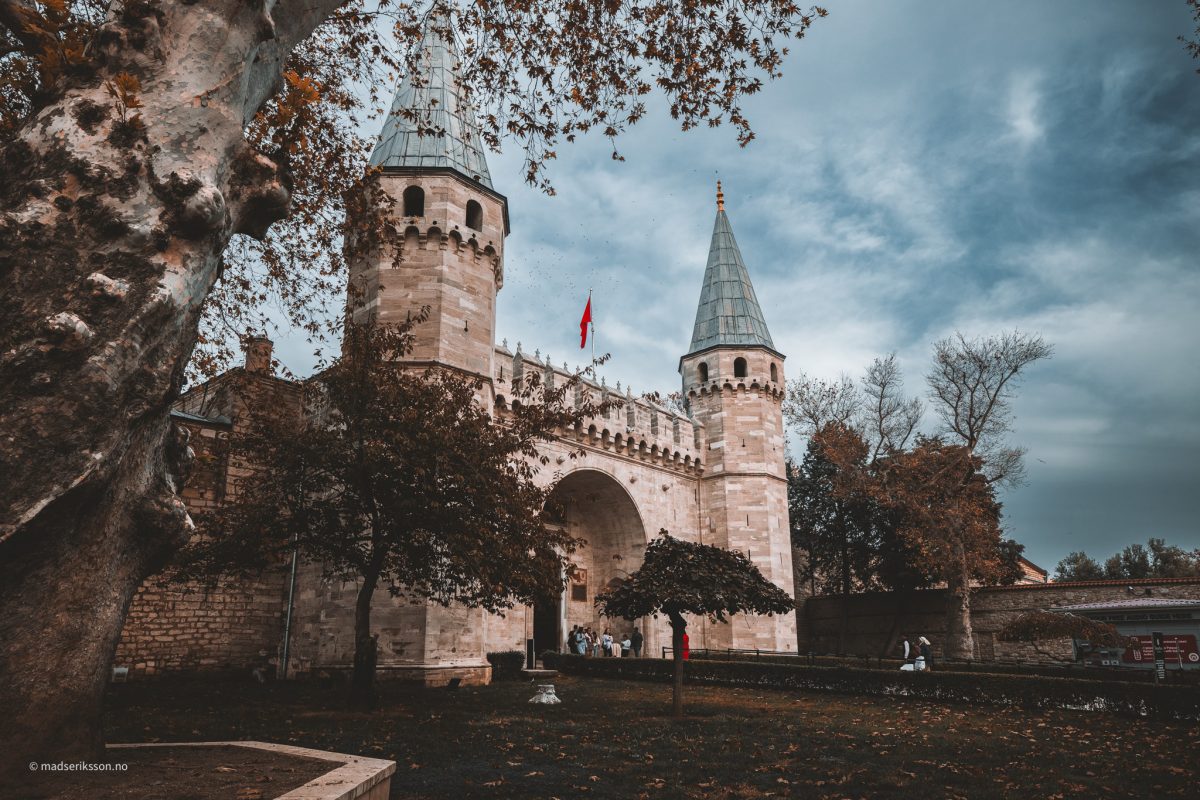
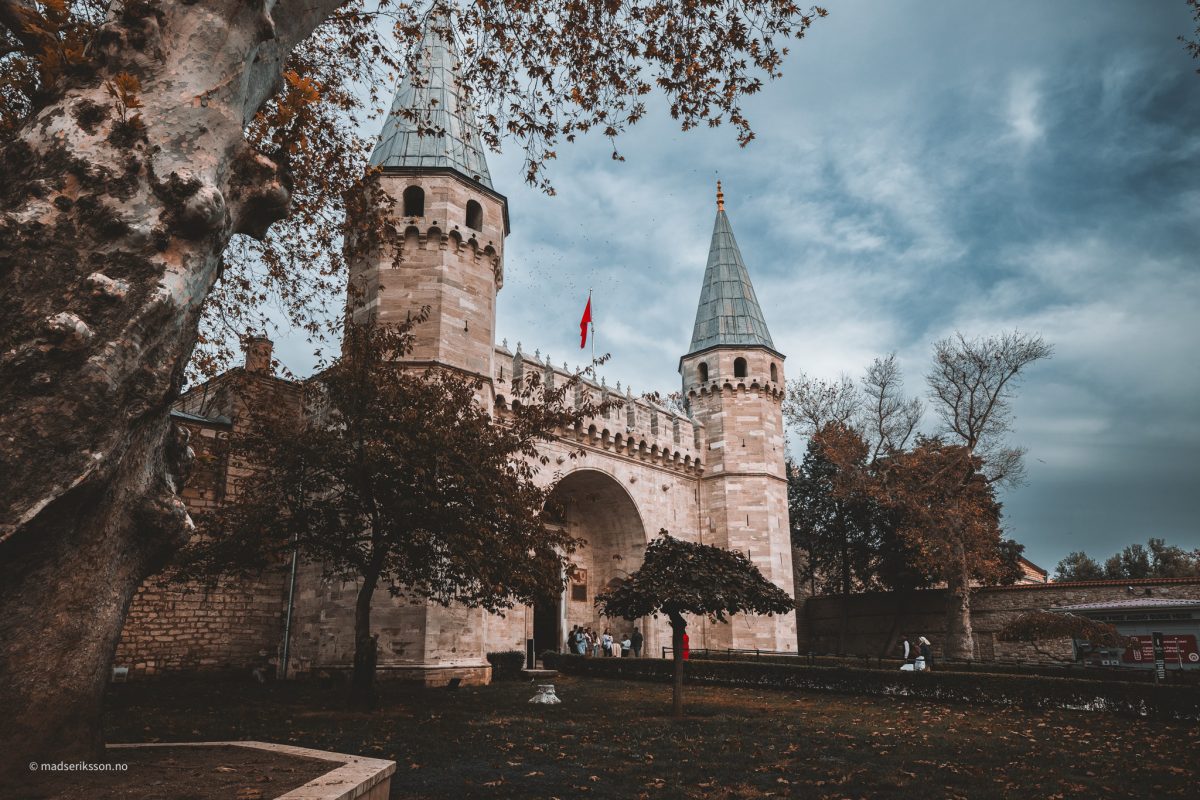
The Imperial Gate opens from the square behind Hagia Sophia and carries Mehmed II’s inscription of 1478. Behind it the First Court, the largest of the four, runs gently uphill as a tree-shaded avenue that can be entered without a ticket. On its left stands Hagia Irene, rebuilt by Justinian and never converted into a mosque. At the far end rises the twin-towered Gate of Salutation, where everyone except the sultan had to dismount.
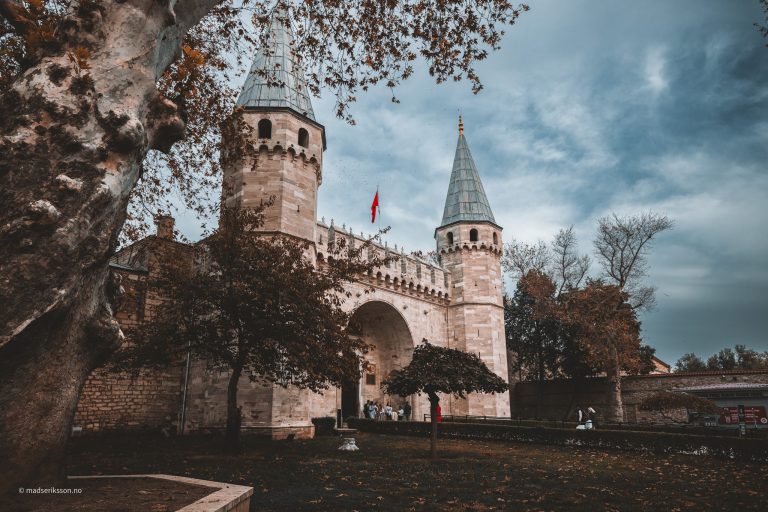
The twin-towered Gate of Salutation, entrance to the Second Court of Topkapı Palace in Istanbul, under autumn plane trees
Where the empire was governed and fed
Beyond the Gate of Salutation lies a park-like court of lawns, cypresses and plane trees. In the far left corner the viziers met beneath the dome of the Imperial Council, while the sultan could listen unseen behind a gilded grille. Beside it rises the Tower of Justice, the tallest structure in the palace. The right-hand side is taken up by the kitchens, rebuilt by Mimar Sinan after a fire in 1574, which could feed some 4,000 people a day.
The private city behind the walls
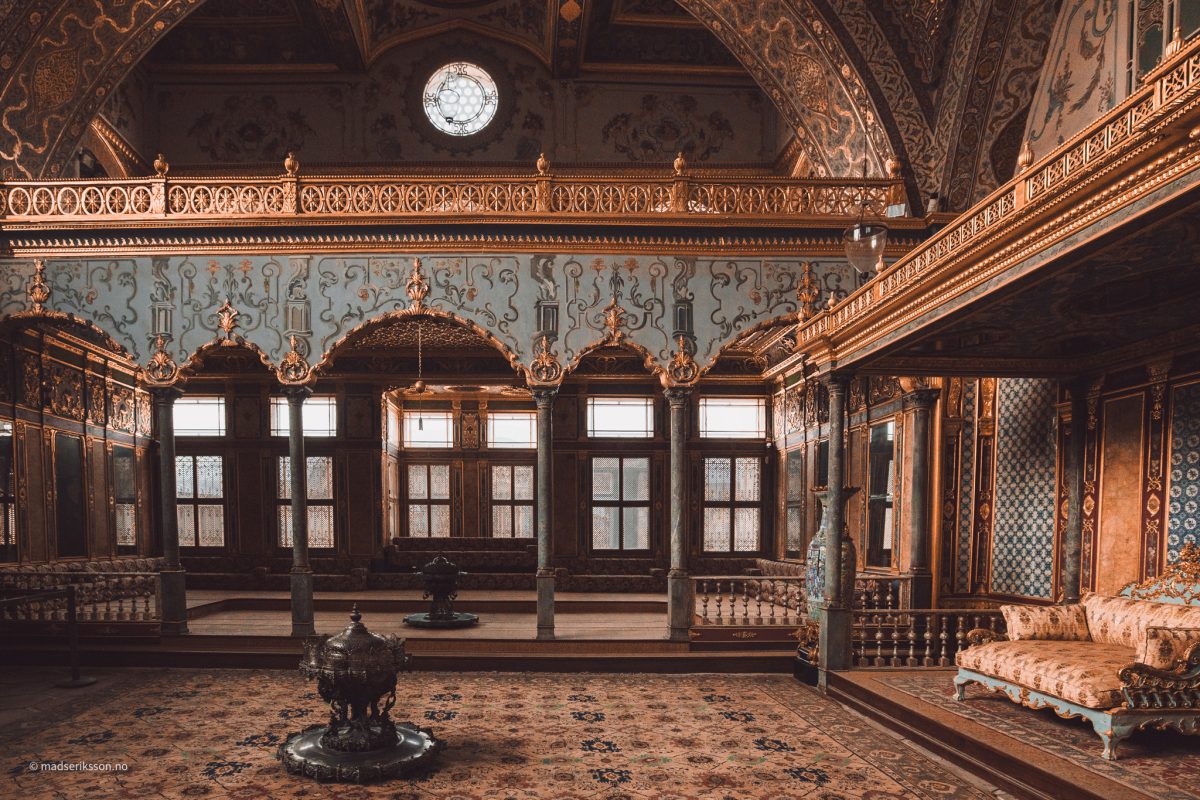
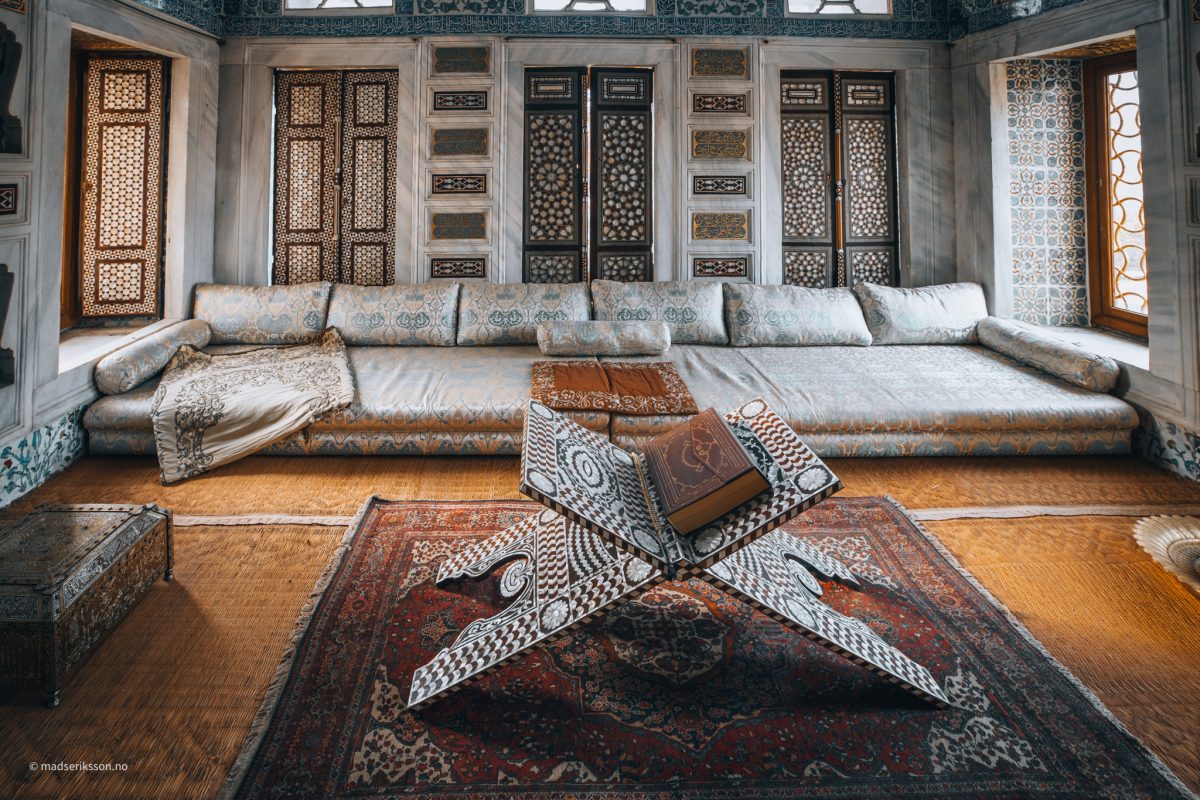
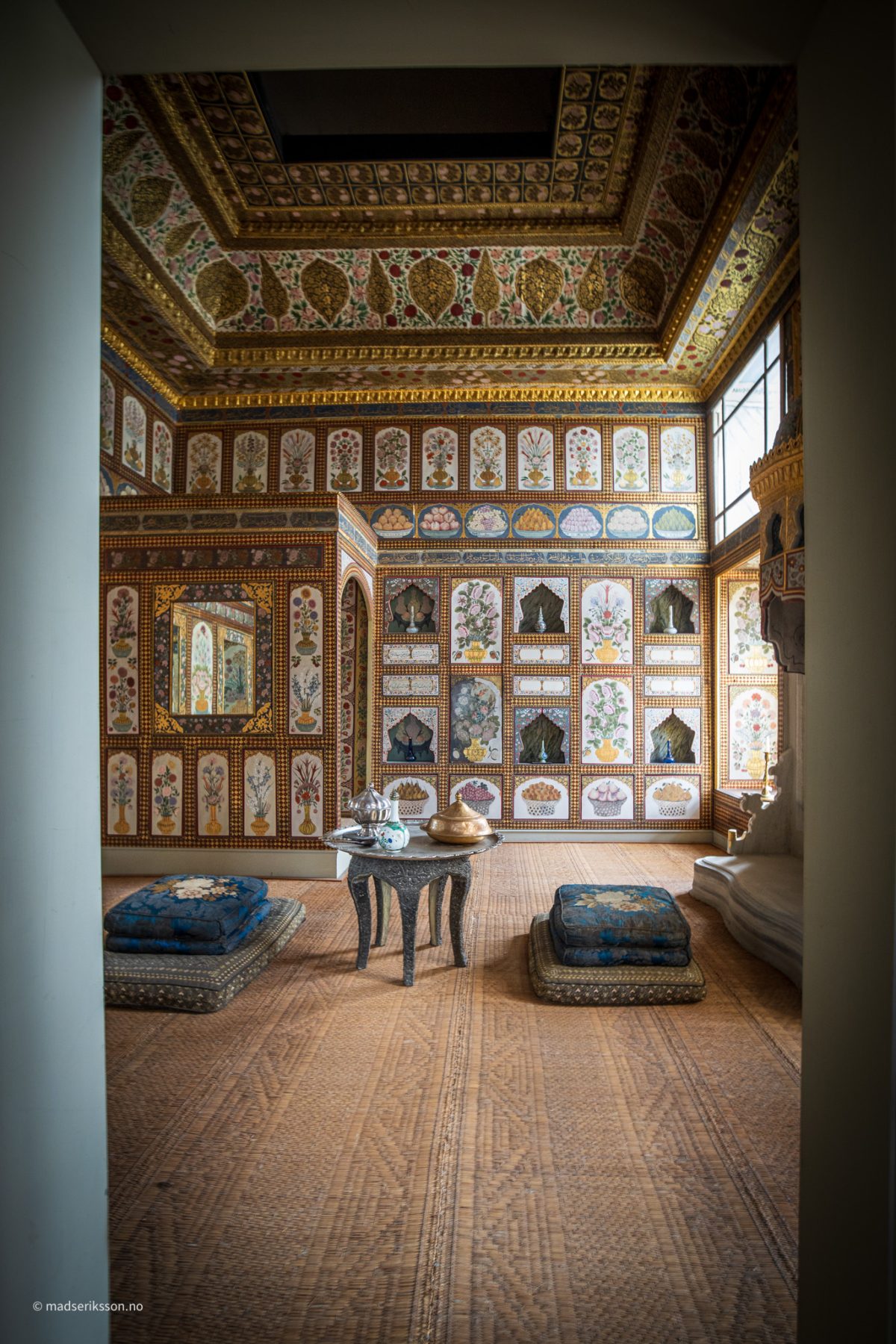
Folded into the side of the second and third courts, the Harem was the family quarters of the dynasty: home to the sultan’s mother, his consorts and children, and guarded by the black eunuchs. Built piece by piece and largely rebuilt after the fire of 1665, it is a maze of small courtyards, corridors and several hundred rooms. The finest are the domed Imperial Hall, the tiled Privy Chamber of Murad III and the painted Fruit Room of Ahmed III.
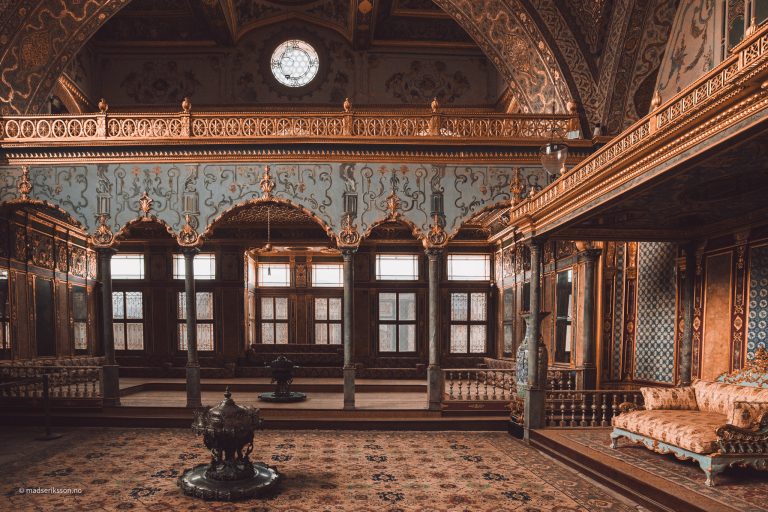
A gilded hall with a musicians’ gallery and a canopied platform in the Harem of Topkapı Palace, Istanbul
The sultan’s threshold and his treasure
The Gate of Felicity, with its gilded canopy, marked the edge of the sultan’s private world. Directly behind it stands the Audience Chamber, where ambassadors were received, and beyond it the marble Library of Ahmed III of 1719. In the far right corner the Conqueror’s Pavilion of about 1460 holds the Treasury, with the 86-carat Spoonmaker’s Diamond and the Topkapı Dagger. In the northern corner the sultan’s former Privy Room keeps the Sacred Relics.
Kiosks above three waters
At the tip of the peninsula the palace dissolves into gardens and terraces. Around a marble pool stand the Revan Kiosk of 1635–36 and the Baghdad Kiosk of 1638–39, both built for Murad IV, with the small gilded İftar canopy between them. From the terrace the Golden Horn opens to the north, the Bosphorus begins to the north-east and the Asian shore lies across the strait.
Two empires on one square
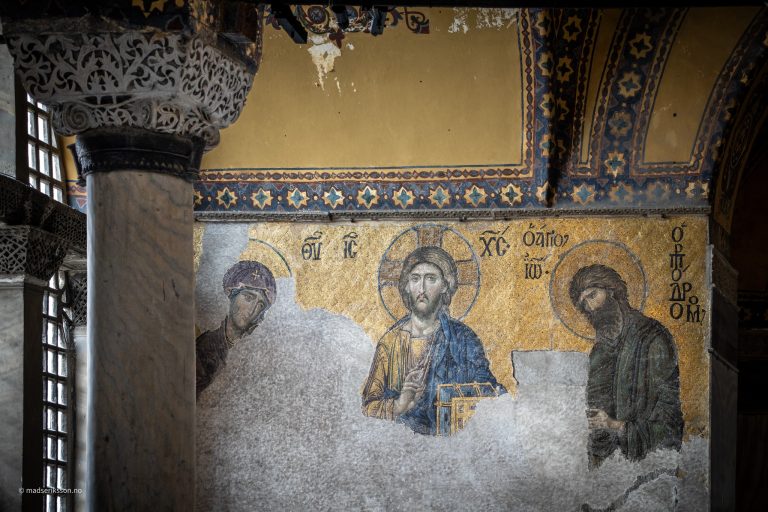
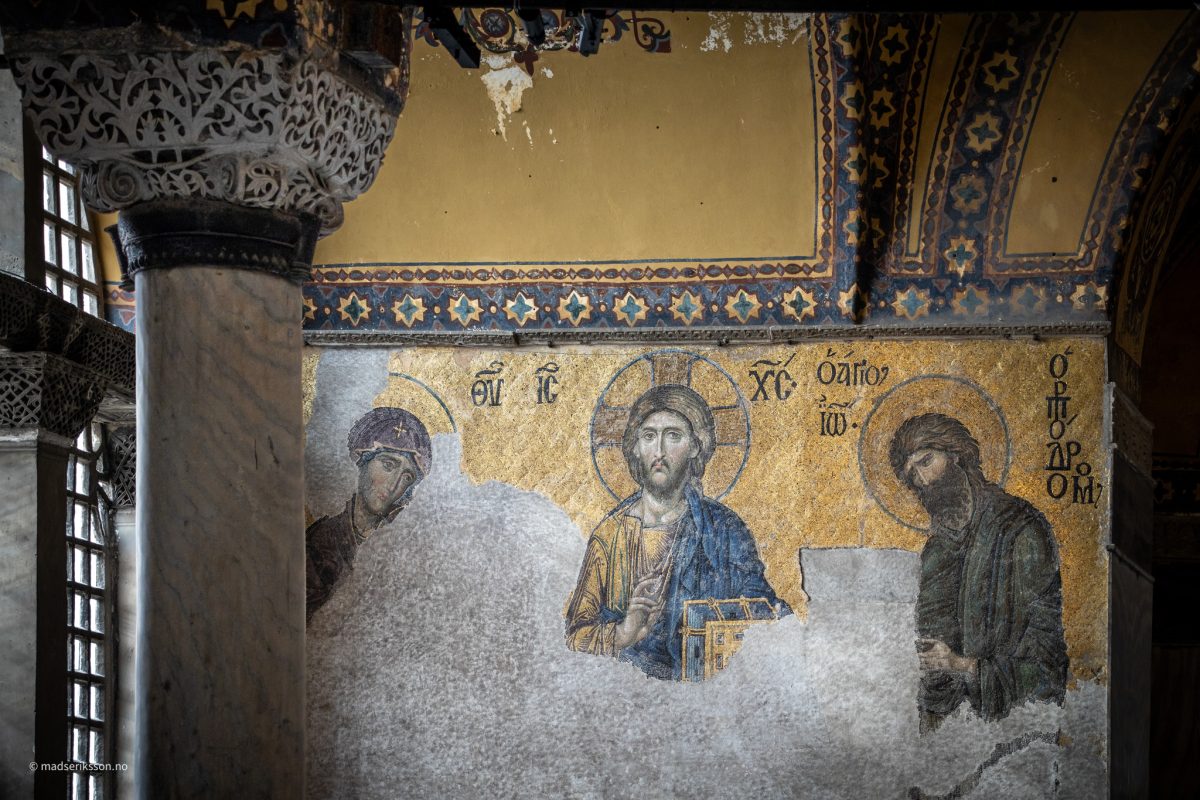
Hagia Sophia, Justinian’s great domed church completed in 537, stands only a few steps from the Imperial Gate. For the sultans it was the imperial mosque of the capital, and since 2020 it has been an active mosque again; its upper galleries, with the Deësis mosaic, are visited on a separate route. Below the palace walls the paths of Gülhane Park lead down towards Sirkeci, Eminönü and the Spice Bazaar.
The Deësis mosaic in the upper gallery of Hagia Sophia, with Christ between Mary and John the Baptist.
3D model © 2026 madseriksson.no · Photographs © madseriksson.no. Buildings, walls and paths: © OpenStreetMap contributors (ODbL). Heights of the halls, gates, towers, domes and minarets are simplified and approximate; the terrain of Seraglio Point is shown flat. Sun positions are approximate.
From the Conqueror’s Palace to the Republic’s Museum
How a residence begun six years after the fall of Constantinople grew into the seat of an empire, was rebuilt after earthquakes and fires, emptied in 1856 and opened to the public in 1924
When Mehmed II rode into Constantinople in May 1453 he inherited a city of ruins and half-empty quarters. His first residence, the Old Palace, rose in the middle of the peninsula on the site of today’s Istanbul University, but within a few years he chose a more commanding position: the old acropolis of Byzantium on the point, where the first Greek settlers had built their temples and where the land falls away on three sides to the water. Work began in 1459. The core of the new palace was in place by the mid to late 1460s, and in 1478 the sultan set his inscription over the Imperial Gate that still opens from the square beside Hagia Sophia.
The palace grew with the empire. Under Süleyman the Magnificent in the 1520s the Second Court took its final shape, with the domed Imperial Council chamber and its tall Tower of Justice, and over the sixteenth century the Harem moved from the Old Palace into Topkapı, bringing the sultan’s mother, wives, children and household under the same roof as the state. That move changed the palace and, many historians argue, the empire itself: in the century that followed, the women of the dynasty — above all the Valide Sultans, the mothers of reigning sultans — became political figures in their own right, and the Harem became one of the places where power was exercised. An earthquake in 1509, a kitchen fire in 1574 and a great fire in 1665 that swept through the Harem each forced large-scale rebuilding.
Topkapı was never finished, because it was never meant to be. Each sultan added a kiosk, a bath, a library or a set of rooms, and the palace became a record in stone of four centuries of changing taste — from İznik tiles to Baroque gilding to European chandeliers.
By the nineteenth century the palace had become old-fashioned. The reforming sultans of the Tanzimat era wanted modern residences on the European model, with corridors, staircases and ballrooms, and in 1856 Abdülmecid I moved the court to the new Dolmabahçe Palace on the Bosphorus shore. Topkapı was not abandoned: the treasury, the imperial wardrobe and the Sacred Relics remained, and the palace kept a ceremonial role, with sultans returning for the annual visit to the Prophet’s mantle during Ramadan. The Republic was proclaimed in October 1923. On 3 April 1924 a government decree turned Topkapı into a museum.
In 1985 the palace was inscribed on the UNESCO World Heritage List as part of the Historic Areas of Istanbul, a site made up of four zones of the old city. Topkapı belongs to the Archaeological Park at the tip of the peninsula, together with Hagia Sophia, Hagia Irene, the Hippodrome and the Blue Mosque. Responsibility for the museum has since passed to Milli Saraylar, the National Palaces authority, which reopened the restored Treasury, the Sacred Relics and the Mecidiye Kiosk in 2023, opened new sections of the Harem in 2026 and has introduced summer night visits.
The First Court — A Public Square, a Byzantine Church and the Gate of Salutation
The outer court where anyone could enter, the church that was never turned into a mosque, and the twin-towered gate where every visitor except the sultan had to dismount
The palace begins in the square behind Hagia Sophia. Here, beside the elegant square fountain of Ahmed III with its broad eaves and carved marble panels, the Imperial Gate — Bâb-ı Hümâyûn — opens in the outer wall. It dates from 1478 and carries Mehmed II’s inscription, although its present marble face is a nineteenth-century refacing. The First Court behind it, the largest of the four, was a semi-public service yard and parade ground, open to anyone with business at the palace.
That is still its character. The First Court, a long, tree-shaded avenue running gently uphill, can be entered without a ticket, and many visitors cross it without noticing what stands on its left-hand side. Hagia Irene, the Church of Holy Peace, is one of the oldest churches in Istanbul. A church stood here by the fourth century; the present building was rebuilt by Justinian after the Nika riots of 532 burned its predecessor, and repaired again after an earthquake in 740. It is one of only two Byzantine churches in the city never converted into a mosque: enclosed within the palace walls, it served instead as the Janissaries’ arsenal until 1826. Inside, the bare brick interior is crowned by a dome, and the apse holds a large mosaic cross on a gold ground from the period of Iconoclasm, when figurative images were banned. It requires its own ticket or the palace’s combined ticket.
The Gate of Salutation is where the palace begins to close. Viziers and ambassadors dismounted here; only the sultan rode through. Beyond it, silence was the rule, and the court was ordered by rank.
Further along the court stand the buildings of the Imperial Mint, established here in 1727, and, near the end on the right, a small fountain that guides call the Executioner’s Fountain, where by tradition the executioners washed their hands and swords. The court ends at the Gate of Salutation, Bâbüsselâm, also called the Middle Gate. With its two octagonal towers capped by pointed roofs and its crenellated wall, it looks more like the entrance to a European castle than to an Ottoman palace; an inscription shows it existed by 1542. Everyone except the sultan had to dismount before it. Today the ticket gates and security check stand here, and it is through this gate that every visit begins.
The square outside the Imperial Gate is also the meeting point of two empires. Hagia Sophia, the great domed church of Justinian completed in 537, stands only a few steps away, and for the sultans it was the imperial mosque of the capital, a short procession from their gates. Since 2020 it has been an active mosque again. Visitors from abroad enter its upper galleries on a separate paid route, where the finest of its Byzantine mosaics survive, among them the Deësis, the image of Christ between the Virgin Mary and John the Baptist. Hagia Sophia is covered in the guide to Istanbul and ranks second in the site’s list of Europe’s greatest cathedrals and churches; together with Topkapı it makes the natural core of a first day in the old city.
The Second Court — Where the Empire Was Governed and Fed
The domed chamber where the viziers met under the sultan’s hidden gaze, the tower that marks the palace on the skyline, and the kitchens that cooked for a city within the city
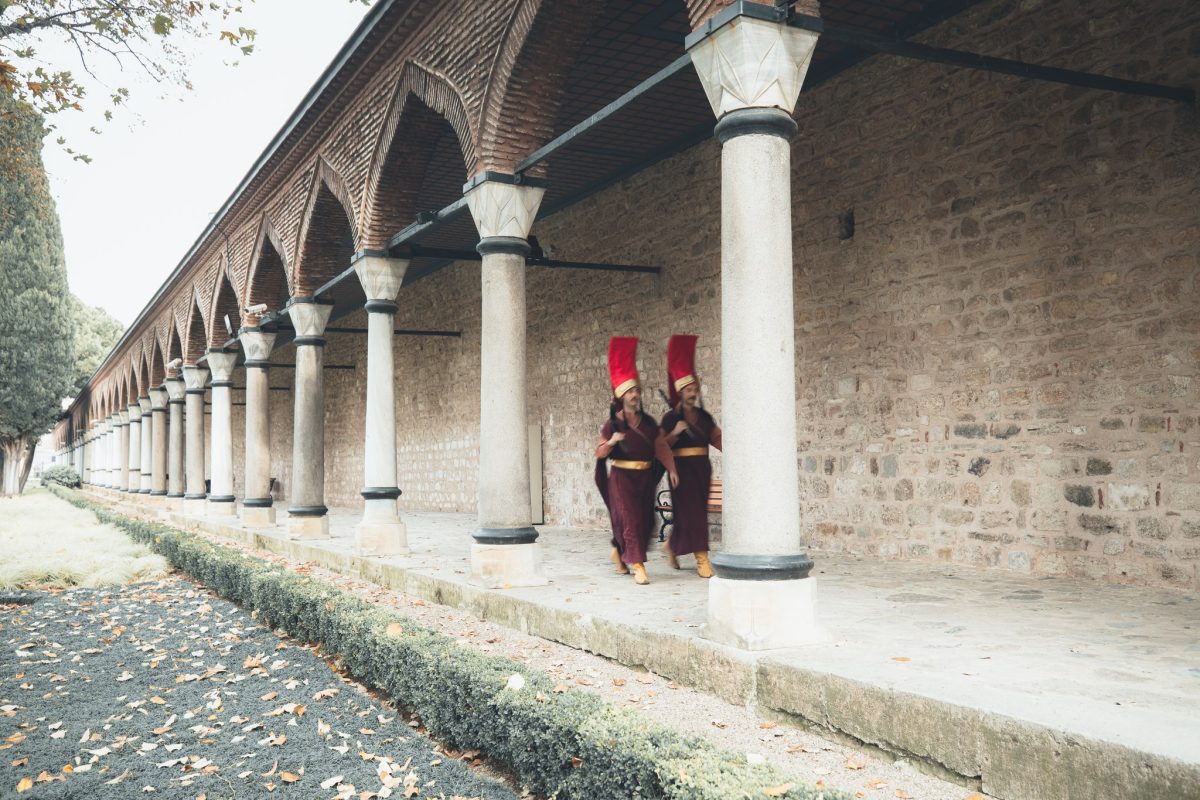
Through the Gate of Salutation the atmosphere changes at once. The Second Court is a broad, park-like enclosure of lawns, cypresses and old plane trees, surrounded by low colonnades. It was the court of government, where the state met in public view and in strict order; on council days, ambassadors and petitioners were led across it between lines of silent Janissaries. Today it is the busiest part of the palace, with the Harem entrance, the Imperial Council and the kitchens all opening from it.
The Imperial Council, the Divan-ı Hümayun, stands in the far left corner. Its low domed hall, the Kubbealtı, “beneath the dome”, was where the grand vizier and the other viziers met several times a week to hear petitions, debate policy and receive envoys. The building dates in its present form mainly from the time of Süleyman, though it was restored after the fire of 1665 and redecorated in the Rococo taste in the late eighteenth and early nineteenth centuries. High on one wall is a gilded grille. Behind it, the sultan could sit and listen to the deliberations of his council unseen, and the knowledge that he might be there — or might not — was itself an instrument of power. Next to the council hall rises the Tower of Justice, the tallest structure in the palace and its signature on the skyline of the peninsula; it was raised under Süleyman and given its present lantern under Mahmud II in 1825. The halls around the Kubbealtı now house the palace’s collection of arms and armour, with swords, helmets, shields and firearms spanning several centuries.
The sultan’s window over the council chamber was a lesson in Ottoman statecraft: the ruler was present without being visible, and every vizier spoke as if he were listening.
The right-hand side of the court is taken up by the palace kitchens, the Matbah-ı Amire, one of the most remarkable service complexes of any royal residence. They are a long range of ten domed halls, and after a fire in 1574 they were rebuilt by Mimar Sinan, who gave them the two rows of twenty broad chimneys that still stand out on the palace roofline. Here a staff of more than 800 cooks, bakers, confectioners and helpers prepared food for up to around 4,000 people a day — the sultan and his family, the Harem, the pages of the inner palace, the guards and the officials — with separate kitchens for the sultan, for the Harem and for the staff, and specialist workshops for sweets, sherbets and preserves.
The kitchens now house the palace’s collection of porcelain and kitchenware, and it is among the most impressive in the world. Topkapı holds around 10,700 pieces of Chinese porcelain, from Song and Yuan dynasty celadons to Ming blue-and-white and Qing enamelled wares, and around 5,000 pieces of European porcelain, along with Japanese Imari, Ottoman glass and the enormous copper cauldrons and ladles of the kitchens themselves. The collection grew from a few hundred pieces in the sixteenth century to many thousands by the eighteenth, through gifts, purchases and the confiscated estates of fallen officials. Tradition held that celadon would change colour or crack if poisoned food was served on it, which may help explain why the sultans collected it in such quantities. The kitchens are worth a deliberate visit rather than a glance: most visitors rush past them towards the Treasury, and they are often the quietest rooms in the palace.
The Harem — The Private City Behind the Walls
Not the fantasy of European painters but a household, a school and a court of power: corridors and courtyards, apartments of the Queen Mother, and some of the most beautiful rooms of the Ottoman world
The word harem means a sanctuary, a place forbidden to outsiders, and for centuries the Ottoman Harem was the most closely guarded part of the palace. European painters filled it with odalisques; the reality was more interesting. The Harem was the family quarters of the dynasty: home to the sultan’s mother, his consorts and children, the princes who might one day rule, and hundreds of women in service, many of whom arrived as enslaved girls and were educated here in music, embroidery, reading and court etiquette before being married off or rising within its hierarchy. It was guarded by the black eunuchs, whose chief, the Kızlar Ağası, was one of the most powerful officials in the empire. At its head stood the Valide Sultan, the Queen Mother, who controlled its finances, its appointments and often a good deal of the empire’s politics.
The Harem was built piece by piece over three centuries, and much of it was rebuilt after the fire of 1665, so it is a maze rather than a plan: several hundred rooms in all, arranged around small courtyards and connected by narrow corridors, stairs and passages. Only part of it is open, but the visitor route is long and varied. It begins at the Carriage Gate, where the women entered and left in closed carriages, and leads through the Courtyard of the Black Eunuchs. From there a passage opens into the Courtyard of the Concubines, the smallest in the Harem. In May 2026 the restored apartments of the sultan’s consorts and the rooms around this courtyard opened to visitors for the first time in their furnished state, after work that began in 2020: three apartments of the kadınefendi, the senior consorts, a dormitory, a kitchen, a bath and a coffee room, furnished with some 750 historical objects and textiles chosen by the curators of the National Palaces. The new section adds about twenty minutes to the route and is included in the Harem ticket.
The apartments of the Valide Sultan are the heart of the Harem: a sequence of rooms rebuilt in the late 1660s, lined with tiles and painted panels and grouped around their own courtyard. Beyond them lies the most splendid room in the palace, the Imperial Hall, the Hünkâr Sofası. Built in the late sixteenth century, it is covered by the largest dome in the palace and was the place where the sultan received his family and was entertained on religious holidays and at weddings. Its walls are faced with tiles, a gilded gallery runs around the upper level for the musicians, and on the far side a raised and canopied platform marks the place of the sultan’s throne. Later redecoration in the European-influenced taste means that Ottoman tiles, Baroque gilding and Rococo painted panels all meet in one space.
The Harem is best read as a building about succession. Every room was arranged around one question — which son would rule next — and the women who could answer it held real power.
Next to the Imperial Hall is the Privy Chamber of Murad III, designed by Mimar Sinan in the late sixteenth century and the oldest surviving room in the Harem. Its walls are lined with the finest İznik tiles of the period, with a broad band of calligraphy running around the room, a tall bronze-hooded fireplace and a cascade fountain set into the wall, whose sound was meant to keep private conversations from being overheard. It is the classical Ottoman interior at its height. Little more than a century later, a very different room was added next to it. The Fruit Room of Ahmed III, completed in 1705, is a small dining chamber whose walls are covered in painted wooden panels of bowls of fruit and vases of flowers. It belongs to the beginning of the Tulip Era, the reign of a sultan who loved gardens and flowers, and its pictorial decoration — closer to a still life than to the abstract patterns of the earlier rooms — shows the arrival of European influence in the palace more clearly than any other interior.
The route continues through the Twin Kiosk, a pair of seventeenth-century rooms for the crown princes with painted ceilings and coloured glass. For much of that century the princes lived here in effect as prisoners, in the quarters known as the Kafes, the Cage, after the custom of killing a new sultan’s brothers gave way to confinement. The visit ends along the Golden Road, the narrow corridor by which the sultan passed between the Harem and the Third Court, and the exit leads out close to the Sacred Relics.
The Third Court — The Gate of Felicity and the Treasury of the Sultans
The threshold of the sultan’s private world, the room where ambassadors were received, a school for the empire’s elite, and the jewels that most visitors come to see
The Gate of Felicity, Bâbüssaâde, separates the outer palace from the inner. It was the gate of the sultan himself: on accession days and religious holidays the throne was set up beneath its broad, gilded canopy, and the court filed past to pay homage, while beyond it no one could pass without the sultan’s permission. The gate probably dates from the reign of Mehmed II but owes its present appearance, with painted and gilded eaves and marble columns, to a redecoration in the Rococo style in 1774.
Directly behind the gate stands the Audience Chamber, the Arz Odası, a small pavilion surrounded by a deep colonnade. Here the sultan received the grand vizier after council meetings and gave audience to foreign ambassadors from a canopied throne; the pavilion burned in 1856 and was rebuilt. Beyond it, in the centre of the court, stands the Library of Ahmed III, an elegant marble pavilion of 1719 raised on a basement, with a fountain at its front, and around the edges of the court lie the rooms of the Enderun, the palace school. This was one of the most remarkable institutions of the empire: boys recruited across the empire were trained here as pages, and the best became governors, admirals and grand viziers. Since a round of restorations completed in 2023, the old Campaign Pages’ Hall has held the gallery of imperial costumes and the former Treasury Dormitory a gallery of Ottoman calligraphy.
The Treasury is where Topkapı becomes almost unreal — emeralds the size of eggs, thrones set with gems, and a diamond whose legend begins on a rubbish heap.
The Treasury occupies the Conqueror’s Pavilion, the Fatih Köşkü, in the far right corner of the court. Built around 1460, it is one of the oldest buildings in the palace, a row of domed halls opening onto a terrace above the Sea of Marmara, and it was used from the beginning to store the most valuable possessions of the dynasty. It reopened in April 2023 after nine years of restoration, and its halls now display a selection of objects that sums up the wealth of the empire: ceremonial armour, jewelled thrones, reliquaries, rock-crystal and jade vessels, aigrettes for turbans, and a pair of gold candlesticks, each weighing around 48 kilograms and set with 6,666 diamonds.
Two pieces draw the crowds. The Spoonmaker’s Diamond, the Kaşıkçı Elması, is a pear-shaped stone of 86 carats set in silver and surrounded by 49 smaller diamonds. Its name comes from a legend: a poor fisherman is said to have found it on a rubbish heap and sold it to a spoonmaker for three wooden spoons. Nearby is the Topkapı Dagger, made in 1747 on the orders of Sultan Mahmud I as a gift for Nader Shah of Persia. The gold hilt carries three large emeralds, and a small watch is concealed in its top. The embassy carrying it was on its way when news arrived that Nader Shah had been assassinated, and the dagger returned to Istanbul. It became world-famous in 1964, when Jules Dassin made it the target of the heist in his film Topkapi.
The Sacred Relics — The Holiest Rooms in the Palace
The sultan’s former private apartment, where the mantle of the Prophet Muhammad is kept and the Qur’an is recited without pause
In the northern corner of the Third Court, a suite of domed rooms faced with İznik tiles was once the sultan’s private apartment, the Has Oda or Privy Room. It is now the Chamber of the Sacred Relics, and for many Muslim visitors it is the true destination of a visit to Topkapı. The relics came to the Ottomans largely after Selim I conquered Mamluk Syria and Egypt in 1516–17 and the guardianship of Mecca and Medina passed to the dynasty; according to tradition, the last Abbasid caliph handed the mantle of the Prophet to Selim. More were sent to the sultans over the following centuries, many from the holy cities of the Hejaz, until the late nineteenth century. The rooms were renovated and reopened in 2023, when the number of objects on display was raised from about 60 to about 300.
The relics are arranged through several rooms. The most venerated, the Blessed Mantle — the Hırka-i Saadet — and the Holy Banner of the Prophet are kept in their own chamber, seen through a doorway. Elsewhere are a footprint, hairs from the Prophet’s beard, a tooth, his seal and a letter attributed to him, swords of the Prophet and his companions, objects associated with earlier prophets — a staff said to be that of Moses, a sword associated with David — and treasures from the Kaaba in Mecca, including its old keys and gold gutters from its roof. The museum presents them as the palace received and preserved them; their attributions are a matter of faith rather than of history.
The sound defines the room: an imam recites the Qur’an continuously while the museum is open, and the murmur follows visitors from case to case.
The Privy Room had a ceremonial role long after the court left Topkapı. Every year on the fifteenth day of Ramadan, the sultan, his family and the leading officials came here to visit the mantle in a solemn ceremony. The atmosphere is still closer to that of a mosque than of a museum: dress modestly, keep voices low and do not take photographs, which are not permitted inside. The tiled rooms themselves are among the finest in the palace.
The Fourth Court — Kiosks, Terraces and the View Over Two Continents
The sultans’ private garden at the tip of the peninsula, where two pavilions commemorate the conquests of Murad IV and the Bosphorus, the Golden Horn and Asia spread out below
The Fourth Court is not really a court at all but a series of gardens and terraces stepping down towards the point: the sultan’s private retreat, with tulip beds, pools and small, light pavilions made for pleasure rather than ceremony.
The upper terrace, paved in marble around a large pool with a fountain, holds the finest group. On one side stands the Revan Kiosk, built in 1635–36 for Murad IV to celebrate his capture of Yerevan in the Caucasus; it is a small domed pavilion with three alcoves for sofas, used as a place of religious retreat. On the other side of the terrace is the Baghdad Kiosk, built in 1638–39 by the architect Hasan Ağa to commemorate the same sultan’s reconquest of Baghdad. It is often considered the masterpiece of the classical Ottoman pavilion: a domed cross-shaped room with four alcoves lined with low sofas, a deep overhanging roof on slender columns, and an interior of blue, green and white tiles, with cupboard doors and shutters inlaid with mother-of-pearl and tortoiseshell.
From the terrace of the Baghdad Kiosk the whole meaning of the site becomes clear: the Golden Horn on one side, the mouth of the Bosphorus ahead, the Asian shore beyond — and the palace placed at the hinge of them all.
Between the two kiosks, a small gilded canopy, the İftar Pavilion, juts out over the edge of the terrace; according to tradition the sultans broke their fast here during Ramadan, watching the sun set over the Golden Horn. Its curving, gilded bronze roof was something new in Ottoman architecture. Next to it, the Circumcision Room of 1640 is faced with some of the finest blue-and-white tiles in the palace, some dated as early as 1529. Lower down, towards the sea, stands the Mecidiye Kiosk, built in 1840 by Sarkis Balyan, the Armenian architect of the Ottoman court, in the European style of the period — a sign of the direction the dynasty was already taking before it left for Dolmabahçe. It was opened to visitors for the first time in 2023.
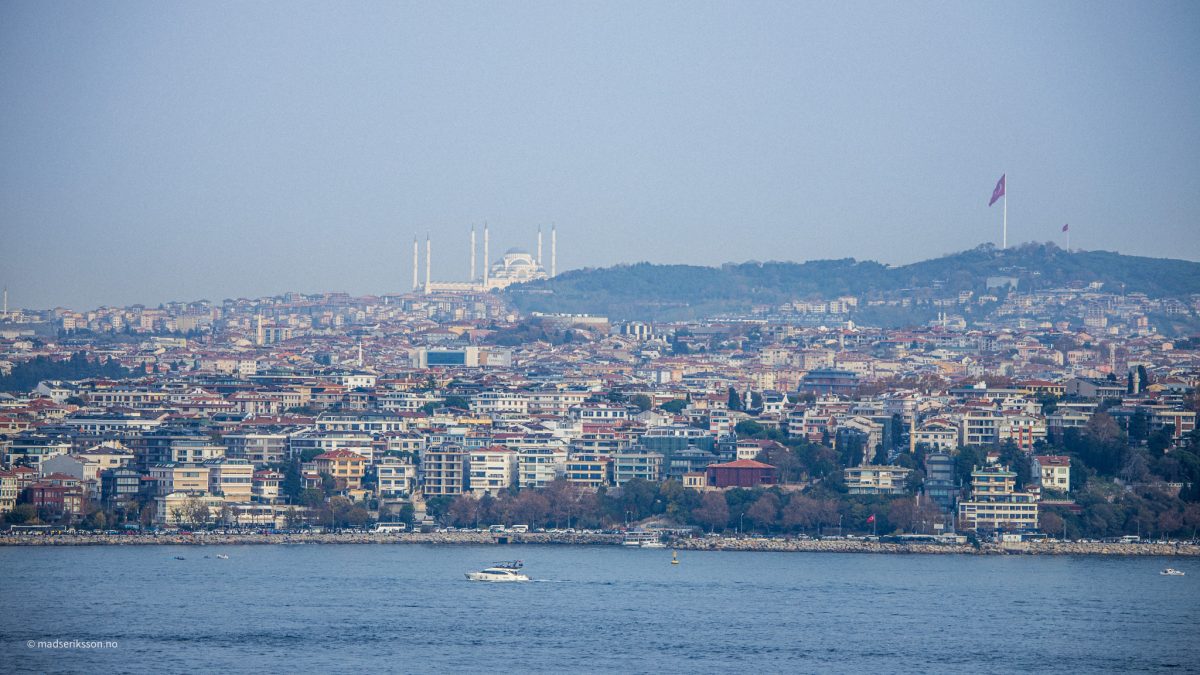
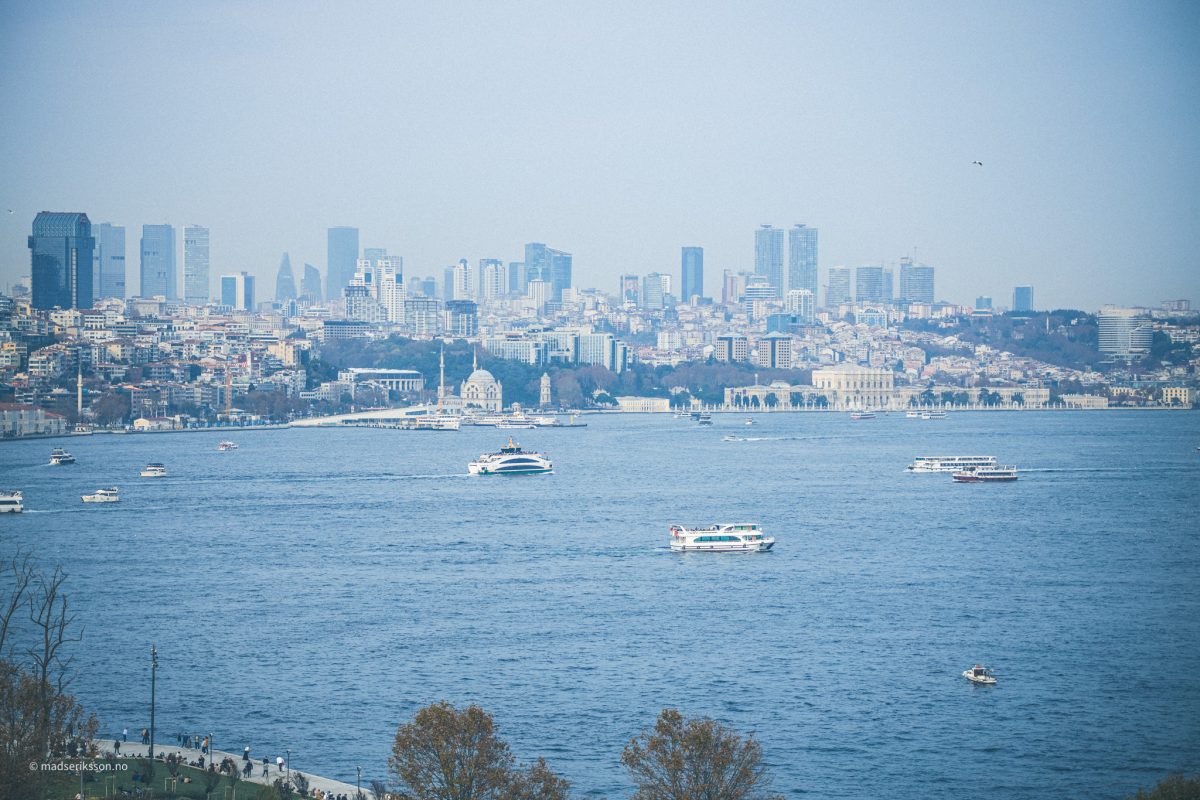
The view is the reward for walking the full length of the palace. From the terraces of the Fourth Court the Golden Horn opens to the north, with the Galata Tower and the hills of Beyoğlu across the water; to the north-east the Bosphorus begins its course between Europe and Asia; and to the east, across the strait, lie Üsküdar and the Asian side of the city. It is the reason Mehmed II chose this headland, and still the best place in the old city to understand Istanbul’s geography.
Visiting Topkapı — Tickets, Timing and a Route Through the Courts
What the tickets cover, when to arrive, how long to allow, and how to see the palace in a sensible order without spending half the day in queues
Topkapı opens at 09:00 and closes at 17:30, with ticket sales ending at 17:00. It is closed on Tuesdays, as it has been for many years, and on the first day of the Ramadan holiday, Ramazan Bayramı; the Turkish version of the official visiting page also lists New Year’s Day as a closing day. On the other religious and public holidays it generally stays open, sometimes with shortened hours on the first day.
There are three main tickets. For visitors from abroad, the combined ticket, covering the palace courts and collections, the Harem and Hagia Irene, costs from about 2,750 Turkish lira, roughly €50 at late-2026 exchange rates; it is valid for one day. Separate tickets for the Harem and for Hagia Irene cost about 1,050 lira each. Children up to six enter free and students receive a reduced rate (foreign students need an ISIC card). Lira prices have risen repeatedly in recent years, so these figures are a guide rather than a guarantee. The Turkish Museum Card, the Müzekart, is valid for the main palace but not for the Harem or Hagia Irene, which need their own tickets. In summer the palace has also opened on Saturday evenings for night visits on a separate, more expensive ticket.
The best plan is the simplest: arrive before the gates open, go straight through the Second Court to the Treasury and the Sacred Relics, and leave the Harem and the kitchens for the late morning, when the crowds have moved on.
Allow at least three hours, and four or more with the Harem and Hagia Irene. Queues build quickly from mid-morning, especially at weekends, in summer and on cruise-ship days, so arriving shortly before 09:00 makes a real difference. Buying tickets online saves time at the booths but not at the security check, and an audio guide is worth having in the Harem. Dress is relaxed in most of the palace, but shoulders and knees should be covered for the Sacred Relics.
The palace is easiest to reach on foot from Sultanahmet, a few minutes’ walk from Hagia Sophia and the Blue Mosque. The T1 tram stops at Sultanahmet and at Gülhane, both within ten minutes of the Imperial Gate, and the walk down through Gülhane Park leads to the Sirkeci and Eminönü waterfront, the ferry piers and the Spice Bazaar, which makes a natural end to a day in the old city. Topkapı is one of the great museum palaces of the world, comparable in richness to the institutions in the site’s ranking of the world’s greatest museums; for many visitors to Istanbul it is the single sight that explains the rest.
«Topkapı is a palace that has to be read in sequence. Each gate narrows the circle of those allowed through, each court is quieter and more private than the last, and the whole design leads from the crowd in the square outside Hagia Sophia to a sultan alone on a marble terrace above the meeting of two seas. Between them lie the council chamber where an empire was governed, the kitchens that fed four thousand people a day, the corridors of the Harem where its succession was decided, the relics that gave it its religious authority and the jewels that displayed its wealth. Go early, walk it in order, give the Harem the time it deserves, and end on the terrace of the Baghdad Kiosk, looking out over the water that made Istanbul.»

More in the same area
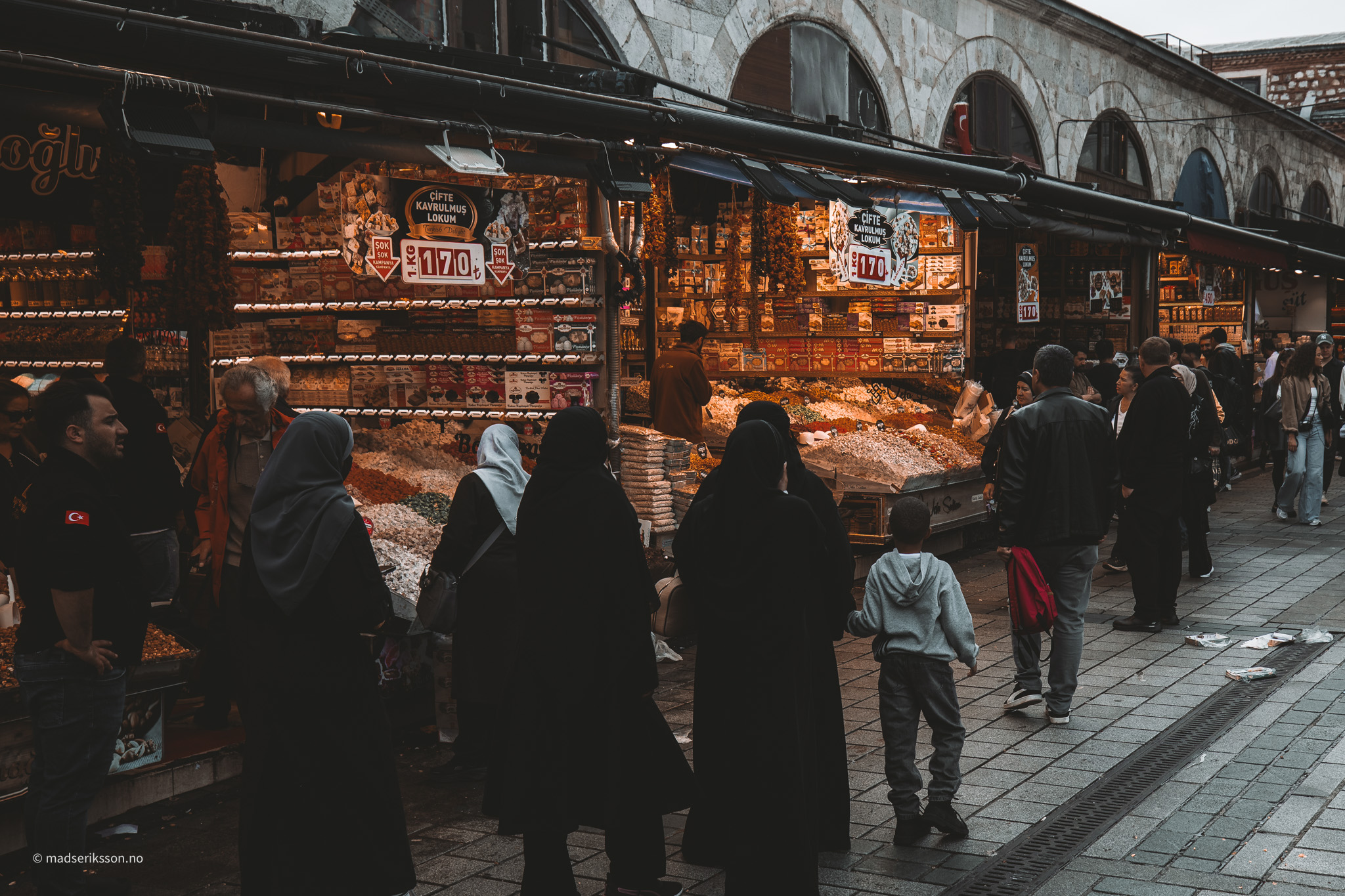 Food and DrinksIstanbul’s Spice Bazaar: The Market Built to Pay for the New Mosque
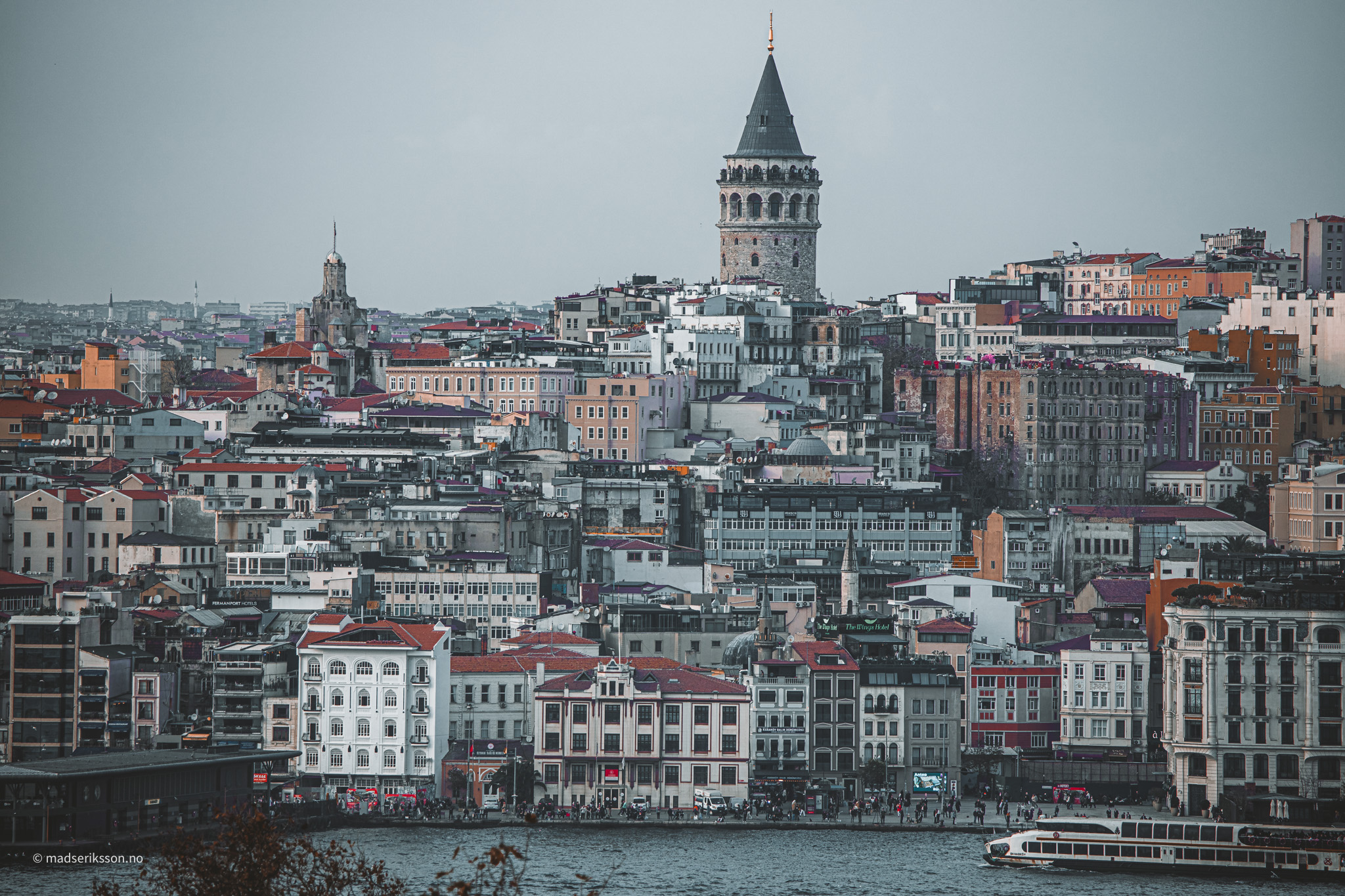 CitiesExploring the Wonders of Istanbul
 ArchitectureEurope’s 10 Greatest Cathedrals and Churches
 ArchaeologyAngkor Wat and the Bayon — The Temple-Mountain and the City of Faces
 Train travelThe World’s 10 Great Railway Journeys
 NatureThe World’s 15 Most Spectacular Waterfalls