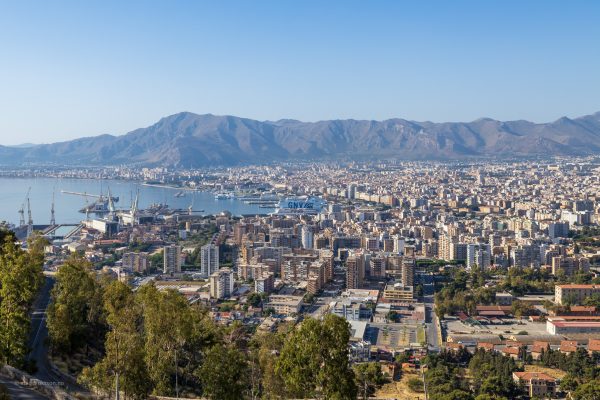
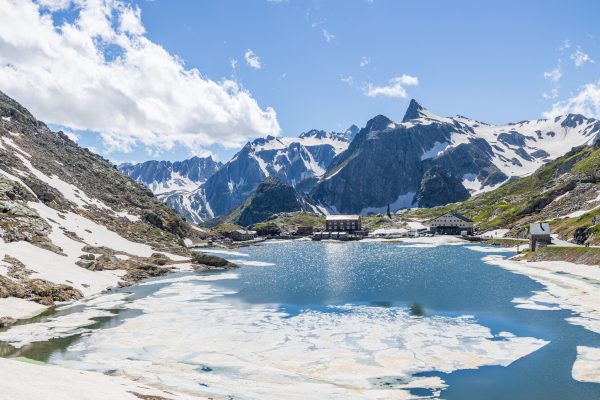
Italy’s first capital, the world’s second-best collection of Egyptian antiquities, eighteen kilometres of arcades, a car factory with a test track on the roof, and the city where vermouth was invented in 1786. Turin has more going on than almost anywhere in Italy and gets a fraction of the visitors — largely because it spent a century being described as an industrial town, which it also is, and which turns out to be part of the appeal.

Turin sits at the foot of the Alps in Piedmont, on the Po, about an hour from Milan by fast train. It was the seat of the House of Savoy, and when Italy was unified it became the country’s first capital, from 1861 to 1865 — a role it held briefly and then lost to Florence and eventually Rome. The city that resulted is unusually formal for Italy: a rectilinear grid inherited from the Romans, long straight avenues, and mile after mile of arcaded pavement built so that the royal court could cross town without getting wet.
Then, in the twentieth century, it became the company town of Fiat — and for a long time that was the whole of its reputation abroad. Southern Italians moved north in enormous numbers to work in the factories; the population roughly doubled; and the tourist trade went elsewhere. The industry has since contracted, the buildings it left behind have been converted rather than demolished, and the result is a city where a baroque royal palace and a rooftop car test track are both major attractions.
How this article is arranged
Four sections: the historic centre and its museums; the industrial city, meaning Lingotto and the hill at Superga; food and drink, which in Turin means vermouth, chocolate and the aperitivo, all three of which were substantially invented here; and the practical business of trains, tickets and how to fit it together. Two full days is the minimum. Three is better.
Turin in 3D
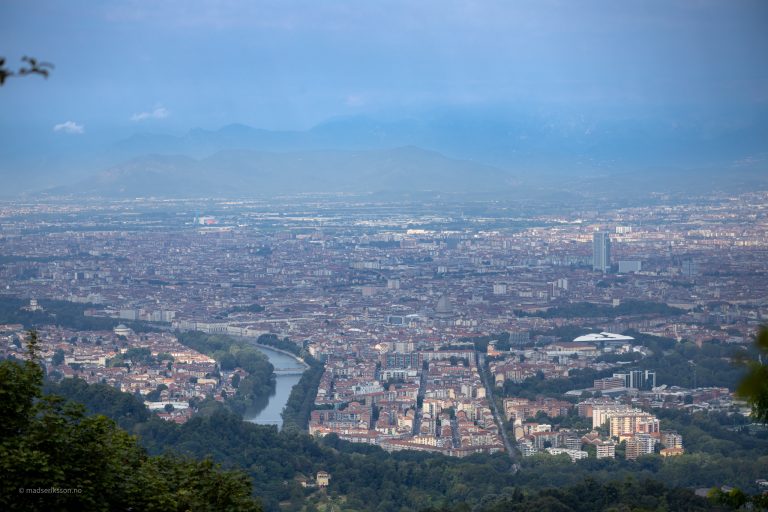
Turin lies on the Po at the foot of the Alps, and was the seat of the House of Savoy and, from 1861 to 1865, the first capital of united Italy. The centre keeps the rectilinear grid of the Roman colony of Augusta Taurinorum and some 18 km of arcades. This frame covers the old city from Porta Nuova to the Palazzo Civico, and east across the river to the Gran Madre di Dio and the hills.
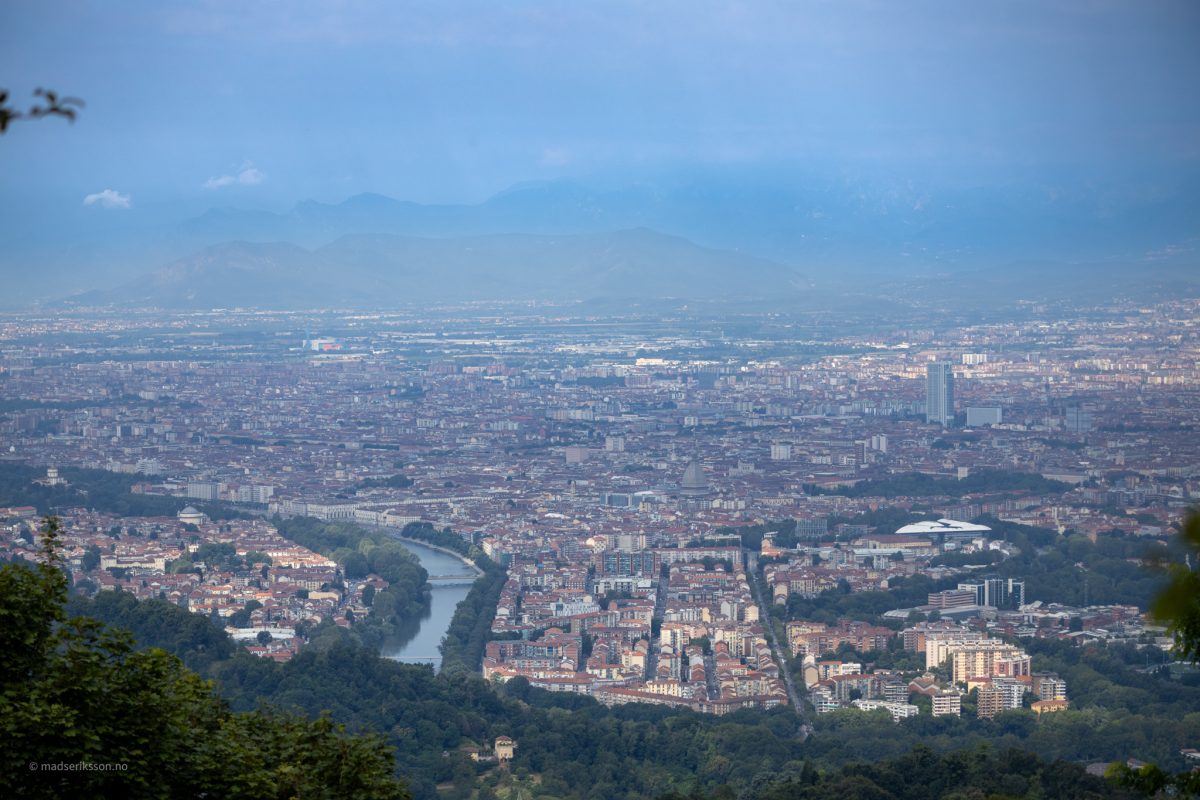
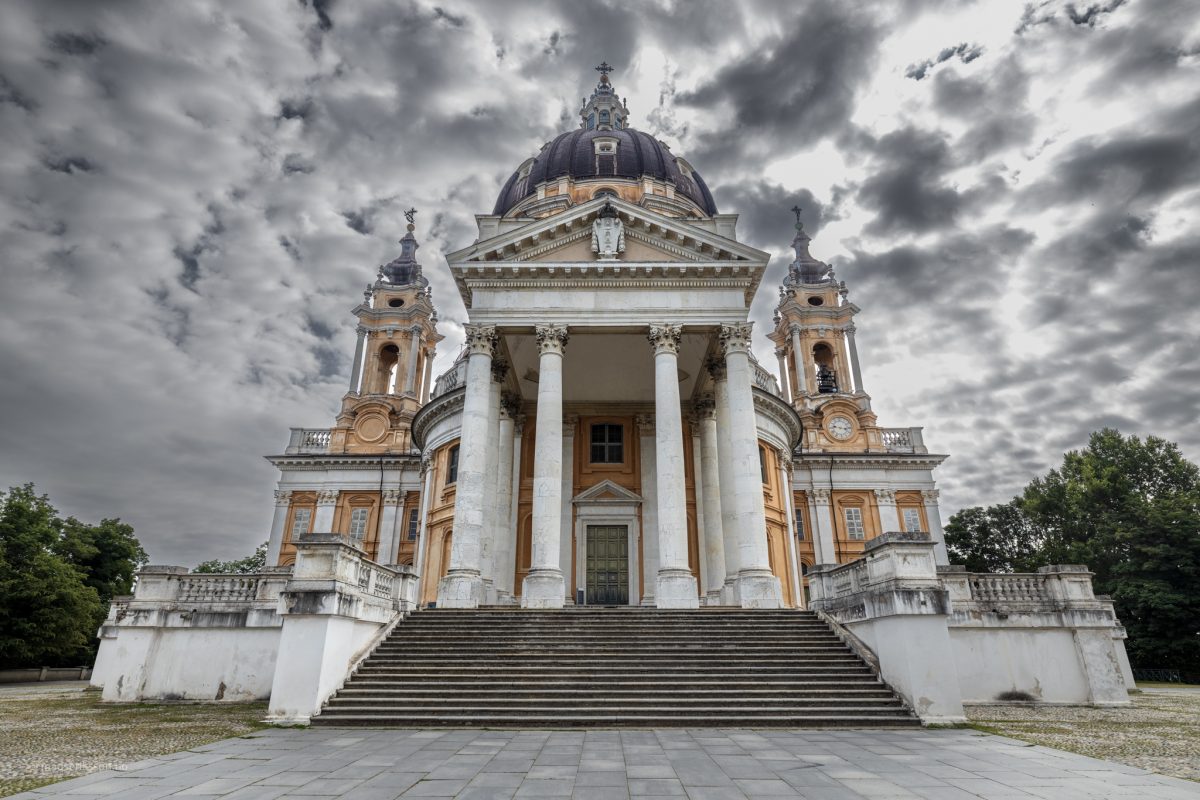
View of Turin from the Basilica of Superga.
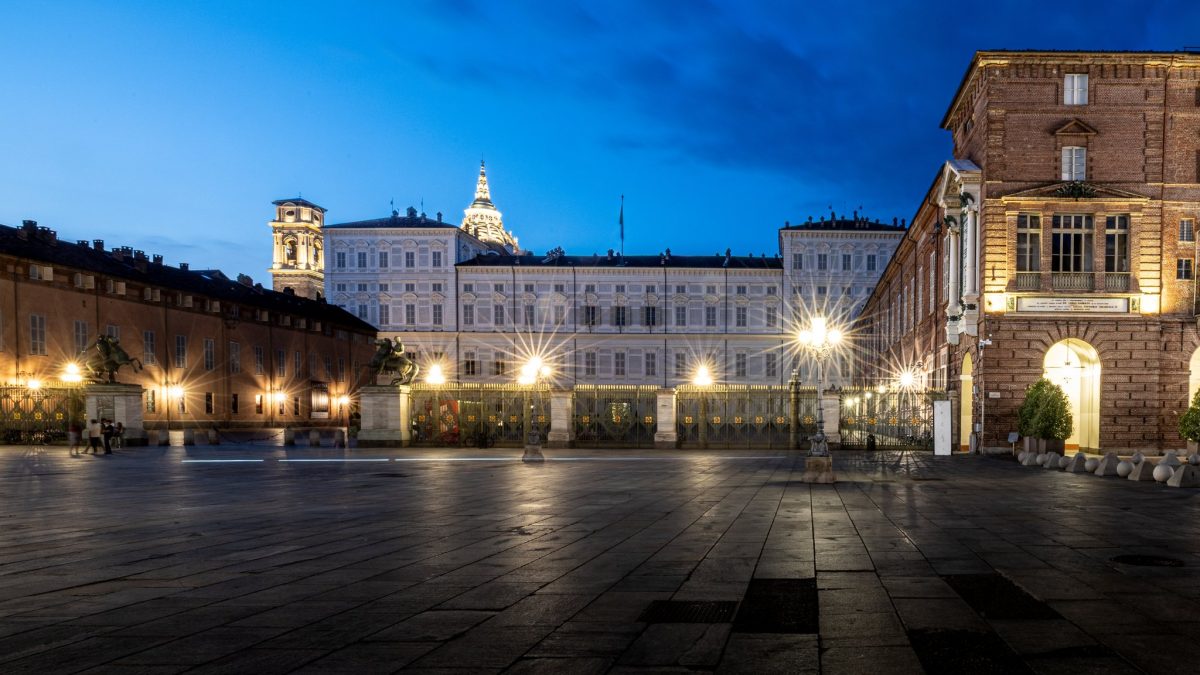
Palazzo Madama and the Royal Palace
Piazza Castello is the centre of Savoy Turin. Palazzo Madama in the middle grew from a Roman gate into a medieval castle and was given a Baroque facade by Filippo Juvarra in the early 18th century; it later housed the first Senate of the Kingdom of Italy. Behind it stand the Royal Palace and the cathedral, home of the Holy Shroud, and the Savoy residences have been a UNESCO World Heritage Site since 1997.
The Museo Egizio and Piazza San Carlo
The Museo Egizio, founded in 1824 by King Charles Felix, is the oldest museum devoted solely to ancient Egypt and is considered the most important Egyptian collection outside Cairo. A block away, Piazza San Carlo is the most formal of Turin's Baroque squares, lined with arcades and historic cafés, and Via Roma runs south from it to Porta Nuova station.
The Mole Antonelliana
The Mole Antonelliana, 167.5 m high, is still the tallest unreinforced brick building in the world. Alessandro Antonelli began it in 1863 as a synagogue for Turin's Jewish community, which gave it up as the costs rose; it was completed in 1889, after his death, and today houses the National Museum of Cinema. To the west, Renzo Piano's Intesa Sanpaolo tower of 2015 reaches almost the same height.
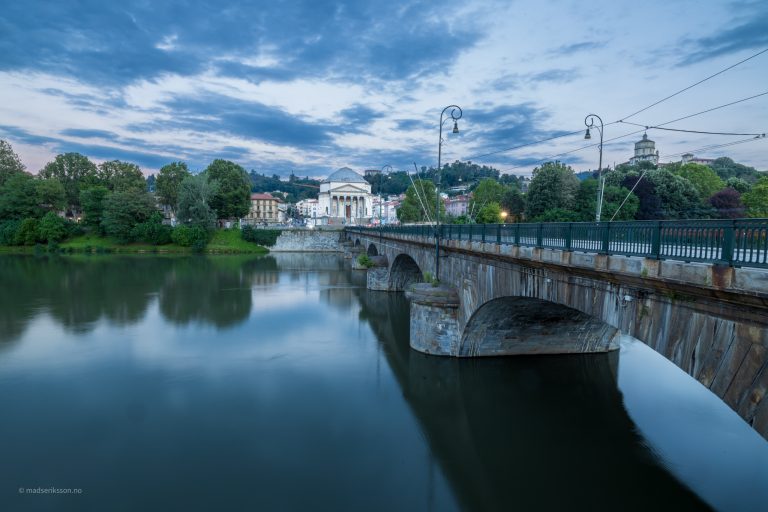
The Po and the Gran Madre di Dio
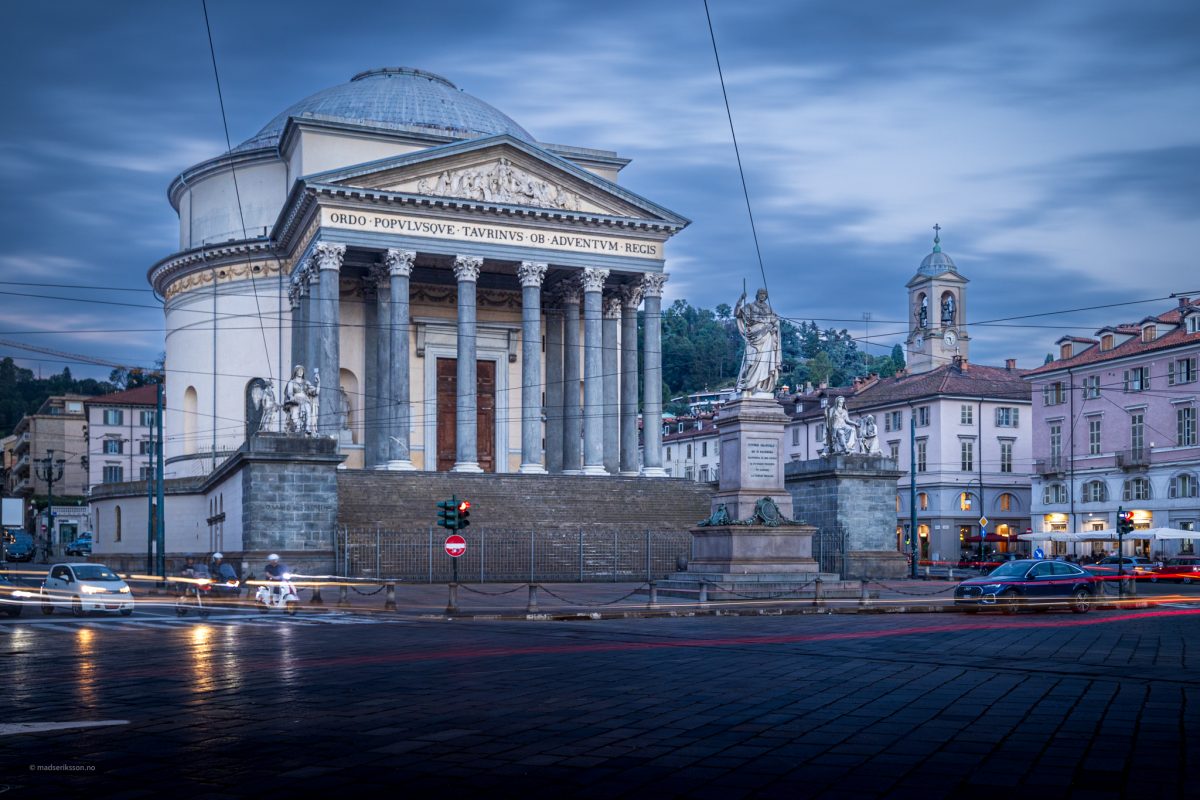
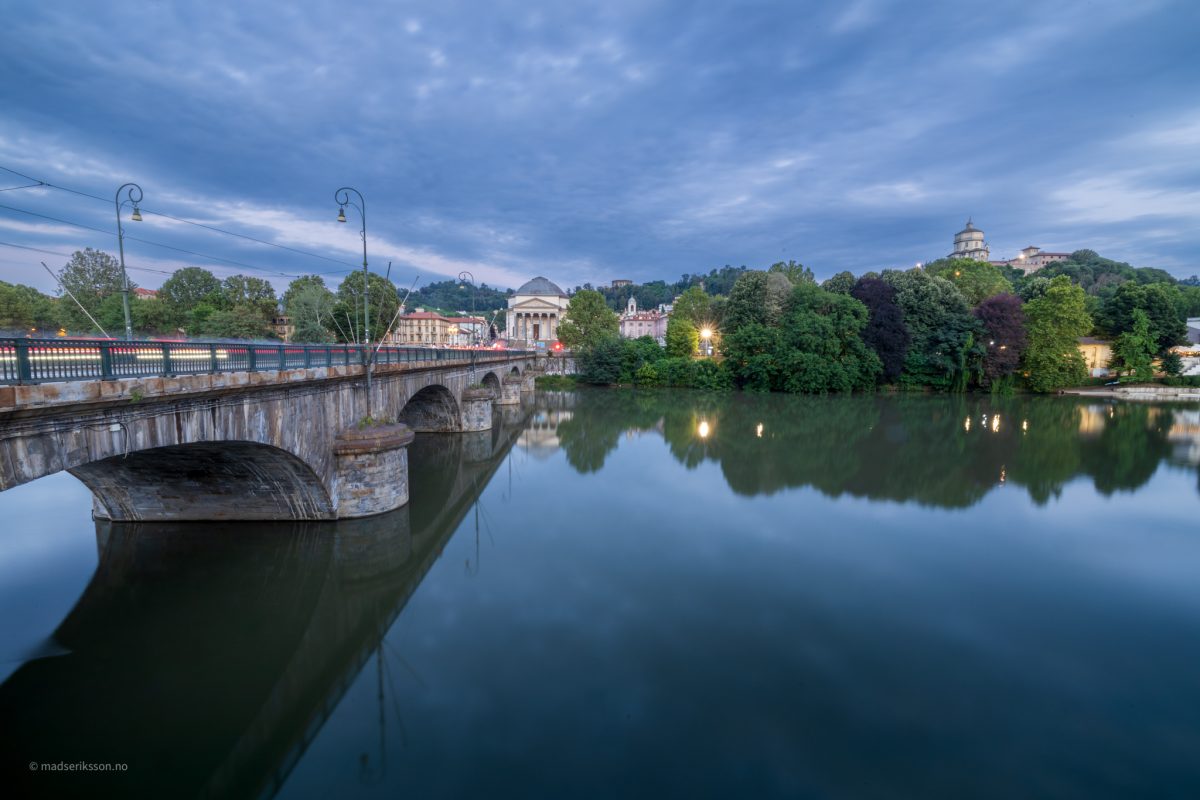
The Ponte Vittorio Emanuele I crosses the Po from Piazza Vittorio Veneto to the Gran Madre di Dio, a church modelled on the Pantheon in Rome. It was conceived in 1814 to celebrate the return of King Victor Emmanuel I after the Napoleonic years, begun in 1818 to designs by Ferdinando Bonsignore and inaugurated in 1831. Above it, the church of Monte dei Cappuccini looks back over the city to the Alps.
The Po River with the Vittorio Emanuele I Bridge leading to the church of the Gran Madre di Dio.
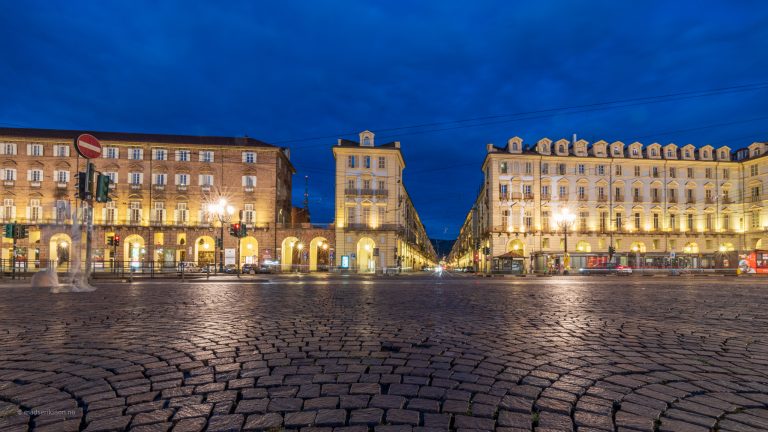
Piazza Vittorio Veneto
Piazza Vittorio Veneto, laid out by Giuseppe Frizzi from around 1825, covers about 31,000 m² between Via Po and the river and is one of the largest arcaded squares in Europe. Its arcades continue up Via Po towards Piazza Castello, part of the network that let the court cross the city without getting wet.
Turin, Italy
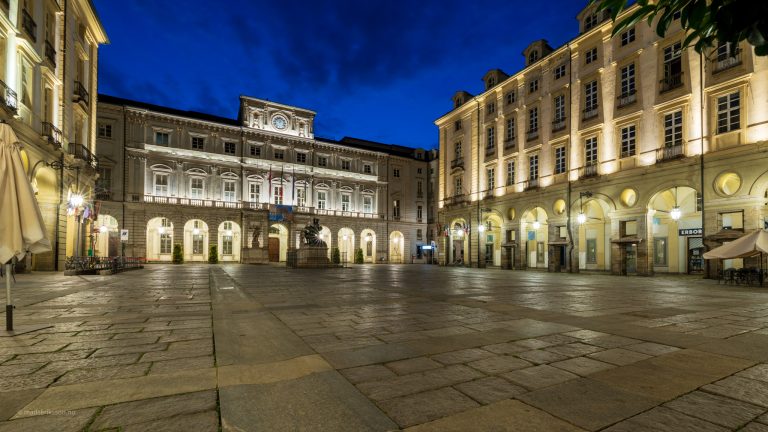
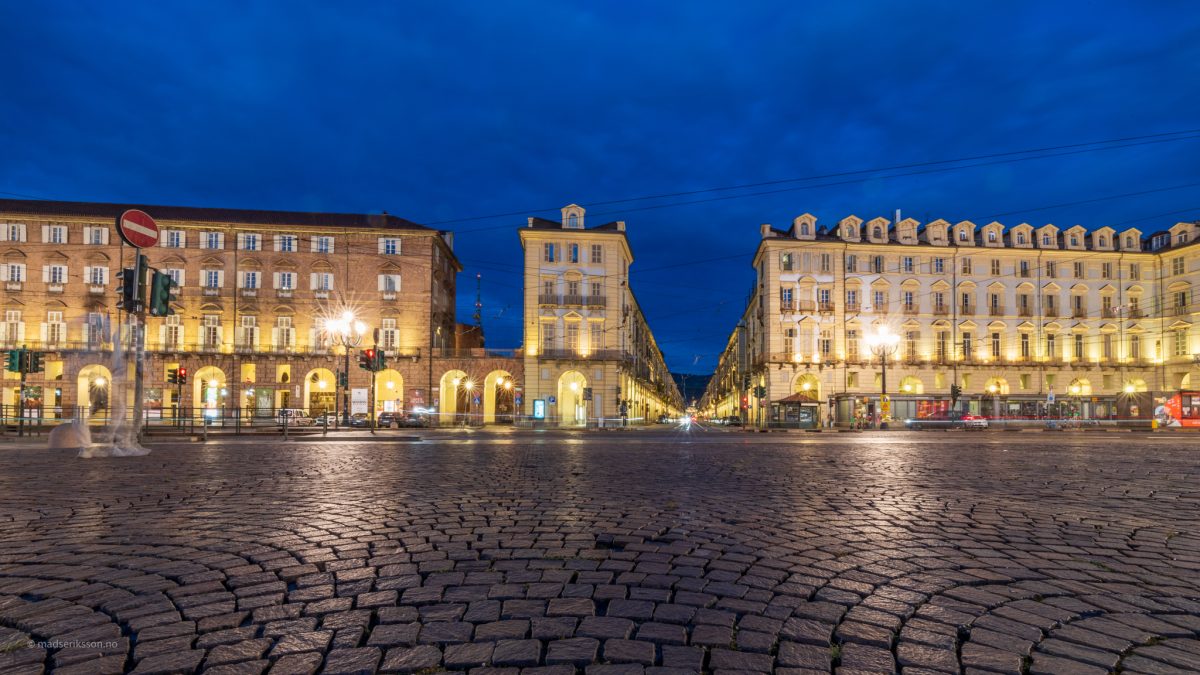
Palazzo Civico at night
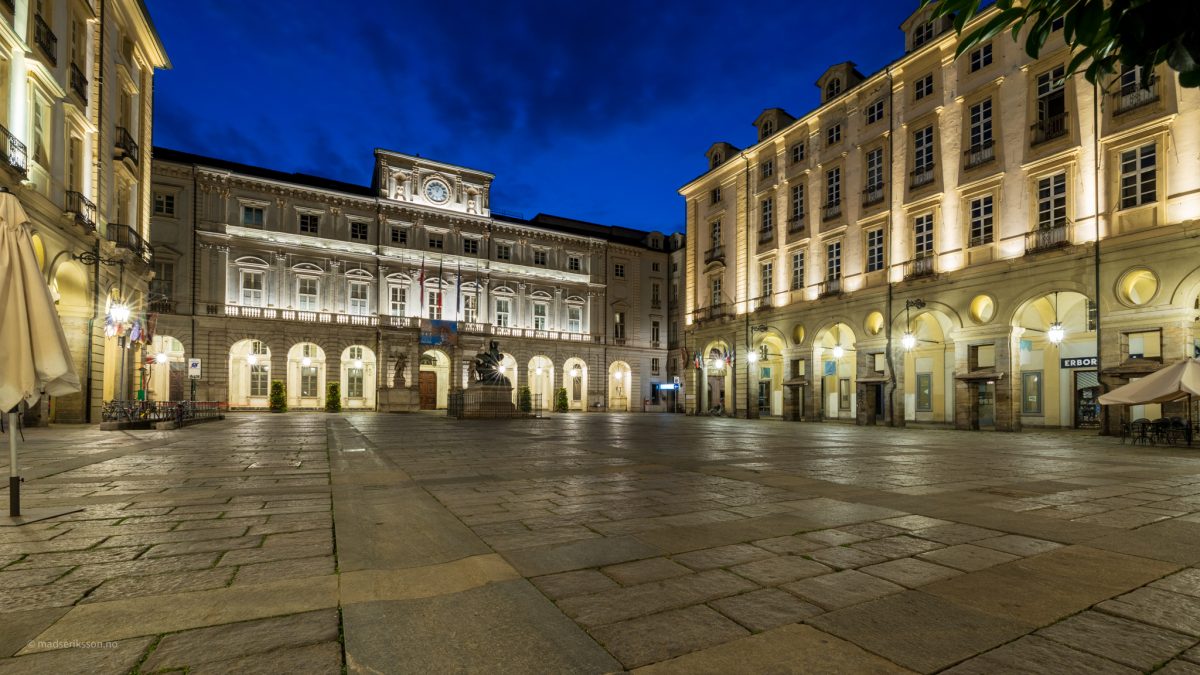
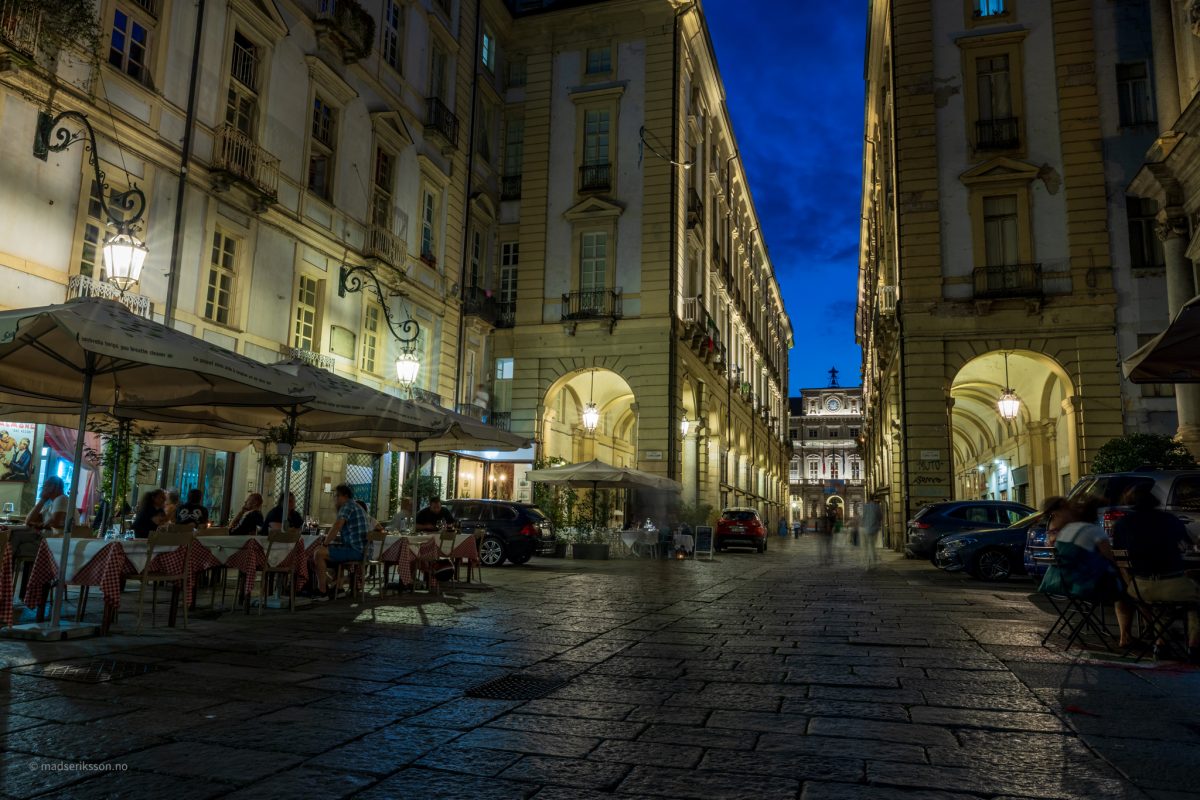
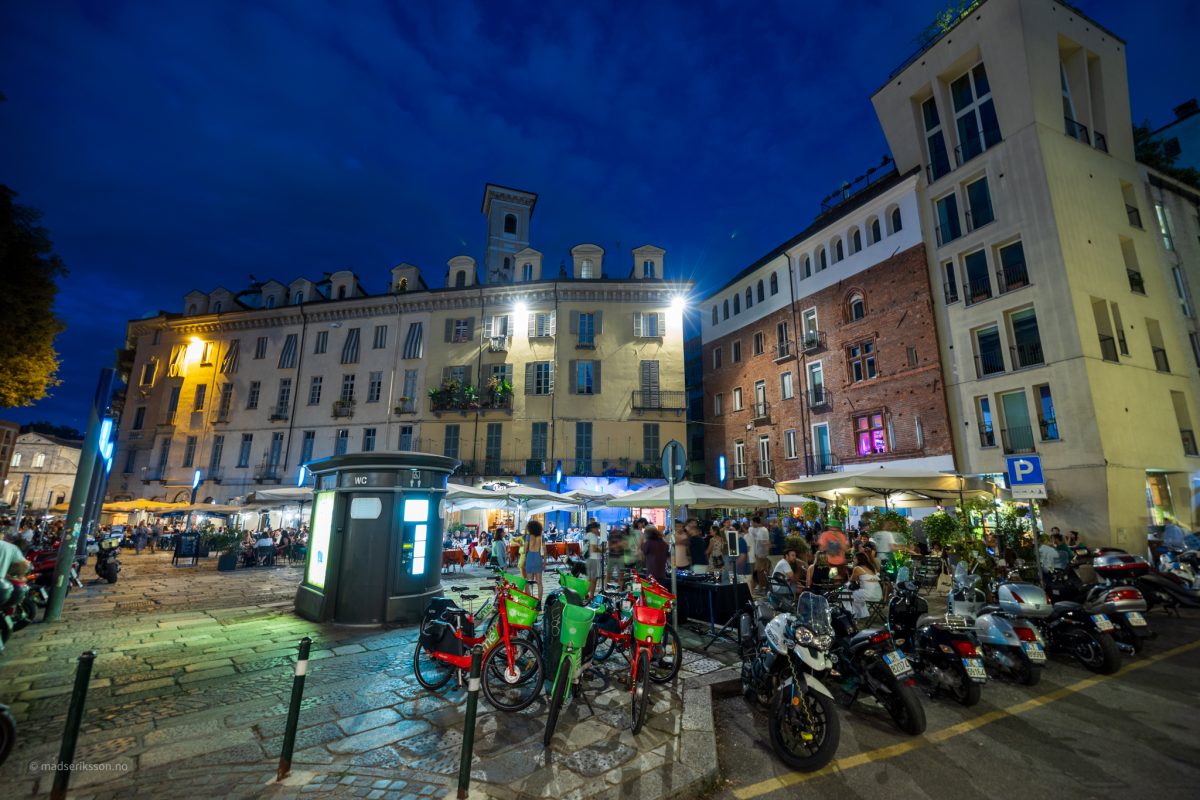
Piazza Palazzo di Città, in the old Roman quarter now known as the Quadrilatero, is fronted by the Palazzo Civico, Turin's city hall, with a monument to Amadeus VI, the Green Count, in the middle. After dark the surrounding streets fill with bars and restaurants, and the lit arcades run on towards Piazza Castello and the cathedral.
Turin, Italy
3D model © 2026 madseriksson.no · Photographs © madseriksson.no. Buildings and heights: © OpenStreetMap contributors (ODbL), via OpenMapTiles. Ground imagery: Sentinel-2 cloudless 2023 by EOX IT Services GmbH (contains modified Copernicus Sentinel data 2023; CC BY 4.0). Heights are approximate where OpenStreetMap has no measured value; sun positions are approximate.
A capital built for four years of use
Baroque squares, a royal palace, eighteen kilometres of arcades and the oldest Egyptian museum in the world — all inside a twenty-minute walk
The single most impressive thing in Turin is the Museo Egizio, and most people are unprepared for how good it is. Founded in 1824 out of the Savoy royal collection, it is the oldest museum anywhere devoted solely to Egyptian material, and its holdings are usually placed second in importance only to Cairo. A full renovation reopened it in 2015 and it marked its bicentenary in 2024. Give it three hours; it will take four. Book a timed slot before you go.
The other landmark is the Mole Antonelliana, which is a stranger building than its postcards suggest. Alessandro Antonelli started it in 1863 as a synagogue for the city’s Jewish community, and then kept adding height as construction went on until the costs became impossible and the community handed the building to the city. It was completed in 1889, after Antonelli’s death, and it has never functioned as a synagogue. At 167.5 metres it remains the tallest unreinforced brick building in the world.
“A synagogue that became a cinema museum, built by an architect who could not stop making it taller. Turin does not have a straightforward landmark.”
Inside is the Museo Nazionale del Cinema, which since 2000 has filled the vast central hall with a spiral ramp of exhibits and reclining seats. It is genuinely well done and worth the ticket even if you have no particular interest in film. The glass lift runs 85 metres up the middle of the dome to a viewing platform with the Alps behind the city — on a clear winter day this is the best view in Turin.
Between and around those two, walk the arcades. Turin has around eighteen kilometres of porticoes, built so the Savoy court could cross the city under cover, and they still work exactly as intended. Piazza San Carlo is the set piece — a formal square lined with cafés, several of which have been in business since the eighteenth century — and Piazza Castello holds Palazzo Madama and, behind it, the Palazzo Reale. The Savoy residences are collectively a UNESCO World Heritage site, listed in 1997, and if you have a third day the enormous palace at Venaria Reale, just outside the city, is the biggest of them.
The car city, and the hill
A test track on a factory roof, now planted as a garden — and a basilica above the city that a football team flew into in 1949
The Lingotto plant opened in 1923 and worked like a machine you walk through. Raw materials went in at the ground floor, the car was assembled as it moved upward through five storeys, and it emerged onto a test track on the roof — a full oval with banked corners, five hundred metres round, where every finished car was driven before leaving. Le Corbusier called it one of the most impressive sights in industry. It is also where the Minis race across the rooftop in The Italian Job in 1969.
Production ended in the 1980s, and the decision that followed is the interesting one: Fiat held a competition and Renzo Piano converted the building rather than clearing it. It now contains a shopping centre, a conference venue, university faculties, two hotels and a concert hall, with the structure left legible throughout. Piano added the Pinacoteca Agnelli above the roof in 2003 — a small glazed gallery on struts that reads as a control tower hovering over the track, holding the Agnelli family’s art collection.
“Forty thousand plants laid out along a banked test track five storeys up. It is the most Turin thing in Turin: nothing thrown away, everything repurposed, none of it explained.”
And in 2022 the track itself reopened to the public as La Pista 500, planted as a garden of more than 40,000 plants across some 300 species and billed as the largest hanging garden in Europe. You walk the oval, including the banking, with the Alps on one side and the city on the other. Entry is about €4, or €12 combined with the Pinacoteca — and on Mondays you can drive an electric Fiat 500 around it, which is exactly as good as it sounds.
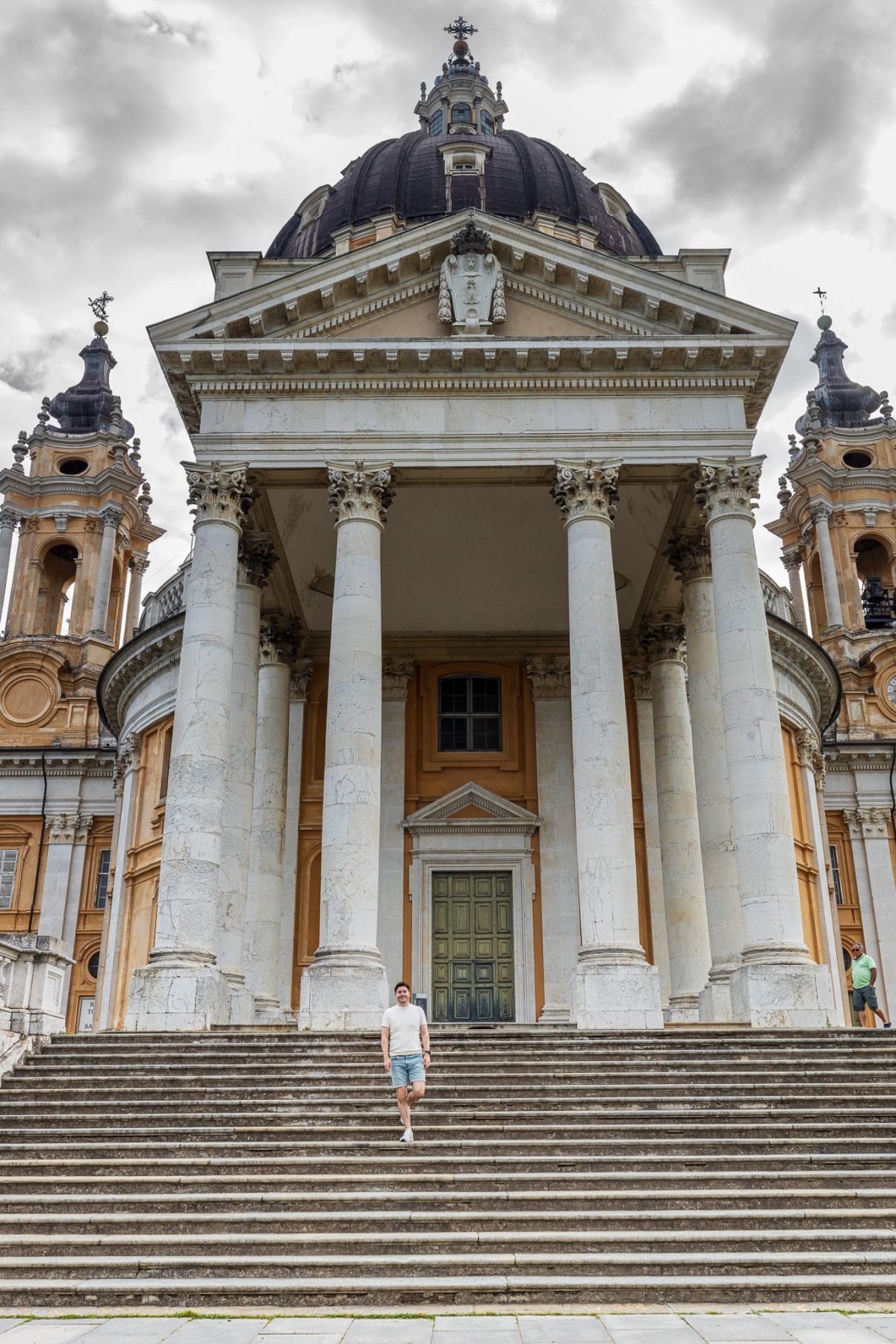
The other half of this section is on the hill east of the city. The Basilica of Superga, built by Filippo Juvarra in the early eighteenth century, stands at 669 metres with the whole Po valley and the Alps laid out below it. You get there on a rack railway from Sassi, which is a pleasant twenty minutes in itself.
On 4 May 1949, at 17:03, the aircraft carrying the Grande Torino football squad home from a match in Lisbon flew into the hill beside the basilica in low cloud. All thirty-one people on board were killed, including eighteen of Torino’s first-team players — the core of the Italian national side — along with the coaching staff, club officials, journalists and crew. Close to a million people lined the streets of Turin for the funeral. There is a memorial at the crash site behind the basilica, and it is still visited constantly, most heavily every 4 May. Go up for the view; the memorial is not a detour, it is the reason many Italians come.
The city that made the aperitivo
Vermouth in 1786, hazelnut chocolate out of a wartime shortage, and a coffee that is really a dessert — Turin’s contribution to how Italy drinks
Start with vermouth, because Turin genuinely invented it. In 1786, Antonio Benedetto Carpano — working from a shop near Piazza San Carlo, across from the royal palace — fortified and aromatised white wine with a long list of herbs and spices, and produced something sweeter and more approachable than the local reds. He sent a crate to King Vittorio Amedeo III, it was adopted by the royal household, and demand became such that the shop reportedly began opening around the clock. Modern vermouth, and by extension a very large share of the world’s cocktails, starts in this square.
That is also where the aperitivo comes from. The Turin version is not the Milanese all-you-can-eat buffet; it is a drink taken standing or sitting between roughly six and eight in the evening, with something small alongside it — olives, crisps, a few bits of focaccia, occasionally rather more. Order a vermouth on ice with a slice of orange rather than a spritz, and you are drinking the thing in the place it was made.
“Chocolate here is a consequence of a blockade. Cocoa ran short, the makers cut it with the hazelnuts growing in the hills, and Piedmont accidentally created its best-known product.”
Then the chocolate. Turin was a chocolate city long before Switzerland was, and gianduia — the hazelnut-and-cocoa paste sold here as the small ingot-shaped gianduiotto — came out of a cocoa shortage in the Napoleonic period. Makers stretched what cocoa they had with the hazelnuts of the Langhe hills, and ended up with something better than what they had been rationing. The direct descendant of that improvisation is the jar of chocolate-hazelnut spread in your kitchen, which is also a Piedmontese product.
The other local institution is the bicerin — espresso, drinking chocolate and cream, layered in a small glass and not stirred. It is served in the historic cafés under the arcades, most famously at the one that gave it its name, in business since 1763. It is closer to a dessert than a coffee, and one is enough.
Beyond the city, this is Piedmont, which means the Langhe and Barolo to the south, white truffles from Alba in autumn, and the region where the Slow Food movement began in the 1980s. Turin is also where Eataly opened its first store in 2007, in a converted vermouth factory next to Lingotto — which is either a fitting piece of symmetry or a very good piece of marketing, and probably both.
Fitting it into two or three days
An hour from Milan, cheap by Italian standards, and considerably better in autumn than in August
Turin has two main stations. Porta Nuova is the older one and sits at the foot of Via Roma, which puts you a fifteen-minute walk from almost everything in section one. Porta Susa handles most of the high-speed traffic. From Milan the journey is about an hour; from Paris there is a direct service through the Fréjus tunnel, and the airport, Caselle, is half an hour out with a rail link into the city.
Inside the city, the historic centre is entirely walkable and largely arcaded. There is one metro line, a decent tram network, and for Lingotto the metro runs straight there. For Superga, take the tram to Sassi and then the rack railway up the hill — check its running days before you go, as the schedule varies by season and it does not run every day of the week.
“Two days does the city and Lingotto. Three lets you add Superga and a morning in the Langhe, and three is the right answer.”
On tickets: the Torino+Piemonte Card covers a long list of museums including the Egizio, the Mole and the royal palaces, and pays for itself quickly if you are doing more than two or three of them. It is sold in one-, two-, three- and five-day versions. Whether or not you buy it, book the Museo Egizio in advance — it is the busiest thing in the city and timed entry is the norm.
On timing: September to November is the best window. Turin sits in the Po valley, which is hot and humid in high summer and frequently foggy in midwinter, and the shoulder months give you clear air, the Alps visible from the top of the Mole, and — in October and November — white truffle season in the hills south of the city. August is the month to avoid: uncomfortable, and a fair number of restaurants close for their own holidays.
One last note on expectations. Turin is not Florence or Venice; it does not perform for visitors, the centre is a working city rather than a preserved one, and a good deal of what is interesting here is industrial, twentieth-century or both. That is precisely why it is worth going — you get one of the great museum collections in Europe and a roof garden on a Fiat factory, without queueing for either.
“Turin is the Italian city people mean to visit and then don’t. It has no shortage of reasons — a museum founded in 1824 that only Cairo can better, a synagogue that became a cinema, a factory roof planted with forty thousand plants, and a square where somebody invented vermouth and changed how the world drinks. What it lacks is a queue. Go now, in October, and have the whole thing more or less to yourself.”
More in the same area
 ArchitecturePisa — The Leaning Tower, the Square of Miracles and the City on the Arno
 CitiesExploring the Enchanting City of Venice
 CitiesMilan: A Fashionable and Cultural Hub in Italy
 CitiesSan Marino — The Republic on the Rock, Its Towers and Its Captains Regent
 CitiesCorleone: Beyond the Godfather — History, Anti-Mafia and the Ficuzza Forest
 ArchitectureBologna — Porticoes, Towers and the City That Wrote Down Its Recipes
City Frames · scroll-driven 3D
More cities in three dimensions
54 city guides open with a model built from open map data. Scroll, and the camera moves from landmark to landmark.
Departures · City Frames
Where to next?
| Time | Destination | Country | Status |
|---|
Live · position of the sun
Golden hour, right now
The low, warm light just after sunrise and just before sunset. These are the cities on the site where it is happening at this moment.