San Marino is a country of 61 square kilometres and around 34,000 people, entirely surrounded by Italy, that has governed itself for longer than almost any state on earth. Its founding legend dates it to the year 301, when a stonemason from the Dalmatian island of Rab took refuge on a limestone mountain above Rimini. Its constitution still rests on statutes written in 1600, and every six months since the 13th century it has chosen two heads of state to rule it together. Its capital sits on the ridge of Monte Titano behind a line of three towers, looking out across the hills to the Adriatic: the only one of the medieval city-states of Italy that never stopped being one.

The story of San Marino begins as a legend. Marinus, a stonemason from Rab, is said to have crossed the Adriatic around 297 to work on the walls of Rimini, and later to have retreated as a hermit to Monte Titano, where a small Christian community gathered around him. A local landowner, Felicissima, is said to have given them the mountain. Whatever the truth of it, a self-governing community on the mountain is recorded by the Middle Ages, and it survived what swallowed almost every other independent town in Italy: Cesare Borgia occupied it for a few months in 1503, a papal cardinal for a few months in 1739–40, and each time it got its independence back. Napoleon offered to enlarge it in 1797, and the republic politely declined.
Today San Marino is a small, prosperous state with its own government, stamps, coins and football team, using the euro without belonging to the European Union. Most visitors come for a few hours on a day trip from the beaches of Rimini, ten-odd kilometres away, and see only the capital’s souvenir shops. Given a little more time, it is a remarkable place: a fortified ridge-top town with some of the most dramatic views in central Italy, and a working republic whose ceremonies and institutions have been in continuous use for centuries.
How to approach San Marino
This guide covers San Marino in three parts: the republic itself — how it came to survive, and how a state of 34,000 people still governs itself with medieval institutions; the City of San Marino on Monte Titano, from the Palazzo Pubblico and the basilica to the three towers along the ridge; and the mountain and the country beyond the capital, from the cable car and the old railway to the walks around the cliffs.
San Marino in 3D
San Marino is a republic of 61 km² and around 34,000 people, entirely surrounded by Italy, and by tradition was founded on 3 September 301 by Marinus, a stonemason from the island of Rab. Its capital runs along the western flank of Monte Titano, a limestone ridge 739 m high whose eastern side drops in sheer cliffs, with Borgo Maggiore at its foot. Its statutes, its two heads of state and its neutrality make it one of the oldest surviving republics in the world.
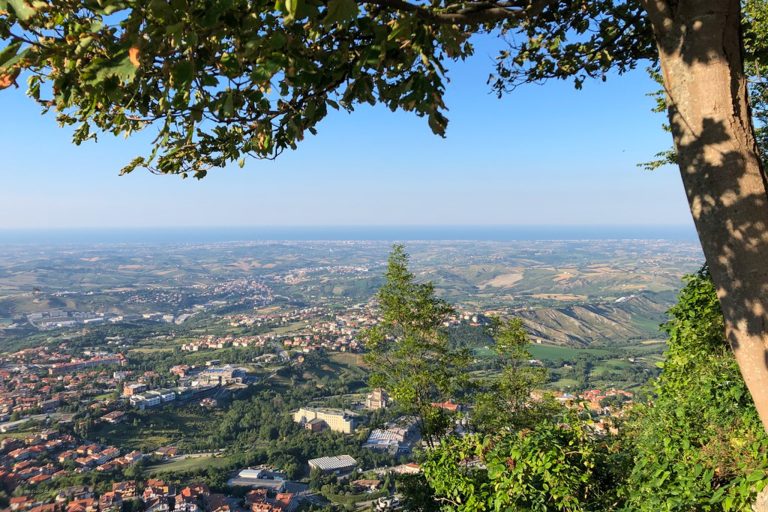
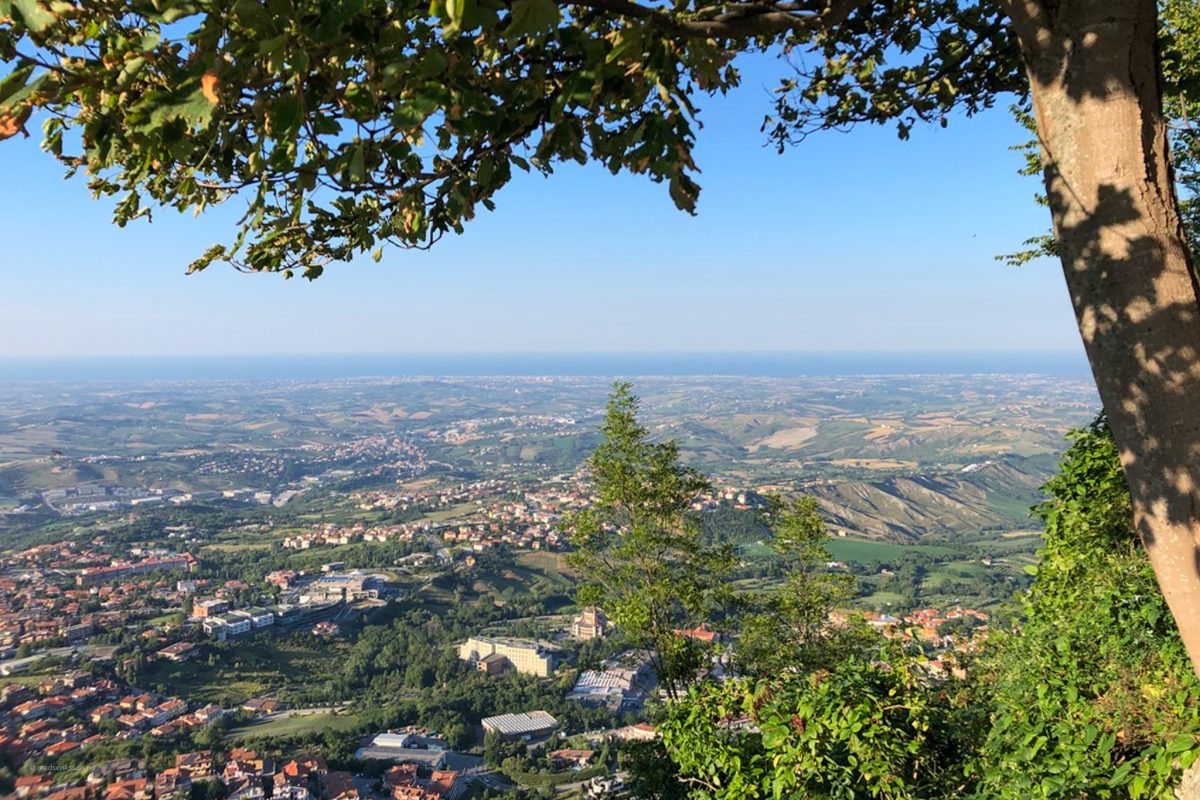
The view east from Monte Titano across the coastal plain to Rimini and the Adriatic
The Guaita
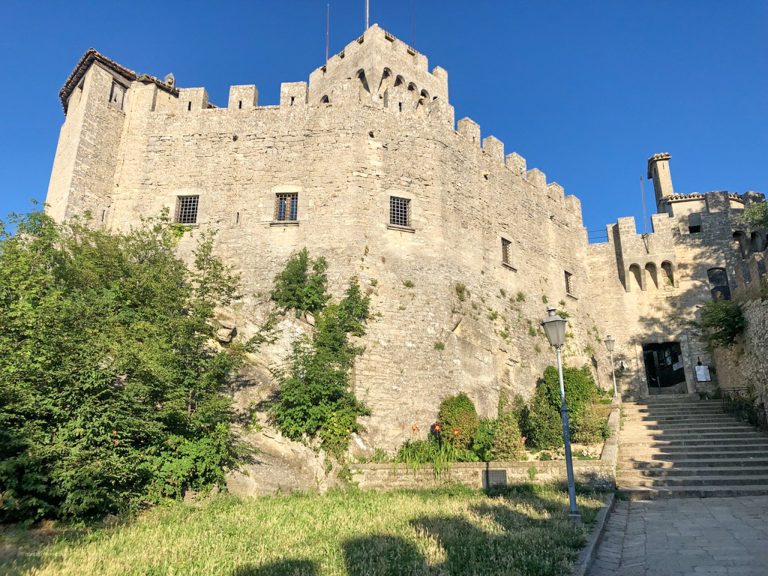
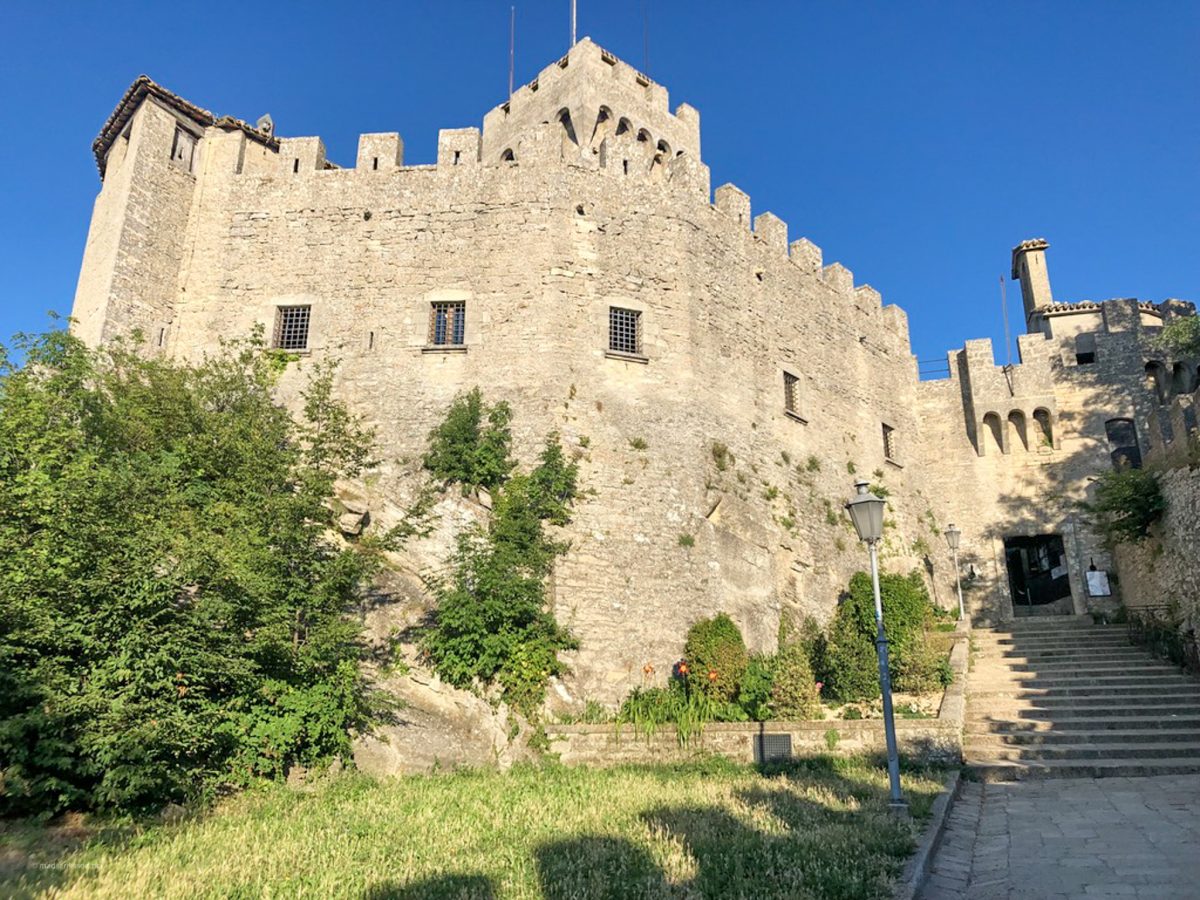
The Guaita, the first and oldest of the three towers, dates from the 11th century and took its present form in the 15th, during the wars with the Malatesta lords of Rimini. A double ring of crenellated walls surrounds its keep and the small chapel of St Barbara, and it served as the republic's prison until 1970. The path along the crest between the towers is known as the Passo delle Streghe.
Steps lead up to the crenellated walls of one of the fortress towers on Monte Titano
The Cesta
The Cesta stands on the highest of Monte Titano's three summits, built in the 13th century on the remains of an older fort. Since 1956 it has housed a museum of more than 1,550 weapons, and on clear days the view from its walls reaches across Romagna to the Adriatic coast at Rimini.
Palazzo Pubblico
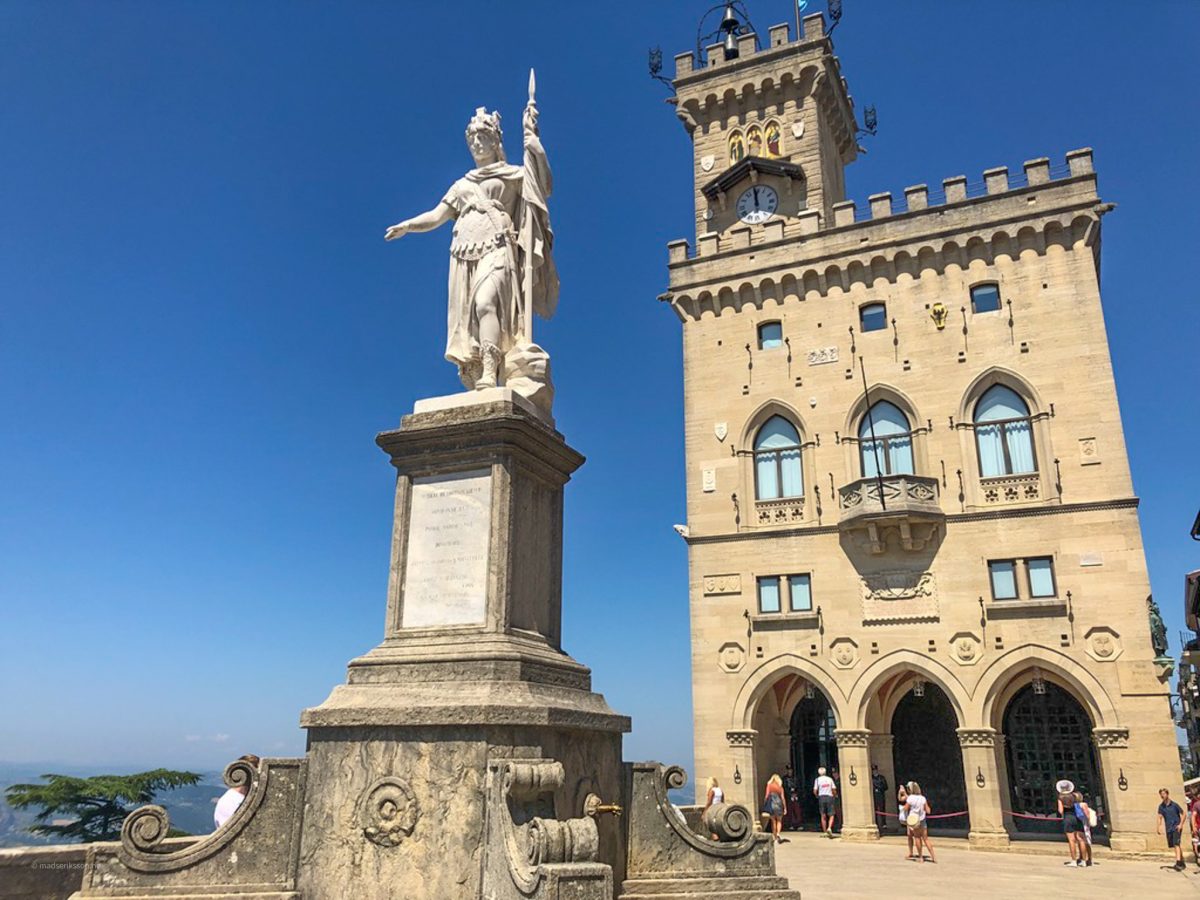
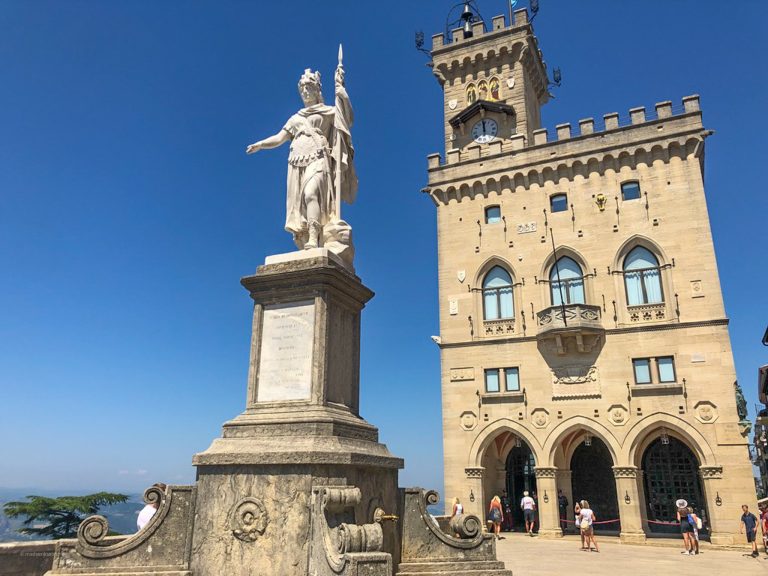
The Palazzo Pubblico, seat of the government and of the Grand and General Council, looks medieval but was built in 1884–1894 to designs by the Roman architect Francesco Azzurri; Gae Aulenti's restoration was inaugurated in 1996. San Marino has been led by two Captains Regent, elected for six months at a time, since 1243, and they take office here on 1 April and 1 October. The Statue of Liberty stands on the square in front.
The Statue of Liberty on Piazza della Libertà in front of the Palazzo Pubblico, San Marino
Basilica di San Marino
The neoclassical basilica was built between 1826 and 1838 to designs by the Bolognese architect Achille Serra, with a portico of eight Corinthian columns, on the site of an older church. The relics of Saint Marinus, found in 1586, lie beneath the high altar, with a silver reliquary bust of 1602 beside it. In 2008 the historic centre and Monte Titano were inscribed together on the UNESCO World Heritage List.
The Funivia and Borgo Maggiore
Borgo Maggiore, the old market town of the republic, lies at the foot of the mountain on its western side. The Funivia, opened in 1959, links its square with the capital, climbing 166 m in about two minutes.
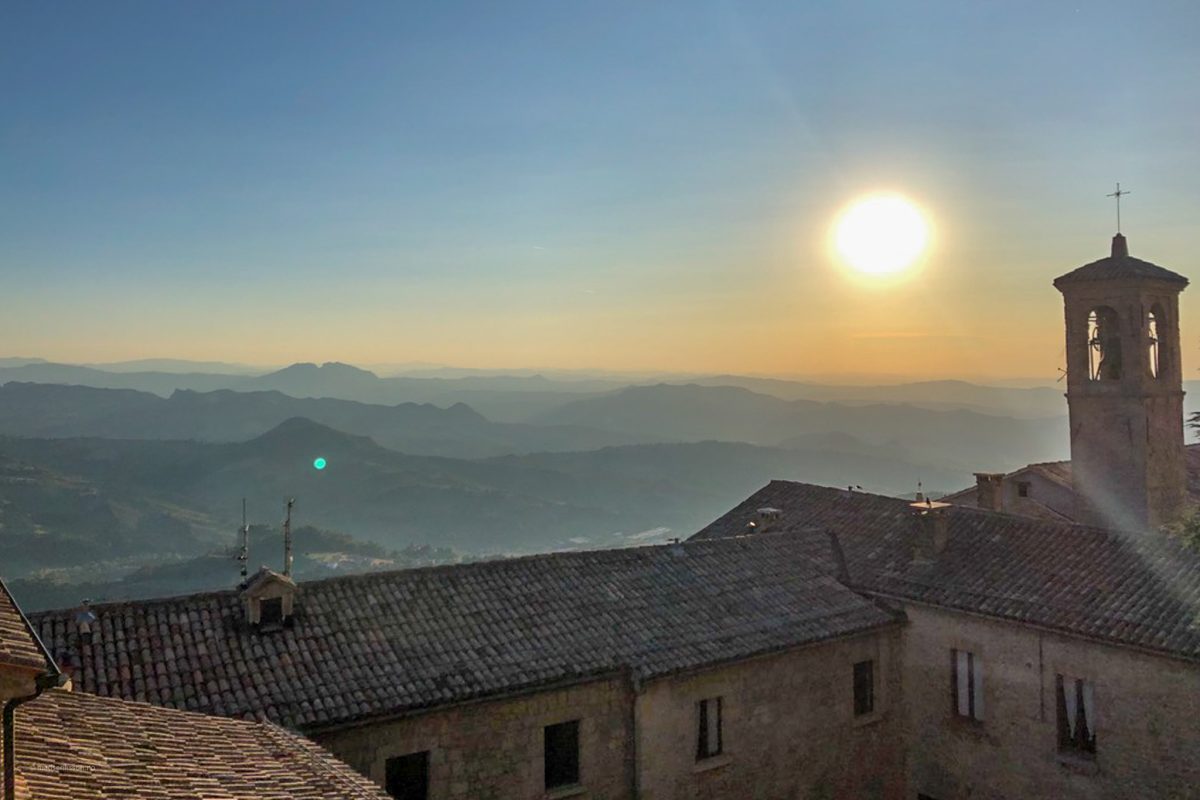
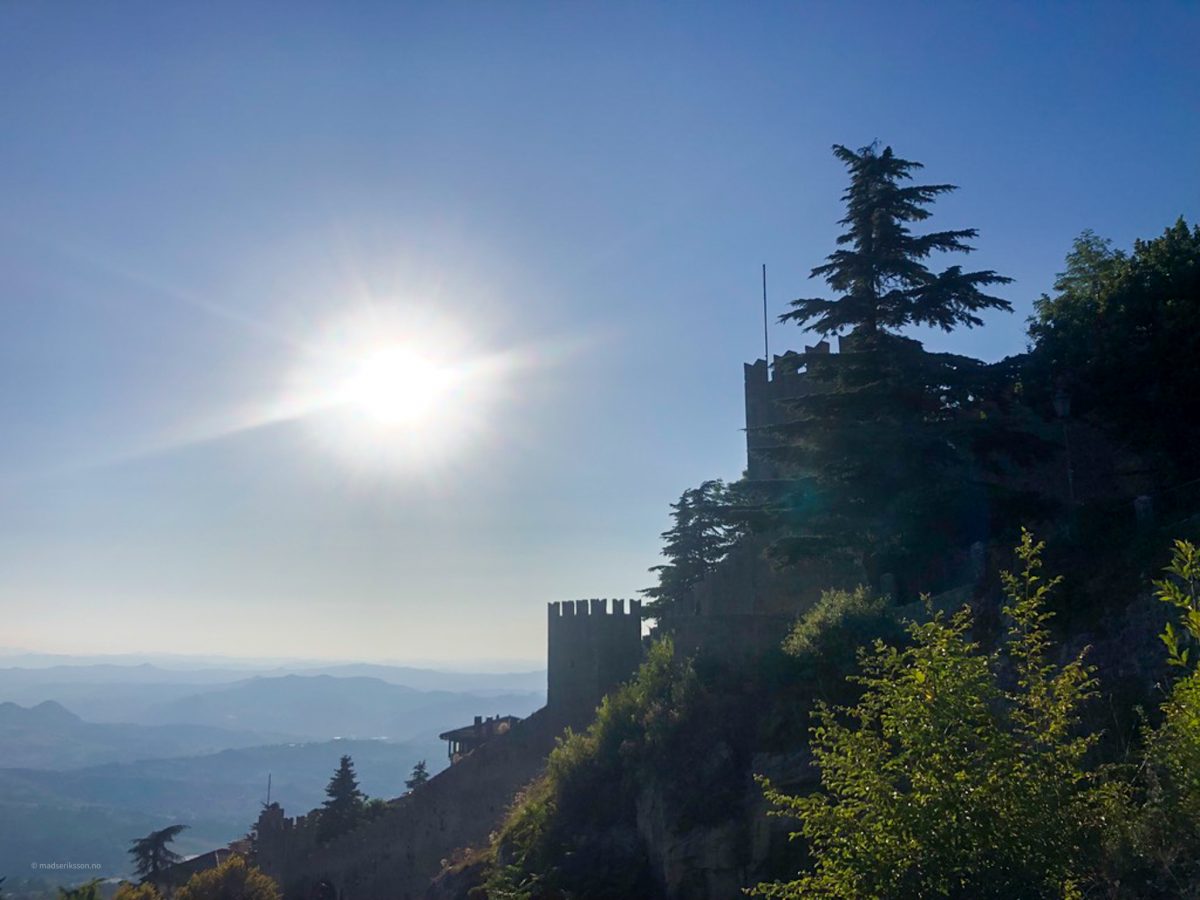
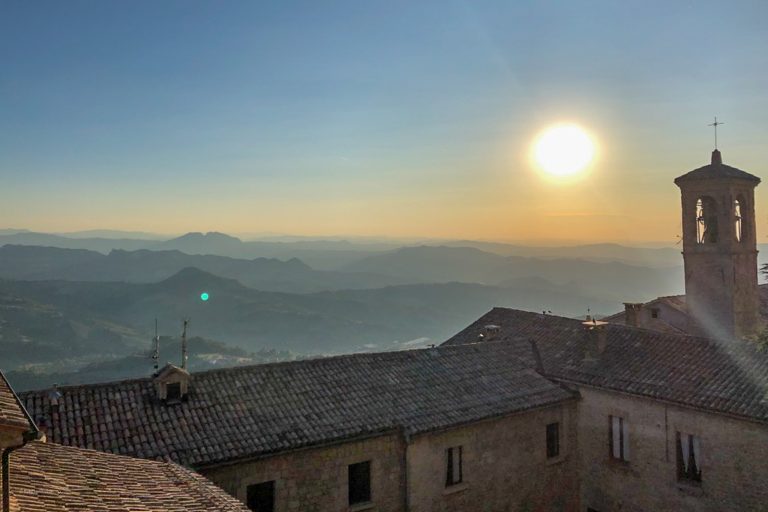
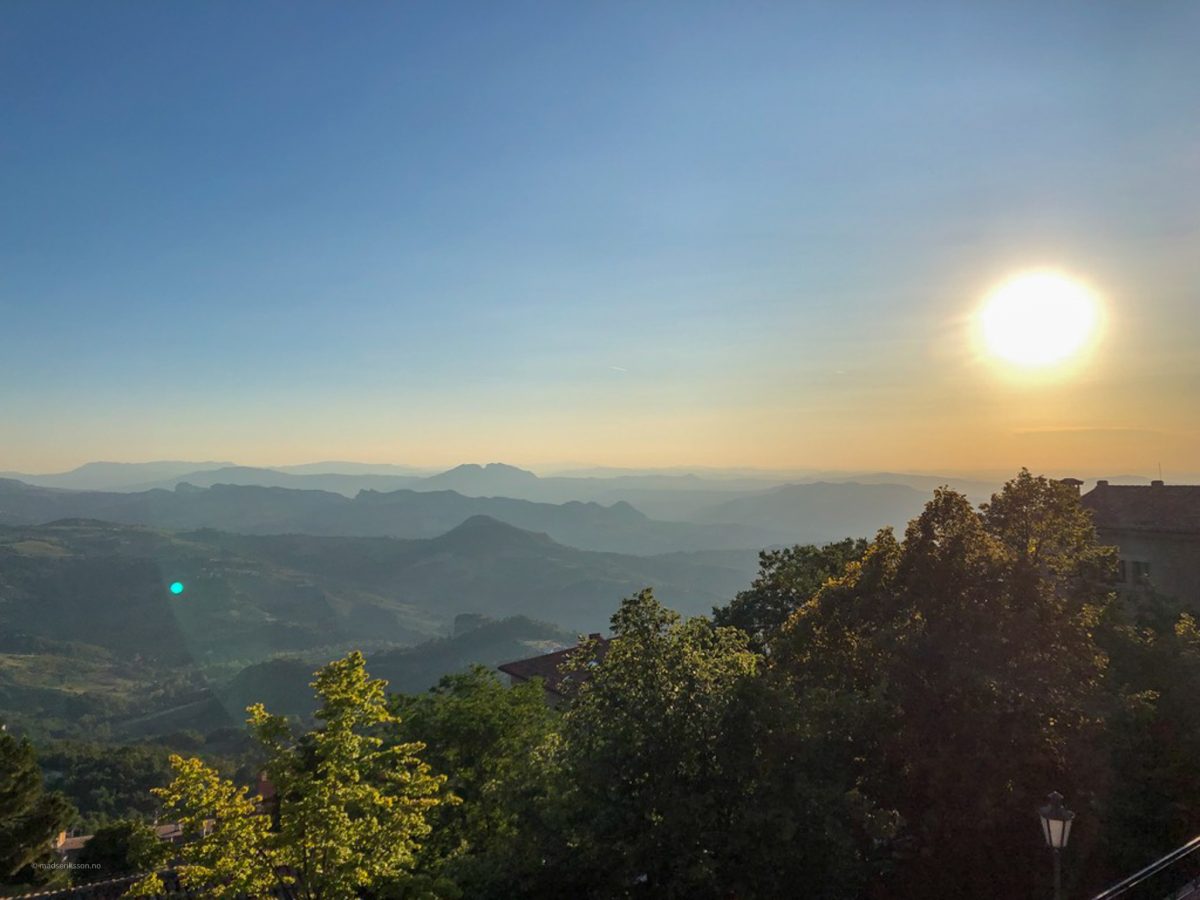
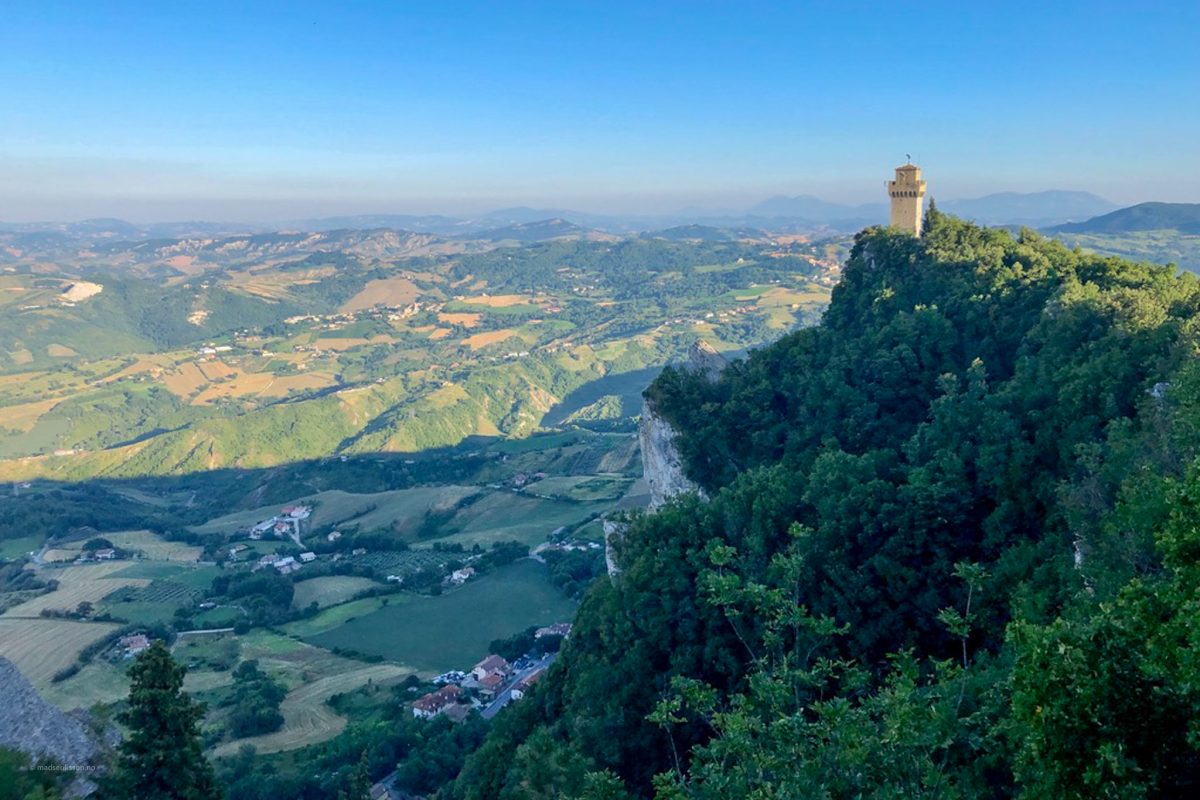
Evening sun over the hazy hills of central Italy, seen across the rooftops of the City of San Marino
The Montale
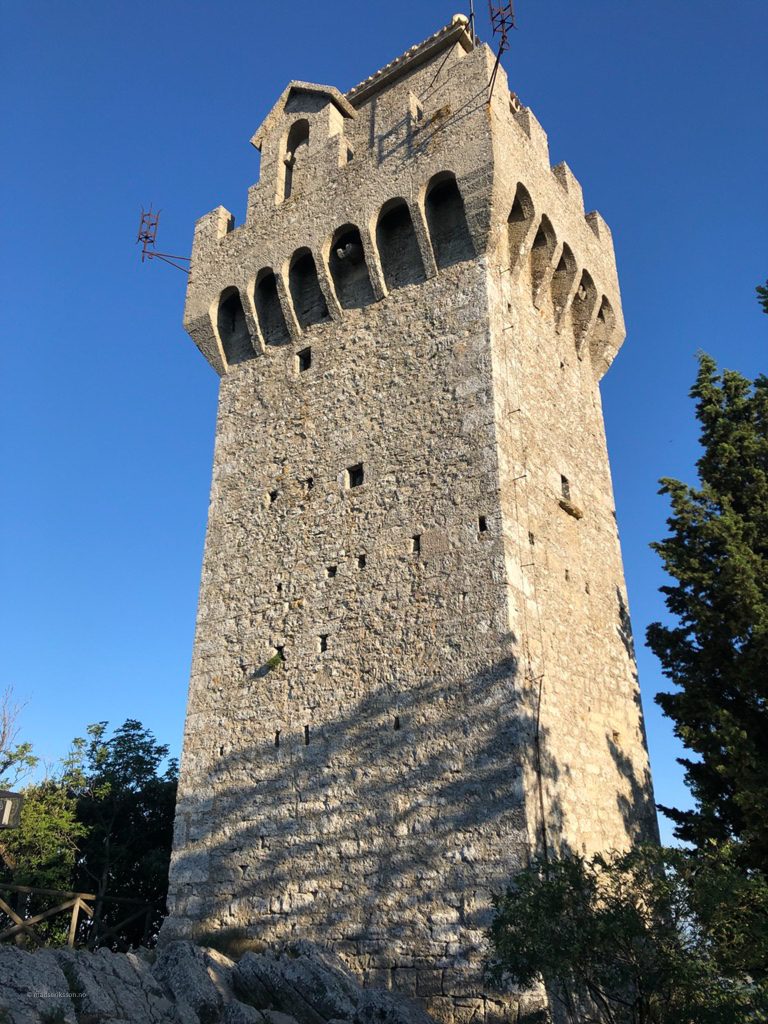
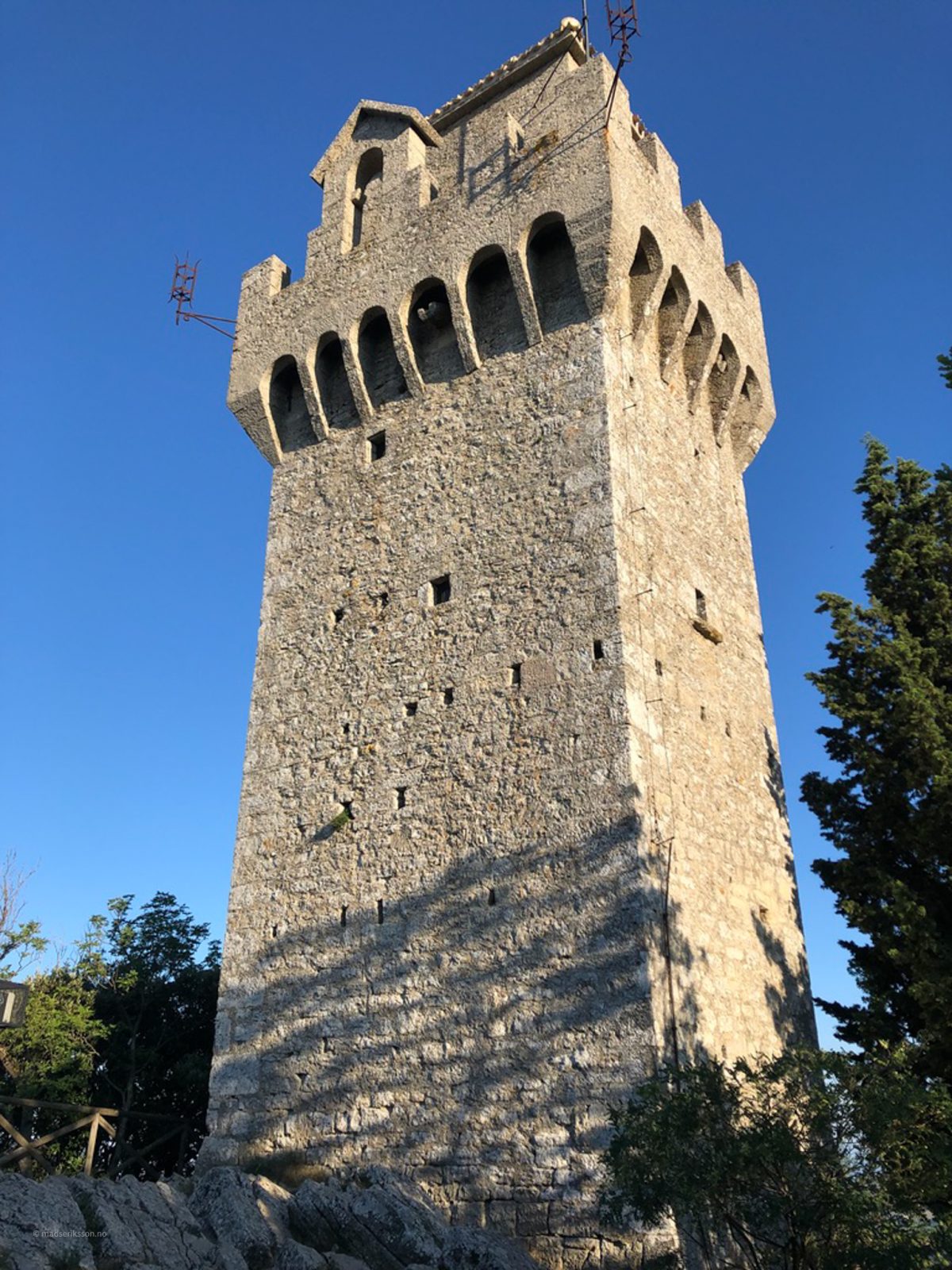
The Montale, the smallest of the three towers, was built in the 14th century on the lowest summit of the ridge and is not open to visitors. Its only entrance is about 7 m above the ground, a common defence in medieval keeps. The three towers appear on the national flag and coat of arms.
A medieval stone tower with arched battlements on the ridge of Monte Titano, San Marino
The old railway
An electric railway from Rimini reached the capital in 1932, climbing 31 km through 17 tunnels; it was put out of action in the war in 1944, when more than 100,000 refugees sheltered in the republic, many of them in its tunnels. In 2012 an 800 m stretch below the old station, through the horseshoe tunnel under the Montale, reopened as a heritage line.
The republic at night
San Marino outlasted the other city-states of Italy: Cesare Borgia held it for a few months in 1503, and a papal occupation under Cardinal Alberoni ended on 5 February 1740. Its constitutional basis is still the Statutes of 1600, and in 1861 the republic made Abraham Lincoln an honorary citizen.
3D model © 2026 madseriksson.no · Photographs © madseriksson.no. Buildings and heights: © OpenStreetMap contributors (ODbL), via OpenMapTiles. Ground imagery: Sentinel-2 cloudless 2023 by EOX IT Services GmbH (contains modified Copernicus Sentinel data 2023; CC BY 4.0). Heights are approximate where OpenStreetMap has no measured value; sun positions are approximate.
The Republic — Seventeen Centuries of Staying Out of the Way
How a mountain community outlasted the city-states, the popes and Napoleon, and still governs itself with institutions older than most countries
The earliest government of San Marino was the Arengo, an assembly of the heads of the community’s families. In 1243 it began electing two consuls to lead it, and the pair — now called the Captains Regent — have served together for six-month terms ever since. They take office in a ceremony on 1 April and 1 October each year, must have been born citizens, and cannot serve again for three years: a set of rules designed in the Middle Ages to stop any one family from taking over, and still in force. The Captains are chosen by the Grand and General Council, the parliament, and their role today is largely ceremonial. The legal foundation of the state remains the Statutes of 8 October 1600, which have been amended but never replaced.
San Marino survived largely by being too small, too poor and too awkward to be worth keeping. Cesare Borgia occupied it in 1503 and lost it a few months later when his father, the pope, died. In 1739 Cardinal Alberoni, the papal legate in Romagna, seized it and imposed a new constitution; the citizens refused to cooperate, appealed to Rome, and had their independence restored in February 1740. Napoleon recognised the republic in 1797 and offered it more land, which it turned down, reasoning that a larger state would attract more attention. The Congress of Vienna confirmed its independence in 1815, and in 1849 it sheltered Giuseppe Garibaldi and his followers on their retreat from Rome — a debt Garibaldi repaid by leaving it alone when Italy was unified. A treaty with the new Kingdom of Italy in 1862 settled its status.
During the Second World War San Marino declared itself neutral. It was bombed by the Allies in June 1944 in the belief that German forces were using it, and as the fighting reached the Gothic Line, more than 100,000 refugees crowded into a country that then had a population of only a few thousand.
The country is divided into nine municipalities, or castelli, each originally a fortified settlement: the City of San Marino on the mountain, Borgo Maggiore at its foot, and Serravalle, Domagnano, Fiorentino, Faetano, Montegiardino, Chiesanuova and Acquaviva spread across the surrounding hills. Most of the population and most of the modern economy are in the lower towns. The republic marks its history with its own public holidays: St Agatha on 5 February, the anniversary of the great Arengo of 1906 on 25 March, the fall of the Sammarinese fascist party on 28 July, and 3 September, the feast of St Marinus and of the Republic itself.
The City on the Rock — A Parliament, a Basilica and Three Towers
The car-free capital along the western flank of Monte Titano, its town hall, and the towers on the three summits that appear on the national flag
The City of San Marino, home to around 4,000 people, is strung along the western slope of Monte Titano just below the crest, a tight web of steep lanes, stairways and small squares, most of them closed to cars. Its heart is the Piazza della Libertà, a terrace open on one side to a view across the hills, with a Statue of Liberty at its centre. On the square stands the Palazzo Pubblico, the seat of government. It looks medieval but was built in 1884–94, to designs by the Roman architect Francesco Azzurri, on the site of the old communal palace; the architect Gae Aulenti restored it in the 1990s. Uniformed soldiers of the Guard of the Rock stand at its door; inside sits the Grand and General Council, the republic’s parliament.
A short walk up the hill, the Basilica di San Marino is a neoclassical church built between 1826 and 1838, with a portico of eight Corinthian columns, on the site of a much older church. Under its altar lie the relics of Saint Marinus, rediscovered in 1586; a silver reliquary bust of the saint from 1602 stands beside it, and part of the relics was sent back to his native island of Rab. From the basilica, the lanes climb to the ridge. In 2008 UNESCO inscribed the historic centre and Monte Titano together as a World Heritage Site, as the testimony to a free republic that has survived continuously since the Middle Ages — a living town that still performs every function of a capital.
The three towers stand on the three summits of Monte Titano, strung out along the crest of the cliffs. They are on the national flag, on the coat of arms and on almost every souvenir in the town — and the view from between them is the reason to come.
The first and most famous tower, the Guaita, dates from the 11th century and took its present form in the 15th, during the wars with the Malatesta lords of Rimini: a double ring of crenellated walls around a tall keep, with a small chapel dedicated to St Barbara. It served as the republic’s prison for minor offences until 1970. Further along the ridge stands the second tower, the Cesta, built in the 13th century on the highest summit on the remains of an older fort; it houses a museum of more than 1,500 weapons, from the Middle Ages to the modern era. The third tower, the small Montale, was built in the 14th century on the lowest summit; it is not open to visitors, and its only door is several metres above the ground. Both open towers are part of the State Museums, and on clear days the view from their walls reaches over the hills of Romagna and Montefeltro to the Adriatic coast.
The Mountain — A Limestone Ridge Above the Adriatic
A sea floor raised into a fortress, a two-minute cable car, a railway that sheltered refugees, and the food and festivals of a country that sits between Romagna and the Marche
Monte Titano is a block of limestone that was once the floor of a sea, lifted and tilted so that its eastern side drops away in sheer cliffs while the western slope descends more gently to the valleys. The rock still yields fossils, shark teeth among them. That shape explains the whole country: the cliffs made the summit almost impossible to attack from the east, and the town grew on the gentler western side, under the protection of the towers on the crest. The summit is about 750 metres high, and from the ridge the view runs east over the coast at Rimini to the sea and west into the folded hills of the Montefeltro. Paths wind around the base of the cliffs and between the towers, and early morning, before the day-trip coaches arrive, is the best time to walk them.
At the foot of the mountain on its western side lies Borgo Maggiore, the old market town of the republic. A cable car, the Funivia di San Marino, opened in 1959 and modernised in 1996, links it with the capital, climbing 166 metres in about two minutes. Below the capital, too, are the remains of one of the most ambitious pieces of engineering in the republic’s history: the electric railway from Rimini, opened in 1932, which climbed 31 kilometres into the hills through 17 tunnels, two of them spirals. Bombing and the war closed it in 1943–44, and during the fighting its tunnels sheltered refugees. In 2012 an 800-metre stretch at the top, through the horseshoe of the Montale tunnel, was reopened as a heritage line, and some of the other tunnels have become footpaths.
San Marino’s food is the food of the country around it — the fresh pasta of Romagna and the Marche — with a few things of its own, most famously the Torta Tre Monti, a wafer cake named after the three towers and made commercially since 1942.
The republic’s festivals are as distinctive as its institutions. The investiture of the new Captains Regent on 1 April and 1 October is a public ceremony of processions and uniforms, and 3 September, the feast of St Marinus, is the national day. The Crossbow Corps, about eighty volunteers in medieval costume whose history goes back to 1295, gives demonstrations of shooting at festivals through the year. San Marino also has a small wine industry of its own, and its restaurants serve the fresh pasta and country cooking of the neighbouring regions. Staying overnight in the capital is the best way to see it: after the day visitors leave, the lanes empty and the towers stand quiet above the plain.
«San Marino is easy to dismiss as a curiosity: a ridge of souvenir shops with a view. Stay a little longer and it becomes something stranger and more serious — a republic that has elected two heads of state every six months for almost eight hundred years, that turned down Napoleon, sheltered Garibaldi and a hundred thousand refugees, and has kept itself free simply by refusing to become important. Come early or stay late, when the lanes are quiet. Climb from the Guaita to the Cesta along the ridge, look east to the Adriatic and west to the hills, and the reason the republic chose this rock becomes obvious.»

More in the same area
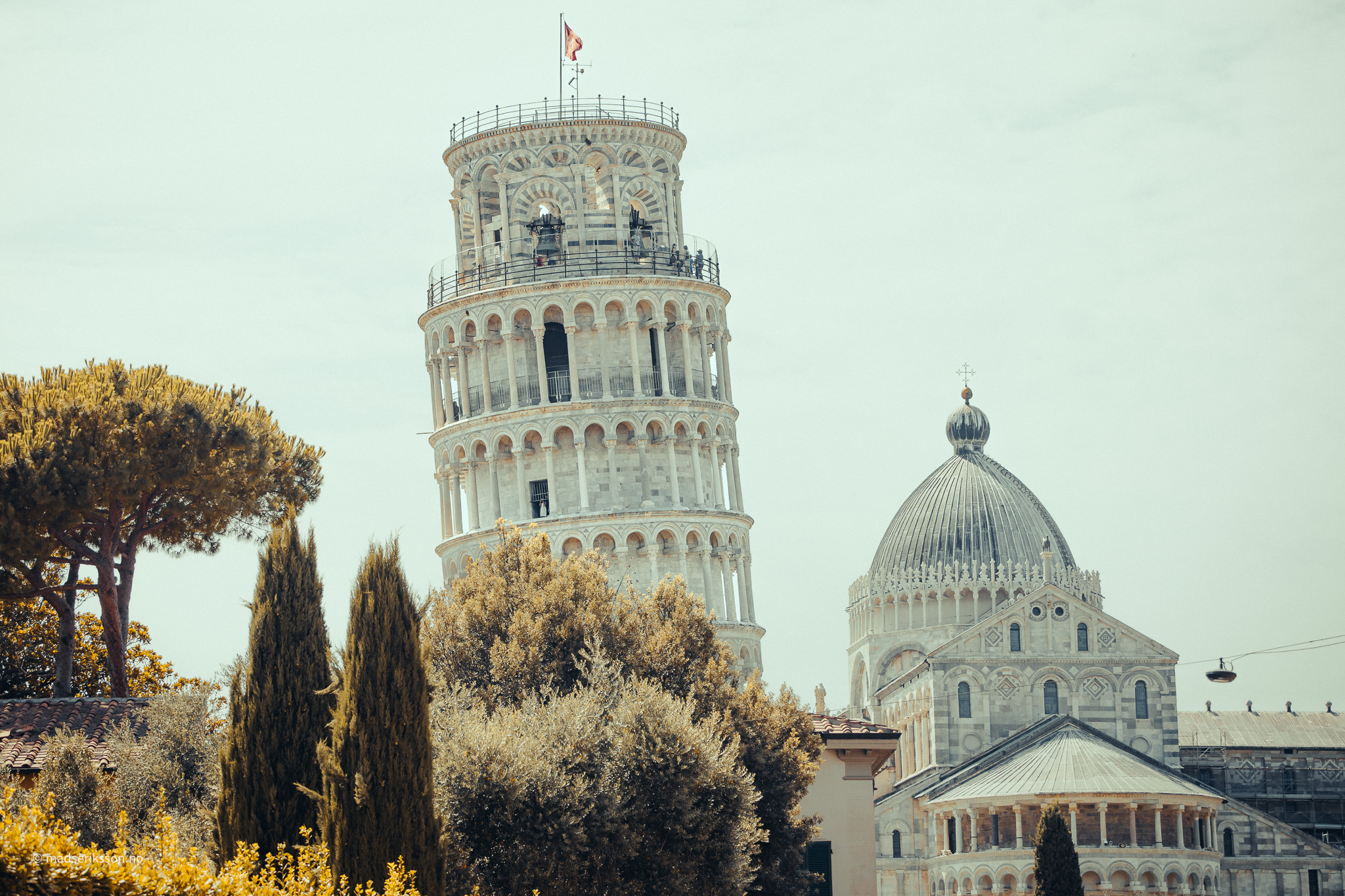 ArchitecturePisa — The Leaning Tower, the Square of Miracles and the City on the Arno
 CitiesExploring the Enchanting City of Venice
 CitiesMilan: A Fashionable and Cultural Hub in Italy
 CitiesCorleone: Beyond the Godfather — History, Anti-Mafia and the Ficuzza Forest
 CitiesTurin: A City of Elegance and History
 ArchitectureBologna — Porticoes, Towers and the City That Wrote Down Its Recipes
City Frames · scroll-driven 3D
More cities in three dimensions
54 city guides open with a model built from open map data. Scroll, and the camera moves from landmark to landmark.
Departures · City Frames
Where to next?
| Time | Destination | Country | Status |
|---|
Live · position of the sun
Golden hour, right now
The low, warm light just after sunrise and just before sunset. These are the cities on the site where it is happening at this moment.