Hardangervidda is a high, treeless plateau of around 6,500 square kilometres in the middle of southern Norway, and after dark it is one of the emptiest places in the south of the country. A single main road crosses it. There are no towns on it, only a handful of mountain lodges, a railway station with no road access and the largest national park on the Norwegian mainland. At Dyranut the road runs past at 1,243 metres above sea level. From late August to the middle of April, on a clear and moonless night, the sky above the plateau is dark enough to show the Milky Way arching overhead, the Andromeda Galaxy as a smudge to the naked eye and, when the Sun is active, the northern lights rising over the northern horizon.

Most people see Hardangervidda in daylight, from the Bergen Line train or the Norwegian Scenic Route along Rv7. In summer the plateau is a place of long light, and for four months of the year the sky never becomes fully dark. The other eight months are a different story. With no towns, no street lighting and no industry across most of the plateau, the night sky above Hardangervidda is as dark as anywhere that can be reached by car in southern Norway — and the plateau’s height and open horizons make it unusually good for watching it.
Darkness comes with conditions. The best nights fall in the same months when the weather on the plateau is at its least forgiving, Rv7 can be closed for long periods or driven only in convoy behind a snowplough, and several of the mountain lodges are shut. A clear night here is a matter of planning: the season, the phase of the Moon, the forecast for cloud and geomagnetic activity, and where it is safe to stop along a road that runs for long stretches above 1,100 metres.
How to approach Hardangervidda after dark
This guide covers the plateau’s night sky in four parts: why the sky above Hardangervidda is so dark, and what that looks like on a light-pollution map; when to go — the months of true darkness, the phases of the Moon, what part of the Milky Way can be seen this far north and how often the northern lights reach 60 degrees; where to watch, from the lodges along Rv7 to Finse on the railway and the rim of the plateau above Vøringsfossen and Trolltunga; and the practical side of winter nights in the mountains, with notes on photographing the sky.
Why It Is Dark — A Plateau Without Towns
How a high, empty upland with one road across it ended up with some of the darkest accessible skies in southern Norway
On a light-pollution map of southern Norway, the bright patches sit where expected: around Oslo and the Oslofjord, along the coast from Kristiansand to Stavanger, in Bergen and in the valley towns. Between them, in the middle of the country, is a broad dark area, and Hardangervidda lies at its heart. The reason is simple. The plateau covers around 6,500 square kilometres at an average height of some 1,100 metres, and almost none of it is inhabited. Its settlements lie in the valleys around its edges, mostly below the rim of the plateau, so that their light is partly screened by the terrain. Up on the plateau itself there are mountain lodges, summer farms and cabins, and very little else.
One main road crosses it. Rv7 climbs out of Måbødalen above Eidfjord in the west, runs over the northern part of the plateau past Dyranut, Halne and Haugastøl, and drops towards Geilo in the east; for most of the way it is the only source of artificial light in sight, apart from the occasional pair of headlights. The Bergen Line crosses further north, through Finse. South of the road, the 3,422 square kilometres of Hardangervidda National Park — opened on 1 June 1981 and the largest national park on the Norwegian mainland — protect an area with no public roads at all. Sky darkness is often described with the Bortle scale, devised by the American amateur astronomer John Bortle, from class 1 at a truly dark site to class 9 in an inner city. City centres sit at the bright end of it; the interior of Hardangervidda belongs at the dark end.
Darkness is only half the story. Height matters too: at 1,100 to 1,250 metres along the road, an observer is above a good part of the haze, moisture and valley fog that dim the sky lower down — and on the open plateau, with no trees and no steep walls, the horizon is visible almost all the way round.
The climate helps in places. The western side of the plateau, facing the Atlantic, is much wetter than the east, with more than 1,000 millimetres of precipitation a year in some areas. The eastern and central parts, towards Haugastøl and Geilo, lie further in the lee of the mountains and are drier. Cold, dry winter air is also more transparent than humid air, which is one reason why stars look so sharp on a frosty night. None of this makes clear skies certain — cloud and wind can arrive with little warning — but when the plateau clears, the sky above it is very dark indeed.
When to Go — Eight Months of Dark, and the Nights That Count
Why the summer sky never darkens at 60 degrees north, how the Moon decides the best nights, which Milky Way is visible here, and what it takes for the aurora to reach the plateau
The sky is only fully dark when the Sun is more than 18 degrees below the horizon — what astronomers call astronomical darkness. At Dyranut, around 60.4 degrees north, that happens only from about 22 August until about 19 April. For the rest of the year the Sun never sinks far enough. Around midsummer it dips only about six degrees below the northern horizon at night, and from early May to the start of August the sky does not even reach nautical darkness: the brightest stars appear, but the sky stays blue-grey and the Milky Way is invisible. The darkness returns quickly: a couple of hours around 01:00 at the end of August, from about 22:30 to 04:30 by mid-September, and some twelve and a half hours at the winter solstice.
Within those months, the Moon decides which nights are worth the drive. A full or nearly full Moon washes out the Milky Way, and on a snow-covered plateau its light is reflected back up from the ground as well. The best window is the week or so either side of new moon, when the Moon sets early or rises late. What can be seen also changes with latitude. The bright core of the Milky Way in Sagittarius — the part that dominates photographs from southern Europe — never climbs more than about half a degree above the southern horizon here, and only around midsummer, when the sky is too light anyway. What Hardangervidda offers instead is the northern Milky Way. On autumn evenings its band runs almost straight overhead, through Cygnus, the Swan, which passes some 75 degrees up, and Cassiopeia, which crosses close to the zenith; the Andromeda Galaxy, the most distant object easily visible to the naked eye, stands high in the same part of the sky. In winter the fainter band through Perseus, Auriga and Orion takes over.
The aurora is a bonus rather than a promise at this latitude. Hardangervidda lies well south of the main auroral zone, but on a dark night with a clear view to the north, a Kp index of around 3 to 4 is usually enough for a glow over the northern horizon — and during geomagnetic storms the lights can climb high into the sky.
The Kp index, from 0 to 9, measures how disturbed the Earth’s magnetic field is. Minor geomagnetic storms, at Kp 5, occur on roughly 900 days in an average eleven-year solar cycle; they bring the aurora higher above the plateau and make it far easier to see. The present cycle, Solar Cycle 25, passed its maximum in October 2024 and is now in its declining phase, but strong storms continue to occur after solar maximum, and geomagnetic activity tends to be higher around the equinoxes. That makes September and October, and February and March, attractive months to try: the nights are long and dark, and the plateau is usually less hostile than in midwinter. For the dates of new moon and the nights with full astronomical darkness through the season, see the dark-sky calendar below.
When the plateau goes truly dark
Click or tap a night to see its sky in the star map below. Calculated for Dyranut with the sun at least 18° below the horizon for astronomical darkness; moon above or below the horizon as seen from the plateau. Cloud and aurora cannot be forecast this far ahead — check the Yr forecast and an aurora forecast on the day.
The sky over the plateau
Stars to magnitude 5.4, the Milky Way and the moon and planets are calculated for Dyranut (60.42° N, 7.47° E). Aurora cannot be predicted ahead – the green glow only shows the low northern sky where it usually starts.
Where to Watch — From the Road, the Railway and the Rim
The high point of Rv7, the lodges by the lakes, a station without a road, and the western edge of the plateau above the fjords
Dyranut is the obvious place to start. Two mountain lodges stand side by side here, Dyranut Turisthytta and Dyranut Fjellstova, at around 1,245 metres, close to the highest point of Rv7, with open fells in every direction and the national park beginning to the south. The car park by the lodges gives safe space to stop, and a short walk away from the buildings puts the lights behind and an unbroken horizon in front. From Dyranut a marked winter ski route runs about 24 kilometres south across the plateau to Sandhaug, a staffed lodge of the Norwegian Trekking Association (DNT) at around 1,250 metres with no road access at all; in summer the walk via Bjoreidalshytta takes about six hours.
Further east, the road runs along the lake of Halnefjorden past Halne Fjellstugu, at about 1,140 metres, where the lake gives a wide, flat foreground and a long view to the north — the direction that matters for the aurora. At Haugastøl, around 990 metres up, Rv7 meets the Bergen Line, and the station and the hotel make it the easiest point on the plateau to reach by train; Ustaoset, further east on the railway, has open ground close to the station. North of the road, on the railway alone, is Finse. At 1,222 metres it is the highest station on the line, and the village has no road connection: visitors arrive by train, on skis or on foot, and the lights of Finse are the only ones for many kilometres around. The story of the railway itself is told in Bergensbanen: The Oslo–Bergen Railway Across Hardangervidda.
For the aurora, the direction of view matters more than the exact spot. Any place with a low, open northern horizon and no lights in that direction will do — and on Hardangervidda, a few minutes’ walk from the road is usually enough to find one.
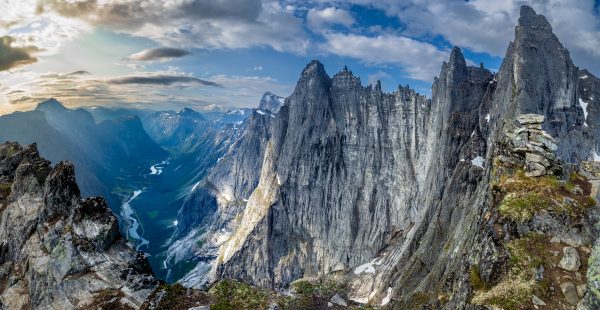
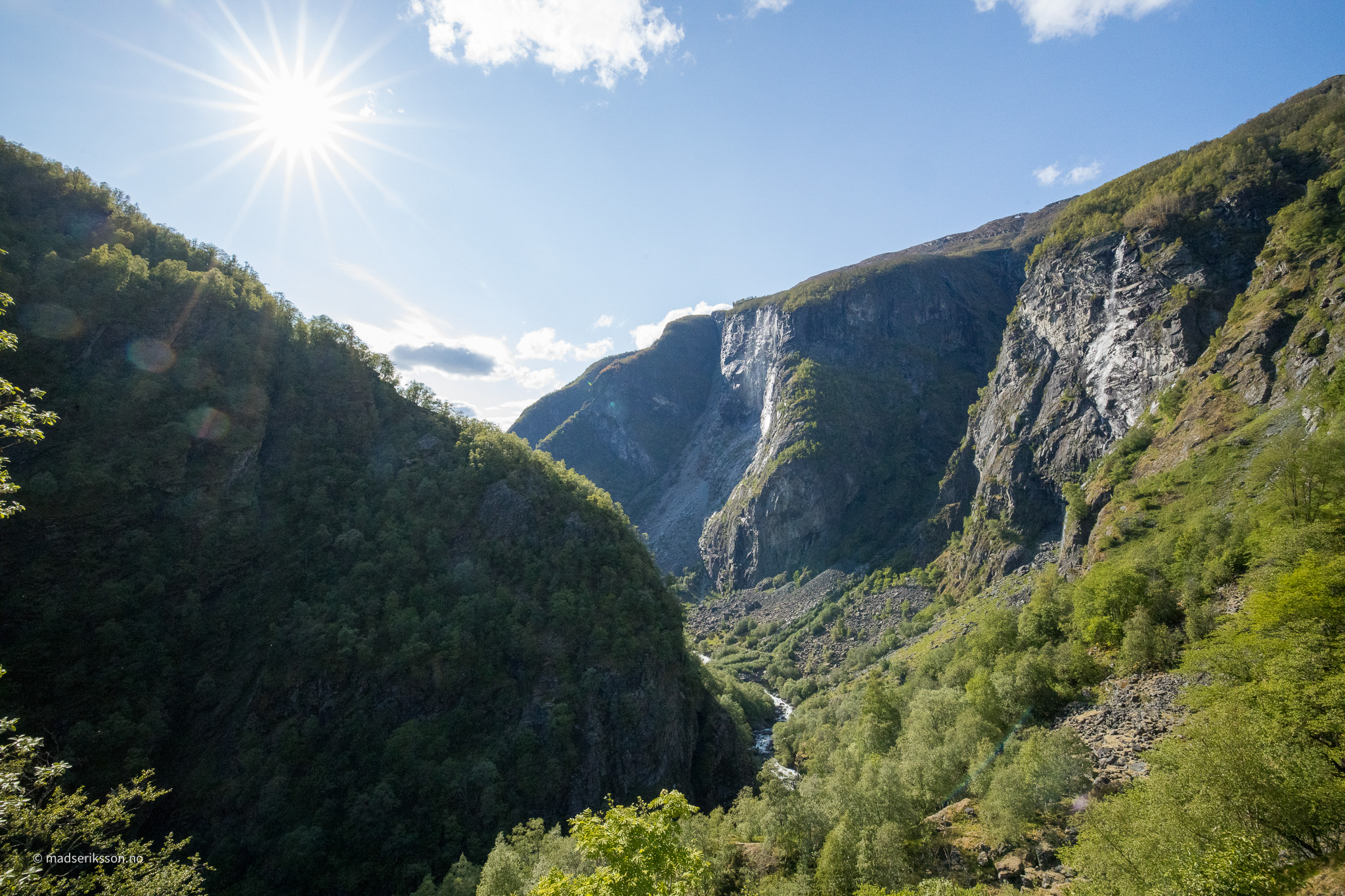
The western rim of the plateau is darker than its reputation suggests but harder to use at night. At the top of Måbødalen, Vøringsfossen drops 182 metres in total into the gorge below the plateau edge, with a longest single fall of 163 metres; the viewing area by the Fossli Hotel, built in 1891, sits at around 700 metres, with the plateau rising behind. The area around the waterfall closes in winter because of snow and ice, so it suits the late-summer and autumn dark season rather than winter. More on the waterfall itself is in Vøringsfossen: Norway’s Majestic Waterfall. Further south, Trolltunga hangs over Ringedalsvatnet on the western edge of the mountains, some 27 kilometres return on foot from Skjeggedal. The independent hiking season runs from June to September, so a night camped at the tongue in early September, in settled weather, is the realistic way to combine the hike with a dark sky. The hike is described in Trolltunga: Nature’s Majestic Rock Formation.
Practical and Safe — Winter Nights in the Mountains, and the Camera
How the road over the plateau works in winter, where to sleep, what to carry, and the settings behind the photograph in this article
Rv7 across Hardangervidda is a mountain pass, and in winter it behaves like one. In bad weather the plateau stretch is closed with barriers, and in an ordinary winter it can be shut for around 1,000 hours in total; it may also be closed for periods to let the wild reindeer cross undisturbed. When conditions are marginal, traffic is sent across in convoy, led by a snowplough with another plough at the back, and drivers wait at the barrier until the convoy leaves. Check the road status with the Norwegian Public Roads Administration (Statens vegvesen) and the mountain-pass forecast on Yr before setting out, and never drive past a closed barrier, even if the weather looks calm where it stands. Start with a full tank or a fully charged battery, and carry warm clothes, food and a hot drink in the car.
The cold is the other constant. A clear night is usually a cold one, especially in winter, and on an open plateau with no shelter even a light wind makes standing still for an hour much harder than the thermometer suggests. Dress as for a winter ski tour: insulated boots, a down jacket over several layers, a hat, mittens and something to stand on. Stop only in car parks and lay-bys, never on the carriageway, and do not wander far from the road in the dark — drifting snow can come quickly, and the terrain looks the same in every direction. A head torch with a red-light mode preserves night vision. For a base, the two lodges at Dyranut open mainly in spring, summer and autumn; Halne Fjellstugu, with 75 beds by the lake, is open from early winter until the beginning of October; Haugastøl 1000 moh, a family-run hotel by the station, and Finse 1222, the hotel beside the platform at Finse, give access by train. Finse 1222 opens for a winter season from New Year to the end of May and a summer season from early July to the end of September. Opening dates vary from year to year, so check them before relying on a bed in the dark months.
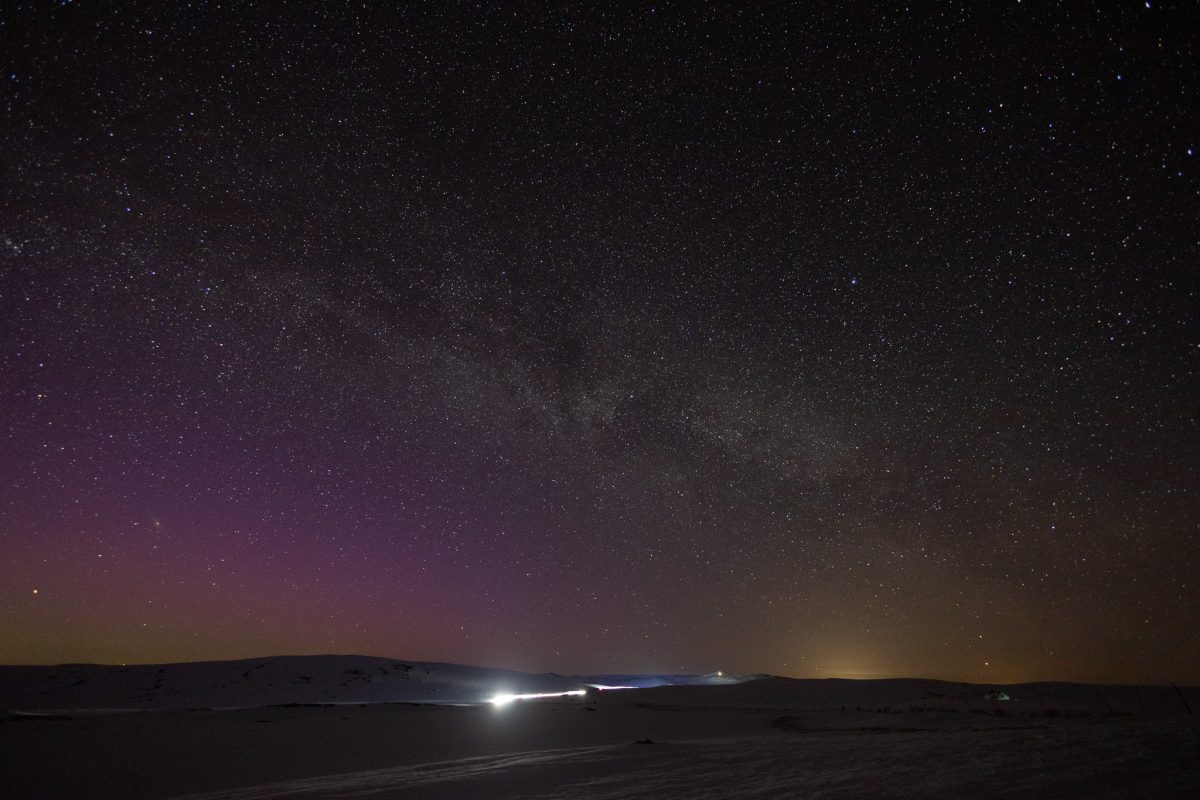
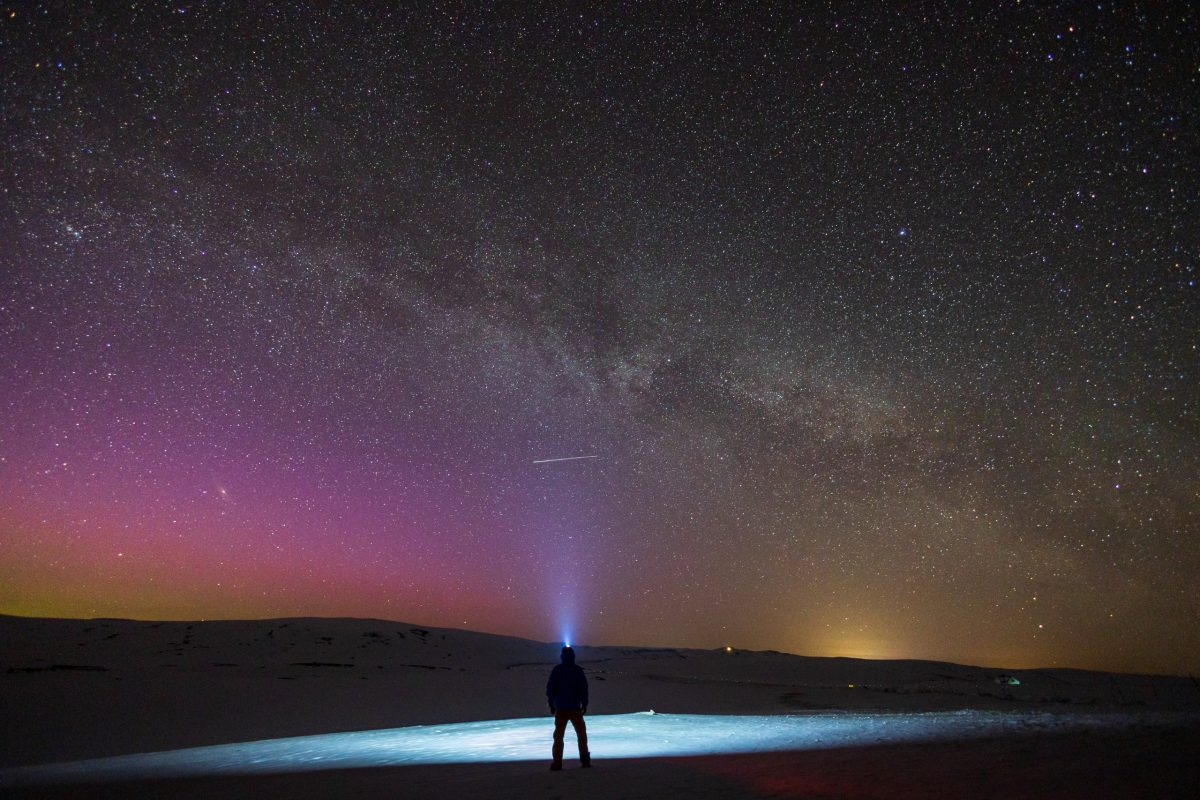
The photograph above was taken at 16 mm and f/2.8, with a 20-second exposure at ISO 1600 on a Canon EOS R — on a moonless night in mid-April, a few hours before new moon and at the very end of the season of full astronomical darkness.
Those settings are a sound starting point for the Milky Way on the plateau. A wide lens at its widest aperture gathers as much light as possible; 20 seconds at 16 mm is comfortably within the old “500 rule” for a full-frame camera (500 divided by the focal length, or about 30 seconds), although on a high-resolution sensor the stars begin to stretch slightly at this length, and 10 to 15 seconds gives rounder points. Under a very dark sky, ISO 3200 brings out more of the Milky Way than ISO 1600, at the cost of more noise. Use a sturdy tripod, focus manually on a bright star using magnified live view, shoot in raw and set a fixed white balance around 3,500 to 4,000 K. For the aurora, shorten the exposure as the display brightens — a few seconds is often enough — so that the curtains keep their structure. Cold drains batteries fast, so carry spares in an inside pocket, and a lens heater keeps frost off the front element. Headlights on Rv7 will sweep across long exposures from time to time, as they do along the horizon in the photograph above: either wait for a gap in the traffic or walk far enough from the road to put the lights out of frame.
«Hardangervidda is known for its summers — the long light, the reindeer, the walk to Trolltunga, the train through the snow at Finse. Its nights are less famous and in some ways more remarkable. For eight months of the year, a road that anyone can drive climbs to more than 1,200 metres and crosses a plateau with almost no artificial light on it, under a sky dark enough to show the Milky Way from horizon to horizon and, on the right night, the aurora rising in the north. Given a dark Moon, a clear forecast, warm clothes and an open road, it takes no more than a short walk from the car park at Dyranut to stand under one of the darkest skies in southern Norway.»

More in the same area
 Train travelBergensbanen: The Oslo–Bergen Railway Across Hardangervidda
 GlaciersEurope’s 10 Greatest Glaciers — And How to Experience Them
 NatureThe World’s 15 Most Spectacular Waterfalls
 FjordsBorebreen and Nansenbreen: Remote Glaciers of Oscar II Land
 HikingTrolltunga: Timing the Long Hike to Norway’s Troll’s Tongue
 HikingAurlandsdalen: Running the Wild Lower Valley to Vetlahelvete