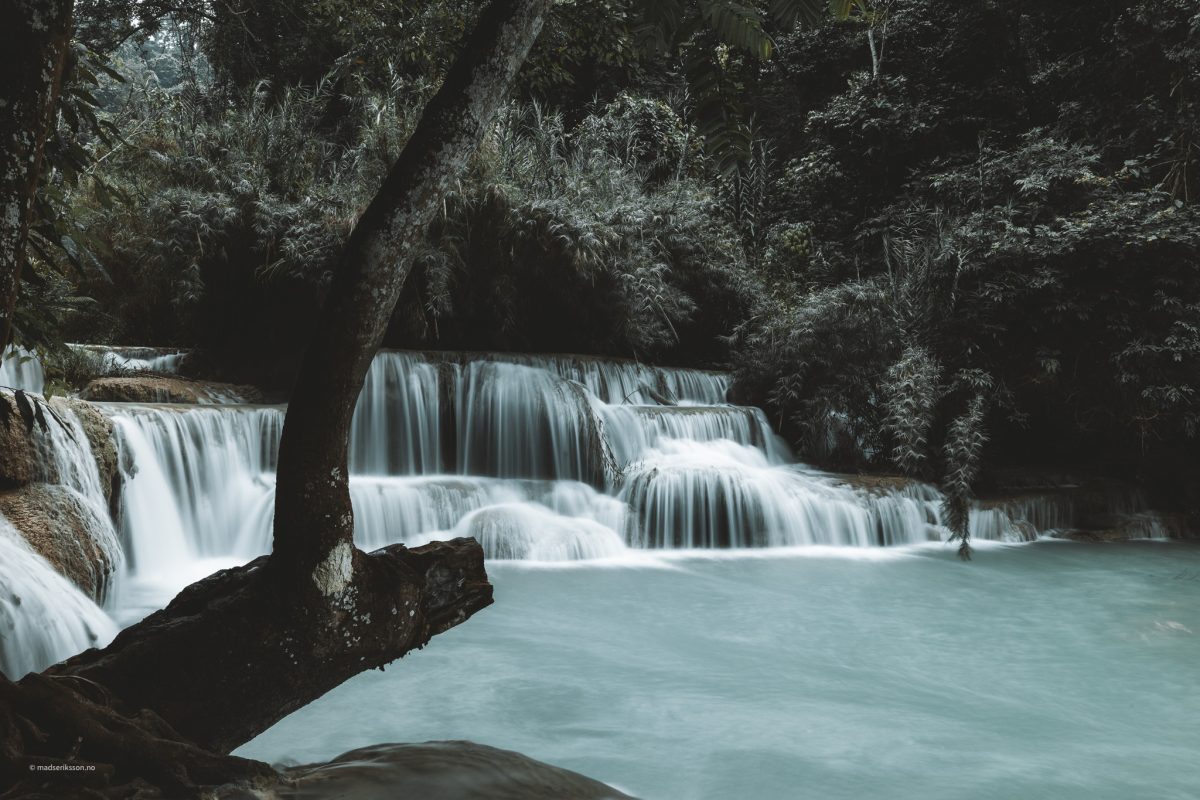
Twenty-nine kilometres south of Luang Prabang, hidden in a limestone valley in the forested mountains of northern Laos, water has been dissolving calcium carbonate out of the rock for thousands of years and depositing it, layer by layer, into the pools and cascades of Tat Kuang Si. The result is a waterfall of extraordinary colour: a sequence of turquoise and mint-green pools descending through travertine terraces to the main cascade, where 50 metres of white water drops through the forest. The colour is not a trick of the light or a photographer’s filter. It is chemistry — the same chemistry that colours the Plitvice Lakes of Croatia and the travertine pools of Pamukkale. It is also one of the most beautiful natural phenomena in Southeast Asia, and it is 29 kilometres from one of the region’s most visited cities. Come early.

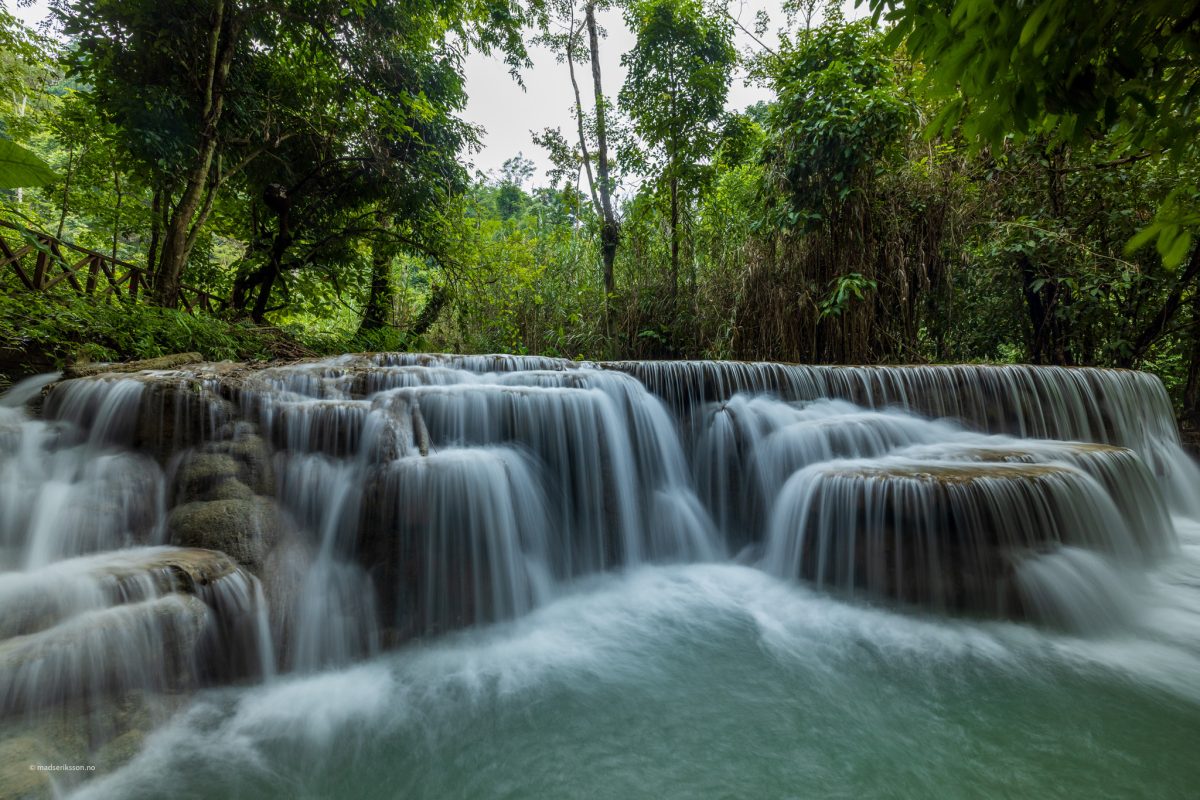
Tat Kuang Si — tat meaning waterfall in Lao — is the most celebrated natural attraction near Luang Prabang and one of the finest waterfall systems in Southeast Asia. It is formed by a stream flowing off the limestone mountains south of Luang Prabang, passing over a series of travertine terraces and pools before dropping over the main 50-metre cliff face into a broad plunge pool at the base. The travertine — calcium carbonate deposited by the mineral-rich water as it flows and evaporates — builds up slowly over thousands of years into the fan-shaped terraces and rimstone dams that contain the pools, and it is the dissolved calcium carbonate remaining in suspension that gives the water its distinctive colour: a saturated turquoise in the dry season, shifting toward green or blue depending on the depth, the light, and the mineral concentration of the flow at any given moment.
The site has three distinct elements that reward separate attention: the lower terrace pools immediately beyond the entrance, where the calm, shallow water is at its most photogenic and where swimming is permitted; the forest trail that climbs through the trees to the upper tiers and the main falls; and the sun bear rescue centre at the entrance, run by the Australian conservation organisation Free the Bears, which houses bears rescued from the illegal wildlife trade and provides a significant context for understanding the conservation challenges of the broader Mekong region. All three are part of a single entry ticket; all three deserve more time than most visitors give them.
How to approach Tat Kuang Si
Tat Kuang Si is best visited early in the morning — ideally by 8am — before the tour groups from Luang Prabang arrive in mid-morning. The site is open from approximately 8am to 5:30pm; the first hour after opening is the quietest and the light on the pools is at its most horizontal and penetrating. A full visit, including the walk to the upper falls, time at the lower pools and a proper visit to the bear centre, takes 3–4 hours. Allow for the return journey to Luang Prabang and plan the day around the falls rather than treating them as a half-hour stop.
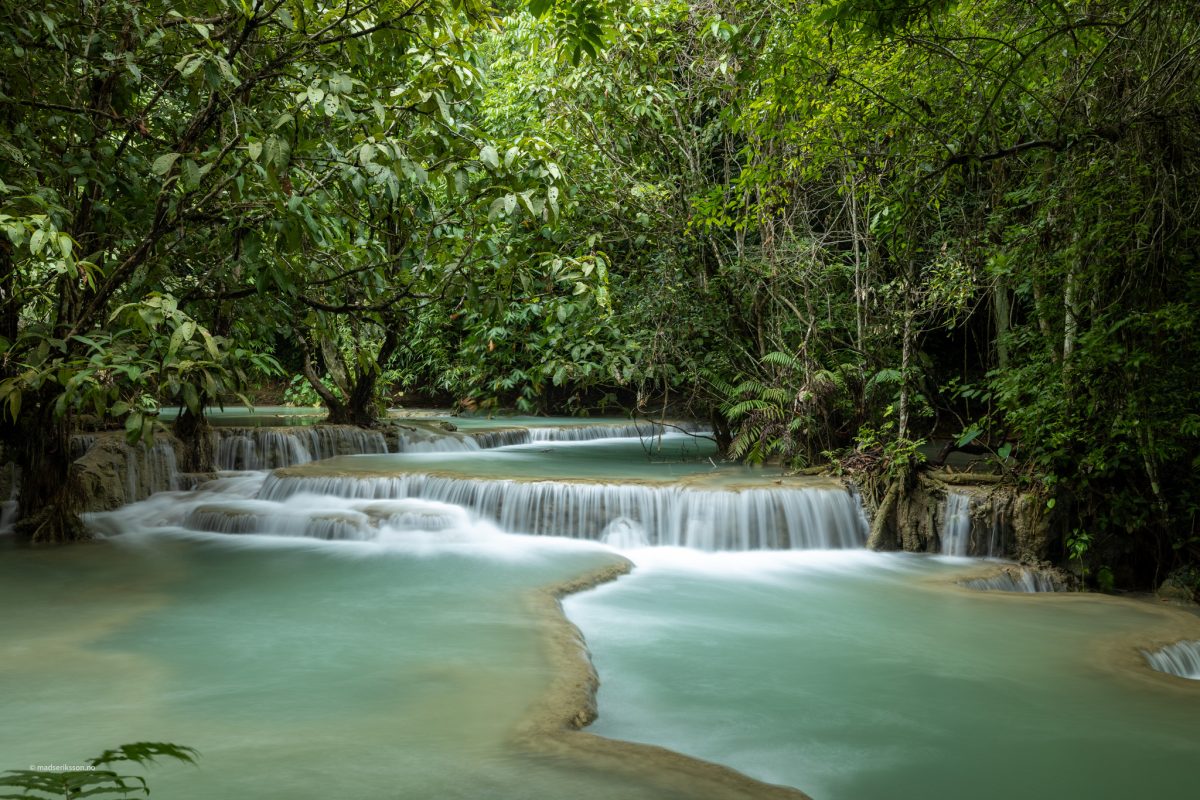
The Turquoise Pools — Chemistry Made Visible in Three Shades of Blue-Green
The colour of the pools at Tat Kuang Si is not a trick of the light and not a filter. It is dissolved calcium carbonate, the same mineral that colours the Plitvice Lakes, building up over thousands of years into travertine terraces that hold water of impossible clarity
The pools of Tat Kuang Si are turquoise because of chemistry. The stream that feeds the falls flows through the limestone mountains south of Luang Prabang, dissolving calcium carbonate (CaCO³) from the rock as it moves. When this mineral-saturated water reaches the open air of the falls and loses carbon dioxide, the calcium carbonate precipitates out of solution: some of it deposits as travertine on the pool floors and terrace walls, slowly building up the rimstone dams that contain the pools; some of it remains in suspension, and it is this suspended calcium carbonate that scatters light in a way that preferentially reflects blue and green wavelengths, absorbing red. The result is the colour that greets you when you walk through the entrance and reach the first pool: a saturated, almost unreal turquoise that deepens in the lower pools where the water is clearest and approaches mint-green or pale blue in the shallower upper terraces where the suspended mineral concentration is different. The same process produces the colours of the Plitvice Lakes in Croatia, the Havasu Falls of the American Southwest and the travertine terraces of Pamukkale in Turkey — formations that are not unique to Laos but are here at an exceptional scale and in exceptional condition.
The lower pools — the broad, calm terraces immediately accessible from the entrance path — are where the colour is most concentrated and the experience most immediate. The water is shallow enough to see the travertine floor clearly, cool enough (approximately 20–22°C year-round) to be refreshing in the heat of the Lao day, and calm enough in the dry season to reflect the surrounding forest in its surface. Swimming is permitted in the designated lower pool areas; the upper pools and the areas adjacent to the main falls are closed to swimmers for conservation. Jumping from the travertine formations is prohibited and causes real damage: the travertine is fragile enough that the impact of a human body can fracture terrace walls that took centuries to form. This is not a theoretical conservation concern — the formations at heavily visited travertine sites elsewhere in Asia have been visibly damaged by precisely this kind of use. Tat Kuang Si is still in excellent condition partly because the rule is enforced.
The travertine terraces of Tat Kuang Si are still growing — millimetres per year, as dissolved calcium carbonate deposits on the pool floors and rims. The pools you see today have been building for thousands of years. A human landing on a rimstone wall can fracture it in an instant. The sign saying not to jump is not decorative.
The colour of the pools changes with the seasons in ways that are worth understanding before you book. In the dry season — November through April — the water flow is lower, the mineral concentration is higher and the clarity is at its greatest: this is when the turquoise is most saturated and most photographically dramatic. In the wet season — June through September — the increased rainfall dilutes the mineral content, carries suspended sediment from the surrounding hillsides, and pushes the colour toward greener, murkier water; the falls are far more powerful, the volume of water extraordinary, but the celebrated turquoise is considerably reduced. May and October are transitional months. If the colour is your primary purpose, come in the dry season. If the power and sound of the falls matter as much, the wet season has its own argument.
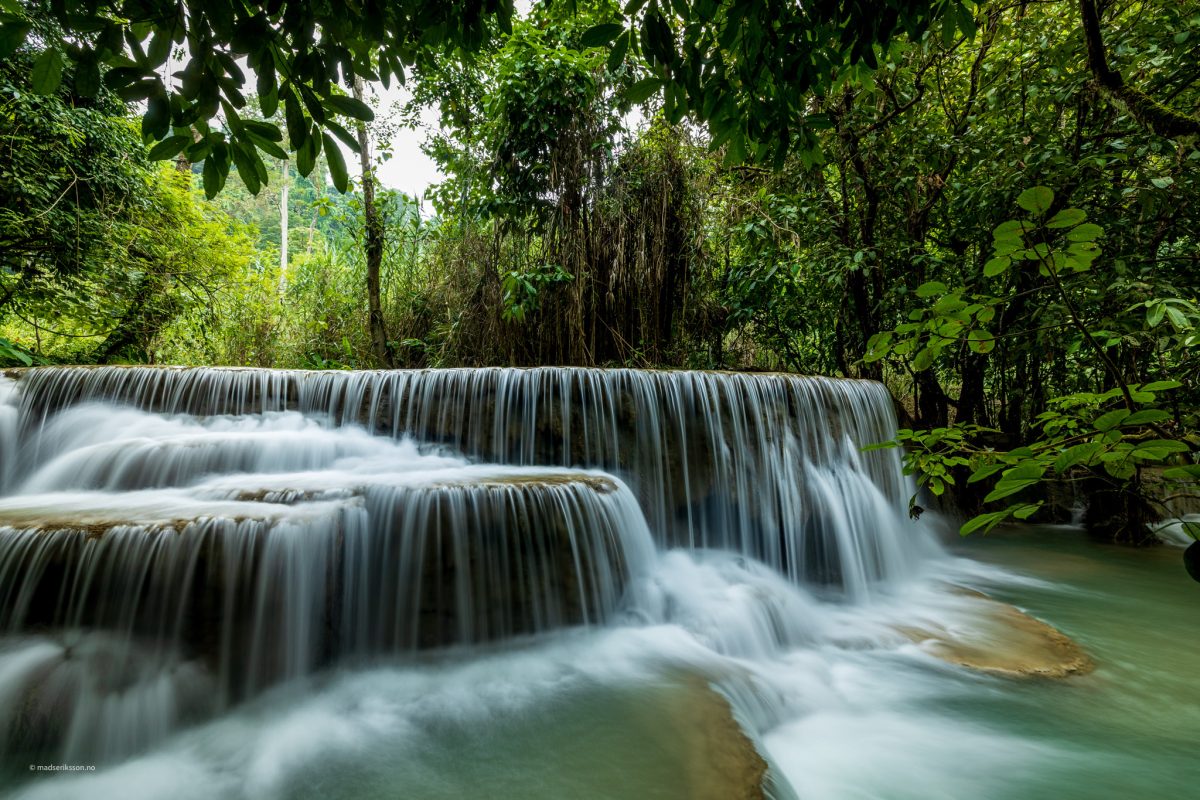
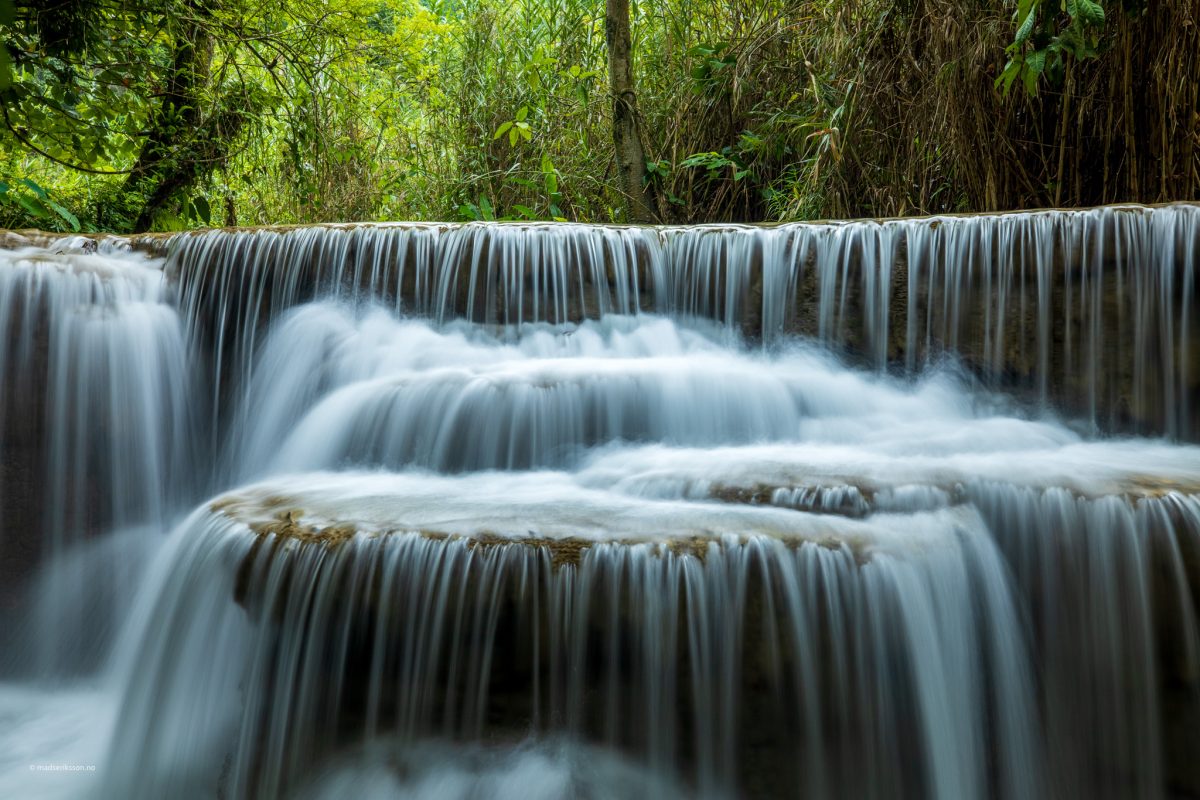
The Main Falls — 50 Metres of White Water in a Limestone Forest
The lower pools are the photograph; the upper falls are the reason. A 30–40 minute walk through forest and alongside cascades leads to the full height of the falls and the viewpoint where the scale of the whole system becomes comprehensible
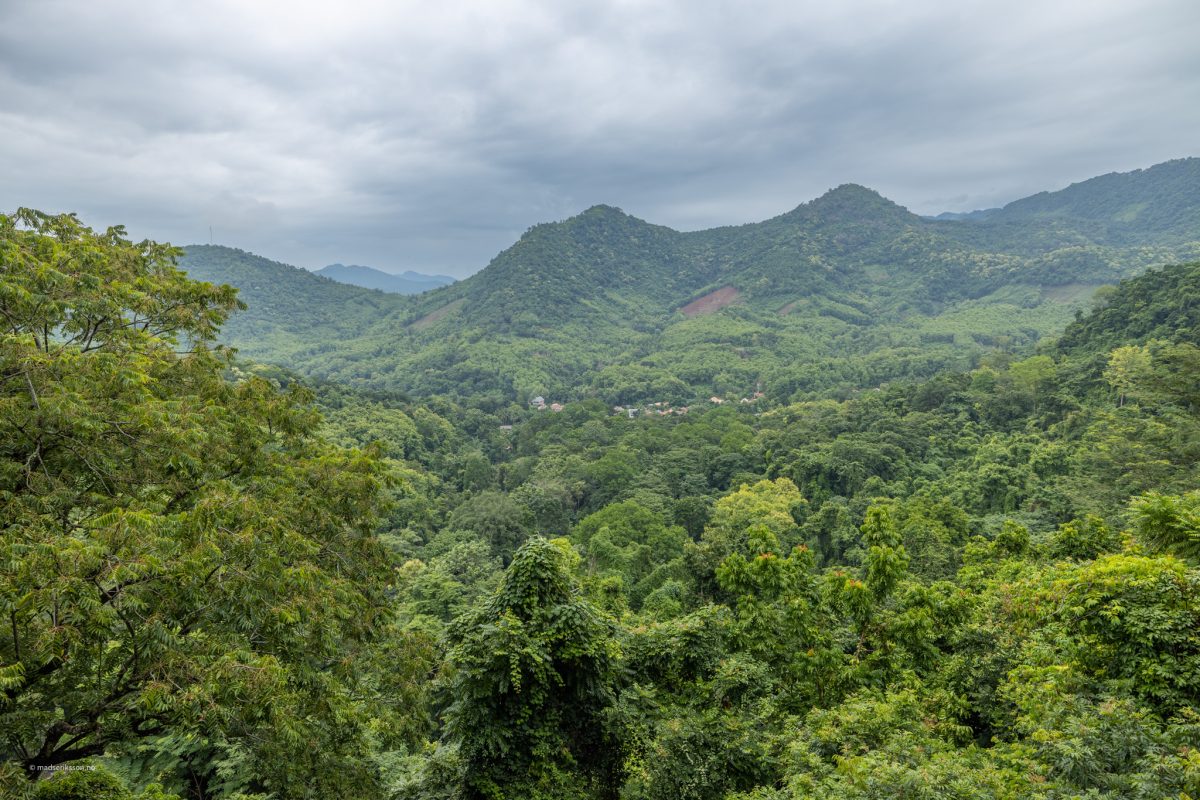
The trail from the lower pools to the main falls follows the left bank of the stream upward through the forest, passing alongside the middle tiers of the cascade — where the water moves more quickly between shallower pools separated by short drops — before reaching the base of the main falls. The forest along the trail is tropical deciduous, with large fig trees, bamboo and the occasional strangler fig — a fig that begins life as an epiphyte in the canopy of another tree, gradually sending roots down to the ground until the host tree is completely encased and eventually dies, leaving the fig standing in the form of its dead neighbour. The walk is not difficult and the path is well maintained; it is muddy in the wet season and requires reasonable footwear. The sound of the water increases steadily as you climb, and the air temperature drops noticeably as you approach the main plunge pool at the base of the upper falls: the spray and the shade of the cliff combine to create a genuine cool zone that is unlike the hot, bright atmosphere of the lower pools.
The main falls — a single curtain of water dropping approximately 50 metres over a limestone cliff into a broad plunge pool — are most impressive in the wet season, when the flow is at its maximum and the falling water generates a permanent mist that hangs in the canyon and catches the light. In the dry season the flow is reduced to a thinner curtain, but the clarity of the pool below compensates: the turquoise is deepest here, where the water has just arrived from the limestone source, and the contrast between the white falling water and the still, coloured pool is at its sharpest. A wooden viewing platform at the top of the falls, reached by a separate path that climbs the right bank, gives the best overview of the entire system — the full extent of the terraced pools below, the valley they sit in, and the forested limestone mountains on all sides. This is the viewpoint from which the scale of Tat Kuang Si becomes fully apparent: not a single waterfall but a cascading system filling an entire limestone valley, operating at a geological timescale that the colour of the water makes immediately legible.
Standing at the viewpoint above the main falls, looking back down over the full extent of the terrace system — turquoise pools, white cascades, forest on both sides, the valley narrowing toward the limestone mountains in the distance — makes it clear that what you are looking at is not a waterfall with some nice pools. It is a landscape that a mineral-saturated stream has been building, one layer of travertine at a time, for thousands of years. The appropriate response is to stay for longer than you planned.
The Bear Rescue Centre — What the Wildlife Trade Left Behind
At the entrance to the falls, an Australian conservation organisation runs a sanctuary for sun bears and Asiatic black bears rescued from bile farms, traffickers and illegal captivity across Laos, Cambodia and Vietnam
The bear rescue centre at Tat Kuang Si is operated by Free the Bears, an Australian non-profit organisation founded in 1995 after its founder saw a newspaper image of bear bile cages in Cambodia and decided to do something about it. The centre houses sun bears (Helarctos malayanus) and Asiatic black bears (Ursus thibetanus) — both species listed as vulnerable on the IUCN Red List — that have been confiscated by Lao authorities from traffickers, seized from people keeping them illegally as pets, or rescued from bear bile operations. Bear bile — specifically ursodeoxycholic acid (UDCA) — has been used in traditional Chinese and Vietnamese medicine for centuries, and demand for it sustains an industry in which bears are kept in small metal cages designed to allow repeated insertion of catheters for bile extraction. The practice is illegal in Laos; enforcement is inconsistent; the rescue centre exists partly because enforcement exists at all, and partly because the organisation has built the infrastructure to care for animals that cannot be released into the wild after captivity.
Sun bears — the smallest bear species, native to tropical rainforests across Southeast Asia — are immediately identifiable by the pale crescent on their chest and by their extraordinarily long tongues, evolved for extracting insects and honey from tree cavities. At the rescue centre they can be observed at reasonably close range through the viewing fence: foraging, climbing the structures in their enclosures, interacting with each other and with the enrichment objects (logs, ropes, hanging food) that keepers use to maintain their physical and psychological condition. The bears at the centre are not domesticated and the viewing is not a show; they are living out as normal a bear life as is possible in a rescue setting, which is to say: actively, noisily, and with evident personality. Asiatic black bears, larger and with the distinctive white V-shaped chest marking, are also present; they are more solitary in nature and typically less active during the warm parts of the day. The centre provides written information about both species, the trade that threatens them, and the organisation’s work; spending time reading it gives the visit a weight that the waterfall alone, as beautiful as it is, does not.
A sun bear’s tongue can extend to 25 centimetres — roughly half the length of its body — to reach insects in tree cavities. In the rescue centre, they use this tongue on the enrichment logs that keepers fill with honey and insects. Watching a sun bear work a log is watching an evolutionary specialisation at full expression. It is considerably more engaging than most wildlife shows.
«The pools of Tat Kuang Si are the colour they are because a stream has been dissolving limestone for thousands of years, and the calcium carbonate remains suspended in the water, scattering light in the frequencies that the eye reads as turquoise. This is not magic. It is a physical process, well understood, operating on a timescale that makes every human presence here a brief visit. The bears in the rescue centre are there because a market for their bile exists across the region, and the enforcement of the laws against it is inconsistent enough that a non-profit from Australia needed to build a sanctuary to house the animals that fall through the gaps. Both of these things are true simultaneously, and the experience of spending a morning at Tat Kuang Si — at the pools, on the forest trail, watching a sun bear apply its 25-centimetre tongue to a log full of honey — holds both without contradiction. It is one of the more complete mornings available near Luang Prabang.»
More in the same area
 CitiesLuang Prabang — The Most Complete Traditional City in Southeast Asia
 NatureThe World’s 15 Most Spectacular Waterfalls
 CanyonsFimmvörðuháls: An Unforgettable Mountain Trail in Iceland
 NatureIceland’s Great Waterfalls: Gullfoss, Skógafoss, Svartifoss and the Thundering North
 ForrestsDiscover the Enchantment of Arashiyama Bamboo Grove
 HikingVøringsfossen: Norway’s Majestic Waterfall