The Forum Romanum is the valley where Western civilisation talked to itself for a thousand years. Here the Roman Republic debated its laws, celebrated its triumphs and buried its dead. Here Julius Caesar was mourned and Augustus was deified. Here Cicero spoke and Nero fiddled, metaphorically at least, while the empire expanded in every direction. The site covers a few hundred metres of ground between two hills in the centre of Rome — and no comparable area on Earth concentrates more political and cultural history in less space. For centuries after Rome fell, cows grazed over it. The cows had no idea what they were standing on.

The valley between the Capitoline and Palatine hills was a marshland used as a burial ground before Rome existed. The first settlements on the surrounding hills — traditionally dated to the mid-8th century BCE, which archaeology broadly supports — began to drain and pave the valley floor from around the 7th century BCE, and the Forum that emerged became the civic centre of a city that would, over the following eight centuries, extend its authority from Scotland to Mesopotamia. The word forum derives from the Latin foras — meaning outside, in the sense of a public space — and the Roman Forum was public in the most total sense: marketplace and law court, sacred precinct and political stage, all overlapping in the same physical space. Every major event in the life of the Roman Republic and early Empire touched this valley: the laws were posted here, the triumphs ended here, the bodies of the great were displayed and cremated here.
What visitors see today is the result of nine centuries of construction, destruction and excavation. By the medieval period the Forum had accumulated approximately 8 metres of debris — collapsed buildings, landfill, accumulated silt — above its ancient level, and the buried site became known as the Campo Vaccino, the cow pasture. The excavations of the 19th century removed this overburden and exposed the ancient level; the descending steps at the entrance to the Forum mark the gap between today’s street and antiquity. The broader archaeological zone — encompassing the Forum, the Palatine Hill, the Colosseum, the Imperial Fora and the Circus Maximus — covers several square kilometres in the centre of a living city of 3 million people. No other archaeological site in the Western world coexists with a functioning modern metropolis at this scale and this density of historical significance.
How to approach the Forum Romanum
This guide covers four aspects of the Roman archaeological zone: the Republican Forum and its temples, arches and political monuments; the Palatine Hill, the residence of emperors and the mythological birthplace of Rome; the Colosseum and the world of Roman spectacle; and the Imperial Fora, the sequence of additional forums built by the emperors north of the Republican valley, culminating in Trajan’s Forum and its extraordinary column. A combined ticket covers the Forum, Palatine and Colosseum; book online in advance, particularly in peak season, to avoid multi-hour queues.
The valley between two hills
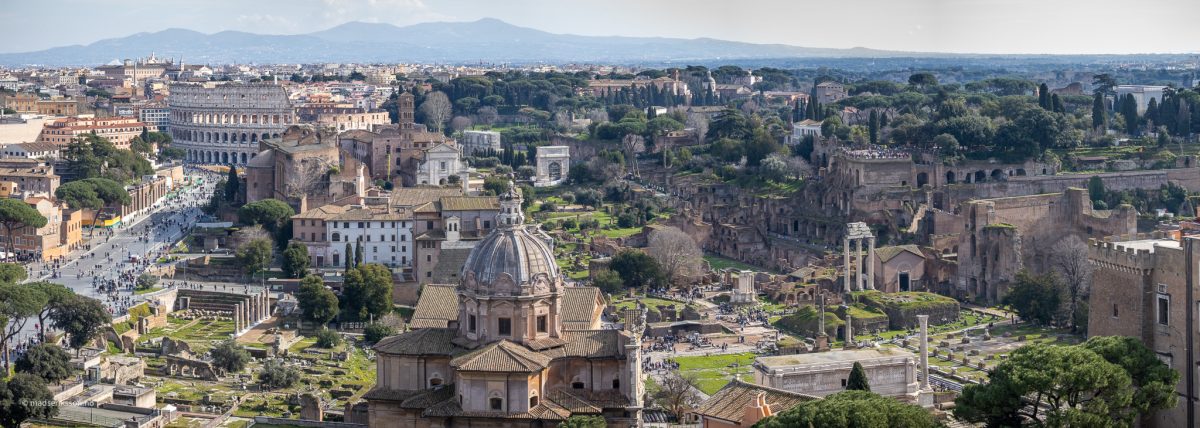
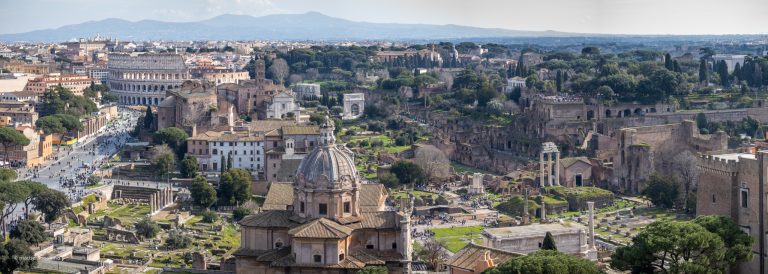
The Forum Romanum fills the valley between the Capitoline and Palatine hills. For nine centuries it was marketplace, law court, sacred precinct and political stage. By the Middle Ages about 8 metres of debris covered it, and it was known as the Campo Vaccino, the cow pasture.
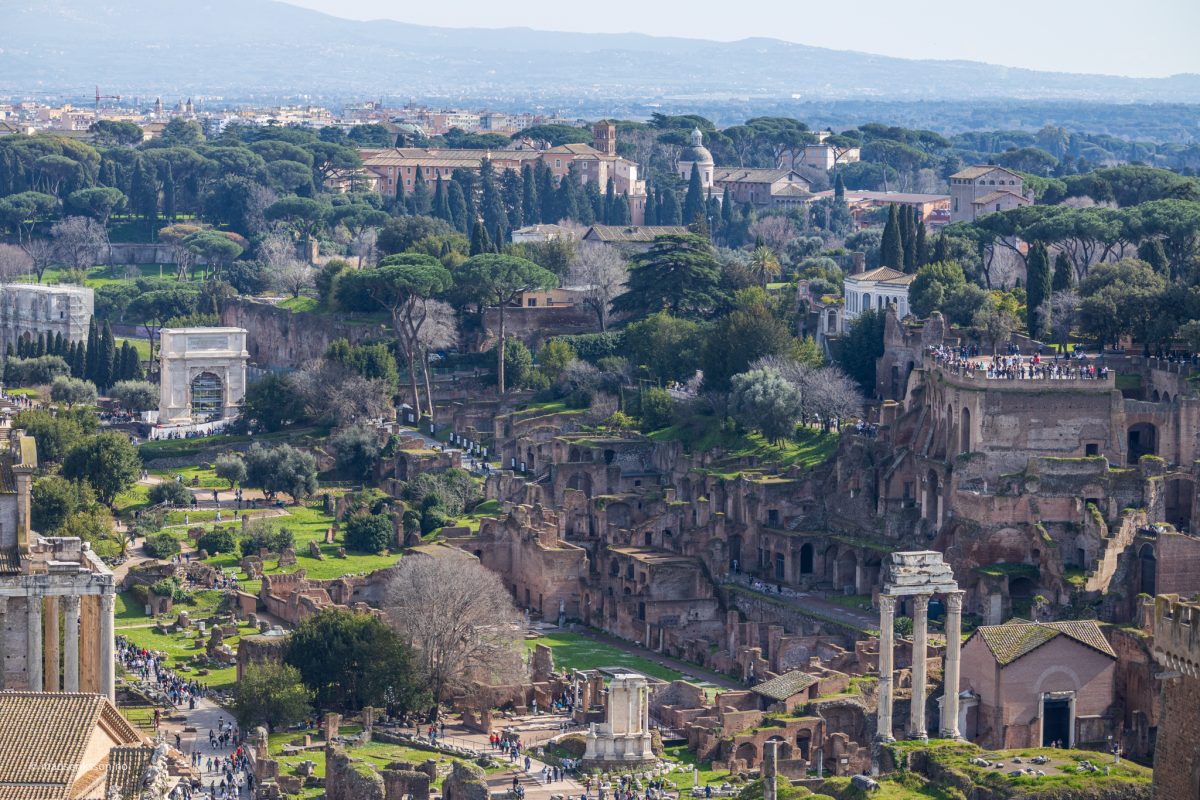
The Roman Forum and the domes of central Rome from above.
Where the Senate met
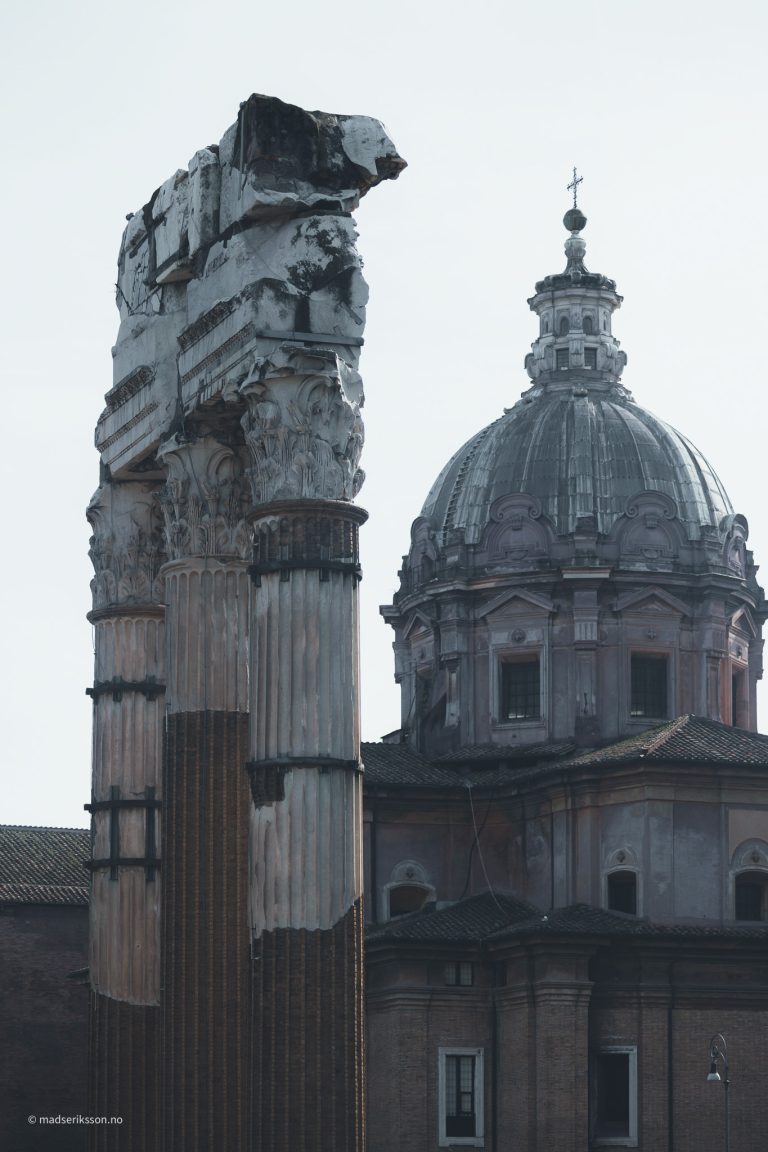
Entering through the Arch of Septimius Severus (203 CE), the first building of consequence is the Curia Julia, the Senate house, begun by Julius Caesar and completed by Augustus. Outside stands the Rostra, the speaker's platform, and to the south the Temple of Saturn, first dedicated in 497 BCE, with its eight columns.
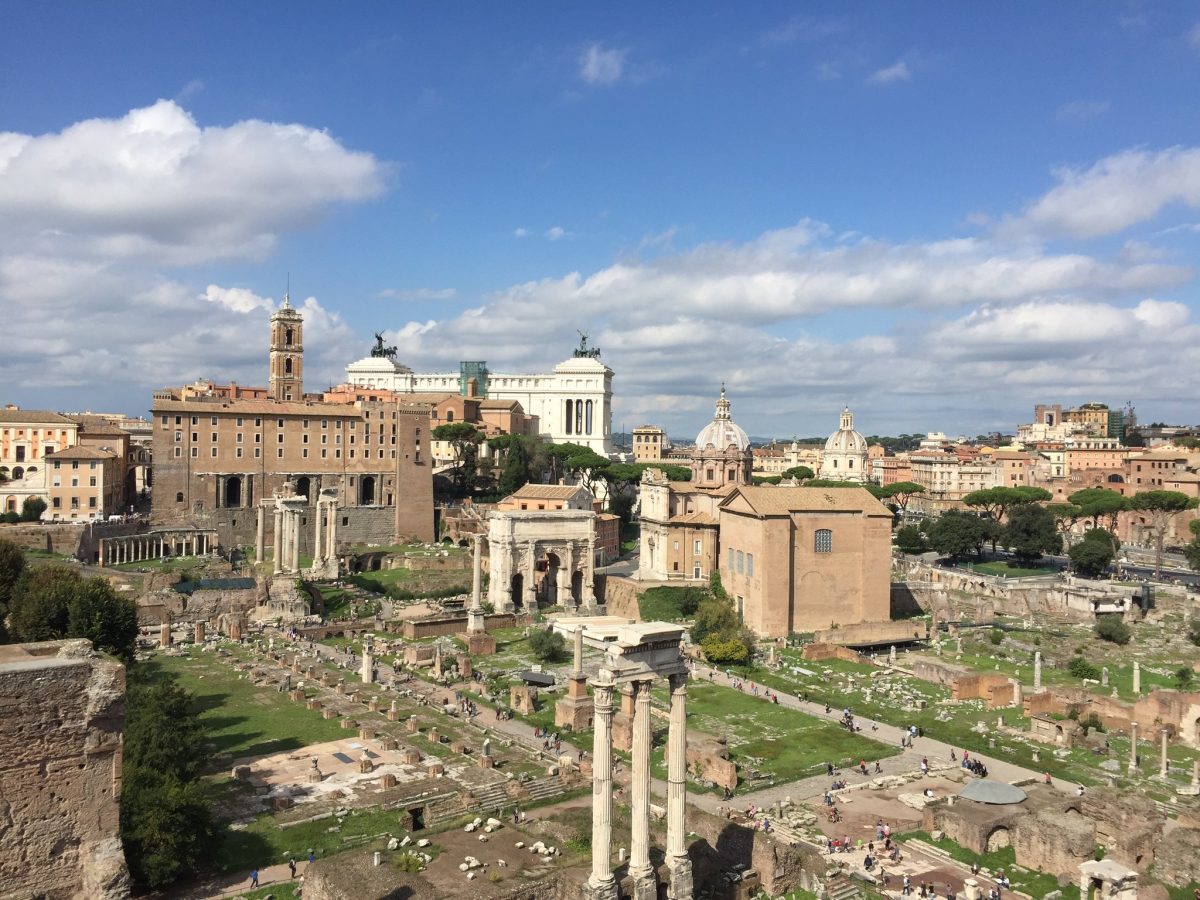
Weathered columns in the Roman Forum, with the dome of a Baroque church behind
The sacred flame and Caesar's pyre
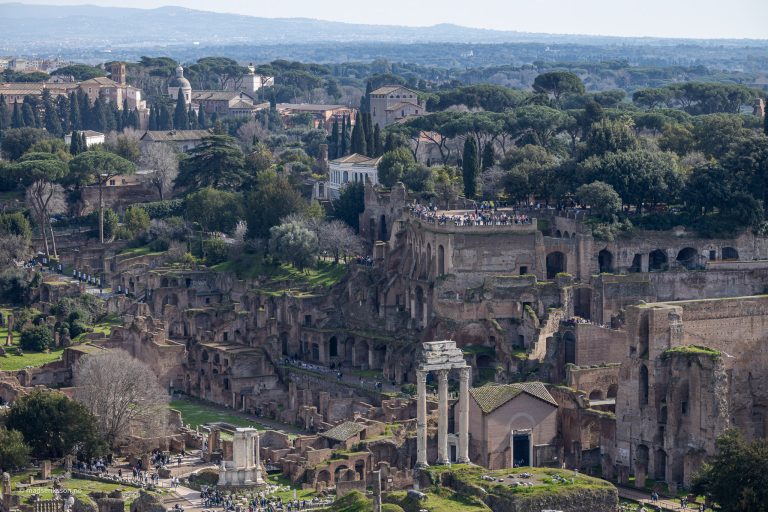
Augustus built the Temple of Divus Julius on the spot where Caesar's funeral pyre burned in 44 BCE. Nearby, the round Temple of Vesta housed the flame the Vestal Virgins kept burning for over a thousand years, and the House of the Vestals still has statues standing in its courtyard.
The Forum Romanum below the Palatine Hill, with the three surviving columns of the Temple of Castor and Pollux
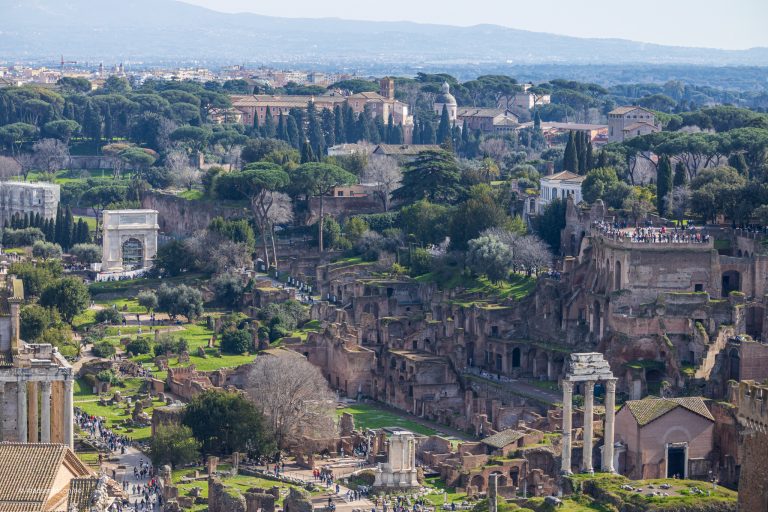
To the Arch of Titus
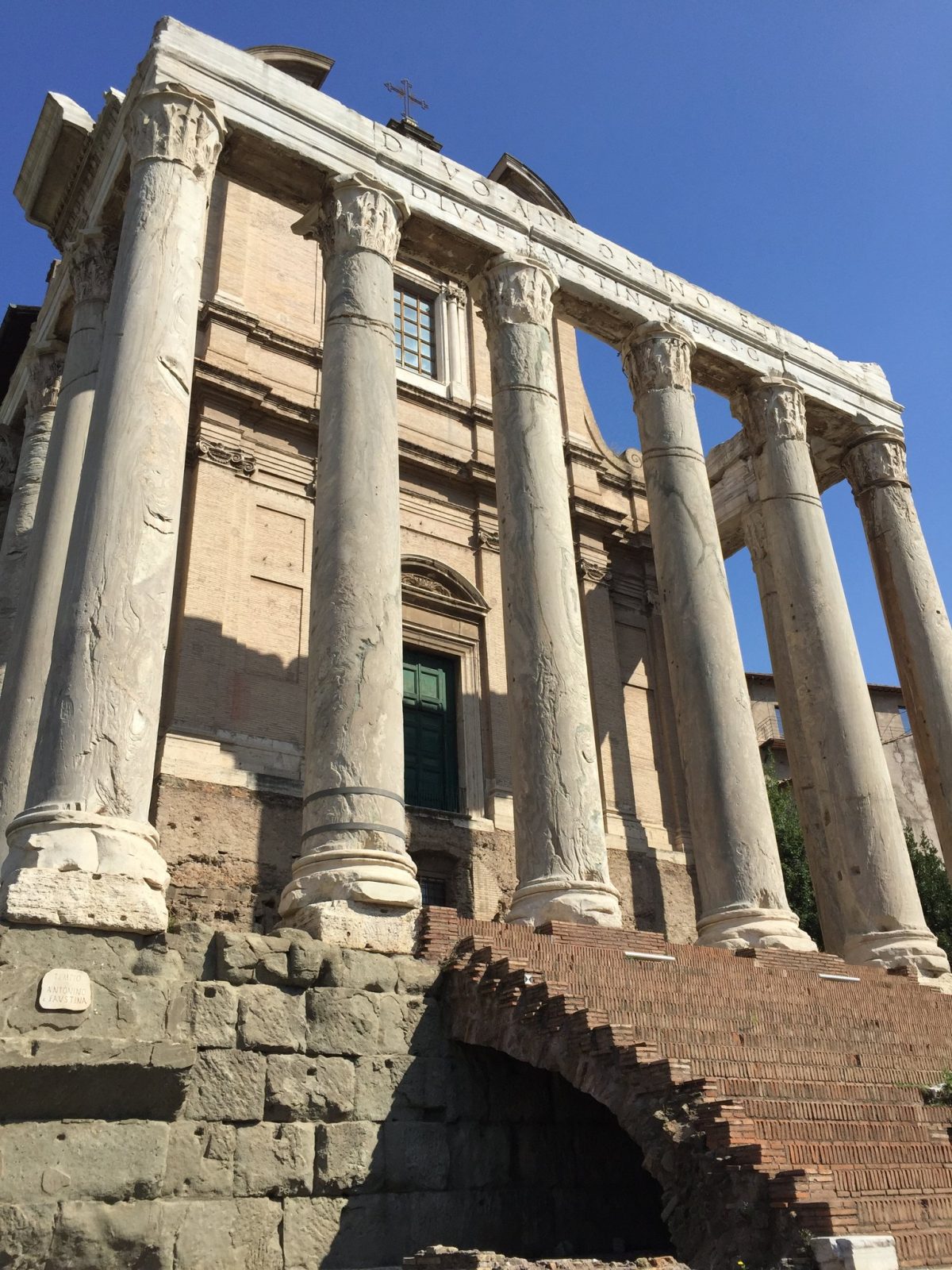
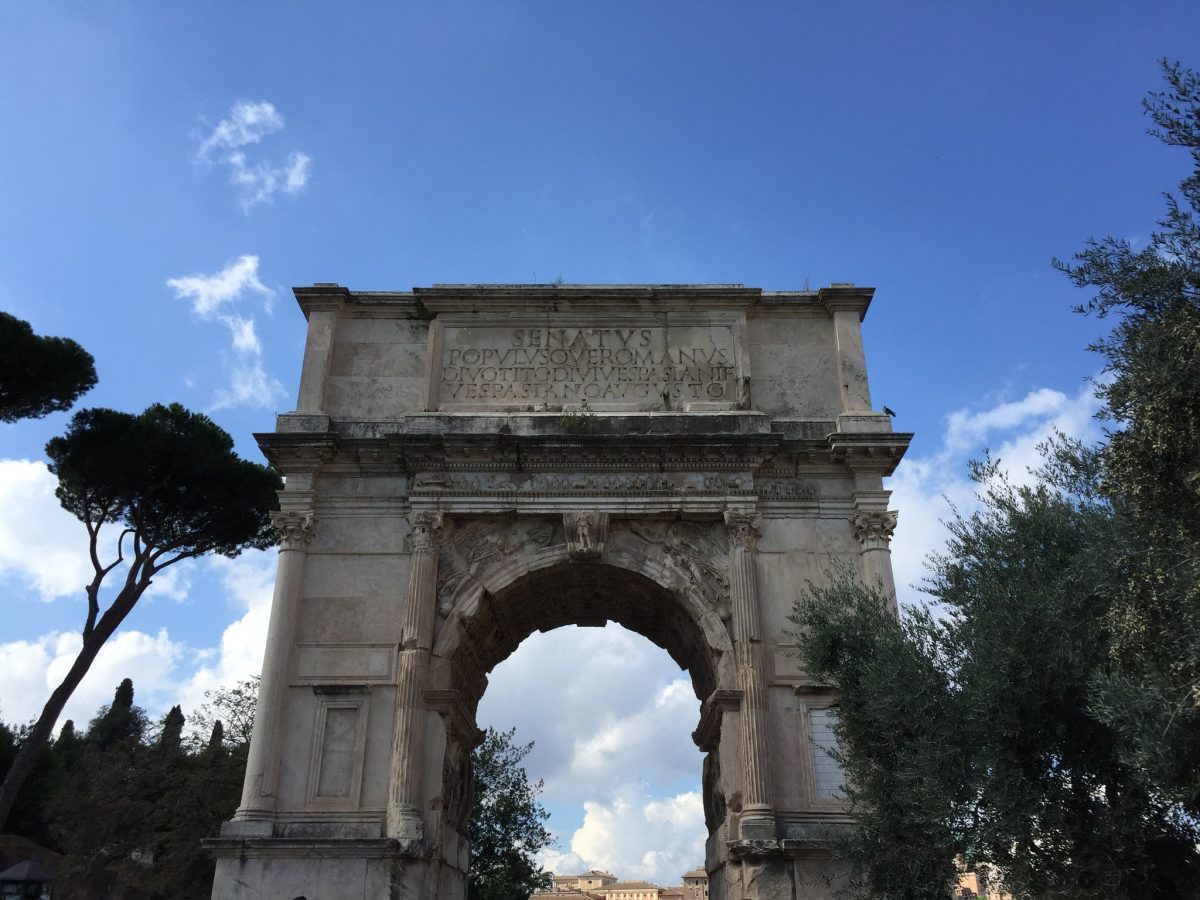
The Via Sacra runs through the Forum from the Arch of Septimius Severus to the Arch of Titus, the route of the triumphal processions. The Arch of Titus (81 CE) carries the earliest known depiction of the seven-branched menorah.
The Temple of Castor and Pollux and the Arch of Titus in the Forum Romanum below the Palatine Hill
Where the emperors lived
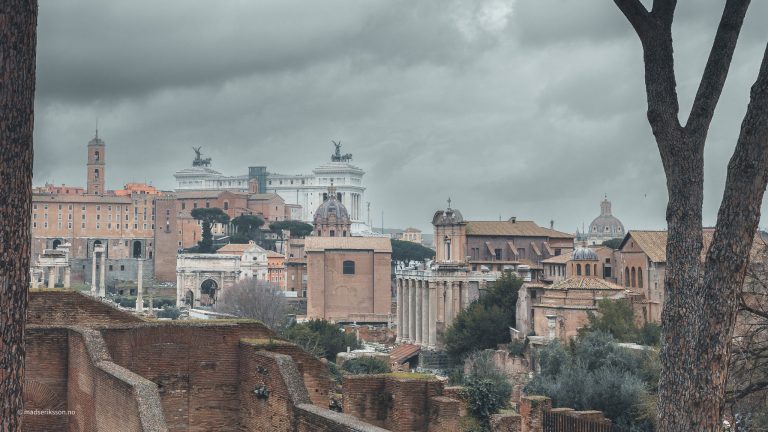
The Palatine rises 40 metres above the Forum to the south. Augustus chose it for his residence, and Domitian's Domus Flavia (92 CE) followed. The word palace comes from Palatinus, and the hill gives the best panorama over the Forum.
The Forum Romanum from the Palatine, with the Capitoline and the Vittoriano rising behind
Rome's great arena
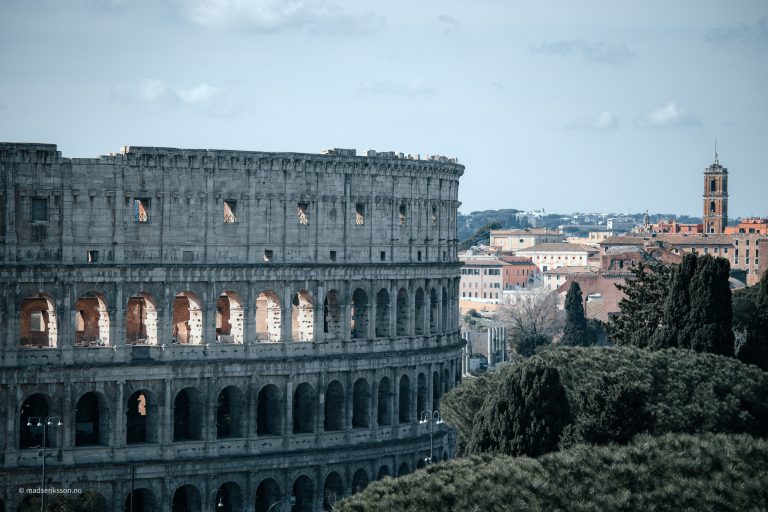
The Colosseum was completed in 80 CE and inaugurated with 100 days of games; about 100,000 cubic metres of travertine went into it. It now receives about 7 million visitors a year.
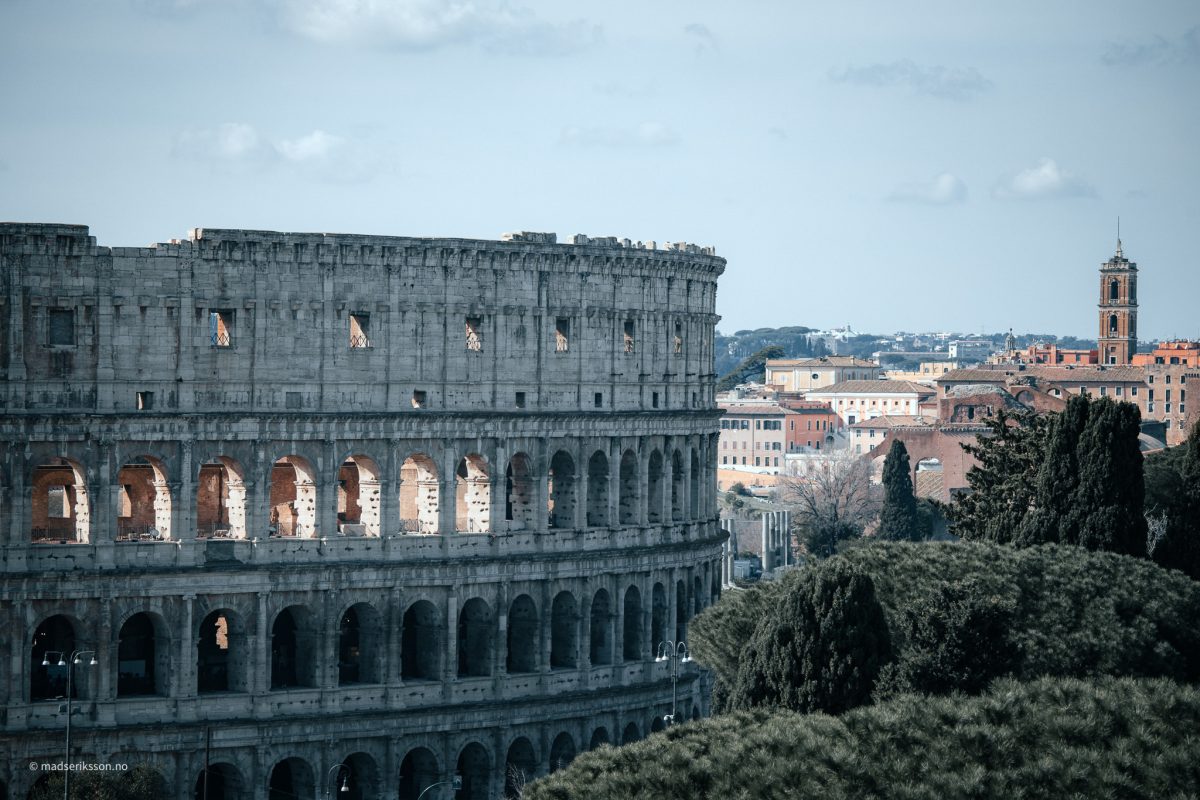
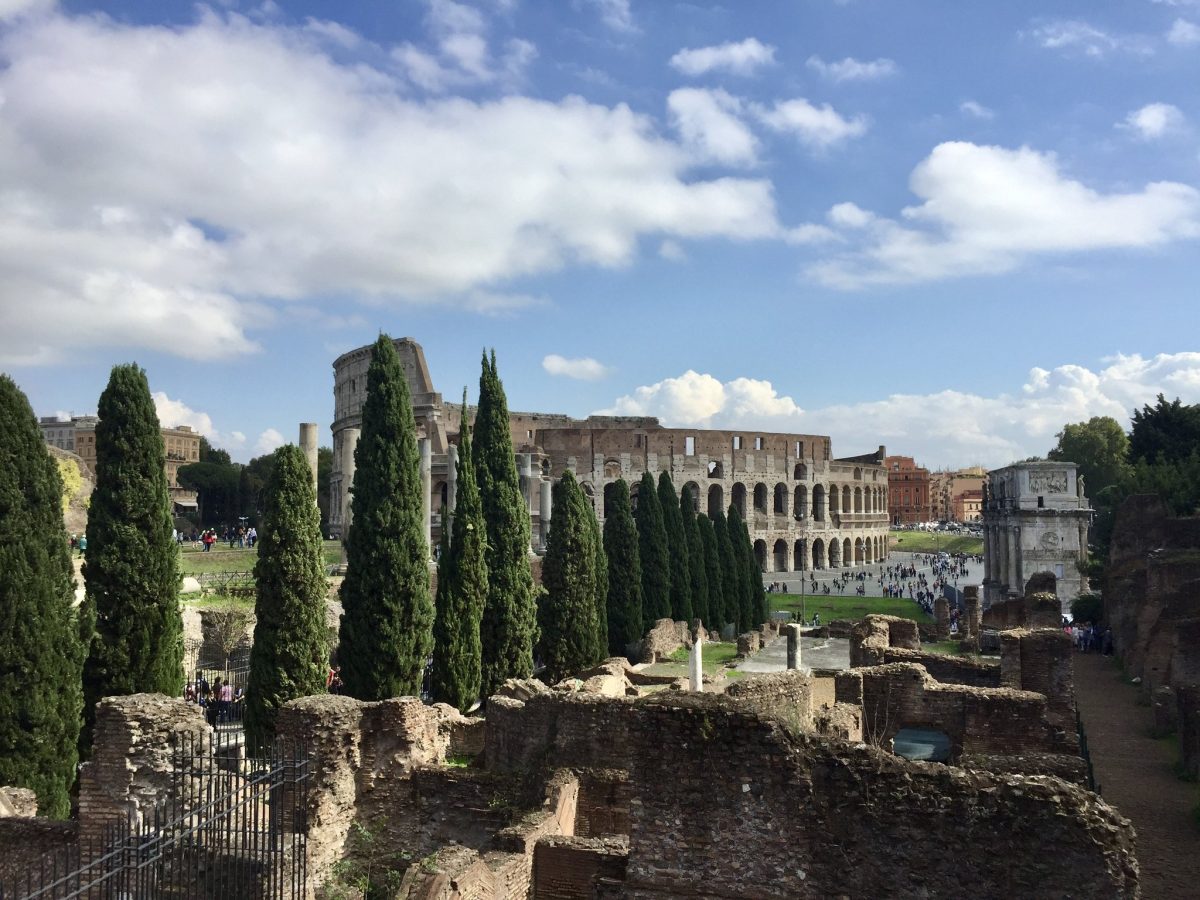
The upper arcades of the Colosseum beside the archaeological park of the Forum Romanum
Trajan's Forum and column
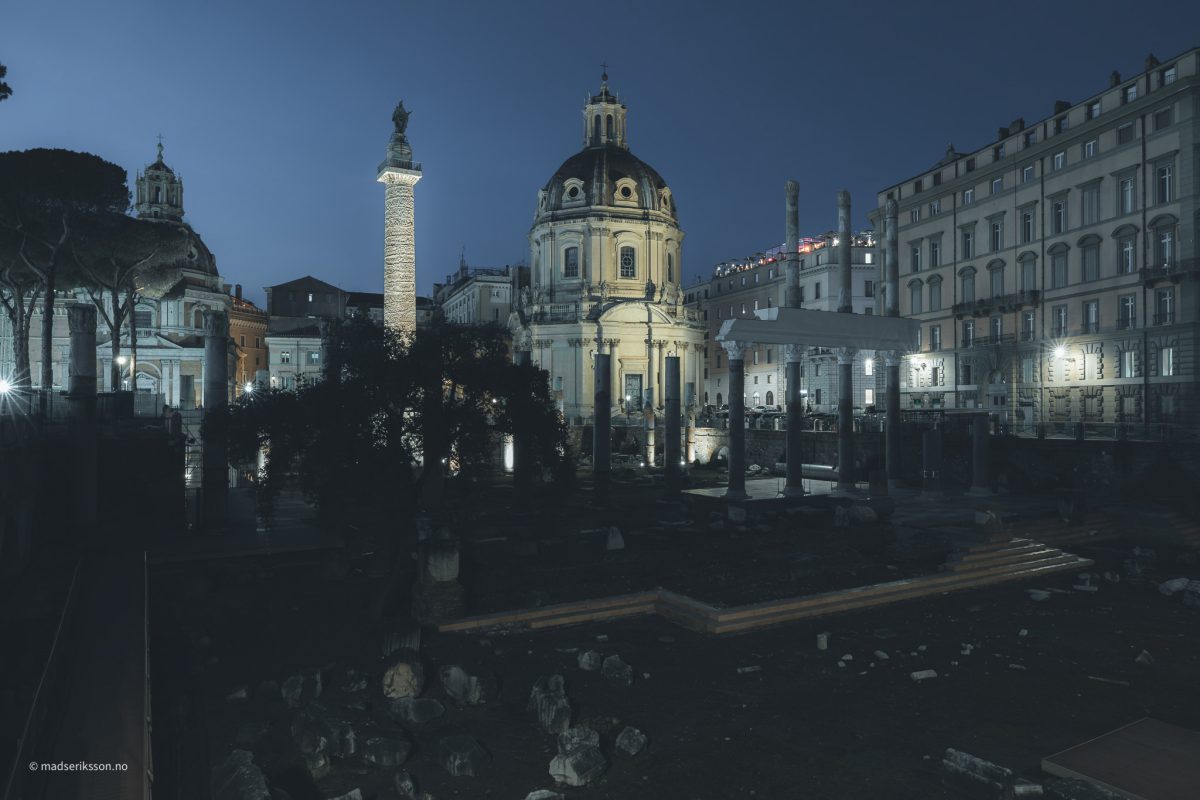
North of the Republican valley the emperors built a sequence of further forums, culminating in Trajan's Forum. Trajan's Column (113 CE) is a 30-metre marble shaft wound with 155 scenes of the Dacian Wars.
One ticket, three sites
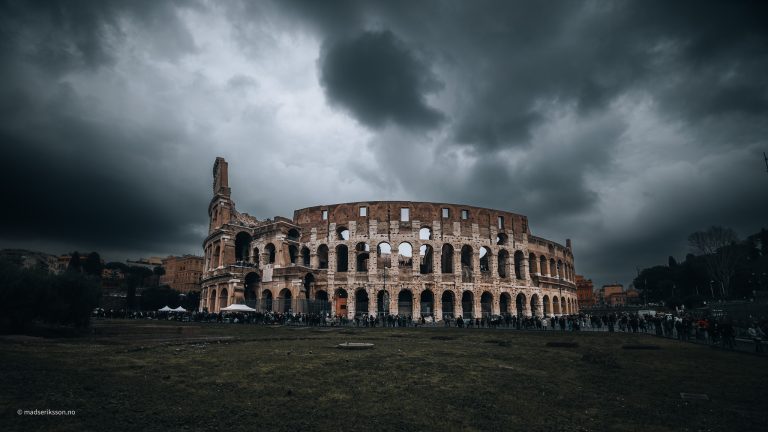
A combined ticket covers the Forum, the Palatine and the Colosseum. Book online in advance, particularly in peak season, to avoid multi-hour queues.
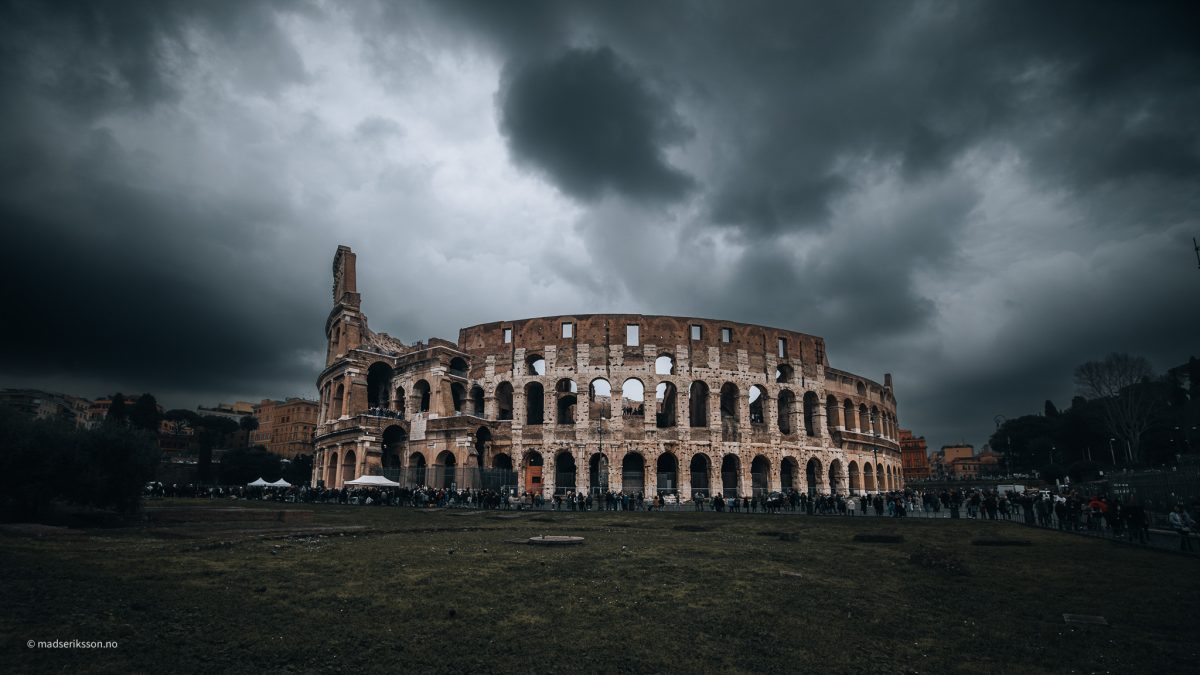
The Colosseum under a dark, stormy sky at the edge of the Forum Romanum archaeological zone
3D model © 2026 madseriksson.no · Photographs © madseriksson.no. Ruins, buildings, walls and paths: © OpenStreetMap contributors (ODbL). Heights of the ruins, the Palatine Hill and the Colosseum are simplified and approximate; the rest of the terrain is shown flat. Sun positions are approximate.
The Republican Forum — A Thousand Years of Roman Public Life
The temples, law courts, speaker’s platform and sacred monuments of the Roman Republic — built, rebuilt and enlarged across a millennium, and buried under eight metres of medieval debris before anyone thought to look
Entering the Forum from the western end, through the Arch of Septimius Severus (203 CE), the first building of consequence is the Curia Julia — the Senate house. Julius Caesar began rebuilding the Senate in 44 BCE, shortly before his assassination; Augustus completed it in 29 BCE. The building that stands today is a 3rd-century reconstruction, but it follows the same plan and uses the same footprint as the Augustan original. It is one of the best-preserved ancient buildings in Rome, having been converted into a church in 630 CE by Pope Honorius I — a conversion that preserved the building while most of what surrounded it was stripped for building materials. The original bronze doors are still in place; they are among the oldest functioning bronze doors in the world. Inside, the marble floor patterned in coloured stone and the two low platforms along the walls where senators sat are largely intact. To stand in the chamber where the Roman Senate debated the fate of Carthage, voted on the Gracchian land reforms, and heard Cicero deliver his speeches against Catiline is to be in direct contact with the constitutional machinery of the ancient world.
Immediately outside, the Rostra — the speaker’s platform — was the most important piece of political furniture in the Roman world. Named for the bronze prows (rostra) of ships captured from the Latin city of Antium in 338 BCE, which were mounted on the platform as trophies, it was from here that the great speeches of Roman public life were delivered: Cicero’s Philippics against Mark Antony, Mark Antony’s oration over Caesar’s body in 44 BCE, the proclamations of emperors. South of the Rostra, the Temple of Saturn — first dedicated in 497 BCE, rebuilt multiple times, its eight columns standing to this day — housed the Roman treasury, the aerarium. The Via Sacra (the Sacred Way) runs through the Forum from the Arch of Septimius Severus at the west to the Arch of Titus at the east, and was the route of the triumphal processions that brought conquered peoples and their treasures through the heart of Rome.
After Cicero was assassinated on Mark Antony’s orders in 43 BCE, Antony had Cicero’s severed head and his right hand — the hand that had written the Philippics — displayed on the Rostra. His wife Fulvia reportedly pulled out Cicero’s tongue and stabbed it with her hairpin.
At the eastern end of the Forum, the circular Temple of Vesta — whose current reconstruction dates from 1930 but follows the footprint of successive versions going back to the 7th century BCE — housed the sacred flame that the Vestal Virgins maintained continuously for over a thousand years. If the flame went out, it was considered a sign of divine displeasure; the responsible Vestal was publicly flogged. The adjacent House of the Vestals, where the six Vestals lived, is one of the better-preserved domestic complexes in the Forum, with statues of the Vestals still standing in the central courtyard. The Temple of Divus Julius — built by Augustus on the spot where Caesar’s funeral pyre burned in 44 BCE — is now a low platform with a curved niche at its front; flowers are still left there by visitors on the Ides of March every year.
The Palatine Hill — Where Romulus Ploughed His Furrow and the Emperors Built Their Palaces
The hill above the Forum is both the mythological birthplace of Rome and the site of the most elaborate imperial residences of the ancient world — and the word “palace” is named after it
The Palatine Hill, rising 40 metres above the Forum to the south, was the most prestigious address in ancient Rome from the Republic through the Empire. According to legend, it was here that Romulus ploughed the sacred furrow that defined the boundary of the original city in 753 BCE, and the hut of Romulus — a reconstructed Iron Age dwelling in the southwestern corner of the hill — represents the archaeological evidence of 8th-century BCE settlement that broadly supports the legendary date. Augustus, the first emperor, chose the Palatine for his residence deliberately: not in the grandest manner, but in a modest house adjacent to the temple of Apollo that emphasized his piety and restraint. The House of Augustus (also called the House of Livia) is one of the most significant surviving domestic interiors of the ancient world: its painted rooms, preserved under centuries of later construction, retain some of the finest examples of Roman Second Style wall painting, with architectural trompe l’œil perspectives and delicate decorative panels in excellent condition. Access is by timed guided tour; it is worth booking.
Later emperors were less restrained. Tiberius built the Domus Tiberiana across the northern slope of the hill; Caligula extended it to overlook the Forum. Nero’s Domus Aurea (the Golden House) swept across much of central Rome, though its Palatine components were later incorporated by Domitian. It was Domitian who transformed the hill entirely: his Domus Flavia (92 CE), designed by the architect Rabirius, covered the entire summit with a complex of reception halls, a throne room, a sunken garden and private apartments of a scale and elaboration that defined the concept of imperial residence for every subsequent dynasty in Europe. The word “palace” derives directly from Palatinus; every later European palace — Versailles, the Alhambra, Hampton Court — traces its conceptual lineage to Domitian’s building on this hill. The Domus Flavia’s ruins — massive brick walls, vaulted spaces, the octagonal fountain of the dining room still legible — are the most impressive structures on the Palatine today.
Every language in Europe uses a word derived from Palatinus for a royal residence — palazzo, palais, palacio, Palast, palace. The concept of the palace as the defining building of power was established on this hill in 92 CE by Domitian and Rabirius. Every subsequent palace is, conceptually, a descendant of the Domus Flavia.
The Palatine offers the finest views over the Forum Romanum and across to the Capitoline Hill — views that have been essentially unchanged since antiquity — as well as west over the Circus Maximus, the enormous stadium in the valley below that held up to 250,000 spectators for chariot races. The Farnese Gardens, laid out in the 16th century over the ruins of Tiberius’s palace by the Farnese family, remain as one of the earliest botanical gardens in Europe; their terraced walks and the two small pavilions at the northern end give some of the most atmospheric settings in the archaeological zone. The combination of Forum views, imperial ruins and Renaissance garden on the same hill, in the same afternoon, is one of the more concentrated experiences Rome offers.
The Colosseum — The Largest Amphitheatre Ever Built and the Most Visited Ancient Monument on Earth
Built in ten years, financed by the plunder of Jerusalem, holding 50,000–80,000 spectators for gladiatorial combat and animal hunts — and still standing, after 2,000 years, as the defining image of ancient Rome
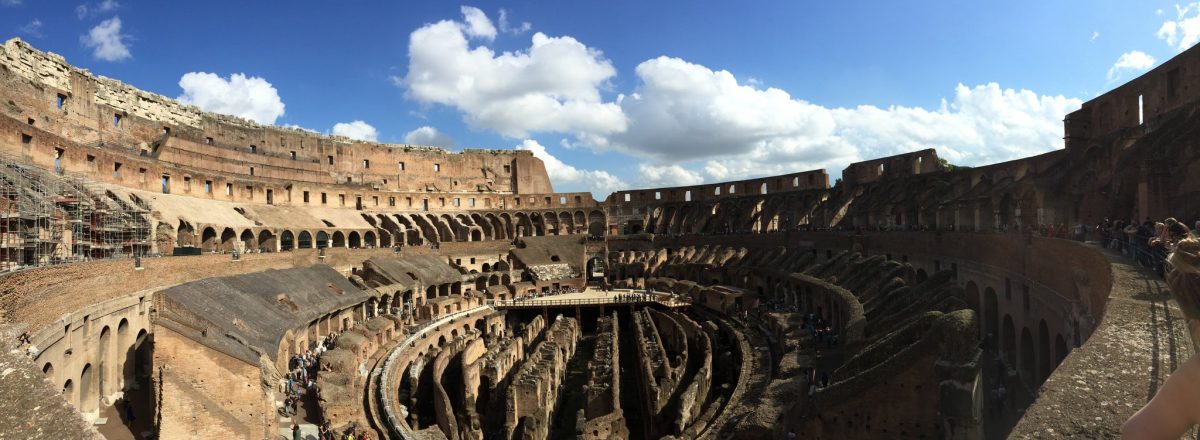
The Colosseum — officially the Flavian Amphitheatre, its popular name deriving from either its enormous size or the colossal statue of Nero that stood adjacent — was built by the emperors Vespasian and Titus between 70 and 80 CE. Vespasian began construction on the site of Nero’s private lake (part of the Domus Aurea), reclaiming the land for public use as a deliberate political statement. The workforce included an estimated 100,000 Jewish prisoners of war captured during the sack of Jerusalem in 70 CE, and the construction was financed primarily by the treasure of the Temple of Jerusalem brought to Rome by Titus. Approximately 100,000 cubic metres of travertine limestone were used in the outer walls, held together by 300 tonnes of iron clamps (the holes left when medieval scavengers extracted the iron are still visible). The four-storey elliptical exterior, 188 metres long, 156 metres wide and 48 metres tall, is the largest amphitheatre ever constructed. Titus inaugurated it in 80 CE with 100 days of games; according to sources, 9,000 animals were killed in the opening celebrations.
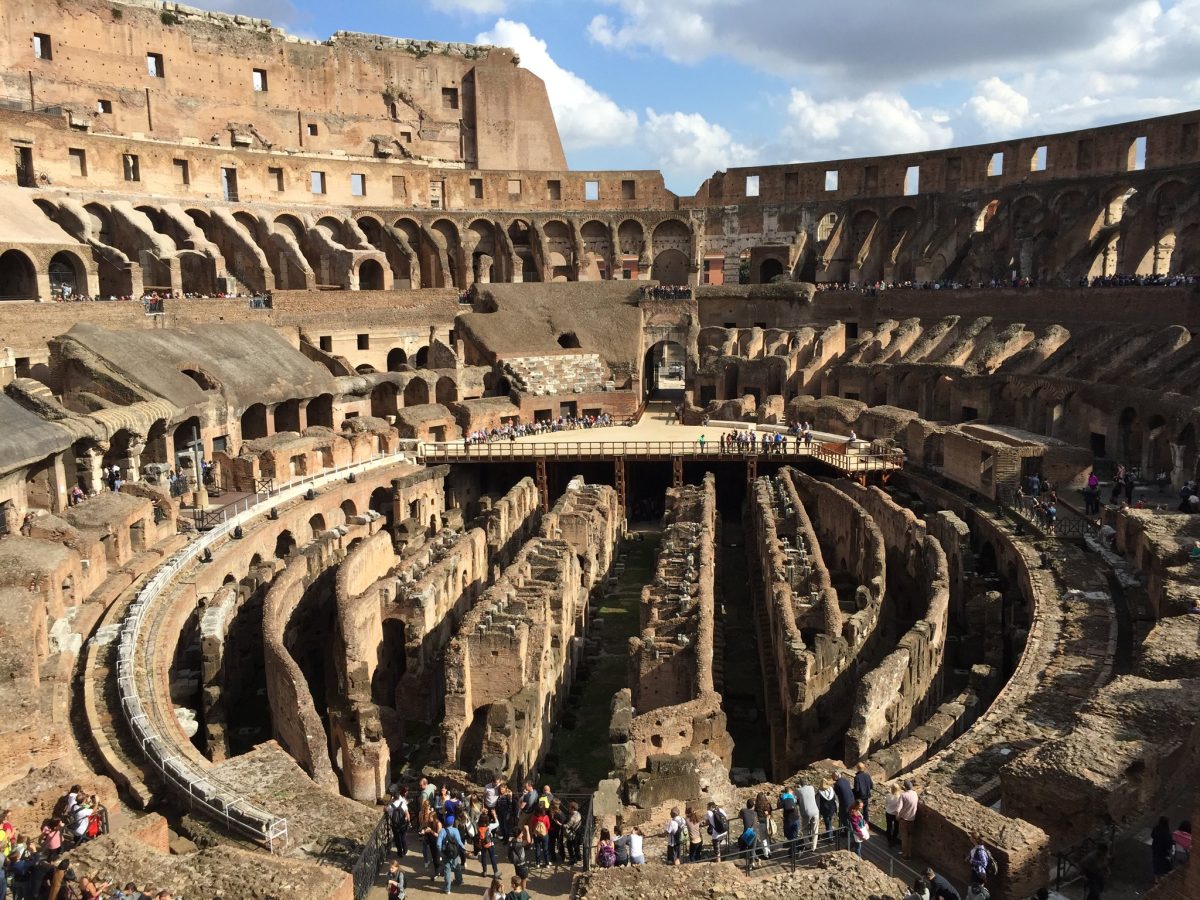
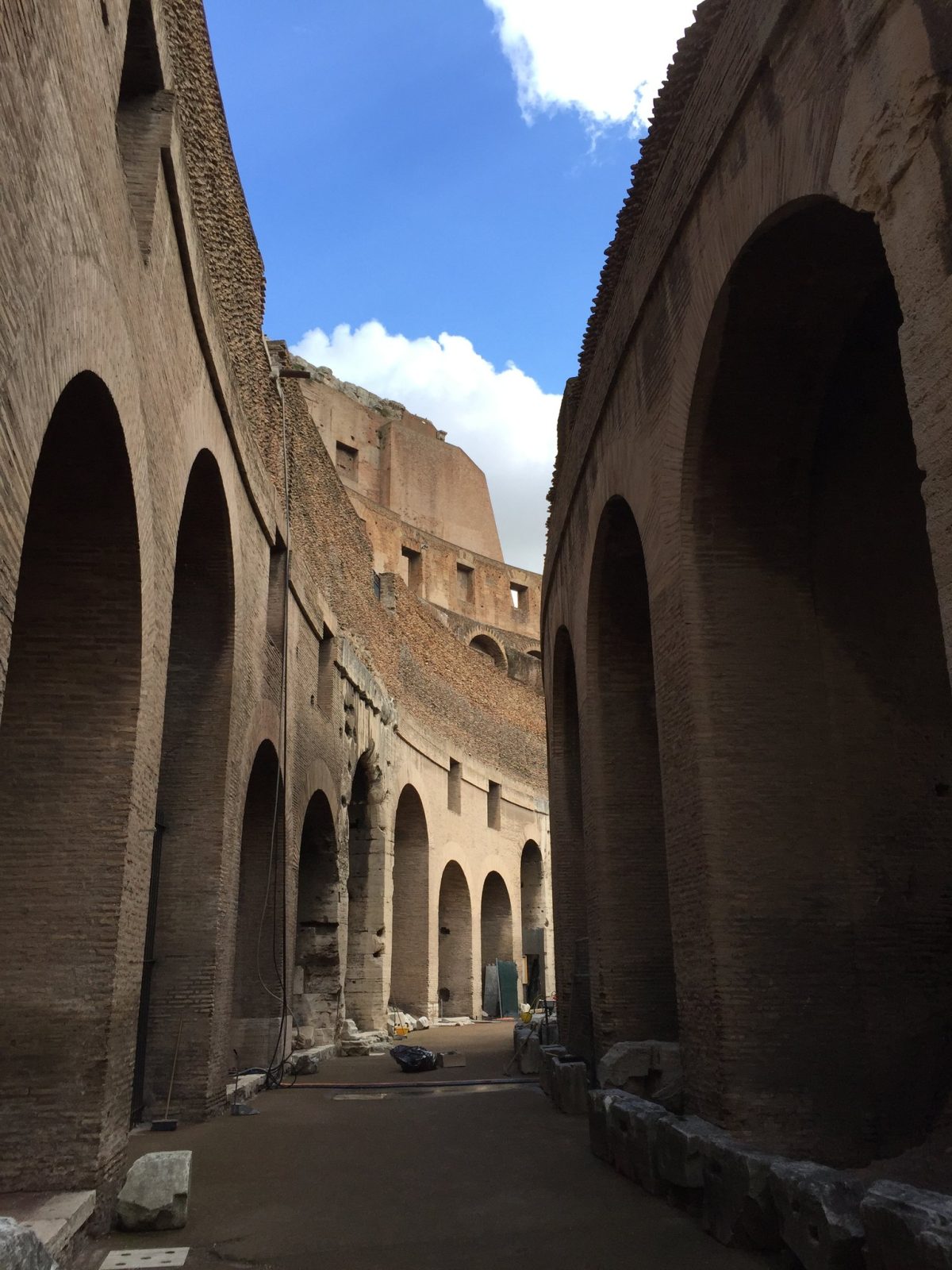
The interior, once decorated with marble seating, coloured awnings (the velarium, operated by sailors from the Miseno fleet) and elaborate scenographic machinery for the arena floor, now shows its bare brick and concrete substructure. The hypogeum — the underground system of tunnels and cages beneath the arena floor — is the most revealing part of the building for understanding how the spectacle worked: the 32 animal lifts, the corridors for gladiators and condemned prisoners, the mechanism by which exotic animals and elaborate scenic props could be raised directly onto the arena floor through trapdoors. The hypogeum can be visited on a specific ticket; it is the most interesting part of the building and the most frequently overlooked. Gladiatorial combat was abolished by the Emperor Honorius in 404 CE, following pressure from Christian clergy; animal hunts continued until 523 CE. The building was subsequently used as a fortress, a quarry, a cemetery, a workshop and a housing complex before being formally protected in the 19th century.
The Colosseum was built by Jewish prisoners of war, financed by the treasure of the Temple of Jerusalem, inaugurated with the slaughter of 9,000 animals over 100 days, and is now visited by 7 million people a year. It is the most visited paid archaeological site in the world. It has been standing for nearly 2,000 years.
The Colosseum is best visited in the early morning (tickets from 9am) or in the last hour before closing, when the crowds are thinnest and the light on the travertine exterior is most dramatic. The combined Forum–Palatine–Colosseum ticket must be booked online in advance; walk-up queues regularly exceed two hours. The underground (hypogeum) and upper tiers require separate booking on a premium ticket. Standing at the arena floor level and looking up at the rising tiers of seating gives the clearest sense of what 80,000 people gathered in one building looked, sounded and felt like — an experience of scale that the building conveys even in its partially ruined state.
The Imperial Fora — Five Emperors, Five Forums, One Column That Tells Everything
When the Republican Forum became too small, the emperors built their own — each grander than the last, culminating in Trajan’s Forum, the largest ever built, and the column that records a war in 2,662 figures wound around 30 metres of marble
The Republican Forum became too small for the ambitions of the late Republic, and Julius Caesar began the first of the Imperial Fora — a sequence of five additional forums built by Caesar, Augustus, Vespasian, Nerva and Trajan north of the original valley, each serving both a civic and a propagandistic function. The Forum of Caesar (46 BCE), the first, was built with the spoils of the Gallic Wars and centred on a temple to Venus Genetrix — the divine ancestor Caesar claimed for his family. The Forum of Augustus (2 BCE) was built on land Augustus personally purchased from private owners when the original site proved too small; it is dominated by the Temple of Mars Ultor (Mars the Avenger), vowed by Augustus before the Battle of Philippi in 42 BCE where Caesar’s assassins were defeated. Two of the original Corinthian columns of the temple still stand to their full height, giving one of the most dramatic vertical accents in the archaeological zone. The Forum of Nerva (97 CE), the smallest and most constrained, was inserted into the narrow space between the Forums of Augustus and Vespasian.
The Forum of Trajan, the last and largest of the imperial forums, was built by the emperor Trajan between 107 and 112 CE using the spoils of the Dacian Wars (the two campaigns in what is now Romania, 101–102 CE and 105–106 CE, that are recorded on the Column). The project required the removal of the saddle connecting the Capitoline and Quirinal hills — an engineering undertaking of extraordinary ambition — and resulted in a forum 300 metres long containing a basilica, two libraries (one Greek, one Latin), an equestrian statue of Trajan, and the Column itself. Trajan’s Market, a multi-storey commercial complex built into the hillside above the forum, is the best-preserved example of a Roman commercial building in existence and houses the museum of the Imperial Fora. The height of the Column — 30 metres from base to the figure of Trajan at the top — was intended to indicate the height of the hill that was removed to create the forum below. Trajan was buried in the Column’s base; the urn containing his ashes was placed there in 117 CE.
Trajan’s Column is 30 metres tall and wound with a continuous helical relief of 2,662 figures in 155 scenes. Trajan himself appears 58 times. The relief was originally painted in vivid colours. The scroll, if unrolled, would stretch for approximately 200 metres — the longest comic strip in the ancient world.
The Imperial Fora today are divided by the Via dei Fori Imperiali — the broad road driven through the archaeological zone by Mussolini in 1932 to provide a ceremonial route for military parades, which destroyed an unknown quantity of unexcavated ancient remains in the process. The road is now pedestrianised on Sundays and there have been proposals for its removal to allow full excavation of what lies beneath it. The most accessible entry point for the Imperial Fora is Trajan’s Market, which can be visited independently of the Forum–Palatine–Colosseum complex on a separate ticket. Walking the length of the Via dei Fori Imperiali from the Colosseum to the Capitoline, looking down into the excavated levels on both sides, gives the best sense of the overall scale and sequence of the imperial building programme — and of how much remains to be excavated.
«The Forum Romanum does something to the historical imagination that no other archaeological site quite manages. The distance between what happened here and where you are standing is so short — a few metres of excavated earth, a few columns still upright — and the weight of what happened here is so enormous that the combination produces a kind of temporal vertigo. Cicero spoke from the Rostra. Caesar’s body burned in the Forum. Augustus walked the Via Sacra. Trajan commissioned a column that records a war in such detail that modern historians still use it as a primary source. All of this in a valley that was, for centuries, a cow pasture. The cows were standing on the Senate house. The Senate house is still there. So, in some sense, is everything else.»

More in the same area
 CitiesRome: A Timeless Journey Through History and Culture
 ArchitectureSt Peter’s Basilica: Michelangelo’s Dome and 120 Years of Building
 ArchitectureThe Pantheon in Rome: A Marvel of Ancient Architecture
 ArchaeologyExploring the Ancient Ruins of Pompeii
 ArchitectureEurope’s 10 Greatest Cathedrals and Churches
 ArchitecturePisa — The Leaning Tower, the Square of Miracles and the City on the Arno