The Arête à Laurence is the gentlest way to step from a cable car into real alpine terrain. From the top station of the Aiguille du Midi, 3,842 metres above sea level and twenty minutes from the centre of Chamonix, the route goes down the famous snow arête, crosses the glacier at the Col du Midi and climbs a short granite ridge, roughly 100 metres long, to the back door of the Refuge des Cosmiques at 3,613 metres. It is usually graded PD, with one short step of about 4b that can be downclimbed or abseiled, and the whole outing from station to hut and back measures about 3.8 kilometres with around 220 metres of ascent. That makes it small by Mont Blanc standards, but it holds everything that defines a glacier day in the Alps: crampons on an exposed crest, a rope on a crevassed glacier, scrambling on granite at altitude and a hard pull back up to the station. For anyone with basic glacier skills, or a beginner climbing with a qualified mountain guide, it is one of the best first ridges in the massif.

Most people who ride the cable car to the Aiguille du Midi stay behind glass and railings. They look out from the terraces at Mont Blanc, at the Grandes Jorasses and the Dent du Géant, and at the small figures who walk out of an ice tunnel on to a knife-edge of snow and disappear down towards the glacier. Those figures are skiers heading for the Vallée Blanche and climbers heading for the ridges and faces around the Col du Midi, and for a few hours they are part of the same high world the visitors only look at. The Arête à Laurence is the shortest and least demanding way to join them.
The ridge lies just south of the Refuge des Cosmiques, the big mountain hut that sits on a rocky spur between the Col du Midi and the start of the much better known Arête des Cosmiques. Where the Cosmiques ridge climbs back to the Midi with abseils, cracks and a ladder on to the viewing platform, and in high summer often with queues at the hard steps, the Arête à Laurence is a modest crest of granite blocks and snow that leads from the glacier up to the hut. It rarely features in guidebooks as a destination in its own right, and on most days it is quiet. That quiet is part of its value. It is a place to learn how the massif works — how the station connects to the glacier, how a rope party moves across snow bridges, how crampons feel on granite — without the pressure of a long route or a crowd behind.
The photographs in this article were taken on 27 April 2022, in spring conditions, by a party that went out from the Midi with skis carried on their packs and crampons on their boots. The glacier was deep in snow, the sky was clear, and the light was the hard, bright light of late April at 3,500 metres. The first picture at the ice tunnel was taken at about 9.40 in the morning and the last, back in the tunnel, just after 15.00, so the outing filled most of the day with time for pauses, photographs and a long look at the view. Conditions in summer are different: the snow on the ridge thins out, more rock appears, the glacier opens and the crevasses become visible. Both seasons are covered below.
How to approach the Arête à Laurence
The article follows the day in the order it unfolds. It begins at the Aiguille du Midi, with the cable car, the ice tunnel and the snow ridge that every party has to descend. It then crosses the glacier past the Col du Midi to the foot of the arête, climbs the ridge itself, including the one step that calls for care, and arrives at the Refuge des Cosmiques. The next sections cover the return to the station, the harder ridges that the Laurence leads on to, and who the route really suits: what skills, equipment and acclimatisation a party should bring, and when a guide is the right answer. Distances and heights come from the GPS track of the outing; hut and cable car details were checked against current official sources in November 2026.
Arête à Laurence
From the Aiguille du Midi the route goes down the snow arête and across the glacier past the Col du Midi. From there it climbs the short granite ridge of the Arête à Laurence to the Refuge des Cosmiques, and returns the same way to the station.
Read more: Aiguille du Midi
Down the snow arête
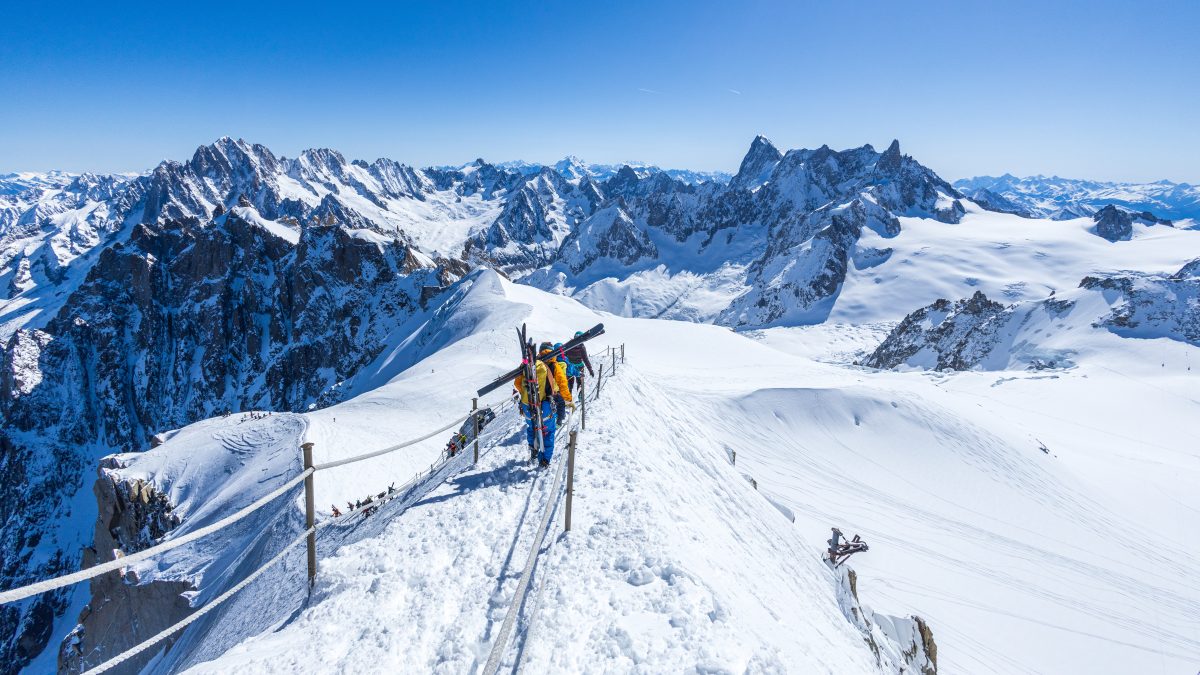
From the tunnel exit on the Aiguille du Midi, the famous, exposed snow arête is descended on crampons.
Across the glacier at the Col du Midi
On the glacier the route heads west on the rope, past the south flank of the Aiguille du Midi. For much of the season the crevasses lie hidden under the snow.
Up the arête
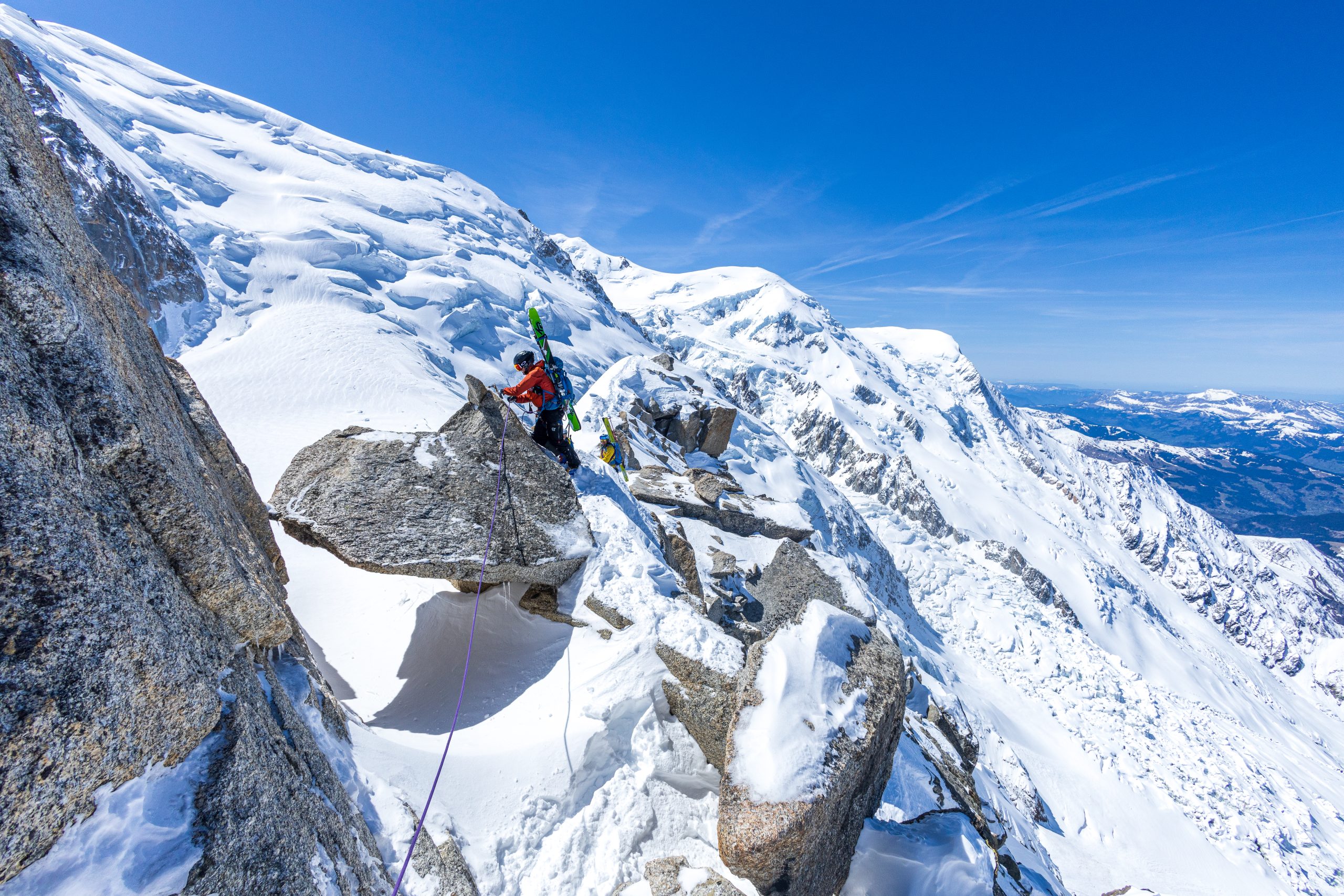
The ridge is around 100 metres long, on good granite with clear holds. The only technical point is a five-metre cracked slab of about 4b.
Refuge des Cosmiques, 3,613 m
After a little over two hours the route reaches the terrace behind the Refuge des Cosmiques, a natural place for a break. The hut reopens in mid-February 2027 after a closed 2026 season.
Back to the Aiguille du Midi
The return crosses the glacier and climbs the exposed snow arête to the station, an ascent many underestimate. The whole outing took three and a half hours.
3D graphic © 2026 madseriksson.no. Terrain: Copernicus DEM GLO-30 (© DLR e.V. 2010–2014 and © Airbus Defence and Space GmbH 2014–2018, provided under the Copernicus programme by the EU and ESA). Glacier and snow: Sentinel-2 cloudless 2016 by EOX IT Services GmbH (contains modified Copernicus Sentinel data 2016, CC BY 4.0).
The Aiguille du Midi — Twenty Minutes from Town to Glacier
The cable car carries climbers from the streets of Chamonix to almost 3,850 metres, and an ice tunnel and an exposed snow ridge lead them on to the glacier
The day starts in the middle of Chamonix. The cable car leaves the valley station at 1,035 metres, changes cabins at the Plan de l’Aiguille at around 2,300 metres and climbs the last great span to the rock needle of the Aiguille du Midi, a vertical rise of more than 2,800 metres in about twenty minutes. Opened in 1955, it still holds the record for the greatest vertical ascent of any cable car in the world, and it is the reason the Arête à Laurence can be done as a day trip without a night in a hut. The guide to the Aiguille du Midi covers the terraces, the museum of mountaineering and the glass “Step into the Void” in detail; for climbers, the station is above all a doorway.
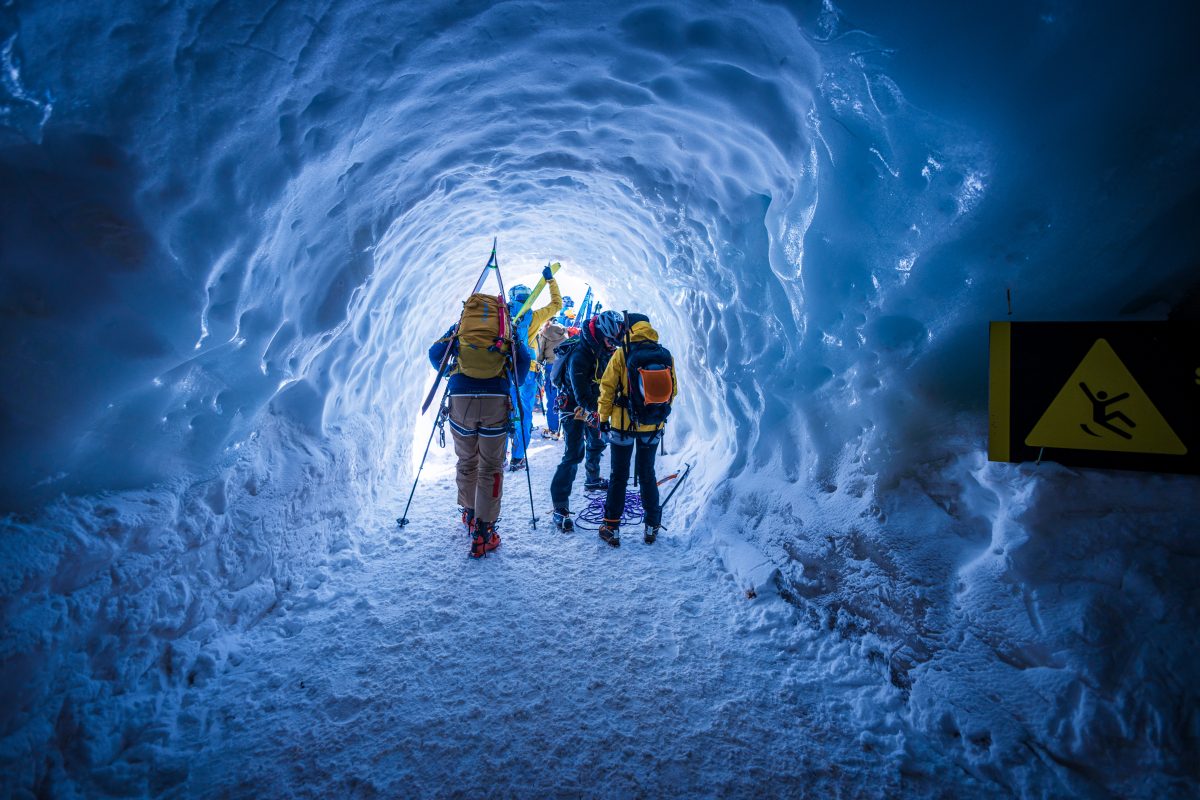
That doorway is an ice tunnel. From the station buildings a passage leads through a cave cut into the snow and ice of the ridge, where parties put on harnesses, tie into the rope and fasten their crampons. At the far end the tunnel opens on to the Midi arête, the narrow snow crest that drops from the station towards the glacier plateau of the Col du Midi and the upper Vallée Blanche. It is one of the most photographed places in the Alps. On the left the north face falls steeply towards Chamonix; on the right the slope runs down towards the glacier; ahead lies the whole eastern half of the massif, from the Aiguille Verte to the Grandes Jorasses. In winter and spring a team of workers shapes the ridge into a path, carving a zigzag into the steepest part and fixing handlines along it, so the crest is usually well trodden. It remains exposed, and a slip here would be serious.
The descent is short. On the GPS track it measures little more than 350 metres from the tunnel exit to the flatter snow below, but it is the part of the day where most beginners feel the altitude and the exposure at the same time. Crampons, an ice axe and a rope are the norm, and parties usually move together on a short rope, clipping the handlines where they exist. On the late-April day documented here, the photographs show climbers walking down the ridge between the handlines with skis strapped to their packs, the party bound for the Laurence among them. In summer the ridge can be icy in the morning and soft and slushy in the afternoon, and later in the season the crest narrows as the snow melts away.
The ice tunnel is where the Aiguille du Midi stops being a viewpoint and becomes a mountain. Everything beyond it is glacier terrain, with the same rules as anywhere else in the high Alps.
Timing matters from the start. The cable car runs every fifteen or thirty minutes depending on demand, and in high season the early cabins fill with climbers and skiers. For the 2026–27 winter, the operator lists daily service from 19 December 2026 to 28 March 2027 from 8.10, with the last return departure at 15.00, and from 29 March to 30 May 2027 with the last return departure at 15.30. An adult return ticket costs from about €83 and a single from about €61. Because the outing finishes back at the top station, the last cabin down is the hard deadline of the day, and parties should plan to be back at the tunnel with a good margin. Bad weather, high wind or technical faults can close the cable car at short notice, and a party caught out on the glacier then faces a night at the hut or a long descent on foot.
The Glacier — A Rope Party Under Mont Blanc du Tacul
From the foot of the Midi arête the route crosses the broad glacier plateau of the Col du Midi, past the south side of the Aiguille du Midi, to the start of the ridge
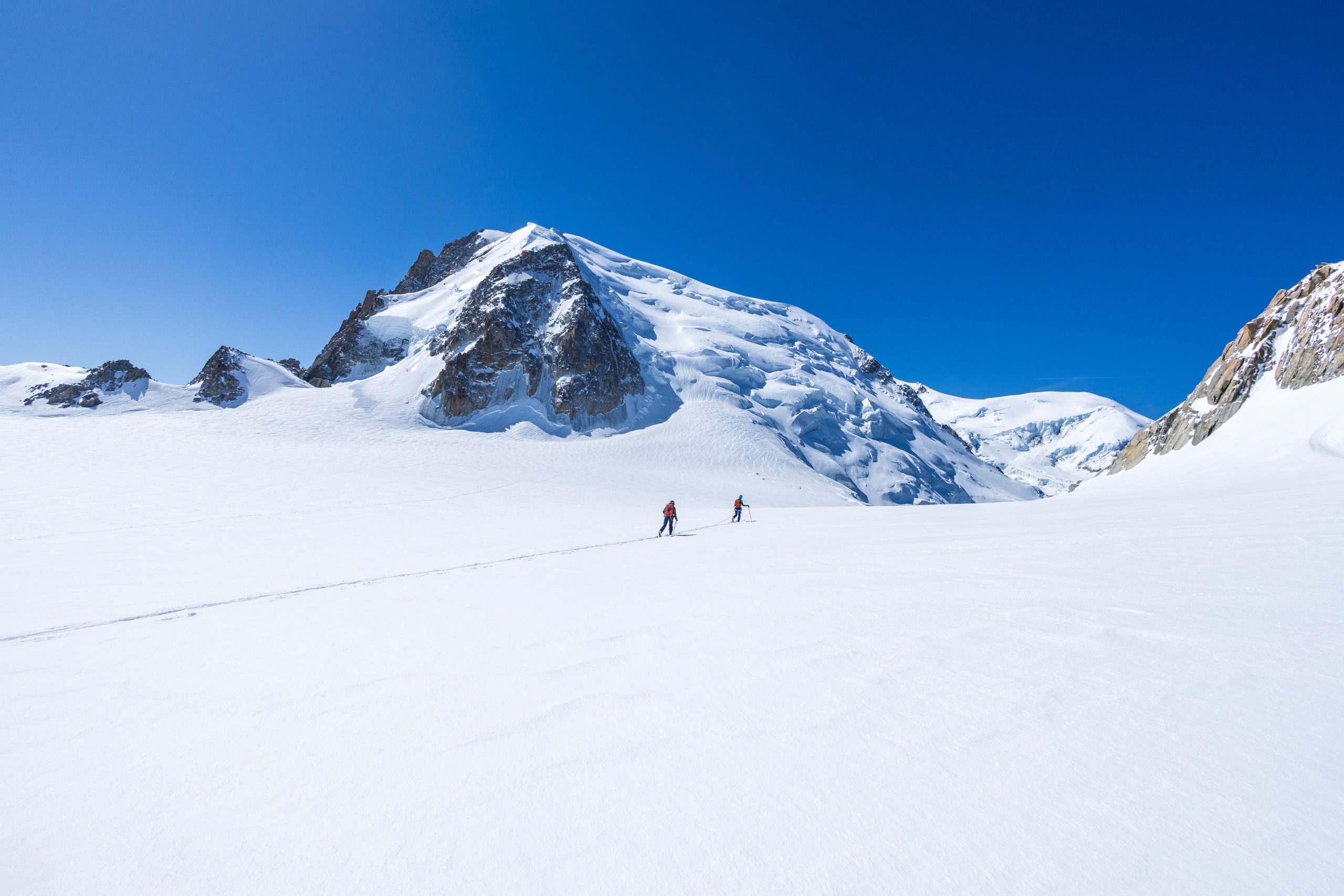
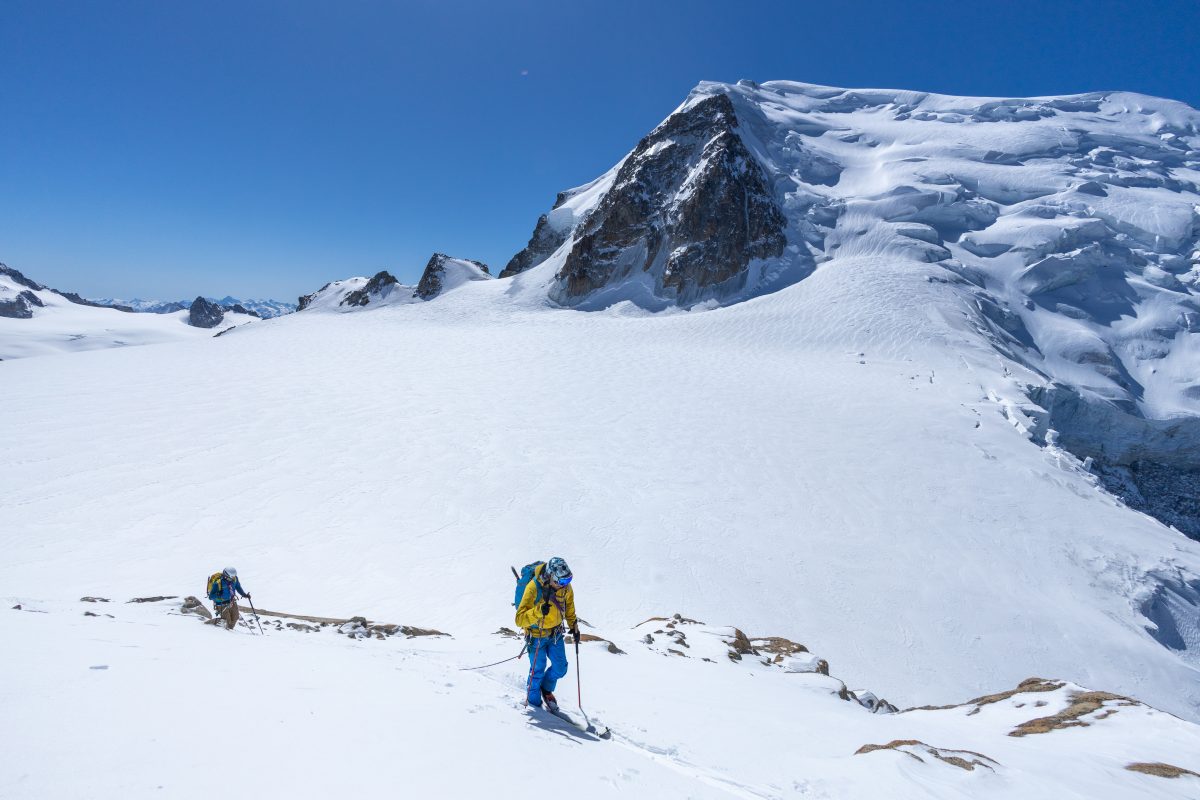
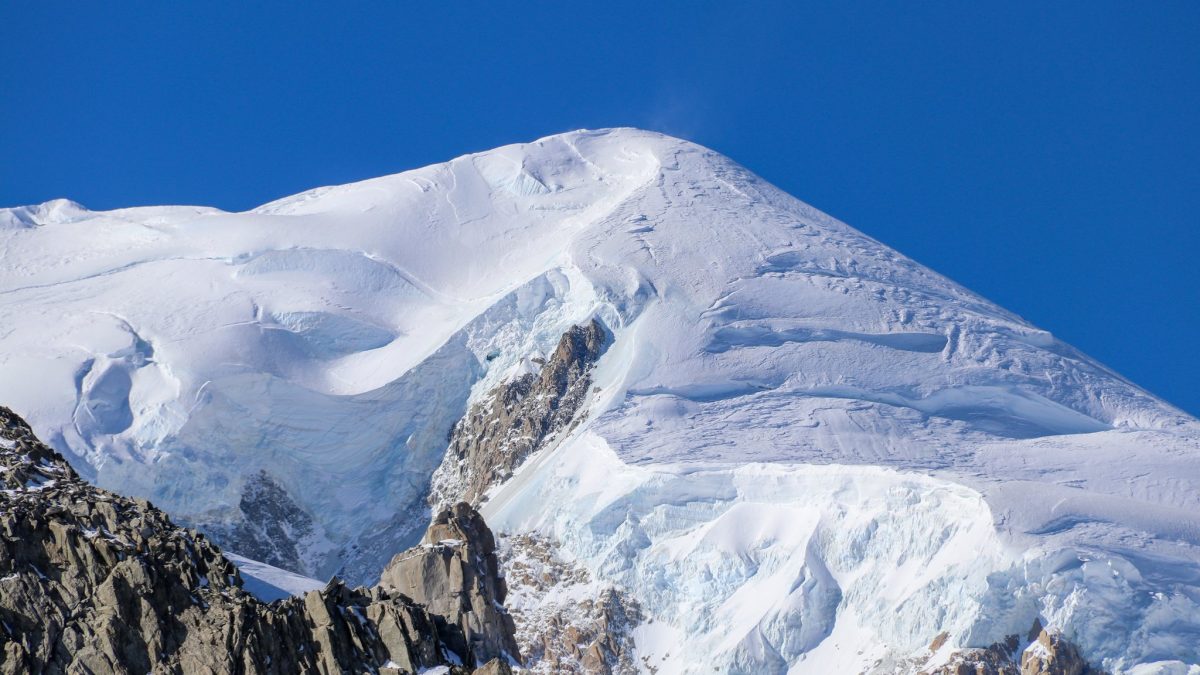
At the foot of the snow ridge the world opens out. The Col du Midi is a wide, gently sloping glacier plateau at about 3,530 metres, the saddle between the Aiguille du Midi and Mont Blanc du Tacul, and the source of the ice that flows east and down as the Glacier du Géant and the Vallée Blanche. Above it rises the great snow dome of Mont Blanc du Tacul, 4,248 metres, with the dark rock triangle of its north face — the Triangle du Tacul — facing the plateau. Most traffic heads east here: skiers follow the tracks down the Vallée Blanche, and climbers walk across to the Tacul or to the routes on the south face of the Midi. The way to the Arête à Laurence turns south and then west instead, beneath the rock walls of the Aiguille du Midi, towards the spur on which the Refuge des Cosmiques stands.
The GPS track of the outing shows the shape of it clearly. From the base of the Midi arête the line runs south across the plateau, keeping well away from the rock walls on the right, then curves west to the foot of the arête below the hut. From the top station to the start of the ridge it measures about two kilometres, almost all of it gently downhill or level, and on a good surface it is a walk of well under an hour. The glacier is not dangerous because it is steep; it is dangerous because it is crevassed. For much of the year, and certainly in spring, the crevasses lie hidden under snow bridges that may or may not hold the weight of a person, and the only reliable protection is a rope between the members of the party, kept reasonably tight, with everyone able to hold a fall and help with a rescue.
On the April day photographed here, the plateau was a smooth white sheet with ski tracks running across it, and the party moved on foot with skis on their packs, roped together. The photographs show two figures far out on the glacier under the Tacul, and a roped pair walking a single track across the plateau with the Grandes Jorasses on the horizon and the rock and ice of Mont Blanc du Tacul above them. In summer the same ground looks different: the snow thins, the glacier surface becomes harder and dirtier, and crevasses open as visible slots across the plateau. The well-used track between the Midi and the hut is then usually obvious, but it moves from year to year as the glacier changes, and it is still not a path in any normal sense.
This short glacier crossing is a large part of why the Arête à Laurence works so well as a first alpine route. It shows, in miniature and close to safety, what glacier travel involves: roping up properly, managing the rope while walking, staying in line, thinking about where the crevasses might be. A party that already knows these skills can practise them in a forgiving setting. A party that does not should not learn them here alone, but with a qualified mountain guide, who will also carry and know how to use the crevasse rescue kit that every rope team on the glacier should have.
The Col du Midi is wide, bright and gentle, and that is exactly what makes it treacherous. The crevasses do not show themselves, and the rope is the only thing that makes the walk safe.
The Arête — A Short Granite Crest to the Hut
Snow, sound granite blocks and one five-metre slab lead up from the glacier to the back door of the Refuge des Cosmiques, with the Aiguille du Midi straight ahead
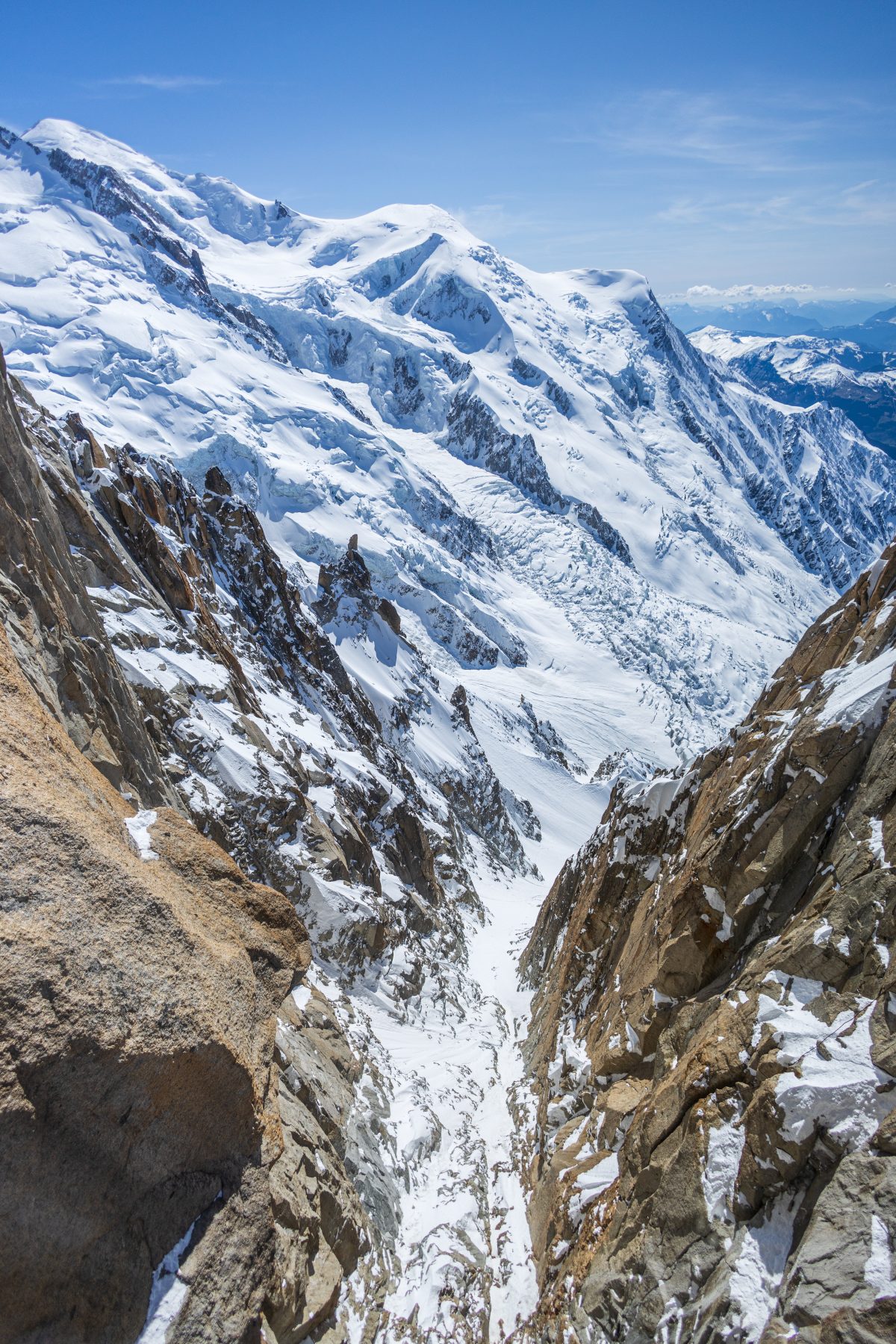
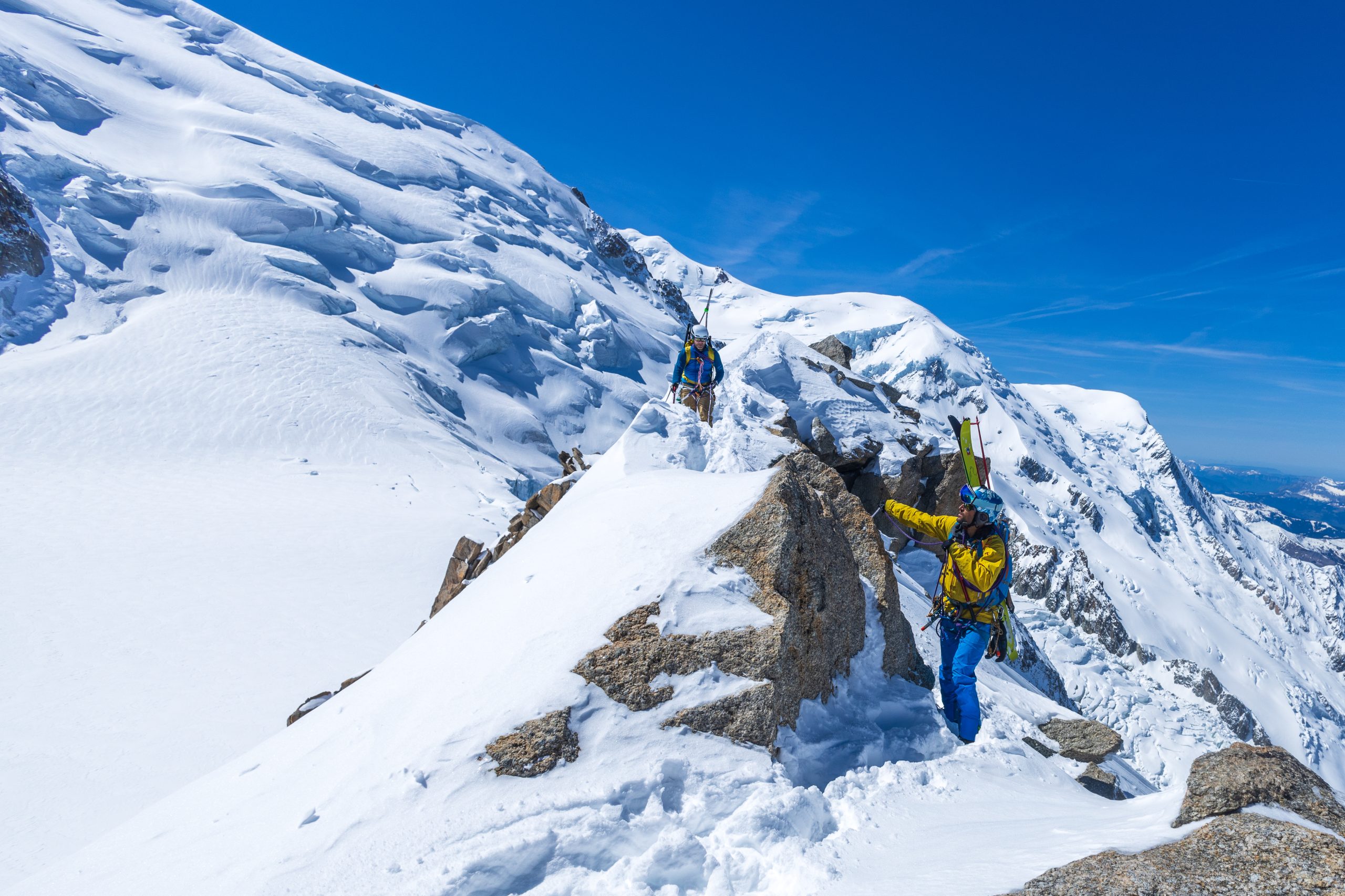
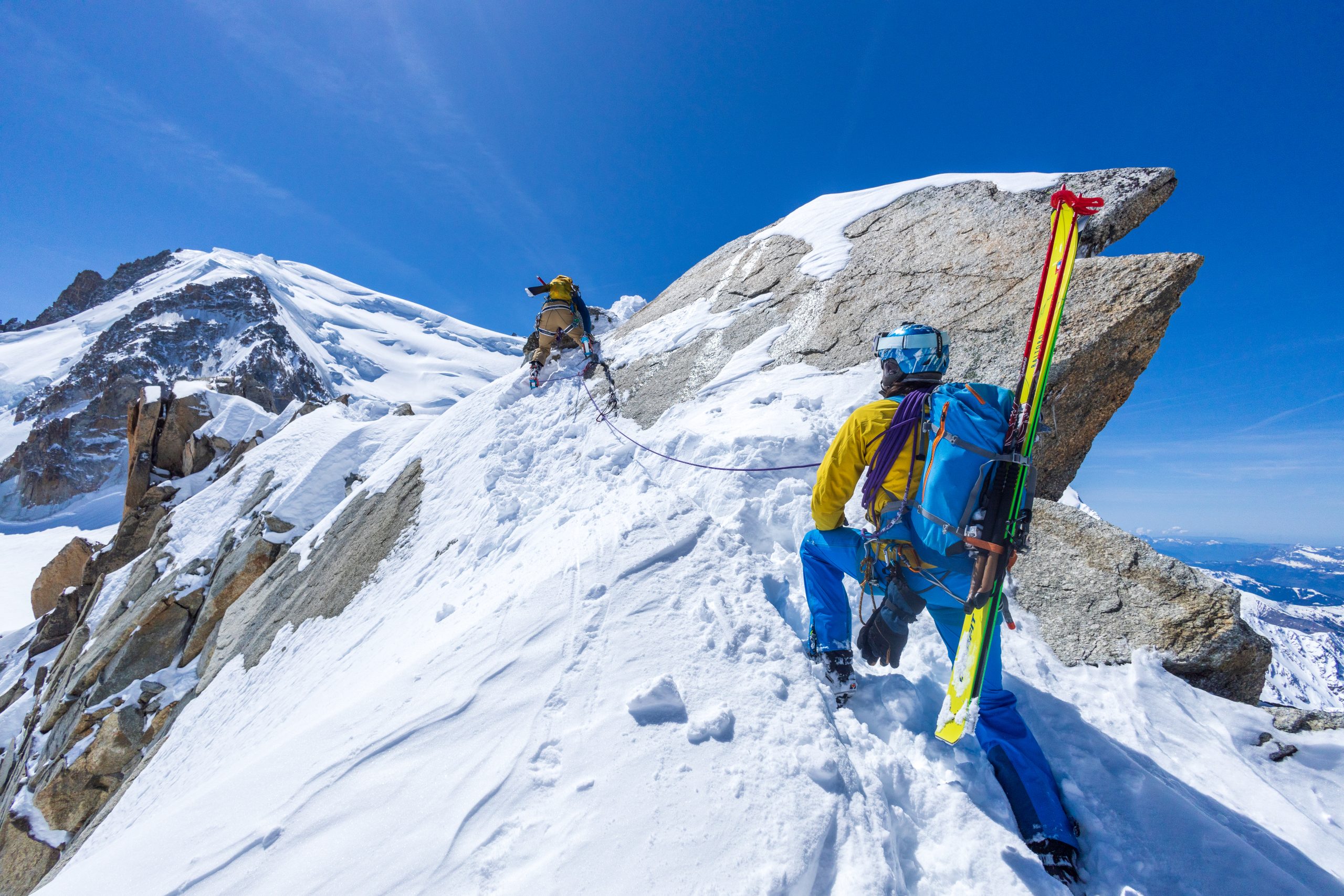
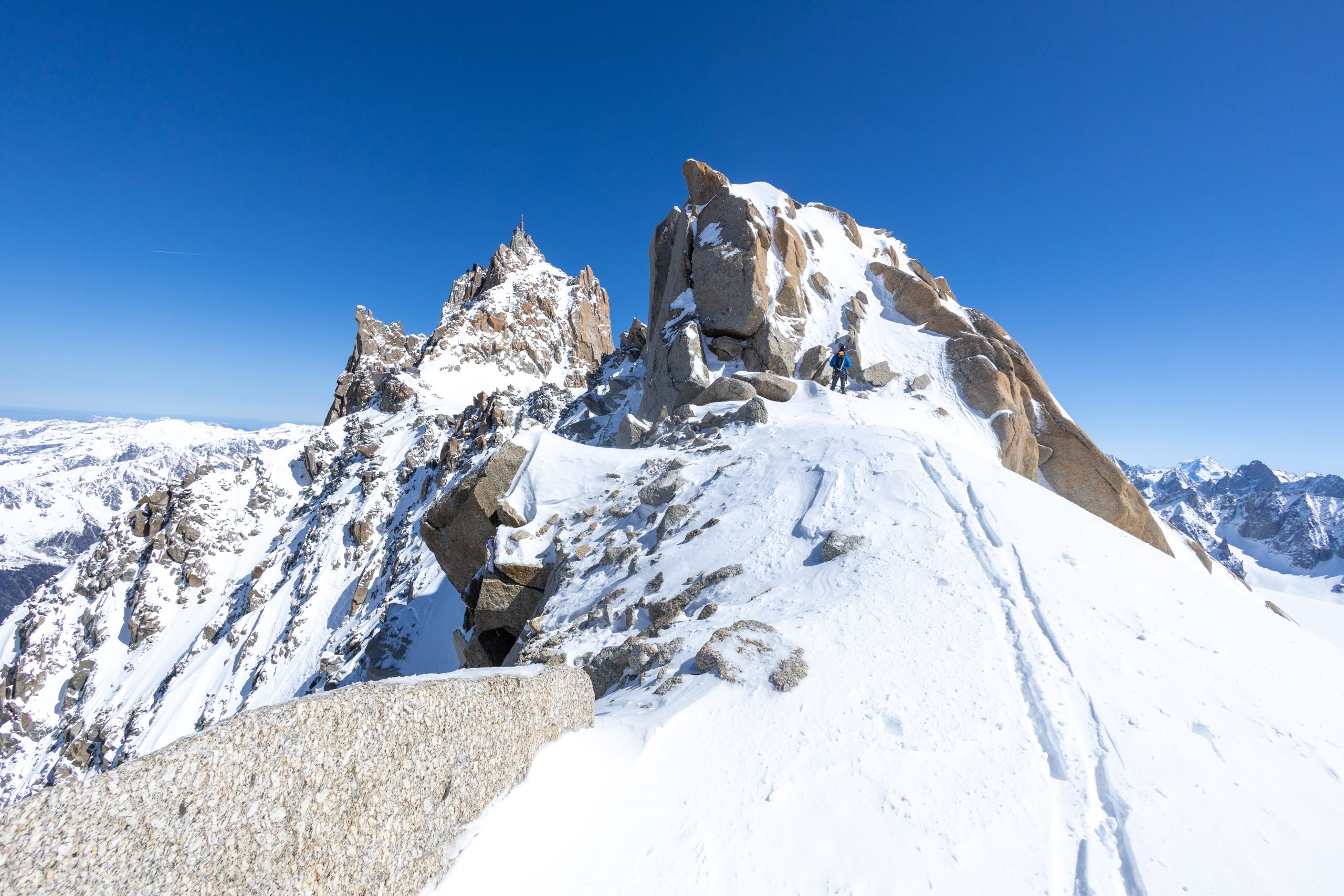
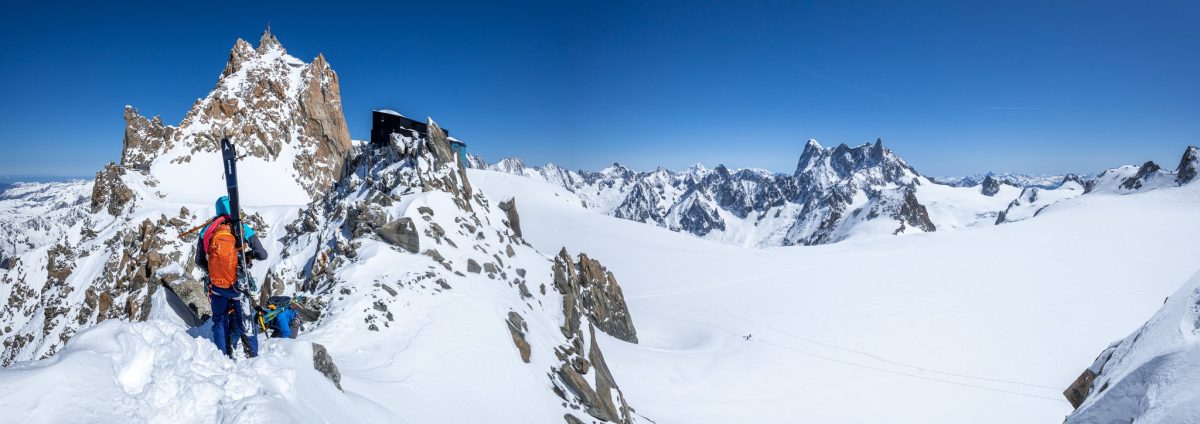
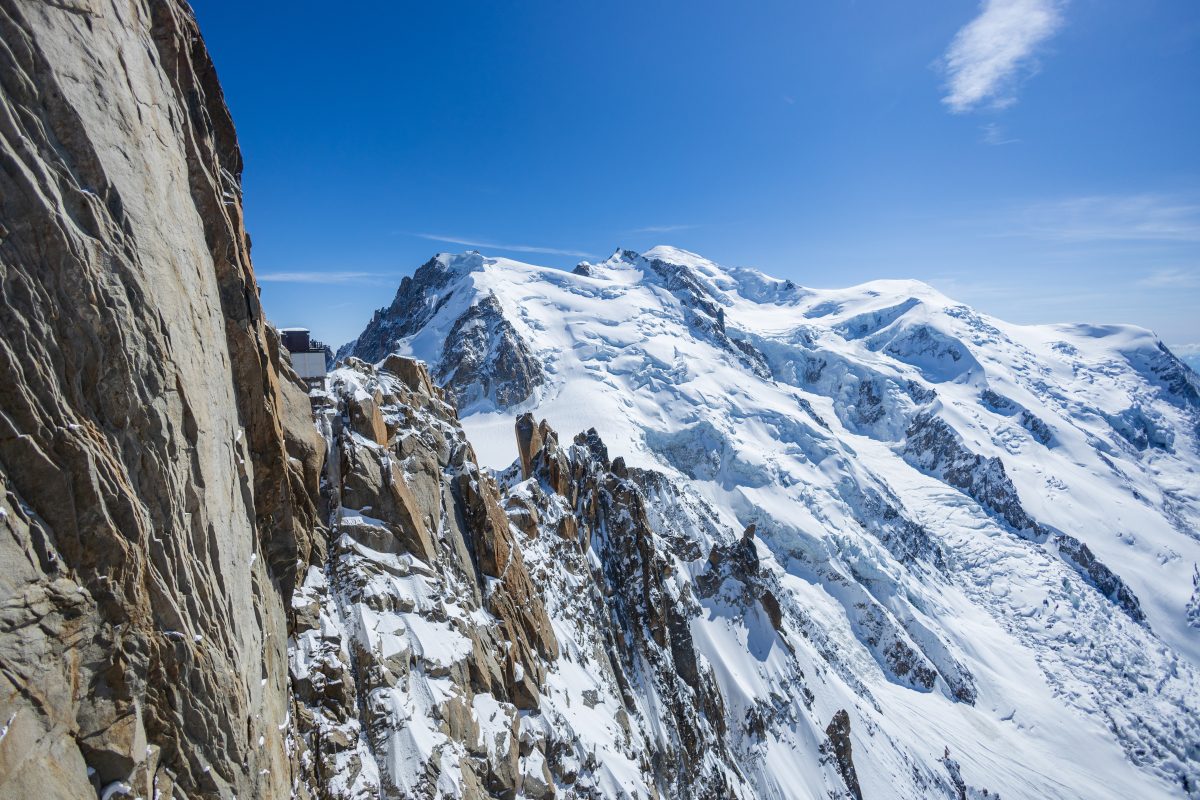
The ridge begins a short way west of the Col du Midi, where a rocky crest rises out of the glacier and climbs north towards the Cosmiques spur. A ramp on the left leads up on to the crest, and from there the route follows the edge to the right, sometimes on snow, sometimes on blocks of the warm-coloured granite that makes the Chamonix aiguilles so famous. The rock is generally good and the holds are clear. For most of its length the ridge is a scramble rather than a climb, but it is a scramble with air on both sides: on the left the slope drops towards the plateau, on the right the view falls away over the glaciers on the Chamonix side, and ahead the needle of the Aiguille du Midi, with its station and mast, fills the sky.
The Laurence is short. The ridge itself is about 100 metres long, and most descriptions give one to two hours for it, or two to three hours for the whole outing from the station to the hut. It is usually graded PD, peu difficile, on the French alpine scale — a step up from the walking-on-snow routes graded F, and well below the AD of the Arête des Cosmiques — and some descriptions rate it lower still. Grades only tell part of the story at this height. At more than 3,500 metres, on a crest where a fall would not end on the next ledge, even simple moves demand concentration, and for a first-timer the real test is moving calmly and steadily on exposed ground in crampons, with the rope managed well between partners.
There is one step that calls for real technique. Partway along the ridge the crest drops over a cracked granite slab about five metres high, graded about 4b. Parties either downclimb it directly, which is easy for a confident climber but awkward in crampons and with skis on the back, or rig a short abseil. A 30-metre rope is enough, and it makes sense to carry it ready whatever the plan, because snow and ice on the slab can turn a straightforward downclimb into a delicate one. On the day photographed here, the slab and the blocks around it carried a thick layer of spring snow; one climber is seen working past an overhanging boulder with the rope running back to a partner, skis strapped to the pack.
One slab, one abseil, a hundred metres of granite. The Laurence is small enough to learn on and real enough to remember.
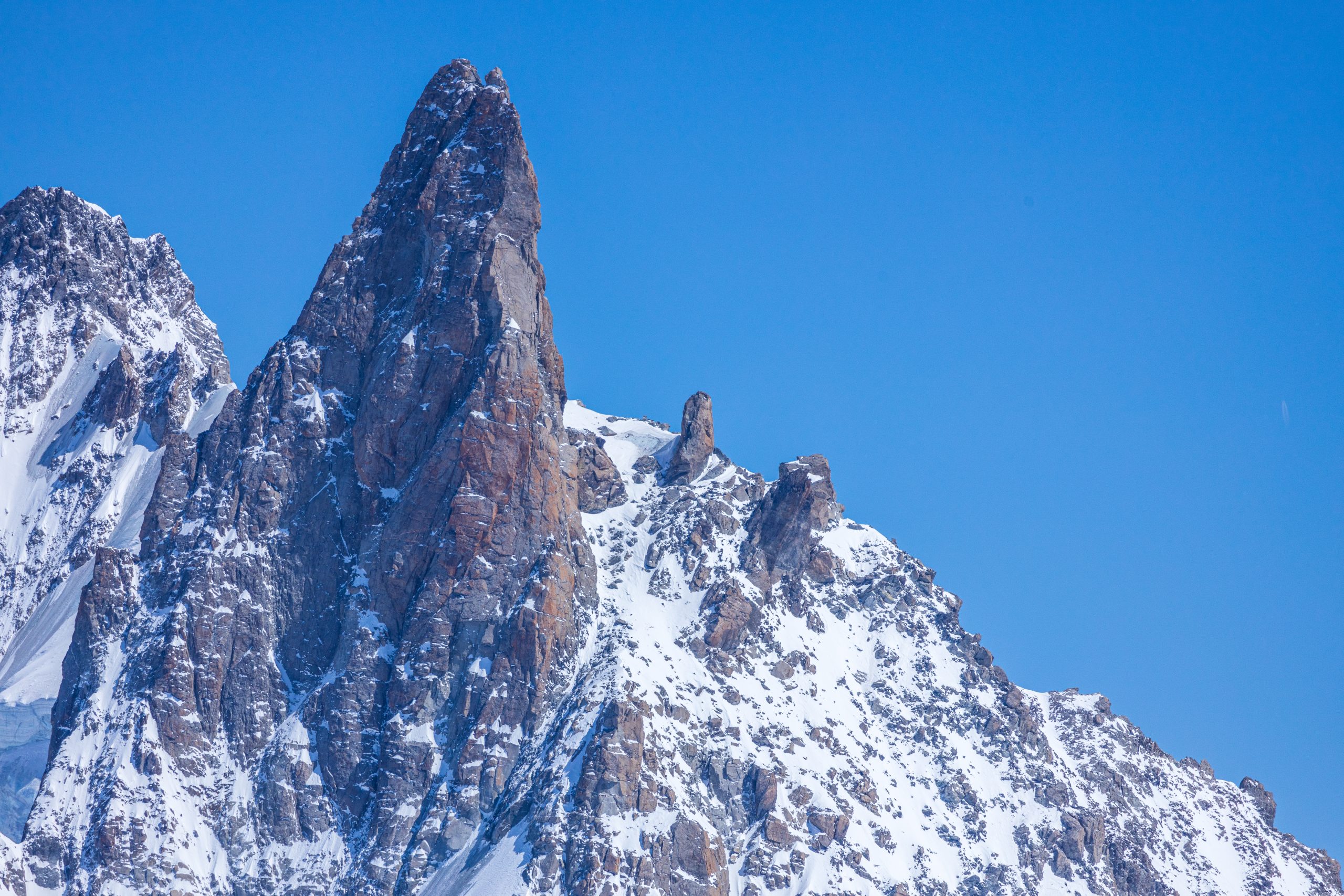
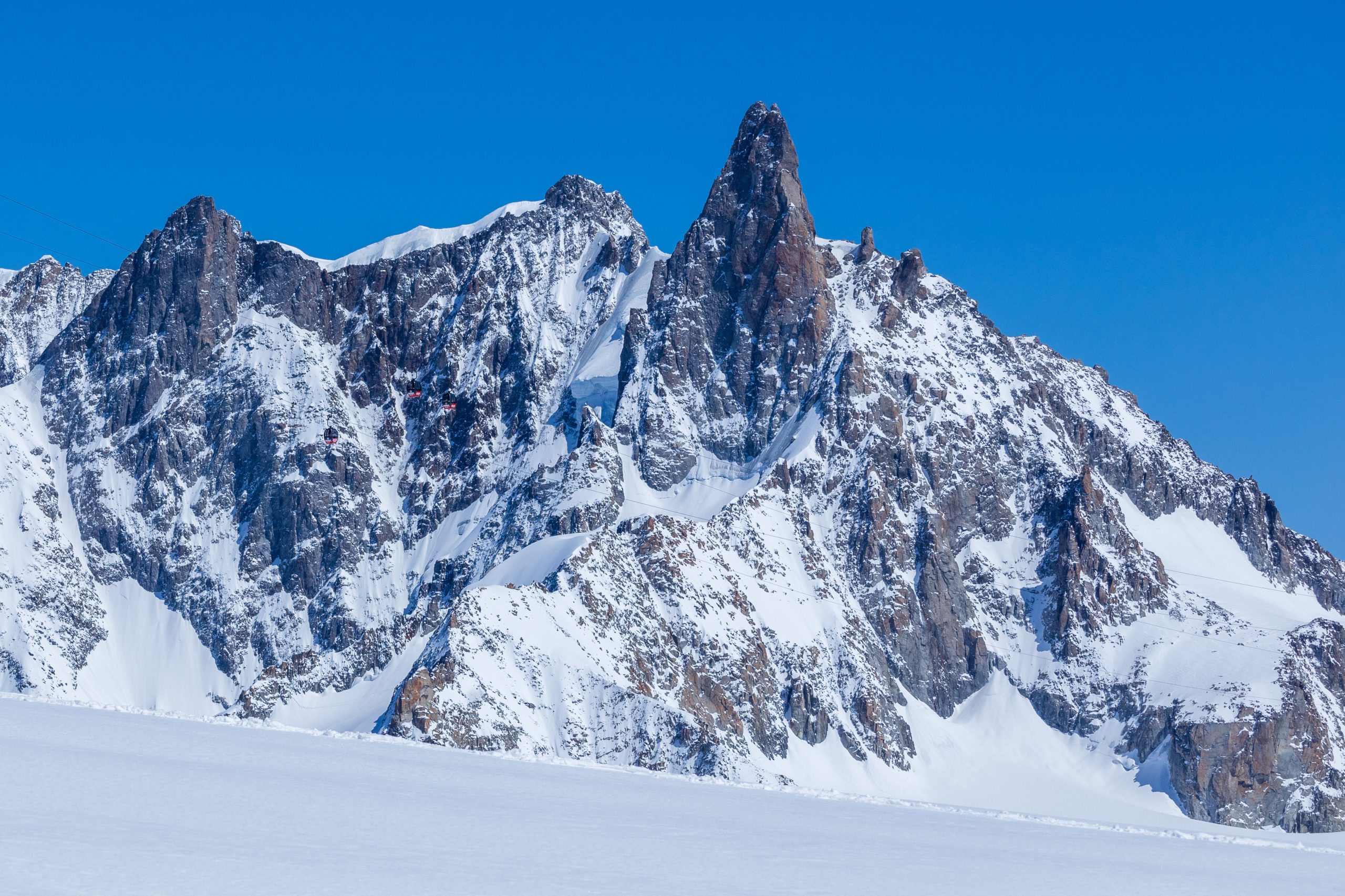
After the slab the ridge continues on mixed snow and rock towards the hut. Near the top end there is a large block that is reported to be loose, which is a good reason to test every hold rather than pull blindly on whatever looks solid. The last part leads directly beneath the Refuge des Cosmiques, and the route finishes by climbing up to the back of the building, where a ladder gives access to the hut. From the upper ridge the view is one of the best in the massif: the Aiguille du Midi rising directly behind the dark hut building, the Glacier du Géant spreading east towards the Grandes Jorasses and the Dent du Géant, and the snow dome of Mont Blanc du Tacul above the plateau that the party has just crossed.
The Refuge des Cosmiques — A Hut Born of Physics
The goal of the ridge is one of the busiest huts in the French Alps, the base for the Cosmiques Arête, Mont Blanc du Tacul and the three-peak route to Mont Blanc
The Refuge des Cosmiques stands on a rocky promontory between the Col du Midi and the foot of the Arête des Cosmiques, a dark, angular building that looks almost industrial against the snow. Its name goes back to science rather than mountaineering. In the 1930s a high-altitude station was set up here to study cosmic rays, the particles from space that strike the upper atmosphere, an initiative associated with the French physicist Louis Leprince-Ringuet, and for decades the site was run by the national research centre, the CNRS. The present hut, built around 1990 and opened in 1991, is owned by the commune of Chamonix and run by a Chamonix guiding organisation under a concession. Next to it stands the much smaller Abri Simond, a basic shelter with about fifteen places that stays open when the main hut is closed.
For climbers, the Cosmiques is one of the most useful huts in the Alps. It sits at the hub of the Col du Midi, within an hour of the cable car, and it is the usual base for the Arête des Cosmiques, for Mont Blanc du Tacul and for the three-peak traverse of Mont Blanc du Tacul, Mont Maudit and Mont Blanc. It is also a popular night for ski tourers and for parties acclimatising before bigger objectives. Sources disagree slightly on its size, but it sleeps well over a hundred people in dormitories, serves half-board with dinner and an early breakfast, and in the busy months is often full; bookings are made online, with a deposit, and open in January for the following season.
One important point for 2026 and 2027: the hut did not open for the 2026 season. Its own website gives the reopening as mid-February 2027, with the season running to the end of September and reservations opening in January 2027. The ridge, the glacier and the cable car are unaffected, and during the closure the Abri Simond remains available as a basic shelter, but anyone planning to combine the Laurence with a night at the hut, or counting on the hut as a refuge in bad weather, should check the current status before setting out.
The hut at the top of the ridge began as a laboratory for cosmic rays. Today it is where the high routes of the Col du Midi begin and end.
Arriving at the hut from the Laurence is a quiet pleasure. In a normal season the terrace offers a place to sit, drink something warm and take in the panorama: the Aiguille du Midi directly above, the Glacier du Géant sweeping east, the Grandes Jorasses and the Dent du Géant across the ice, and Mont Blanc du Tacul looming over the col. For parties who want to stay, a night at the Cosmiques turns the short outing into a gentle introduction to hut life at altitude, with a sunrise over the massif and an early start on a bigger route the next morning. For those returning the same day, the hut is simply the turning point, and the real work of the day still lies ahead.
The Return — The Climb Everyone Underestimates
Back across the glacier and up the snow arête to the station, and then the harder ridges that the Laurence opens the door to
From the hut the simple way back is the way in. The track drops off the Cosmiques spur on to the glacier, runs east across the plateau to the foot of the Midi arête and climbs the snow ridge to the ice tunnel. On the GPS track this return leg measures about 1.4 kilometres, with roughly 165 metres of ascent, most of it on the final snow ridge. It sounds trivial, and on paper it is: across the whole outing the track adds up to just 3.8 kilometres with about 220 metres of climbing. But this is the part of the day that catches people out. At over 3,600 metres, a few hours after arriving from the valley, every step uphill is noticeably harder, and many first-time visitors find the plod up the arête the most strenuous part of the day.
The conditions change too. By early afternoon the sun has softened the snow on the ridge, and the trodden steps can turn to slush over a harder base, or freeze into icy steps if cloud comes in. The exposure on the upper arête is the same as in the morning, but tired legs and thin air make it feel greater. A steady pace, crampons kept on and the rope kept tidy are the answer. On the April day photographed here, the party was on the lower part of the snow ridge, below the station and its cable car cabin, at about half past two in the afternoon and back in the ice tunnel a little after three.
For stronger parties, the hut is also the start of a more ambitious return. The Arête des Cosmiques, first climbed by George and Maxwell Finch in 1911, leads from the hut back up to the Aiguille du Midi along a longer and more serious granite ridge. It is graded AD, with a couple of abseils, steeper mixed steps where footholds have been drilled into the rock, and a final ladder on to the viewing platform of the station. Doing the Laurence out to the hut and the Cosmiques back makes a complete circuit of both ridges in about four to five hours, but it requires a clear step up in skills: abseiling, climbing in crampons on rock and route-finding. It is also a route to check before setting out, since there has been significant rockfall on the ridge in recent years and conditions can change from season to season. On summer weekends, queues at the cruxes are common.
The Laurence goes out to the hut and the Cosmiques comes back to the station: two ridges, one turning point and a whole day in the high mountains without touching a ski piste.
Skiers have another option. Because the Laurence starts and ends at the Midi, a fast and fit party can do it early in the morning and still be back at the tunnel in time to ski the Vallée Blanche, the long glacier descent from the Midi to Chamonix, the same day. The logistics are tight and require an early cabin and no delays, but the combination shows how much the Midi makes possible in a single day. For those planning a longer stay in Chamonix with alpine climbing as the goal, the classic progression starts with the Laurence to learn the terrain and the logistics, moves on to the Arête des Cosmiques for abseils and more sustained exposure, and then to bigger objectives such as the Triangle du Tacul or the mixed traverse of the Aiguilles Marbrées above the Italian side of the Glacier du Géant.
Who It Suits — A First Ridge, Done Properly
What a party needs to know, carry and expect before stepping out of the ice tunnel, and how the route changes between spring and summer
The Arête à Laurence is often described as a beginner’s route, and in the context of the Mont Blanc massif it is. It is short, close to the cable car, technically easy except for one brief step, and it ends at a staffed hut in a normal season. But “beginner” here means a beginner in alpine climbing, not a beginner in the mountains. Two kinds of party suit it best. The first is a newcomer to alpinism who is fit, comfortable with heights and goes with a qualified mountain guide; for such a person the Laurence is an ideal first ridge, with the guide handling the rope, the glacier and the decisions. The second is an independent party with basic glacier skills: walking roped together, moving in crampons on snow and rock, building simple anchors, abseiling, and knowing how to arrest a fall and pull a partner out of a crevasse. For them it is a perfect training day, a chance to put those skills together at altitude in a contained setting.
The equipment list is the standard one for glacier terrain around the Midi. Each person needs mountaineering boots that take crampons, crampons, an ice axe, a harness, a helmet, warm and windproof clothing, gloves, sunglasses and plenty of sun protection, since the glare off the snow at 3,500 metres is intense even on a cold day. The party needs a rope suitable for glacier travel — a 30-metre length is enough for the abseil on the slab — plus slings, locking karabiners and the gear for crevasse rescue. A small amount of rock protection is useful on the ridge. Carrying skis, as the party in these photographs did, makes the scrambling more awkward but turns the day into the start of a ski outing.
Altitude deserves respect. The cable car lifts its passengers from the valley to almost 3,850 metres in twenty minutes, far faster than the body can adjust, and headaches, breathlessness and fatigue are common on a first visit. The effect is usually mild on a short outing that stays near 3,500 metres, but it is real, and it is one reason the return up the snow ridge feels so hard. Spending a day or two at moderate altitude beforehand, staying well hydrated and keeping the pace easy all help. Anyone who feels genuinely unwell should turn back early; the station is never far away, and that is one of the great advantages of this route.
The Laurence is a beginner’s ridge in the same way a short sea crossing is a beginner’s voyage: easy when everything goes right, and still the open sea when it does not.
The route is possible whenever the Midi cable car runs and conditions are reasonable, but the character changes through the year. In late winter and spring, as on the April day documented here, the glacier is covered in deep snow, crevasses are hidden, and the ridge carries a mantle of snow over the granite, which makes the scrambling easier in places and more delicate on the slab. The Col du Midi is busy with skiers, but the climbing routes are quieter than in summer. In high summer the snow on the ridge shrinks, more rock appears, crevasses open on the glacier, and the Arête des Cosmiques next door can be crowded; the Laurence then becomes a pleasant, quieter alternative. In every season the weather is the deciding factor. Wind, cloud and new snow can transform the Col du Midi in minutes, and a forecast check, at the Midi itself or for Chamonix, belongs in every plan.
For a broader view of the Chamonix side of the massif, the Chamonix ski touring guide follows a spring tour from Argentière to the Refuge Albert 1er above Le Tour, and The Alps in Pictures gathers photographs of granite, glaciers and the Aiguille du Midi from the same spring.
«The Arête à Laurence is not a great route in the sense of a long climb or a famous summit. It is a beginning. Twenty minutes after leaving the streets of Chamonix, a party steps out of an ice tunnel on to a snow ridge, ropes up on a glacier under Mont Blanc du Tacul, climbs a short crest of granite and arrives at a hut that takes its name from the study of cosmic rays. Along the way the Mont Blanc massif shows itself as it really is: not a view behind glass, but a world of ice, rock and air that can be entered on its own terms. Most people who do the Laurence once start looking at the ridges around it before they are back at the station, and the Aiguille du Tour at the northern end of the massif is the natural next step.»