Beijing was laid out as a diagram of the universe. A single line, 7.8 kilometres long, runs north to south through the old city, and on it the Ming emperors placed everything that mattered: the drum and bell that told the hours, the hill that guarded the palace, the palace itself with its nearly ten thousand rooms, the great gate where power faced the people, and, to the south, the altars where the Son of Heaven prayed for the harvest. Six centuries later the line is a World Heritage Site and the city around it, one of the largest metropolises on Earth, holds about 21.8 million people, a subway network of more than 900 kilometres and, at the northern end of the same axis, the steel lattice of the stadium where the Olympic Games opened in 2008 and again, in winter, in 2022. Few capitals show their history and their ambition along one straight road.

Beijing — Peking in older European usage — has been a capital, with interruptions, for most of the last eight centuries. Kublai Khan built his Great Capital, Dadu, here in the thirteenth century; the Ming emperor Yongle, Zhu Di, moved his court north from Nanjing and between 1406 and 1420 raised the walled palace now called the Forbidden City, with the Temple of Heaven to the south completed in the same year. Twenty-four emperors, fourteen of the Ming and ten of the Qing, ruled from that palace until the last dynasty fell in 1911–12. On 1 October 1949 the People’s Republic of China was proclaimed from the balcony of Tiananmen, the gate in front of it, and the city has been the national capital ever since.
What makes Beijing legible to a visitor is the plan. The imperial city was built symmetrically on either side of a north–south axis that runs from the Bell and Drum Towers in the north through Jingshan, the Forbidden City, Tiananmen and the square, past the gate of Zhengyangmen and down to Yongdingmen in the south, with the Temple of Heaven and the Altar of Agriculture placed on either side. In July 2024 this Beijing Central Axis, 7.8 kilometres long with fifteen components, became China’s 59th World Heritage Site. The modern city has extended the line northwards to the Olympic Green, where the National Stadium and the National Aquatics Centre were built for the 2008 Games.
How to approach Beijing
The sections below follow the axis from the centre outwards: Tiananmen Square and the Qianmen gate; the Forbidden City and the view from Jingshan; the Temple of Heaven; the Olympic Green; and the hutong lanes, the food and the acrobats, before the practicalities. Beijing has changed quickly since 2009, the year after the Summer Olympics: visits to the square and the palace are now booked in advance with a passport, the Water Cube has been an ice rink and back again, and the dragon on top of Pangu Plaza is gone. Like Tokyo and Seoul, Beijing is a city of enormous distances best crossed underground; unlike them, its centre is still organised around an emperor who is no longer there. The Great Wall, an hour or two to the north, is covered in a separate article on the wild wall at Jiankou.
Beijing in 3D
Beijing has been a capital, with interruptions, for most of the last eight centuries, and today holds about 21.8 million people. Its Central Axis, 7.8 km long with fifteen components from Yongdingmen in the south to the Bell and Drum Towers in the north, became China's 59th World Heritage Site in July 2024. This frame follows the axis from the Temple of Heaven through Qianmen, Tiananmen and the Forbidden City to Jingshan and the hutongs of Shichahai.
The Temple of Heaven
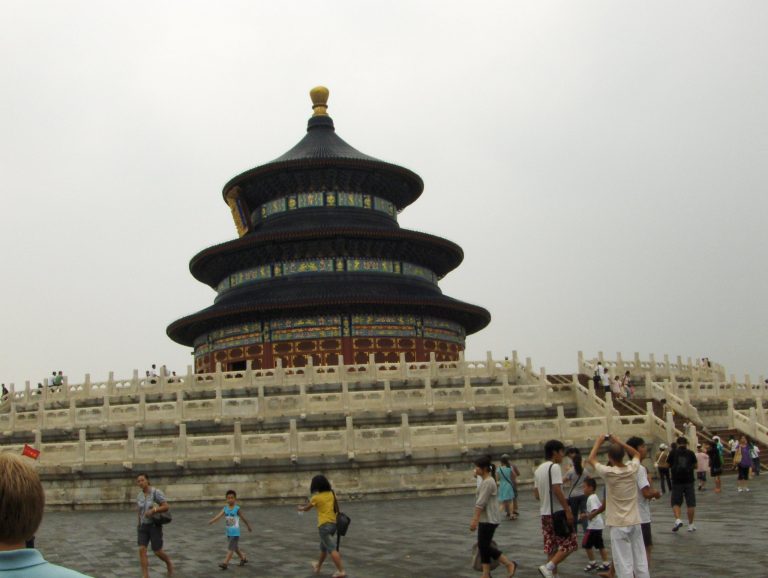
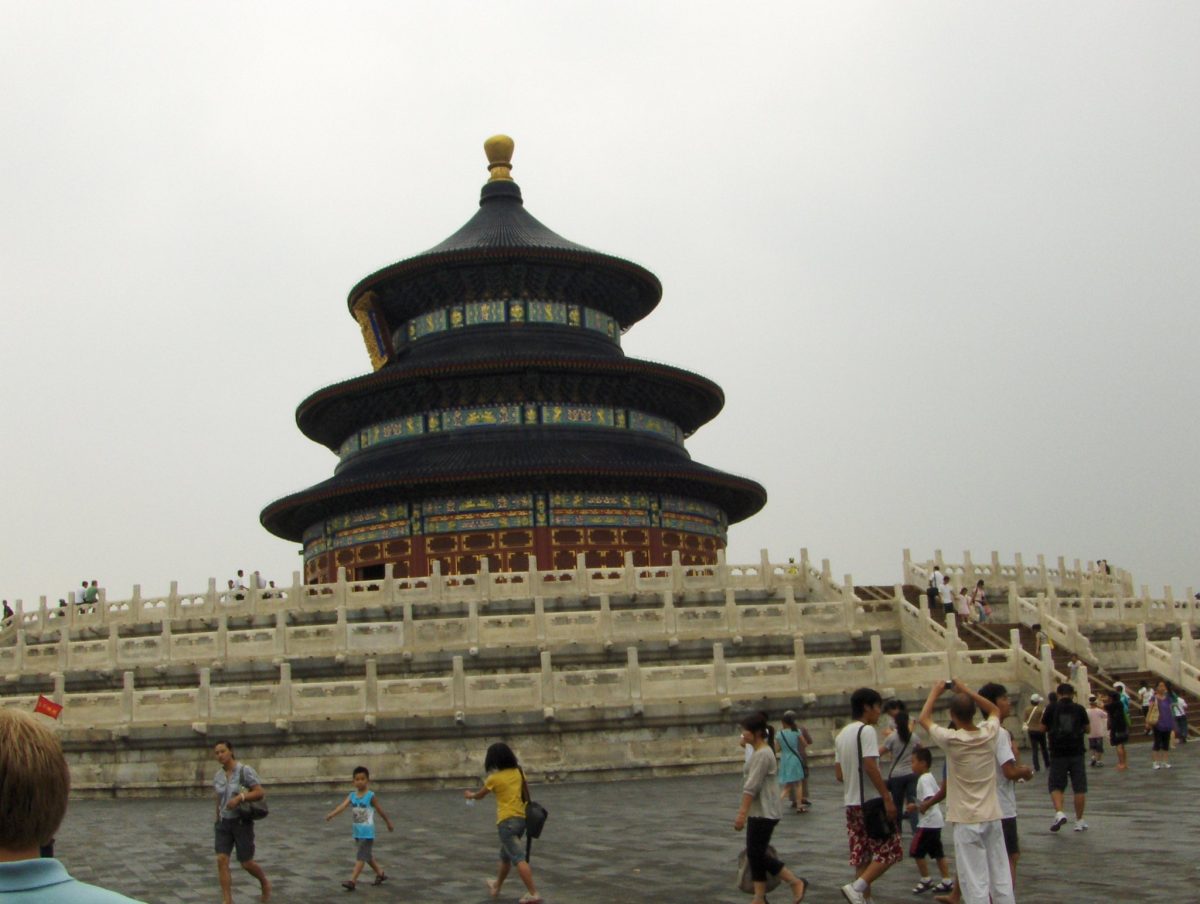
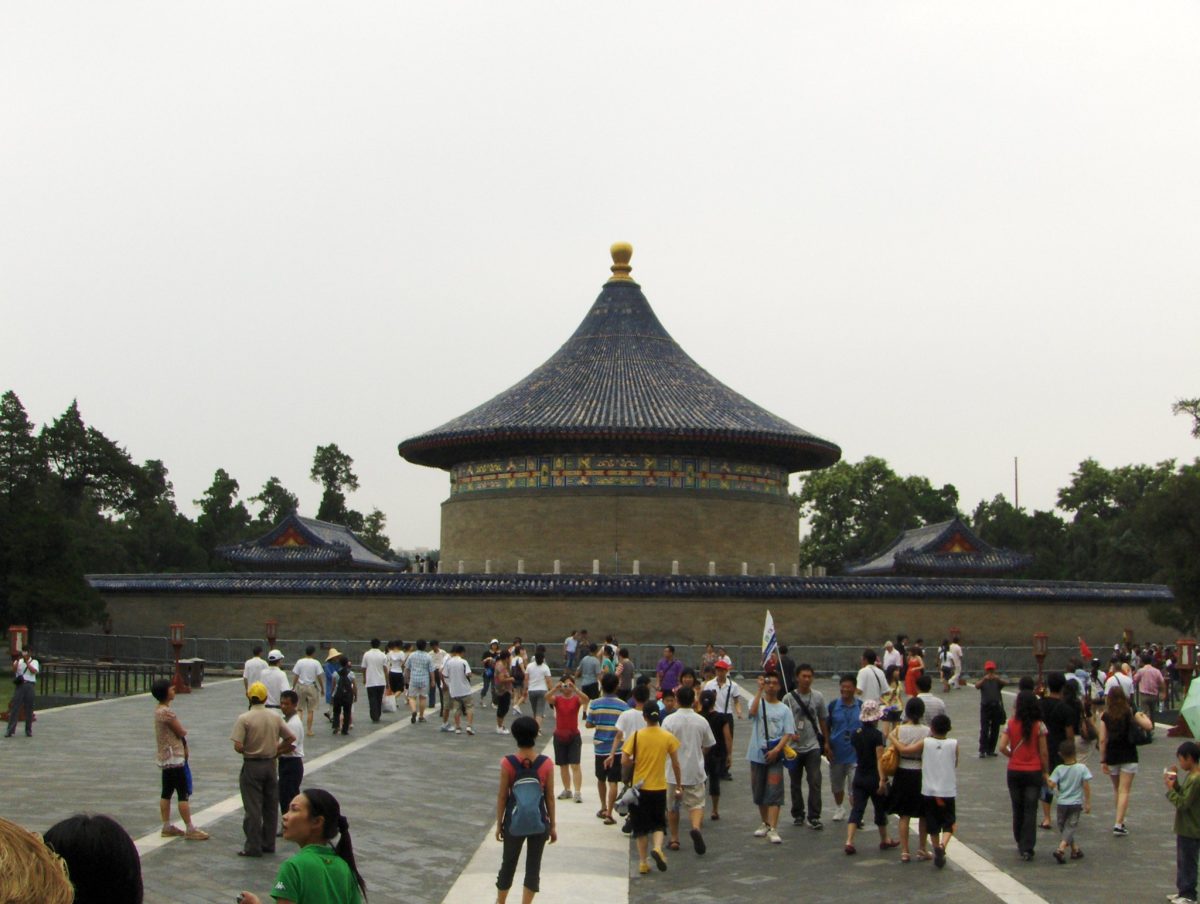
Completed in 1420 together with the Forbidden City, the Temple of Heaven covers 273 hectares of cypress woods south-east of Qianmen, where the emperor prayed for a good harvest in spring and sacrificed to heaven at the winter solstice. The Hall of Prayer for Good Harvests, 38 m high and built of wood without nails, burned after a lightning strike in 1889 and was rebuilt on the old plan; a raised walkway of 360 m leads south to the Imperial Vault of Heaven of 1530, inside the Echo Wall, and on to the Circular Mound Altar. The park opened to the public in 1918, and every morning its 72-bay Long Corridor fills with card players, dancers and musicians.
The Hall of Prayer for Good Harvests on its three-tier marble terrace at the Temple of Heaven, Beijing
Zhengyangmen and Qianmen Street
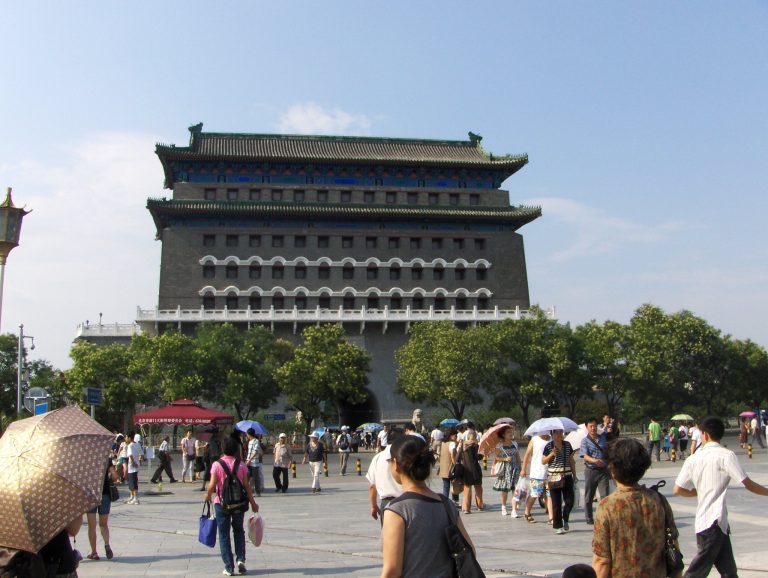
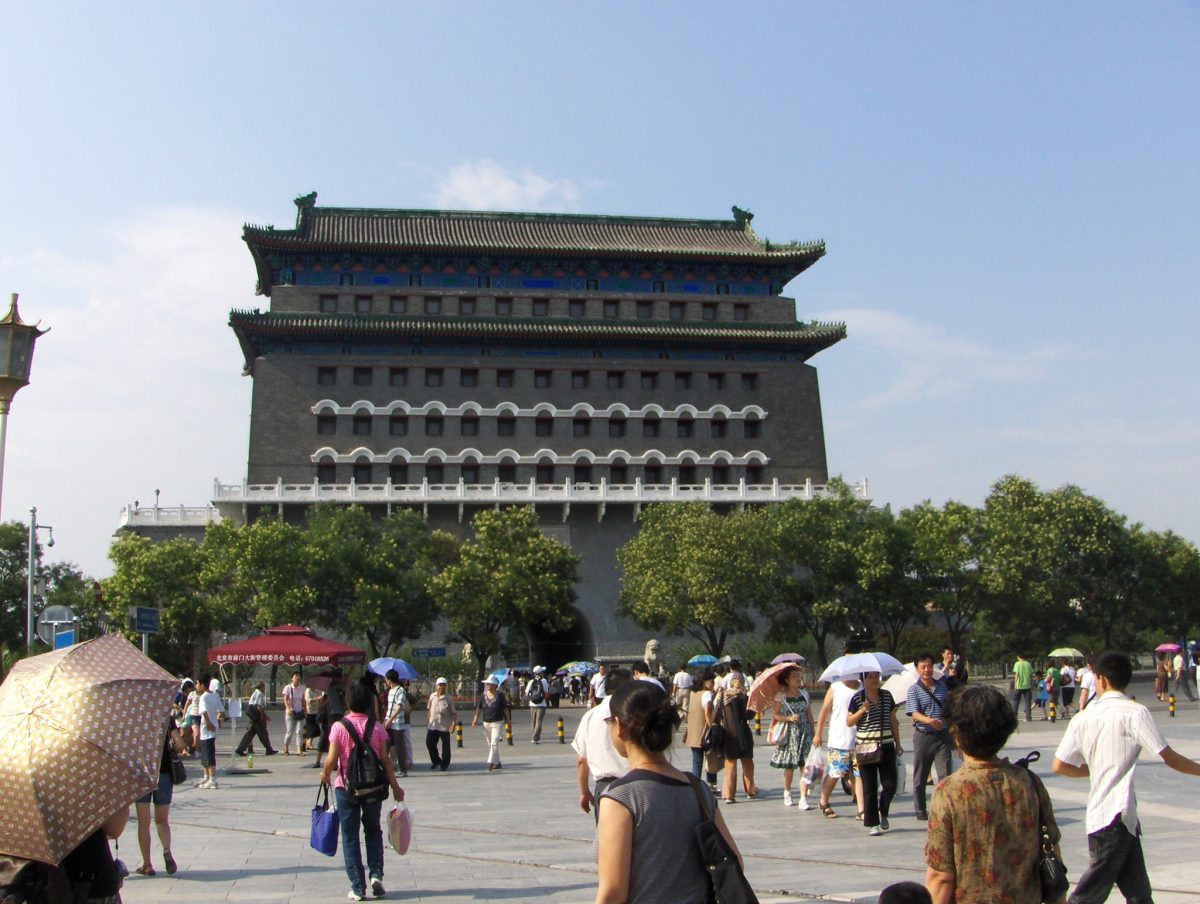
Zhengyangmen, the Front Gate of the inner city wall, was first built in 1419 and is really two buildings: the gatehouse, at 42 m the tallest of Beijing's city gates, and to the south the grey-brick Arrow Tower, pierced by rows of windows for archers. The wall that joined them went after the complex was damaged in 1900 and reworked in 1914–15 to let traffic through. Beyond the gate runs Qianmen Street, rebuilt in the 2000s as a pedestrian street of restored shopfronts, with lanes of older shops leading off towards Dashilan.
The Arrow Tower of Zhengyangmen (Qianmen) at the southern end of Tiananmen Square, Beijing
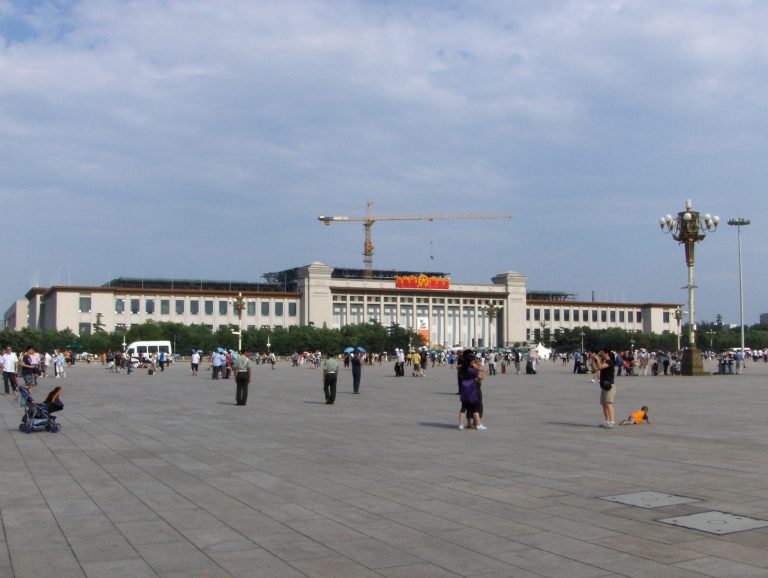
Tiananmen Square
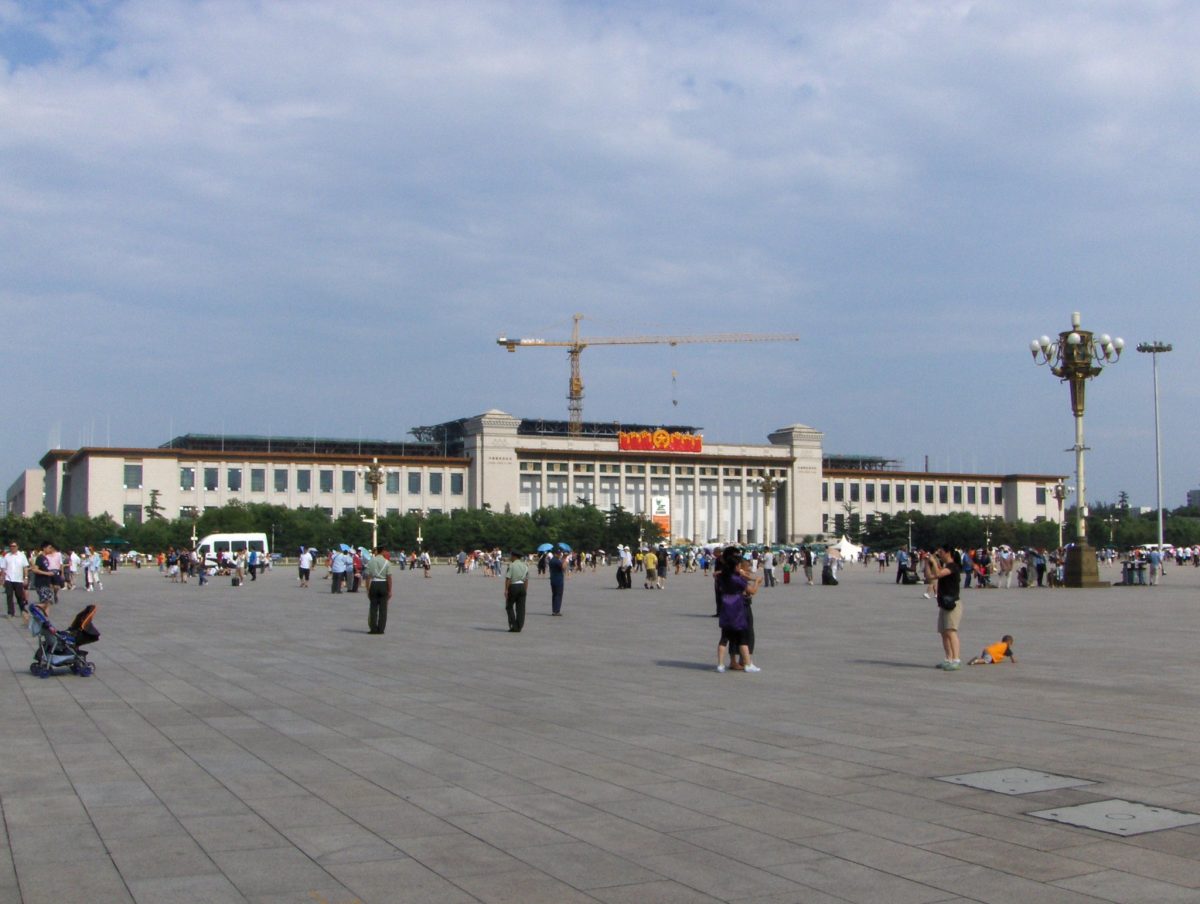
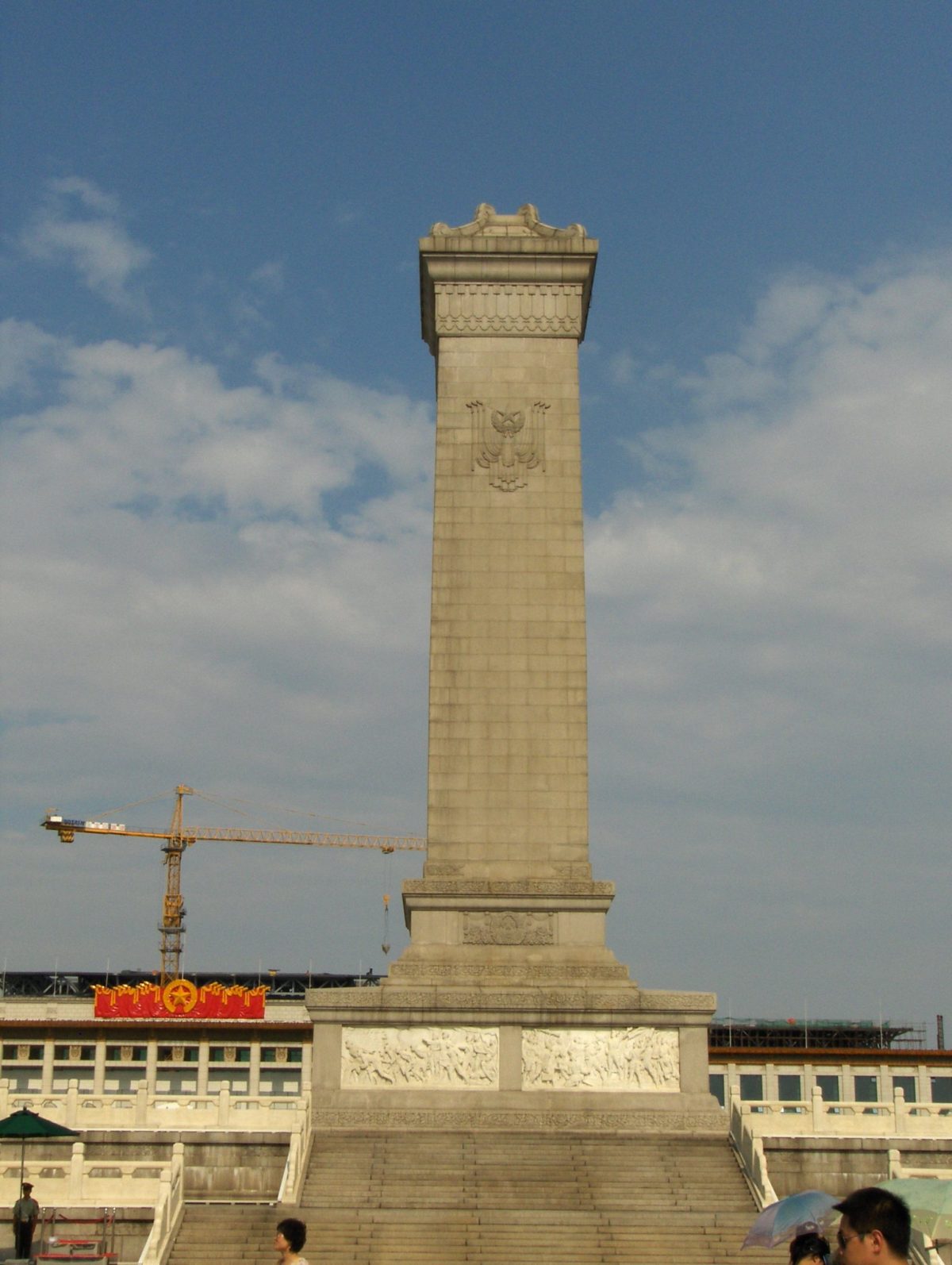
The square took its present form in 1958–59, when the space in front of the gate was enlarged about fourfold, with the Great Hall of the People on the west side and, on the east, the building that has housed the National Museum of China since 2003; in 2009 the museum stood behind cranes, and it reopened on 17 March 2011 after a four-year expansion. At the centre rises the granite Monument to the People's Heroes, about 38 m high, with the Chairman Mao Memorial Hall to the south. The national flag at the north end is raised at sunrise and lowered at sunset, and every visit to the square now needs a free real-name booking made one to seven days ahead.
Tiananmen Square looking east to the National Museum of China, with construction cranes from its expansion in 2009
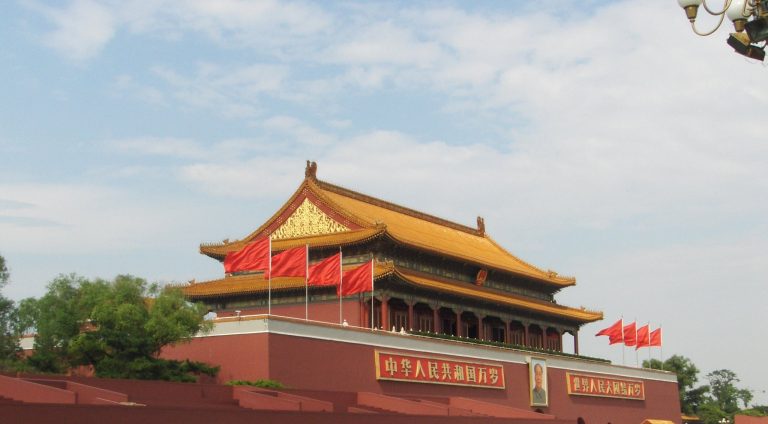
Tiananmen and the Meridian Gate
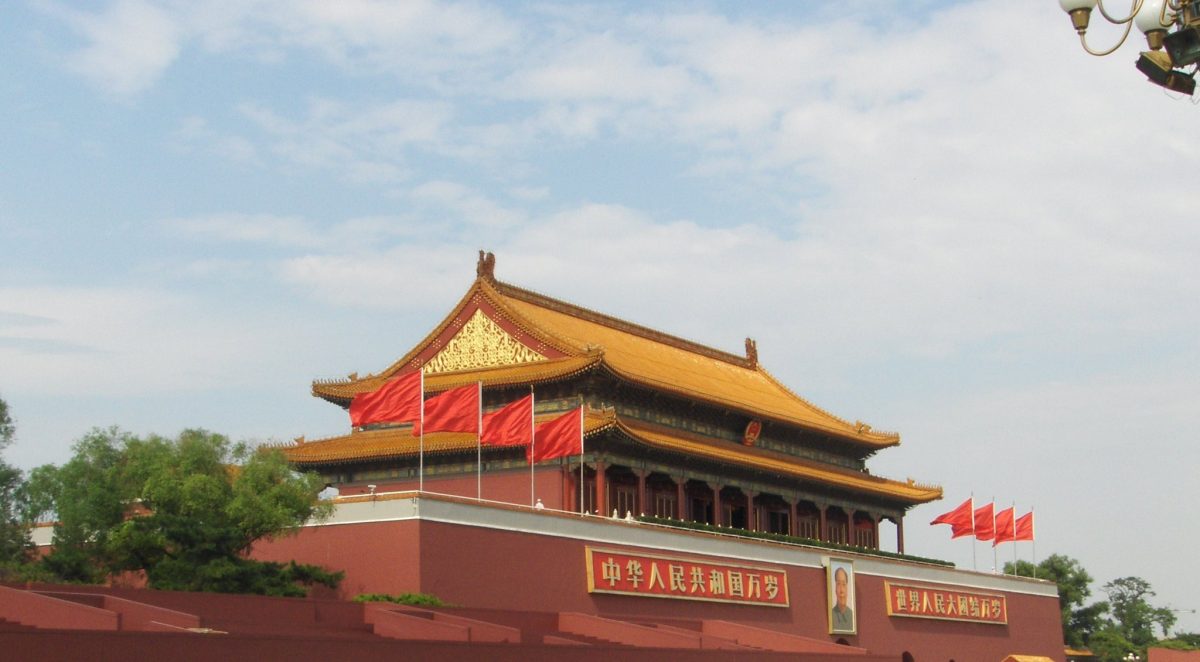
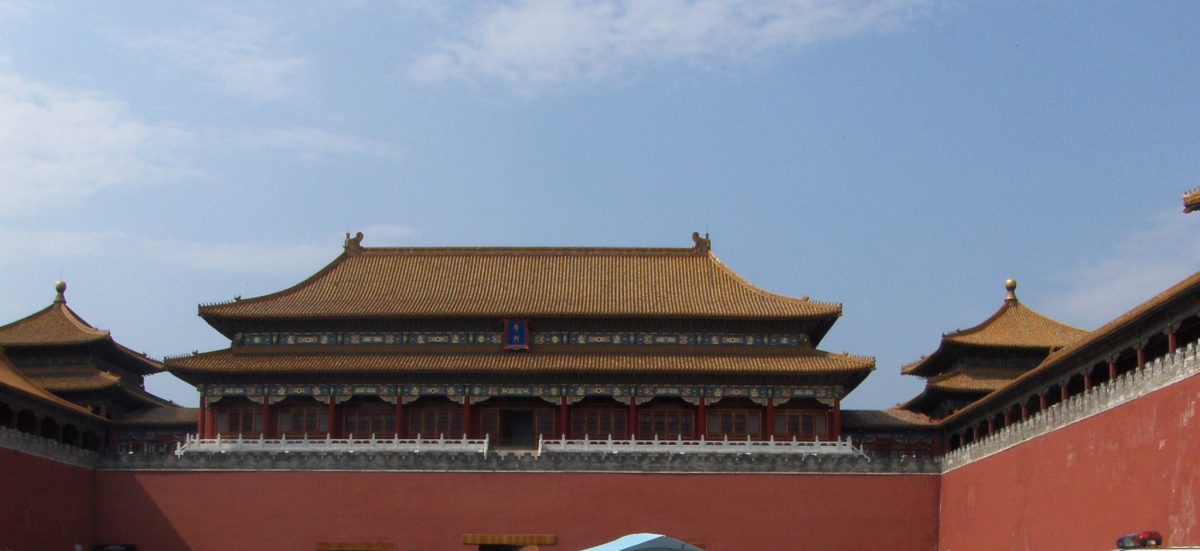
The present Tiananmen, 66 m long and 32 m high on its red base, was completed under the Qing in 1651 on the site of a Ming gate of 1420, and on 1 October 1949 Mao Zedong proclaimed the People's Republic from its balcony. Some 550 m further north, the U-shaped Meridian Gate, whose central hall and four corner pavilions are known as the Five Phoenix Towers, is the only entrance to the Forbidden City. Tickets, CNY 60 from April to October and CNY 40 from November to March, are now sold only online in the visitor's own name, and the palace is closed on Mondays.
Tiananmen, the Gate of Heavenly Peace, with red flags along its upper terrace and the slogan boards on its red wall, Beijing
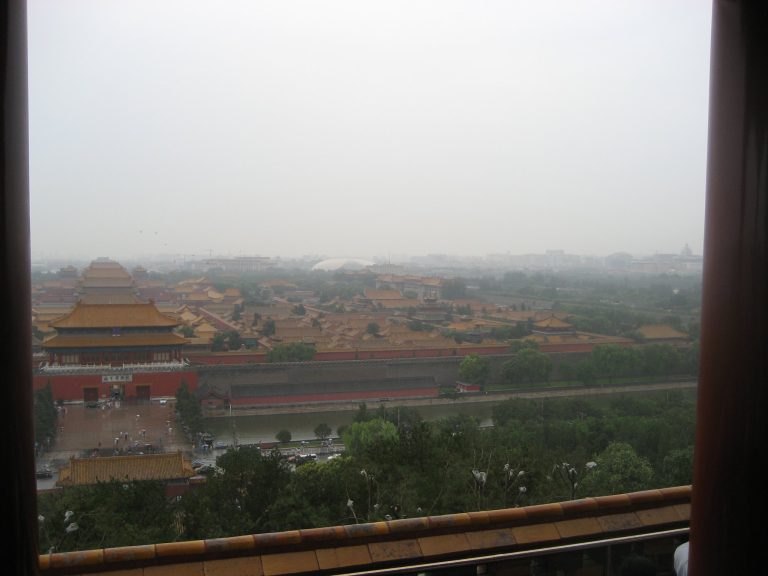
The Forbidden City from Jingshan
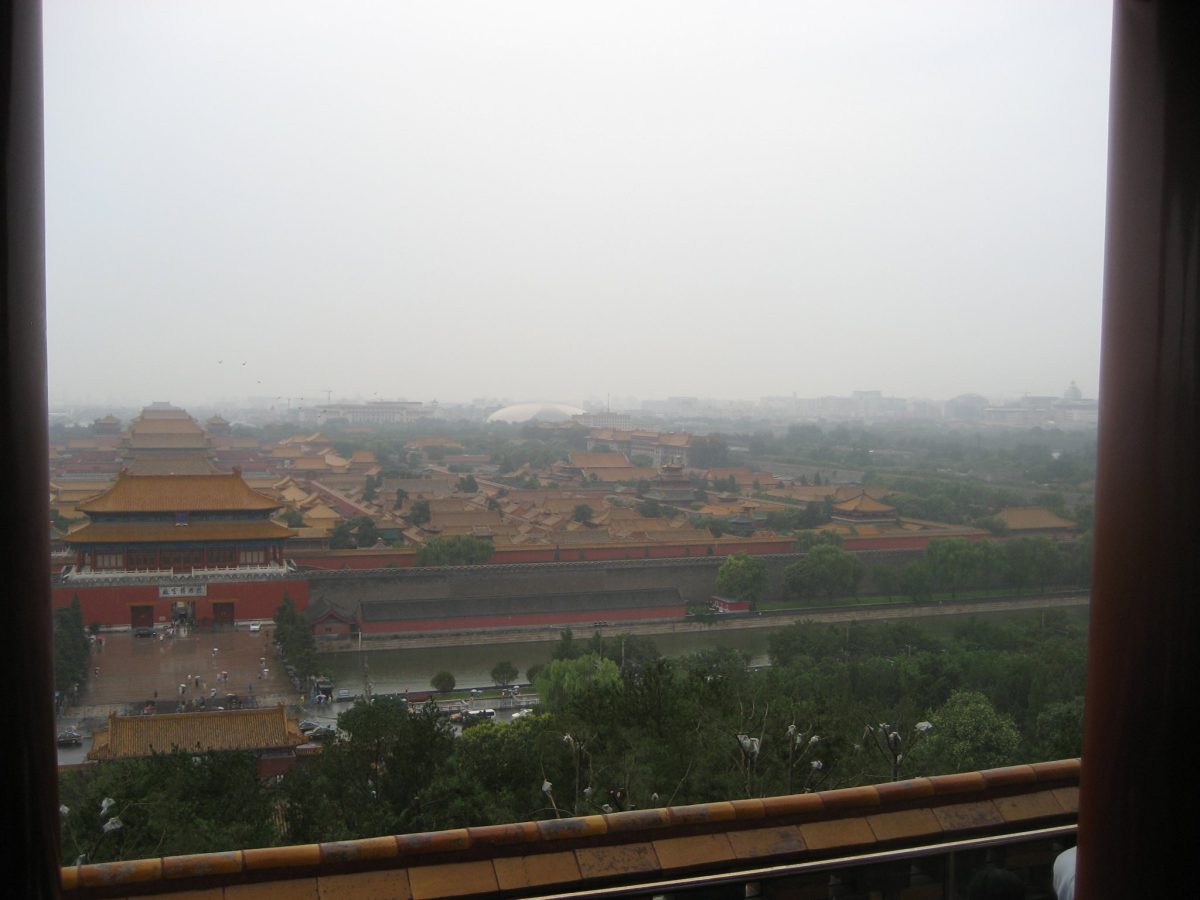
Jingshan, a 45.7 m artificial hill raised in the Yongle era from the earth of the palace moats, is where the last Ming emperor, Chongzhen, hanged himself in 1644; the Wanchun Pavilion of 1750 on its central peak stands on the highest point of the axis. From its terrace the Forbidden City, built in 1406–1420 and about 960 m by 760 m, unfolds to the south as one composition of yellow roofs, from the Gate of Divine Prowess to the three great halls of the outer court. It has been the Palace Museum since 10 October 1925 and a World Heritage Site since 1987.
The Forbidden City seen from Jingshan, with the Gate of Divine Prowess and the moat in front and the palace roofs receding south
The hutongs, Shichahai and the Drum Tower
North of Jingshan, the grey-brick lanes and courtyard houses that once filled almost the whole walled city survive around the Shichahai lakes, Qianhai and Houhai, and in the alleys either side of Nanluoguxiang. At the northern end of the Central Axis stand the Drum Tower, 46.7 m high, and the Bell Tower, 47.95 m, completed in its present form in 1745, which once beat and rang the hours for the whole city.
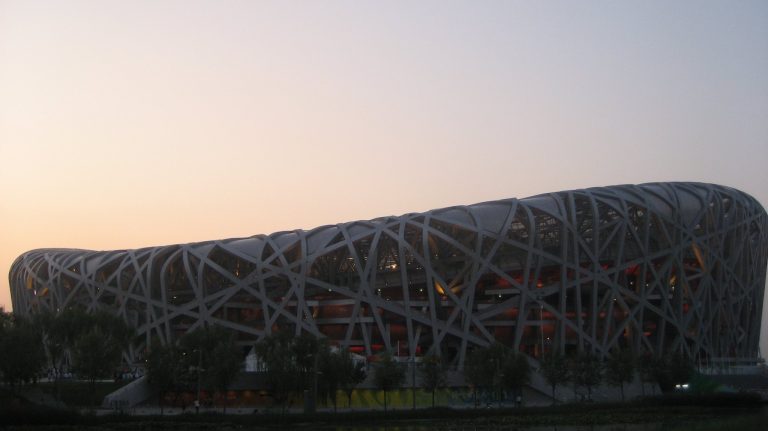
The axis north to the Olympic Green
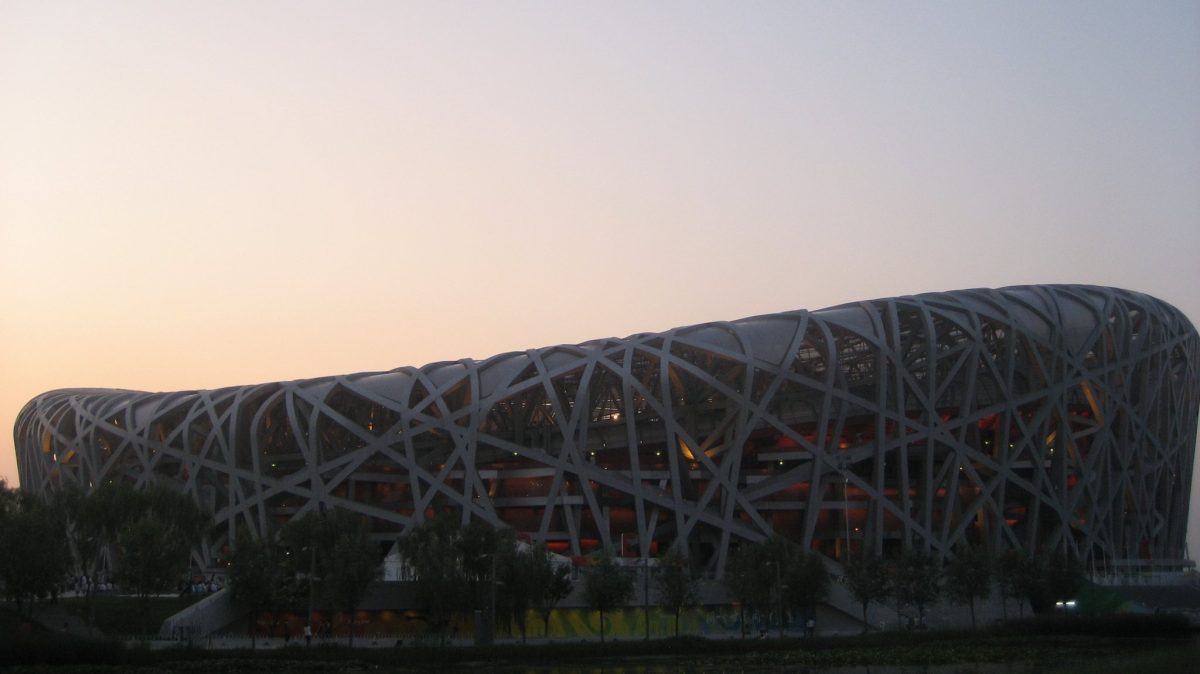
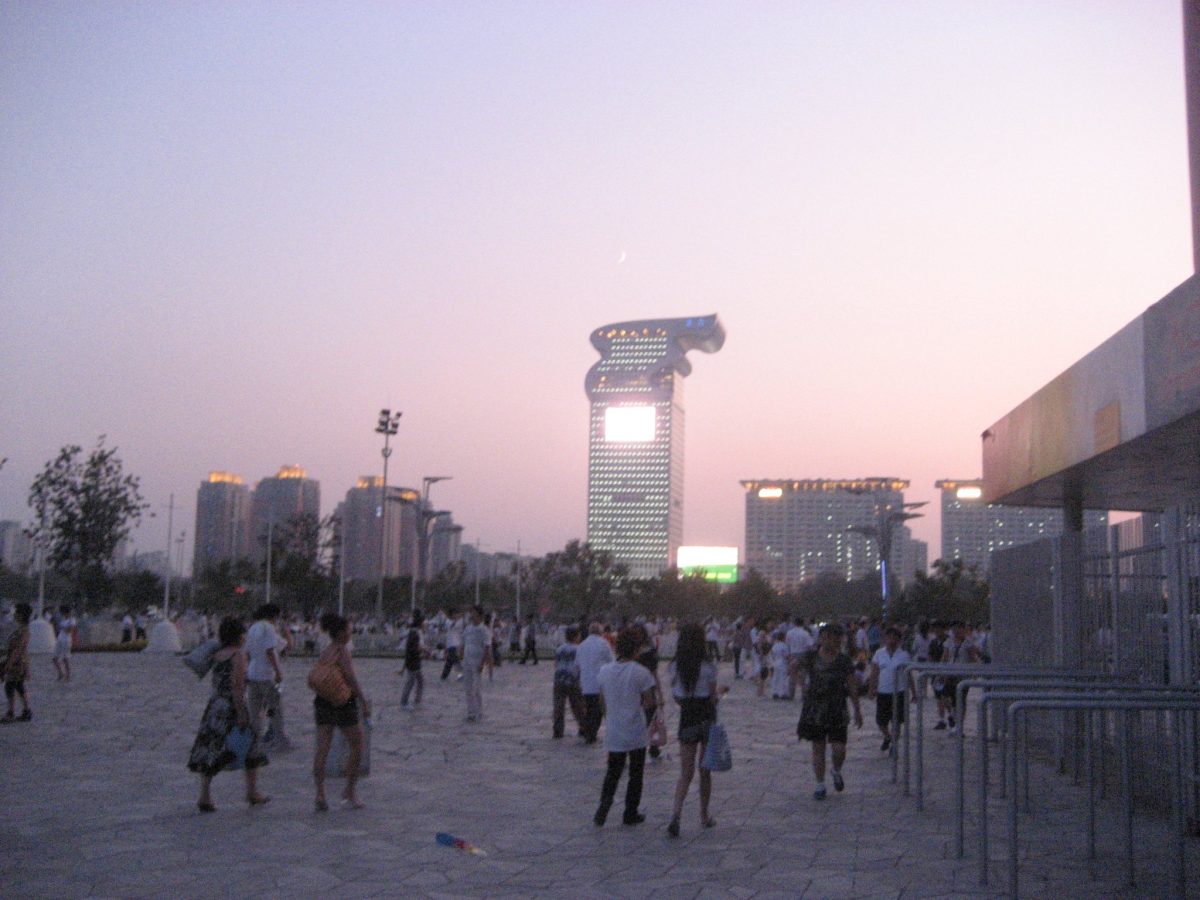
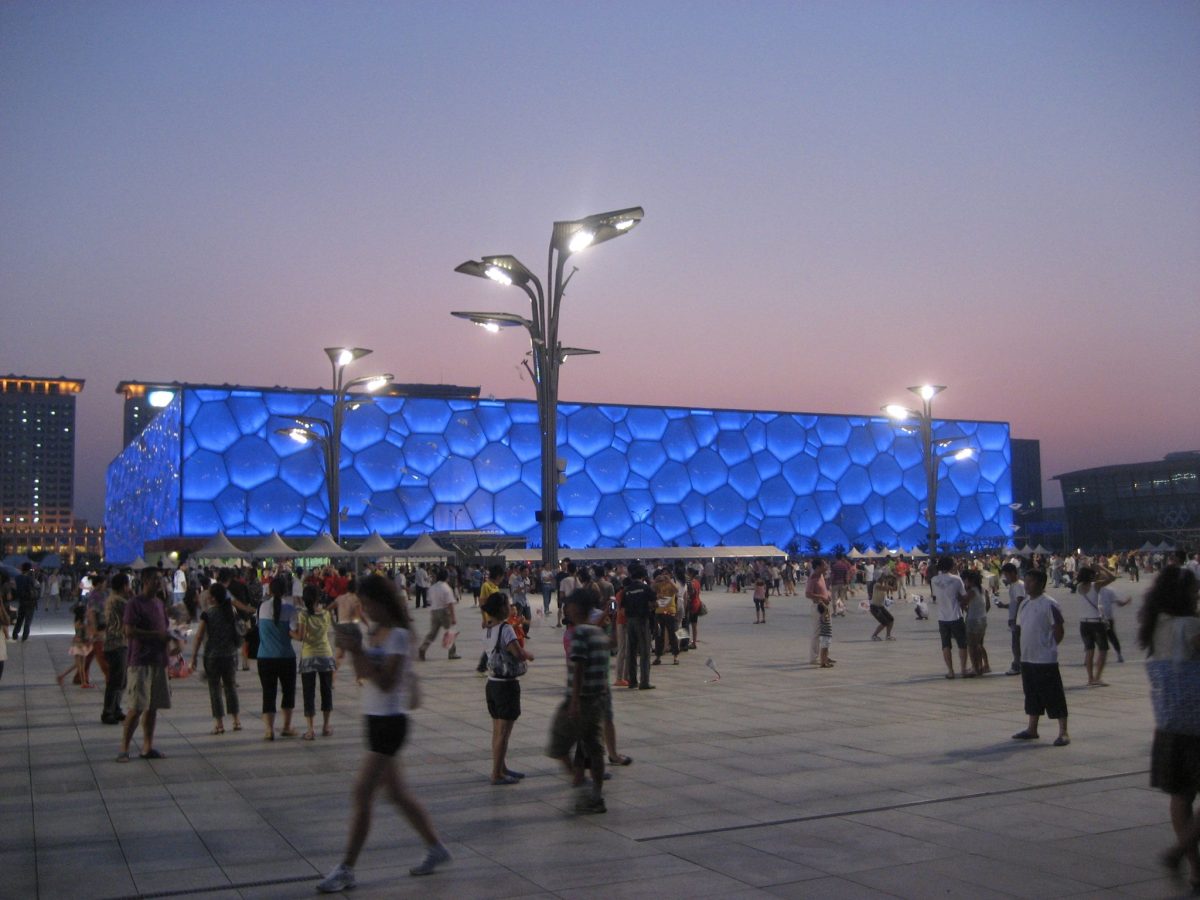
Beyond the Bell and Drum Towers and the Fourth Ring Road the axis continues to the Olympic Green, some 9 km north of Tiananmen and outside this frame, where the National Stadium and the National Aquatics Centre flank the line as the Temple of Heaven and the Altar of Agriculture flank it in the south. The Bird's Nest, opened on 28 June 2008, is the only stadium to have staged the ceremonies of both a Summer and a Winter Olympics. The photographs date from 2009: since then the Water Cube has served as the “Ice Cube” for curling in 2022 before returning to swimming, and Pangu Plaza lost its dragon-head crown in 2021–22.
The National Stadium, the Bird's Nest, at dusk on the Olympic Green in Beijing, a year after the 2008 Olympic Games
3D model © 2026 madseriksson.no · Photographs © madseriksson.no. Buildings and heights: © OpenStreetMap contributors (ODbL), via OpenMapTiles. Ground imagery: Sentinel-2 cloudless 2023 by EOX IT Services GmbH (contains modified Copernicus Sentinel data 2023; CC BY 4.0). Heights are approximate where OpenStreetMap has no measured value; sun positions are approximate.
Tiananmen and the Square — The Gate of Heavenly Peace and the Space in Front of It
A Ming gate rebuilt in 1651, a square enlarged fourfold in the 1950s, and the tallest of the old city gates at its southern end
Tiananmen, the Gate of Heavenly Peace, was the front door of the Imperial City. The first gate here was built in 1420 on the model of a palace gate in Nanjing; lightning destroyed it in 1457, rebels burned its successor in 1644, and the present double-roofed tower, 66 metres long and 32 metres high on its red base, was completed under the Qing in 1651, taking the name it has kept. Five arched passages lead through the wall, crossed in front by marble bridges over a moat. On 1 October 1949 Mao Zedong proclaimed the People’s Republic from the gate’s balcony, and his portrait has hung over the central arch ever since, between two boards reading “Long live the People’s Republic of China” and “Long live the great unity of the peoples of the world”. The upper terrace can be climbed with its own ticket (CNY 15), released online seven days ahead; it is closed on Mondays, and the route continues north towards the palace, so the square is best seen first.
South of the gate, across Chang’an Avenue, opens Tiananmen Square, one of the largest public squares in the world. It took its present form in 1958–59, when the area in front of the gate was cleared and enlarged about fourfold for the tenth anniversary of the People’s Republic, and the buildings around it went up in the same year: the Great Hall of the People on the west side, home of the National People’s Congress, and on the east side the museum building that since 2003 has housed the National Museum of China. In the summer of 2009 the museum stood behind cranes; it reopened on 17 March 2011 after a four-year expansion that gave it nearly 200,000 square metres of floor space, and its collections now run from Neolithic jades and Shang bronzes to the twentieth century. In the middle of the square rises the granite obelisk of the Monument to the People’s Heroes, about 38 metres high, with large marble reliefs carved around its base; south of it stands the Chairman Mao Memorial Hall, built in the year after Mao’s death in 1976.
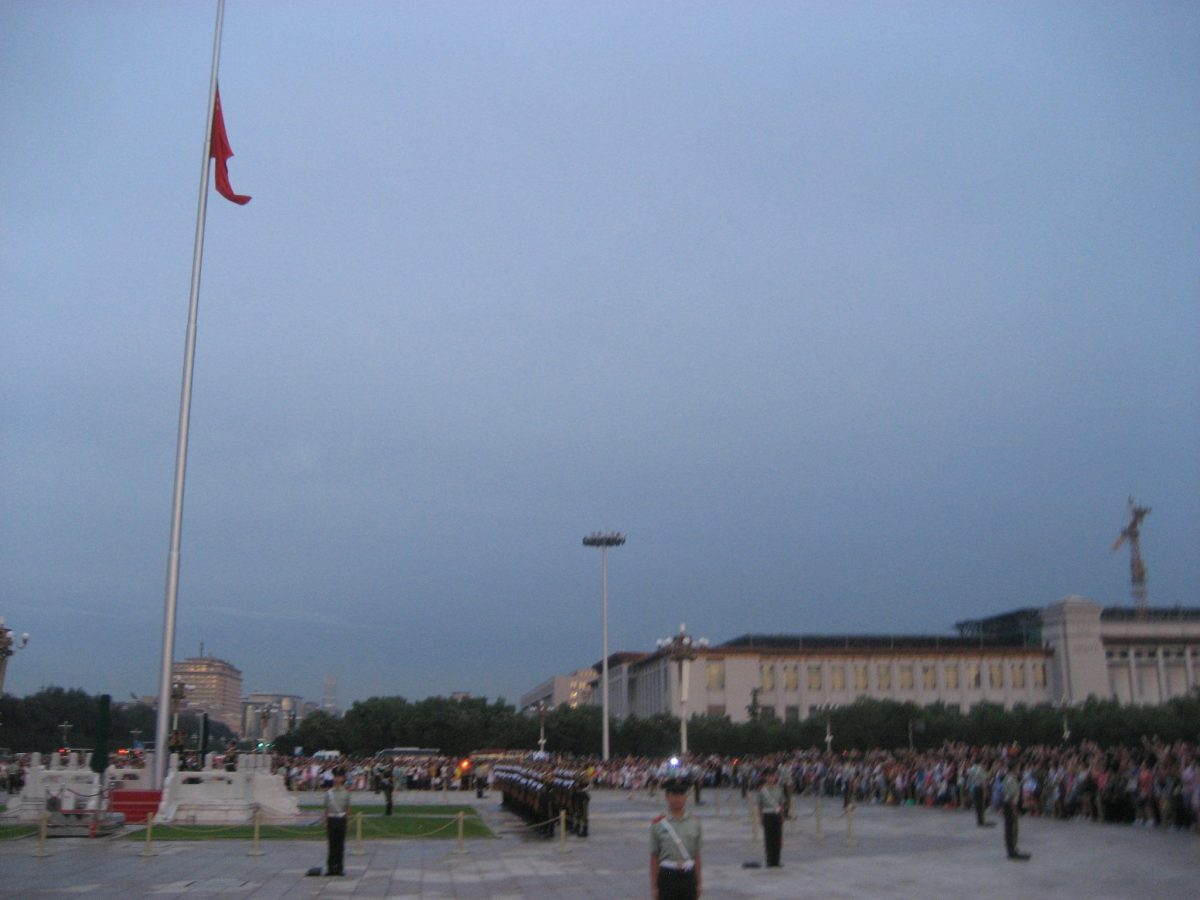
The square is a ceremony as much as a place. Every day the national flag at its northern end is raised at sunrise and lowered at sunset, and the times move with the sun.
Those two moments draw the biggest crowds. An honour guard marches out from the gate, and the flag is raised at sunrise and lowered at sunset at the flagpole on the northern edge of the square, in front of the gate; on a summer evening thousands line the railings. Every visit to the square now requires a free, real-name reservation, made one to seven days ahead through an official WeChat mini-program and shown with the original passport at a chosen checkpoint; the flag-raising slot has to be booked specifically and goes fast. The Memorial Hall and the National Museum each need their own booking (checked November 2026; the Memorial Hall reopened on 1 September 2026 after a renovation and normally admits visitors from Tuesday to Sunday mornings).
The southern end of the square is closed by Zhengyangmen, or Qianmen, the “Front Gate” of the inner city wall, first built in 1419. It is really two buildings: the gatehouse, at 42 metres the tallest of all Beijing’s city gates, and south of it the Arrow Tower, a massive grey-brick bastion pierced by rows of small windows for archers. The wall that joined them has gone — the gate complex was damaged in 1900 and reworked in 1914–15 to let traffic through — but the pair still marks the axis. Beyond it runs Qianmen Street, the old commercial avenue outside the gate, rebuilt in the 2000s as a pedestrian street of restored shopfronts, painted wooden archways and a vintage-style tram, with lanes of older shops, tea houses and roast-duck restaurants running off to either side towards Dashilan.
The Forbidden City and Jingshan — Five Centuries Behind Red Walls, and the Hill That Looks Down on Them
The palace of twenty-four emperors, walked from south to north, and the artificial hill built from the earth of its moat
The Forbidden City — Zijincheng, the Purple Forbidden City — was the seat of the Ming and Qing emperors from 1420 until 1912, a walled rectangle about 960 metres from north to south and 760 metres across, surrounded by a moat and laid out so that every important building sits on the central axis. Its buildings are counted in the hundreds and its rooms at nearly ten thousand. Since 10 October 1925 it has been the Palace Museum, and since 1987 a World Heritage Site; the finest part of the imperial collection was shipped south during the 1930s and 1940s and much of it is now in the National Palace Museum in Taipei. The visit runs one way, from south to north. Entry is only through the Meridian Gate, Wumen, a U-shaped red bastion whose central hall and four corner pavilions are known as the Five Phoenix Towers; from here the emperor announced the calendar and reviewed his armies.
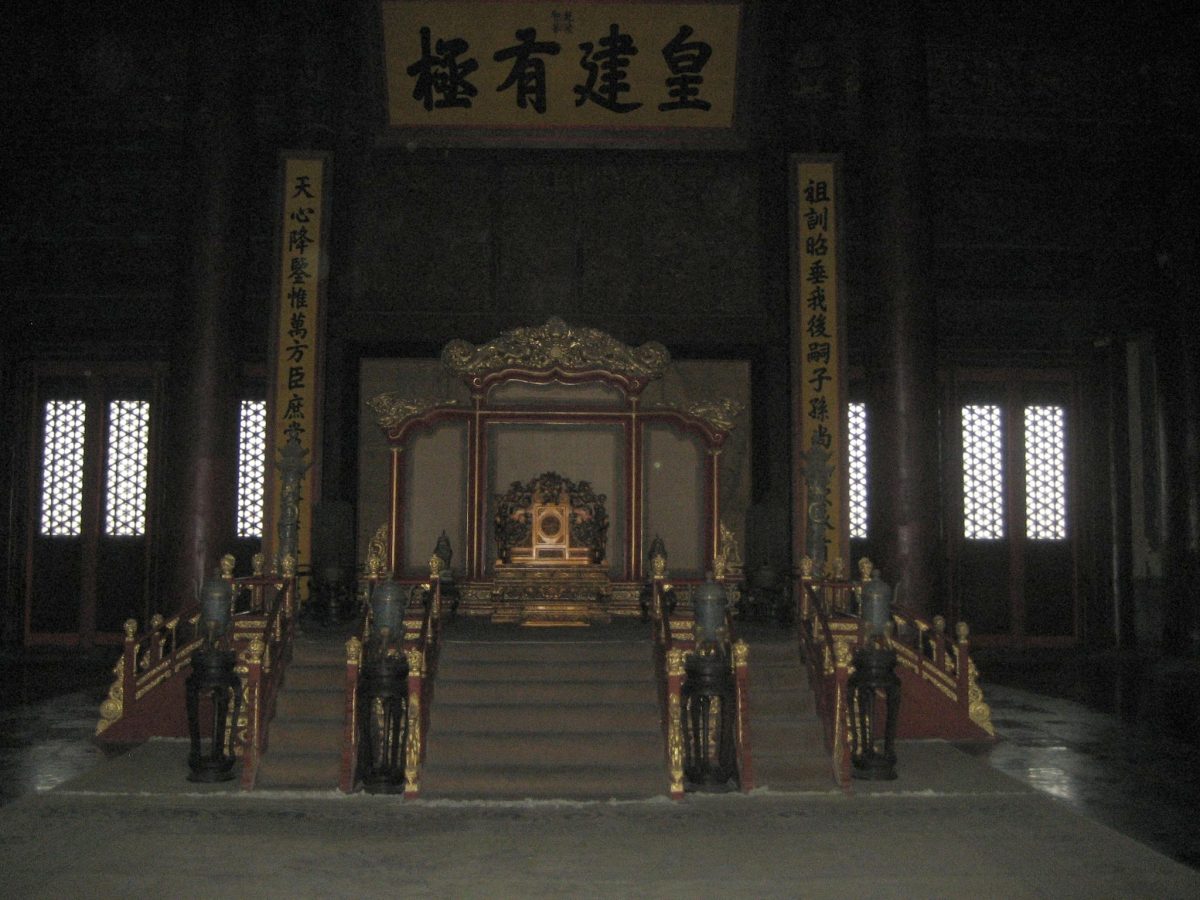
Beyond the Gate of Supreme Harmony, across the vast paved courtyard where the court assembled for ceremonies, stand the three great halls of the outer court on a three-tiered marble terrace: the Hall of Supreme Harmony, the largest hall in the palace and the place of enthronements; the small square Hall of Central Harmony, where the emperor prepared for ceremonies; and the Hall of Preserving Harmony, its throne set beneath a board inscribed Huang jian you ji, where the Qing emperors gave banquets and later held the final palace examinations. Behind them the gates narrow into the inner court — the residential palaces, the Hall of Mental Cultivation where the Qing emperors from Yongzheng onwards lived and worked, and the six eastern and six western palaces of the consorts — and the scale drops from parade ground to courtyard house. The Treasure Gallery and the Gallery of Clocks charge an extra CNY 10 each and are among the best rooms in the palace.
The Forbidden City is laid out to be read from south to north: first power, then ceremony, then private life. Every visitor still walks it in that order.
Tickets cost CNY 60 from April to October and CNY 40 from November to March. They must be reserved online, up to seven days ahead, in the visitor’s own name and with a passport, one ticket per ID per day; nothing is sold at the gate, the palace is closed on Mondays except on public holidays, and it opens at 8:30 with last entry at 16:00 in summer and 15:30 in winter (checked November 2026). The exit is through the Gate of Divine Prowess, Shenwumen, in the north wall, or the East Glorious Gate, Donghuamen. Three to four hours is the minimum; the side palaces to the east and west are far quieter than the axis.
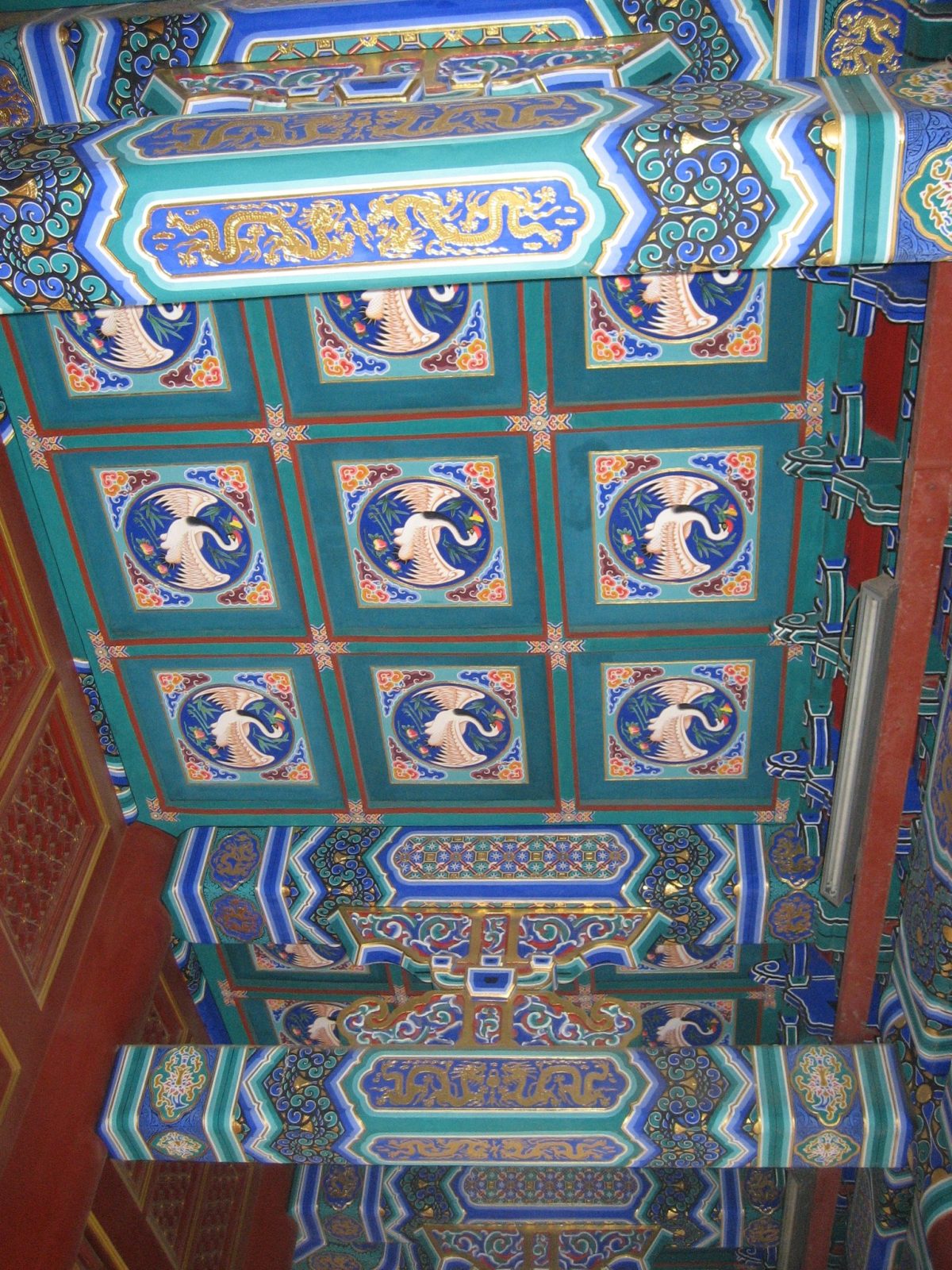
Directly across the road from the northern gate rises Jingshan, a 45.7-metre artificial hill raised in the Yongle era from the earth dug out for the palace moats and canals. It was the emperors’ garden and the feng shui shield of the palace against the north; on its slope the last Ming emperor, Chongzhen, hanged himself in 1644 as rebel forces entered the city. Five pavilions crown its five peaks, and the central one, the Wanchun Pavilion of 1750, stands on the highest point of the central axis. From its terrace the whole Forbidden City is laid out to the south as a single composition of yellow roofs between red walls, with the Gate of Divine Prowess and the moat in front — on a hazy summer afternoon it fades into the city, on a clear autumn morning it reaches as far as the square. The ceilings of the pavilions are painted with cranes in roundels of blue, green and gold.
The Temple of Heaven — Where the Son of Heaven Prayed for the Harvest
A round hall of wood without nails, a wall that carries a whisper, an altar built on the number nine — and a park that belongs to the people of Beijing every morning
South-east of Qianmen, behind a long wall, lies the largest religious complex of imperial China. The Temple of Heaven, Tiantan, was completed in 1420 together with the Forbidden City as an altar to heaven and earth; in 1530 separate sacrifices to heaven were introduced and in 1534 it took its present name. Its 273 hectares of cypress woods and walled enclosures, square at the south and rounded at the north to echo the ancient belief in a round heaven above a square earth, were where the emperor, as Son of Heaven, came at fixed seasons of the year to offer sacrifices — for a good harvest in spring and to heaven itself at the winter solstice. The current layout was completed under the Qianlong Emperor in the eighteenth century, and it has been a World Heritage Site since 1998.
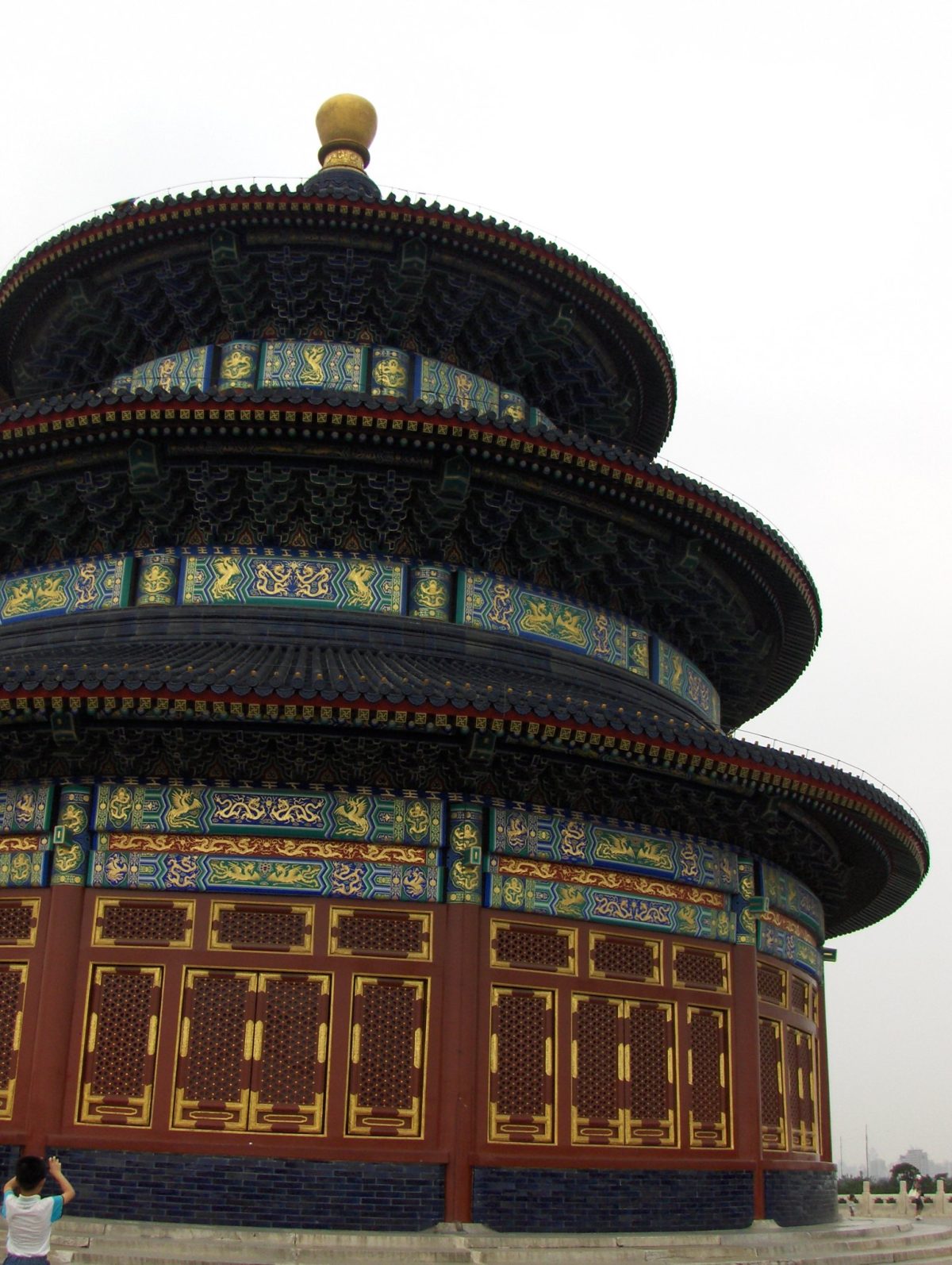
The building on every postcard is the Hall of Prayer for Good Harvests, a round hall 38 metres high under three tiers of deep blue glazed tiles with a gilded finial, standing on a three-level terrace of white marble. It is built entirely of wood without nails, and its columns tell the calendar: four inner pillars for the seasons, twelve in the middle ring for the months and twelve on the outside for the traditional double hours of the day. The hall seen today is not the Ming original: lightning set it on fire in 1889, and it was rebuilt within a few years on the old plan. South of it a raised walkway of 360 metres, the Vermilion Steps Bridge, leads to the Imperial Vault of Heaven of 1530, a smaller round hall with a single conical roof where the tablets of heaven were kept. It stands inside the circular Echo Wall, whose smooth curve carries a voice spoken near the wall to a listener on the far side — when the courtyard is quiet enough to hear it. Further south is the open-air Circular Mound Altar, three rings of white marble in which every number of steps, slabs and balusters is nine or a multiple of nine.
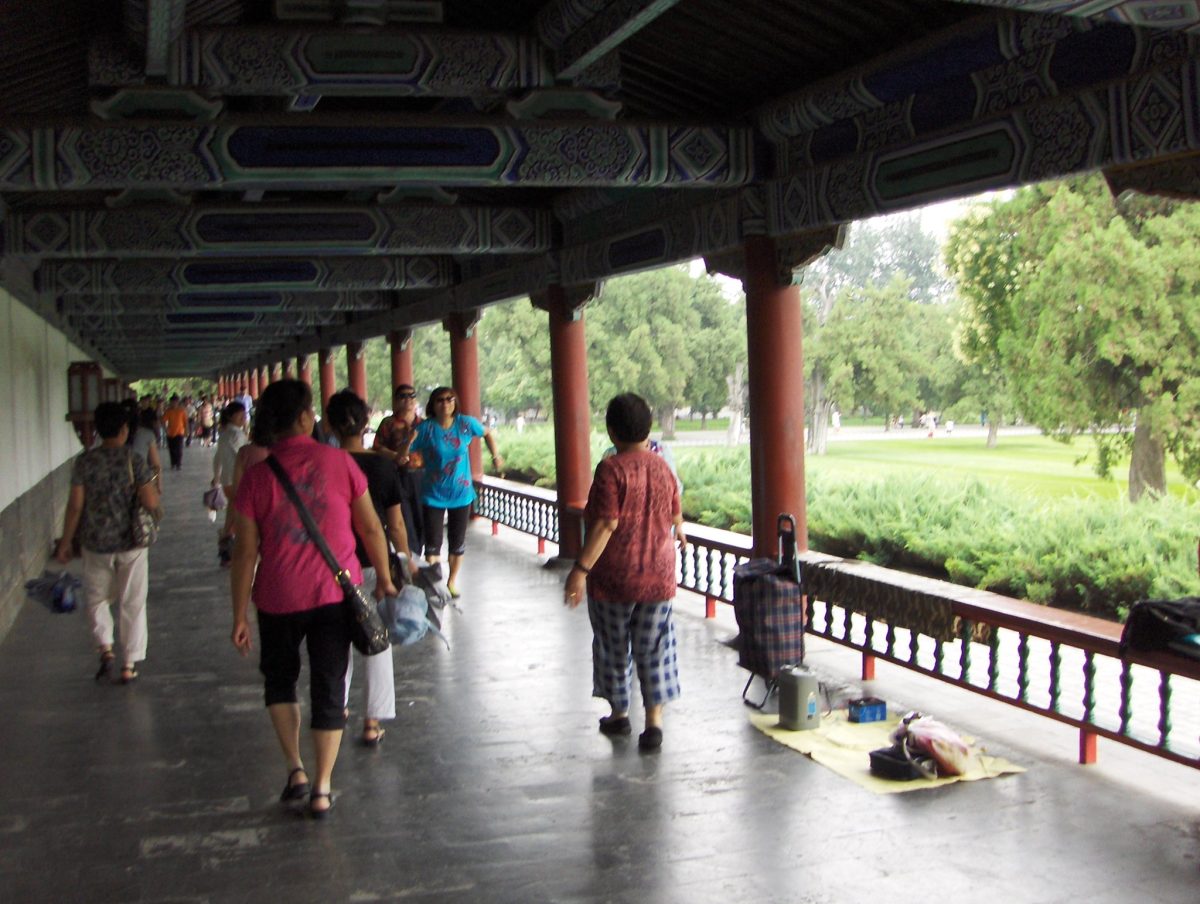
Once a year the emperor fasted here and prayed for the harvest of the whole empire. Today, every morning, retired people dance, sing and play cards under the painted beams of the corridor that once carried his offerings.
The Temple of Heaven was occupied by foreign troops during the Second Opium War and again in 1900, when the Eight-Nation Alliance made it a headquarters, and in 1918 it opened to the public as a park. That is the second reason to come, and the best time is early. From six in the morning the woods fill with people doing tai chi, dancing with fans, kicking shuttlecocks, singing and playing the erhu. Much of the life gathers in the Long Corridor east of the Hall of Prayer, a covered gallery of 72 bays with red columns and painted beams, rebuilt in 1752, through which the sacrificial animals and offerings were once carried from the Divine Kitchen to the altars; its walls were removed in 1937, and it is now a long open room for card games, chess, knitting and music. Park admission is CNY 15, or CNY 34 including the Hall of Prayer, the Echo Wall and the Circular Mound (high season, checked November 2026); the park opens from 6:00 to 22:00, the halls from 8:00 to 18:00 and not on Mondays, and tickets are booked by name one to seven days ahead.
The Olympic Green — A Nest of Steel, a Cube of Bubbles, and the Axis Extended North
The venues of the first city to host both the Summer and the Winter Olympics, seen at dusk a year after the 2008 Games
North of the old city the central axis does not stop. Beyond the Bell and Drum Towers and the Fourth Ring Road it continues as the spine of the Olympic Green, the park built for the 2008 Summer Games, with the two great venues placed on either side of it as the Temple of Heaven and the Altar of Agriculture are placed on either side of the old axis in the south.
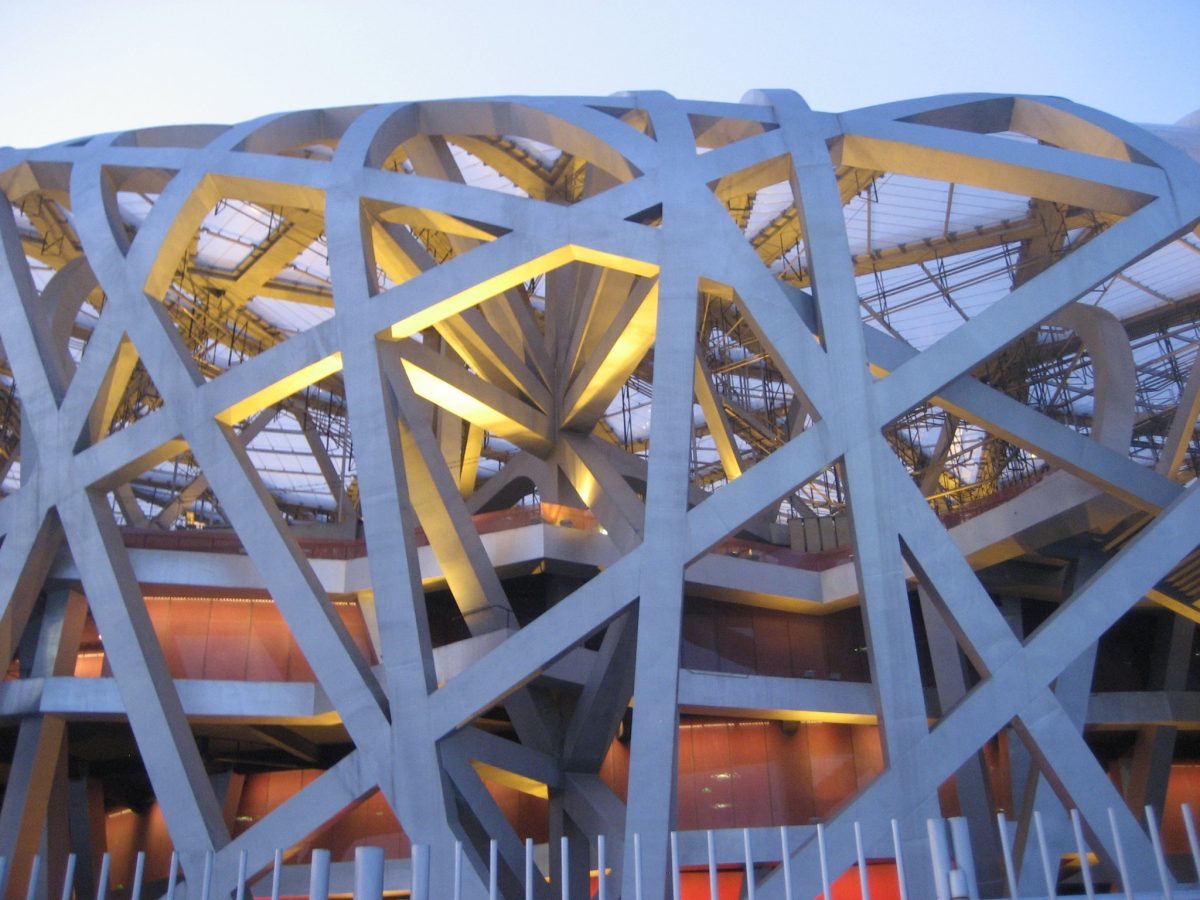
The National Stadium, universally called the Bird’s Nest, was designed by Herzog & de Meuron with the China Architecture Design and Research Group and the engineers Arup. Its saddle-shaped bowl is wrapped in a lattice of apparently random steel members that are in fact the structure itself, and at dusk the red-painted interior glows through the grey steel like embers. It opened on 28 June 2008 with 91,000 seats; after the temporary seating was removed it holds about 80,000. In 2008 it staged the opening and closing ceremonies and the athletics, and in February 2022 it did so again for the Winter Olympics, which makes it the only stadium to have hosted the ceremonies of both the Summer and Winter Games — and Beijing the first city to host both. Between the Games it has been used mainly for concerts and other large events.
In 2008 Michael Phelps won eight gold medals in the Water Cube. Fourteen years later the same pool lay under a sheet of ice, and curling stones slid over it.
West of the stadium, the National Aquatics Centre — the Water Cube — is a box wrapped in translucent cushions in the pattern of soap bubbles, lit blue at night, where Michael Phelps won his eight gold medals in 2008. After the Games part of it became a water park. For 2022 it was converted into the “Ice Cube”: a curling rink was built on a removable structure over the Olympic pool in about twenty days, and after the Winter Paralympics the ice was taken out again and the venue returned to swimming. Beyond the Water Cube, at the south-western edge of the Green, rises Pangu Plaza, a 191.7-metre office tower completed in 2008 by C.Y. Lee & Partners, the architects of Taipei 101. In 2009 its top was shaped like a dragon’s head, a landmark visible across the whole park; the dragon was removed in a refurbishment in 2021–22, and the tower now ends in a plain rectangular crown. The Olympic Green is reached by Line 8 of the subway; the stadium and the aquatics centre are most rewarding after sunset, when both are lit.
Hutongs, Duck and Acrobats — The City Between the Monuments
Grey-brick lanes and courtyard houses, a night market that no longer exists, the city’s most famous dish, and an art form two thousand years old
Between the avenues, old Beijing survives in its hutongs, the narrow lanes of single-storey grey-brick courtyard houses, siheyuan, that once filled almost the whole city inside the walls. Many were cleared in the decades of rebuilding, but whole districts remain north of the Forbidden City: around the lakes of Shichahai — Qianhai and Houhai, with their bars and rowing boats — and in the lanes off Nanluoguxiang, now a busy street of cafés and shops with quieter alleys on either side. At the northern end of the central axis stand the Drum Tower and the Bell Tower, which once beat and rang the hours for the whole city and are now part of the World Heritage Site; the square between them is one of the most pleasant places in the city on a summer evening.
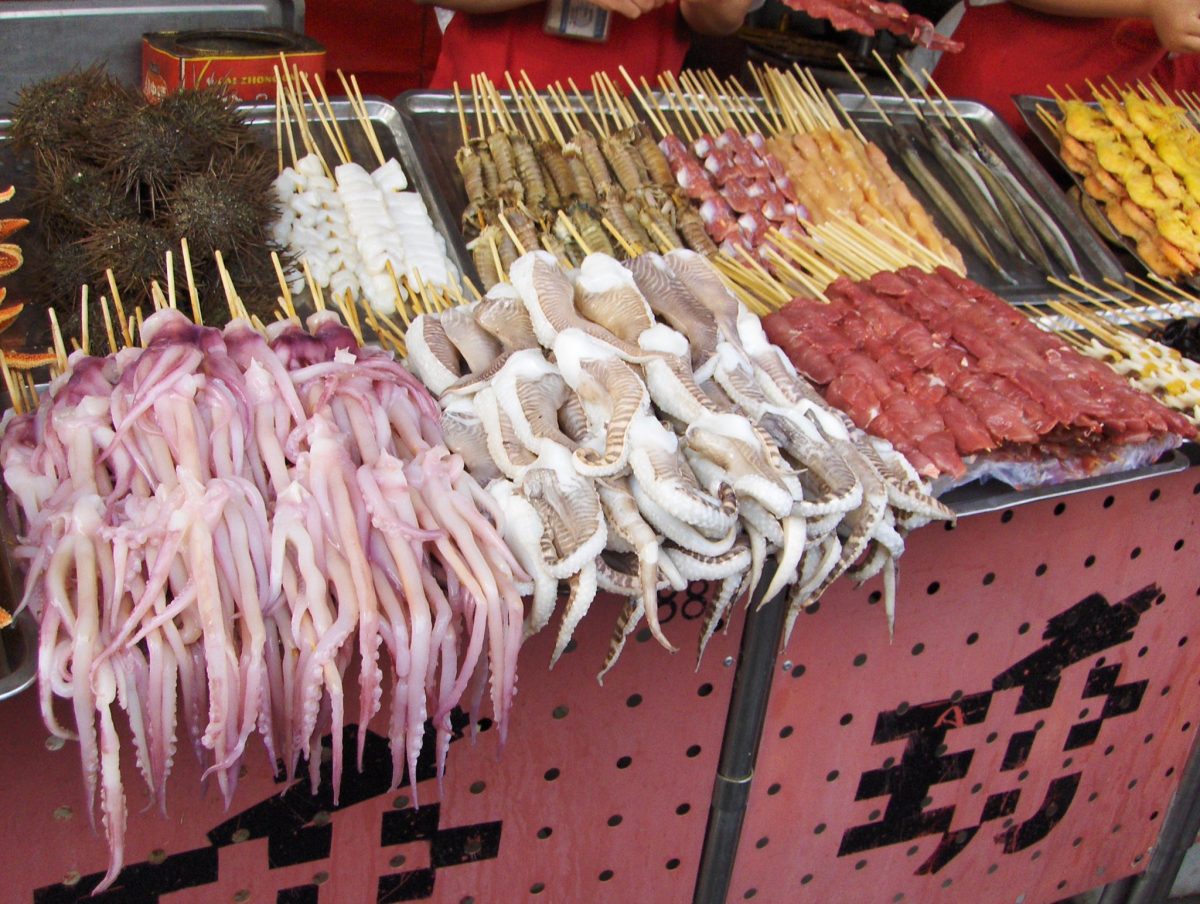
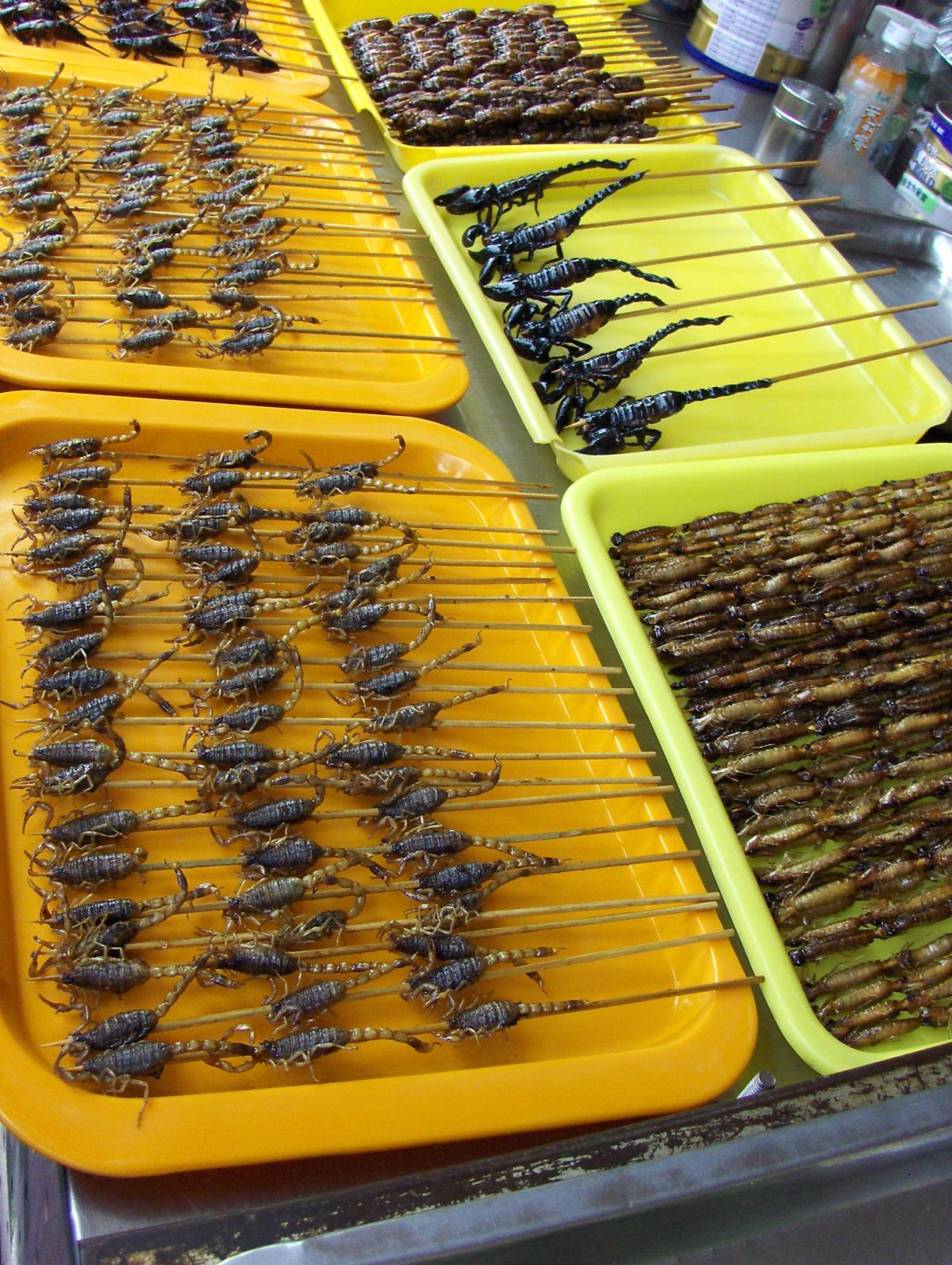
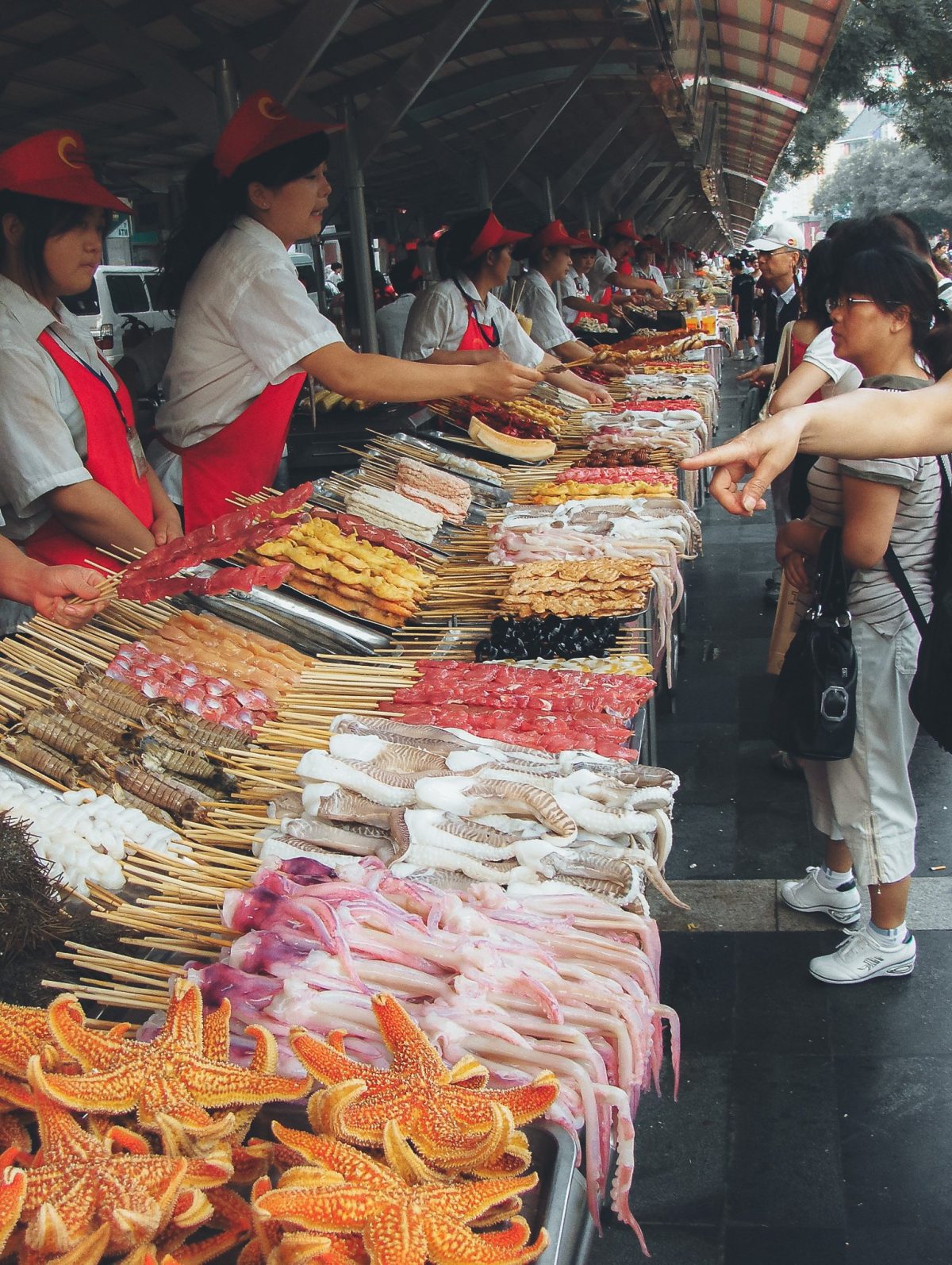
For decades one of the most photographed food scenes in Beijing was the Donghuamen Night Market, a row of identical red stalls at the northern end of Wangfujing, named after the east gate of the Forbidden City nearby. Vendors in red caps and aprons grilled lamb skewers, dumplings and candied fruit, and laid out squid, sea urchin and silkworms alongside skewered scorpions for the adventurous; signs were in Chinese and English. The market was closed for good on 24 June 2016 after complaints about hygiene and noise, and visitors looking for street food now find it in the snack streets and night markets elsewhere in the city. The dish that defines Beijing, though, is eaten sitting down: Peking duck, its skin roasted to a lacquered crisp and carved at the table, then wrapped in thin pancakes with spring onion, cucumber and sweet bean sauce. Two old houses represent its two schools — Bianyifang, founded in 1416, roasts in a closed brick oven; Quanjude, founded in 1864, hangs the ducks over an open fruitwood fire — and dozens of newer restaurants argue about which is better.
The market at Donghuamen is gone, and with it the scorpions on sticks. The duck, roasted the same way since the Ming, is still carved at the table.
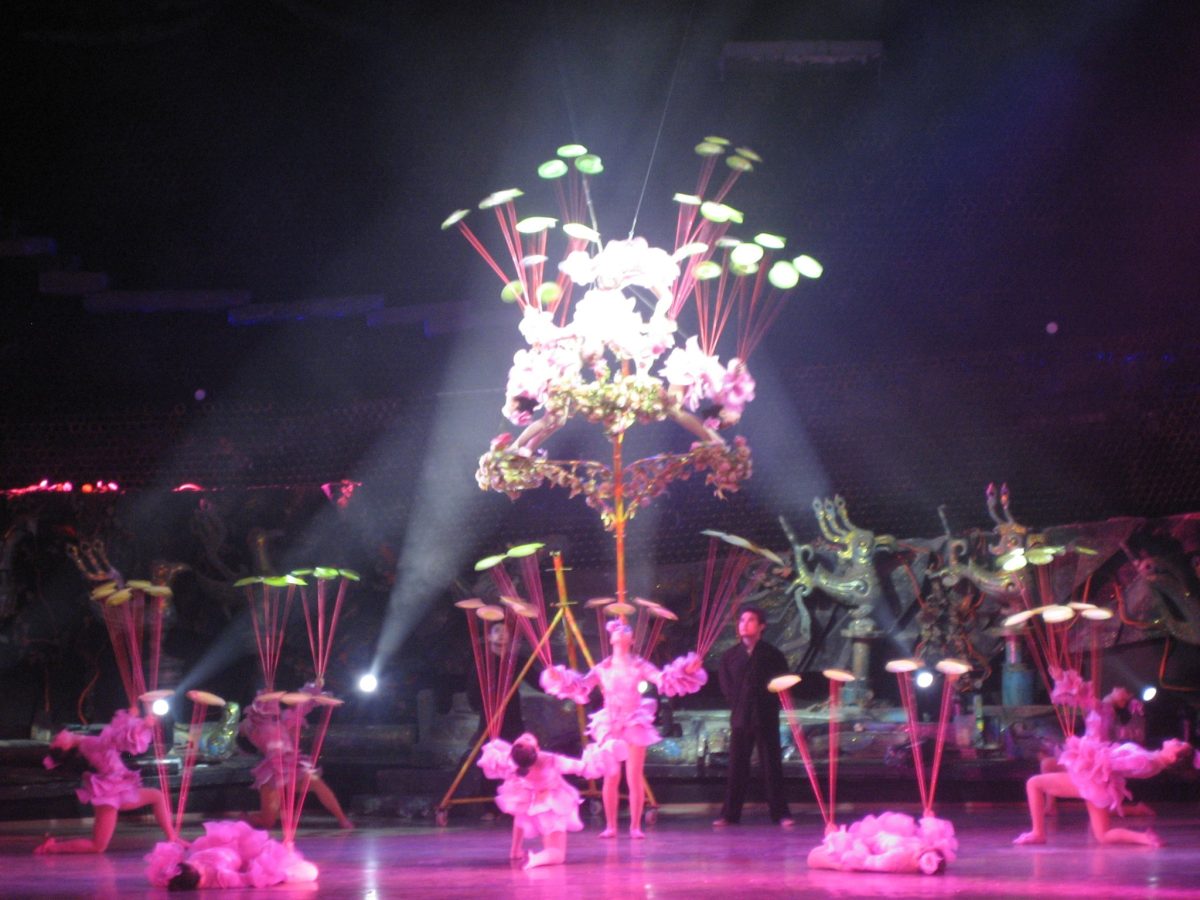
Evening entertainment in Beijing has long meant two things: Peking opera and acrobatics. Chinese acrobatics goes back more than two thousand years, and the city’s best-known stage for it is the Chaoyang Theatre on the East Third Ring Road, by Hujialou station on Line 10, where acrobats perform every evening. The show runs for about an hour: plate-spinners balancing dozens of spinning dishes on long rods, contortionists and hand-balancers, hoop-divers, and a finale in which one bicycle carries more and more riders until it seems impossible that it still moves. Performances usually start at 17:15 and 19:15, and tickets booked ahead start from about CNY 220 (checked November 2026). The plate-spinning and the bicycle finale have been part of the programme for many years.
Getting Around and When to Go — A City Measured in Subway Stops
More than 900 kilometres of metro, two international airports, a passport for every ticket, and two short golden seasons
Beijing is vast, and the distances between its sights are measured in kilometres, not blocks: from the Temple of Heaven to the Olympic Green is more than twelve kilometres in a straight line. The answer is the subway, which had only two lines at the end of the 1990s and reached about 909 kilometres at the start of 2026. Fares are low and distance-based, signs and announcements are in English, and every station has bag screening. Line 1 runs under Chang’an Avenue past Tiananmen and Wangfujing, Line 2 follows the line of the demolished city wall, Line 8 runs up the axis to the Olympic Green, and Line 10 circles the inner city. Taxis and ride-hailing apps are plentiful, and most payment is by mobile phone; both Alipay and WeChat Pay can now be linked to foreign bank cards, but it is worth carrying some cash. The city has two international airports, Capital (PEK) in the north-east and Daxing (PKX), opened in 2019, in the far south, both linked to the centre by express trains.
Two practical rules shape every visit. First, almost everything is booked in advance by name: the square, the gate tower, the Forbidden City, the Temple of Heaven, the National Museum and the Memorial Hall each use their own real-name reservation system, usually opening seven days ahead and requiring the passport used for the booking at the gate. The most sought-after slots go within minutes, and the Forbidden City is closed on Mondays. Second, entry has become simpler: holders of Norwegian passports, and those of most EU countries and several others, can visit China without a visa for up to 30 days under a scheme currently extended to 31 December 2026, and travellers of many other nationalities can transit visa-free for up to 240 hours on an onward ticket (checked November 2026).
Beijing has a continental climate of extremes. July and August are hot, humid and wet — the July average high is about 32 °C and the month brings around 170 millimetres of rain, a third of the year’s total, often in heavy afternoon storms; the summer haze softens every view. Winters are dry, bright and cold, with average highs around freezing in January. Spring can bring dust blown in from the deserts to the north-west between March and May. The best months are late April to May and mid-September to October, when the air is clearest, the temperatures mild and the trees of Jingshan and the Temple of Heaven green or turning gold. Avoid the first week of October and the Spring Festival if possible: these national holidays bring the largest crowds of the year, and the reservation slots for the palace and the square sell out first.
«Beijing does not hide its plan. Stand on the summit of Jingshan and the city is laid out like an argument: the palace below in a single sweep of yellow roofs, the great gate and the square beyond it, and somewhere in the haze to the south the blue roofs of the hall where the emperor prayed for rain. Turn round and the same line runs north, past the drum that once told the city the time, towards a stadium of steel that has opened two Olympic Games. Between those two ends the city has torn down its walls, built a subway longer than any in Europe, closed its scorpion stalls and taken the dragon off its tower. The axis has stayed where it was. That, more than any single palace, is what makes Beijing worth the long journey — a capital that can still be read in one straight line.»