The Brooklyn Bridge took fourteen years to build and cost the lives of its designer and, by most estimates, more than two dozen of the men who built it. When it opened on 24 May 1883 it was the longest suspension bridge in the world, the first great bridge to hang from cables of steel wire, and the first fixed link between Manhattan and what was then the separate city of Brooklyn. Its two granite towers, pierced by pointed Gothic arches, were taller than almost anything else on the New York skyline. More than 140 years later the bridge still carries traffic across the East River — and, on an elevated timber promenade above the cars, close to thirty thousand people a day on foot.

The bridge was the life’s work of John Augustus Roebling, a German-born engineer who had already built suspension bridges at Niagara and over the Ohio River at Cincinnati. In the late 1860s New York and Brooklyn were two of the largest cities in the United States, linked only by ferries that were slowed or stopped by ice and fog every winter. Roebling’s answer was a suspension bridge on a scale nobody had attempted, with a main span of nearly 500 metres between two masonry towers. He never saw work begin. In June 1869, while surveying the site of the Brooklyn tower from the ferry slip at Fulton Landing, his foot was crushed by a docking ferry; tetanus set in after the amputation of his toes, and he died the following month. His son Washington Roebling, then 32, took charge of the project, and after he was disabled by caisson disease his wife Emily Warren Roebling became the link between the bedridden chief engineer and the men on site.
What makes the bridge more than an engineering monument is that it is still used the way it was intended: as a way to walk from one city to another. The promenade runs down the centre of the bridge, raised above the roadways on either side, so that walkers look out over the traffic to the harbour, the towers of Lower Manhattan and the newer bridges upstream. Since 2021 cyclists have had a protected lane of their own at road level, and since 2024 the vendors who once crowded the walkway have been banned. The crossing takes half an hour at a brisk pace and an hour or more for anyone stopping for photographs — which, on this bridge, is almost everyone.
How to approach the Brooklyn Bridge
This guide covers the bridge in four parts: the story of the Roebling family and the fourteen years of construction; the engineering of the towers, the caissons beneath them and the steel-wire cables; the walk across the promenade, with the practical details of where to start and when to go; and the Brooklyn waterfront at the far end, where the parks and streets of Dumbo give the classic views of the bridge from below.
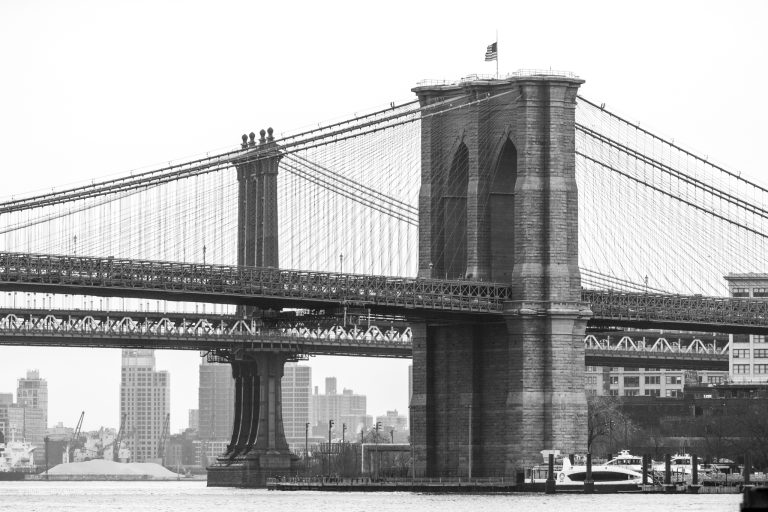
The first fixed link to Brooklyn
The Brooklyn Bridge opened on 24 May 1883 as the longest suspension bridge in the world, the first great bridge to hang from steel-wire cables and the first fixed link between Manhattan and the then separate city of Brooklyn. It took fourteen years to build and cost about $15.5 million.
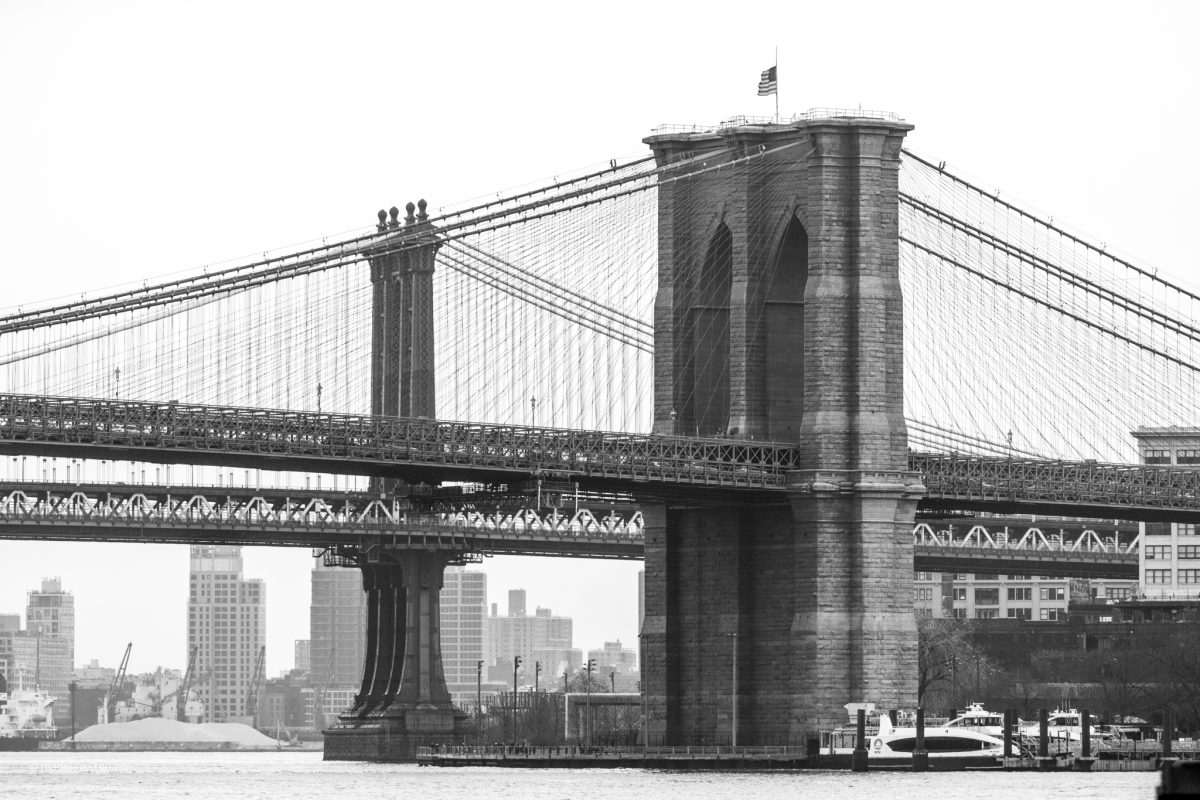
The Gothic stone towers and steel cables of the Brooklyn Bridge spanning the East River
Father, son and Emily Warren Roebling
John Augustus Roebling designed the bridge but was injured at the Fulton Ferry slip in June 1869 and died of tetanus the following month. His son Washington took charge until caisson disease confined him to his house in Brooklyn Heights, and Emily Warren Roebling carried his instructions to the engineers on site.
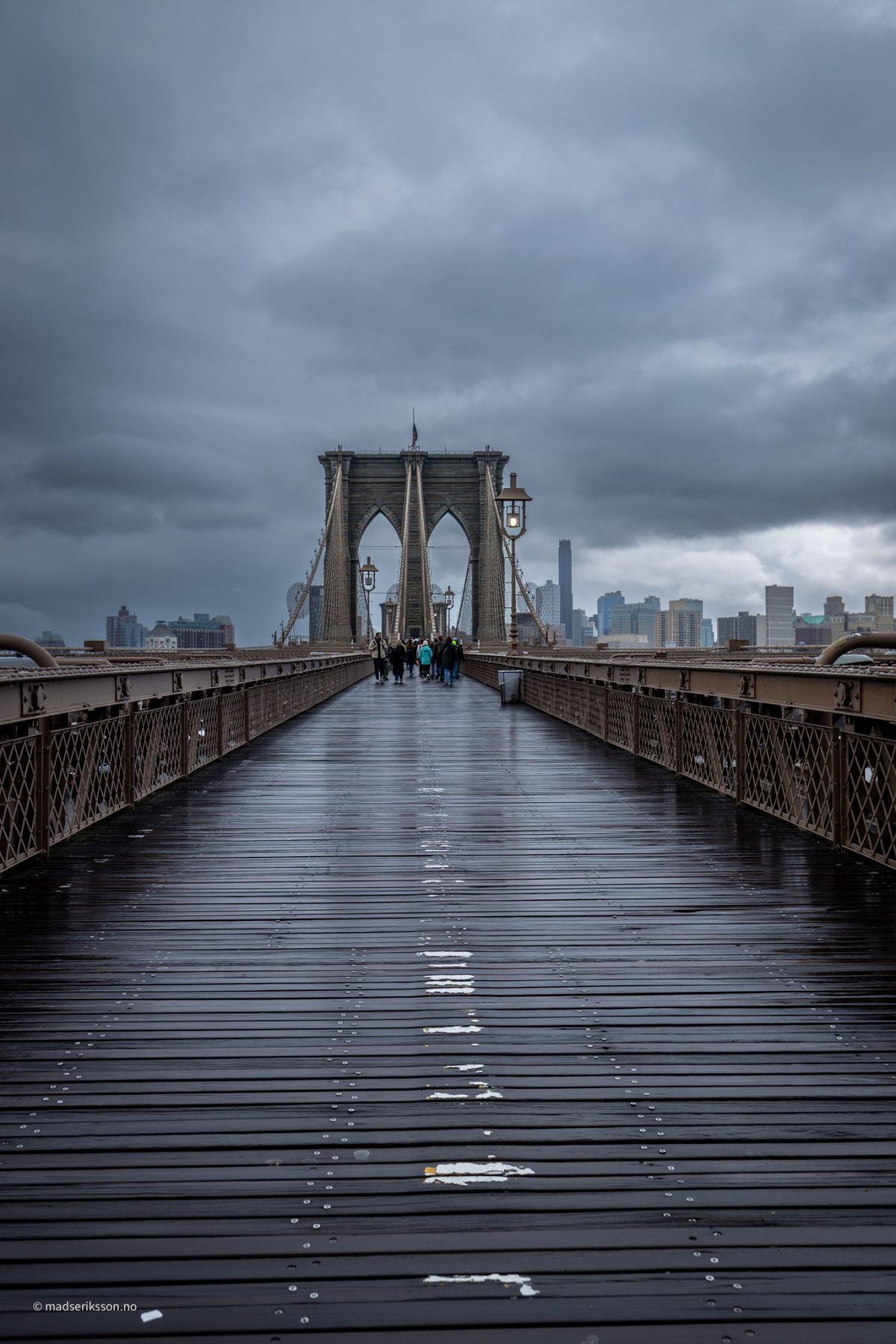
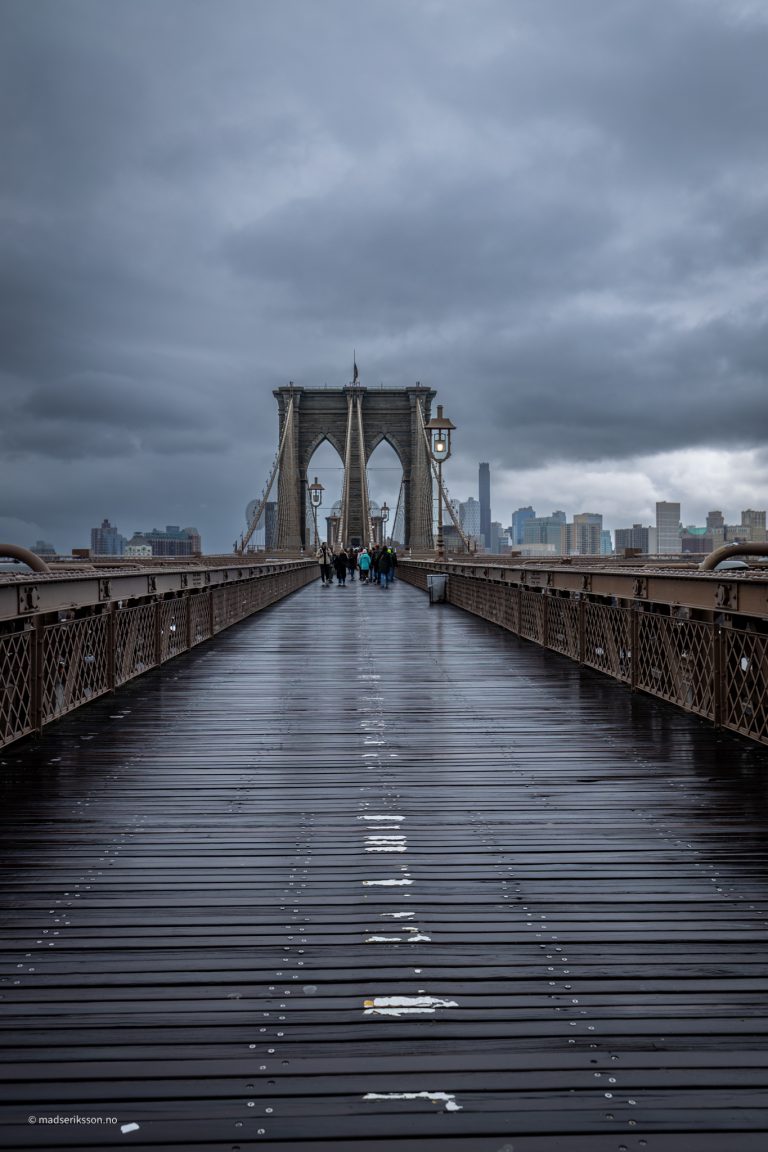
The wet wooden promenade of the Brooklyn Bridge leading towards a stone tower under a stormy sky
Timber boxes sunk into the riverbed
Each tower rests on a caisson, a bottomless timber box sunk into the riverbed as men dug out the mud beneath it in compressed air. The Brooklyn caisson reached 13.6 metres below high water and the Manhattan caisson 23.9 metres, where digging stopped on compacted sand and gravel, short of bedrock.
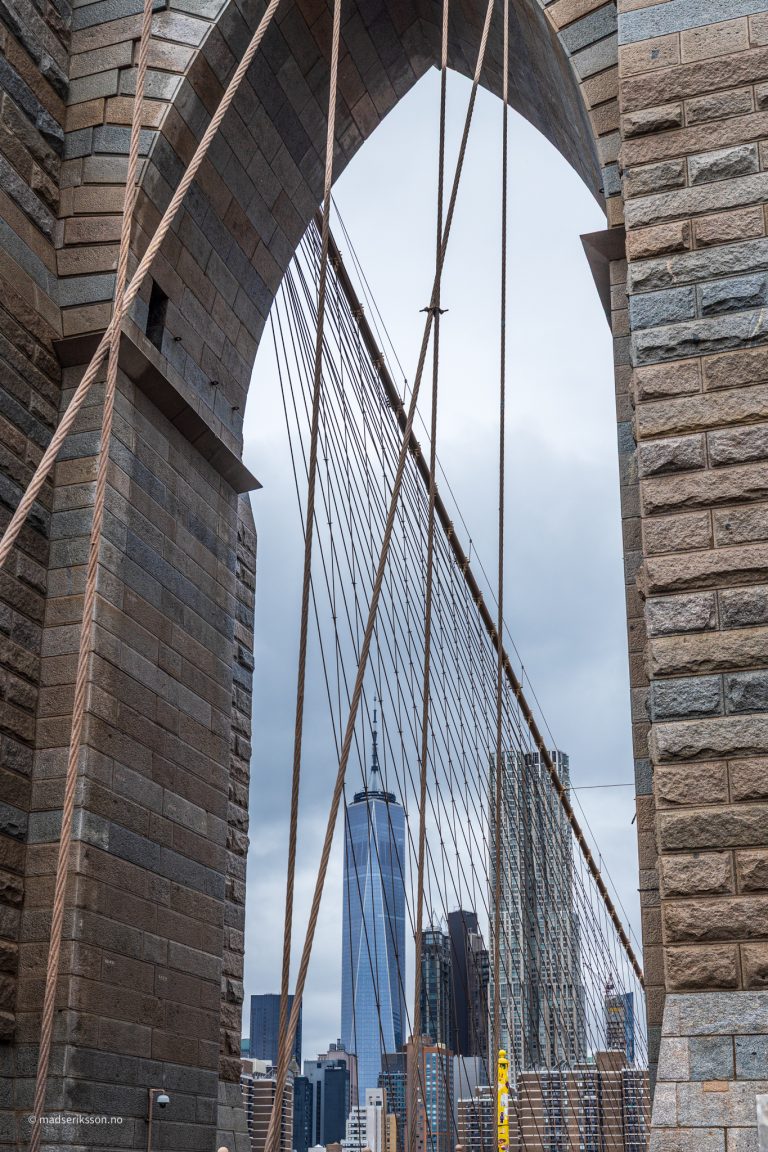
Stone pierced by Gothic arches
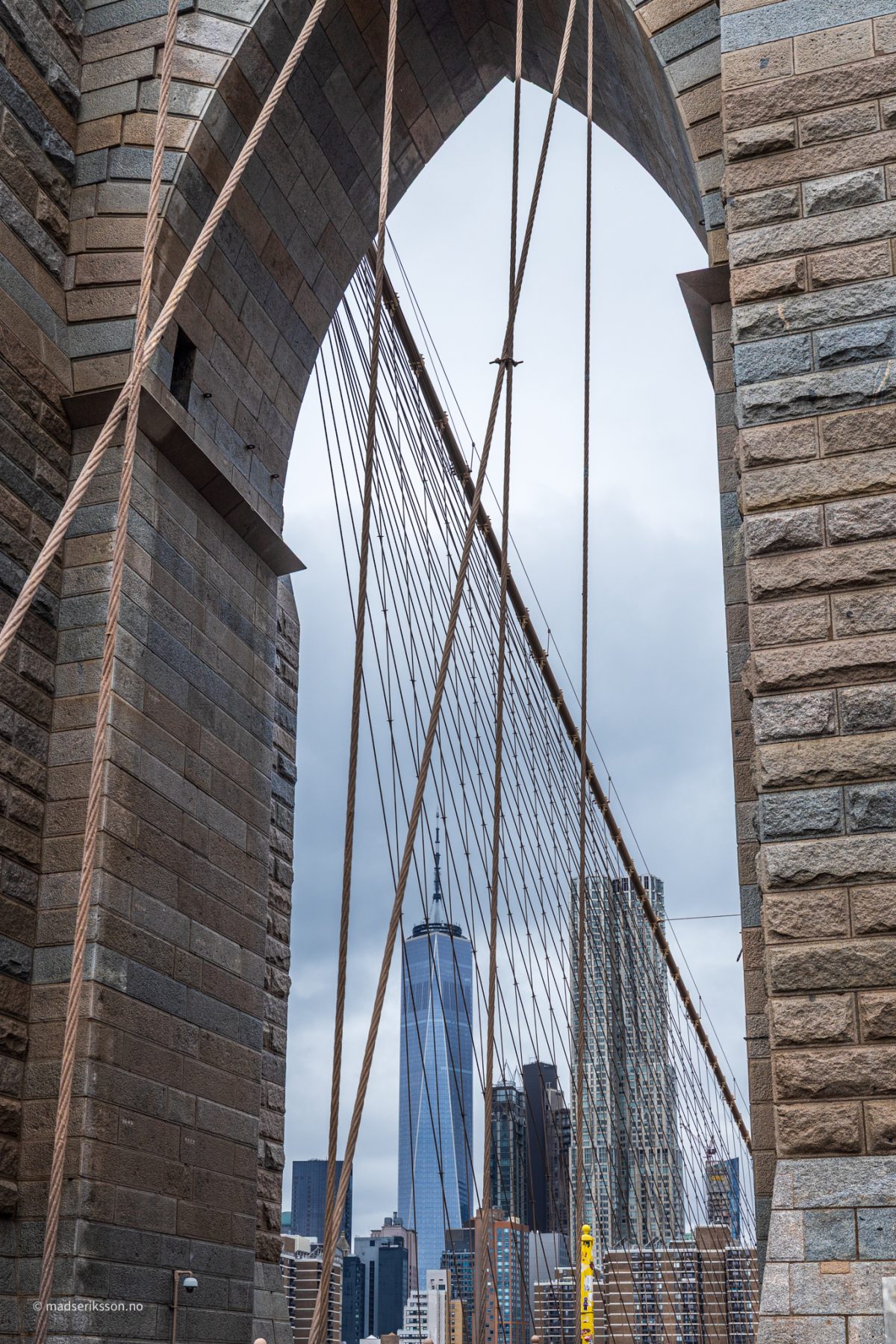
The towers are built of limestone and granite bound with Rosendale natural cement and rise about 84 metres above high water. Each is pierced by a pair of pointed Gothic arches about 36 metres high, through which the roadways and the promenade pass. A four-year, $300 million restoration was completed in 2024.
One World Trade Center framed by a pointed arch of a Brooklyn Bridge tower
Four cables of steel wire
The deck hangs from four main cables, each about 40 centimetres thick and spun in place from more than 5,000 parallel steel wires in 19 strands. When rejected wire was found in the cables, around 150 extra wires were added to each. Some 400 diagonal stays from the towers stiffen the 486-metre main span.
The Gothic stone towers and steel cables of the Brooklyn Bridge spanning the East River
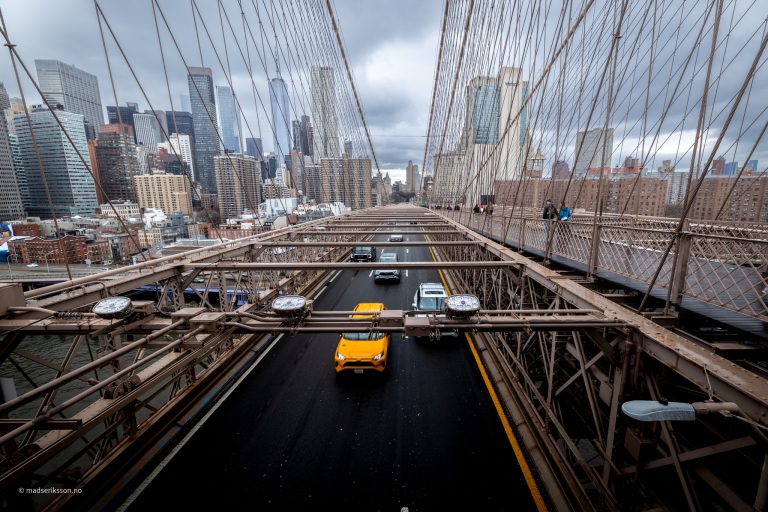
A walkway above the traffic
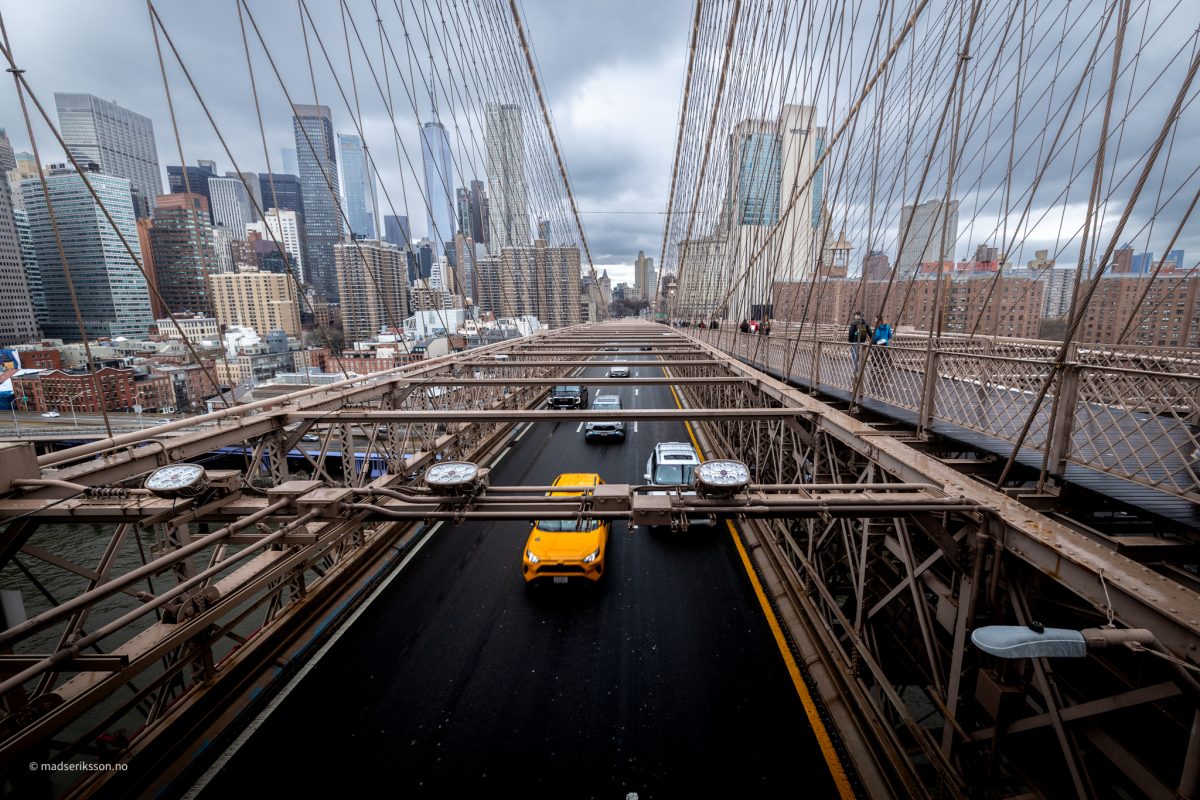
The timber promenade runs down the middle of the bridge, raised above the roadways and through the arches of both towers. In 2024 it carried almost 29,000 pedestrians a day. Cyclists have had their own protected lane at road level since 2021, and vendors have been banned since 2024.
A yellow taxi crossing the Brooklyn Bridge below the promenade, with the Lower Manhattan skyline ahead
The bridge from below
Dumbo, the old industrial district between the two bridges, runs down to the river. Pebble Beach and Main Street Park look straight up at the deck and cables, Jane's Carousel of 1922 turns in a glass pavilion by Jean Nouvel, and Fulton Ferry Landing marks where John Roebling was injured in 1869.
City Hall to High Street
The Manhattan entrance is beside City Hall Park; on the Brooklyn side the walkway ends near High Street, with stairs down to Washington Street for Dumbo. A straight crossing takes about 30 minutes. Early morning is quietest, and walking from Brooklyn puts the Manhattan skyline ahead the whole way.
A yellow taxi crossing the Brooklyn Bridge below the promenade, with the Lower Manhattan skyline ahead
3D model © 2026 madseriksson.no · Photographs © madseriksson.no. Towers, anchorages and surroundings: © OpenStreetMap contributors (ODbL). The deck, approaches and four main cables are drawn as simplified lines from the figures in the article (486 m main span, towers about 84 m above high water, clearance about 41 m); the diagonal stays and suspenders are left out, and heights are simplified.
Three Roeblings — Fourteen Years to Cross the East River
How the bridge passed from a father who died before it began, to a son who directed it from his window, to the woman who carried his instructions to the river
John Roebling’s plan was approved in 1869, and within weeks the project had lost its designer. The accident at the Fulton Ferry slip in June that year cost him his toes, and the tetanus infection that followed killed him in July. Washington Roebling had worked alongside his father on earlier bridges and had studied the latest caisson techniques in Europe; he stepped in as chief engineer, and in January 1870 work began on the foundations of the Brooklyn tower. For the next three years the bridge was largely invisible: the important work went on below the riverbed, inside enormous timber boxes in which men dug in compressed air.
That work broke Washington Roebling’s health. Like many of the labourers, he spent long hours in the caissons and suffered repeated attacks of what was then a little-understood illness — caisson disease, now known as decompression sickness. By the early 1870s he was largely confined to his house in Brooklyn Heights, from where he followed the progress of the towers through a telescope. Emily Warren Roebling, who had taught herself the mathematics and engineering of the project, carried his instructions to the assistant engineers, dealt with the contractors and the bridge trustees, and for roughly eleven years acted as the public face of the chief engineer. When the bridge opened, she was the first person to ride across it.
The bridge opened on 24 May 1883 to enormous crowds. Six days later a stampede on one of the approach stairways killed at least twelve people — a reminder of how new and how unsettling the idea of a bridge on this scale still was.
The bridge had cost about $15.5 million, more than twice the original estimate, and by most counts around 27 men had died building it, from falls, accidents in the caissons and the bends. It changed the two cities on either side almost at once. Cable cars soon ran across the bridge between the termini at each end, later replaced by elevated trains and trolleys, and in 1898 Brooklyn merged with New York to become one of the five boroughs of the greater city. The rail tracks were removed in a reconstruction between 1944 and 1954, which widened each roadway to three lanes.
The Engineering — Stone Towers, Sunken Caissons and Cables of Steel
Why the bridge rests on timber boxes sunk into the riverbed, why its cables contain more wire than the contract required, and what the web of diagonal stays is for
Each of the two towers rests on a caisson: a vast, bottomless box of timber, open underneath, that was floated into position and then sunk into the riverbed as men inside dug out the mud and boulders beneath its edges. Compressed air pumped into the working chamber kept the water out. As the box sank, the masonry of the tower was built up on its roof, pressing it deeper. The Brooklyn caisson reached 13.6 metres below high water; the Manhattan caisson went down to 23.9 metres, where the air pressure needed was so high that several men died of caisson disease. Washington Roebling decided to stop there, on a bed of compacted sand and gravel, rather than continue to bedrock — a judgement the tower has borne out ever since.
Above the water the towers are built of limestone and granite bound with Rosendale natural cement, and they rise about 84 metres above high water. Each is pierced by a pair of pointed Gothic arches, about 36 metres high, through which the roadways and the promenade pass. Between the towers, the deck hangs from four main cables, each around 40 centimetres in diameter. They were spun on site from thousands of individual steel wires, carried back and forth across the river on travelling wheels and then bundled and compressed — a technique John Roebling had developed on his earlier bridges, used here for the first time with steel rather than iron wire on a bridge of this size.
The steel nearly undid the project. Some of the wire supplied by the contractor J. Lloyd Haigh turned out to be wire that inspectors had already rejected, smuggled back into the deliveries after testing. Too much of it was already in the cables to remove, so Washington Roebling ordered around 150 additional sound wires added to each cable to make up the strength.
The characteristic web of the bridge — the lines that fan out from the tops of the towers — is the other half of the design. Alongside the vertical suspenders that hang from the main cables, Roebling added some 400 diagonal stays running straight from the towers to the deck. They stiffen the deck against wind and give the bridge a margin of safety beyond the cables alone, and they are why it looks so unlike later suspension bridges. The stone of the towers has recently been restored in a four-year, $300 million programme, completed in 2024, which cleaned every block, replaced the mortar and returned the towers to their original grey.
Walking Across — The Promenade Above the Traffic
Where to join the walkway, what to look for on the way over, and why the Manhattan-to-Brooklyn direction is not always the best one
The promenade begins on the Manhattan side at the edge of City Hall Park, a few steps from the Brooklyn Bridge–City Hall subway station, and climbs gradually up the long approach ramp before it reaches the river. It runs down the middle of the bridge, raised above the roadways and generally between three and five metres wide, with timber planks underfoot. For the first few hundred metres it passes over the streets of Lower Manhattan; then the Manhattan tower comes up ahead, and the walkway passes straight through its pair of Gothic arches. The cables and stays close around it like rigging on a ship, and the views open out across the water.
Looking south from the main span, the harbour lies beyond the end of the East River: Governors Island, the Statue of Liberty on its island further out, and the towers of the Financial District, with One World Trade Center the tallest of them, behind the piers of the South Street Seaport. To the north, the Manhattan Bridge crosses the river in a parallel line, with the Williamsburg Bridge beyond it. At the Brooklyn tower the walkway passes through the arches again, then descends towards Brooklyn. A staircase leads down to Washington Street for Dumbo and the waterfront; the main path carries on to Tillary Street and the subway at High Street.
The promenade is shared space, and it rewards a little etiquette. Walkers should keep to the walkway, stop at the sides rather than in the middle to take photographs, and stay out of the cyclists’ lane at road level.
Timing makes the most difference. The promenade is at its quietest early in the morning, when the low light from the east falls on Lower Manhattan; from late morning onwards in summer it can be very crowded, especially at weekends and around the towers. Walking from Brooklyn to Manhattan puts the skyline in front of you the whole way, which is why many people take the subway to High Street or York Street and walk back. Walking towards Brooklyn in the late afternoon puts the sun behind you, and arriving in Dumbo at dusk means reaching the waterfront parks in time to watch the lights come on across the river.
Seeing the Bridge — The Brooklyn Waterfront From Below
The cobbled street that frames the Manhattan Bridge, the riverside lawns between the two bridges, and the landing where the story of the Brooklyn Bridge began
Dumbo — Down Under the Manhattan Bridge Overpass — is the old industrial district between the two bridges on the Brooklyn side, a grid of cobbled streets and converted warehouses that runs down to the river. Its most famous view is at the bottom of Washington Street, near Water Street: the Manhattan Bridge fills the end of the street, and one of the arches of its Manhattan tower frames the Empire State Building in the distance. The spot is busy with photographers at all hours, and it is worth arriving early in the morning. It is a view of the neighbouring bridge rather than of the Brooklyn Bridge, but it explains why so many people end their walk here.
Below Dumbo, Brooklyn Bridge Park runs along the waterfront in a chain of lawns, piers and small beaches. Pebble Beach and Main Street Park, between the two bridges, look straight up at the deck and the cables of the Brooklyn Bridge from almost underneath. Jane’s Carousel, a restored merry-go-round from 1922, turns inside a glass pavilion by the architect Jean Nouvel at the water’s edge, with the bridge rising directly behind it. Further south, the piers of the park give a side-on view of the whole span with the towers of Lower Manhattan behind.
For a century and a half the bridge has drawn artists back to it — the poet Hart Crane, whose long poem The Bridge was published in 1930, and the painter Joseph Stella, who turned its cables and arches into a modern cathedral.
Just south of the bridge is Fulton Ferry Landing, where the ferries ran before the bridge existed and where John Roebling was injured in 1869. Today the NYC Ferry calls nearby, and the pier at the landing is one of the closest points to the Brooklyn tower. Climbing up from the waterfront to Brooklyn Heights leads to the Brooklyn Heights Promenade, a raised walkway along the edge of the bluff that looks across the river to Lower Manhattan, with the whole length of the bridge to the north. It is a short walk from the bridge’s Brooklyn end, and it gives the view that Washington Roebling had from his window as he watched the bridge go up.
«The Brooklyn Bridge was built by a family as much as by a city: designed by a father who died before work began, directed by a son who could no longer reach the river, and carried through by a woman who learned its engineering to keep it going. What they left is still a working bridge, and still the best walk in New York. Cross it early in the morning, when the promenade is quiet and the light is on the towers of Lower Manhattan. Walk through the arches, look up at the web of cables and stays, and finish on the Brooklyn waterfront, looking back at the span from below.»

More in the same area
 ArchitectureThe United Nations in New York: A Hub for Global Diplomacy
 ArchitectureGuggenheim Museum, New York: Frank Lloyd Wright’s Spiral on Fifth Avenue
 ArchitectureEmpire State Building: The 410-Day Skyscraper and Its Observation Decks
 CitiesDiscovering New York: The City That Never Sleeps
 ArchitectureTen Buildings That Changed Their Cities — Modern Architecture Ranked on Impact, Not Image
 TravelFlorida Keys and Key West: The Overseas Highway, the Reef and the End of the Road