The United Nations Headquarters sits on eighteen acres of international territory on the East River in Midtown Manhattan — legally distinct from the United States, governed by its own rules, flying the flags of 193 member states along First Avenue in a row that stretches two city blocks. The Secretariat tower, designed by a team that included Le Corbusier and Oscar Niemeyer and completed in 1952, gave New York its first glass curtain-wall skyscraper and the world a new symbol of multilateral ambition. The site where global diplomacy has been conducted — and sometimes failed — for over seventy years is open to visitors, and the guided tour is one of the stranger and more thought-provoking hours you can spend in New York City.

The story of how the United Nations ended up on the East River begins with a deadline and a donation. In 1946, when the newly formed organisation needed a permanent home, cities across the United States competed for the prestige: Philadelphia, Boston, San Francisco, and several sites north of New York were all seriously considered. At almost the last minute, John D. Rockefeller Jr. wrote a cheque for $8.5 million to purchase a site in Turtle Bay, Manhattan — then home to slaughterhouses, breweries, and light industry — and offered it to the General Assembly as a gift. The offer was accepted. The site, bounded by 42nd and 48th Streets and extending east to the river, was declared international territory, and a team of eleven architects from ten countries — the “Workshop for Peace” — was assembled to design the complex. Le Corbusier and Oscar Niemeyer were the dominant creative forces; the final executed design was led by American architect Wallace Harrison. The complex was completed in 1952 and has occupied the same eighteen acres ever since.
The headquarters consists of four main buildings: the 39-story Secretariat tower with its revolutionary glass curtain walls; the domed General Assembly Building, whose principal hall seats over 1,800 delegates; the low-lying Conference Building connecting the two; and the Dag Hammarskjöld Library, added in 1961. The grounds contain sculptures, gardens, a rose collection, a segment of the Berlin Wall, and the “Knotted Gun” — Carl Fredrik Reuterswärd’s sculpture of a revolver with its barrel tied in a knot, a gift from Luxembourg and one of the most recognised symbols of the UN’s disarmament mission. The entire complex remains under UN jurisdiction, making it technically neither American soil nor any other national territory — a legal status that has occasional practical consequences and enduring symbolic weight.
How to approach the United Nations Headquarters
This guide covers the UN in four sections. We begin with the architecture — the Secretariat tower, the glass curtain wall, and the story of the Workshop for Peace. We then go inside the two rooms most visitors remember: the General Assembly Hall and the Security Council Chamber. The third section covers the art collection, the gifts from member states, and the outdoor sculptures — a dimension of the site that most visitors underestimate. The fourth section is practical: tickets, security, the check-in process at 801 First Avenue, what to bring, and how to combine a UN visit with the surrounding Midtown East neighbourhood.
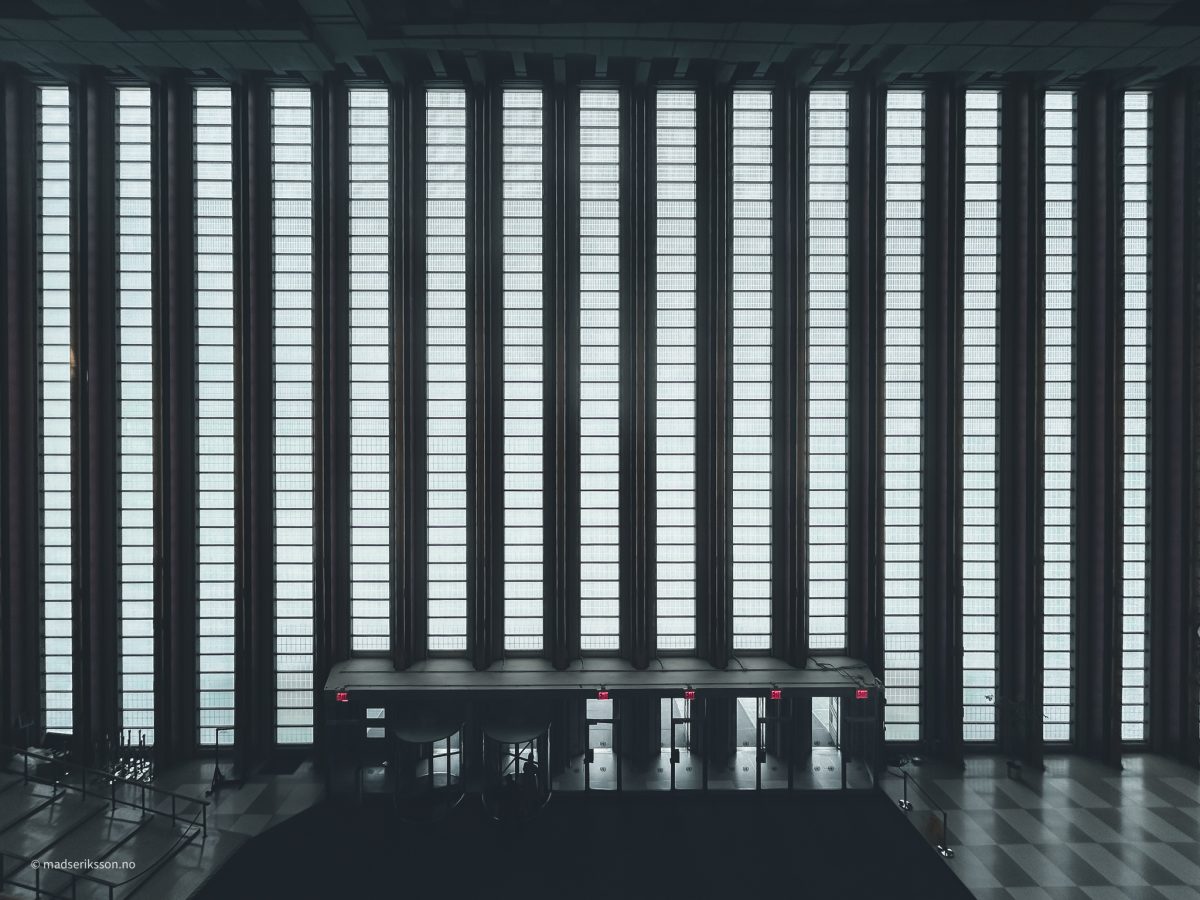
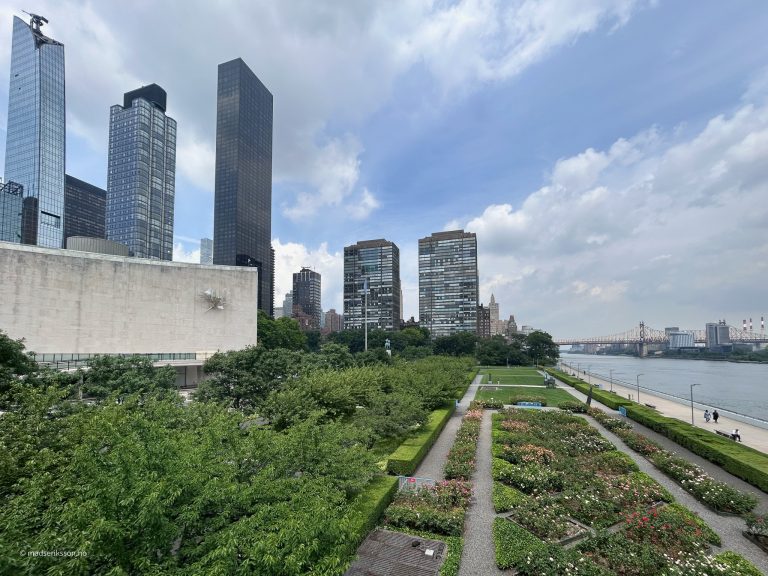
International territory on the East River
In 1946 John D. Rockefeller Jr. paid $8.5 million for a site in Turtle Bay, then home to slaughterhouses, breweries and light industry, and gave it to the United Nations. Bounded by 42nd and 48th Streets and the East River, its 18 acres are international territory, and the complex was completed in 1952.
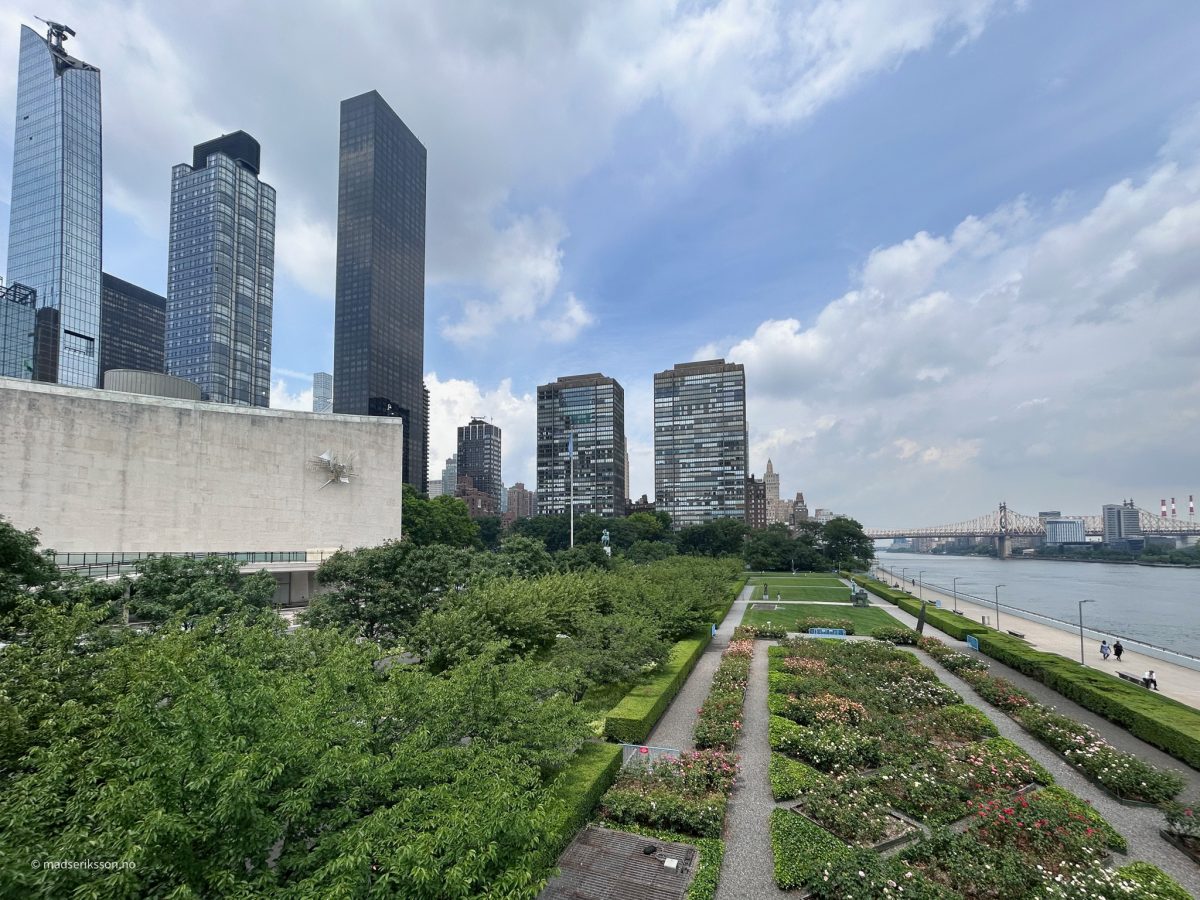
The UN rose garden beside the East River, with Midtown towers on one side and the Queensboro Bridge beyond
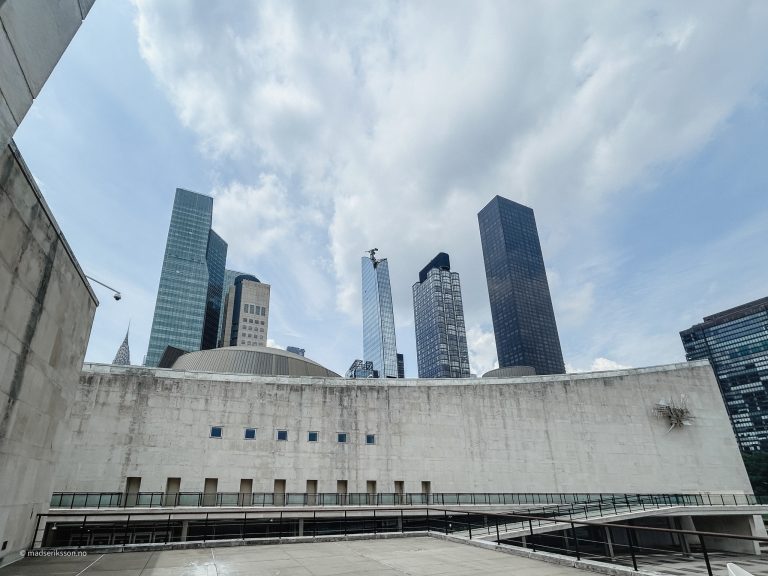
One design from ten countries
A board of eleven architects from ten countries designed the complex. Le Corbusier and Oscar Niemeyer were the dominant creative forces, alongside Sven Markelius of Sweden, and the executed design was led by the American Wallace Harrison. Four main buildings make up the headquarters, with the Dag Hammarskjöld Library added in 1961.
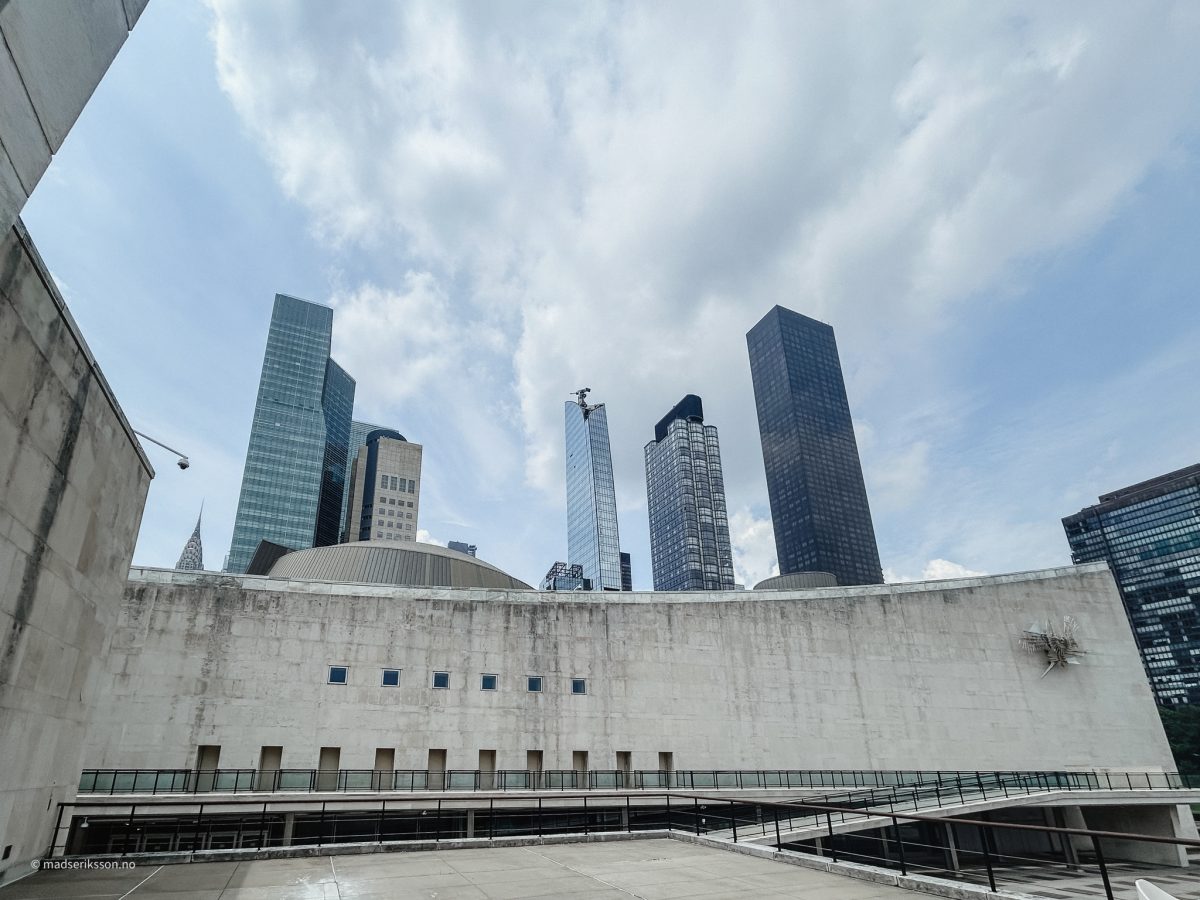
The low marble wall and shallow dome of the General Assembly Building, with Midtown towers rising behind
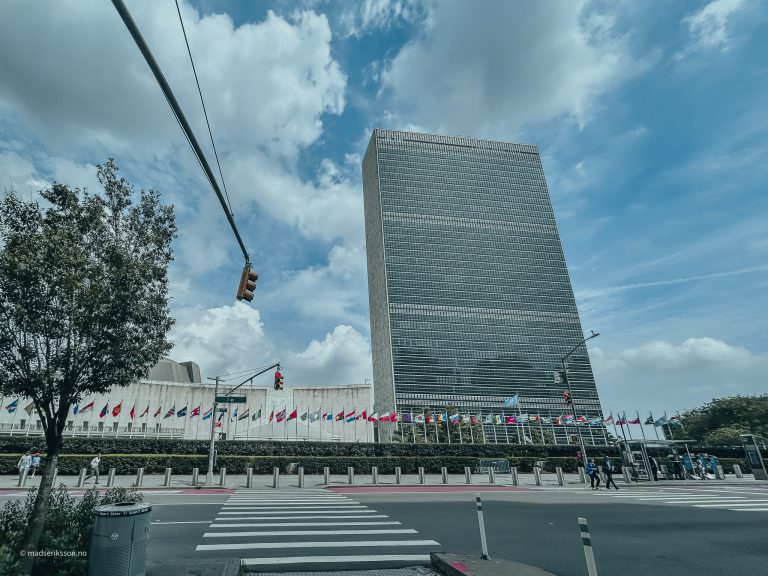
New York's first glass curtain wall
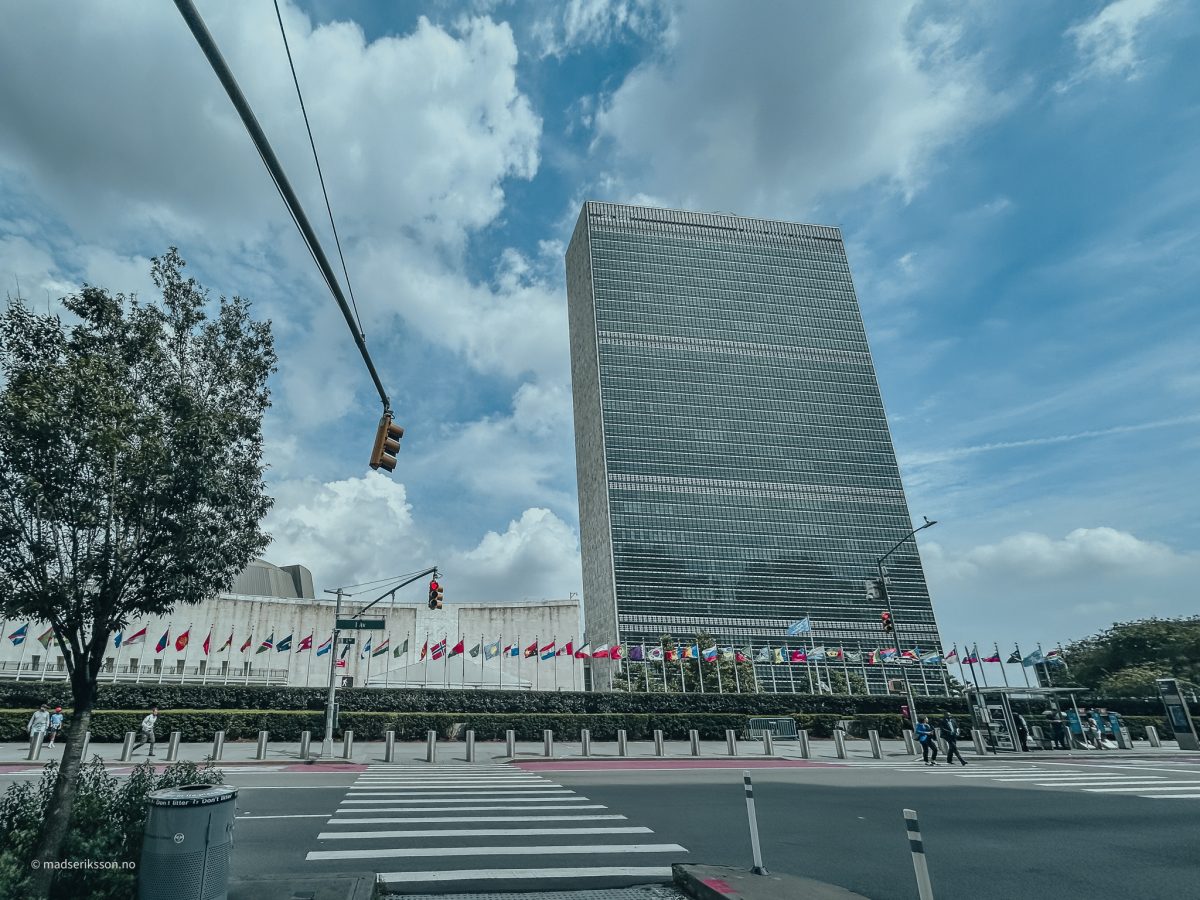
The 39-storey Secretariat was the first skyscraper in New York with a glass curtain wall: 5,400 blue-green tinted windows covering 300,000 square feet of its east and west faces. The narrow north and south ends are faced in white marble, so from the river the tower reads as a single shimmering slab.
The Secretariat tower and the row of member-state flags along First Avenue in Manhattan
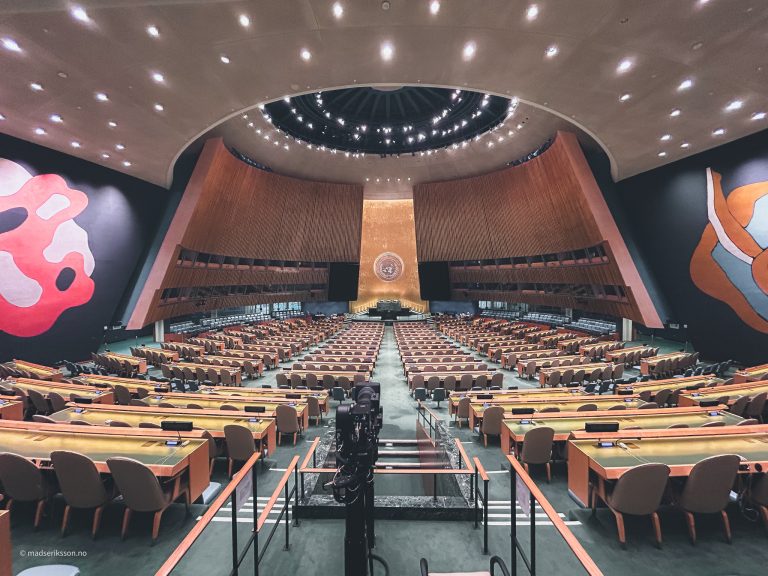
Where the world votes
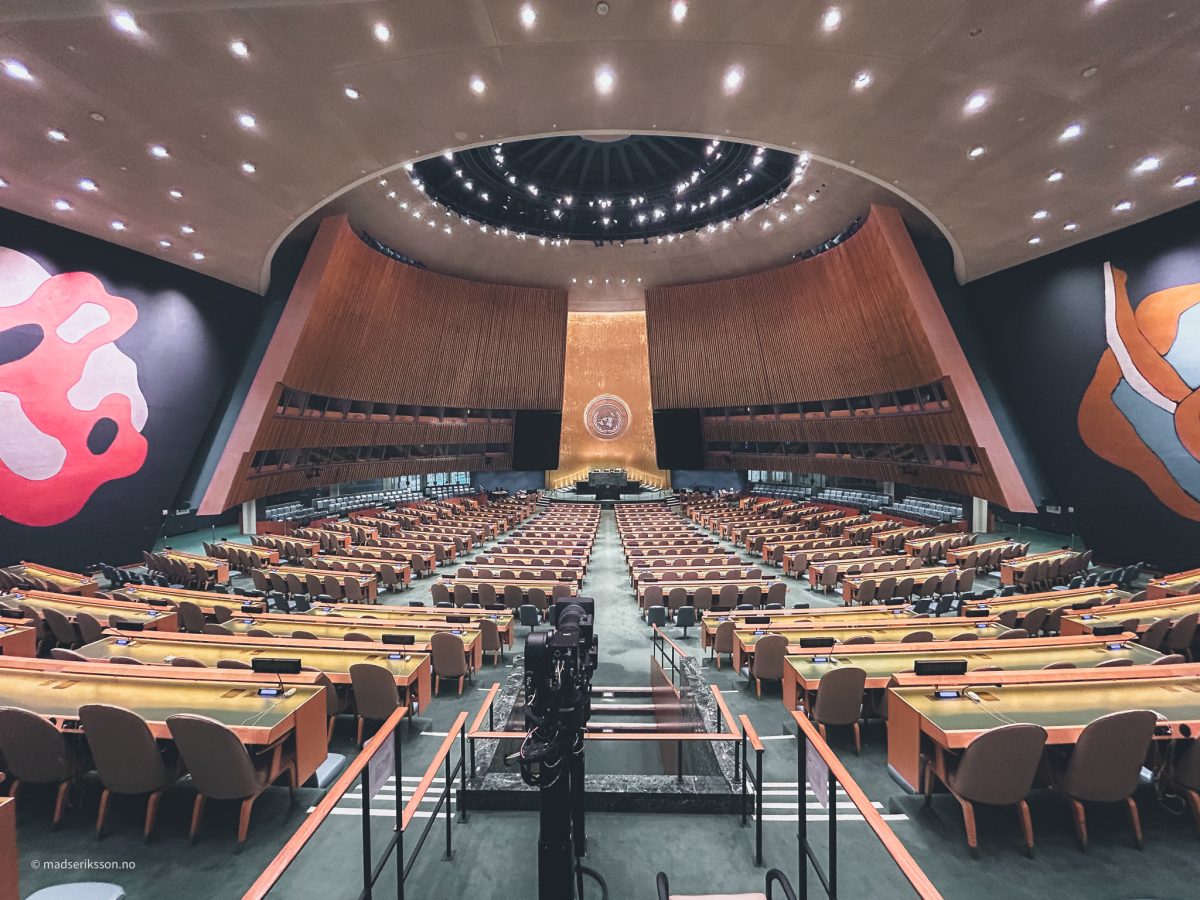
The domed General Assembly Building, with its curved roof, was designed partly to look suitably monumental from the street. Its hall seats more than 1,800 delegates from 193 member states, the ceiling rises 35 metres above the floor, and every September world leaders speak here in the General Debate.
The General Assembly Hall at UN Headquarters, with rows of delegate desks facing the podium
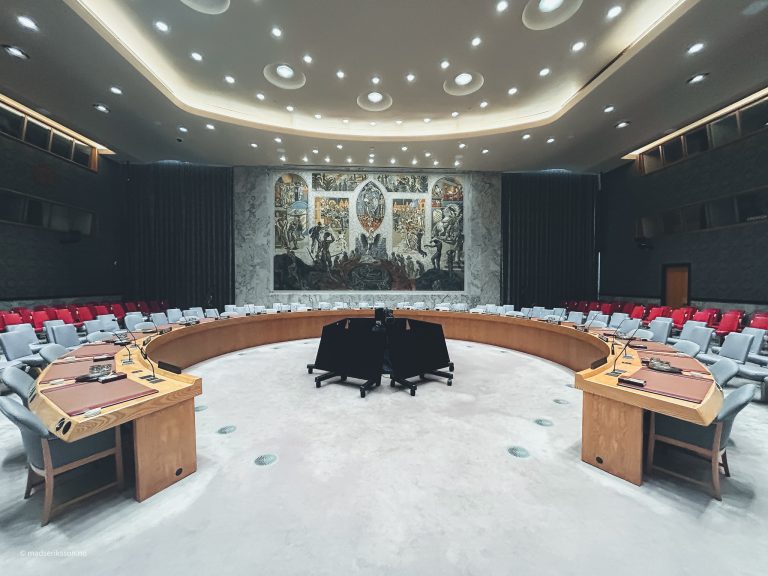
Where the world argues
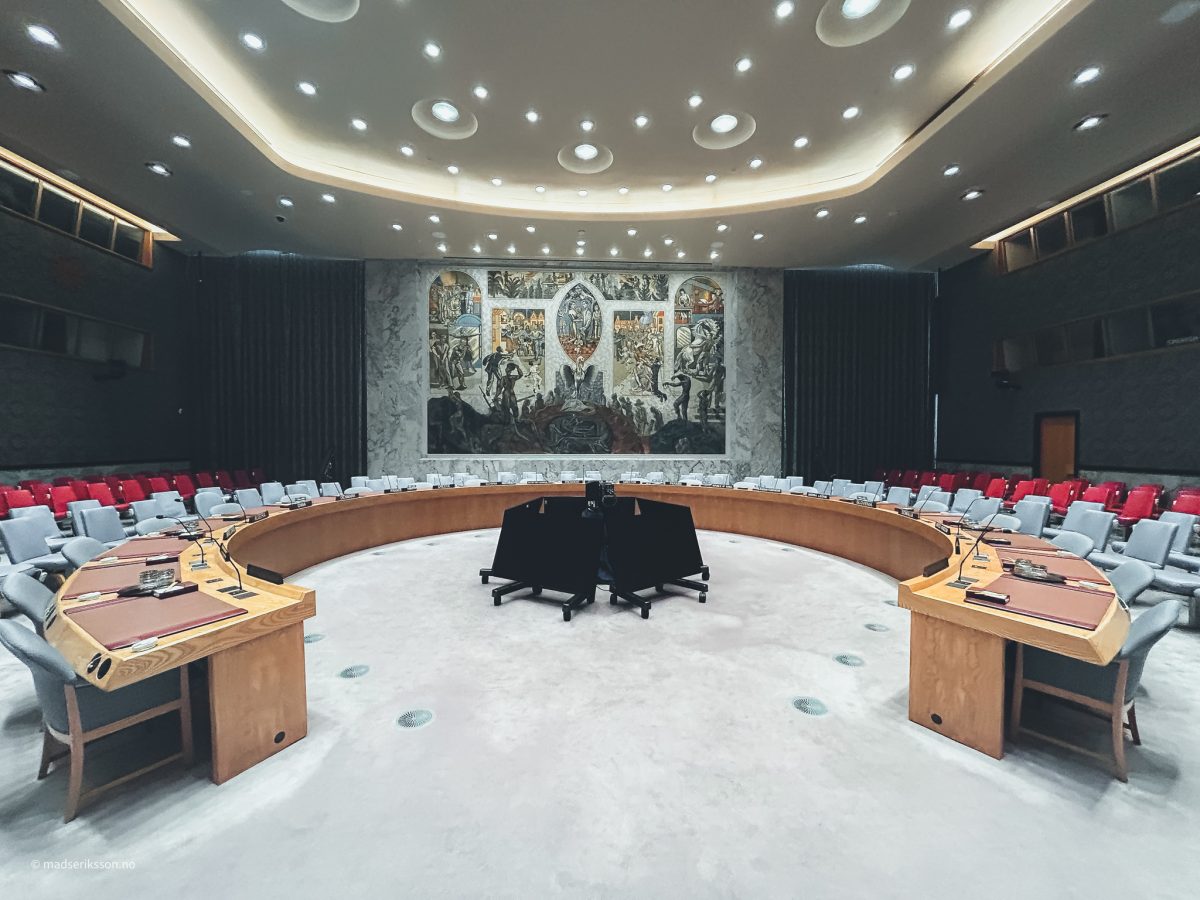
The low Conference Building links the tower and the Assembly. Its Security Council Chamber was designed by the Norwegian architect Arnstein Arneberg and given by Norway, with Per Krohg's phoenix mural on the back wall. Fifteen members sit at the horseshoe table; five hold a veto. Denmark and Sweden gave the other two council chambers.
The Security Council Chamber at UN Headquarters, its horseshoe table facing Per Krohg’s mural
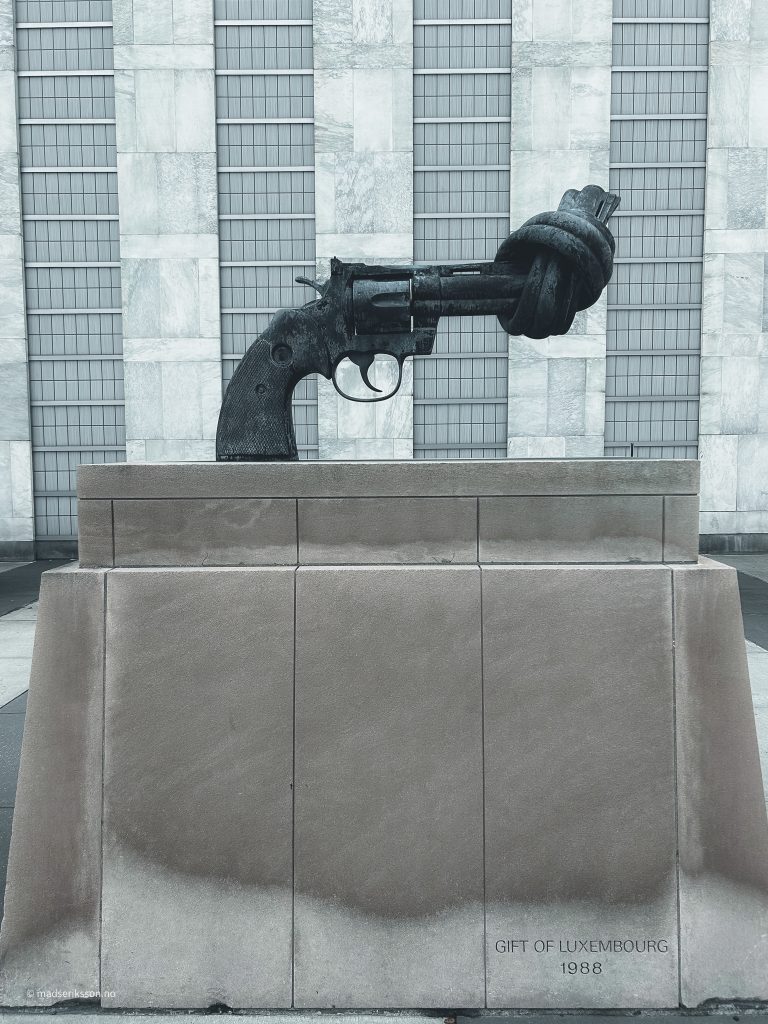
Gifts from member states
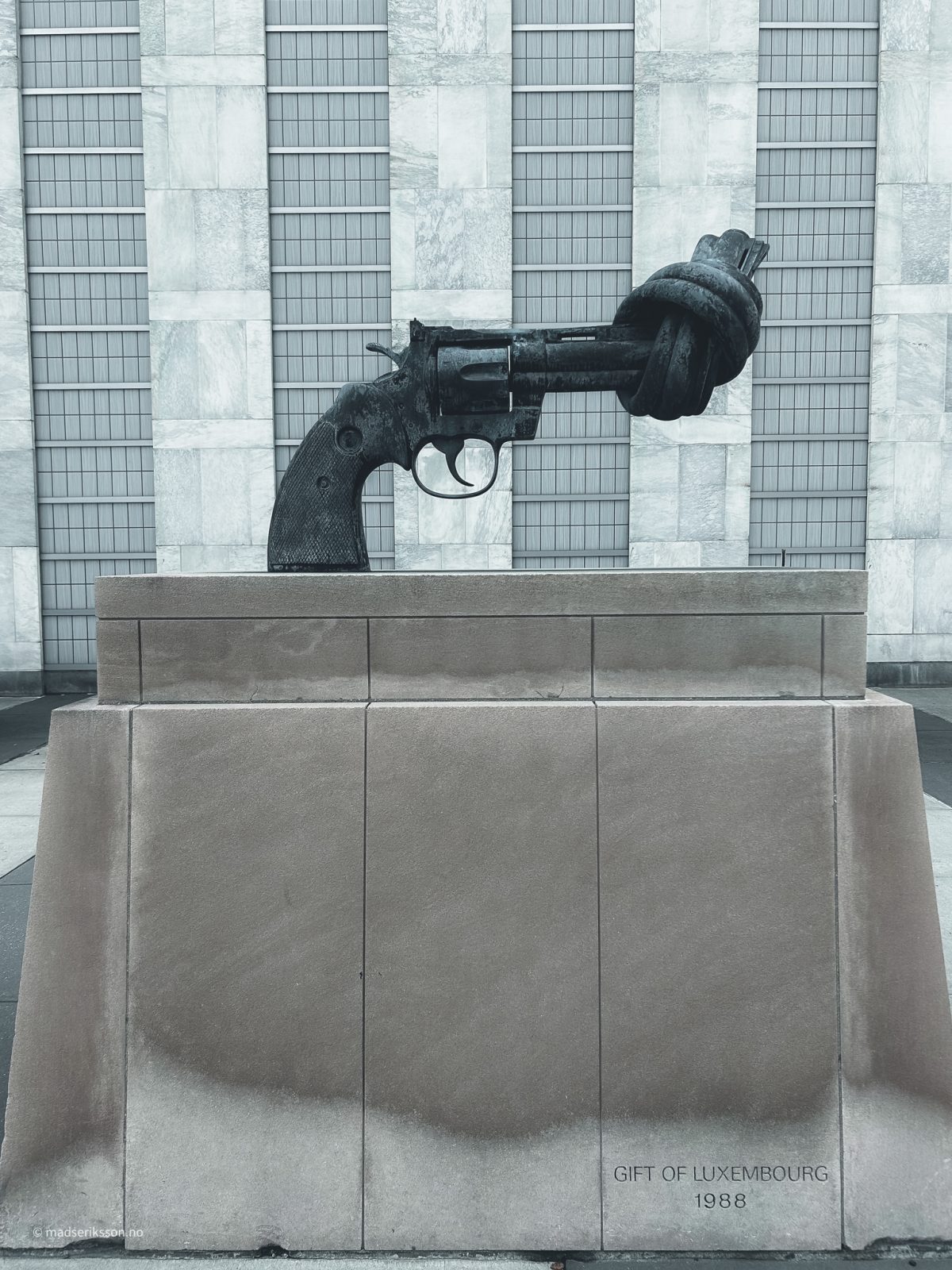
Almost every work in the collection was given by a member state. On the visitors plaza stands Carl Fredrik Reuterswärd's Non-Violence, the knotted revolver given by Luxembourg in 1988, beside the Ark of Return of 2015. The North Lawn holds a segment of the Berlin Wall, and the Japanese Peace Bell is rung twice a year.
Carl Fredrik Reuterswärd’s Knotted Gun sculpture, a gift from Luxembourg, at UN Headquarters in New York
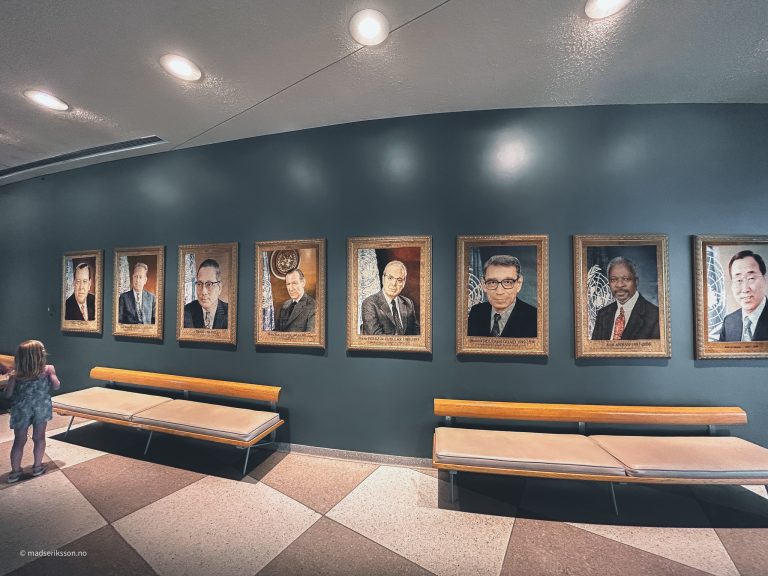
A memorial to Hammarskjöld
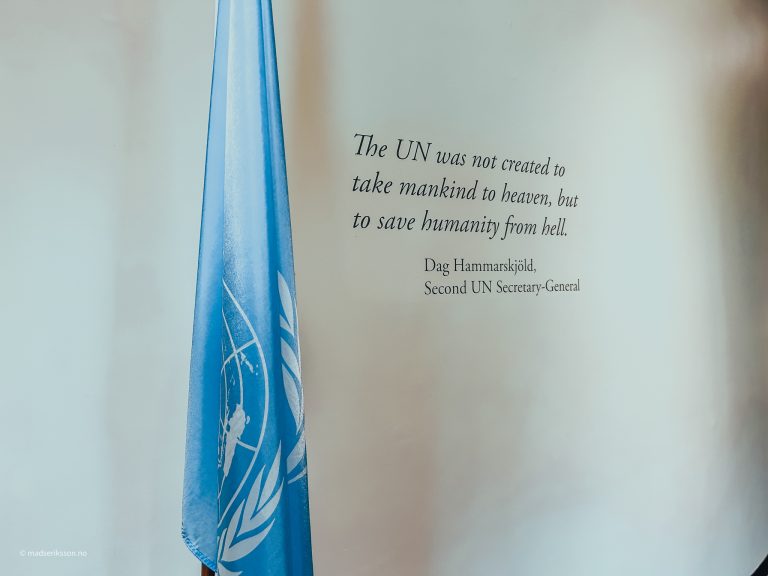
Inside, Marc Chagall's stained-glass window, donated by UN staff, remembers Secretary-General Dag Hammarskjöld and those who died with him in the 1961 plane crash. The visitors' lobby displays the 30 articles of the Universal Declaration of Human Rights and artefacts from Hiroshima and Nagasaki.
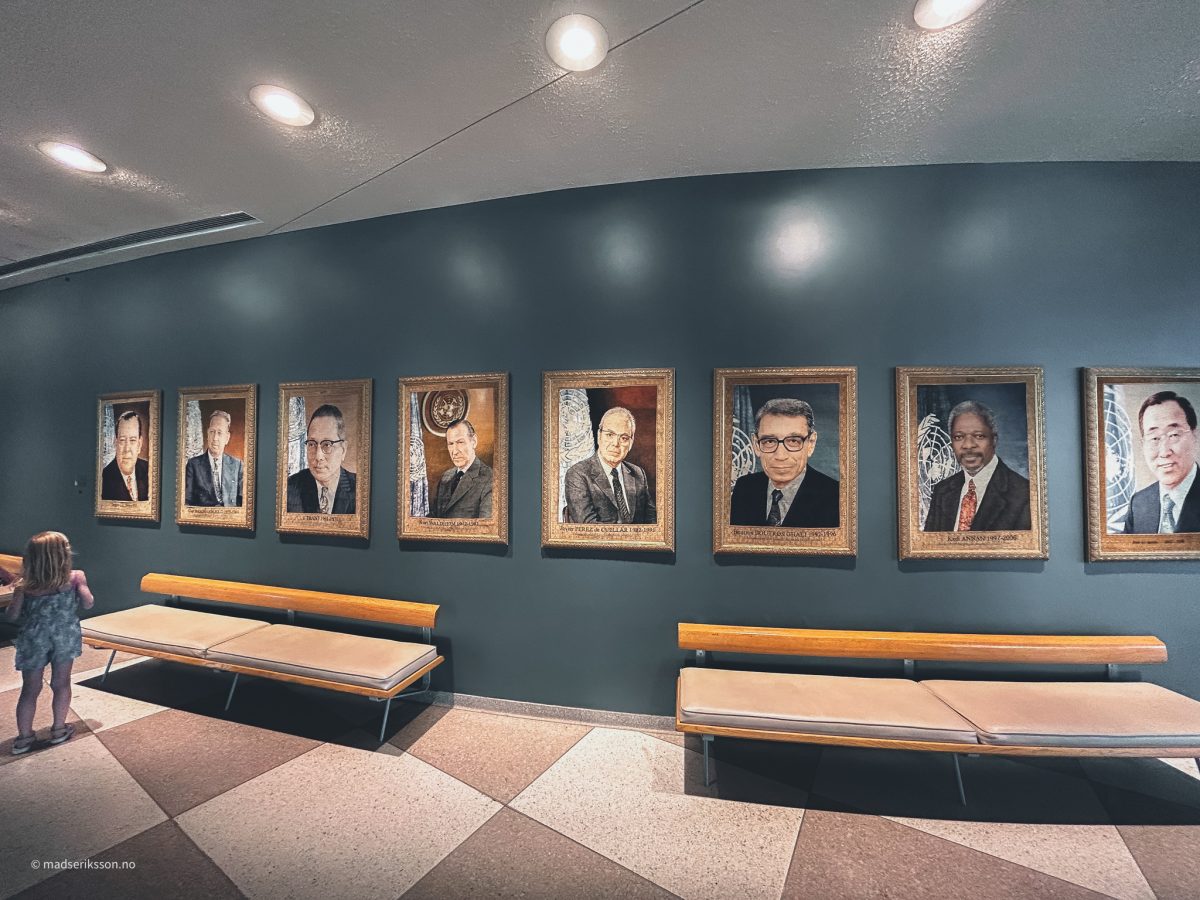
Official portraits of former UN Secretaries-General hung along a curved wall at United Nations Headquarters
Check in at 801 First Avenue
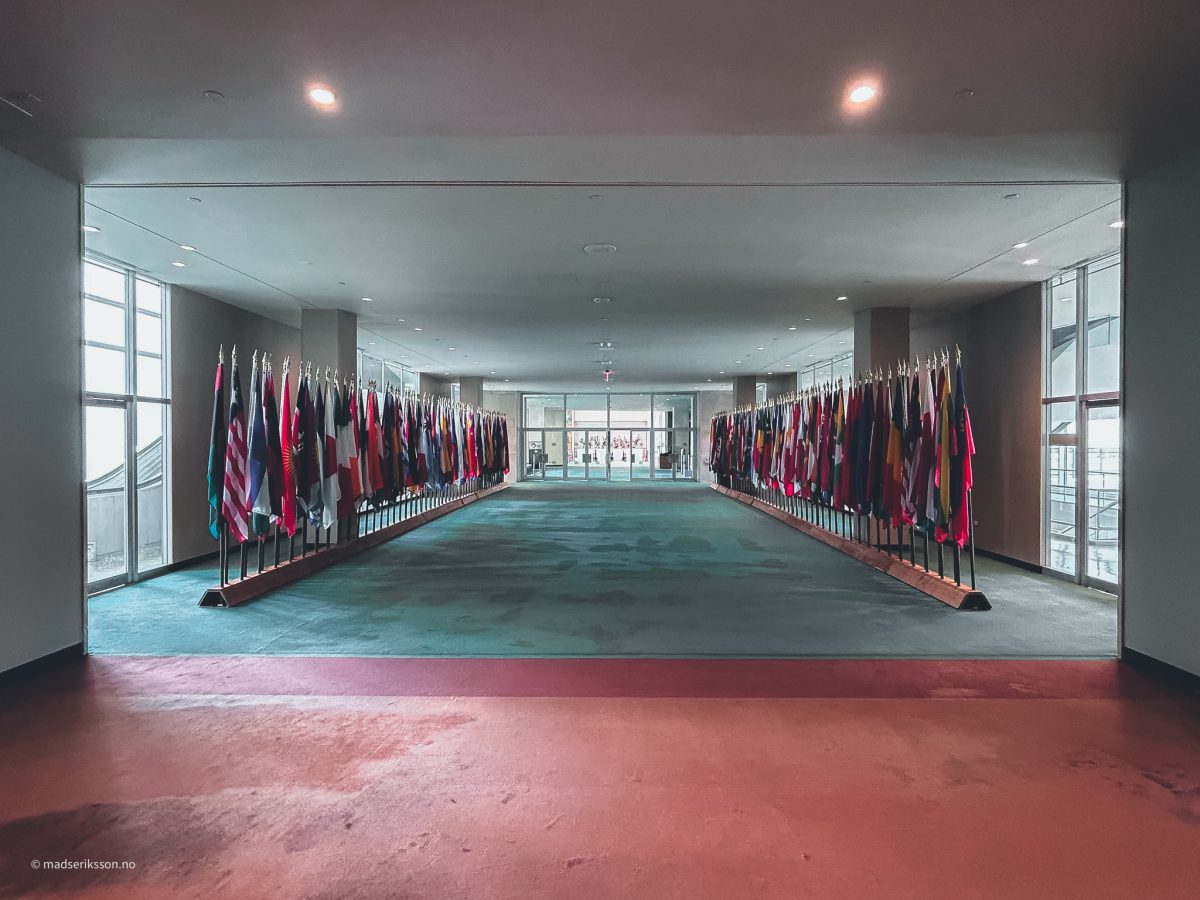
Guided tours run Monday to Friday and cost about $26. Check-in is at 801 First Avenue, on the corner of 45th Street, not the main gate; arrive 60 minutes early with photo ID. The 193 flagpoles along First Avenue run alphabetically. September, during the General Assembly, is best avoided.
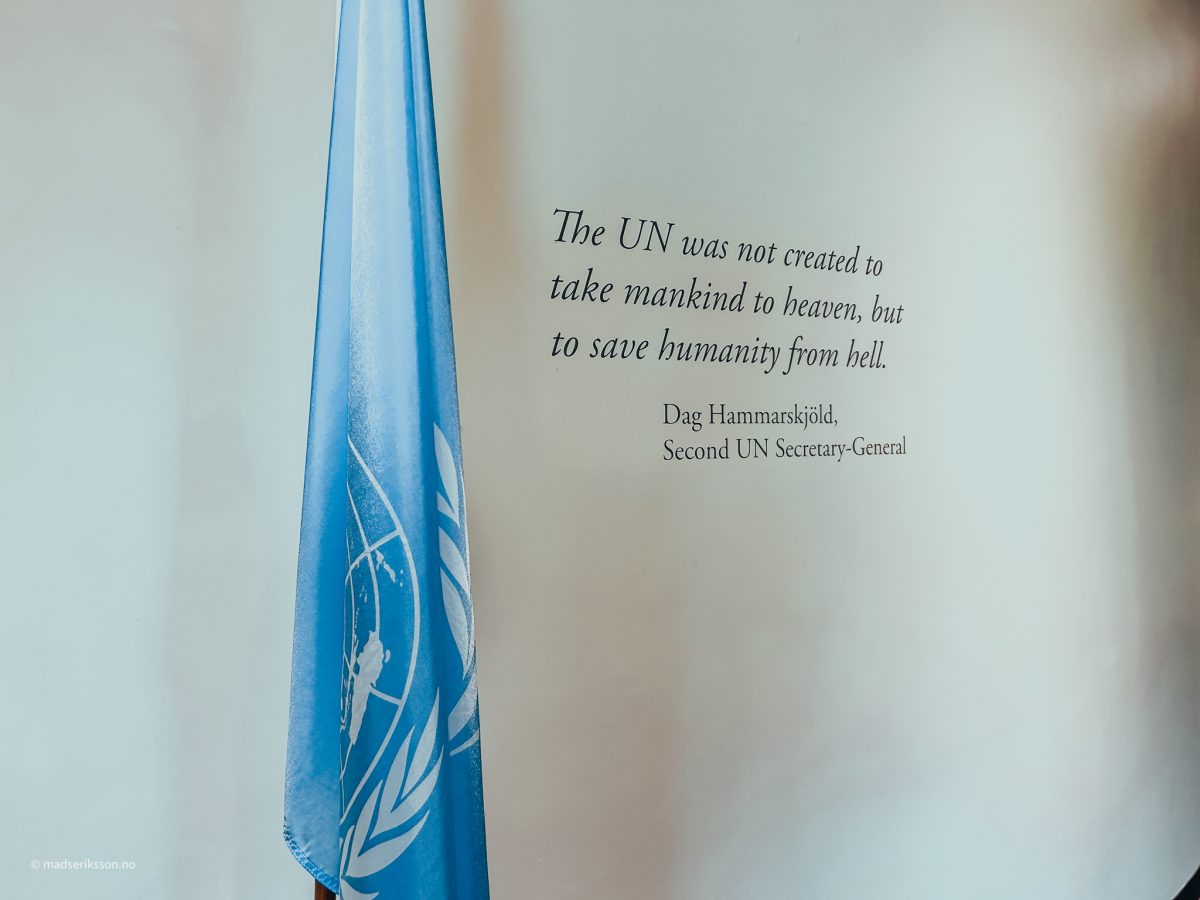
Dag Hammarskjöld’s words on the purpose of the UN, inscribed on a wall beside the blue United Nations flag
3D model © 2026 madseriksson.no · Photographs © madseriksson.no. Buildings and surroundings: © OpenStreetMap contributors (ODbL), with the complex drawn from its mapped parts. Heights are simplified and the General Assembly's curved roof and dome are shown as flat blocks.
The Architecture — Le Corbusier, Niemeyer & the First Glass Skyscraper
A building that was designed to embody transparency. It also gave New York its first glass curtain-wall skyscraper.
The UN complex is more architecturally significant than most visitors realise. The 39-story Secretariat Building, completed in 1952, was the first skyscraper in New York to use a glass curtain wall — a building technology that has since defined the appearance of cities worldwide. The eastern and western elevations are entirely clad in blue-green tinted glass: 5,400 individual windows covering 300,000 square feet, then a greater proportion of glass than any other structure in the world. The design was intentional symbolism: an institution dedicated to transparency, openness, and international cooperation expressed in a building whose primary material was glass. The narrower north and south elevations are faced in white marble, giving the tower its distinctive profile — all glass on two faces, all marble on two others — visible from the East River as a shimmering rectangular slab.
The story of the building’s design is almost as interesting as the building itself. The “Workshop for Peace” assembled eleven architects from ten countries, including Le Corbusier, Oscar Niemeyer of Brazil, Sven Markelius of Sweden, and representatives from the Soviet Union, China, Australia, and Uruguay. The process was fractious: Le Corbusier, characteristically, later claimed the entire design as his own, despite the collaborative nature of the board. The final executed design, led by Wallace Harrison, drew primarily on proposals submitted by Le Corbusier and Niemeyer, combined and modified through a process that satisfied nobody completely and produced something that satisfied millions of visitors. The General Assembly Building, with its distinctive curved roof and domed façade, was designed partly to secure US Congressional support for the project by looking suitably monumental from the street.
The Secretariat tower was the first glass curtain-wall skyscraper in New York. It gave the city — and eventually the world — its dominant building typology. The irony is that it was designed as a symbol of transparency for an institution whose work is often anything but.
Walking around the complex from the outside gives a better sense of its scale than you get from the street. The 193 flagpoles along First Avenue are arranged alphabetically by country name in English — Afghanistan to Zimbabwe — and on a clear day the flags snapping in the East River wind create one of the more genuinely stirring visual experiences in Manhattan. The complex is best approached from the south, walking north along First Avenue from 42nd Street, with the Secretariat rising to your left and the East River to your right.
The Two Great Rooms — Where the World Votes & Where It Argues
The General Assembly Hall seats 1,800 delegates. The Security Council Chamber was a gift from Norway.
The General Assembly Hall is the room where every head of state or government who has addressed the world body has stood — from Nikita Khrushchev (who, famously, may or may not have banged a shoe) to Nelson Mandela, from Fidel Castro to Greta Thunberg. It seats over 1,800 delegates from the UN’s 193 member states and is used for the annual General Debate every September, when world leaders travel to New York to deliver national statements from the green marble podium at the front of the hall. The ceiling rises 35 metres above the delegates’ floor; the room is wider than it is tall; the acoustic design ensures that simultaneous interpretation in all six official languages can be delivered to every seat through individual headsets. On a tour, when no session is in progress, you enter through the press gallery and look down at the empty seats — and the weight of the decisions taken here, for better and worse, is surprisingly palpable.
The Security Council Chamber is the other room everyone wants to see, and for good reason. It was designed by Norwegian architect Arnstein Arneberg and gifted by Norway, and its dominant feature is Per Krohg’s mural covering the entire back wall: a large allegorical painting in which a phoenix rises from the ashes of war, figures representing freedom and justice emerge from the darkness, and the optimism of 1952 is rendered in paint with an earnestness that the subsequent seven decades have strained but not entirely destroyed. The chamber is intimate by global-governance standards — the horseshoe table where the fifteen Security Council members sit is surprisingly small, given that this is the room where binding resolutions on war and peace are decided. The five permanent members (the US, the UK, France, Russia, and China) each hold veto power, a fact whose consequences are visible in almost every significant conflict of the past seventy years.
The Security Council Chamber was designed by Norway, painted by Norway, and given to the United Nations as a gift. It is the room where permanent members can veto any resolution — the most consequential architectural feature of the post-war world.
The two other council chambers are equally worth attention. The Trusteeship Council Chamber was gifted by Denmark and is now used by the General Assembly and its committees; it features a painted ceiling and a sculpture by Danish artist Henrik Starcke. The Economic and Social Council Chamber was a gift from Sweden, designed by Sven Markelius and containing a deliberate design choice that most visitors only learn about on the tour: the ceiling tiles are left unfinished, symbolising that the UN’s work is perpetually ongoing and never complete. A striking orange triangular mural by Swedish designer Ann Edholm completes the room. Three Scandinavian countries, three of the building’s most architecturally distinct spaces — and all of them gifts.
The Art & Grounds — Gifts, Symbols & the World’s Most Political Collection
From a Chagall stained-glass window to a piece of the Berlin Wall — the UN art collection is unlike any other.
The UN art collection is one of the most genuinely unusual in the world — not because of its quality, though it includes work by Chagall, Henry Moore, Barbara Hepworth, and Arnaldo Pomodoro, but because of its nature. Almost every significant object in the collection was given to the United Nations by a member state, meaning that each piece carries the diplomatic and political intent of the nation that donated it. The collection is, in the most literal sense, a catalogue of what 193 countries wanted to say to the world body and, through it, to each other. The result is a display of extraordinary symbolic density that rewards attention even from those with no particular interest in contemporary art.
On the visitors plaza outside the main entrance, Carl Fredrik Reuterswärd’s Non-Violence sculpture — a large-calibre revolver with its barrel tied in a knot — is the most photographed object at the UN. It was gifted by Luxembourg in 1988 and has become one of the most reproduced symbols of disarmament in the world. Adjacent to it is the Ark of Return, a permanent memorial designed by Haitian architect Rodney Leon to honour the victims of the transatlantic slave trade — installed in 2015 and among the most quietly powerful objects on the grounds. In the North Lawn garden (accessible on special tours May through August), a segment of the Berlin Wall stands between the rose beds and the cherry trees planted by Japan. The Japanese Peace Bell — cast from coins and metals donated by citizens of 60 countries and hung in a log shrine donated in 1954 — is rung twice a year: at the spring equinox, to mark the start of the UN year, and on International Day of Peace, 21 September.
Every significant artwork at the UN was given by a member state. The collection is a political document as much as an artistic one — a record of what nations wanted to say to the world body, in objects rather than speeches.
Inside the building, Marc Chagall’s large stained-glass window — a memorial to Secretary-General Dag Hammarskjöld and the others who died with him in the 1961 plane crash — is among the most moving objects in the complex. The window was donated by the United Nations staff and depicts figures and symbols of peace and sacrifice in Chagall’s characteristic style. The visitor’s lobby also contains panels displaying the 30 articles of the Universal Declaration of Human Rights, illustrated by Brazilian artist Octavio Roth, and artefacts from the nuclear bombings of Hiroshima and Nagasaki. The art tour, offered separately from the standard guided tour, covers the full collection across all four accessible chambers and the lobby and is recommended for visitors with a specific interest in the works.
Planning Your Visit — Tickets, Security & What to Know Before You Go
The check-in process is at 801 First Avenue, not the main entrance. Arrive 60 minutes early. Avoid September.
The visitor check-in process is the most important practical detail to understand before going. You do not enter the UN grounds through the main entrance on First Avenue — you first go to the Visitor Check-In Office at 801 First Avenue, corner of 45th Street, where you present your ticket and a valid government-issued photo ID (required for all visitors 18 and older), pass through airport-style security screening, and receive a visitor’s badge. Allow at least 60 minutes before your tour time for this process; arriving later means losing your ticket with no refund. Children under 5 are not permitted on tours; the Visitors Centre exhibits are accessible to all ages. No bag check facility is available, so travel light. Dress appropriately for a professional working environment: smart casual is the standard, and overly casual clothing may attract comment.
Standard guided tours run Monday through Friday and last approximately one hour. Tickets cost approximately $26 for adults, with reduced rates for students, seniors, and children (5–12). Book in advance at un.org/en/visit — tours sell out regularly, especially in spring and autumn. A limited number of same-day tickets may be available on-site. Several specialist tours are also available: the Architecture Tour focuses specifically on the “Workshop for Peace” design process; the Art Tour covers the full collection across all accessible chambers; the Garden Tour (May–August, seasonal) accesses the North Lawn with the Berlin Wall segment and Eleanor Roosevelt memorial; and themed tours on Black History, Focus on Women, and Children’s programming run throughout the year. Photography with personal cameras and phones is generally permitted; video recording is not. The Visitors Café and gift shop are accessible without a tour ticket. The UN also operates its own post office where you can send postcards franked with UN postage stamps — a detail that genuinely delights philatelists.
Check in at 801 First Avenue, corner of 45th Street — not the main gate. Arrive 60 minutes early. Miss this and you miss your tour, with no refund. It is the most important logistical detail of the entire visit.
Getting there: the nearest subway is the 4, 5, 6, or 7 train to Grand Central–42nd Street (a ten-minute walk west); alternatively, the M15, M27, or M42 buses stop close to the entrance. The surrounding Midtown East neighbourhood is rich with architecture: Grand Central Terminal (1913) is 15 minutes west; the Chrysler Building (1930) is ten minutes; Tudor City, a residential enclave built over the 1920s on a raised platform overlooking the UN site, is immediately adjacent and worth a short detour for its Arts and Crafts architecture and the surprising quiet of its pedestrian-only streets. Avoid visiting in September — the annual General Assembly brings world leaders, motorcades, and significantly restricted access to the entire area, and the experience for ordinary visitors deteriorates sharply.
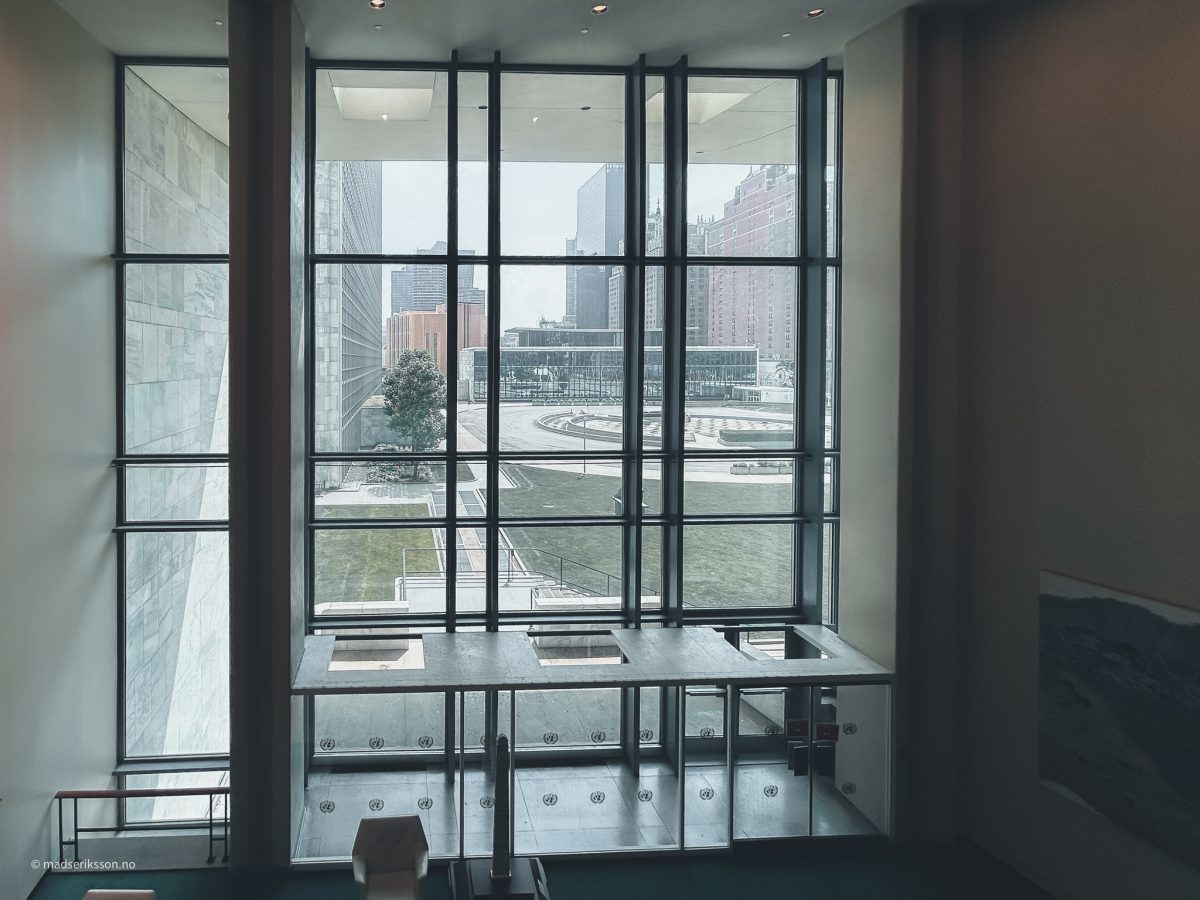
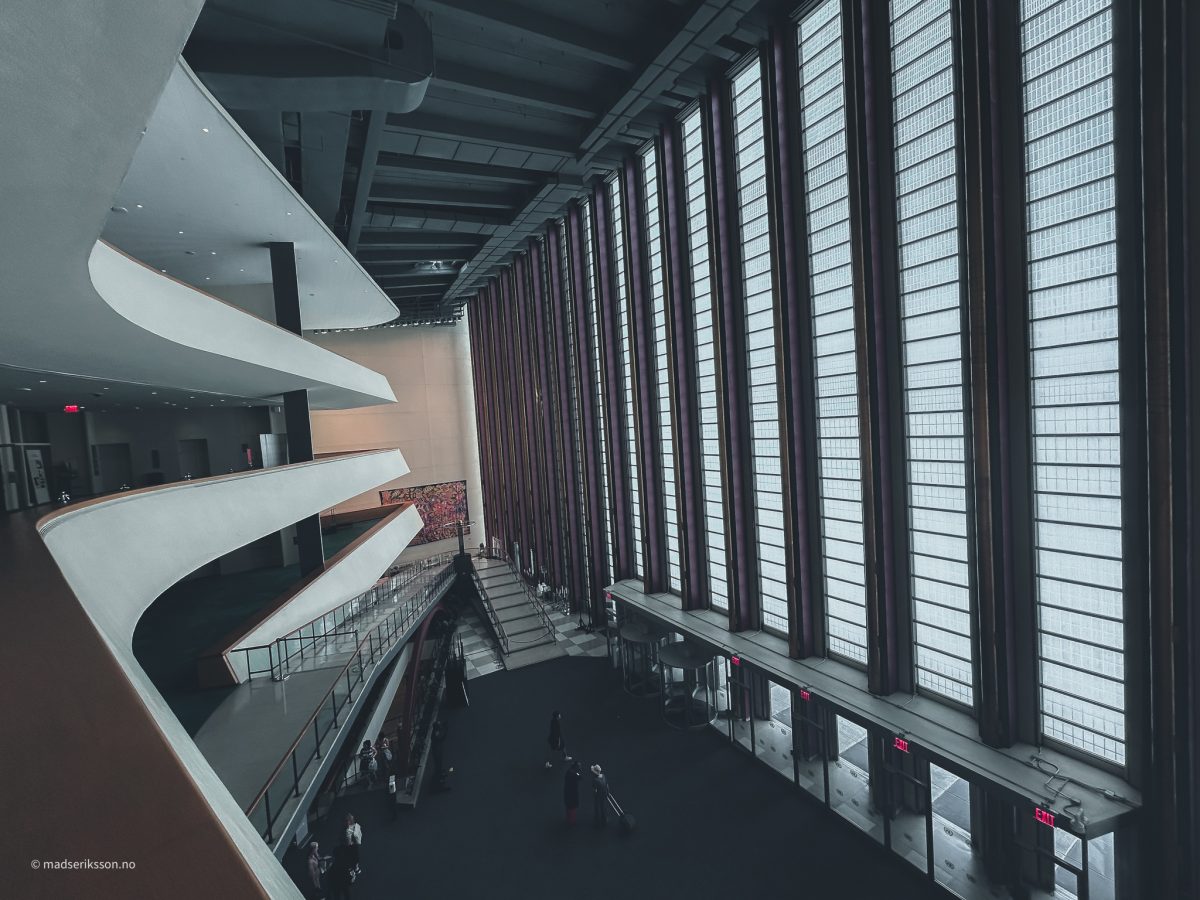
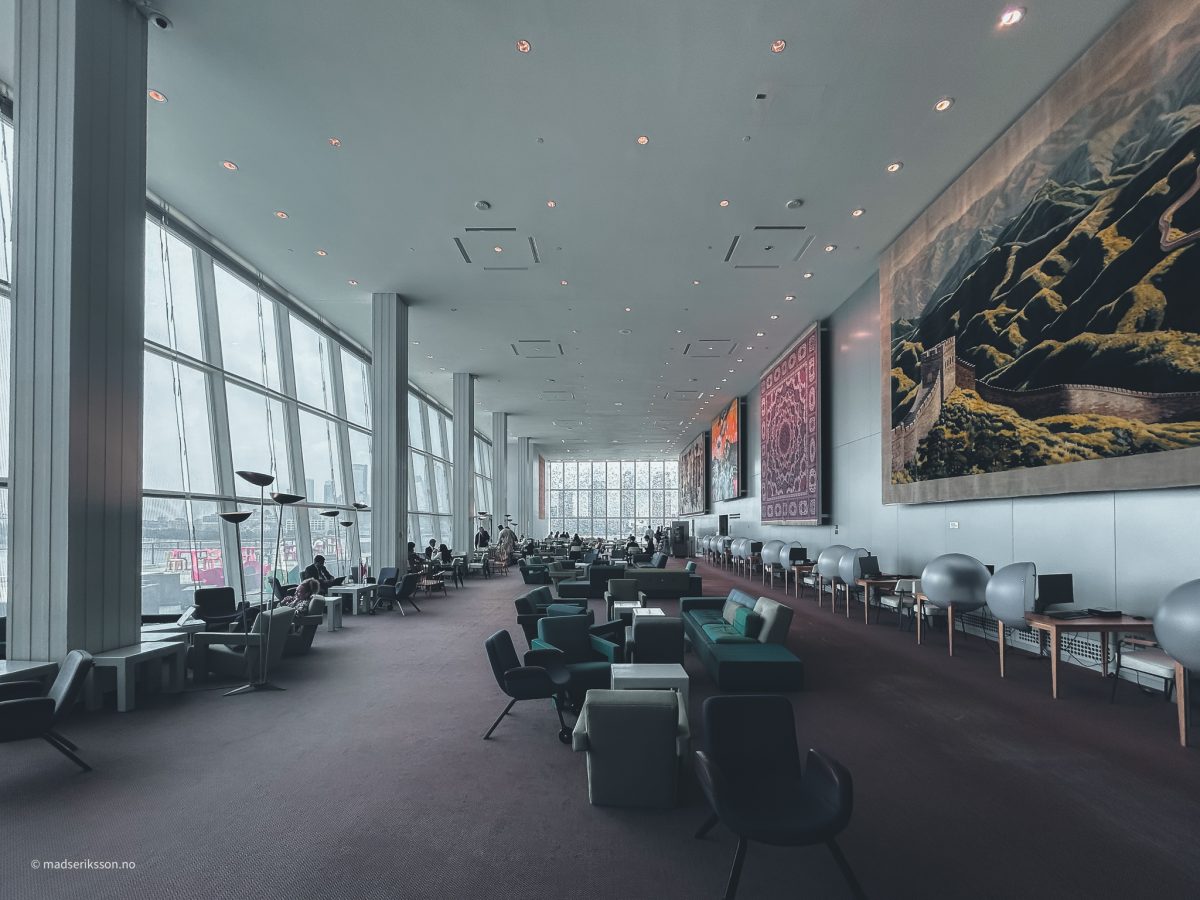
«The United Nations Headquarters is one of those places that makes you think harder than you expected to, and not always in comfortable directions. Standing in the Security Council Chamber — the Norway-gifted room where the world’s most consequential decisions about war and peace are taken by fifteen countries, five of them holding veto power over the rest — you are confronted with the gap between the institution’s founding ideals and its actual operating constraints. The per Krohg mural on the wall shows a phoenix rising from the ashes of war; below it, the horseshoe table where the permanent members sit is remarkably ordinary-looking furniture for a space where the fate of entire populations has been decided. But then, the General Assembly Hall is where every member state has an equal vote and equal voice, and the flags of 193 countries snap in the East River wind along First Avenue, and the Peace Bell rings twice a year, and the Knotted Gun stands outside in bronze telling anyone who looks at it what the organisation still believes itself to be for. The gap between aspiration and reality is very much part of what the UN is. Go and see it in person — it is instructive in ways that no news report manages to convey.»
More in the same area
 ArchitectureGuggenheim Museum, New York: Frank Lloyd Wright’s Spiral on Fifth Avenue
 ArchitectureBrooklyn Bridge: Roebling’s Steel-Wire Span and the Walk Across the East River
 ArchitectureEmpire State Building: The 410-Day Skyscraper and Its Observation Decks
 CitiesDiscovering New York: The City That Never Sleeps
 ArchitectureTen Buildings That Changed Their Cities — Modern Architecture Ranked on Impact, Not Image
 TravelFlorida Keys and Key West: The Overseas Highway, the Reef and the End of the Road