Forty minutes north of Milan by train, the plain of Lombardy stops and the mountains begin. Lake Como fills a glacial trough 46 kilometres long and more than 400 metres deep, shaped like an inverted Y, and at the tip of its south-western arm sits the old silk town that gave the lake its name. Como is the easiest door to the Italian lakes: a walled Roman grid with a marble cathedral, a lakefront where the ferries leave for Bellagio and Varenna, a funicular of 1894 that climbs to the balcony village of Brunate, and, along the western shore, Cernobbio and the Renaissance villa that became the most famous hotel on the lake. This is the southern basin of Lake Como in high summer and in October, and the boats, trains and villas that connect it to the rest of the lake.

Lake Como, the Lario of the Romans and of the people who live around it, is the third-largest lake in Italy after Garda and Maggiore, and the most dramatic of them. It covers some 146 square kilometres, but its shape makes it feel far larger: three long, narrow arms meeting at the promontory of Bellagio, walled on every side by mountains that rise straight out of the water. The Adda enters at the northern end near Colico and leaves through the south-eastern arm at Lecco. The south-western arm, the one that ends at Como, is a cul-de-sac with no outlet, which is why the lakefront of Como floods when the water is high and why its basin feels so enclosed, almost like a fjord.
The town of Como, with about 83,000 inhabitants, is the capital of its province and the oldest settlement on the lake. Julius Caesar drained the marshes at the end of the lake and moved the Roman town to its present site as Novum Comum, and its chequerboard of streets still follows the Roman plan. Both Plinys, the naturalist who died at Vesuvius and his nephew the letter-writer, were born here, and they stand in marble on either side of the cathedral door. For most of the Middle Ages Como fought Milan and lost, and for much of the 20th century it was the silk capital of Italy. Today its economy runs increasingly on visitors who arrive by train from Milan, step out onto the lakefront and keep going.
How to approach Lake Como from Milan
There are two classic ways in. The first is through Como itself: regional trains from Milano Centrale reach Como San Giovanni in about forty minutes, and the Trenord line from Milano Cadorna ends at Como Lago, a few steps from the ferry piers, in about an hour. From Como, boats run up the lake to Bellagio and beyond. The second is through Varenna on the eastern shore, about an hour from Milano Centrale on the line towards Tirano, where the short car ferries of the central lake link Varenna, Bellagio, Menaggio and Cadenabbia. A day trip can cover Como, the funicular to Brunate and a walk along the western shore to Cernobbio. Two or three days allow the boat up the lake, the villas of the Tremezzina and a night in Bellagio or Varenna. Lake Lugano and Lake Maggiore lie within reach to the north-west for anyone who wants to make it a lakes tour.
Como in 3D
Como lies at the tip of the south-western arm of Lake Como, a glacial trough 46 kilometres long and up to 425 metres deep, with the wooded slope of Brunate rising almost 500 metres directly above the town. Julius Caesar resettled the Roman colony here as Novum Comum, and the walled town still follows its grid of streets. With about 83,000 inhabitants it is the capital of its province, forty minutes by train from Milan.
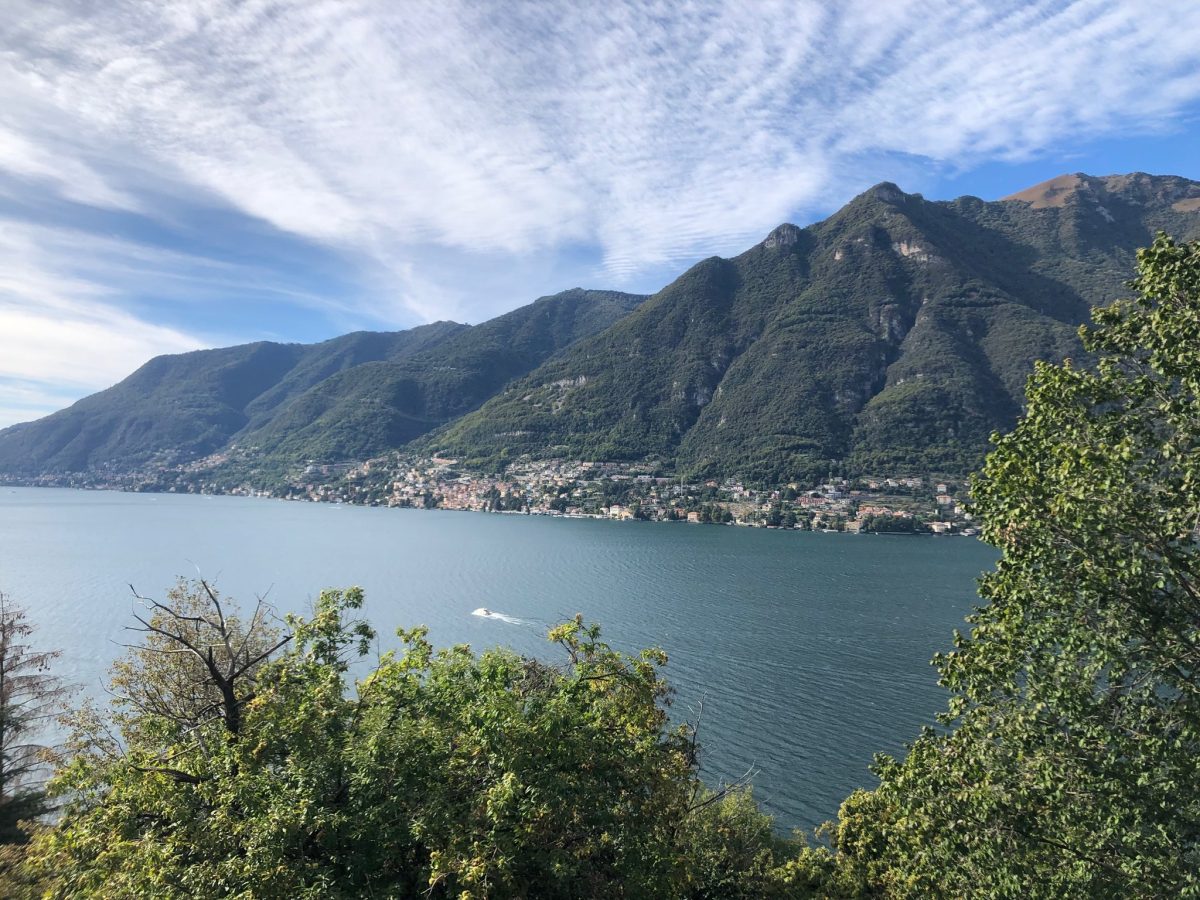
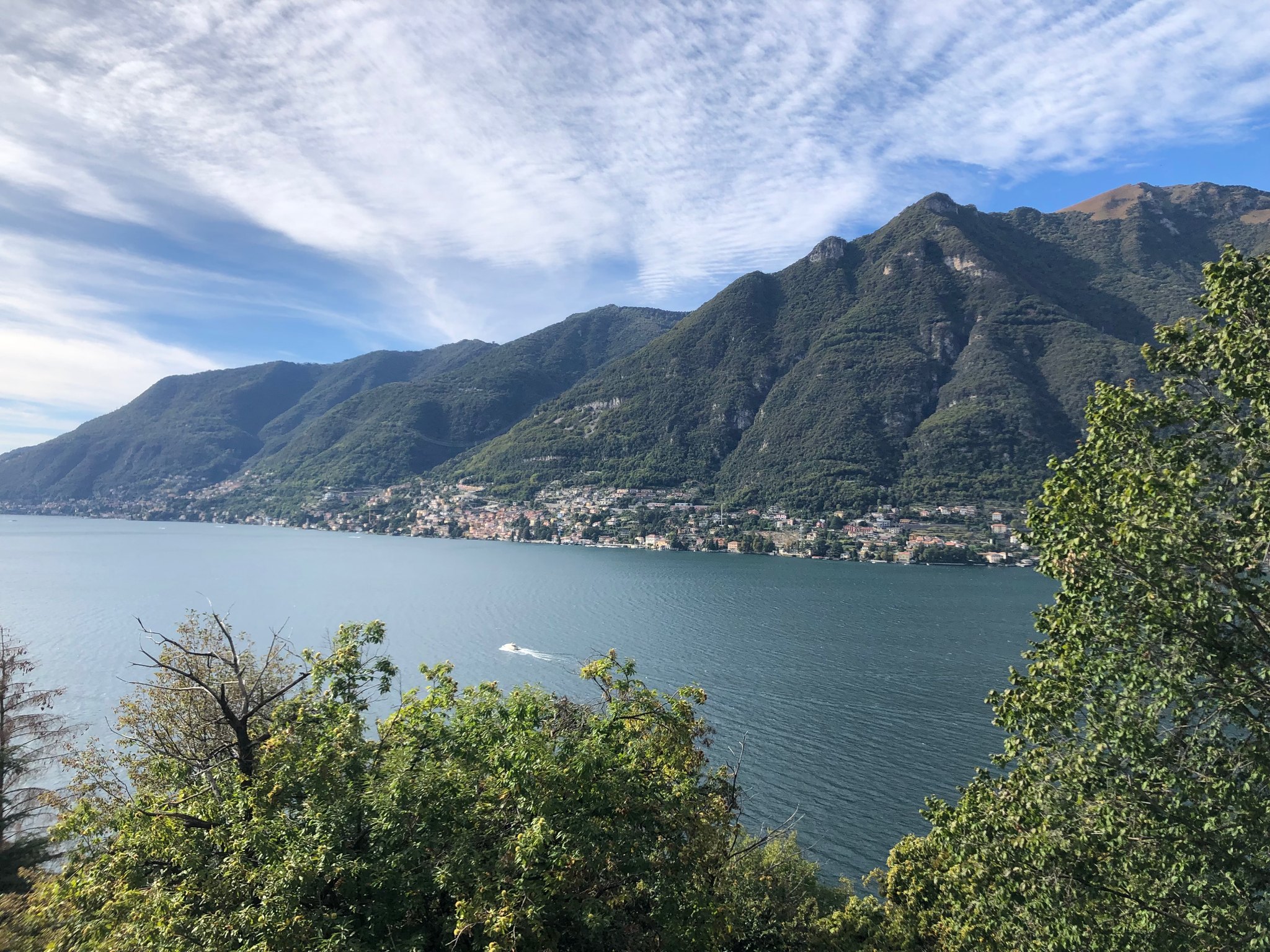
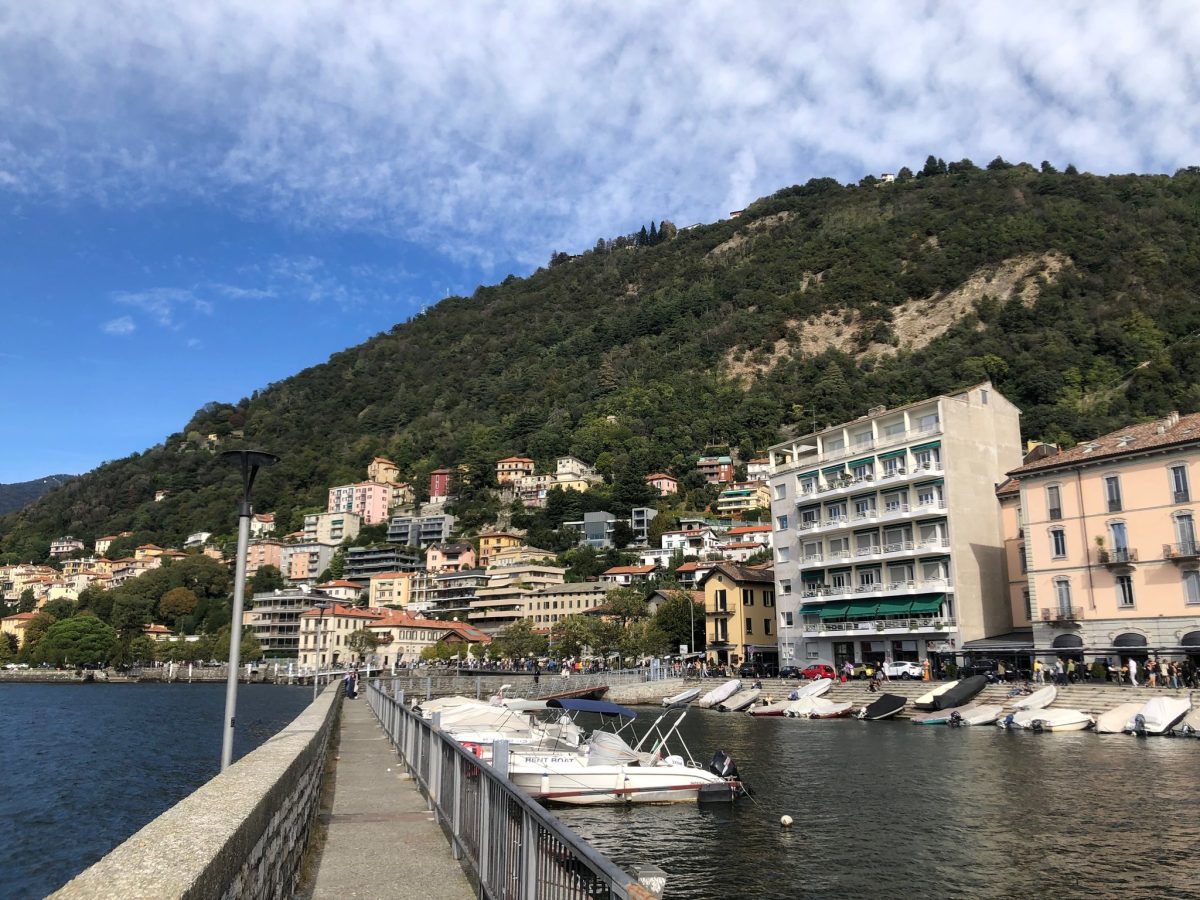
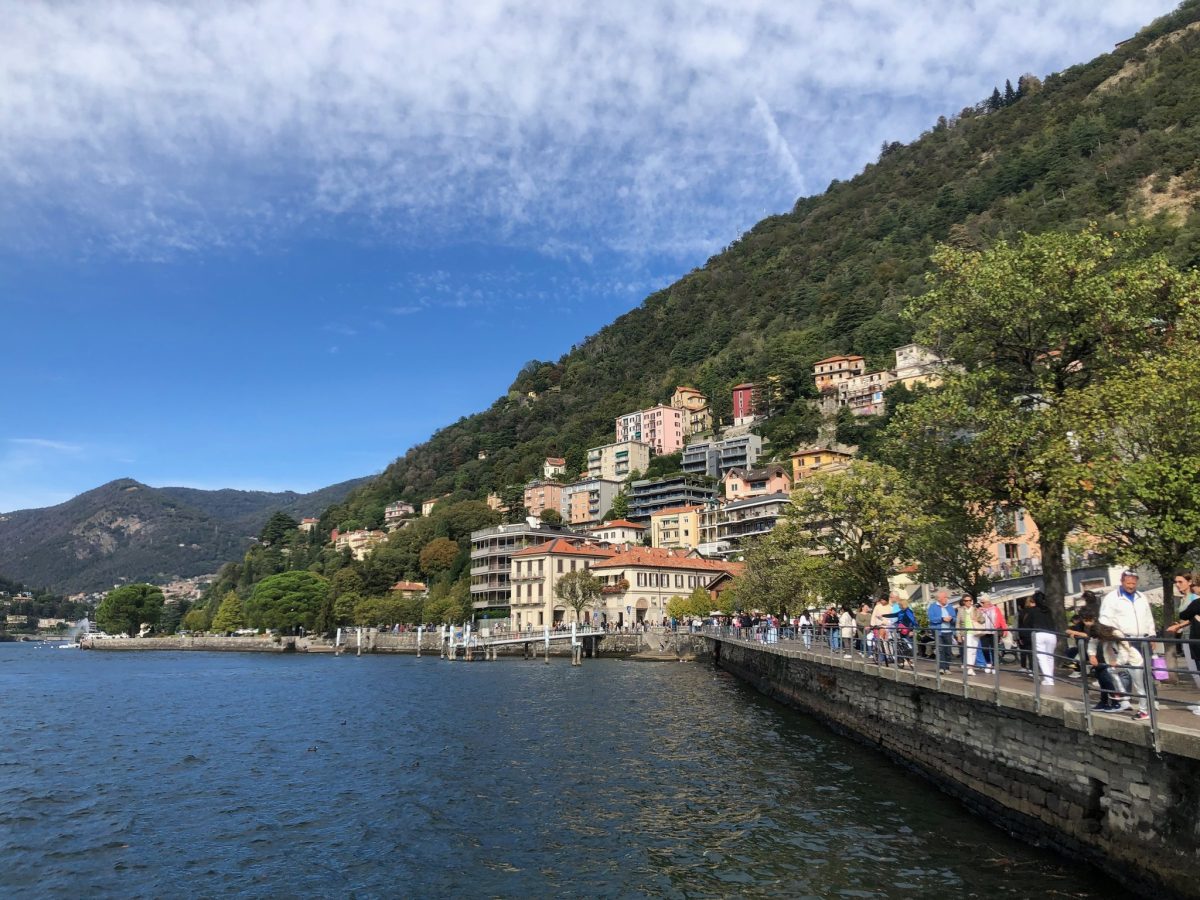
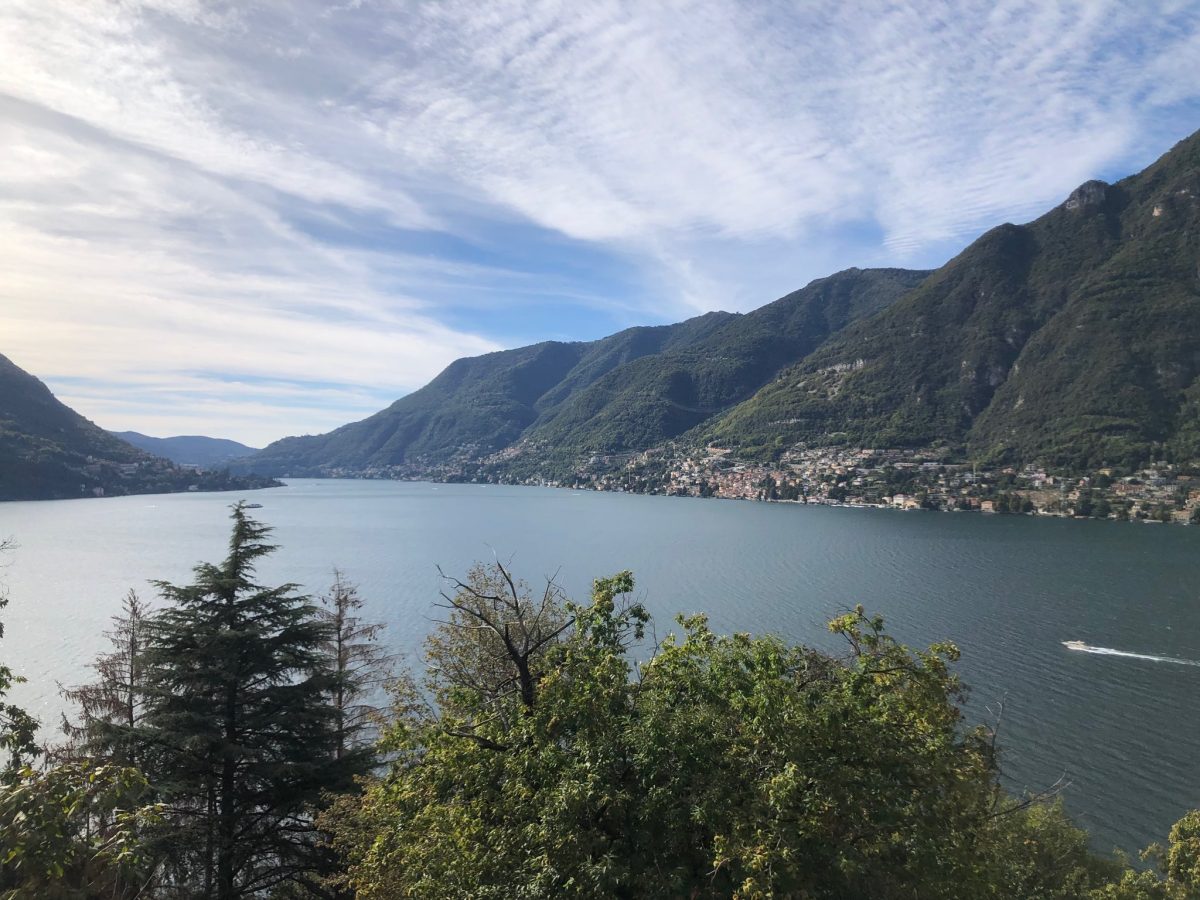
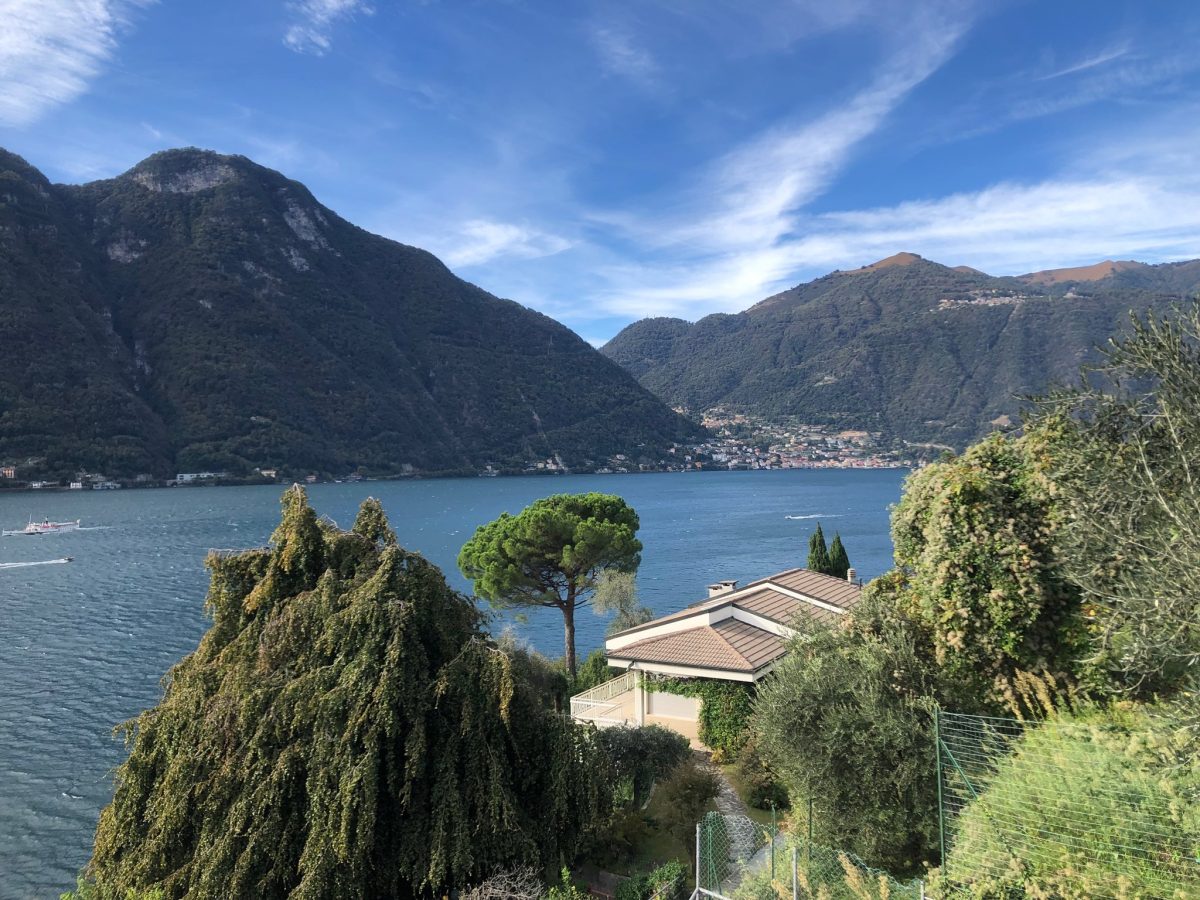
Lake Como north of Como in October, with lakeside villages strung along the foot of steep wooded mountains on the far shore
The Cathedral and the Walled Town
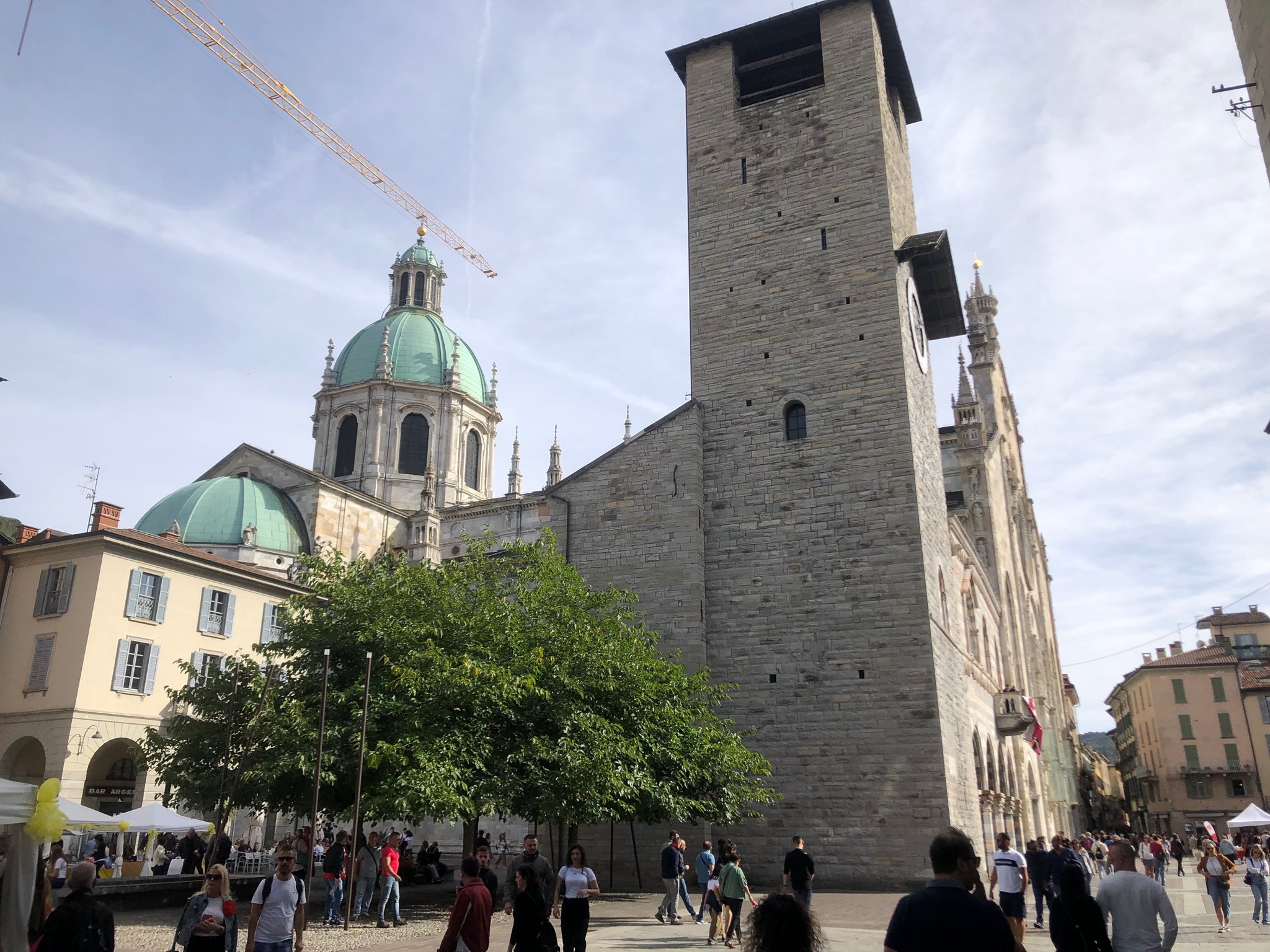
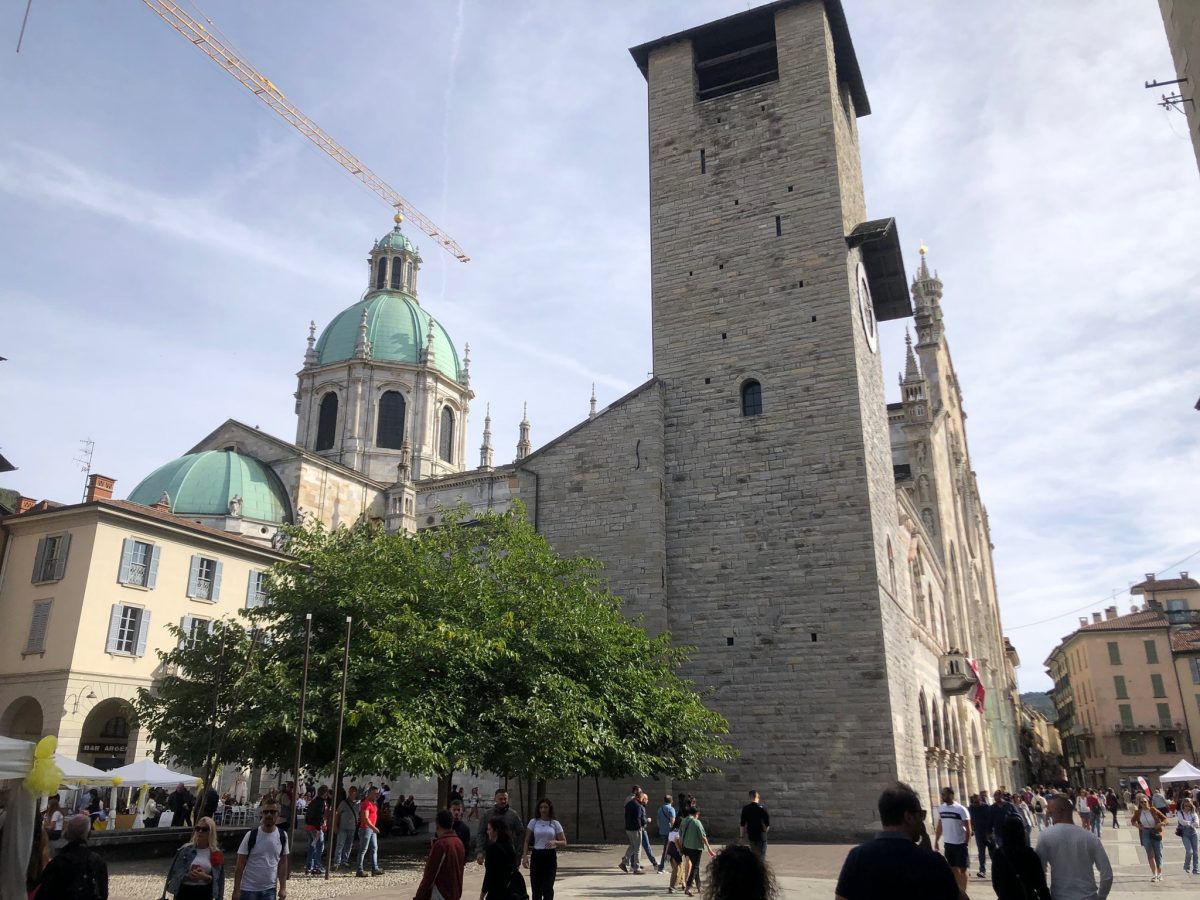
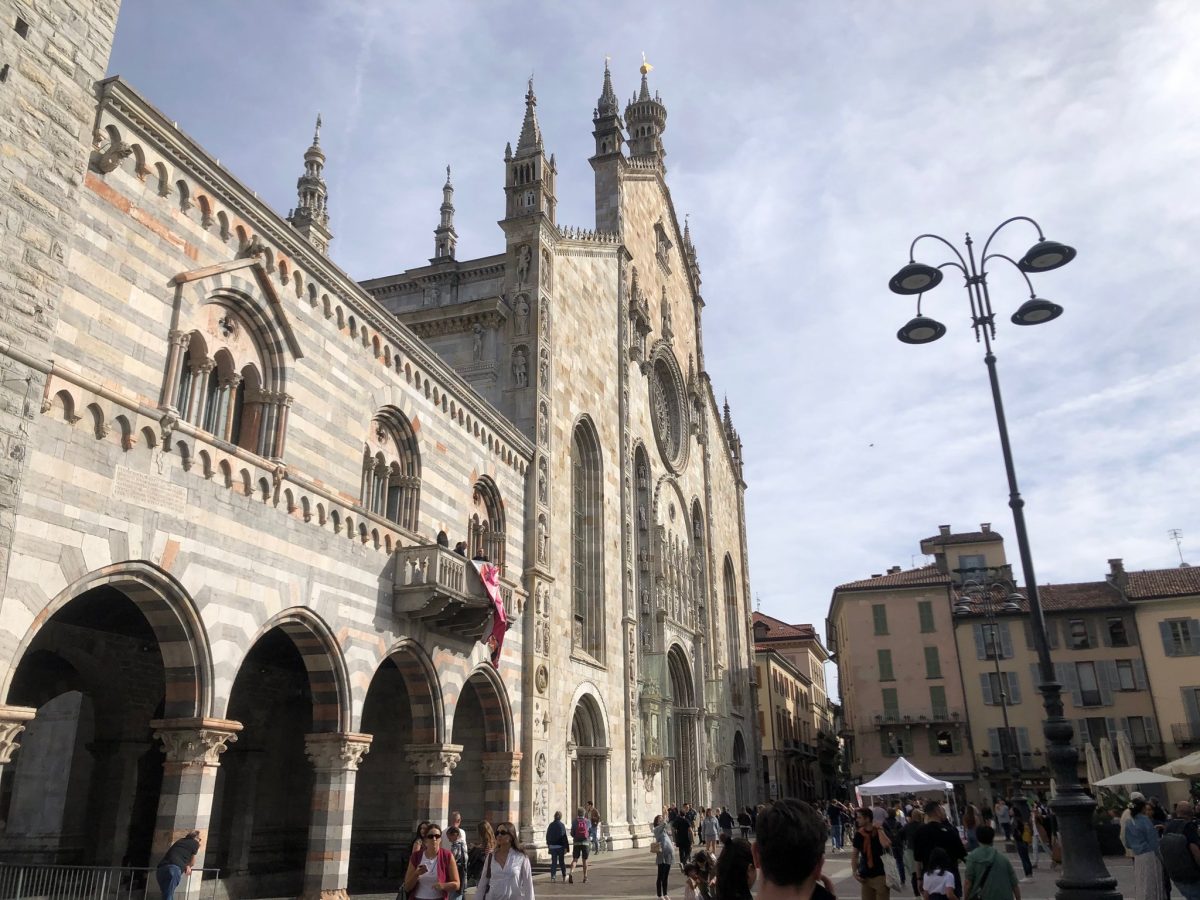
The cathedral of Santa Maria Assunta was begun in 1396 and finished only in 1770, when the dome by Filippo Juvarra was completed 75 metres above the floor. Its marble west front of 1457–1498 places the Roman authors Pliny the Elder and Pliny the Younger, both natives of Comum, beside the main portal. The striped Broletto of 1215 stands wall to wall with it, and directly behind the apse is Giuseppe Terragni's Casa del Fascio of 1933–1936, a 33-metre square of white Rationalism.
The green dome of Como Cathedral and the stone Torre del Comune on Piazza del Duomo in Como
The Lakefront and the Boats
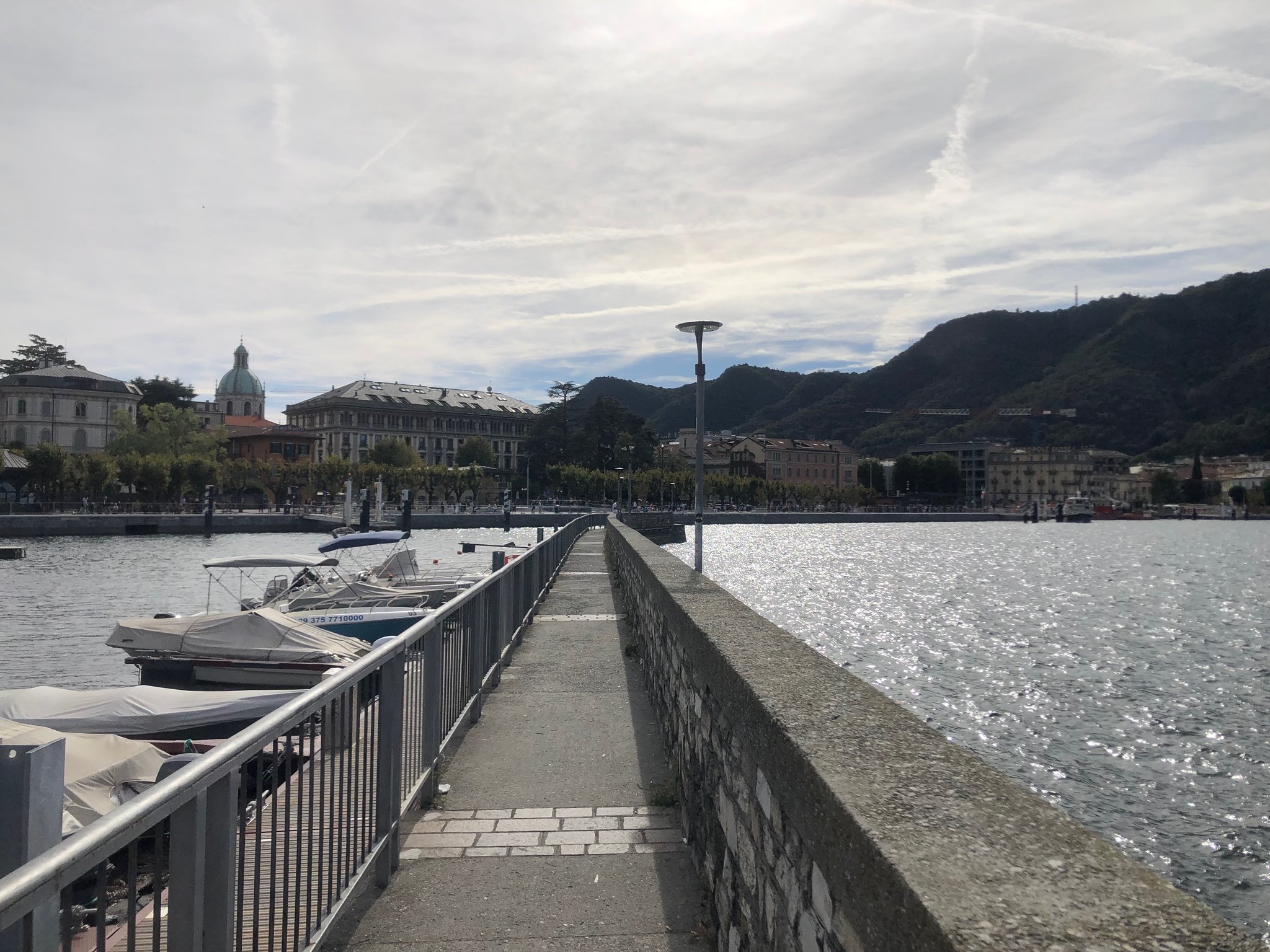
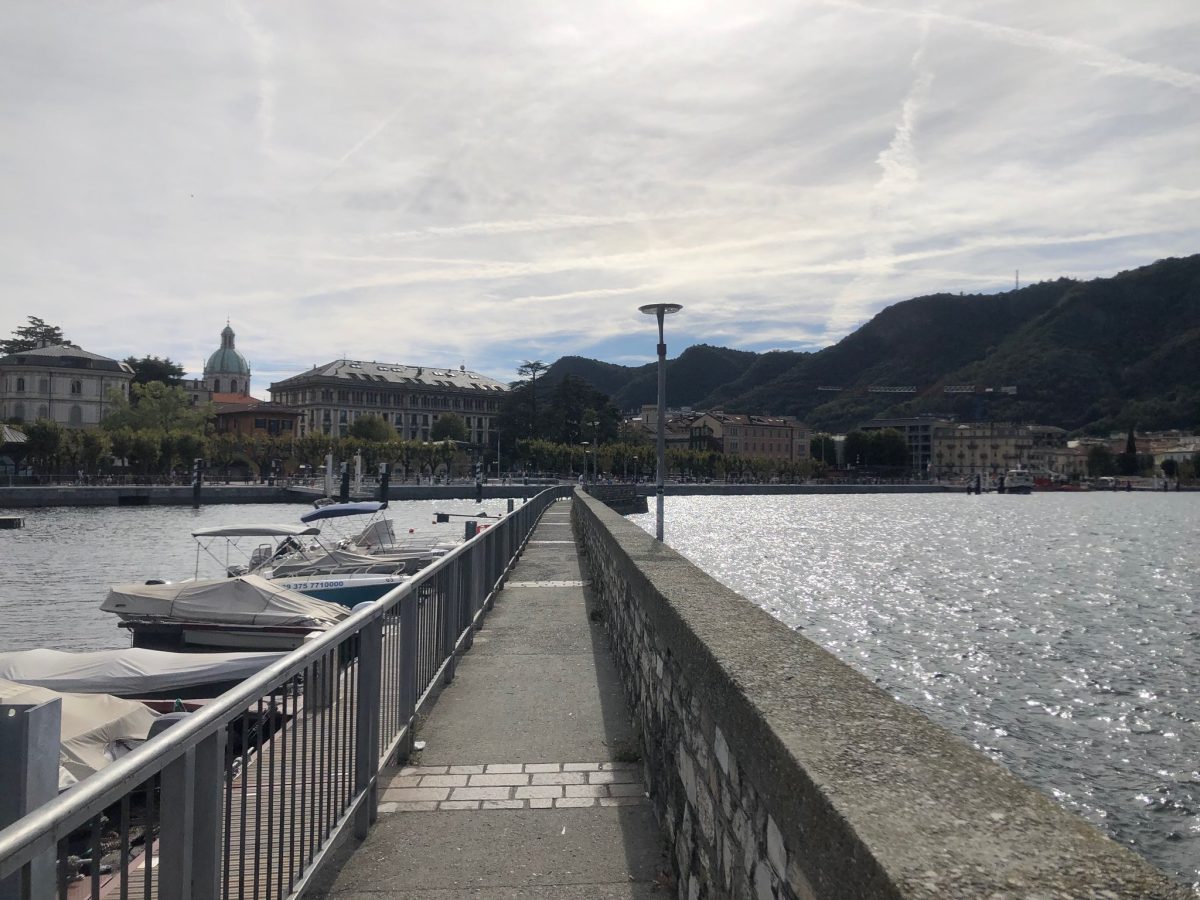
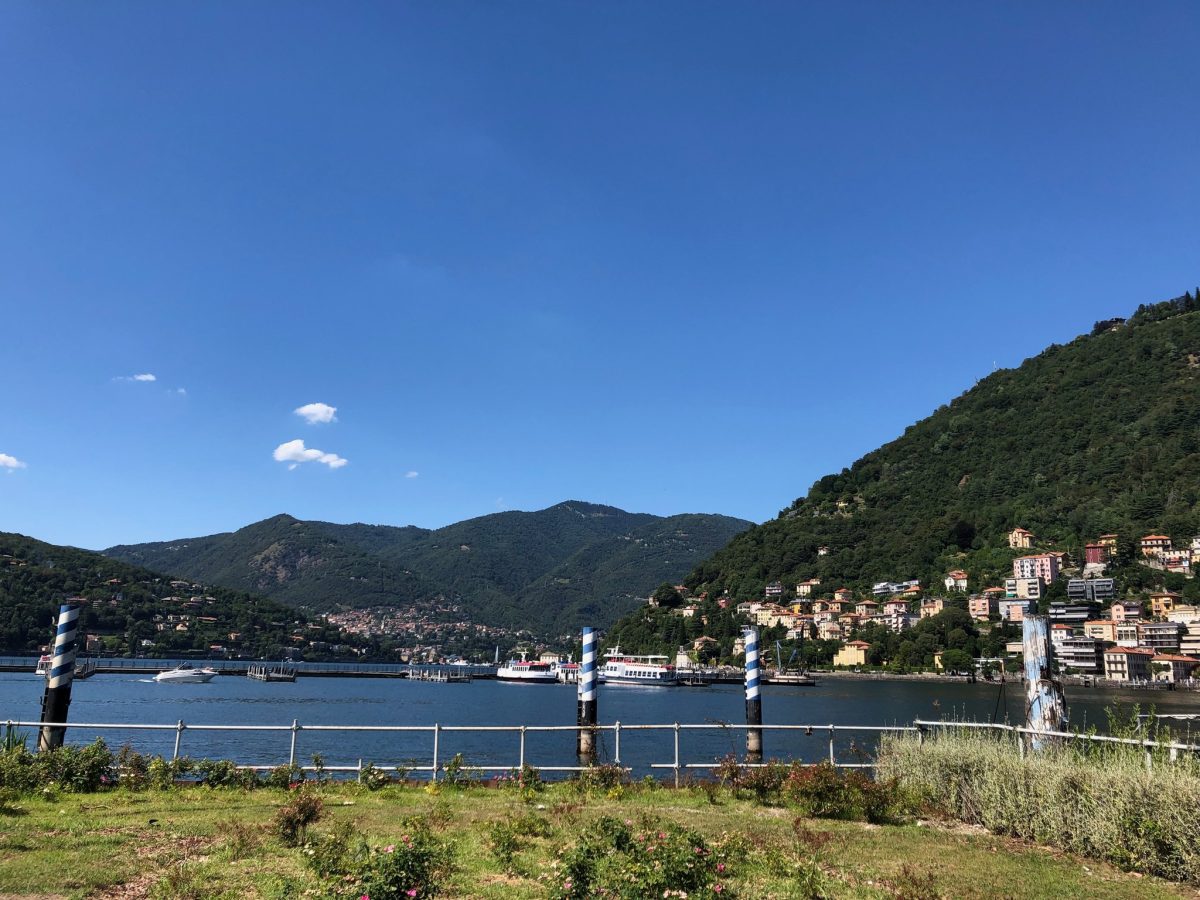
Piazza Cavour opens straight onto the harbour, with the piers of the Navigazione Laghi ferries in front; slow boats reach Bellagio in just over two hours, hydrofoils in about 45 minutes. As the Como arm has no outlet, this is the first part of the town to flood when the lake rises. Promenades lead west along Lungo Lario Trieste towards the Tempio Voltiano and east along Lungo Lario Trento to the funicular station.
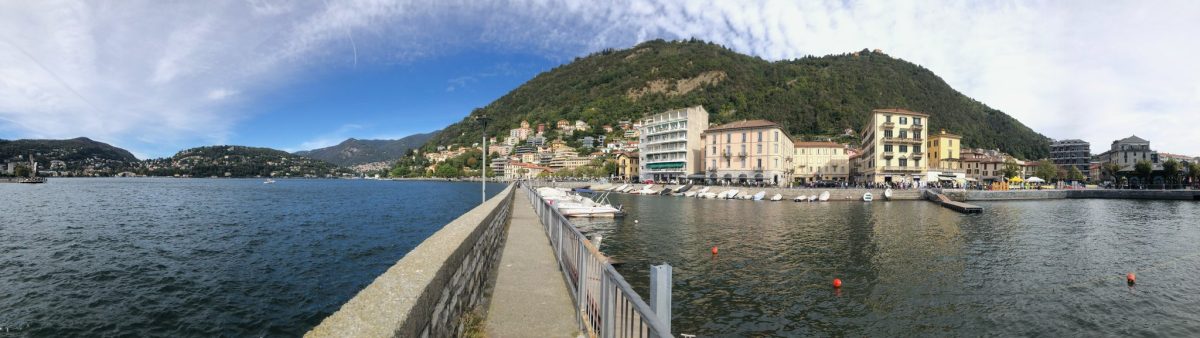
Como’s waterfront seen from a harbour pier, with the green dome of Como Cathedral rising behind the lakeside buildings
A Temple to the Volt
Alessandro Volta, who announced the voltaic pile in 1800 and gave his name to the volt, was born in Como in 1745 and died there in 1827. The domed Neoclassical Tempio Voltiano, designed by Federico Frigerio and paid for by the industrialist Francesco Somaini, was built in 1925–1927 and opened in July 1928 to house his instruments. On the breakwater nearby stands Daniel Libeskind's steel sculpture Life Electric, 13.75 metres high, raised in 2015.
The Grandest Villa on the Waterfront
The Marquis Innocenzo Odescalchi commissioned Villa Olmo in 1782, and the Swiss architect Simone Cantoni built its long Neoclassical front facing the lake between 1797 and 1812. The city of Como acquired the villa in 1924; it now hosts exhibitions and events, and the park is open daily. The lakeside path continues north towards Punta Geno and, a few kilometres further, Cernobbio and Villa d'Este.
Seven Minutes Up the Hillside
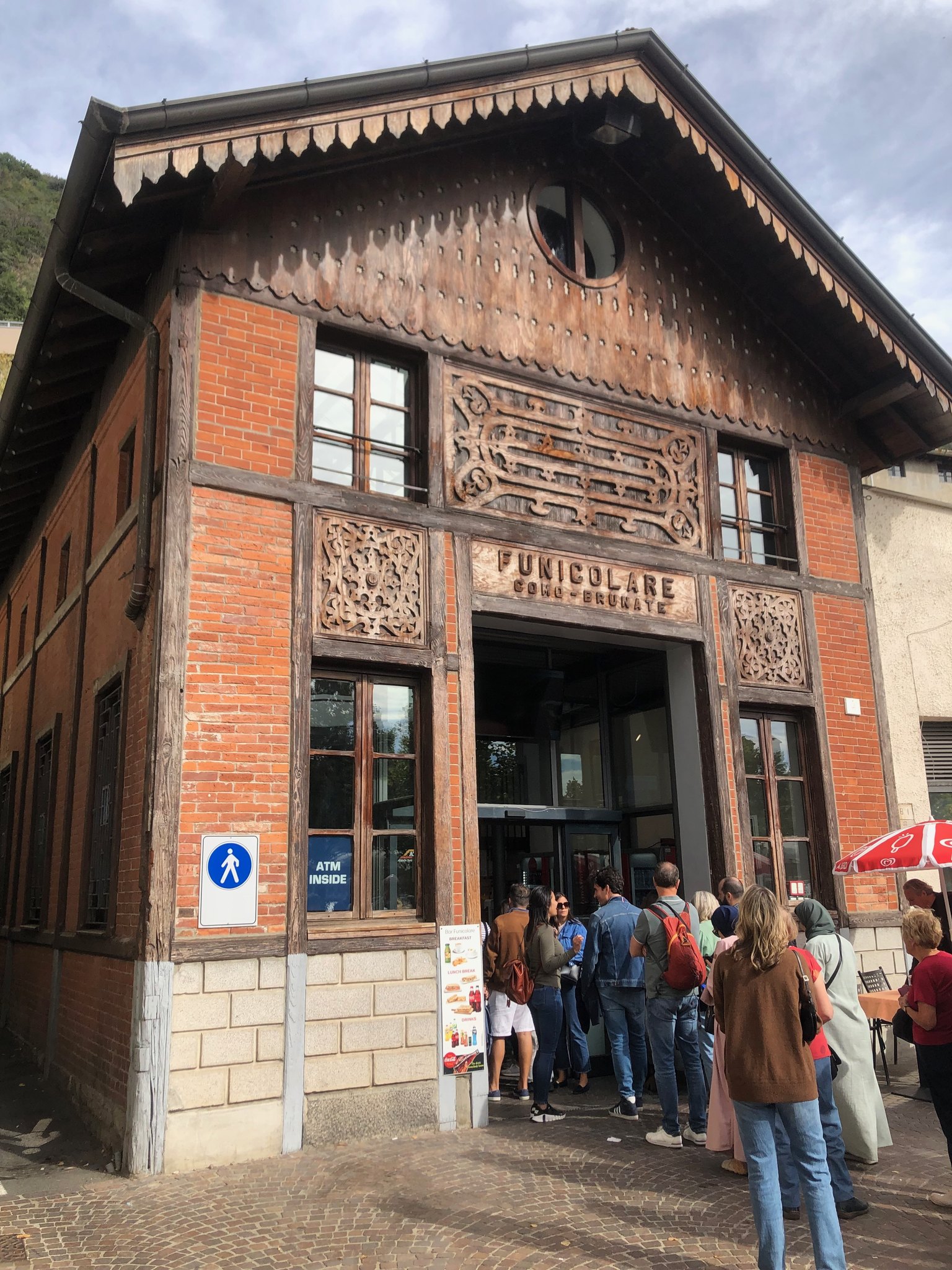
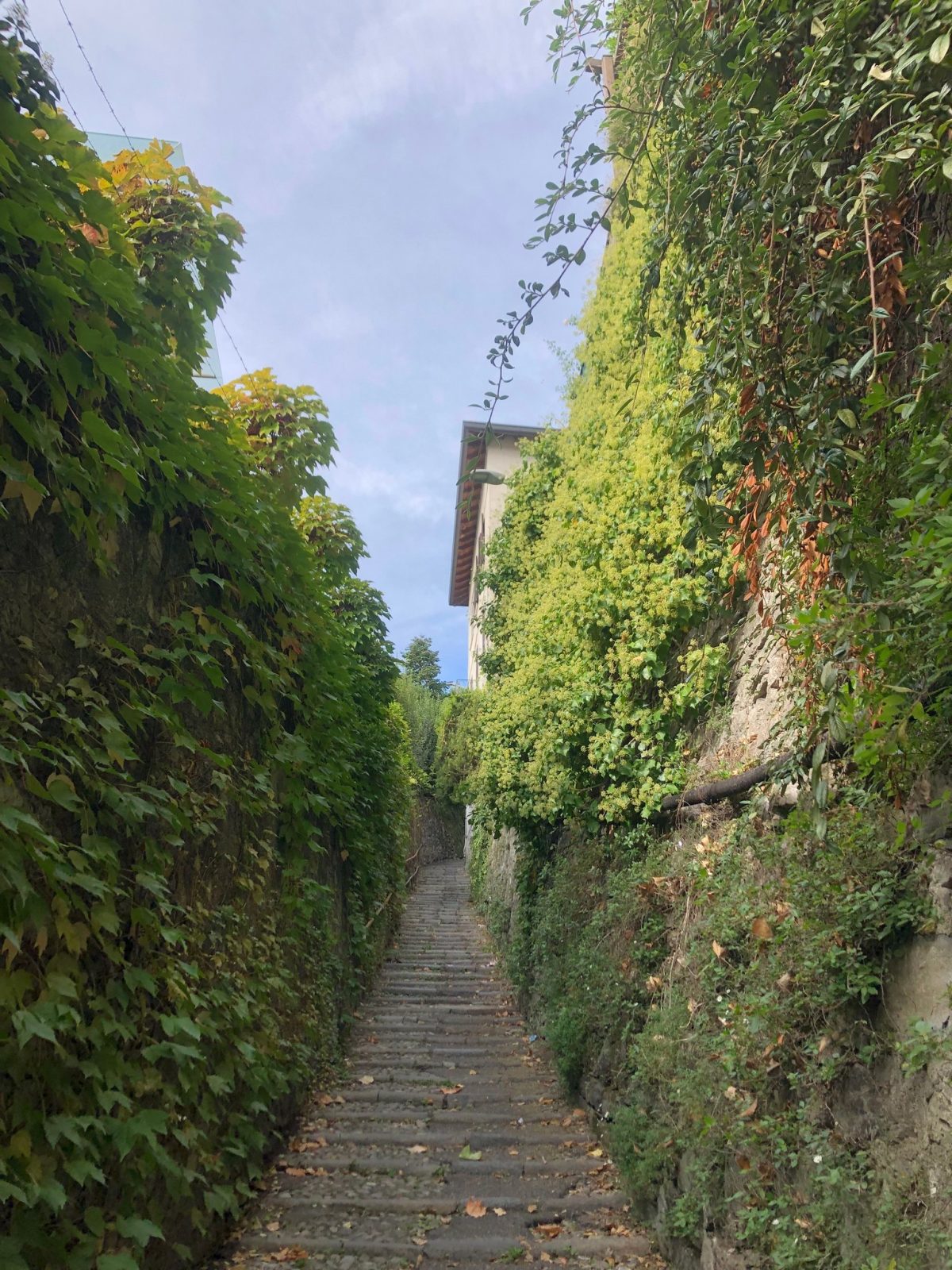
The funicular from Piazza De Gasperi opened in 1894, ran on steam until it was electrified in 1911 and climbs about 1,080 metres of track at gradients of up to 55 per cent. It rises almost 500 metres to Brunate in around seven minutes, with cars every quarter of an hour from early morning until midnight. The old stepped paths between ivy-covered walls take about an hour on foot back down to the lakefront.
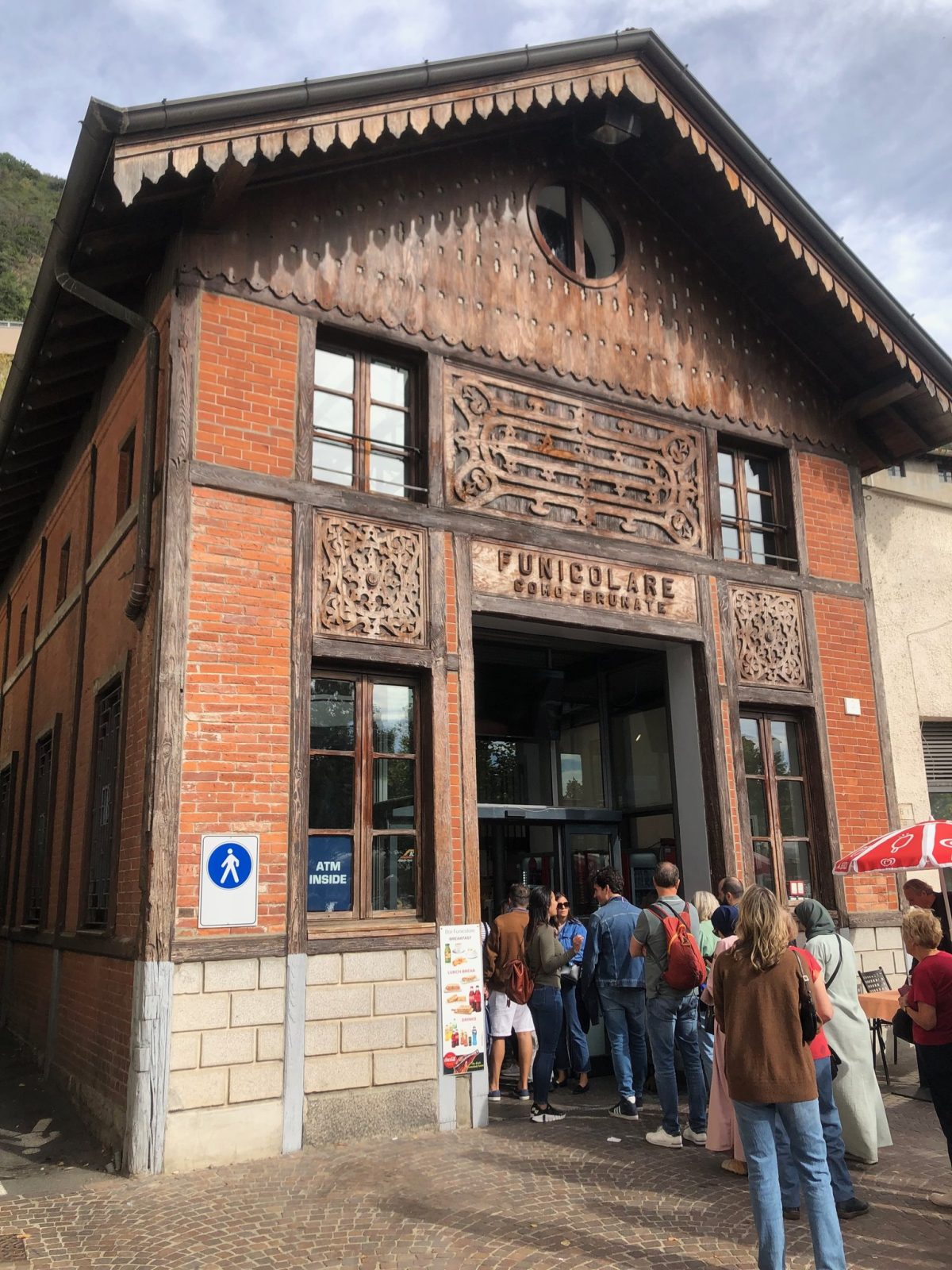
The carved timber and brick lower station of the Como–Brunate funicular in Como
The Balcony of the Lake
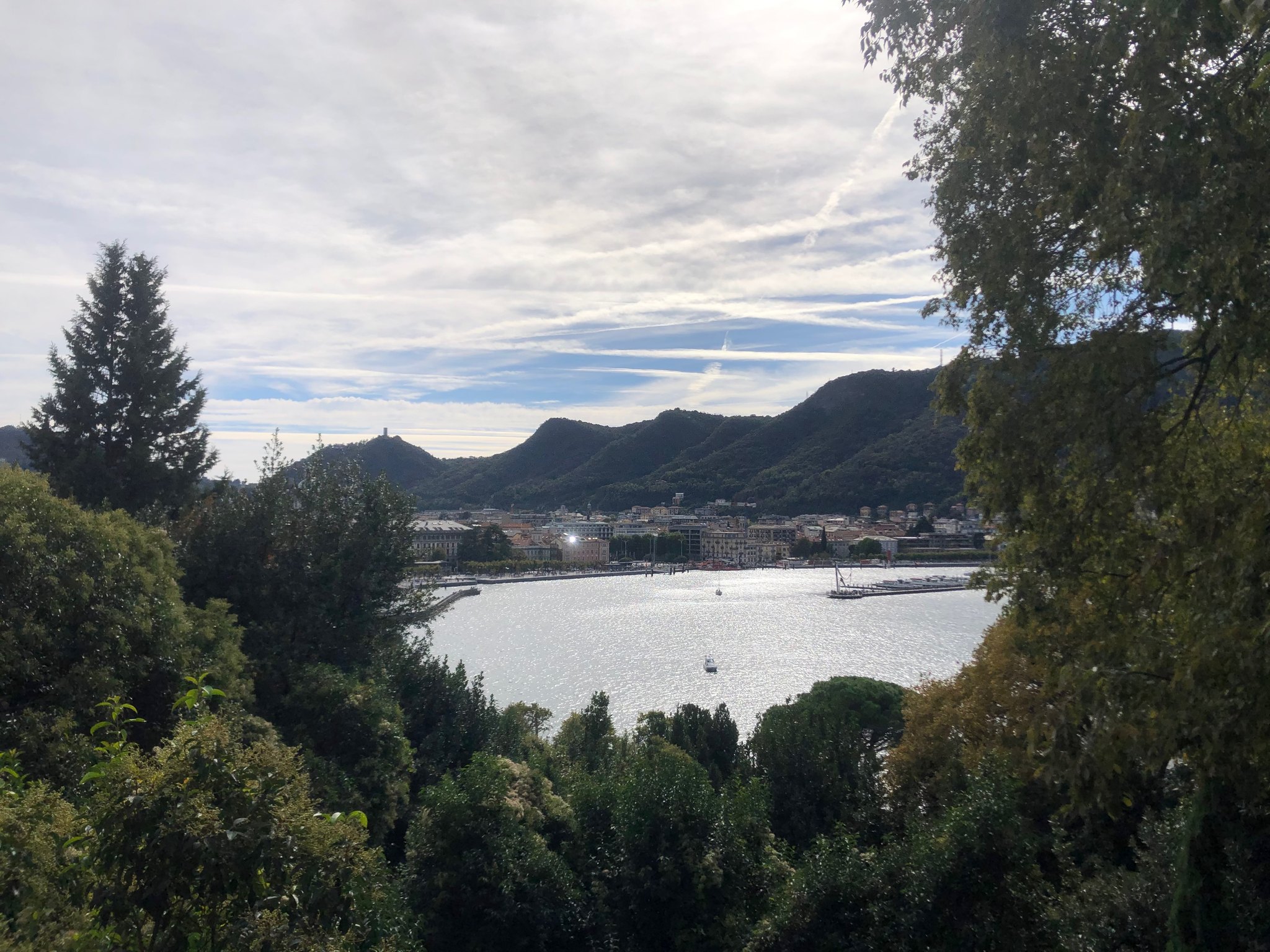
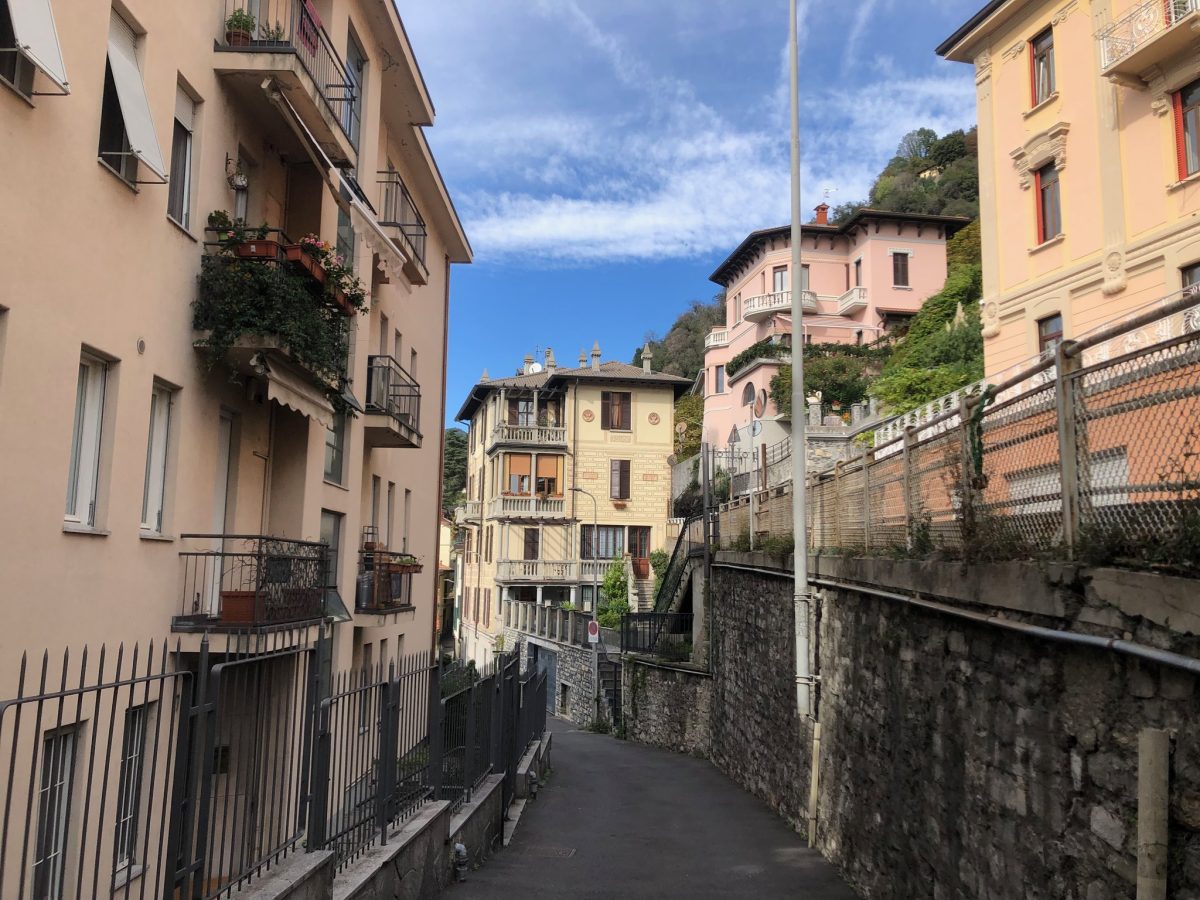
Brunate, at 715 metres and with fewer than 1,600 residents, became a summer resort of Liberty-style villas at the end of the 19th century and looks straight down on Como and the first basin of the lake. Half an hour's walk higher, on Monte Tre Croci at about 906 metres, stands the Faro Voltiano, a 29-metre lighthouse inaugurated in 1927 for the centenary of Volta's death. Its 143 steps lead to two balconies, and after dark its beam turns green, white and red.
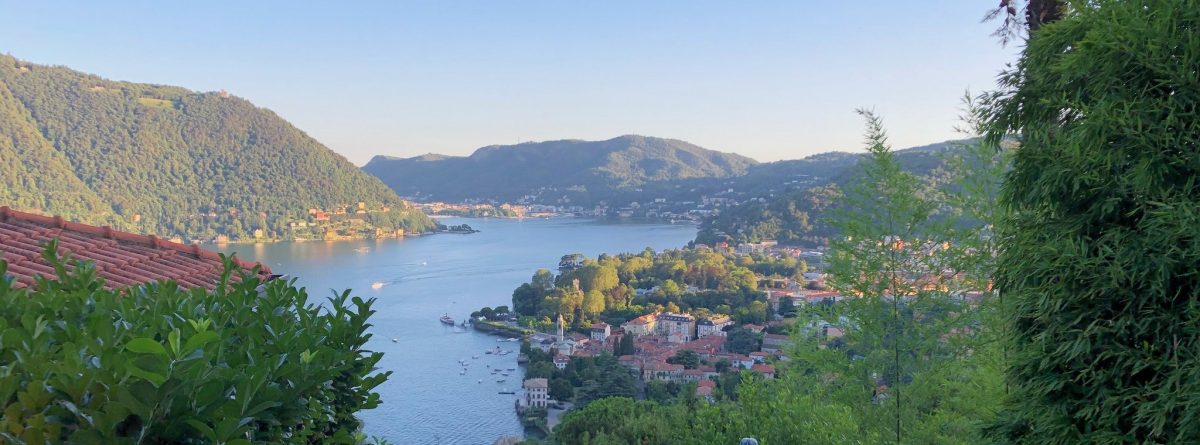
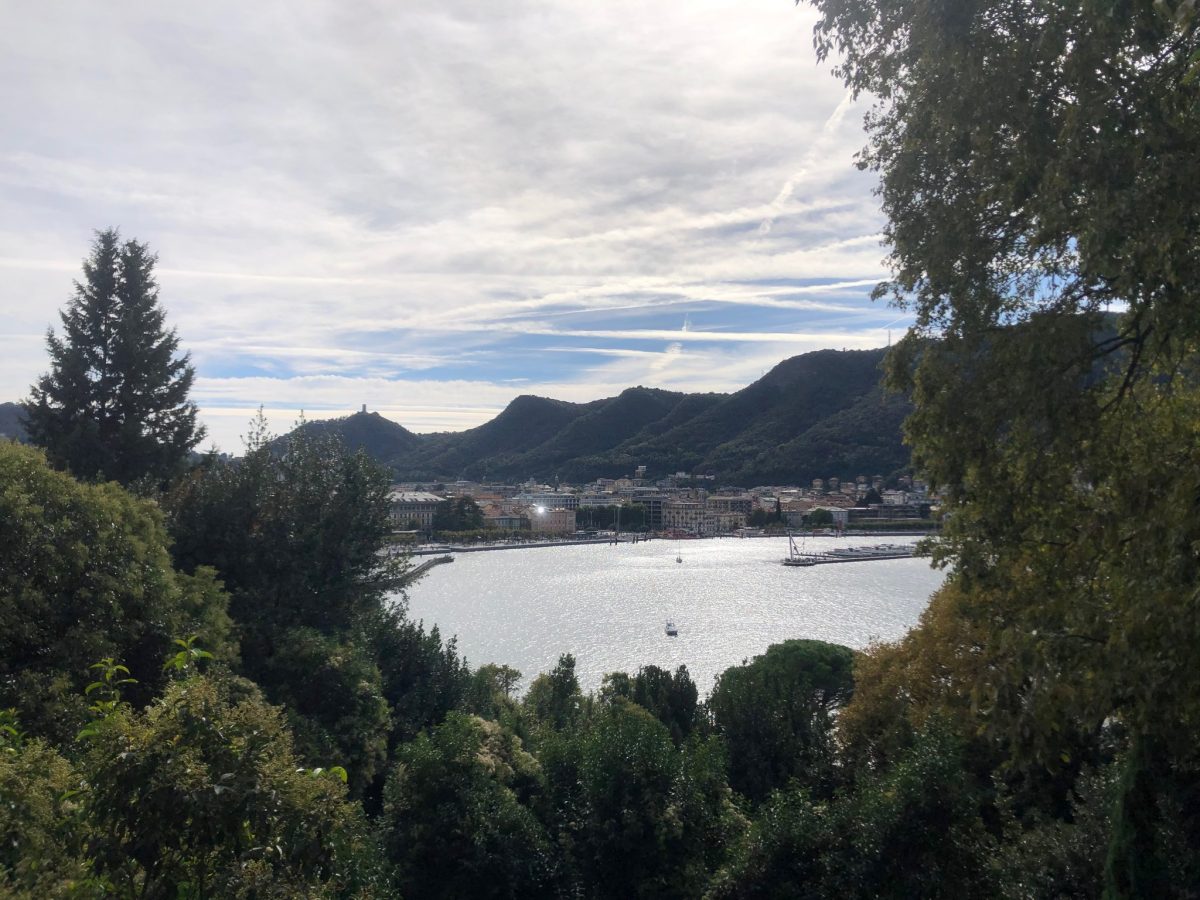
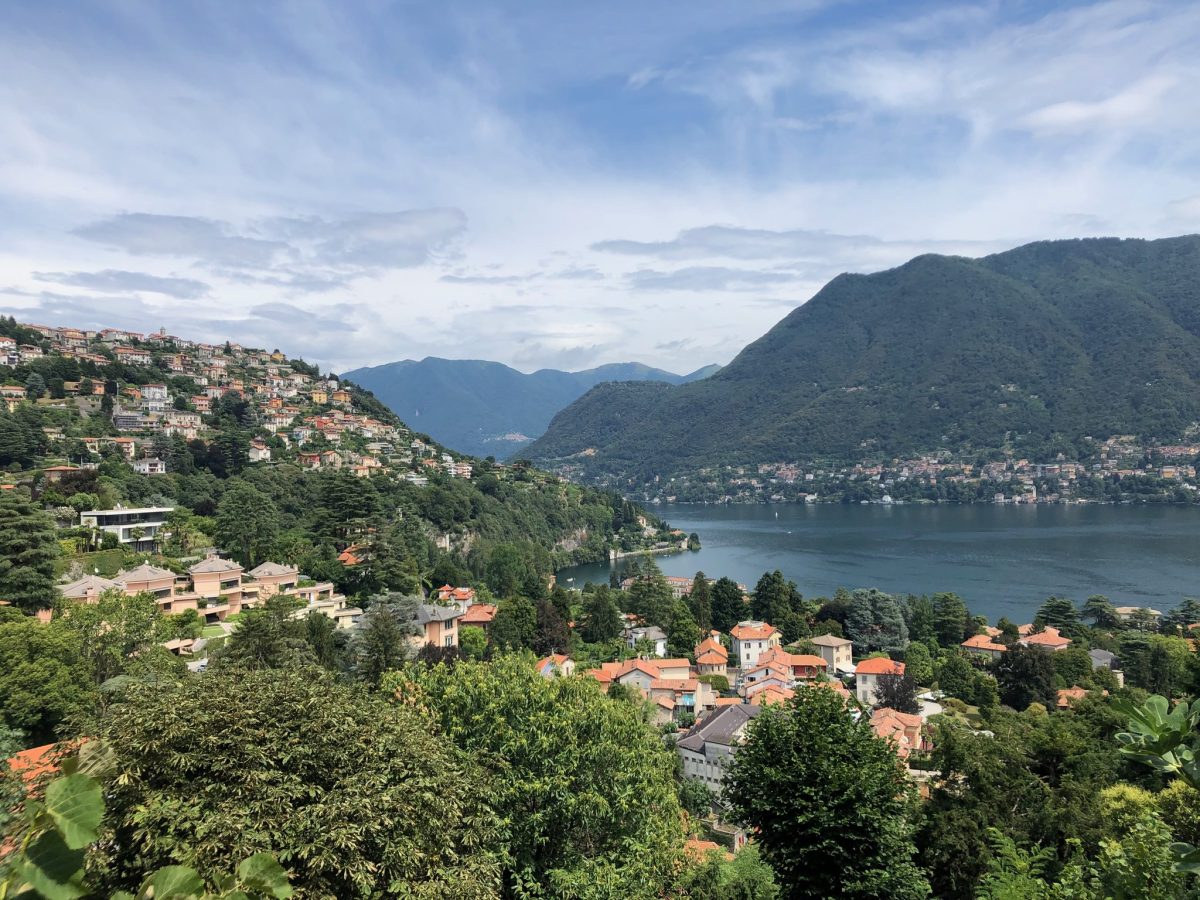
Como and the head of the lake seen through the trees from the hillside on the eastern side of the town
The Lights of the Southern Basin
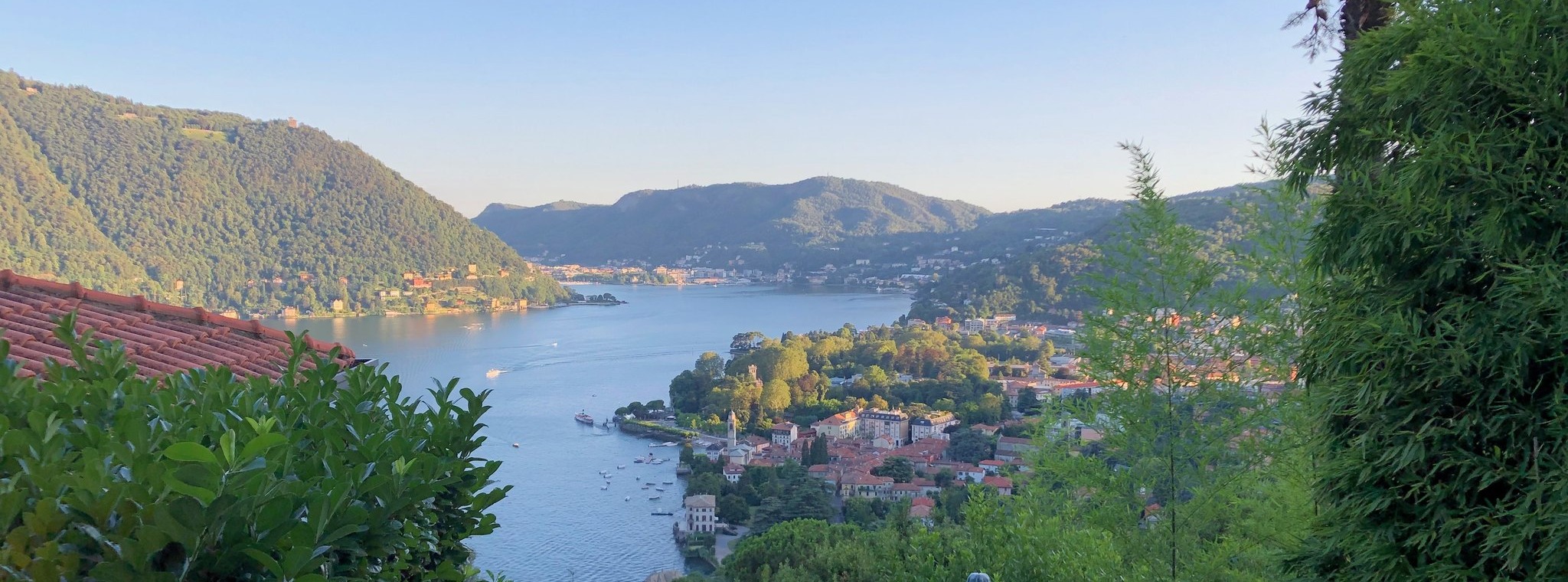
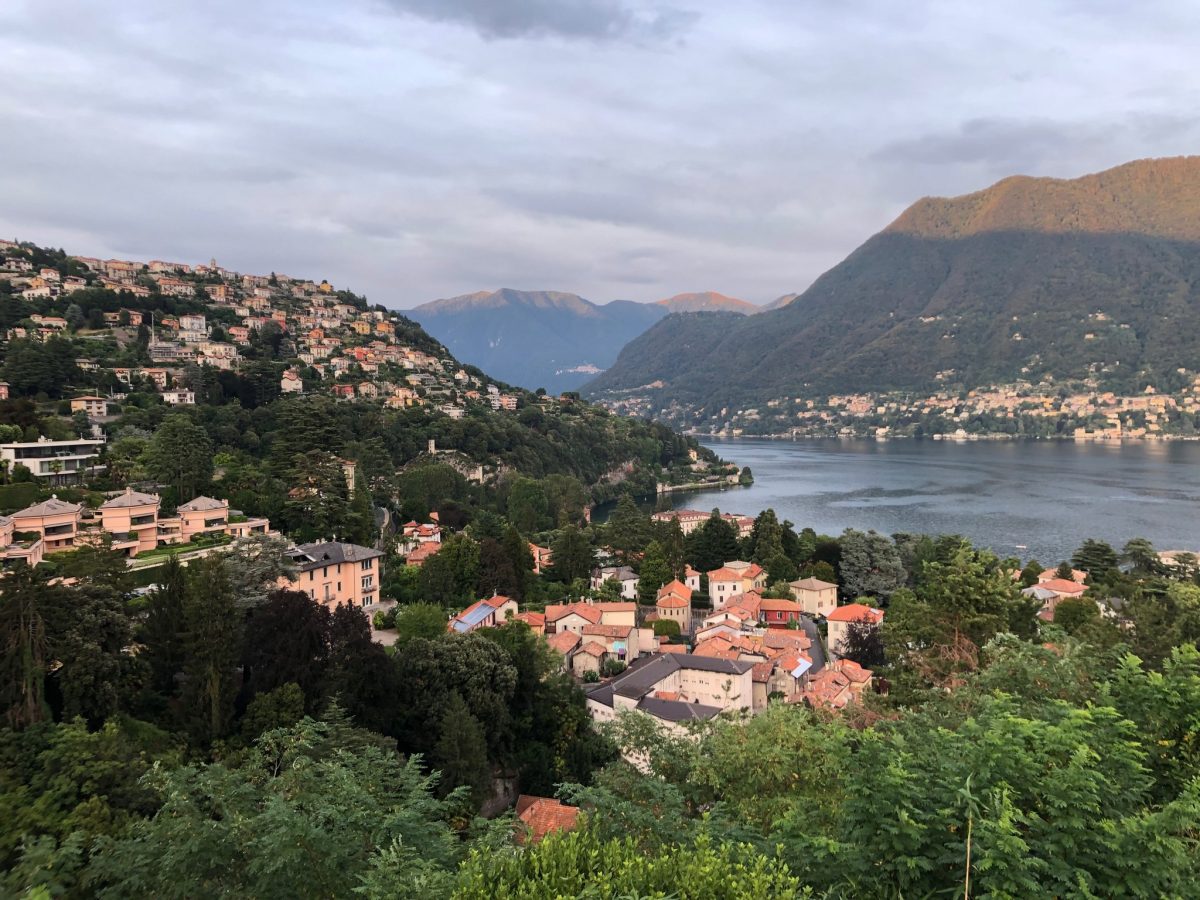
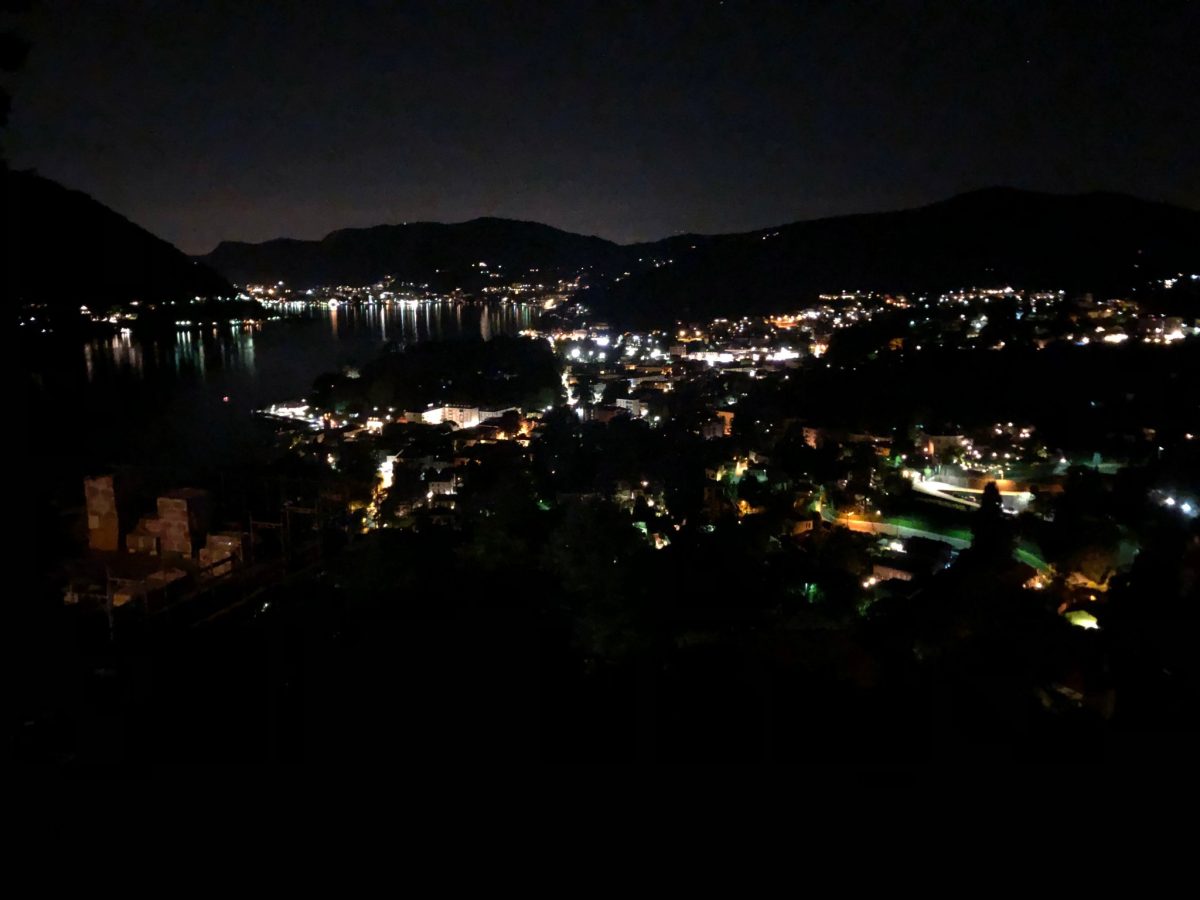
At night the cathedral dome rises above the rooftops of the walled town, and the lights of Como and Cernobbio trace the outline of the southern basin. On summer evenings the mountains of the eastern shore keep the last sun long after the lake has fallen into shadow. The last funicular leaves for Brunate around midnight.
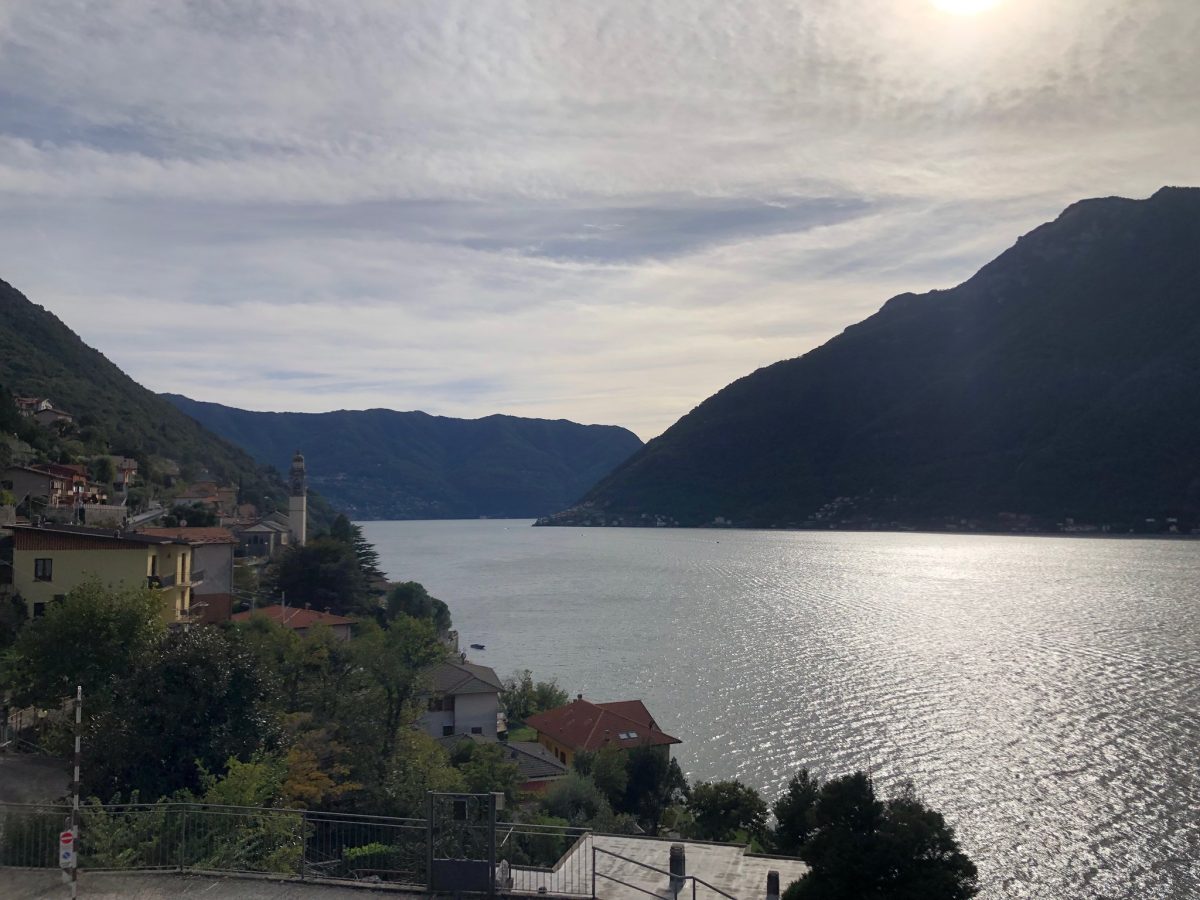
Cernobbio and the southern basin of Lake Como in the evening light, looking towards Como at the head of the lake from the hills above the western shore
3D model © 2026 madseriksson.no · Photographs © madseriksson.no. Buildings and heights: © OpenStreetMap contributors (ODbL), via OpenMapTiles. Ground imagery: Sentinel-2 cloudless 2023 by EOX IT Services GmbH (contains modified Copernicus Sentinel data 2023; CC BY 4.0). Heights are approximate where OpenStreetMap has no measured value; sun positions are approximate.
The Lakefront of Como — Where the Plain Ends and the Lake Begins
A harbour square, a temple to electricity, a Neoclassical villa and two promenades that lead along the water out of town in opposite directions
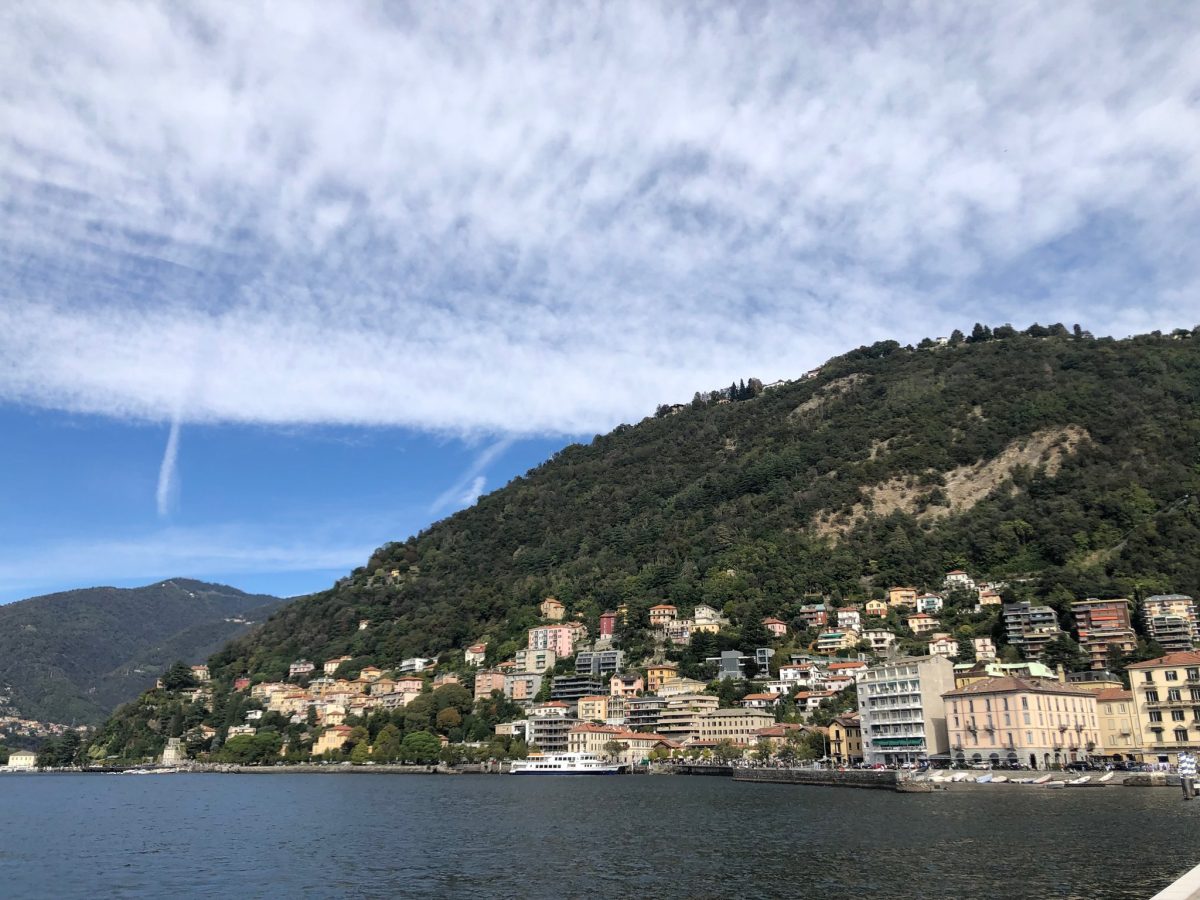
The centre of the Como waterfront is Piazza Cavour, a broad square opening straight onto the harbour, with the piers of the lake ferries in front and the old town behind. It is a strangely modest gateway to one of the most celebrated lakes in Europe: a car park of a square, a few grand hotels, a line of ticket kiosks and the boats coming and going. Its real distinction is the view. From the end of the harbour moles the whole first basin of the lake is laid out, a sheet of water a kilometre or two wide enclosed by steep wooded slopes, with the villages of the western shore to the left and the hillside of Brunate rising almost vertically to the right. It is also the lowest point of the town, and when Lake Como is in flood, Piazza Cavour is where the water comes ashore first.
To the west, the promenade of Lungo Lario Trieste and Lungo Lario Marconi leads past the public gardens to the Tempio Voltiano, a small domed Neoclassical temple built between 1925 and 1927 to designs by the local architect Federico Frigerio and paid for by the industrialist Francesco Somaini. It is a museum to Alessandro Volta, the Como-born physicist who announced the voltaic pile in 1800 and gave his name to the volt. Inside are the instruments and papers that survived a fire in 1899, early versions of the pile, Leyden jars and electrometers, together with the medals and honours Volta received from Napoleon and others. Just beyond it, on the end of a breakwater, stands Daniel Libeskind’s steel sculpture Life Electric, raised in 2015 as a second homage to the same man.
Como is one of the few towns in Europe that has built monuments to a unit of measurement. Every battery in the world carries the name of a man who was born, worked and died a few hundred metres from its harbour.
Further on, the lakeside path passes a string of villas to reach Villa Olmo, the grandest building on the Como waterfront. It was commissioned in 1782 by the Marquis Innocenzo Odescalchi as a summer residence and built between 1797 and 1812 to designs by the Swiss architect Simone Cantoni, a long Neoclassical front facing the lake across a formal garden. The elm that gave it its name is long gone. The city bought the villa in the 1920s, and today it is used for exhibitions and events; the park is open daily and entry to the villa is free. In the other direction, east of Piazza Cavour, the promenade continues past the funicular station along the foot of the Brunate hillside towards Villa Geno, a quieter walk with the water lapping against the wall, moored boats below and the slopes climbing so steeply above that the houses seem stacked on top of each other.
The Walled Town — A Marble Cathedral on a Roman Chessboard
Four centuries of cathedral building, a striped medieval town hall, a Romanesque basilica outside the walls and the most influential modernist building in Italy
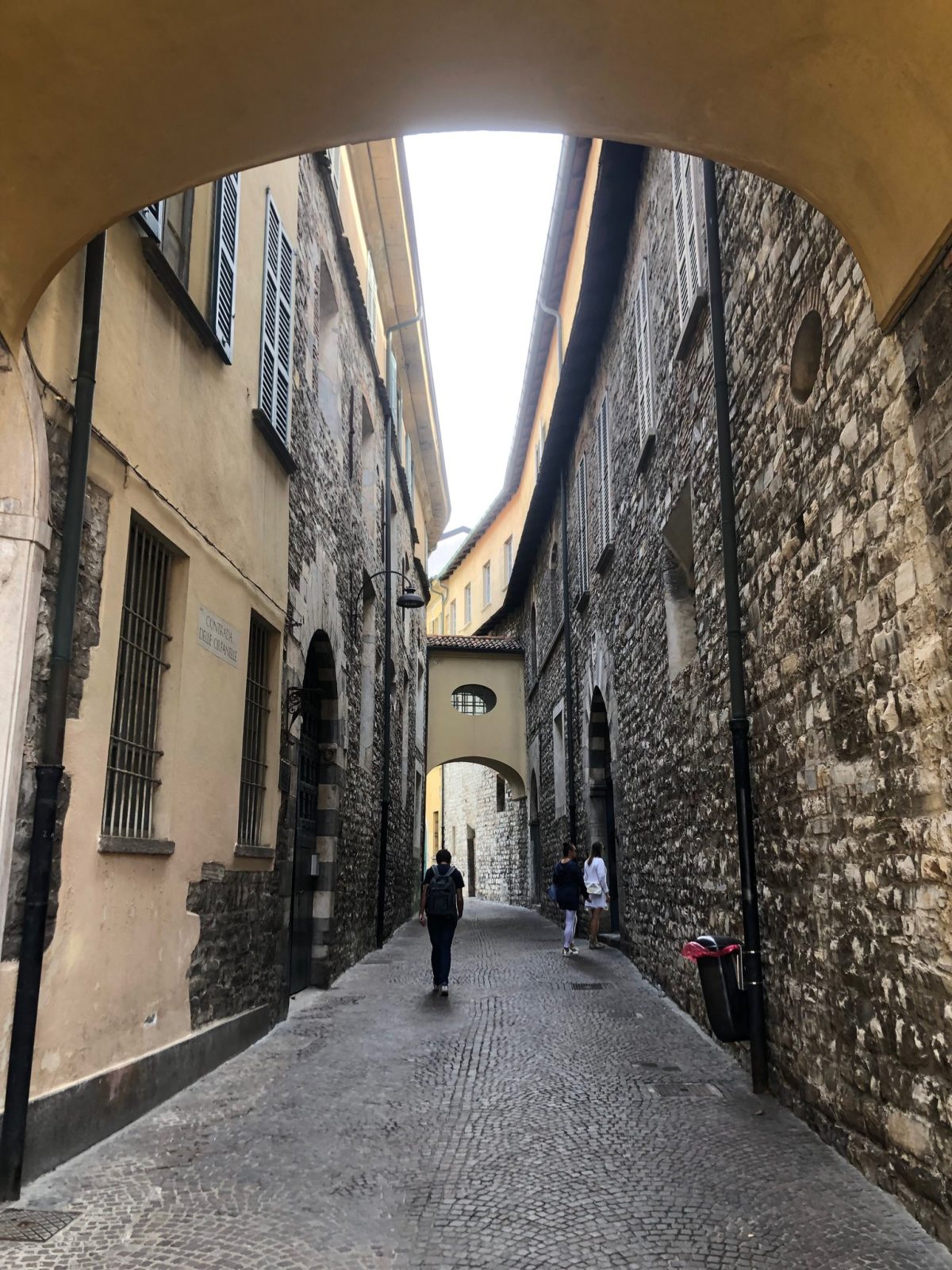
Behind the lakefront lies the città murata, the walled town, a compact rectangle of streets laid out on the Roman grid of Novum Comum and still partly ringed by its medieval walls and towers. It is a place for wandering rather than sightseeing: narrow lanes of grey stone and ochre plaster, small squares with cafés, vaulted passages and arches between the houses, and the shop windows of the silk trade that made the town rich. The streets are quietest early in the morning and at lunchtime, when day visitors are on the boats.
At its heart is Piazza del Duomo and the cathedral of Santa Maria Assunta, one of the last great Gothic cathedrals in Italy and one of the first Renaissance ones. Building began in 1396 on the site of a Romanesque church and was not finished until 1770, and the result reads like a history of Lombard architecture. The marble west front, completed between 1457 and 1498, is late Gothic in outline and early Renaissance in detail, with the Rodari family’s sculpture crowding every surface and the two Plinys seated in niches on either side of the main door, a rare honour for pagans on a cathedral. The nave is Gothic, the east end Renaissance, and the great green dome that dominates every view of the town is Baroque, designed by the Turin architect Filippo Juvarra and completed in 1770. Inside, a set of nine tapestries woven at the end of the 16th century in Ferrara, Florence and Brussels hangs in the nave. Entry is free.
The Broletto was there first. When the cathedral grew, the town hall was cut back to make room, and the two buildings now stand wall to wall: one striped in white, grey and red marble, the other a single cliff of carved white stone.
Pressed against the cathedral’s left flank is the Broletto, the medieval town hall, built in 1215 under the podestà Bonardo Codazzo and remodelled in 1477, when part of it was cut away for the cathedral. Its arcaded ground floor and banded façade of white, grey and red marble make one of the most photographed corners of Lombardy, and the square stone Torre del Comune beside it once rang the town to council. Directly behind the apse of the cathedral, the twentieth century stands in deliberate contrast: Giuseppe Terragni’s Casa del Fascio of the 1930s, a white Rationalist cube built as the local Fascist party headquarters and now regarded as a masterpiece of modern architecture. Outside the walls to the south, the Romanesque basilica of Sant’Abbondio, consecrated in 1095, with twin bell towers and a 14th-century fresco cycle in the apse, is the oldest major church of the town and worth the fifteen-minute walk. For the great Gothic cathedral of the region, Milan’s Duomo, see Milan: A Fashionable and Cultural Hub in Italy and Europe’s 10 greatest cathedrals and churches.
Up to Brunate — Seven Minutes to the Balcony of the Lake
A Victorian funicular, a Belle Époque resort above the rooftops, a lighthouse 900 metres up and the old mule paths that lead back down
At the eastern end of the lakefront, a short walk from Piazza Cavour, a chalet-like building of red brick and carved dark timber carries the words Funicolare Como–Brunate over its door. The line opened in 1894, at the height of the fashion for mountain railways, and ran on steam until 1911, when it was converted to electric traction. From the station the track climbs 1,084 metres straight up the hillside, at gradients of up to 55 per cent, through tunnels and between villa gardens, to Brunate, about 500 metres above the lake. The ride takes around seven minutes, with cars leaving every fifteen minutes from early morning until midnight, and every twelve minutes in the morning rush, because Brunate is a working village as well as a viewpoint. A single costs about €3.60 and a return about €7.20. On fine weekends in summer the queue at the bottom can take half an hour.
Brunate, at about 715 metres, has fewer than two thousand residents and a long reputation as the balcony of the lake. At the end of the 19th century wealthy families from Como and Milan built summer houses here in the Liberty style, the Italian Art Nouveau, and the village is still scattered with turreted villas, wooden chalets and grand hotels from that era. Alessandro Volta himself spent time here. The view from the terraces near the upper station takes in the town of Como directly below, the full length of the first basin of the lake, and on clear days the plain of Lombardy towards Milan and the snow peaks of the Alps on the horizon to the west.
Brunate is the kind of place that only a funicular could create: a resort of villas and hotels clinging to a mountainside, five hundred metres above a town that its residents can reach in seven minutes.
From the upper station, a road and footpath climb in under half an hour to the hamlet of San Maurizio and the Faro Voltiano, a 29-metre lighthouse built in 1927 for the centenary of Volta’s death. At about 909 metres, it is almost certainly the only lighthouse in Europe that looks down on a lake from a mountain, and its tricolour beam is visible from much of the basin at night. A climb of 143 steps leads to its circular balconies, the highest viewpoint of the walk. Beyond it, marked trails continue along the ridge towards Monte Piatto, with its prehistoric boulders and the mushroom-shaped Pietra Pendula, and down to the villages of the eastern shore. The best way back to Como is on foot: the old stepped paths that link the hillside with the town drop steeply between ivy-covered walls, past villa gardens and through the residential streets above the funicular station, and take about an hour to the lakefront. For more mountain railways and lifts, see the world’s 10 great railway journeys.
Cernobbio and the Western Shore — A Cardinal’s Villa and the Hills Above
The first village up the lake, the Renaissance villa that became the most famous hotel on Lake Como, and the steep hillside where the views open in every direction
The western shore road leaves Como past Villa Olmo and reaches Cernobbio within a few kilometres, the first of the lakeside villages on the way north. It is a small town with a real centre, a lakefront piazza where the ferries call, a handful of cafés under the plane trees and a promenade along the water, set at the foot of Monte Bisbino, the mountain on the Swiss border that dominates the western side of the basin. Buses and boats link it with Como in a few minutes, and the walk along the lakeside from Villa Olmo is one of the pleasantest ways to leave the town.
Cernobbio is known around the world for one building. In 1565 Cardinal Tolomeo Gallio, secretary of state to Pope Gregory XIII and a native of the lake, commissioned the architect Pellegrino Tibaldi to build him a villa on the shore, then called the Villa del Garovo. In the 19th century it passed through a series of owners, the most notorious of them Caroline of Brunswick, the estranged wife of the future George IV of Britain, who lived here from 1815 and gave the villa the name it still carries. Since 1873 it has been a hotel, Villa d’Este, one of the grandest in Europe, set in a Renaissance garden with a nymphaeum and a cypress-lined water staircase. Alfred Hitchcock shot scenes for his first film, The Pleasure Garden, on the grounds in 1925, and since 1928 the lawns have hosted the Concorso d’Eleganza, the most exclusive classic car show in Europe. The gardens are for guests and events; for everyone else, the villa is best seen from the water. Next door, the 19th-century Villa Erba is a conference and exhibition centre, and in the centre of Cernobbio the restored Liberty-style Villa Bernasconi of 1906 opens its interiors to visitors as a house of the Belle Époque.
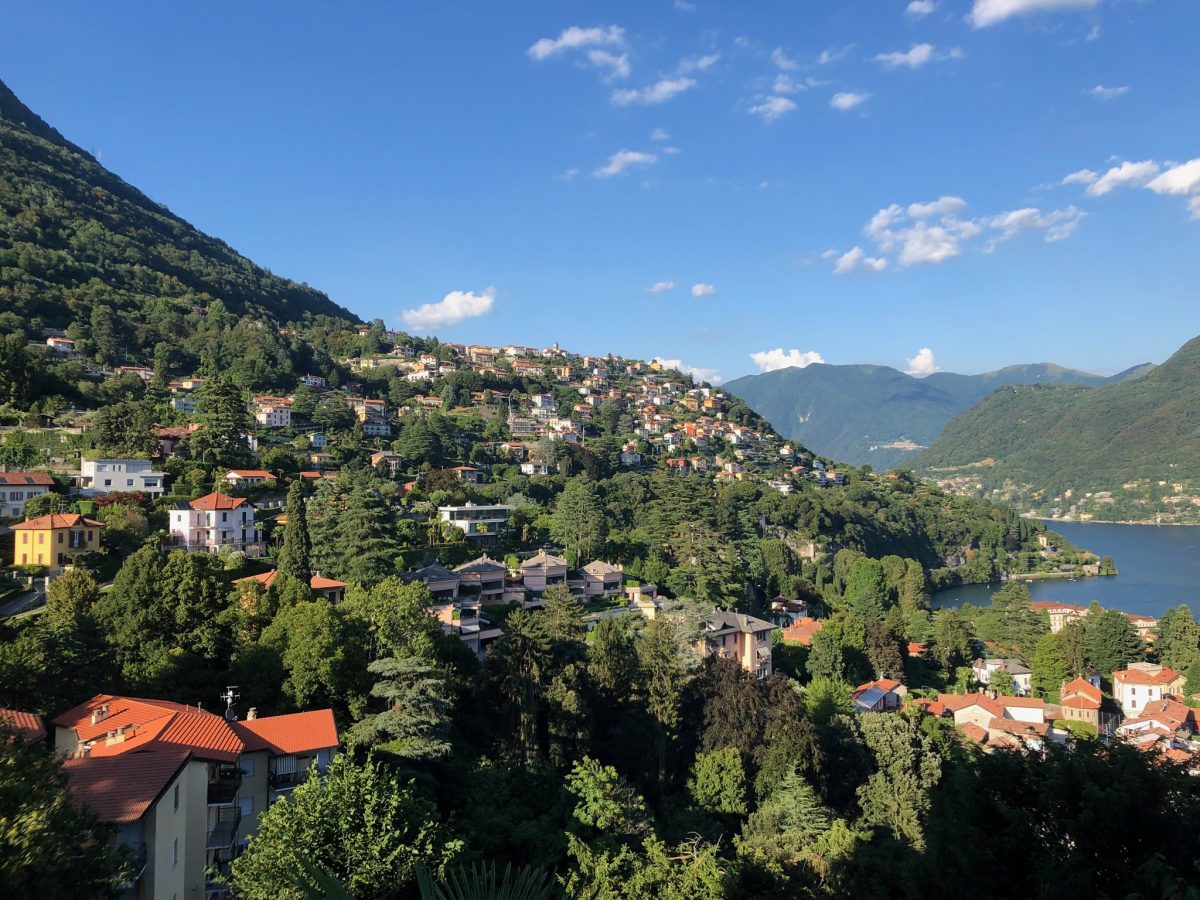
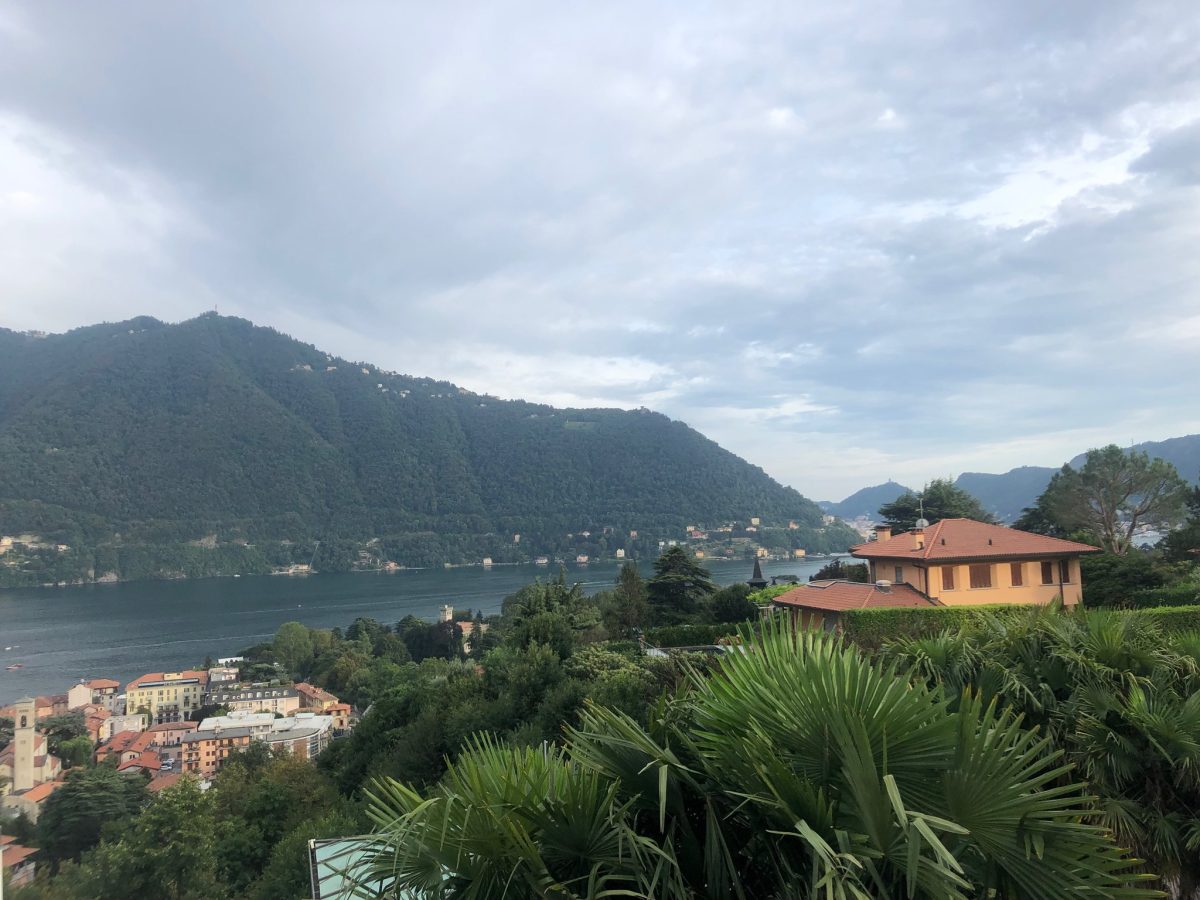
From the hills above Cernobbio the whole southern basin is laid out like a map: the village directly below, the water narrowing towards Como at the end of the lake, and on the far side the wooded mountain of Brunate with its lighthouse on top.
The hillside above Cernobbio rises steeply through the hamlets of Rovenna and Piazza Santo Stefano towards Monte Bisbino, and a narrow road with many hairpins climbs almost to the summit at 1,325 metres. The lower slopes are a patchwork of villas, gardens and chestnut woods, with several hotels and terrace restaurants that look straight down onto the lake. From here, the view runs south over the roofs of Cernobbio to Como at the head of the basin, and east across the water to the slopes of Brunate and the villages of Blevio and Torno on the opposite shore. On summer evenings the mountains of the eastern shore catch the last of the sun long after the lake has fallen into shadow, and at night the lights of Cernobbio and Como trace the outline of the water. North of Cernobbio, the shore road continues through Moltrasio, Carate Urio and Laglio, villages built on narrow ledges between the mountains and the lake, towards Argegno and the Tremezzina.
Up the Lake — Boats to Bellagio, Varenna and the Garden Villas
How the lake ferries work, the pearl at the fork of the lake, the village of stairways opposite, and the villas and gardens of the Tremezzina shore
The boats of Navigazione Laghi, the state-run lake ferry company, leave Como from the piers in front of Piazza Cavour and work their way up the western arm of the lake, crossing from shore to shore and calling at almost every village. There are two kinds of service. The ordinary ships are slow, stopping a dozen times or more and taking just over two hours to reach Bellagio, but they are the best way to see the lake, with open decks and the villas sliding past at walking pace. The fast hydrofoils and catamarans make the same journey in about three quarters of an hour, with fewer stops and enclosed cabins. A single from Como to Bellagio costs about €12, with a supplement of about €5 for the fast service; to Varenna it is about €13.50. A one-day pass for unlimited travel on the lake costs about €29.50, which pays for itself on a day of island-hopping. Queues build at the ticket offices in summer, so arriving twenty minutes before departure is wise, and services can be suspended in rough weather. In the winter timetable, in force from November to mid-March, there are fewer boats and most slow services do not run the full length of the lake.
Bellagio stands at the point where the lake divides, on the tip of the promontory between the Como and Lecco arms, and it is the most visited village on Lake Como. Its lanes of stone steps climb steeply from the waterfront arcades to the church of San Giacomo, and the gardens of its two great villas fill the headland. Villa Serbelloni on the hill above the village belongs to the Rockefeller Foundation and is visited only on guided tours of the park; Villa Melzi on the lakeshore to the south, built between 1808 and 1810 for Francesco Melzi d’Eril, vice-president of Napoleon’s Italian Republic, has Neoclassical gardens of camellias, azaleas and rhododendrons open from the end of March to autumn, for about €10. Franz Liszt stayed in Bellagio in 1837, and his daughter Cosima, later the wife of Richard Wagner, was born there.
The best way to see Lake Como is from the deck of the slow boat, which takes two hours to cover what the hydrofoil does in forty-five minutes and crosses the lake a dozen times on the way. Nobody who has the time takes the fast one twice.
Across the water, Varenna on the eastern shore is smaller, steeper and for many visitors more charming: pastel houses stacked above a tiny harbour, the lakeside walkway known as the Passeggiata degli Innamorati, the botanical garden of Villa Monastero and the ruined Castello di Vezio on the hill above. The short car ferries of the central lake link Varenna, Bellagio, Menaggio and Cadenabbia in ten to thirty minutes, making it easy to cross between them several times a day. On the western shore opposite Bellagio lies the Tremezzina, the most sheltered stretch of the lake, with two of its finest gardens. Villa Carlotta at Tremezzo, built in 1690 and named after the Prussian princess who received it as a wedding present, is famous for its azaleas and rhododendrons in April and May and for its Neoclassical sculpture collection; entry costs about €17.50 in 2026. Villa del Balbianello, built in 1787 on the site of a monastery at the tip of the wooded Lavedo point near Lenno, belonged to the explorer Guido Monzino and now to the Italian heritage trust FAI; its terraced garden is reached by taxi boat from Lenno or on foot along a path of about a kilometre, and costs about €15. Between them, the Greenway del Lago di Como, a marked walking route of about 10.5 kilometres from Colonno to Cadenabbia, links villages, churches and villa gates along the shore in about three and a half hours.
Food, Seasons and When to Go — Perch, Polenta and the Light of October
What the lake puts on the plate, how the year turns on the water, and why spring and autumn beat the height of summer
The cooking of Lake Como is the cooking of the mountains and the water, closer to the Alps than to the Mediterranean. The signature dish is risotto con pesce persico, a plain saffron-less risotto topped with fillets of lake perch fried in butter and sage. Missoltini, shad salted and dried in the sun and pressed in tins, are the traditional preserved fish of the central lake, grilled and served with polenta. Polenta itself, often cooked with cheese and butter in the mountain villages, appears with game, braised meat and mushrooms in autumn. The local cheeses come from the valleys above the lake, and the wines from the terraced vineyards of the Valtellina to the north. Como was for centuries a silk town, and the shops of the walled town still sell ties, scarves and fabric from the mills of the surrounding valleys.
The climate is milder than the mountains around the lake suggest. The deep water stores heat, and the shores are lined with palms, olives, oleanders and citrus trees that would not survive elsewhere at this latitude. July averages highs of about 30 °C, with humid, sometimes thundery afternoons; January averages about 6 °C by day, with frost on clear nights. It is also a wet region, with about 1,600 millimetres of rain a year, much of it in spring and autumn downpours. The water warms enough for swimming from June to September at the lidos along the shore.
July and August bring the crowds, the heat and the haze. October brings clear air, empty boats, the first snow on the peaks to the north and a low sun that lights the far shore all afternoon.
The best months are April to June and September to October. In spring the gardens of the villas are at their peak, with camellias in March and April and the famous azaleas and rhododendrons of Villa Carlotta in April and May. In September and October the summer crowds have gone, the air is often clearer than in midsummer and the woods on the slopes turn gold. July and August are hot, busy and expensive, with queues for the boats and the funicular. From November to March the lake is at its quietest: the boats run on a reduced timetable, many hotels in the smaller villages close, and most villa gardens shut between early November and late March, although Villa Carlotta and Villa del Balbianello open on selected winter weekends and holidays. Como itself, with its cathedral, museums, shops and the funicular, is a year-round destination, and on a clear winter day the snow peaks above the lake are at their most spectacular. For the city at the other end of the train line, see Milan in pictures, and for other cities of the north, Turin, Bologna and Venice. North of the border, Basel is a few hours away by train through the Gotthard.
«Lake Como is usually sold as a collection of villas, and the villas are everything they promise. But the lake begins with a town. Como was here two thousand years before the first hotel, and it has the walls, the cathedral and the stubborn civic pride to prove it: a Roman grid, a marble church that took four centuries to build, a museum to the man who gave the world the battery. Then the water takes over. Seven minutes on a Victorian funicular, and the town is a map below; a few kilometres along the shore, and a cardinal’s villa has become a palace for guests; two hours on the slow boat, and the mountains close in on both sides until the lake divides at Bellagio. Few places in Europe change so completely in so short a distance, and fewer still are forty minutes from a railway station in Milan.»