Pompeii is not a ruin in the conventional sense. It is a city interrupted — caught mid-sentence on the morning of 24 October 79 CE when the column of ash and pumice from Vesuvius began to fall, and preserved in that moment with a fidelity that no ruin built over centuries could achieve. The bread was in the ovens. The election notices were fresh on the walls. The lunch counters were stocked and the brothel was open. What the volcanic material buried, it also kept: for nearly two thousand years, until the excavations began in the 18th century, Pompeii waited beneath 6 metres of ash for someone to come back.

Pompeii was a prosperous Roman town of approximately 11,000 people at the foot of Vesuvius — a commercial hub, a resort town for wealthy Romans from the capital, a place of taverns and thermopolia and baths and a large amphitheatre. It had been a settlement since at least the 7th century BCE, absorbed into the Roman world as a colony in 89 BCE after the Social War, and had been building and rebuilding itself for centuries. The earthquake of 62 CE had damaged much of the city, and in 79 CE reconstruction was still ongoing in several quarters. The city had been living on the slopes of a volcano for its entire existence without apparent concern; Vesuvius had not erupted in recorded history, and its fertile slopes were covered in vineyards. There was no reason, on the morning of what is now believed to have been 24 October 79 CE, to expect what followed.
The archaeological site today covers approximately 66 hectares — about two-thirds of the ancient city, with the rest remaining unexcavated. It was inscribed, together with Herculaneum and Torre Annunziata, as a UNESCO World Heritage Site in 1997. Serious excavation began under the Bourbon kings in 1748 and has continued, with varying levels of rigour, ever since; the Great Pompeii Project, launched in 2012 and still ongoing, represents the most systematic modern effort to document, conserve and restore the site. Each decade of excavation reveals new information about how the Romans lived: the charcoal inscription discovered in 2018 in the Regio V area — a date written casually on a wall — shifted the scholarly consensus on the eruption date from August to October, resolving questions about the autumn produce (pomegranates, walnuts) found at the site.
How to approach Pompeii
This guide covers four aspects of Pompeii: the eruption of 79 CE and what is known about how and why it preserved the city so completely; the Forum and the public buildings that reveal Roman civic life; the private houses, streets and commercial spaces that reveal Roman daily life; and the victims — the approximately 1,150 bodies found at the site, the plaster casts made from their void spaces in the ash, and what they tell us about who was in Pompeii on that October morning and what they were doing. Pompeii requires at least half a day and ideally a full day; arrive early, bring water, and consider hiring an audio guide or guide for the first visit.
A city interrupted
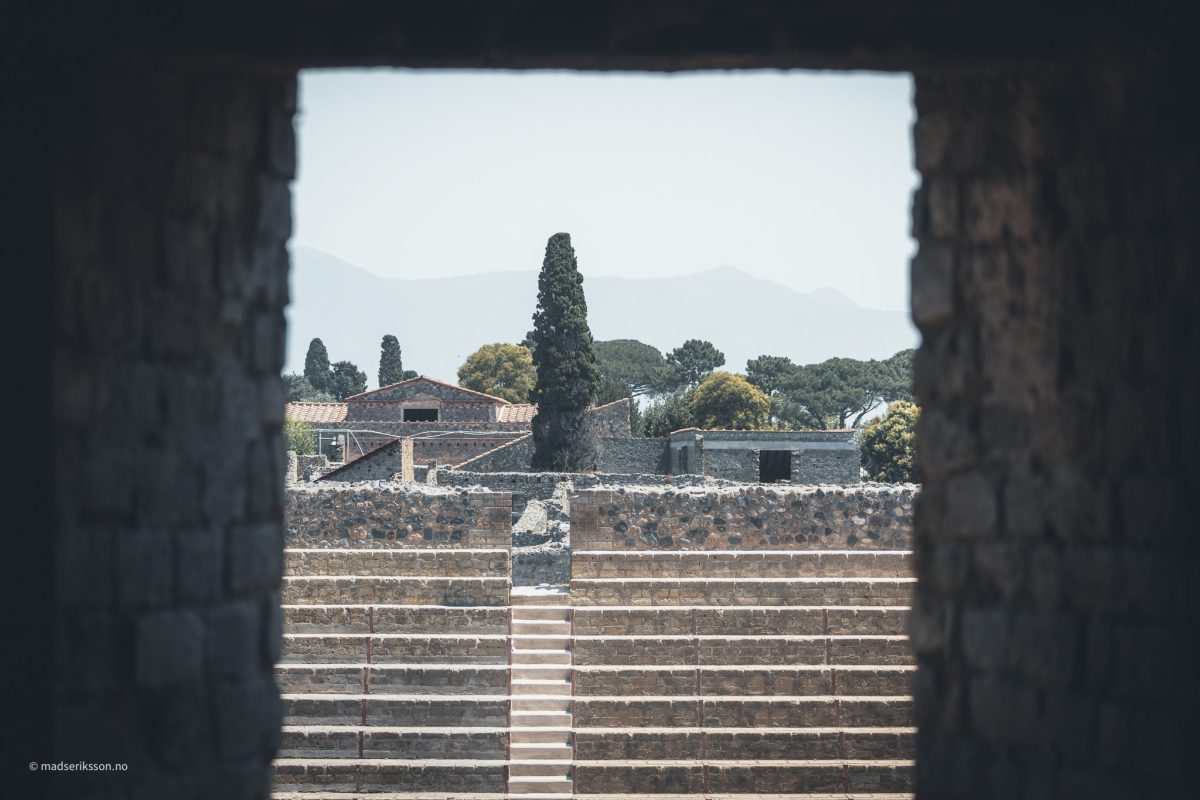
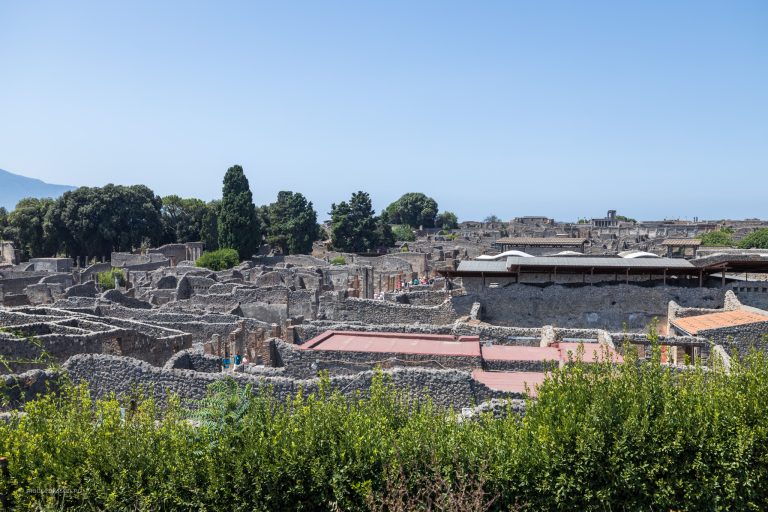
Pompeii was a prosperous Roman town of about 11,000 people at the foot of Vesuvius. The archaeological site covers about 66 hectares, two-thirds of the ancient city; the rest is left unexcavated. Every mapped wall of the excavated houses is drawn here.
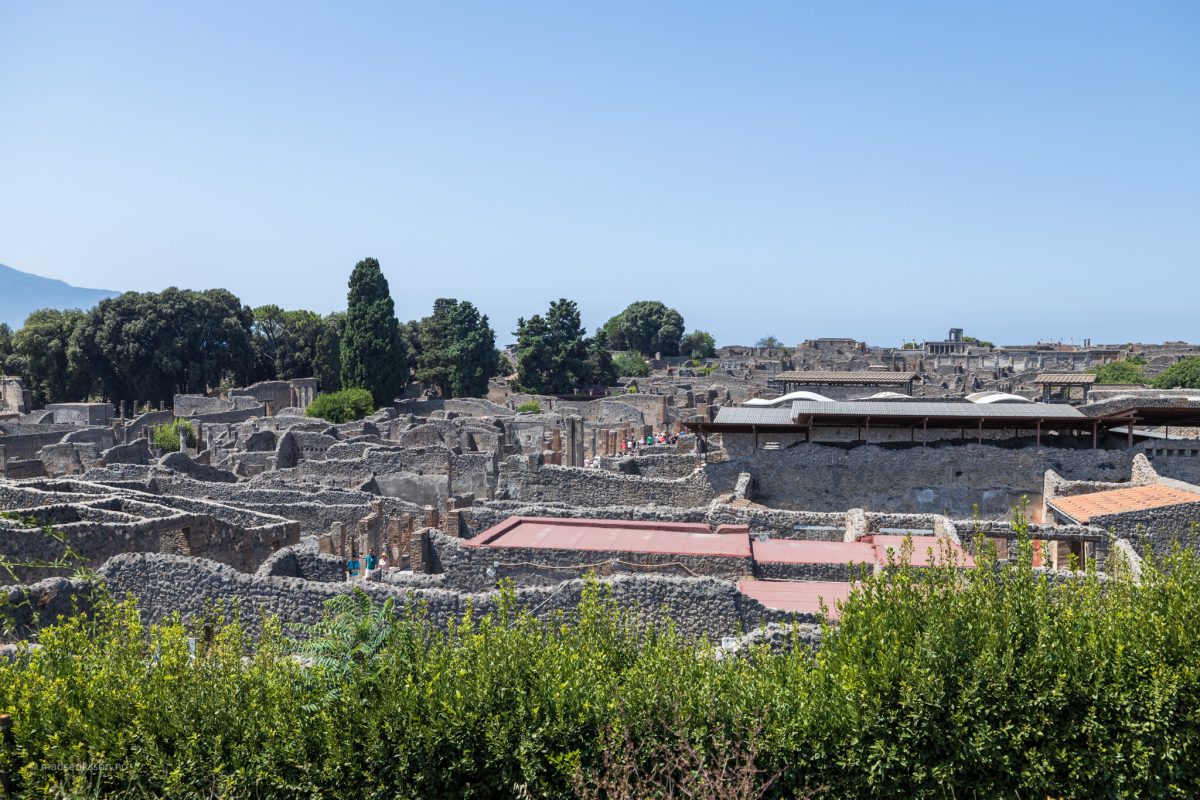
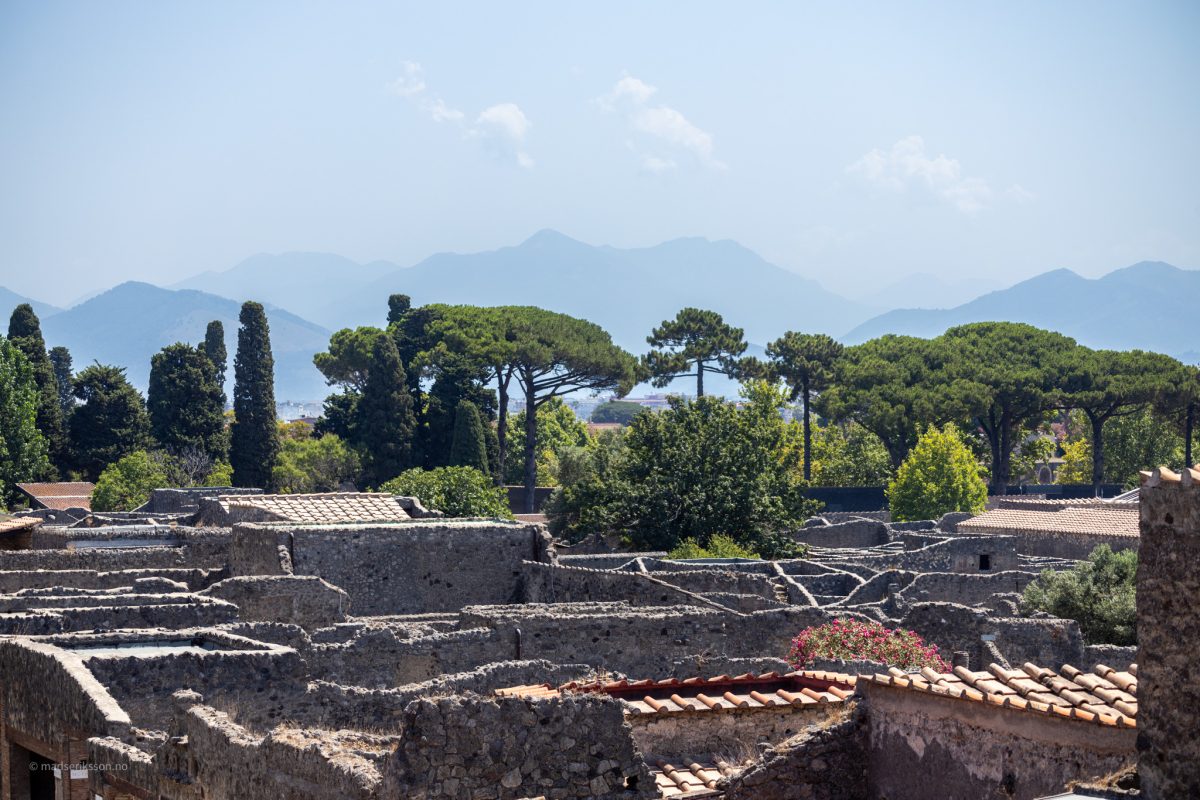
Looking over the excavated houses of Pompeii towards the amphitheatre and the hills beyond
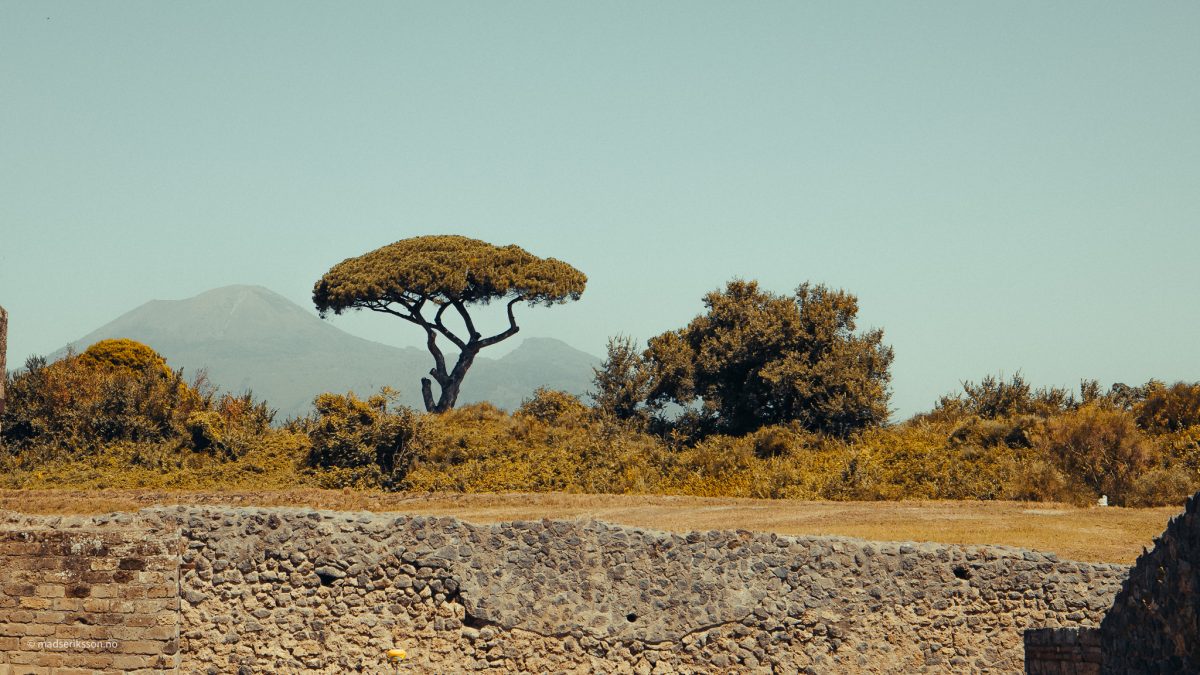
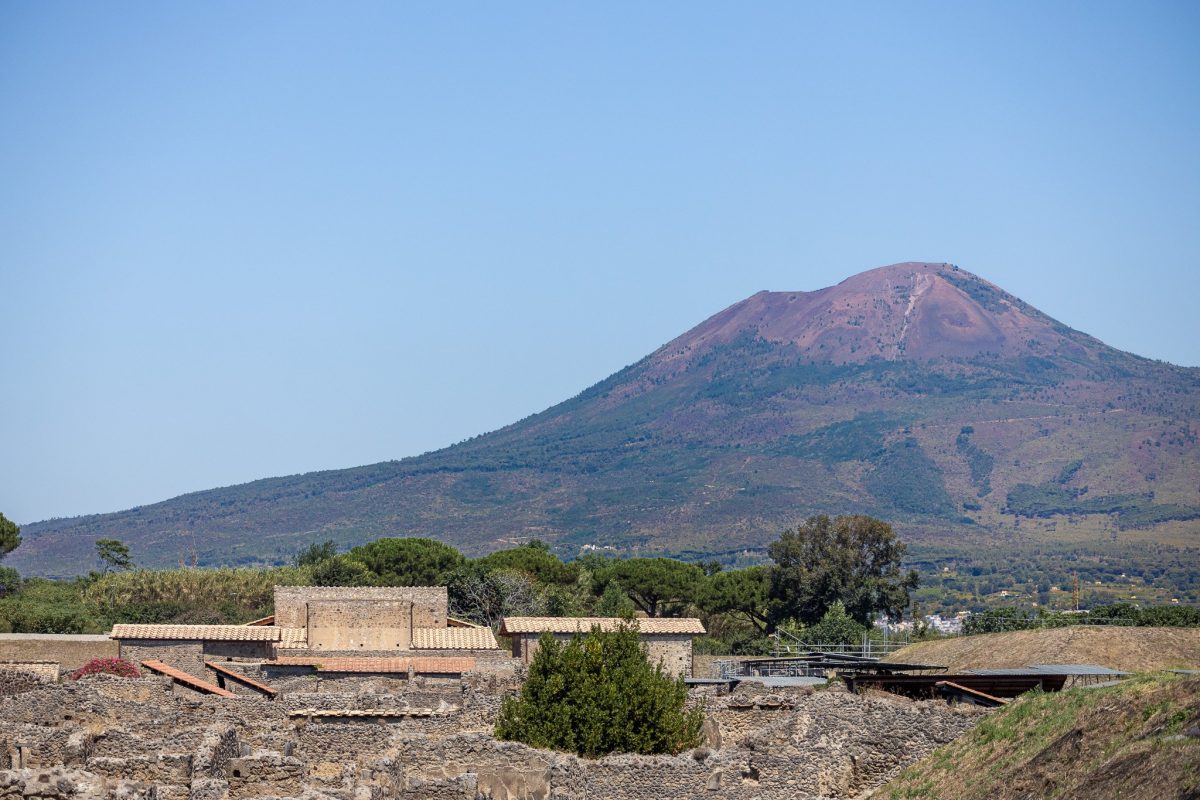
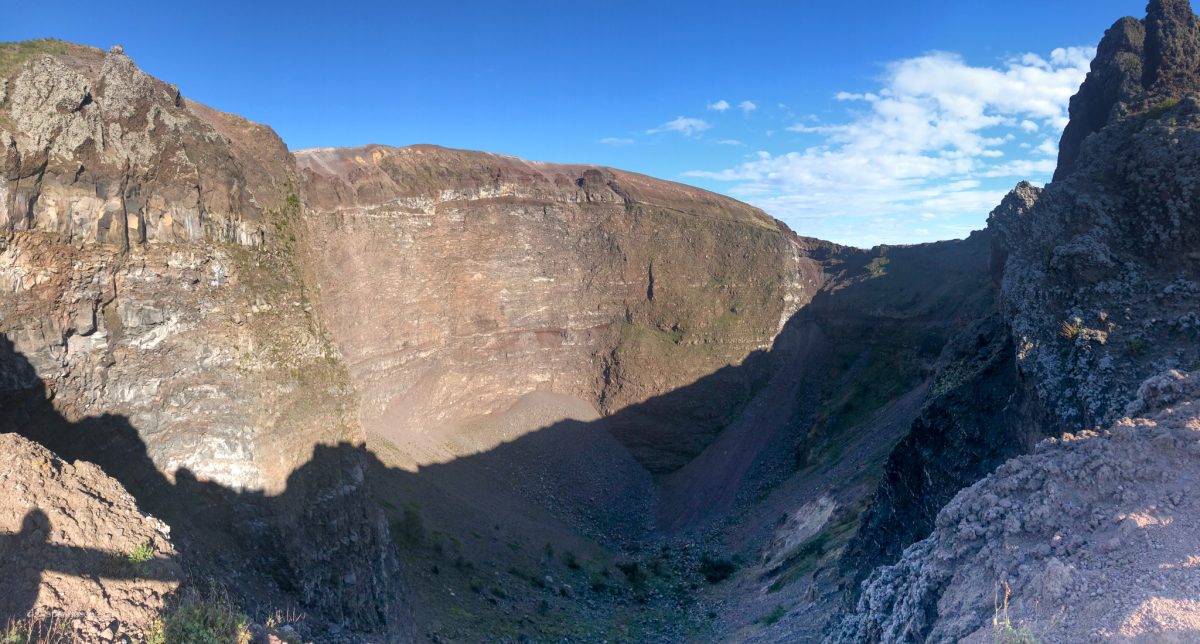
The mountain behind the city
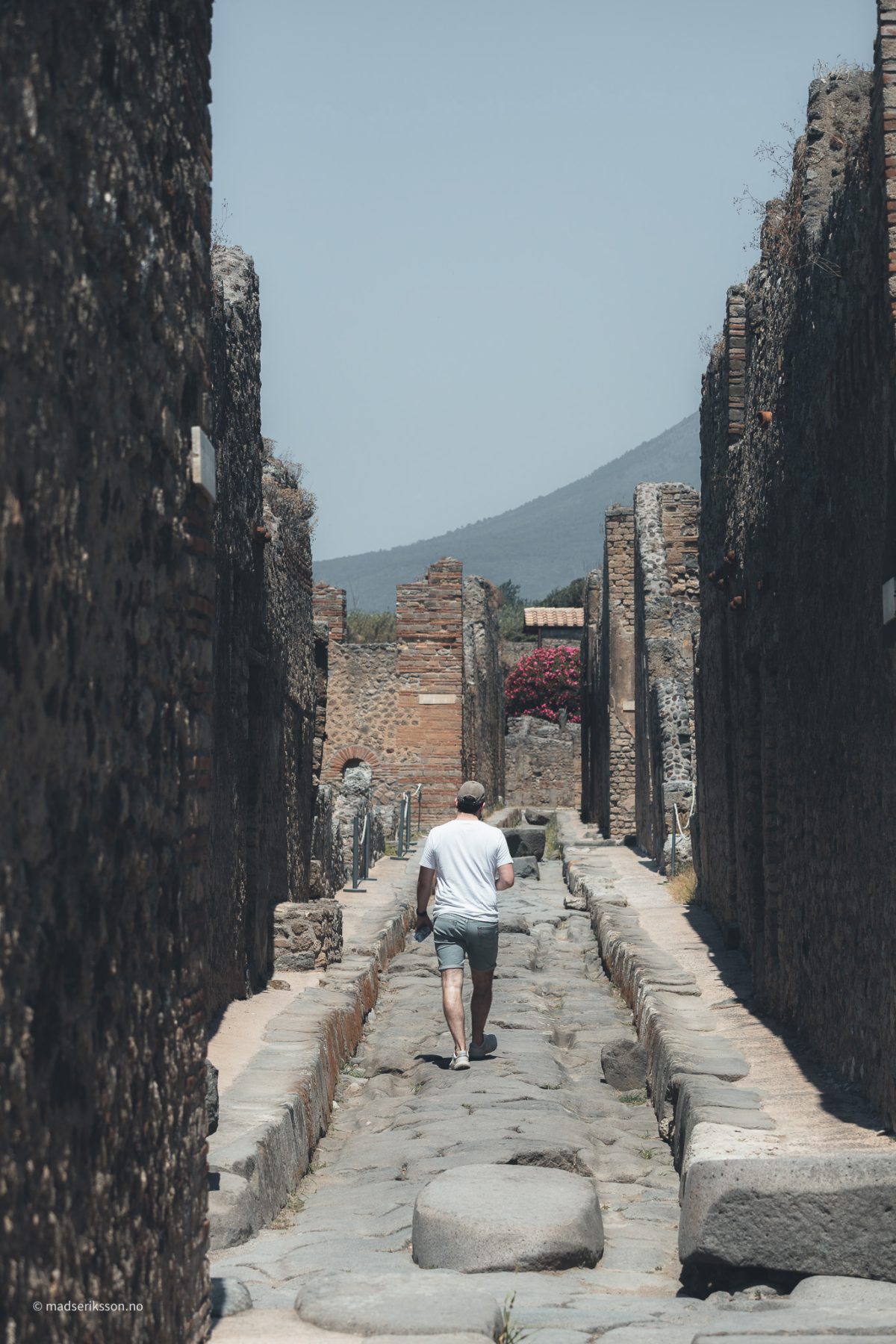
On what is now believed to have been 24 October 79 CE, Vesuvius sent a column of ash and pumice 33 kilometres into the air. About six metres of pumice and ash buried the city, and it stayed lost until excavations began in 1748.
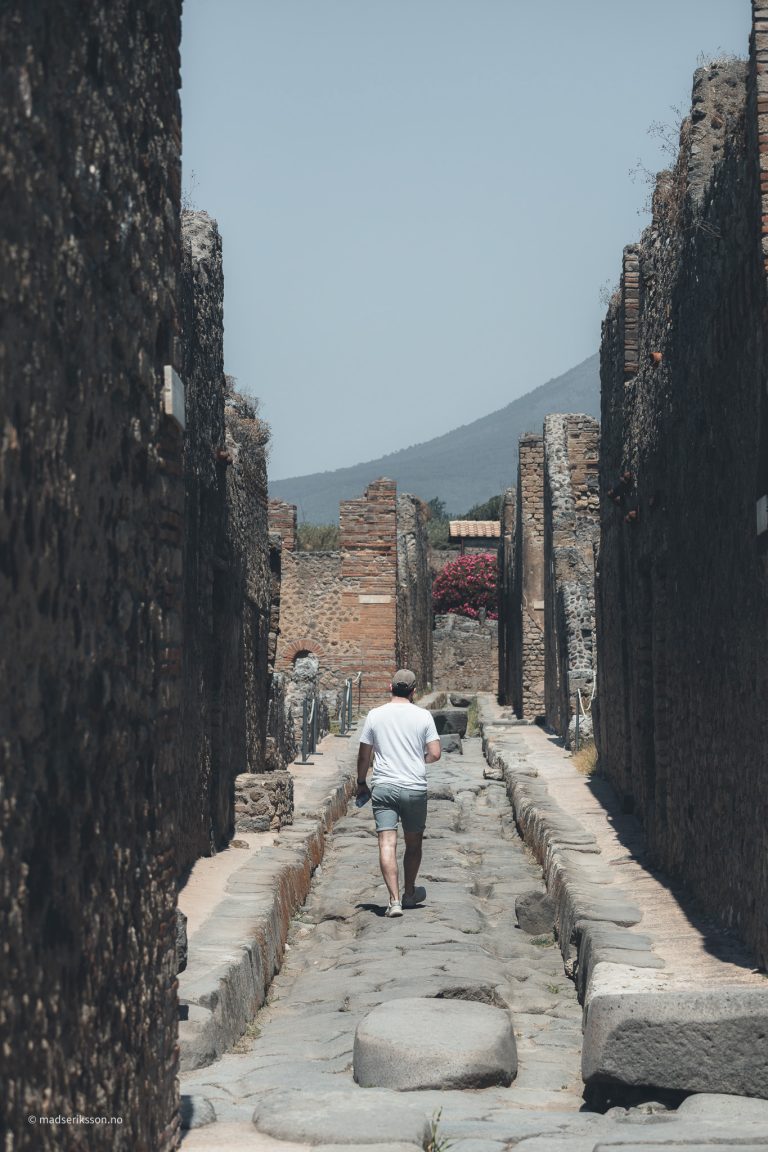
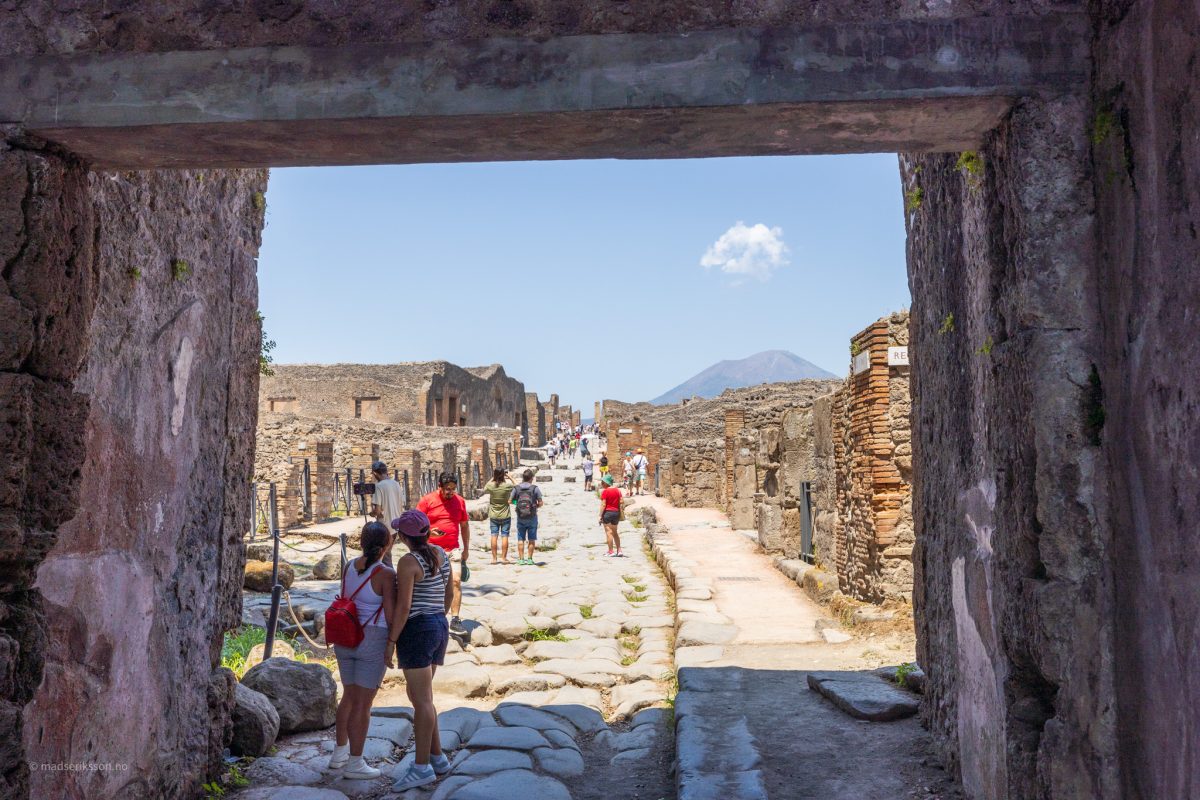
A visitor walks a lava-paved street in Pompeii, with stepping stones and Vesuvius at the end
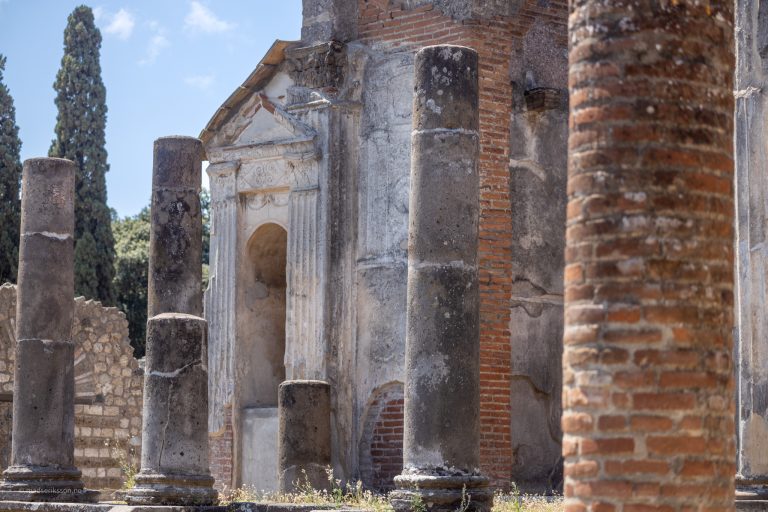
Roman civic space at full scale
The Forum, 38 metres wide and 142 metres long, was the political, religious and commercial heart of the city. The Temple of Jupiter at its northern end frames Vesuvius on the horizon; the Basilica stands on the southwestern side.
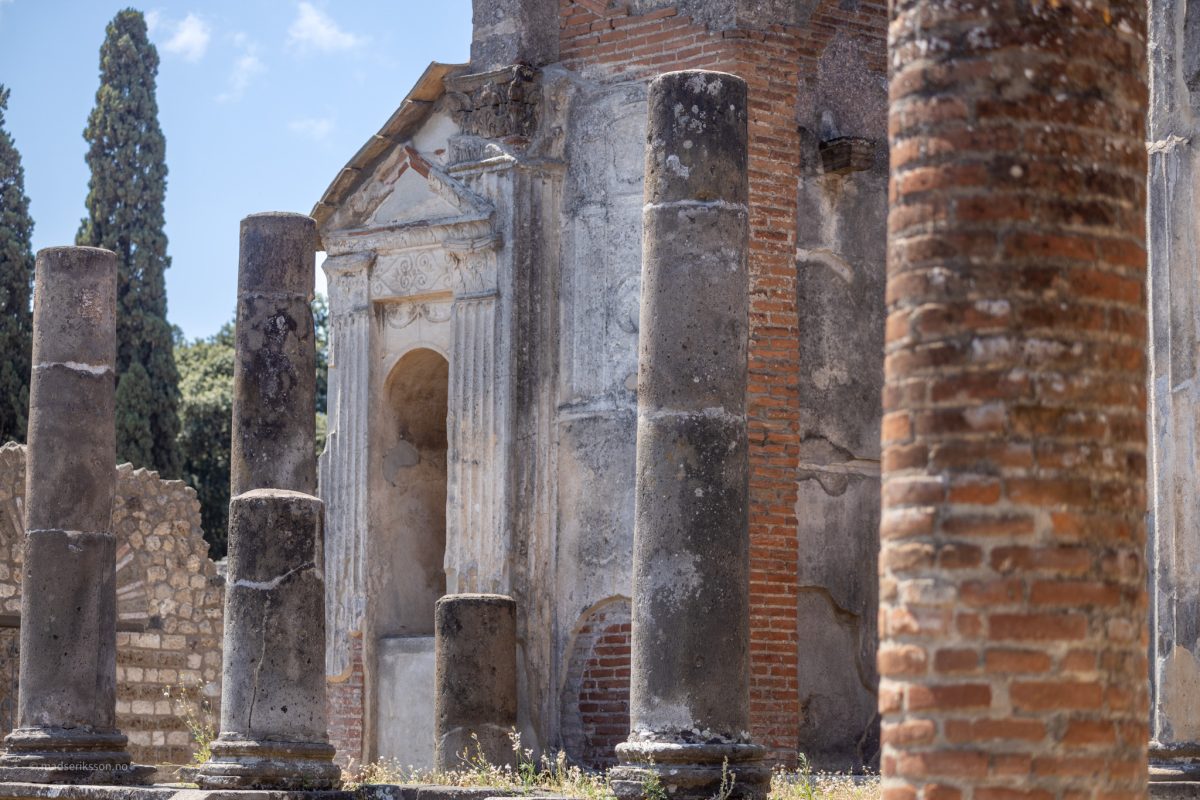
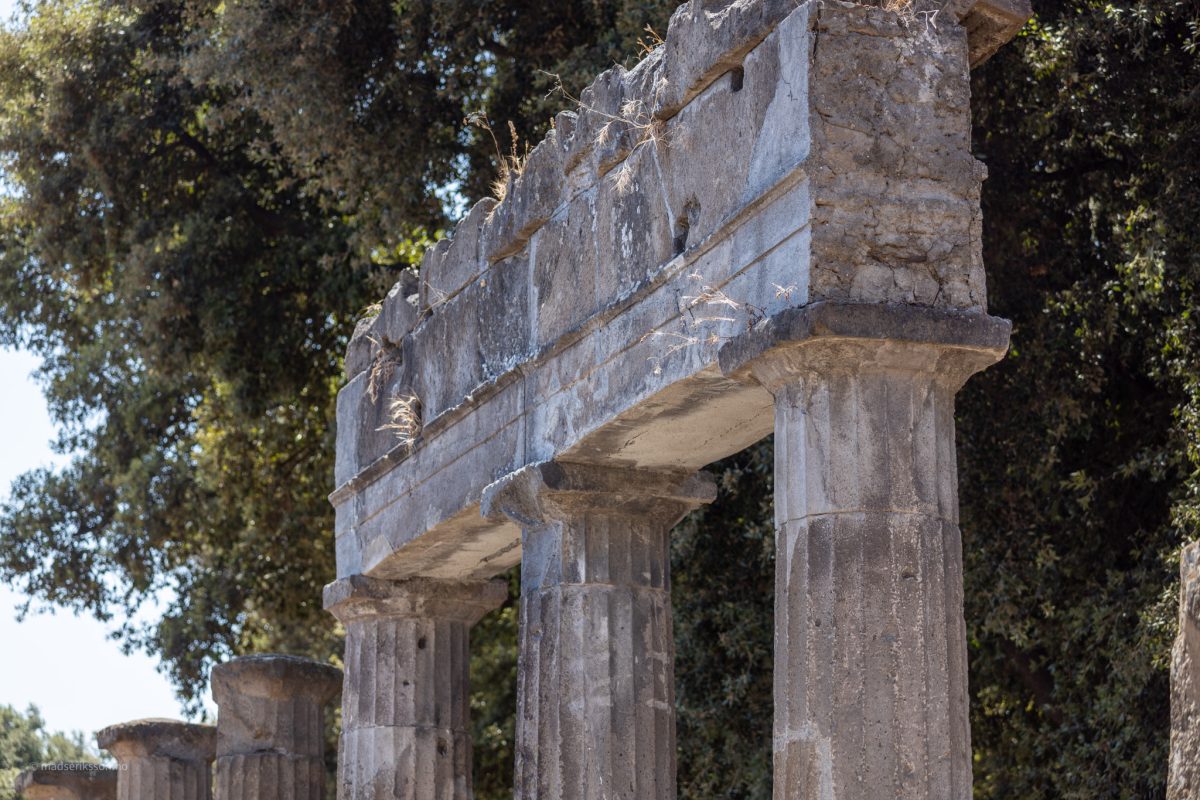
Brick and stone columns of a ruined temple standing among cypresses in Pompeii
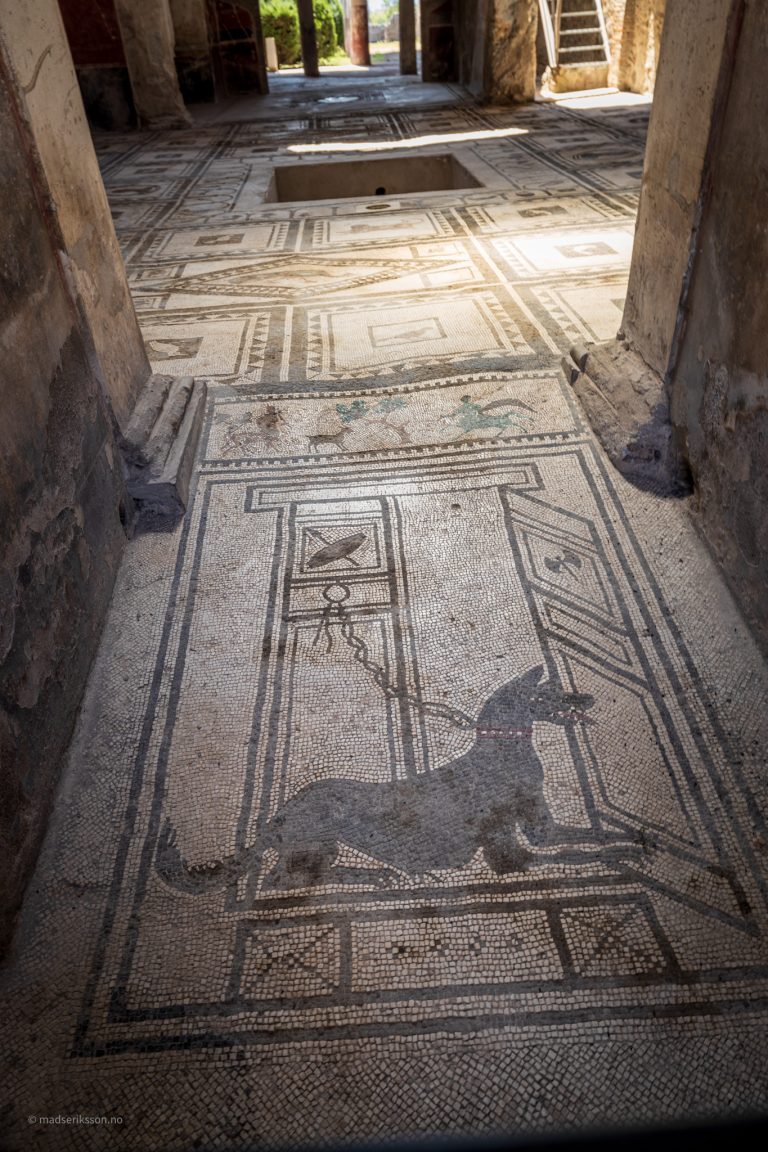
The largest house in Pompeii
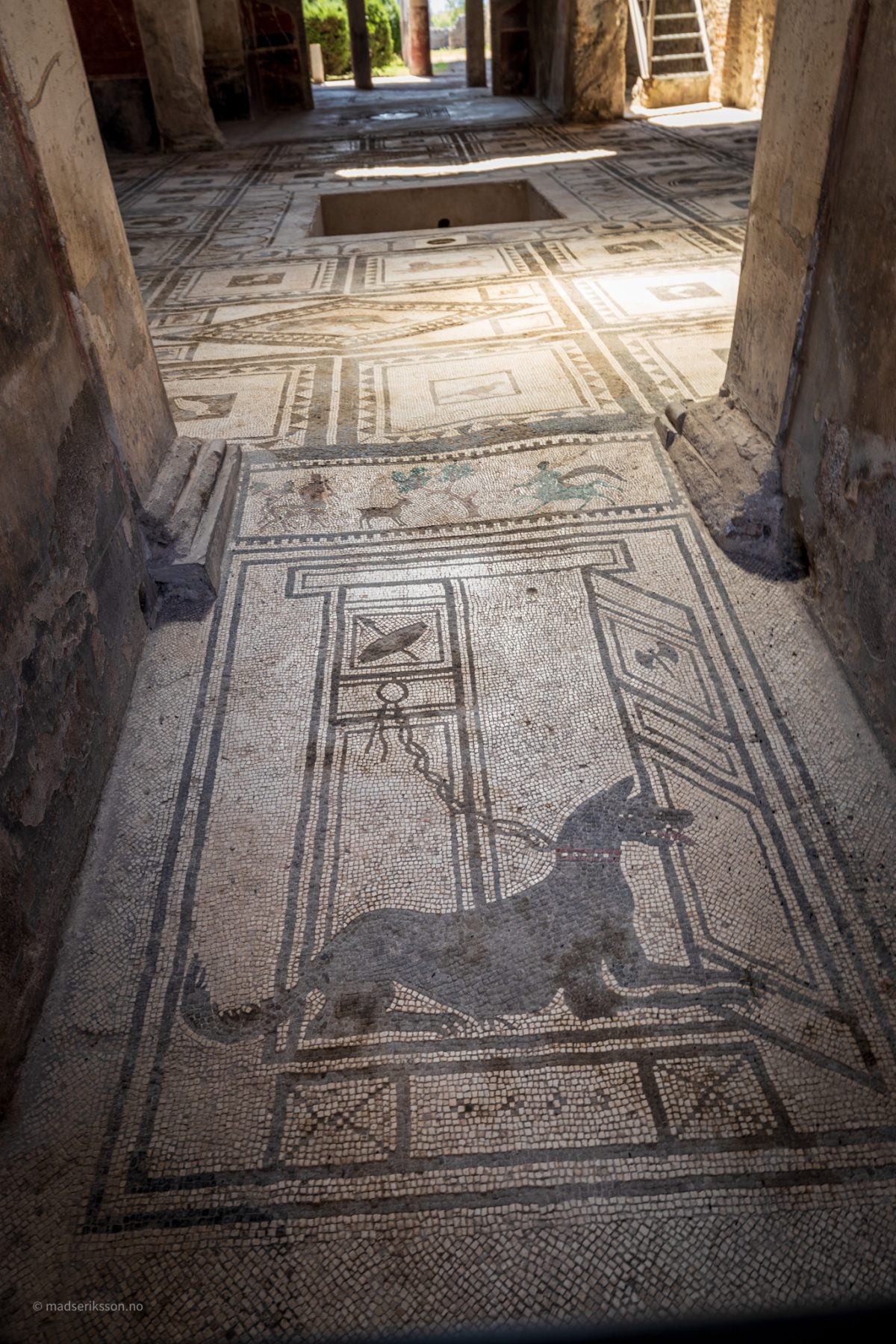
The House of the Faun covers an entire city block, 3,000 square metres, and once held the Alexander Mosaic, now in Naples. A few blocks north, the House of the Vettii keeps the most complete painted decoration of any house in the city.
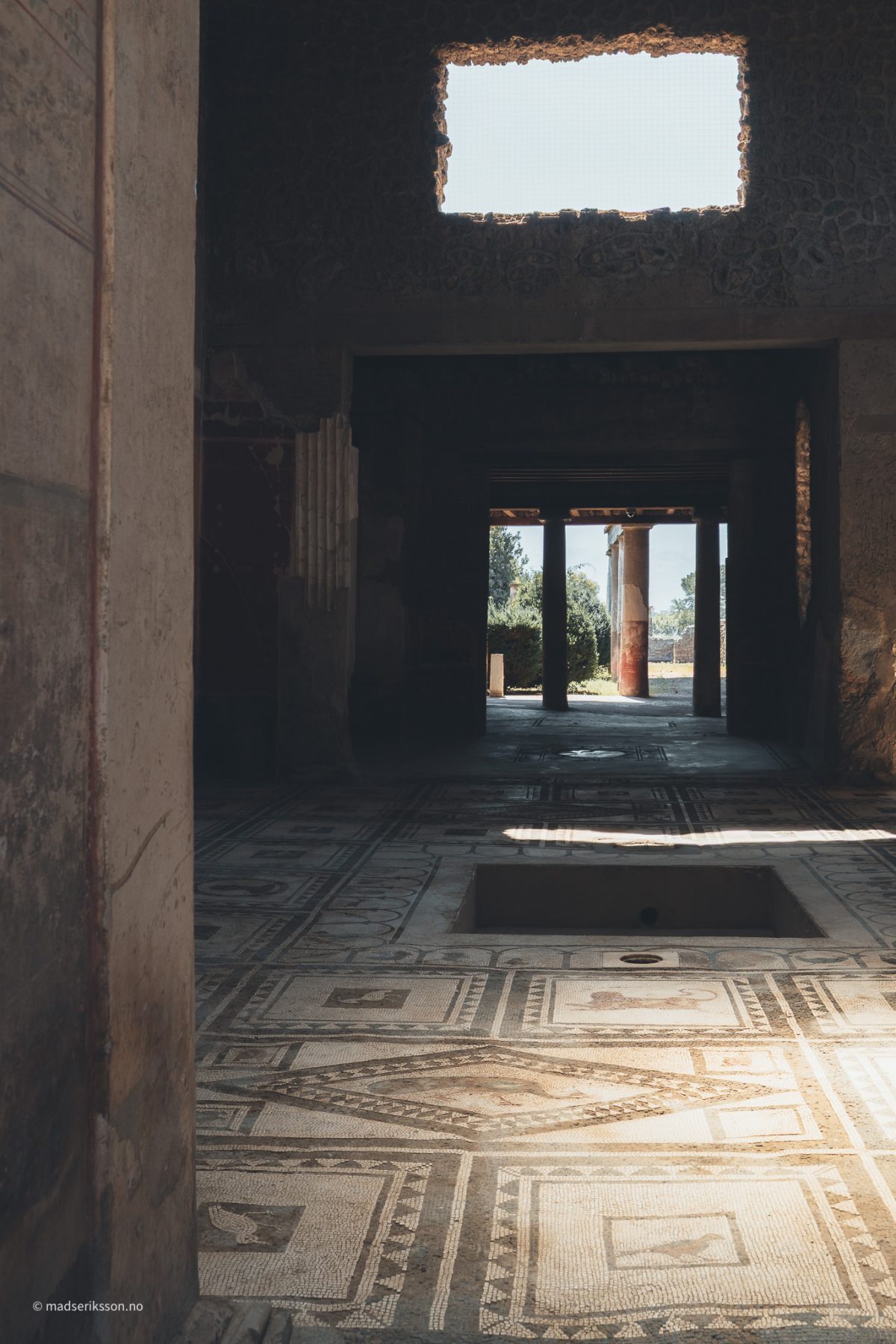
Mosaic of a chained guard dog at the entrance to a Roman house, leading into the atrium, Pompeii
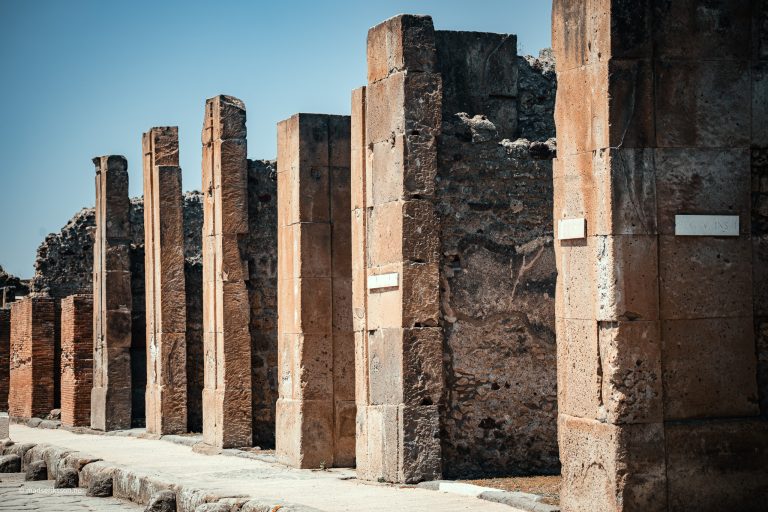
The main commercial street
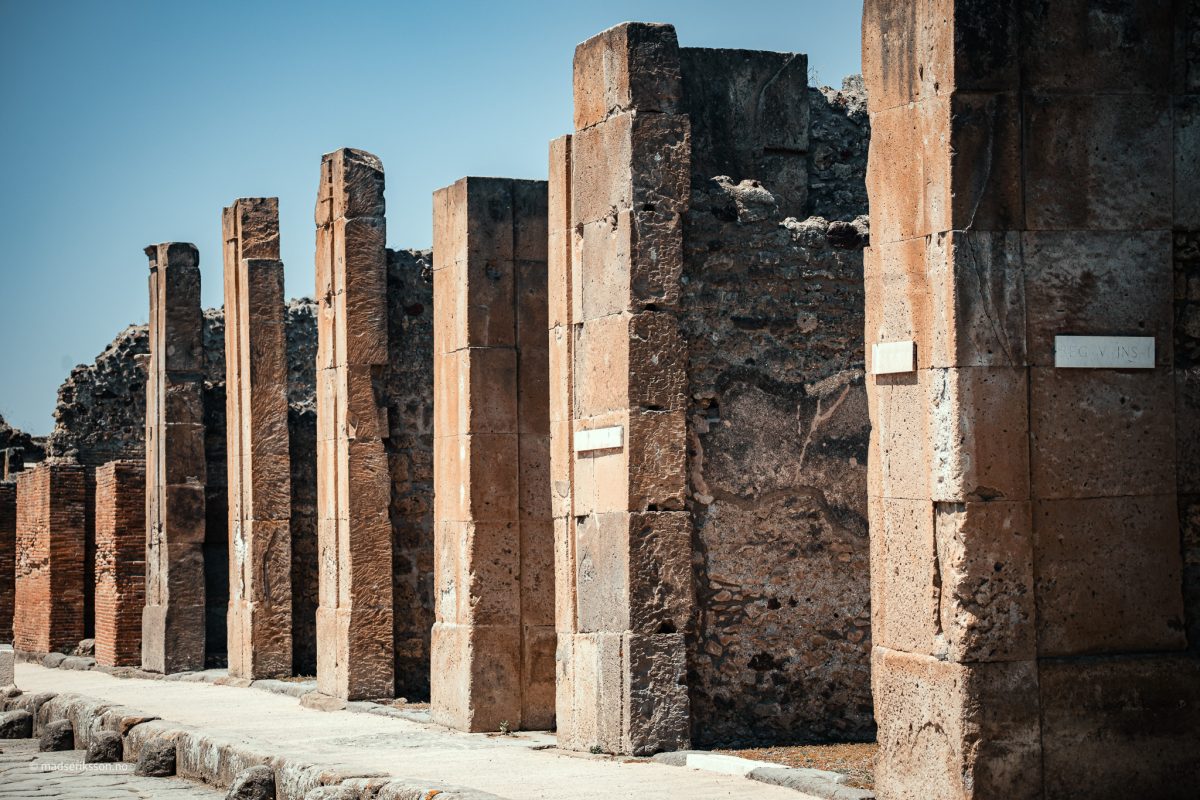
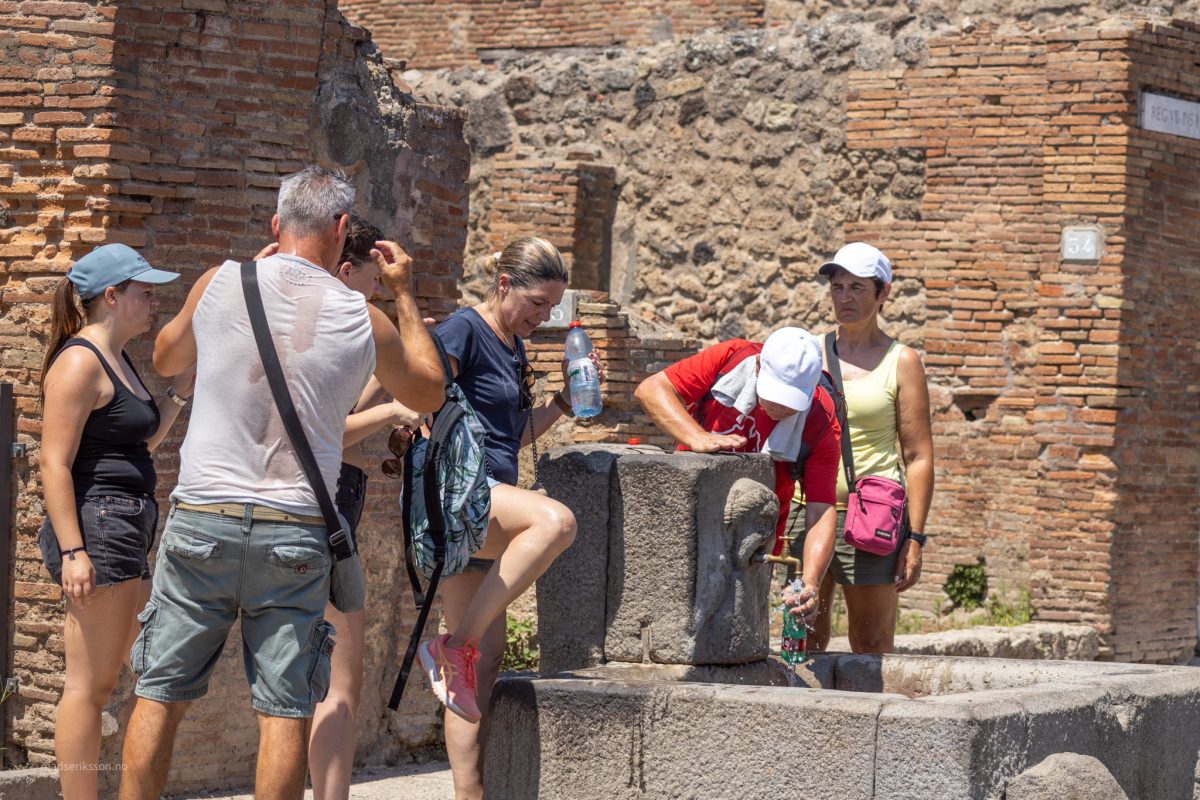
Via dell'Abbondanza runs east–west across the site, with its original paving, stepping stones and continuous line of shopfronts. The Stabian Baths, the oldest in Pompeii, open off it, and around 80 thermopolia served hot food across the city.
A row of stone and brick pillars along a paved street in Pompeii under a clear summer sky
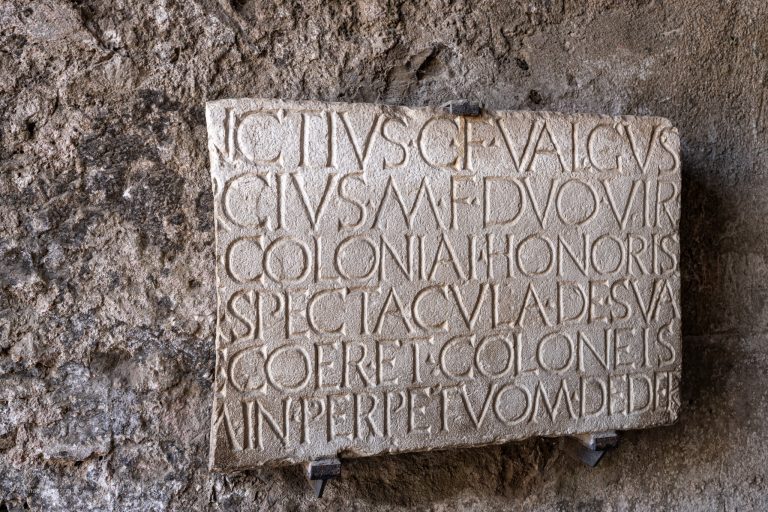
The oldest Roman amphitheatre
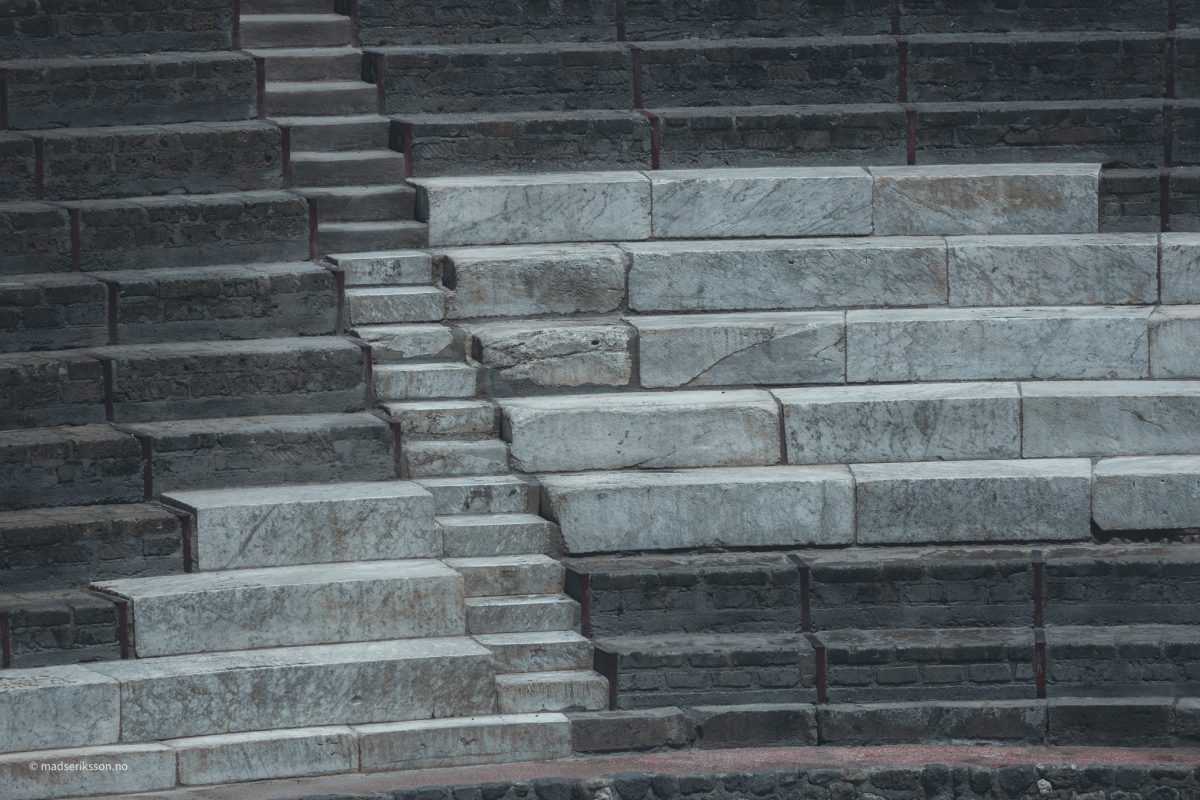
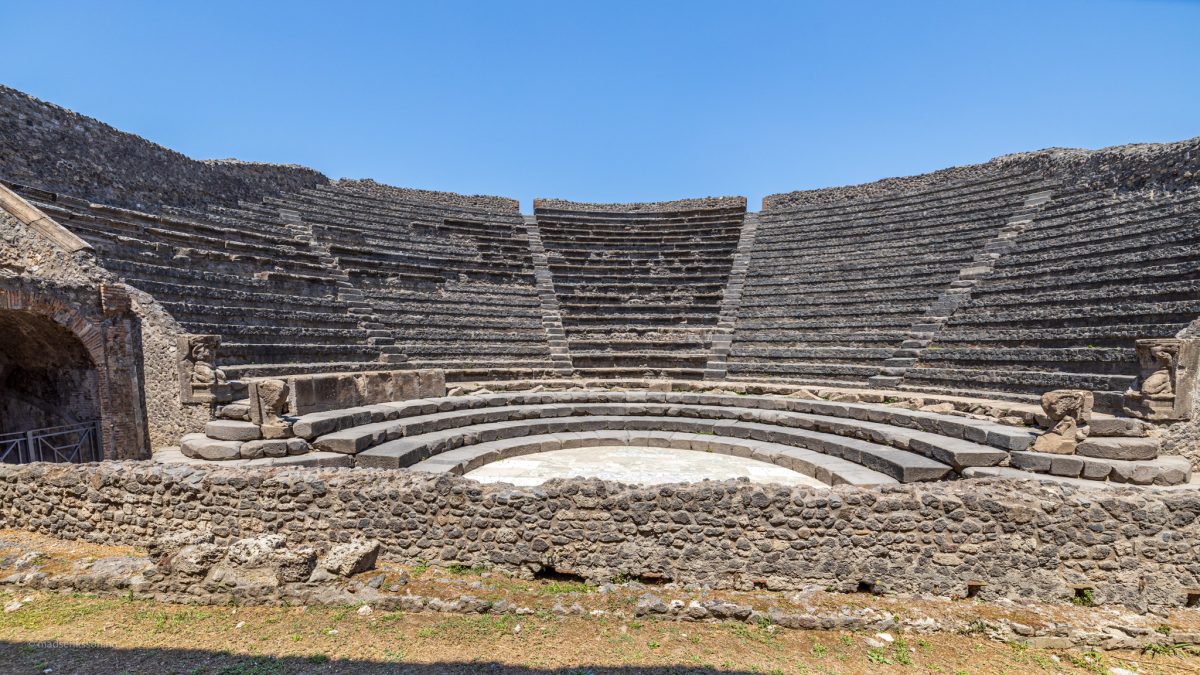
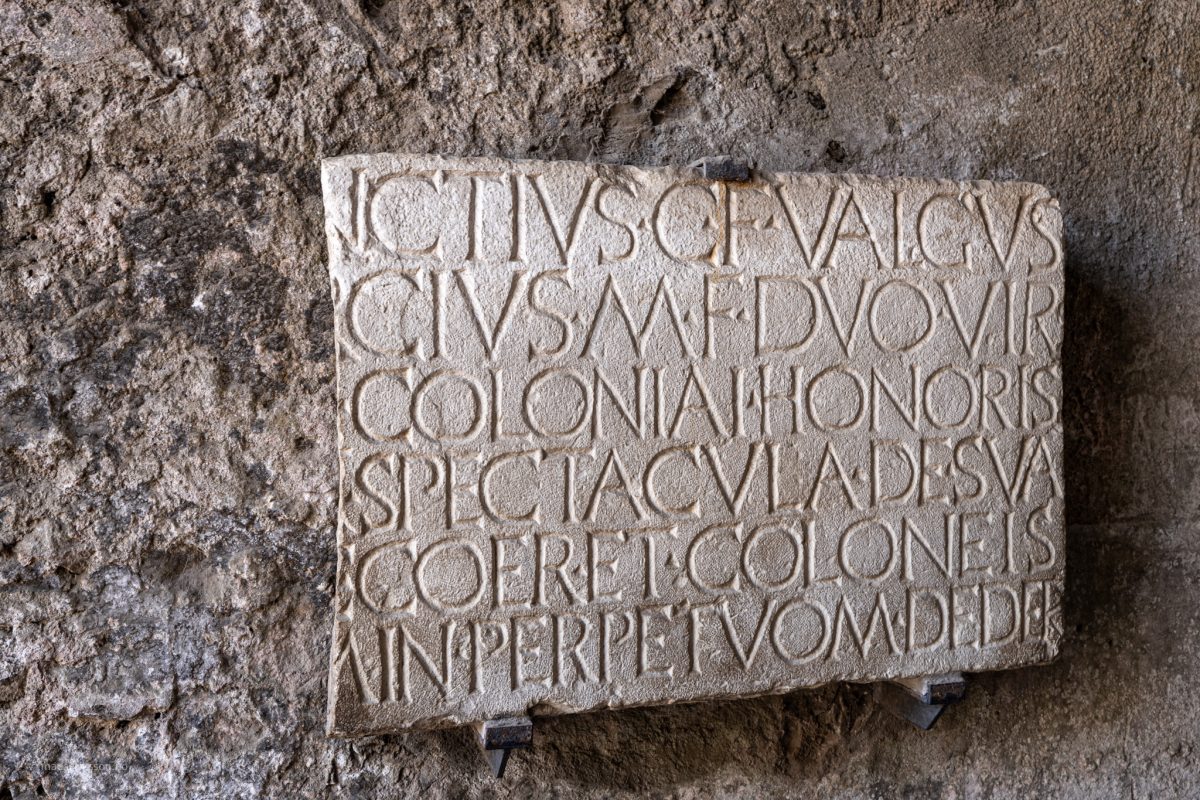
Built around 70 BCE, the amphitheatre is the oldest surviving Roman amphitheatre in the world and held about 20,000 spectators. After riots in 59 CE, Nero banned events there for ten years. Beside it lies the Large Palestra, 141 by 107 metres.
Latin inscription honouring the magistrates who paid for the shows and seating at Pompeii’s amphitheatre
The people caught by the mountain
Near the Nocera Gate, 13 people lie where the final surge caught them, in the largest group of casts found in one place. The technique was developed in 1863 by Giuseppe Fiorelli, who filled the voids in the ash with plaster.
Arrive early
Pompeii is 23 kilometres southeast of Naples. The Circumvesuviana train stops at Pompeii Scavi – Villa dei Misteri, beside the Porta Marina entrance. Bring water and good shoes; there is very little shade, and a full visit takes three to five hours.
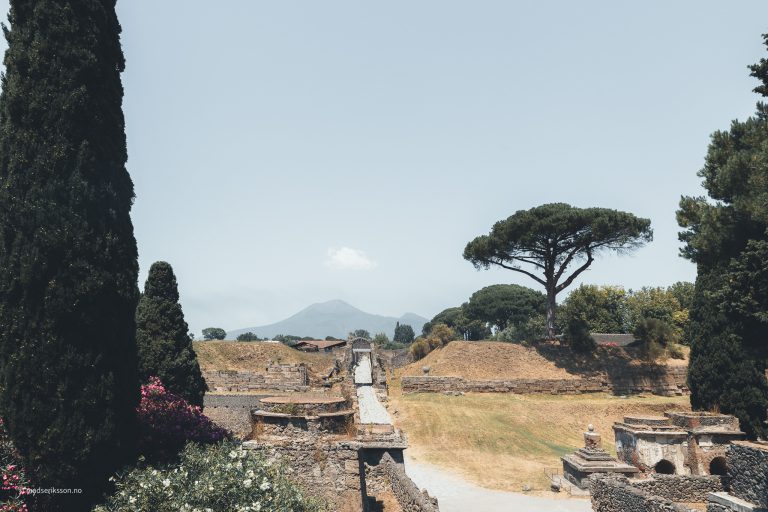
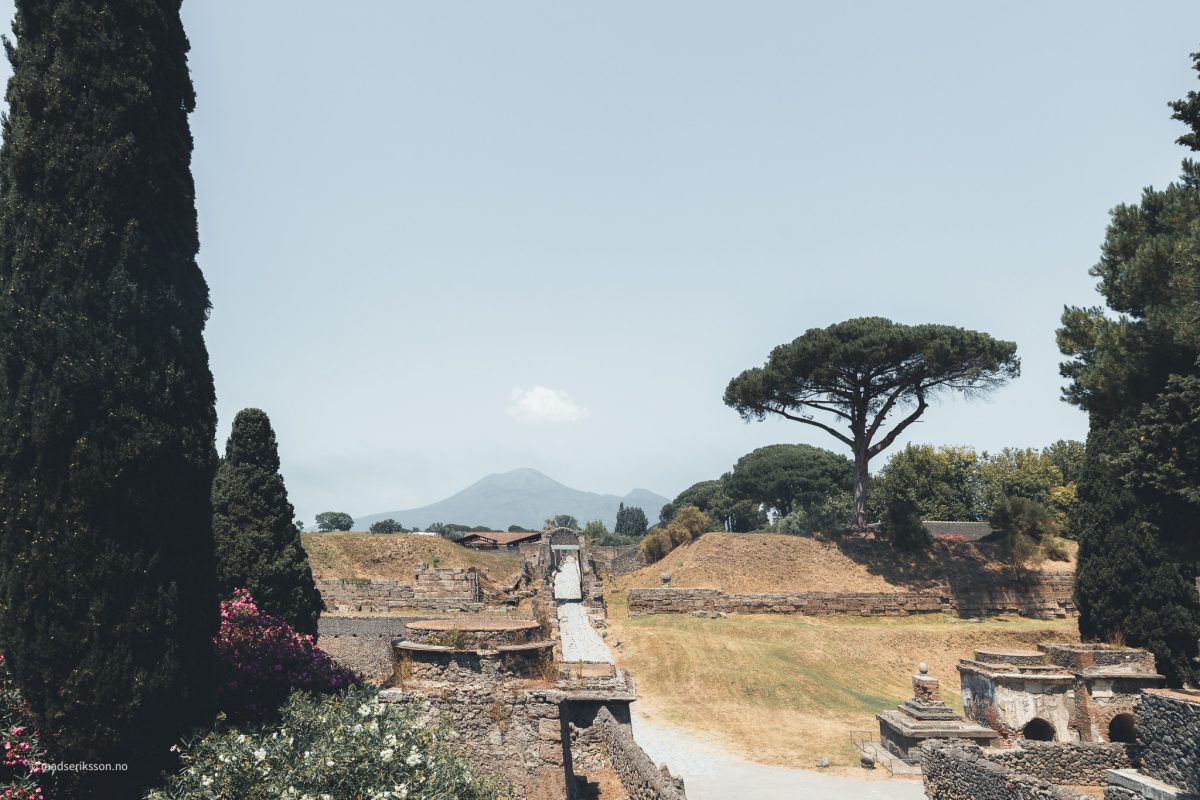
Tombs and the old road into Pompeii beneath umbrella pines, with Vesuvius on the horizon
3D model © 2026 madseriksson.no · Photographs © madseriksson.no. Walls, buildings, streets and gardens: © OpenStreetMap contributors (ODbL). Wall heights, the theatres and amphitheatre and Vesuvius are simplified and approximate; sun positions are approximate.
The Eruption — What Happened on That October Morning
A column of ash 33 kilometres high, then a series of pyroclastic surges moving at hundreds of kilometres per hour — and one 17-year-old who wrote it all down
The eruption began on the morning of what is now believed to have been 24 October 79 CE, when Vesuvius sent a column of ash, pumice and superheated gas 33 kilometres into the atmosphere — what volcanologists now call a Plinian eruption, named after the account left by Pliny the Younger. The column deposited pumice and ash on Pompeii at a rate of approximately 15 centimetres per hour through the afternoon and night. Many inhabitants fled in the early hours; those who sheltered in buildings were increasingly endangered as roofs collapsed under the weight of the deposits. The lethal phase came in the early hours of the following morning, when the eruption column destabilised and collapsed, sending a series of pyroclastic surges — clouds of superheated gas and rock moving at up to 700 kilometres per hour — down the slopes of the volcano. The surges reached Pompeii at temperatures estimated at 250–300°C. Death was instantaneous. The sixth and final surge buried the city under its upper layers of ash and ended the eruption.
Pliny the Younger, aged 17, was staying with his uncle — Pliny the Elder, commander of the Roman fleet at Misenum — on the far side of the bay when the eruption began. His uncle sailed toward Pompeii to rescue people from the shore and died there, overcome by the fumes. Pliny the Younger remained at Misenum, observed the eruption across the bay, and later wrote two letters to the historian Tacitus describing what he had seen. These letters are the sole contemporary eyewitness account of the event and provide the framework within which all subsequent archaeological interpretation has been placed. “A dense black cloud was coming up behind us, spreading over the earth like a flood,” he wrote of the surges. “We had scarcely sat down to rest when darkness fell, not the dark of a moonless or cloudy night, but as if the lamp had been put out in a closed room.”
Pliny the Elder sailed toward Pompeii to rescue survivors. He died on the beach at Stabiae, overcome by the fumes. His nephew, who stayed behind and wrote the letters, gave us everything we know about what happened.
What the eruption achieved, inadvertently, was the most complete preservation of a Roman city ever produced. The pumice fall was loose enough to preserve spaces between objects; the subsequent ash hardened around organic materials before they fully decomposed, leaving negative impressions — the voids that Fiorelli would fill with plaster in 1863 to recreate the exact forms of people, animals and objects in the moment of the eruption. Wooden furniture, food on shelves, cloth on beds, the skins of grapes, the grain in the millstones — all of this was held in the matrix of volcanic material for nearly two thousand years, waiting.
The Forum and Public Life — Roman Civic Space at Full Scale
The Forum of Pompeii is the most complete surviving example of a Roman civic centre — the political, religious and commercial heart of a city, frozen in 79 CE
The Forum of Pompeii — 38 metres wide and 142 metres long, paved in travertine marble and flanked by a two-storey colonnade — was the administrative, commercial and religious centre of the city. Around its perimeter stood the principal public buildings: the Temple of Jupiter at the northern end, framing the view of Vesuvius behind it; the Basilica on the southwestern side, where legal and commercial transactions were conducted; the buildings of the aediles and duoviri (the elected magistrates who administered the city); the market building (Macellum); and the temple of the city’s patron goddess Eumachia, built by a wealthy priestess whose business in wool processing dominated the south side of the Forum. The Forum was a pedestrianised space — stepping stones survive where it intersects with through streets, aligned to allow pedestrians to cross without stepping in the street water while allowing wheeled traffic to pass between them. The ruts worn in the stone by generations of carts are still visible throughout the city.
The Stabian Baths — the oldest surviving Roman bath complex at Pompeii, built in the 4th century BCE and expanded several times — give the most complete picture available of how the Romans bathed: the sequence of changing room (apodyterium), cold room (frigidarium), warm room (tepidarium) and hot room (caldarium) is fully preserved, with the stucco decoration of the vaulted ceilings, the marble benches and the terracotta pipes that circulated hot air through the walls and floors (hypocaust heating). Baths were not a private luxury but a social necessity — most Pompeian houses had no private bathing facilities, and the city’s bath complexes were used daily by virtually the entire population. Three major bath complexes served the 11,000 inhabitants, with a fourth, the Central Baths, still under construction when the eruption occurred in 79 CE.
The Temple of Jupiter at the northern end of the Forum was positioned so that Vesuvius was visible on the horizon directly behind it, between the columns. Whether this was deliberate, or whether the Romans simply did not know what the mountain behind their city was capable of, is unknown.
The Pompeii amphitheatre, built around 70 BCE, is the oldest surviving Roman amphitheatre in the world — predating the Colosseum in Rome by 140 years. It held approximately 20,000 spectators and was used for gladiatorial games, animal hunts and public executions. In 59 CE, riots broke out between fans from Pompeii and the neighbouring town of Nuceria at a gladiatorial event; the brawl left many dead and injured, and the Emperor Nero banned all events at the amphitheatre for ten years. A fresco depicting the riot was found in a Pompeian house and is now in the Naples Archaeological Museum. The Large Palestra adjacent to the amphitheatre — a 141 by 107 metre exercise ground with a swimming pool at its centre, surrounded by a colonnade — was where the young men of Pompeii trained. The roots of a plane tree that stood in the centre of the Palestra are still visible in the ground.
The Houses and the Streets — Daily Life in a Roman City
The private houses, the bakeries, the fast-food counters and the painted walls of Pompeii are the most detailed record of Roman daily life ever found anywhere
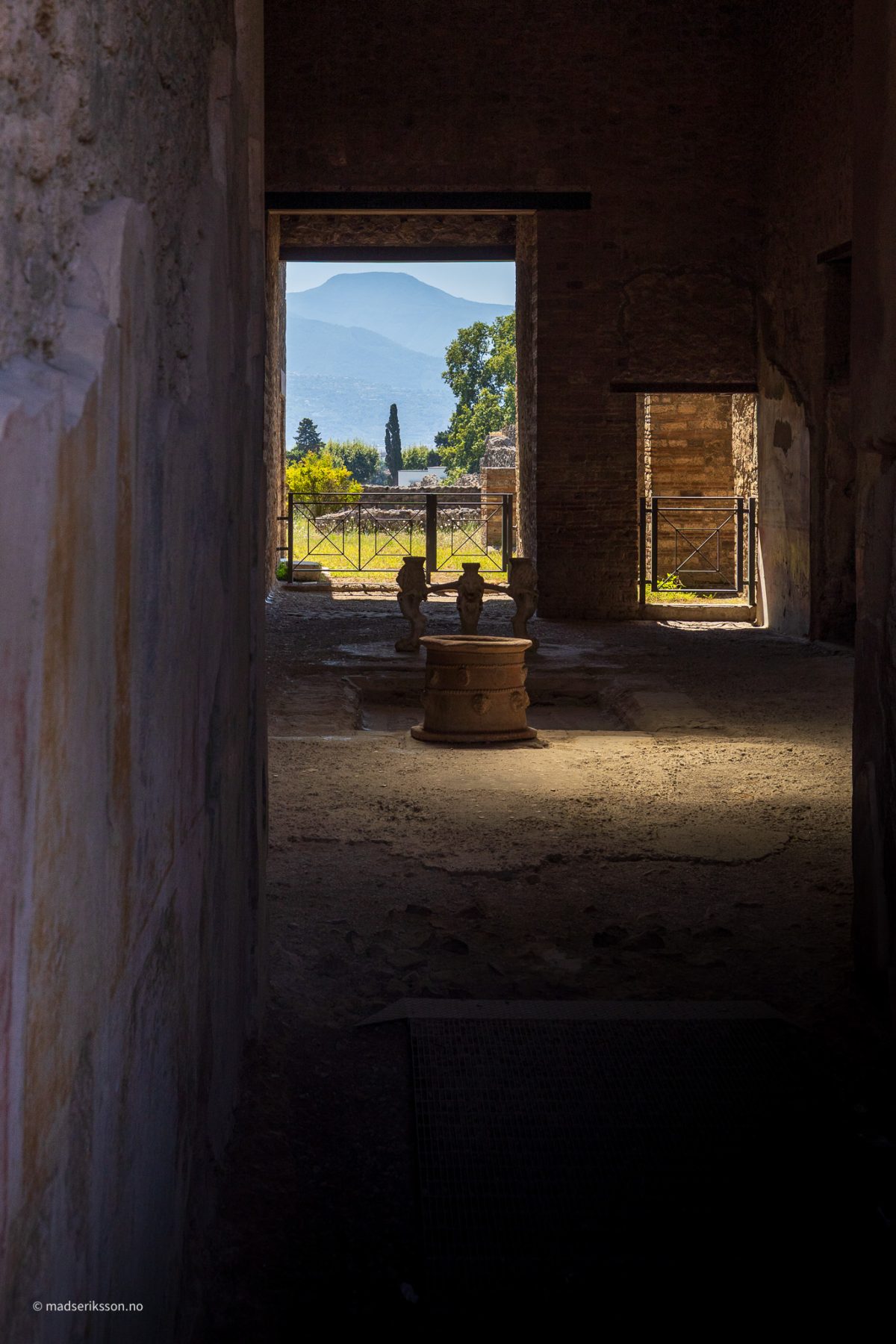
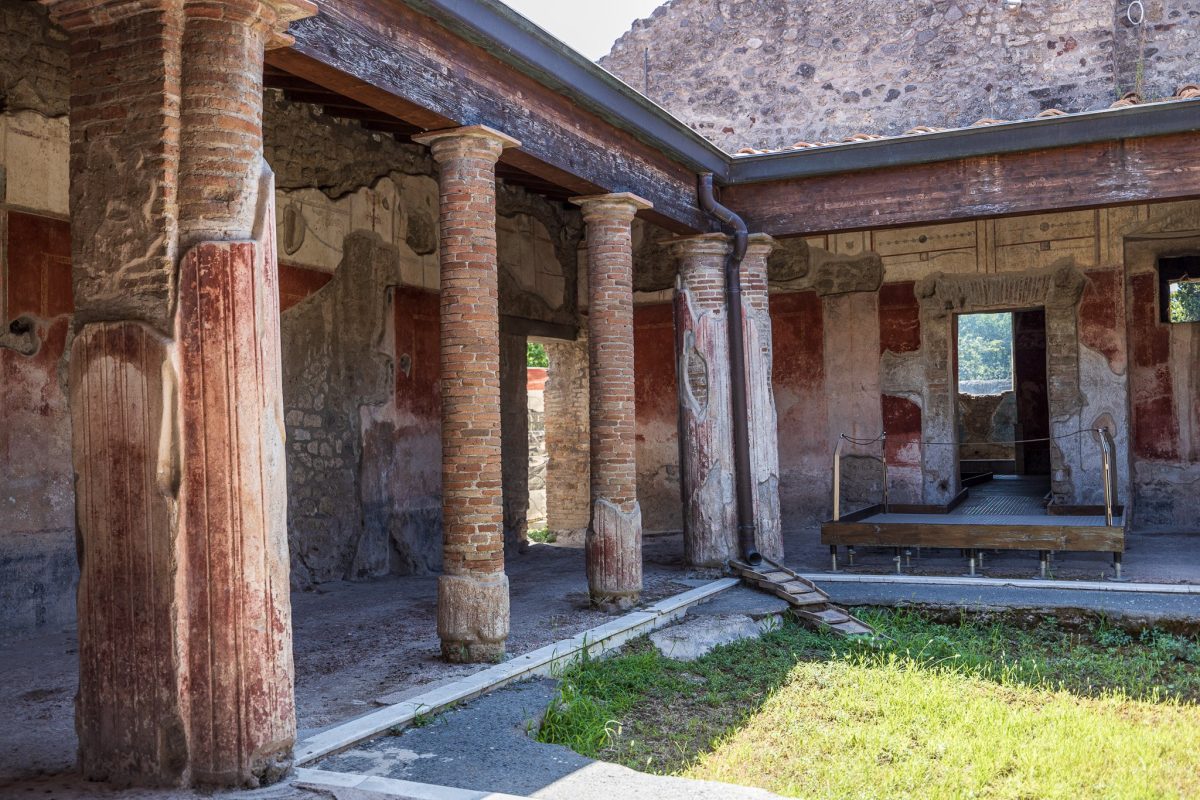
The House of the Faun is the largest private house at Pompeii — 3,000 square metres covering an entire city block — and the most significant in terms of what it contained. Named for the bronze dancing faun found in its impluvium (the central rain-collecting pool), it was the home of one of the wealthiest families in the city, probably connected to the Samnite aristocracy that preceded the Roman colonisation. Its threshold bore the word HAVE (“welcome”) in mosaic. Its floor was covered in the Alexander Mosaic — 11,000 tesserae depicting Alexander the Great at the Battle of Issus in a work of such scale, detail and compositional mastery that it has never been surpassed in the medium. The mosaic is now in Naples; the house contains reproductions. The two atria, the two peristyle gardens and the scale of the entertaining spaces give some sense of the kind of wealth that Roman provincial cities generated in the late Republican and early Imperial period.
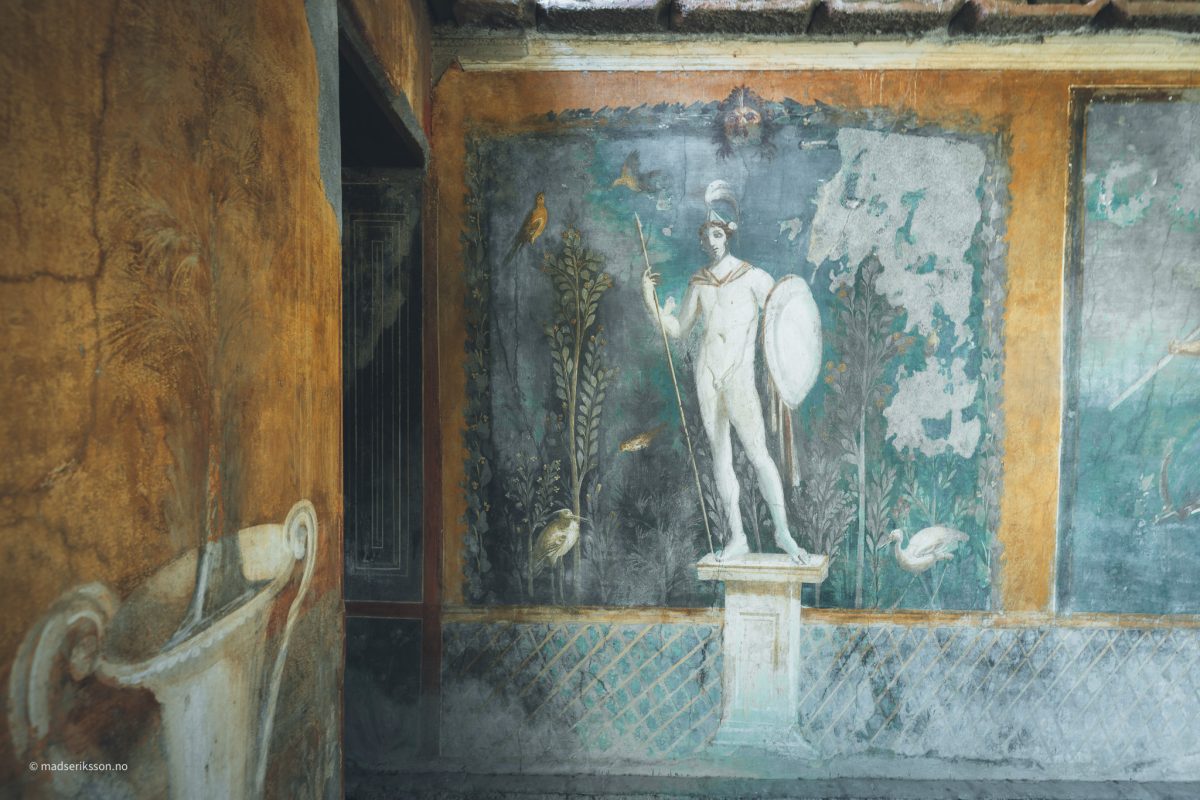
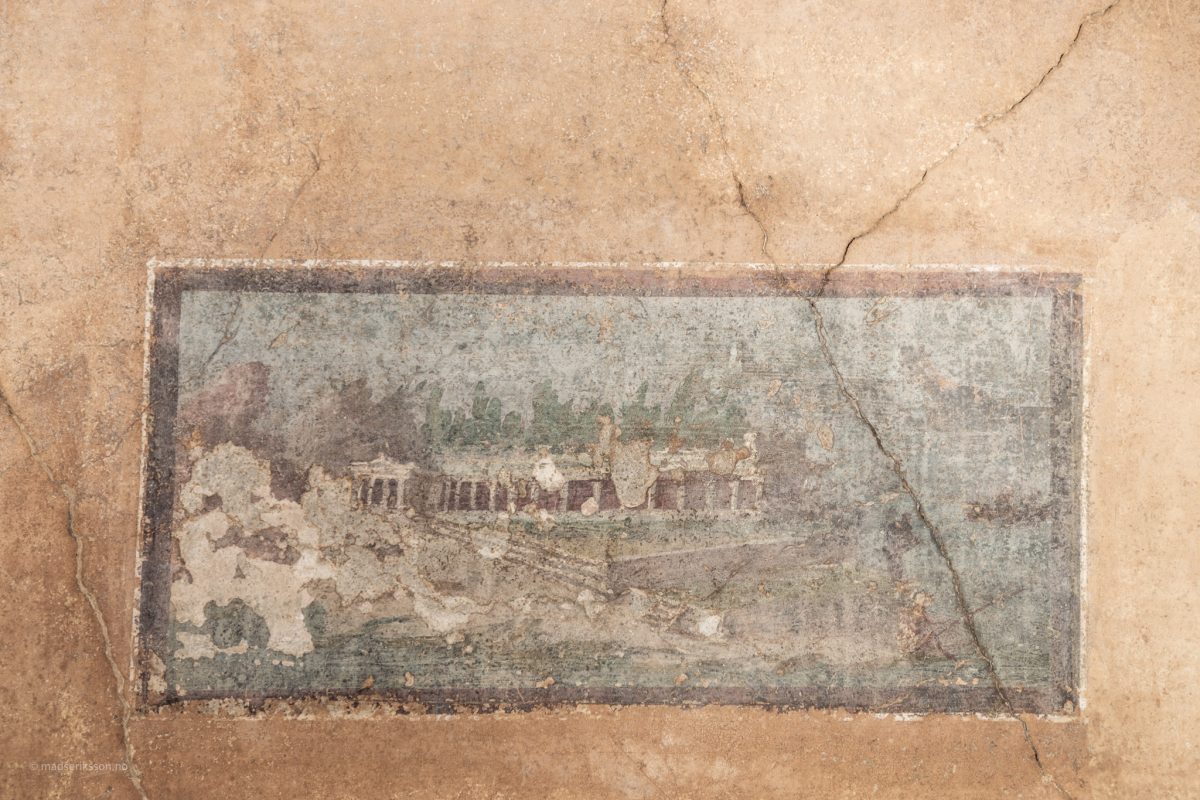
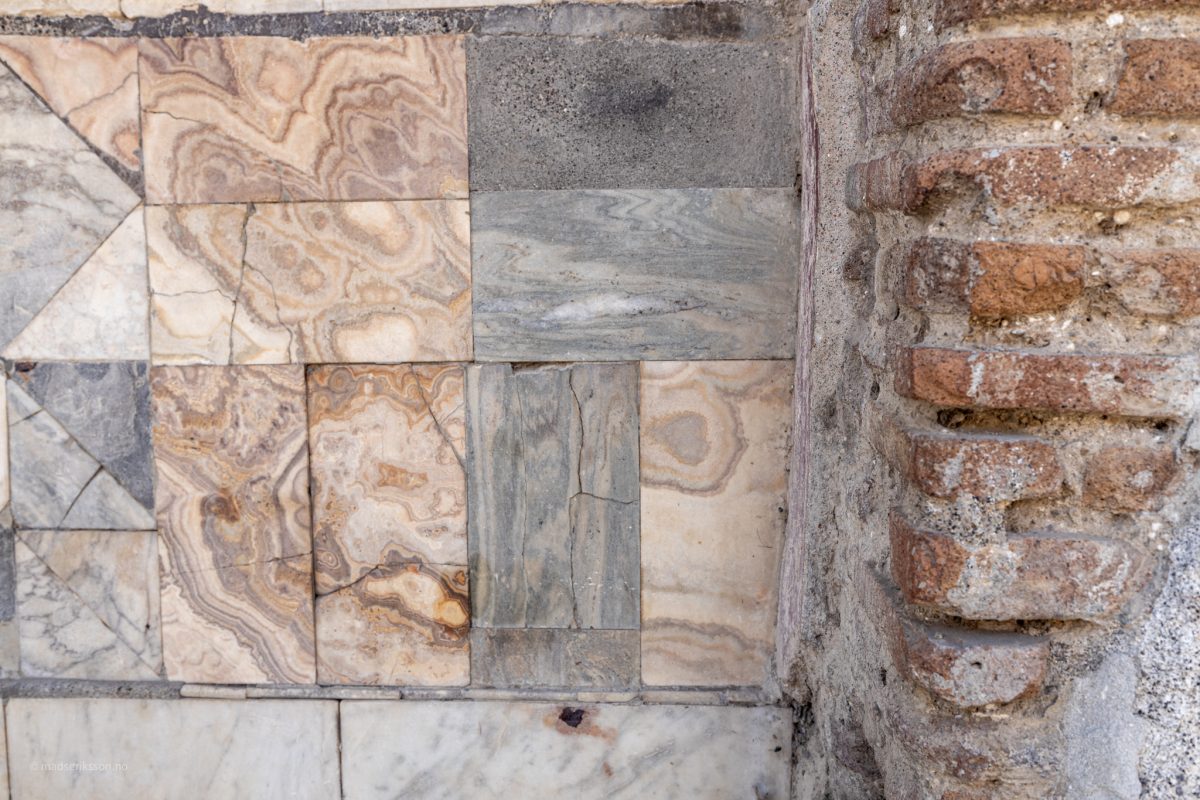
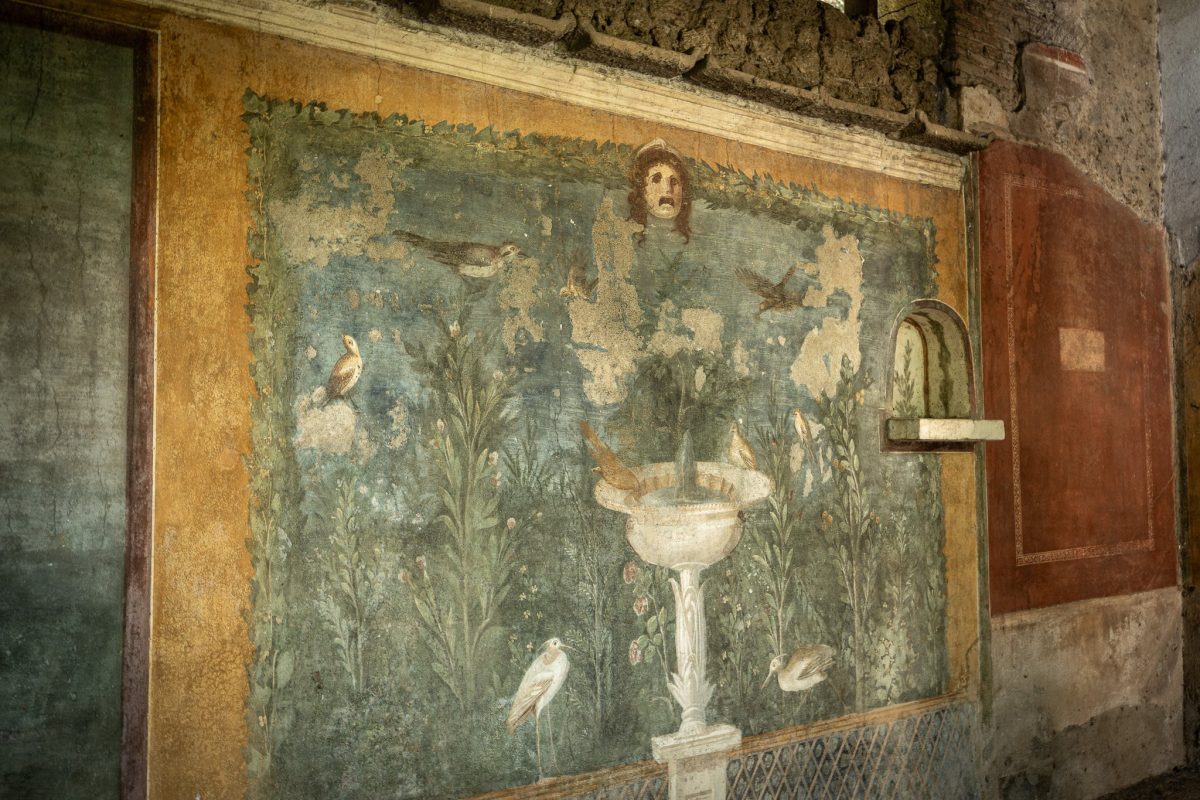
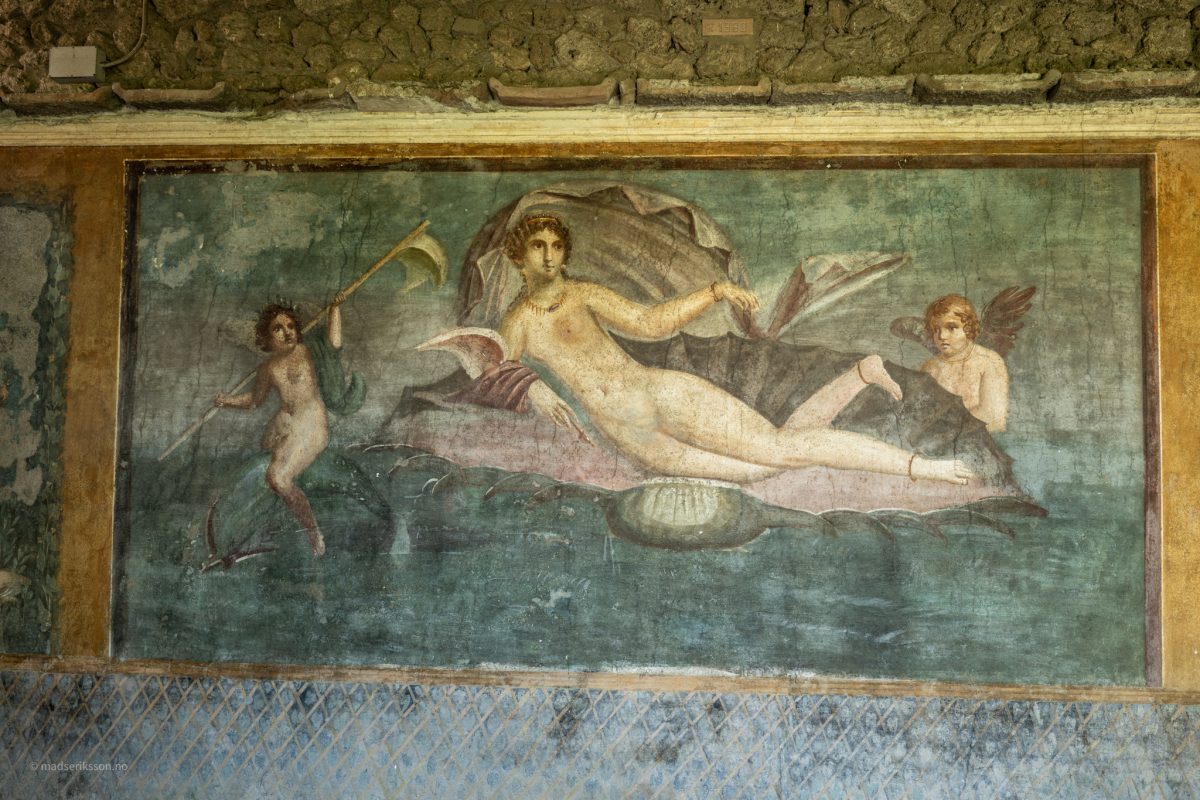
The House of the Vettii, owned by two freed slaves who had made considerable fortunes in commerce, is the most completely preserved of Pompeii’s houses in terms of its painted decoration: the walls of the triclinium (dining room) are covered in mythological scenes — Hercules strangling serpents as an infant, Pentheus torn apart by Maenads, Ixion on his wheel — executed in the Fourth Style Pompeian painting that was fashionable at the time of the eruption. The garden has been replanted to match the plant species identified in the root cavities, and the bronze garden statues and fountains have been restored to their original positions. The entrance to the house features a famous painted image of Priapus that was kept behind a locked door during the Victorian era. Via dell’Abbondanza — the main commercial street of Pompeii, running east-west across the site — retains its original paving, stepping stones, drinking fountain and the continuous line of shop fronts whose doorways are still framed by their original stone thresholds.
Thirty-five bakeries have been identified at Pompeii, each with its lava-stone millstones still in place. In one, 81 carbonised loaves of bread were found in the oven, stamped with the baker’s name, exactly as they had been left when the eruption began.
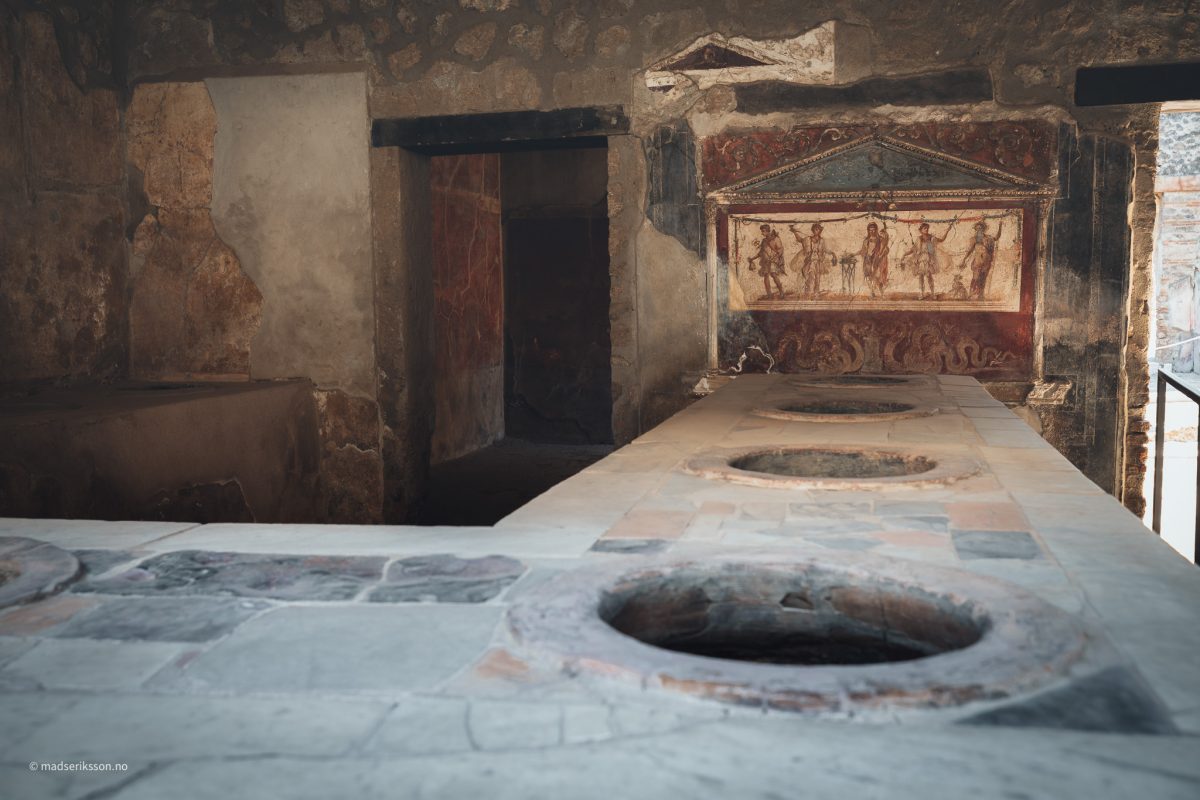
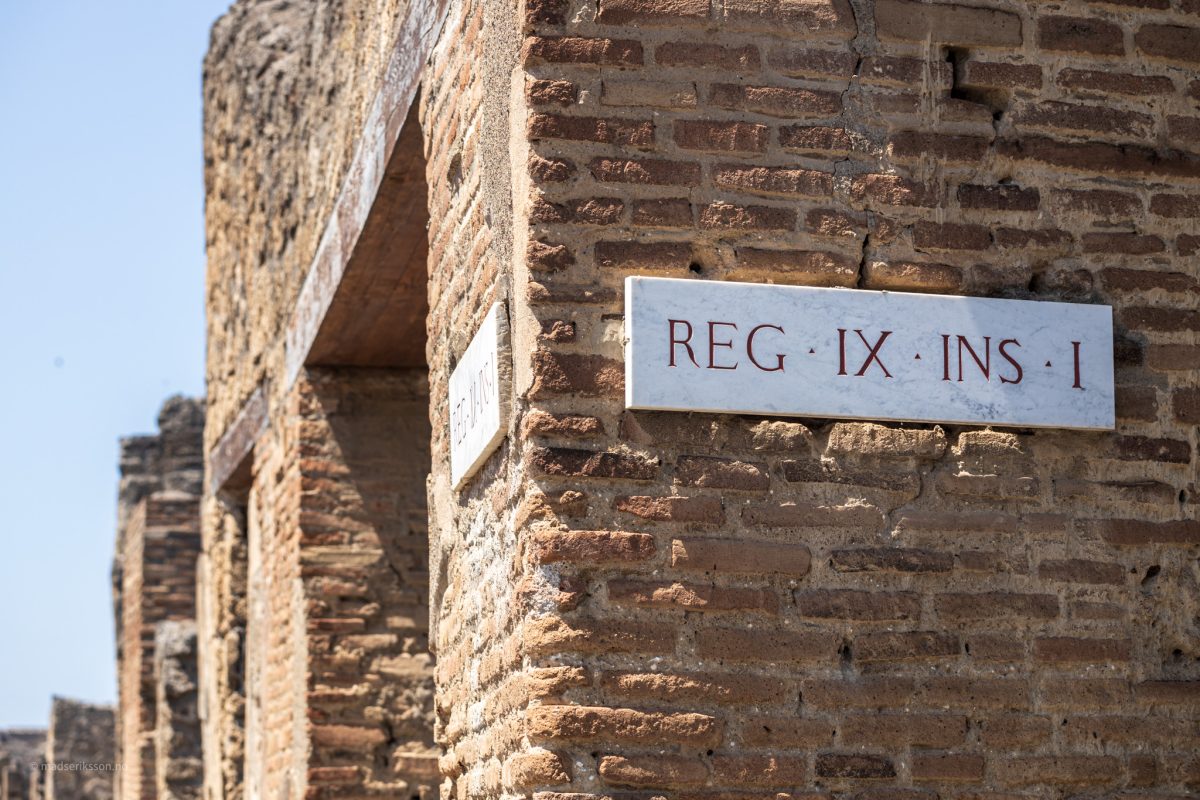
The street walls of Pompeii carry over 11,000 surviving inscriptions — the largest corpus of Roman graffiti anywhere in the world. They include the election notices (programmata) recommending candidates with specific endorsements from tradespeople; personal messages (“I slept here”, “Lovers, like bees, lead a honey-sweet life”); gladiatorial fight records listing wins and defeats; insults; declarations of love; and the accounts of businessmen. Taken together they constitute a direct record of how ordinary Romans communicated in public space — using walls the way a later era would use newspapers, and the way a still later era would use the internet. The recently excavated Thermopolium of Regio V, uncovered during the Great Pompeii Project, is the most completely preserved fast-food counter found at the site: the dolia still contain traces of the duck, pig, fish, snail and beef that were on the menu on the day of the eruption.
The Victims — The People Caught by the Mountain
Of the approximately 11,000 people in Pompeii when Vesuvius erupted, roughly 2,000 did not escape. The plaster casts of some of them remain among the most affecting objects in all of archaeology
Most of the people in Pompeii on the morning of 24 October 79 CE survived. They fled during the pumice fall of the afternoon and night, taking what they could carry. But approximately 2,000 — some who chose to shelter, some who left it too late, some who may have returned to retrieve possessions — were still in the city when the pyroclastic surges arrived in the early hours of the following morning. Death from a pyroclastic surge is instantaneous: the temperature is between 250 and 300 degrees Celsius and the surge moves at hundreds of kilometres per hour. There is no question of survival, and no question of suffering for more than a fraction of a second. Bodies fell exactly where the surge caught them, and the volcanic material hardened around them as the ash layers built up.
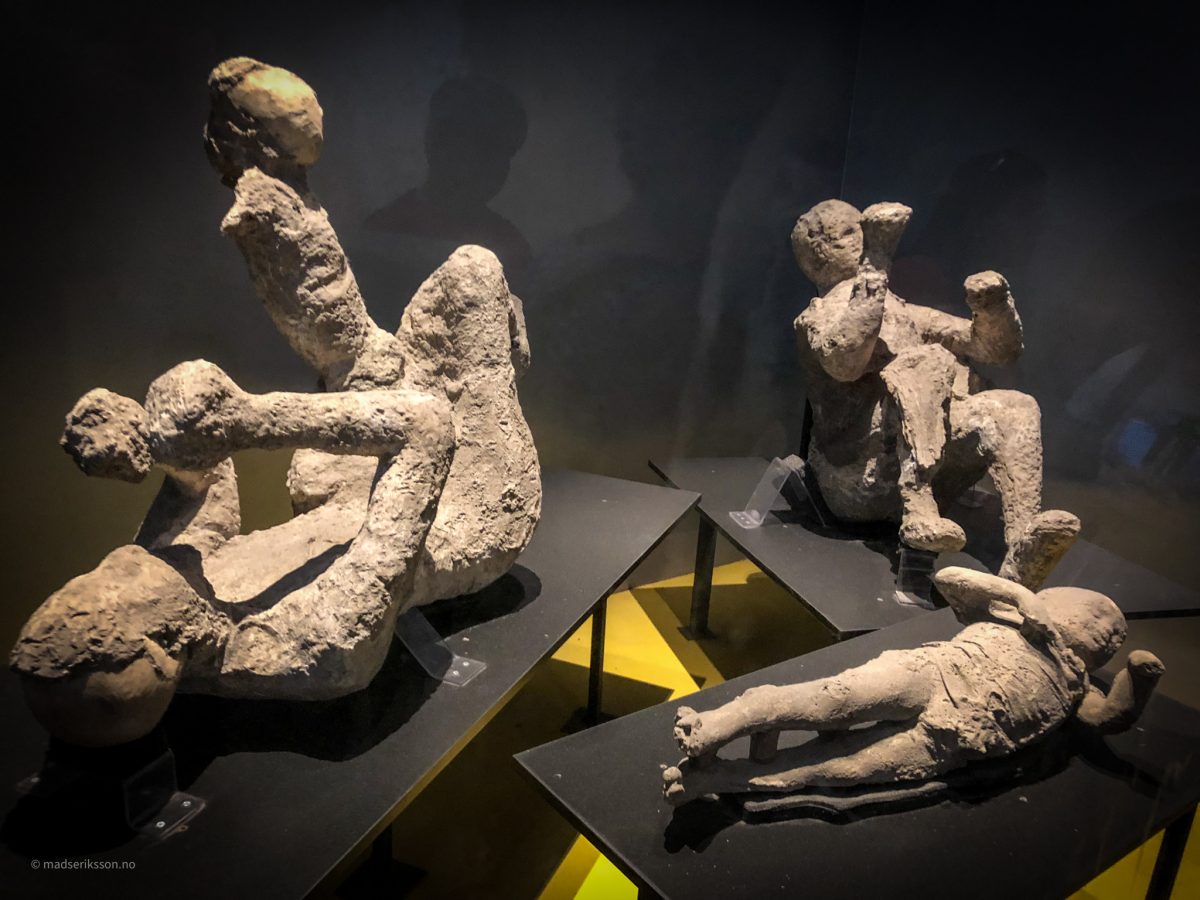
The technique that makes these people visible was developed in 1863 by Giuseppe Fiorelli, the archaeologist appointed to systematise the Pompeii excavations by the newly unified Italian government. Fiorelli realised that the voids left in the hardened volcanic material by decomposed organic material — bodies, wooden furniture, tree trunks — retained the exact shape of the original. By injecting liquid plaster into these voids through small holes, he could recreate the objects in three dimensions. The plaster casts of the human victims are the most powerful results of this technique: figures in the exact position of their last moment, preserving not only the outlines of their bodies and clothing but in many cases the expressions on their faces. The dog on the chain in the House of Vesonius Primus, writhing in an arc above the floor; the gladiator casts found in the gladiatorial barracks; the family group sheltering in a room that gave them no protection — each of these is an individual, whose name we do not know, preserved in their last second.
The 13 plaster casts in the Garden of the Fugitives are a family group — or at least a group of people who were together when the surge caught them. They are lying in the positions in which they fell. The smallest cast is a child.
The Garden of the Fugitives, near the Nocera Gate at the southern end of the site, contains the largest group of casts found in a single location: 13 people, apparently a family or group of families, who had reached a vineyard garden and were attempting to leave through the city gate when the final surge caught them. They lie in the positions in which they fell, covering their faces, holding each other. The smallest cast is of a child. The group is displayed in situ behind glass, and the site is one of the most visited at Pompeii — not for its spectacle but for its specificity. These are not the relics of a civilisation or the remnants of a historical event. They are people. Modern analysis of the bones and teeth within the casts has identified individuals who grew up outside Campania, people with dental disease consistent with their diet, children whose age can be estimated. The names remain unknown. The details do not.
«Pompeii disorients the visitor who comes expecting ruins. What is here is not the romantic decay of a thing that has been falling apart for centuries; it is the abrupt end of something that was functioning. The wheel ruts in the paving. The painted election notices. The bread in the oven. The 13 people in the garden. Walking through Pompeii is not the experience of loss in the abstract sense that other archaeological sites provide — it is the experience of a specific interruption, at a specific moment, to specific people whose names we mostly do not know. The mountain that killed them is still there, still active, visible from every street in the city. The 3 million people who now live in its shadow live there for the same reason the Pompeians did: the soil is excellent.»
More in the same area
 CitiesNaples: Exploring the Soul of Southern Italy
 ArchitectureEurope’s 10 Greatest Cathedrals and Churches
 MountaineeringMarmolada: The West Ridge Via Ferrata to the Top of the Dolomites
 ArchaeologyTa Prohm — The Temple the Jungle Is Winning
 Train travelThe World’s 10 Great Railway Journeys
 NatureThe World’s 15 Most Spectacular Waterfalls