Europe has no shortage of beautiful old cities. What it has a shortage of is cities that are still primarily themselves — where the life being lived is not organised around the visiting of it, where the food being eaten is the food of the place rather than the food of the tourist industry, where the streets contain the people who built them as well as the people who came to photograph them. The ten cities in this guide were chosen because each of them, in different ways and to different degrees, has managed to remain more itself than its alternatives. They are not all undiscovered. Some are deeply visited. What they have in common is a cultural substance that tourism has not yet consumed, and in several cases a resilience that has survived far worse things than tourism.

Europe’s most visited cities — Paris, Rome, Barcelona, Amsterdam, Prague — are not on this list. They are extraordinary places, but they have become so oriented toward their own visitability that the original city is increasingly a setting for the experience of being a tourist in it. This is not a moral argument against visiting them; it is an observation about what they have become. The ten cities in this guide have, with varying degrees of intention and luck, avoided this transformation. Matera was inhabited for 9,000 years before tourism arrived; it will remain itself after tourism moves on. Évora has a Roman temple and a bone chapel and a medieval university and almost no international tourism infrastructure. Ohrid has 365 churches, a lake that is 3 million years old, and a character entirely its own. Berat survived the most isolationist communist regime in Europe partly by having been sealed off from the world for 45 years; its Ottoman urban fabric is intact because nobody could get in to develop it.
The ranking reflects a combination of historical depth, preservation of urban fabric, strength of living cultural traditions, and the degree to which the city remains primarily a place where people live rather than a place where people visit. These criteria produce some surprising inclusions and some notable absences. Venice is not here: the physical substance is unparalleled, but the city is losing its population at 1,000–2,000 people per year and may not qualify as a living city in the sense this guide intends within a generation. The cities that are here are all, in their different ways, still fully alive.
How to read this ranking
The cities are ranked by the depth and completeness of their cultural character and the degree to which that character remains self-sustaining. Each section covers what makes the city distinctive, what the visitor will find, and what to prioritise. None of these cities requires the advance booking that the major European capitals demand; several require almost no planning beyond arriving. That, too, is part of what makes them what they are.
#1 Matera — From Italy’s Shame to European Capital of Culture in Seventy Years
9,000 years of continuous habitation in cave dwellings carved from a limestone ravine — declared a national disgrace in 1948, evacuated by government order in the 1950s, UNESCO-listed in 1993, and now one of the most remarkable cities in southern Europe
Matera is one of the oldest continuously inhabited settlements on Earth. The sassi — the cave dwellings carved into the walls of two ravines (Sasso Caveoso to the south, Sasso Barisano to the north) on the edge of the Murge plateau in Basilicata — have sheltered people for approximately 9,000 years, making them among the earliest examples of human habitation in Europe. The cave system expanded and densified over millennia: by the 20th century, approximately 15,000 people were living in the sassi in conditions of extreme poverty, sharing spaces with their livestock, without running water, sanitation or adequate ventilation. When the Italian politician Palmiro Togliatti visited in 1948 and described the situation as “la vergogna d’Italia” — Italy’s shame — it was a political act that led directly to government intervention: between 1952 and 1963, the Italian state forcibly relocated the entire sassi population to new housing on the plateau above. The caves were sealed and left to decay. Carlo Levi’s “Christ Stopped at Eboli” (1945) had already described the grinding poverty of the region in terms that made it an emblem of southern Italian underdevelopment.
The rehabilitation of Matera is the most remarkable reversal in the recent history of Italian urban heritage. From the 1980s onward, architects, historians and local administrators recognised the sassi as one of the most significant examples of vernacular troglodyte urbanism in the world and began the process of restoration. UNESCO inscribed them in 1993; by the 2000s, former cave dwellings were opening as boutique hotels, restaurants and galleries. Matera was selected as European Capital of Culture for 2019. The caves that were a disgrace are now a destination; the inhabitants who were evacuated as a matter of public health policy are now — some of them — property owners whose family caves are worth significant sums. The sassi as they exist today are a mix of inhabited residences, hotels, restaurants and empty shells still awaiting restoration, spread across the ravine walls in a density that the view from the opposite side of the canyon makes fully comprehensible: thousands of cave openings stacked above each other like a geological apartment block, with the cathedral on the ridge above. Mel Gibson filmed “The Passion of the Christ” here in 2004, using the sassi as a stand-in for first-century Jerusalem. It was not a difficult substitution.
The caves that the Italian government declared a disgrace in 1948 and evacuated by law in the 1950s are now hotels charging €300 or more per night. The families who were relocated to “modern” housing on the plateau spent decades trying to return. Most eventually did. The cave is a better house than the concrete block. It always was.
#2 Tallinn — The Best-Preserved Medieval City in Northern Europe and the Country That Won Its Freedom Through Song
A walled medieval city on the Gulf of Finland, with Hanseatic merchant houses, a hill fortress and a pharmacy open since 1422 — and a cultural identity forged through occupation, resistance and the mass singing that eventually set Estonia free
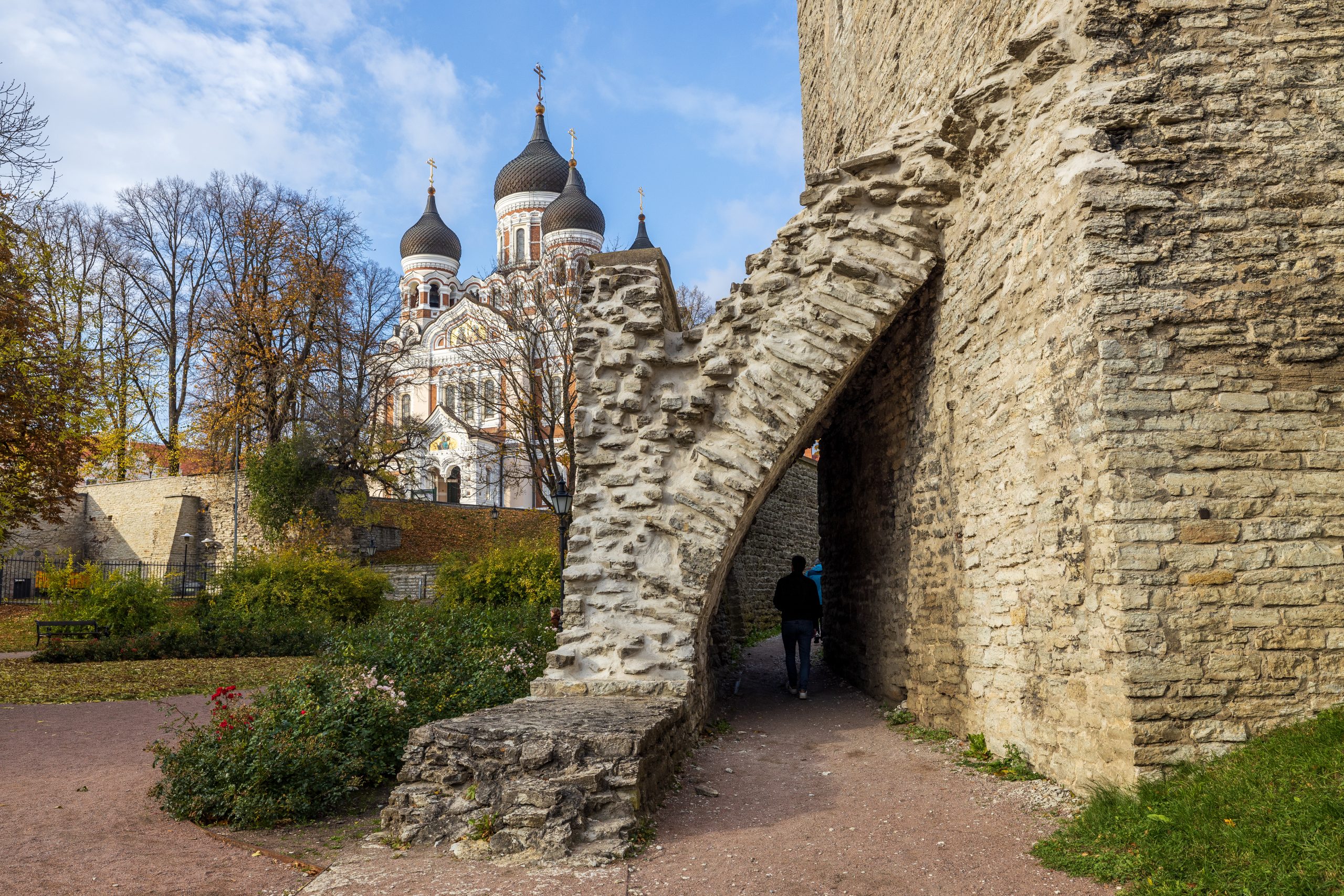
Tallinn’s Old Town — Vanalinn — is the best-preserved medieval city centre in Northern Europe: a walled enclave of Hanseatic merchant houses, Gothic churches, guild halls and fortified towers on a limestone escarpment above the Gulf of Finland, inscribed as a UNESCO World Heritage Site in 1997. The city divides naturally into Toompea (the Upper Town, on the limestone hill, historically the seat of rulers and bishops, now the location of the Estonian parliament and the Presidential Palace) and the Lower Town (the merchant city below, with its market square, Hanseatic warehouses and the Great Guild Hall). The Raeapteek — the pharmacy on the Town Hall Square — has been in operation since at least 1422, making it one of the oldest continuously operating pharmacies in Europe; it still sells remedies, though not the unicorn horn and ground mummy dust that were on the menu in the 15th century. The city passed through Danish, German Livonian Order, Swedish, Russian and Soviet hands before Estonian independence; each occupier left architectural traces, and the cumulative layering is part of what gives Tallinn its specific character — a medieval shell containing Baltic German, Swedish imperial and Soviet accretions, now carrying a thoroughly contemporary Estonian digital-society overlay.
The Estonian cultural identity that makes Tallinn feel distinctly itself was forged through resistance. The Singing Revolution of 1987–1991 — in which mass song festivals, a tradition of Estonian national culture since 1869, were used as acts of defiance against Soviet occupation — culminated in the Baltic Way on 23 August 1989: approximately two million people formed a human chain 675 kilometres long from Tallinn through Riga to Vilnius. The Estonian Song Festival Grounds (Lauluväljak), 3 kilometres east of the Old Town, hold up to 100,000 people and host the Song Festival every five years; the atmosphere of the grounds, with their vast shell-shaped stage, is charged with the memory of what singing meant here. Estonia declared independence in 1991; it has been a member of the EU and NATO since 2004 and is now one of the most digitally advanced societies in the world. The contrast between the 15th-century streetscape of the Old Town and the government services available on a smartphone within it is one of the more striking juxtapositions in contemporary Europe.
The Estonian pharmacy on Tallinn’s Town Hall Square has been open since 1422. It sold unicorn horn and ground mummy as medicines in the 15th century. It now sells ibuprofen and cough syrup. It has survived Danish, German, Swedish, Russian and Soviet rule without closing. Six hundred years of continuous operation in a building that still looks like a pharmacy should.
#3 Toledo — The City Where Three Civilisations Left Their Buildings Side by Side
The former capital of Visigothic and Castilian Spain, where Christians, Jews and Muslims built simultaneously for centuries and where El Greco found the light that made his painting what it became
Toledo occupies a granite promontory surrounded on three sides by the Tajo River, 70 kilometres south of Madrid, and served as the capital of Visigothic Spain, the seat of the Castilian monarchy and one of the most intellectually significant cities in medieval Europe. The “Three Cultures” designation — referring to the centuries during which Christian, Jewish and Muslim communities coexisted and collaborated in the city, particularly during the 11th–13th centuries when the Toledo School of Translators translated Arabic versions of Greek and Arabic scientific texts into Latin, transmitting classical learning to a European world that had largely lost it — is not mere civic marketing. The physical evidence is present in the streets: the Synagogue of El Tránsito (1357), built by Samuel ha-Levi with Mudéjar plasterwork and Hebrew inscriptions on the walls, stands a few hundred metres from the Mosque of Cristo de la Luz (999 CE), which became a church after the Christian reconquest, which stands a few minutes’ walk from the Gothic Cathedral (begun 1226), one of the largest and most elaborate in Spain. The street plan of the old city — a tangle of narrow lanes following Islamic city planning logic, impossible to navigate by anything other than instinct — has barely changed since the medieval period. Toledo was the capital of Spain until Philip II moved the court to Madrid in 1561, choosing a geographically central location over this particular history.
El Greco — Domenikos Theotokopoulos, a Cretan painter trained in Venice who arrived in Toledo in 1577 and never left — found in the city’s specific light, its vertical architecture and its devotional intensity the conditions that transformed his painting. His elongated figures, stormy skies and blazing spiritual colour are inseparable from Toledo; the view of the city from across the Tajo, with its cathedral rising from the dense medieval fabric behind it, was his subject and is recognisable as such in “View of Toledo” (c. 1599–1600, now at the Metropolitan Museum in New York) — a painting that shows the city essentially as it still appears today. The Casa y Museo del Greco, the El Greco Museum at the site of the house where he lived and worked for 37 years, holds the largest collection of his work in Toledo. Marzipan — Toledo’s other contribution to European culture — has been produced here since the medieval period and is sold in every pastry shop in the city, in forms ranging from the traditional flat discs to elaborate figurative sculptures made at Christmas.
The view of Toledo from across the Tajo River has changed almost nothing since El Greco painted it around 1599. The cathedral is in the same position. The Alcázar is on the same rock. The bridges are in the same places. Looking at the painting in New York and then looking at the view in Toledo is one of the stranger experiences of European travel — the difference between them is 425 years and almost nothing else.
#4 Évora — A Roman Temple, a Bone Chapel and Almost No International Tourists
A remarkably complete medieval city in the Alentejo, with a 1st-century Roman temple in the town centre, a chapel lined with 5,000 skulls, a 16th-century university and a food culture of quiet excellence — and the good fortune of not being on the main tourist route
Évora is the capital of the Alentejo, Portugal’s largest region and its least touristed, and it contains within its medieval walls one of the most concentrated assemblies of historical monuments in Iberia. The Temple of Diana (more correctly the Temple of the Imperial Cult) stands in the centre of the city: fourteen Corinthian granite columns from the 1st or 2nd century CE, surviving because they were incorporated into the wall of a medieval slaughterhouse and thus preserved when the surrounding Roman city was dismantled. The Cathedral of Évora (Sé de Évora), a Romanesque-Gothic structure begun in 1186, contains a museum with medieval sculpture and a rooftop cloister walk that gives the finest panoramic view over the city’s terracotta roofscape to the Alentejo plain beyond. The Chapel of Bones (Capel dos Ossos) in the Igreja de São Francisco — a chapel whose walls, ceiling and columns are entirely lined with the skulls and bones of approximately 5,000 Franciscan monks, assembled in the 16th century as a meditation on mortality — is one of the most extraordinary spaces in Portugal; the inscription above the entrance (“We bones that are here, for your bones we wait”) is the most direct possible welcome. The Silver Water Aqueduct (Aqueduto da Prata) — Roman in origin, extended in the 16th century — still stands at the northern edge of the city, its 36 kilometres of arches marching toward the city walls.
What Évora has that its Iberian equivalents lack is the near-absence of mass tourism. The Portuguese government’s investment in Lisbon and the Algarve has made Évora — 130 kilometres east of Lisbon, one hour by train or bus — quietly accessible without being overwhelmed. The university, reopened in 1979 after being suppressed by the Marquis of Pombal in 1759, brings a young population; the weekly market draws the surrounding agricultural communities; the Alentejo food culture — çorda de àgua (bread soup), migas, ensopado de borrego (lamb stew), the fattened pork of the black pata negra pig — is served in restaurants that are neither expensive nor oriented toward foreign visitors. The wine of the surrounding D.O.C. Évora zone — dense Alentejo reds from Alicante Bouçhet and Aragonez — is some of the finest in Portugal at very reasonable prices. Évora is the argument that UNESCO World Heritage designation does not inevitably produce a heritage experience; sometimes it just acknowledges what was already there.
Évora has a 1st-century Roman temple, a 12th-century cathedral, a 16th-century bone chapel and a 16th-century aqueduct, all within fifteen minutes’ walk of each other, in a city of 57,000 people that most European travellers have never heard of. It is one hour from Lisbon by bus. This is not a widely understood fact.
#5 Bologna — The Red, the Learned and the Fat
The city of the world’s oldest university, 38 kilometres of covered porticos and a food culture so deeply embedded in Italian identity that the rest of Italy simply calls it the gastronomic capital — La Grassa, the Fat
Bologna has been known since the Middle Ages by three epithets: La Rossa (the Red, for both the terracotta colour of its medieval buildings and its century-long status as the stronghold of Italian communism from WWII to the 1990s), La Dotta (the Learned, for the University of Bologna, founded in 1088 CE and the oldest university in the world, whose alumni include Dante, Petrarch, Copernicus and Umberto Eco) and La Grassa (the Fat, for a food culture so celebrated within Italy that the phrase requires no further explanation). The university has been in continuous operation for nearly a thousand years and still occupies much of the medieval and Renaissance city centre; its presence gives Bologna a density of young, international population — approximately 85,000 students in a city of 400,000 — that makes it one of the most energetically inhabited of Italy’s historic cities. Piazza Maggiore, the broad central square with the Basilica di San Petronio (begun 1390, never completed to its intended size because the Pope intervened when it threatened to exceed St Peter’s in Rome), is one of the finest public spaces in Italy. The Two Towers — Asinelli (97 metres, climbable via 498 steps) and Garisenda (48 metres, leaning, visible from everywhere) — are what remains of the approximately 180 towers that the city’s noble families built in the 12th and 13th centuries as expressions of wealth and power.
The porticos of Bologna — 38 kilometres of covered arcaded walkways built from the 12th century onward, running continuously through the city centre and out to the hilltop Sanctuary of San Luca via the world’s longest portico (3.8 kilometres, 666 arches) — were inscribed as a UNESCO World Heritage Site in 2021. They were originally built to provide covered space for the university’s expanding student population; they now allow a Bolognese to walk from one end of the city centre to the other in rain without getting wet. The food culture of Bologna deserves its reputation and its epithet. Ragù bolognese — which is never served with spaghetti in Bologna, only with tagliatelle or lasagne, a distinction enforced with genuine feeling — tortellini in brodo (the canonical Christmas dish, small pasta parcels in clear capon broth), mortadella (the original, with pistachio, not the pallid imitation exported elsewhere), and tagliatelle with whatever the Quadrilatero market had that morning constitute a food culture that is specific, deep and available at every price point in a city that is not, by Italian standards, a major tourist destination.
The official recipe for tagliatelle alla bolognese is deposited at the Bologna Chamber of Commerce. The width of a properly made tagliatelle noodle, when cooked, should be 8mm — equal to 1/12,270th of the height of the Asinelli Tower. This is not a joke. It is a civic ordinance. Bologna takes its pasta seriously in ways that require institutional frameworks.
#6 Valletta — The City That a Single Man Built in a Single Decision
Founded in 1566 by the Knights of St John after the Great Siege of Malta, Valletta is the EU’s smallest capital, a Baroque city of 5,500 residents within its 16th-century walls, and home to the only Caravaggio that the artist himself signed
Valletta was founded on 28 March 1566 by Jean Parisot de la Valette, Grand Master of the Knights of St John, on a barren limestone peninsula between two natural harbours on the north coast of Malta. The founding followed the Great Siege of Malta of 1565, in which an Ottoman force of approximately 40,000 men besieged the Knights’ existing fortifications for four months and failed to take them; the victory was considered miraculous throughout Catholic Europe, and the construction of a new, purpose-built fortified capital was the Knights’ response. The city was planned on a Renaissance grid — one of the earliest examples of large-scale urban planning on a grid system in Europe — with streets running perpendicular and parallel to each other across the peninsula, steep enough on the cross-streets that they require steps. The entire city was built within approximately two decades of its founding, giving it an architectural consistency unusual in European capitals: a coherent Baroque city of limestone palaces, churches, auberges (the national residences of the Knights’ different langues) and the enormous fortifications that ring the peninsula. The Grandmaster’s Palace, the Auberge de Castille and the Co-Cathedral of St John — the latter built between 1573 and 1578 and containing the most lavish Baroque interior in Malta — are the principal monuments. St John’s Co-Cathedral also houses “The Beheading of St John the Baptist” by Caravaggio (1608), the largest painting Caravaggio ever made and the only one he signed — in the blood flowing from the Baptist’s severed neck, the single word ‘F Michelangelo’, a detail so disturbing and so specific that it has been the subject of art historical discussion ever since.
Valletta has approximately 5,500 residents within its 16th-century walls — a population that has been declining for decades as the city becomes increasingly commercial and as residents move to the suburbs. The designation as European Capital of Culture in 2018 brought investment in public space, arts infrastructure and the restoration of several significant buildings; the Upper and Lower Barrakka Gardens, overlooking the Grand Harbour and the Three Cities on the opposite shore, remain the finest free viewpoints in Malta. The Maltese language — the only Semitic language that is an official EU language, written in the Latin alphabet and carrying Arabic grammatical structure with heavy Italian and English borrowing — is spoken everywhere in Valletta alongside English; it is one of the more improbable national languages in Europe, a direct consequence of nine centuries of Arab rule followed by Norman, then Aragonese, then Knights’ and then British.
Caravaggio arrived in Malta in 1607, fleeing a murder charge in Rome. The Knights made him a Knight of the Order in return for his paintings. A year later, following an altercation in which he wounded another Knight, they imprisoned him, he escaped, and was expelled from the Order “as a foul and rotten member.” “The Beheading of St John” remains in the cathedral he painted it for. He signed it in the victim’s blood.
#7 Ohrid — The Jerusalem of the Balkans and the Birthplace of the Cyrillic Alphabet
365 Byzantine churches, a lake 3 million years old, the literary school where the Cyrillic alphabet spread across the Slavic world — and almost no international tourists, which is entirely their loss
Ohrid sits on the northeastern shore of Lake Ohrid in southwestern North Macedonia, close to the Albanian border, and is one of the oldest continuously inhabited cities in Europe and the most historically significant city in the western Balkans that most Europeans have never heard of. The city was known as the “Jerusalem of the Balkans” for the density of its Christian churches — it is said to have had 365, one for each day of the year, at its Byzantine peak. Approximately 30 survive in reasonable condition; the most celebrated is the Church of St John the Theologian at Kaneo, a small 13th-century Byzantine church on a limestone promontory above the lake, with a red-tiled roof and frescoed interior, that is now the most reproduced image in North Macedonia. The Church of St Sophia, the former cathedral of the Archbishopric of Ohrid, contains Byzantine frescoes from the 11th and 14th centuries that are among the finest in the Balkans. Samuel’s Fortress — the 10th-century fortification built by Tsar Samuel of the First Bulgarian Empire on the hilltop above the city — gives panoramic views over the lake and the surrounding mountains and represents one of the better-preserved medieval fortifications in the region.
The Ohrid Literary School, established in the 9th century by Saints Clement and Naum — disciples of Cyril and Methodius — was the institution through which the Glagolitic and Cyrillic alphabets were developed and spread across the Slavic world. Ohrid is therefore, in a very specific sense, the birthplace of Slavic literacy: the alphabet in which Russian, Ukrainian, Bulgarian, Serbian, Belarusian and Mongolian are written today was disseminated from this city in the 9th century. Lake Ohrid itself — sharing its surface between North Macedonia and Albania — is one of the oldest lakes in the world, estimated at 3–5 million years old, and contains numerous endemic species that have evolved in isolation over that period, including the Ohrid trout (Salmo letnica) and several unique invertebrates. The lake’s extraordinary clarity and depth (maximum 288 metres) produce a colour that shifts between turquoise and deep blue depending on the light, and the combination of the Byzantine townscape and the lake below it is specific to this place and unlike anything else in the Balkans.
The Cyrillic alphabet — in which 250 million people write today, across Russia, Ukraine, Bulgaria, Serbia, Belarus, Mongolia and several Central Asian nations — was developed and spread from a literary school in a small city on the shore of a Macedonian lake in the 9th century. Ohrid is the reason the Russian novels you read were written in Cyrillic. Almost no one outside the region knows this.
#8 Plovdiv — Six Thousand Years on Seven Hills and a Roman Theatre Still Used for Concerts
One of the oldest continuously inhabited cities in Europe, with a Thracian, Greek, Roman, Byzantine, Ottoman and Bulgarian identity layered into a city that only the rest of the world hasn’t discovered yet
Plovdiv is one of the oldest continuously inhabited cities in Europe — the Thracian settlement of Eumolpias on this site dates to approximately 4000 BCE, making it older than Rome, Athens or Troy. It was successively a Thracian, Macedonian (Philip II of Macedon captured it in 342 BCE and renamed it Philippopolis, which is still its Greek name), Roman, Byzantine, Bulgarian, Ottoman and modern Bulgarian city, and the physical layers of all of these presences are visible within the city today. The Roman Theatre of Philippopolis, built in the 2nd century CE during the reign of Trajan, seats approximately 7,000 spectators and is still used for concerts and performances — one of the best-preserved Roman theatrical venues in the Balkans, in continuous occasional use for nearly 2,000 years. The Old Town on the three remaining hills (Dzhambaz, Nebet and Taksim Tepe) is the finest assembly of Bulgarian National Revival architecture in existence: the wooden-frame houses of the 18th and 19th century, with their characteristic cantilevered upper storeys overhanging the cobbled lanes and their elaborately painted and plastered façades, represent the architectural expression of the Bulgarian cultural revival that preceded national independence from Ottoman rule in 1878.
Plovdiv is Bulgaria’s second city and has always been somewhat overshadowed by Sofia — to its considerable benefit. The absence of the capital’s political and bureaucratic energy has allowed Plovdiv to develop a creative and cultural character that is increasingly attracting the Bulgarian art, music and restaurant scenes. The Kapana district — the “Trap”, a former craftsman quarter of narrow lanes south of the main pedestrian street — has been transformed since approximately 2010 into a dense concentration of independent coffee shops, studios, galleries and restaurants that is the most vibrant neighbourhood in the city without having become homogeneous or expensive. Plovdiv was European Capital of Culture in 2019, shared with Matera — a pairing that connected two cities whose authenticity survived their respective versions of 20th-century transformation. The Plovdiv Fair, the oldest trade fair in the Balkans (since 1892), still operates biannually and gives the city a commercial energy that coexists easily with the heritage tourism.
The Roman Theatre of Plovdiv was built in the 2nd century CE. It seats 7,000 people. It is still used for concerts. In August, sitting in a 2,000-year-old stone theatre watching a Bulgarian folk ensemble with the old town below and the Rhodope mountains behind, it is very difficult to think of a more efficiently deployed archaeological site anywhere in Europe.
#9 Berat — The City of a Thousand Windows, Preserved by Isolation
Albania’s finest Ottoman-era city survived four decades of communist isolation as the most sealed country in Europe — and emerged with its traditional urban fabric largely intact, its Byzantine frescoes undamaged and almost no infrastructure for the international tourists who are only now beginning to arrive
Berat is Albania’s most remarkable city and one of the least known UNESCO World Heritage sites in Europe. The name “City of a Thousand Windows” — Qyteti i Njëmijë Dritareve — refers to the characteristic Ottoman-era houses that climb the hillsides above the Osum River in the Mangalem and Gorica quarters: white-walled, multi-storeyed buildings with remarkably large windows stacked above each other in rows that, from across the river, create the visual impression of an entire mountainside of glass. The Kala — the castle fortress above the city, whose walls date to antiquity with Byzantine and Ottoman extensions — is inhabited: a small community still lives within the fortress walls, surrounded by Byzantine churches whose 13th-century frescoes by the master painter Onufri are among the finest examples of the Macedonian school of Byzantine art. The Onufri Museum in the Church of the Dormition of St Mary holds the largest collection of his work — icons of intense colour and remarkable expressive power, painted in a pigment mixed with egg yolk that has preserved its red and gold tones for 500 years.
Berat’s extraordinary state of preservation is a direct consequence of Albania’s 45-year communist isolation under Enver Hoxha — the most isolationist regime in European history, which sealed the country’s borders entirely from the mid-1960s until 1990, prohibited all foreign travel, outlawed religion, renamed mosques and churches as cultural centres and covered the country in approximately 700,000 concrete bunkers. The absence of foreign investment, international tourism and development capital meant that Berat’s traditional urban fabric was neither modernised nor exploited for tourism: it simply continued, slightly decayed, largely intact, until the country opened. The mosque has been restored; the churches are open again; the bunkers are gradually being repurposed as cafes, studios and tourist shelters. International tourism to Albania is growing rapidly but remains, by European standards, extremely limited — Berat receives a fraction of the visitors that equivalent UNESCO cities elsewhere receive, which means the city still primarily functions as a place where people live. It is 120 kilometres south of Tirana, reachable by furgon (shared minibus) or private car.
Enver Hoxha built 700,000 concrete bunkers across Albania — one for every four citizens — against an invasion that never came. He closed the borders, outlawed religion and built the most isolated state in Europe. Berat’s Ottoman city survived precisely because nothing could get in to change it. The bunkers are now being converted into cafes. The city remains.
#10 Mostar — The Bridge That Was Destroyed and Built Again
The 16th-century Ottoman bridge that an army destroyed in 1993 and that Bosniak and international craftsmen rebuilt in 2004 using the same stone and the same Ottoman methods — and the city beneath it that is still, in its Čaršija quarter, one of the most complete Ottoman urban environments in Europe
The Stari Most — the Old Bridge — of Mostar was built in 1566 by the Ottoman architect Mimar Hayruddin, a student of the great Sinan, on the orders of Suleiman the Magnificent. A single elegant arch of locally quarried tenelija limestone crossing the Neretva River at 21 metres above the water, it was the longest single-span stone bridge in the world when it was completed and one of the most beautiful. It stood for 427 years. On 9 November 1993 — the fourth anniversary of the fall of the Berlin Wall, which was not a coincidence — Croatian forces shelled it from a nearby hillside, and on the 60th impact the bridge fell into the river below. The destruction was deliberately symbolic: a 16th-century Ottoman monument destroyed as an act of cultural war during a conflict in which identity and history were weapons. The international community’s decision to rebuild it — using the same tenelija limestone from the same quarry, using the same Ottoman construction techniques including the same hand tools, led by Turkish and Bosniak craftsmen who had studied the original — was equally symbolic: a statement that what had been deliberately erased could be deliberately restored. The rebuilt bridge opened in July 2004; it was inscribed as a UNESCO World Heritage Site in 2005. Divers have been jumping from it into the Neretva since the 17th century; they still do, as a local tradition that requires training, courage and a significant entry fee paid to the diving club.
The Čaršija — the Ottoman bazaar district on the east bank of the Neretva — is the most complete Ottoman commercial quarter in Bosnia and one of the best preserved in the western Balkans: narrow cobbled lanes of craft workshops and coffee houses, the Kujundžiluk (Coppersmith Street) with its metalworkers and souvenir sellers, mosques and sebiljs (Ottoman public water fountains) at every corner. The call to prayer echoes across the river gorge at dawn; the smell of börek and Turkish coffee fills the lanes from the early morning. Mostar is divided by more than the river: the east bank is Bosniak Muslim, the west bank Croat Catholic, a division imposed by the 1993–1995 war that the bridge physically reconnects but that political and social reality has not yet fully healed. The rebuilt bridge crosses a community that is still, in 2025, working through what the war meant and what reconciliation requires. Visiting Mostar and understanding only the Ottoman architecture is to understand half of what the city is.
On 9 November 1993 — the fourth anniversary of the fall of the Berlin Wall — Croatian shells destroyed the Stari Most. The date was chosen. A bridge built in 1566 fell in a river because someone decided that what it represented needed to be removed. It was rebuilt in 2004. The tension between what was destroyed and what was restored is what the bridge now carries, in addition to pedestrians.
«What these ten cities have in common is not picturesque poverty or deliberate preservation. It is something harder to name: a relationship to their own history that is functional rather than decorative. The Roman Theatre of Plovdiv is used for concerts. The pharmacy in Tallinn has been open since 1422. The monks’ bones in Évora are still making their argument about mortality. The bridge in Mostar was destroyed as an act of war and rebuilt as an act of refusal. Matera’s caves — Italy’s shame, then Italy’s pride — are now hotels, which is its own kind of irony, but the stone is still the same stone and the ravine is still the ravine. The cities that remain most themselves are the ones that have continued using what they are, rather than displaying it. These ten are, each in their own way, still using what they are.»
More in the same area
 CitiesThe World’s 10 Great Food Markets
 Train travelThe World’s 10 Great Railway Journeys
 NatureThe World’s 15 Most Spectacular Waterfalls
 ArchitectureEurope’s 10 Greatest Cathedrals and Churches
 ArchitectureTen Buildings That Changed Their Cities — Modern Architecture Ranked on Impact, Not Image
 ArchitectureThe World’s 10 Greatest Museums