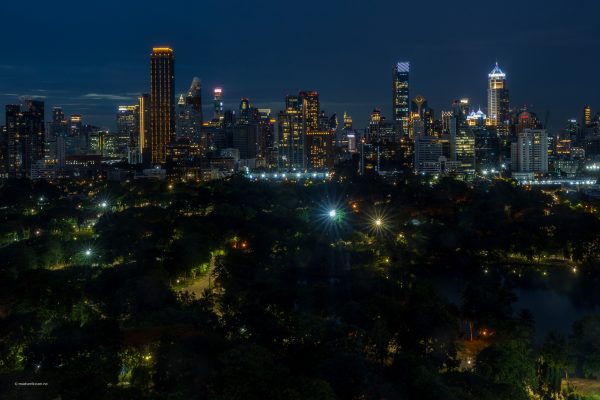
A walled compound the size of a small town, built in 1782 when a general made himself king and moved the capital across the river. Inside it stands a temple with no monks, and inside that a jade figure less than a metre tall that three times a year the King of Thailand climbs a ladder to undress and dress again. The Grand Palace is the most visited building in Bangkok and the least explained — most people walk it in ninety minutes without being told what any of it is.

The Grand Palace was begun in 1782, the year Chao Phraya Chakri took the throne as Rama I and moved the Siamese capital from Thonburi to the east bank of the Chao Phraya. It was the residence of the kings of Siam for a century and a half. It is not one any more — the court moved out under Rama V and the palace is now used for ceremony rather than living, which is why you can walk through most of it and why parts of it are closed without warning.
What visitors actually see is two things sharing one wall. The outer court and the royal chapel, Wat Phra Kaew, which is where the Emerald Buddha sits and where almost all the gold is; and the palace buildings proper, a much stranger collection where a Thai spired roof sits on top of an Italianate façade. Most of the residential inner court is not open, and never has been.
How this article is arranged
Four sections. A walk through the complex in the order the layout actually wants you to take it. Then the Emerald Buddha itself — a small object with a long and violent travel history that explains a good deal about mainland Southeast Asia. Then the buildings and the Ramakien murals in the cloister, which almost everybody walks past. And the practical section, which for this place matters unusually much: the dress code is enforced, the hours are shorter than you think, and the scam outside the gate is the most persistent in Thailand.
A walled town on the old royal island
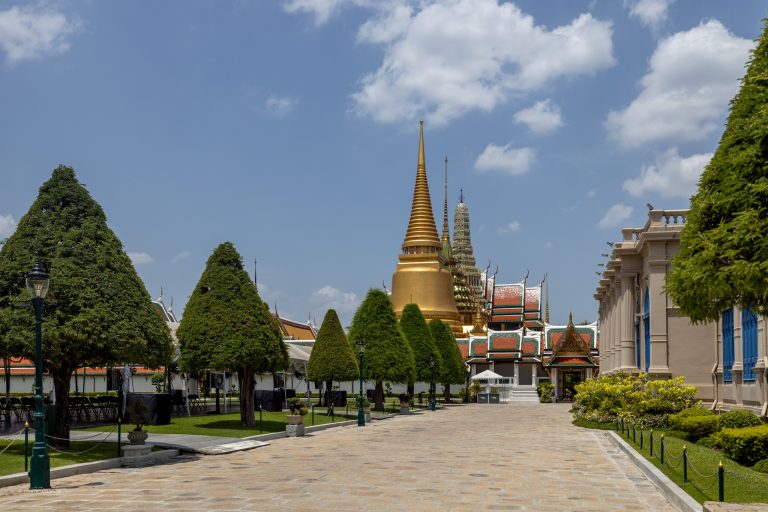
The Grand Palace was begun in 1782, the year Chao Phraya Chakri took the throne as Rama I and moved the capital from Thonburi to the east bank of the Chao Phraya. The walled rectangle holds two things sharing one wall: the royal chapel of Wat Phra Kaew in the north-east corner, and the palace courts to the south and west.
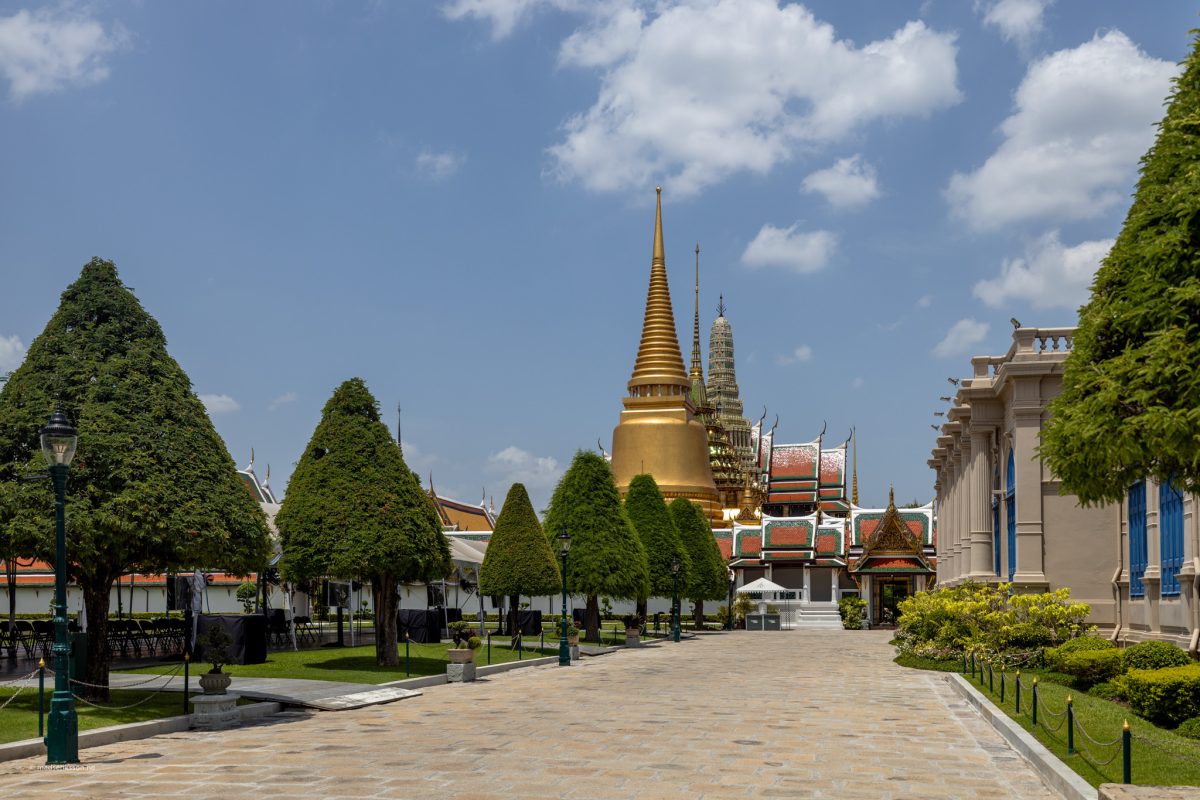
The avenue through the outer court towards the golden chedi of Wat Phra Kaew
Read the wall first
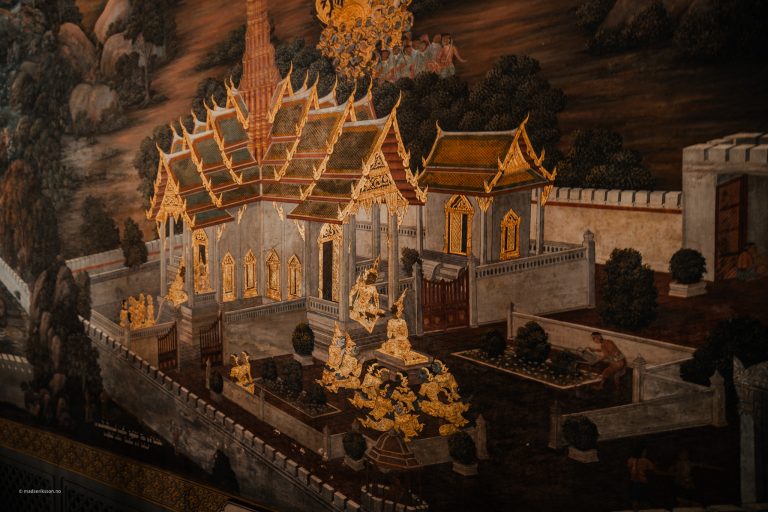
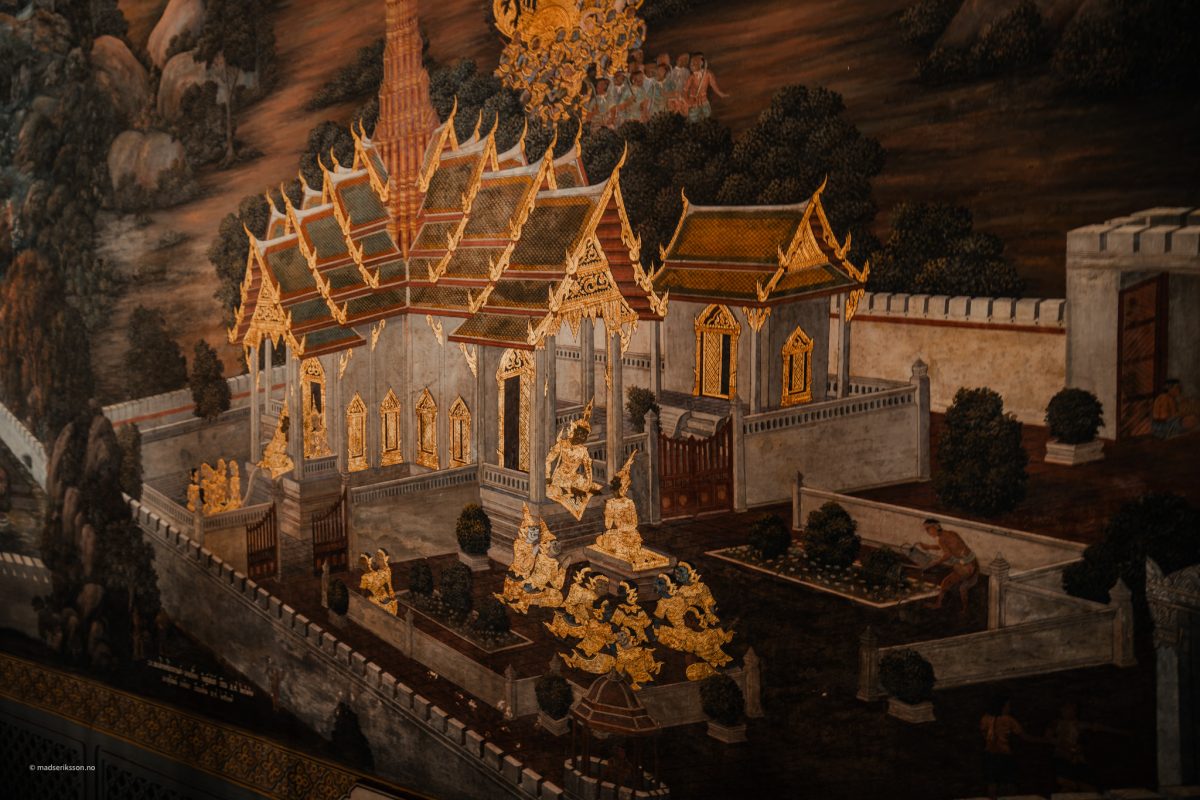
A covered cloister runs round the inside of the temple enclosure, painted with the Ramakien in 178 panels. Shaded and usually empty, it tells the story that every guardian, statue and roof finial in the compound is drawn from.
A palace scene from the Ramakien murals in the galleries around Wat Phra Kaew
Three set pieces on one platform
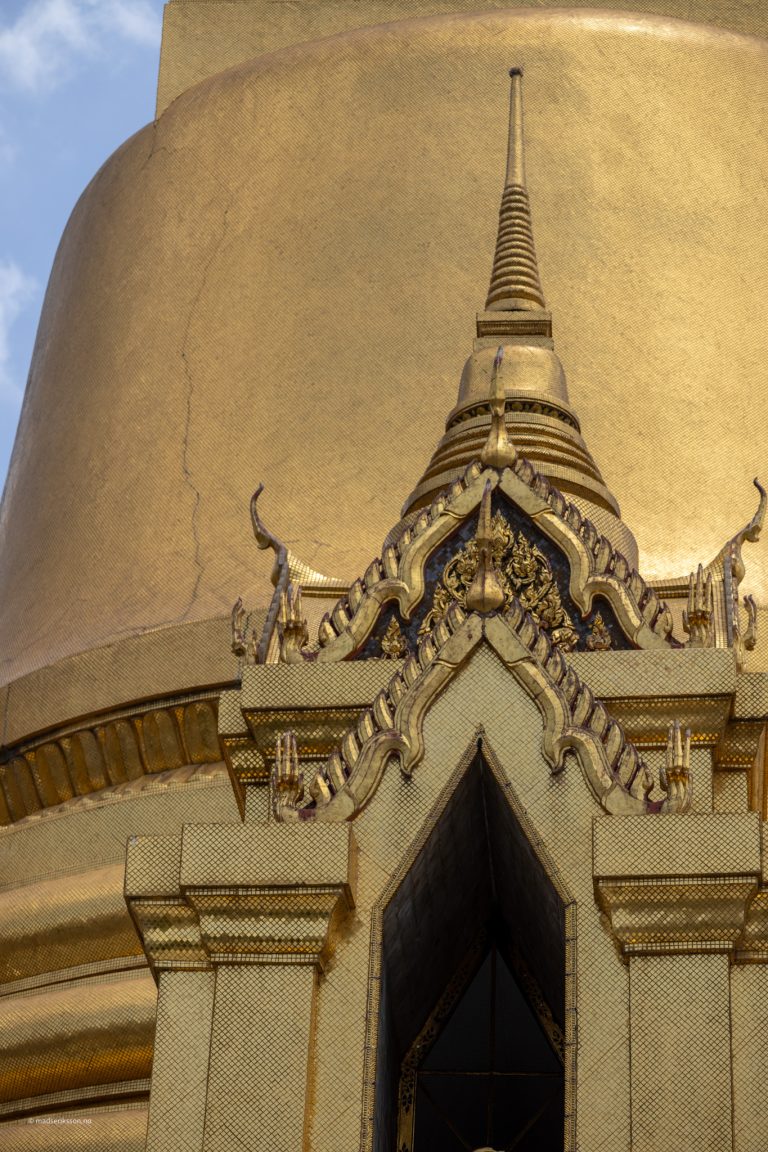
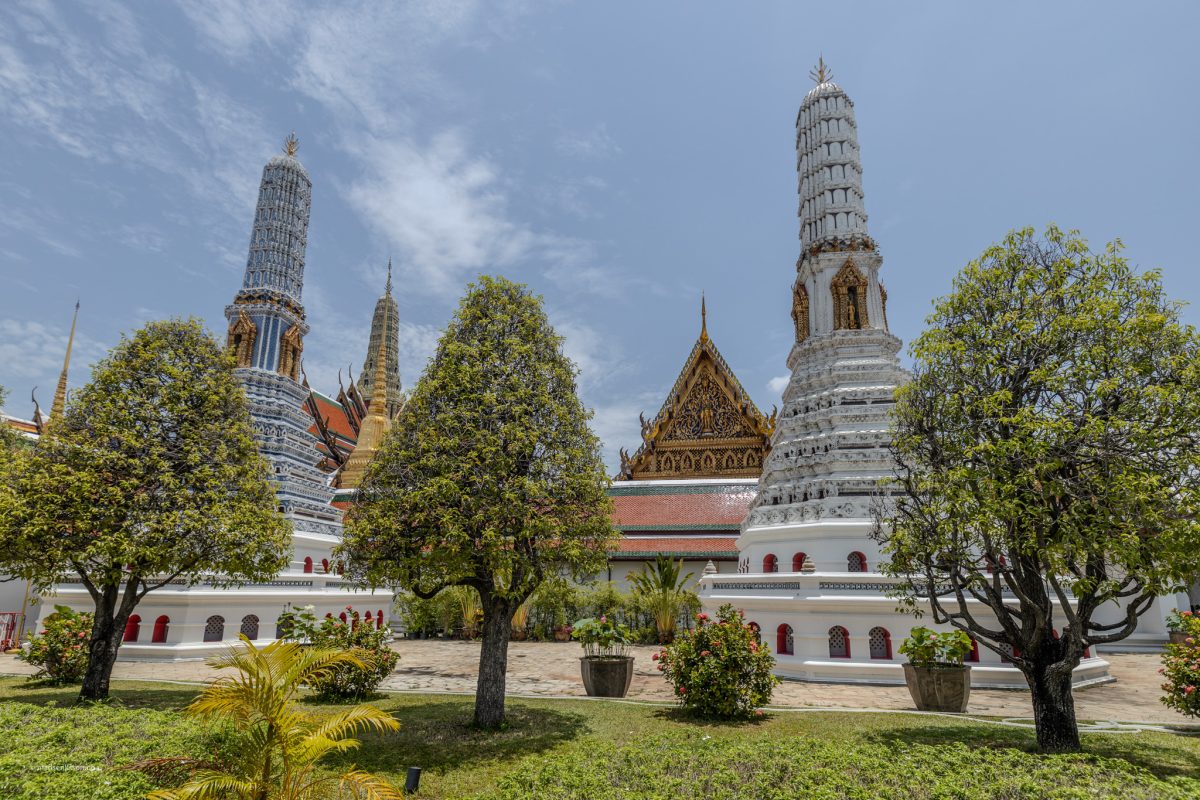
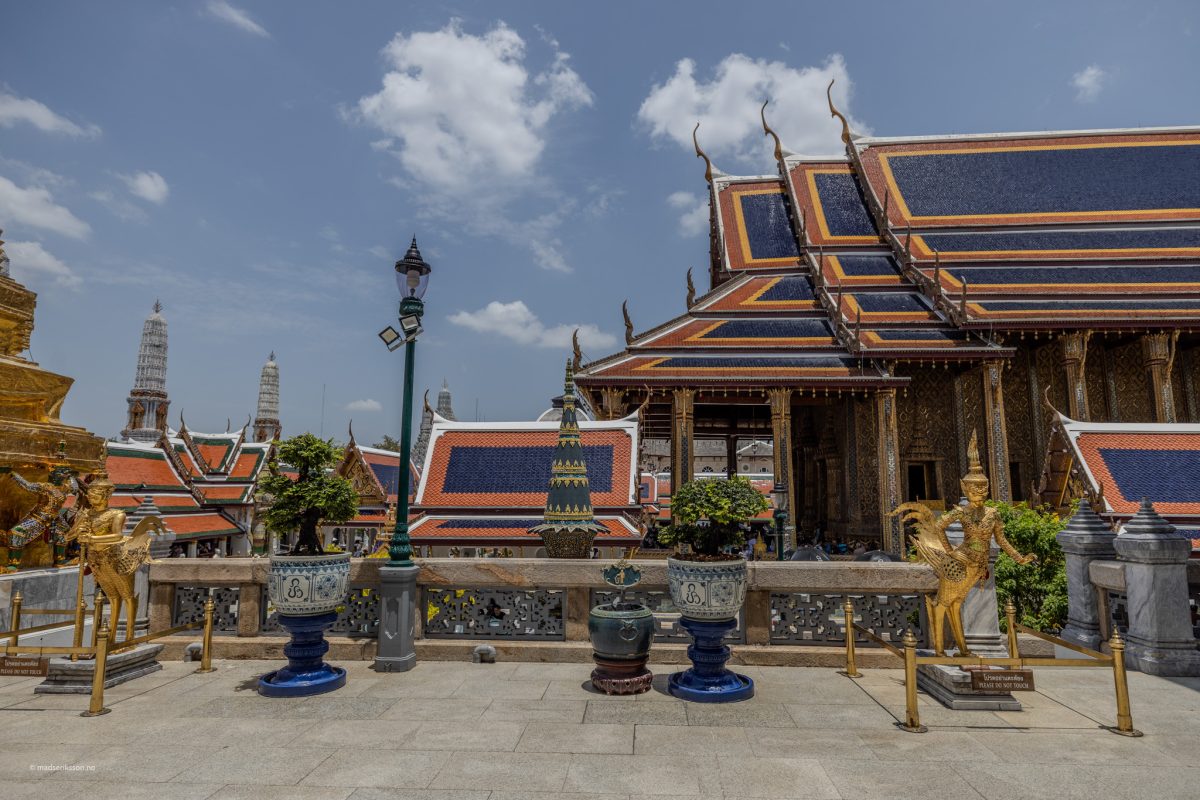
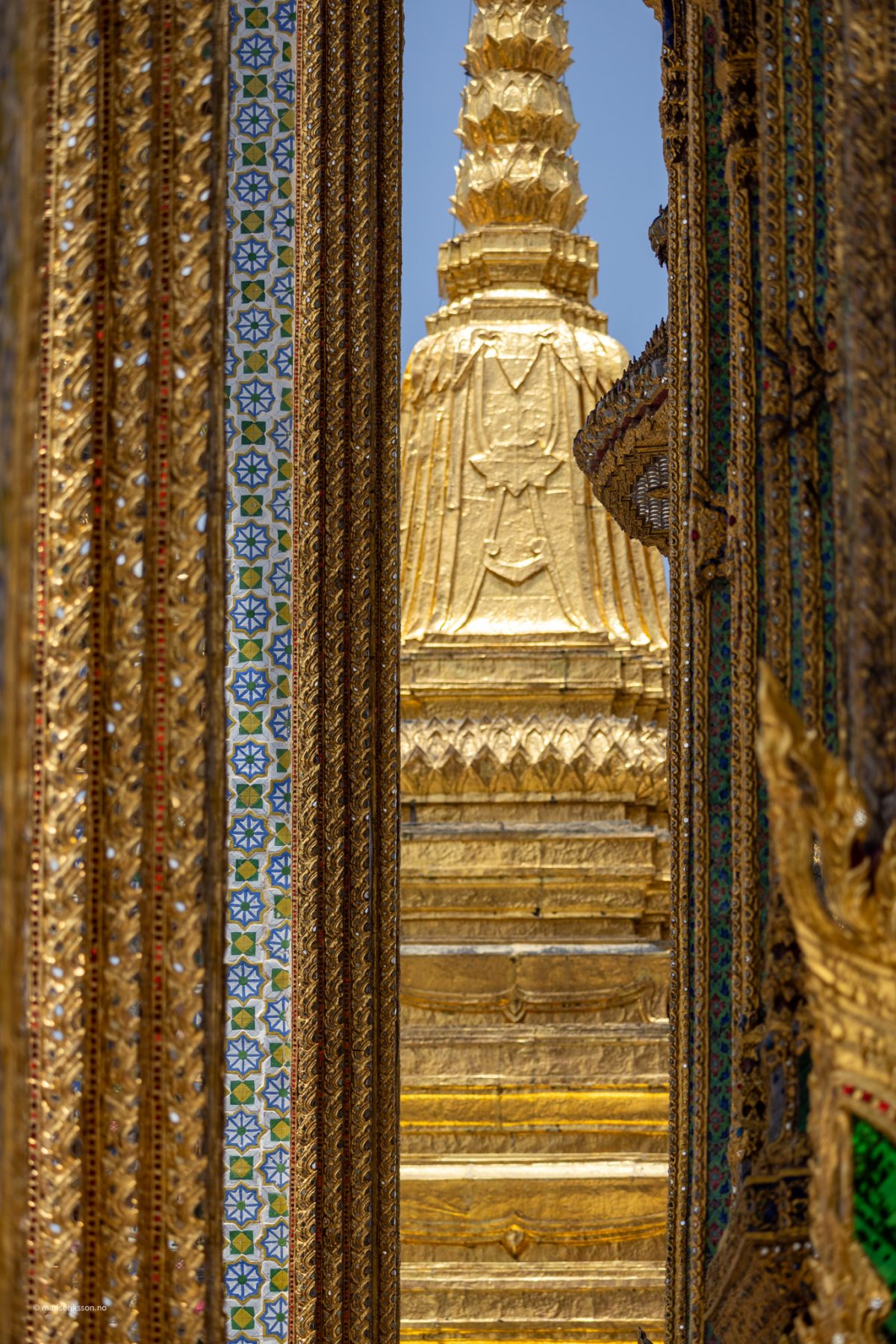
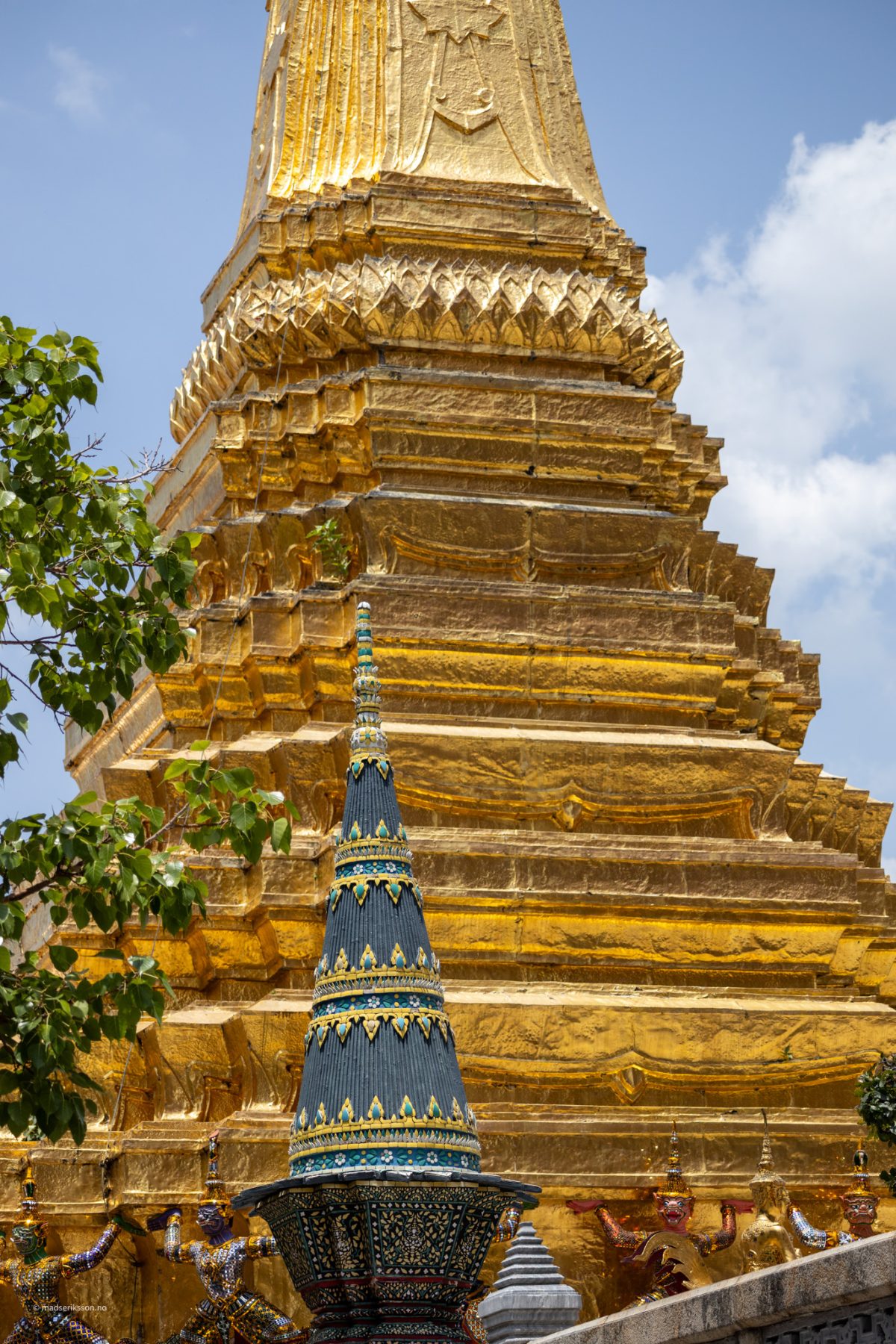
The raised terrace carries a gold-tiled chedi, the Phra Mondop that houses the scriptures, and Prasat Phra Thep Bidon, the royal pantheon. They are seen from outside; the interiors are generally closed.
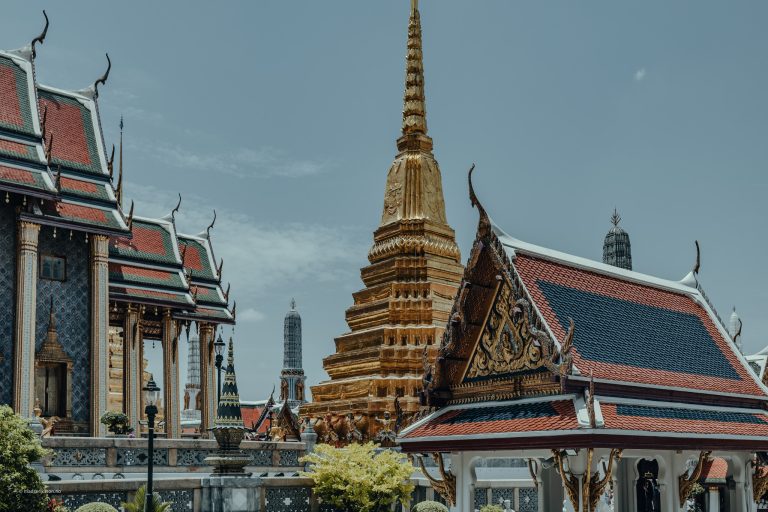
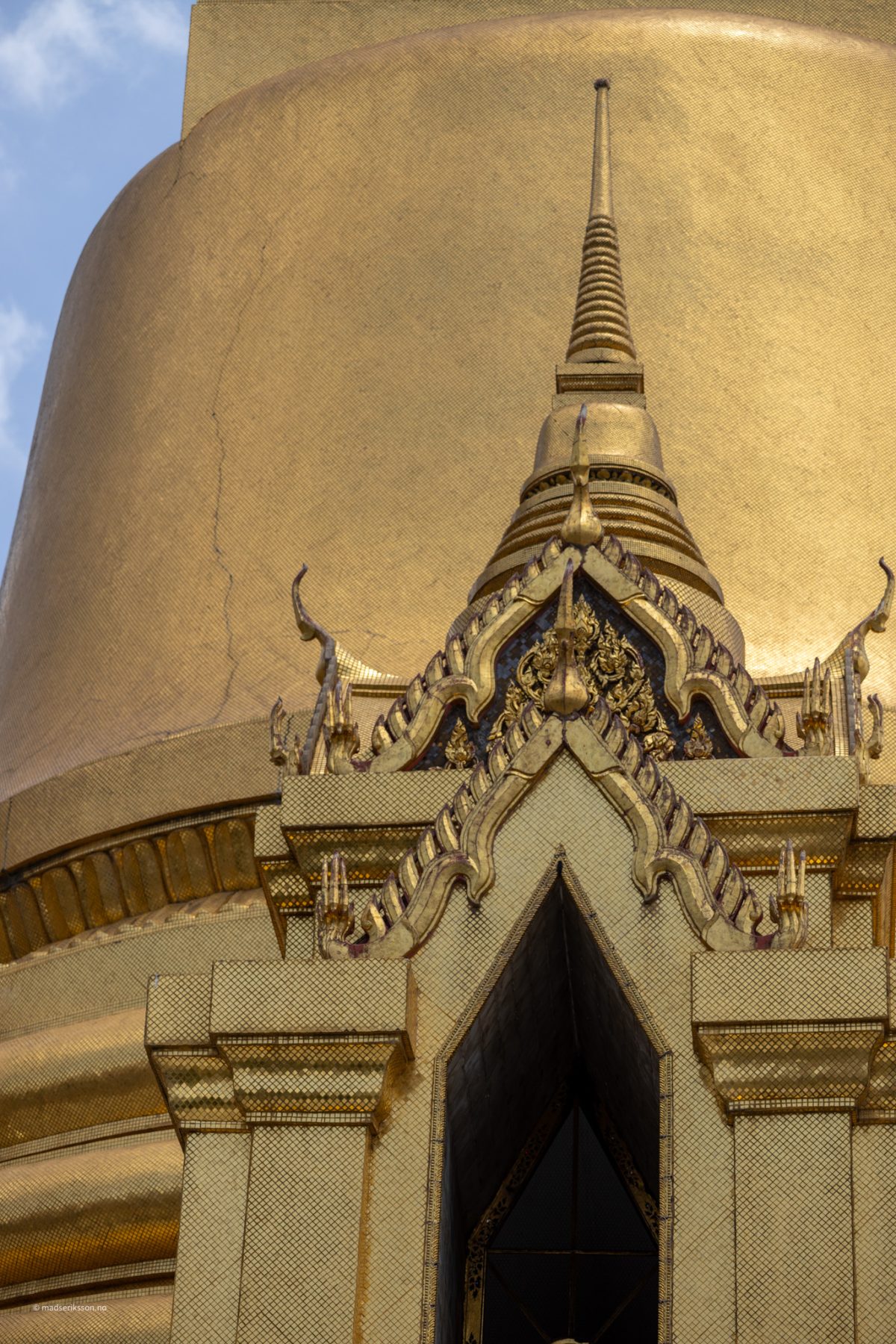
The gilded bell of Phra Si Rattana Chedi above one of its porticoes
The figures from the murals
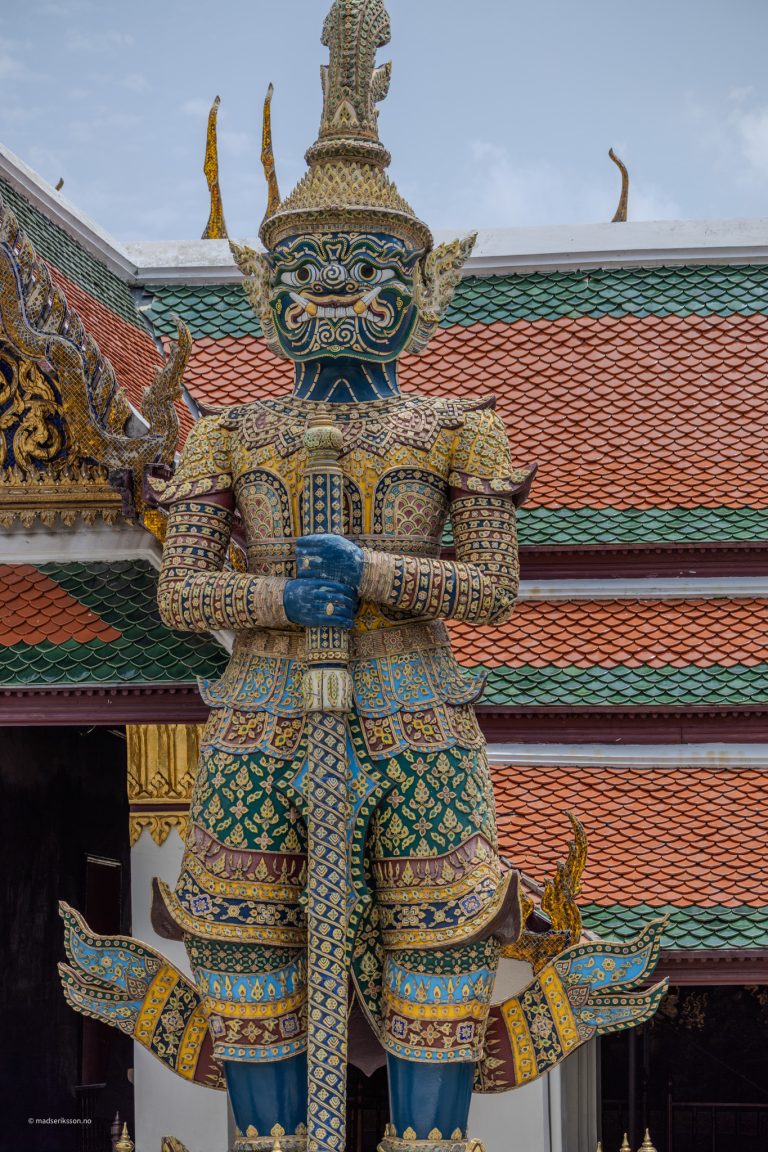
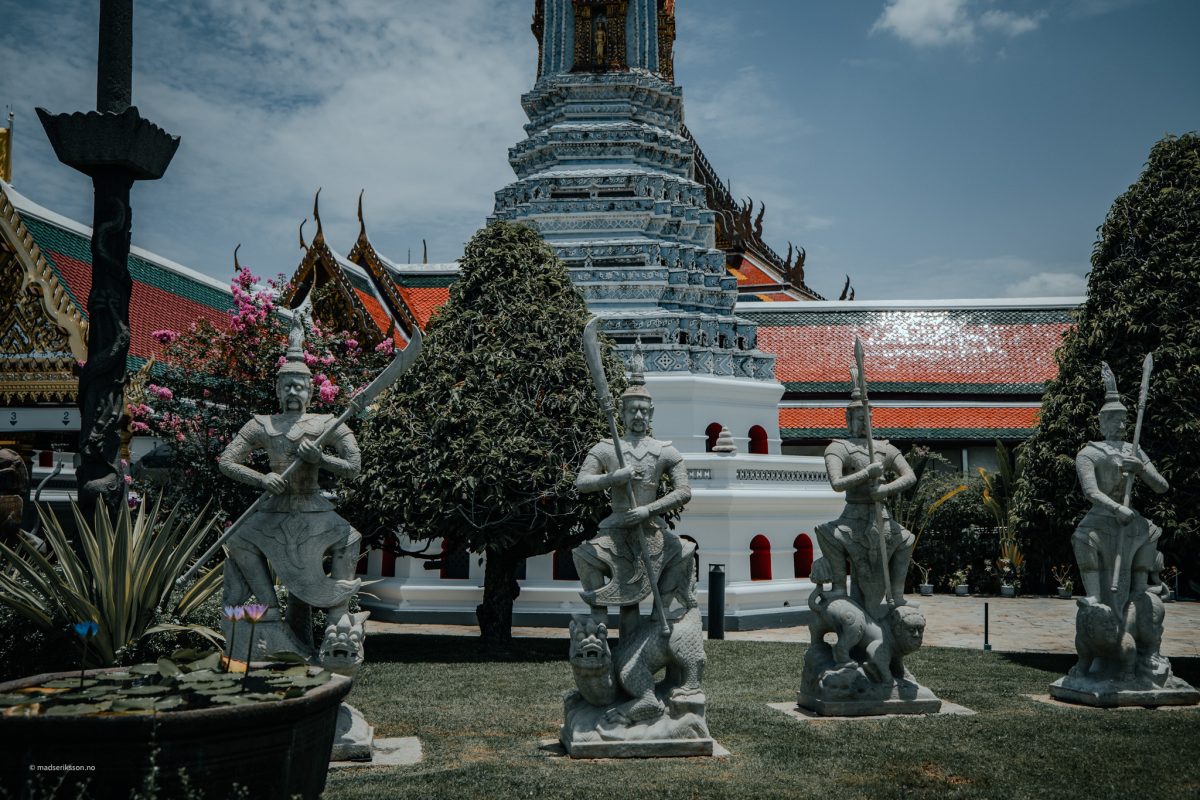
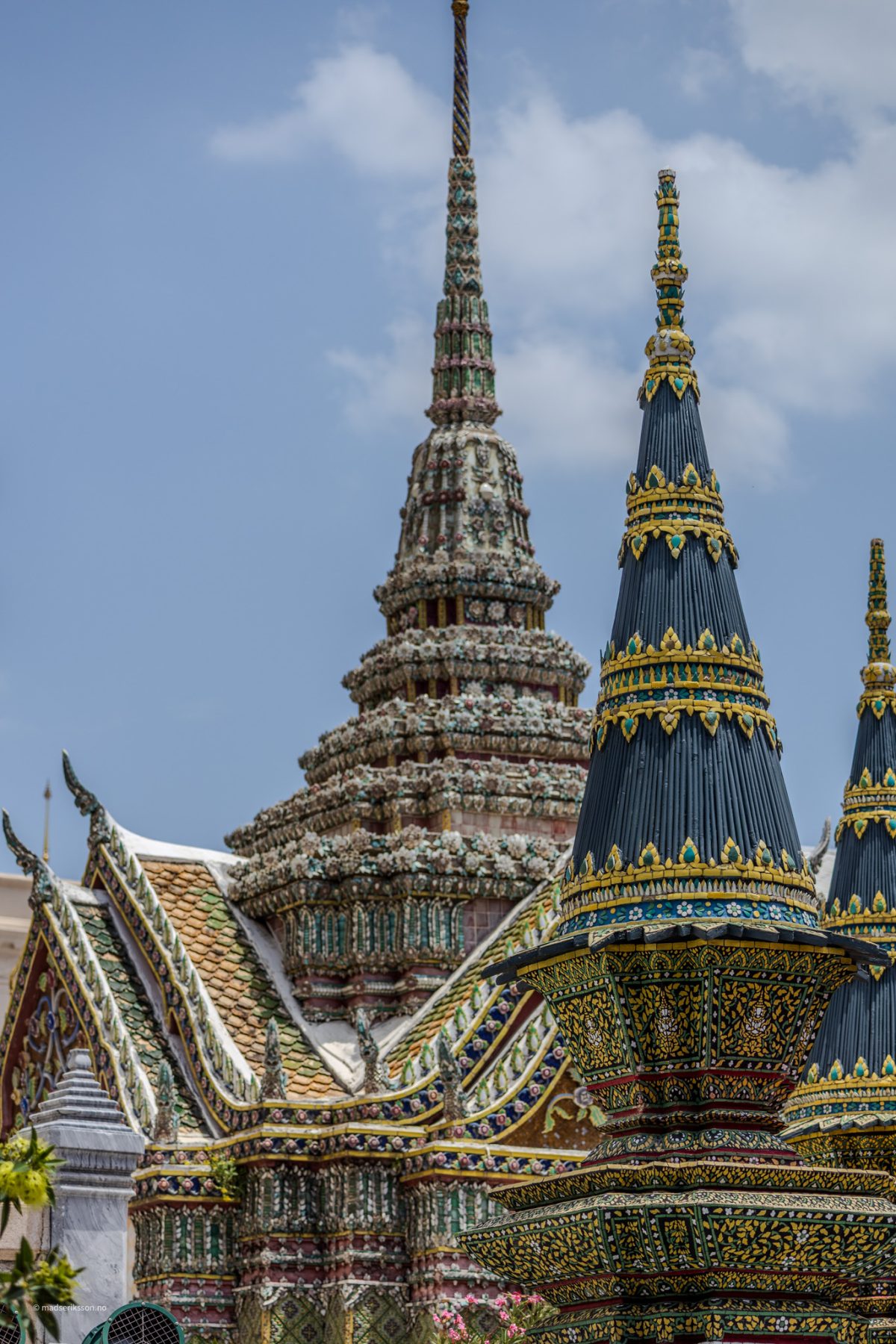
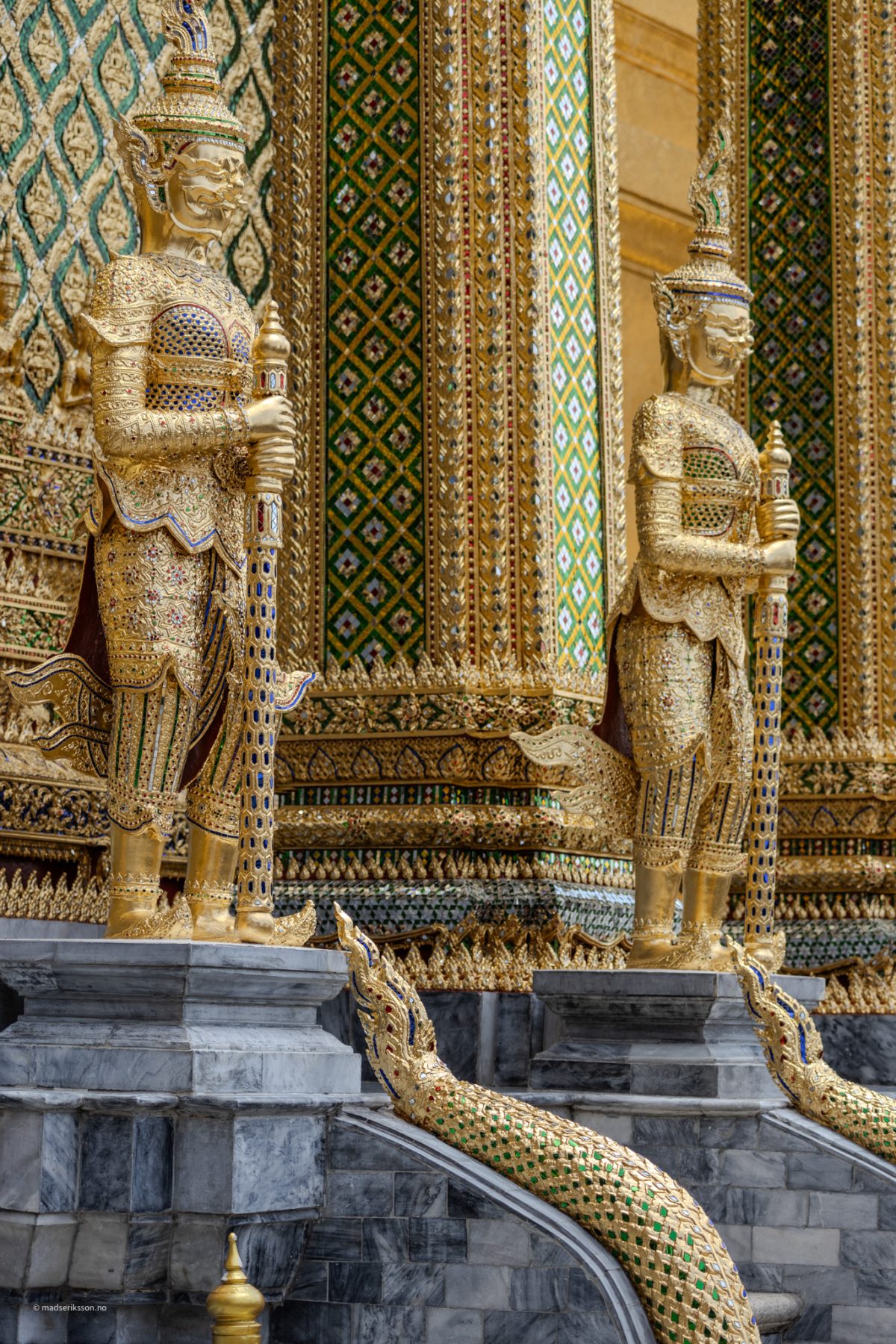
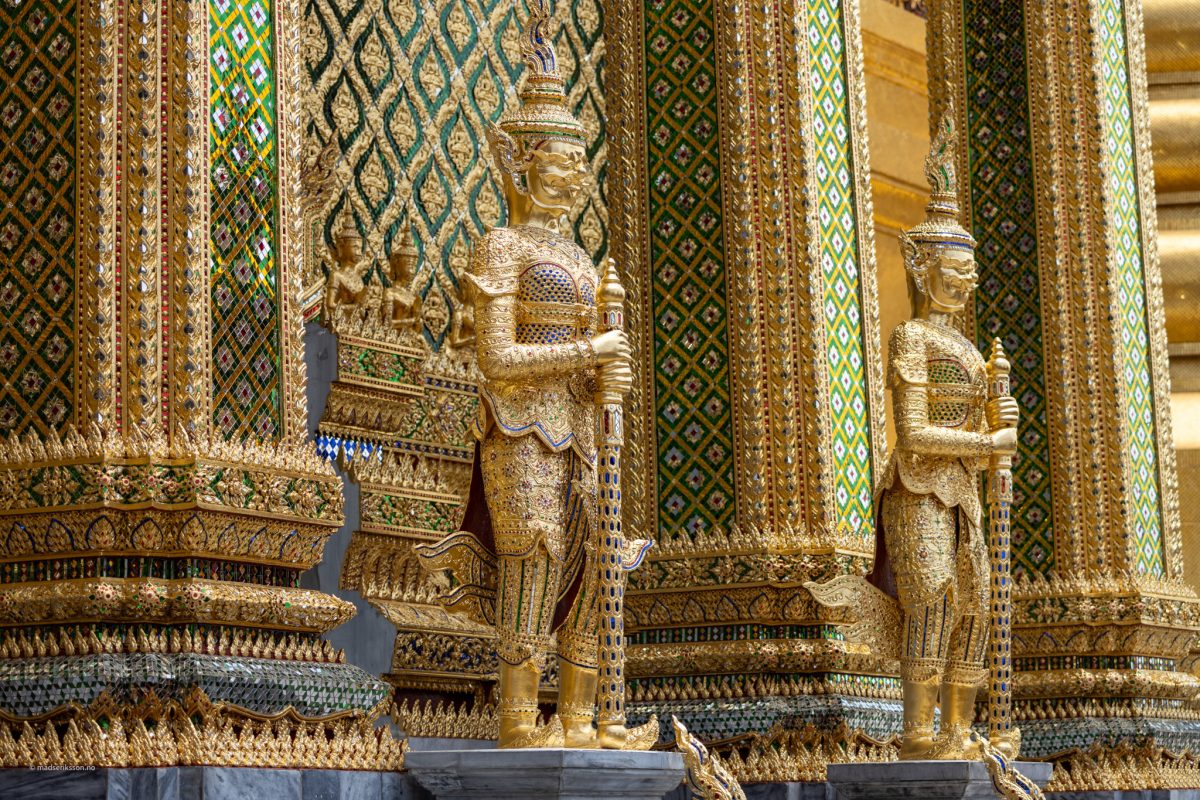
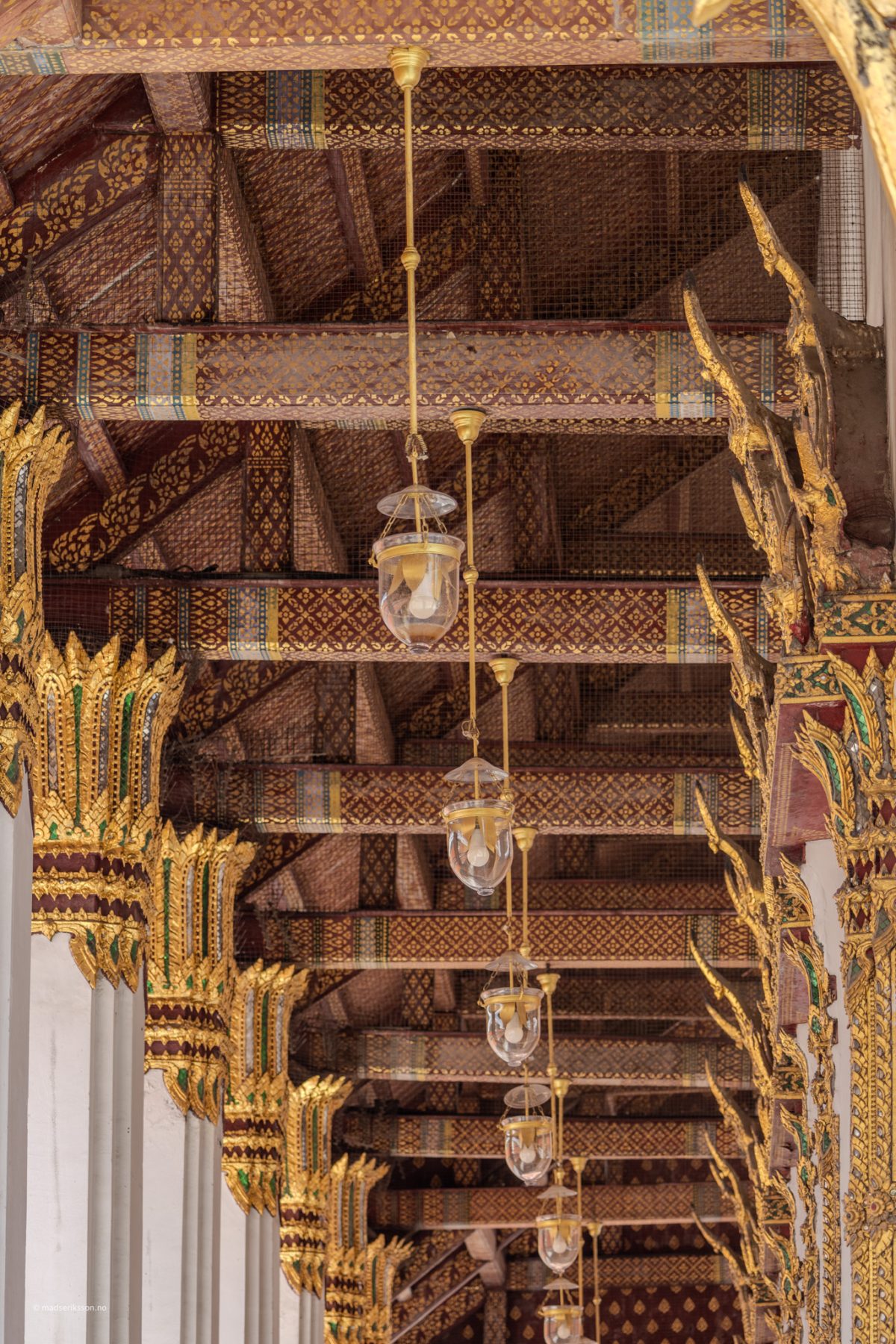
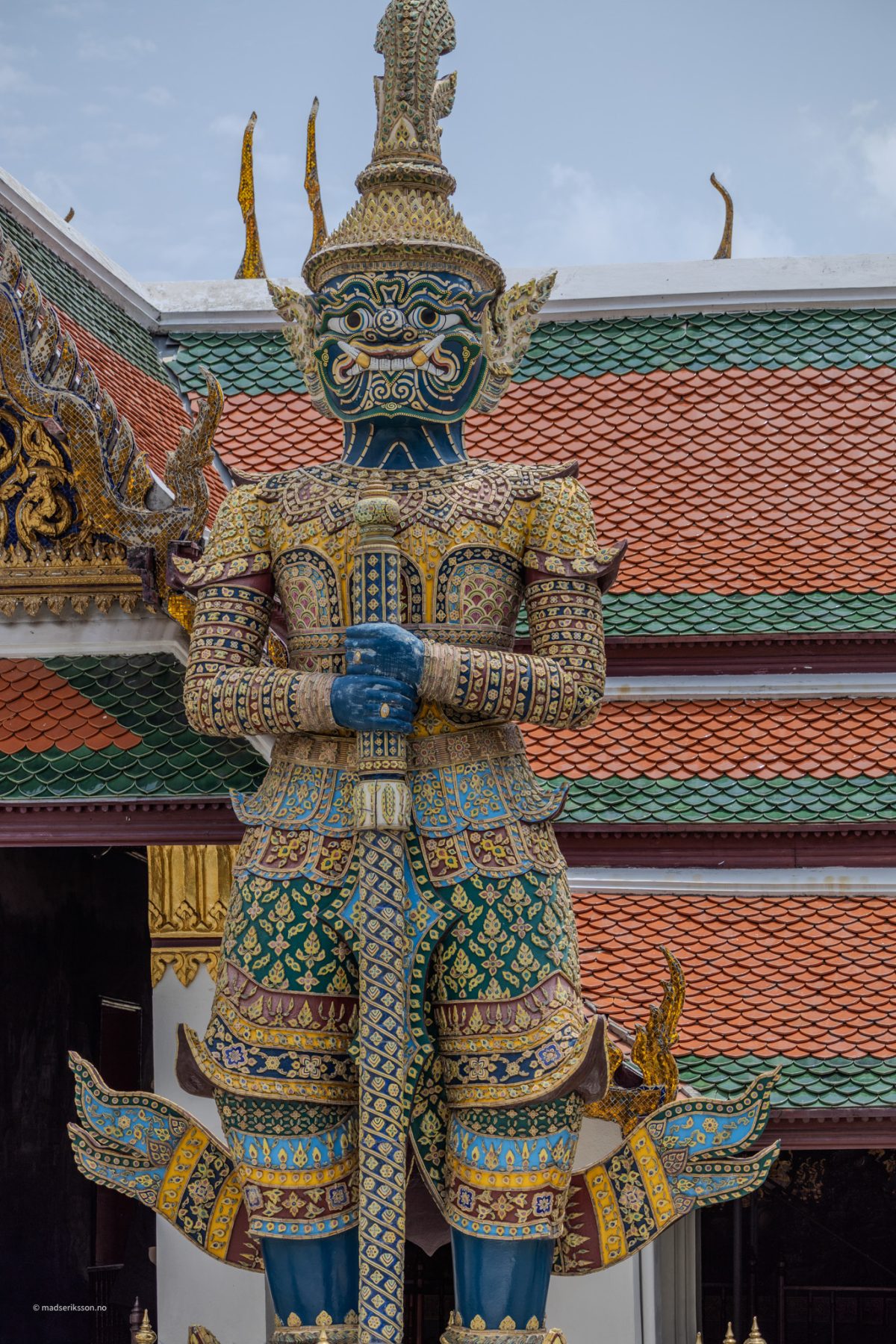
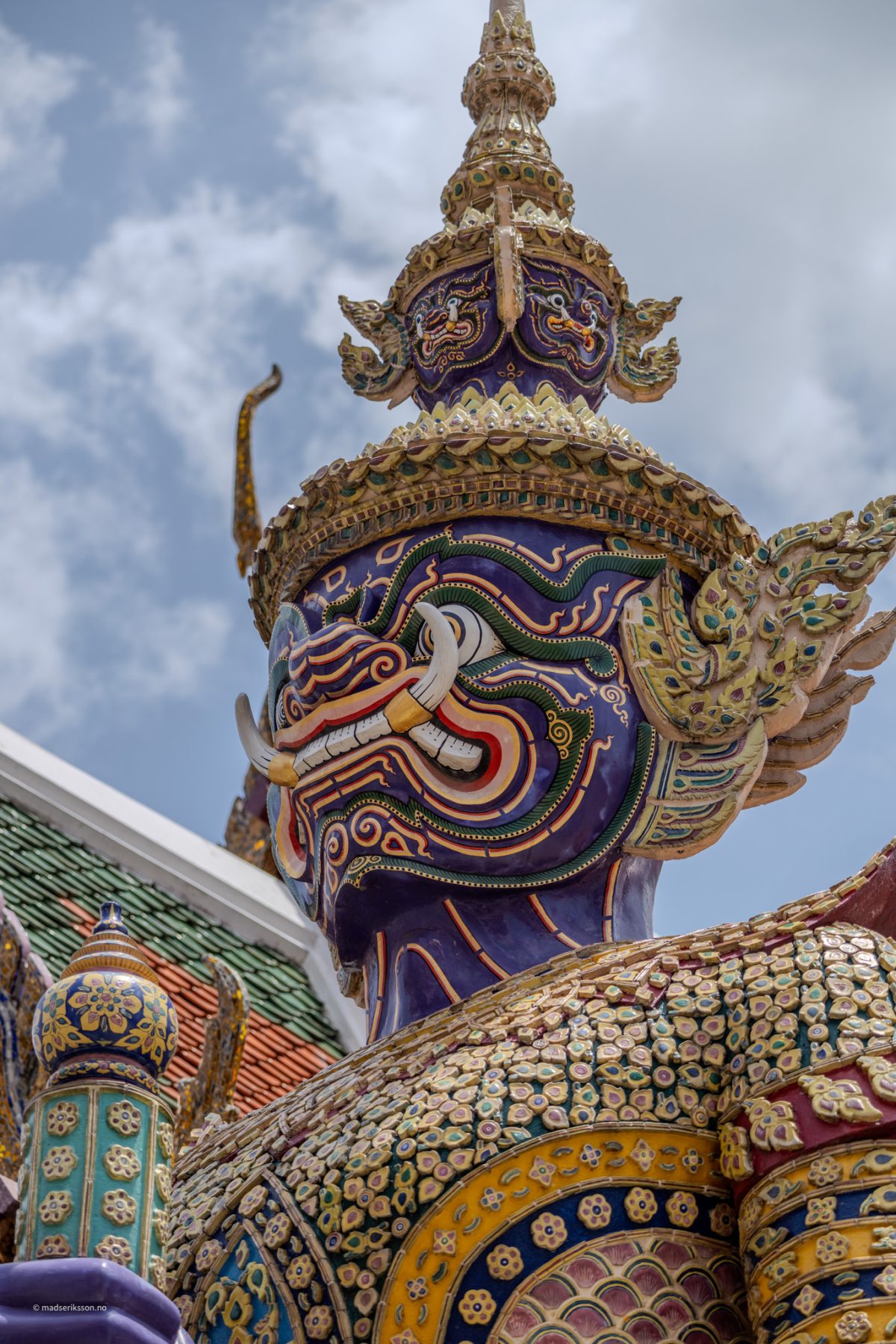
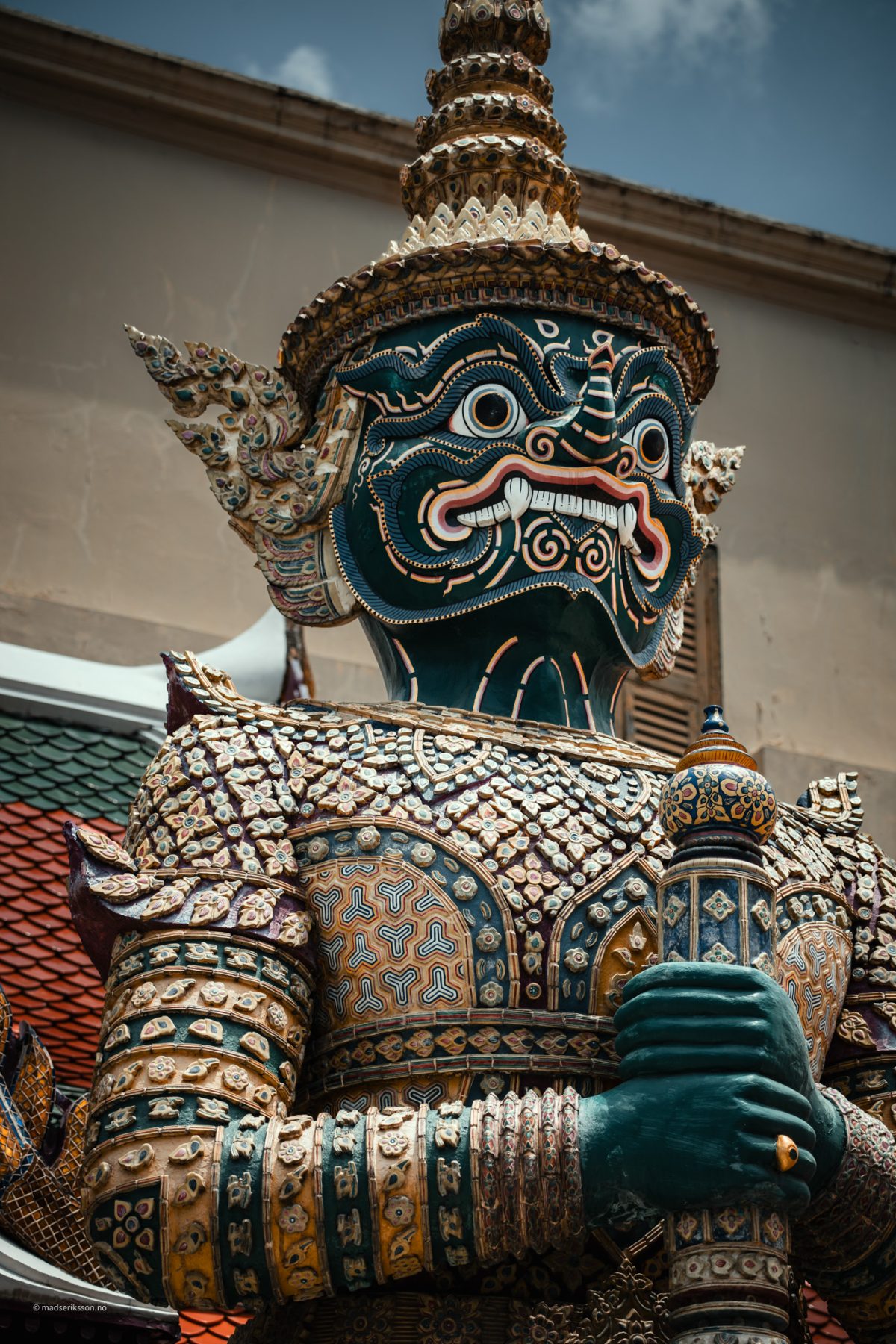
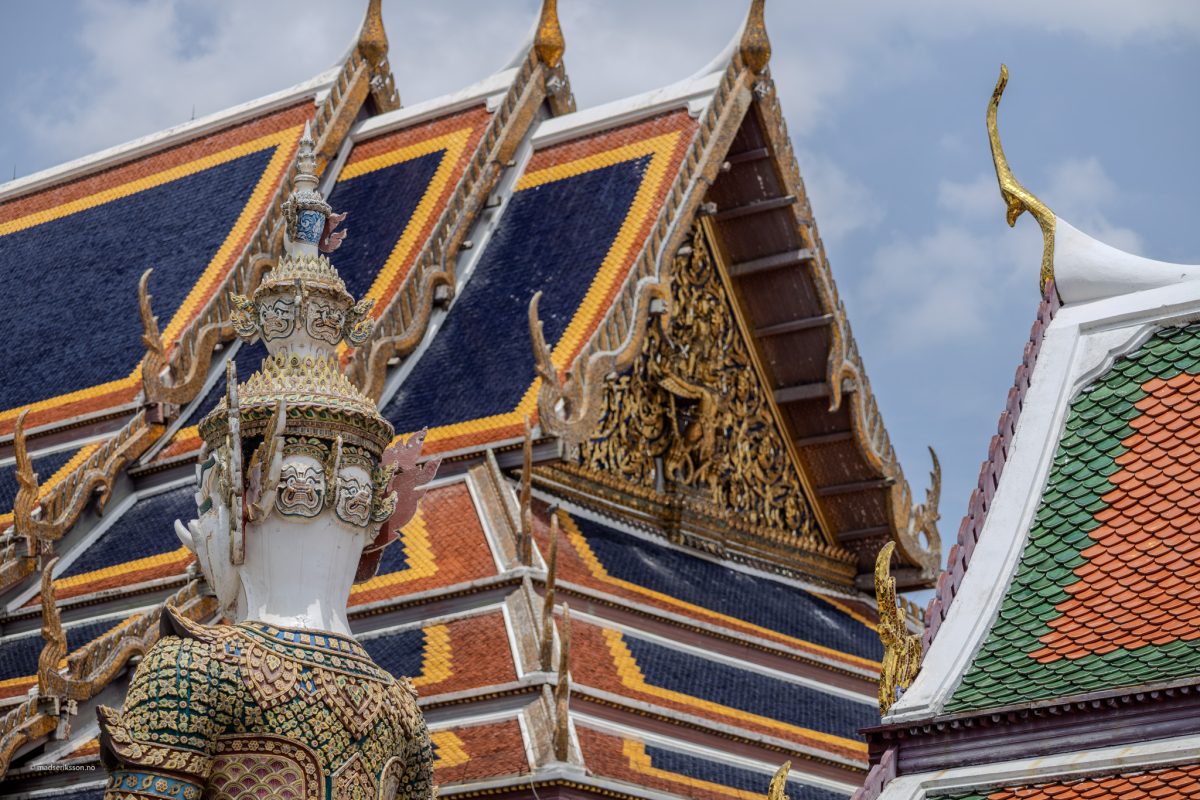
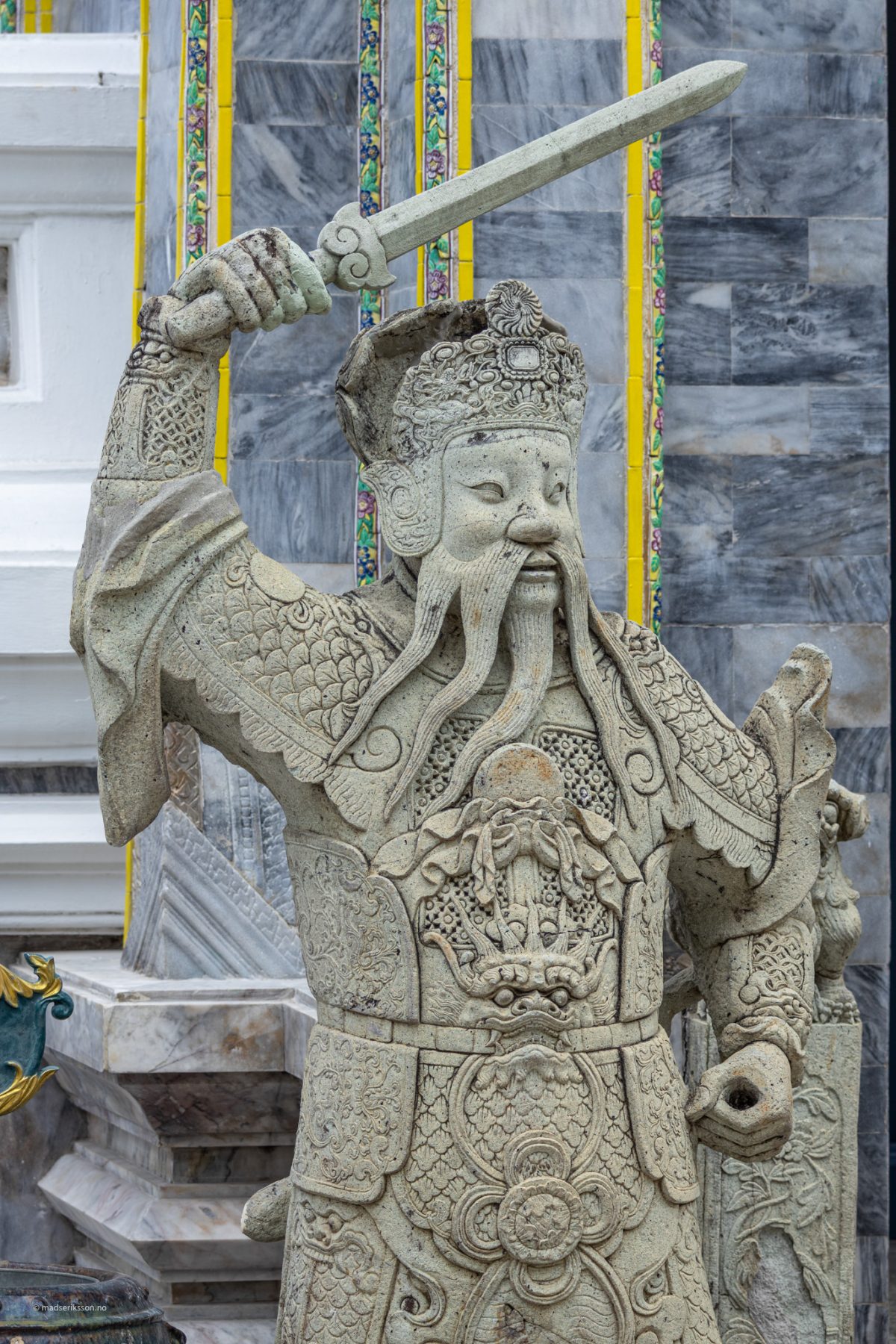
Giant yaksha demons stand at the gates of the temple enclosure, gilded guardians line the terrace and the prangs along the east side glitter with ceramic mosaic. All of them are characters from the Ramakien on the cloister wall.
One of the yaksha demon guardians that watch over the gates of Wat Phra Kaew
What the compound exists for
The ordination hall holds the Emerald Buddha, high on a gilded throne. It is carved from green jade or jasper and stands well under a metre tall. There are no resident monks: Wat Phra Kaew was built as the king’s chapel. Shoes come off and photography stops at the door.
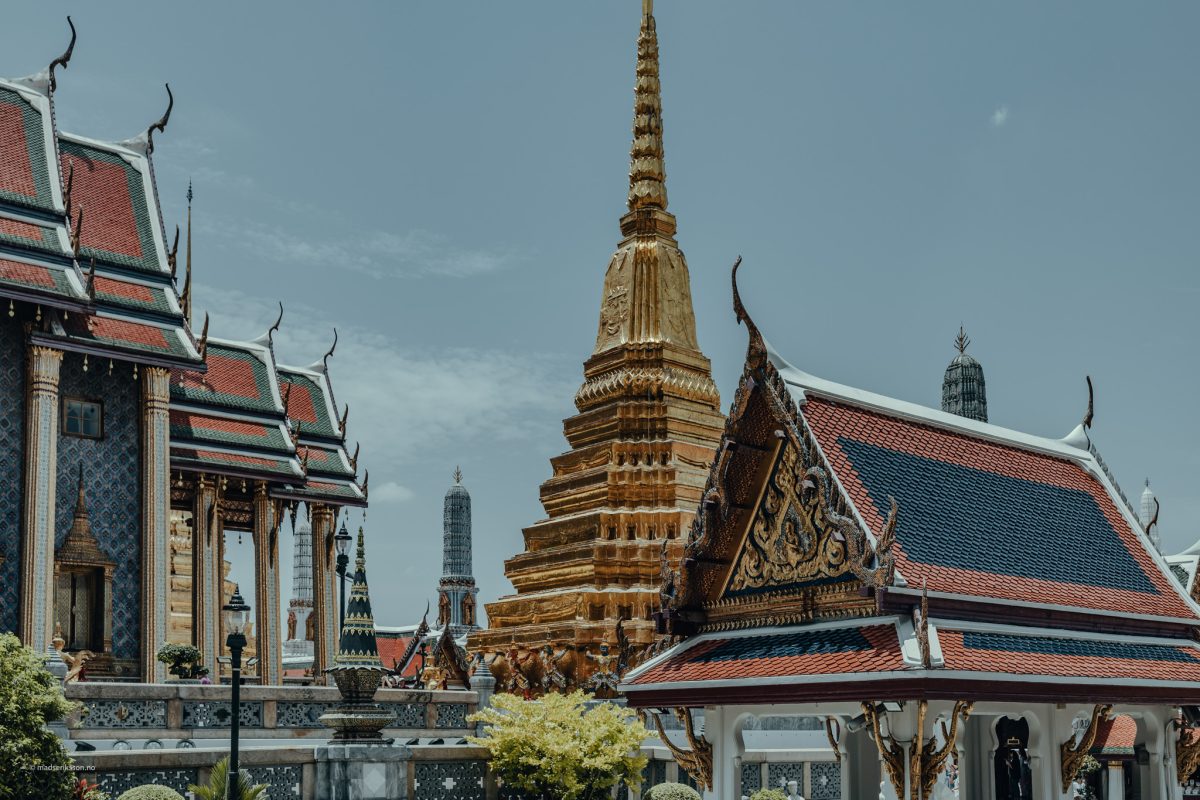
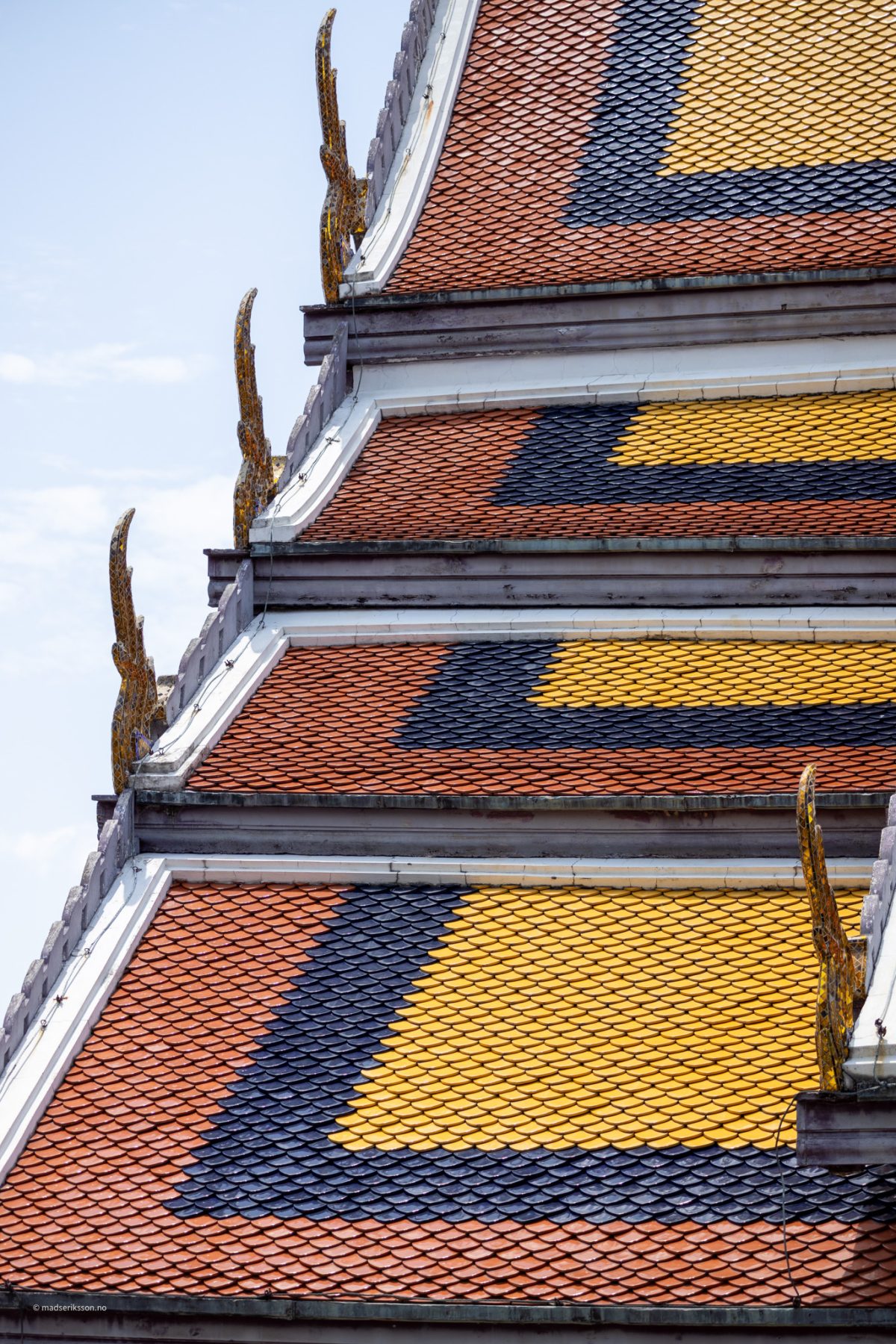
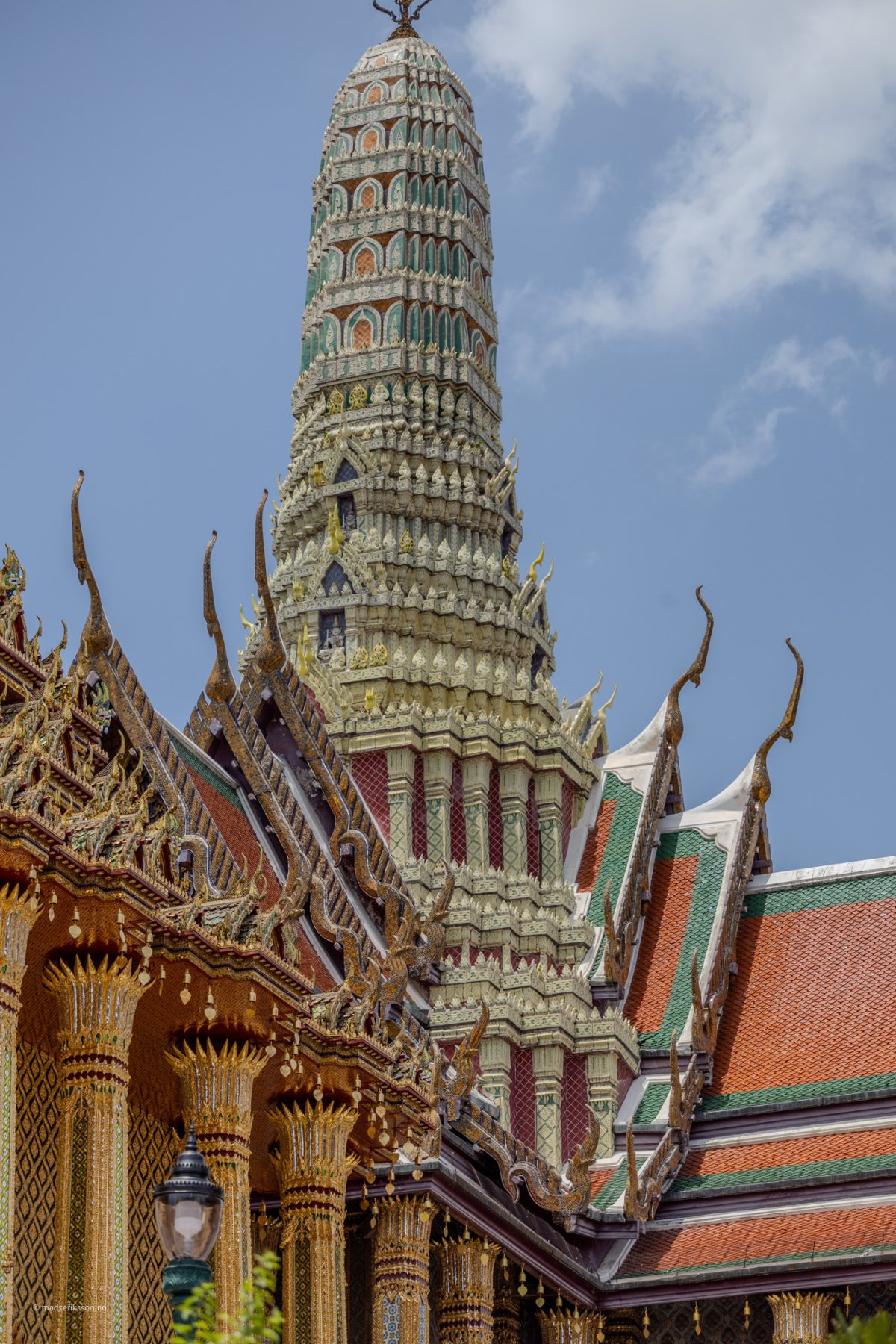
The golden chedi and temple roofs of Wat Phra Kaew
A Westerner in a Thai hat
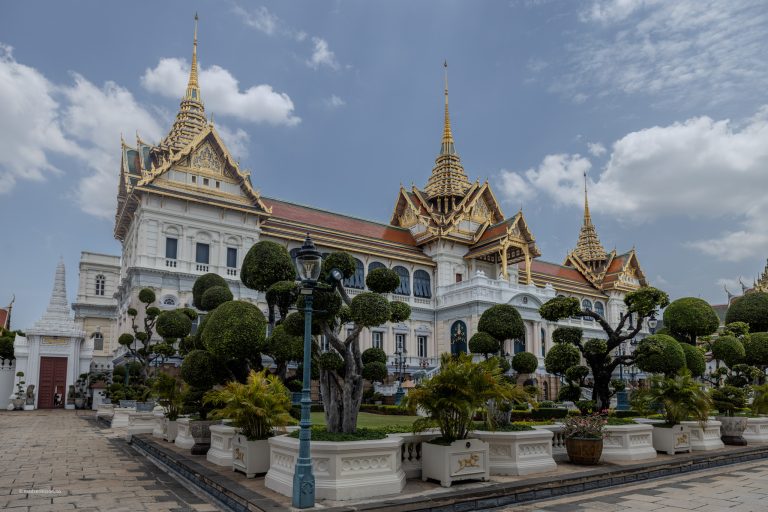
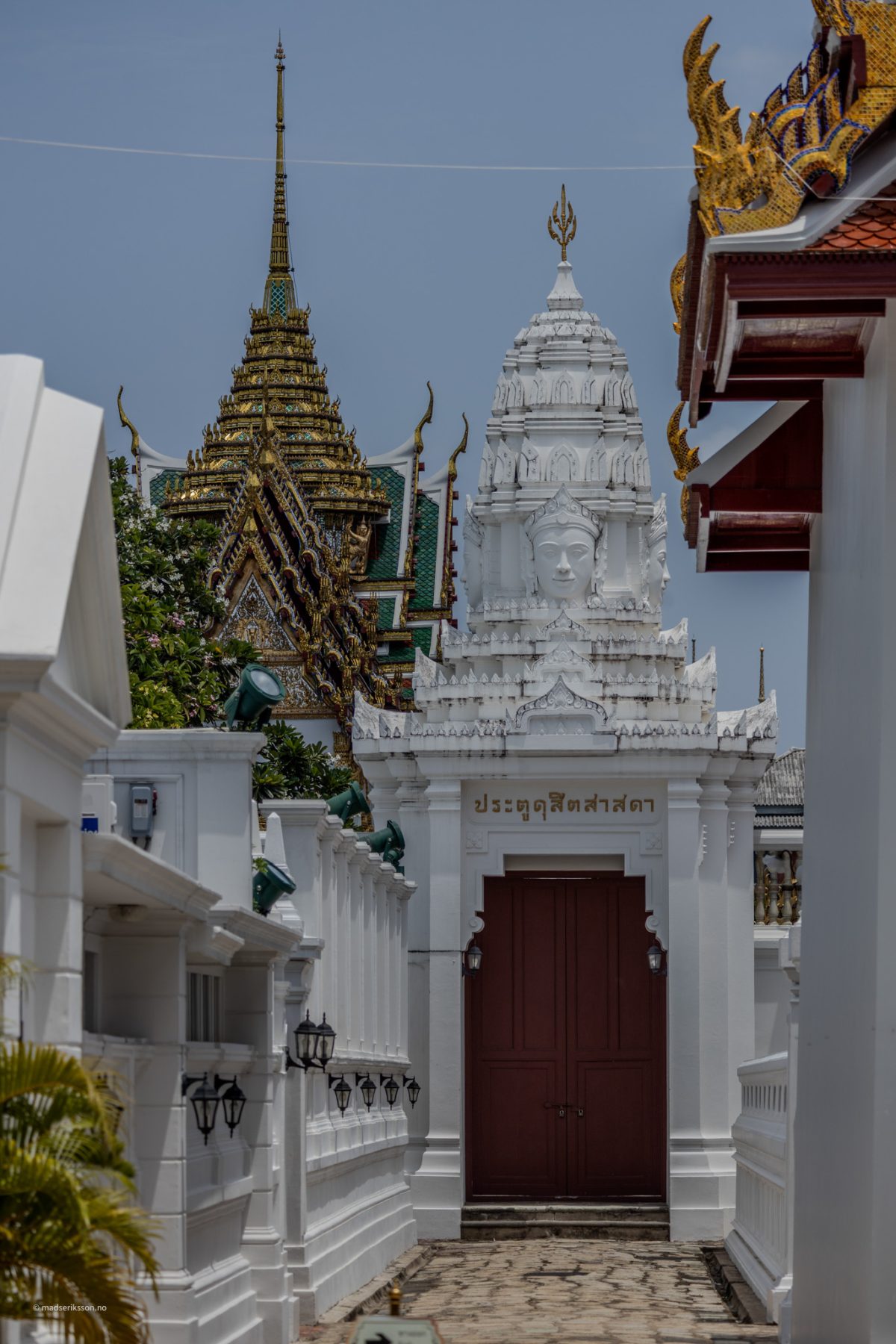
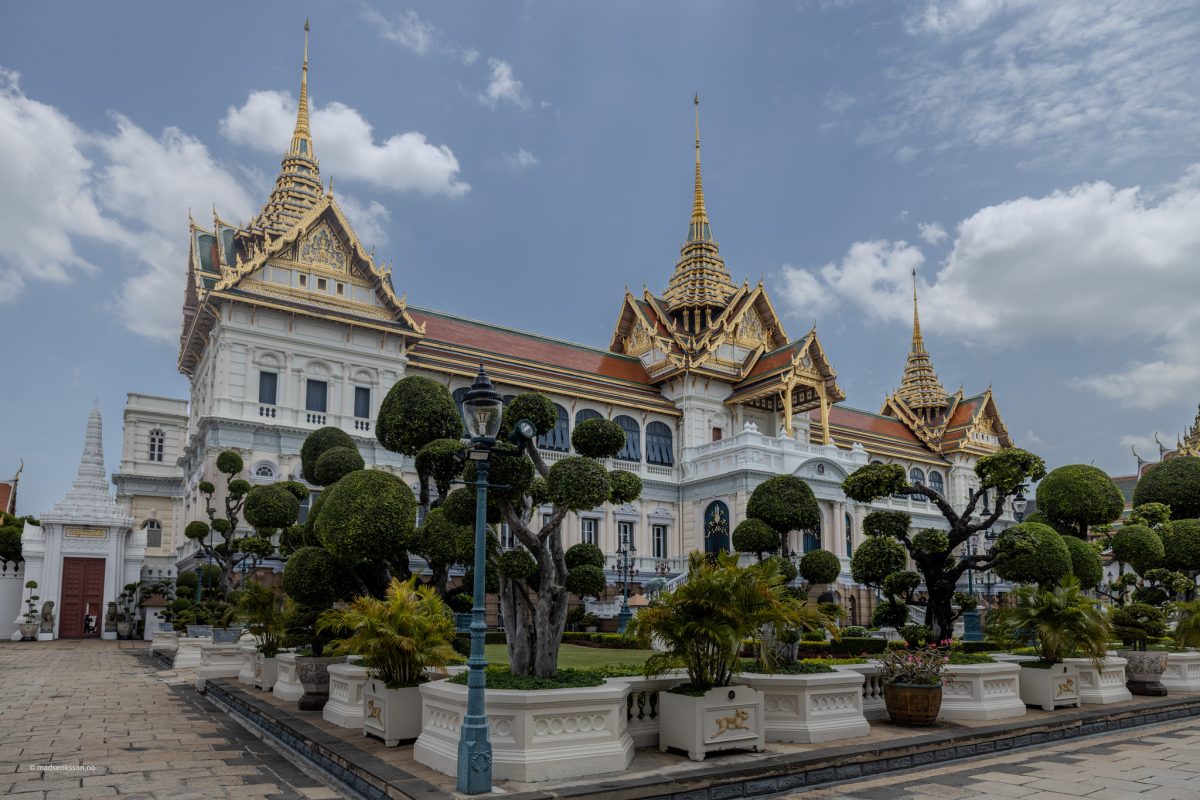
Out of the temple, the palace proper begins. Chakri Maha Prasat, built under Rama V in the 1880s, puts Thai spired roofs on a European Renaissance body. The older Dusit Maha Prasat beside it is the hall in which kings lie in state. Most of it is seen from outside.
Chakri Maha Prasat, the European-style throne hall with Thai spired roofs, behind its clipped trees
Then the reclining Buddha
Ten minutes on foot south of the palace walls lies Wat Pho, with its reclining Buddha and four great chedis. It is calmer than the palace and many consider it the better temple of the two, before the river and the boats.
3D model © 2026 madseriksson.no · Photographs © madseriksson.no. Buildings, walls and paths: © OpenStreetMap contributors (ODbL). Heights of the halls, chedis, prangs and spires are simplified and approximate; the terrain is shown flat. Sun positions are approximate.
The walk, in the order it makes sense
The complex has a logic, and the standard route ignores it — this is the sequence that turns ninety confused minutes into an afternoon that adds up
The complex covers a walled rectangle in Phra Nakhon, the old royal island, and it is arranged in courts — outer, middle, inner — of decreasing accessibility. What is open to visitors is essentially the outer court and the royal chapel; the residential inner court has never been public and is not now.
Here is the one piece of advice that changes the visit. Do the cloister first. Almost everyone arrives, sees gold, and walks straight towards it, spending an hour photographing spires without any idea what the figures on them are. The Ramakien murals run continuously round the inside of the enclosing wall in 178 panels, they are shaded, they are almost always empty, and they tell the story that every statue, guardian and roof-finial in the compound is drawn from. Read even a quarter of it and the rest of the complex stops being decoration and starts being narrative.
“Everyone photographs the gold and nobody reads the wall. The wall is the instruction manual for the gold.”
From there the raised terrace holds the three set pieces — a gold-tiled chedi, the mondop that houses the scriptures, and the royal pantheon — which you see from outside; interiors here are generally closed. Then the ubosot, the ordination hall, which is what the whole compound exists for: inside, high on a gilded throne, sits the Emerald Buddha. Shoes come off, photography stops, and you sit with your feet pointing away from the image. It is small and it is a long way up, and people are routinely surprised by both.
Only after that do you leave the temple enclosure for the palace buildings — the Chakri Maha Prasat with its European body and Thai roofs, and the older Dusit Maha Prasat, which is the building where kings lie in state. Most of this is exterior viewing, and some of it closes at short notice for ceremonial use.
On timing: allow two to three hours, and be at the gate at 08:30 when it opens. This is not about crowds alone — it is about heat. The compound is stone, gold and white paint with very little shade, and by eleven in the morning it is genuinely punishing. Do the terrace early, keep the cloister for when the sun is high, and carry water.
The object the country is built around
Not emerald, not large, and not originally Thai — the most politically significant piece of stone in Southeast Asia, and how it got here
Start with the two corrections. It is not emerald — the figure is carved from a green semi-precious stone, described variously as jade or jasper, and the name refers to the colour. And it is not large: well under a metre, seated cross-legged, and placed so high on its gilded throne that from the floor of the ordination hall you are looking at a small green silhouette a long way above your head. Visitors are frequently disappointed for about thirty seconds, and then work out that the size is not the point.
The point is the history. The image enters the written record in 1434 at Chiang Rai, when lightning struck a stupa and cracked it open to reveal a figure inside. From there it moved the way sacred objects moved in mainland Southeast Asia — by conquest. Lampang, then Chiang Mai, then across to Vientiane, where it remained for more than two hundred years.
“It came to Bangkok in 1779 as spoils of war, carried back by the general who three years later made himself king. The palace was built around it, not the other way round.”
In 1779 Siamese forces took Vientiane, and the general who led them — Chao Phraya Chakri — brought the image back with him. Three years later that same man became Rama I, moved the capital to Bangkok, and built a palace with a chapel at its centre to house it. The Emerald Buddha is, in a very direct sense, the reason the Grand Palace is where it is. It is also why the object remains a live matter between Thailand and Laos to this day.
Then there are the robes. Three times a year, marking the turn from hot season to rainy season to cool, the King of Thailand personally changes the Emerald Buddha’s costume — climbing to the throne and removing one set of gold ornament and dressing the figure in the next. The costumes are elaborate and enormously valuable, and the ceremony is one of the very few royal duties the Thai monarch still performs with his own hands rather than by proxy. If you visit shortly after a change, the figure you see will be dressed differently from the one in every photograph you looked at beforehand.
Two practical notes for the ordination hall itself. Photography is not permitted inside, and the rule is enforced. And the sitting convention matters: you sit on the floor with your feet pointing away from the image, never towards it. Thai visitors will be praying around you. This is the one part of the complex that is not a monument but a functioning shrine, and it is worth adjusting your behaviour accordingly for the ten minutes you are in there.
The buildings, and the wall nobody reads
A palace that argues with itself about which century it belongs to, and a hundred and seventy-eight painted panels that explain the whole compound
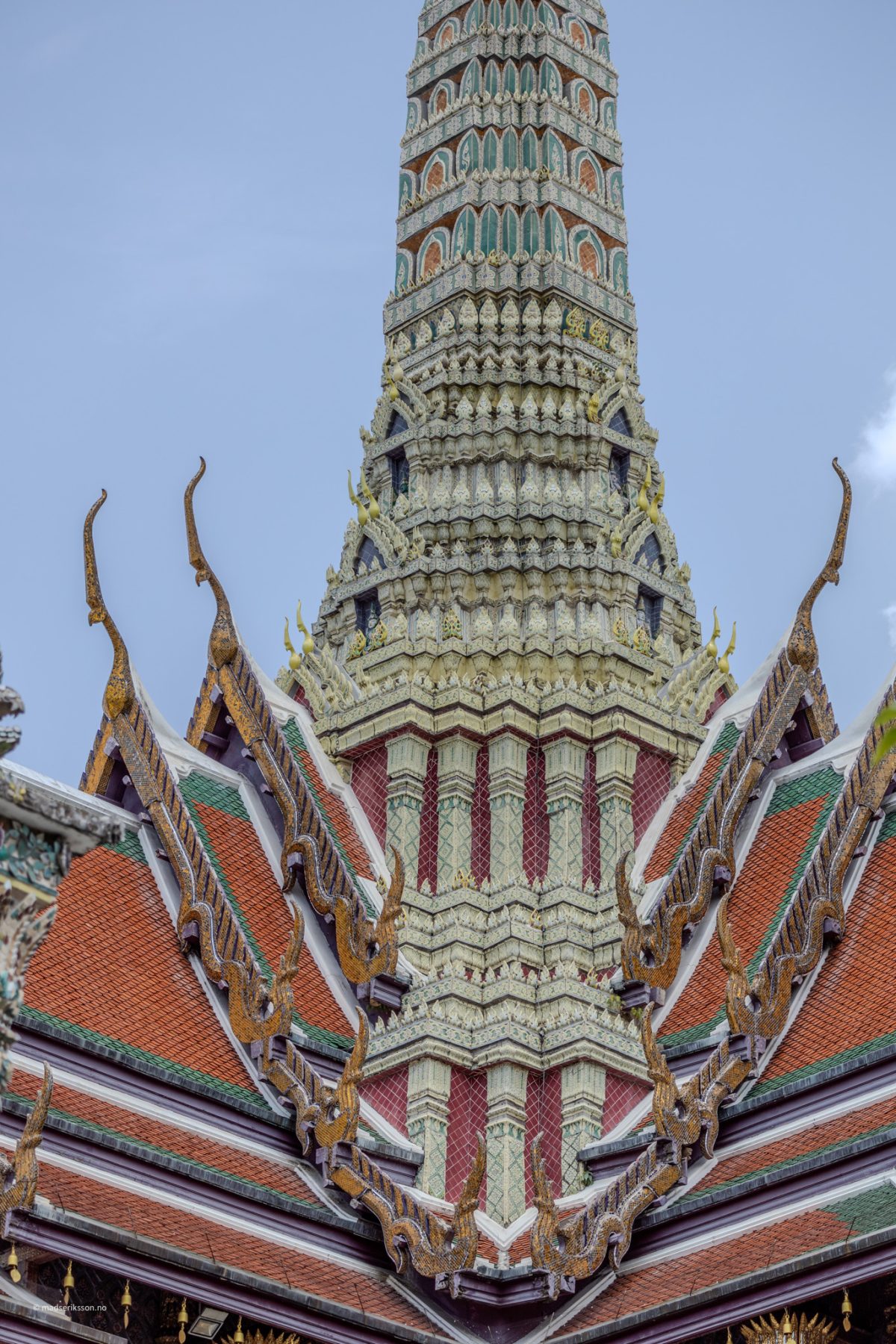
The strangest building in the compound is the Chakri Maha Prasat, put up under Rama V in the 1880s, at the point when Siam was working very hard to present itself to European powers as a modern state rather than a colonial opportunity. The body of the building is European Renaissance — symmetrical, classical, entirely at home in Vienna. On top of it sit three Thai spired roofs.
The usual account is that the design was European throughout until a late intervention insisted on Thai roofs, and the result is a building that visibly changes its mind halfway up. Bangkok has described it ever since as a Westerner wearing a Thai hat, which is both affectionate and precise. Whether you read it as awkward or as a rather sophisticated piece of diplomacy in stone depends on the day, and both readings are defensible.
“A building that is Italian below the cornice and Siamese above it. The join is exactly where the politics of the 1880s sat.”
Next to it, the Dusit Maha Prasat is the older and purer thing — a cruciform hall under a tiered spire, in the classical Siamese manner and without a European line anywhere on it. This is the building where Thai kings lie in state, and it is the one to look at if you want to know what the Chakri Maha Prasat would have been had nobody been trying to impress anyone.
And then the Ramakien murals, which are the best thing inside the walls and which most visitors walk past twice without stopping. The Ramakien is the Thai telling of the Indian Rāmāyaṇa, and it runs continuously round the inside of the temple cloister across 178 panels — Rama, the abduction of Sita, the monkey general Hanuman, the demon king Ravana and the war that follows. It has been repainted repeatedly over two centuries, so what you see is not the original surface, and it is no less remarkable for that.
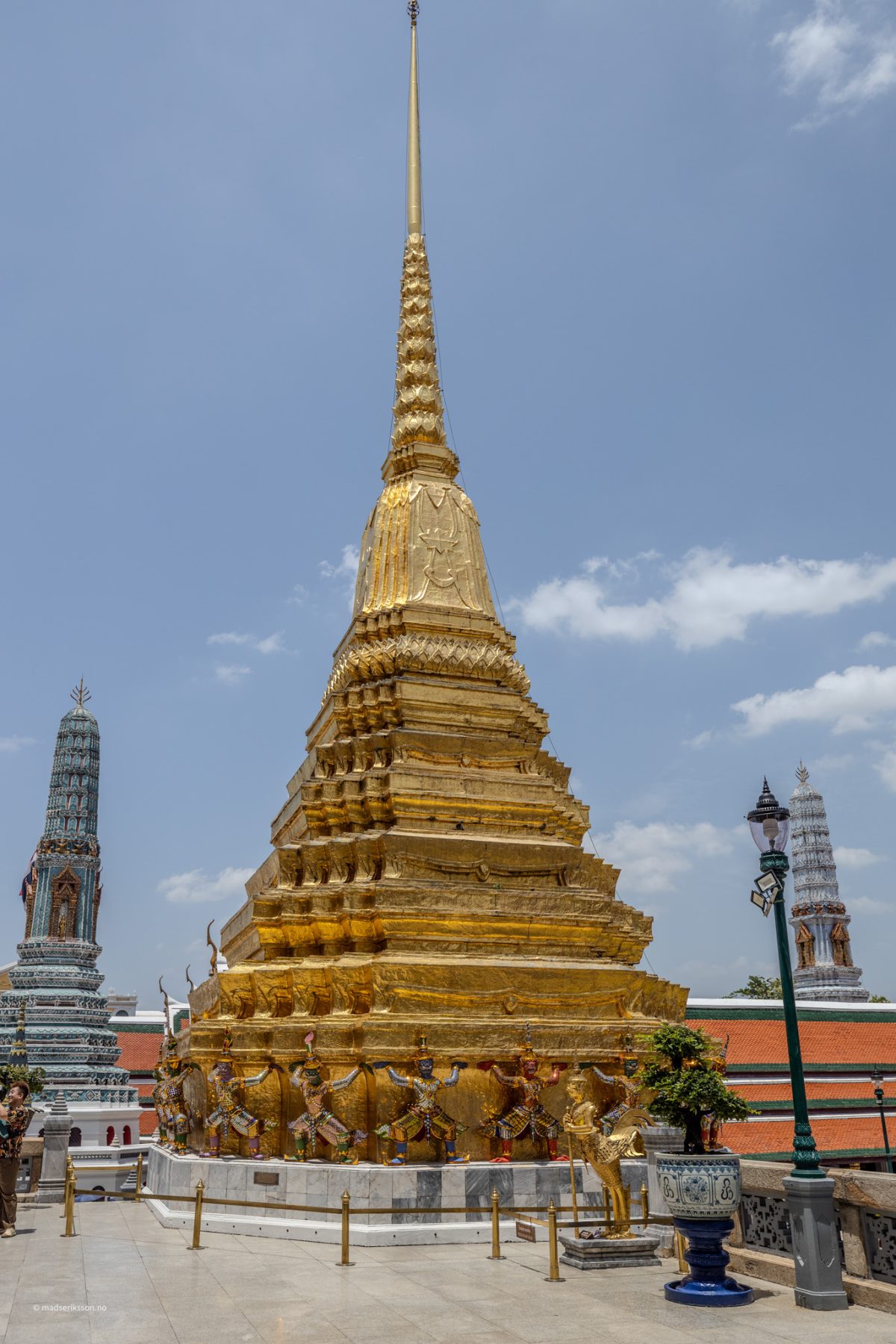
Read the wall and the rest of the compound resolves. The giant yaksha guarding the gates are characters from this story. The monkey figures holding up the golden chedi are Hanuman’s army. The demon faces on the roof finials are Ravana’s. Without the mural they are decorative; with it they are a cast list. It is shaded, it is quiet even at midday, and it is included in the ticket you have already paid for.
Getting in without trouble
Three things get people turned away at this gate, and all three are avoidable before you leave the hotel
Admission is 500 baht, and the timing catches people out: the complex opens at 08:30 but the ticket office and last entry close at 15:30. Turning up at four in the afternoon because a website said it closes at half past four means standing outside a shut ticket window. Go at opening — it is cooler, emptier and gives you the full three hours.
The dress code is the strictest of any attraction in Thailand, and it is checked rather than suggested. You need long trousers or a skirt that fully covers the knee, a top with sleeves covering the shoulder, and closed shoes or strapped sandals. Not permitted: shorts of any length, ripped or torn jeans, vests, tank tops, crop tops, transparent fabric, or backless flip-flops. Cover-ups can be obtained on site if you have got it wrong, which costs time and a deposit. Bring the right clothes; it is thirty seconds of packing.
“If a friendly stranger outside the wall tells you the palace is closed today, the palace is not closed today.”
Which brings us to the third thing. The Grand Palace is open every day of the year, including weekends and public holidays; the only exceptions are royal ceremonies, which are announced officially in advance on the palace’s own site. The scam is decades old and still running: someone approaches you near the wall — often well-dressed, sometimes in something resembling a uniform — explains that the palace is closed today for a ceremony, and offers a tuk-tuk to some other temples instead. That trip ends at a gem shop or a tailor. Do not take advice about opening hours from anyone who is not behind the ticket window.
Getting there: the palace sits in Phra Nakhon, on the old royal island. The pleasant approach is by Chao Phraya express boat to the Tha Chang or Tha Tien piers, which is cheap, quick and avoids the traffic entirely. The MRT Blue Line now reaches Sanam Chai station, a short walk south. Taxis are fine if metered; the tuk-tuk drivers waiting directly outside the gate are, for the reasons above, not.
Finally, string it together properly. Wat Pho is ten minutes’ walk south — cheaper, calmer, with the reclining Buddha and the country’s most famous massage school, and in my view the more enjoyable of the two temples. From the pier beyond it, a two-minute ferry crosses to Wat Arun on the far bank, which is at its best in late afternoon light. Palace at opening, Wat Pho at midday, Wat Arun towards sunset: that is the day, and it works.
“Most people leave the Grand Palace having photographed a great deal of gold and understood almost none of it. The compound is not a collection of pretty buildings — it is a single argument, made in 1782 and extended ever since, that a general who took a jade figure from Vientiane had the right to found a dynasty. Read the wall, look at what the guardians are holding, work out why the roofs on one building disagree with the walls beneath them, and it stops being a photo stop and becomes the most legible thing in Bangkok.”
More in the same area
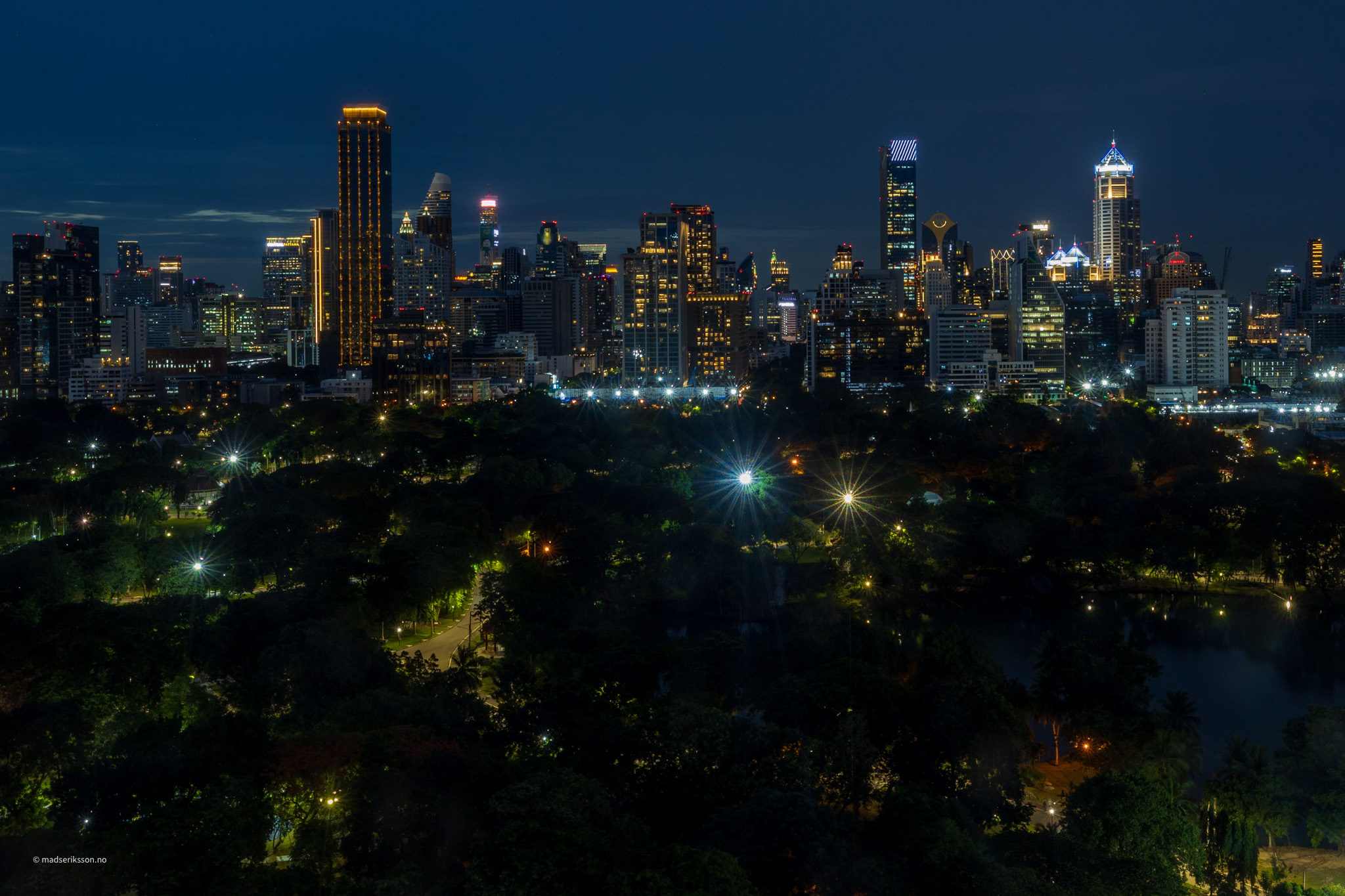 CitiesBangkok — the World’s most visited City
 CitiesThe World’s 10 Great Food Markets
 Train travelThe World’s 10 Great Railway Journeys
 NatureThe World’s 15 Most Spectacular Waterfalls
 ArchitectureEurope’s 10 Greatest Cathedrals and Churches
 ArchitectureTen Buildings That Changed Their Cities — Modern Architecture Ranked on Impact, Not Image