Nothing at Ta Prohm is standing still. The stone was laid without mortar in 1186; the seeds arrived later, carried onto the rooftops by birds. For five centuries the forest has been working its way down through the galleries, one root and one displaced block at a time. What you walk through today is not a ruin that nature happened to decorate. It is a slow argument between a building and a forest — and the forest is ahead.

Ta Prohm sits about a kilometre east of Angkor Thom, on the southern edge of the East Baray. It was founded in 1186 by Jayavarman VII — the king behind the great late-Angkorian building programme — as a Mahayana Buddhist monastery and centre of learning, and it was dedicated to his mother. The central image represented Prajnaparamita, the personification of wisdom, and was modelled on her. Five years later he built Preah Khan for his father. The two temples were designed as a pair.
The plan is a flat temple rather than a temple-mountain: five rectangular enclosure walls laid out around a central sanctuary, with the outermost measuring roughly one kilometre by 650 metres and enclosing 650,000 square metres that once held a small town. It faces east, as Khmer temples do. And it was built without mortar — the single technical detail that decides everything that happens later in this story.
Why this one was left alone
When French conservators began clearing Angkor in the early twentieth century, the École française d’Extrême-Orient made a deliberate exception for Ta Prohm. It would be stabilised enough to walk through, but otherwise left as it was found — what the record politely calls a concession to the taste for the picturesque. Maurice Glaize, the scholar who did much of the early work here, chose it precisely because it had “best merged with the jungle” without yet becoming part of it. That judgement, made a century ago, is why Ta Prohm looks the way it does — and why it is the hardest temple at Angkor to keep standing.
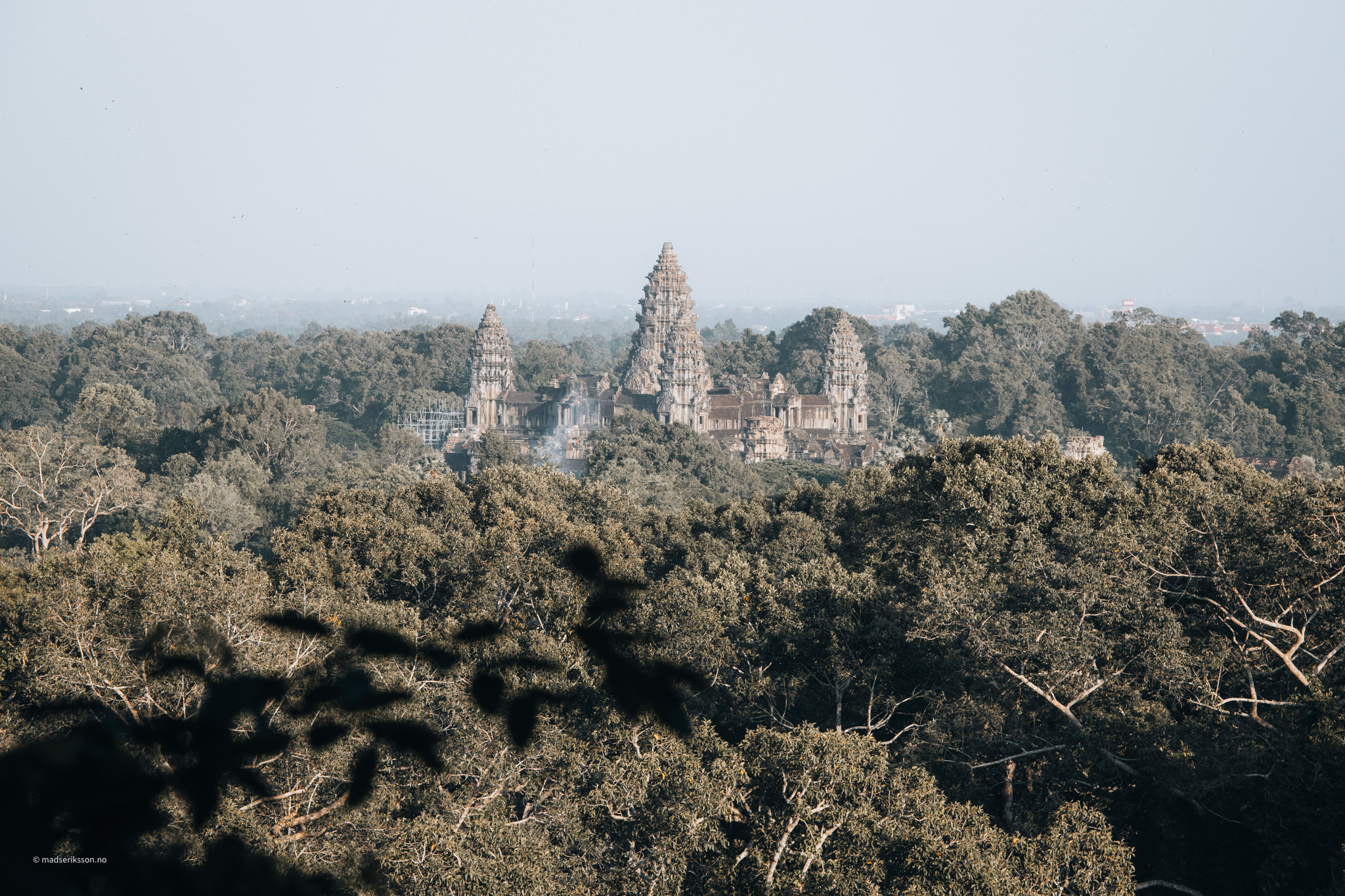
Ta Prohm, from above
Ta Prohm sits about a kilometre east of Angkor Thom. Jayavarman VII founded it in 1186 as a Mahayana Buddhist monastery and dedicated it to his mother. Five enclosure walls surround the central sanctuary; the outermost measures roughly one kilometre by 650 metres and encloses 650,000 square metres. From above, almost all of it is forest.
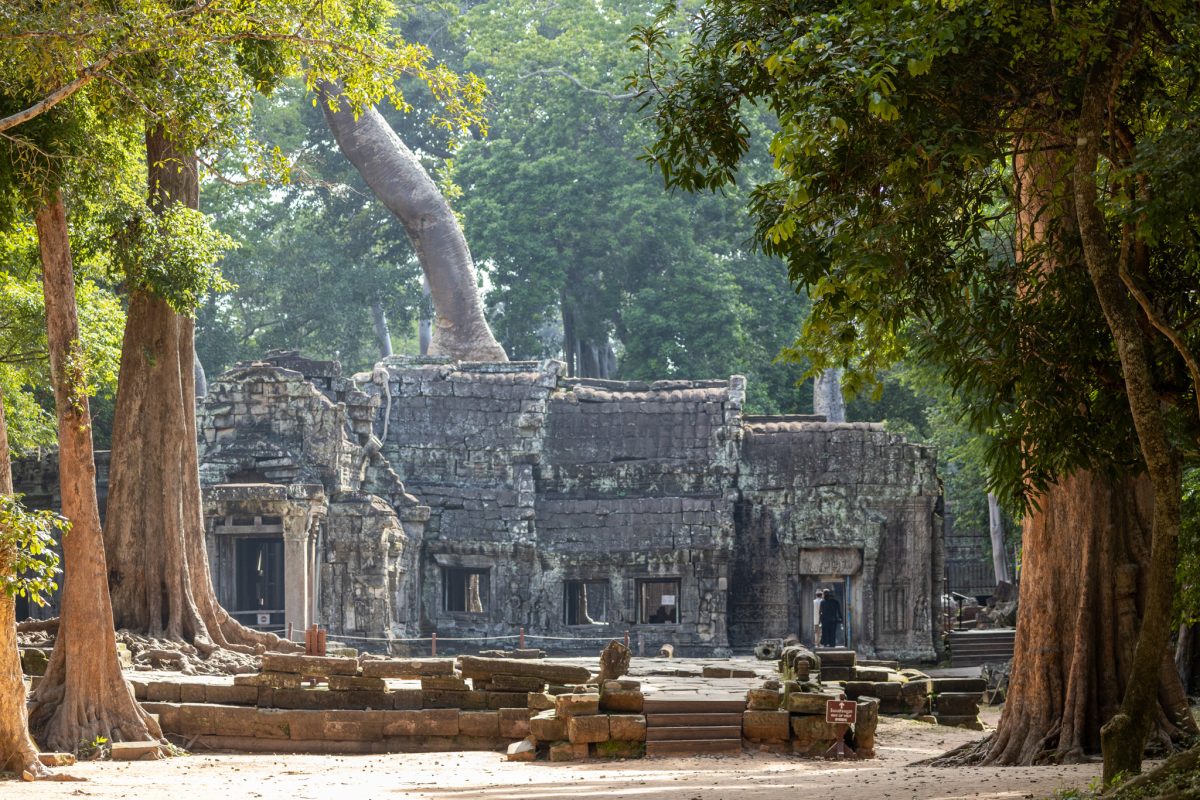
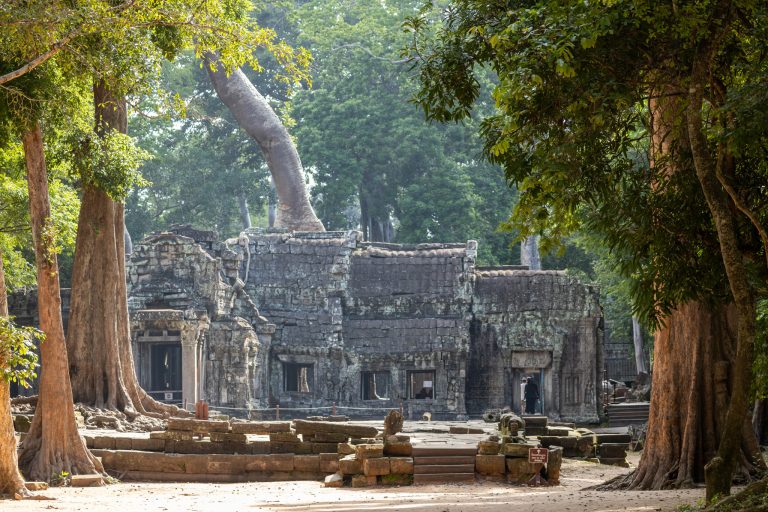
Tall forest trees around a ruined gallery of Ta Prohm, with a giant trunk rising from its roof
The way in
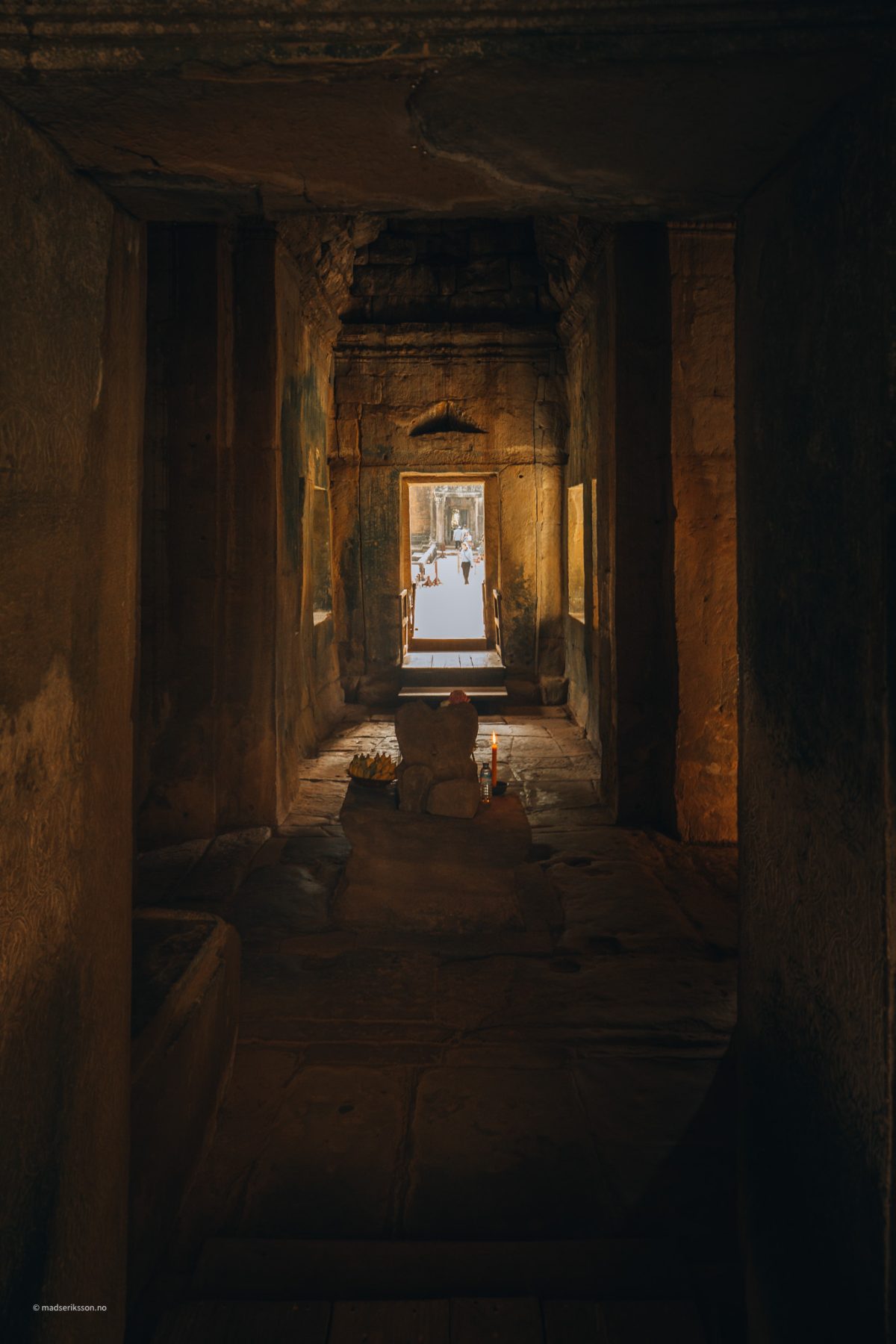
Like other Khmer temples, Ta Prohm faces east. Access today is from the east and the west only, which channels every visitor along broadly the same route towards the centre.
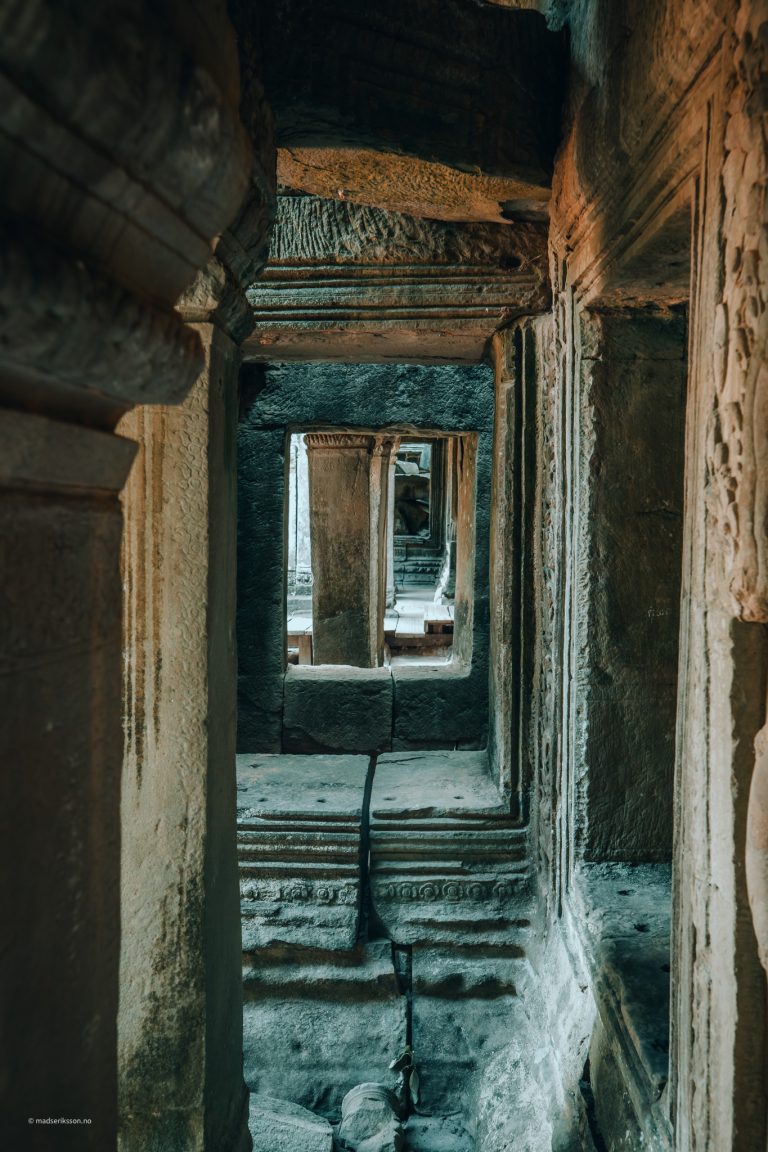
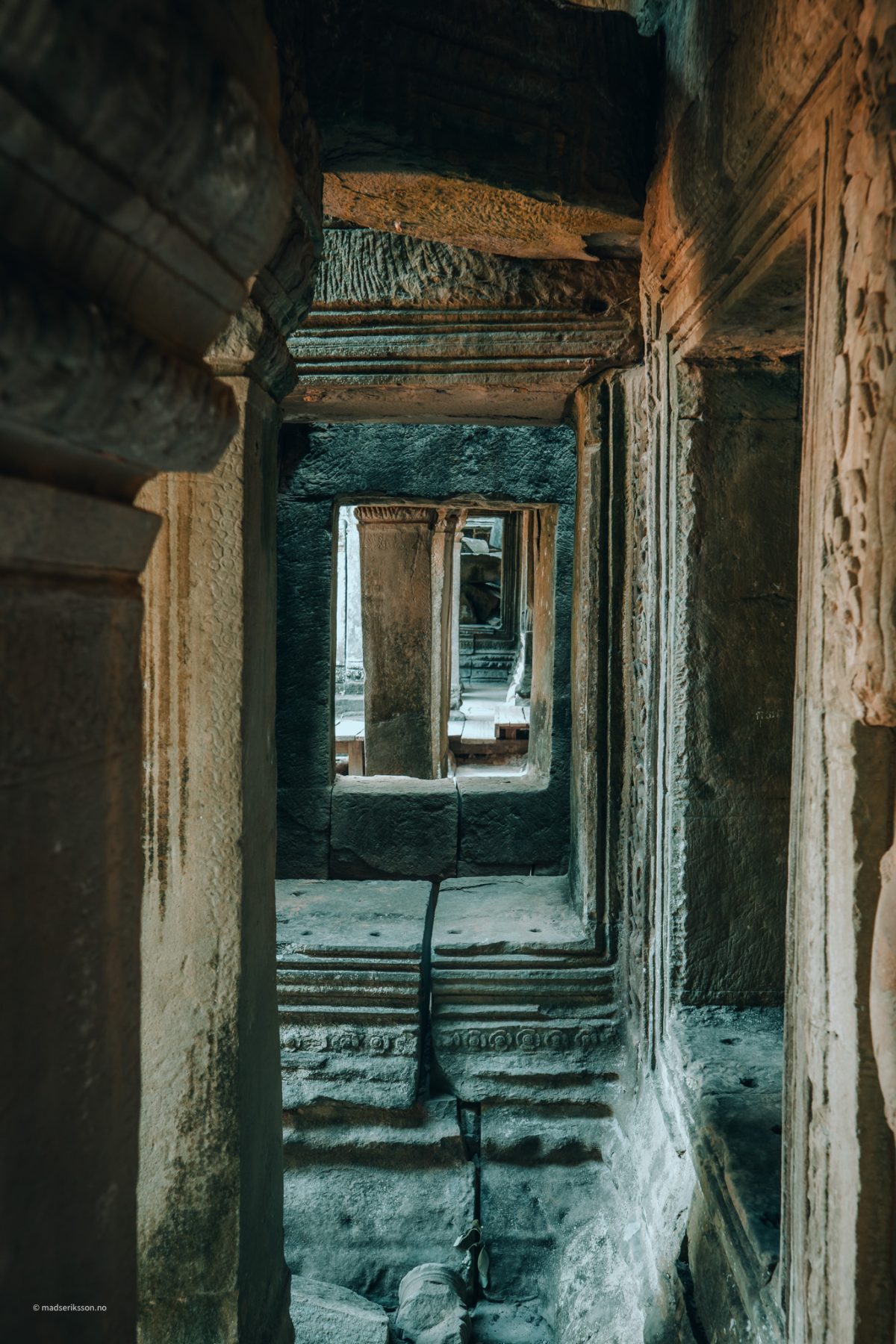
A long line of doorways receding through the stone galleries of Ta Prohm
The plan beneath the trees
With the trees taken away, the plan appears: a flat temple rather than a temple-mountain, with galleries and walls laid out in rectangles around the central sanctuary. The sandstone was laid without mortar, the detail that decides everything that happens later.
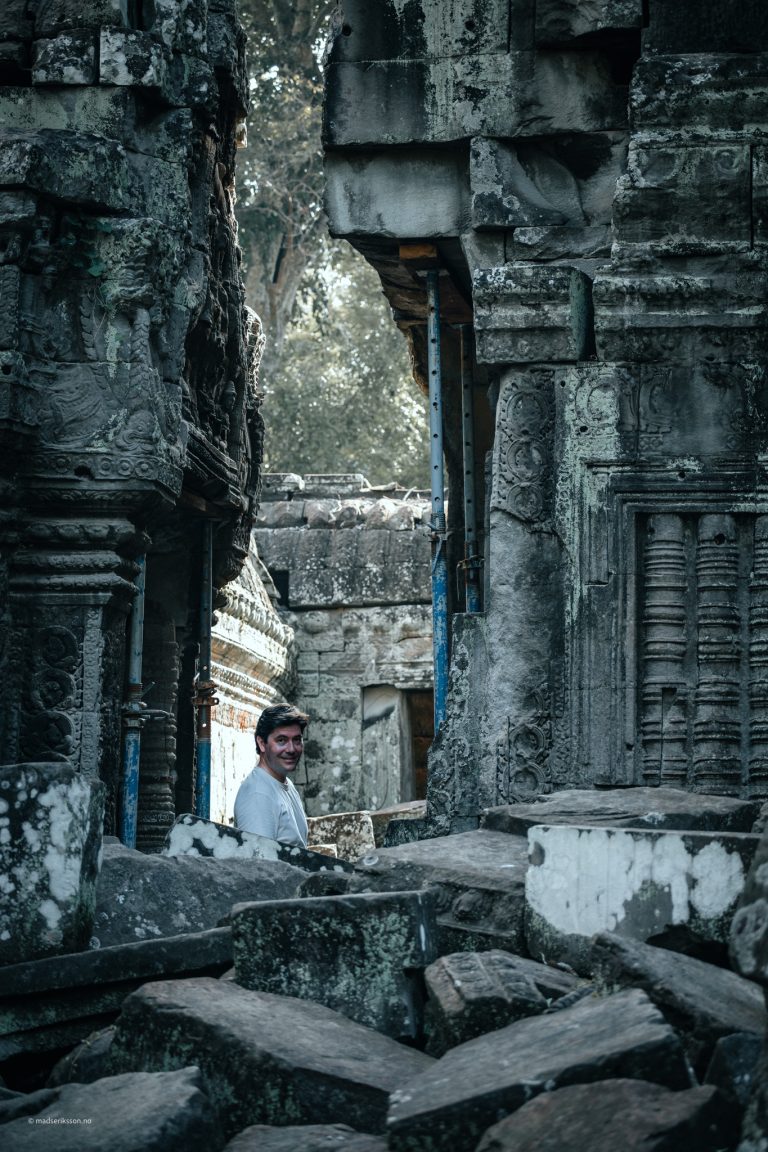
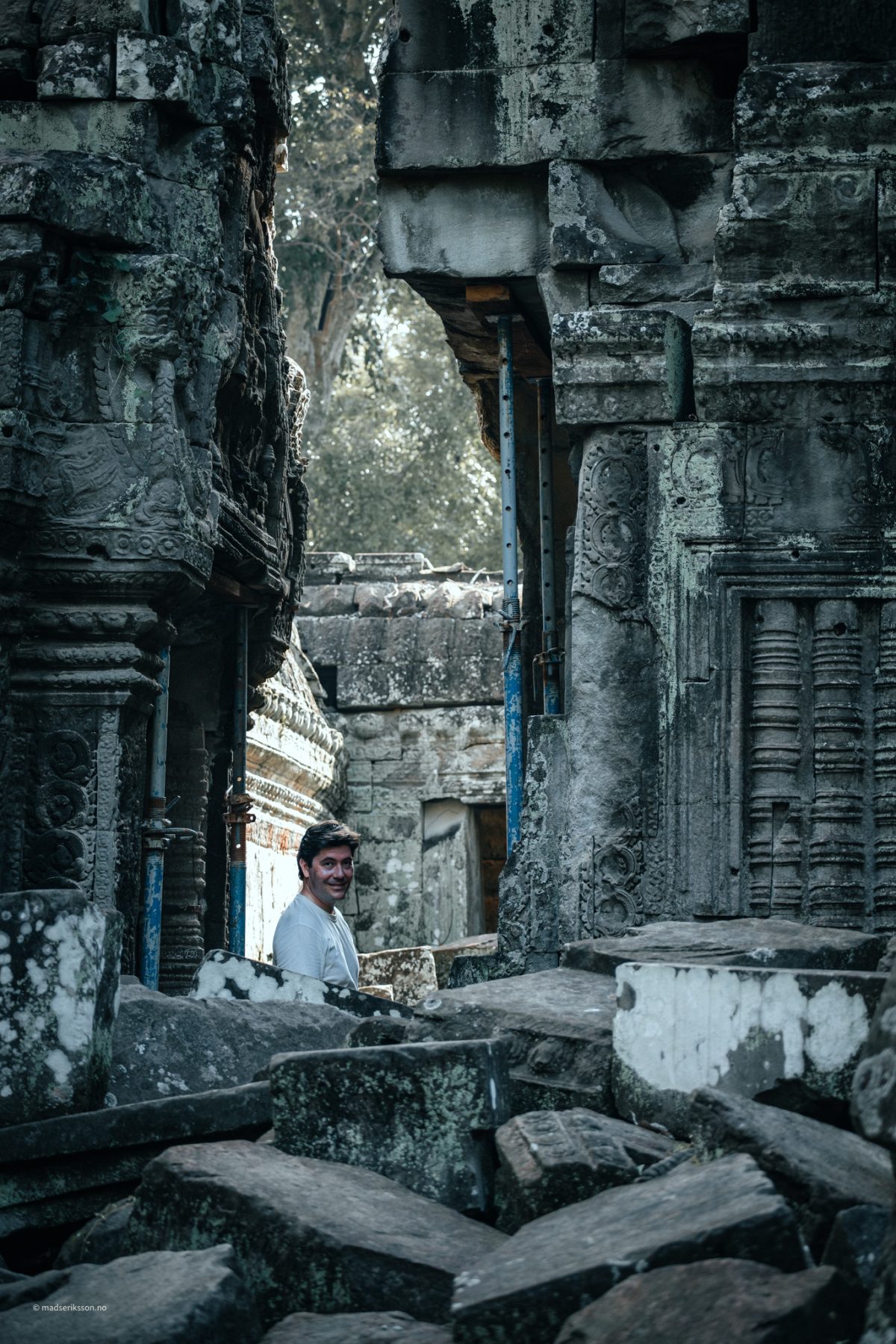
A visitor resting among fallen blocks and broken walls in the ruins of Ta Prohm
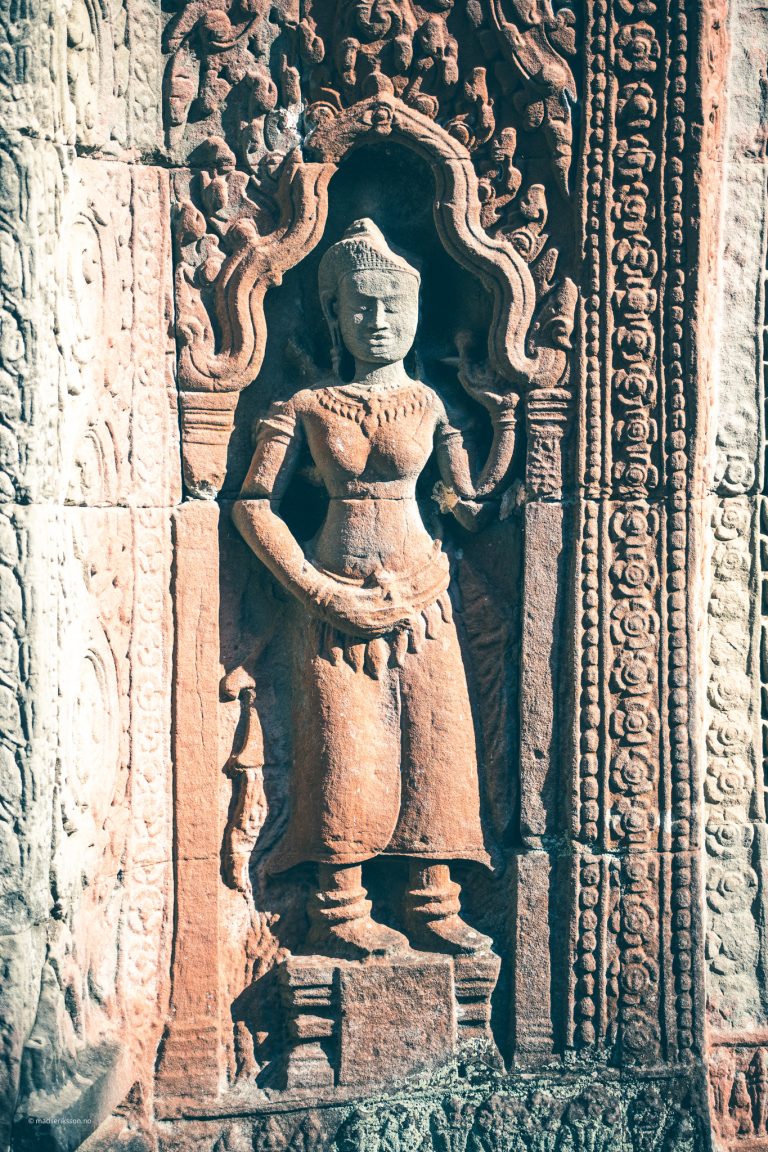
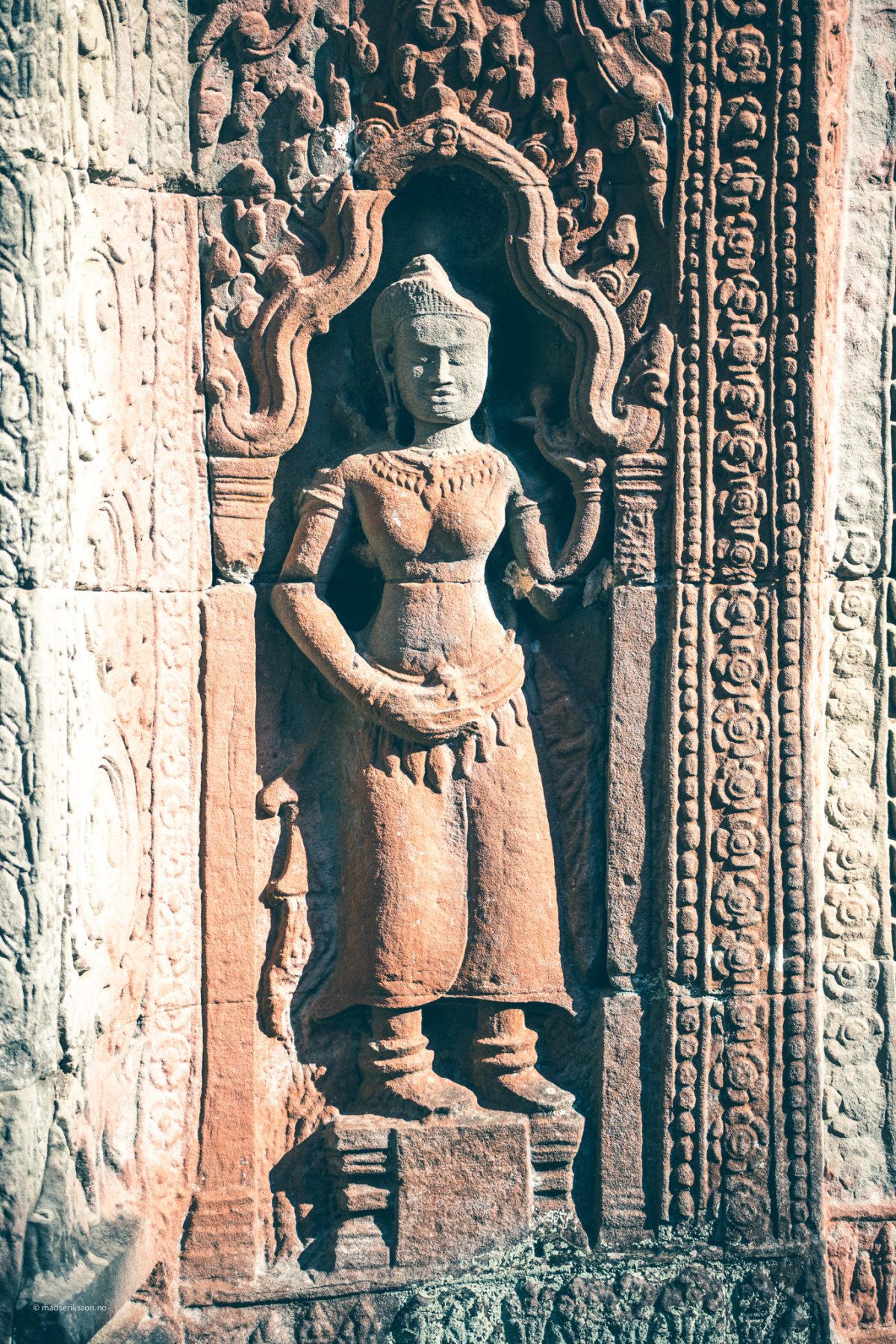
The Hall of Dancers
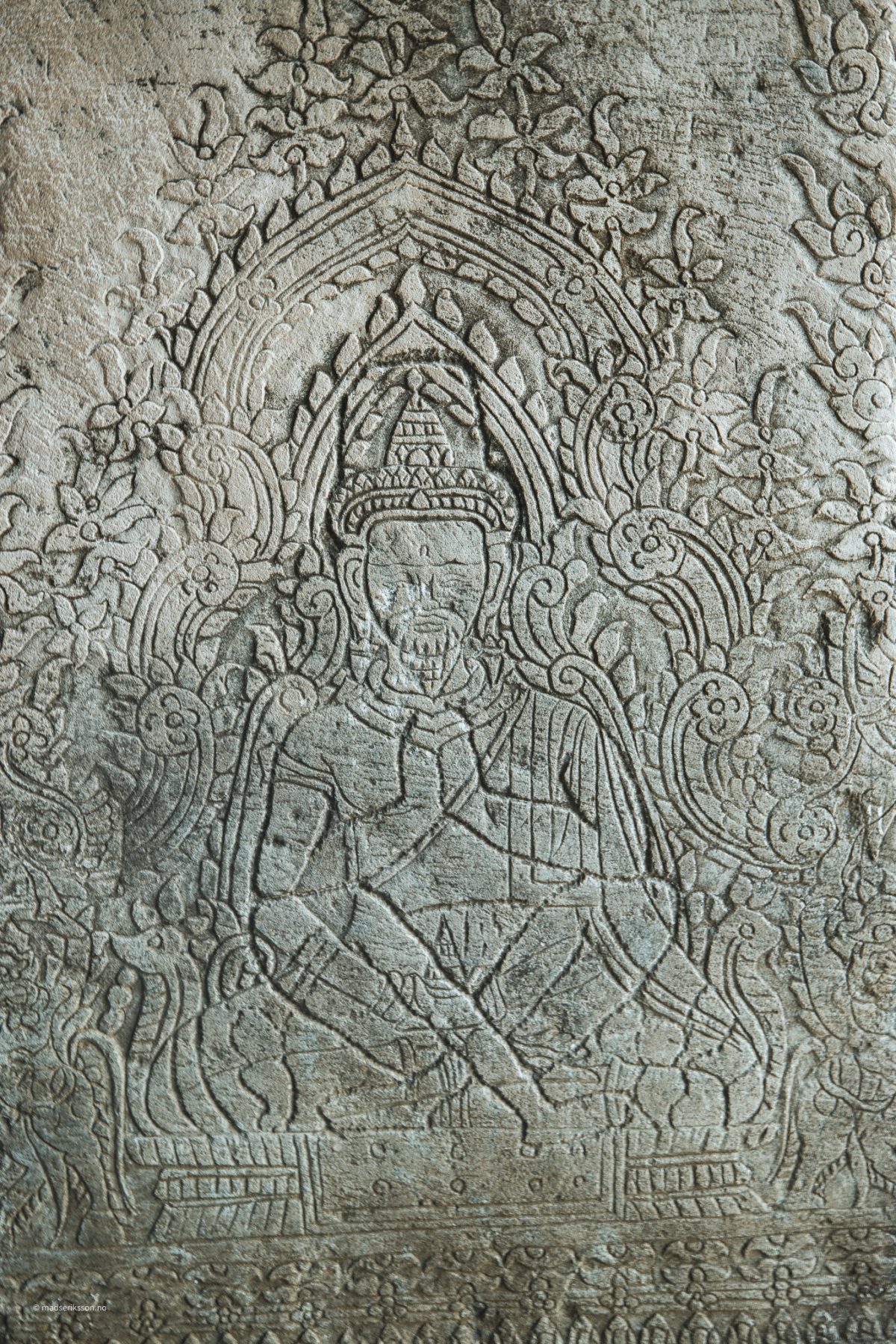
The foundation stele lists 615 dancers among the people of the monastery, and the Hall of Dancers, east of the third gopura, was built for them. It reopened after renovation in November 2022.
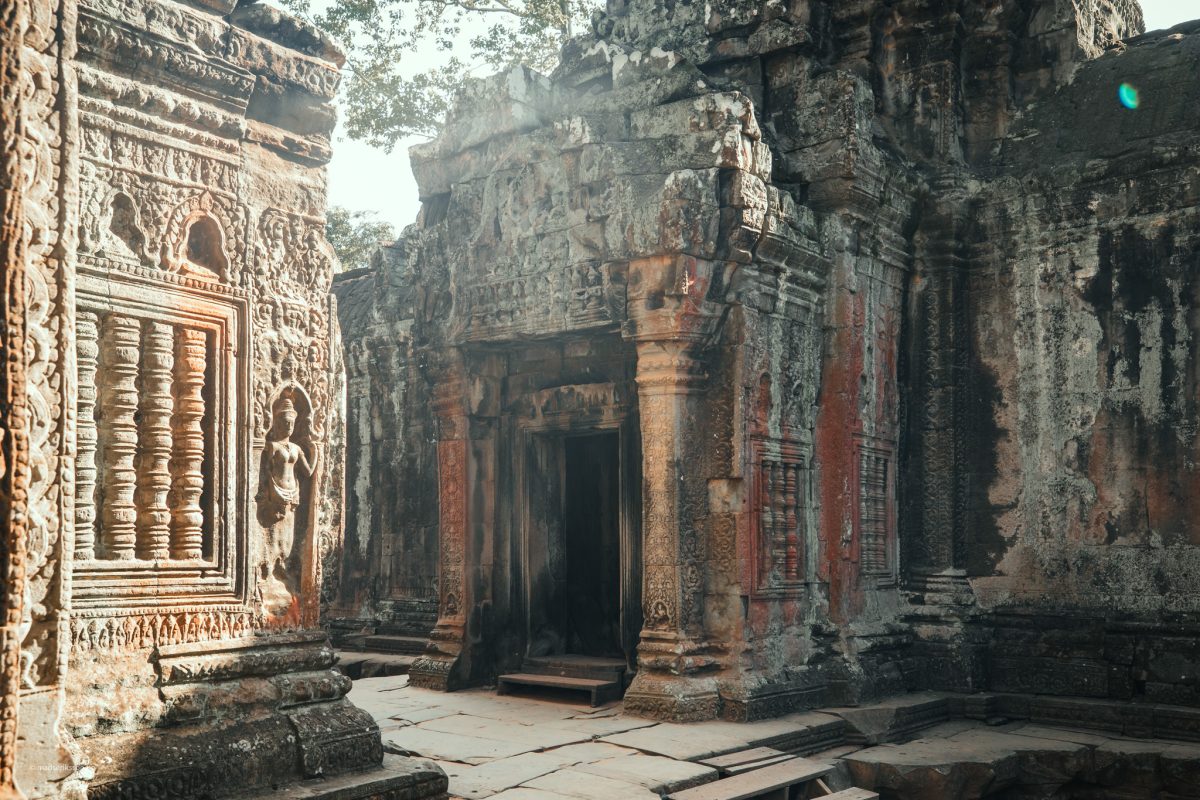
A carved devata standing in an ornate niche on a temple wall at Ta Prohm near Siem Reap
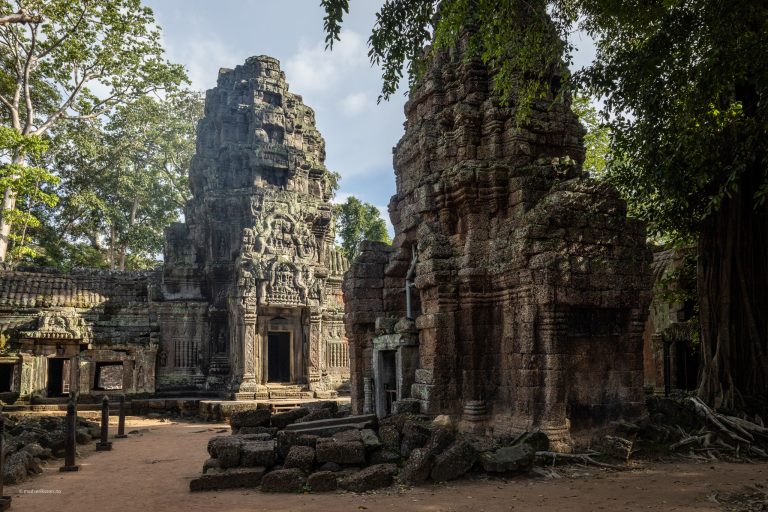
The central sanctuary
The central image represented Prajnaparamita, the personification of wisdom, and was modelled on the king's mother. The stele counts 12,640 people living at the monastery.
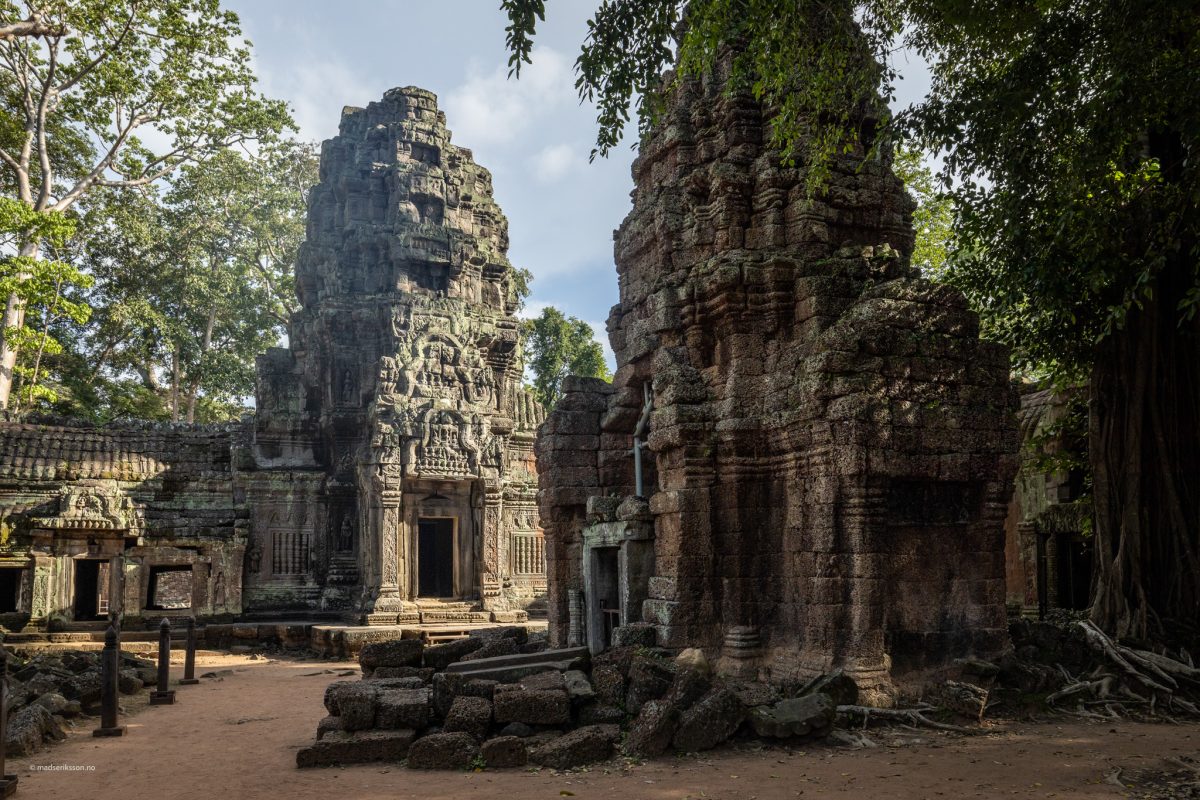
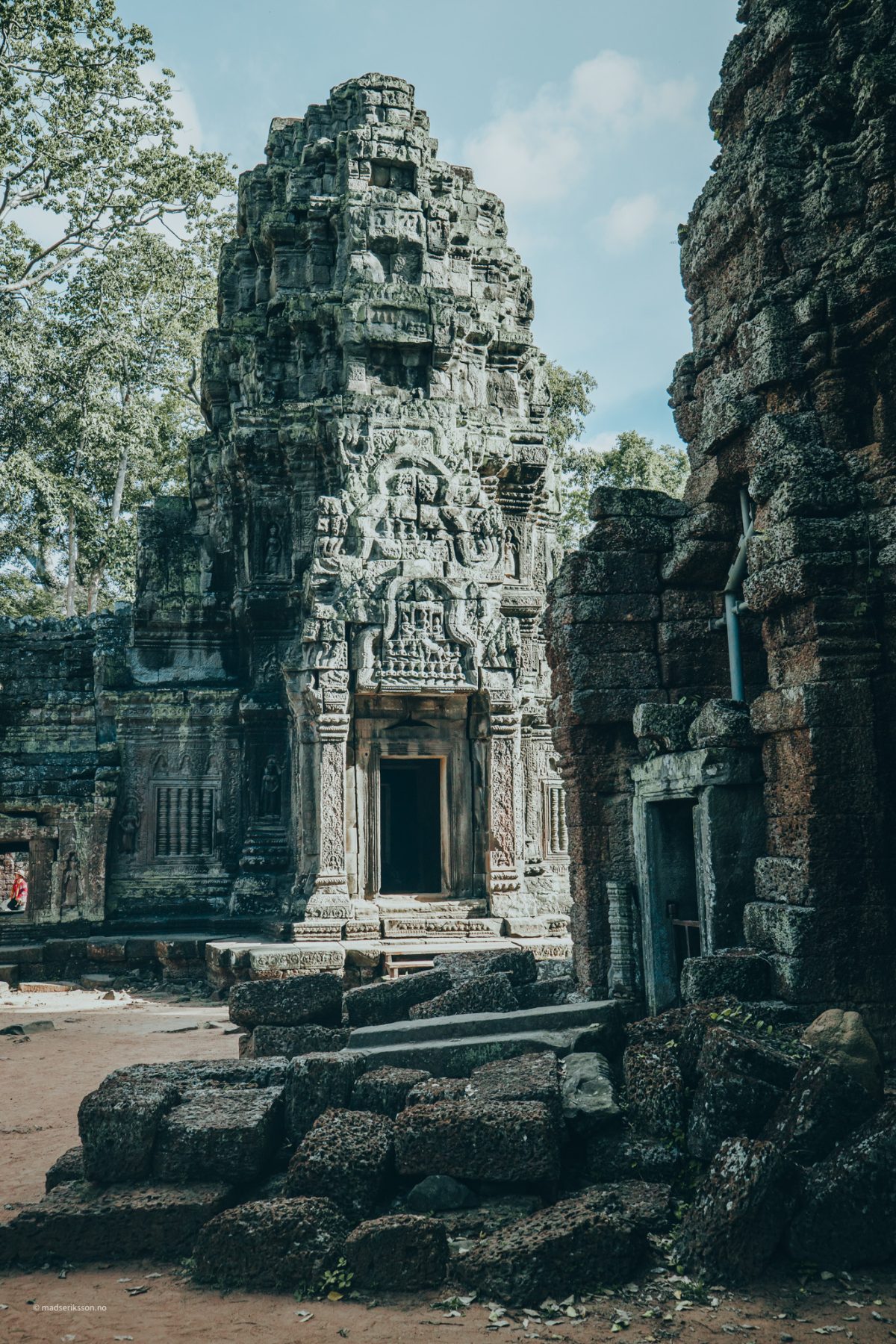
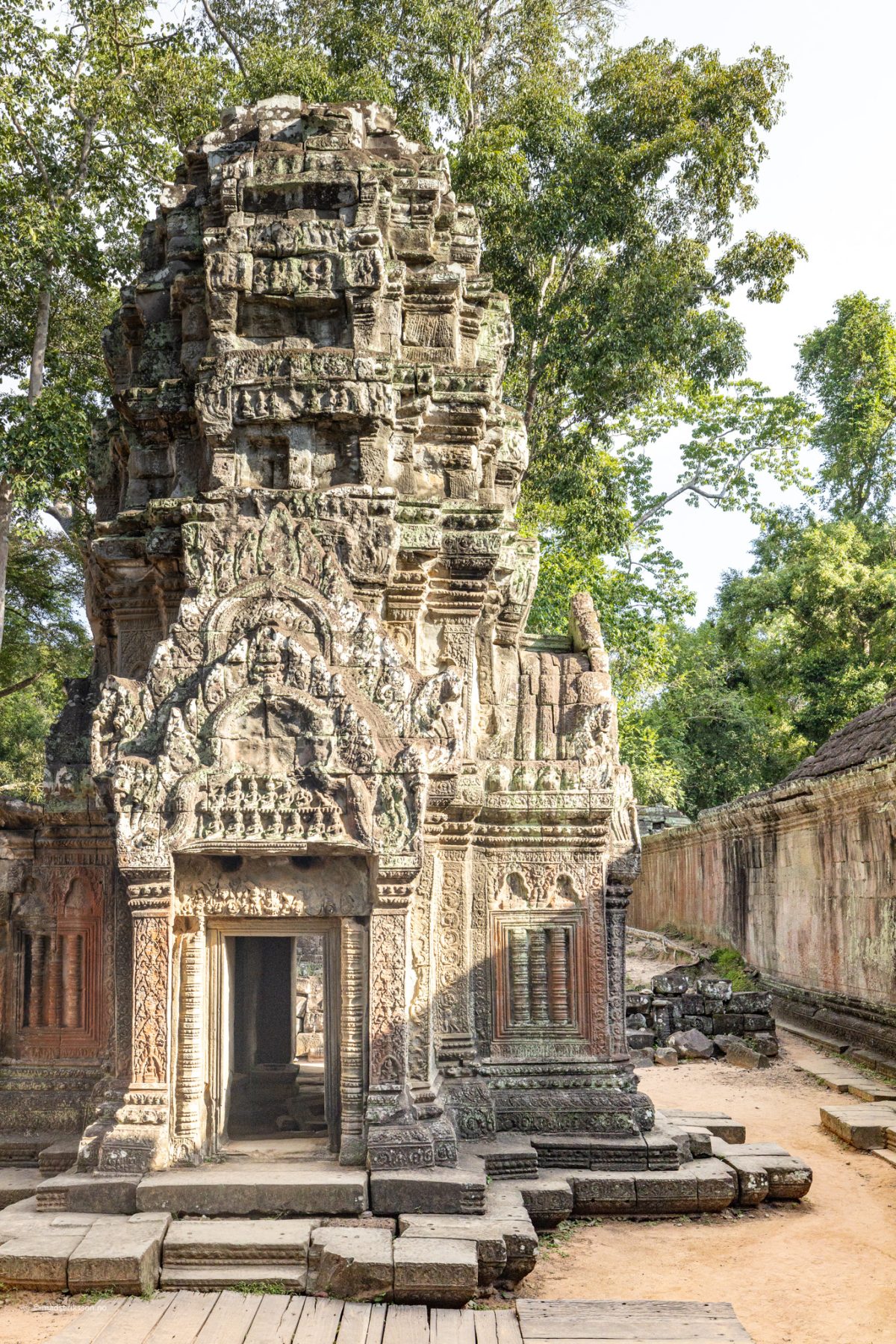
Carved sandstone towers in an inner courtyard of Ta Prohm, framed by the surrounding forest
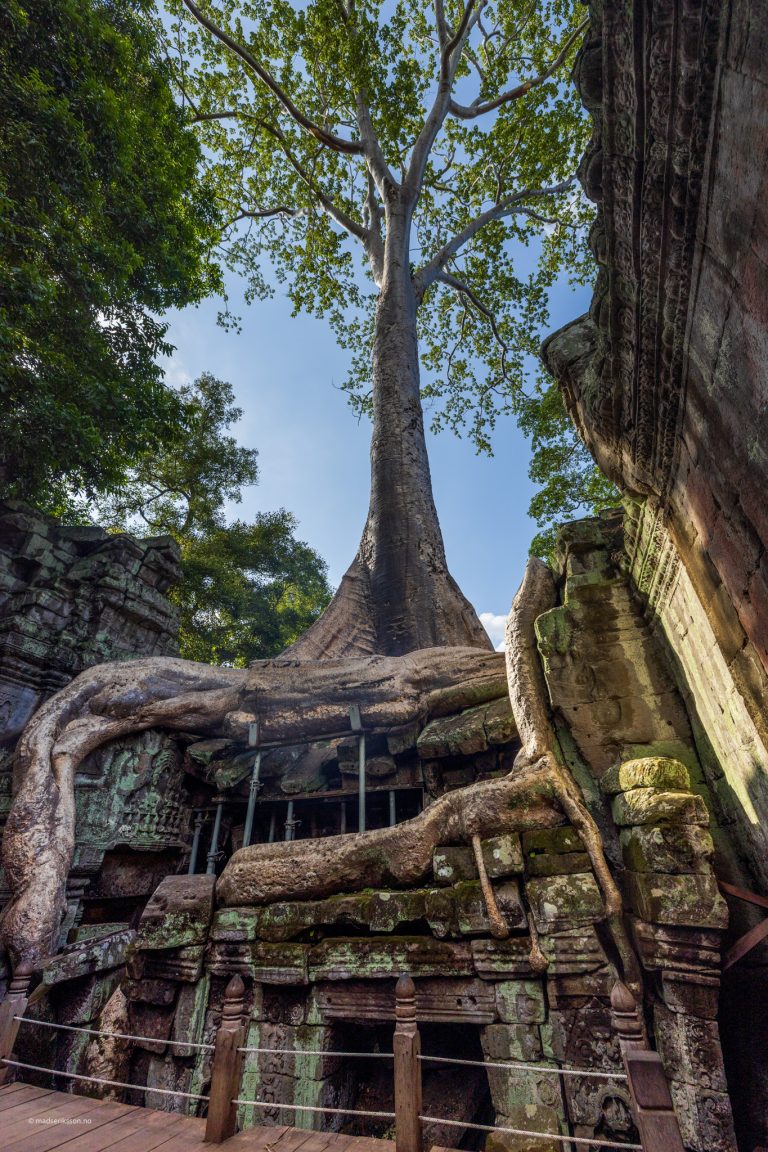
Seeds that arrived on the roof
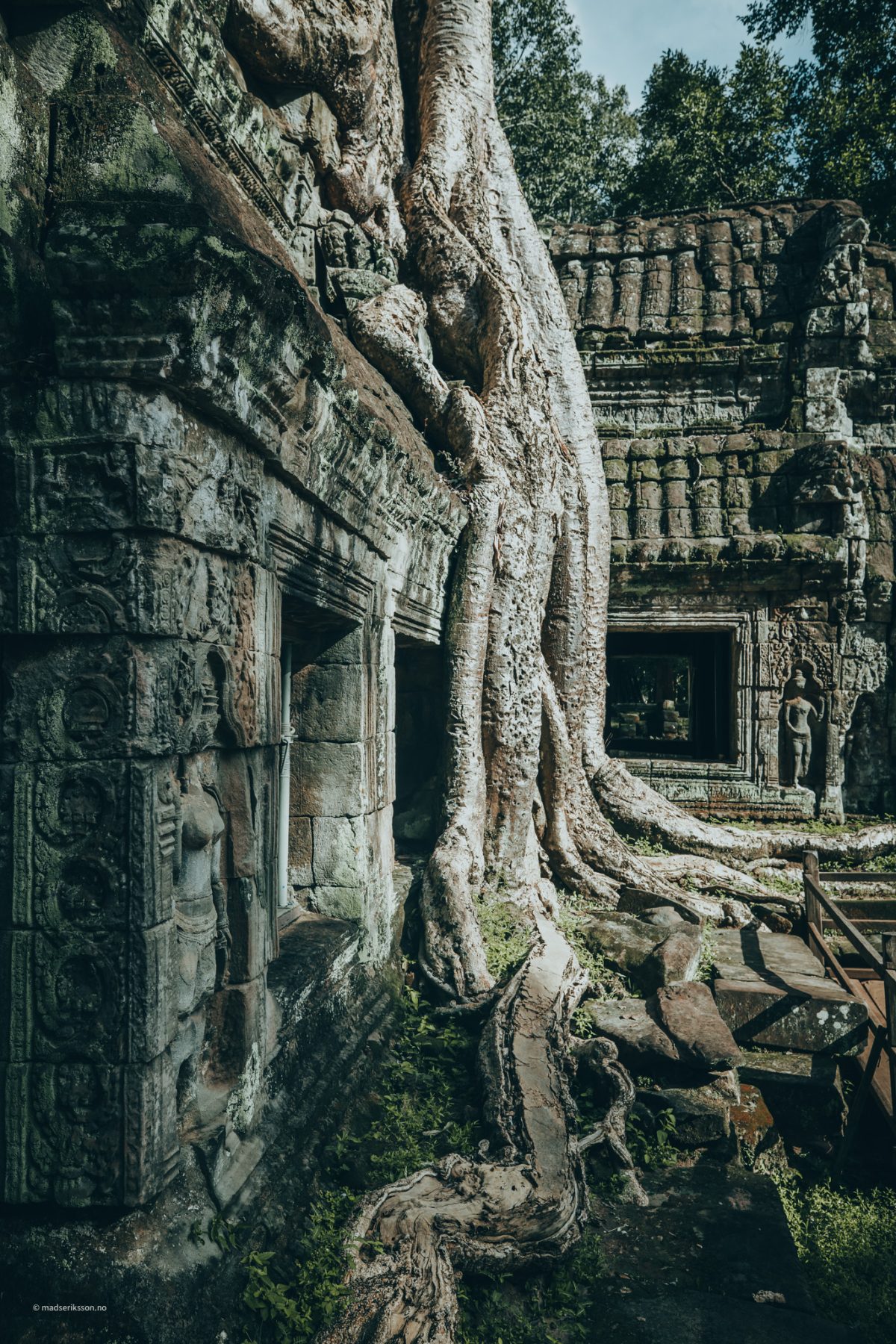
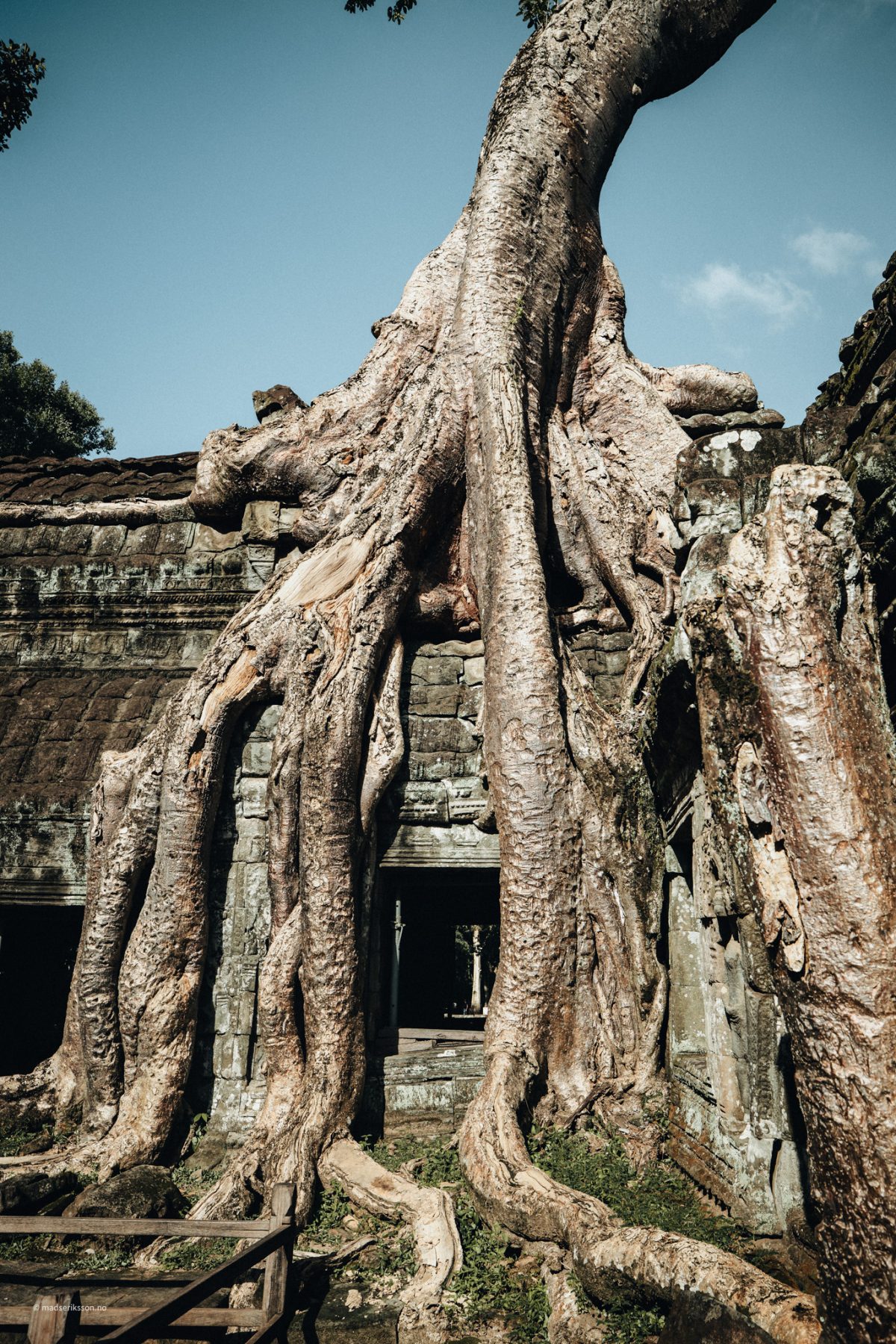
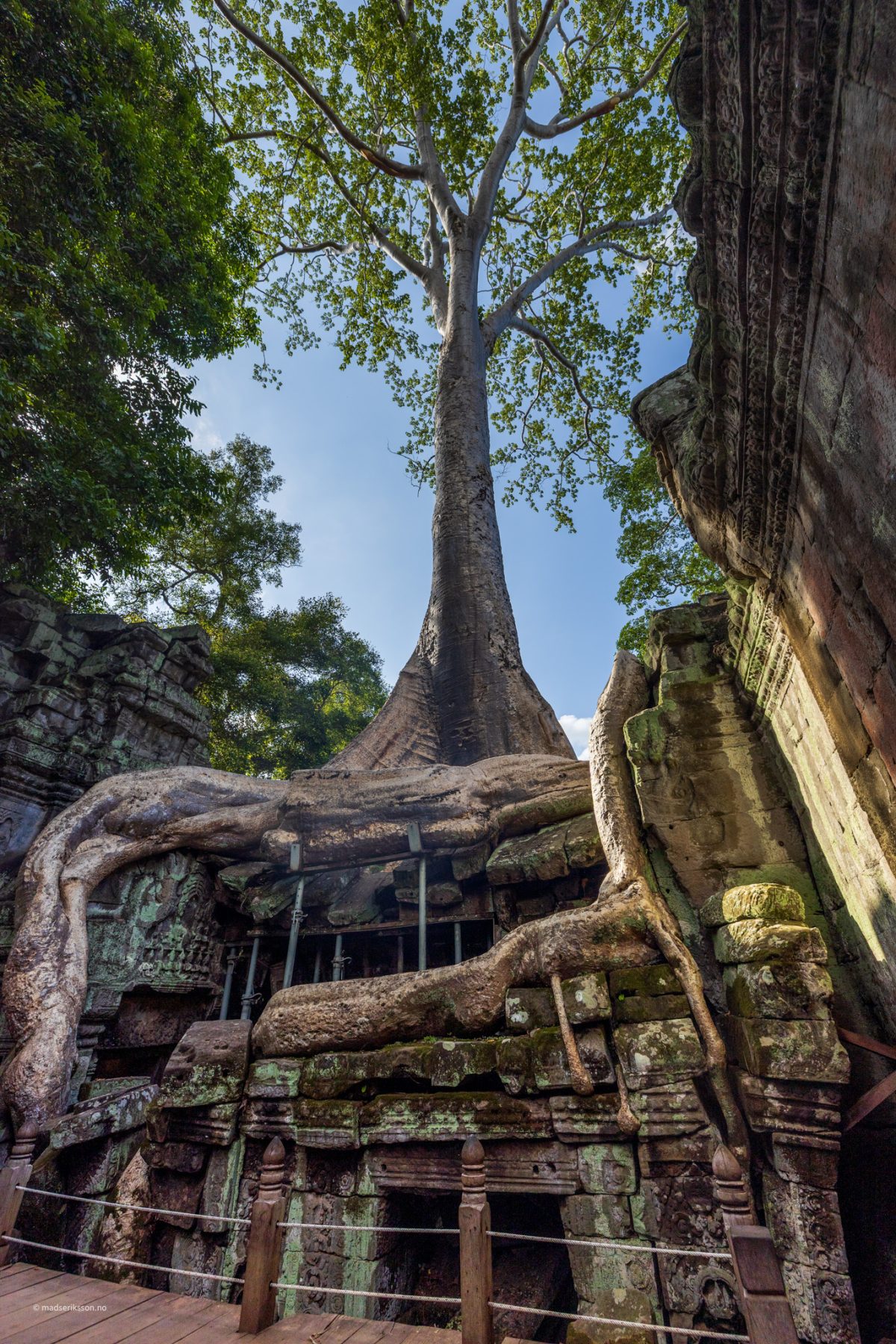
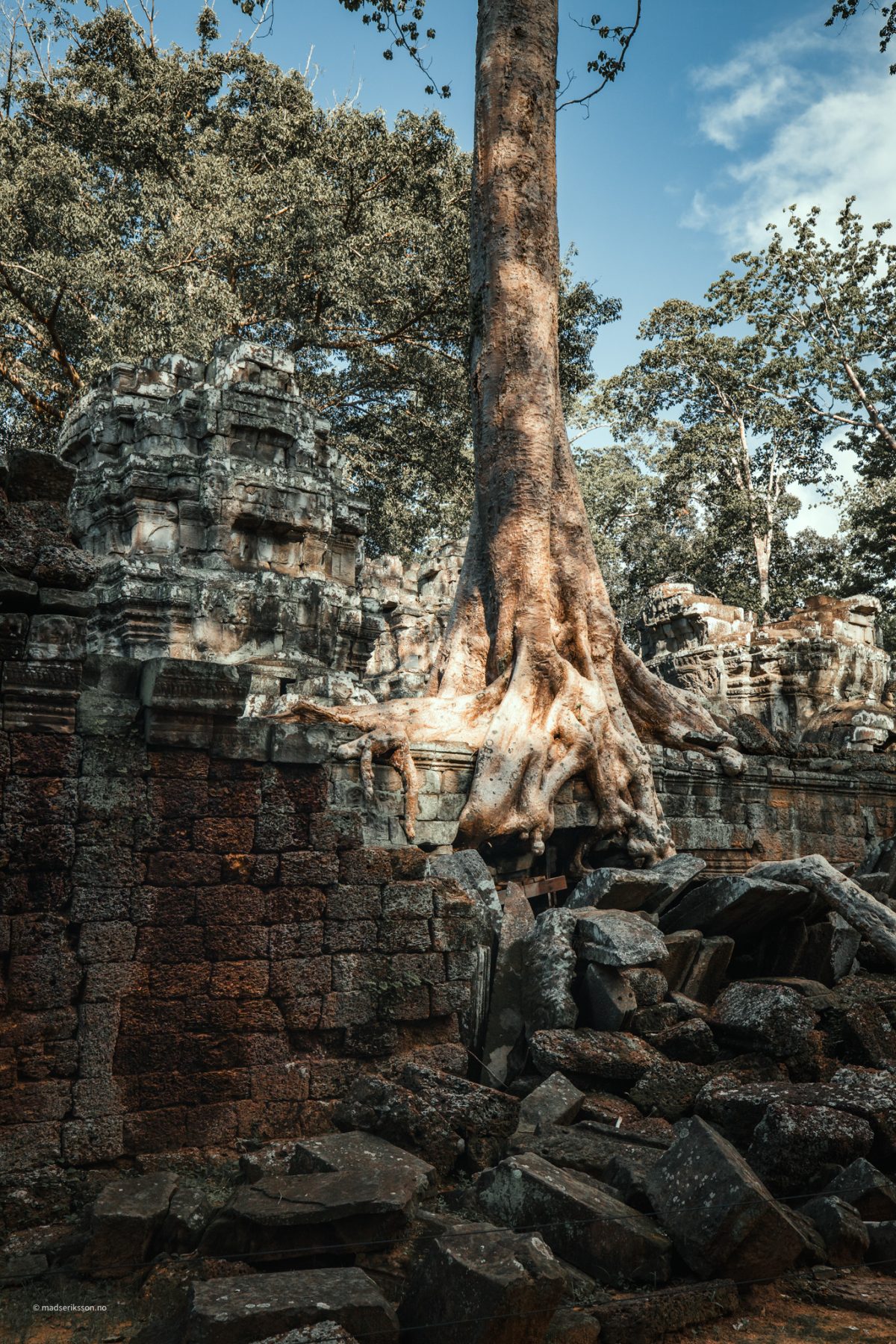
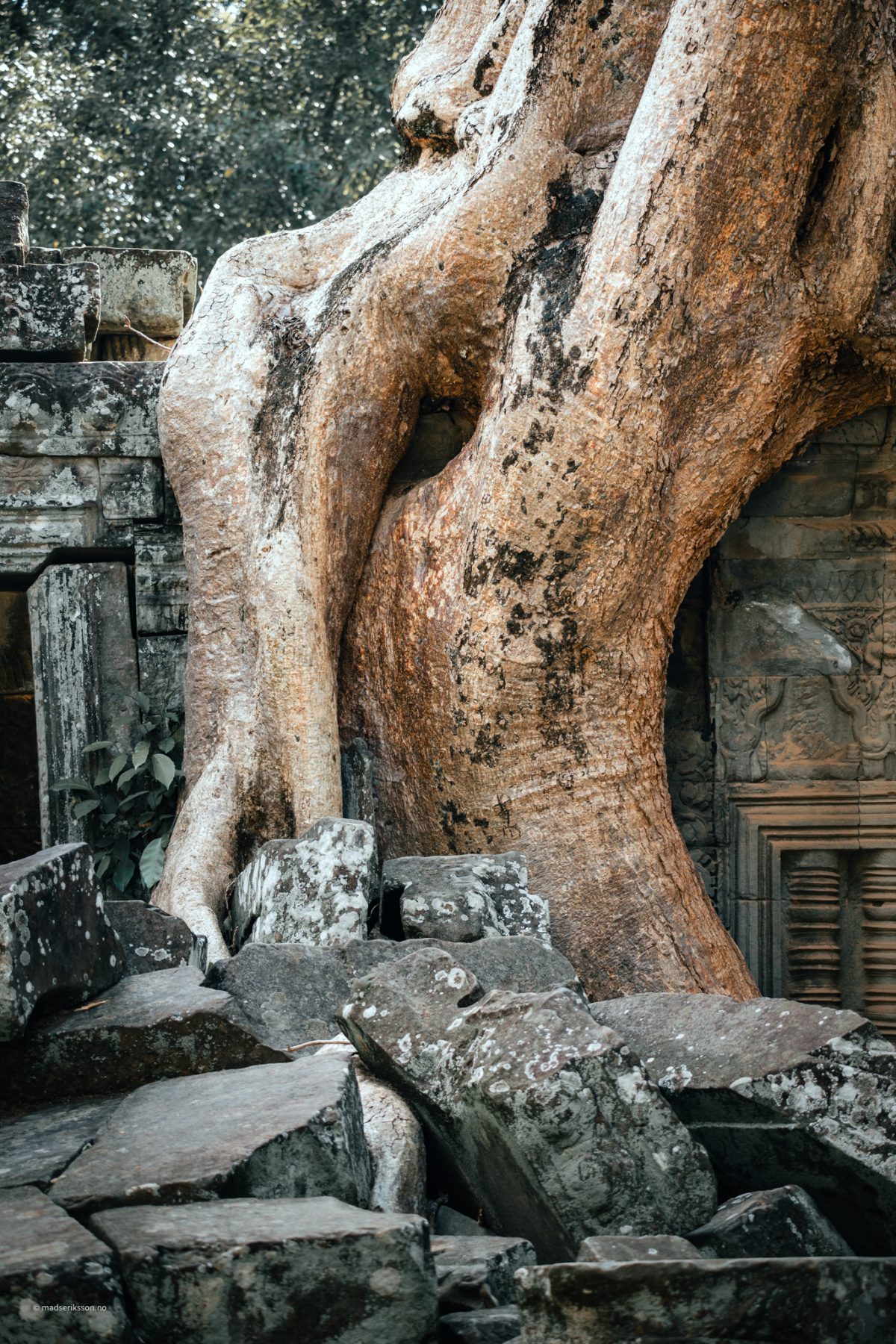
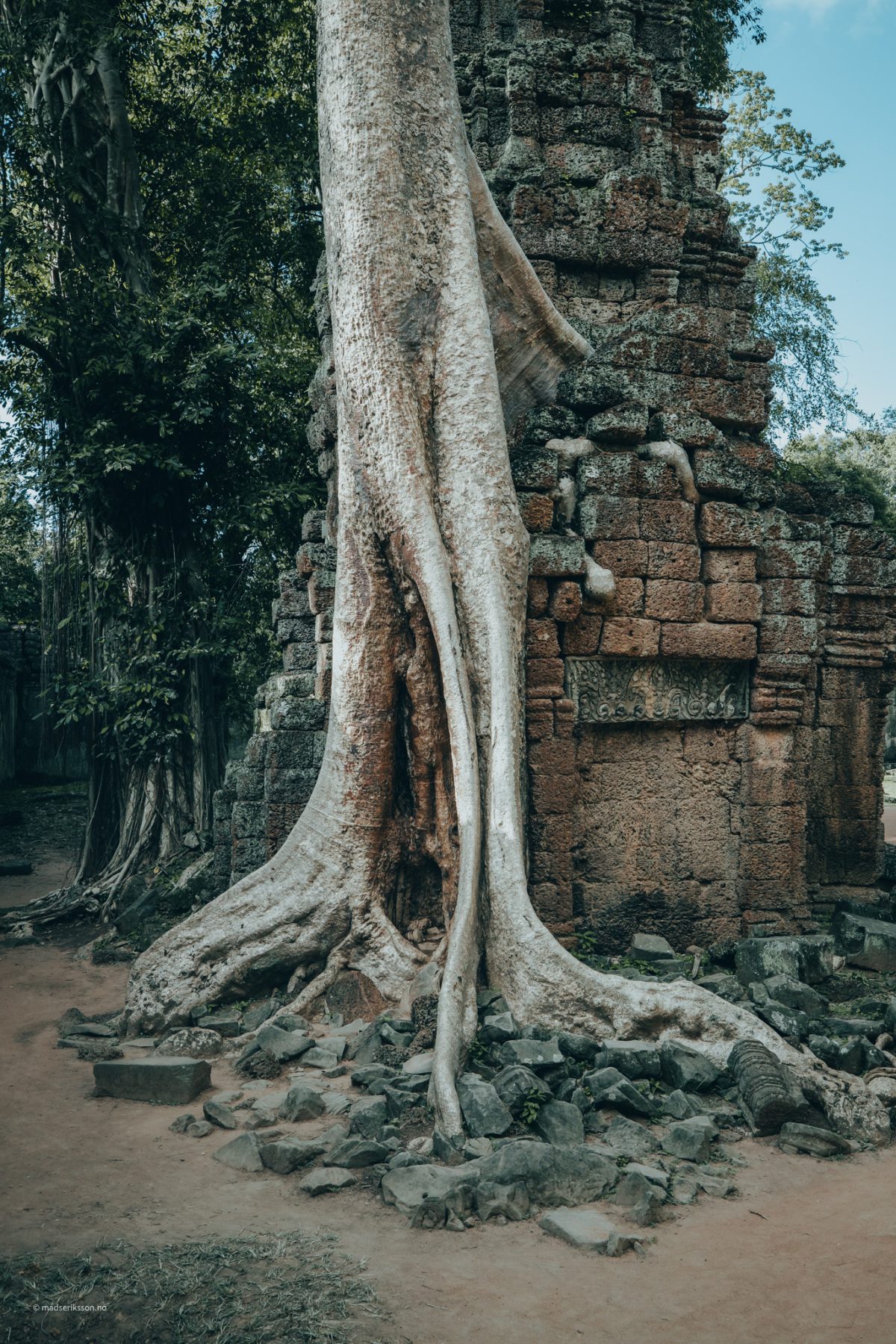
Birds left seeds on the flat gallery roofs, and the roots grew down through the joints of the mortarless stone. Two species dominate: Tetrameles nudiflora, known in Khmer as spung, with its great buttress roots, and a strangler fig. The largest stand more than 30 metres tall.
A towering tree rooted on top of a ruined gallery at Ta Prohm, its roots spilling over the stones
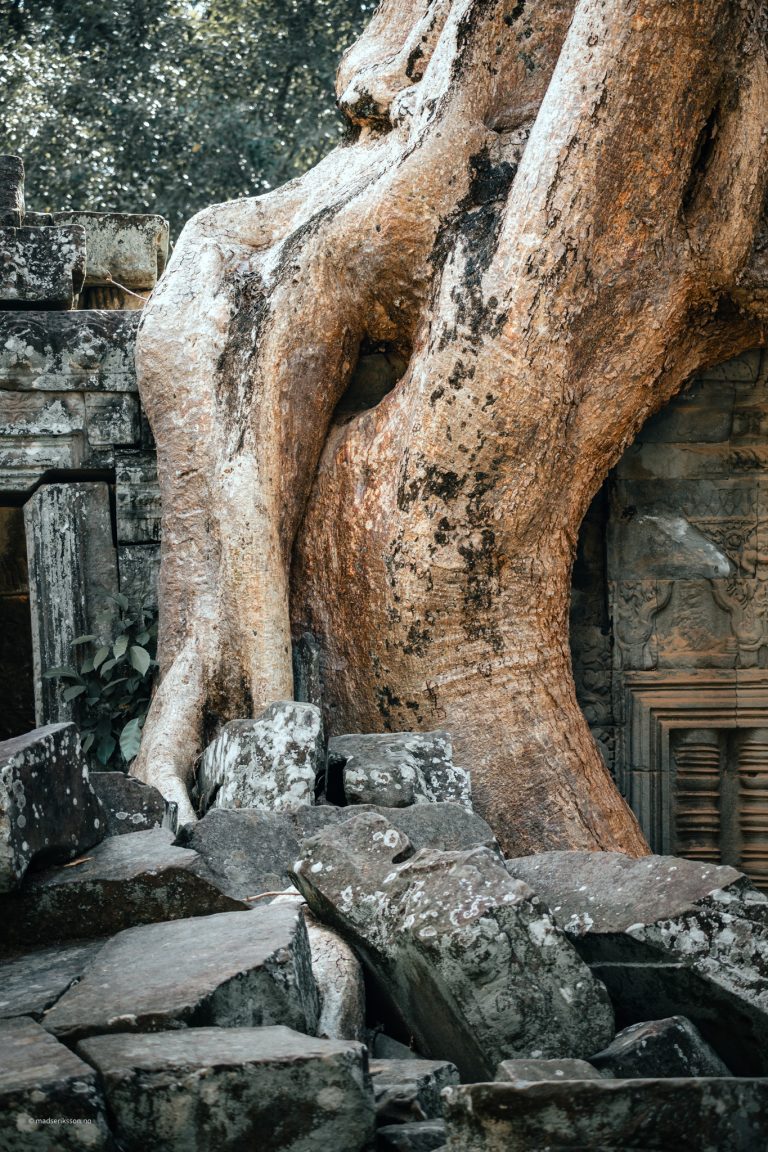
Keeping a ruin ruined
The APSARA Authority and the Archaeological Survey of India share the work. The main works ran from 2004 to 2013; wooden walkways and platforms keep visitors off fragile stone. Some trees are removed, others are consolidated with the stone they hold.
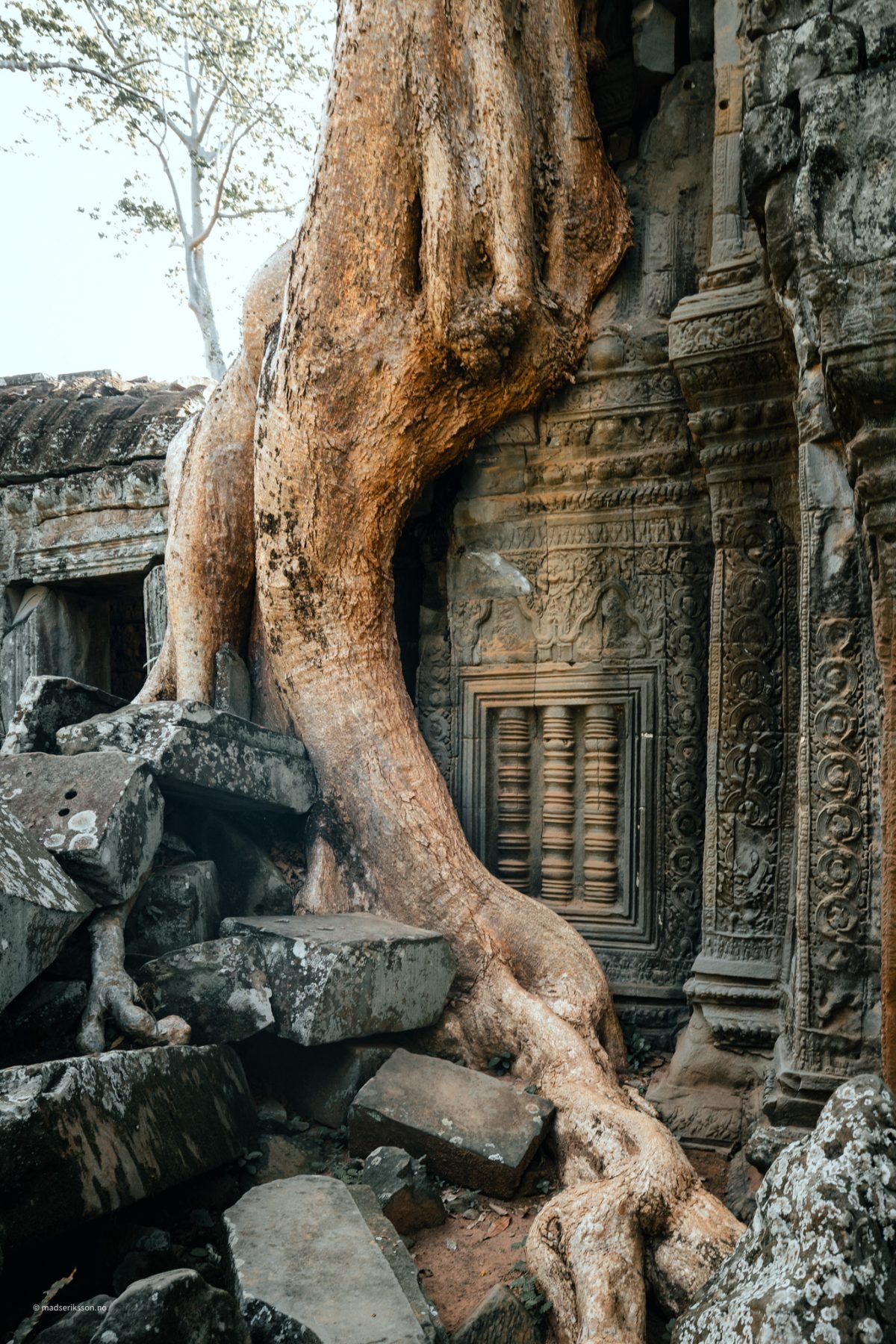
Pale tree roots wrapped around a doorway at Ta Prohm, with toppled stones piled at their base
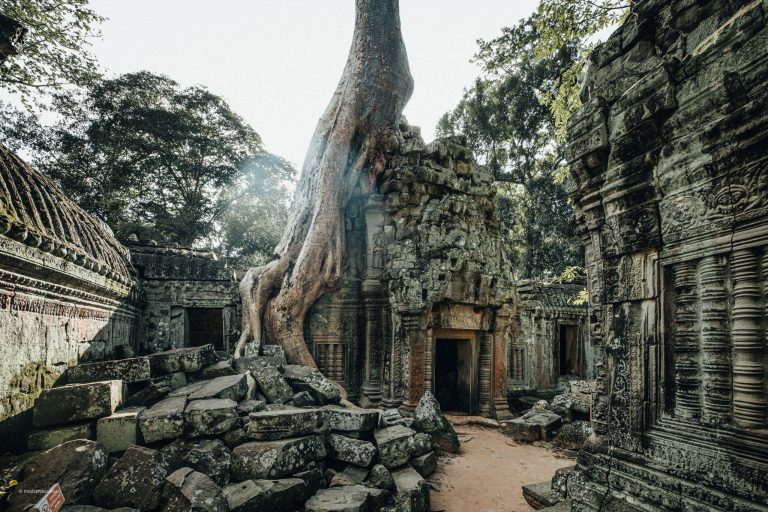
Arrive early, or late
Ta Prohm opens 06:00–18:00 and sits on the Small Circuit with Angkor Wat and the Bayon. Arriving at opening, or after about 15:30, makes a real difference to the crowds. Allow 1.5–2 hours.
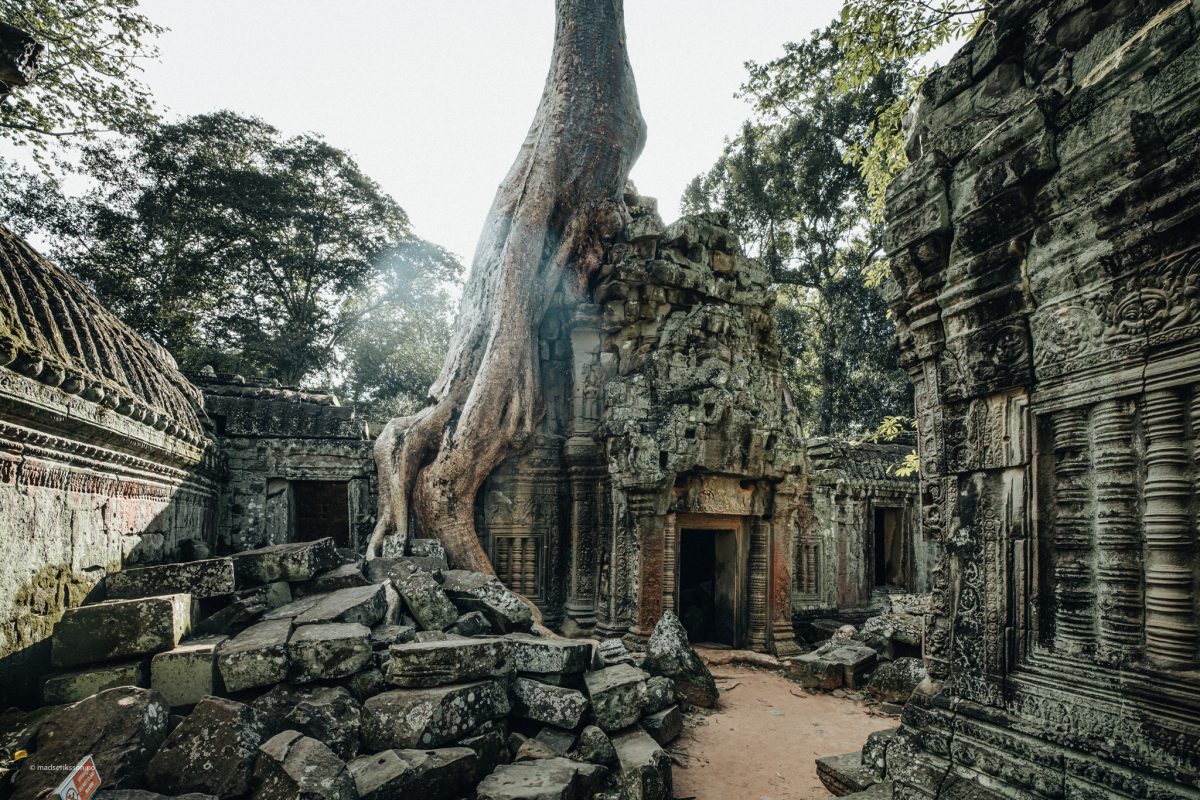
A tree rising from a gopura above heaps of fallen stone in the inner courtyards of Ta Prohm
3D model © 2026 madseriksson.no · Photographs © madseriksson.no. Temple plan, walls and paths: © OpenStreetMap contributors (ODbL). Forest cover derived from Sentinel-2 cloudless 2023 by EOX IT Services GmbH (contains modified Copernicus Sentinel data 2023; CC BY 4.0). Wall and gallery heights and the forest are simplified and approximate; sun positions are approximate.
A monastery of 12,640 people
The inscription counts everything — priests, dancers, diamonds — and it remains the most vivid document we have of a Khmer temple actually working
Numbers like these are easy to skim past, so it is worth pausing on what they describe. This was not a quiet contemplative retreat. It was an institution with a payroll, a treasury, a dance company and an agricultural hinterland of tens of thousands of people — closer to a small university town than to a shrine. Additions were still being made a century later, under Srindravarman at the end of the thirteenth century.
Then it stopped. With the collapse of Angkor as a political capital in the fifteenth century, the monastery was abandoned, and the estate that fed it dispersed. Nobody swept the roofs after that. Within a few generations of neglect, seeds landed on the gallery tops, found soil in the accumulated leaf litter, and germinated — and the second half of Ta Prohm’s history began.
Seeds that arrived on the roof
Every tree at Ta Prohm started life several metres above the ground, and grew downwards into the building
The mechanism is worth understanding, because it explains why Ta Prohm looks like this and Angkor Wat does not. Birds deposited seeds on the flat gallery roofs. Leaf litter and dust had already collected there, enough to germinate in. The seedlings grew, sent roots downwards in search of proper soil, and found the joints between mortarless sandstone blocks to be the path of least resistance. Over decades the roots thickened. Sandstone does not stretch. The blocks moved instead.
Two species dominate. The larger — pale, smooth-barked, with the enormous fan-shaped buttress roots that spread across whole gallery sections — is Tetrameles nudiflora, known in Khmer as spung. The smaller, whose roots pour down the walls in narrow braided ropes, is a strangler fig, generally given as Ficus gibbosa.
The tree that isn’t a silk-cotton tree
You will still read almost everywhere that the great trees of Ta Prohm are silk-cotton trees, and the postcards say so too. They are not, and the mistake is a good deal older than the postcards. Early French writers at Angkor called them fromager — a vernacular name that belongs to Ceiba pentandra, a genuinely majestic tree, but an American one. The label stuck, guidebooks copied guidebooks for the next century, and a Caribbean nickname ended up attached to a Southeast Asian species.
It survived that long because the two are genuinely hard to tell apart. Both are huge, pale-barked, deciduous, and both throw out the same theatrical plank buttresses. Separating them reliably means looking at flowers or fruit — which sit thirty metres up, in a tree nobody is climbing, flowering leafless for a few weeks in the dry season. From the ground, with a camera, you take the guidebook’s word for it. It is also not one tree: several large specimens stand in the complex, different writers have described different ones as “the” tree, and there is no reason they all have to be the same species.
“The trees are not growing on the temple. They are growing through it, and they got in the same way water does — by finding the seams.”
Three compositions do most of the work in photographs. The doorway on the eastern side, its lintel almost entirely swallowed by descending roots, is the one that appeared in Lara Croft: Tomb Raider in 2001 and gave the temple its second name; there is a viewing platform in front of it and, in high season, a queue. The eastern gallery further in has the largest buttress roots in the complex. And inside the western enclosure a fig has settled over one of the libraries, draping carved stone in a way that is somehow gentler and more unsettling than the famous doorway.
Glaize, writing in the 1940s, noted that the trees at Ta Prohm had prompted more descriptive excess than any other feature at Angkor. He was right, and this paragraph is not helping. But standing under one of them and following a single root from the canopy to the point where it has quietly levered a two-tonne block out of alignment is a genuinely sobering piece of arithmetic — the tree is not old by the standards of the building, and it is winning anyway.
The work of keeping a ruin ruined
Every tree here is both the reason people come and a slow demolition in progress — and someone has to decide, trunk by trunk, which ones stay
Conservation at Ta Prohm is a partnership between the APSARA Authority, which manages the Angkor park, and the Archaeological Survey of India. By 2013 the ASI had stabilised or restored most of the complex, some sections rebuilt from scattered blocks. Wooden walkways, platforms and rope railings went in to keep visitors off fragile stone, and the Hall of Dancers — where those 615 performers once worked — reopened after renovation in November 2022.
The hard part is not the masonry. It is the trees. A root system that has grown through a wall for two hundred years is now, in a real structural sense, part of that wall: remove the tree and the stonework it was holding together can come down with it. Leave it, and it keeps pushing. So the policy is selective rather than principled — some trees are taken out where the risk is immediate, others are consolidated in place with the stone they have colonised, and a few are simply monitored while everyone waits to see what they do next.
“The instruction here is to preserve an appearance of neglect, which is a much more expensive undertaking than actual neglect.”
For visitors this translates into something quite specific: stay on the boardwalks. It is not crowd management dressed up as conservation. The open stone underfoot in the unstabilised sections is genuinely loose, and a great deal of what you are walking past is being held in position by arrangements that do not tolerate improvisation.
The other constraint is people. Ta Prohm is one of the most visited stops on the Small Circuit, and the famous doorway is rarely without a queue. Access today is from the east and the west only, which channels everyone along broadly the same route. Arriving around opening, or after about half past three, makes a substantial difference — not just to photographs, but to whether the place reads as a temple or as a queue. Give it ninety minutes if you can. Forty-five will cover the doorway and the central sanctuary and miss most of what makes it worth the trip.
“Most ruins ask you to imagine what they once were. Ta Prohm asks the opposite question — what happens next. The trees are on a schedule the builders never accounted for, the conservators are negotiating rather than restoring, and every year the balance shifts a little further. It is the only temple at Angkor where the most interesting thing is not the past tense.”
More in the same area
 CitiesSiem Reap — The City at the Gate of the Largest Temple on Earth
 ArchaeologyExploring the Ancient Ruins of Pompeii
 Train travelThe World’s 10 Great Railway Journeys
 NatureThe World’s 15 Most Spectacular Waterfalls
 ArchitectureEurope’s 10 Greatest Cathedrals and Churches
 CitiesBergen: The Gateway to the Fjords