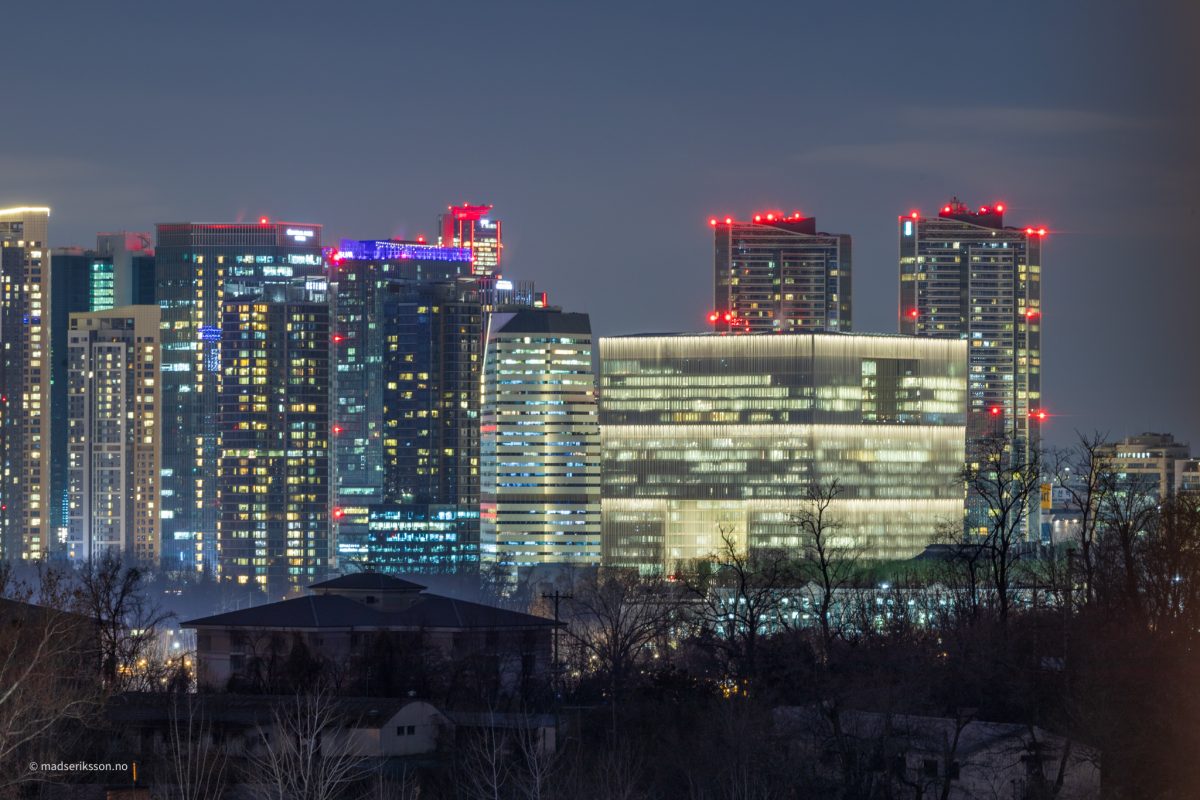
Gangnam means simply “south of the river”. Fifty years ago much of it was farmland and orchards on the far bank of the Han, outside the city that had grown up around the palaces to the north. Today Gangnam-gu is the most famous district in Seoul: 39.5 square kilometres of office towers, department stores, private academies and apartment blocks, home to around 556,000 people and to some of the most expensive property in Korea. A pop song made its name known around the world in 2012. Between the glass towers, though, stand a Buddhist temple founded in the eighth century and the burial mounds of three Joseon kings, inside a forest that is a UNESCO World Heritage Site.

Until the early 1960s the land south of the Han River lay outside Seoul altogether, part of Gwangju County in Gyeonggi Province. It was brought into the city in 1963, and from the end of the decade the government set about building a new city here — the Yeongdong development — to relieve the crowded old centre north of the river. New bridges crossed the Han, broad avenues were laid out in a grid, schools and government offices were encouraged to move south, and apartment complexes rose on the former fields. Gangnam became a district of its own in 1975. Within a generation it had become a byword for new money, ambitious parents and expensive taste, the setting that Psy satirised in “Gangnam Style”.
The district repays a visitor who looks beyond the shopping. Bongeunsa, a working Buddhist temple more than twelve centuries old, sits on a hillside directly opposite the COEX convention centre, with monks chanting to the sound of the traffic on Yeongdong-daero. A few stops along the subway, the tombs of the Joseon kings Seongjong and Jungjong lie in a walled pine forest, a quiet green island among the office towers of Teheran-ro. To the north, towards the river, the streets of Apgujeong, Cheongdam and Sinsa hold the flagship stores, the K-pop agencies and the cafés that have made Gangnam a reference point for fashion across Asia.
How to approach Gangnam
This guide covers Gangnam in four parts: how farmland south of the Han was turned into Seoul’s richest district in half a century; the two places where the older Korea survives inside it, Bongeunsa temple and the royal tombs of Seonjeongneung; the COEX complex around Samseong station, with its underground mall and its famous library; and the northern neighbourhoods of Apgujeong, Cheongdam and Sinsa, for shopping, K-pop and food.
South of the River — From Orchards to Seoul’s Richest District
How a planned new town on the far bank of the Han became the shorthand for wealth and ambition in modern Korea
When the area south of the Han was absorbed into Seoul in 1963, it was mostly fields, orchards and scattered villages. The city north of the river was overflowing, and in the late 1960s and 1970s the government decided to build a second Seoul on the empty land opposite. The plan, known as the Yeongdong development, laid out a grid of wide avenues and superblocks, linked to the old centre by new bridges over the Han. Apartment complexes were built at speed, and to draw families south, leading high schools were moved out of the old city into the new district. Gangnam was separated from Seongdong to become a district of its own in 1975; four years later the land east of the Tancheon stream was split off again as Gangdong.
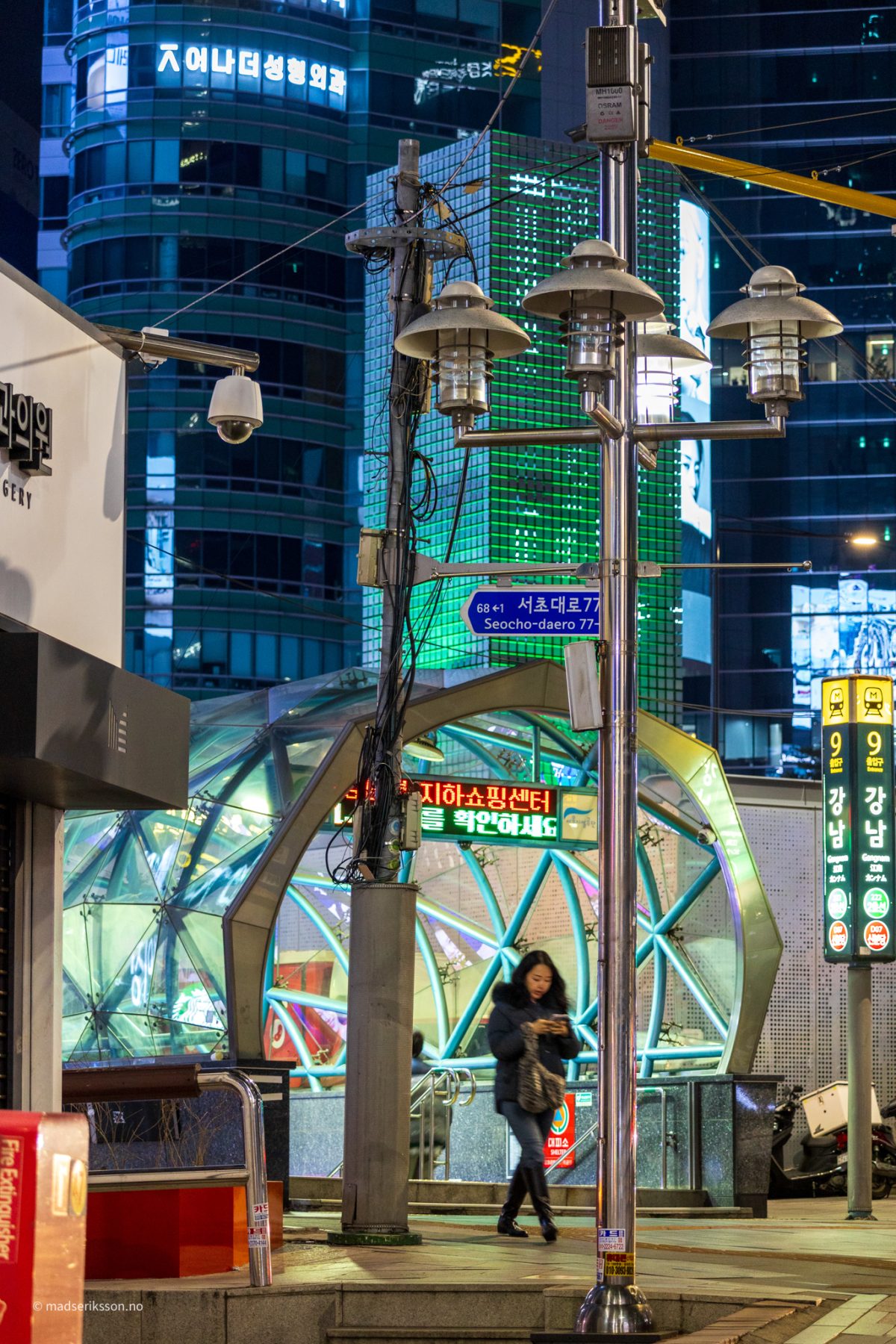
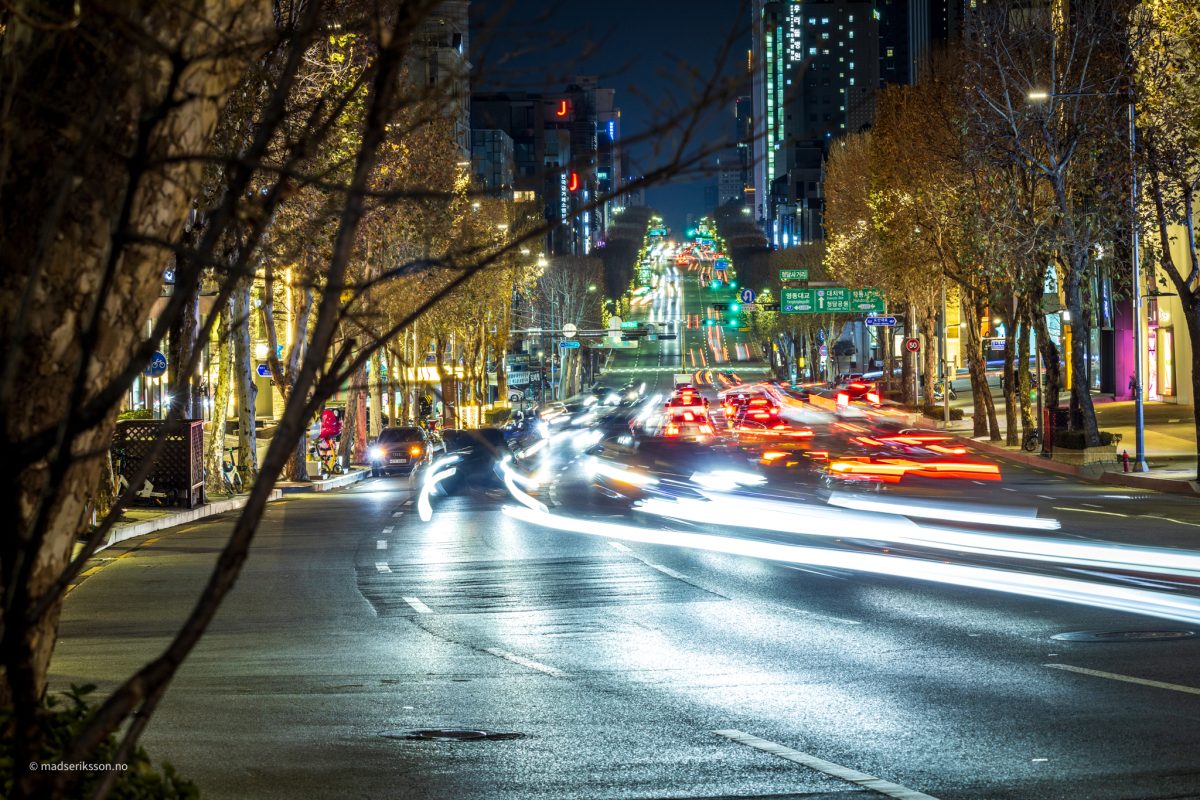
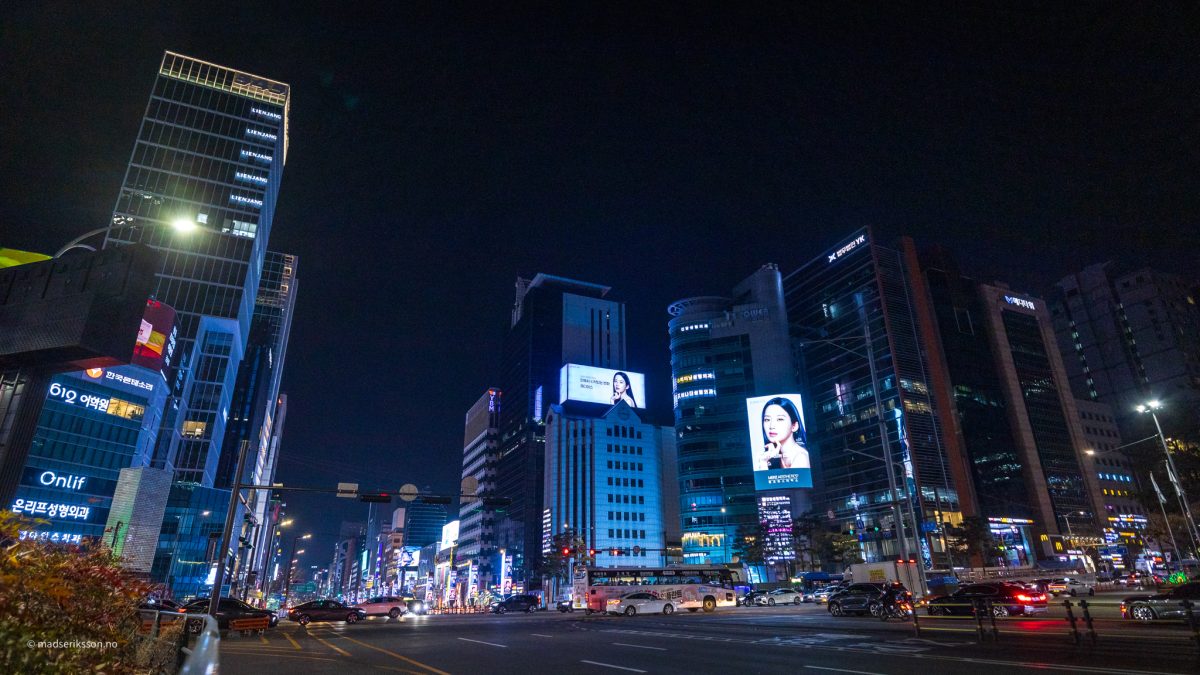
The result is the most recognisably modern part of Seoul. Teheran-ro, the avenue that runs east from Gangnam station to Samseong, is lined with the headquarters of banks, technology companies and start-ups, and the streets on either side are filled with restaurants, private academies and bars serving the office crowd. Gangnam station itself, where subway Line 2 meets the Shinbundang Line, is one of the busiest crossroads in the city, with underground shopping arcades running off in every direction. Further south and east, the district becomes one of high-rise apartment estates, with Daechi-dong’s cram schools famous across the country.
“Gangnam Style” was released in July 2012. In December that year it became the first video on YouTube to reach a billion views, and the name of a Seoul district became known around the world.
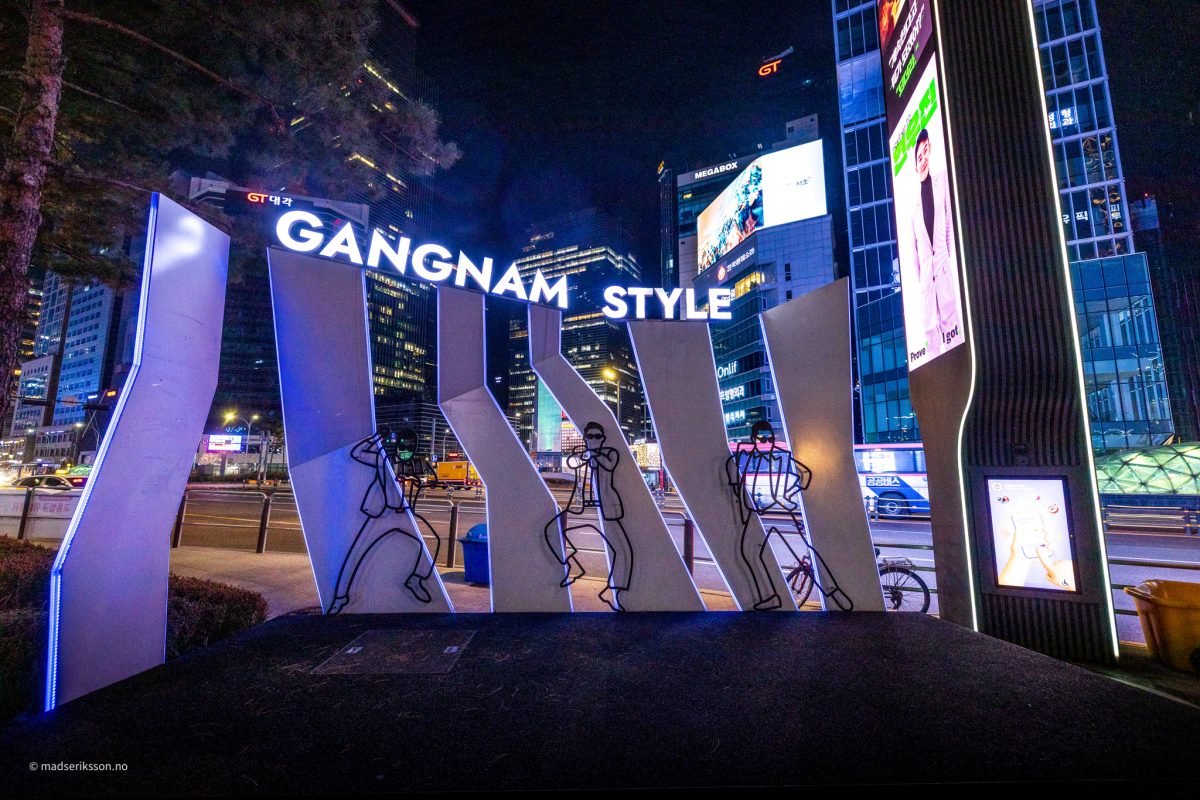
Psy wrote the song as a gentle parody of the Gangnam lifestyle — the expensive coffee, the designer clothes, the effortless display of status — and much of the video was filmed in the district, including a scene on the roof of the ASEM Tower at COEX. Gangnam has been happy to embrace the joke: a sculpture of the song’s famous crossed-wrist dance stands outside COEX, and the district promotes itself to visitors as the home of the Korean Wave. Behind the image, Gangnam-gu is above all a place where people live and work, with around 556,000 residents, and some of the most expensive apartments in South Korea.
The Older Gangnam — A Silla Temple and the Tombs of Three Royals
Where to find chanting monks opposite a convention centre, and a pine forest of burial mounds between the office towers
Bongeunsa stands on the slope of a small hill, Sudosan, directly across the road from the COEX complex. It was founded in 794, at the end of the Silla period, by the monk Yeonhoe, and was known as Gyeonseongsa until it was rebuilt in 1498 under the patronage of Queen Jeonghyeon and given the name it has today. It belongs to the Jogye Order, the largest school of Korean Buddhism, and it is a working temple rather than a museum. Visitors walk in through the gate on Bongeunsa-ro, past the halls with their painted eaves, and up the hillside to the courtyards where services are held through the day. Entry is free.
The highest point of the temple grounds is the great standing Maitreya Buddha, Mireuk Daebul, carved in 1996 and 23 metres tall, looking out over the treetops towards the towers of Samseong. Among the older buildings is the Panjeon, a hall that houses woodblocks of the Avatamsaka Sutra carved in 1855; it was one of the few buildings to survive the Korean War. For a closer look at temple life, Bongeunsa runs one of the best-known templestay programmes in Seoul, with short sessions of meditation, chanting and tea with the monks; these must be booked in advance.
The contrast is the point of a visit. From the upper courtyards of Bongeunsa, beneath the eaves of a temple first founded more than twelve centuries ago, the glass towers of COEX and Teheran-ro fill the view across the road.
One stop west of Samseong on Line 2, at Seolleung station, a walled forest covers the royal tombs of Seonjeongneung. Three members of the Joseon royal family are buried here: King Seongjong, his queen Jeonghyeon — the same queen who rebuilt Bongeunsa — and their son, King Jungjong. The grassed burial mounds, guarded by stone figures of officials and animals, stand on low ridges among the pines, reached by paths through the woods. The site is part of the Royal Tombs of the Joseon Dynasty, inscribed as a UNESCO World Heritage Site in 2009. In 2026 entry costs KRW 1,000 for adults; the tombs are closed on Mondays, and opening hours change with the seasons, from early morning until early evening in winter and until 21:00 in summer.
COEX — The Underground City at Samseong
A convention centre, a vast mall beneath it, a library with walls of books and the sculpture that made a pop song permanent
The COEX complex, at the eastern end of Teheran-ro, grew up around Korea’s main international convention and exhibition centre. Its tower blocks include the World Trade Center Seoul and the ASEM Tower, built for the Asia–Europe summit held here in 2000, and beneath them lies the COEX Mall, now run as Starfield COEX Mall: around 154,000 square metres of shops, restaurants, cinemas and an aquarium, almost all of it on a single underground level. It connects directly with Samseong station on Line 2 and Bongeunsa station on Line 9, which makes it easy to arrive and, in a downpour or a cold snap, to spend half a day without going outside.
At the centre of the mall is the Starfield Library, an open, two-storey atrium whose walls are lined with bookcases 13 metres high, holding tens of thousands of books and hundreds of magazine titles. It is a favourite with photographers, and it is free: anyone can sit at the long tables or on the steps and read. It is open daily from 10:30 to 22:00, and it is at its quietest on weekday mornings. Outside, on the plaza by the main entrance, the COEX K-Pop Square is a free, open-air plaza beneath an enormous curved LED screen that shows video art and K-pop clips.
The best-known sight outside COEX is not a building but a pair of wrists: a giant bronze sculpture of the crossed hands from the “Gangnam Style” horse-riding dance, unveiled in 2015 near the spot where part of the video was filmed.
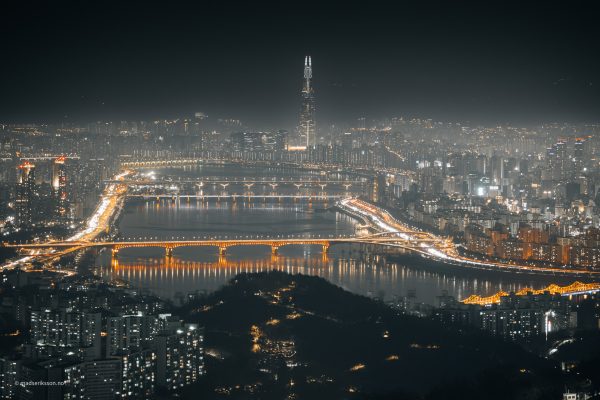
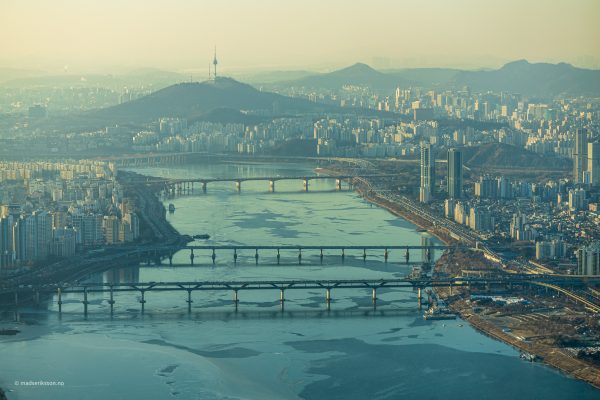
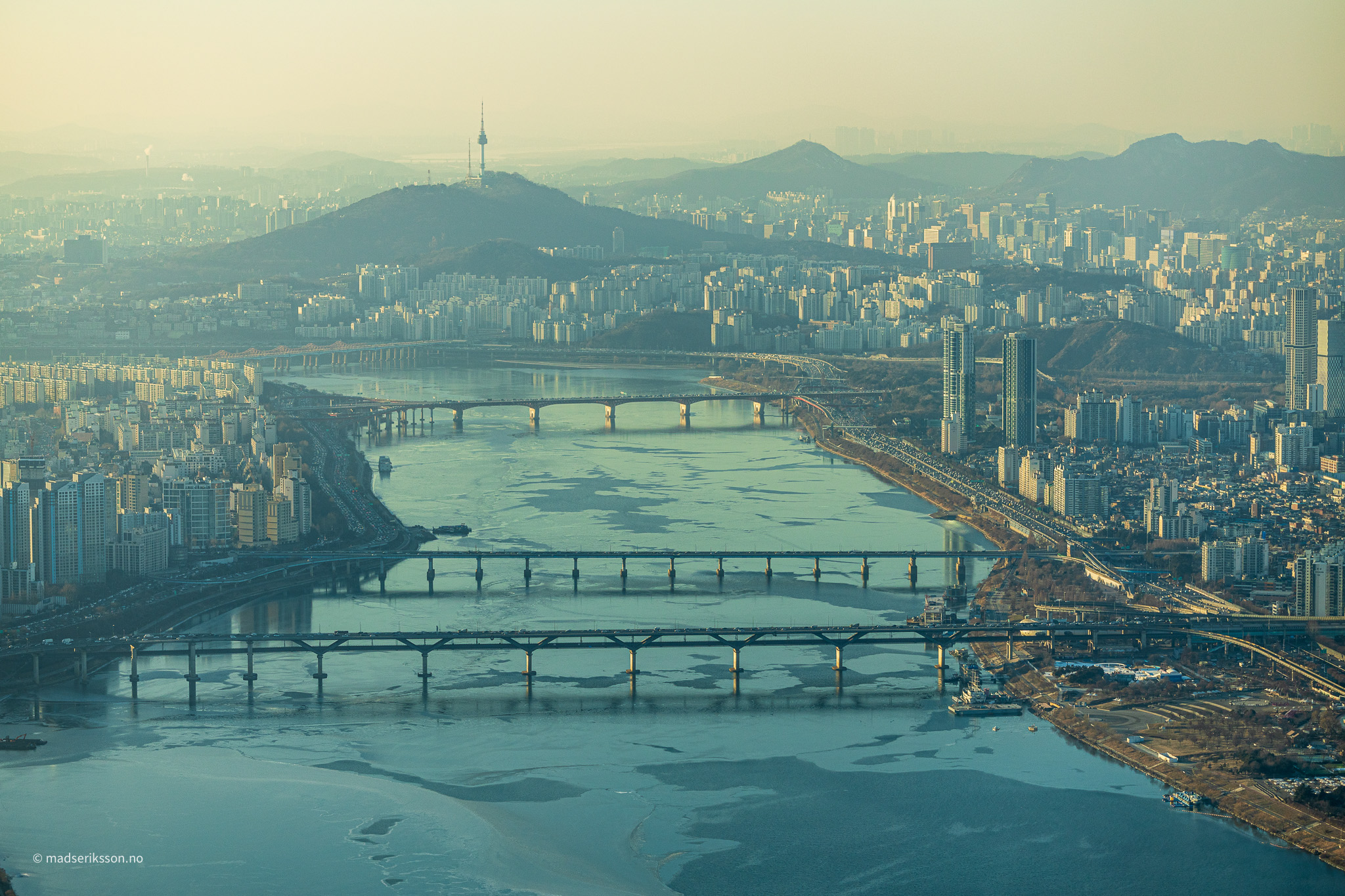
Directly across Yeongdong-daero from the mall, Bongeunsa makes an obvious pairing — the temple in the morning, COEX in the afternoon. From the area around Samseong the skyline to the east is dominated by the Lotte World Tower in the neighbouring Songpa district, at 555 metres the tallest building in Korea; its observation deck is one of the best places to see Gangnam spread out along the river (see the view from Lotte World Tower). In the other direction, Teheran-ro leads back towards Gangnam station, with the royal tombs of Seonjeongneung halfway between.
North Gangnam — Flagship Stores, K-Pop and the Tree-Lined Street
The neighbourhoods along the Han where Seoul shops, eats and goes out, and what is left of the K-pop agencies that made them famous
The northern edge of Gangnam, along the south bank of the Han, is where its reputation for luxury was made. Apgujeong was one of the first areas to be filled with high-rise apartments in the 1970s, and the streets around Apgujeong Rodeo station became Seoul’s fashion quarter, with boutiques, hair salons and cosmetic clinics. Eastwards, in Cheongdam-dong, the avenue of Apgujeong-ro is lined with the flagship stores of international fashion houses in buildings commissioned from leading architects, and the side streets hold galleries, wedding studios and some of the most expensive restaurants in the city.
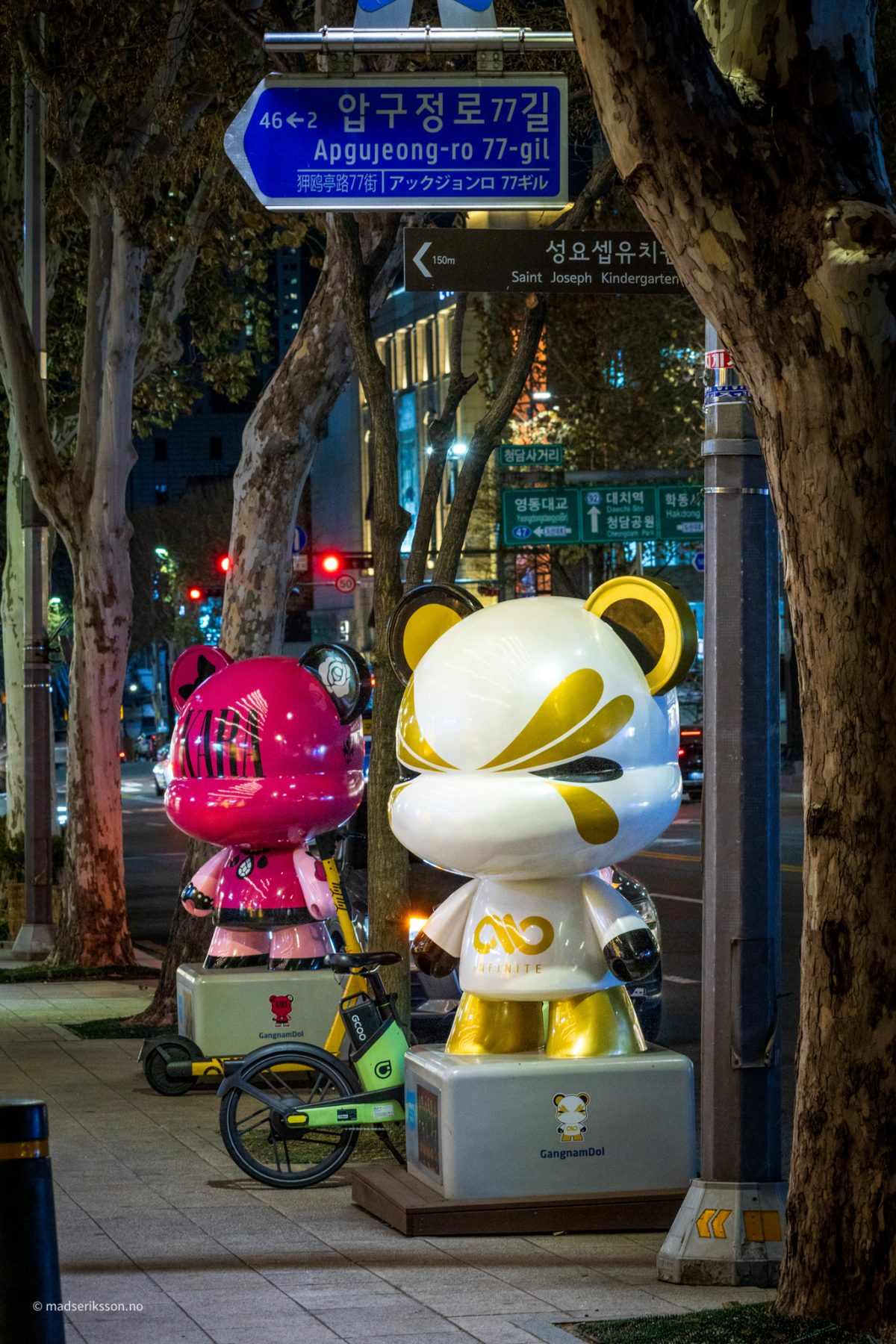
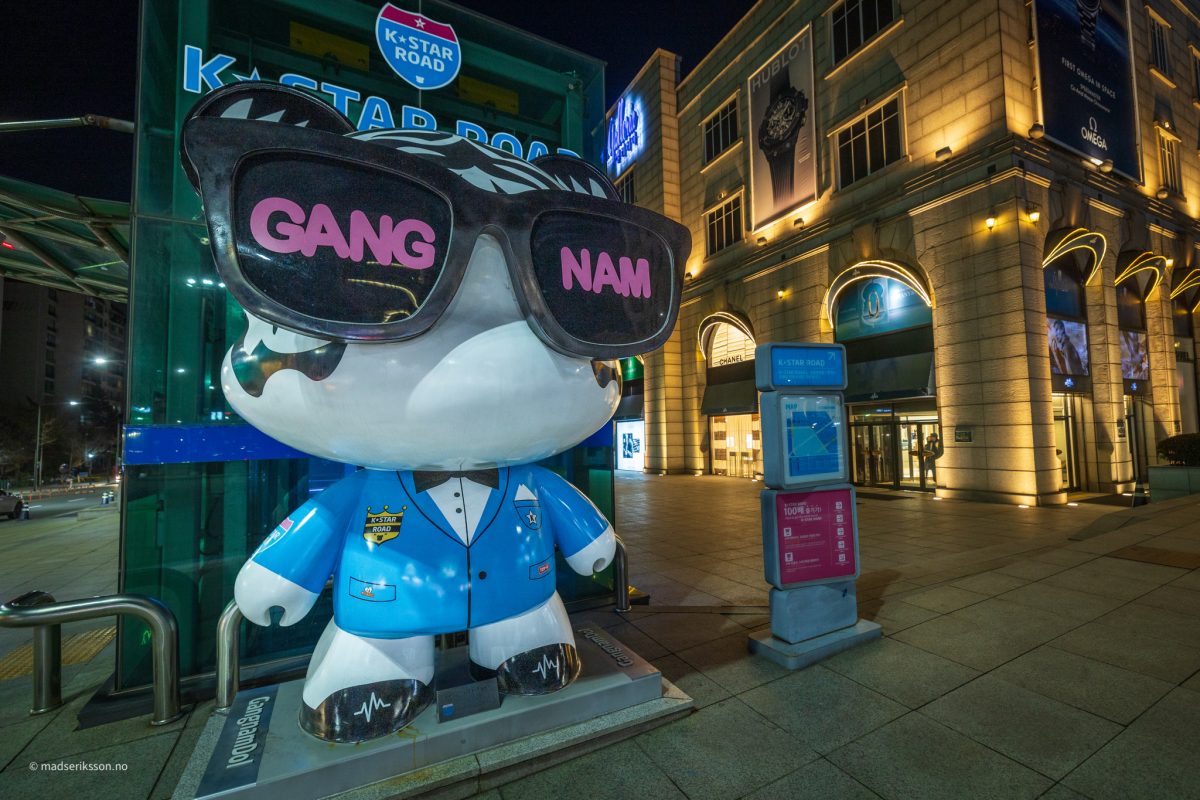
Cheongdam was also the heart of the K-pop industry. Several of the big entertainment agencies had their headquarters here, and fans came in the hope of a glimpse of their idols. The geography has shifted: SM Entertainment moved its headquarters north of the river to Seongsu-dong in 2021, and JYP has also left, though Starship, FNC and P Nation are still based in the district. What remains for visitors is the K-Star Road, a stretch of about a kilometre from exit 2 of Apgujeong Rodeo station towards the Cheongdam crossroads, lined with seventeen large, brightly painted bear-like figures called GangnamDol, each dedicated to a K-pop group. The agencies are working offices, and fans are asked to keep their distance and their voices down.
Garosu-gil — literally the “tree-lined street” — is the gentlest part of the district: a long avenue of ginkgo trees in Sinsa-dong, with boutiques and cafés spilling into the lanes on either side.
Garosu-gil is close to Sinsa station on Line 3 and the Shinbundang Line, and it is at its best on a weekday afternoon or in autumn, when the ginkgo leaves turn gold. Around it, and around Gangnam station and Sinnonhyeon to the south, are the streets for eating and going out: Korean barbecue restaurants where diners grill pork belly and beef at the table, late-opening fried chicken and beer places, noodle shops and food courts beneath the department stores, and noraebang karaoke rooms rented by the hour. Gangnam’s nightlife is at its busiest from Thursday to Saturday, and the subway runs until around midnight, after which taxis take over.
«Gangnam is a district that was invented in a generation, and it can look like nothing but glass, money and traffic. Look a little closer and the older Korea is still here: monks chanting on a hillside opposite a convention centre, three Joseon royals asleep beneath their mounds in a forest of pines, a temple founded in the eighth century and rebuilt by a queen whose tomb lies little more than a kilometre away. Start the day at Bongeunsa, walk across to the library at COEX, spend the afternoon among the boutiques of Apgujeong and Garosu-gil, and end it where Gangnam is happiest — at a barbecue table near the station, late into the evening.»

More in the same area
 CitiesSeoul: A Thriving Fusion of Tradition and Modernity
 ArchitectureThe Breathtaking View from Lotte World Tower in Seoul
 ArchitectureDongdaemun Design Plaza: A Modern Architectural Marvel in Seoul
 Food and DrinksExploring Gwangjang Market: A Culinary Paradise in Seoul
 ArchitectureTen Buildings That Changed Their Cities — Modern Architecture Ranked on Impact, Not Image
 Food and DrinksDongmun Market: Jeju City’s Post-War Market and Its Night Market at Gate 8