Prague is the best-preserved medieval city in Central Europe and one of the most visited capitals on the continent — yet it manages, particularly outside the summer peak, to retain something of the quality that makes it so persistently compelling: the sense of a city that history passed through rather than over, leaving its Gothic towers, Baroque palaces and Art Nouveau boulevards standing where they were built, above the curve of the Vltava River and beneath the vast profile of the castle on the hill. Franz Kafka was born here. The Velvet Revolution happened here. The beer is among the finest in the world. Prague holds all of it with a particular gravity.

Prague has been continuously settled since the 6th century CE, when Slavic tribes established themselves in the bend of the Vltava River beneath the hill that would eventually be crowned with the largest castle complex in the world. The Přemyslid dynasty founded the first castle in the 9th century; Charles IV, Holy Roman Emperor and King of Bohemia, made Prague one of the most important cities in 14th-century Europe, commissioning the stone bridge that still bears his name, beginning construction of St. Vitus Cathedral, and founding Central Europe’s first university. The city that followed — through Habsburg rule, through the Austro-Hungarian Empire, through the brief flowering of the First Czechoslovak Republic after 1918 — accumulated architectural layers of remarkable quality and coherence, from the Romanesque to the Art Nouveau, that remain largely intact.
What preserved them was a combination of fortune and geography. Prague escaped the bombing that destroyed Dresden and Warsaw. The communist period (1948–1989), though devastating in human terms — the 1968 Warsaw Pact invasion to crush the Prague Spring remains one of the defining moments of Cold War Europe — left the physical fabric of the historic centre largely untouched through a combination of limited development resources and deliberate conservation. The Velvet Revolution of November 1989, led from Wenceslas Square by Václav Havel and a generation of dissidents, brought the communist era to its end without violence. The city that emerged from it has been one of the most visited in Europe ever since, and the challenge for the visitor is to find, beneath the organised tourism of the Old Town, the city that Kafka walked through and that Havel governed.
How to approach Prague
This guide covers four aspects of Prague: the Castle district and Hradčany above the river; the Old Town, Charles Bridge and the Jewish Quarter below it; the modern history of the city — Wenceslas Square, the Velvet Revolution and the literary Prague of Kafka and Havel; and the food and beer culture that gives the city its most immediate pleasures. Prague is compact and almost entirely walkable in its historic centre, and the walk across Charles Bridge at dawn, before the crowds arrive, is one of the great urban experiences in Europe.
Prague in 3D
Prague grew up in a bend of the Vltava below the castle hill, settled by Slavic tribes in the 6th century and made one of the leading cities of 14th-century Europe by Charles IV. The Historic Centre, from Hradčany and Malá Strana to the Old Town, the New Town and Vyšehrad, has been a UNESCO World Heritage Site since 1992. About 1.35 million people live in the city today.
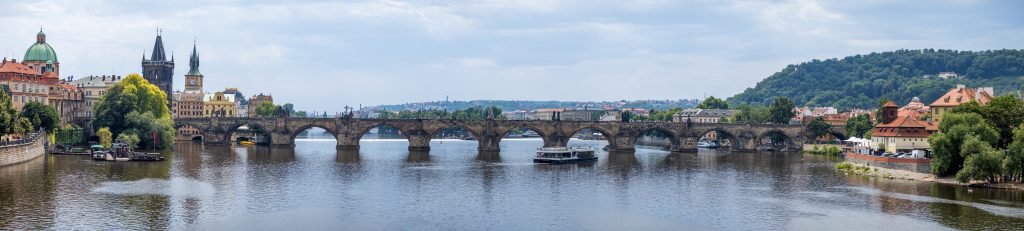
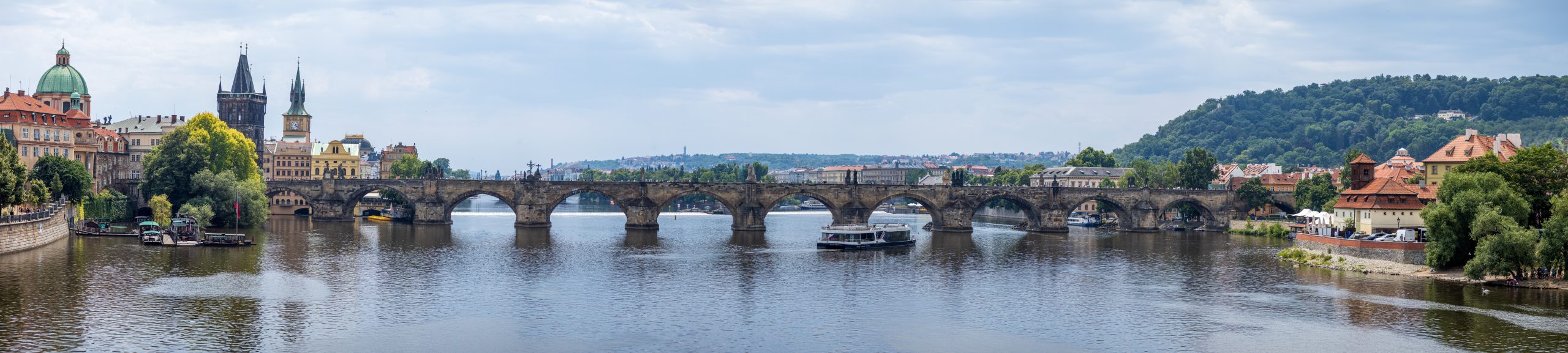
Charles Bridge stretching across the Vltava towards the Old Town, seen from upriver in Prague
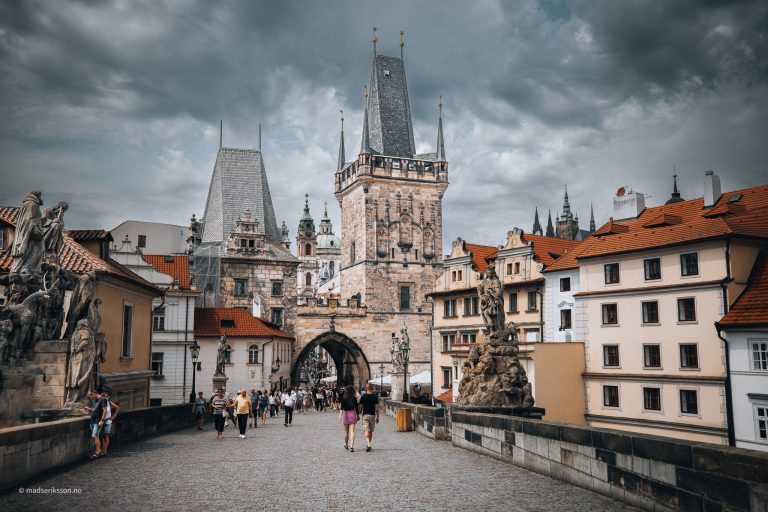
Charles Bridge
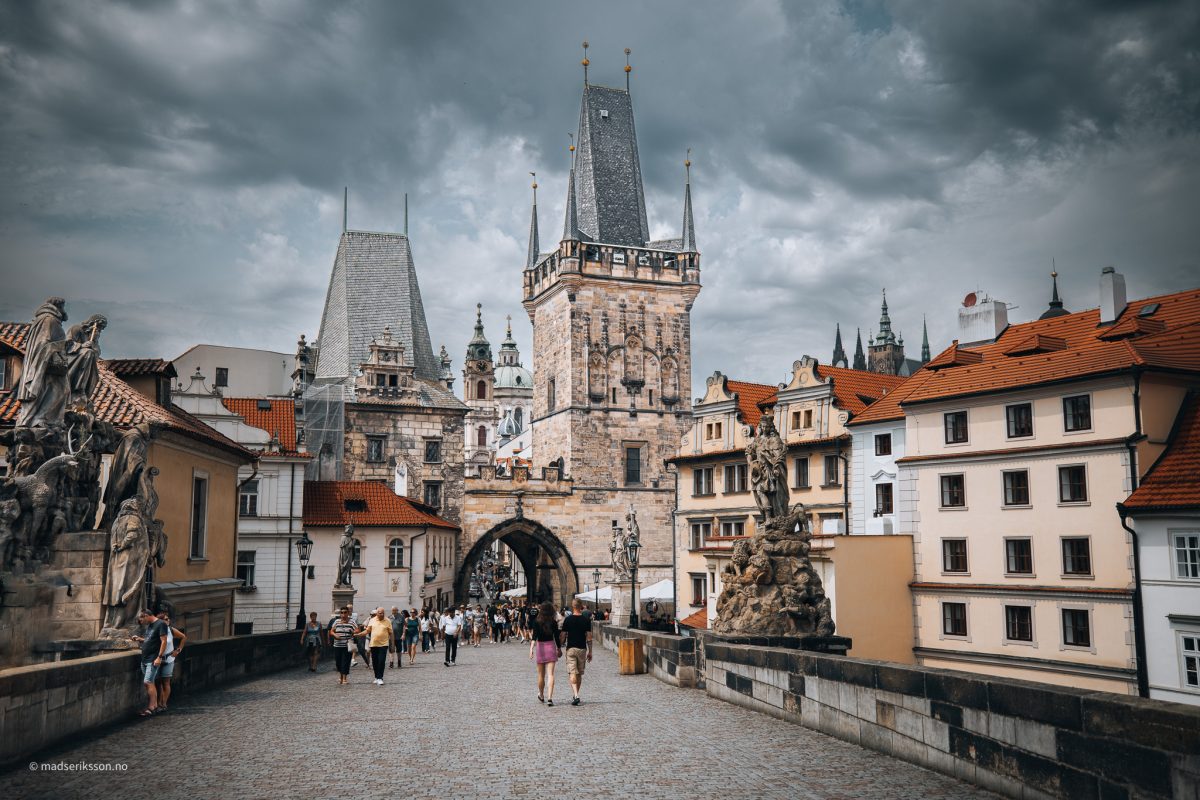
Charles Bridge was begun in 1357 under Charles IV and completed around 1402, and for more than four centuries it was the only bridge across the Vltava in Prague. It is 516 m long and lined with 30 Baroque statues, added from 1683 onwards. The Gothic Old Town Bridge Tower guards its eastern end.
Charles Bridge in Prague, leading towards the Lesser Town Bridge Tower under a stormy sky
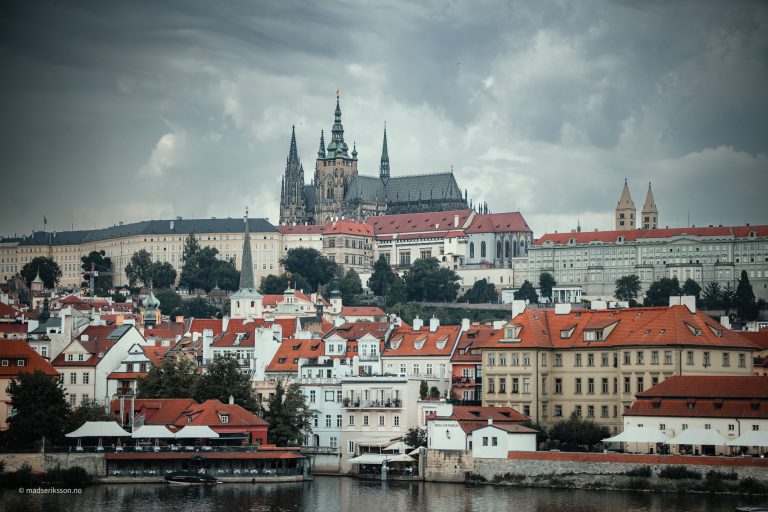
Prague Castle and St Vitus
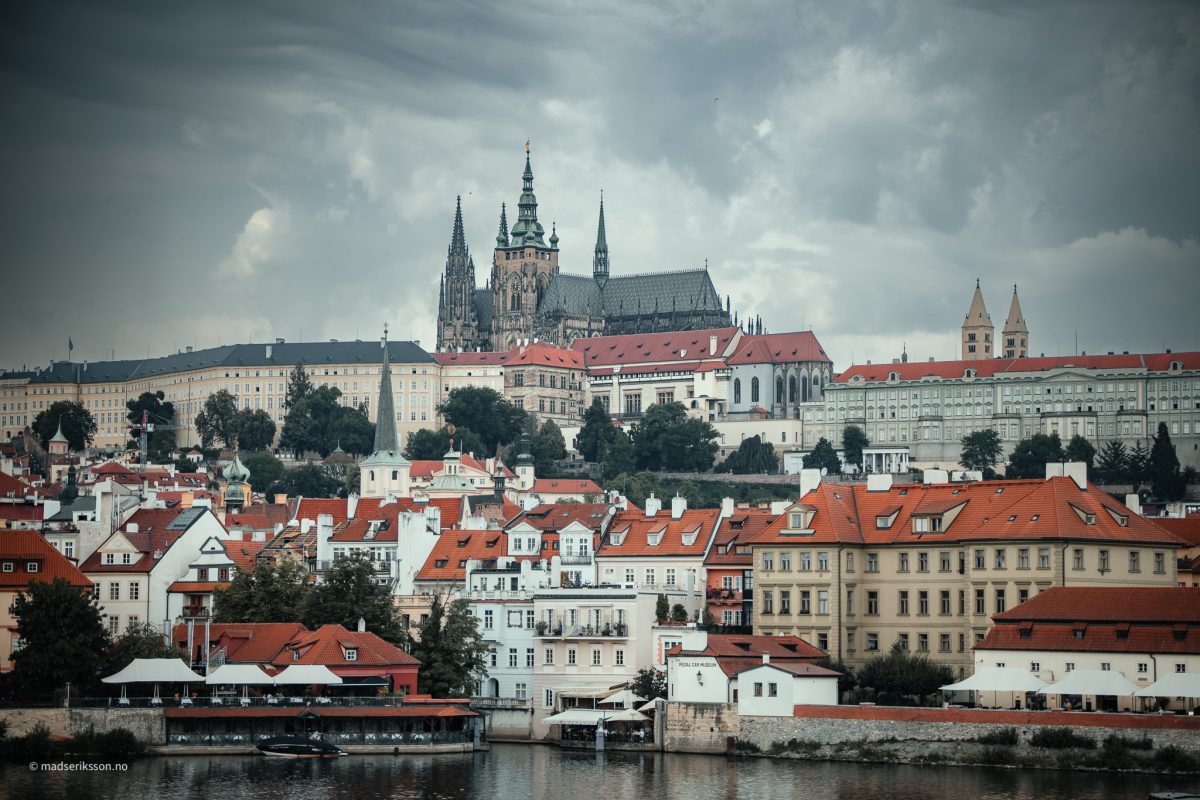
Prague Castle covers about 70,000 square metres on the ridge above the left bank and has been the seat of Bohemian kings, emperors and Czech presidents for over a thousand years. St Vitus Cathedral inside it was begun in 1344 and completed in 1929, and its main tower is 96.5 m tall.
Prague Castle and St Vitus Cathedral above the red roofs of Malá Strana, seen across the Vltava
Malá Strana and Petřín
The Baroque Lesser Town fills the slope between the castle and the river with palaces, gardens and the green dome of St Nicholas Church. Above it rises Petřín Hill, where the 63.5 m Petřín Lookout Tower was built in 1891, with 299 steps to its platforms.
The Jewish Quarter
Josefov, the former Jewish ghetto, is named after Emperor Joseph II, who granted Jews civic rights in 1781. The Old-New Synagogue, built around 1270, is still in use, and the Old Jewish Cemetery holds about 12,000 visible tombstones in up to 12 layers, the oldest from 1439. The walls of the nearby Pinkas Synagogue carry the names of 77,297 Bohemian and Moravian Jews murdered in the Holocaust.
Wenceslas Square
Wenceslas Square is a boulevard 750 m long and 60 m wide, running up to the National Museum. It saw the Warsaw Pact tanks of 1968, the self-immolation of Jan Palach in January 1969 and, in November 1989, crowds of up to 750,000 during the Velvet Revolution.
National Theatre and the Dancing House
The Neo-Renaissance National Theatre on the Vltava embankment opened in 1881 and stages opera, ballet and drama. Further upstream, the Dancing House by Vlado Milunić and Frank Gehry was completed in 1996 on a corner site left empty since the Second World War.
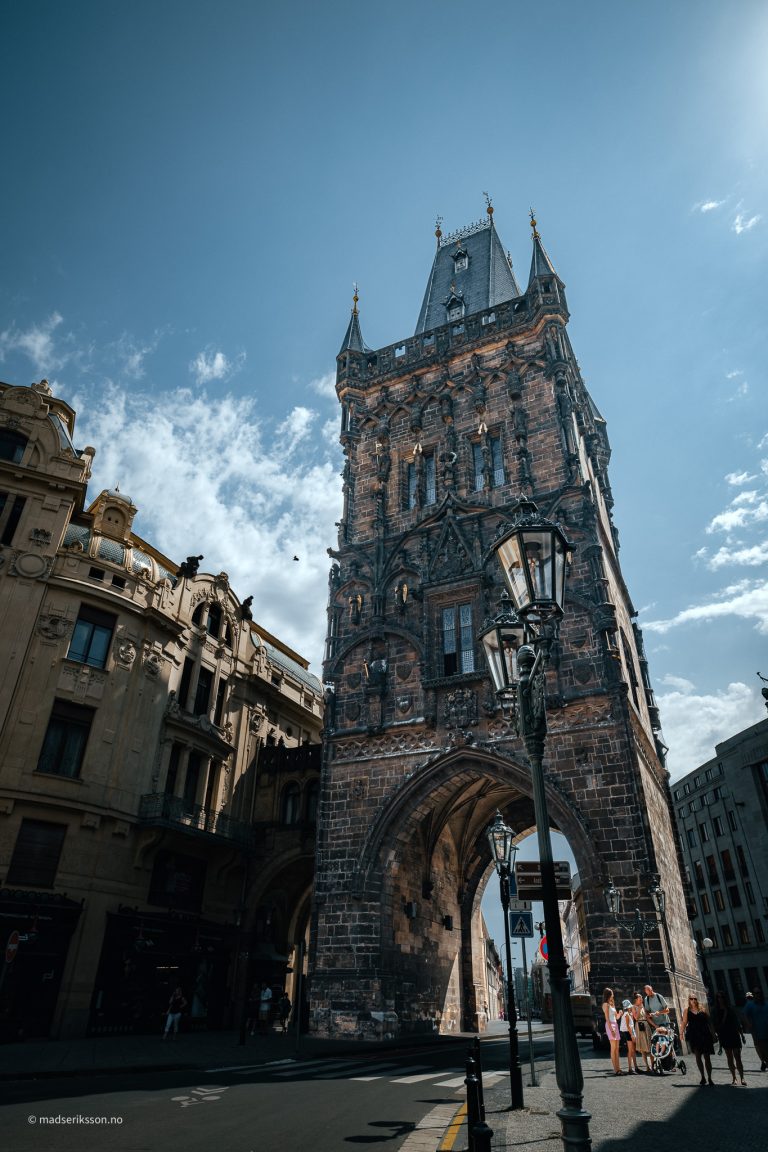
The Powder Tower
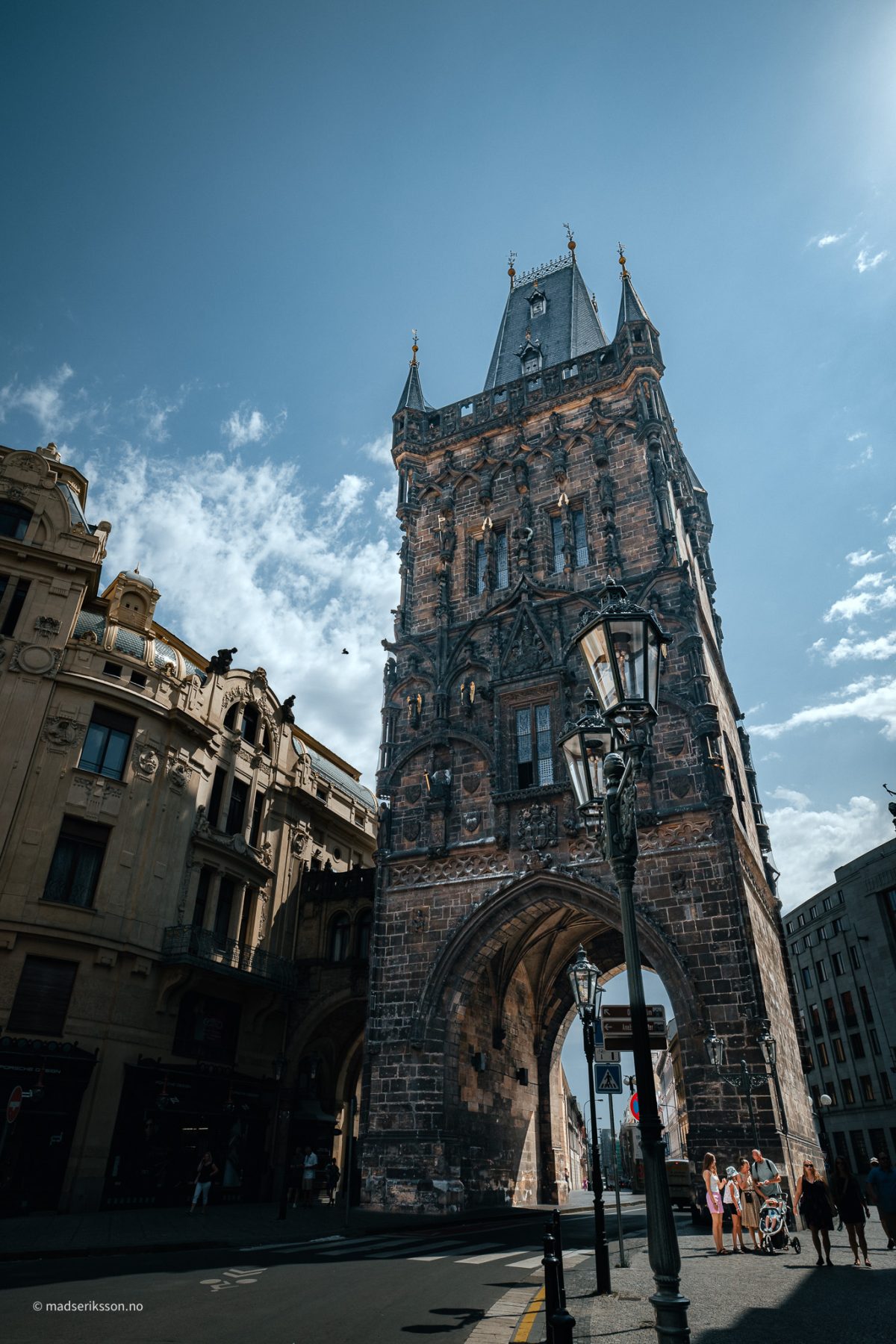
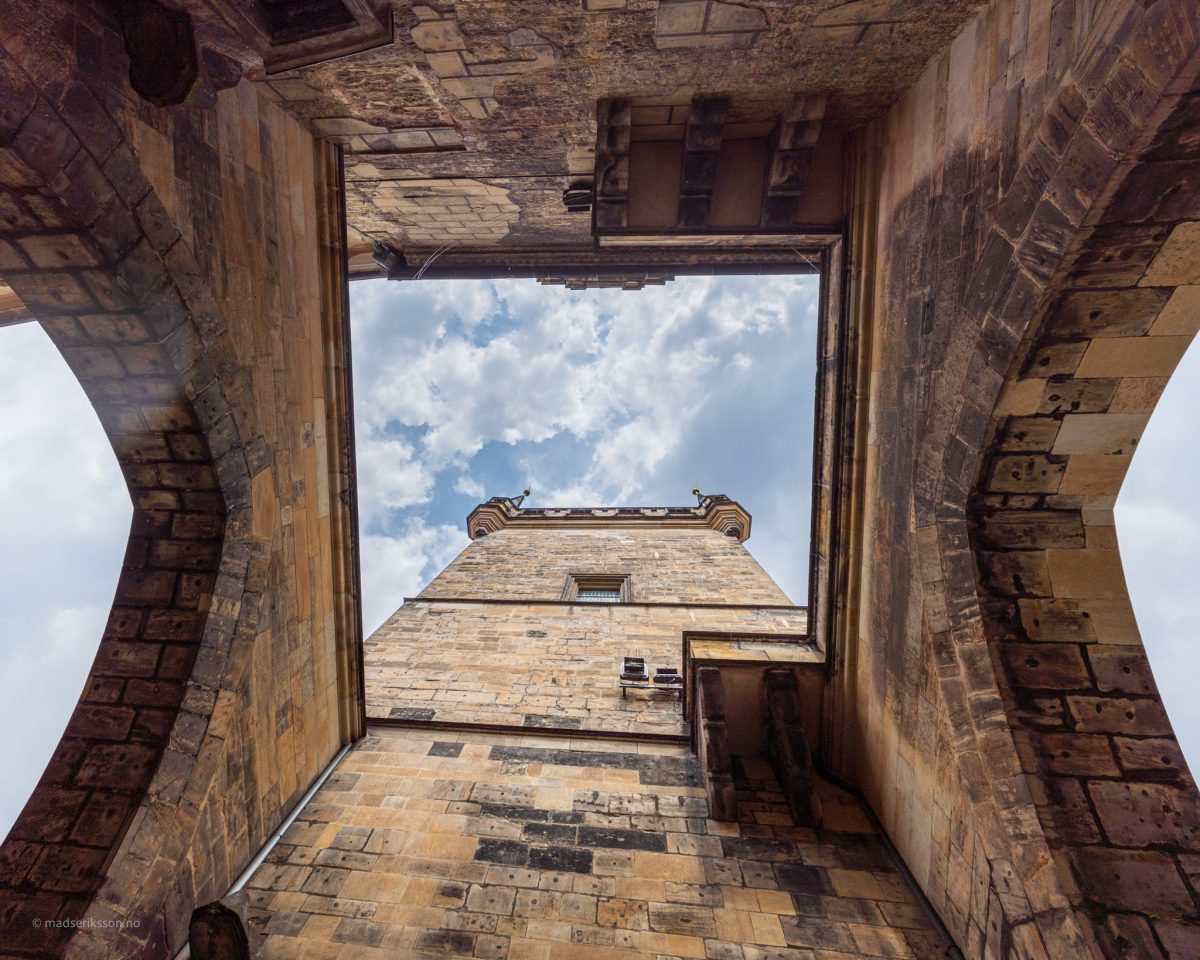
The 65 m Powder Tower, begun in 1475, is one of the original gates of the Old Town and stands where the coronation processions of the Bohemian kings set out. Beside it, the Art Nouveau Municipal House was built in 1905–12 on the site of the former Royal Court, with interiors by Alfons Mucha among others.
The blackened Gothic Powder Tower, one of the old city gates of Prague, against a blue sky
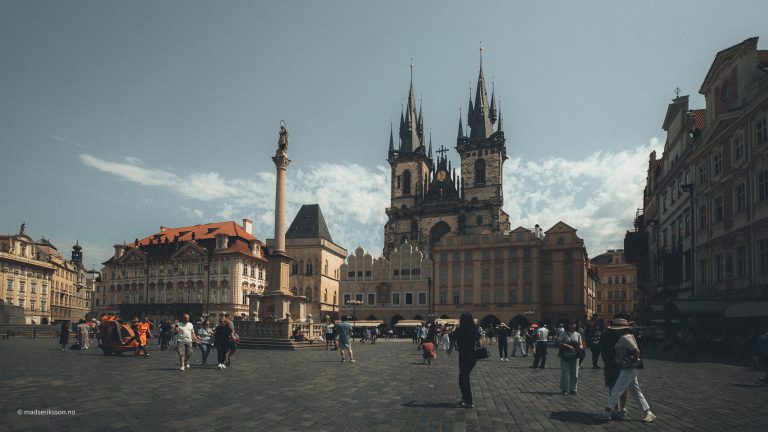
Old Town Square at night
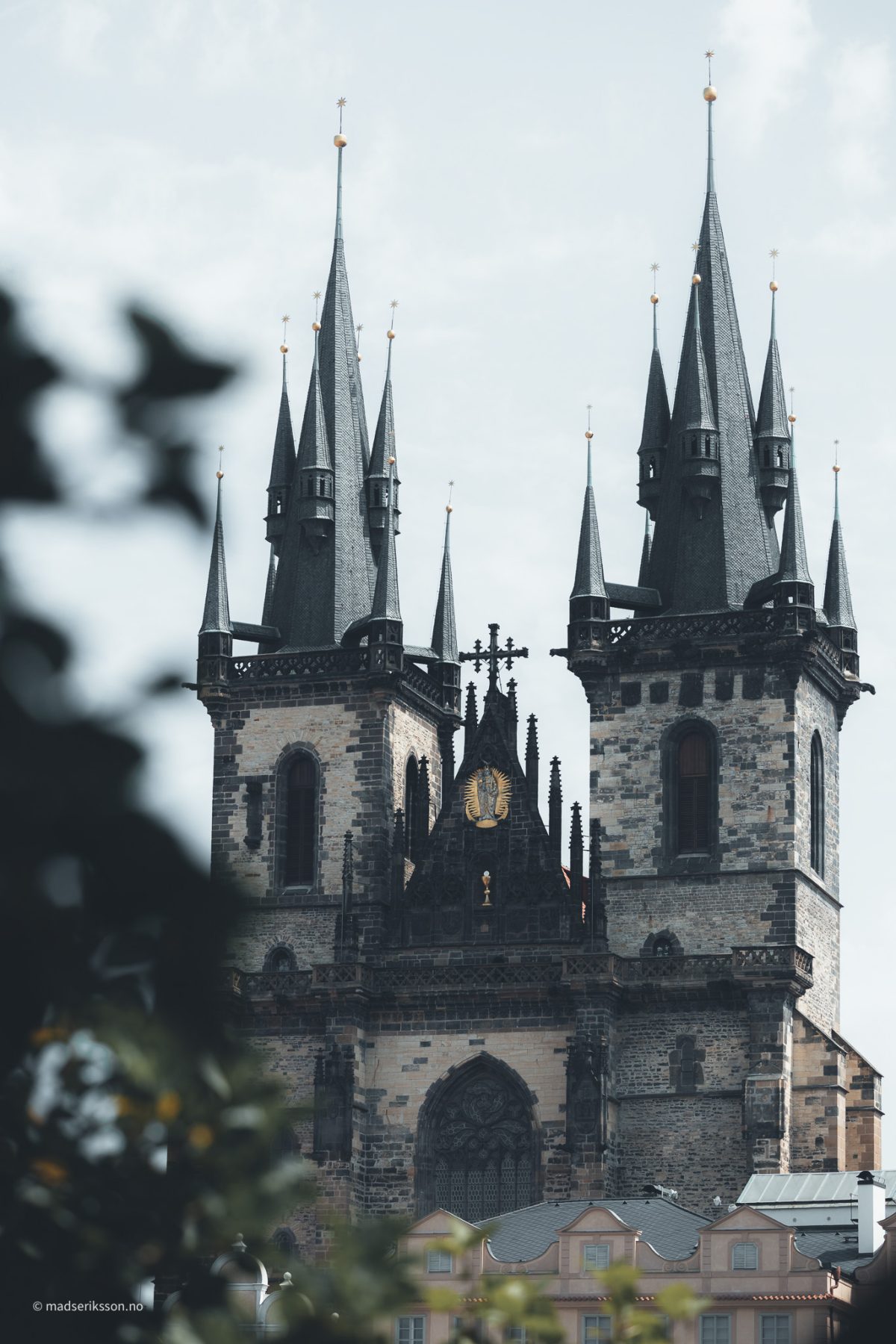
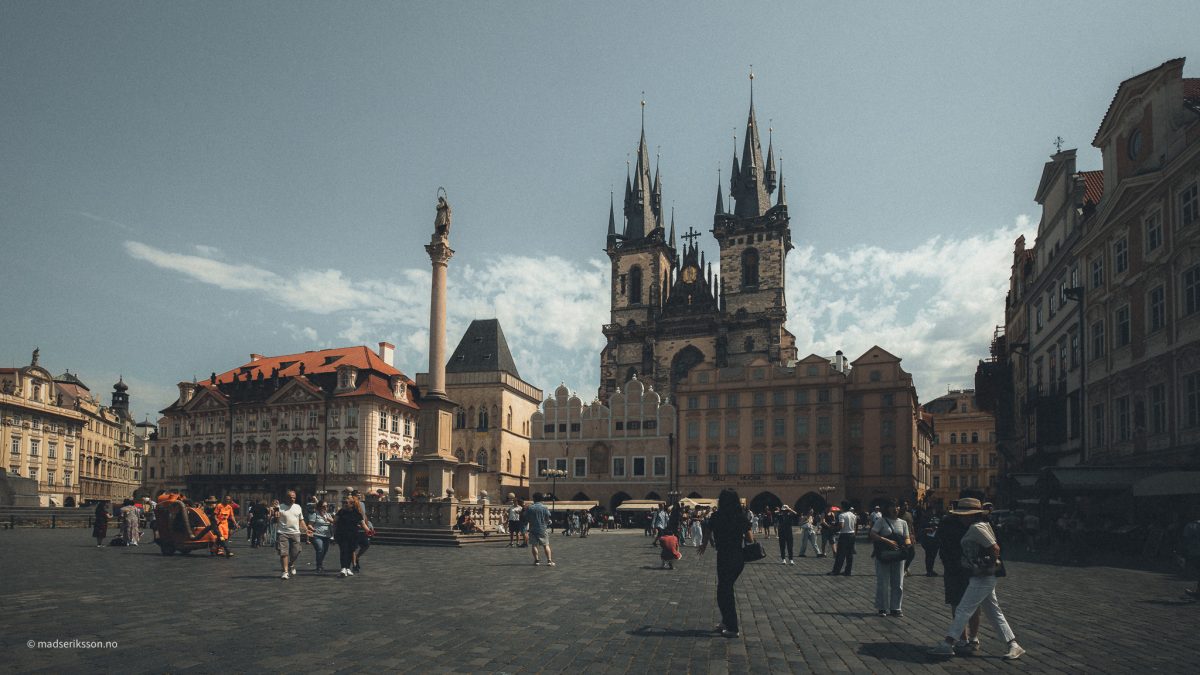
The Old Town Hall was founded in 1338, and its tower, almost 70 m high, was completed in 1364. The Astronomical Clock on its south face has run since 1410, and on the hour the twelve Apostles parade above the dial. Across the square, the two 80 m towers of the Týn Church were finished in the 15th century and 1511.
Old Town Square with the Marian column and the Týn Church, busy with people on a cloudy day
3D model © 2026 madseriksson.no · Photographs © madseriksson.no. Buildings and heights: © OpenStreetMap contributors (ODbL), via OpenMapTiles. Ground imagery: Sentinel-2 cloudless 2023 by EOX IT Services GmbH (contains modified Copernicus Sentinel data 2023; CC BY 4.0). Heights are approximate where OpenStreetMap has no measured value; sun positions are approximate.
The Castle District — The Largest Castle Complex in the World
Prague Castle dominates the city from every direction — from its hill above the Vltava, it contains a cathedral begun in 1344 and completed in 1929, a royal palace, galleries, gardens and the office of the Czech president
Prague Castle — Pražský hrad — is the largest ancient castle complex in the world by area, covering approximately 70,000 square metres on the ridge above the left bank of the Vltava. It has been the seat of Bohemian kings, Holy Roman Emperors and Czech presidents for over a thousand years, and contains within its walls a complete world: St. Vitus Cathedral, the Old Royal Palace, the Basilica of St. George, the Lobkowicz Palace, the Story of Prague Castle museum, galleries, gardens and the administrative offices of the Czech presidency. A full exploration of the complex requires most of a day. The view from the castle ramparts over the city — the red-tiled rooftops of Malá Strana, the curve of the Vltava, the Old Town beyond, and the whole panorama of spires and towers that has given Prague its nickname — is the finest urban panorama in Central Europe.
St. Vitus Cathedral, within the castle complex, was begun in 1344 under Charles IV and completed — after interruptions from wars, religious conflict and a lack of funds that stretched across six centuries — in 1929. The west façade and the great rose window are 20th-century work; the choir and the Golden Gate on the south portal are medieval. Inside, the Chapel of St. Wenceslas, built over the tomb of the patron saint of Bohemia, is lined with semiprecious stones and 14th-century frescoes and is the most elaborately decorated space in the cathedral. The stained glass windows were commissioned from Czech artists in the early 20th century; the Art Nouveau window designed by Alfons Mucha for the north aisle is among the finest examples of his work.
St. Vitus Cathedral took 585 years to complete. The cornerstone was laid in 1344; the final stones of the west towers were set in place in 1929. The building contains six centuries of architectural history in a single structure.
Golden Lane (Zlatá ulička) — a row of tiny coloured houses built into the northern ramparts of the castle in the 16th century to house castle guards — has become one of the most visited spots in Prague, partly for its charm and partly for the fact that Franz Kafka lived briefly in one of them (number 22, now a bookshop) during the winter of 1916–17. Below the castle, the Baroque quarter of Malá Strana (the Lesser Town) fills the slope between the castle and the river with palaces, gardens, churches and the densely tiled lanes that give the district its particular atmosphere. The Wallenstein Palace Garden (Valdštejnská zahrada), a 17th-century formal garden open to the public, is one of the most serene spaces in central Prague.
Old Town and the Bridge — Medieval Prague at Street Level
Charles Bridge at dawn, the Astronomical Clock on the hour, and the oldest Jewish cemetery in Europe — the historic core of Prague delivers on every front
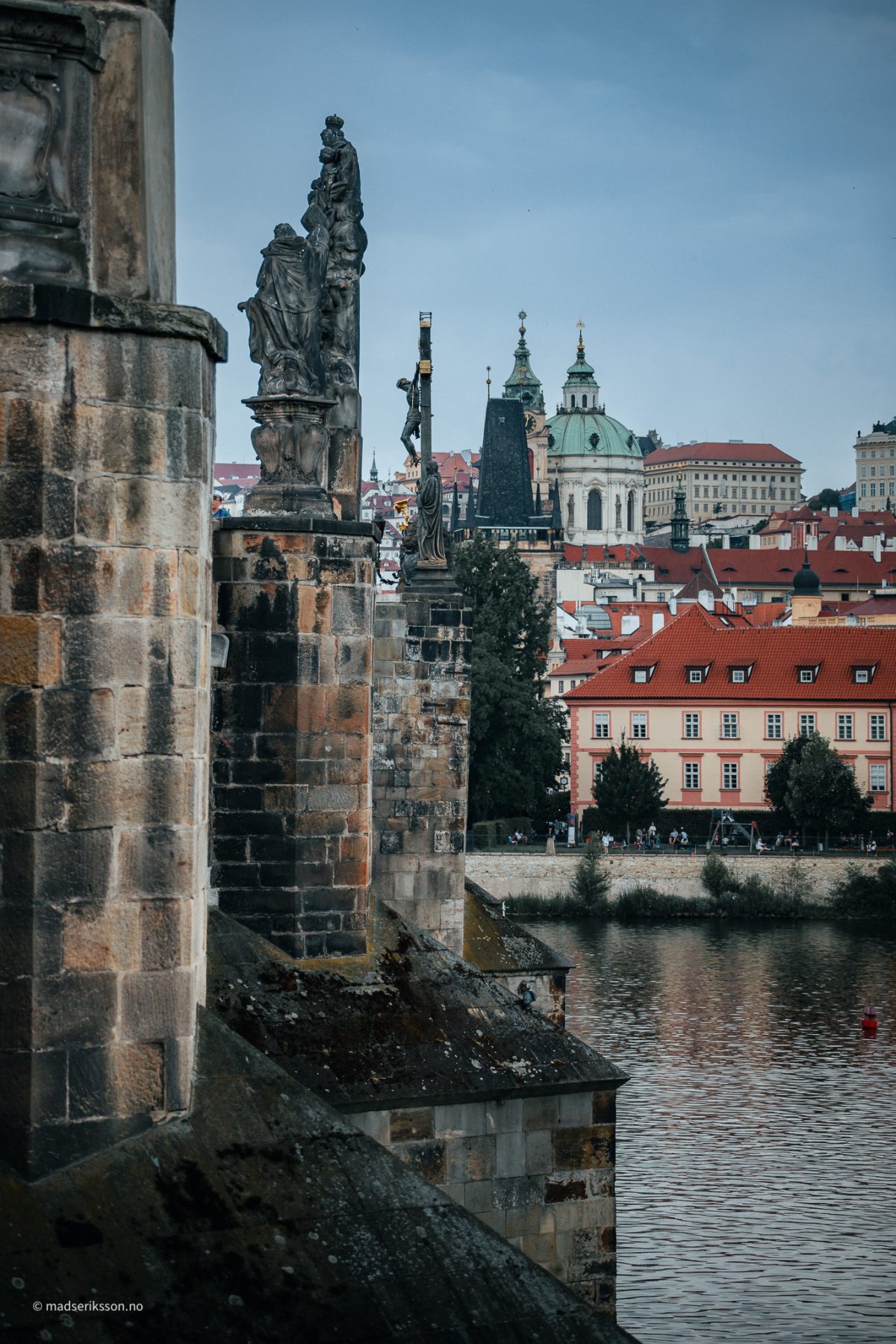
Charles Bridge is 516 metres of Gothic sandstone spanning the Vltava River, built on the order of Charles IV in 1357 and completed around 1402. For over four centuries it was the only bridge across the Vltava in Prague and the principal route between the Old Town and the Castle District. The 30 Baroque statues that line its balustrades were added from the late 17th century onward, following the installation of the bronze statue of St. John of Nepomuk in 1683 — whose base, rubbed by generations of hands seeking good fortune, is now polished to a bright gold. The bridge is at its best at dawn, before the tourist crowds and the portrait painters and the musicians who occupy it through the day: at 6am, in winter mist or summer first light, with the castle on the hill and the river below and the towers of the Old Town bridge gate framing the view, it is extraordinary. The rest of the day it is extremely crowded, which does not prevent it from being still worth crossing.
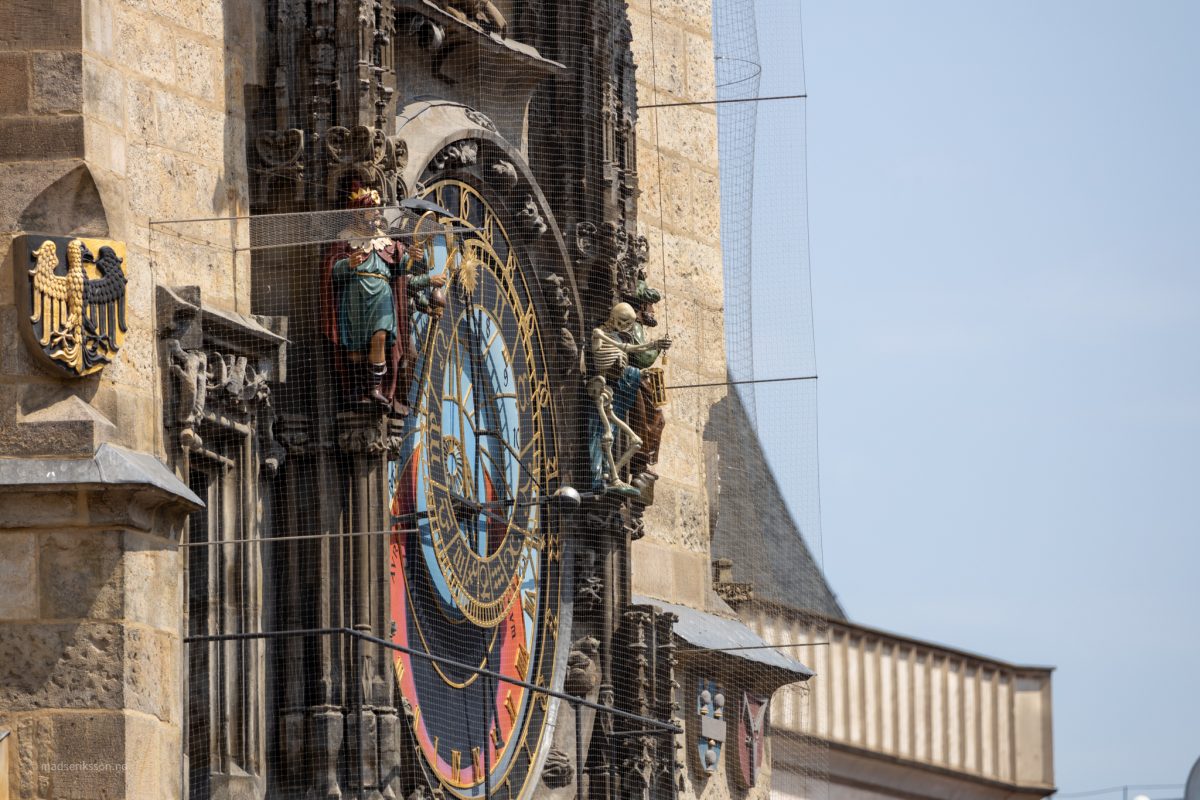
The Old Town Square (Staroměstské náměstí) is one of the finest medieval squares in Europe, surrounded by Gothic, Baroque and Rococo buildings that have accumulated around it over eight centuries. The Astronomical Clock (Orloj) on the south face of the Old Town Hall Tower has been running since 1410, making it one of the oldest working mechanical clocks in the world. The clock displays astronomical time, Old Bohemian time, Babylonian time and the signs of the zodiac simultaneously; on the hour, from 9am to 11pm, a procession of the twelve Apostles passes through two windows above the clock face, accompanied by the crowing of a golden cockerel and the ringing of a bell by a skeleton representing Death. The mechanism has been repaired, damaged and restored many times; the current version was restored after Second World War damage in 1948.
The Astronomical Clock has been running since 1410. The skeleton representing Death has been ringing its bell on the hour since the 15th century. Every hour, tourists gather in the square below to watch it, as they have done for six hundred years.
Josefov — the former Jewish ghetto of Prague, named after Emperor Joseph II who granted Jews civic rights in 1781 — is one of the most significant Jewish heritage sites in the world. Six synagogues survive, including the Old-New Synagogue (Staronová synagoga), built around 1270 and one of the oldest surviving synagogues in Europe, still in active use. The Old Jewish Cemetery, established in the 15th century and used until 1787, contains approximately 12,000 visible tombstones in layers up to 12 deep — the accumulation of centuries during which the community was forbidden to expand its burial ground beyond the ghetto walls. The Pinkas Synagogue, converted into a memorial after the Second World War, bears inscribed on its walls the names of 77,297 Bohemian and Moravian Jews who were murdered in the Holocaust.
Modern Prague — Kafka, Havel and the City of Dissent
The long boulevard where two revolutions began, the city that produced Kafka and Mucha, and the art that survived the occupation
Wenceslas Square (Václavské náměstí) is not a square but a broad boulevard, 750 metres long and 60 metres wide, running from the National Museum on the high end down to the Old Town. It has been the site of many of the most significant events in Czech history: the declaration of the independent Czechoslovak state in 1918, the Nazi occupation parade in 1939, the 1968 Warsaw Pact tanks, the self-immolation of student Jan Palach in January 1969 in protest against the Soviet occupation, and the mass gatherings of the Velvet Revolution in November 1989 when up to 750,000 people assembled beneath the balcony of the Melantrich building to hear Václav Havel and Alexander Dubček speak. The square today is a commercial boulevard of hotels, shops and restaurants, but the equestrian statue of St. Wenceslas at the upper end — where Palach died and where people laid flowers through the communist years — remains the city’s most charged public space.
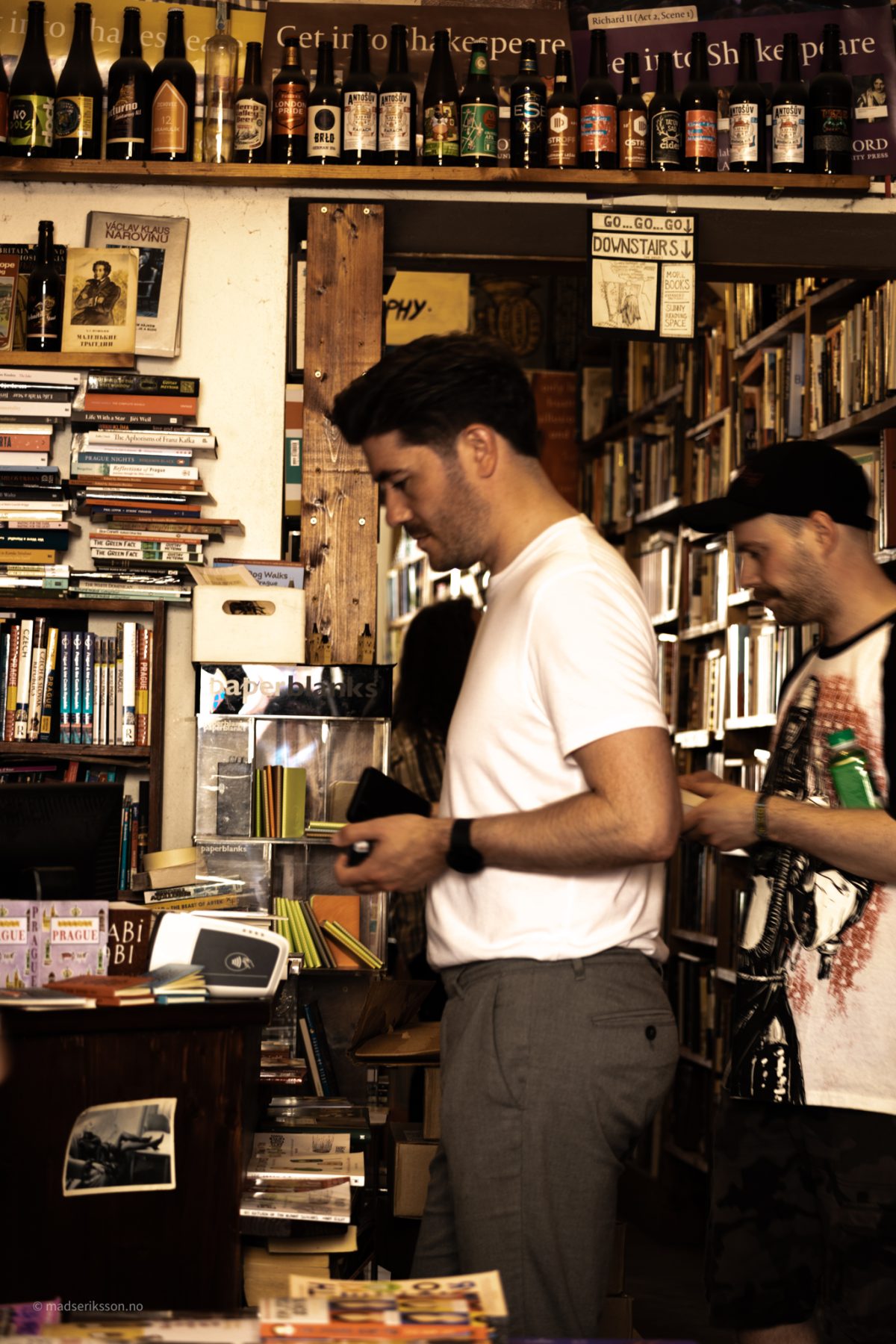
Franz Kafka was born in 1883 in a house on the edge of the Jewish Quarter, a few steps from the Old Town Square, and spent almost his entire life within a few hundred metres of his birthplace. He worked as an insurance lawyer and wrote at night, producing the works that would define literary modernism — The Metamorphosis (1915), In the Penal Colony (1919), The Trial (1925) and The Castle (1926) — in a city whose labyrinthine bureaucracy and linguistic complexity between Czech, German and Yiddish informed his entire sensibility. The Kafka Museum in Malá Strana provides the most thorough account of his life and work; the house where he was born, on the corner of Náměstí Franze Kafky, has a small plaque and a bust.
Kafka asked his friend Max Brod to burn all his manuscripts on his death. Brod, who had been a trusted reader throughout Kafka’s life, did not. The Trial and The Castle were published posthumously. Kafka would not have been surprised.
Art Nouveau Prague is most visible in the Municipal House (Obecní dům), built between 1905 and 1912 on the site of the former Royal Court, with interiors by a group of the most significant Czech artists of the period including Alfons Mucha. Mucha — whose poster designs for Sarah Bernhardt’s Paris theatre productions defined the Art Nouveau aesthetic internationally — spent the last decades of his life in Prague working on the Slav Epic, a cycle of 20 enormous paintings depicting the history of the Slavic peoples, now on permanent display in the Veletržní palác. The New Town Hall, the hotels along Wenceslas Square and the apartment buildings of Vinohrady and Žižkov demonstrate how thoroughly Art Nouveau transformed Prague’s architectural character in the early 20th century.
Czech Food and Beer — The Finest Lager in the World and the Long Lunch
The Czech Republic has the highest beer consumption per capita on Earth, and the Bohemian Pilsner that drives it is regarded by brewers as the reference point for the style
The Czech relationship with beer is statistical, cultural and almost philosophical. At approximately 188 litres per person per year, the Czech Republic has the highest beer consumption per capita in the world — a figure that becomes more comprehensible when you consider that the beer available here is, by widespread consensus among brewers and beer writers, the finest lager in the world. Bohemian Pilsner — the golden, hop-forward style invented in Plzeň in 1842 when the citizens of that city, tired of their consistently bad ale, commissioned a Bavarian brewer named Josef Groll to make something better — is the template from which virtually all commercial lager worldwide derives. The version available from tap in a Prague pivnice (beer hall) or hospoda (pub), properly poured into a cold glass with a dense white head, is a different drink from its international imitators. Kozel, Pilsner Urquell, Budvar and Bernard are the principal names; the craft brewing scene has added considerable variety since the 2010s.
Czech cuisine is a Central European tradition of considerable depth, built on pork, duck, game, root vegetables, dumplings (knedlíky) and fermented cabbage (zelí). The signature dish is svíčková na smetaně — braised beef sirloin in a sauce of root vegetables, cream and lemon, served with bread dumplings, a spoonful of cranberry sauce and a dollop of whipped cream. It is rich, complex and entirely specific to Czech cooking; a properly made svíčková in a traditional restaurant is one of the better arguments for the cuisine’s reputation. Roast pork (vepřo-knedlo-zelo: roast pork, dumplings and cabbage) is the other fundamental — less elaborate but equally satisfying when well executed. Prague also has a tradition of game cooking (venison, wild boar, pheasant) that reflects the country’s forested interior.
Svíčková is braised beef in cream sauce with bread dumplings, cranberry and whipped cream. It takes most of a day to make properly. Every Czech grandmother has a version. None of them are wrong.
The pivnice — the Czech beer hall — is one of the great democratic social institutions of European culture: long wooden tables, shared seating, beer from the tap at prices that remain among the lowest in the European Union, and a menu of Czech classics that has not changed significantly since the 1970s. The best are in the outer neighbourhoods away from the tourist centre: Žižkov, Vinohrady and Holešovice all have excellent traditional hospody. The Prague farmers’ markets — at Náměstí Míru, at Náplavka on the riverbank (Saturday mornings) and at Jiřák in Žižkov — offer the best access to Czech produce and street food outside the restaurant context, and the Saturday Náplavka market, with its line of stalls along the riverbank below Vyšehrad, is one of the most pleasant morning experiences in the city.
More in the same area
 CitiesThe World’s 10 Great Food Markets
 ArchitectureTen Buildings That Changed Their Cities — Modern Architecture Ranked on Impact, Not Image
 CitiesHiroshima and Miyajima: A preserved ruin and a shrine on the tideline
 CitiesSiem Reap — The City at the Gate of the Largest Temple on Earth
 CitiesThe World’s 10 Most Beautiful City Parks
 CitiesBangkok — the World’s most visited City
City Frames · scroll-driven 3D
More cities in three dimensions
54 city guides open with a model built from open map data. Scroll, and the camera moves from landmark to landmark.
Departures · City Frames
Where to next?
| Time | Destination | Country | Status |
|---|
Live · position of the sun
Golden hour, right now
The low, warm light just after sunrise and just before sunset. These are the cities on the site where it is happening at this moment.