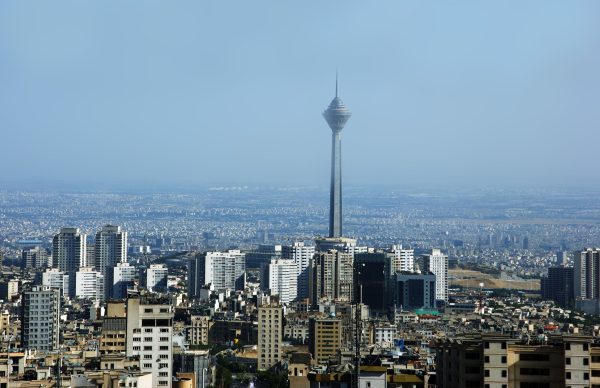
Two centuries ago Doha was a pearling settlement on a shallow bay of the Gulf. When the pearl trade collapsed in the 1920s and 1930s the town lost its living; then came oil, and later gas, and within two generations it became one of the wealthiest cities in the Gulf. Today more than four in five of Qatar’s people live in and around the capital, and the bay is ringed by a seven-kilometre waterfront: glass towers in West Bay at one end, the Museum of Islamic Art on its own island at the other, and between them a restored old market and a national museum shaped like a desert rose.

Doha is a young city with old roots. It was founded in the 1820s near the older settlement of Al Bidda, lived on the pearl trade, and was declared the capital of an independent Qatar only in 1971. Most of what visitors see has been built since then, and much of it in the last twenty years: the city hosted the Asian Games in 2006 and the football World Cup in 2022, opened a new airport in 2014 and a driverless metro in 2019, and filled its waterfront with landmark buildings by internationally famous architects. The city proper had around 1.2 million inhabitants in 2020, and the great majority of Qatar’s residents are foreign workers.
For a visitor, that history gives Doha two faces that are best seen together. One is the city of museums and skylines, of towers in West Bay and of art in public places. The other is older and smaller: the lanes of Souq Waqif, the dhows on the bay, the falcons and spice sellers, and the desert beyond the city. Doha is compact enough to see much of it in a two- or three-day stopover, and it is at its best in the cooler months; from May to September the average daytime high is above 38 °C.
How to approach Doha
This guide covers Doha in four parts: the Corniche and the Museum of Islamic Art at the heart of the bay; Souq Waqif and the restored old centre of Msheireb; the modern city of the National Museum, Katara and West Bay; and the desert and coast beyond the city, from the dunes of the Inland Sea to the UNESCO-listed ruins at Al Zubarah.
Doha in 3D
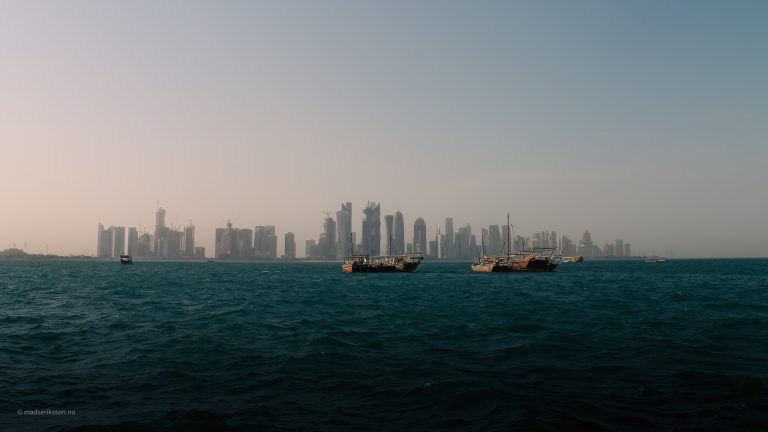
Doha was founded in the 1820s as a pearling settlement on a shallow bay of the Gulf and became the capital of an independent Qatar in 1971. The Corniche curves for about 7 km around Doha Bay, much of it on land reclaimed from the sea from the late 1960s. This frame runs from the towers of West Bay in the north to Souq Waqif and the National Museum in the south.
Doha, Qatar
The Museum of Islamic Art
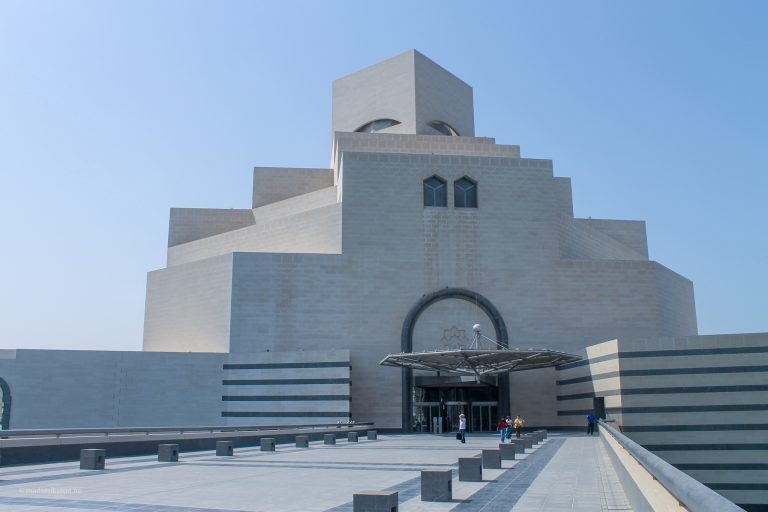
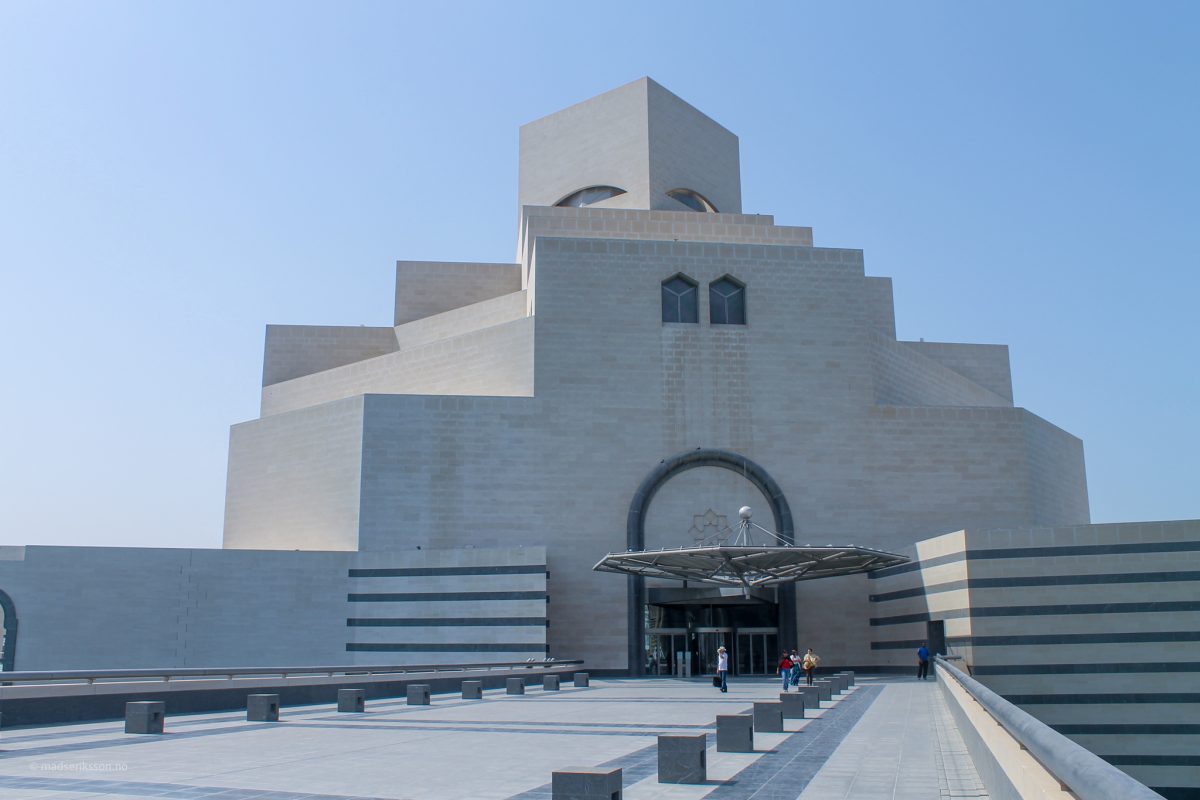
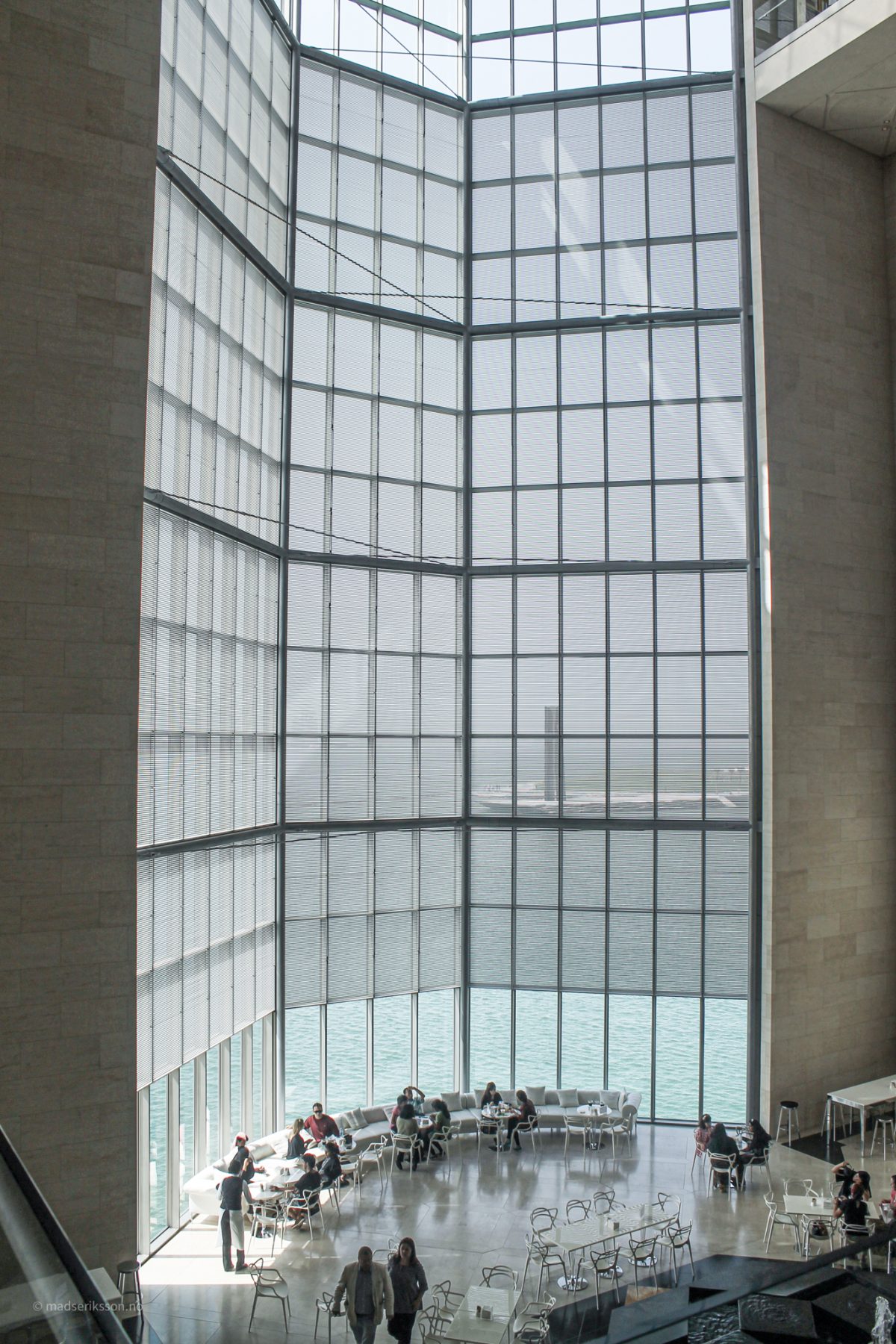
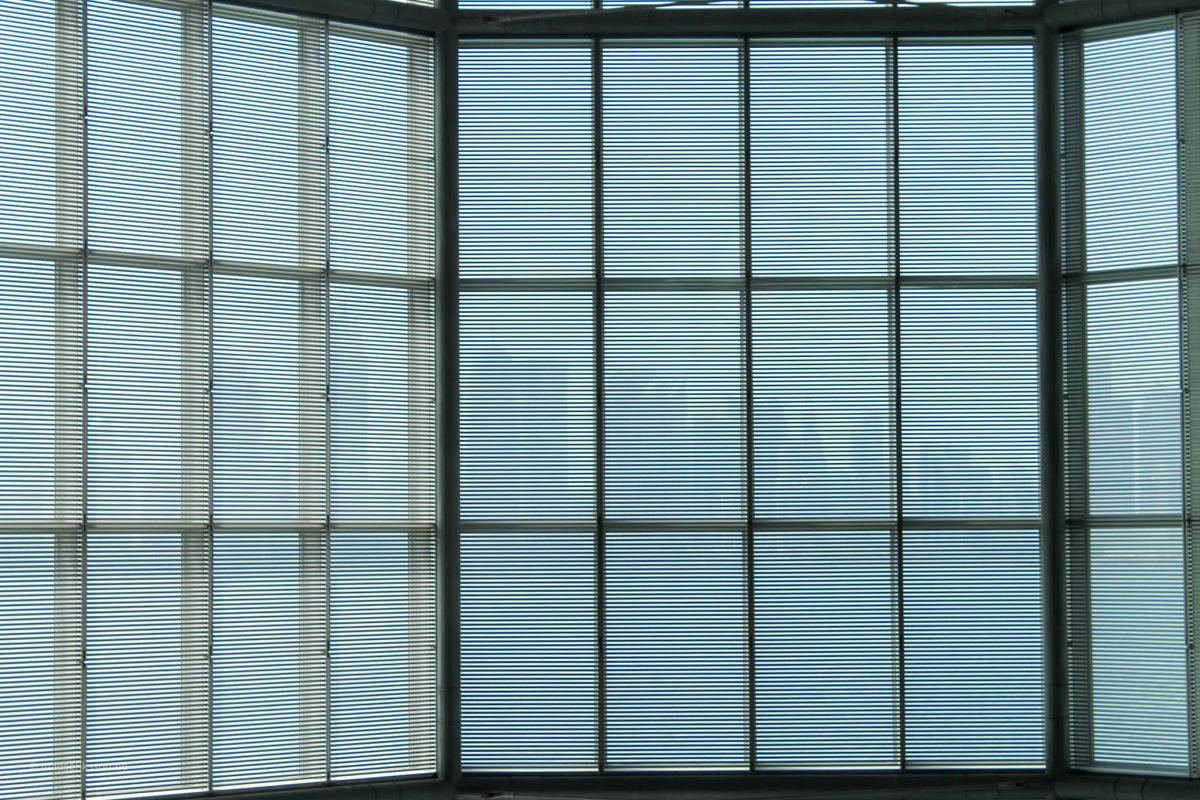
I. M. Pei was about 91 when he designed the Museum of Islamic Art, which opened in 2008 on its own artificial island about 60 m off the Corniche, so that nothing could ever be built against it. The museum covers 45,000 m² and some 1,400 years of art from across the Islamic world. From its windows the towers of West Bay line the far side of the bay.
Museum of Islamic Art, Doha
Souq Waqif
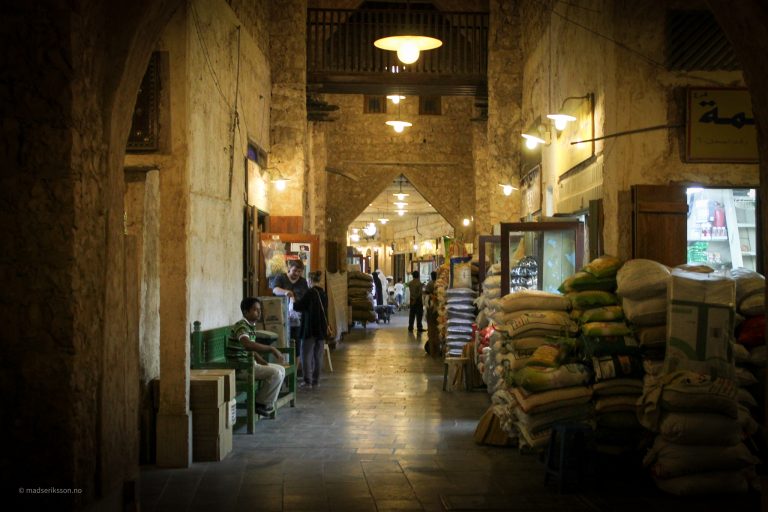
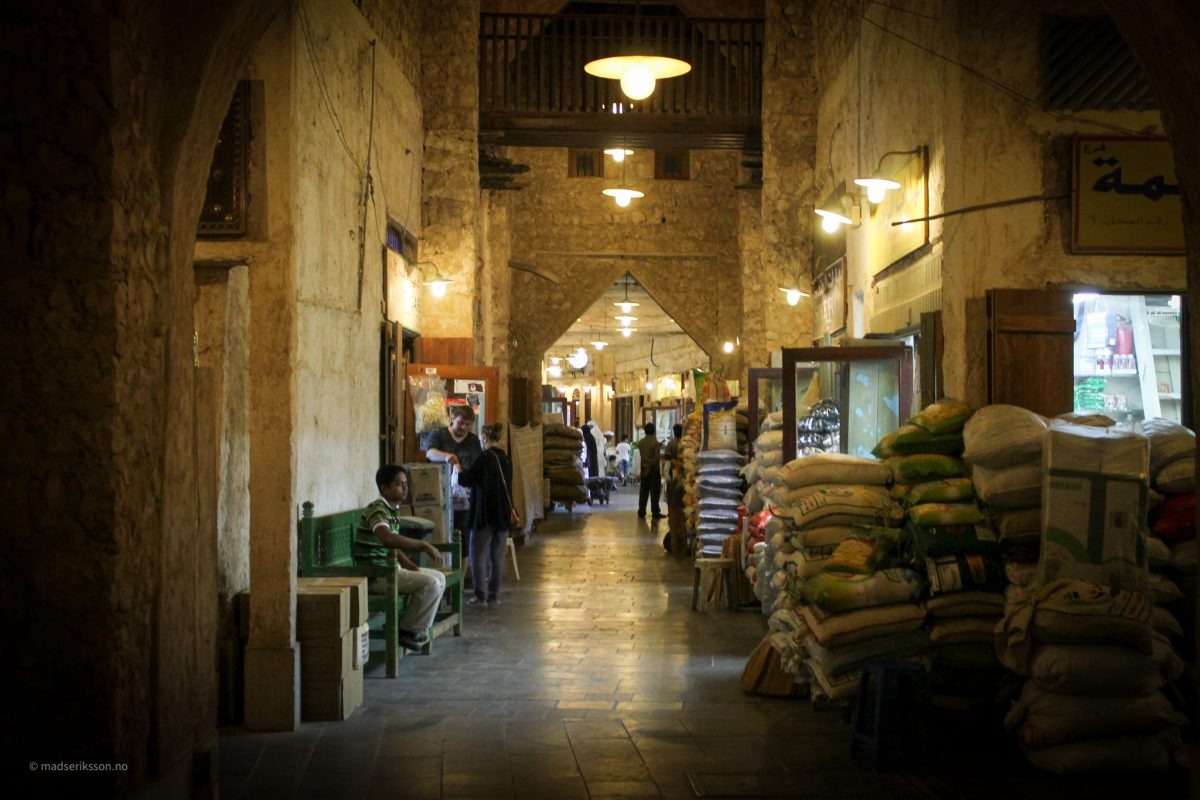
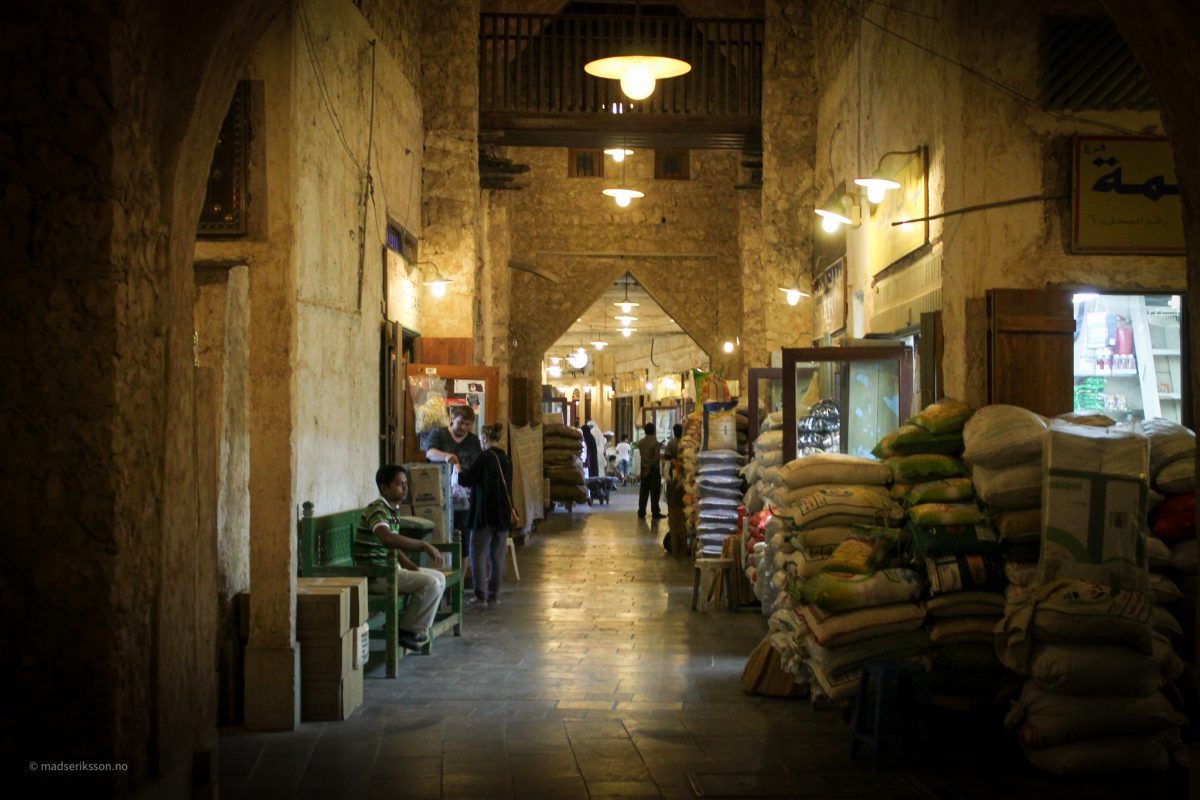
Souq Waqif, the standing market, grew up on the bank of Wadi Musheireb, where Bedouin and townspeople traded livestock and goods. Most of it was destroyed by fire in 2003 and restored in traditional style between 2006 and 2008, with spice, textile and gold shops and a separate falcon souq. On the Corniche in front of it, the Pearl Monument recalls the trade on which the city was founded.
Doha, Qatar
Msheireb and the Amiri Diwan
Next to the souq, Msheireb is a 31-hectare district of the old city redeveloped as a new downtown, completed in 2022. Four historic houses within it, among them Bin Jelmood House and Company House, became the Msheireb Museums in 2015. Msheireb station below is the interchange where all three lines of the Doha Metro, opened in 2019, meet.
The National Museum of Qatar
Jean Nouvel modelled the National Museum of Qatar, opened on 28 March 2019, on the desert rose, a crystal formation found in the Gulf sands. Its interlocking discs shade about 40,000 m² of galleries built around the restored palace of Sheikh Abdullah bin Jassim Al Thani from the early 20th century.
Dhows on the bay
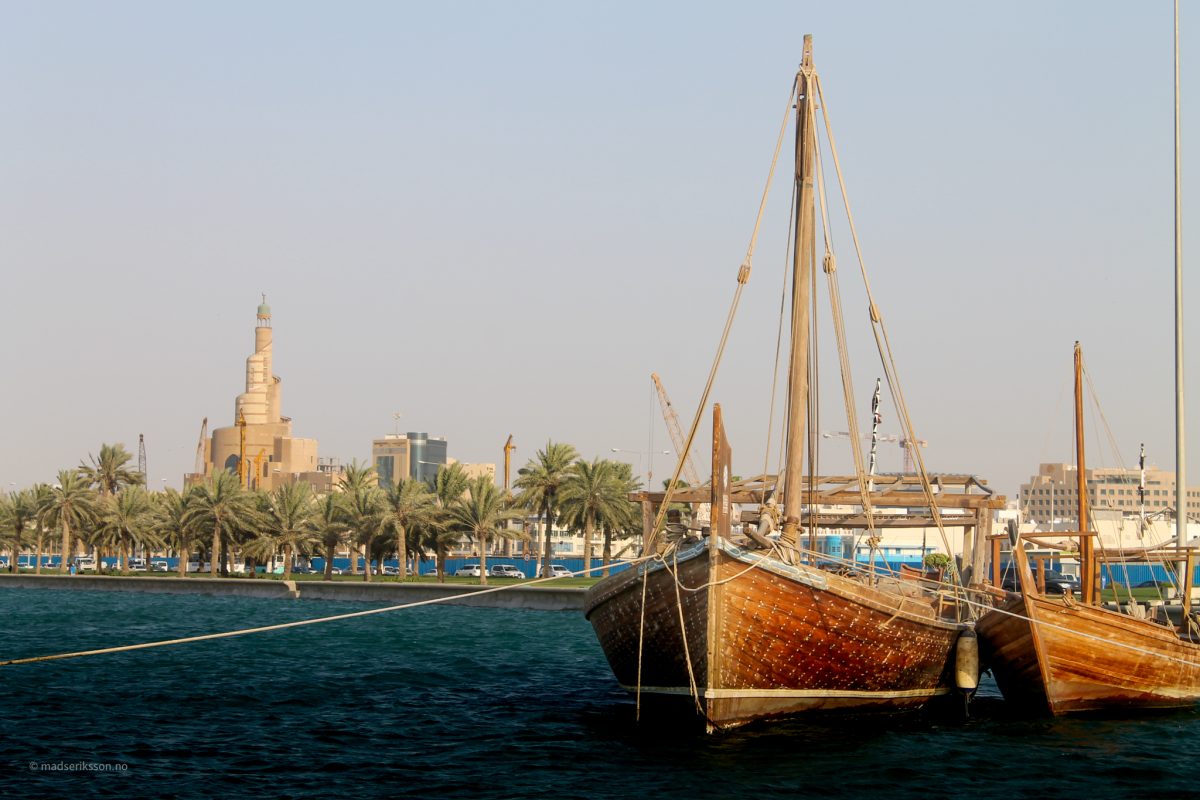
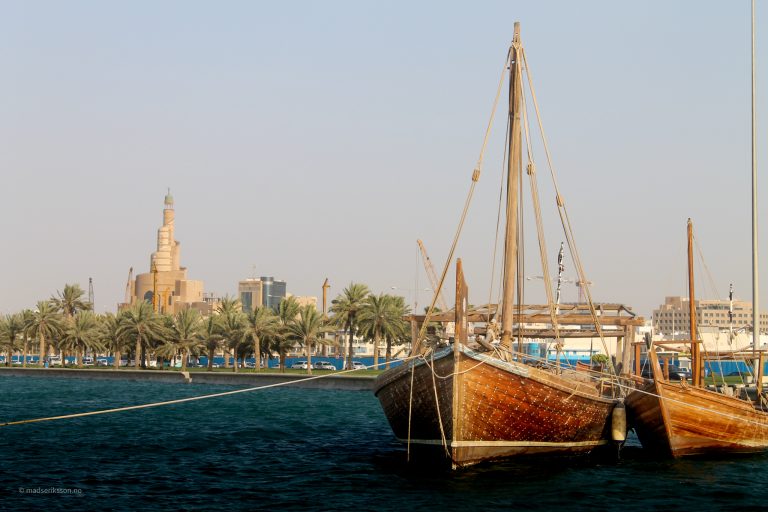
Wooden dhows still moor along the Corniche, and three dhow docks built for the 2022 World Cup are the starting points for trips on the bay. Behind the quays, the spiral minaret of the Fanar Islamic cultural centre rises above Souq Waqif. In the evening the promenade fills with walkers as the heat eases.
Doha, Qatar
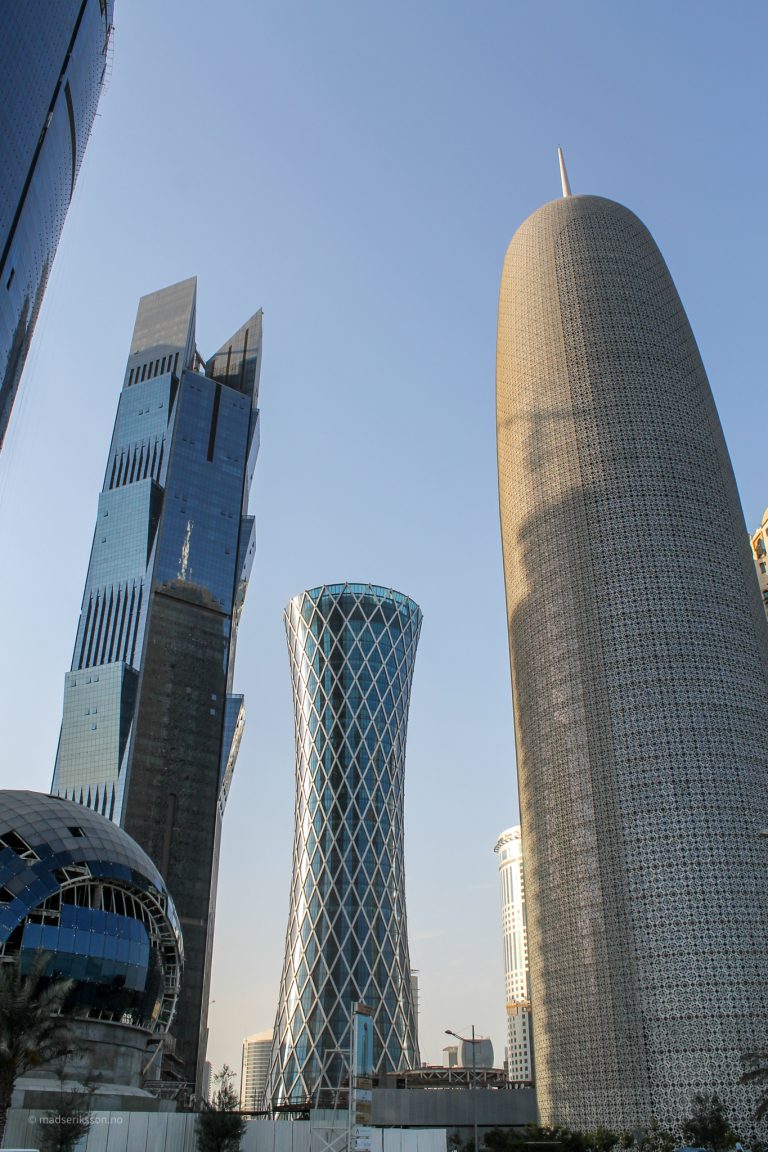
Doha Tower and West Bay
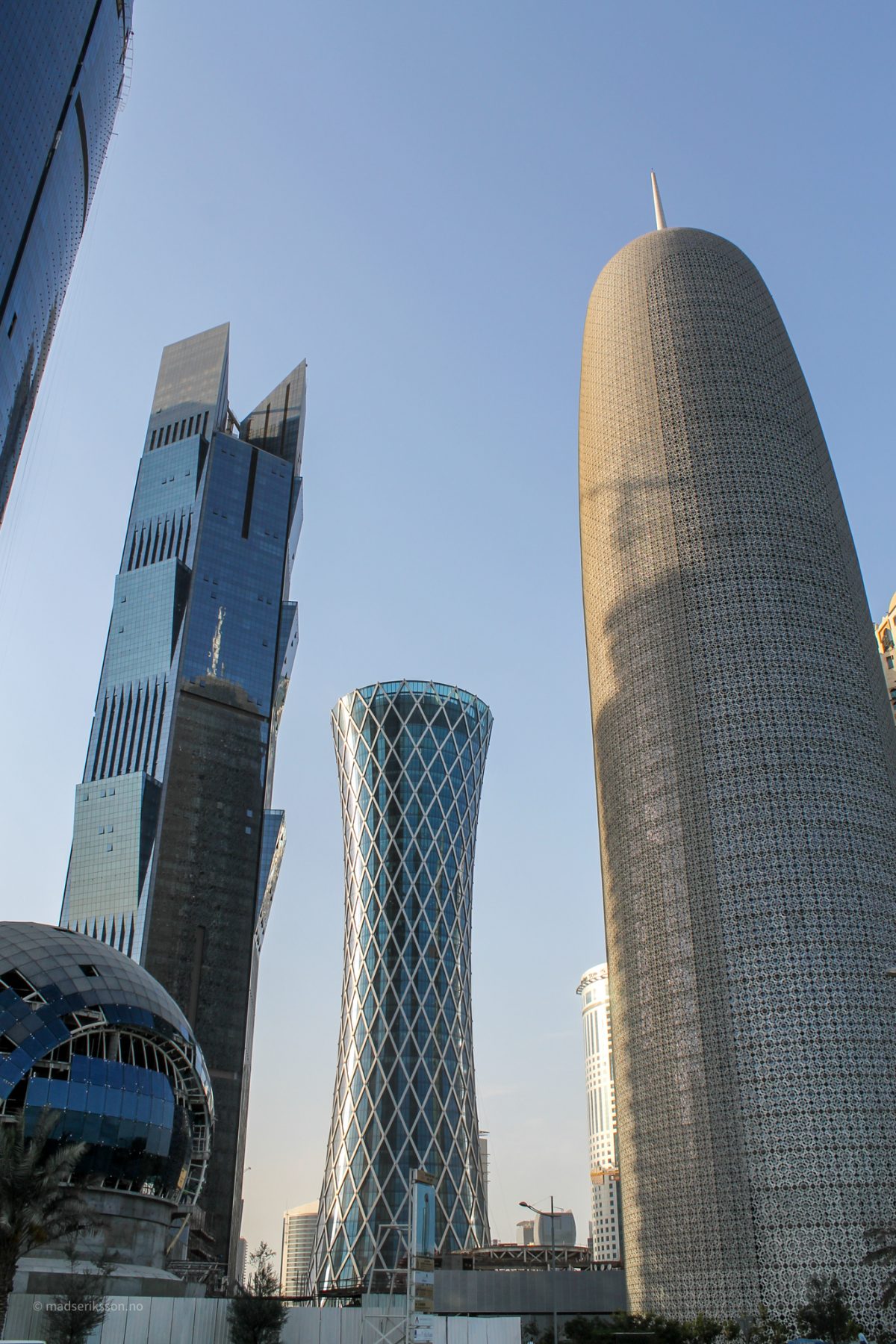
West Bay, at the northern end of the Corniche, is Doha's business district, a skyline that did not exist a generation ago. Its best-known tower is Jean Nouvel's 238 m Doha Tower, completed in 2012, a cylinder wrapped in a lattice of screens, which won the CTBUH award for best tall building worldwide that year.
Doha, Qatar
The bay at night
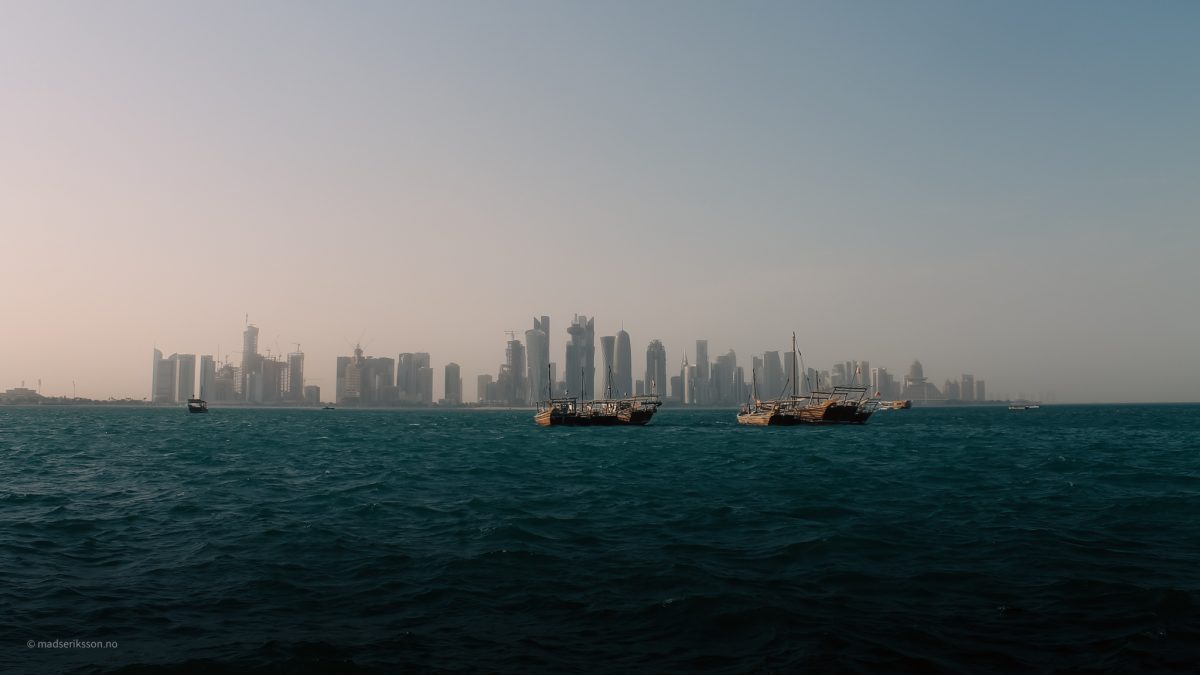
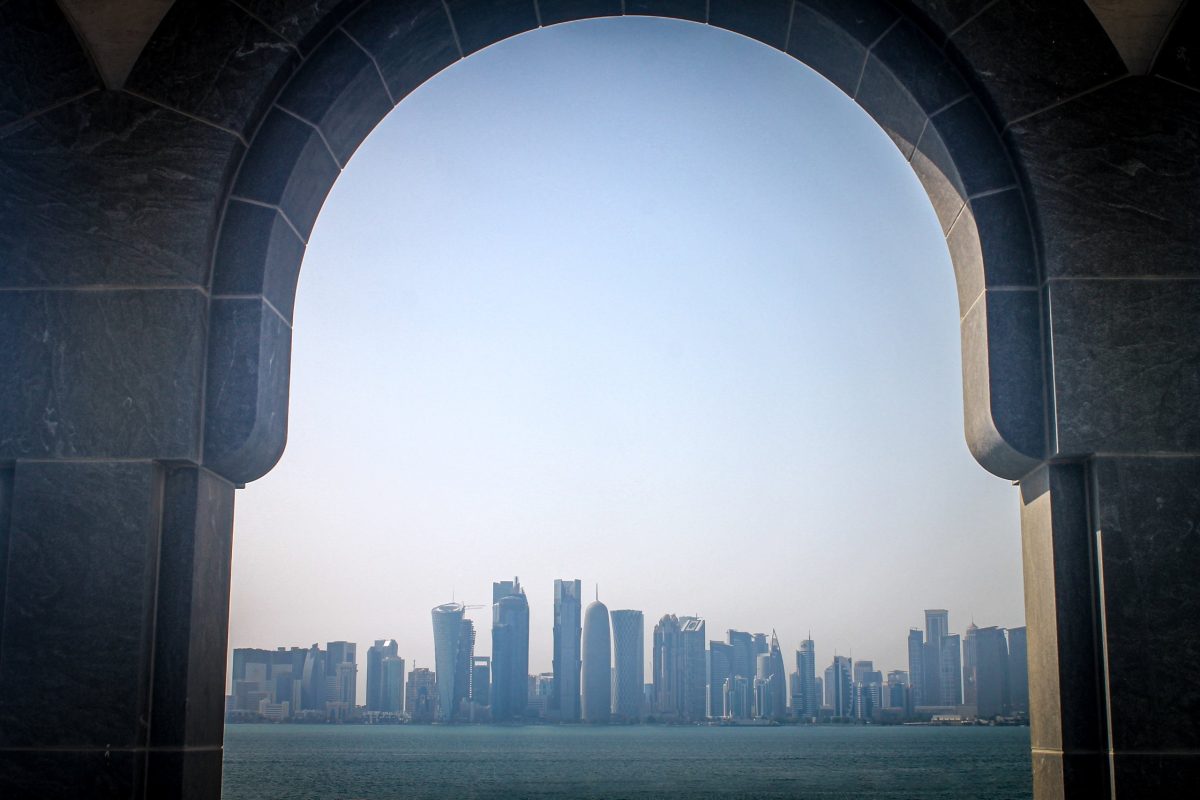
After dark the towers of West Bay light up across the water, seen from the Corniche and from the Museum of Islamic Art at the other end of the bay. The cooler months from late autumn to early spring are the best time to visit; from May to September average daytime highs are above 38 °C.
3D model © 2026 madseriksson.no · Photographs © madseriksson.no. Buildings and heights: © OpenStreetMap contributors (ODbL), via OpenMapTiles. Ground imagery: Sentinel-2 cloudless 2023 by EOX IT Services GmbH (contains modified Copernicus Sentinel data 2023; CC BY 4.0). Heights are approximate where OpenStreetMap has no measured value; sun positions are approximate.
The Corniche — Seven Kilometres Around the Bay, and a Museum on Its Own Island
The waterfront that holds the city together, the dhows along the quays, and I. M. Pei’s last great museum at the southern end of the bay
The Corniche is the spine of Doha. It runs for about seven kilometres in a broad crescent around Doha Bay, from the Sheraton at the tip of West Bay in the north to Doha Club Park at the southern end, and most of it stands on land reclaimed from the sea from the late 1960s onwards. A promenade runs the whole way, popular with walkers and families in the evening, when the heat eases and the towers of West Bay light up across the water. Three dhow docks built for the 2022 World Cup, at Al Bidda Park, Al Dafna Park and Sheraton Park, are the starting points for dhow trips on the bay. Near the entrance to the port stands the Pearl Monument, an open oyster shell holding a pearl — a reminder of the trade on which the city was founded.
At the southern end of the bay, on an artificial promontory about sixty metres off the Corniche, stands the Museum of Islamic Art. Its architect, I. M. Pei, was about 91 when he was persuaded out of retirement to take on the project; he insisted on an island site so that no future building could crowd it. The museum opened in 2008, covers 45,000 square metres over four floors of permanent and temporary exhibitions, and reopened in October 2022 after a renovation that created 18 redesigned galleries with more than 1,100 objects, most of them newly acquired.
Pei placed the Museum of Islamic Art on its own island so that nothing could ever be built against it. From the Corniche it stands alone against the water, with the towers of West Bay on the far side of the bay.
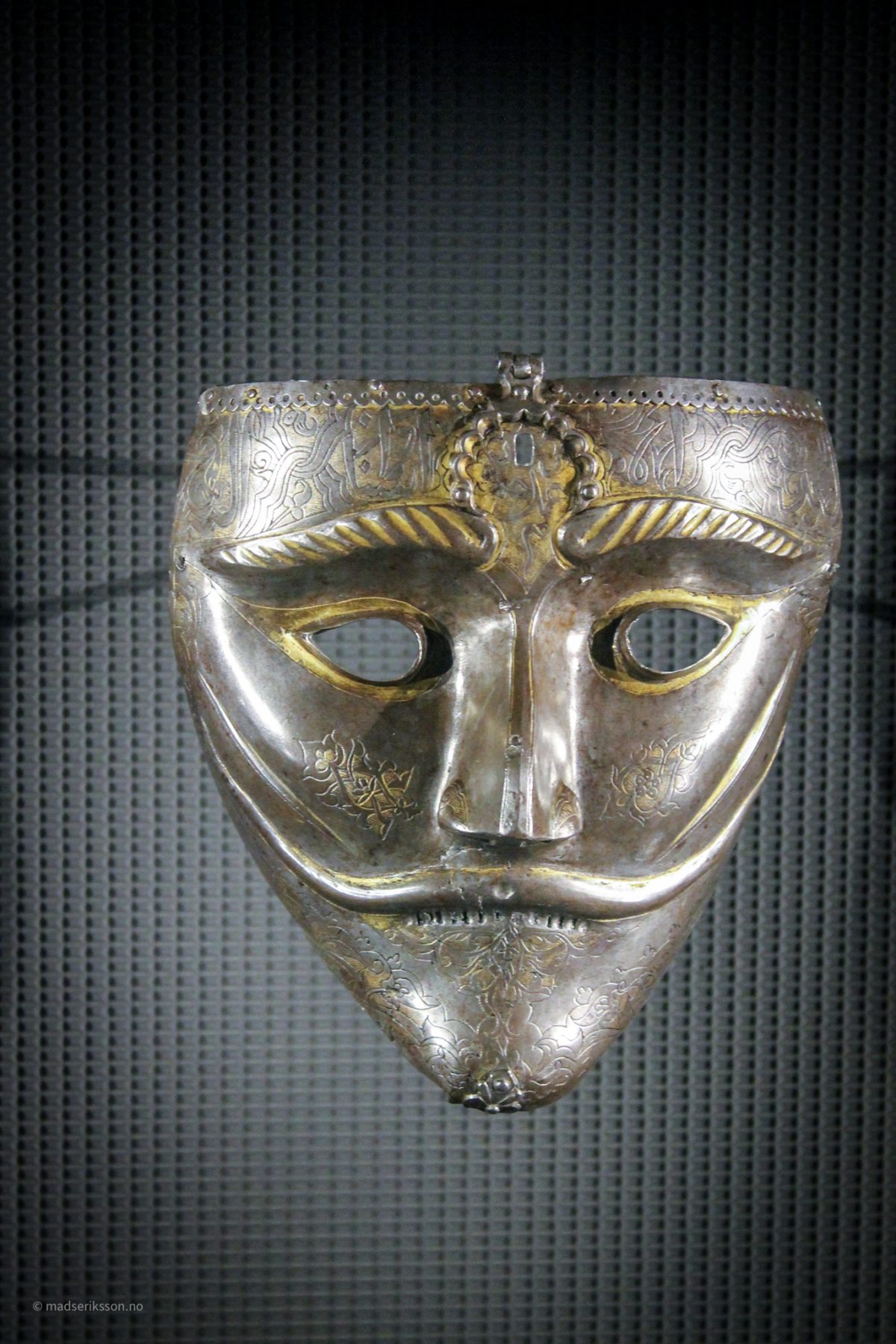
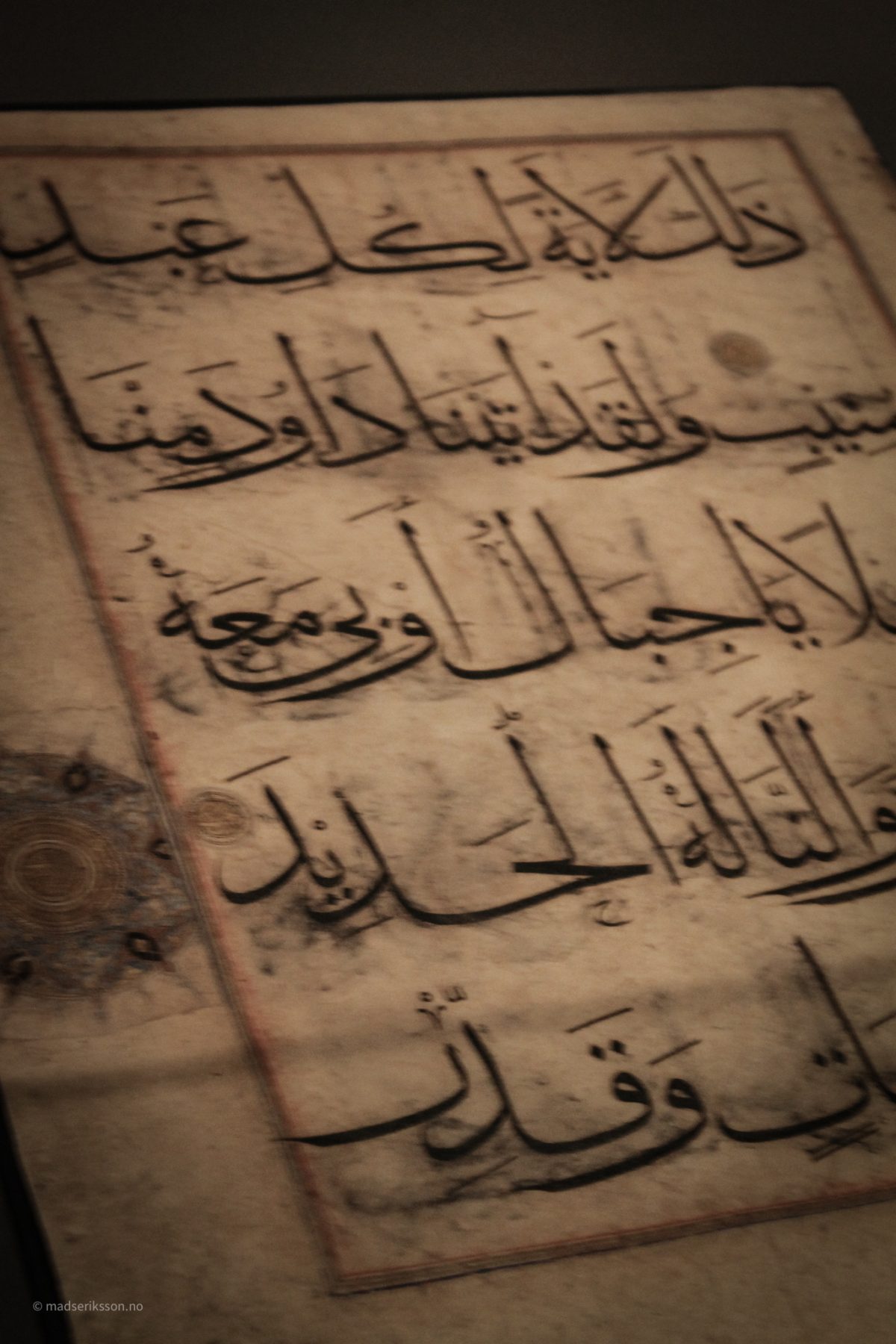
The collection covers some 1,400 years of art from across the Islamic world, from Spain to Central Asia and India, and from the 7th century to the 20th. Among its best-known pieces are pages from the Persian epic Shahnameh, a 10th-century planispheric astrolabe made in Iraq, and a carved emerald plaque owned by the Mughal emperors. In 2026 adult tickets cost QAR 100, while residents of Qatar and the GCC and children aged 16 and under go free. The museum is closed on Wednesdays and opens in the afternoon on Fridays. Beside it, MIA Park stretches along the shore, with cafés, a playground, a twice-weekly bazaar and Richard Serra’s steel sculpture 7.
Souq Waqif — The Standing Market, Rebuilt
Spices, falcons and evening crowds in the restored heart of old Doha, and the four heritage houses of Msheireb next door
Souq Waqif stands on the bank of Wadi Musheireb, a dry riverbed where Bedouin and townspeople met to trade for at least a century — mainly in livestock and the goods that went with it. Its name is usually translated as “the standing market”, after the traders who are said to have stood at the gates to show their wares. As Doha grew rich and spread outwards in the late twentieth century the old market declined, and in 2003 a fire destroyed most of it. The government’s restoration, begun in 2006 and completed in 2008, demolished the buildings added after the 1950s and refurbished the older structures.
The result is partly a reconstruction, but it works as a real market. The lanes are lined with shops selling spices, textiles and handicrafts, with jewellers selling gold, and with restaurants and cafés. A separate section is given over to falcons, which remain central to Gulf culture, together with the equipment used to train and follow them, down to landing pads and GPS tracking systems. The souq comes to life in the evening, when families, residents and visitors fill the lanes and the restaurant terraces.
Souq Waqif was rebuilt after the fire of 2003 by clearing away the modern additions and restoring what was old. It is busiest after dark, when the heat of the day fades and the lanes fill with people.
Next to the souq lies Msheireb, a 31-hectare district of the old city that has been redeveloped as a new downtown quarter; its final phase was completed in 2022. Preserved within it are four historic houses that now form the Msheireb Museums, opened in 2015: Bin Jelmood House, Company House, Mohammed bin Jassim House and Radwani House. Msheireb station, beneath the district, is the central interchange of the Doha Metro, where all three lines meet.
Modern Doha — A Desert Rose, a Cultural Village and a Wall of Towers
The national museum that tells Qatar’s story from the desert to the gas fields, the amphitheatre and mosques of Katara, and the skyline of West Bay
The National Museum of Qatar, which opened in March 2019 at the southern end of the Corniche, is the most striking building in Doha. Jean Nouvel based its form on the desert rose, a cluster of crystals that forms in the sand of the Gulf, and built it as a mass of interlocking discs that create sheltered spaces to shade visitors from the desert heat. At its heart is the preserved palace of Sheikh Abdullah bin Jassim Al Thani, and the new building grows around it. Its galleries cover some 40,000 square metres and tell the story of Qatar and its people.
North along the coast, between West Bay and The Pearl, Katara Cultural Village opened in 2010 as a purpose-built district for the arts. It gathers a lot into a small space: a marble amphitheatre seating up to 5,000, an opera house, galleries and concert halls, two mosques — one covered in turquoise and purple mosaic, the other in gold tiles — traditional pigeon towers around fifteen metres tall, and a public beach about one and a half kilometres long. It hosts exhibitions, concerts and festivals through the year, and restaurants line its waterfront.
Seen from the Corniche at dusk, the towers of West Bay are the image of modern Doha — a skyline that did not exist a generation ago.
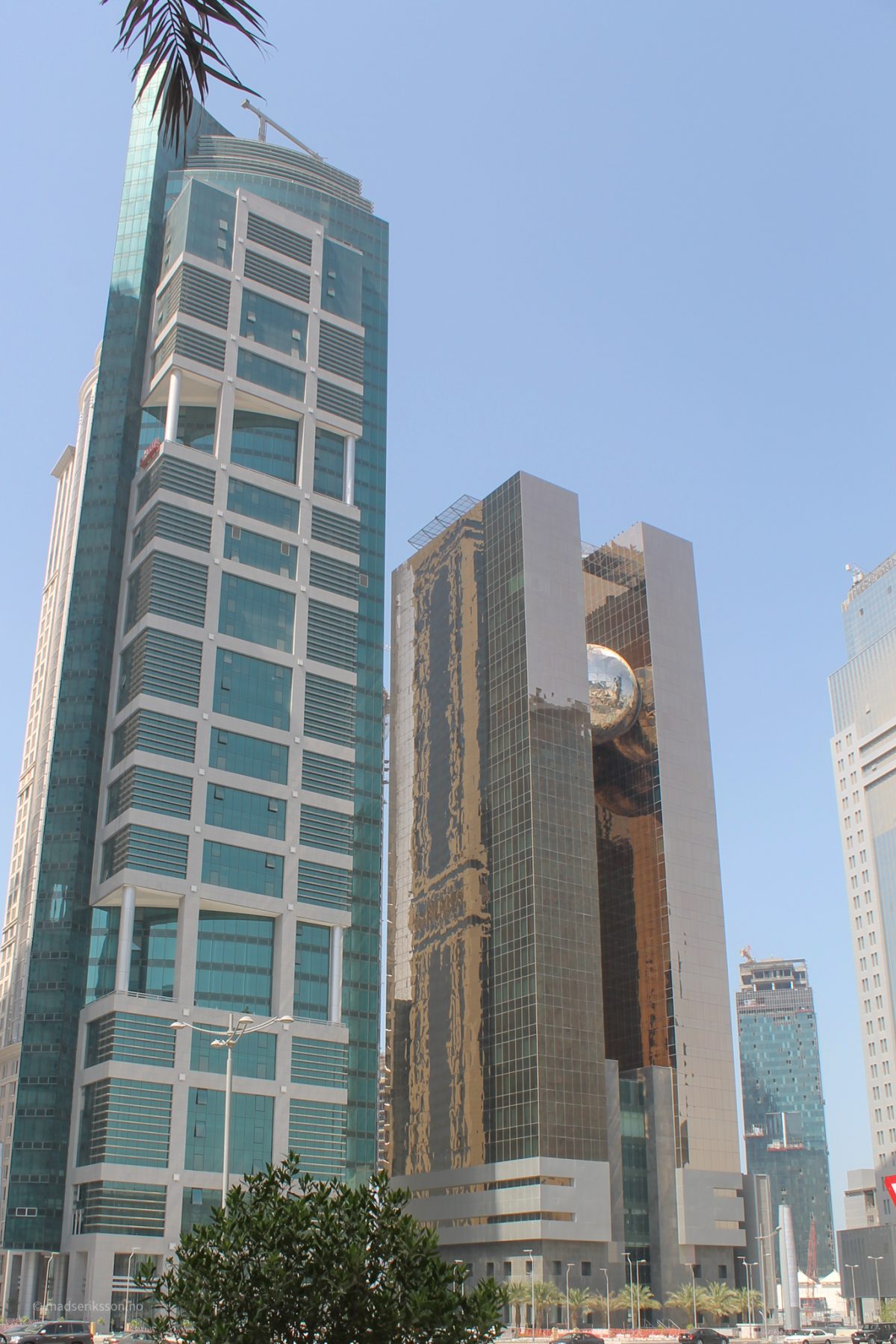
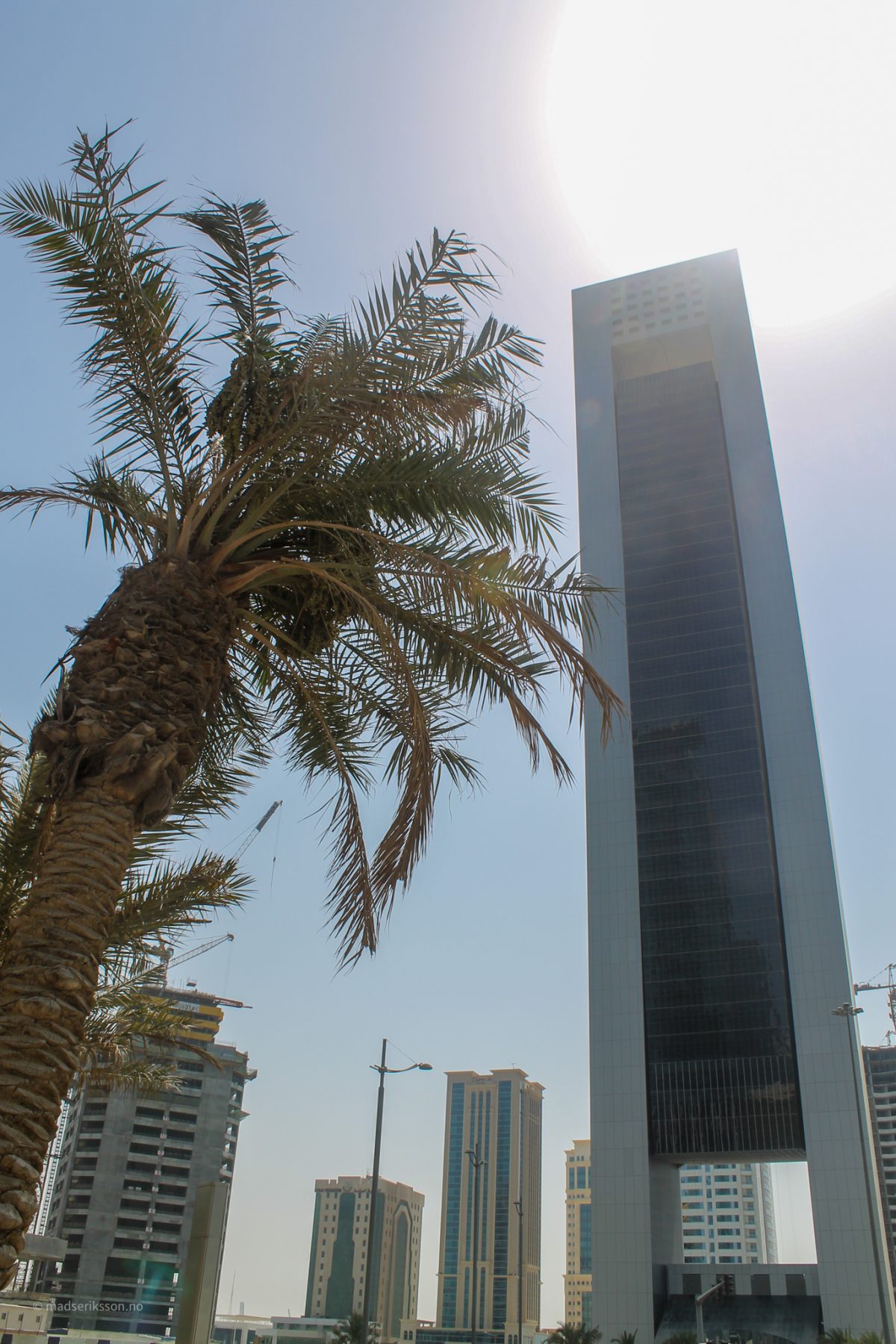
West Bay, at the northern end of the Corniche, is Doha’s business district and its skyline. Among its best-known towers is the 238-metre Doha Tower, designed by Jean Nouvel and completed in 2012. Further inland, in the Aspire Zone built for the 2006 Asian Games, the 300-metre Aspire Tower — also called the Torch — was completed in 2007 and remains one of the city’s landmarks. Katara has its own station on the Red Line of the metro.
Beyond the City — Dunes, the Inland Sea and a Pearling Town in Ruins
Where the desert meets the Gulf in the south, and where the story of Qatar’s pearl trade survives in the north-west
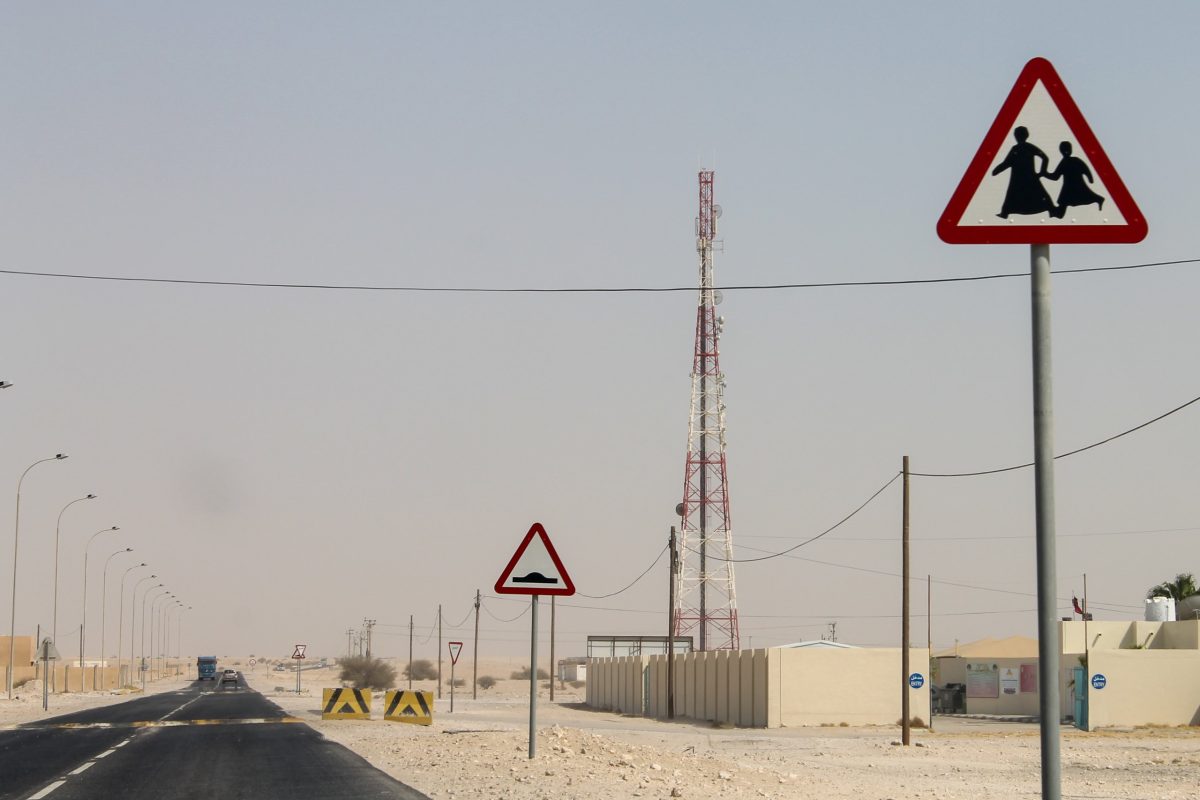
The most spectacular desert landscape in Qatar lies in the far south-east of the country, around 78 kilometres from the capital. Khor Al Adaid, known to English speakers in Qatar as the Inland Sea, is an inlet of the Gulf that winds for nearly ten kilometres between high sand dunes into a lagoon on the border with Saudi Arabia. The dunes here rise to between about 40 and 60 metres, and offshore winds push them towards the shoreline. The area was made a nature reserve in 2007 and is Qatar’s largest; it is on UNESCO’s tentative list for World Heritage status, and it is home to grazing camels, ospreys and, offshore, turtles and dugongs.
Most visitors go with an organised desert safari from Doha, the most common routes running south via Mesaieed, and combine a drive across the dunes with time at the water’s edge. The desert is far more pleasant in the cooler months; in summer, temperatures are punishing by midday. Driving on sand calls for a four-wheel-drive vehicle and experience, and independent visitors are better off with a guided trip.
At Khor Al Adaid the dunes run down to the sea. It is the landscape most visitors to Doha leave the city to see.
In the opposite direction, around 105 kilometres north-west of Doha, lie the ruins of Al Zubarah. Founded in the middle of the eighteenth century by settlers from Kuwait, it became one of the great pearling and trading towns of the Gulf, with links to India, Oman and Iraq, before being occupied in 1809, abandoned and only partly resettled in the nineteenth century. The site was inscribed as Qatar’s first UNESCO World Heritage Site in 2013 for its preservation and its connection to pearling and trade. Nearby stands Al Zubara Fort, built in 1938. Together with the souq and the museums of the Corniche, it completes the story of how a pearling coast became a capital.
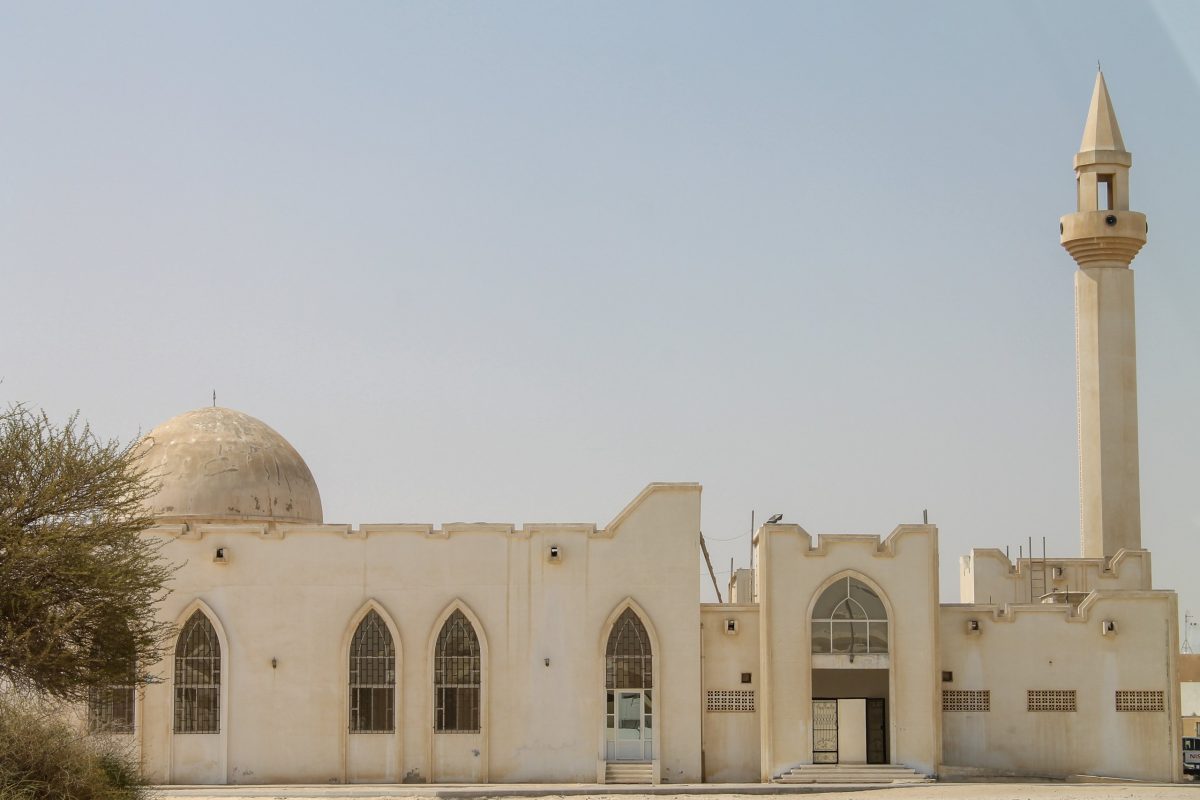
«Doha has gone from pearling town to Gulf capital in less than a century, and it shows the whole journey within a few kilometres of its bay. Walk the Corniche from Pei’s museum on its island towards the towers of West Bay, spend an afternoon inside Nouvel’s desert rose learning how the country got here, and come back to Souq Waqif after dark, when the falcon shops and spice stalls are at their busiest. Then leave the city for a day, drive out to the dunes of the Inland Sea, and see the landscape that all of it was built against.»

More in the same area
 CitiesThe World’s 10 Great Food Markets
 ArchitectureTen Buildings That Changed Their Cities — Modern Architecture Ranked on Impact, Not Image
 CitiesHiroshima and Miyajima: A preserved ruin and a shrine on the tideline
 CitiesThe World’s 10 Most Beautiful City Parks
 CitiesBangkok — the World’s most visited City
 CitiesLuang Prabang — The Most Complete Traditional City in Southeast Asia
City Frames · scroll-driven 3D
More cities in three dimensions
54 city guides open with a model built from open map data. Scroll, and the camera moves from landmark to landmark.
Departures · City Frames
Where to next?
| Time | Destination | Country | Status |
|---|
Live · position of the sun
Golden hour, right now
The low, warm light just after sunrise and just before sunset. These are the cities on the site where it is happening at this moment.