At 9:53 on the morning of 14 July 1902, the bell tower of St Mark’s collapsed into Piazza San Marco. A crack had been spreading down its brickwork for days, the square had been cleared, and when the tower came down in a single heap of rubble the only casualty was the caretaker’s cat. Venice decided the same evening to build it again “where it was and as it was”, and ten years later, on St Mark’s Day 1912, the new campanile was inaugurated — 98.6 metres of brick and stone, crowned by a golden archangel, that looks almost exactly like the one that had stood there for a thousand years.

The campanile stands on its own at the corner of Piazza San Marco, a few metres from the façade of the basilica it serves, and it is the tallest structure in the historic centre of Venice. It began as a watchtower, built to look out over the lagoon for approaching ships and to guide Venetian vessels into port, and grew over the centuries into a lighthouse, a bell tower, a weather vane, a place of punishment and, briefly, an observatory. Its plain square shaft of red brick, twelve metres on each side, carries an arcaded belfry, a cube decorated with the lion of St Mark and the figure of Venice, and a green pyramid spire with the archangel Gabriel turning on its tip.
For visitors it is the simplest way to see Venice from above. A lift inside the shaft reaches the belfry in around half a minute, and from the loggia around the bells the city opens out in every direction: the domes of the basilica directly below, the Doge’s Palace and the lagoon to the south, the rooftops and campanili of Venice stretching away to the north, and on clear days the Alps beyond the mainland. It is quicker and far less crowded than most Venetian sights — and much of what visitors see from the top is the tower’s own history laid out below.
How to approach St Mark’s Campanile
This guide covers the campanile in three parts: the thousand-year history of the original tower, from a ninth-century watchtower to Galileo’s telescope; the morning in 1902 when it fell, and the decade it took to put it back; and the visit itself — the lift, the bells, the views from the belfry and the best times to go up.
The tallest tower in Venice
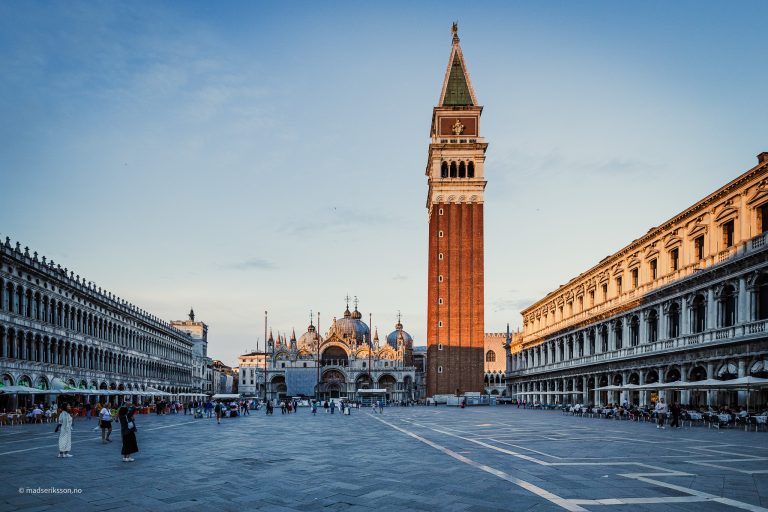
St Mark’s Campanile stands on its own at the corner of Piazza San Marco and the Piazzetta, a few metres from the façade of the basilica it serves. At 98.6 metres it is the tallest structure in the historic centre of Venice. It began as a watchtower over the harbour basin, ordered by Doge Pietro Tribuno in 888, and grew into a beacon, a bell tower and a landmark for ships coming in from the sea.
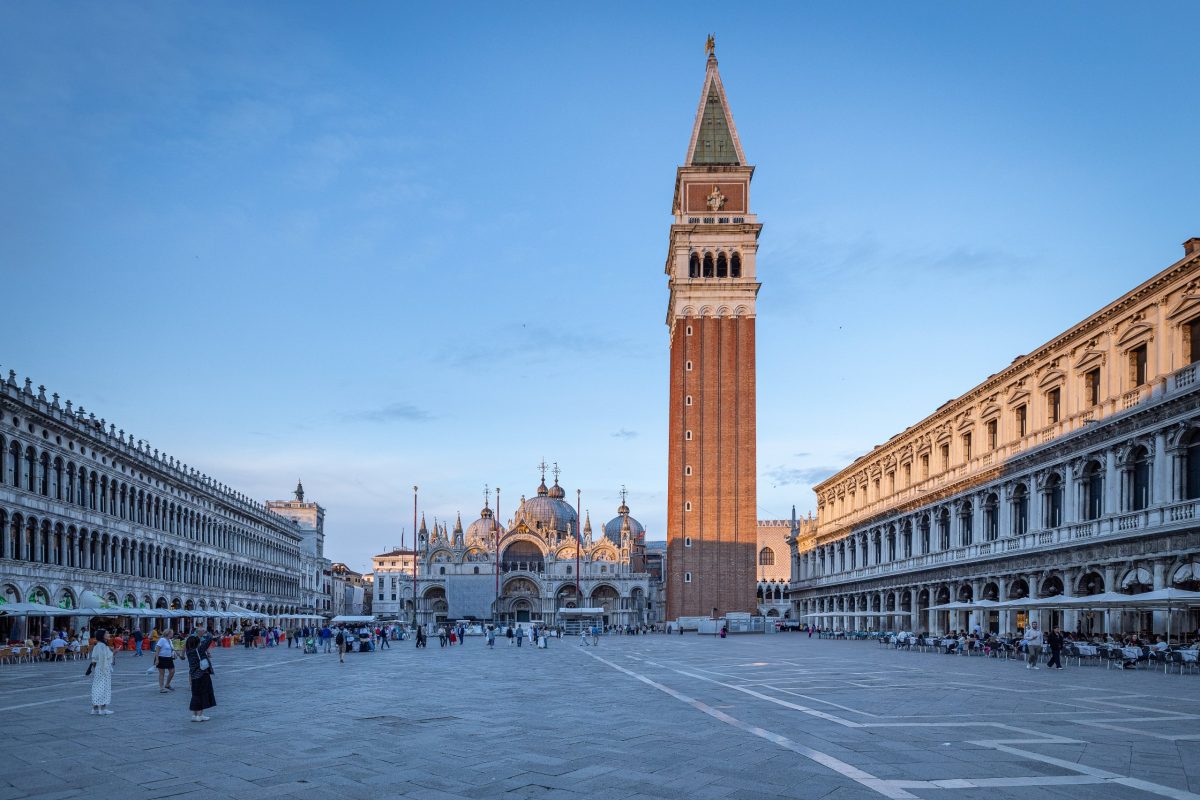
Piazza San Marco in evening light, with the Campanile and the Basilica di San Marco
Brick shaft, belfry and angel
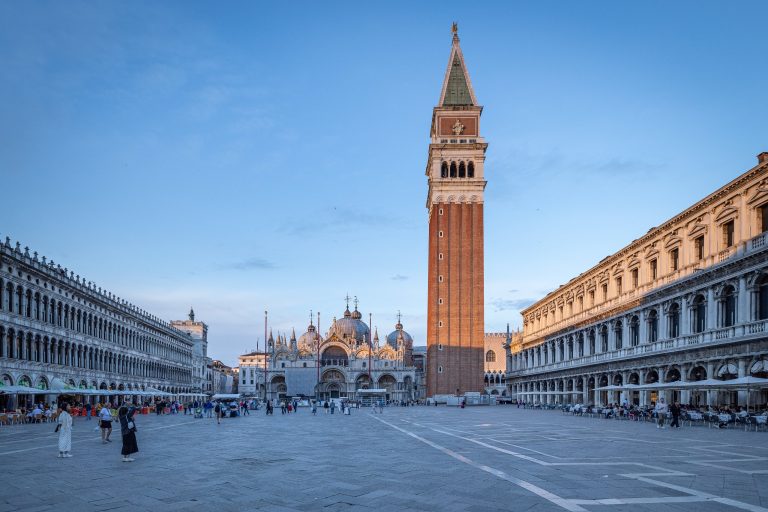
A plain square shaft of red brick, twelve metres on each side, carries an arcaded belfry, a cube decorated with the lion of St Mark and the figure of Venice, and a green pyramid spire. Belfry and spire took this shape between 1511 and 1514 to a design by Giorgio Spavento. On the tip turns the gilded archangel Gabriel, first placed in 1513 as a weather vane; the present statue dates from 1822.
The Campanile rising above Piazza San Marco, with the Basilica at its foot
Where it was and as it was
Twenty-three minutes after the Piazza had been cleared, the tower came down vertically into a mound of brick. The basilica, only a few metres away, was hardly touched, but Sansovino’s Loggetta at the foot of the tower was crushed and a corner of the Marciana Library across the Piazzetta destroyed. The only victim was the caretaker’s cat. The new campanile was inaugurated on St Mark’s Day, 25 April 1912.
Domes and palace below
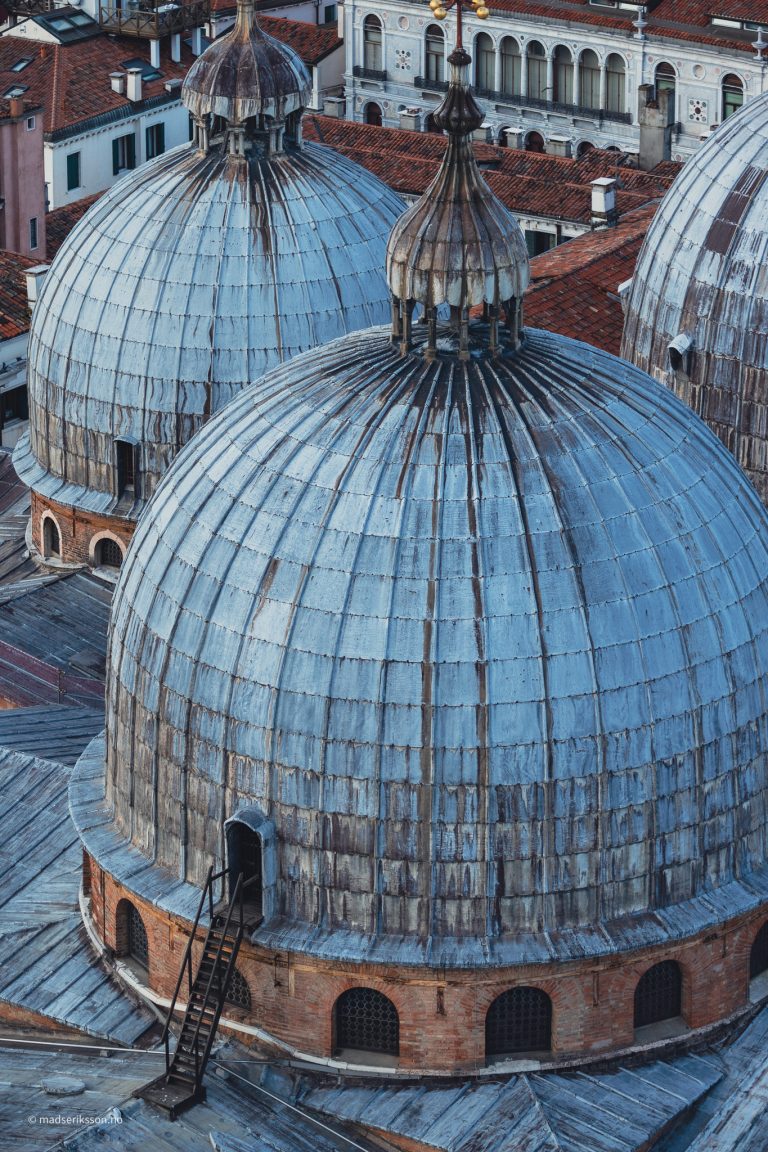
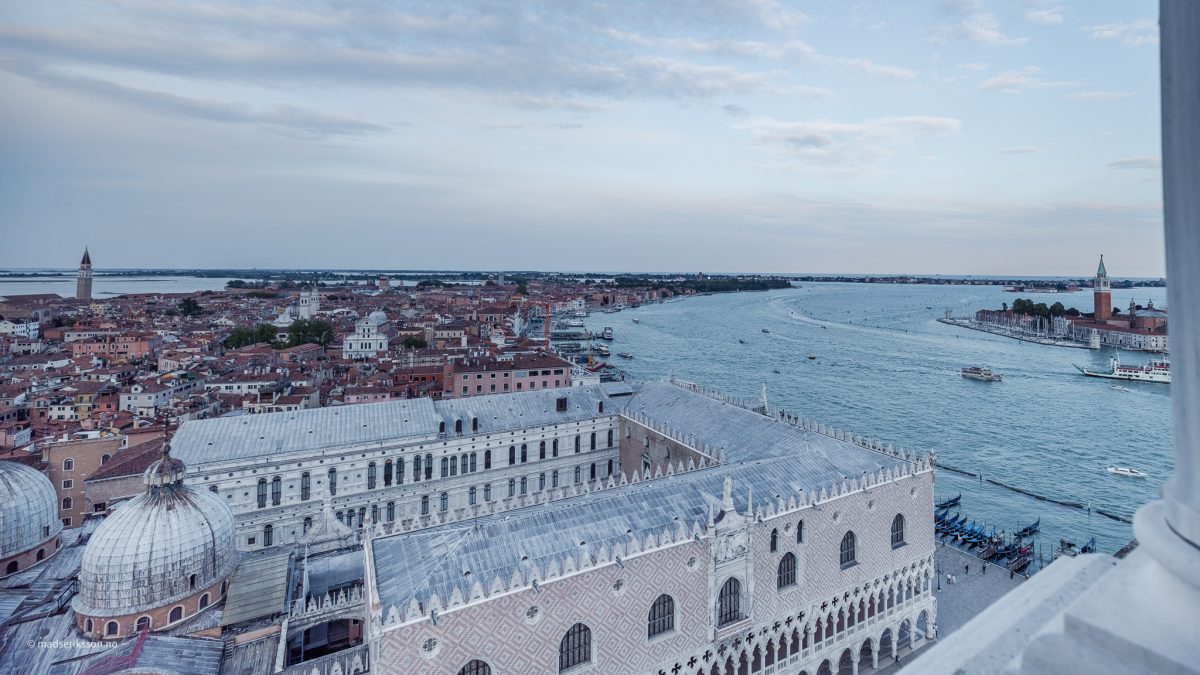
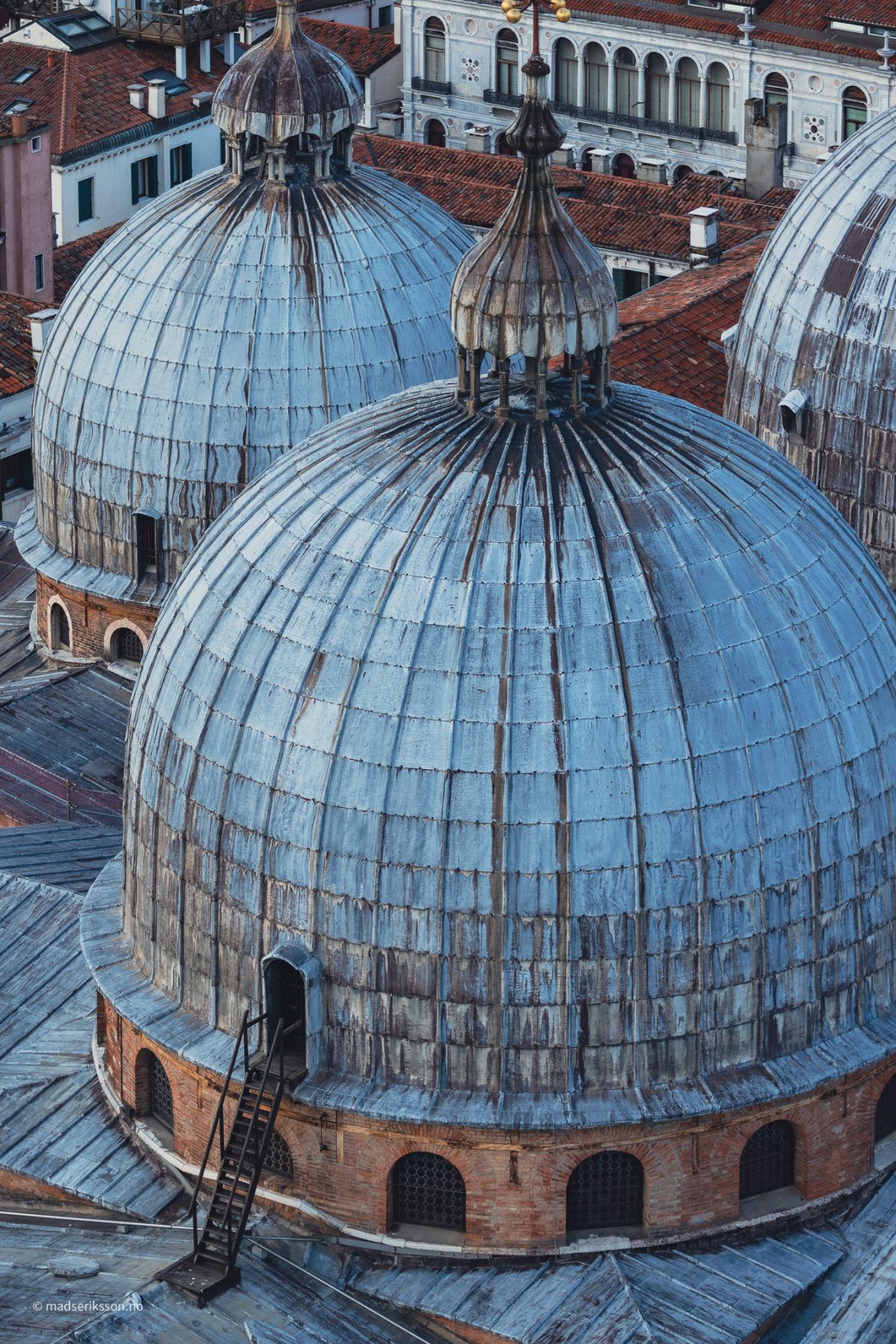
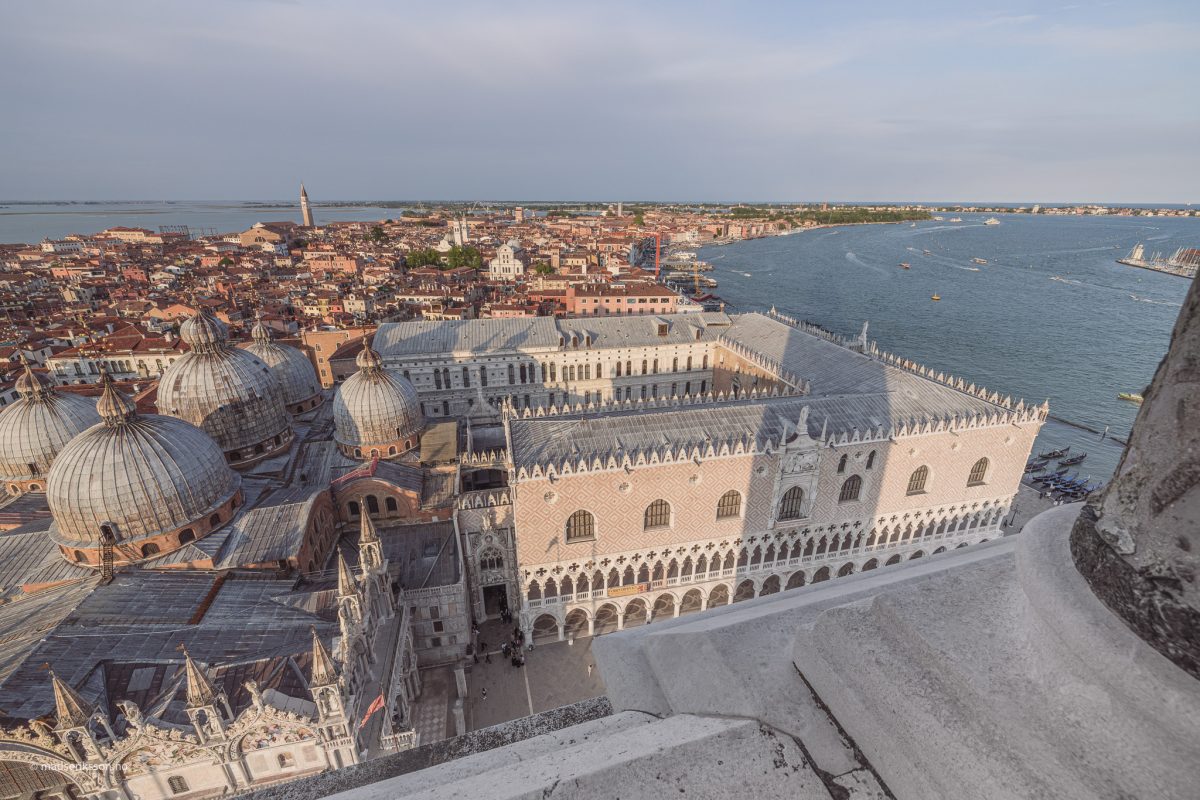
A lift inside the shaft reaches the belfry in around thirty seconds, from an entrance beside the Loggetta facing the Doge’s Palace. To the east, directly below the loggia of the bells, lie the five domes of St Mark’s Basilica and the courtyard and roofs of the Doge’s Palace, with the Riva degli Schiavoni curving away along the water.
The lead-covered domes of the Basilica di San Marco seen from the top of the Campanile
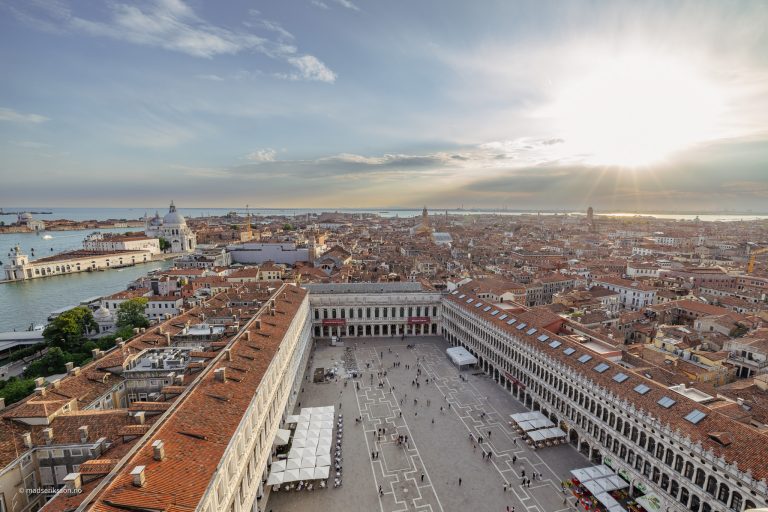
The square makes sense at last
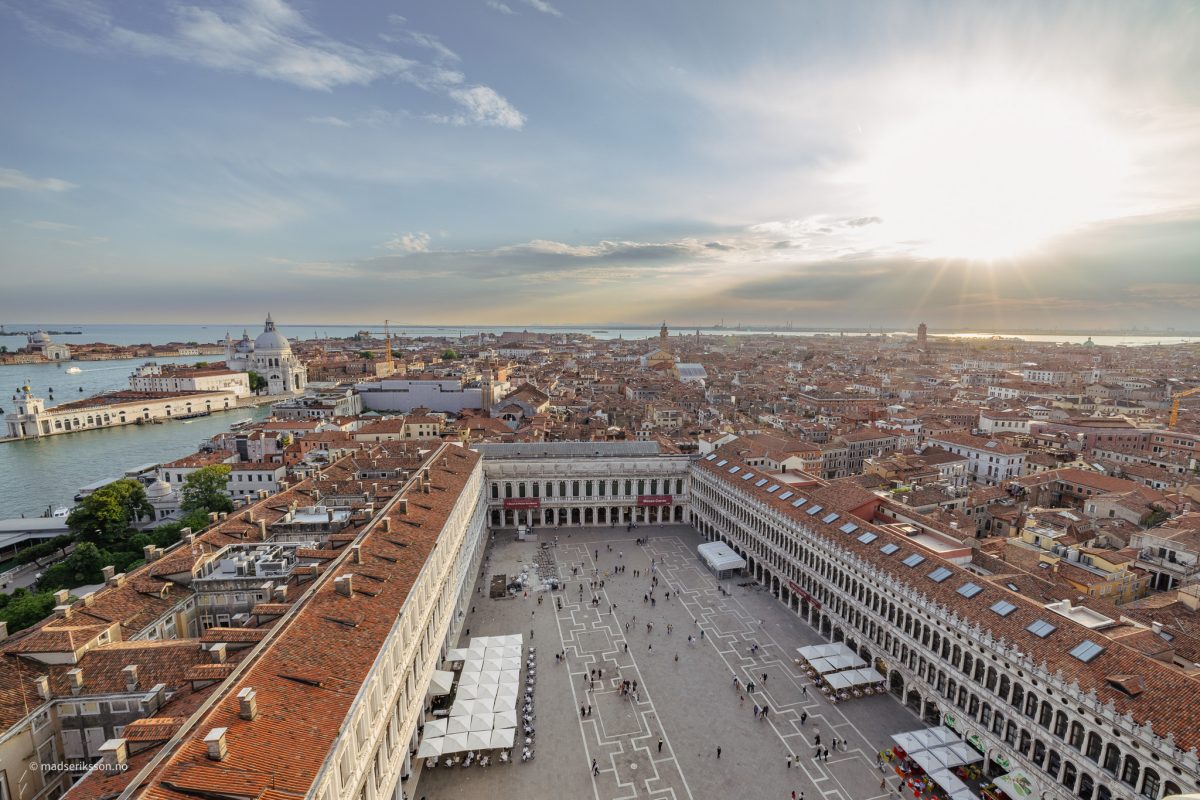
From the belfry the plan of Piazza San Marco becomes clear: the long trapezoid of the square, the turn into the Piazzetta, the two columns at the water’s edge, and the basilica set at an angle at the end of it all.
Piazza San Marco seen from the Campanile, with Santa Maria della Salute across the water
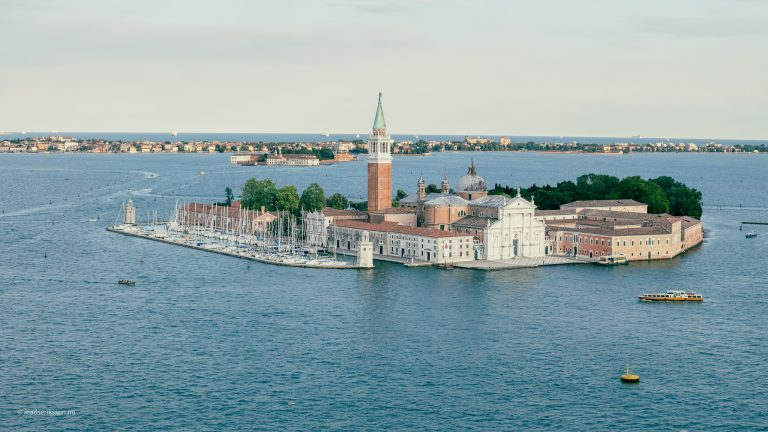
San Giorgio and the Salute
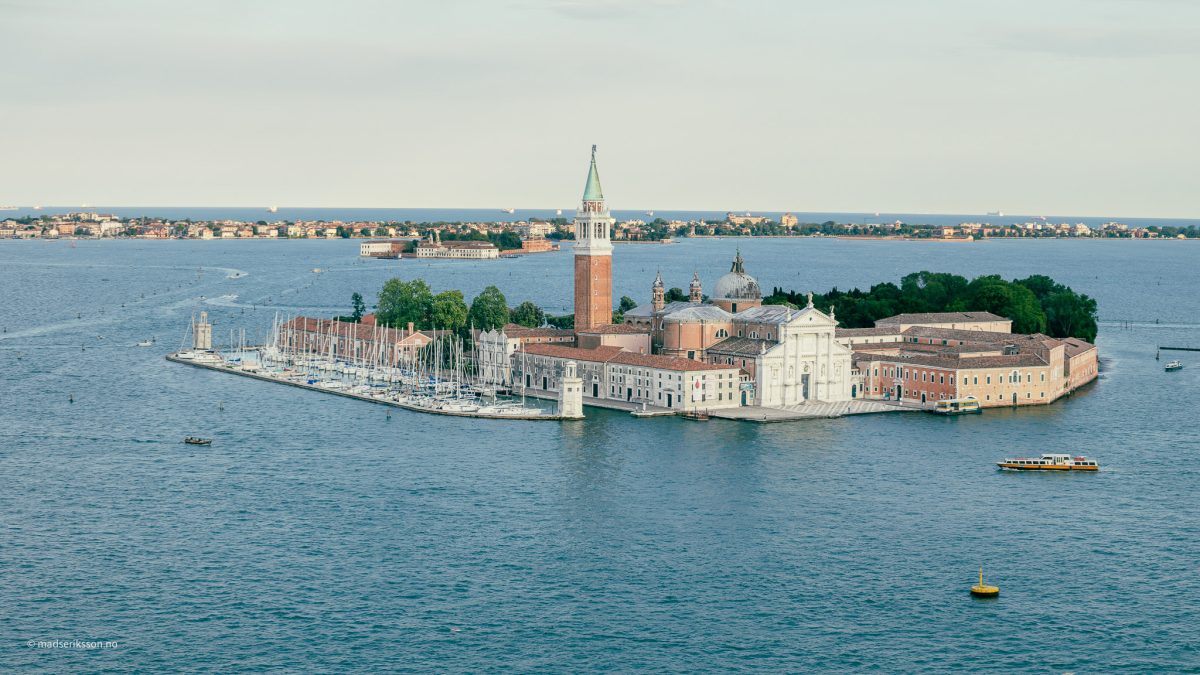
To the south lie the basin of San Marco, the white church and campanile of San Giorgio Maggiore on its island, the entrance of the Grand Canal with the dome of the Salute and, beyond them, the long low line of the Lido.
San Giorgio Maggiore and its bell tower on their island in the lagoon, seen from St Mark’s Campanile, Venice
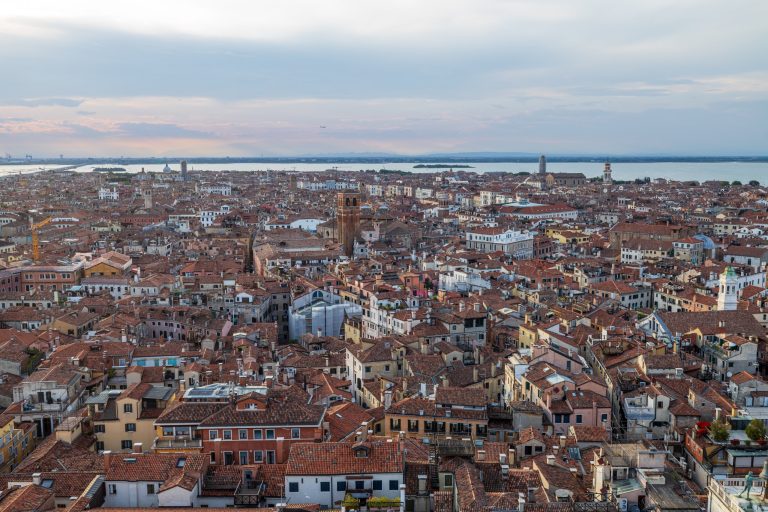
Venice as a solid city
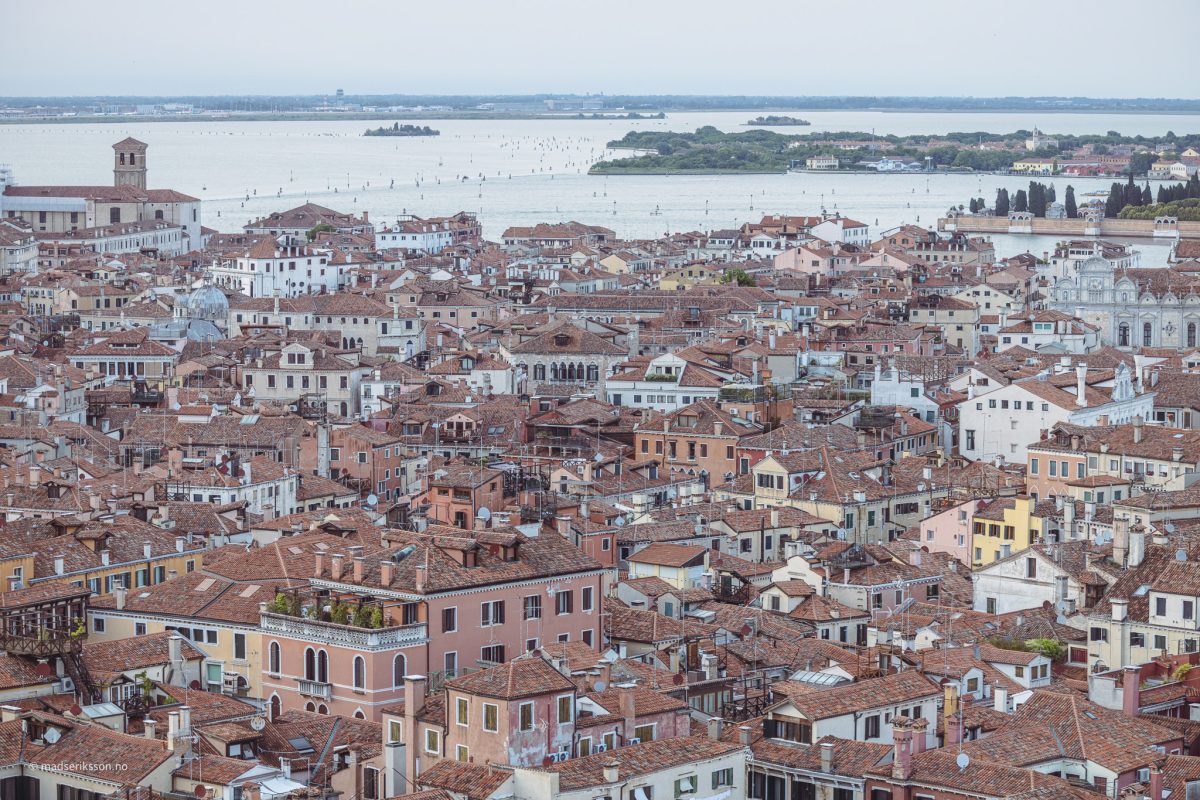
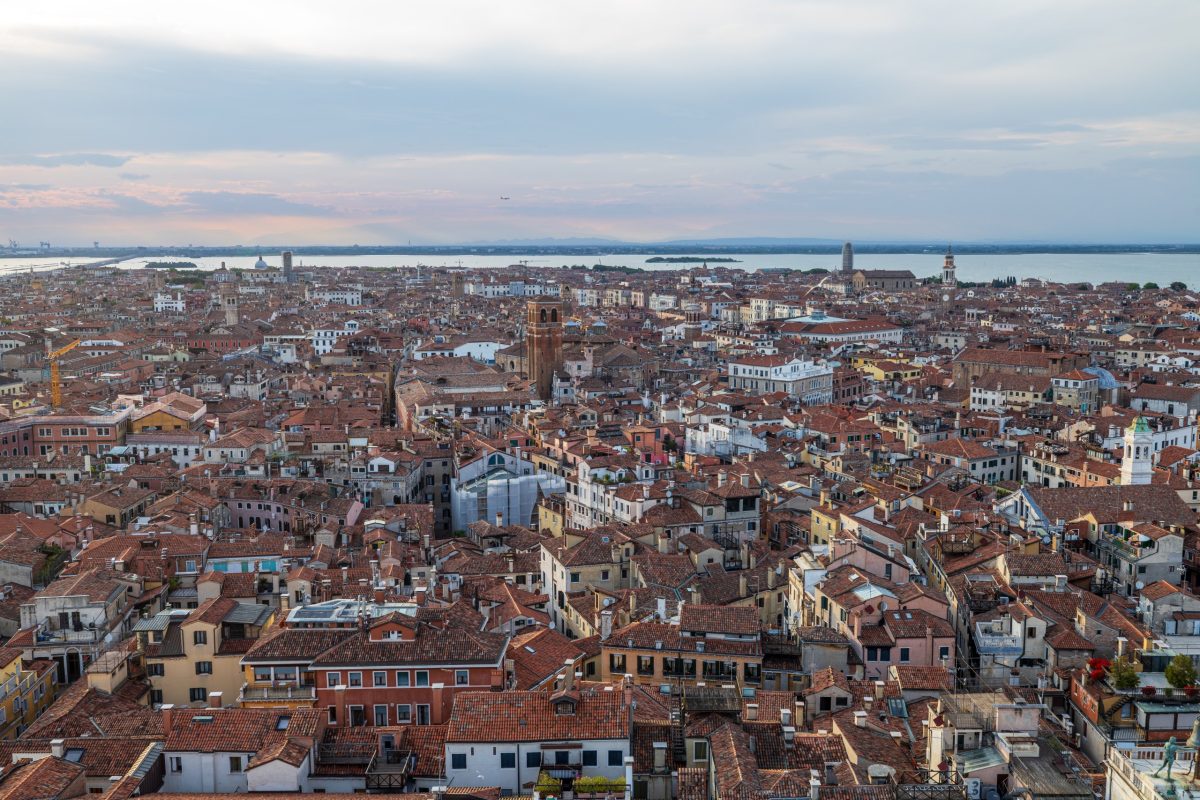
To the west and north the city spreads out as a single field of terracotta roofs, chimneys and bell towers, cut by the curve of the Grand Canal, with the mainland and, on clear winter days, the snow-covered Alps on the horizon. The canals vanish between the roofs, and Venice looks for once like a solid city.
The rooftops of Venice from the top of the Campanile, with the lagoon beyond
3D model © 2026 madseriksson.no · Photographs © madseriksson.no. Buildings, canals and shoreline: © OpenStreetMap contributors (ODbL). The campanile is modelled from its height of 98.6 m; the domes, the Salute and all other heights are simplified and approximate. Sun positions are approximate.
A Thousand-Year Tower — From Watchtower to Belfry
How a lookout over the lagoon was raised, burned, rebuilt and crowned over six centuries, and why its archangel used to turn with the wind
The first tower on the site was ordered by Doge Pietro Tribuno in 888 as a watchtower over the harbour basin. It was soon replaced by a larger structure that served as both beacon and bell tower, and its foundations show how Venice builds on mud: wooden piles driven into the clay of the lagoon, two layers of oak planks laid across them, and on top a stone base twelve metres square and five metres high, finished in 912. The brick shaft rose to the level of the belfry in the late tenth century, and under Doge Domenico Morosini in the 1150s the tower reached about 60 metres. Between 1156 and 1172 it was given a belfry and a wooden spire sheathed in gilded copper, which made it visible far out across the lagoon and turned it into a landmark for ships coming in from the sea.
A tall tower of brick and timber in the middle of a lagoon was a lightning conductor long before anyone knew how to protect it. The spire burned in 1388, was destroyed again by a bonfire in 1403, and was struck repeatedly over the next three centuries — at least a dozen times between 1489 and 1762. In the early sixteenth century the belfry and spire were rebuilt between 1511 and 1514 to a design by Giorgio Spavento, with the work directed by Pietro Bon. This is the shape the campanile still has: the arcaded loggia for the bells, the attic decorated with lions and the figure of Venice as Justice, and the tall pyramid spire. In July 1513 a gilded wooden angel was hoisted to the top; it was mounted on a pivot and turned with the wind as a giant weather vane. Only in 1776 was the tower given a lightning rod.
On 21 August 1609 Galileo Galilei climbed the campanile with a group of Venetian nobles to demonstrate his new telescope. From the belfry they could make out ships approaching long before they were visible to the naked eye — a demonstration aimed squarely at a maritime republic.
The bells regulated the life of the city. The largest, the Marangona, called the carpenters of the Arsenal — the marangoni — to work at dawn and released them at dusk; the others marked midday, summoned the members of the Great Council to their sessions and announced public executions in the Piazzetta below. The angel on the spire was replaced in 1557 and again in 1822, when the old figure had worn out and stopped turning; the present statue is the work of Luigi Zandomeneghi. In 1542 Jacopo Sansovino added the Loggetta at the foot of the tower, a small marble and bronze loggia facing the Doge’s Palace, where nobles met before entering the palace.
The Collapse — Rebuilt Where It Was and As It Was
The morning the campanile fell into the Piazza, the cat that did not get out in time, and the decade-long reconstruction that gave Venice its tower back
The warning signs came in the days before. In July 1902 a crack opened in the brickwork of the shaft and kept spreading, fragments began to fall, and the campanile was closed to the public and guarded. On the morning of 14 July the Piazza was cleared at half past nine. Twenty-three minutes later the tower folded in on itself and came down vertically, almost as if it had been demolished on purpose, leaving a mound of brick where it had stood. The basilica, only a few metres away, was hardly touched. The Loggetta at the foot of the tower was crushed, and a corner of Sansovino’s Marciana Library across the Piazzetta was destroyed. No one was killed; the only victim was the caretaker’s cat.
The city council met the same evening and voted to rebuild the tower exactly as it had been. The phrase used then — dov’era e com’era, “where it was and as it was” — became a motto for reconstruction in Italy and elsewhere. The new campanile reproduces the old one in outline and detail, but it was built to modern standards, on strengthened foundations and with room inside the shaft for a lift. Fragments of the old Loggetta were gathered from the rubble and pieced back together, and the bronze gates and statues were restored. Of the five bells only the Marangona, the great bell of the Arsenal, survived; the other four were recast and blessed in 1909.
The angel went back up on 5 March 1912, and on 25 April — the feast of St Mark, patron of Venice — the new campanile was inaugurated, almost ten years after the old one fell. It is the reason the Piazza still looks the way painters have shown it for five hundred years.
The rebuilt tower has needed attention of its own. Venice sinks slowly and floods often, and the area around the foundations is among the lowest points of the Piazza. At the start of this century the foundations were consolidated, with titanium cables run around their perimeter to hold the base together. Looking at the campanile today, it is easy to forget that the brickwork is barely more than a century old. That is the measure of the reconstruction’s success: of all the buildings around Piazza San Marco, the one most visitors assume to be the oldest is in fact the newest.
Going Up — Thirty Seconds to the Bells
What the belfry offers, what can be seen from it, and how to time a visit so that the bells and the light are on your side
The entrance is at the foot of the tower beside the Loggetta, facing the Doge’s Palace. Visitors go up by lift through the inside of the shaft, and the ride to the belfry takes around thirty seconds. The viewing level is the arcaded loggia that holds the bells: open arches on all four sides, protected by railings, with the five great bells hanging in the middle. It is not a large space, and it fills quickly at busy times. The bells still ring for services in the basilica and to mark the hours, and they are loud — standing beside them when the Marangona strikes is part of the experience, though those with sensitive hearing may prefer to time the visit between the hours.
The view divides into four. To the east, directly below, are the five domes of St Mark’s Basilica and the courtyard and roofs of the Doge’s Palace, with the Riva degli Schiavoni curving away along the water. To the south lie the basin of San Marco, the white church and campanile of San Giorgio Maggiore on its island, the entrance of the Grand Canal with the dome of the Salute, and beyond them the long low line of the Lido. To the west and north the city spreads out as a single field of terracotta roofs, chimneys and bell towers, cut by the curve of the Grand Canal, with the mainland and — on clear winter days — the snow-covered Alps on the horizon. What is almost invisible from above is water: the canals vanish between the roofs, and Venice looks for once like a solid city.
From the belfry the plan of Piazza San Marco makes sense at last — the long trapezoid of the square, the turn into the Piazzetta, the two columns at the water’s edge, and the basilica set at an angle at the end of it all.
The campanile opens at 09:30 every day and stays open into the evening: until 21:15 in summer and 19:15 in winter, with the last entry up to an hour earlier and changes possible in bad weather or during events. In 2026 an individual ticket costs €15, and tickets are sold online through the official ticket office of the basilica, with timed slots. The queue is usually shortest at opening time and in the last hour before closing; the evening visit in summer has the advantage of softer light over the lagoon and the chance to see the city turn gold at sunset. The lift may stop in high wind or thunderstorms, and the belfry is closed when the weather makes it unsafe.
«St Mark’s Campanile is two towers in one. The first stood for a thousand years, watched for ships, called the shipwrights to work, burned in the lightning and carried Galileo’s telescope to the Venetian nobility; the second rose from its rubble in ten years, copied so faithfully that few who see it today realise it is little more than a century old. Go up early or late, stand beside the Marangona, and look down on the Piazza the way the old watchmen did — the basilica, the palace, the lagoon and the roofs of Venice stretching away to the mainland.»

More in the same area
 CitiesExploring the Enchanting City of Venice
 ArchitectureEurope’s 10 Greatest Cathedrals and Churches
 ArchitecturePisa — The Leaning Tower, the Square of Miracles and the City on the Arno
 ArchitectureSt Peter’s Basilica: Michelangelo’s Dome and 120 Years of Building
 ArchitectureThe Pantheon in Rome: A Marvel of Ancient Architecture
 ArchitectureBologna — Porticoes, Towers and the City That Wrote Down Its Recipes