Alicante has more than 300 days of sunshine per year, a Moorish castle visible from 50 kilometres at sea, the most beautiful marble promenade in Spain, a fortified island 22 kilometres offshore with water so clear you can see the bottom at 10 metres, and a midsummer festival in which enormous satirical sculptures are burned to the ground at midnight — a UNESCO Intangible Cultural Heritage event that the city has been performing every June 24th since the 17th century. It also has, at the end of its port, a small plaque marking the quay where thousands of Republican refugees waited in March 1939 for ships that never arrived, as Franco’s forces entered the last city to fall in the Spanish Civil War. Alicante holds all of this simultaneously and presents most of it as a beach destination. It is considerably more than that.

Alicante — Alacant in Valencian, the co-official language of the region — is the capital of the province of Alicante and the second city of the Valencian Community after Valencia. It sits on the southeastern coast of Spain at a latitude comparable to northern Tunisia, which gives it one of the mildest climates in continental Europe: January averages 12°C; August rarely exceeds 30°C; rainfall is scarce and mostly confined to autumn. The city has been inhabited since the Bronze Age, settled by Iberians, Greeks, Carthaginians and Romans (who called it Lucentum, the City of Light), held by the Moors for five centuries, reconquered by the Crown of Castile in 1296 and developed as a trading port for the export of esparto grass, wine and the almonds that would eventually become its most distinctive food product: the turrón of Jijona and Alicante, the hard and soft nougat made from local almonds and honey that has been produced in this region since at least the 16th century and gives Alicante a gastronomic identity entirely separate from its beach tourism reputation.
The city most visitors see — the marina, the Explanada, the castle hill and the beach of Postiguet — is the best of Alicante, but not all of it. The neighbourhood of El Barrio (the Barrio de Santa Cruz), climbing the slopes beneath the castle in whitewashed lanes decorated with ceramic pots and bougainvillea, is one of the finest historic quarters in southeastern Spain and is substantially undervisited relative to its quality. The MARQ (Museo Arqueológico Provincial de Alicante) was named European Museum of the Year in 2003. Tabarca, the small fortified island 22 kilometres offshore, has a marine reserve whose water clarity rivals anything in the Balearics. All of this is available, with minimal planning, from a city that is primarily marketed as a gateway to the Costa Blanca resort coast.
How to approach Alicante
Alicante is compact and walkable at its historic core. The castle, the old quarter, the Explanada, the central market and the main beach are all within 20 minutes’ walk of each other. The city works best as a destination in its own right rather than a base for day trips: spend two to three days in the city itself, take the ferry to Tabarca for one day, and use the afternoons for the things Alicante does better than anywhere else in Spain — a long lunch, a slower walk along the Explanada, the specific quality of Mediterranean evening light at the end of a day with no agenda.
Alicante in 3D
Alicante is the second city of the Valencian Community, on the Mediterranean coast in the south-east of Spain. The Romans called it Lucentum, and the Moors held it for five centuries before Castile took the city in the 13th century. This frame covers the centre between the castle hill of Benacantil, the port and the market quarter.
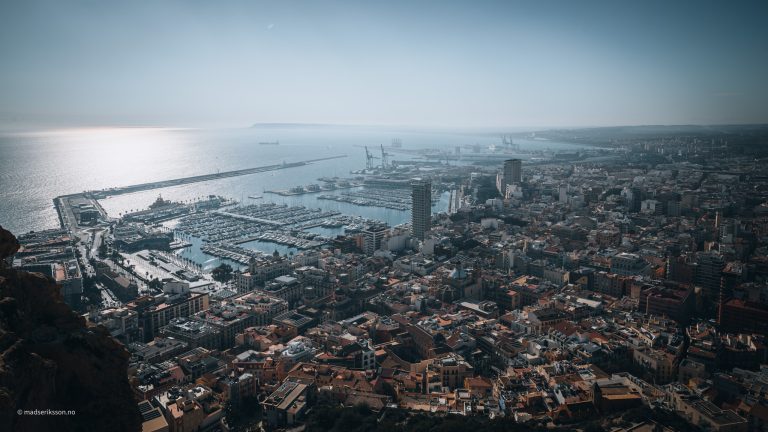
Castillo de Santa Bárbara
The Castillo de Santa Bárbara stands on Mount Benacantil, 166 m above the sea, and its walls cover three levels of the hill. The future Alfonso X of Castile took the fortress on 4 December 1248, the feast of Saint Barbara, which gave it its name. Entry to the castle is free, and a lift cut through the rock climbs from the level of Postiguet beach.
El Barrio and the old churches
El Barrio, the Santa Cruz quarter, climbs the slope beneath the castle walls in whitewashed, stepped lanes over the site of the Moorish medina. Below it stand the Basilica of Santa María and the Co-Cathedral of San Nicolás, with the town hall between them.
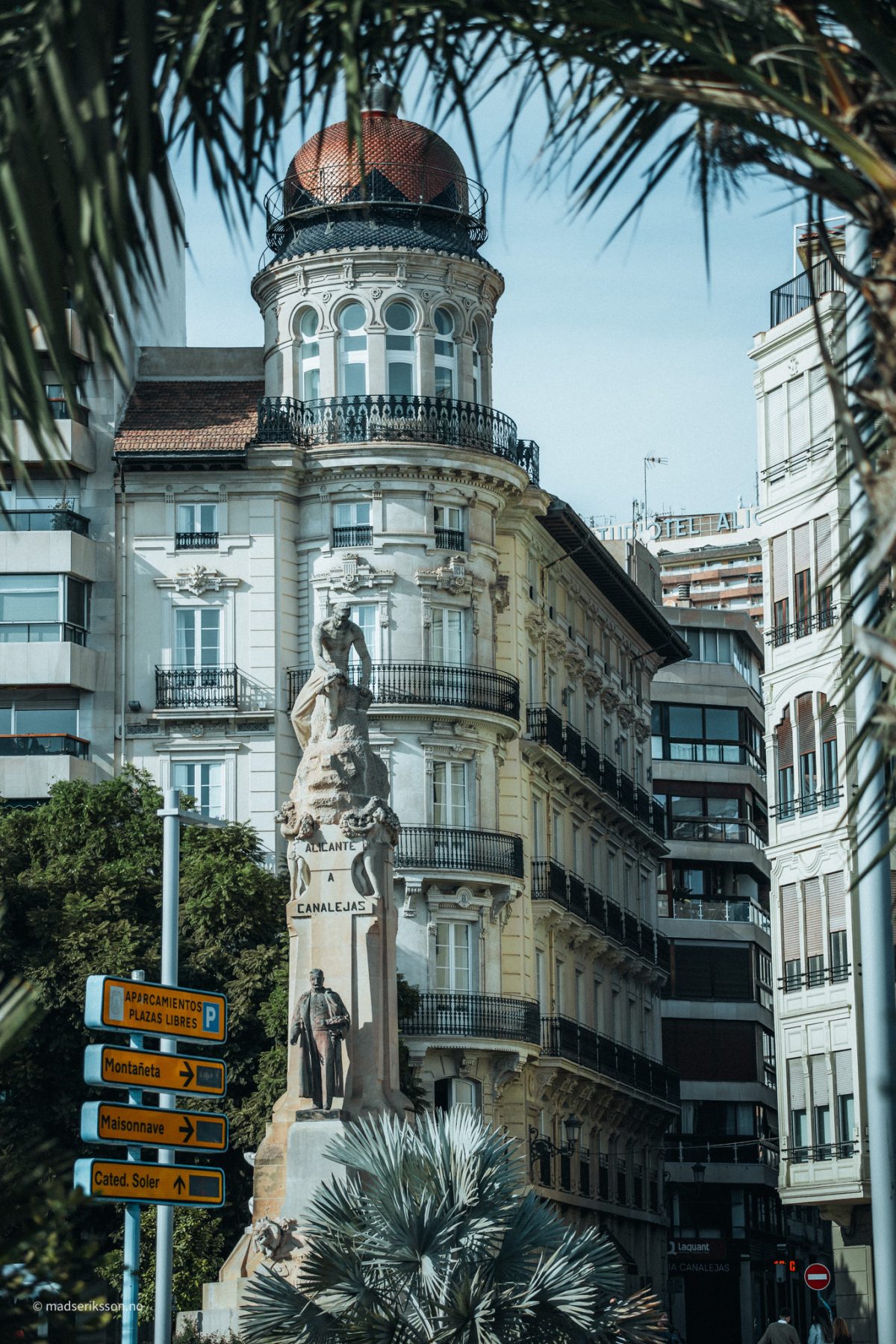
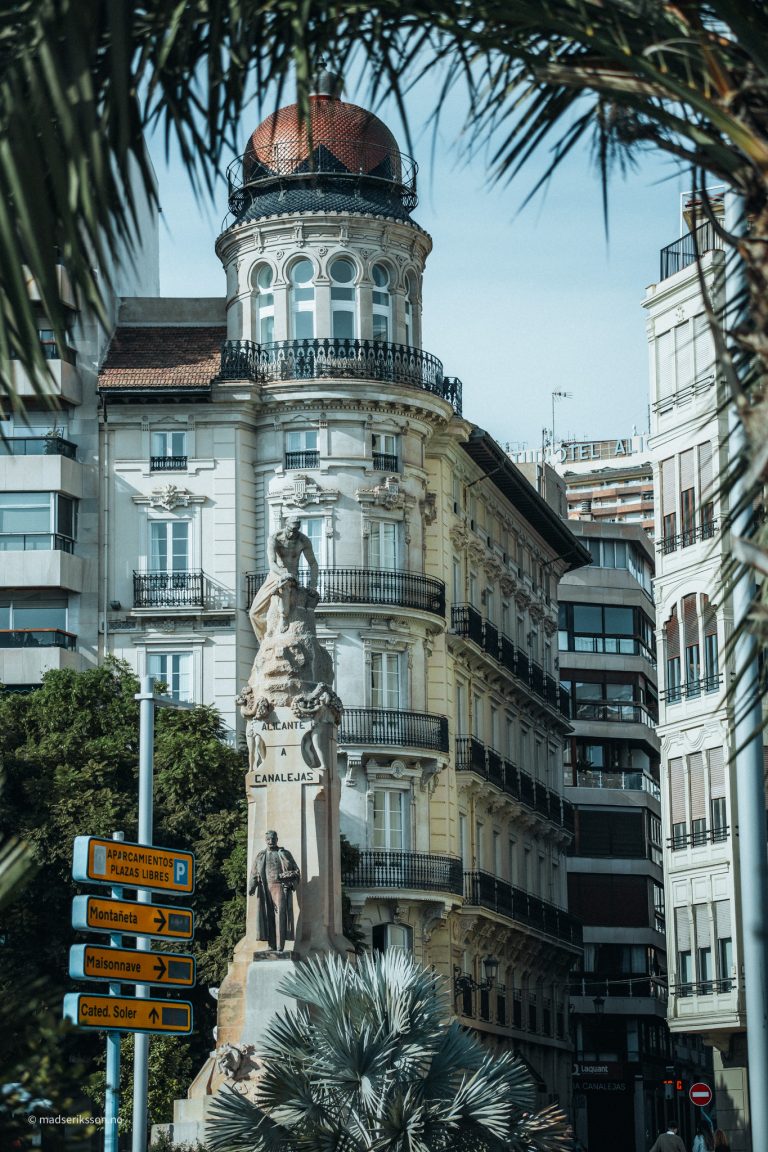
A domed corner building and a stone monument on a palm-lined street in central Alicante
The central market
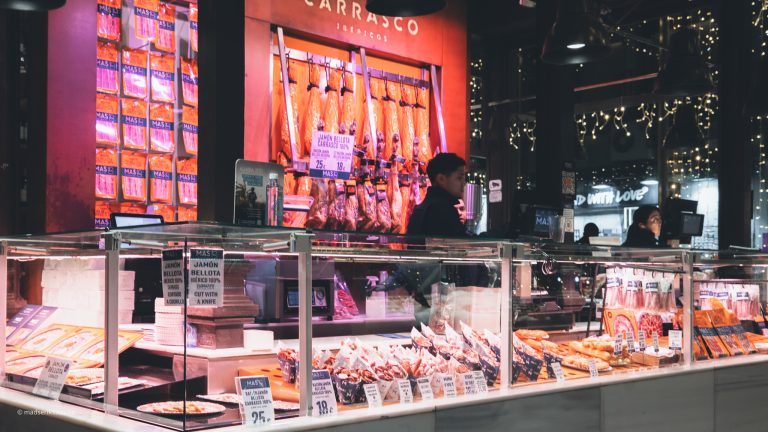
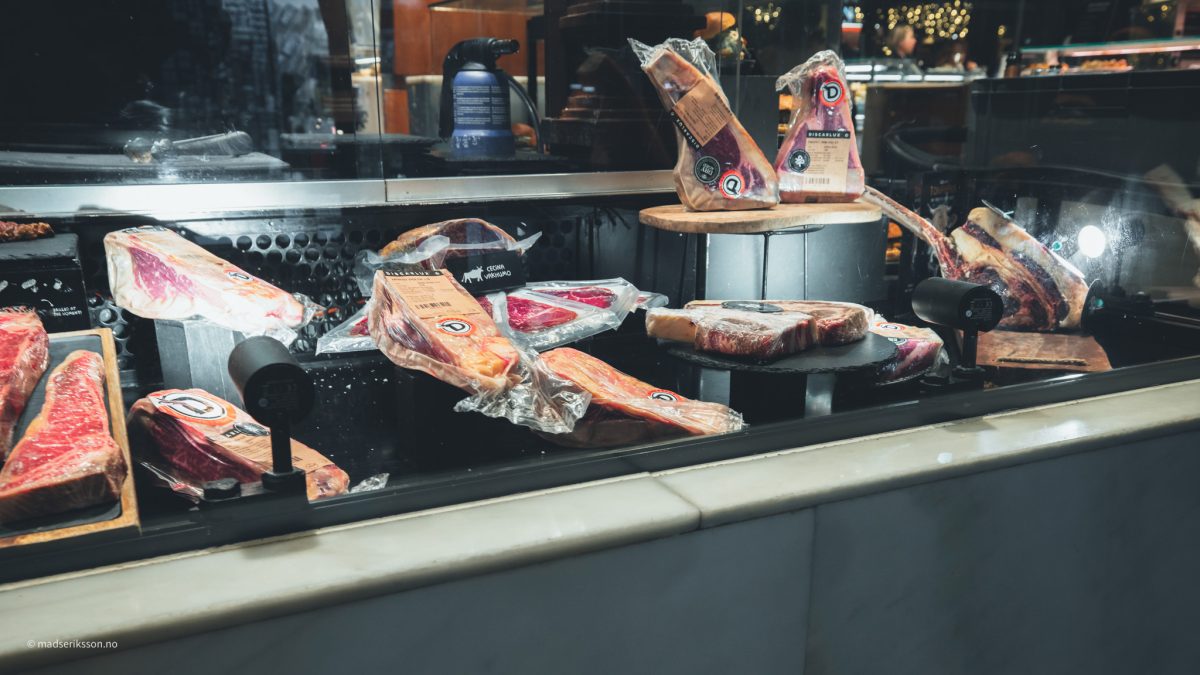
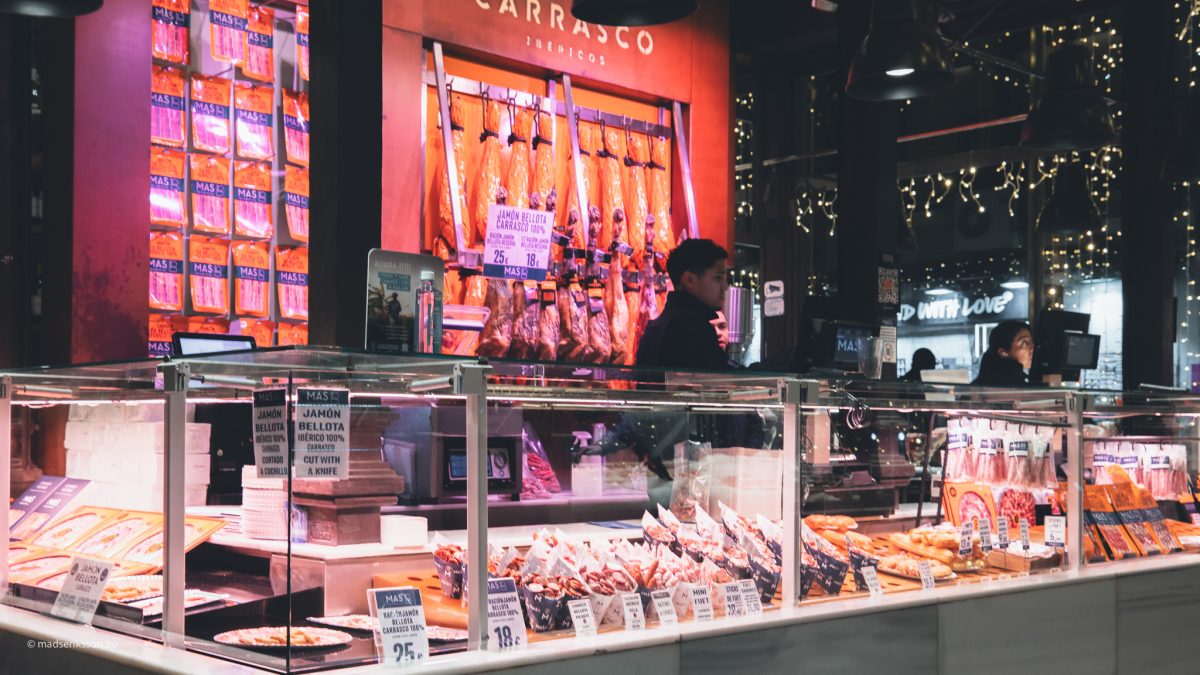
The Mercado Central sells fish from the morning boats, produce from the huerta and turrón, the almond nougat of Alicante and Jijona, both protected geographical indications. The market is busiest before noon, and Plaza de los Luceros, a few blocks west, is where the daily mascletà sounds during the Hogueras de San Juan in June.
Hams hanging above a long, brightly lit counter of cheese and cured meats in a market hall in Alicante
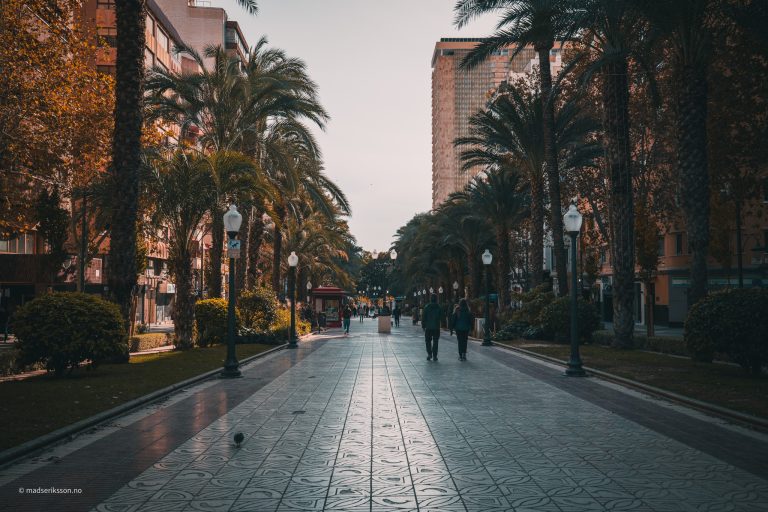
The Explanada
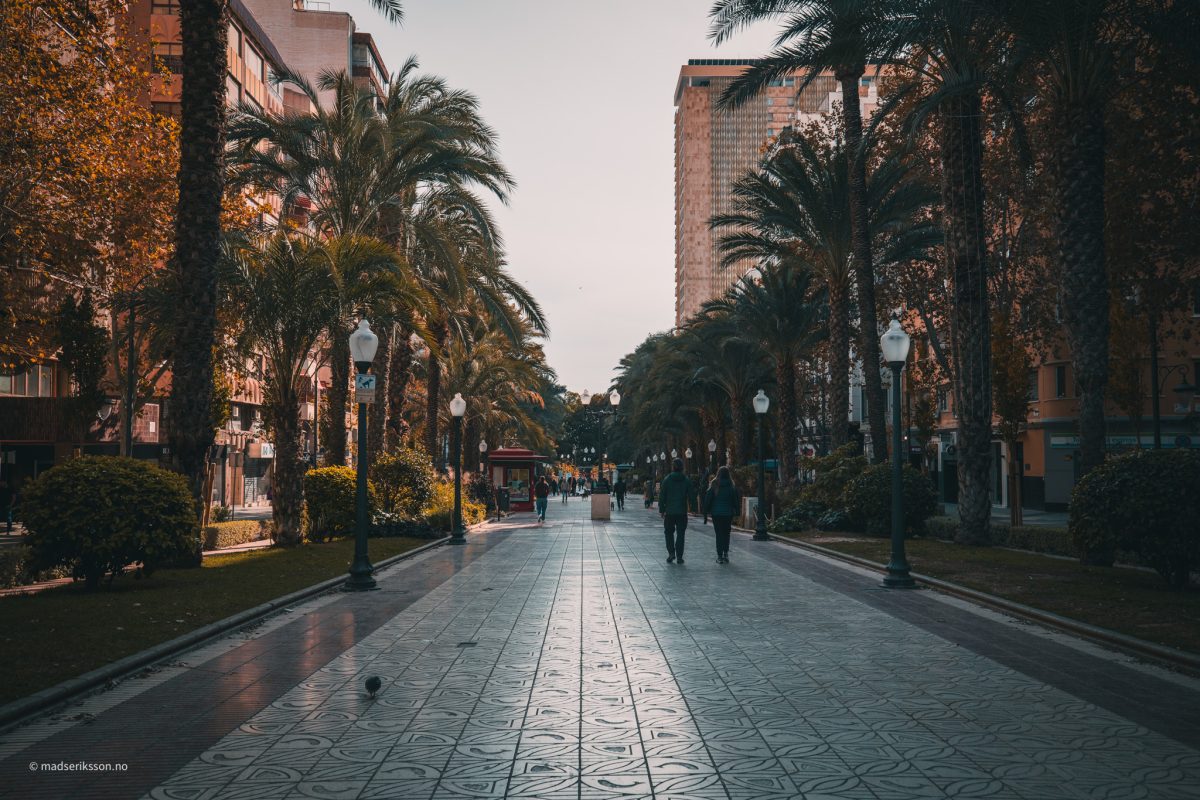
The Explanada de España runs for just over 500 m along the port, shaded by some 350 palms. Its wave pattern of more than 6.5 million marble tesserae in red, cream and black dates from the redesign by Miguel López and Alonso Fajardo in 1959. Ferries for the island of Tabarca, 22 km offshore, leave from the quay at its end.
A palm-lined pedestrian promenade with patterned paving in central Alicante
Postiguet and the castle cliff
Postiguet beach curves north from the port beneath the bare limestone face of Benacantil. In the evening sun, the rock profile known as the Cara del Moro, the Moor's Face, stands out above the beach and the castle walls turn ochre.
The marina at dusk
The marina occupies the old harbour south of the Explanada. In the last days of March 1939, thousands of Republican refugees waited on its quays for ships as the Civil War ended; a memorial now marks the spot. At dusk the masts and the castle above catch the last light.
The city after dark
On the night of 24 June, during the Hogueras de San Juan, the satirical sculptures built across the city burn at midnight in La Cremà. On ordinary nights the Explanada, the Rambla and Plaza de los Luceros fill with the evening paseo, and the floodlit castle hangs over the city.
Read more: Madrid — The Capital That Was Chosen by Calculation and Became Something Else
3D model © 2026 madseriksson.no · Photographs © madseriksson.no. Buildings and heights: © OpenStreetMap contributors (ODbL), via OpenMapTiles. Ground imagery: Sentinel-2 cloudless 2023 by EOX IT Services GmbH (contains modified Copernicus Sentinel data 2023; CC BY 4.0). Heights are approximate where OpenStreetMap has no measured value; sun positions are approximate.
The Castle and the Quarter Beneath It — Alicante From Its Highest and Its Most Human Point
The Castillo de Santa Bárbara on Mount Benacantil, free to enter, visible from 50 kilometres at sea, with the best view over the city and the Mediterranean in southeastern Spain — and directly beneath it, El Barrio, the old Moorish quarter of whitewashed lanes, ceramic flowerpots and tapas bars that is the finest historic neighbourhood in the region
Mount Benacantil rises 166 metres directly from the city to the Castillo de Santa Bárbara, the fortress that has defined Alicante’s skyline since its Moorish construction in the 9th century and its substantial expansion by the Spanish in the 16th. It is one of the largest medieval fortifications on the Spanish Mediterranean coast, its walls covering three distinct levels of the mountain and its highest keep visible from the sea at distances that made it a navigational landmark for centuries of Mediterranean sailors. The castle is free to enter — a generosity that is not universal in Spanish cities of comparable heritage — and accessible by a lift cut through the rock of Benacantil from the beach of Postiguet (a small fee applies to the lift), or on foot up the road that winds around the eastern side of the hill. The view from the highest terrace is the defining panorama of Alicante: the city’s white buildings dropping to the palm-lined Explanada and the port below, the Postiguet beach curving north, the Mediterranean extending south and east toward the invisible horizon, and on clear days the outline of Tabarca island 22 kilometres offshore. The view in the opposite direction, inland toward the dry mountains of the interior, reveals the agricultural landscape — almond groves, citrus orchards, the red soil of the huerta — that produces the raw materials for Alicante’s most specific food traditions.
The Barrio de Santa Cruz — El Barrio — occupies the hillside directly beneath the castle walls, between the castle access road and the old city centre. It is the oldest inhabited part of Alicante, the neighbourhood that overlays the Moorish medina of the city’s pre-Reconquista period, and it has the character of a quarter that modernisation reached late and gently: narrow stepped streets, whitewashed walls with the regularity broken by ceramic flowerpots in reds and yellows and oranges, occasional views through gaps between houses down to the waterfront far below, small bars and restaurants operating from premises whose conversion from private houses is still architecturally legible. The neighbourhood is compact — it can be walked across in 15 minutes — and densely photographed, but the photographic record misses what the experience delivers: the coolness of the lanes in midday shade, the specific smell of jasmine and salt air, the sound of the city below reaching up in fragments. El Barrio is the part of Alicante that is most itself and least reducible to any other place.
The castle was used as a prison during and after the Spanish Civil War, holding Republican prisoners in the same fortification that had been built to defend the city they had just lost. Some were executed within its walls. The panoramic view that visitors now pay a lift fee to access was the last view many of them had of the city below. The castle does not advertise this layer of its history prominently. It is nonetheless there, in the same stone, in the same light.
The Explanada — 6.6 Million Marble Tiles and the Art of Doing Nothing Well
500 metres of palm-lined marble promenade along the port, paved in a wave pattern of 6.6 million red, black and white tiles, where Alicante’s residents have been conducting the Mediterranean ritual of the evening paseo for centuries — the social centre of the city and the argument for why promenade culture is not a decorative addition to city life but a structural part of it
The Explanada de España runs 500 metres along the edge of Alicante’s port between the castle hill to the north and the marina to the south, paved entirely in a mosaic of 6.6 million marble tiles — red, black and white — laid in an undulating wave pattern that references the Mediterranean visible at the promenade’s far end. The pattern was installed in the 1950s during the Franco period, which gives the Explanada an uncomfortable historical context that its current character — relaxed, democratic, full of grandparents and children and cyclists and people sitting at café tables doing nothing in particular — entirely transcends. It is one of the finest promenades in Spain, in a country that takes promenades seriously, and its quality is not architectural so much as social: the Explanada is where Alicante’s residents conduct the paseo — the Mediterranean evening walk, the ritual circulation of the community that functions as social media before social media and as a form of civil life that cities without promenades have difficulty replicating. The palm trees on both sides shade it from the afternoon sun; the port on the south side provides a horizon; the castle above on the north side provides a frame. The whole thing is correctly proportioned in a way that is rare in designed public space.
At the port end of the Explanada, past the café terraces and the tourist kiosks and the boats for Tabarca, there is a small memorial marking the quay where Republican refugees crowded in March and April 1939 as Franco’s forces closed in on the last Republican-held city in Spain. The Soviet ships that had been promised did not come; the French ships that had been requested did not come; a British ship took a small number of those who could afford passage; the rest were captured when the Nationalists entered the city on 1 April 1939. Many were subsequently executed or imprisoned. The memorial is modest relative to the event it marks; the waterfront that surrounds it is now a prosperous marina. Both things coexist on the same quay, which is Alicante’s relationship to its 20th-century history in concentrated form.
The evening paseo on the Explanada in July begins around 8pm, when the temperature has dropped to something approaching tolerable, and continues until well after midnight. Every generation of the city is present simultaneously: elderly couples walking at the pace their joints allow, children on bicycles and scooters that the elderly couples navigate around with long practice, groups of teenagers occupying the café chairs that the tourists vacated at dinner time, families with pushchairs, couples, solitary readers with books. Nobody is performing; everyone is simply there. This is what a successful public space produces. Alicante has been producing it on this strip of marble for seventy years.
Tabarca — The Fortified Island That Charles III Built for Genoese Prisoners
The only permanently inhabited island in the Valencian Community, 22 kilometres offshore, fortified by Charles III in 1770 to house Genoese prisoners captured by North African pirates — now a protected marine reserve with the clearest water on the Costa Blanca, a resident population of 50 people in winter, and a ferry that leaves from the port beneath the castle
Isla de Tabarca is 1.8 kilometres long and 400 metres wide, entirely flat, fortified by an 18th-century wall that encloses a small grid of streets, a church, a lighthouse and the houses of the winter population of approximately 50 people. It is the only permanently inhabited island in the Valencian Community and one of the smallest permanently inhabited islands in the Mediterranean. Its name comes from Tabarka, a port city on the coast of Tunisia, because the island was founded in 1770 by King Charles III of Spain to house Genoese coral fishermen and merchants who had been captured by Tunisian pirates while working out of Tabarka and held for years in North Africa. Charles III secured their release and, needing somewhere to place several hundred displaced Genoese in the Mediterranean, established a fortified settlement on this previously uninhabited island and named it after the Tunisian city they had come from. The current inhabitants are the descendants of those 18th-century Genoese settlers mixed with mainland Spanish families; the Taborcan dialect, a variant of Valencian with Genoese influences, was spoken on the island until the early 20th century and is now extinct.
The island’s significance to visitors today is primarily its water. The Reserva Marina de Tabarca, established in 1986 as the first marine reserve in the Spanish Mediterranean, protects the seabed around the island from fishing and anchoring; the result is water of exceptional clarity with seagrass meadows, octopus, sea bream, moray eels, starfish and the occasional seahorse visible at shallow depths without specialised equipment. Snorkelling from the island’s rocky shore is productive at any competence level; the more serious dive sites around the island’s outer walls require a guide. The ferry from Alicante port runs multiple times daily between April and October and takes approximately 45 minutes; there are also services from Santa Pola (closer, 15 minutes) and Guardamar del Segura. The island has several restaurants serving fresh fish — the caldero tabarcino, a rice and fish stew specific to the island, is the best reason to eat lunch here rather than bringing it from the mainland.
Tabarca in January: the ferry runs twice a week; the restaurants are mostly closed; the resident population goes about its business without tourists for the first time since October. The fortification walls, the church of San Pedro y San Pablo, the lighthouse at the far end and the Mediterranean on all sides look exactly as they have looked since 1770, minus the Genoese dialect. The island has no cars, no traffic and no noise beyond the wind and the water. In summer it has several thousand day visitors. Both versions are the same island; they are very different experiences.
Las Hogueras — The Festival That Burns Everything at Midnight, and the Food Worth Coming for Year-Round
Las Hogueras de San Juan: months of building satirical sculptures up to 20 metres tall, five days of firecrackers and processions, and then La Cremà on the night of June 24th when everything burns simultaneously and the smoke rises past the castle — a UNESCO Intangible Cultural Heritage that Alicante has been performing since the 17th century. Plus turrón, arroz a banda and the best almond on the Mediterranean
Las Hogueras de San Juan — the Bonfires of Saint John — is Alicante’s answer to Valencia’s Fallas, its older cousin and in some respects its more intense version: a five-day midsummer festival culminating on the night of June 24th with the simultaneous burning of all the festival sculptures in the city. The hogueras — satirical sculptures in papier-mâché, polystyrene and wood, often reaching 15 to 20 metres in height — are built by neighbourhood associations (comisiones) over the preceding months and installed in the streets and plazas of the city in the days before the festival. They depict public figures, political events, social absurdities and local characters in a tradition of civic satire that is both ancient and remarkably current: the subjects of each year’s hogueras are negotiated, designed, argued over and unveiled with the seriousness of editorial decisions. The festival week involves daily processions, the Mascletà (the daytime firework display of pure percussive sound — the noise is the point, not the visual), the coronation of the festival queen and her court, and the general transformation of the city into a continuous street party that operates at full intensity from early afternoon until dawn. On the night of June 24th, La Cremà begins at midnight: the sculptures burn in order across the city, smaller ones first and larger ones later, the fire services controlling the blazes and the crowds pushing as close as the heat allows. The smoke from the burning — of months of work, of the satirical targets, of the polystyrene and papier-mâché of a city’s collective creative output — rises over the castle and disperses into the Mediterranean air. The festival was inscribed on the UNESCO Intangible Cultural Heritage list in 2016.
The food of the Alicante province is the food of a dry Mediterranean coast with good fishing, abundant almonds and a long tradition of rice cultivation in the coastal wetlands: arroz a banda, the rice dish cooked in concentrated fish stock whose name (“rice on the side”) reflects the fisherman’s tradition of eating the fish first and serving the rice separately; caldero, a similar dish from the Mar Menor; and the full range of Valencian rice preparations that predate the international dominance of paella and in many respects surpass it in local dining rooms. The turrón of Jijona and Alicante — the soft ground nougat and the hard whole-almond nougat, both with Protected Geographical Indication status — is made from marcona almonds grown in the dry hills of the province’s interior, the sweetest and fattiest almond variety in Spain, and can be bought year-round in the confectionery shops of the city centre rather than only at Christmas as most of Spain experiences it. The Mercado Central de Alicante, a covered market in the centre of the city, sells the raw materials — fresh fish from the morning boats, local produce, dried goods — and is best visited before noon.
The Mascletà — the daily midday firework display during Las Hogueras week — produces no significant visual effect. It is a display of sound: a carefully orchestrated sequence of firecrackers and mortar shells whose detonations build in speed and intensity over approximately five minutes, reaching a final climax of overlapping explosions that is felt physically in the chest as much as heard. First-time visitors often don’t understand what they are attending; veteran Alicante residents judge the Mascletà on the quality of its percussion the way music critics judge a concert. Standing in the Plaza de los Luceros during the climax of a good Mascletà is an experience that has no equivalent in any other festival context in the world.
«Alicante is a city that presents itself as a beach destination and is, in fact, a city of considerable depth and specific character. The castle that has stood on Mount Benacantil since the 9th century has been a Moorish fortification, a Spanish fortress, a Civil War prison and a tourist attraction, in that order, and all of those functions have left their mark on the same stone. The Explanada where families conduct the evening paseo was installed during the Franco period and has been used by every subsequent generation to conduct a form of public life that does not require permission, agenda or expenditure. The port where Tabarca ferries now depart is the same port where Republican refugees waited in 1939 for ships that did not come. The turrón that fills the confectionery shops at Christmas is made from the same marcona almonds grown in the same dry hillsides as it was in the 16th century. Alicante holds its history without resolving it into a simple story, which is what most cities of genuine character do. The 300 days of sunshine help, but they are not the reason to come.»
More in the same area
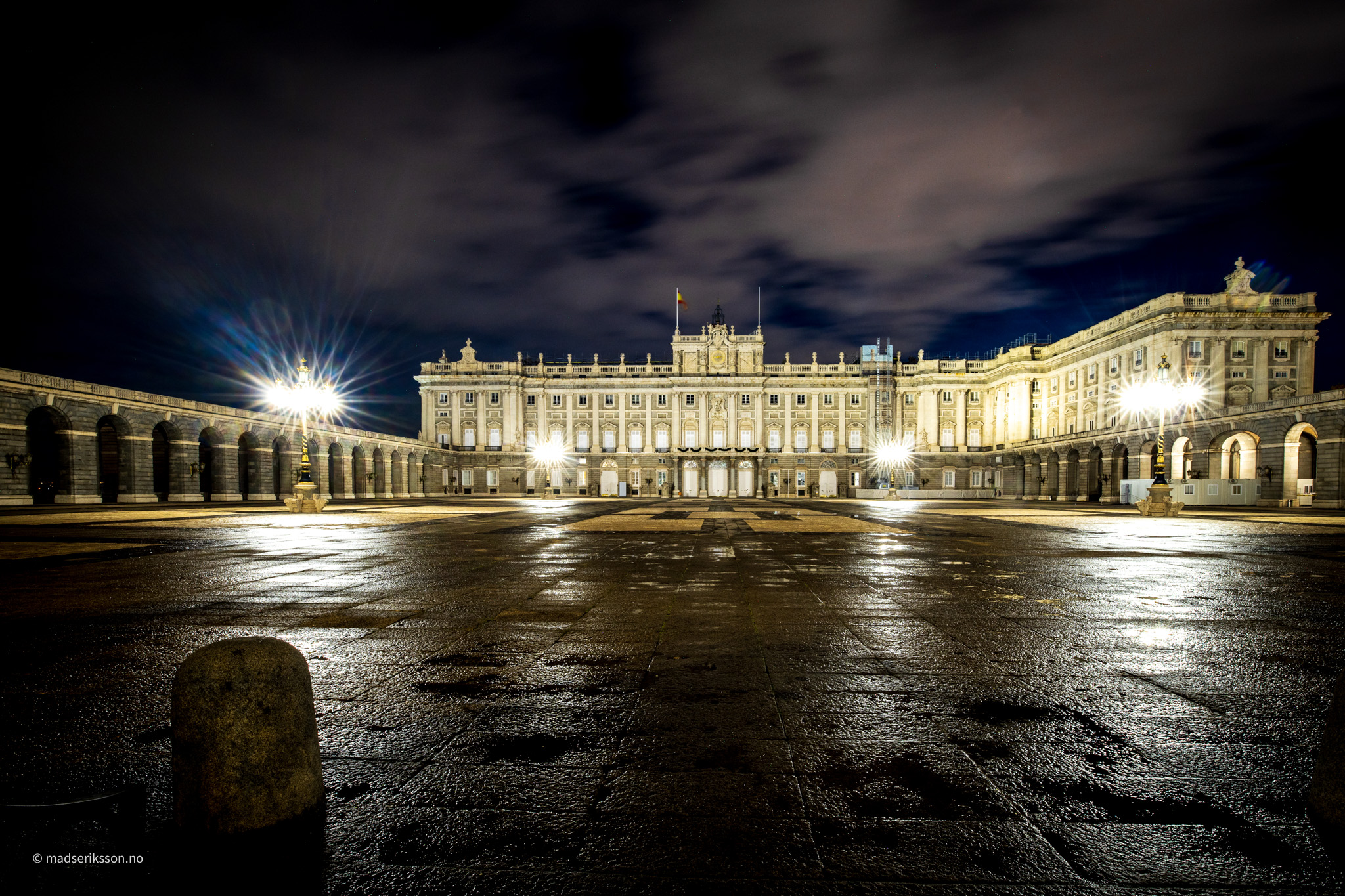 CitiesMadrid — The Capital That Was Chosen by Calculation and Became Something Else
 CitiesZaragoza: Roman Colony, Islamic Palace and the Basilica of the Pillar
 CitiesSan Sebastián — More Michelin Stars Per Person Than Anywhere on Earth
 ArchitectureValencia’s City of Arts and Sciences — The Eye, the Skeleton and the €400 Million Opera House
 ArchitectureGuggenheim Museum, Bilbao
 CitiesThe World’s 10 Great Food Markets
City Frames · scroll-driven 3D
More cities in three dimensions
54 city guides open with a model built from open map data. Scroll, and the camera moves from landmark to landmark.
Departures · City Frames
Where to next?
| Time | Destination | Country | Status |
|---|
Live · position of the sun
Golden hour, right now
The low, warm light just after sunrise and just before sunset. These are the cities on the site where it is happening at this moment.