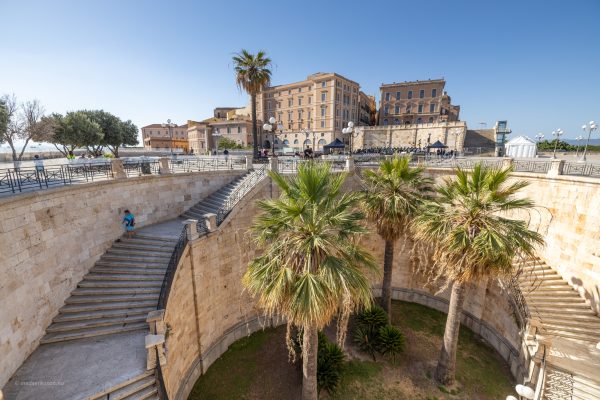
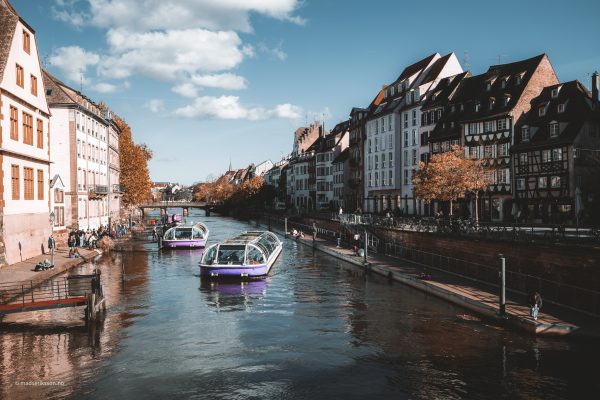
Naples is the loudest city in Italy. It is also, under the noise, one of the most layered — a city of 2,700 years of continuous habitation, built on a Greek foundation, shaped by Romans, Normans, Angevins, Aragonese, Spanish viceroys and Bourbon kings, all of whom left something behind in the streets and the churches and the underground tunnels and the food. A volcano 15 kilometres away last erupted in 1944 and remains active. Twenty kilometres southeast, an entire Roman city was buried by it in 79 CE and is still being excavated. Naples invented pizza. The espresso here is different from everywhere else, and everyone in Naples will explain to you exactly why.

Naples was founded by Greek colonists around 470 BCE as Neapolis — the New City — on a site already occupied by the earlier settlement of Parthenope. The Romans absorbed it, the Normans conquered it in the 11th century, the Angevins made it the capital of the Kingdom of Naples in the 13th century, and the Aragonese, the Spanish and finally the Bourbons of the Kingdom of the Two Sicilies each left their architectural and cultural marks on what became, in the 17th and 18th centuries, one of the largest cities in Europe. The historic centre — Spaccanapoli and its surrounding grid, still following the orthogonal layout of the ancient Greek city — was inscribed as a UNESCO World Heritage Site in 1995. Beneath it, a network of Greek and Roman tunnels, cisterns and catacombs runs for kilometres, still being mapped and opened to the public in pieces.
Naples is the third largest city in Italy and the capital of the Campania region. Its metropolitan area of over 3 million people is one of the densest in southern Europe, compressed between the bay and the volcanic hills. The city has a reputation — partly earned, partly myth — for chaos and difficulty that deters some visitors, and this is a genuine loss: Naples is one of the most culturally significant, culinarily extraordinary and visually striking cities in the country. The pizza alone, which was invented here and is at its original best here, would justify the visit. The Sansevero Chapel, containing one of the most technically extraordinary marble sculptures ever made, would double it. Add Pompeii, Herculaneum, the National Archaeological Museum and the Bay of Naples and the question is not why to go but how long to stay.
How to approach Naples
This guide covers four aspects of Naples: the historic centre, the underground city and the Sansevero Chapel; Pompeii, Herculaneum and Vesuvius; the bay and the waterfront, with Capri and Ischia as offshore extensions; and the food — which in Naples is as much a cultural inheritance as any monument and deserves the same level of attention. Naples is best approached on foot in the historic centre, by circumvesuviana train for Pompeii, and by ferry for the islands.
Naples in 3D
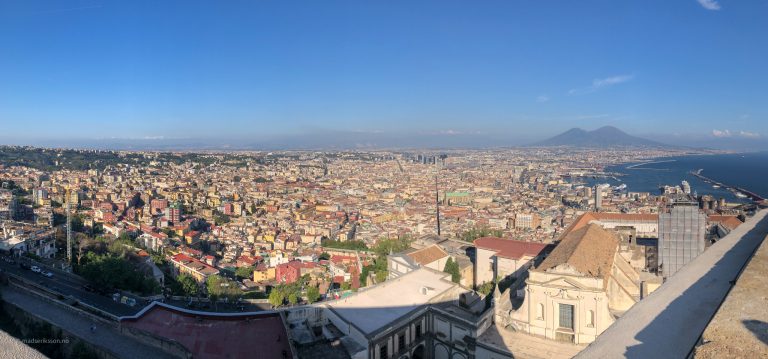
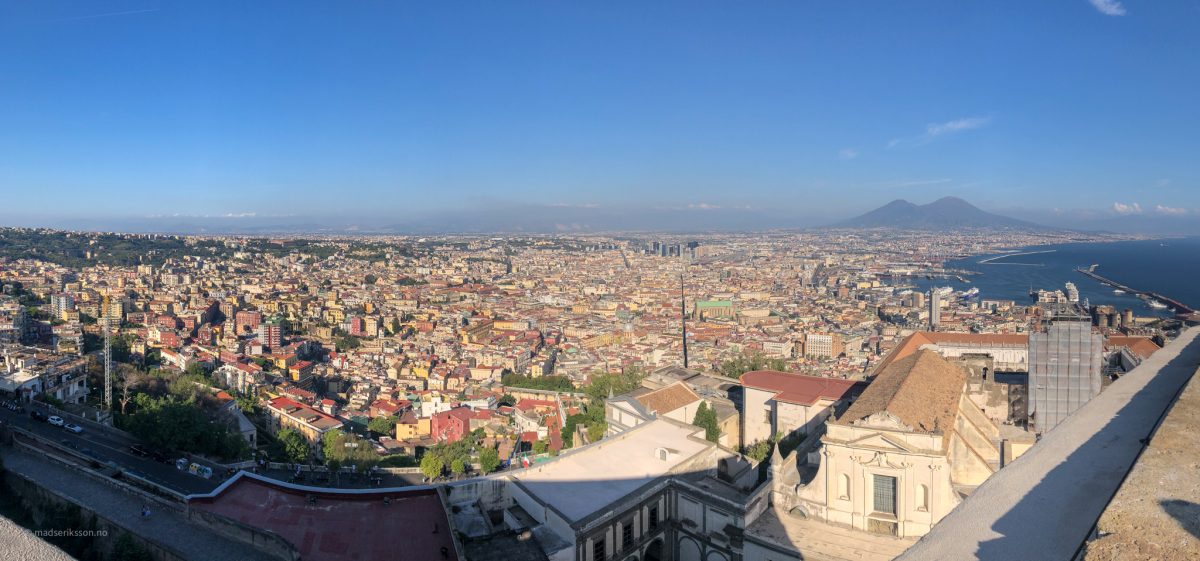
Naples curves around the northern shore of the Bay of Naples, with Mount Vesuvius, 1,281 m high, rising about 15 km east of the centre. Founded by Greek colonists around 470 BCE as Neapolis, the 'new city', it is now the third-largest city in Italy. This frame runs from the Villa Comunale and Castel dell'Ovo in the west to the towers of the Centro Direzionale in the east.
Panorama over the rooftops of Naples to the bay and Vesuvius on a clear day
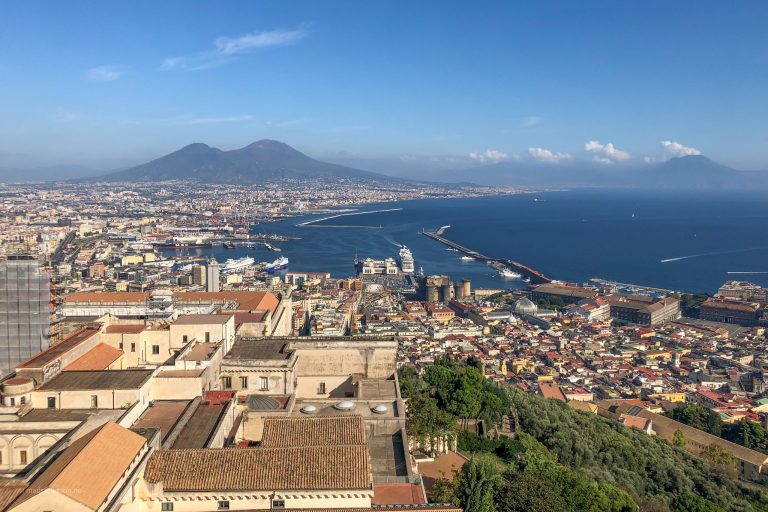
Castel Sant'Elmo and San Martino
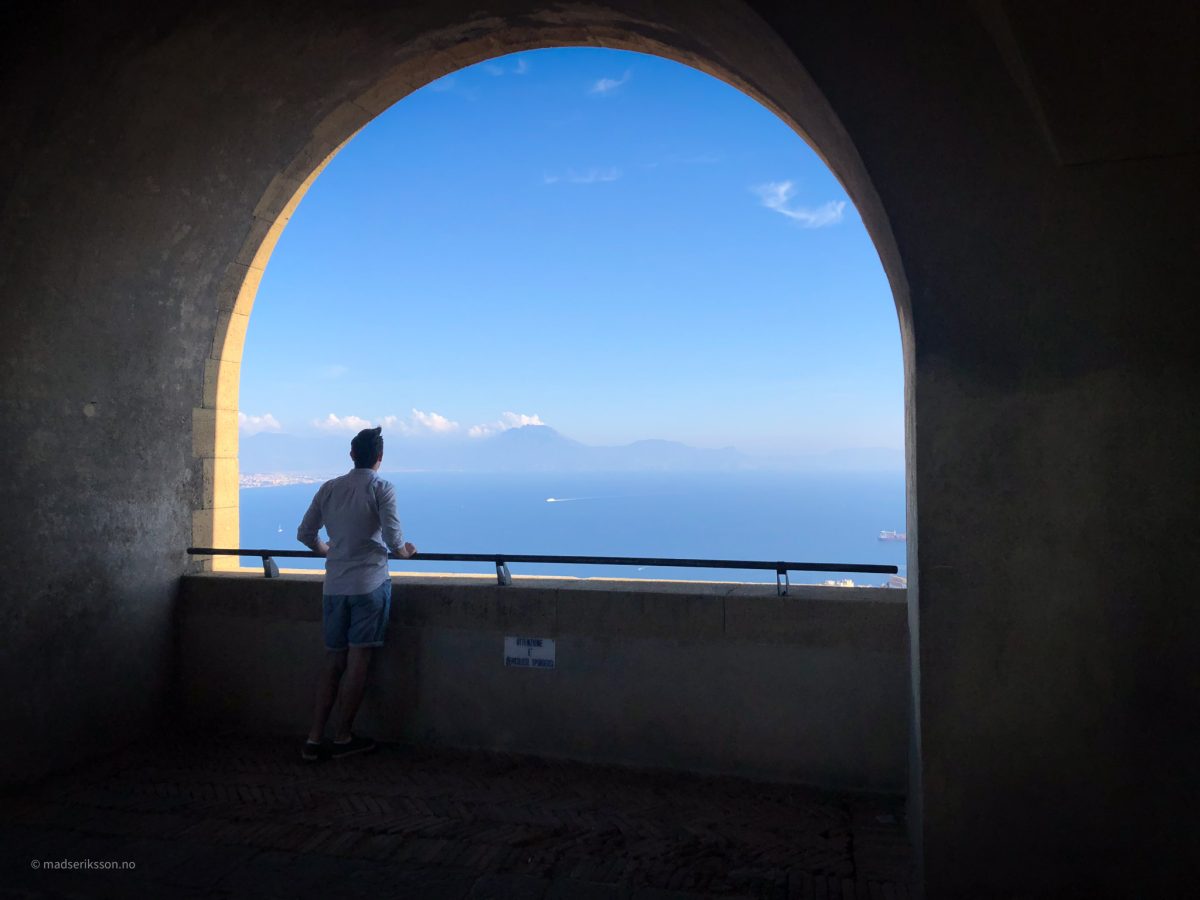
Castel Sant'Elmo crowns the Vomero hill above the old city. A fortress stood here by 1275, and between 1537 and 1547 it was rebuilt for the Spanish viceroys as a six-pointed star fort. Beside it, the former Carthusian monastery of San Martino now houses the Museo Nazionale di San Martino, and its terraces look down over the Quartieri Spagnoli to the port and Vesuvius.
Naples spread around its bay, with Mount Vesuvius on the horizon and the port below
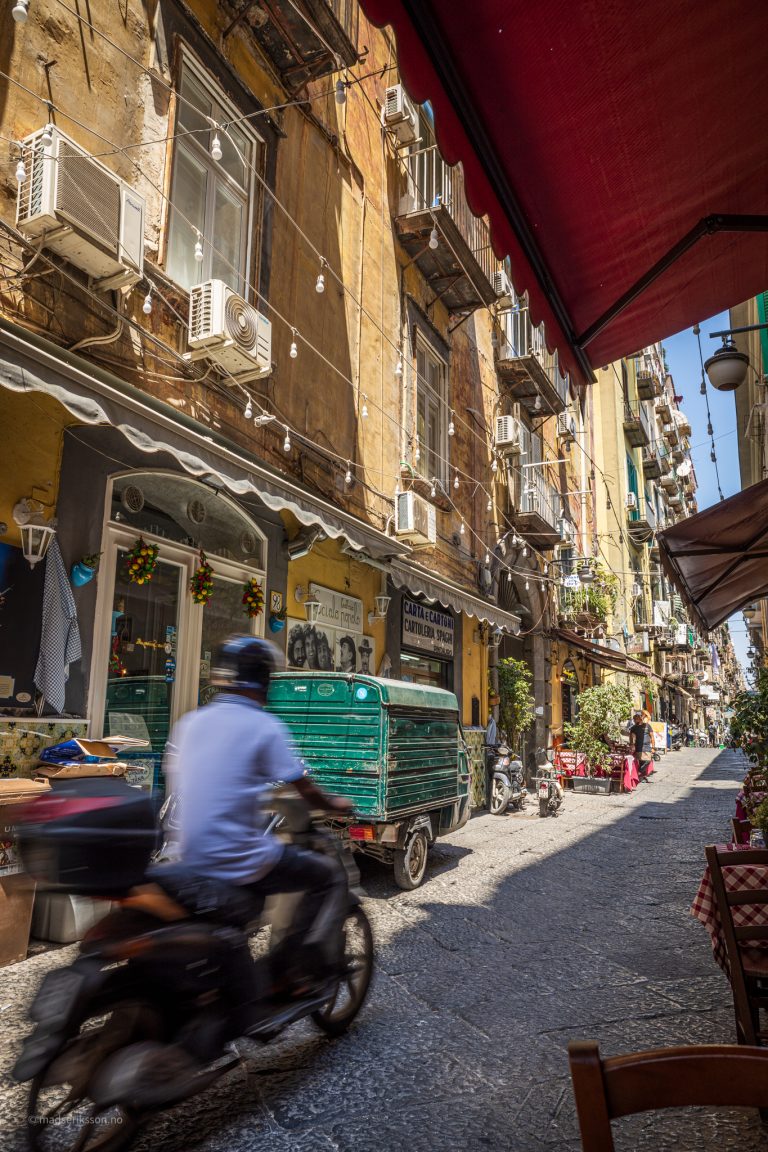
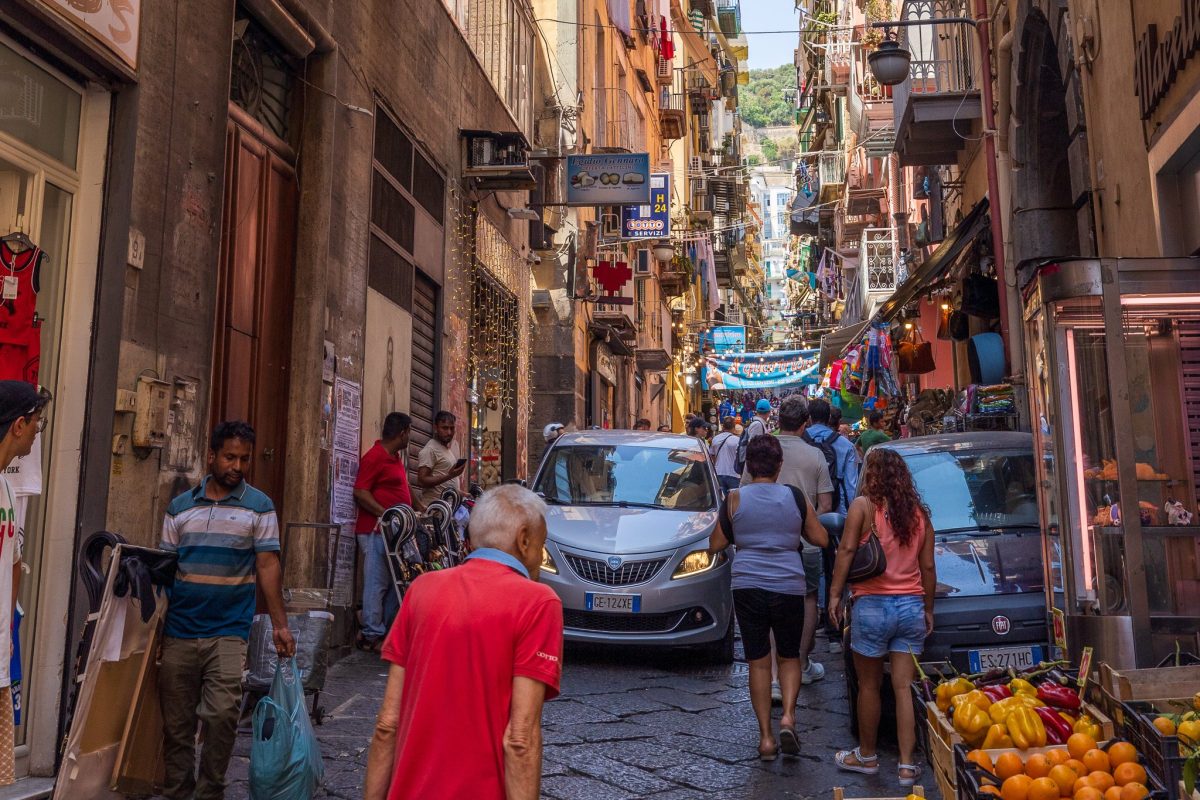
Spaccanapoli and the historic centre
Spaccanapoli, the 'Naples-splitter', runs dead straight through the old city along one of the main streets of the Greek grid, under the names Via Benedetto Croce and Via San Biagio dei Librai. Just off it, the Sansevero Chapel holds Giuseppe Sanmartino's Veiled Christ of 1753, and to the north stand the cathedral of San Gennaro and the National Archaeological Museum, home to the finds from Pompeii and Herculaneum. The historic centre has been a UNESCO World Heritage Site since 1995.
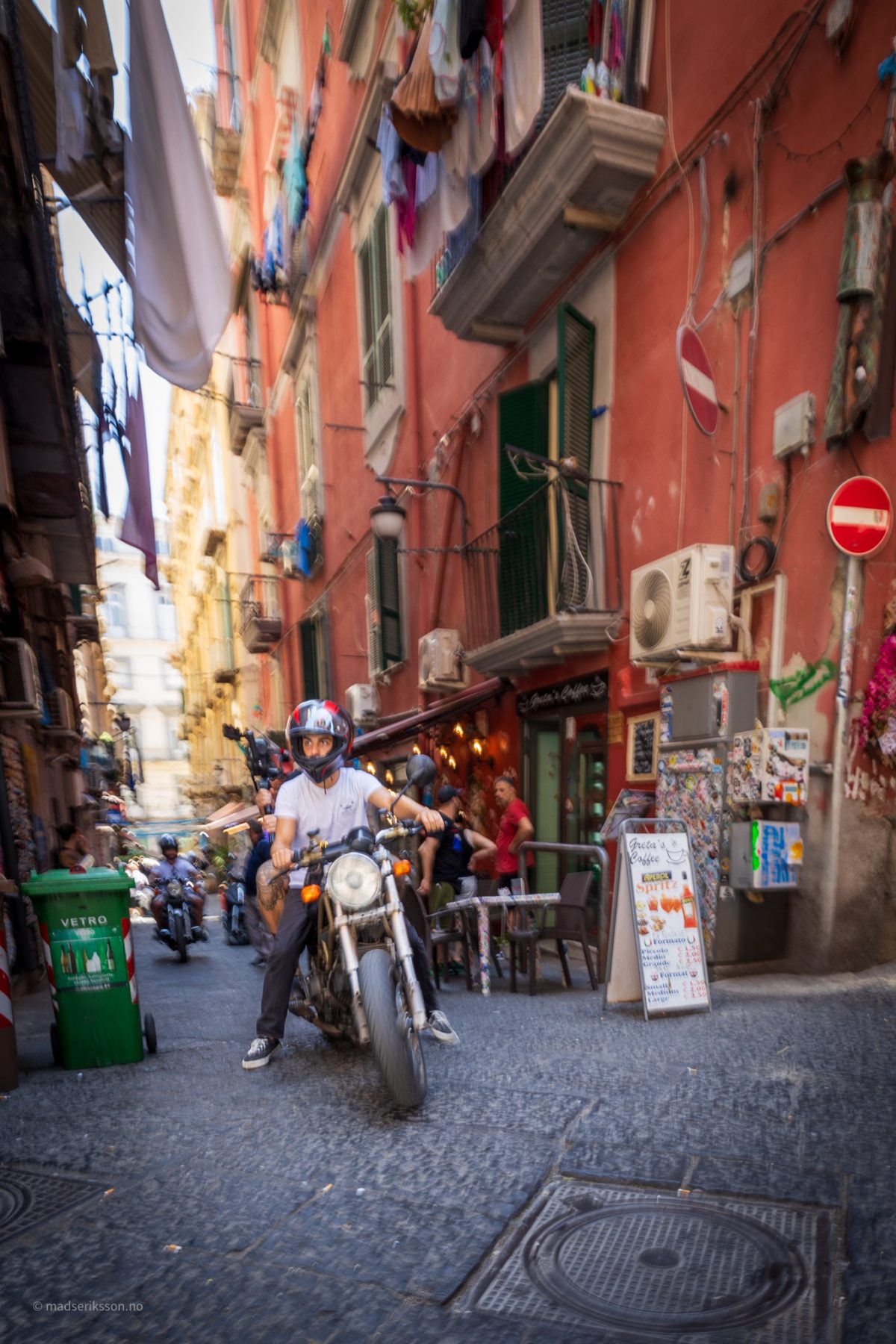
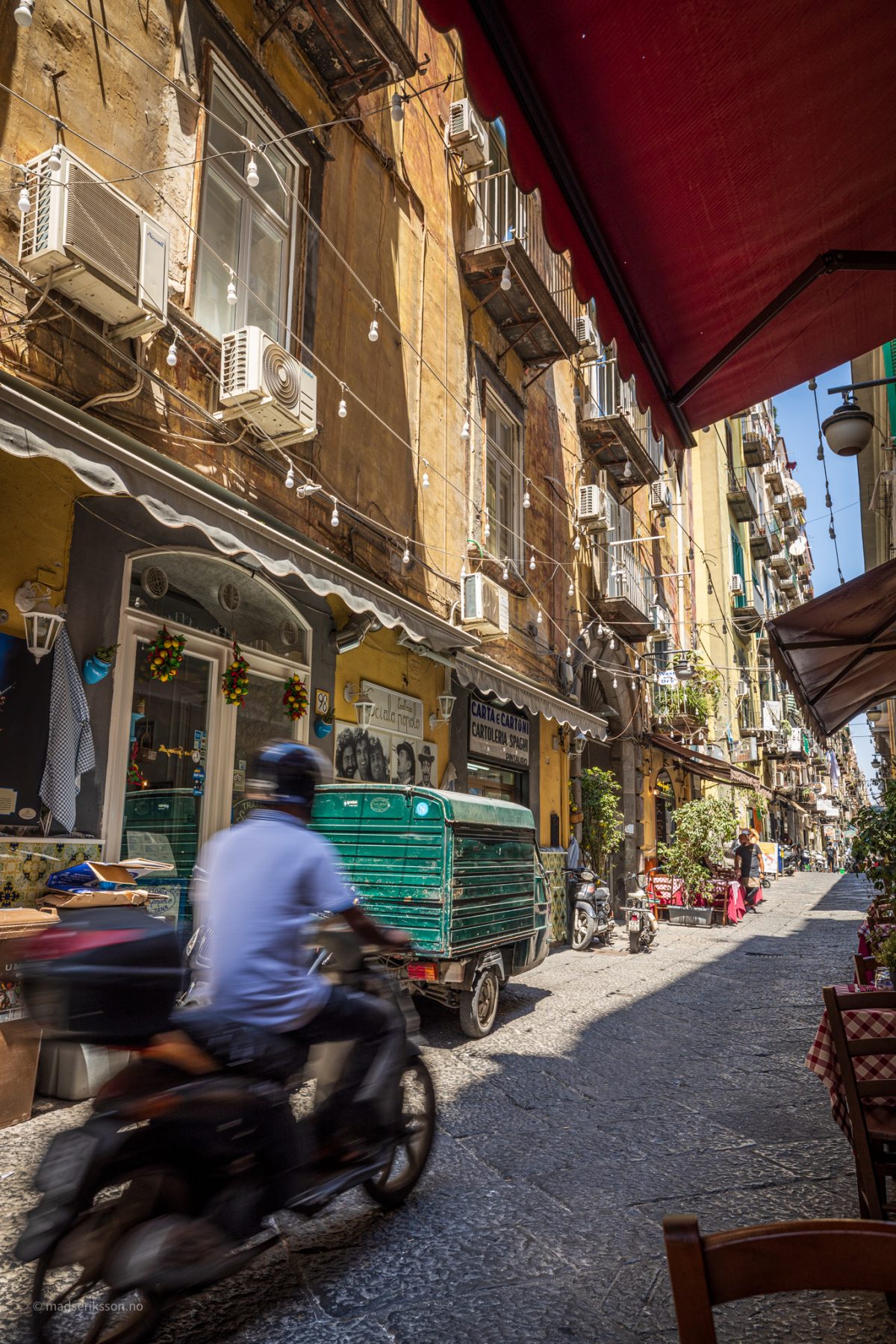
A scooter speeding along a sunlit lane in the historic centre of Naples, lined with balconies and café tables
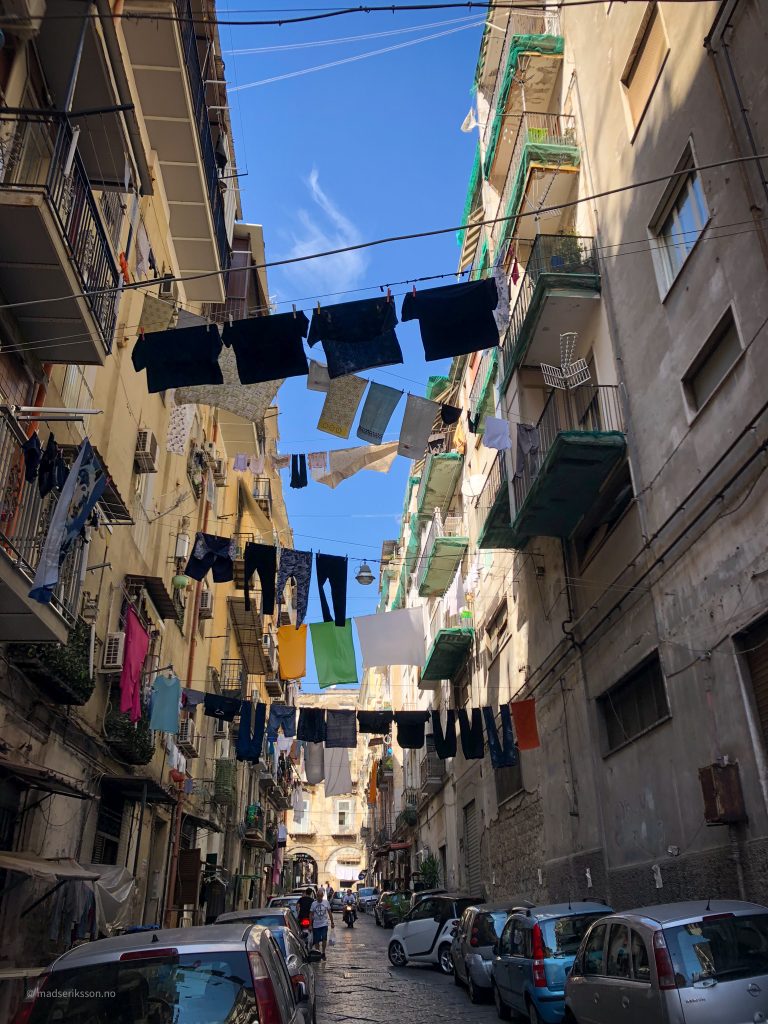
The Quartieri Spagnoli
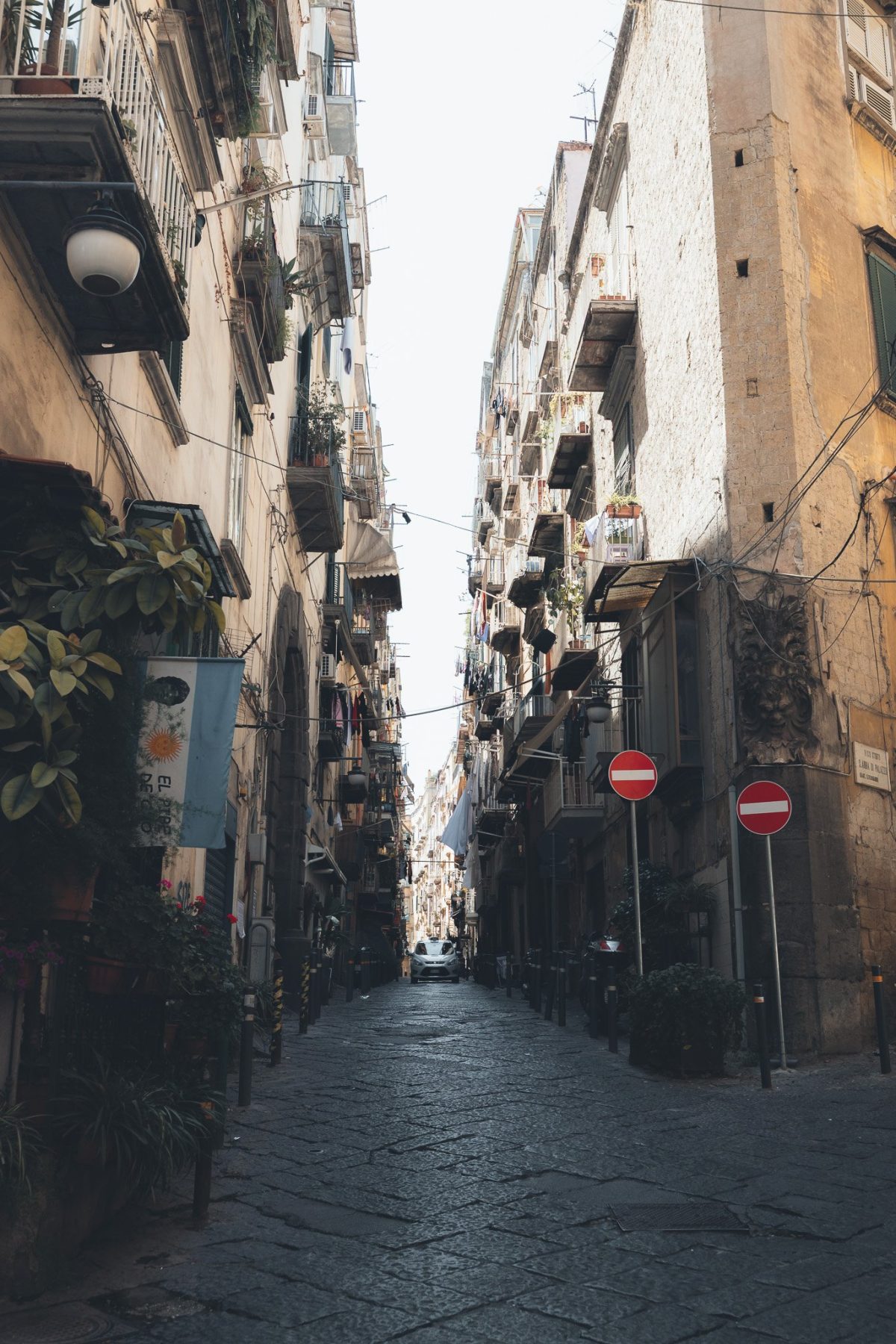
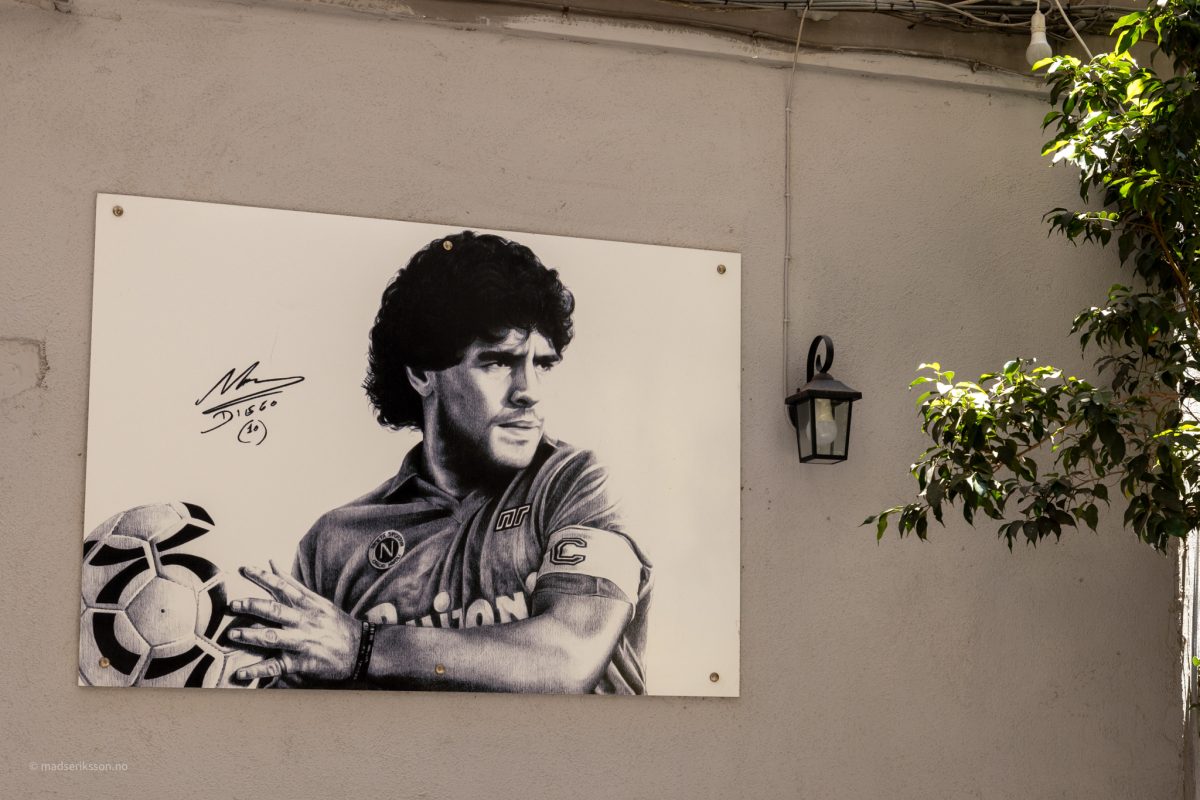
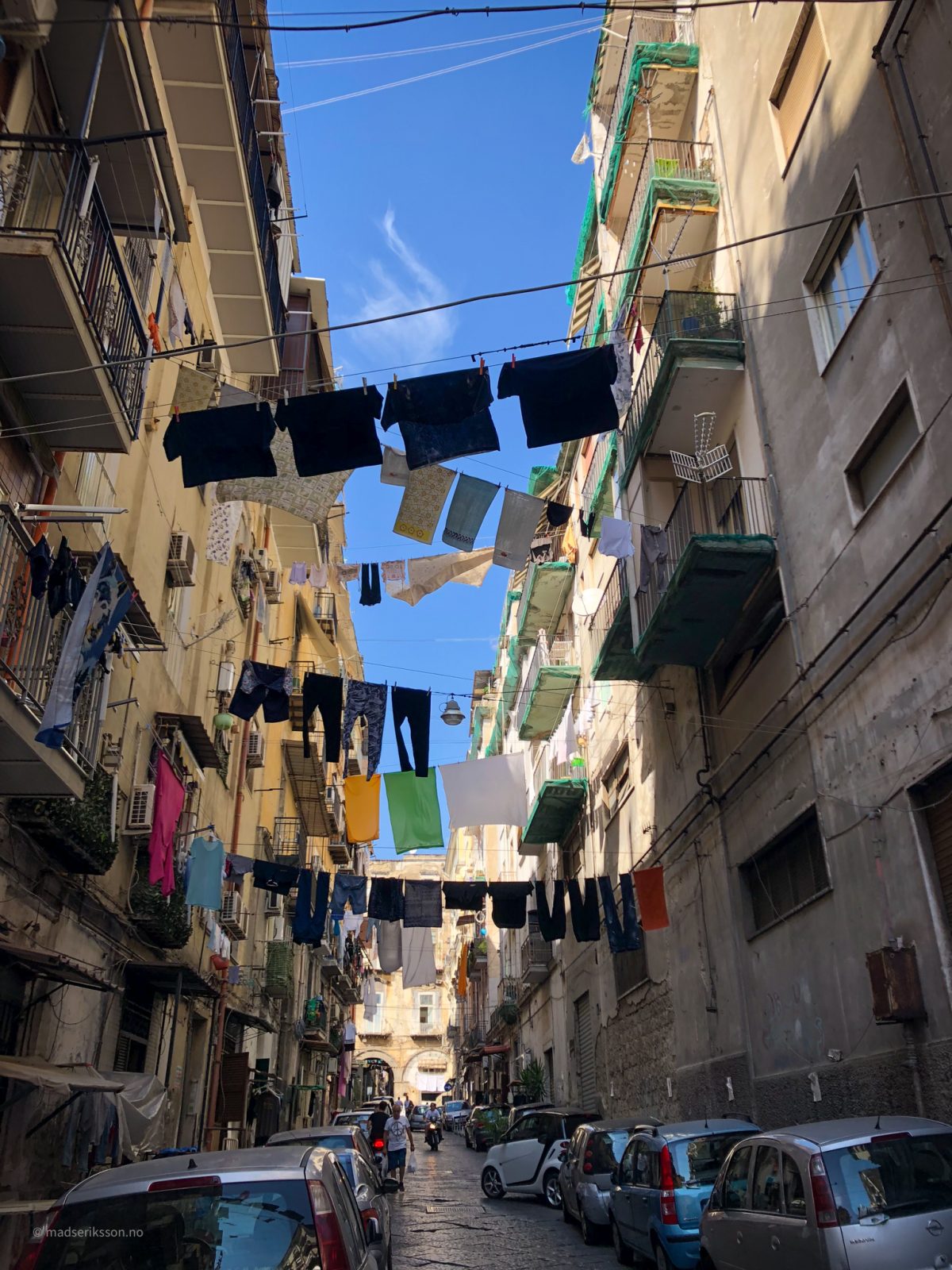
The Quartieri Spagnoli were laid out from 1536 under the viceroy Pedro de Toledo to house Spanish garrison troops, a tight grid of about 18 by 12 narrow streets on the slope west of Via Toledo. Around 14,000 people live in its 80 hectares, under washing lines strung between the balconies. Murals of Diego Maradona, who won two league titles with Napoli, cover the walls of the Largo Maradona at its heart.
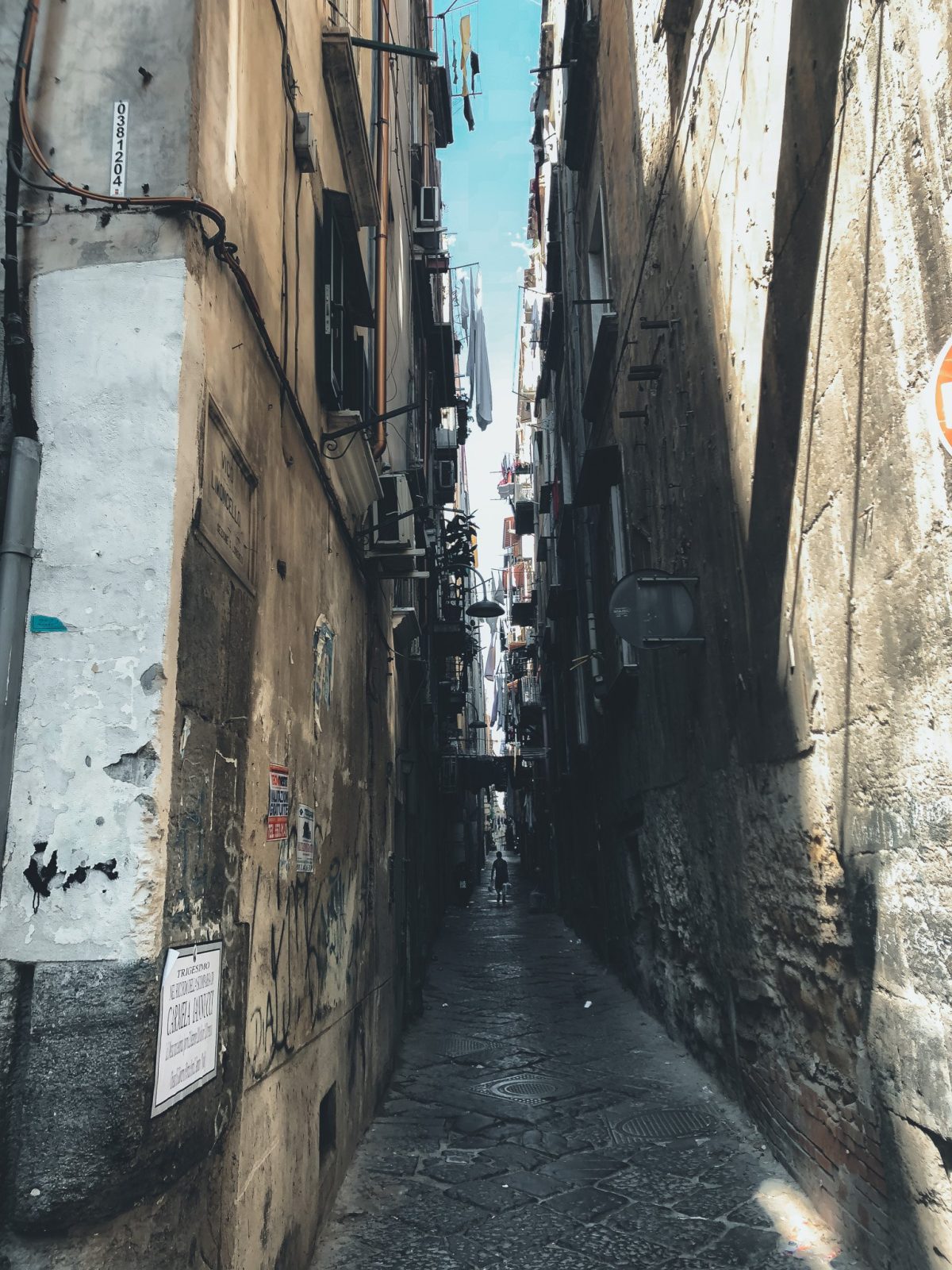
Washing lines strung high across a narrow street in Naples, between balconies under a blue sky
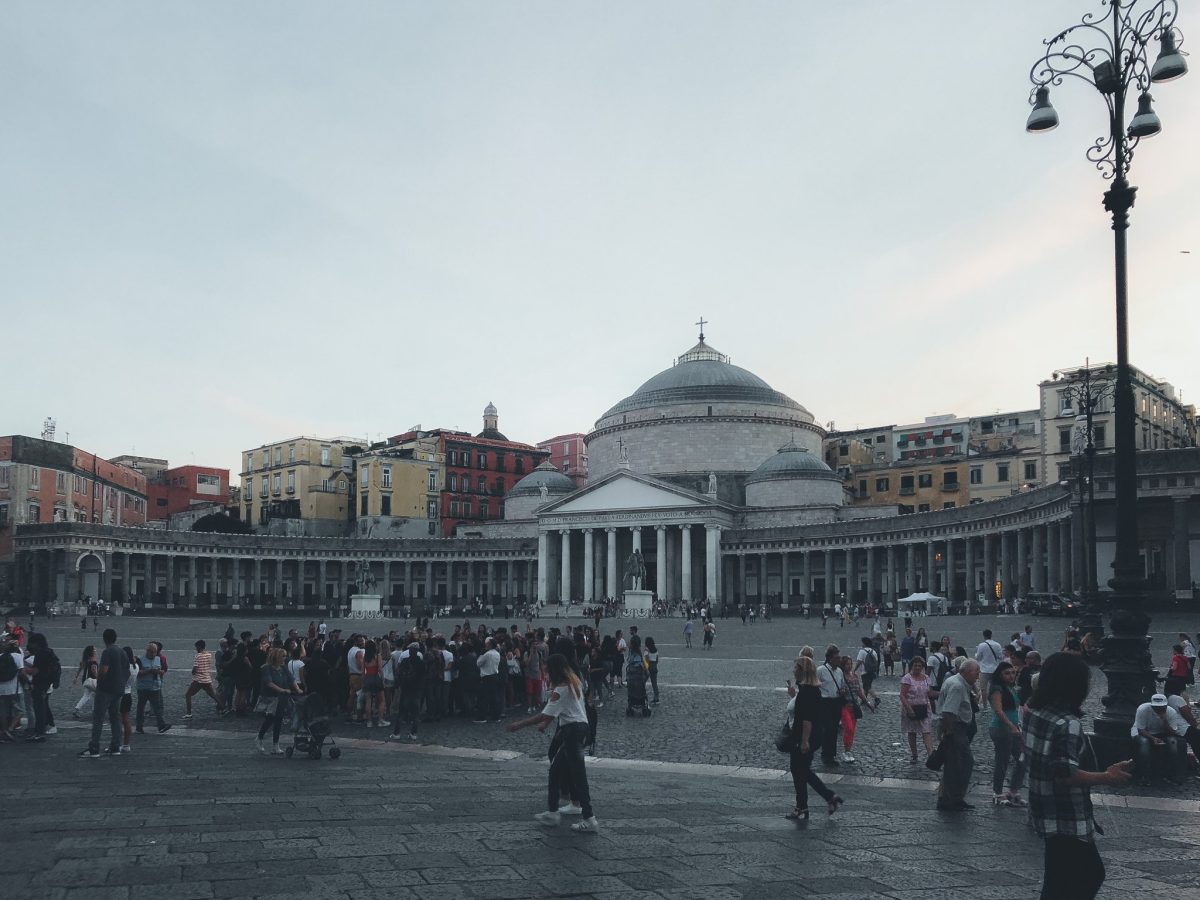
Piazza del Plebiscito and the Royal Palace
Piazza del Plebiscito covers about 25,000 m², closed on its western side by the curved colonnade of San Francesco di Paola, whose dome rises to about 53 m. Facing it, the Royal Palace was begun in 1600 to designs by Domenico Fontana, with a main façade 169 m long. The Teatro di San Carlo, built against the palace and opened on 4 November 1737, is the oldest continuously active opera house in the world.
Castel Nuovo and the port
Castel Nuovo, the Maschio Angioino, was built from 1279 for Charles I of Anjou, who moved the royal court here from Castel dell'Ovo. The Aragonese kings rebuilt it in the 15th century and set a white marble triumphal arch, 35 m high, between its round towers in 1470. Ferries and hydrofoils to Capri, Ischia and Procida leave from the Molo Beverello just below its walls.
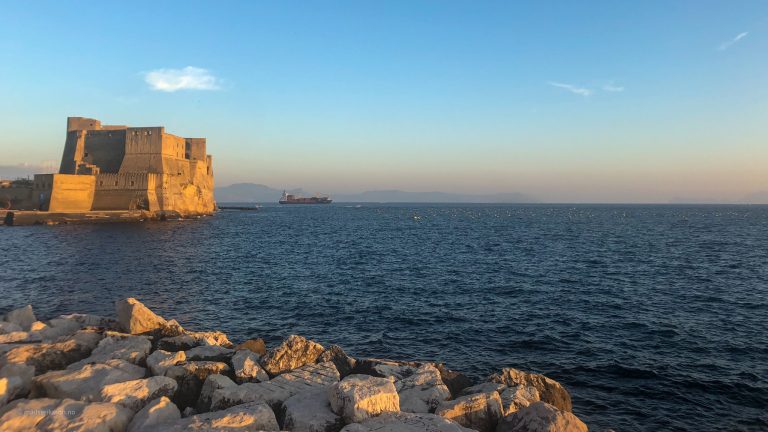
Castel dell'Ovo and the seafront
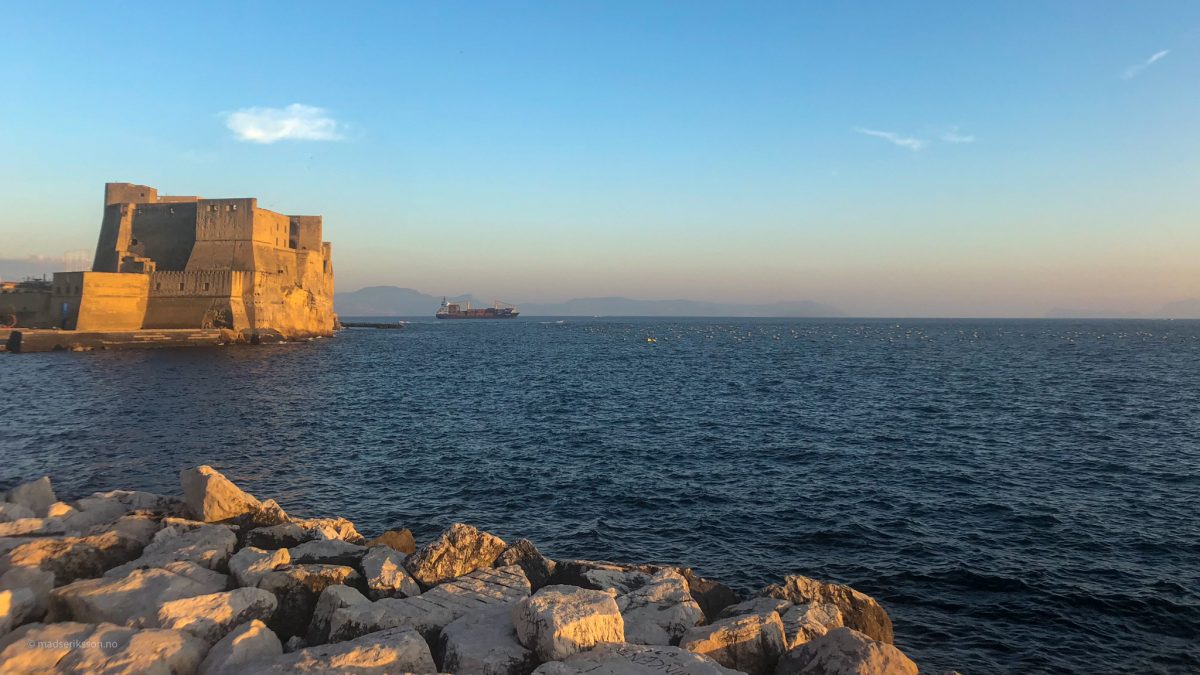
Castel dell'Ovo stands on the former islet of Megaride, where Greek settlers from Cumae founded the first city around 650 BCE and the Roman general Lucullus later built a villa. The Normans raised the first castle here in the 12th century, and its present form dates from Aragonese rule in the 15th. From the causeway, the seafront promenade runs west past the Villa Comunale towards Mergellina.
Castel dell’Ovo on its small island in the Bay of Naples, lit by the low evening sun
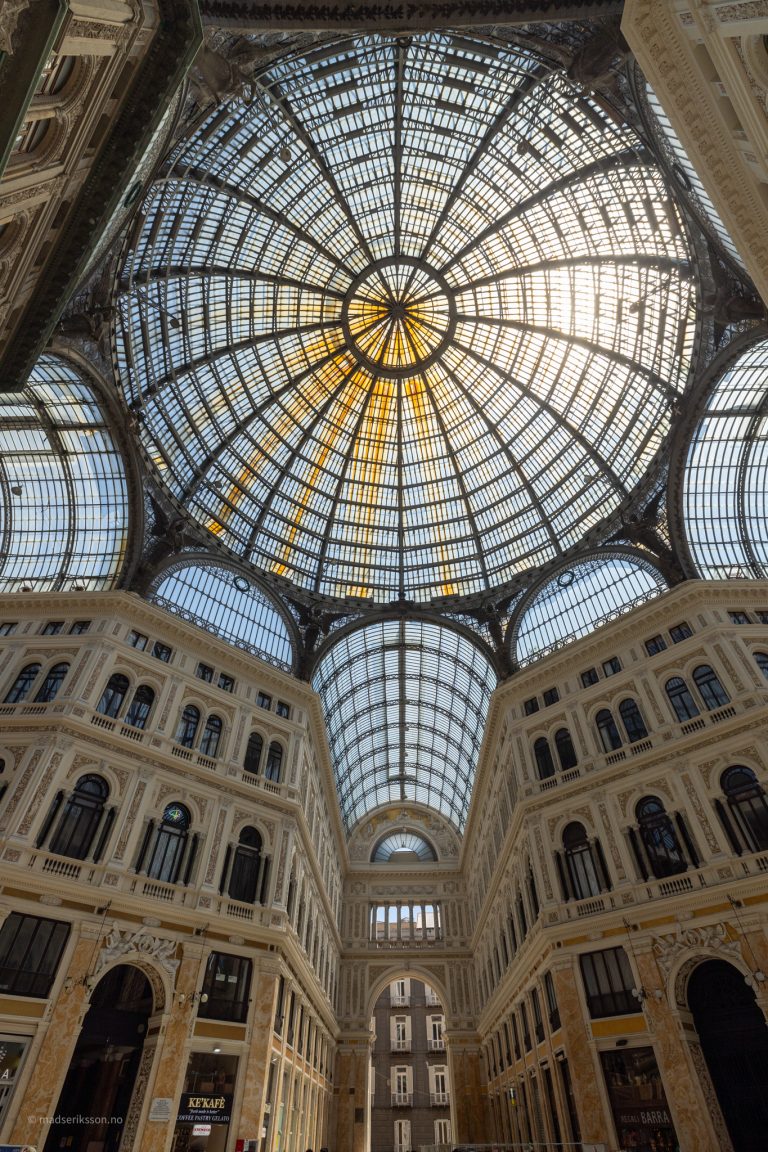
Galleria Umberto I
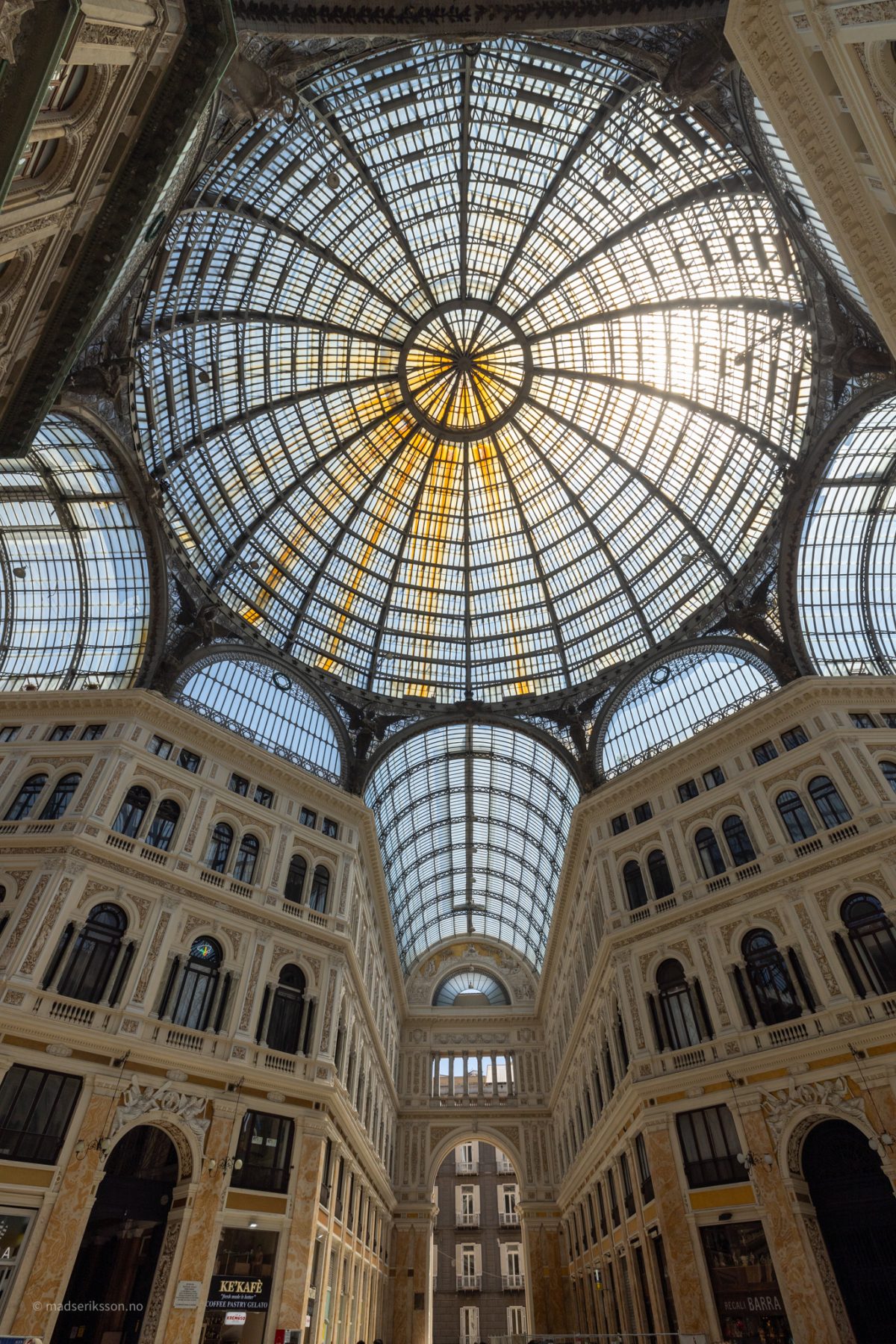
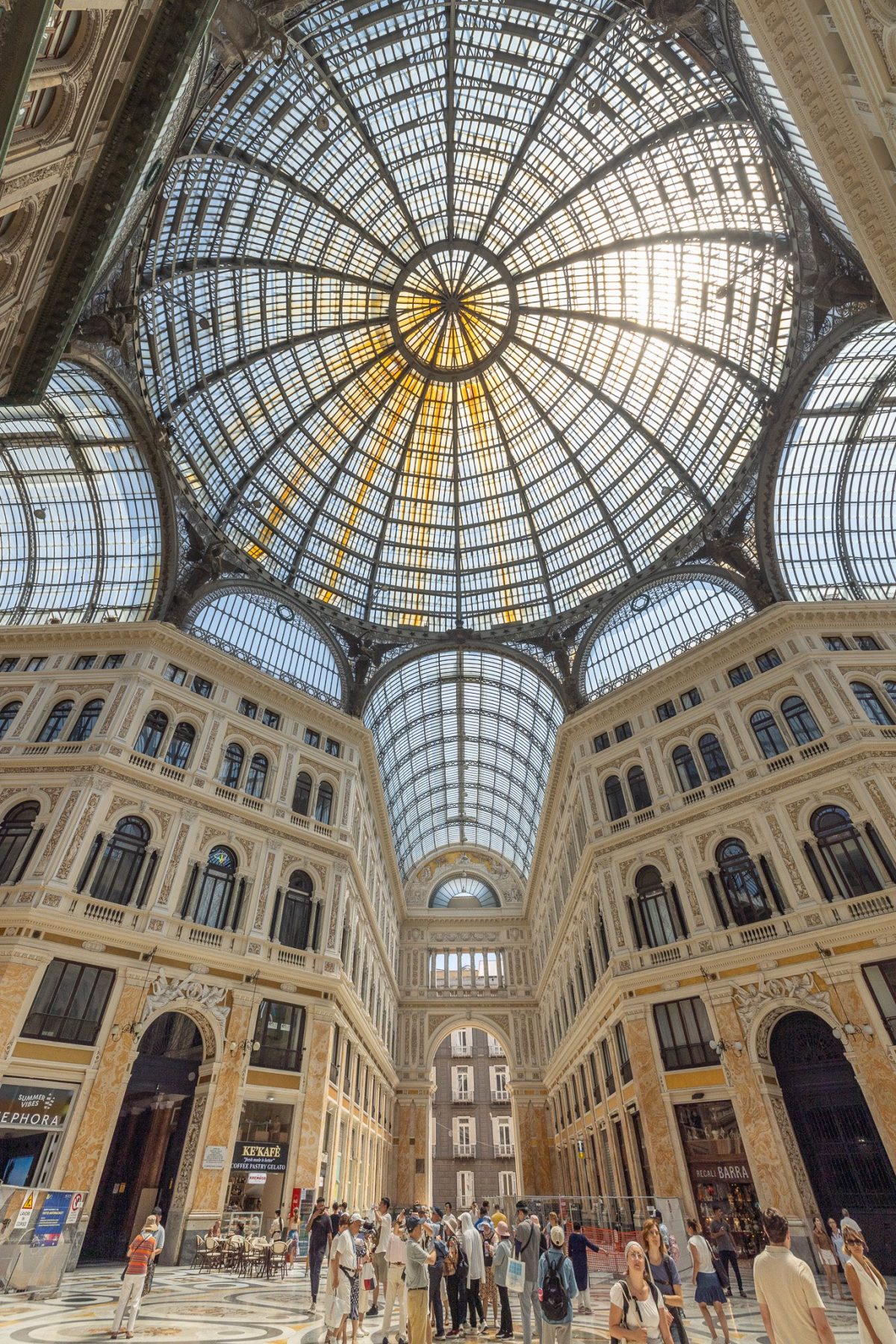
The Galleria Umberto I was built between 1887 and 1890 as a covered public arcade opposite the Teatro di San Carlo. Its four glazed arms meet under an iron-and-glass dome 57 m high, and its cross plan links Via Toledo with the streets around the opera house and the Royal Palace.
The glass and iron dome of the Galleria Umberto I, the grand 19th-century shopping arcade in Naples
The Centro Direzionale
East of the central station, the Centro Direzionale is a business district of about 110 hectares planned by Kenzo Tange, who received the commission in 1982; it was completed in 1995. Its tallest building, the 129 m Telecom Italia tower, is the tallest in southern Italy, and after dark its towers become a cluster of lit windows above the old city.
3D model © 2026 madseriksson.no · Photographs © madseriksson.no. Buildings and heights: © OpenStreetMap contributors (ODbL), via OpenMapTiles. Ground imagery: Sentinel-2 cloudless 2023 by EOX IT Services GmbH (contains modified Copernicus Sentinel data 2023; CC BY 4.0). Heights are approximate where OpenStreetMap has no measured value; sun positions are approximate.
The Historic Centre — 2,700 Years in a Street
The straight line of Spaccanapoli cuts through the old city following the grid of the ancient Greek Neapolis — and beneath it, the tunnels go deeper still
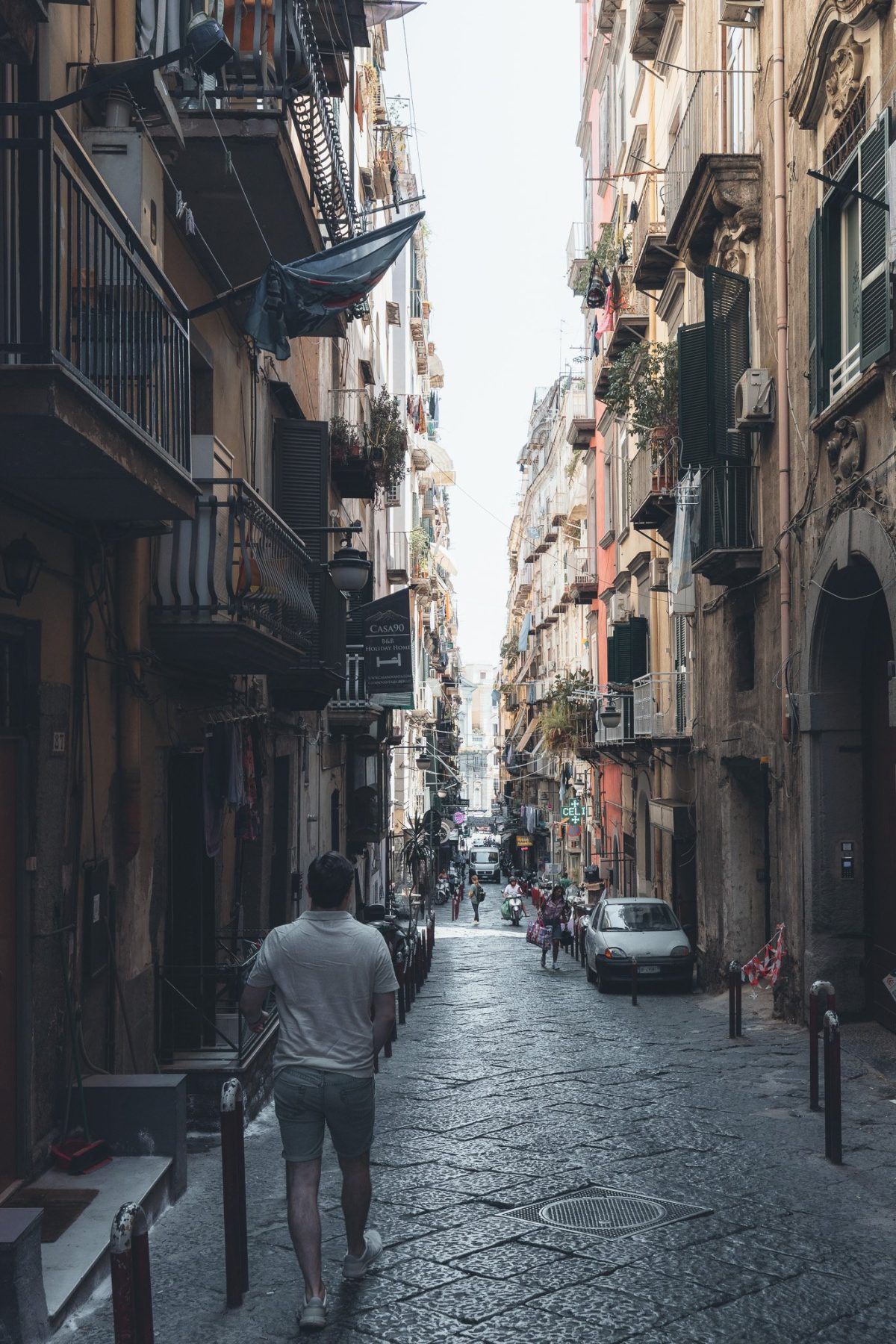
Spaccanapoli — the name means “Naples-splitter” — is a straight east-west street that cuts through the old city following one of the main axes of the ancient Greek grid. Walking it end to end takes about 30 minutes and passes through the full density of Neapolitan urban life: laundry across the street, Baroque church facades, pizzerie with wood smoke coming from their doors, street shrines with electric lights, presepe workshops, the smell of sfogliatelle frying somewhere close. The street is named differently in each section — Via Benedetto Croce, Via San Biagio dei Librai, Via Vicaria Vecchia — but it is continuous, and following it is the most direct introduction to the city’s character. The churches along it — particularly the Church of the Gesù Nuovo and the Church of Santa Chiara with its majolica-tiled cloister — are individually significant and collectively overwhelming in the same way that the street itself is: too much to take in at once, but rewarding to anyone who slows down.
The Cappella Sansevero, a few steps off Spaccanapoli, is a small private chapel that contains what many consider the greatest marble sculpture of the 18th century: the Veiled Christ, carved in 1753 by Giuseppe Sanmartino for Raimondo di Sangro, Prince of Sansevero. The work depicts the dead Christ lying beneath a transparent veil — the same block of marble as the body beneath it, carved so that the fabric appears to float on the surface with the weight and texture of real cloth. Sanmartino was 27 years old when he carved it. Canova, who saw it decades later, said he would have given all his own work to have made it. The chapel also contains the Disinganno (Disillusion) by Francesco Queirolo, in which a fisherman disentangles himself from a net of astonishing intricacy, and two anatomical machines in the basement — human skeletons with the arterial system preserved in metal, their purpose and origin still debated.
Canova said that if he could have made only one work in his life, he would have chosen the Veiled Christ. He was not being modest. The cloth is stone and it looks like silk.
San Gregorio Armeno, a narrow street running north from Spaccanapoli, is the centre of Naples’ presepe tradition: an entire street of workshops producing hand-crafted nativity figures, operating year-round but at maximum intensity in the weeks before Christmas. The Neapolitan presepe — a tradition with roots in the 13th century and its current elaborate form in the 17th and 18th centuries — is distinct from other nativity traditions in its inclusion of genre figures depicting everyday Neapolitan life alongside the biblical cast: bakers, washerwomen, fishermen, tavern keepers and contemporary figures. The underground city (Napoli Sotterranea) tours depart from Piazza San Gaetano, immediately adjacent, and descend into a labyrinth of Greek cisterns and Roman aqueducts that gave the city its water supply for millennia and served as air-raid shelters in the Second World War.
Pompeii, Vesuvius and the Museum — A Catastrophe Preserved
On 24 August 79 CE, Vesuvius buried two Roman cities. Both can be visited today from Naples — as can the volcano itself, and the museum that holds almost everything excavated from them
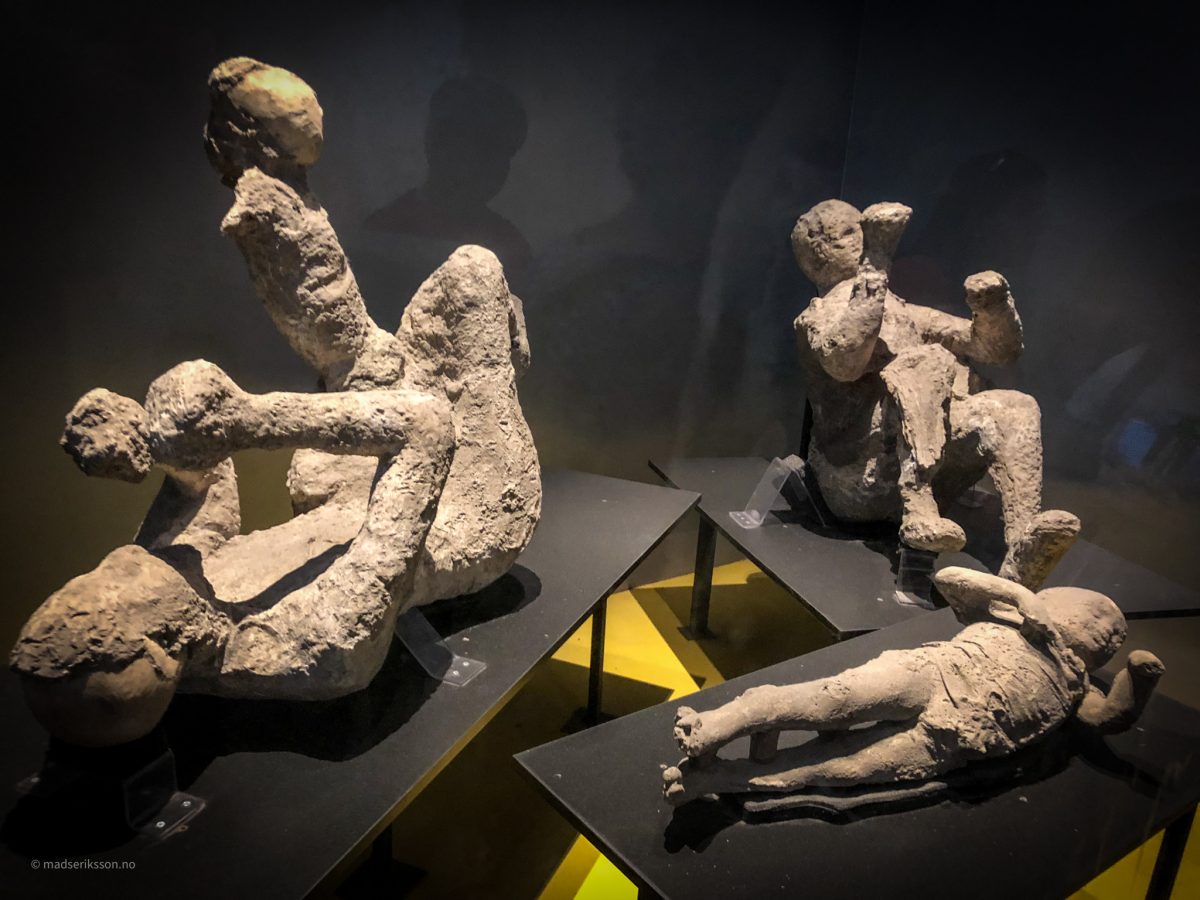
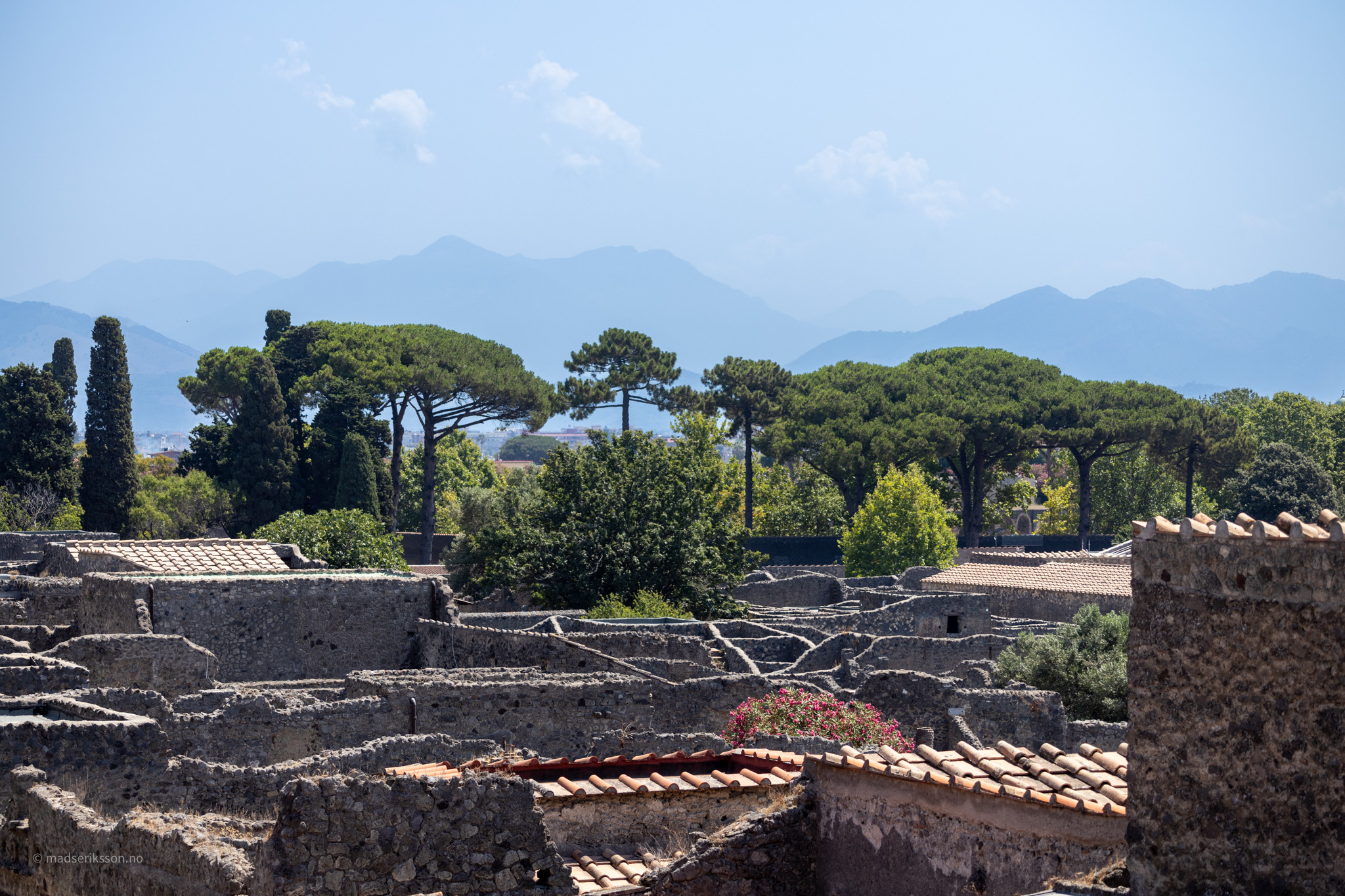
Pompeii was a prosperous Roman town of approximately 11,000 people when Vesuvius erupted on 24 August 79 CE, sending a column of ash and pumice 33 kilometres into the sky and then collapsing in a series of pyroclastic surges that buried the city under 6 metres of volcanic material. The inhabitants who did not flee in time were killed by the heat and gases of the surges; their bodies decomposed and left cavities in the hardened ash, which excavators in the 19th century filled with plaster to produce the haunting casts of Pompeians in the positions of their deaths. The site covers approximately 66 hectares, of which about two-thirds has been excavated; the rest remains unexcavated to preserve it for future techniques. Walking Pompeii requires at least half a day and ideally a full day: the Forum, the Lupanar, the amphitheatre (the oldest surviving Roman amphitheatre), the bakers’ quarter with its millstones, the houses with intact frescoes, and the plaster casts in the Garden of the Fugitives are all separately significant.
Herculaneum — Ercolano — was buried under 20 metres of pyroclastic material rather than ash, which preserved it in a different and in many ways more complete way than Pompeii. Wooden furniture, doors, food on tables, carbonised scrolls, painted walls in the condition they were left in on the morning of the eruption — Herculaneum offers a more intimate and more detailed picture of Roman domestic life than any other site. It is smaller and less visited than Pompeii and can be covered in 2–3 hours. The Circumvesuviana train from Naples Porta Nolana reaches the Herculaneum entrance in approximately 15 minutes; the same line continues to Pompeii in another 20 minutes.
In Herculaneum, the wood survived. The pyroclastic flow that buried the city carbonised the furniture, the doors and the wooden structures rather than destroying them. You can walk through Roman houses where the furniture is still in place after 2,000 years.
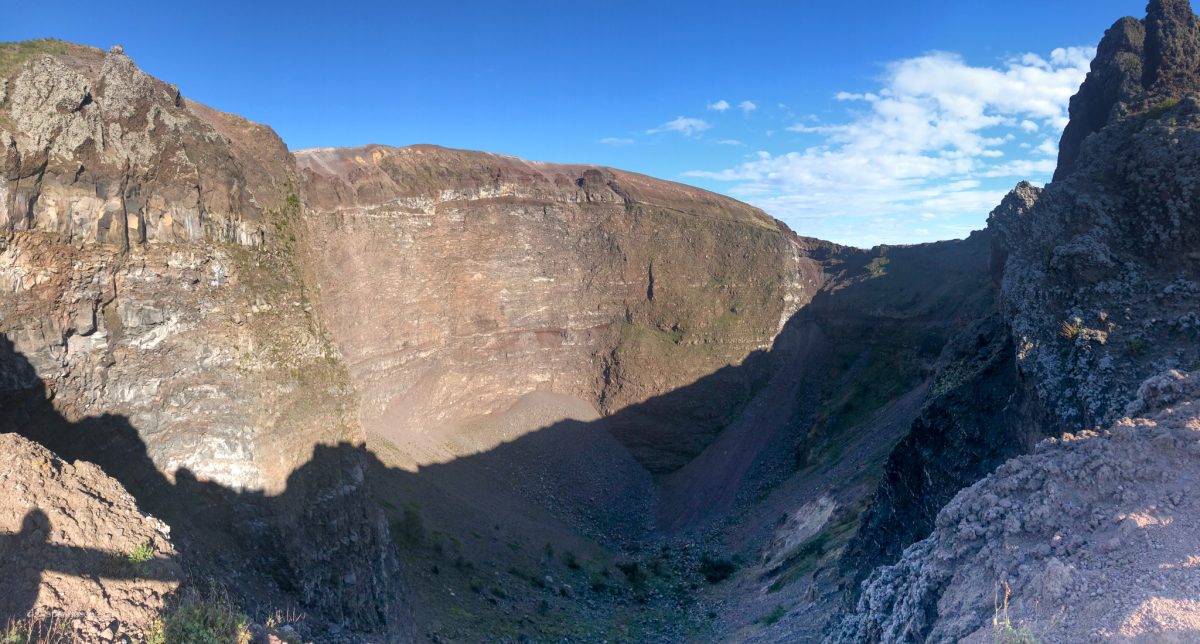
The Museo Archeologico Nazionale di Napoli (MANN) is the essential complement to any visit to Pompeii or Herculaneum: the finest finds from both sites — the Alexander Mosaic from the House of the Faun (11,000 square centimetres of tesserae depicting Alexander the Great at the Battle of Issus), the erotic objects and paintings in the Secret Room, the surgical instruments, the carbonised foods, the silver tableware — were removed to Naples during the Bourbon excavations and are displayed here. The museum also holds the Farnese collection, including the Farnese Hercules (a 3rd-century Roman copy of a Greek bronze, 3.17 metres tall) and the Farnese Bull (the largest sculpture to have survived from antiquity, carved from a single block of marble). Mount Vesuvius itself — 1,281 metres, last eruption 1944 — can be reached by bus from Herculaneum and climbed on foot to the crater rim in about 30 minutes from the car park. The view into the crater and over the Bay of Naples is extraordinary.
The Bay of Naples — Islands, Castles and the Most Beautiful Gulf in the World
The bay that inspired more paintings, more poetry and more operatic arias than any other body of water in Europe — with Vesuvius on one side and Capri on the other
The Bay of Naples — the Golfo di Napoli — is one of the most celebrated bodies of water in the world: a semicircular gulf with the city and Vesuvius to the north, the Sorrento peninsula and Capri closing it to the south, and Ischia and Procida in the west. The light on the bay, the colour of the water and the layered view of city, mountain and island have made it a subject of painting and poetry since antiquity, and neither the port traffic nor the urban density of the modern city has removed the essential drama of the setting. The Lungomare — the seafront promenade running from the Piazza Vittoria to the Castel dell’Ovo — gives the most continuous access to the bay, with views that on clear mornings extend to Capri and Ischia and on very clear days to the Aeolian Islands beyond. The walk, in the early morning or at sunset, with the castle reflected in the bay and Vesuvius in the background, is the essential Naples waterfront experience.
Castel dell’Ovo — the Castle of the Egg, so named for a legend that Virgil placed a magical egg beneath its foundations to prevent it from collapsing — is Naples’ oldest castle, built on the island of Megaride (now connected to the mainland by a causeway) and incorporating a 6th-century Byzantine monastery in its lower levels. The Bourbon Palazzo Reale on Piazza del Plebiscito, and the Castel Nuovo (Maschio Angioino), built in the 13th century by Charles I of Anjou and now housing the civic museum, define the waterfront between the port and the Santa Lucia district. Piazza del Plebiscito — one of the largest piazzas in Italy, with the neoclassical colonnade of the church of San Francesco di Paola enclosing it in a semicircle modelled on St. Peter’s in Rome — was pedestrianised in the 1990s and has become the primary public space of the city. The hill above it, Posillipo, is the affluent residential district with the best elevated views over the entire gulf.
The island of Capri has been a place of extreme privilege since the Emperor Augustus first visited it in 29 BCE, liked it, and swapped the larger and more productive island of Ischia with the city of Naples to get it. The island has not looked back.
Capri — reached by hydrofoil in approximately 50 minutes from the port of Naples, or by ferry in an hour — is one of the most visited islands in the Mediterranean, with limestone sea stacks, a car-free interior village and the Blue Grotto (Grotta Azzurra), a sea cave in which the light diffuses through a submerged opening to illuminate the water in an intense, saturated blue. The island has been desirable since antiquity: Augustus exchanged Ischia for it; Tiberius built 12 villas there and ruled the empire from it. The crowds are heavy in summer; the island in October or April, outside the peak season, is a different experience. Ischia, the volcanic island an hour west of Naples by ferry, is larger than Capri, less visited by international tourists, and known for its thermal springs, its wine (particularly the white Biancolella) and the Aragonese castle at Ischia Ponte, connected to the island by a medieval bridge.
Neapolitan Food — The Birthplace of Pizza and the Finest Coffee in Italy
Naples invented pizza and takes this seriously. It also produces the espresso that every other Italian city benchmarks itself against, and a pastry tradition of considerable depth
Pizza Napoletana was invented in Naples — not as a novelty food but as the staple of the urban poor, sold from street vendors and eaten folded in quarters (a portafoglio) — and is protected by both EU legislation and the strict rules of the Associazione Verace Pizza Napoletana (VPN). A certified Neapolitan pizza requires: dough made from specific flour, water, salt and yeast, fermented for at least 8 hours; San Marzano tomatoes grown in the volcanic soil of the Sarno valley under DOP designation; fior di latte mozzarella or buffalo mozzarella from Campania; and a wood-fired domed oven at 485°C in which the pizza cooks in 60–90 seconds. The result — soft, slightly charred at the crust, with the centre just barely cooked through — is entirely different from every imitation. The two canonical varieties are the Margherita (tomato, mozzarella, basil) and the Marinara (tomato, garlic, oregano, no cheese), the latter being the older and arguably the purer of the two. The best pizzerias in Naples have queues; they move quickly.
The sfogliatella is Naples’ most characteristic pastry: a shell-shaped object with a flaky, multi-layered exterior of paper-thin dough (sfogliatella riccia) or a smooth short-pastry shell (sfogliatella frolla), filled with a mixture of ricotta, semolina, candied citron and cinnamon. It is eaten hot, within minutes of leaving the oven, and the contrast between the shattering exterior and the soft, slightly sweet filling is one of the great pastry experiences in Italy. The correct place to eat one is at a pasticceria that bakes throughout the morning; the correct time is 8am. Pastiera Napoletana — a ricotta and wheat berry tart with orange blossom water, traditionally made at Easter — is the other essential of the Naples pastry tradition, and struffoli — tiny deep-fried dough balls coated in honey and candied fruit — are the Christmas equivalent.
The caffè sospeso — “suspended coffee” — is a Neapolitan custom: you pay for two coffees, drink one, and leave one paid for an anonymous stranger who cannot afford it. The practice has continued without interruption since the early 20th century.
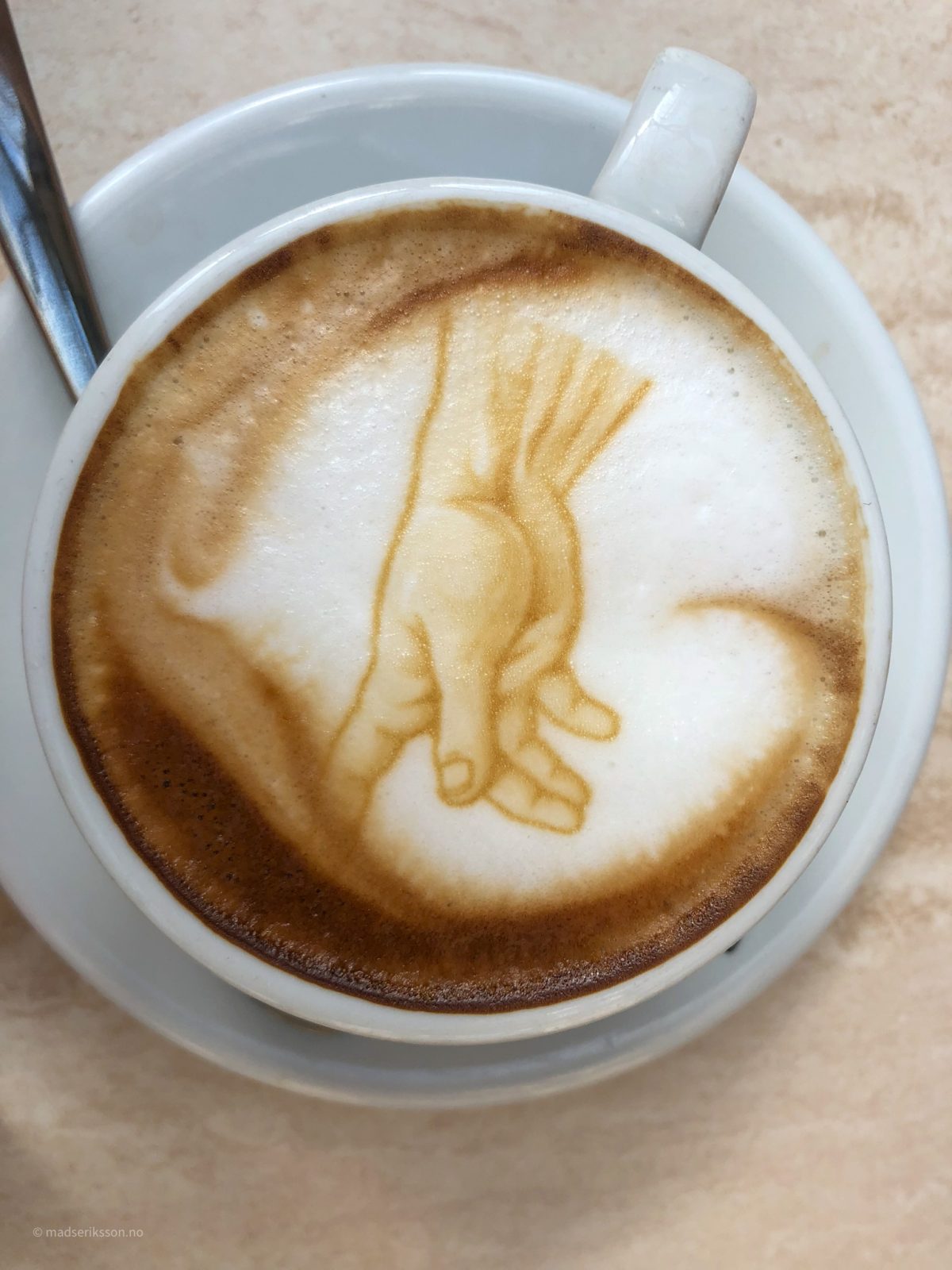
The Neapolitan espresso is darker, shorter and more intense than the Roman or Milanese versions — a function of the roast, the water (Naples’ municipal water is notably soft, which affects extraction) and the bar culture in which it is made and consumed. Coffee in Naples is drunk standing at the bar, in a small ceramic cup that has been pre-warmed, in approximately 90 seconds. The tradition of caffè sospeso — a coffee paid for in advance for an anonymous stranger who cannot afford it — originates in Naples and is still practised in some traditional bars. The price of a coffee at a Naples bar remains among the lowest in Italy, which is in itself considered a civic point of principle. Naples also produces some of the finest street food in Italy outside pizza: fritta (fried dough), cuoppo (paper cone of mixed fried seafood and vegetables), and the enormous variety of fresh pasta, ragù and fried snacks available from the rosticcerie and friggitorie of the historic centre.
«Naples is not a city that makes itself easy. It is loud, complicated, dense and occasionally chaotic in a way that is genuinely different from the managed chaos of Rome or the tourist-organised complexity of Venice. But what it offers in exchange for that difficulty is correspondingly direct: the Sansevero Chapel and its impossible veil, Pompeii in the early morning before the tour groups arrive, a Margherita pizza eaten standing up at the bar of a pizzeria that has been making the same pizza since before most European cities had their current form. Naples has been at this longer than almost anywhere. The volcanic soil around it grows the finest tomatoes in the world. The water makes the coffee different. The city knows these things and does not particularly require confirmation from outside. Going to Naples is not a challenge. It is a privilege.»
More in the same area
 ArchaeologyExploring the Ancient Ruins of Pompeii
 ArchitectureEurope’s 10 Greatest Cathedrals and Churches
 MountaineeringMarmolada: The West Ridge Via Ferrata to the Top of the Dolomites
 ArchitecturePisa — The Leaning Tower, the Square of Miracles and the City on the Arno
 CitiesExploring the Enchanting City of Venice
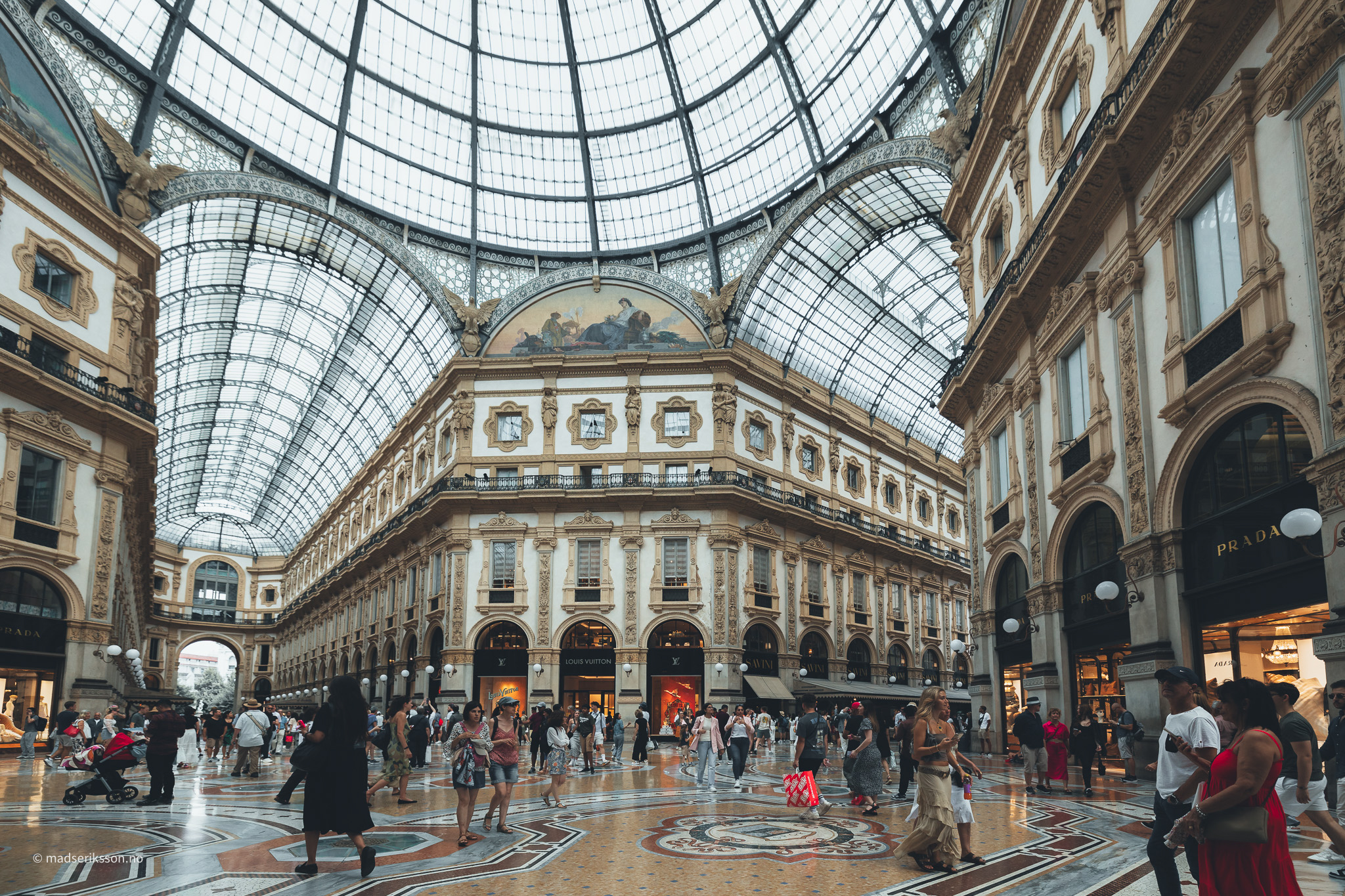 CitiesMilan: A Fashionable and Cultural Hub in Italy
City Frames · scroll-driven 3D
More cities in three dimensions
54 city guides open with a model built from open map data. Scroll, and the camera moves from landmark to landmark.
Departures · City Frames
Where to next?
| Time | Destination | Country | Status |
|---|
Live · position of the sun
Golden hour, right now
The low, warm light just after sunrise and just before sunset. These are the cities on the site where it is happening at this moment.